
46.2 Million Americans (1 in 6) Now Living in Poverty
Posted: September 13, 2011 Filed under: Barack Obama, income inequality, poverty, U.S. Economy, U.S. Politics, unemployment | Tags: Census Bureau, Income Inequality, jobs, median income, Poverty, unemployment 10 Comments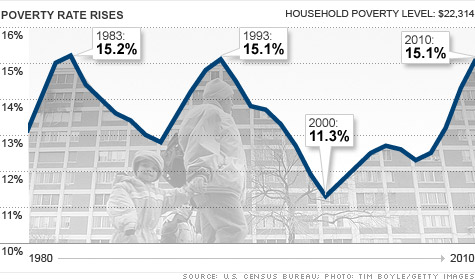
Chart courtesy of CNN Money
As of 2010, 1 in 6 Americans was living in poverty, according to a report from the Census Bureau today. The poverty rate was 15.1%, the highest number of Americans living below the poverty rate since the number has been examined. From the New York Times:
An additional 2.6 million people slipped below the poverty line in 2010, census officials said, making 46.2 million people in poverty in the United States, the highest number in the 52 years the Census Bureau has been tracking it, said Trudi Renwick, chief of the Poverty Statistic Branch at the Census Bureau.
That figure represented 15.1 percent of the country.
The poverty line in 2010 was at $22,113 for a family of four.
“It was a surprising large increase in the overall poverty rate,” said Arloc Sherman, senior researcher at the Center on Budget and Policy Priorities. “We see record numbers and percentages of Americans in deep poverty.”
The middle class has also lost ground in terms of yearly income.
And
…real median household incomes declined by 2.3 percent in 2010 from the previous year, to $49,400. That was 7 percent less than the peak in 1999 of $53,252.
“A full year into recovery, there were no signs of it affecting the well being of a typical American family,” said Lawrence Katz, an economics professor at Harvard. “We are well below where incomes were in the late 1990s.”
According to the census figures, the median annual income for a male full-time, year-round worker in 2010 — $47,715 — was virtually unchanged from its level in 1973, when the level was $49,065, in 2010 dollars, said Sheldon H. Danziger, professor of public policy at the University of Michigan.
As we all know, the rich have gotten much much richer and are continuing to get richer still because of the Bush/Obama economic policies. From CNN Money:
For middle-class families, income fell in 2010. The median household income was $49,445, down slightly from $49,777 the year before.
Median income has changed very little over the last 30 years. Adjusted for inflation, the middle-income family only earned 11% more in 2010 than they did in 1980, while the richest 5% in America saw their incomes surge 42%.
“Over that period of time, it’s not that the American economy has necessarily performed badly,” Osterman said. “As a country we’re richer over that period, but there’s been this real shift in where the income has gone, and it’s to the top.”
Amplifying that trend, the bottom 60% of households saw their income fall last year, while households making $100,000 or more enjoyed a rise in income.
CNN has a chart that shows the poverty level in each state, so you can check to see how people are doing in your neck of the woods. In general, the South is the worst off, and Louisiana and Mississippi have the highest percentages of people living below the poverty line.
I hope someone is showing this data to President Obama, because he needs to either do something about jobs and income inequality or follow LBJ’s example and get out of the way so we can find candidate who is able to show some leadership.
Going …. Going …. Gone
Posted: September 6, 2011 Filed under: 2012 presidential campaign | Tags: jobs, poll numbers, the economy 5 Comments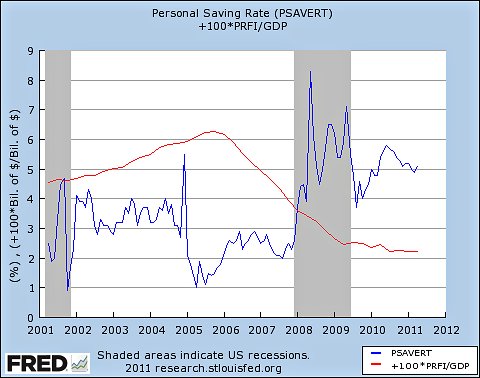 The sellout continues …
So, this week is filled with speechification on job creation. Romney and Huntsman have two of the most incoherent plans I’ve ever read. As usual, it’s a hodgepodge of stuff that’s not about creating jobs. And the other republicans in the race–like President Obama–have more checklists on Trade Agreements, lower taxes, patent reform, and tickling the fancy of some imagined confidence fairy. Again, all I can say is the High Priest of Voodoo and the Confidence Fairy have more power in this country than you and I. I’m getting tired of basing public policy on people’s imaginary friends.
I’m not trying to scare you off with Nifty Graphs, but I want to use one from FRED via Paul Krugman showing the Personal Savings rate. That’s the blue line. The Red line shows residential construction as a percentage of GDP which I’m less concerned about for this discussion but you can read about why it concerns Paul Krugman on his blog post “On the Inadequacy of the Stimulus”. I’m just going to use it as proxy for US investment since it’s a portion of that.
This is really simple macroeconomics math. People get income. They do four things with that income. A portion of that is sent to the government via taxes. A portion is spent on purchasing things and services in the US called domestic consumption. A portion is also spent on imported goods and services. This subtracts from our GDP as well as our income. The lowest percentage of what we do with our income has been that portion dedicated to savings until–as the graph shows–the Great Recession. Our savings rate has really gone up which means we’re spending a lot less. Savings and money spent on imports take money directly out of the expenditures portion of our economy as do taxes. Taxes come back to our county’s expenditures via Government spending. This happens relatively quickly and is powerful because when the government spends, it spends. It doesn’t save, it doesn’t buy imports as a rule, and of course it doesn’t pay taxes. Savings works its way back to the economy through investment which is the smallest part of our domestic expenditures. Right now–as proxied by the red line–you can see that investment isn’t really happening. Because we are a net importer, that income just drains out of our economy and stimulates economies elsewhere. Now, I’m not a protectionist and this is not meant to be a post arguing we shouldn’t do Trade Agreements. What I’m saying is that because of our expenditures patterns, that’s not really a net gain for us in terms of jobs. We get access to cheap goods,yes, but it doesn’t really bring about jobs. Right now, people are spending less and you can see that by the increase in savings, but it’s not getting invested back into the economy because of this vicious circle. People save and don’t spend. Businesses don’t have customers so they don’t hire and expand. We’ve been trying tax incentives for businesses for three years and it’s really not working because increased savings means no customers. Tax rates are not the primary motivator for either consumer or business spending. So, why does every one keep suggesting more of the same? Why even bring trade agreements into the discussion? We need direct job creation. We need a strong middle class with healthy incomes. We know how to do it. Our politicians, however, are in opposites world.
It’s certainly not paying off for the economy and it’s certainly not paying off in terms of support for Obama or Congress. People know this approach is not working. As usual, the same poll shows that Congressional approval is worse than the increasingly horrible numbers for Obama.
Public pessimism about the direction of the country has jumped to its highest level in nearly three years, erasing the sense of hope that followed President Obama’s inauguration and pushing his approval ratings to a record low, according to a new Washington Post-ABC News poll.
More than 60 percent of those surveyed say they disapprove of the way the president is handling the economy and, what has become issue No. 1, the stagnant jobs situation. Just 43 percent now approve of the job he is doing overall, a new career low; 53 percent disapprove, a new high.
As part of a reinvigorated effort to regain momentum as he heads toward the 2012 election year, Obama traveled to Detroit on Monday for a Labor Day appearance that served as a prelude to his speech Thursday to a joint session of Congress in which he will unveil new proposals to create jobs.
The urgency for Obama to act is driven not just by the most recent unemployment report, which on Friday showed no job growth in August and the unemployment rate stuck at 9.1 percent, but also by the depth of the political hole in which the president finds himself. Even more than two-thirds of those who voted for Obama say things are badly off course.
By this time in their presidencies, approval ratings for both Ronald Reagan and Bill Clinton — who also suffered serious midterm setbacks during their first term — had settled safely above the 50 percent mark. Both then stayed in positive territory throughout their reelection campaigns.
When ratings for George W. Bush slipped into the low 40s during his second term in office, they remained there or lower for the remainder of his presidency.
Obama does, however, rate better than do congressional Republicans, his adversaries in recent, fierce confrontations on federal spending. Just 28 percent approve of the way Republicans in Congress are doing their job, and 68 percent disapprove, the worst spread for the GOP since summer 2008.
When it comes to head-to-head match-ups on big economic issues, the public is deeply — and evenly — divided between Obama and congressional Republicans. Four in 10 side with both Obama and the GOP on jobs. There are similarly even splits on the economy generally and on the deficit. In all three areas, the percentages of Americans trusting “neither” are at new highs.
Nonetheless, current trends are highly unfavorable for the president. By 2 to 1, more Americans now say the administration’s economic policies are making the economy worse rather than better
So, in the midst of these terrible numbers comes a call by Boehner and Cantor to Obama to meet prior to the President’s latest speechification which is alway basically a lot of words that eventually mean nothing. They are dangling that partisanship football–like Lucy to Charlie Brown–just one more time Will Charlie Brown Obama go for it one more time?
House GOP leaders on Tuesday asked President Obama to meet with congressional leaders from both parties to discuss his jobs plan ahead of his Thursday night address to Congress.
In a letter to Obama, House Speaker John Boehner (R-Ohio) and Majority Leader Eric Cantor (R-Va.) cited the need for a bipartisan deal on jobs in requesting the meeting. Their letter also outlined potential areas of cooperation.
“We would suggest that prior to your address to Congress you convene a bipartisan, bicameral meeting of the congressional leadership so that we may have the opportunity to constructively discuss your proposals,” the letter said.
Keeping to my Peanuts metaphor: ARGHHHHHHHHHHHHHHHHHHHHH! The only jobs plan the Republicans have at the moment is to put Obama into the unemployment lines. Congressional Democrats appear just as unwilling to take principled stands based on sound economics. Nancy Pelosi has now dropped the word “stimulus“. The unbelievable yielding Democratic Party folds every time. It’s no wonder we’re in the mess that we’re in right now and people are frustrated.
Democrats are now being careful to frame their job-creation agenda in language excluding references to any stimulus, even though their favored policies for ending the deepest recession since the Great Depression are largely the same.
Indeed, with President Obama scheduled Thursday to lay out his job-creation plans before a joint session of Congress, liberal Democrats and left-leaning policy groups are pressuring him to ignore short-term deficit spending concerns in favor of sweeping spending initiatives designed to boost hiring.
The Democrats’ signature “Make it in America” platform aims to create jobs by increasing infrastructure spending, providing financial help to struggling states and expanding tax credits for businesses, all of which were key elements of their 2009 economic stimulus bill.Recognizing the unpopularity of the 2009 package, however, Democratic leaders have revised their message with less loaded language – “job creation” instead of “stimulus” and “Make it in America” in lieu of “Recovery Act” – in hopes of tackling the jobs crisis.
Repackaging meaningless rhetoric on important issues that you refuse to fight for is a frigging’ losing strategy. The Republicans know it. One of the most interesting things I’ve read all week is this call in Bloomberg by a writer from the National Review for Republicans to get behind some one electable because Republican Party Central smells the blood in the water. Both parties have these terrible pathological behaviors. The Republicans are overrun at the moment by the craziest of the crazies with ideas that would bring down the republic. Democrats can’t seem to do anything but dither and try to find new buzz words to repackage already failed ideas that hand over everything to the donor class. Lost in all of this are hard working American people who do not understand why normal governance stuff is not getting done. It just seems like more and more of what used to make American strong is going, going and gone. A pox on both their houses. I want an alternative.
Did White House Push for $535 Million Loan to Now Bankrupt Solyndra?
Posted: September 2, 2011 Filed under: Republican politics, Team Obama, U.S. Economy, U.S. Politics, unemployment | Tags: ABC News, bankruptcy, Barack Obama, Department of Energy, George Kaiser, green energy, House Energy Committee, Job Creation, jobs, layoffs, Rep. Fred Upton (R-MI), solar energy, Solyndra, stimulus bill, unemployment 18 Comments
Obama visiting the Solyndra plant
Minkoff Minx highlighted this story earlier today, but I thought I’d expand on it a little bit. As Minx wrote earlier, Solyndra is a solar energy company that the Obama admnistration has hyped as an example of the potential of green energy technology to create jobs in the U.S. From the LA Times editorial page:
Solyndra was the first company to be awarded a federal loan guarantee under the stimulus, worth $535 million. Taxpayers are likely to end up on the hook for much if not all of that amount, a highly embarrassing development for President Obama because he was among the company’s biggest cheerleaders. He visited its Fremont plant in May 2010 even though PricewaterhouseCoopers had weeks earlier raised doubts about its plans for an initial public offering by questioning whether it could continue as a going concern.
That’s especially troubling because Solyndra is backed by one of Obama’s key fundraisers, George Kaiser of Tulsa. Congressional Republicans were raising alarms about Obama’s connections to Solyndra well before Wednesday’s announcement, with GOP members of the House Energy and Commerce Committee voting in July to subpoena documents from the Office of Management and Budget on the loan-guarantee decision.
Two important questions are raised by Solyndra’s failure: Should the government be in the business of picking winners and losers by providing loan guarantees to risky energy ventures? And is Obama using stimulus funds to reward his political contributors?
The Times says “yes” to the first question and “maybe” to the second, pending the results of the House investigation.
As the LA Times noted, questions were being asked about the Solyndra loan even before the bankruptcy announcement. Brian Ross and his colleagues at ABC News have also been looking into the White House connection.
ABC News and the Center for Public Integrity’s iWatch News first reported on questions about the choice of Solyndra for the loan in May after the Department of Energy disclosed it was being forced to restructure its loan package for the company, which was showing early signs of financial distress. One of Solyndra’s major investors was George Kaiser, an Oklahoma billionaire who raised between $50,000 and $100,000 for Obama during the 2008 election.
Following the ABC News and iWatch News reports, the House Energy and Commerce Committee opened their own investigation into the loan and into the Kaiser link, which Stearns office said in a statement “raised concerns that politics may have played a role in putting taxpayer dollars at risk making this loan guarantee.” ….
White House officials deferred ABC News’ request for comment on this report to the Department of Energy. There, officials told ABC News and iWatch News that it used objective factors in selecting Solyndra. The department released a statement Wednesday on its website blaming changing economics in the industry — including a major push by Chinese firms to drive down solar panel prices — for the company’s collapse along with two other domestic firms. According to the Energy Department, the price for solar products dropped 42 percent in 2011.
I don’t know why anyone would be surprised to learn that Obama was using government money to help his big donors. Isn’t that what he’s been doing with Wall Street since the fiscal crisis began? Even before he was elected, Obama whipped for TARP. If he hadn’t convinced members of the Congressional Black Caucus to vote for it, the bailout bill never would have passed. So now Republicans control the House, and they can’t wait to investigate.
House Energy Committee Chair Fred Upton (R-MI) sent a letter to the White House
which calls on the White House to turn over correspondence between administration officials, Solyndra and its investors….”How did this company, without maybe the best economic plan, all of a sudden get to the head of the line?” Upton told ABC News in an interview this week. “We want to know who made this decision … and we’re not going to stop until we get those answers.”
The White House denies any involvement in the approval of the loan, although members of the administration have enthusiastically and publicly praised it. Yet more neutral observers have been critical of the deal.
While Energy Department officials steadfastly vouched for Solyndra — even after an earlier round of layoffs raised eyebrows — other federal agencies and industry analysts for months questioned the viability of the company. Peter Lynch, a longtime solar industry analyst, told ABC News the company’s fate should have been obvious from the start.
“Here’s the bottom line,” Lynch said. “It costs them $6 to make a unit. They’re selling it for $3. In order to be competitive today, they have to sell it for between $1.5 and $2. That is not a viable business plan.”
Furthermore, OMB considered the loan to be “risky,” according to ABC News.
The White House’s Office of Budget and Management viewed the arrangement as a riskier bet to taxpayers than DOE had. That forced the government to set aside millions more in case of a default, iWatch reported last month.
I guess we’ll have to wait and see what happens, but I can only assume that Republicans in the House are going to be on this like white on rice. They hate Obama and they hate green energy.
ZERO new jobs
Posted: September 2, 2011 Filed under: U.S. Economy, unemployment | Tags: jobs, unemployment 11 Comments I’m reviewing the jobs market stats right now and the austerity pogrom is having an impact on employment. It’s stifling growth of GDP and job creation. We don’t need the confidence fairy or more tax cuts. We need policy that directly creates jobs because we don’t even have anemic growth at this point. This may put some pressure on the President to think big when he announces his jobs plan next week. I have a feeling that will be anemic also and tempered by what he thinks he can get past the Republicans. The clear news is that state, local and the federal governments are clearly joined together in an effort to create another recession.
The lack of growth in nonfarm payrolls placed the job market well below the consensus forecast by economists of a 60,000 increase, which itself was none too optimistic. It was a sharp decline from July, which the Labor Department on Friday revised to show a gain of 85,000 jobs.
August’s stall came after a prolonged increase in economic anxiety this summer that began with the brinksmanship in Washington’s debt-ceiling debate, followed by the country’s loss of its triple-A credit rating, stock market whiplash and renewed concerns about Europe’s sovereign debt.
On Friday, Wall Street stocks promptly lost more than 2 percent of their value at the opening of trading, with the Dow Jones industrial average down about 200 points by midday, and some economists upgraded their odds for a double-dip recession.
The jobs figure, a monthly statistical snapshot by the Department of Labor, appears slightly more negative than it is because it does not include 45,000 Verizon workers who were on strike when the survey was taken but who will reappear in next month’s report. But even factoring in the Verizon jobs, private sector growth was the slowest it has been since May of last year. In addition, the report showed that job growth in June and July was softer than previously thought.
“As long as payrolls are weak, you will continue to hear cries of not just recession risk, but cries that the United States is in a recession and we just don’t know it,” said Ellen Zentner, the senior United States economist for Nomura Securities.
Economists blamed both sluggish demand for goods and services and the heightened uncertainty over the economy’s direction for the slow pace of job creation, saying political deadlock was creating economic paralysis.
The worse trends continue to happen in the fundamentals where duration still remains a huge problem. The other problem is in ‘underutilized’ workers or people that really want to work full time but are stuck in temp or part time positions and those that are working jobs beneath their skill and experience levels.
The number of workers only able to find part time jobs (or have had their hours cut for economic reasons) increased to 8.826 million in August from 8.396 million in July.
These workers are included in the alternate measure of labor underutilization (U-6) that increased to 16.2% in August from 16.1% in July.
…
According to the BLS, there are 6.034 million workers who have been unemployed for more than 26 weeks and still want a job. This was down from 6.185 million in July. This is very high, and long term unemployment is one of the defining features of this employment recession.
There are some pretty amazing long term patterns appearing in the recent numbers. If you haven’t had a chance to read “The Slow Dissappearance of the American Working Man” from Bloomberg Businessweek, you should. Basically, a smaller share of men have jobs today than anytime since World War 2. A lot of this is due to the disappearance of traditional manufacturing jobs, but also the lack of construction jobs since the housing crash. Here’s some other interesting demographics.
The portion of men who work and their median wages have been eroding since the early 1970s. For decades the impact of this fact was softened in many families by the increasing number of women who went to work and took up the slack. More recently, the housing bubble helped to mask it by boosting the male-dominated construction trades, which employed millions. When real estate ultimately crashed, so did the prospects for many men. The portion of men holding a job—any job, full- or part-time—fell to 63.5 percent in July—hovering stubbornly near the low point of 63.3 percent it reached in December 2009. These are the lowest numbers in statistics going back to 1948. Among the critical category of prime working-age men between 25 and 54, only 81.2 percent held jobs, a barely noticeable improvement from its low point last year—and still well below the depths of the 1982-83 recession, when employment among prime-age men never dropped below 85 percent. To put those numbers in perspective, consider that in 1969, 95 percent of men in their prime working years had a job.
Men who do have jobs are getting paid less. After accounting for inflation, median wages for men between 30 and 50 dropped 27 percent—to $33,000 a year— from 1969 to 2009, according to an analysis by Michael Greenstone, a Massachusetts Institute of Technology economics professor who was chief economist for Obama’s Council of Economic Advisers. “That takes men and puts them back at their earnings capacity of the 1950s,” Greenstone says. “That has staggering implications.”
What is going on here? For one thing, women, who have made up a majority of college students for three decades and now account for 57 percent, are adapting better to a data-driven economy that values education and collaborative skills more than muscle. That isn’t to say women have yet eclipsed men in the workplace. They continue to earn about 16 percent less than men and struggle against gender discrimination and career interruptions as they disproportionately take time away from the job to raise children. And both men and women have confronted job losses in the weak economy. In July, 68.9 percent of women aged 25-54 had jobs, vs. 72.8 percent in January 2008. (In 1969, however, fewer than half did.) After a long decline in men’s work opportunities, the recession worsened things with a sharp drop in male employment. Unemployed men are now more likely than women to be among the long-term jobless.
This is not good for the economy or society. Here’s another disturbing result when so many working class men go without a living wage and a job. Men are frequently raised to feel self worth from jobs so that losing that identity can create havoc for the man and the people around him.
While unemployment is an ordeal for anyone, it still appears to be more traumatic for men. Men without jobs are more likely to commit crimes and go to prison. They are less likely to wed, more likely to divorce, and more likely to father a child out of wedlock. Ironically, unemployed men tend to do even less housework than men with jobs and often retreat from family life, says W. Bradford Wilcox, director of the National Marriage Project at the University of Virginia.
Also, since women’s wages are clearly not raising in response, women may be employable but they are certainly not valued in terms of the services they provide. Until we find a way to provide jobs for all skill levels, we are not going to see an end to our economic problems. It seems really counter-intuitive to me that the government is so obsessed on its debt right now that they are willing to slow growth and incur increasing safety net expenditures rather than implement the lessons of the past and provide jobs programs for services that would jump start the private sector by providing willing customers. Rebuilding our infrastructure seems like a no-brainer expenditure right now. I continue to feel like we’re in opposites world. Since the President appears willing to adopt traditional Republican economic policies thatjust stall the economy, I wonder where the Republicans will go. My understanding is that five of the Republican presidential candidates want to eliminate the very minimal tax on capital gains now. I guess the conversation will start next week. I have a feeling that the only winners in the debate and policy push will once again be the extremely rich who make their incomes from speculation and gambling in financial markets rather than a decent day of work.
Bomb Scare at John Boehner’s Ohio Office
Posted: August 14, 2011 Filed under: Republican politics, U.S. Politics | Tags: bomb scare, Cincinnati, jobs, John Boehner, Ohio, oil 11 Comments
Let them eat cake.
WEST CHESTER, Ohio – A bomb squad was called to House Speaker John Boehner’s West Chester office Sunday.
A West Chester officer on patrol spotted three black suitcases at the door of Boehner’s office around 11:30 a.m.
West Chester police and fire and the Butler County Bomb Squad responded to the scene.
The bomb squad spent two hours disrupting the packages one-by-one with a robot to ensure the area was safe.
Police said there were no bombs in the suitcases, only papers…There were messages on each of the briefcases that included the words “jobs and oil.”
Hmmmm…are some of Speaker Boehner’s unemployed constituents getting frustrated? I wonder what “included the word” means? Were there other words on the suitcases other than “jobs and oil?” What was on the papers in the briefcases?
Boehner’s Cincinnati-Dayton Road office has been the scene of several protests in recent weeks.
Last week, Boehner’s local staff locked the office door and refused to meet with members of Service Employees International Union and union groups when about 125 protestors showed up chanting immediately in front of the office.

 peej
peej Carissa
 bostonboomer
 dakinikat
 ecocatwoman
 mablue2
 Mama Lopez
 peggysue22
 quixote
 skydancingguestblogger
 Mona (aka Wonk the Vote)



 Sky Dancing
Recent Comments