
Thursday Reads
Posted: April 3, 2014 Filed under: morning reads, U.S. Politics | Tags: Afghanistan War, amateur archaeologist, atomic bomb testing, Bill Clinton, Charles Koch, Chief Justice John Roberts, Citizen's United, Don Miller, FBI Raids, Fort Hood Texas, historical artifacts, Iraq War, Ivan Lopez, mass shootings, Rush County IN, space aliens, US Supreme Court, Vietnam War, Waldron IN 35 Comments
Good Morning!!
The news that bleeds this morning is the shooting at Fort Hood.
So here’s the most recent article on that from the Boston Globe: Fort Hood gunman sought mental health treatment.
FORT HOOD, Texas (AP) — An Iraq War veteran being treated for mental illness was the gunman who opened fire at Fort Hood, killing three people and wounding 16 others before committing suicide, in an attack on the same Texas military base where more than a dozen people were slain in 2009, authorities said.
Within hours of the Wednesday attack, investigators started looking into whether the man’s combat experience had caused lingering psychological trauma. Fort Hood’s senior officer, Lt. Gen. Mark Milley, said the gunman had sought help for depression, anxiety and other problems.
How is that even a question? I’ve written for years that we’ll pay a terrible price for these pointless wars and the way the men and women sent to fight in them. Massive numbers of Vietnam vets suffered from PTSD, Agent Orange exposure, drug addiction, and unemployment; and those guys mostly just went for one two-year deployment. But we didn’t have a draft when Bush decided he just had to act out his daddy issues and go back into Iraq and kill Saddam Hussein like his father failed to do. Talk about psychological problems!
The volunteer army wasn’t big enough for that, and they redeployed men and women to Iraq and Afghanistan again and again even when they were obviously had head injuries or PTSD. Now we’re all going to keep paying the price for Bush and Cheney’s folly, and the way they treated human beings like cannon fodder.
Back to the Globe article on the latest shooting:
The shooter was identified as Ivan Lopez by Texas Rep. Michael McCaul, chairman of the House Homeland Security Committee. But the congressman offered no other details, and the military declined to identify the gunman until his family members had been notified.
Lopez apparently walked into a building Wednesday afternoon and began firing a .45-caliber semi-automatic pistol. He then got into a vehicle and continued firing before entering another building, but he was eventually confronted by military police in a parking lot, according to Milley, senior officer on the base.
As he came within 20 feet of an officer, the gunman put his hands up but then reached under his jacket and pulled out his gun. The officer drew her own weapon, and the suspect put his gun to his head and pulled the trigger a final time, Milley said.
The gunman, who served in Iraq for four months in 2011, had been undergoing an assessment before the attack to determine if he had post-traumatic stress disorder, Milley said.
He arrived at Fort Hood in February from another base in Texas. He was taking medication, and there were reports that he had complained after returning from Iraq about suffering a traumatic brain injury, Milley said. The commander did not elaborate.
One more from the Washington Post: Pentagon grapples to understand how yet another insider threat went undeterred.
Wednesday’s mass shooting by an Army specialist in Fort Hood, Tex., put the Pentagon on a dreaded, if increasingly familiar, footing as officials grappled to understand how yet another insider threat went undeterred.
It unfolded just two weeks after the Defense Department unveiled the findings of threeinvestigations into last year’s fatal shooting at a Navy Yard building in Washington, D.C., by a contractor and four years after a similarly extensive inquiry into a massacre at Fort Hood by an Army psychiatrist led to vows of sweeping reforms.
“We do not yet know how or why this tragedy occurred, but nearly five years after the Nidal Hasan shooting at Fort Hood in 2009, it is clear that we must do far more to ensure that our troops are safe when they are at home on base,” Rep. Thomas J. Rooney (R-Fla.), a former Army lawyer who was based at Fort Hood, said in a statement. “We must thoroughly investigate what happened today so that we can take whatever action is necessary to prevent something like this from ever occurring again.”
Yeah right. Keep on telling yourself that. To use an old military expression, “Situation Normal, All Fu*cked Up” (SNAFU).
Now let’s move on to the latest outrage from our right-wing, “religious” Supreme Court.
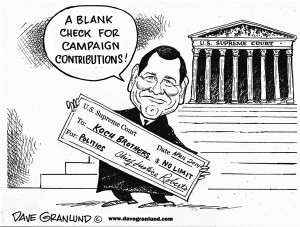
From Adam Liptak at the NYT: Supreme Court Strikes Down Overall Political Donation Cap
The Supreme Court on Wednesday continued its abolition of limits on election spending, striking down a decades-old cap on the total amount any individual can contribute to federal candidates in a two-year election cycle….
The 5-to-4 decision, with the court’s more conservative members in the majority, echoed Citizens United, the 2010 decision that struck down limits on independent campaign spending by corporations and unions.
Wednesday’s decision seemed to alter campaign finance law in subtle but important ways, notably by limiting how the government can justify laws said to restrict the exercise of First Amendment rights in the form of campaign contributions.
Follow me below the fold . . . Read the rest of this entry »
Thursday Reads
Posted: January 9, 2014 Filed under: Barack Obama, FBI, Foreign Affairs, morning reads, The Media SUCKS, the villagers, U.S. Military, U.S. Politics | Tags: Afghanistan War, Betty Medsger, COINTELPRO, Doyle McManus, Edward Snowden, Fox News, Gabriel Sherman, George W. Bush, Glenn Greenwald, Iraq War, J. Edgar Hoover, Joe Biden, Robert Gates, Roger Ailes 119 Comments
Good Morning!!
The Villagers are still nattering on about excepts from retired defense secretary Robert Gates’ new memoir Duty, which will be released on January 14.
The DC media is focused on Gates’ criticisms of President Obama and how they will embarrass the administration and negatively affect Hillary Clinton’s chances in 2016. What has impressed me so far in the excepts I have read is that Obama was wary of the military and willing to stand up to them. Some examples from an e-mail I received from Foreign Policy Magazine yesterday:
Gates on what Biden did to poison the military well: “I thought Biden was subjecting Obama to Chinese water torture, every day saying, ‘the military can’t be trusted.'”
On Obama’s approach to Afghanistan: “I never doubted Obama’s support for the troops, only his support for their mission.”
On Obama’s approach to Afghanistan: “I believe Obama was right in each of these decisions.”
On Obama and Bush: “During my tenure as secretary, Bush was willing to disagree with his senior military advisers on the wars, including the important divergence between the chiefs’ concern to reduce stress on the force and the presidents’ higher priority of success in Iraq. However, Bush never (at least to my knowledge) questioned their motives or mistrusted them personally. Obama was respectful of senior officers and always heard them out, but he often disagreed with them and was deeply suspicious of their actions and recommendations. Bush seemed to enjoy the company of the senior military; I think Obama considered time spent with generals and admirals an obligation.”
On Obama as an ice man: “I worked for Obama longer than Bush and I never saw his eyes well up. The only military matter, apart from leaks, about which I ever sensed deep passion on his part was ‘Don’t Ask, Don’t Tell,’ the law prohibiting gays from serving openly in the military that Obama successfully pushed to repeal.”
On an oval office meeting that deeply pissed him off: “…Donilon was especially aggressive in questioning our commitment to speed and complaining about how long we were taking. Then he went too far, questioning in front of the president and a room full of people whether Gen. Fraser was competent to lead this effort. I’ve rarely been angrier in the Oval Office than I was at that moment; nor was I ever closer to walking out of that historic room in the middle of a meeting. My initial instinct was to storm out, telling the president on the way that he didn’t need two secretaries of defense. It took every bit of my self discipline to stay seated on the sofa.
Every one of those quotes made me like and respect Obama and Biden more. I’m sure I’m not alone in that reaction.
A couple more “criticisms” quoted in The Atlantic: Robert Gates: The Iraq War Undermined U.S. Efforts in Afghanistan.
President Bush always detested the notion, but our later challenges in Afghanistan—especially the return of the Taliban in force by the time I reported for duty—were, I believe, significantly compounded by the invasion of Iraq. Resources and senior-level attention were diverted from Afghanistan. U.S. goals in Afghanistan—a properly sized, competent Afghan national army and police, a working democracy with at least a minimally effective and less corrupt central government—were embarrassingly ambitious and historically naive compared with the meager human and financial resources committed to the task, at least before 2009.
Who doesn’t agree with that? Well, sure some right wing nut jobs, but the majority of Americans have completely soured on the Iraq war, according to many polls over the past few years.
Wars are a lot easier to get into than out of. Those who ask about exit strategies or question what will happen if assumptions prove wrong are rarely welcome at the conference table when the fire-breathers are demanding that we strike—as they did when advocating invading Iraq, intervening in Libya and Syria, or bombing Iran’s nuclear sites. But in recent decades, presidents confronted with tough problems abroad have too often been too quick to reach for a gun. Our foreign and national security policy has become too militarized, the use of force too easy for presidents. Today, too many ideologues call for U.S. force as the first option rather than a last resort.
So Obama’s approach might have kept us out of Iraq, right? I don’t see that as a problem. I want my president to be wary of the military and hesitant to go to war. I want my president to get teary-eyed over granting rights to people who have been historically discriminated against and stay dry-eyed and rational when contemplating “military matters.”
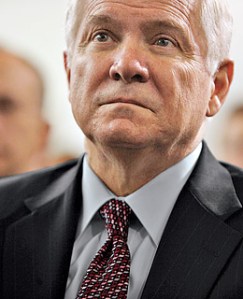
So let Gates have his day in the sun. Today some in the media are already questioning whether his book may damage his reputation. From Foreign Policy again: Did Bob Gates’ New Book Just Trash His Golden Reputation?
Gates, 70, has unmasked himself as just another former Washington official writing just another kiss-and-tell in the soon-to-be-released Duty: Memoirs of a Secretary at War, in which he takes shots at a sitting commander-in-chief, his top aides and Congress, an institution with which he often expressed frustration – but also respect. Gates was known for being discreet and sharp-minded, loyal to the office he occupied and careful about what he said in public. So deliberate were his public pronouncements about wars or national security policy or budgets that he became the E.F. Hutton of the Pentagon — everyone leaned in every time he had something to say.
But now his brand seems diminished by the scrappy, petty nature of many of his criticisms — even though some are substantive and legitimate — and a legacy he seemed quietly determined to protect may be permanently reduced to something less than what it once was.
We’ll have to wait and see. It’s also possible that the furor over Gates’ memoir will fade quickly, because another book is coming out on January 21, and it looks to be a lot more entertaining–the tell-all book about Fox News’ Roger Ailes, The Loudest Voice in the Room, by Gabriel Sherman. Excerpts started leaking out yesterday and they are wild! Check these “key revelations” from Gawker:
- During a salary negotiation in the 1980’s, Ailes offered producer Randi Harrison an additional $100 each week she would agree to have sex with him whenever he wanted.
- He also privately thinks of Bill O’Reilly as “a book salesman with a TV show” and Brian Kilmeade as “a soccer coach from Long Island.”
- During a 1990’s power struggle with NBC executive David Zaslav, Ailes was accused of making an anti-Semitic remark involving an obscenity and “the words ‘little’ and ‘Jew’.” NBC’s chairman and counsel believe “he probably said it.”
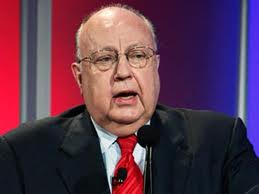
New York Magazine has published a lengthy except from Sherman’s book and it is the most fascinating and horrifying thing I’ve read in ages. Ailes is far weirder than I ever imagined. The article opens with a description of how Ailes moved into a rural town in upstate New York, hoping to return to his small-town roots, but instead bought the local newspaper and tried to transform it into a mini-Fox News. It’s a riot! Just a small except to whet your appetite for the bizarre:
As summer turned to fall, political issues began to arise. Alison Rooney, the copy editor, at first found reasons to be optimistic about the ownership change. She liked using the new computers to put out the paper and looked forward to the newsroom moving into a renovated two-story building on Main Street. But that honeymoon ended when Rooney laid out a press release from the Garrison Art Center that described a work invoking the “mythological story” of the Virgin Birth. After the release was published, the priest of Our Lady of Loretto wrote a letter to the editor, and Beth Ailes lit into Rooney. A few weeks later, Rooney got another dressing-down as she formatted a promotion of the high school’s upcoming production of Urinetown, this time from an editor who found the language offensive and removed the title of the show from the headline.
Another drama erupted after a reporter named Michael Turton was assigned to cover Haldane Middle School’s mock presidential election. After the event, Turton filed a report headlined “Mock Election Generated Excitement at Haldane; Obama Defeats McCain by 2–1 Margin.” He went on, “The 2008 U.S. presidential election is now history. And when the votes were tallied, Barack Obama had defeated John McCain by more than a two to one margin. The final vote count was 128 to 53.” Reading the published version a few days later, Turton was shocked. The headline had been changed: “Mock Presidential Election Held at Haldane; Middle School Students Vote to Learn Civic Responsibility.” So had the opening paragraph: “Haldane students in grades 6 through 8 were entitled to vote for president and they did so with great enthusiasm.” Obama’s margin of victory was struck from the article. His win was buried in the last paragraph.
Turton was upset, and wrote a questioning e-mail to Hunt, but never heard back. Instead, he received a series of accusatory e-mails from the Aileses. Turton had disregarded “specific instructions” for the piece, Beth wrote. “Do you anticipate this becoming an ongoing problem for you?” A short while later, Roger weighed in. Maureen Hunt’s instructions to focus on the school’s process for teaching about elections had been “very clear,” he wrote, and Turton’s “desire to change the story into a big Obama win” should have taken a backseat. Ailes described himself as “disappointed” by Turton’s failure “to follow the agreed upon direction.”
Soon afterward, Turton learned that Maureen Hunt had resigned, and Ailes continued his quest to bring “fair and balanced” to Philipstown.
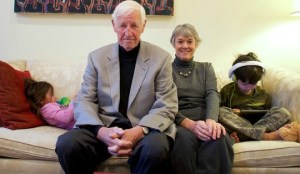
John and Bonnie Raines, two of the burglars, at home in Philadelphia with their grandchildren. Mark Makela for The New York Times
Since I’ve been discussing new books so far, I guess I might as well continue. On Tuesday, The New York Times published interviews with some of the activists who broke into an FBI office in Media, Pennsylvania on March 8, 1971 and stole a massive number of files. They took the files to a remote location, studied them for ten days, and found evidence of the illegal FBI domestic spying program COINTELPRO. Unlike Edward Snowden, the burglars swore to keep their identities a secret so that the story itself would get all the public attention. From the Times article:
They were never caught, and the stolen documents that they mailed anonymously to newspaper reporters were the first trickle of what would become a flood of revelations about extensive spying and dirty-tricks operations by the F.B.I. against dissident groups….
The burglars had, until now, maintained a vow of silence about their roles in the operation. They were content in knowing that their actions had dealt the first significant blow to an institution that had amassed enormous power and prestige during J. Edgar Hoover’s lengthy tenure as director.
“When you talked to people outside the movement about what the F.B.I. was doing, nobody wanted to believe it,” said one of the burglars, Keith Forsyth, who is finally going public about his involvement. “There was only one way to convince people that it was true, and that was to get it in their handwriting.”
That’s heroism in my book. They revealed real government abuses that had been almost unknown until they found the proof. Now one of the reporters who helped get the story out, Betty Medsger, has written a book called The Burglary: The Discovery of J. Edgar Hoover’s Secret FBI. It came out this week, and I’m dying to read it.
By contrast Snowden and his PR man Glenn Greenwald have so far revealed very little that we didn’t already know or suspect about NSA domestic spying and have spent most of the seven months since they began rolling out their revelations 1) publishing articles about the NSA spying on foreign countries and their partnerships with foreign countries who have few espionage resources; 2) giving self-aggrandizing interviews and bragging about all the secrets they have; 3) Defending Snowden’s decision to defect to Russia. At the same time Greenwald has sold book and movie rights and worked on a media start up funded by libertarian E-bay and Paypal billionaire Pierre Omidyar. I haven’t heard anything about Greenwald sharing his earnings with Edward Snowden either.
Fortunately some in the media are beginning to point out inconsistencies in Snowden’s and Greenwald’s behavior. Here is an op-ed by Doyle McManus that lays out the case very well. Edward Snowden, in shades of gray I agree with just about everything he wrote.
Is Edward Snowden” Edward Snowden a whistle-blower or a traitor?
Debate over the renegade computer technician who leaked thousands of secret National Security Agency documents is too often reduced to that deceptively simple choice.
But it’s the wrong way to pose the question, because Snowden is both of those things at the same time. Yes, he’s a whistle-blower, and if that were all he had done, he would deserve our thanks for forcing a debate over the NSA’s swollen powers.
But he’s also a scoundrel who deserves prosecution and public condemnation. That’s because his leaks no longer seem focused on protecting U.S. citizens’ constitutional rights or toughening safeguards on the NSA. Instead, Snowden’s disclosures have expanded far beyond those laudable aims to exposing U.S. intelligence-gathering operations that appear not only legal but legitimate in the eyes of most Americans.
McManus is referring to revelations about the NSA doing it’s job, which is gathering foreign intelligence to protect national security. A little more:
“…most of those disclosures, from Merkel to Al Qaeda, have nothing to do with Americans’ right to privacy. Snowden has acknowledged that his ambitions go far beyond limiting what the NSA can do at home. “I have acted at great personal risk to help the public of the world, regardless of whether that public is American, European or Asian,” he told the Guardian in June.
Well, OK. But that makes him, by his own description, a global crusader against NSA spying anywhere, not merely a whistle-blower against potential abuses inside the United States. It means some of his disclosures have made Americans safer against government prying, but others have probably made us less safe.
And for a man who proclaims himself a fighter for universal rights, accepting asylum in Russia and praising his hosts for their devotion to freedom does not strengthen his claim to consistency, let alone nobility.
I’ll end there and turn the floor over to you. What stories are you following today. Please post your links in the comment thread, and have a great Thursday!
No Wonder U.S. Was So Desperate To Capture Julian Assange
Posted: April 8, 2013 Filed under: torture, U.S. Military, U.S. Politics, Wikileaks | Tags: Col. James Steele, death squads, Iraq War, Julian Assange, The UK Guardian 42 Comments
Have you been following the latest news on Wikileaks? Some very interesting information has been coming out in the past two days. I’m beginning to understand why the Obama administration–along with some foreign governments were so anxious to arrest Julian Assange and shut down Wikileaks. Thanks to Bradley Manning and Assange, news organizations are revealing plenty about what our government was been up to in the 1970s.
Yesterday, the Guardian published a shocking expose of the U.S. torture and death squad operations in Iraq. The article reveals direct connections between the Pentagon and Iraqi “torture centers.” In addition, Guardian researchers showed how Iraq policy grew out of America’s “dirty wars” in Vietnam and Latin America with a veteran of those past outrages, retired Army Colonel James Steele, leading the way.
The Pentagon sent a US veteran of the “dirty wars” in Central America to oversee sectarian police commando units in Iraq that set up secret detention and torture centres to get information from insurgents. These units conducted some of the worst acts of torture during the US occupation and accelerated the country’s descent into full-scale civil war.
Colonel James Steele was a 58-year-old retired special forces veteran when he was nominated by Donald Rumsfeld to help organise the paramilitaries in an attempt to quell a Sunni insurgency, an investigation by the Guardian and BBC Arabic shows.
After the Pentagon lifted a ban on Shia militias joining the security forces, the special police commando (SPC) membership was increasingly drawn from violent Shia groups such as the Badr brigades.
A second special adviser, retired Colonel James H Coffman, worked alongside Steele in detention centres that were set up with millions of dollars of US funding.
Coffman reported directly to General David Petraeus, sent to Iraq in June 2004 to organise and train the new Iraqi security forces. Steele, who was in Iraq from 2003 to 2005, and returned to the country in 2006, reported directly to Rumsfeld.
Where did all this information come from? You guessed it.
The Guardian/BBC Arabic investigation was sparked by the release of classified US military logs on WikiLeaks that detailed hundreds of incidents where US soldiers came across tortured detainees in a network of detention centres run by the police commandos across Iraq. Private Bradley Manning, 25, is facing a prison sentence of up to 20 years after he pleaded guilty to leaking the documents.
The Guardian also made available to a 51-minute documentary focused on “the mystery man of Iraq,” James Steele. It’s also posted on YouTube, so I’ve embedded it here. You can also watch it on the Guardian website. I watched it yesterday, and plan to watch it again.
If you can’t watch the whole thing right now, here’s a good summary and evaluation of the documentary by William Boardman at Op-Ed News.
As if that weren’t enough, today Wikileaks released “1.7m US diplomatic and intelligence reports covering every country in the world” in a searchable database called “Plus D.” The Daily Mail reports:
Whistleblowing website WikiLeaks today published more than 1.7million U.S. records covering diplomatic or intelligence reports on every country in the world. The data released today includes more than 1.7million U.S. diplomatic records from 1973 to 1976 – covering a traffic of cables, intelligence reports and congressional correspondence.
WikiLeaks described the Public Library of US Diplomacy (PlusD) as the world’s largest searchable collection of U.S. confidential, or formerly confidential, diplomatic communications.Much of the work was carried out by WikiLeaks founder Julian Assange, 41, during his time in the Ecuadorian Embassy in London, where he has been staying since last summer….
The Ecuadorian Government has granted Mr Assange political asylum and has repeatedly offered Swedish prosecutors the chance to interview him at the embassy in Knightsbridge, central London.
Mr Assange said the information showed the ‘vast range and scope’ of U.S. diplomatic and intelligence activity around the world.
These cables weren’t even leaked! They came from the National Archives, but Wikileaks organized the material so that it could be used by news organization and individuals. According to News.com.au, Plus D is ‘What Google should be like’, says Wikileaks founder Julian Assange.
Some examples of tidbits from the database that have been published today:
Salon — Kissinger: The illegal we do immediately; unconstitutional takes longer
HuffPo — WikiLeaks: Vatican Dismissed Pinochet Massacre Reports As ‘Communist Propaganda’
The Australian News — WikiLeaks reveals US Thatcher memo
The Atlantic — WikiLeaks ‘Kissinger Cables’ Reveal How Much Russians Loved Joni Mitchell
You can search the database yourself here.
Quiet Sunday Night Open Thread
Posted: March 24, 2013 Filed under: just because, open thread, The Media SUCKS | Tags: Anthony Lewis, Cary Grant, Clarence Earl Gideon, Gideon v. Wainwright, Gideon's Trumpet, Grace Kelly, Greg Mitchell, Iraq War, King of the Cat Burglars, Peter Scott, Rothschild giraffe calf, SCOTUS, The Human Fly, The Washington Post, To Catch a Thief, Warren Court 7 Comments
Here’s a feel-good story for a quiet Sunday night:
Rare Rothschild giraffe born at Greenwich conservation center
When a rare, nearly 6-foot-tall giraffe was born Friday morning at the LEO Zoological Conservation Center, she had a crowd waiting for her.
Petal, a 6-year-old Rothschild giraffe — which are classified as endangered — gave birth to a healthy female calf with a group of other giraffes and conservation center staff watching.
“She’s a great mom,” said Marcella Leone, founder and director of the center. “She was very proud, trying to show off her newborn.”
Petal, now a second-time mother, has already bonded with her newborn, who looks like her, with a mix of dark patches broken up by bright cream channels.
There’s a contest to name the newborn, which you can enter here.
LEOZCC is a nonprofit, accredited conservation center and off-site breeding facility specializing in species at risk and conservation-based education programs. The mission of the Lionshare Educational Organization, which manages LEO Zoological Conservation Center, is to inspire conservation leadership by engaging people with wildlife and the natural world.
Here’s a video of the baby giraffe standing up for the very first time.
Isn’t that adorable?
I don’t know if you saw this story at The Daily Beast yesterday: Why Tea Partiers Are Boycotting Fox News
Apparently some Tea Partiers are upset with Fox News for not hammering the Benghazi story anymore.
“Particularly after the election, Fox keeps turning to the left,” said Stan Hjerlied, 75, of Fort Collins, Colo., and a participant in the boycott. He pointed to an interview Fox News CEO Roger Ailes gave after the election in which he said that the Republican Party and Fox News need to modernize, especially around immigration. “So we are really losing our only conservative network.”
The three-day boycott lasted Thursday morning through Sunday morning, and is the second time this group of activists have gone Fox-free in an effort to steer the coverage. Organizers say a two-day boycott earlier this month knocked 20 percent off of the network’s regular viewership. (A Daily Beast analysis of the same data showed that the boycott had little effect.) […]
A leader of the boycott, Kathy Amidon, of Nashville, declined an interview, instead directing The Daily Beast to a website, Benghazi-Truth. The website, a single-page, 23,000-word manifesto complete with multicolored fonts, supposedly incriminating videos of Fox News’s complicity in a coverup, and communist propaganda photographs, is kept by someone who identifies himself online as “Proe Graphique,” and who other members of boycott described as someone who works “in New York media.”
By way of explanation, the website reports: “People ask why not all mainstream media? Why just Boycott FOX? The answer, again, is that FOX needs the Tea Party/conservatives more than the conservatives need FOX after FOX turned left, basically selling out the people who made FOX successful in an attempt to earn an extra buck. FOX is extremely vulnerable to these boycotts while the rest of the MSM doesn’t need us at all, to speak of.”
Talk about biting off your own nose to spite your face! How far right are these people if they think Fox News is too far left?
This story isn’t really lightweight, but it’s so ridiculous that it’s almost funny. Greg Mitchell posted a piece that he wrote on assignment for the Washington Post on media failures on Iraq. Amazingly, ten years after the fact, the Post wimped out and killed the story. Here’s Mitchell’s introduction–you can read the whole think at his blog.
Due to “popular demand,” based on my post last night, I’m publishing below the assigned Outlook piece that I submitted to the Washington Post on Thursday. I see that the Post is now defending killing the piece because it didn’t offer sufficient “broader analytical points or insights.” I’ll let you decide if that’s true and why they might have rejected it.
The original appeared almost word-for-word at The Nation this weekend (there I added a reference to Bob Woodward and to Bob Simon). I had absolutely no plans to even mention that the piece was killed until late last night when I saw that Paul Farhi of the Post had written for Outlook a piece claiming that the media “didn’t fail” in the run-up to the Iraq war. That inspired me to write the post last night which has proved quite popular.
The cowardice of the corporate media is just amazing.
When I was a senior in high school, I had to write a lengthy term paper for my English class. I had recently read a book about a momentous Supreme Court decision, Gideon v. Wainwright. The book was Gideon’s Trumpet, by Anthony Lewis. I was so inspired by the book and the SCOTUS decision that I wrote my term paper about the case. I called it “Justice for the Poor.” I was a liberal from childhood and I’ve only moved further left in my old age!
From the summary of the case at the United States Courts website:
Clarence Earl Gideon was an unlikely hero. He was a man with an eighth-grade education who ran away from home when he was in middle school. He spent much of his early adult life as a drifter, spending time in and out of prisons for nonviolent crimes.
Gideon was charged with breaking and entering with the intent to commit a misdemeanor, which is a felony under Florida law. At trial, Gideon appeared in court without an attorney. In open court, he asked the judge to appoint counsel for him because he could not afford an attorney. The trial judge denied Gideon’s request because Florida law only permitted appointment of counsel for poor defendants charged with capital offenses.
At trial, Gideon represented himself – he made an opening statement to the jury, cross-examined the prosecution’s witnesses, presented witnesses in his own defense, declined to testify himself, and made arguments emphasizing his innocence. Despite his efforts, the jury found Gideon guilty and he was sentenced to five years imprisonment.
Gideon sought relief from his conviction by filing a petition for writ of habeas corpus in the Florida Supreme Court. In his petition, Gideon challenged his conviction and sentence on the ground that the trial judge’s refusal to appoint counsel violated Gideon’s constitutional rights. The Florida Supreme Court denied Gideon’s petition.
Gideon next filed a handwritten petition in the Supreme Court of the United States. The Court agreed to hear the case to resolve the question of whether the right to counsel guaranteed under the Sixth Amendment of the Constitution applies to defendants in state court.
The Supremes decided that criminal defendants who could not afford an attorney should be provided with one.
The Court held that the Sixth Amendment’s guarantee of counsel is a fundamental right essential to a fair trial and, as such, applies the states through the Due Process Clause of the Fourteenth Amendment. In overturning Betts, Justice Black stated that “reason and reflection require us to recognize that in our adversary system of criminal justice, any person haled into court, who is too poor to hire a lawyer, cannot be assured a fair trial unless counsel is provided for him.” He further wrote that the “noble ideal” of “fair trials before impartial tribunals in which ever defendant stands equal before the law . . . cannot be realized if the poor man charged with crime has to face his accusers without a lawyer to assist him.”
I don’t think my English teacher was particularly liberal, but he said I convinced him with my paper and I got an “A.”
You can read more about this case at The Nation.
I really miss the Warren Court!
I came across a fascinating obituary yesterday in The Guardian. It’s about Peter Scott, who for years was a cat burgler who targeted movie stars and other very wealthy people. He was known as “The King of the Cat Burglers” and “The Human Fly.”
Peter Scott, the “King of the Cat Burglars”, who has died of cancer aged 82, was once Britain’s most prolific raider of the wealthy, specialising in the theft of jewellery and artworks from Mayfair mansions and stately homes. He was the subject of a film, starring a young Judi Dench, and the author of a memoir in which he claimed he was “sent by God to take back some of the wealth that the outrageously rich had taken from the rest of us”.
Born Peter Craig Gulston into a middle-class Belfast family, he was educated at the Belfast Royal Academy, where a contemporary was John Cole, the former BBC political editor and Guardian journalist. By the age of 12 Peter had decided on a life of crime rather than any of the legal options that would have been available to him. His teenage apprenticeship involved burgling houses in the wealthy Belfast suburbs, with his college scarf, rugby bag and debonair manner as disguise. He reckoned to have carried out more the 150 such thefts by the time he was finally arrested in 1952 and sent to Crumlin Road jail for six months.
Realising that he was now a marked man in Belfast, he changed his name to Scott, moved to London and found work as a club bouncer in the West End. But off duty, he won a reputation as an accomplished and athletic cat burglar, able to climb and penetrate the best-guarded home counties mansions. He specialised in stealing from the very rich or, as he put it, “the real meaty jugular vein of society”. Jail time – by the end of his career he had served about 14 years – was the price he was prepared to pay for being a real-life Raffles.
While inside for an early stretch, he met the then best-known thief in London, George “Taters” Chatham. Together the two of them stole millions of pounds’ worth of art and jewellery. Over the years, Scott claimed to have robbed Vivien Leigh and Zsa Zsa Gabor and to have taken Sophia Loren’s £200,000 necklace when she was in Britain filming The Millionairess in 1960. He robbed the late Shah of Iran’s English mansion, making sure not to disturb the peacocks, which acted as guard dogs. The French Riviera was another happy hunting ground.
Scott wrote a memoir called The Gentleman Thief, published in 1995. Even after the book was published and Scott was supposedly retired,
…in 1997, he was involved in the theft of Picasso’s Tête de Femme from a Mayfair gallery. Scott quoted WE Henley to the officers who arrested him: “Under the bludgeonings of chance, my head is bloody but unbowed.”They were unimpressed. He was jailed for three and a half years for handling stolen goods, having pleaded guilty halfway through the trial. “I was poaching excitement,” was how he explained his relapse.
Scott spent his later years as a tennis coach and tending the gardens of a church in Camden, north London – he had always sought horticultural work in jail – and offering advice to local youngsters about the pitfalls of crime.
There an even longer tribute to Scott at The Telegraph.
This guy reminded me so much of the Cary Grant character in Hitchcock’s To Catch a Thief. In the movie, Grant plays a reformed cat burglar named John Robie. Like Scott, Robie loved to spend time in his garden caring for his roses. In the movie, someone is pulling off daring jewel thefts using Robie’s modus operandi, and Robie is naturally a suspect. In order to prove his innocence he has to catch the imitator. I’m sure you’ve seen the movie, but here’s the trailer. I couldn’t get it to embed. And here’s a clip in which Grace Kelly tries to trap Robie into stealing her (fake) diamonds, but instead . . . fireworks!
I hope you’re having an enjoyable evening. Please share any upbeat or funny links you’ve come across today–actually whatever you want to post is fine. This is a wide open thread!
Tuesday Reads: SCOTUS and Voting Rights, Iraq War Buildup, and Reno Saccoccia
Posted: March 19, 2013 Filed under: morning reads, U.S. Politics, Violence against women | Tags: Ahmed Chalabi, Anthony Kennedy, Antonin Scalia, Christopher Hitchens, David Frum, Dick Cheney, George W. Bush, Iraq War, Reno Saccoccia, Sonya Sotomayor, Steubenville rape case, voting rights 35 Comments
Good Morning!!
There’s a great big sloppy white mess outside my house this morning–something like 6 or 7 inches of heavy, wet snow. I’m not sure how I’ll get out of here; I may have to try to hire someone to dig me out. Anyway, I’m resigned to being stuck in the house for today at least.
Soooo… let’s see what happening in the news.
I’m going to start out with some news from the Supreme Court. Yesterday the court debated another voting rights case, and once again Sonya Sotomayor went toe-to-toe with right-wing judicial activist Antonin Scalia. This time it was a case from Arizona over whether a state can require proof of citizenship beyond what is required by federal voter registration forms. Here’s some background from Spencer Overton at HuffPo:
The latest case involves the simple question of whether Arizona can refuse to accept a federal voter registration form. But the stakes are much higher. A victory for Arizona could accelerate a nationwide trend of political operatives attempting to manipulate election rules for political gain, and could undermine the power of Congress to protect voting rights.
The National Voter Registration Act requires that all states “accept and use” a single, uniform voter registration form for federal elections. States can still use their own registration forms, but they must also accept and use the Federal Form. The purpose of the Federal Form is to increase participation by preventing states from erecting barriers to voter registration.
The Federal Form requires that prospective voters check a box and sign the form affirming they are U.S. citizens under penalty of perjury. Arizona, however, adopted a state law requiring “satisfactory proof” of U.S. citizenship to register, such as a birth certificate, U.S. passport, or state driver’s license that shows citizenship.
As a result, Arizona initially rejected over 31,000 voter registration applications — including citizens who registered using the Federal Form. Community-based registration drives were hit especially hard, because they rely on approaching individuals who may not be carrying a birth certificate or similar documentation (or unwilling to give a photocopy of these sensitive documents to a registration-drive volunteer). For example, community-based registration drives in Arizona’s largest county — Maricopa County — dropped 44%.

Obviously, if Arizona wins the case, other red states would pass similar laws that would trump federal voting regulations. Yesterday, Sotomayor and Scalia “clashed” over the Arizona law. Talking Points Memo:
Much as they did weeks ago during arguments over the constitutionality of the Voting Rights Act, the two justices on Monday each led the charge on opposite sides of the case — Scalia for less federal involvement in states’ ability to set their voting laws, and Sotomayor for broad national authority to protect citizens’ right to vote.
Sotomayor’s opening volley began immediately after Arizona Attorney General Thomas C. Horne stepped up to defend his state’s law. She fired off a series of questions, which she would continue asking in different flavors throughout his argument, about inconsistencies between Arizona’s Prop 200 and the NVRA.
“If I see the purpose of the NVRA to simplify registration, how are Arizona’s provisions consistent with that objective and purpose, given that … many people don’t have the documents that Arizona requires?” Sotomayor said. She asked Horne why he thinks Congress would have required states to accept a voter registration form if states can then turn around and require additional information like a passport or birth certificate.
“Why isn’t that just creating another form?” she demanded. Arizona, she said, may object to the fact that proof of citizenship isn’t required, but “that’s what Congress decided.”
As for Scalia:
The conservative jurist wasn’t convinced requiring people to attest under oath was sufficient.
“So it’s under oath — big deal,” Scalia said. “If you’re willing to violate the voting laws, I suppose you’re willing to violate the perjury laws.” He posited that only “a very low number” of voters would be harmed by a requirement to submit proof of citizenship.
Well that makes sense–not. Why bother having witnesses swear to tell the truth in court cases then?
Of course Anthony Kennedy was his usual waffling self. Again from TPM:
At one point, Kennedy wrestled with whether Arizona’s proof-of-citizenship requirement crosses a line. He asked the state’s attorney general, who was defending the law, whether states may also require proof of one’s address or date of birth when registering to vote. If so, he posited, then the federal requirement “is not worth very much.”
At another point, he launched a defense of Arizona’s actions in principle and took issue with some of the reasoning by the Ninth Circuit Court of Appeals, which ruled against Arizona.
“The state has a very strong and vital interest in the integrity of its elections,” Kennedy said, “even when those, and perhaps especially when those are elections of federal officials. And it seems to me the Ninth Circuit’s new test did not give sufficient weight to that interest.”
Roberts is apparently “leaning slightly” toward Arizona’s point of view. It’s really frightening that voting rights are in the hands of this conservative court. Thank goodness for Sotomayor’s willingness to be vocal in her arguments. Here are couple more interesting tidbits:
“Let me give you this example,” Alito said. “A person rides up to a place to register on a bicycle and gets out and hands in the federal form. This boy looks like he is 13 years old and he is carrying school books, he is wearing a middle school t-shirt, but he has filled out the form properly. Are they required to register him?”
Retired Justice Sandra Day O’Connor, a native Arizonan who in 2010 ruled against her statein this case from a lower court on which she occasionally sits, was present in the chamber.
In the final moments, Scalia warned the Obama administration’s lawyer, who was arguing against Arizona, that if the constitutionality of the NVRA form is challenged in broader terms, “You’re going to be in bad shape — the government’s going to be.”
There was a little bit of good news from the Court yesterday, according to HuffPo: Supreme Court Refuses To Hear Goldman Sachs’ Appeal To Financial Crisis Lawsuit.
Goldman Sachs Group Inc suffered a defeat on Monday as the U.S. Supreme Court let stand a decision forcing it to defend against claims it misled investors about mortgage securities that lost value during the 2008 financial crisis.
Without comment, the court refused to consider Goldman’s appeal of a September 2012 decision by the 2nd U.S. Circuit Court of Appeals in New York. Goldman shares sank more than 2 percent.
That court let the NECA-IBEW Health & Welfare Fund, which owned some mortgage-backed certificates underwritten by Goldman, sue on behalf of investors in certificates it did not own, but which were backed by mortgages from the same lenders.
Goldman and other banks have faced thousands of lawsuits by investors seeking to recoup losses on mortgage securities.
The bank has said that letting the 2nd Circuit decision stand could cost Wall Street tens of billions of dollars.
{{applause}}
David Frum posted a fascinating article at The Daily Beast late yesterday on the lead-up to the Iraq War. Frum was a speechwriter for George W. Bush at the time. You should read the whole thing, but I’ll just quote this one intriguing portion:
The first time I met Ahmed Chalabi was a year or two before the war, in Christopher Hitchens’s apartment. Chalabi was seated regally at one end of Hitchens’s living room. A crowd of nervous, shuffling Iraqis crowded together at the opposite end. One by one, they humbly stepped forward to ask him questions or favors in Arabic, then respectfully stepped backward again. After the Iraqis departed, Chalabi rose from his chair and joined an engaged, open discussion of Iraq’s future democratic possibilities.
The last time I saw Chalabi was in his London apartment, on the very eve of war. My little group arrived past midnight. Chalabi was listening to the evocative strains of Sufi music. He showed me a black-and-white photograph of seven men, wearing the clothes of the 1940s. They were the board of directors of a company his father had founded: a mixed group of Sunni, Shiite, and Christian, and even a Jew. Chalabi remarked that this picture was taken while Europe was tearing itself apart in genocidal violence. He didn’t add that it was taken shortly after British forces defeated a pro-Axis coup in Baghdad—but failed to prevent a murderous pogrom against Baghdad’s Jewish population.
I was less impressed by Chalabi than were some others in the Bush administration. However, since one of those “others” was Vice President Cheney, it didn’t matter what I thought. In 2002, Chalabi joined the annual summer retreat of the American Enterprise Institute near Vail, Colorado. He and Cheney spent long hours together, contemplating the possibilities of a Western-oriented Iraq: an additional source of oil, an alternative to U.S. dependency on an unstable-looking Saudi Arabia.
You might imagine that an administration preparing for a war of choice would be gripped by self-questioning and hot debate. There was certainly plenty to discuss: unlike the 1991 Gulf War, there was no immediate crisis demanding a rapid response; unlike Vietnam, the U.S. entered the war fully aware that it was commencing a major commitment.
Yet that discussion never really happened, not the way that most people would have imagined anyway. For a long time, war with Iraq was discussed inside the Bush administration as something that would be decided at some point in the future; then, somewhere along the way, war with Iraq was discussed as something that had already been decided long ago in the past.
I’m running out of space, so I’ll leave you with this follow-up to the Steubenville rape trial.

From Deadspin: Fire This Asshole: Why Does Steubenville’s Football Coach Still Have His Job?
Reno Saccoccia is a local legend, in the way that 30-year coaches of football powerhouses in economically depressed Ohio Valley towns tend to be legends. He’s in the Ohio Coaches Hall of Fame. He’s won three state titles. When Saccoccia won his 300th game last year, a sellout crowd of more than 10,000 people packed Harding Stadium—christened “Reno Field” in 2007—and chanted “Reno, Reno, Reno” as he left the field.
He breakfasts regularly with the sheriff. His sister-in-law works in the county’s juvenile court, where he is licensed as a mediator. He “molds young boys into men.” So how did Saccoccia react when he got word that two of his young boys were accused of raping a passed-out student?
On the night of the assault, a Steubenville student recorded this video joking about it. Off-camera, someone says “Trent and Ma’lik raped someone.” Among the text messages released at the trial of Trent Mays and Ma’lik Richmond, one sent by Mays indicated that Saccoccia had seen the video:
Deleate that off You-tube. Coach Sac knows about it. Seriously delete it.
Saccoccia would later claim he was unaware of the social media evidence, angrily telling a reporter that he didn’t “do the internet.” But a flurry of texts sent on August 13, the day after the incident, indicated that Saccoccia had heard what had happened.
Even as all of Steubenville gradually heard the rumors, even after a local blogger alerted the country to what had happened in Steubenville, those involved in posting and sharing the photos and videos continued to play. They were only suspended eight games into the season, more than two months after the assault and arrests.
Less than a month later, Saccoccia testified on behalf of Mays and Richmond in a hearing to determine whether they would be tried as adults.
As we all know, the “boys” were tried as juveniles and got off easy. Seriously, this asshole has to go!

 peej
peej Carissa
 bostonboomer
 dakinikat
 ecocatwoman
 mablue2
 Mama Lopez
 peggysue22
 quixote
 skydancingguestblogger
 Mona (aka Wonk the Vote)



 Sky Dancing
Recent Comments