
Monday Reads by The Numbers
Posted: March 9, 2015 Filed under: morning reads | Tags: Bobby Jindal, Independent Book Stores, Iowa Caucuses, pay equity, Wage Gap, women on boards of directors in the US 15 Comments Good Morning!
One of the hazards of my occupation is the use of statistics. Statistics can be very useful for spotting trends and outliers in all kinds of things. Many researchers and all politicians are selective about which statistics to share. They generally want the outcome that proves their hypothesis or case. I came across a variety of stories this weekend that caught my eye because descriptive statistics played a role. I thought I’d share a few with you.
We are less than a year from the Iowa caucuses. These odd little political happenings in an odd little state generally kick off the hopes and fears of presidential wannabes. I lived in Iowa as a kid and my father owned a business there for 30 years so I know a little about the state and its quirks. This essay in the Denver Post makes some very good points to argue that the “Iowa caucuses are a poor proxy for America”. Iowa manages to put forth some of the whackiest Republican candidates possible. They usually fail miserably when New Hampshire holds its primaries and fall out by the time the bigger states come into play. Why does the press spend so much time in Iowa then?
Considering they are the first in the nation for presidential delegate selection, the Iowa caucuses present quite the contrast to the United States as a whole. Iowa is not remotely demographically representative of our nation.
It is significantly more white, rural and Christian than the national average. Only 12.4 percent of Iowans are minorities, while nationally minorities comprise 28 percent of the population. Thirty-six percent of Iowans live in rural areas or small towns, whereas in the United States overall, 19.3 percent do. About 54 percent of Iowans identify as religious, whereas 49 percent of Americans identify as religious nationally.
While the disparity in the level of religious involvement is not shocking, the percentage of those religious people who are Christian stands out. Of the 54 percent of religious Iowans, only .5 percent identify as Muslim, Jewish, or of Eastern religion. This is markedly lower than the 4.7 percent of Americans nationally who identify themselves as religious but practice a religion other than Christianity.
On a racial basis, the Iowa caucuses skew significantly from the national average. The attendees are really white. Indeed, at the Republican caucuses of 2012, a full 99 percent of attendees were white, while nationally about 89 percent of the Republican Party is white. There was virtually zero representation at the Republican caucuses from the near 12 percent of Republicans who are from minorities.
The makeup of the Democratic caucuses is somewhat more representative of America, but not much. In 2008, the last time there were contested caucuses in Iowa, 93 percet of Democratic caucus-goers were white, with 4 percent of attendees reporting as African-American and 3 percent reporting as another race. Nationally, in 2008, the Democratic Party was 66 percent white, 16 percent African-American, and 12 percent Hispanic.
Perhaps the lack of participation among minority voters has something to do with the caucus process itself.
JJ did an excellent job covering some of the events of International Women’s Day yesterday. One of the issues that has always been near and dear to me–and Patricia Arquette it seems–is pay equity. Here’s some  depressing numbers on that. Basically, a report by the U.N. states that it will take 70 years for the gap to close at this rate. That’s completely disheartening.
Women will continue to be paid less than men for the next 70 years if the gender pay gap continues to reduce at the present rate, according to a report by a UN agency released ahead of International Women’s Day.
The document published by the International Labour Organisation (ILO) comes 20 years after 189 countries adopted a blueprint to achieve equality for women in 12 critical areas, including health, education, employment, political participation and human rights.
The historic agreement marked the first time that the UN recognised a woman’s right to control her own sexuality without coercion, and reaffirmed her right to decide whether and when to have children.
However, despite the agreement women still lack access to education, training, recruitment; have limited bargaining and decision-making power; and still shoulder responsibility for most unpaid care work.
And while women have slowly taken up more places in the global workplace since the 1995 Beijing Platform, the percentage that women earn in comparison to men has only crawled up by one point to 77 per cent.
The report also revealed that women across the world are also faced by a “motherhood pay gap”, over and above the gender pay gap, with women in developing countries suffering the most.
 The country of Germany has taken one step to increase the number of women in corporate boardrooms. They’ve legislated quotas.
Germany on Friday became the latest and most significant country so far to commit to improving the representation of women on corporate boards, passing a law that requires some of Europe’s biggest companies to give 30 percent of supervisory seats to women beginning next year.
Fewer than 20 percent of the seats on corporate boards in Germany are held by women, while some of the biggest multinational companies in the world are based here, including Volkswagen, BMW and Daimler — the maker of Mercedes-Benz vehicles — as well as Siemens, Deutsche Bank, BASF, Bayer and Merck.
Supporters said the measure has the potential to substantially alter the landscape of corporate governance here and to have repercussions far beyond Germany’s borders.
In passing the law, Germany joined a trend in Europe to accomplish what has not happened organically, or through general pressure: to legislate a much greater role for women in boardrooms.
The law was passed after an unusually passionate debate, and much talk of milestones, cracking glass ceilings and making history. Chancellor Angela Merkel, in her 10th year in power, was on hand as deputies in her governing grand coalition of center right and center left stood to register their votes in favor of the law, which passed by a simple clear majority. The small opposition of Greens and leftist deputies abstained, believing the measure did not go far enough.
“You have to be sparing with the word ‘historic,’ ” said Justice Minister Heiko Maas, who with a Social Democrat colleague, Family Minister Manuela Schwesig, spent months steering the law over legal and political hurdles. “But I think today we can apply it.” For Germans, he called the law “the greatest contribution to gender equality since women got the vote” in Germany in 1918.
With women still lagging globally in corporate offices, on governing boards and in pay, and many still struggling with family-work policies, pressure has been growing for legislative solutions.
Norway was the first in Europe to legislate boardroom quotas, joined by Spain, France and Iceland, which all set their minimums at 40 percent. Italy has a quota of one-third, Belgium of 30 percent and the Netherlands a 30 percent nonbinding target.
Britain has not legislated boardroom quotas, but a voluntary effort, known as the 30% Club, has helped to substantially increase women’s representation. The group, founded by Helena Morrissey, a money manager, has used persuasion to help double the percentage of women on the boards of major British companies since 2010, to 23 percent.
The United States has also seen women’s representation grow slightly, up to 17 percent of board seats, without legislative mandates, though its growth has been extremely slow.
 There seems to be a definite movement by corporations and religious types to make sure that schools don’t teach any form of critical thinking. That and other trends make for an interesting question of the direction of culture in the US. Here’s a few numbers and question on that from The American Scholar and Scott Timberg.
Traditionally, bookstores were where aspiring writers earned a living, and where readers went for sustenance and community. Yet in the two decades since the mid-1990s, during which the U.S. population has grown by 60 million—we’ve lost half of our independent bookstores, and record shops have virtually disappeared. The causes are mostly technological and involve online outlets like Amazon. Meanwhile, in parts of Europe, especially the German-speaking world and France, independent culture merchants are at least surviving rough times, and some are thriving. Are Americans hopelessly mired in neoliberal economics, technology worship, and the logic of winner-take-all, or is there something we can do to save these places and the people who work in them?
If you really want a deranged use of statistics. Take a look at what USA just let my Governor pen for them. There is a total disconnect between what Jindal has written and what’s in the news about the Jindal “economy” on every newspaper in Louisiana. Why on earth would a newspaper publish such obvious bull shit and propaganda? Who owns that damned newspaper?
Seven years ago, I ran for governor promising to make the economy bigger and the government smaller. We have lived up to that, accomplishing in Louisiana what the federal government has failed to do. We have balanced budgets, drastically reduced the size of government and empowered growth in our private sector.
Our state budget is nearly $9 billion smaller, with over 30,000 fewer state workers, than when we took office in 2008. And guess what? After reining in the size of government and lowering taxes, Louisiana’s economy is stronger than ever.
Since 2008, Louisiana’s economy has grown nearly twice as fast as the national economy, and private-sector employment has grown at a rate of two-and-a-half times the U.S. rate, while our budgeting practices have earned our state eight credit rating upgrades. We now have more people working and living in Louisiana, with higher incomes, than ever before.
For next year’s budget, a dramatic drop in oil prices has meant less money for state government. That’s OK. It should come as no surprise to anyone that we plan to address this challenge by continuing to cut the size of government without raising taxes.
This is what was on USA Editorial page however. “Growth has been sluggish in Louisiana and Kansas, and the plunge in revenue has devastated their budgets.”
Here’s one worth steering away from: Governors in Louisiana and Kansas have been experimenting with big tax cuts that advocates claim will unleash explosive economic growth. The results have been dismal. Growth has been sluggish in both states, and the plunge in revenue has devastated both states’ budgets:
- In Louisiana, Gov. Bobby Jindal pushed a big tax cut through the legislature after he took office seven years ago. Since then, the state budget has gone from a nearly $1 billion budget surplus in 2007-08 to a projected $1.6 billion shortfall for the budget year that begins July 1. Jindal, who long ago took a pledge never to raise taxes, has cut higher education and resorted to unsustainable one-time remedies such as draining reserve funds and selling state assets.
Louisiana’s jobless rate has gone from much better than the national rate in 2008 to much worse. Jindal claims his state’s economic growth has beaten the nation’s, but he cherry-picks the years and doesn’t mention that since 2010, the state has lagged behind the national recovery.
There’s like a total disconnect between what they’ve said on their editorial page and what they let Jindal blather on about. What a contrast in the Orwellian use of selected statistics by Jindal and the reality on the ground. Oh, if you want to see what exactly type of industry that Jindal’s bringing in check out this shady deal. This is a three part special from AJ called “China’s Louisiana Purchase: Who’s building a methanol plant on the bayou?” It’s by the numbers, textbook environmental racism.
ST. JAMES PARISH, La. — A prominent Chinese tycoon and politician — whose natural gas company’s environmental and labor rights record recently started coming under fire in the Chinese press — is parking assets in a multibillion dollar methanol plant in a Louisiana town. And he appears to be doing it with help from the administration of likely GOP 2016 presidential ticket contender Louisiana Gov. Bobby Jindal.
Not many locals in a predominantly black neighborhood of St. James Parish — halfway between New Orleans and Baton Rouge — know that Wang Jinshu, the Communist Party Secretary for the northeastern Chinese village of Yuhuang and a delegate to the National People’s Congress, is the man at the helm of a $1.85 billion methanol plant to be built in their town over the next two years with a $9.5 million incentive package from the state. The details of the project are unclear, residents say, largely because they were not told about the project until local officials, amid discussions with state officials and Chinese diplomats, decided to move forward with the project in July 2014.
“We never had a town hall meeting pretending to get our opinion prior to them doing it,” said Lawrence “Palo” Ambrose, a 74-year-old black Vietnam War veteran who works at a nearby church. “They didn’t make us part of the discussion.”
The Chinese company has filed for expedited permits to construct and operate a plant on a sprawling 1,100 acres — situated between a high school, two churches and an assisted living facility for senior citizens — from the Louisiana Department of Environmental Quality, which is set to study the impact on the local environment and deliver its decision on March 6, 2015.
The plant is part of a recent push by New Orleans–area officials to reach out to Asia’s growing economic powerhouse to redevelop communities still devastated by the effects of natural disasters like Hurricane Katrina. Some of those projects, it appears, have since gone sour. In one instance, which Al Jazeera will explore in the third installment of this series, a company contracted by the city government stands accused of stealing millions of dollars from Chinese investors seeking U.S. citizenship in exchange for building businesses in an underserved neighborhood.
Local economic development authorities told Al Jazeera that St. James Parish is an ideal location for the methanol plant because of readily accessible deep water and cheap fuel from the shale oil boom that will help cut production costs. But it remains unclear what the impetus is behind a methanol plant that plans to send the lion’s share of its product back to China, which is struggling to find a market for the methanol already being produced.
What is clear is that there are links between Wang’s U.S. subsidiary — Houston-headquartered Yuhuang Chemical Inc. — and the Chinese government and the Jindal administration.
 It seems China’s tired of being a polluted pissing pot so they’re joining with Jindal to stick it the poorest of the poor in Louisiana. This story series is a freaking eye-opener. Be sure to read all three parts.
Here’s a very sad story. I used to love to go pick out sheet music at the local music stores and in music stores in big cities when I was young. It seems the very last New York Classical Sheet music store has closed.
Even the home to Carnegie Hall and the New York Philharmonic isn’t immune to the realities of the digital age of music.
Frank Music Company, New York City’s last remaining store dedicated to selling classical sheet music, closed on Friday. Frank’s customers, a community of artists dedicated to playing music written with quills centuries ago, must now buy them online or download PDFs.
The store’s owner, Heidi Rogers, said dwindling sales killed the shop.
“Musicians are underpaid,” she said. “How can they buy music if they’re not getting paid enough?”
Here’s a number that’s a good one. Baby giant tortoises were born on one of the Galapagos Islands for the first time in more than a century!!
For the first time in more than one hundred years, researchers have found newborn baby tortoises on the tiny Galapagos island of Pinzón. It’s a major win for a population that has struggled after being nearly decimated by human impact.
“We found ten tiny, newly hatched saddleback tortoises on the island early last month,” wrote a trio of researchers in the January 15th issue of the journal Nature. “There could be many more, because their size and camouflage makes them hard to spot. Our discovery indicates that the giant tortoise is once again able to reproduce on its own in the wild.”
So, that’s it for me today. Just thought I’d let you know that I’ve gone back to gigging to try to make ends meet. Yesterday, I played the most unique church service I’ve ever done. Well, the service wasn’t unique if you understood Norwegian. It was at the Norwegian Seaman’s church. It’s a Lutheran church funded by the Norwegian government for expats and visiting Norwegians. It was truly an experience! Oh, and Norwegian waffles are the best!!! So, that’s the first adventure. My second adventure will be on Bourbon Street where I will be playing three shows a night (4 times a week) as the straight woman and accompanist to Ms. Jessica Duplantier who is and up and comer and sure to head straight to RuPaul’s reality show Drag Race!!! So, how’s that for a stuffy old Finance professor? Yes, there will be pictures, I promise!
What’s on your reading and blogging list today? Any good news out there?
Tuesday Reads: SC Republican Debate, Karen Santorum, and Did Mitt Really Win Iowa?
Posted: January 17, 2012 Filed under: 2012 presidential campaign, 2012 primaries, morning reads, Republican presidential politics, U.S. Politics | Tags: abortion, abortion providers, Dr. Tom Allen, internet backout, Iowa Caucuses, Karen Santorum, Mitt Romney, Newt Gingrich, PIPA, Pittsburgh abortion clinic, Republican South Carolina debate, Rick Perry, Rick Santorum, Ron Paul, SOPA, South Carolina primary, Wikipedia 32 Comments
Good Morning!!
Last night was the Fox News/WSJ South Carolina Republican Debate. As usual, it was a nightmare. It’s so strange to listen to people who feel they need to defend themselves if they ever did a decent thing in their lives or ever subscribed to some rational opinion or policy. And these men claim to be “Christians.” We had a live blog of the horrible thing, so check it out if you’re interested in what we said off the top of our heads.
I’m writing this late Monday night, so all the reactions to the debate haven’t come out yet. I’ll update in the comments in the morning, but here’s a preliminary report from Fox News.
Gingrich and Perry led the assault against Romney’s record at Bain Capital, a venture capital firm that bought companies and sought to remake them into more competitive enterprises.
“There was a pattern in some companies … of leaving them with enormous debt and then within a year or two or three having them go broke,” Gingrich said. “I think that’s something he ought to answer.”
Perry referred to a steel mill in Georgetown, S.C. where, he said, “Bain swept in, they picked that company over and a lot of people lost jobs there.”
Romney said that the steel industry was battered by unfair competition from China. As for other firms, he said, “Four of the companies that we invested in … ended up today having some 120,000 jobs.
“Some of the businesses we invested in were not successful and lost jobs,” he said, but he offered no specifics.
Romney claimed that the steel mill in SC that went bankrupt had been purchased by another company after he left Bain, and that all the employees were offered jobs, but not at union wages. Perry also demanded that Mitt release his tax returns. Mitt very nervously said he would “probably” do that in April. He is leaving the decision “open,” but made no definite commitment. Romney supported indefinite detention of American citizens without due process, while Ron Paul argued that American citizens should have the right of Habeas Corpus.
The Wall Street Journal had a live blog of the debate as did the Washington Post and Andrew Sullivan at The Daily Beast.
Did you know that Karen Santorum lived with an abortion doctor close to three times her age before she met and married Rick? There’s a pretty detailed piece on this at The Daily Beast. Mrs. Santorum’s
live-in partner through most of her 20s was Tom Allen, a Pittsburgh obstetrician and abortion provider 40 years older than she, who remains an outspoken crusader for reproductive rights and liberal ideals. Dr. Allen has known Mrs. Santorum, born Karen Garver, her entire life: he delivered her in 1960.
“Karen was a lovely girl, very intelligent and sweet,” says Allen, who at 92 uses a walker but retains a sly smile. A wine aficionado who frequented the Pittsburgh Symphony and was active in the local chapter of the ACLU, he lives with his wife of 16 years, Judi—they started dating in 1989, soon after he and Garver split—in the same large detached row house where he lived with the woman who would become Santorum’s wife. He and Garver also lived for several years in another house a few blocks away. “Karen had no problems with what I did for a living,” says Allen, who helped start one of the first hospital-sanctioned abortion clinics in Pennsylvania. “We never really discussed it.”
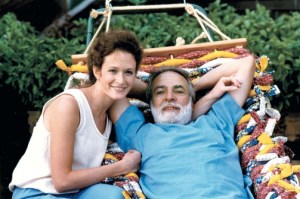
Karen Garver Santorum with former live-in lover
In fact, Karen told her older lover that he would like Rick, who was then pro-choice and “a humanist.” More from Hass’ story:
Mary and Herbert Greenberg, longtime friends of Allen’s through Herbert’s job as concertmaster of the Pittsburgh Symphony, recall that Karen had seemed entirely familiar and comfortable with the subject of abortion when the couples socialized. In October 1983, Mary Greenberg (who had moved to Baltimore with her husband) flew to Pittsburgh to consult Allen about an abortion. He directed her to colleagues at the Women’s Health Center; Karen, recalls Mary, immediately offered to accompany her to the clinic. “She told me it wasn’t that bad, that I shouldn’t be worried,” says Mary, who ultimately went on her own, and met Allen and Garver for dinner later that night. “She was very supportive.”
Allen says they split up because Karen wanted to have children and he had been there and done that already.
I’m just fascinated by this. I spent most of yesterday reading about the Santorums, and trying to figure out when and how their dramatic conversion took place. Neither was raised in a fundamentalist home, and neither was particularly religious before they got married. Then something happened. It really smells cult-like to me. I’m wondering if Santorum was approached by a fundamentalist group when he entered national politics. According to friends, he was a moderate Republican at first and then suddenly went off the deep end. If I can figure out what happened, I’ll write a post about it.
This is interesting. According to the Washington Times, fundy activists are now fighting over the endorsement of Santorum by the group of 150 who met in Texas on Sunday.
In an evolving power struggle, religious conservatives are feuding about whether a weekend meeting in Texas yielded a consensus that former Pennsylvania Sen. Rick Santorum is the best bet to stop Mitt Romney’s drive for the Republican presidential nomination.
A leading evangelical and former aide to President George H.W. Bush said he agreed with suspicions voiced by others at the meeting of evangelical and conservative Catholic activists that organizers “manipulated” the gathering and may even have stuffed the ballot to produce an endorsement of Mr. Santorum over former House Speaker Newt Gingrich.
Mr. Santorum, who nearly upset Mr. Romney in the Iowa caucuses, won the first ballot ahead of Mr. Gingrich in Saturday’s Texas meeting but the margin was too slim for organizers to claim a consensus. It was not until the third ballot, taken after many people had left to catch flights back home, that Mr. Santorum won more than 70 percent of those still in attendance and claimed the endorsement.
Former White House evangelical-outreach official Doug Wead, who represented GOP presidential hopeful Texas Rep. Ron Paul at the event, said it appeared the outcome obviously was determined in advance by the choice of the people invited.
The article is pretty funny. Read it if you enjoy fights among right wing nuts.
There has been talk that Romney was credited with too many votes in Iowa and should have come in second. Now Byron York is saying it could be true. According to York,
there is a very real chance that the Republican Party of Iowa will announce this week that Rick Santorum, and not Romney, won the Iowa caucuses.
Results released on caucus night — actually, at 2 the next morning — showed Romney won by eight votes, 30,015 to Santorum’s 30,007. Many observers assumed that those results were final, especially when party officials said there would be no recount.
But the results were not final. Even though there is no provision for a recount in the party caucuses, state GOP rules do require that the results be certified, which is nearly the same thing. That certification process began the day after the caucuses and is expected to wrap up this week, yielding a final, official vote tally…..
In the past two weeks, party employees have been working nearly nonstop to certify the results from each of Iowa’s 1,774 precincts. During that time, they have regularly briefed campaign representatives on what’s going on. In the next few days, they are expected to finish tallying and certifying the last Form Es and come up with official certified results.
The final numbers will be different from those released on caucus night. One campaign source says the vote count as of midday Monday showed Santorum ahead by 80-something votes. If that number holds through certification of the last precincts, Santorum will win. Of course, there is always the possibility that some of the final precincts will contain discrepancies that put Romney back on top. It’s just not clear.
Hmmmmmmm….
Many internet sites, including Sky Dancing plan to go dark tomorrow, Jan. 18, as a protest against the Stop on-line piracy (SOPA) and Protect IP (PIPA) acts. The big news last night was that Wikipedia is joining the protest.
Might want to get your Encyclopedia Britannica set out of storage: Wikipedia will go dark Wednesday, joining a growing number of popular websites staging an online revolt against two anti-piracy bills.
Founder Jimmy Wales made the announcement in tweets on Monday, telling followers his goal is to “melt phone systems in Washington” in opposition to the Stop Online Piracy Act in the House and the PROTECT IP Act in the Senate.
The online protest puts Wikipedia in the company of other websites such as Reddit and popular games such as Minecraft in leveraging its substantial size and clout to campaign against the bills. Wales suggested on Twitter the impact of the blackout could be significant, given that “comScore estimates the English Wikipedia receives 25 million average daily visitors globally.”
We’ll have more information today on Sky Dancing’s plans. As of now, we plan to black out our site beginning at 8AM Wednesday. The protest is scheduled to end at 8PM Wednesday night, so we’ll be posting after that.
That’s all I’ve got for you today. What are you reading and blogging about?
Live Blog: Iowa Caucuses
Posted: January 3, 2012 Filed under: 2012 presidential campaign, Republican politics, Republican presidential politics, U.S. Politics | Tags: 2012 presidential election, Iowa Caucuses, live blog, Republican primaries 121 Comments
Political signs in Des Moines, Iowa
The caucuses are just wrapping up, and it looks like I may get my wish. Ron Paul seems to be leading at the moment with Romney second, and Santorum third. I can’t wait to see the elite Republicans freak out if Paul wins. From CBS News:
Doors have closed at caucus precincts across Iowa, and early results from CBS News entrance polls show a three-way race for the Republican presidential nomination among Ron Paul, Mitt Romney and Rick Santorum.
Entrance polling reveals that Paul’s voters are male, younger, and many are first-time caucus goers. Romney’s voters are looking for someone who can beat President Obama, while Santorum’s voters looking for a true conservative.
Much data has yet to be collected, and those arriving earliest may not reflect the total caucus voters. The precincts closed their doors at 7 p.m. CT, leaving Republican voters in the Hawkeye State to be the first to weigh in on this year’s presidential contest. Mitt Romney took the lead among the early entrance polls four years ago, but finished second in the caucuses to Mike Huckabee, who was then the choice of evangelical conservatives.
USA Today has a Live Blog of events in Iowa, and so does CNN. CNN also has live video from several caucus sites.
I’m listening to MSNBC on satellite radio. What are you watching or listening to? What are you hearing? Who do you think is going to win this thing? Let us know in the comments. If you have found a good place to watch on-line, let me know and I’ll post it up here.
Tuesday Reads: Iowa Caucuses Edition
Posted: January 3, 2012 Filed under: 2012 presidential campaign, Mitt Romney, morning reads, Republican presidential politics, Team Obama, U.S. Politics | Tags: Barack Obama, Iowa Caucuses, Mitt Romney, Nate Silver, New Hampshire primary, Rick Santorum, Ron Paul 41 Comments
Good Morning!!
The Iowa Caucuses will be held tonight, and we’ll live blog the results later on. The outcome is still pretty much up in the air. I’m definitely rooting for Romney to lose, but I can’t decide whom I’d rather see come in first–Rick Santorum or Ron Paul. Neither one has a shot at the nomination, but I’d love to see the GOP elites scrambling if Paul wins it. I think they won’t get as upset by a Santorum win, but it would be irritating for them. Either Paul or Santorum could mess things up for Romney in New Hampshire, if they come out of Iowa with some momentum.
Nate Silver has his usual thorough analysis of the polls: Iowa Race Tightens in Final 48 Hours.
A new Public Policy Polling survey in Iowa, conducted Saturday and Sunday, shows a virtual three-way tie in advance of the Iowa caucuses. Ron Paul has a nominal lead with 20 percent of the vote in the poll, followed by Mitt Romney at 19 percent and Rick Santorum at 18 percent.
Our forecast model, which combines the Public Policy Polling survey with other recent polls of the state, also shows an effective three-way tie, although it has Mr. Romney ahead by the slimmest of margins. The model projects Mr. Romney to receive 21.0 percent of the vote, followed by Mr. Paul at 20.6 percent and Mr. Santorum — whose numbers have been on the rise — at 19.3 percent.
Silver notes that the PPP poll shows a weaker result for Romney’s than the Des Moines Register poll.
The most noteworthy feature of the Public Policy Polling survey is that it shows a slightly worse result for Mr. Romney than The Des Moines Register Iowa Poll, which was conducted Tuesday through Friday and had Mr. Romney at 24 percent of the vote.
We can interpret this in one of three ways. It may merely be random variance. It may reflect methodological differences between the surveys; the Des Moines Register poll calls cellphones, for instance, and uses live interviewers, which the Public Policy Polling survey does not. (Previous Public Policy Polling surveys have shown slightly better results for Mr. Paul, and slightly worse ones for Mr. Romney, than those conducted by other polling firms.)
Or it may suggest that that there has been a percentage point or two worth of erosion in Mr. Romney’s numbers, since the Public Policy Polling survey is the more recent of the two….There is some slight evidence for the latter theory in that Mr. Romney performed slightly worse in interviews that Public Policy Polling conducted on Sunday, receiving 18 percent of the vote to the 21 percent he received on Saturday.
Oh please, let Romney lose!
As for Mitt himself, he’s oozing confidence.
“You guys, I need you tomorrow night,” he told more than 600 people packed into an asphalt company’s truck garage. “I need every single vote in this room, and I need you to get a couple of other votes in your neighborhood, get them to caucus. I need a great showing here in Cedar Rapids. We’re going to win this thing with all our passion and strength and do everything we can to get this campaign on the right track to go across the nation and to pick up the states and to get the ballots I need and the votes I need to become our nominee. That’s what we’re going to get, with your help.”
Campaign aides later said that Romney meant he was going to win the nomination, not necessarily the caucuses.
Roger Simon of Politico says that Romney will be the nominee no matter how he does in Iowa.
If Mitt Romney wins the Iowa caucuses, the race for the Republican nomination is over.
If Mitt Romney comes in second in Iowa, the race for the Republican nomination is over.
And if Mitt Romney comes in third in Iowa, the race for the Republican nomination is over.
Why? Is his message of goodness and decency and American exceptionalism so overwhelmingly persuasive or are his personal attributes so awesomely compelling?
No. It’s because the Iowa caucuses do not pick winners as much as they eliminate losers. And the Iowa caucuses Tuesday are likely to eliminate from serious contention the only two men who might have blocked Romney’s path to victory: Newt Gingrich and Rick Perry.
Now that’s depressing. If Simon is right, we’ll have nothing to look forward to but a year of boring back and forth between ultra-boring Mitt and even more boring Barack. Ugh!
But the Republicans still want to find a Romney alternative. Suddenly Rick Santorum is raising big bucks, according to CNN.
Rick Santorum’s poll numbers aren’t the only thing on the rise. The former senator from Pennsylvania’s fundraising figures are also skyrocketing.
A senior Santorum adviser tells CNN the campaign raised more money in the last week than they raised on-line the past six months, adding that fundraising is between 300% and 400% higher on a daily basis than it was just ten days ago.
Yup, they can’t stand Romney and don’t want to get stuck with him. I can totally empathize with that too. I wonder if it bothers Romney that he’s so unwanted? I supposed not….
The candidates are still saying some pretty outrageous things. Mitt Romney compared President Obama to Kim Kardashian because he didn’t live up to his campaign promises. Ron Paul claimed that Rick Santorum is “very liberal” [!]
Ron Paul dinged rival Rick Santorum Monday for being a “very liberal” candidate, saying the former Pennsylvania senator and staunch social conservative voted for too much spending during his time in Congress.
Speaking to CNN Senior Congressional Correspondent Dana Bash before a campaign event with his son, Kentucky Sen. Rand Paul, the White House hopeful said his rival had taken positions counter to true conservative ideas.
And Rand Paul called Santorum a “war mongering moderate” on a talk radio show yesterday. Here are the relevant Rand Paul quotes via TPM:
He’s also someone who never served in the military. Ron Paul served in the military, will use force against our enemies if it’s required and if Congress approves of it, but I’m a little concerned about someone who didn’t serve in the military like Santorum, who’s a little over-eager to bomb countries because I don’t think he’s maturely thinking through the process and the consequences of war.
Well, you know you’re starting to see that some of the conservatives have gone here and there and they’re looking for someone who they think is their champion. But before they settle on Santorum they need to realize he was a big supporter of Medicare Part D, the expansion of Medicare, a big supporter of No Child Left Behind, I’ve seen him asked directly about the Department of Education, he’s for it. … We still believe in eliminating the Dept. of Education, that there is no function on the federal level for that. But Rick Santorum’s a big supporter of the Department of Education; he in fact voted to double the size of the Department of Education with No Child Left Behind. So I call him a big government moderate and I think conservatives need to be wary before thinking Santorum can be their champion.
Supporting the Department of Education? The horror!
The Daily Beast published a primer on the workings of the Iowa Caucuses yesterday for those (like me) who need a review of the process. Here’s the gist of it:
What happens at a caucus meeting?
At 7 p.m., caucus-goers will recite the Pledge of Allegiance and elect officers to run the meeting. Representatives from each campaign—usually campaign staffers—will give a brief speech urging those present to vote for their candidate. After the speeches, caucus-goers will write the name of their preferred candidate on a piece of paper, and campaign representatives will watch while they are counted. The caucus will then report the results to the room, and then by phone to the Iowa Republican Party. Caucus-goers will finish the night by picking delegates and writing platform resolutions—building blocks of a party manifesto—for the county GOP convention. The Iowa GOP will announce the statewide results to the media and on its website.
Yes, there will be Democratic caucuses, even though there’s no competition for Obama.
Jan Bauer fondly recalls the energy that then-candidate Barack Obama brought to Iowa in the 2008 Democratic presidential caucuses and the razor-sharp ground game that paved his road from here to the White House.
Four years later, Bauer finds herself calling other Story County Democrats to remind them that they have important political work to do Tuesday just like their Republican counterparts – even if Obama is unopposed for their party’s nomination.
“A lot of Democrats aren’t even aware that we’re caucusing,” said Bauer, Democratic chairwoman in the county that includes Ames, home to Iowa State University. “We’re getting little to no attention in the media … but we still have to reorganize the party.”
Obama will be speaking to them by satellite.
There’s also an fascinating article at the Daily Beast about Obama’s tightly controlled reelection operation. These guys sound like a lot of frat boys–or maybe Skull and Bones members. I’ve annotated the following for those (like me) who aren’t hip to current yuppie culture.
The Obama campaign is not kidding around. I recently visited its headquarters in Chicago, and I can personally vouch for how much it’s not kidding around. Yes, there was a blue Ping-Pong table in the middle of the office—custom-made, evidently, because the Obama 2012 logo was emblazoned on it. (Twice.) There were printouts of people’s nicknames—Sandals! Shermanator!—where corporate nameplates usually go. There was a mesh trucker hat from South Dakota, which was blaze orange and said “Big Cock Country” on the crown. There was a cardboard speech bubble (“nom nom data nom”) affixed to an Uglydoll. There was miniature air-hockey table. A narwhal mural. A stuffed Rastafarian banana.
But do not be deceived. There was also a chaperone following me everywhere I went and digitally recording everything anyone said to me. Ben LaBolt, Obama’s press secretary, and Stephanie Cutter, his deputy campaign manager, closed their doors as I walked by. An underling clammed up when I asked what she and her colleagues do on the weekends. At one point my minder agreed to let me out of her sight for a few milliseconds, but then I got too close to a big whiteboard covered in hieroglyphic flow charts and she instantaneously materialized at my side, having somehow teleported the 50 yards from where I’d last seen her. “Sorry,” she said, not sounding sorry at all. “You can’t look at that.” The next day it was covered by a tarp.
Sigh…. These are the people who are running the Democratic Party …. and the country. Now what are you reading and blogging about today?
Thursday Reads: Primary Season is Upon Us
Posted: December 29, 2011 Filed under: 2012 presidential campaign, Republican presidential politics, Surreality, U.S. Politics | Tags: Iowa Caucuses, Michele Bachmann, Mitt Romney, New Hampshire primary, Newt Gingrich, Rick Santorum, Ron Paul 41 Comments
Good Morning!!
It’s hard to believe, but the Iowa Caucuses are just a few days away, next Tuesday, January 3. The New Hampshire primary will be held on January 10. The South Carolina and Florida primaries will be on January 21 and 31 respectively.
I’ll be focusing on the Republican primary campaign this morning, but please do post links to other stories that interest you in the comments.
Unfortunately, there’s no primary contest on the Democratic side, so we’re reduced to watching the Republicans. The good news is that the Republican candidates are entertaining to watch–that is, if your taste in entertainment runs toward the bizarre, the ironic, and the surreal and if you enjoy black humor.
Yesterday morning’s PPP poll showed Ron Paul still leading in Iowa.
The last week and a half has brought little change in the standings for the Iowa Republican caucus: Ron Paul continues to lead Mitt Romney by a modest margin, 24-20. Newt Gingrich is in 3rd at 13% followed by Michele Bachmann at 11%, Rick Perry and Rick Santorum at 10%, Jon Huntsman at 4%, and Buddy Roemer at 2%.
Paul’s strength in Iowa continues to depend on a coalition of voters that’s pretty unusual for a Republican in the state. Romney leads 22-20 with those who are actually Republicans, while Paul has a 39-12 advantage with the 24% who are either independents or Democrats. GOP caucus voters tend to skew old, and Romney has a 34-12 advantage with seniors. But Paul’s candidacy looks like it’s going to attract an unusual number of younger voters to the caucus this year, and with those under 45 he has a 35-11 advantage on Romney. The independent/young voter combo worked for Barack Obama in securing an unexpectedly large victory on the Democratic side in 2008 and it may be Paul’s winning equation in 2012.
The poll showed that Paul’s supporters are much more “passionate” than Romney’s, and Romney’s approval rating with Iowa voters had dropped from 49 to 44 percent. Interestingly, Romney is doing well with Fox News watchers, while Paul does much better with voters who don’t watch Fox.
Later in the day yesterday, the CNN/Time/ORC poll showed Romney ahead of Paul with likely Caucus-goers 25 to 22 percent, with Gingrich continuing to lose support rapidly and Rick Santorum surging, as Gingrich supporters move to him.
A new survey of people likely to attend Iowa’s Republican caucuses indicates that the former House speaker’s support in the Hawkeye State is plunging. And according to a CNN/Time/ORC International Poll, one-time long shot candidate Rick Santorum has more than tripled his support since the beginning of the month.
Twenty-five percent of people questioned say if the caucuses were held today, they’d most likely back Mitt Romney, with 22% saying they’d support Rep. Ron Paul of Texas. Romney’s three point margin is within the poll’s sampling error….
In Iowa, both Romney and Paul are each up five points among likely caucus goers from a CNN/Time/ORC poll conducted at the start of December. The new survey indicates that Santorum, the former senator from Pennsylvania, is at 16% support, up 11 points from the beginning of the month, with Gingrich at 14%, down from 33% in the previous poll. Since Gingrich’s rise late last month and early this month in both national and early voting state surveys, he’s come under attack by many of the rival campaigns.
Santorum’s increasing support is coming mostly from the right wing Christians.
“Most of Santorum’s gains have come among likely caucus participants who are born-again or evangelical, and he now tops the list among that crucial voting bloc, with support from 22% of born-agains compared to 18% for Paul, 16% for Romney, and 14% for Gingrich,” says CNN Polling Director Keating Holland.
It certainly looks like Iowa tea party voters are still seeking an anti-Romney candidate to get behind. The CNN/Time/ORC poll also sampled New Hampshire voters and found Romney still leading there.
Establishment Republicans are rooting hard for Mitt Romney. Everyone on Morning Joe yesterday was confident that he would eventually take the nomination. At Politico, Maggie Haberman, Jonathan Martin, and Alexander Burns report that Romney is “within striking distance” of winning Iowa.
Even as he tried to keep talk about his prospects in check Tuesday, a slew of public and private polling and anecdotal evidence on the ground suggests that Romney is within striking distance of a first-place finish in Iowa — especially as Ron Paul’s momentum spurt appears to have run into the reality of front-runners’ scrutiny.
Romney’s team is moving to make the most of it. The candidate launched a bus tour Tuesday and suggested on a conference call with Iowans this week that he’ll be in the state for New Year’s Eve. After a solid ad buy in Iowa for a month totaling more than $1.1 million, Romney’s camp has upped its spending in the Quad Cities market, sources familiar with the purchase told POLITICO. His team has dropped a collection of mail pieces, both positive about Romney and negative about the perceived closest alternative — Newt Gingrich.
In another clear sign he’s playing to win, he has quietly moved a handful of staffers from his headquarters in Boston and in other states earlier this month to give his skeleton Iowa staff a needed boost. And he’s cycling in a platoon of high-profile surrogates to rally around him in the state at stump stops and on talk radio, including Gov. Chris Christie, Sen. John Thune, Rep. Aaron Schock and former Sens. Norm Coleman and Jim Talent.
At Philly.com, blogger Erik Uliasz argues that Ron Paul will win in Iowa, because he has the best organization in the state.
The caucuses are not won by opinion polls alone. They’re won by the politician who can pack Iowa’s churches, libraries and community centers at 7 p.m. exactly on a frigid January Tuesday, and whose supporters won’t suddenly decide to back a different candidate during an hour’s worth of jawing, dealing and very public voting.
Unlike other “flavors of the week” of the GOP contest, Paul hasn’t surged into the lead all of a sudden — he’s grown his support gradually, earning supporters the hard way.
And that’s why Paul’s surge to first place has to be taken seriously. Alone among the candidates, he has built an organizational machine to recruit and identify caucus-goers and turn them out on Jan. 3. Paul’s rise in Iowa isn’t a bubble. It’s a mound, and it is rock solid….
Paul’s campaign has built a sophisticated voter turnout machine. With its intensely dedicated core of youthful followers recruiting non-party regulars to the caucus electorate, it is reminiscent of nothing so much as Barack Obama’s 2008 Iowa campaign, which was his springboard to the Democratic nomination.
In addition, the fact that there are no candidates competing with Obama in the Democratic caucuses will help Paul. Much of his support comes from Democrats and Independents (see PPP poll results above), and they can attend the Republican caucuses.
At CNN though, Micah Sifry writes that “Paulbots,” who sound remarkably like the Obots of 2008, might “torpedo” his campaign by being too obnoxious and too up front about Paul’s real beliefs, as reflected in the recently released old newsletters. Sifry writes that
there’s a paradox buried inside Paul’s rise in the Republican field, a time bomb ticking away. Call it the curse of the “Paulbots.”
The more Paul rises, the more he needs to temper his rhetoric and fine-tune his message (especially given the kind of baggage he carries). And the more he needs a fine-tuned message, the more he has to control his fractious fans. But people who organize themselves online today are notoriously hard to control.
They sure do sound like Obots:
Recall how in 2007, the “Paulbots” were everywhere: running up the numbers on every online poll they could find, generating one-day fundraising records in a desperate bid for national attention (they coined the word “money-bomb”), and creating massive amounts of voter-generated media on his behalf. They made everything from viral videos to a Ron Paul blimp….
This year the Paulbots have been a bit calmer and more under the radar says Sifry.
But things are about to get a bit crazy. Paul’s late surge and possible win next week in Iowa are going to generate a huge burst of national media attention and plenty of hard-edged questions about his past and views. And the Paulbot base doesn’t handle criticism very well.
The other day, for example, my techPresident colleague Sarah Lai Stirland reported on a growing battle breaking out on the massive social news filtering site Reddit between Paul supporters and critics tired of their efforts to “spam” Redditors with slanted news favoring Paul. Vocal Paul supporters outnumber their critics on the site, but their language and tactics are often arrogant and ugly. Passion can power a campaign, but self-righteousness can also cripple it.
Here’s a little sample of the kinds of information the Paul people might not want spread far and wide in the national media. From Talking Points Memo:
Paul’s Iowa chair, Drew Ivers, recently touted the endorsement of Rev. Phillip G. Kayser, a pastor at the Dominion Covenant Church in Nebraska who also draws members from Iowa, putting out a press release praising “the enlightening statements he makes on how Ron Paul’s approach to government is consistent with Christian beliefs.” But Kayser’s views on homosexuality go way beyond the bounds of typical anti-gay evangelical politics and into the violent fringe: he recently authored a paper arguing for criminalizing homosexuality and even advocated imposing the death penalty against offenders based on his reading of Biblical law.
“Difficulty in implementing Biblical law does not make non-Biblical penology just,” he argued. “But as we have seen, while many homosexuals would be executed, the threat of capital punishment can be restorative. Biblical law would recognize as a matter of justice that even if this law could be enforced today, homosexuals could not be prosecuted for something that was done before.”
Reached by phone, Kayser confirmed to TPM that he believed in reinstating Biblical punishments for homosexuals — including the death penalty — even if he didn’t see much hope for it happening anytime soon. While he said he and Paul disagree on gay rights, noting that Paul recently voted for repealing Don’t Ask Don’t Tell, he supported the campaign because he believed Paul’s federalist take on the Constitution would allow states more latitude to implement fundamentalist law. Especially since under Kayser’s own interpretation of the Constitution there is no separation of Church and State.
And this is interesting: Michele Bachmann’s Iowa campaign manager has switched horses and joined the Ron Paul campaign.
In a surprise move, and a blunt reflection of the shifting fortunes of Republican presidential candidates ahead of the opening vote in the 2012 nominating contest, Michele Bachmann’s Iowa campaign chairman defected Wednesday night to Ron Paul’s campaign.
State Sen. Kent Sorenson, a tea party favorite, was hired as a Bachmann staffer in Iowa even before she announced her candidacy. He helped lead her campaign to victory in the Ames straw poll in August. Ever since, however, Bachmann’s popularity has been in decline….
“It’s difficult, but it’s the right thing to do,” Sorenson said, announcing his decision before a crowd of several hundred at a Veterans for Ron Paul rally at the Iowa State Fairgrounds in Des Moines.
Sorenson predicted that Paul would be the object of attacks by the Republican establishment in the days ahead, and said he wanted to help defend him.
The Texas congressman welcomed his newest staffer in understated fashion, thanking Sorenson for “stopping by. That was very nice.”
So, there’s lots of intrigue in Iowa, and next week the focus will move to New Hampshire. If Ron Paul really does pull off a win or even a close second in Iowa, I would not be at all surprised to see him do very well or even win in New Hampshire. At least it might be fun to watch the Republican insiders squirm if that happens.
What do you think? And what are you reading and blogging about today?

 peej
peej Carissa
 bostonboomer
 dakinikat
 ecocatwoman
 mablue2
 Mama Lopez
 peggysue22
 quixote
 skydancingguestblogger
 Mona (aka Wonk the Vote)



 Sky Dancing
Recent Comments