Read more at Politico.
Donald Trump suffered the biggest defeat yet to his tariff policies on Friday, as a federal appeals court ruled he had overstepped his presidential powers when he enacted punitive financial measures against almost every country in the world.
In a 7-4 ruling, the Washington DC court said that while US law “bestows significant authority on the president to undertake a number of actions in response to a declared national emergency”, none of those actions allow for the imposition of tariffs or taxes.

Flyball sees a Martian fish.
It means the ultimate ruling on the legality of Trump’s tariffs, which were famously based on spurious economic science and rocked the global economy when he announced them in April, will probably be made by the US supreme court….
The decision centers on the tariffs Trump introduced on 2 April, on what he called “liberation day”. The tariffs set a 10% baseline on virtually all of the US’s trading partners and so-called “reciprocal” tariffs on countries he argued have unfairly treated the US. Lesotho, a country of 2.3 million people in southern Africa, was hit with a 50% tariff, while Trump also announced a tariff of 10% on a group of uninhabited islands populated by penguins.
The ruling voided all those tariffs, the judges finding the president’s measures “are unbounded in scope, amount and duration”. They said the tariffs “assert an expansive authority that is beyond the express limitations” of the law his administration used to pass them.
Tariffs typically need to be approved by Congress, but Trump claimed he has the right to impose tariffs on trading partners under the International Emergency Economic Powers Act (IEEPA), which in some circumstances grants the president authority to regulate or prohibit international transactions during a national emergency.
The court ruled: “It seems unlikely that Congress intended, in enacting IEEPA, to depart from its past practice and grant the president unlimited authority to impose tariffs.”
Trump invoked the same law in February to impose tariffs on Canada, Mexico and China, claiming that the flow of undocumented immigrants and drugs across the US border amounted to a national emergency, and that the three countries needed to do more to stop it.
Read the rest at The Guardian.
A federal judge on Friday blocked the Trump administration from carrying out fast-track deportations of people detained far from the southern border, removing, for now, one of the cornerstones of President Trump’s campaign to carry out mass deportations.
The case focused on a policy shift announced during the first week of Mr. Trump’s second term that authorized the Department of Homeland Security to launch quick deportations, across the country and without court proceedings, of undocumented immigrants who cannot prove they have lived in the country for more than two years.
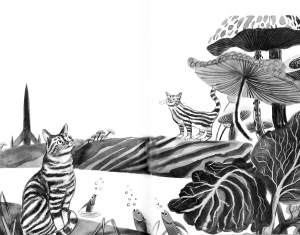
Flyball sees Moofa for the first time.
Such quick deportations, known as expedited removal, have been carried out for decades, but they were concentrated among people arrested at or near the southern border. The Trump administration sought to expand the practice nationwide, to hasten the removal of people arrested deep inside the country.
In a 48-page opinion, Judge Jia M. Cobb of the U.S. District Court for the District of Columbia wrote that the Trump administration had acted recklessly in a frenzied effort to quickly remove as many people as possible, likely violating due process rights and risking wrongful detentions.
She wrote that the administration had taken over a process that was once as simple as turning back migrants with negligible ties to the United States “after a single conversation with an immigration officer” near the southern border, making it a default practice in places as far away as New York.
“When it comes to people living in the interior of the country, prioritizing speed over all else will inevitably lead the government to erroneously remove people via this truncated process,” Judge Cobb wrote.
Dakinikat wrote yesterday that Trump cancelled Secret Service protection for former VP Kamala Harris. California Governor Gavin Newsom will pick up the slack.
The Los Angeles Times: CHP to protect ex-VP Kamala Harris after Trump pulls Secret Service detail, sources say.
Former Vice President Kamala Harris will receive protection from the California Highway Patrol after President Trump revoked her Secret Service protection, law enforcement sources said Friday.
California officials put in place a plan to provide Harris with dignitary protection after Trump ended an arrangement that gave his opponent in last year’s election extended Secret Service security coverage.
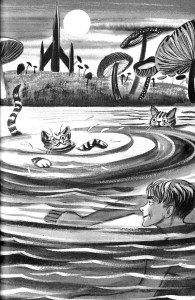
Fred, Moofa and a reluctant Flyball swim in the Martian canal.
Trump signed a memorandum on Thursday ending Harris’ protection as of Monday, according to sources not authorized to discuss the security matter.
Former vice presidents usually get Secret Service protection for six months after leaving office, while ex-presidents get protection for life. But before his term ended, then-President Biden signed an order to extend Harris’ protection beyond six months to July 2026. Aides to Harris had asked Biden for the extension. Without it, her security detail would have ended last month, according to sources.
Gov. Gavin Newsom, who would need to sign off on such CHP protection, would not confirm the arrangement. “Our office does not comment on security arrangements,” said Izzy Gordon, a spokesperson for Newsom. “The safety of our public officials should never be subject to erratic, vindictive political impulses.”
The decision came after Newsom’s office and Los Angeles Mayor Karen Bass were in discussions Thursday evening on how best to address the situation. Harris resides in the western portion of Los Angeles.
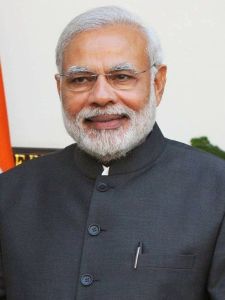
Trump has alienated India’s Prime Minister Narendra Modi and may have driven him to align of China, Russia, and North Korea.
Mujib Mashal, Tyler Pager, and Anupreeta Das at The New York Times (gift link): The Nobel Prize and a Testy Phone Call: How the Trump-Modi Relationship Unraveled.
Prime Minister Narendra Modi of India was losing patience with President Trump.
Mr. Trump had been saying — repeatedly, publicly, exuberantly — that he had “solved” the military conflict between India and Pakistan, a dispute that dates back more than 75 years and is far deeper and more complicated than Mr. Trump was making it out to be.
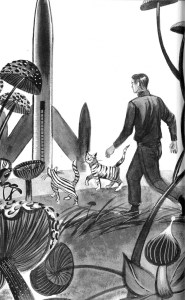
Fred and the cats walk to the spaceship Halley.
During a phone call on June 17, Mr. Trump brought it up again, saying how proud he was of ending the military escalation. He mentioned that Pakistan was going to nominate him for the Nobel Peace Prize, an honor for which he had been openly campaigning. The not-so-subtle implication, according to people familiar with the call, was that Mr. Modi should do the same.
The Indian leader bristled. He told Mr. Trump that U.S. involvement had nothing to do with the recent cease-fire. It had been settled directly between India and Pakistan.
Mr. Trump largely brushed off Mr. Modi’s comments, but the disagreement — and Mr. Modi’s refusal to engage on the Nobel — has played an outsize role in the souring relationship between the two leaders, whose once-close ties go back to Mr. Trump’s first term.
The dispute has played out against the backdrop of trade talks of immense importance to India and the United States, and the fallout risks pushing India closer to American adversaries in Beijing and Moscow. Mr. Modi is expected to travel to China this weekend, where he will meet with President Xi Jinping and President Vladimir V. Putin of Russia.
Use the gift link to read the rest, if you’re interested.
I’ll end with this disturbing piece from Jonathan Freedland at The Guardian: Step back and take it in: the US is entering full authoritarian mode.
If this were happening somewhere else – in Latin America, say – how might it be reported? Having secured his grip on the capital, the president is now set to send troops to several rebel-held cities, claiming he is wanted there to restore order. The move follows raids on the homes of leading dissidents and comes as armed men seen as loyal to the president, many of them masked, continue to pluck people off the streets …
Except this is happening in the United States of America and so we don’t quite talk about it that way. That’s not the only reason. It’s also because Donald Trump’s march towards authoritarianism is so steady, taking another step or two every day, that it’s easy to become inured to it: you can’t be in a state of shock permanently. And, besides, sober-minded people are wary of sounding hyperbolic or hysterical: their instinct is to play down rather than scream at the top of their voice.
There’s something else, too. Trump’s dictator-like behaviour is so brazen, so blatant, that paradoxically, we discount it. It’s like being woken in the night by a burglar wearing a striped shirt and carrying a bag marked “Swag”: we would assume it was a joke or a stunt or otherwise unreal, rather than a genuine danger. So it is with Trump. We cannot quite believe what we are seeing.
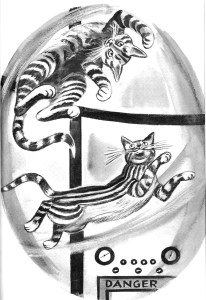
Flyball and Moofa weightless and happy as kittens.
But here is what we are seeing. Trump has deployed the national guard on the streets of Washington DC, so that there are now 2,000 troops, heavily armed, patrolling the capital. The pretext is fighting crime, but violent crime in DC was at a 30-year low when he made his move. The president has warned that Chicago will be next, perhaps Baltimore too. In June he sent the national guard and the marines into Los Angeles to put down protests against his immigration policies, protests which the administration said amounted to an “insurrection”. Demonstrators were complaining about the masked men of Ice, the immigration agency that, thanks to Trump, now has a budget to match that of the world’s largest armies, snatching people from street corners or hauling them from their cars.
Those cities are all run by Democrats and, not coincidentally, have large Black populations. They are potential centres of opposition to Trump’s rule and he wants them under his control. The constitution’s insistence that states have powers of their own and that the reach of the federal government should be limited – a principle that until recently was sacred to Republicans – can go hang.
A bit more:
Control is the goal, amassing power in the hands of the president and removing or neutering any institution or person that could stand in his way. That is the guiding logic that explains Trump’s every action, large and small, including his wars on the media, the courts, the universities and the civil servants of the federal government. It helps explain why FBI agents last week mounted a 7am raid on the home and office of John Bolton, once Trump’s national security adviser and now one of his most vocal critics. And why the president hinted darkly that the former New Jersey governor Chris Christie is in his sights.
It’s why he has broken all convention, and possibly US law, by attempting to remove Lisa Cook as a member of the board of the Federal Reserve on unproven charges of mortgage fraud. Those charges are based on information helpfully supplied by the Trump loyalist installed as federal housing director and who, according to the New York Times, has repeatedly leveraged “the powers of his office … to investigate or attack Mr Trump’s most recognisable political enemies”. The pattern is clear: Trump is using the institutions of government to hound his foes in a manner that recalls the worst of Richard Nixon – though where Nixon skulked in the shadows, Trump’s abuses are in plain sight.
And all in the pursuit of ever more power. Take the firing of Cook.With falling poll numbers, especially on his handling of the economy, he craves the sugar rush of an interest rate cut. The independent central bank won’t give it to him, so he wants to push the Fed out of the way and grab the power to set interest rates himself. Note the justification offered by JD Vance this week, that Trump is “much better able to make those determinations” than “unelected bureaucrats” because he embodies the will of the people. The reasoning is pure authoritarianism, arguing that a core principle of the US constitution, the separation of powers, should be swept aside, because all legitimate authority resides in one man alone.
Read the rest at The Guardian.
Those are my offerings for today. Have a great Labor Day weekend!




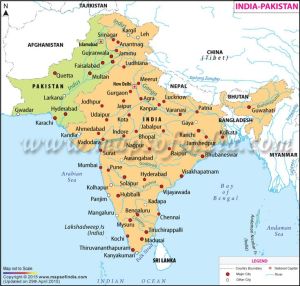
 The sharp rise in tensions follows a deadly April 22 attack on tourists near the town of Pahalgam in Indian-administered Kashmir.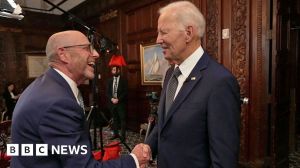



 peej
peej Carissa
 bostonboomer
 dakinikat
 ecocatwoman
 mablue2
 Mama Lopez
 peggysue22
 quixote
 skydancingguestblogger
 Mona (aka Wonk the Vote)



 Sky Dancing
Recent Comments