
We Interrupt your Regularly Scheduled Programming for a Bit of Deprogramming
Posted: April 12, 2011 Filed under: Catfood Commission, Domestic Policy, Economic Develpment, financial institutions, income inequality | Tags: helping the world's poor, Income Inequality, tax havens 9 Comments
Uncle Barrack sez: Time to feed the Corporate Kitty
It’s time for my regular rant on how bad income inequality is for an economy. I know that John Boenher wants to transfer all the resources in the country to so-called job creators and that CEO Hacks are trying to turn the public school system into a drone production unit, but as usual, I’m going to interrupt the messaging with empirical evidence. I’m just one of those people that doesn’t believe any one unless they back it up with honest numbers. This time, I’m going to direct you to a study by the International Monetary Fund (IMF). Just in case you don’t already know, the IMF is not exactly a bastion of comrades-in-arms. They’ve been soundly criticized by developing nations for exporting American-style capitalism wherever they go to provide help to struggling nations. So, with that in mind, here’s a briefing on the study titled “Warning! Inequality May be Hazardous to your Health”.
Their introduction is so meaty that I’m going to leave it nearly wholesale for you before I return to editing more things for a development journal. Finding ways to raise every one’s boat is my thing, just in case you never noticed.
Many of us have been struck by the huge increase in income inequality in the United States in the past thirty years. The rich have gotten much richer, while just about everyone else has had very modest income growth.
Some dismiss inequality and focus instead on overall growth—arguing, in effect, that a rising tide lifts all boats. But assume we have a thousand boats representing all the households in the United States, with boat length proportional to family income. In the late 1970s, the average boat was a 12 foot canoe and the biggest yacht was 250 feet long. Thirty years later, the average boat is a slightly roomier 15 footer, while the biggest yacht, at over 1100 feet, would dwarf the Titanic! When a handful of yachts become ocean liners while the rest remain lowly canoes, something is seriously amiss.
In fact, inequality matters. And it matters in all corners of the globe. You need look no further than the role it might have played in the historic transformation underway in the Middle East.
The increase in U.S. income inequality in recent decades is strikingly similar to the increase in the 1920s. In both cases there was a boom in the financial sector, poor people borrowed a lot, and it all ended in huge financial crises. Did the recent financial crisis result somehow from the increase in inequality?
Some time ago, we became interested in long periods of high growth (“growth spells”) and what keeps them going. The initial thought was that sometimes crises happen when a “growth spell” comes to an end, as perhaps occurred with Japan in the 1990s.
We approached the problem as a medical researcher might think of life expectancy, looking at age, weight, gender, smoking habits, etc. We do something similar, looking for what might bring long “growth spells” to an end by focusing on factors like political institutions, health and education, macroeconomic instability, debt, trade openness, and so on.
Somewhat to our surprise, income inequality stood out in our analysis as a key driver of the duration of “growth spells”.
We found that high “growth spells” were much more likely to end in countries with less equal income distributions. The effect is large. For example, we estimate that closing, say, half the inequality gap between Latin America and emerging Asia would more than double the expected duration of a “growth spell”. Inequality seemed to make a big difference almost no matter what other variables were in the model or exactly how we defined a “growth spell”. Inequality is of course not the only thing that matters but, from our analysis, it clearly belongs in the “pantheon” of well-established growth factors such as the quality of political institutions or trade openness.
While income distribution within a given country is pretty stable most of the time, it sometimes moves a lot. In addition to the United States in recent decades, we’ve also seen changes in China and many other countries. Brazil reduced inequality significantly from the early 1990s through a focused set of transfer programs that have become a model for many around the world. A reduction of the magnitude achieved by Brazil could—albeit with uncertainty about the precise effect—increase the expected length of a typical “growth spell” by about 50 percent.
The upshot? It is a big mistake to separate analyses of growth and income distribution. A rising tide is still critical to lifting all boats. The implication of our analysis is that helping to raise the lowest boats may actually help to keep the tide rising!
That basically says that no one’s boat will really rise as much as it could unless all boats rise. Intuitively, this makes sense because if you think about it, businesses need customers. Poor customers just don’t buy as much unless you provide them with good incomes. Unless you want make government the primary customer in an economy or you’re deluded into thinking business investment will ever be the major agent in GDP, you realize that household consumers are the true center of any market economy. Denying them incomes denies every one of incomes. Just providing monies to the top 1 or 2 percent who are now likely to take their spending and investment any where on the planet is just delusional. Actually, if you want some really good reading on that, I suggest you pick up the book Tax Havens: How Globalization Really Works (Cornell Studies in Money).
In Tax Havens, Ronen Palan, Richard Murphy, and Christian Chavagneux provide an up-to-date evaluation of the role and function of tax havens in the global financial system-their history, inner workings, impact, extent, and enforcement. They make clear that while, individually, tax havens may appear insignificant, together they have a major impact on the global economy. Holding up to $13 trillion of personal wealth—the equivalent of the annual U.S. Gross National Product—and serving as the legal home of two million corporate entities and half of all international lending banks, tax havens also skew the distribution of globalization’s costs and benefits to the detriment of developing economies.
The first comprehensive account of these entities, this book challenges much of the conventional wisdom about tax havens. The authors reveal that, rather than operating at the margins of the world economy, tax havens are integral to it. More than simple conduits for tax avoidance and evasion, tax havens actually belong to the broad world of finance, to the business of managing the monetary resources of individuals, organizations, and countries. They have become among the most powerful instruments of globalization, one of the principal causes of global financial instability, and one of the large political issues of our times.
There’s not really much difference between the Gadhaffi family and the Koch brothers when it comes to where the money goes from exploiting national resources. It’s also really no surprise that when you observe the countries that have the highest per capita incomes in the world that you find the world’s tax havens in the top tiers. (Norway and the US are the only countries in the top ten that aren’t tax havens.) Giving money to the richest folks in your country–the behavior of so-called banana republics–is detrimental to the economic health of that country in many ways. It’s just another way that financial institutions and financial innovation has gutted the productive capability of many a country.
The original IMF study–released on April 8, 2011–is here. I would like to point to the policy implications and suggestions section which makes going to the original study imperative. Think about this when you listen to US banana republic President Obama speak tomorrow on the marvels of the catfood commission’s report. Notice there are other studies cited in the policy suggestions.
There is nonetheless surely policy scope to improve income distribution without undermining incentives—perhaps even improving them—and thereby contribute to lengthening the duration of growth spells.
- Better targeting of subsidies can be a win-win proposition, as with the reallocation of fiscal resources towards subsidies of goods that are consumed mainly by the poor,which can free up capacity to finance public infrastructure investment while better protecting the poor (Coady et al., 2010).
- Active labor market policies to foster job-richer recoveries (ILO, 2011) may help to make recoveries more sustainable, especially as rising unemployment appears to be associated with deteriorations in the income distribution (Heathcote, Perri, and Violante, 2010).
- Equality of opportunity can make for both more equal and more efficient outcomes (World Bank, 2005). For example, effective investments in health and education—human capital—may be able to square the circle of promoting durable growth and equity while avoiding shorter-run disincentive effects (Gupta et al., 1999). Such investments could strengthen the labor force‘s capacity to cope with new technologies (which may have contributed to more inequality in a number of cases), and thereby not only reduce inequality but also help sustain growth. They could also help countries address possible adverse distributional consequences of globalization and reinforce its growth benefits.
- Some countries have managed through pro-poor policies to markedly reduce income inequality. Brazil, for example, after its market-oriented reforms of 1994 implemented active propoor distributional policies, notably, social assistance spending, that were critical to substantial reductions in poverty (Ravallion, 2009).
- Well-designed progressive taxation and adequate bargaining power for labor can also be important in promoting equity, though with due attention to the need to avoid dual labor markets that perpetuate divisions between insiders and outsiders.
Yes, I bolded the sections that are in absolute contradiction with current US political groupthink. I guess Obama just really isn’t that into development policy or research in economics. Read them and weep for what could be. Meanwhile, turn on the TV and go right back to the villagers promoting the idea that trickle up economics makes all of us better off, if you dare.
Income Inequality, Redux
Posted: April 1, 2011 Filed under: income inequality, poverty, The Media SUCKS, the villagers | Tags: Income Inequality, joseph stiglitz, the one percenters, trust fund WATB 12 Comments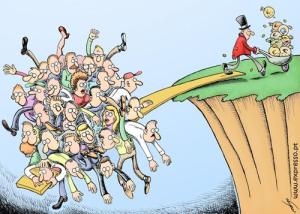
US Income Inequality – Too Big To Ignore
I had to frontpage this because I just can never make this point enough. Vast income inequality is not the sign of a healthy society or economy. H/t to Corrente for my first look at this Joseph Stiglitz article at Vanity Fare called ‘Of the 1%, by the 1%, for the 1%’. We’re back to the Versailles days and the Bush tax policies–extended by Obama–are a good part of the source of the problem. I hate to just lift just one paragraph out of Stiglitz’ rant because the entire thing is worth reading. However, here’s two for starters. Go read the entire thing, please.
But one big part of the reason we have so much inequality is that the top 1 percent want it that way. The most obvious example involves tax policy. Lowering tax rates on capital gains, which is how the rich receive a large portion of their income, has given the wealthiest Americans close to a free ride. Monopolies and near monopolies have always been a source of economic power—from John D. Rockefeller at the beginning of the last century to Bill Gates at the end. Lax enforcement of anti-trust laws, especially during Republican administrations, has been a godsend to the top 1 percent. Much of today’s inequality is due to manipulation of the financial system, enabled by changes in the rules that have been bought and paid for by the financial industry itself—one of its best investments ever. The government lent money to financial institutions at close to 0 percent interest and provided generous bailouts on favorable terms when all else failed. Regulators turned a blind eye to a lack of transparency and to conflicts of interest.
When you look at the sheer volume of wealth controlled by the top 1 percent in this country, it’s tempting to see our growing inequality as a quintessentially American achievement—we started way behind the pack, but now we’re doing inequality on a world-class level. And it looks as if we’ll be building on this achievement for years to come, because what made it possible is self-reinforcing.
The other reason that I decided to front page this is the here-here response from Michael Tomasky at the UK Guardian. It’s aptly called ‘Sad, just sad’. He mentions something we’ve said for some time. The villagers are also the beneficiaries of this kind of windfall. Why would those DC beltway types want to downsize when they can blame teachers, nurses, firefighters, and police officers for all those budget woes? It’s the overgenerous tax cuts. A nation can’t sustain itself without roads, airports, electrical grids, education, and public health and safety programs unless your idea of an ideal nation is that found in the Grapes of Wrath.
Stiglitz might have added the very important point that the majority of the country’s most prominent pundits who go on television and interpret all this for the American people, who soothe their audiences with assurances that all this is completely reasonable, are in the top 1%, which means households above around $380,000 per year. Many of course are far above that (Bill O’Reilly, Rush Limbaugh, etc.). High-end print journalists who aren’t quite at that level are still likely in the top 2%.
Anyway, the piece makes many important points, all of which boil down to the idea that while income inequality has several initial causes, there is only one thing that sustains it: a political process that is owned lock, stock and barrel by the top 1%.
Stepping back and looking at this context, and staying aware of it, makes watching these budget cuts particularly noxious. That’s not to say there isn’t waste, fine. But it is to say that the US political system of today is pretty inevitably designed to help the rich and punish the poor. So it’s no surprise when GOP Congressman Paul Ryan proposes, as he just has, cutting $1 trillion from Medicaid, which provides health care for poor people and the disabled (and to some extent, a greater extent than many people are aware, middle-class families, too, in the form of nursing-home cost support or in-home services like those from NY CDPAP agency).
Yes, Medicaid costs are high, killing the states. The feds could actually pick them up. Ronald Reagan proposed doing this. But that would be radical today. If Americans, especially wealthy ones, were paying taxes (income and capital gains) even at the rate we were in the Reagan era, we’d have no budget problems.
This brings me to the latest “Dopiest Constitutional Amendment of All Time” discussed by former economist Bruce Bartlett. The very same people that gutted tax revenues and funding sources for ten years and went on a spending spree on Treasury Bills now want to demand a federal balanced budget amendment. It’s not like watching the states get into deep trouble with their own versions of the stupid thing has taught any lessons. Balanced budget amendments simply lead to bad economics. When the revenues come in, the politicians spend like crazy on unnecessary things because the money’s there and the economy doesn’t require the expenditures. When the recession hits, the revenues go down, and the balance the budget part hurts, they start doing things that basically put their states in worse situations. This should be immoral, unethical and illegal. Instead, they stick in constitutions. Evidently none of these guys ever got away to reading the Grasshopper and the Ant. They’re all Grasshoppers until the real need for fiscal management comes into play.
Today, all 47 Senate Republicans introduced a constitutional amendment to balance the federal budget. Full text available here. Presumably, this is the amendment that Republicans plan to demand as their price for increasing the federal debt limit. Of course, simply refusing the raise the debt limit would balance the budget overnight — the nation would default on its debt and we would be plunged into the worst fiscal crisis in history, but the budget would be balanced. I have previously explained the idiocy of right wing advocates of debt default (here and here) and the idiocy of a balanced budget amendment (here and here). However, the new Republican balanced budget proposal is especially dimwitted.
At what point do the Republicans just change their name to the party of Batshit Crazy Liars? At what point do the Democrats start fighting some of this? It’s unbelievably hard to watch a group of people with so little at stake except their own re-election just run through a country’s future and assets like a Mardi Gras krewe tossing trinkets to bystanders. How much more looting of national resources to benefit their cronies can we honestly take before people really take to the streets and say enough!
Mr. President, How About Supporting Democracy in the U.S.?
Posted: February 12, 2011 Filed under: Anti-War, Barack Obama, Civil Liberties, Egypt, executive orders, FBI raids, Foreign Affairs, Human Rights, Iran, U.S. Economy, U.S. Politics | Tags: authoritarianism, Bob Herbert, democracy, Egypt, executive power, free speech zones, Hosni Mubarak, hypocrisy, Income Inequality, Martin Luther King, Military Commissions Act, Poverty, USA Patriot Act 24 Comments
Yesterday, President Obama hypocrically praised the Egyptian pro-democracy demonstrators and argued forcefully in favor of the Egyptian government listening and responding to the demands of its people.
There are very few moments in our lives where we have the privilege to witness history taking place. This is one of those moments. This is one of those times. The people of Egypt have spoken, their voices have been heard, and Egypt will never be the same.
By stepping down, President Mubarak responded to the Egyptian people’s hunger for change. But this is not the end of Egypt’s transition. It’s a beginning. I’m sure there will be difficult days ahead, and many questions remain unanswered. But I am confident that the people of Egypt can find the answers, and do so peacefully, constructively, and in the spirit of unity that has defined these last few weeks. For Egyptians have made it clear that nothing less than genuine democracy will carry the day.

Back here in the U.S., President Obama listens only to the rich and powerful while ignoring a level of inequality higher than that in Egypt and an unemployment rate approximately the same as Egypt’s!
In the speech, Obama quoted a man who really stood for nonviolent protest and the fight for democracy:
As Martin Luther King said in celebrating the birth of a new nation in Ghana while trying to perfect his own, “There is something in the soul that cries out for freedom.” Those were the cries that came from Tahrir Square, and the entire world has taken note.
How dare you, Mr. Obama? You are a disgrace. You repeatedly imply comparisons between you and Martin Luther King, while behaving more like Mr. Mubarak.
What happens here in the U.S. when people peacefully protest the government’s policies? If it happens at Democratic or Republican party conventions, protesters are put in cages ironically called “free speech zones” that are far enough from the action to prevent the powerful from being disturbed by democracy-seeking rabble. Peace activists who identify as socialists or dare to support freedom movements in foreign countries are targeted by thuggish FBI raids and secret grand juries.
Mr. President, you and other members of your administration have repeatedly called for the Egyptian government to repeal its emergency laws. What about the emergency laws that have been in place here in the U.S. for many years?
Although most Americans would be surprised to hear it, the United States is technically experiencing more than one ongoing national emergency. In 1979, during the Iran Hostage Crisis, president Jimmy Carter declared a national emergency by executive order, which every president since has renewed. George W. Bush declared a separate state of emergency after the Sept. 11 terrorist attacks, which Barack Obama renewed.
These emergency measures are limited rather than general in nature. The 1976 National Emergencies Act set a two-year term on emergency declarations (although it’s possible to extend a declaration indefinitely), and requires the president to specify what, exactly, the state of emergency empowers him to do. The Sept. 11-related emergency gives the president the right to call retired officers back into active duty (among other powers). The Iran emergency prevents American citizens and companies from entering into oil development contracts with the Islamic Republic.
Those states of emergency have allowed you and your mentor predecessor George W. Bush to gain authoritarian powers for the executive branch through the USA Patriot Act and other unconstitutional laws like the Military Commissions Act. The powers granted by these laws have frequently been abused by government agencies.

Free Speech Zone at Democratic Convention, 2008
The Patriot Act has been reauthorized multiple times and is currently up for renewal.
So, Mr. Obama, what is your position on the latest attempts to keep the most intrusive parts of the Patriot Act from expiring?
When the act was first signed into law, Congress put in some “sunset” provisions to quiet the concerns of civil libertarians, but they were ignored by successive extensions. Unfortunately, those concerns proved to be well founded, and a 2008 Justice Department report confirmed that the FBI regularly abused their ability to obtain personal records of Americans without a warrant.
The answer to that question is that the President wants those provisions extended for three years–two years longer than the Republicans in the House are pushing for!
The Senate is working on an extension also, and one of the leaders in support of that effort is “Democrat” Diane Feinstein (whose investment banker husband has profited handsomely from defense contracts and other government largess related to the financial crisis)
At least one mainstream journalist has called attention to the hypocrisy of your policies this morning, Mr. President–focusing on your disdain for the poor and unemployed in the U.S. In the NYT, Bob Herbert writes:
As the throngs celebrated in Cairo, I couldn’t help wondering about what is happening to democracy here in the United States. I think it’s on the ropes. We’re in serious danger of becoming a democracy in name only.
While millions of ordinary Americans are struggling with unemployment and declining standards of living, the levers of real power have been all but completely commandeered by the financial and corporate elite. It doesn’t really matter what ordinary people want. The wealthy call the tune, and the politicians dance.
So what we get in this democracy of ours are astounding and increasingly obscene tax breaks and other windfall benefits for the wealthiest, while the bought-and-paid-for politicians hack away at essential public services and the social safety net, saying we can’t afford them. One state after another is reporting that it cannot pay its bills. Public employees across the country are walking the plank by the tens of thousands. Camden, N.J., a stricken city with a serious crime problem, laid off nearly half of its police force. Medicaid, the program that provides health benefits to the poor, is under savage assault from nearly all quarters.
The poor, who are suffering from an all-out depression, are never heard from. In terms of their clout, they might as well not exist. The Obama forces reportedly want to raise a billion dollars or more for the president’s re-election bid. Politicians in search of that kind of cash won’t be talking much about the wants and needs of the poor. They’ll be genuflecting before the very rich.
It’s noteworthy that Bob Herbert is saying such things out loud these days, but what we really need is some serious consciousness-raising among the American people as a whole. We could be joining together to fight back against encroachments on our liberties and our economic stability like the people in Egypt, Tunisia and Yemen. When will Americans wake up and see what is happening right here in the USA and begin to demand the restoration of our freedoms and our living standards? When will we fight back against growing government tyranny right here in the USA?
The Parable of the poor little rich people
Posted: January 13, 2011 Filed under: income inequality | Tags: bonus class, Brad Delong, Catherin Rampell, Emmanuel Saez, fractured parables, Income Inequality, Mega rich, Paul Krugman, Robert Reich 16 Comments Last September, Chicago Law Professor and neighbor of the Obama family Todd Henderson complained that he just couldn’t make ends meet on a combined family income estimated to be about $400,000 a year. In February, CNN Morning News Anchor Kiran Chetry interviewed then-White House budget director Peter Orszag. She seemed flummoxed that 1/4 of a million dollars wasn’t a modest family income for civilized parts of the country.
“You also talk about letting taxes expire for families that make over $250,000. Some would argue that in some parts of the country that is middle class.” Back in reality, more than 98 percent of U.S. households make less than $250,000.
What is it with all these rich people who continue to whine about not having enough money to exist when they clearly are very wealthy when compared to the vast majority (98%) of Americans? What kind of warped perspective on life leads them to shed incessant tears during this kind of economy? Why-oh-why do we have such a candy ass batch of plutocrats? Don’t we at least deserve a few that are sincerely rugged?
This is wonky, but there’s a very simple narrative underlying the numbers and analysis.
Catherine Rampell–writing for Economix–offered up an answer in an article called ‘Why So Many Rich People Don’t Feel Very Rich’. It involves a nifty graph. (You know me and nifty graphs.) I actually got a better nifty graph from Brad Delong’s page in a thread called On the Richness of the Rich Once Again. But, I would have never found either nifty graph without the help of ‘Why Does Inequality Make the Rich Feel Poorer?‘ over at Paul Krugman’s blog. I’m going to discuss all of that and harken back to Robert Reich’s thing at Alternet called The Problem Is That America’s Richest 1% Are Raking It in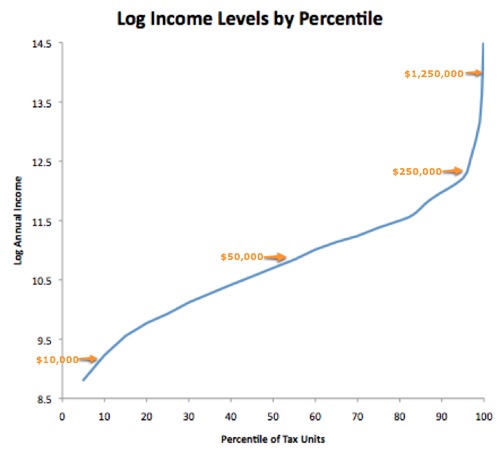 . You should be able to grok the theme of the parable of the poor little rich people by now.
Now what I have to do is explain why the rate of change along the slope of a curve using log income levels by percentile translates into pearl clutching in mamby pamby plutocracts. I know you hate math and it makes your stomach turn. I promise not to use the numbers. We’re going to just talk about the picture and the lines. Over on your right is Brad’s nifty graph. You can see that the curve is upward sloping but the slope varies depending on where you are on the curve.
You can see, however, it is positive at all points. This indicates a direct or positive relationship between two things. If one goes up, the other does too. Because the curve isn’t a straight line, the rate at which the curve goes up is different depending on where you are. This is reflected by the steepness or the flatness of the curve. Think of it as a hill. You have to slog up a steep hill, but a flat hill makes it easier to go forward.
One of the things of interests shown by this graph is the Log of Annual Income and the other is the percentile of tax units. The difference between Rampell’s graph and Delong’s graph is the log calculation. Brad explains why she needs to use the log of annual income compared to the level. Basically, the log turns the comparison in to a growth rate of annual income. A level is simply a level. The log means that we’re using the rate of change happening in incomes as we go up and down the curve. That rate of change is radically different at the richest levels. You can see that the slope almost goes vertical there compared to the middle levels where the curve is less steep and somewhat more horizontal. There’s a story that explains that. Krugman explains it well so I’m going to start with his explanation.
Understatement of the Year Award
Posted: December 17, 2010 Filed under: Bailout Blues, The Great Recession, U.S. Economy, U.S. Politics, We are so F'd | Tags: Income Inequality, Tax Cuts for Billionaires, tax situation for the wealthy 55 Comments From Bloomberg Business Week:
It’s a Great Time to Be Rich
“If the tax cuts become law, the next two years will be the best in living memory for many wealthy Americans to shield their income and fortunes “
A bonanza of new and extended tax benefits could make it as easy as ever for the rich to stay that way.
Under legislation approved by the U.S. Senate on Wednesday, Dec. 15, and now moving on to the House, savvy wealthy Americans would be able to capitalize on an environment in which their tax rates on income and investments remain at historic lows. Also, new rules would make it possible to pass on fortunes to heirs with less fuss and lower taxes than all but a brief period of the past 80 years. It’s a far cry from the 70 percent bite the federal government took out of the largest incomes and estates as recently as 1980.
“The climate we’ll have after this legislation is extremely favorable for wealthy families,” says Jeffrey Cooper, a professor at Quinnipiac University School of Law and a former estate planner who has studied the history of U.S. tax law.
The article goes on to list the incredible list of give aways to people that don’t need it in the Tax Cuts for Billionaires Act. Here’s one salient point to think about while eating your daily gruel and waiting for the debtor’s prisons and poor houses to re-open so you’ll have some place to go when the banks seize your home illegally .
The good news for the rich starts with income tax rates, which for top income groups would remain 35 percent , a rate enacted by former President George W. Bush in 2003. Except for a period from 1988 to 1992, the top tax rate has never been this low since 1931.
Happy Days are here again if you’re part of the investor class too! I’m getting nostalgic for Nixon. That says something, doesn’t it?
For the country’s wealthiest families, income from wages can be far less important than income from investments. According to a Tax Policy Center analysis of 2006 returns, 18.1 percent of all Americans’ cash income comes from business ownership or capital investments, compared with 64.5 percent from labor. For those in the top 1 percent of earners, however, business and capital income make up 53.6 percent of income and labor accounts for 35.3 percent.
Thus, Cooper notes, taxes on capital gains and dividends can be far more important to the rich than income tax rates. The tax compromise extends a 15 percent top tax rate on long-term capital gains and dividends enacted in 2003, which is the lowest rate since 1933. The top capital-gains rate was 77 percent in 1918 and, since 1921, its highest point was 39.9 percent in 1976 and 1977—though certain gains could be excluded from taxation.
No wonder Charles Krauthammer’s red face is all aglow with the spirit of the season!! It’s just not the prunes and the eggnog!!
How can any one defend this administration and its policies as being anything the worst of Reaganomics? At a time when we are seeing record long term unemployment, record foreclosures, record numbers of home owner’s with underwater mortgages, this is what we get. The same folks that benefited from all those bail outs from their failed business decisions and failed investment strategies are being subsidized again.
How can any Democratic congress critter go home and face any of their middle and working class constituents knowing full well they sold their souls to the Obama Company Store. I’m more convinced than ever that this country is in banana republic territory. Next step will undoubtedly be removing what little of the safety net was left in place after Reagan hit the country. After all about one half of U.S. children will most likely be on food stamps at some point in their life. Afterall, they could be out selling matches in the street!! And It’s Christmas time! Why not recreate Dickensian poverty? I’m sure we could use a few child work houses too! After all, it would contribute to the bottom lines of the people that really matter in this country!!

 peej
peej Carissa
 bostonboomer
 dakinikat
 ecocatwoman
 mablue2
 Mama Lopez
 peggysue22
 quixote
 skydancingguestblogger
 Mona (aka Wonk the Vote)



 Sky Dancing
Recent Comments