

Instead, the plane landed in El Salvador.
Wednesday Reads: The Jeffrey Epstein Scandal and Immigration Horrors
Posted: July 23, 2025 Filed under: just because | Tags: Deportation, Donald Trump, Ghislaine Maxwell, Glass House raid, House Speaker Mike Johnson, ICE, immigration, Jeffrey Epstein, President Barack Obama, Sen. Ron Wyden, Tulsi Gabbard, Ventura County CA 9 CommentsGood Morning!!
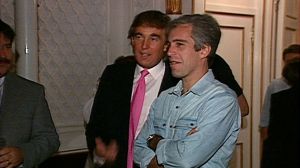
Trump and Epstein ogle young women at a Mar-a-Lago party.
The Epstein story is still leading the news as Trump continues to panic and try desperately to distract from the scandal.
Yesterday, in a bizarre and incoherent oval office rant, he actually accused former president Barack Obama of committing treason by ordering an investigation of Russia’s interference in the 2016 election.
Trump doesn’t understand the concept of treason, which is defined in the Constitution as follows:
Treason against the United States, shall consist only in levying War against them, or in adhering to their Enemies, giving them Aid and Comfort. No Person shall be convicted of Treason unless on the Testimony of two Witnesses to the same overt Act, or on Confession in open Court.
But for malignant narcissist Trump, treason means any fantasized attack on him personally. ABC News: Trump accuses Obama of ‘treason’ in the Oval Office.
Days after President Donald Trump posted an AI-generated fake video showing former President Barack Obama’s arrest on his social media platform, the current president pushed conspiracy theories about Obama in the Oval Office on Tuesday, accusing him of treason without providing evidence regarding the 2016 presidential election.
“They tried to rig the election, and they got caught. And there should be very severe consequences for that,” Trump told reporters on Tuesday.
Trump’s comments come after Director of National Intelligence Tulsi Gabbard submitted a criminal referral to the Department of Justice threatening the Obama administration.
NBC News: Obama pushes back on Trump’s ‘outrageous’ and ‘bizarre’ treason claim.
Former President Barack Obama’s office issued a rare rebuke of President Donald Trump on Tuesday after the president accused his predecessor of having committed “treason” and rigging the 2016 and 2020 elections.
“Out of respect for the office of the presidency, our office does not normally dignify the constant nonsense and misinformation flowing out of this White House with a response,” Obama spokesperson Patrick Rodenbush said. “But these claims are outrageous enough to merit one. These bizarre allegations are ridiculous and a weak attempt at distraction.”
When reporters on Tuesday asked Trump about the late convicted sex offender Jeffrey Epstein, he pivoted to what he called Obama’s “criminality.”
“After what they did to me — and whether it’s right or wrong, it’s time to go after people. Obama’s been caught directly,” Trump told reporters. “What they did in 2016 and 2020 is very criminal. It’s criminal at the highest level. So that’s really the things you should be talking about.”
“Look, he’s guilty. It’s not a question,” Trump added. “This was treason. This was every word you can think of. They tried to steal the election. They tried to obfuscate the election.”
Imagine if any other president had said something like this. But Trump gets away with it.
Trump was referring to claims made by National Intelligence Director Tulsi Gabbard and CIA Director John Ratcliffe in social media posts and television appearances that they had found Obama administration officials manipulated intelligence and conspired to undermine the legitimacy of Trump’s electoral victory in 2016.
Gabbard posted on social media on Friday that she was making a criminal referral to the Justice Department.
At an event with congressional Republicans later Tuesday, Trump praised Gabbard and again accused Obama of being part of an effort to rig the elections. “These are vicious, horrible people,” he said of the former president and others.

Trump sits next to Epstein with two Don Jr. and Ivanka
Of course the Supreme Court claims the Constitution makes presidents immune from prosecution for official acts. But Trump is obviously freaking out about what releasing the Epstein files would reveal about him and desperately lashing out at his political enemies.
This is analysis by Stephen Collinson at CNN: Trump’s latest bid to end Epstein storm: Weaponizing the federal government.
Donald Trump’s bid to smother the uproar over accused sex trafficker Jeffrey Epstein shows that he’s already achieved one goal his critics most feared from his second presidency.
The Justice Department and the head of the US intelligence community are now openly operating as fully weaponized tools to pursue the president’s personal political needs in a degradation of a governing system meant to be an antidote to king-like patronage.
This new dynamic underpinned a wild Oval Office press appearance by Trump on Tuesday, his latest attempt to put out the Epstein fire that had only the now-familiar effect of feeding the flames.
The extent of the president’s capture of two key agencies that are vital to keeping Americans safe was revealed when a reporter asked a question about his administration’s refusal to open all files related to the Epstein case.
The president pivoted to a tirade against Barack Obama, accusing the former president of staging a treasonous coup against him — basing his assault on a convenient and misleading memo about Russia’s 2016 election meddling that was released last week by Director of National Intelligence Tulsi Gabbard.
The Justice Department has also been activated, yet again, to give Trump cover.
Deputy Attorney General Todd Blanche announced Tuesday that he will take the highly unusual move of meeting with Ghislaine Maxwell — who was sentenced to 20 years in federal prison for carrying out a yearslong scheme with Epstein to groom and sexually abuse underage girls — to ask what she knows but hasn’t so far told. Epstein died in jail while awaiting trial on sex trafficking charges.
“I don’t know anything about it,” Trump told reporters in the Oval Office Tuesday.
This seems a stretch, since Blanche is Trump’s former personal lawyer and plans to speak with a prisoner who has a clear incentive to offer testimony that could help a president who has the power to let her out of prison.
Read the rest at CNN.
Meanwhile, Trump sycophant House speaker Mike Johnson took action by cancelling the rest of the House session. Paul Waldman at MSNBC: The Epstein fallout literally shut down the House early for the summer.
It’s been a week and a half since President Donald Trump complained on Truth Social that his many, many accomplishments were being overshadowed, “all over a guy who never dies, Jeffrey Epstein.” There is a kind of truth in Trump’s lament: Six years after his death in a Manhattan jail cell, Epstein lives on — and he has Republicans in something approaching panic. It’s gotten so bad that House Republicans apparently decided to shut the chamber down early before leaving town.
Things fell apart for the GOP in the House Rules Committee, which determines which legislation reaches the House floor. Knowing how much GOP leaders would like this issue to just go away, Democrats attempted to force the House to vote on releasing all the information the government has on Epstein. “To avoid embarrassing votes on Epstein,” NBC News reported, “Republicans decided to recess the committee and not attempt to pass a rule for bills this week. Without a rule, Republicans would be left with nothing to vote on after Wednesday.” Instead, House Speaker Mike Johnson, R-La., began the chamber’s five-week summer recess early, apparently in hopes that by the time the members return in the fall, the affair will all have blown over.
The whole episode recalls the famous line from “All the President’s Men”: “The truth is, these are not very bright guys, and things got out of control.”

Jeffrey Epstein at Trump’s and Marla Maples’ wedding.
Waldman notes that most Republicans don’t buy all the conspiracy theories cooked up by their base, but the Epstein conspiracy theories are base in reality.
…[U]nfortunately for the president and his party, the public interest and the political debate around Epstein concerns real life, including his relationship with Trump. Epstein really was a fabulously wealthy and well-connected pedophile and sex trafficker. He really did die in jail, awaiting trial on sex trafficking and conspiracy charges. Both Trump and Vice President JD Vance really did encourage speculation that Epstein did not commit suicide. There really are a huge number of documents from the government’s investigation of Epstein that have not been made public.
And before the pair had a “falling-out” (in the president’s words) in the mid-2000s, Epstein really was good friends with Donald Trump. “I’ve known Jeff for 15 years. Terrific guy,” Trump said in 2002. “He’s a lot of fun to be with. It is even said that he likes beautiful women as much as I do, and many of them are on the younger side.”
After reiterating that Epstein’s death was a suicide and the case was closed, the administration faced a revolt from right-wing influencers who had been telling their audiences for years that the new Trump administration would blow the lid off everything Epstein was involved in. Then Trump begged people to talk about something, anything else, though his pleadings are falling on deaf ears. And on Tuesday, Deputy Attorney General Todd Blanche announced that — at Attorney General Pam Bondi’s request — he intends to talk to Ghislaine Maxwell, currently serving a 20-year sentence for conspiring to aid Epstein in sex trafficking. The idea that Bondi and Blanche — both Trump loyalists who previously served among the president’s personal lawyers — are suddenly interested in Maxwell for solely apolitical reasons strains credulity, to say the least.
Waldman writes that Republicans are faced with an uprising from the base and Trump’s desire to prevent any further Epstein revelations, and so they decided to get out of town instead of taking a vote on the release of the Epstein files.
New Epstein Revelations
CNN’s and Exclusive: Newly discovered photos and video shed fresh light on Trump’s ties to Jeffrey Epstein.
Newly uncovered archived video footage and photos reveal fresh details about Donald Trump’s past relationship with Jeffrey Epstein.
Photos from 1993 confirm for the first time that Epstein attended Trump’s 1993 wedding to Marla Maples. Epstein’s attendance at the ceremony at the Plaza Hotel was not widely known until now.
In addition, footage from a 1999 Victoria’s Secret fashion event in New York shows Trump and Epstein laughing and chatting together ahead of the runway event. CNN’s KFile uncovered the raw footage during a review of archival video of Trump at events in the 1990s and 2000s. Trump and Epstein appeared together in at least one video among the limited archival footage reviewed.
The new footage and photos, which have not been widely reported and pre-date any of Epstein’s known legal issues, come amid renewed scrutiny of Trump’s past relationship with Epstein. The Justice Department’s recent decision not to release long-promised files related to Epstein has spurred outrage in some corners of Trump’s MAGA movement, where people developed an expectation for bombshell revelations into Epstein’s alleged co-conspirators.
In a brief call with CNN on Tuesday, President Trump, asked about the wedding photos, responded, “You’ve got to be kidding me,” before repeatedly calling CNN “fake news” and hanging up.
In a statement to CNN, White House Communications Director Steven Cheung said, “These are nothing more than out-of-context frame grabs of innocuous videos and pictures of widely attended events to disgustingly infer something nefarious.
“The fact is that the President kicked him out of his club for being a creep. This is nothing more than a continuation of the fake news stories concocted by the Democrats and the liberal media.”
Read the rest at watch videos at CNN.
Greg Sargent at The New Republic: Trump’s Epstein Fiasco Takes Darker Turn as Dem Senator Drops New Bomb.
A few days ago, as the Jeffrey Epstein scandal gripped Washington, Senator Ron Wyden offered a striking revelation in an interview with The New York Times. The Oregon Democrat said that his investigators had discovered that four big banks had flagged to the Treasury Department $1.5 billion in potentially suspicious money transfers involving Epstein, much of which appeared to be related to his massive sex-trafficking network.
Trump with Jeffrey Epstein at Victoria’s Secret event in 1999.
The revelation—which emerged via Wyden’s work as ranking Democrat on the Finance Committee—ratified widespread suspicions that there is still much we don’t know about Epstein’s relations with some of the most powerful and wealthy elites in the world in the lead-up to his 2019 arrest on sex-trafficking charges.
Now Wyden is ratcheting things up once again. Wyden’s office just sent a new letter to Attorney General Pam Bondi—which The New Republic obtained—suggesting seven potent lines of inquiry that the Justice Department could follow, right now, to dig more deeply into Epstein’s web of financial relations with global elites.
“I am convinced that the DOJ ignored evidence found in the U.S. Treasury Department’s Epstein file, a binder that contains extensive details on the mountains of cash Epstein received from prominent businessmen that Epstein used to finance his criminal network,” Wyden writes in the letter.
The Treasury Department has this information because that’s where banks file suspicious activity reports, or SARS. Wyden’s letter says his staff has documented that Epstein-related filings by banks contain “information on more than 4,725 wire transfers involving Epstein’s accounts, all of which merit further investigation.”
Wyden’s letter seeks to demonstrate what the Trump administration is not doing to examine Epstein’s financial relations with the rich and powerful….
Wyden’s move here is in some ways a trolling exercise, since DOJ won’t act on it. But such trolling by lawmakers can be constructive if it communicates new information to the public or highlights the failure of others in power to exercise oversight and impose accountability. Wyden’s letter does both.
Read more at TNR.
Immigration News
I want to recommend a powerful article by Stephen W. Thrasher that was published at Literary Hub: What ICE’s Assault on Ventura County, California Means for the Rest of America. The piece is very long, so I can’t really summarize it with a few quoted paragraphs. I hope you’ll go read the whole thing.
“Mom is gone. They took her away.”
These are the words of an 8-year-old Mexican-American girl I will call Maria, in my hometown of Oxnard, California. She spoke them to her summer school teachers this past week, one of whom is a friend of mine.
Maria’s mother was disappeared by ICE, the worst fear for many families in Ventura County, which emerged on the world stage recently as an ICE raid on the Glass House cannabis farm in Camarillo resulted in the death of farmer Jaime Alanís, the kidnapping of California State University Channel Island professor Jonathan Caravello, and the disappearance and presumed deportation of at least 200 farmers.
Fortunately for Maria, her two tias picked her up the day her mom was kidnapped, and “they took me to Toppers, and I got to eat the ice cream cookie!” Her teacher—I’ll call her Miss Garvin—told me how Maria had never had the ice cream cookie at Toppers before, and that she was trying to hold onto this treat. It seemed as if the adults in Maria’s life were letting her have anything special to distract her—because they did not know when, or even if, she was going to see her mother again.
Miss Garvin told me that “it was a shitshow of a day” as she kept Maria in her line of vision throughout the breakfast and lunch periods.
“It broke my heart,” she told me, to see this normally vivacious girl sitting shell shocked and mute around her friends.
Like Maria, I hail from Ventura County, and am a product of its Title 1 schools. From six to nine years old, I was bused through Oxnard’s bountiful agricultural fields and (literally) across the railroad tracks to the La Colonia neighborhood, where Ramona School educated students like me pretty well despite how economically neglected we were. (I still remember how few streetlights there were when we were bused before dawn, and that there were chickens running through the pot-holed streets just outside our school’s windows).
A bit more:
Like Maria, my biological mother disappeared when I was about her age, though not because she was kidnapped. (She just disappeared for three years while no one, including the private detective my dad and stepmother hired, could find any trace of her beyond an abandoned car.) Like Maria, my survival depended on the care of an Oxnard teacher like Miss Garvin.
Like Maria, I am also a product of Ventura County’s fields, which gave me a place to play, taught me about labor politics, employed the vast majority of my classmates’ parents, and fed me.
But you, wherever you are reading this, you are likely a product of Ventura County’s fields, too—especially if you’ve ever eaten a strawberry. Strawberries are harvested with backbreaking work usually done by undocumented migrant farmers. Oxnard is the largest producer of strawberries in California and is known as the “strawberry capital of the world.” Our 93,000 acres of farmland provides California, the United States, and even other countries not just various berries but avocados, mushrooms, corn, citrus, and even marijuana.
And you are also a product of Ventura County because the Oxnard plain is a hot bed of radical politics. Historically, Ventura County has played a pivotal role in the evolution of labor organizing, as Cesar Chavez lived there for a time and had a strong base of operations during the rise of United Farm Workers.
Just as importantly, Ventura County is playing a crucial role in the attempt to stop fascism right now, for the good people of Ventura, Camarillo, and Oxnard are not taking ICE raids without a fight. Since Trump came back into office, groups like VC Defensa and the 805 Immigration Coalition have been training volunteers to patrol for ICE agents. And when they’re spotted, a call goes out for community members to show up—and people from all walks of life (students, citizens, senior citizens) do.
That’s what happened on July 11: a scout patrol spotted ICE agents and tipped off hundreds of people who showed up at the Glass House Farm to bear witness to the ICE raid.

Scene from Glass House raid in Ventural Country, CA
During that raid, a man was chased off a rooftop to his by masked ICE agents. An activist professor from Cal State Jonathan Caravello was also arrested and jailed after he tried to help a man escape from a tear gas cannister under his wheelchair. Thrasher describes the state of terror that immigrants face in Ventura county. He writes:
If Ventura County falls, we are all going to fall. And the way people there have been treated as threats for interfering with the duties of police—a criminal charge I briefly faced as a professor under similar circumstances as the CSUCI professor—reveal the terror hundreds of millions could face if ICE does, in fact, get a six-fold increase in funding and becomes a bigger internal force than most countries’ militaries….
Even without the threat of ICE, farming has long been identified as one of the most dangerous jobs in America. Given that “more people die while farming than while serving as police officers, firefighters or other emergency responders,” the idea that ICE officers fear for their lives while approaching farmers is absurd.
But the terror of ICE has pushed immigrant families in Ventura County to their deaths in ways fast and slow.
Immigration expert Jeff Crisp at The New York Times (gift link): Trump Is Building a Machine to Disappear People.
In May, the United States flew a group of eight migrants to Djibouti, a small state in the Horn of Africa. For weeks, the men — who are from Cuba, Laos, Mexico, Myanmar, Vietnam and South Sudan — were detained in a converted shipping container on a U.S. military base. More than a month later, the U.S. Supreme Court ruled that the men, who had all been convicted of serious crimes, could be transferred to their final destination: South Sudan, a country on the brink of famine and civil war. Tom Homan, the border czar, acknowledged that he didn’t know what happened to them once they were released from U.S. custody. “As far as we’re concerned,” he said, “they’re free.”
Deporting foreign nationals to countries other than their homeland has quickly become a centerpiece of the Trump administration’s immigration policy. Thousands of people have been sent to countries in the Western Hemisphere, including Costa Rica, El Salvador, Mexico and Panama. At a recent summit of West African leaders, President Trump pressed them to admit deportees from the United States, reportedly emphasizing that assisting in migration was essential to improving commercial ties with the United States. All told, administration officials have reached out to dozens of states to try to strike deals to accept deportees. The administration is making progress: Last week, it sent five men to the tiny, landlocked country of Eswatini in southern Africa after their home countries allegedly “refused to take them back,” according to an assistant homeland security secretary, Tricia McLaughlin. The terms of the deal were not disclosed.
In some ways, this is nothing new. It has become increasingly common for the world’s most prosperous countries to relocate immigrants, asylum seekers and refugees to places with which they have little or no prior connection. Previous U.S. administrations from both parties have sought third-country detentions as easy fixes. In the 1990s, Presidents George H.W. Bush and Bill Clinton both sent thousands of Haitian refugees to detention camps in Guantánamo Bay before forcibly repatriating most of them to Haiti.
What is new about the Trump administration’s deportation efforts, unlike previous European or even past U.S. attempts, is their breadth and scale, effectively transforming migrant expulsions into a tool for international leverage. By deporting foreign nationals to often unstable third countries, the Trump administration is not only creating a novel class of exiles with little hope of returning to either the United States or their country of origin, but also explicitly using these vulnerable populations as bargaining chips in a wider strategy of diplomatic and geopolitical deal making.
This strategy marks a significant evolution in a practice that has been gaining traction throughout the developed world. In the early 2000s, Australia devised the so-called Pacific Solution, an arrangement that diverted asylum seekers arriving by boat or intercepted at sea to holding centers in the island states of Nauru and Papua New Guinea in exchange for benefits, including development aid and financial support. In 2016, amid what was then the largest displacement of people in Europe since World War II, the European Union struck a deal that allowed it to send migrants arriving in Greece from Turkey through irregular means back to Turkey — to the tune of six billion euros.
Use the gift link to read the rest if you’re interested.
The Washington Post (gift link): U.S. deportees, freed from Salvadoran prison, describe ‘horror movie.’
Julio González Jr. had agreed to be deported to Venezuela. When the 36-year-old office cleaner and house painter boarded the flight in Texas in March, he assumed it would take him back to his home country.
Sunday Reads
Posted: January 5, 2025 Filed under: 2021 Insurrection, 2024 Elections, Donald Trump | Tags: Giorgia Meloni, House Speaker Mike Johnson, January 6 2021 insurrection, Joe Biden, Officer Daniel Hodges 5 Comments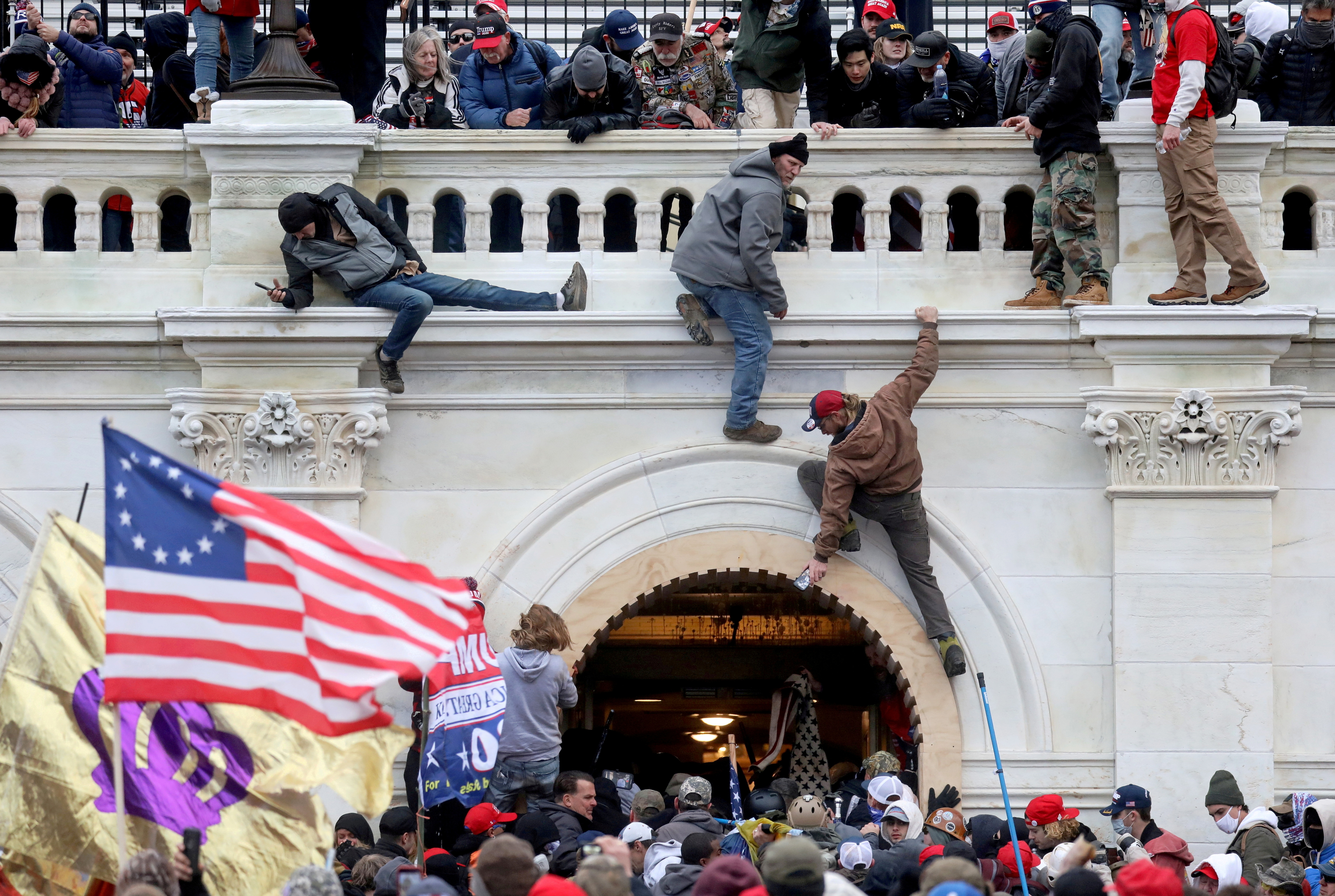
FILE PHOTO: A mob of supporters of U.S. President Donald Trump fight with members of law enforcement at a door they broke open as they storm the U.S. Capitol Building in Washington, U.S., January 6, 2021. REUTERS/Leah Millis/File Photo
Good Afternoon!!
Tomorrow is the fourth anniversary of the Capitol insurrection. Four years later, Trump will be certified as president–without the riot he sicced on Joe Biden in 2021.
Kyle Cheney at Politico: Donald Trump is about to get the Jan. 6 that he denied Joe Biden.
The transfer of power to Donald Trump is shaping up to be, well, peaceful.
No mobs are assembling to disrupt Congress’ Jan. 6 counting of electoral votes. No Democratic leaders are questioning the results of the election or concocting elaborate legal theories to thwart the outcome. The greatest risk of obstruction seems likely to come from a storm system threatening to dump a few inches of snow on the region overnight.
If all goes as expected, by late Monday afternoon, Trump’s victory will be certified in a ceremony overseen by his vanquished rival, Vice President Kamala Harris, who will preside over the proceedings in her capacity as the president of the Senate. Harris has been clear she will administer a straightforward transfer of power. In doing so, she’ll follow in the footsteps of all vice presidents before her — including Mike Pence, who resisted Trump’s pressure to refuse to count electors from states Trump lost in 2020….
It’s the utter antithesis of the carnage unleashed four years ago, under clear blue skies, by thousands of Trump supporters, goaded by lies about a stolen election. Hundreds of them bludgeoned police officers guarding the Capitol as the mob fought to stop Congress from counting the electoral votes that would make Joe Biden president.
The attack spawned the largest-ever federal criminal probe, led to a grave criminal case against Trump, spawned a failed legal effort to remove him from the ballot and defined the political climate of the last two election cycles. Democrats declared Trump a threat to democracy and the president-elect wielded the cases to rally his base and claim political persecution.
The meeting of the House and Senate this time, by contrast, is expected to be almost jarringly routine. Harris will convene the joint session at 1 p.m. Lawmakers of both parties will announce the certified electors from each state, and Harris will affirm they have been counted….
Monday’s joint session is also the first governed by a 2022 law designed to prevent efforts to corrupt the transfer of power and limit the ability of lawmakers to mount challenges to the results. That law lowers the already slim odds of any objections that could hamper the proceedings.
Still, the general atmosphere of calm in Washington belies a deep, simmering tension between those who watched the nation’s democratic institutions buckle on Jan. 6, 2021, and those who hope to whitewash it — especially as Trump attempts to rewrite the history of the attack on the Capitol and prepares to pardon many of its perpetrators. The Justice Department has charged more than 1,500 people for their involvement in the attack, and more than 1,200 have pleaded guilty or been convicted.
 Trump has promised again and again to free the January 6 “hostages” who violently attacked the center of our government and wounded 174 police officers, and led to the deaths of 5 officers–4 of whom died by suicide.
Chris Stein at The Guardian: ‘We have our country back’: convicted January 6 rioters anticipate Trump pardons.
Brandon Fellows, who broke into the US Capitol on January 6 and smoked marijuana in a senator’s office, stood outside the Washington DC jail where he spent part of his three years’ sentence behind bars, thinking about how Donald Trump might soon help him get his life back on track.
Having served his prison sentence after being found guilty on a slew of federal charges, the 30-year-old is today on probation under terms that have prevented him from leaving the capital region to start a chimney maintenance business in New Jersey. But with Trump returning to the White House on 20 January, Fellows expects his circumstances to change dramatically.
“I’m just going to wait till after the election, make sure I don’t have to partake in a real insurrection if Trump loses, and … then I’ll decide what I’m doing after,” he said about his thinking before November’s presidential election. Now that Trump has won, Fellows is counting on the president-elect to pardon him and other January 6 defendants. “With Trump in office, yeah, I’m starting to plan and [rebuild] my life again,” Fellows said.
As soon as he is back in power, Trump has vowed, he will pardon people prosecuted over the assault on the US Capitol that took place four years ago on Monday. Carried out by a mob of Trump’s supporters after he had addressed them outside the White House, the attack brought political violence into the halls of Congress and has been linked to nine deaths among police and rioters.
“We’re going to look at each individual case, and we’re going to do it very quickly, and it’s going to start in the first hour that I get into office,” Trump told Time magazine in an interview after winning re-election. “A vast majority should not be in jail, and they’ve suffered gravely.”
The pardons would mark the end of a four-year campaign by Joe Biden and his attorney general, Merrick Garland, to hold to account the thousands of rioters who overran police lines and sent lawmakers fleeing the Capitol on the day they convened in 2021 to certify the Democrat’s election victory. The justice department has charged more than 1,500 people with offenses related to the attack in the years since, nearly 600 of whom have faced felony charges of assaulting or impeding law enforcement.
But Trump’s jailed followers are counting the days until they receive the absolution Trump has promised. For more than two years, relatives of those charged in the attack and supporters of the former president have gathered on a sidewalk outside Washington DC’s jail for a nightly vigil called “Freedom Corner”, where January 6 is viewed not as an attack on democracy, but a catalyst for unfair government repression.
Trump has used propaganda to try to change the meaning of what happened on January 6, 2001. Dan Barry and Alan Feuer at The New York Times: ‘A Day of Love’: How Trump Inverted the Violent History of Jan. 6.
In two weeks, Donald J. Trump is to emerge from an arched portal of the United States Capitol to once again take the presidential oath of office. As the Inauguration Day ritual conveying the peaceful transfer of power unfolds, he will stand where the worst of the mayhem of Jan. 6, 2021, took place, largely in his name.
Directly behind Mr. Trump will be the metal-and-glass doors where protesters, inflamed by his lie that the 2020 election had been stolen from him, stormed the Capitol with clubs, chemical irritants and other weapons. To his left, the spot where roaring rioters and outnumbered police officers fought hand to hand. To his right, where the prostrate body of a dying woman was jostled in the bloody fray.
And before him, a dozen marble steps descending to a lectern adorned with the presidential seal. The same steps where, four years earlier, Trump flags were waved above the frenzied crowd and wielded like spears; where an officer was dragged facedown to be beaten with an American flag on a pole and another was pulled into the scrum to be kicked and stomped.
Officer Daniel Hodges was crushed in a doorway by rioter Patrick McCaughey III
In the wake of the attack on the Capitol, Mr. Trump’s volatile political career seemed over, his incendiary words before the riot rattling the leaders of his own Republican Party. Myriad factors explain his stunning resurrection, but not least of them is how effectively he and his loyalists have laundered the history of Jan. 6, turning a political nightmare into a political asset.
What began as a strained attempt to absolve Mr. Trump of responsibility for Jan. 6 gradually took hold, as his allies in Congress and the media played down the attack and redirected blame to left-wing plants, Democrats and even the government. Violent rioters — prosecuted, convicted and imprisoned — somehow became patriotic martyrs.
This inverted interpretation defied what the country had watched unfold, but it neatly fit the persecution narrative that binds Mr. Trump to many of his faithful. Once he committed to running again for president, he doubled down on flipping the script about the riot and its blowback, including a congressional inquiry and two criminal indictments against him, as part of an orchestrated victimization.
That day was an American calamity. Lawmakers huddled for safety. Vice President Mike Pence eluded a mob shouting that he should be hanged. Several people died during and after the riot, including one protester by gunshot and four police officers by suicide, and more than 140 officers were injured in a protracted melee that nearly upended what should have been the routine certification of the electoral victory of Mr. Trump’s opponent, Joseph R. Biden Jr.
But with his return to office, Mr. Trump now has the platform to further rinse and spin the Capitol attack into what he has called “a day of love.” He has vowed to pardon rioters in the first hour of his new administration, while his congressional supporters are pushing for criminal charges against those who investigated his actions on that chaotic day.

Some points of view on Trump upcoming second term as “president”:
Russell Berman at The Atlantic: Bad News for Trump’s Legislative Agenda.
The success of President-Elect Donald Trump’s legislative agenda will depend on whether Republicans can close ranks in Congress. They nearly failed on their very first vote.
Mike Johnson won reelection as House speaker by the narrowest of margins this afternoon, and only after two Republican holdouts changed their votes at the last minute. Johnson won on the first ballot with exactly the 218 votes he needed to secure the required majority. The effort he expended to keep the speaker’s gavel portends a tough slog for Trump, who endorsed Johnson’s bid.
Johnson was well short of a majority after an initial tally in the House, which elects a speaker in a long, televised roll call during which every member’s name is called. Three Republicans—Representatives Thomas Massie of Kentucky, Ralph Norman of South Carolina, and Keith Self of Texas—voted for other candidates, and another six refused to vote at all in a protest of Johnson’s leadership. The six who initially sat out the roll call cast their votes for Johnson when their names were called a second time. But it took nearly an hour for Johnson to flip Norman and Self. After huddling with Johnson on and off the House floor, the three men walked together to the front of the House chamber, where Norman and Self changed their votes to put Johnson over the top.
The tense vote marked the second Congress in a row in which the formal, usually ceremonial opening of the House became highly dramatic. Two years ago, conservative holdouts forced Kevin McCarthy to endure 15 rounds of voting and days of horse-trading before allowing him to become speaker. With help from Democrats, the same group ousted him nine months later, leading to Johnson’s election as his replacement….
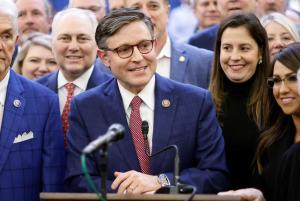
Mike Johnson elected speaker
Yet the members opposing Johnson were not as numerous or dug-in as McCarthy’s adversaries. And although Trump backed McCarthy two years ago, he was more politically invested in Johnson’s success today. A drawn-out fight for the speakership could have threatened his legislative agenda and even delayed the certification of his election. (The House cannot function without a speaker, so it would not have been able to formally open and count the Electoral College ballots as required by the Constitution on January 6.)
Even with today’s relatively swift resolution, Johnson’s struggle to remain speaker is an ominous sign for the GOP’s ability to enact Trump’s priorities in the first few months of his term. The majority that narrowly elected Johnson will temporarily become slimmer once the Senate confirms two Republican lawmakers to Trump’s Cabinet, creating vacancies pending special elections to replace them. And GOP divisions have already emerged over whether the party should launch its governing trifecta with a push to bolster the southern border or combine that effort with legislation extending Trump’s 2017 tax cuts.
Republicans have a bigger buffer in the Senate, where they control 53 seats. But in the House, the GOP edge is two seats smaller than it was at the beginning of the last Congress, and just one or two members will have the power to defeat party-line votes without support from Democrats. Johnson’s main critics, including Massie, Norman, and Self, support Trump’s agenda in the abstract, but they are not loyalists of the president-elect. (Neither Massie nor Roy backed him in the GOP primary last year.) They are far more hawkish on spending than Trump, who showed little concern for deficits in his first term and has pushed Republicans to raise or even eliminate the debt ceiling before he takes office—a move that could smooth the passage of costly tax cuts.
Dan Balz at The Washington Post: A different and more dangerous world awaits President-elect Trump.
President-elect Donald Trump will begin his second term stronger and more dominant as a player on the world stage than when he was sworn in eight years ago. The world that awaits him, however, is far different — and more threatening — than when he left the presidency four years ago.
Trump’s “America First” second-term focus purports to be principally on the home front. The deportation of millions of undocumented immigrants was one of his leading campaign pledges, and his initial appointments suggest he is serious about this priority. The proposal is fraught with practical and political questions.
Dealing with the domestic economy through tax and spending cuts and regulatory changes was another key promise. Polls suggest the economy — mostly inflation — counted more than other issues did in Trump’s victory over Vice President Kamala Harris. But many economists have said that Trump’s economic agenda — tariffs and an extension of tax cuts — could lead to a new round of inflation and more debt. Deportations, too, would disrupt the economy.
Trump has also pledged to bring the civil service to heel. An initiative that includes cost-cutting and finding inefficiencies will be led by multibillionaire entrepreneur Elon Musk and onetime rival Vivek Ramaswamy. The two have grand ambitions and, seemingly, the president-elect’s blessing. Nonetheless, they face multiple challenges before they will be able to deliver more than symbolic changes.
Still, Trump could quickly be drawn into foreign policy challenges. He will confront a world of chaos and conflict: a prolonged war in Ukraine with Russian President Vladimir Putin more hostile than ever, and the Middle East still in turmoil after more than 15 months of warfare, with Iran weakened, Syria without Bashar al-Assad and Israel stronger militarily but scarred internationally because of its conduct in the war in Gaza.
China presents other challenges for Trump, who has threatened major new tariffs on a country with serious economic problems and growing military ambitions. As an indication of his intentions, Trump plans to populate his incoming administration with several China hawks. Meanwhile, governments of key U.S. allies in Europe, particularly France and Germany, are weakened, with right-wing, populist parties on the rise.
Trump prides himself as a dealmaker. His approach to foreign policy in his first term appeared to be more personal than strategic. He prefers dealing with autocrats rather than working with traditional alliances. In his second term, he probably will find it more difficult to work with the likes of Putin, Chinese President Xi Jinping and the leader who sent him what Trump called “love letters,” North Korea’s Kim Jong Un.
Peter Baker at The New York Times: Trump Sees the U.S. as a ‘Disaster.’ The Numbers Tell a Different Story.
To hear President-elect Donald J. Trump tell it, he is about to take over a nation ravaged by crisis, a desolate hellscape of crime, chaos and economic hardship. “Our Country is a disaster, a laughing stock all over the World!” he declared on social media last week.
But by many traditional metrics, the America that Mr. Trump will inherit from President Biden when he takes the oath for a second time, two weeks from Monday, is actually in better shape than that bequeathed to any newly elected president since George W. Bush came into office in 2001.
For the first time since that transition 24 years ago, there will be no American troops at war overseas on Inauguration Day. New data reported in the past few days indicate that murders are way down, illegal immigration at the southern border has fallen even below where it was when Mr. Trump left office and roaring stock markets finished their best two years in a quarter-century.
Jobs are up, wages are rising and the economy is growing as fast as it did during Mr. Trump’s presidency. Unemployment is as low as it was just before the Covid-19 pandemic and near its historic best. Domestic energy production is higher than it has ever been.
The manufacturing sector has more jobs than under any president since Mr. Bush. Drug overdose deaths have fallen for the first time in years. Even inflation, the scourge of the Biden presidency, has returned closer to normal, although prices remain higher than they were four years ago.
“President Trump is inheriting an economy that is about as good as it ever gets,” said Mark Zandi, chief economist of Moody’s Analytics. “The U.S. economy is the envy of the rest of the world, as it is the only significant economy that is growing more quickly post-pandemic than prepandemic.”
Of course Trump will promptly take credit for the good economy as soon as he gets into office.
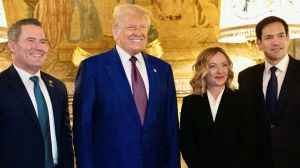
Trump hails Italy’s Giorgia Meloni
Since the election, Trump has been behaving as if he is already president. For example, he has met with several foreign leaders–all autocrats–at his private club in Florida. Another one showed up at Mar-a-Lago yesterday. Emma Bubola at The New York times: Italy’s Prime Minister Visits Trump in Mar-a-Lago.
Prime Minister Giorgia Meloni of Italy visited President-elect Donald J. Trump on Saturday at his Florida golf club for an informal meeting.
The trip to the club, Mar-a-Lago, came only a few days before Ms. Meloni is set to welcome President Biden for an official visit to Italy and the Vatican from Jan. 9 to 12.
On Saturday, she appeared in the grand ballroom at Mar-a-Lago. Mr. Trump, according to pool reports, said he was having dinner with Ms. Meloni, whom he called “a fantastic woman,” adding, “She’s really taken Europe by storm, and everyone else.”
They, along with some potential members of the future Trump administration, including the nominee for secretary of state, Marco Rubio, and for Treasury, Scott Bessent, then watched a screening of a film titled, “The Eastman Dilemma: Lawfare or Justice.”
Ms. Meloni and Mr. Trump have expressed mutual appreciation in the past, and her trip is one of the first few visits by a foreign leader to the president-elect’s estate in Florida since his election in November. The meeting reinforces the hopes of Ms. Meloni’s supporters that the conservative Italian prime minister will become Mr. Trump’s go-to ally in Europe.
Much of that role would involve mediating tensions between other European leaders and Mr. Trump, who has threatened to start a trade war with the continent, as well as to reduce American backing for some NATO countries and for Ukraine in its war with Russia.
The agenda of the meeting was unclear on Saturday night, but observers expected the two leaders would discuss those issues.
Believe it or not, Joe Biden is still President of the United States, and he has some plans for his remaining time in the White House. Carol Lee and Kristin Welker at NBC News: Biden to deliver two major speeches in his final days in office.
President Joe Biden plans to deliver two major speeches before leaving office as part of an effort to outline what he sees as key parts of his legacy from more than 50 years in public service, according to two people familiar with the plans.
The first speech is set to focus on foreign policy and is expected to be delivered sometime after Biden returns on Jan. 12 from a trip to Italy, these people said. They said Biden then plans to close out his final days in the White House with a farewell address to the country.
Neither speech has been fully drafted, the sources familiar with the president’s plans said, but the contours and themes of both have been developed.
In his farewell address, Biden is expected to offer a message to Americans for the future and reflect on his decades in public office, including his four years in the White House, according to the people familiar with the president’s plans.
The traditional address is expected to channel a similar spirit to the parting sentiments offered by some of Biden’s recent predecessors, including former Presidents George W. Bush and Bill Clinton, who delivered their farewell speeches from the White House, and former President Barack Obama, who opted to speak to the nation from his hometown of Chicago in front of a large audience of supporters….
Biden’s foreign policy speech is set to focus on his belief that America is stronger when it invests in its alliances across the world, according to the people familiar with the president’s speeches. Biden is expected to highlight his efforts to broaden and strengthen the North Atlantic Treaty Organization and U.S. relations in the Indo-Pacific, as well as his administration’s military and financial support for Ukraine since Russia’s invasion in 2022.
It’s unclear how much the speech might touch on Biden’s decision to order the U.S. withdrawal from Afghanistan in 2021, which has been widely criticized and resulted in the deaths of 13 American service members.
Biden is likely to reference his administration’s efforts to combat terrorist groups, including ISIS, but the speech is not expected to dwell on domestic terrorism threats following the New Year’s Day attack in New Orleans, the people familiar with the president’s plans said.
That’s all I have for you today. It’s still kind of quiet as we wrap up the holiday season.
Finally Friday Reads: The Turn of the Screw
Posted: December 20, 2024 Filed under: kakistocracy, kleptocracy, Polycrisis | Tags: @johnbuss.bsky.social, @repeat1968. John Buss, Bayou Moses, Elon Musk is a NAZI, Federal Budget and Deficit, House Speaker Mike Johnson, President-Eject Incontinentia Buttocks 9 Comments
“Meanwhile, at Mars-a-Lago… Donold’s training pays off..” John Buss, @repeat1968,@johnbuss.bsky.social
Good Day, Sky Dancers!
With its tumultuous and ineffective leadership, the aptly named chaos caucus again plays a game of brinkmanship that risks American lives and the economy. I’m getting way too old for this kind of torment. The Republican-led Congress has completely forgotten its role in governance and its duties, ensuring the stability required for all the entities that rely on that and the rule of law to function. They only seem to air grievances and feed their raging ids. This year’s version comes with a dangerous twist. The prime chaos factor is the richest man on earth who was not elected or officially appointed to anything. His claim to fame is funding the Trump campaign and those of other Republican elected officials, and he has no clue about our system of government, our institutions, our Constitution, or, for that matter, anything. He’s also bugfuck crazy.
President Eject Incontinentia Buttocks is huddled down in Florida doing God knows what, and J Dank has gone missing. Milk cartons will soon have to show his picture and ask, “Have you seen this vice president?” Bayou Moses looks to be the next biggest loser of the House Speaker’s Gavel. The country looks like some twisted version of The Mouse That Roared. How are we to deal with a Cabal of Billionaires empowered by an angry crew of religious nuts, bigots, and know-nothings? They appear to own the house and the Supreme Court at the moment.
Meanwhile, back in the world of the same old shit, we get Mitch McConnell suddenly lecturing everyone and seemingly trying to protect the old magic ways of the US Senate. McConnell thinks he can swiftly change roles from Macbeth to King Lear. The Democratic Party is appointing the same old group that hasn’t been able to do anything to stop this to leadership positions. I cannot be the only one who doesn’t see any of this ending well.
 So, how on earth did Elon Musk blow up a bipartisan deal on the budget? This is from Sam Stein writing at The Bulwark. “Elon Killed the Budget Deal. Cancer Research for Kids Was Collateral Damage. Advocates were celebrating the inclusion of money and provisions to help fund pediatric research. And then the tweets started.”
THE DECISION BY REPUBLICAN LEADERSHIP to scuttle a bipartisan funding deal on Thursday night has left lawmakers scrambling and others anxiously bracing for a government shutdown.
For a host of issue advocates, however, the prevailing mood in Washington, D.C. was one not of chaos but utter devastation.
The initial deal that congressional leaders had agreed to included a number of key priorities that, in the course of hours, were jettisoned by GOP leaders looking to calm Elon Musk’s pique and satisfy Donald Trump’s demands. And though the slimmed-down bill that Trump endorsed in its place failed to pass the House, few people expected that the initial deal would make a comeback—meaning that many of its components were likely gone for good.
The list of provisions left in the dust heap was lengthy. The initial compromise bill included language to ensure that providers of internet service to rural areas weren’t ripping off customers, to protect consumers from hidden hotel fees, to secure semiconductor supply chains, to restrict U.S. outbound investment in China, even to prohibit deepfake pornography. All those were all gone in the successor bill.
But some of the hardest cuts to swallow involved medical research. In particular, advocates say, the revised funding bill delivered a devastating blow to the fight against pediatric cancer.
The slimmed-down version was stripped of language that would have allowed children with relapsed cancer to undergo treatments with a combination of cancer drugs and therapies. (Currently the Food and Drug Administration is only authorized to direct pediatric cancer trials of single drugs.) The bill also didn’t include an extension of a program that gave financial lifelines, in the form of vouchers, to small pharmaceutical companies working on rare pediatric diseases. It was also missing earlier provisions that would have allowed for kids on Medicaid or CHIP—that is, poor children—to access medically complex care across state lines.
 And, of course, Trump wants to ensure that there’s a two-year extension of the Debt Ceiling so that he can give away the Treasury to his Cabal and grift off the nation without having to take on the burden of once again landing the Federal Budget into record-setting red zones. He seriously believes that the voters will blame all these shenanigans on Biden, who is trying to Trump-proof things and get Federal judges appointed to the bench. Musk is on a rampage to replace the governments that once fought NAZIs with NAZIs all over the world and evidently has the money to attempt it. This is from New York Magazine. “Musk Pauses Torment of GOP to Praise German Extremists.” Nia Prater has the analysis.
Elon Musk has spent the better part of this week working to derail Congress’s attempt to fund the government, but he found time early Friday morning to express support for the politics of Alternative für Deutschland or Alternative for Germany, the country’s most prominent far-right political party.
“Only the AfD can save Germany,” Musk wrote on X early Friday morning.
The comment was in response to a video posted by Naomi Seibt, a German far-right activist, that criticized Friedrich Merz, the leader of the conservative party Christian Democratic Union of Germany. Recently, Merz has been leading in the polls to become the nation’s next chancellor next year. The caption for Seibt’s video read, “The presumptive next chancellor Friedrich Merz (CDU) is horrified by the idea that Germany should follow Elon Musk’s and Javier Milei’s example. He staunchly rejects a pro-freedom approach and refuses any discussion with the AfD.”
The AfD is a nationalist and anti-immigration party that has seen its popularity steadily grow over the last several years. In September, the party won its first state election, becoming the first far-right party to win an election in Germany since the Nazis, per CNN. AfD’s candidate in that race, Björn Höcke, is a controversial figure who has been fined for using a Nazi slogan and criticized for a speech many denounced as antisemitic.
Olaf Scholz, the current chancellor of Germany, was dismissive of Musk’s words when asked about them during an unrelated press conference with Estonian prime minister Kristen Michal on Friday. “We have freedom of speech, and that also applies to multibillionaires,” Scholz said, per Bloomberg. “But freedom of speech also means that you can say things that are not right and do not contain good political advice.”
This is not the first time that Musk has indicated support for AfD. Last year, The Guardian reported that Musk shared a pro-AfD post that criticized Germany funding charity groups that operate ships that rescued migrants, referring to the migrants as “illegal immigrants.”
“Let’s hope AfD wins the elections to stop this European suicide,” the post read.
Musk, who intends to play an starring role in Donald Trump’s second term, has similarly shown an affinity for other conservative leaders in Europe. He’s been pictured with Italian prime minister Giorgia Meloni and Nigel Farage, a British politician who leads the right-wing populist party Reform UK. In recent days, there’s been speculation that Musk might be considering a massive multimillion-dollar donation to Farage’s party, prompting worries among watchdog groups.
 Musk has such a manic schedule, given he’s also trying to give parts of Ukraine to Putin, threatening to oust the Canadian PM, and blowing up the US economy today. Canadian TV had this headline last week. “Elon Musk calls Justin Trudeau ‘insufferable tool’ in new social media post.” Musk is channeling his inner Lex Luther!
Billionaire Elon Musk is calling Prime Minister Justin Trudeau “an insufferable tool” in a new social media post on Wednesday.
“Won’t be in power for much longer,” Musk also wrote about the prime minister on “X.”
Musk was responding to a video posted of Trudeau, in which the prime minister described Kamala Harris’ U.S. presidential loss as a setback for women’s progress.
“We were supposed to be on a steady, if difficult sometimes, march towards progress. And yet, just a few weeks ago, the United States voted for a second time to not elect its first woman president,” Trudeau said during a speech at the Equal Voice Foundation Gala in Ottawa on Tuesday night.
Trudeau also said women’s rights and women’s progress are “under attack overtly and subtly,” and that he “always will be a proud feminist.”
Musk, who is the CEO of Tesla and founder of space company SpaceX, has been tasked to co-chair U.S. president-elect Donald Trump’s new Department of Government Efficiency. He was also a prominent figure in Trump’s election campaign.
Wednesday’s post is Musk’s latest swipe at the prime minister since Trump was re-elected in November. Responding to a user on “X” on Nov. 7 asking for Musk’s help to get rid of Trudeau, Musk wrote “He will be gone in the upcoming election.”
Ontario Premier Doug Ford says he let Trudeau know his comments were “not helpful.”
Ford, who with the rest of Canada’s premiers, met with the prime minister and several of his cabinet ministers on Wednesday to discuss how Canada would respond to Trump’s tariff threats.
“Donald Trump was elected democratically,” Ford said, adding that the premiers made sure Trudeau “got the message loud and clear.”
Musk’s post also comes during a tense time in Canada-U.S. relations.
Trudeau has been facing social media jabs from Trump following the prime minister’s visit to Mar-a-Lago nearly two weeks ago to discuss Trump’s tariff threat. Last month, Trump threatened to impose a 25 per cent tariff on all Canadian imports on his first day in office unless Canada addresses his border security concerns.
Following that meeting, U.S. network Fox News reported Trump joked during the dinner in Florida that if the potential tariffs would harm the Canadian economy — as the prime minister conveyed to him — perhaps Canada should become America’s 51st state(opens in a new tab).
Days later, Trump posted an A.I.-generated image to social media that depicted him standing next to a Canadian flag(opens in a new tab) and overlooking a mountain range with the caption “Oh Canada!”
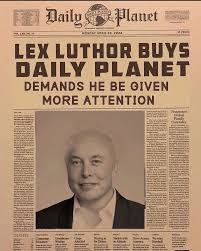 Evidently, since he managed to buy the US Presidency and dupe enough dolts into voting for the Dotard, he thinks he can do it with Canada and a good portion of Europe. He’s also being all kissy-face with the UK’s Nigel Farage. The AP characterizes all these shenanigans thusly. “Musk ascends as a political force beyond his wealth by tanking budget deal.” Is the legacy media going to sleep through all of this and cover it like mundane news? Thomas Beaumont has the analysis.
In the first major flex of his influence since Donald Trump was elected, Elon Musk brought to a sudden halt a bipartisan budget proposal by posting constantly on his X megaphone and threatening Republicans with primary challenges.
The social media warnings from the world’s wealthiest man preceded Trump’s condemnation of a measure negotiated by GOP House Speaker Mike Johnson, which effectively killed the stopgap measure that was designed to prevent a partial shutdown of the federal government.
Washington was scrambled a day after Musk’s public pressure campaign. Trump on Thursday first declined to say whether he had confidence in Johnson. But later in the day, Trump praised him and House leaders for producing “a very good Deal,” after they announced a new plan to fund the government and lift the debt ceiling.
Before the new deal was reached, Congressional Democrats mocked their GOP counterparts, with several suggesting Trump had been relegated to vice president.
“Welcome to the Elon Musk presidency,” Democratic Rep. Robert Garcia of California wrote on X.
What was clear, though, is Musk’s ascendance as a political force, a level of influence enabled by his great wealth. In addition to owning X, Musk is the CEO of Tesla and Space X.
 Since the Supreme Court decided Citizens United, unelected billionaires have bought Supreme Court Decisions and Justices. That’s taken a while to ferret out because the crooked Supreme Court Justices haven’t reported their spoils, and they have no ethics standards. We know they’ve got lobbyists that hand out checks, but most of them do not want to be caught in the act of kleptocracy. Musk has the audacity of a Bond villain. It’s just out there for all to see and the press to cover.
House Speaker Bayou Moses has yet another agreement to put forward as the clock ticks to midnight EST. This is from The Hill. “Johnson says he has plan C to avert shutdown, vote expected.” I’ll believe it when I see it, frankly.
Speaker Mike Johnson (R-La.) said he has a plan C to avert a shutdown and the House will vote Friday morning on the legislation — but Republicans indicated there is not yet widespread agreement.
“Yeah, yeah, we have a plan,” Johnson said Friday morning as he entered the Capitol. “We’re expecting votes this morning, so you all stay tuned. We’ve got a plan.”
He did not say what it entails. And lawmakers leaving meetings in Johnson’s office Friday morning indicated that there was not yet an agreement on a path forward.
“Anybody who’s telling you there’s an agreement is just a little bit ahead of themselves,” Rep. Dusty Johnson (R-S.D.), chair of the Republican Main Street Caucus, said as he left the Speaker’s office later Friday morning.
Lawmakers have little time to avoid a shutdown: Government funding runs out when the clock strikes midnight late Friday.
Sen. Markwayne Mullin (R-Okla.) said on CNBC on shortly after Johnson’s comments Friday morning that he thinks Washington will probably avoid a shutdown since “we’re pushed up against Christmas here,” saying a “clean” funding extension is likely.
“There’s a chance today a clean CR [continuing resolution], short-term clean CR — it may be for two, three weeks,” Mullin said. “That was something that was discussed, you know, late last night, you know, even some discussions this morning. I’m not going to say that’s going to happen, but you know, that’s really the option that’s on the table.”
 This is the usual way for them to avoid the problems. Just keep kicking that can. This just prolongs things. This process has historically been messy and difficult. We may see a technical shutdown tonight, and that does not bode well, given the current antics and players. This is from The Hill. “NY Democrat: ‘Elon Musk has Donald Trump in a vise.” Joanne Haner has the lede.
Rep. Dan Goldman (D-N.Y.) on Thursday suggested Elon Musk is the one directing the Trump administration, not President-elect Trump, pointing to the tech entrepreneur’s leading position in opposing the government funding stopgap measure.
“Elon Musk has Donald Trump in a vise,” Goldman said on MSNBC on Thursday. “And it is very clear that Elon Musk is now calling the shots.”
Musk made several social media posts Wednesday criticizing the spending measure deal unveiled by House Republicans this week. He called the more than 1,500-page measure a big “piece of pork” while calling on GOP lawmakers to oppose it.
Trump later in the day also called for the bill to be dismissed, suggesting instead that Congress pass a clean continuing resolution with a debt hike increase. That proposal was rejected Thursday night, and Congress is now working on a plan C with less than 24 hours to go before the deadline.
“We need to face the reality: Right now, we have President Elon Musk. And Trump? Maybe he’s vice president, I guess,” Goldman said. “Vice presidents don’t do much, so that makes sense. He might be the chief of staff. I don’t know what you call him, but he is not calling the shots.”
Goldman is not the only Democrat saying Musk is the one calling the shots in the administration; a number of Democrats have made similar arguments, while the White House has said Trump and the GOP are doing the bidding of billionaires.
 Meanwhile, the government is making plans for a shutdown. This is from the Washington Post.
House Republicans are discussing the latest plan from leadership to fund the government and avoid a shutdown before a midnight deadline. Several Republicans said the Rules Committee will meet to send two separate bills to the floor, which would need a simple majority to pass. They are: A clean extension of current fiscal levels until mid-March that includes an extension of a farm bill that requires reauthorization, and a $110 billion relief bill to help natural disaster survivors and aid farmers. Republicans had no plans for an immediate vote on suspending the debt limit, despite President-elect Donald Trump’s repeated demands. At the White House, press secretary Karine Jean-Pierre lashed out at Republicans who had agreed to a bipartisan deal and then abandoned it. “This is a mess that Speaker [Mike] Johnson created, that is his mess to fix,” she told reporters at the daily briefing, adding that there was “still time” for Republicans to “do the right thing.” The Office of Management and Budget alerted federal agencies Friday morning to prepare for an imminent government shutdown.
The budget fiasco isn’t the only thing threatening the US and the Global Economies. Trump is just not giving up on his ignorant view of tariffs. This is from CNBC. Trade negotiations are not subject to the art of the Deal. They are gamesmanship on an entirely different level. “‘Tariffs all the way’: Trump says European Union must buy U.S. oil and gas in trade ultimatum.” He thinks he looks like a tough guy, but anyone who knows about economic policy knows he just looks like an idiot.
Trump has made threats of sweeping tariffs on U.S. trading partners including China, Mexico and Canada a signature part of his presidential campaign — and he’s continued the narrative as he prepares to enter office, despite economists warning of risks to domestic inflation.
Analysts say there is high uncertainty over the extent of the tariffs Trump will be willing — or able — to follow through with, and how much of his rhetoric is a starting point for striking deals.
His latest comment comes after EU heads of state held their final meeting of the year on Thursday, during which the topic of Europe-U.S. relations was discussed.
“The message is clear: the European Union is committed to continue working with the United States, pragmatically, to strengthen transatlantic ties,” European Council President António Costa said following the meeting.
Enrico Letta, former prime minister of Italy and dean of the IE School of Politics, Economics and Global Affairs, told CNBC’s “Squawk Box Europe” on Friday that the EU needed to be prepared to retaliate to Trump’s threat.
“I think it is a transactional approach, we have to respond to this transactional approach. [Trump] mixes together energy and tariffs on goods, manufacturing and so on. I think it’s incorrect because the two topics are completely different,” Letta said.
“If the deal is proposed by Trump — such an asymmetric deal on topics that are not linked one to the other — I think we have to do the same.”
“Considering that the most asymmetric part is the relationship on the financial side, we have to start considering that maybe replying on the financial side could be a solution,” he said.
Ahead of the U.S. election in November, EU officials spent months preparing for a lurch toward U.S. protectionism and for a more confrontational relationship with the White House, in the event of a Trump victory. The EU has also made moves toward strengthening its relationship with the U.K., which left the bloc in 2020, as a guard against potential clashes over trade and defense.
 It’s disturbing that many folks and the media are acting like Joe Biden is already out of the picture. However, Republican dysfunction could also deal the final blow to the Republican Party. Jeffries has control over his congress critters. It’s obvious Johnson doesn’t. You may remember that John Boehner threw up his arms and retired over the many chaotic factions. It hasn’t improved since then. Digby has an interesting view in her Salon column. “Elon Musk just killed Donald Trump’s honeymoon. We are seeing is an emerging crack in the GOP coalition.”
The activist base that had recently fashioned itself as the Tea Party after Obama’s election in 2008, quietly reinvented itself as the MAGA movement and lost all interest in fiscal austerity the minute Trump came on the scene. But there has always been some restiveness among the right-wing ideologues in the House and Senate who really want to massively cut discretionary spending and the so-called entitlements to the bone. They’re true believers in the idea that government should not help people, period. They were relegated to the back bench during Trump’s first term and spent most of their time tilting at windmills because Trump was happily spending like the treasury was his own credit line at Deutsche Bank.
He had no appetite for big spending cuts that might hurt his chances for re-election. After all, he didn’t run as a budget-cutting deficit hawk. He always claimed that he didn’t need to drastically cut spending because the debt would disappear with tariffs and unprecedented growth. He said the same thing during the 2024 campaign, insisting that it would even pay for government-funded child care, the worst of all possible worlds.
He pays lip service to cutting spending but he doesn’t really care about it. He’s told people he’s not worried about a U.S. debt crisis as he’ll be out of office by then. And he’s got stuff he wants to spend a lot of money on, like deporting millions of immigrants!
That’s never been clearer than this week when Speaker Mike Johnson, R-La., presented the bipartisan continuing resolution to fund the government until March and all hell broke loose in the House. Those rascally, backbench Tea Party/Freedom Caucus ideologues finally got the leader they’ve been waiting for and his name is Elon Musk, the richest man in the world.
It was a given that the Freedom Caucus gang would not vote for the bill. They vote no on everything. It had been negotiated by the bipartisan negotiators in both chambers with the knowledge that the Senate was still in Democratic hands and the tiny GOP majority in the House required a bipartisan compromise. Everyone knew that the screamers in the House would have a fit and call for Mike Johnson’s head (which is why they changed the rule raising the threshold from one member to nine.) And since the speaker knows better than to go to the john without getting Trump’s permission, you can be sure that Trump was kept informed of all of this. They all agreed that they would get rid of this hot potato, adjourn quickly and go home for the holidays.
That didn’t work out the way they planned it. Trump thought he had cleverly boxed Musk out of real power by creating a powerless “commission” for him and his sidekick Vivek Ramaswamy to come up with enormous spending cuts to reduce the federal government by as much as a third, which he knows won’t happen. However, Trump has essentially empowered Musk to speak for him by having him by his side every minute for the last three months. And seeing as he’s the richest man in the world who owns a major social media platform, he has plenty of power all on his own.
I have actually heard several talking heads think that Trump’s disinterest in the actual work for the job is worse this time around. The suggestions that he just ran for office to stay out of jail and that he would just be a figurehead may come to fruition. His dementia has worsened. He disappears from the public a lot. He doesn’t appear to have a craving for attention or energy. It may be that Doddering Don will be happy for everyone else to do his work as long as he can cuddle up to foreign dictators. I’m surprised Musk got this much press coverage and went rogue on the budget negotiations. The Donald that stalked Hillary wouldn’t have liked that.
But, who am I but a mostly retired economics professor who sometimes would just rather play the piano or guitar all day than think about this and have to unravel it for students.
What’s on your reading and blogging list today?
Wednesday Reads
Posted: April 24, 2024 Filed under: "presidential immunity", 2024 presidential Campaign, abortion rights, Corrupt and Political SCOTUS, Donald Trump, Joe Biden, SCOTUS | Tags: Alvin Bragg, David Pecker, gag order, House Speaker Mike Johnson, Judge Juan Merchan, Manhattan hush money trial, National Enquirer, Ted Cruz, Ukraine aid 3 Comments
By Gabriele Münter
Good Morning!!
Yesterday was the second day of Trump’s Manhattan trial for a plot to interfere with the 2016 election by covering up payoffs to extramarital sexual partners and planting fake stories in the National Enquirer.
It was also the second day of testimony by David Pecker, former CEO of American Media, which owned the Enquirer and many other publications. Pecker, Trump, and his lawyer/fixer Michael Cohen orchestrated the fake news operation.
Before the trial resumed, Judge Juan Merchan held a hearing about whether Trump had already violated the terms of his gag order.
A wrap-up of yesterday’s court business at The Washington Post: A secret pact at Trump Tower helped kill bad stories in 2016.
Donald Trump’s 2016 presidential campaign was repeatedly aided by the National Enquirer, which squelched potentially damaging stories about him and pumped out articles pummeling his rivals, the former boss of the supermarket tabloid testified Tuesday during the ex-president’s trial on charges of falsifying business records.


Yesterday, Trump claimed that thousands of his supporters who wanted to protest his trial outside the courthouse were turned away by police. That just didn’t happen, and he’s frustrated about it.
Amanda Marcotte at Salon: Trump keeps begging for a “rally behind MAGA” — but his supporters aren’t showing up to court.
Donald Trump can’t decide how he wants his supporters to feel about the scene outside of the Manhattan courtroom where he’s being tried on 34 felony indictments for election interference and business fraud. He repeatedly argues that the city he travels through in a daily motorcade to his trial is a war zone. “Violent criminals that are murdering people, killing people” are free to “do whatever they want,” he’s falsely claimed, blasting District Attorney Alvin Bragg as “lazy on violent crime” because he’s supposedly too focused on prosecuting Trump.
By Gary Kim
It’s all a lie — crime is way down from the pandemic-related spikes — but it’s one Trump repeats ad nauseam. And it’s constantly reinforced by Fox News, which pushes out a series of misleading stories and images meant to scare their elderly suburbanite audiences into believing that going into the nation’s largest city results in instant murder. Nonetheless, Trump keeps pleading with his followers to run through what they’ve been told is a “bloodbath” in order to, you know, persuade Bragg and presiding Judge Juan Merchan to just give up on this whole trial nonsense.
On Monday, Trump begged his followers on Truth Social to “RALLY BEHIND MAGA” at courthouses, unsubtly suggesting that they model themselves after the mostly imaginary leftist rioters who “scream, shout, sit, block traffic, enter buildings, not get permits, and basically do whatever they want.” When the MAGA hats failed to show, Trump tried to inspire them with a post complaining that it’s “SO UNFAIR!!!” that he doesn’t get throngs of people like the kind seen at the antiwar protest a few miles north at Columbia University. Other than a few scattered people with pro-Trump signs, the mob he longed for never showed. So he took his pleas to the cameras outside the courthouse Tuesday morning:

WordPress won’t let me post the video, but you can see it at the Salon link.
What’s especially funny about all this is that Trump can’t quite admit that his people just aren’t showing up, and keeps on blaming the barricades and the cops. His lies got to the level of childish make-believe on Tuesday afternoon, as he falsely claimed on Truth Social that “Thousands of people were turned away from the Courthouse” while denying that he was “disappointed by the crowds.” Of course, by fantasizing about a massive caravan rallied to his defense, he proved he is not satisfied with reality.
As the New York Times reported, “A day after Trump issued a call for more supporters to gather outside the Manhattan Criminal Courthouse, the number reached its nadir. The number of identifiable Trump fans across the street in Collect Pond Park on Tuesday sank to the mid-single digits, after hovering at about a dozen for a week”
How can this childish man actually have a chance to be POTUS again?
One more article on the Manhattan trial–an opinion piece by Jed Handelsman Shugerman at The New York Times: I Thought the Bragg Case Against Trump Was a Legal Embarrassment. Now I Think It’s a Historic Mistake.
About a year ago, when Alvin Bragg, the Manhattan district attorney, indicted former President Donald Trump, I was critical of the case and called it an embarrassment. I thought an array of legal problems would and should lead to long delays in federal courts.
After listening to Monday’s opening statement by prosecutors, I still think the Manhattan D.A. has made a historic mistake. Their vague allegation about “a criminal scheme to corrupt the 2016 presidential election” has me more concerned than ever about their unprecedented use of state law and their persistent avoidance of specifying an election crime or a valid theory of fraud.
To recap: Mr. Trump is accused in the case of falsifying business records. Those are misdemeanor charges. To elevate it to a criminal case, Mr. Bragg and his team have pointed to potential violations of federal election law and state tax fraud. They also cite state election law, but state statutory definitions of “public office” seem to limit those statutes to state and local races.
Both the misdemeanor and felony charges require that the defendant made the false record with “intent to defraud.” A year ago, I wondered how entirely internal business records (the daily ledger, pay stubs and invoices) could be the basis of any fraud if they are not shared with anyone outside the business. I suggested that the real fraud was Mr. Trump’s filing an (allegedly) false report to the Federal Election Commission, and only federal prosecutors had jurisdiction over that filing.
A recent conversation with Jeffrey Cohen, a friend, Boston College law professor and former prosecutor, made me think that the case could turn out to be more legitimate than I had originally thought. The reason has to do with those allegedly falsified business records: Most of them were entered in early 2017, generally before Mr. Trump filed his Federal Election Commission report that summer. Mr. Trump may have foreseen an investigation into his campaign, leading to its financial records. Mr. Trump may have falsely recorded these internal records before the F.E.C. filing as consciously part of the same fraud: to create a consistent paper trail and to hide intent to violate federal election laws, or defraud the F.E.C.
In short: It’s not the crime; it’s the cover-up.
Looking at the case in this way might address concerns about state jurisdiction. In this scenario, Mr. Trump arguably intended to deceive state investigators, too. State investigators could find these inconsistencies and alert federal agencies. Prosecutors could argue that New York State agencies have an interest in detecting conspiracies to defraud federal entities; they might also have a plausible answer to significant questions about whether New York State has jurisdiction or whether this stretch of a state business filing law is pre-empted by federal law.
Shugerman didn’t address the fake news operation with the Enquirer.

Henry Woods, El velo de la primera comunión (1893)
In other news, the Senate passed the bill with aid to Ukraine, and Biden will sign it today.
The New York Times: Biden to Sign Aid Package for Ukraine and Israel.
President Biden was set to sign a $95.3 billion package of aid to Ukraine, Israel and Taiwan on Wednesday, reaffirming U.S. support for Kyiv in the fight against Russia’s military assault after months of congressional gridlock put the centerpiece of the White House’s foreign policy in jeopardy.
The Senate voted overwhelmingly to approve the package on Tuesday night, a sign of bipartisan support after increasingly divisive politics raised questions on Capitol Hill and among U.S. allies over whether the United States would continue to back Kyiv. The 79-to-18 vote provided Mr. Biden another legislative accomplishment to point to, even in the face of an obstructionist House.
“Congress has passed my legislation to strengthen our national security and send a message to the world about the power of American leadership: We stand resolutely for democracy and freedom, and against tyranny and oppression,” Mr. Biden said on Tuesday evening, just minutes after the Senate vote.
He said he would sign the bill into law and address the American people on Wednesday “so we can begin sending weapons and equipment to Ukraine this week.”
The White House first sent a request for the security package in October, and officials have bluntly acknowledged that the six-month delay put Ukraine at a disadvantage in its fight against Russia.
“The Russians have slowly but successfully taken more ground from the Ukrainians and pushed them back against their first, second and, in some places, their third line of defense,” John F. Kirby, a spokesman for Mr. Biden’s National Security Council, said on Tuesday on Air Force One. “The short answer is: Yes, there absolutely has been damage in the last several months.”
Arlette Saenz at CNN: How the White House convinced Mike Johnson to back Ukraine aid.
The Senate’s vote on Tuesday to approve new aid for Ukraine capped off six months of public pressure and private overtures by the White House to build support, including the not-insignificant task of winning over House Speaker Mike Johnson.
For months, President Joe Biden and his team pressed the case for additional aid both publicly and privately, leaning into courting Johnson – whose young speakership was under pressure from his right flank – behind the scenes through White House meetings, phone calls and detailed briefings on the battlefield impacts, administration officials said.
Grappling with the leadership dynamics in a House GOP conference increasingly resistant to more aid, Biden directed his team to use every opportunity possible to lay out the consequences of inaction directly to Johnson. That included warnings of what it would mean not just for Ukraine, but also Europe and the US, if Russian President Vladimir Putin were to succeed, administration officials said.
The president specifically urged his team to lean into providing a full intelligence picture of Ukraine’s battlefield situation in their conversations with the speaker and his staff as well as discussing the national security implications for the US, officials said. That push played out over the next six months – starting with a Situation Room briefing one day after Johnson became speaker.
National security adviser Jake Sullivan and Office of Management and Budget Director Shalanda Young briefed the speaker and other key lawmakers on how aid for Ukraine was running out, putting the country’s efforts to fight off Russia in jeopardy. Biden stopped by the meeting and met with Johnson on the side to convey a similar message. Sullivan followed up four days later with a call to Johnson to highlight the measures in place to track aid in Ukraine.
But Johnson quickly made clear aid for Ukraine and Israel would need to be separated – an approach the White House opposed and one that would be tested time and time again in the coming months.
The ordeal ended on Tuesday when the Senate passed the $95 billion foreign aid package, with nearly $61 billion for Ukraine, marking a long-sought foreign policy win for Biden, who has spent the past two years rallying Western support for the war-torn country in its fight against Russia. At the same time, the president has been grappling with his own battle back home to get more aid approved amid resistance from some Republicans. The White House has said he will sign that legislation – which also provides over $26 billion for Israel and humanitarian assistance and more than $8 billion for the Indo-Pacific, including Taiwan – as soon as possible.
Read more details at CNN.
While Trump has been dozing off in court in New York, President Biden has been campaigning, most recently in Florida.
HuffPost: Biden To Florida Voters: Six-Week Abortion Ban Is Trump’s Fault.
President Joe Biden swooped into Florida Tuesday, hoping to parlay the state’s new restrictive abortion law — as well as a ballot initiative that could undo it — into a campaign issue that could give him the state’s trove of electoral votes come November, effectively locking up his reelection.
“There’s one person responsible for this nightmare, and he acknowledges it and he brags about it: Donald Trump,” Biden told a boisterous crowd in a gym at Hillsborough Community College in Tampa.
He attacked Florida’s six-week abortion ban — approved in the wake of the Supreme Court’s 2022 decision overturning Roe v. Wade and ending a national right to abortion — and reminded voters that it was the coup-attempting former president’s three appointees to the high court that paved the way.
“It was Donald Trump who ripped away the rights and freedom of women in America,” he said. “We’ll teach Donald Trump and extreme MAGA Republicans a valuable lesson: Don’t mess with the women of America.”
Political consultants from both parties, while skeptical that Biden will actually win Florida, agree that forcing Trump on the defensive in a state he cannot afford to lose and which he only won by three percentage points in 2020 is a smart move.
“I don’t think he’d be in Tampa today if they didn’t see it as good place to make a contrast,” said Steve Schale, who ran former President Barack Obama’s successful Florida campaign operation in both 2008 and 2012. “There’s nothing more valuable, particularly for an incumbent, than a candidate’s time.”

David Hockney, NIchols Canyon, Hollywood HIlls
Just one more story–an op-ed by Melissa Murray and Andrew Weissmann in The New York Times on the Supreme Court’s upcoming hearing on Trump’s claim of “presidential immunity.”
The Supreme Court Has Already Botched the Trump Immunity Case.
The Supreme Court’s decision to hear oral arguments in Donald Trump’s immunity-appeal case on Thursday may appear to advance the rule of law. After all, few, if anyone, thinks that a majority of the court will conclude that a former president is completely immune from federal criminal liability.
But the court’s decision to review the immunity case actually undermines core democratic values.
The Supreme Court often has an institutional interest in cases of presidential power. But the court’s insistence on putting its own stamp on this case — despite the widespread assumption that it will not change the application of immunity to this case and the sluggish pace chosen to hear it — means that it will have needlessly delayed legal accountability for no justifiable reason. Even if the Supreme Court eventually does affirm that no person, not even a president, is above the law and immune from criminal liability, its actions will not amount to a victory for the rule of law and may be corrosive to the democratic values for which the United States should be known.
That is because the court’s delay may have stripped citizens of the criminal justice system’s most effective mechanism for determining disputed facts: a trial before a judge and a jury, where the law and the facts can be weighed and resolved.
It is this forum — and the resolution it provides — that Mr. Trump seeks, at all costs, to avoid. It is not surprising that he loudly proclaims his innocence in the court of public opinion. What is surprising is that the nation’s highest court has interjected itself in a way that facilitates his efforts to avoid a legal reckoning.
Looking at the experience of other countries is instructive. In Brazil, the former president Jair Bolsonaro, after baselessly claiming fraud before an election, was successfully prosecuted in a court and barred from running for office for years. In France, the former president Jacques Chirac was successfully prosecuted for illegal diversion of public funds during his time as mayor of Paris. Likewise, Argentina, Italy, Japan and South Korea have relied on the courts to hold corrupt leaders to account for their misconduct….
Consider India, Bolivia, Hungary and Venezuela, where the erosion of judicial independence of the courts has been accompanied by a rise in all-consuming power for an individual leader.
Within our constitutional system, the U.S. Supreme Court can still act effectively and quickly to preserve the judiciary’s role in a constitutional democracy. If the court is truly concerned about the rule of law and ensuring that these disputed facts are resolved in a trial, it could issue a ruling quickly after the oral argument.
It would then fall to the special counsel Jack Smith and Judge Chutkan to ensure that this case gets to a jury. Obviously, fidelity to due process and careful attention to the rights of the accused are critical. To get to a trial and avoid any further potential delay, Mr. Smith may decide to limit the government’s case to its bare essentials — what is often called the “slim to win” strategy. And Judge Chutkan has already warned Mr. Trump that his pretrial unruly statements with respect to witnesses and others may result in her moving up the start of the trial to protect the judicial process.
Read the rest at the NYT.
That’s it for me today. What do you think? Are there other stories that interest you?
Lazy Caturday Reads
Posted: April 20, 2024 Filed under: cat art, caturday, Donald Trump, Joe Biden | Tags: FISA bill, House Speaker Mike Johnson, January 6, Judge Chutkan, Letitia James, MAGA Republicans, Marjorie Taylor Green, Rep. Ken Buck, Rep. Tom Cole, Russia, Trump trials, Ukraine aid 5 Comments
Drawing by Laurel Burch
Happy Caturday!!
I have a mixed bag of reads for you this morning. Of course there’s news about Trump’s trials. The jury is all set in the hush money/election interference case, and the trial will begin on Monday with opening statements. The jury interviews were disturbing; many potential jurors were anxious and fearful about getting involved in the case, and some actually shed tears. In the NY fraud case, it looks like Trump’s $175 million bond might not be accepted.
House Speaker Mike Johnson finally decided to pass a bill with aid for Ukraine, and it looks like this could happen this weekend. How did that happen?
The Senate was finally able to pass the FISA bill, just in the nick of time.
Marjorie Taylor Greene emerges as Moscow’s handmaiden, and some Republicans are fed up with her and the other far right crazies.
Trump Trials
The Washington Post: Opening statements set for Monday in Trump’s New York hush money trial.
A jury is set to hear opening statements Monday on whether Donald Trump falsified bank records in connection with his effort to hide an alleged affair from voters in the 2016 election.
The historic trial began this week with a speedy but emotional jury selection. A few potential jurors cried as they considered whether they could handle the first-ever trial of a former president — one who is known for his tirades against the U.S. justice system and is also the presumptive Republican nominee in this year’s presidential election.
New York Supreme Court Justice Juan Merchan thanked participants for their bravery as several shared painful details of their pasts in front of scores of reporters during the jury screening process. He praised others for their honesty in saying that Trump’s rhetoric would make it hard for them to judge Trump fairly.
“I feel so overcome, nervous and anxious,” one potential juror told the judge Friday morning. “This is so much more stressful than I thought it was going to be.” A couple of hours later, a man who had been protesting outside the courthouse all week in opposition to both Trump and President Biden set himself on fire; he was hospitalized in critical condition.
Through questions designed to root out bias among the jury pool, both sides have started to signal their trial strategies.
Assistant District Attorney Joshua Steinglass told prospective jurors that the government would prove not just bank fraud but an implicit conspiracy to “commit election fraud” and “pull the wool over the eyes of the American voters.” In prosecutors’ formulation, Trump skirted campaign finance laws by funneling a $130,000 payment to adult-film actress Stormy Daniels though Michael Cohen, his attorney and fixer, then falsely claiming the money used to repay Cohen was for legal work.
Defense attorney Susan Necheles laid the groundwork for impeaching the testimony of Cohen, a convicted perjurer, by asking potential jurors if they could “use your common sense” and “understand that if two witnesses … say two diametrically opposed things, someone is lying.”
She added that jurors should agree that “if somebody tells a story a number of different ways over time and changes the details, that might be a sign that they are lying.”

Unknown artist
Some things jurors said during their interviews:
One member of the jury pool said Friday that growing up in New Jersey, Trump was his image of big city success. He told himself that one day he would live in Trump Tower, the Fifth Avenue landmark Trump built in the early 1980s: “That was a powerful symbol for me.”
Now, the man said, he associated Trump with “harmful” and “divisive” politics. Worse, he said, he did not think Trump really believed the biased things he said — “I think he just pushes it to stay in power.”
The man was eliminated from the group after it came out that he had referred to Trump on social media as “the devil.” So was a woman who said Trump’s rise had “emboldened” homophobic, racist and sexist commentary at the gym where she used to box.
Others were excluded for reasons having nothing to do with the famous defendant. One woman was overwhelmed with emotion when she explained she could not serve on the jury because of a past felony conviction, the details of which she shared with the judge. A man teared up when he said he had been the victim of a crime.
Trump’s team has been scouring social media for evidence that jurors are biased against him. But many of those picked said they did not engage on such platforms or follow politics closely, preferring news about sports, technology and business. Along with the mainstream news publications the president routinely disparages, multiple prospective jurorssaid they read the conservative New York Post and watch Fox News. And many of the people screened said they would have no problem judging the former president.
He seems “selfish and self-serving,” said one woman.
The way he carries himself in public “leaves something to be desired,” said another.
His “negative rhetoric and bias,” said another man, is what is “most harmful.”
Over the past week, Donald Trump has been forced to sit inside a frigid New York courtroom and listen to a parade of potential jurors in his criminal hush money trial share their unvarnished assessments of him.
It’s been a dramatic departure for the former president and presumptive 2024 GOP nominee, who is accustomed to spending his days in a cocoon of cheering crowds and constant adulation. Now a criminal defendant, Trump will instead spend the next several weeks subjected to strict rules that strip him of control over everything from what he is permitted to say to the temperature of the room.
“He’s the object of derision. It’s his nightmare. He can’t control the script. He can’t control the cinematography. He can’t control what’s being said about him. And the outcome could go in a direction he really doesn’t want,” said Tim O’Brien, a Trump biographer and critic.
Many days, Trump heads to his nearby golf course, where he is “swarmed by people wanting to shake his hand, take pictures of him, and tell him how amazing he is,” said Stephanie Grisham, a longtime aide who broke with Trump after the storming of the Capitol on Jan. 6, 2021….
Now, Trump faces a trial that could result in felony convictions and possible prison time. And he will have to listen to more critics, without being able to punch back verbally — something he revels in doing.

Artist unknown
NBC News: on the latest from the financial fraud case: New York AG Letitia James asks judge to void Trump’s bond in his civil fraud verdict.
New York Attorney General Letitia James on Friday asked that a judge void former President Donald Trump’s bond in his civil fraud case, questioning whether the company that issued it has the funds to back it up.
In a 26-page filing ahead of a pre-scheduled hearing on Monday, James expressed concern about whether Knight Specialty Insurance Company could secure the $175 million bond. She also argued that the collateral put up by the former president should be under the full control of the company.
One of James’ concerns about KSIC is that the insurer “is not authorized to write business in New York and thus not regulated by the state’s insurance department.” She added that the company “had never before written a surety bond in New York or in the prior two years in any other jurisdiction, and has a total policyholder surplus of just $138 million.”
James also criticized Trump’s team’s apparent hold on the collateral put up to back the bond.
“KSIC does not now have an exclusive right to control the account and will not obtain such control unless and until it exercises a right to do so on two days’ notice,” she wrote….
The new filing comes after James filed a notice earlier this month seeking more information about the former president’s bond. In that filing, she asked that Trump’s lawyers or the insurance company “file a motion to justify the surety bond” or provide additional information about the collateral put up by Trump within 10 days.
The hearing will compete for attention with the beginning of Trump’s trial in the hush money/election interference case.
Some January 6 case news at Politico: ‘It can happen again’: Judge set to preside over Trump trial delivers her toughest Jan. 6 sentence to date.
U.S. District Judge Tanya Chutkan has handed down her harshest Jan. 6 sentence to date — five-and-a-half years — to Scott Miller, a Maryland man and former Proud Boys leader who assaulted multiple officers in a violent attempt to breach the Capitol.
Chutkan based her sentence, delivered on Friday, in part on Miller’s “aggressive” actions at the Capitol but also on his private writings that called for racial and religious violence against minorities and Jews. She said the evidence of his “violent ideology” — his embrace of Nazism and his purported belief that Washington, D.C., residents should be executed — troubled her despite Miller’s insistence that he had disavowed those beliefs soon after Jan. 6.
Chutkan’s 66-month sentence narrowly edges two 63-month sentences she handed down to Robert Palmer and Mark Ponder, who similarly joined some of the most egregious violence at the Capitol on Jan. 6: the brutal hand-to-hand combat at the mouth of the building’s Lower West Terrace tunnel.
Chutkan, who is in line to preside over the criminal trial of Donald Trump for his bid to subvert the 2020 election, emphasized her belief that the Jan. 6 mob attack was “close to as serious a crisis as this nation has ever faced.” She lauded officers who, though outnumbered and ill-equipped, fought to protect the building.
“They faced horrendous circumstances. They were assaulted, spat on, beaten, kicked, gassed,” Chutkan said. “They are patriots.”
Chutkan also worried that the conditions that caused Jan. 6 still exist.
“It can happen again,” the Obama-appointed judge said. “Extremism is alive and well in this country. Threats of violence continue unabated.”
I can’t wait until Chutkan sits in judgement on Trump.
Mike Johnson’s turnaround on Ukraine
BBC News: Ukraine Russia war: US Congress close to passing long-awaited aid.
After months of delay, the House of Representatives is due to vote on tens of billions of dollars in US military aid for Ukraine and Israel.
The Guardians, Jerzy Marek
Both measures have vocal opponents in Congress, and their hopes of passage have hinged on a fragile bipartisan coalition to overcome legislative hurdles.
A key procedural vote on Friday gave a strong indication the votes will pass.
A debate is under way and voting is expected later on Saturday.
House Speaker Mike Johnson says he wants to push the measures through, even if it jeopardises his position.
The Ukraine vote will be closely watched in Kyiv, which has warned of an urgent need for fresh support from its allies as Russia makes steady gains on the battlefield.
If the House passes the bills, the Senate may approve the package as soon as this weekend. President Joe Biden has pledged to sign it into law.

Read details on the bills at the BBC link.
ABC News: House Democrats help Johnson avoid defeat on foreign aid bills, despite GOP defections.
The House on Friday cleared a key procedural hurdle in passing foreign aid to Israel, Ukraine and Taiwan, despite dozens of Republican defections, with Democrats helping Speaker Mike Johnson avoid a stinging defeat.
Soon after, a third Republican said he would join a threatened move to oust him.
The chamber voted 316-94 to advance the bills, setting up Saturday votes on final passage of $95 billion in foreign assistance that has been held up in a political fight in Washington for several months.
Procedural votes such as Friday’s are typically passed by the House majority alone, but Democrats stepped in to help push the legislation forward after Republican hard-liners collectively opposed the measure. More Democrats voted to advance the bills than Republicans.
“Democrats, once again, will be the adults in the room,” said Rep. Jim McGovern, D-Mass., during debate ahead of the vote.
Leaving the House floor after the vote, Johnson said the four foreign aid bills are “the best possible product” under the circumstances. “We look forward to final passage on the bill tomorrow.”
The individual bills provide roughly $26 billion for Israel, $61 billion for Ukraine and $8 billion for the Indo-Pacific. The measures are similar to legislation passed by a bipartisan group in the Senate back in February, which tied all aid together into one measure.
Greg Sargent at The New Republic: Mike Johnson’s Shockingly Pro-Ukraine Speech Really Sticks It to MAGA.
It was a remarkable moment: After introducing a package of bills that includes military aid to Ukraine, Mike Johnson flatly told reporters on Wednesday that enabling Ukraine to defend itself is in the best interests of America and the world. This surprised a lot of people who had wrongly assumed the House speaker was effectively functioning as a stooge for Vladimir Putin—and Donald Trump—and would thus slow-walk Ukraine aid to death before ever allowing a vote on it.
By Найди кота
Johnson’s new stance has attracted a good deal of positive attention. But I want to highlight an aspect of it that’s been overlooked because it’s an important tell about the true state of MAGA ideology and what it’s demanding of Republicans these days.
“I really do believe the intel and the briefings that we’ve gotten,” Johnson said, in a moment that became a mini-speech. “I think that Vladimir Putin would continue to march through Europe if he were allowed. I think he might go to the Balkans next. I think he might have a showdown with Poland, or one of our NATO allies.” If so, he added, we might find ourselves sending troops to defend allies from Putin later.
Did we really hear the speaker say that he believes what our intelligence services have told him about the long-term consequences of cutting off aid to Ukraine?
This is a direct challenge to the MAGA worldview in multiple ways. Johnson is treating Putin as the aggressor in the Russia-Ukraine conflict and acknowledging his broader imperialist designs, which is heresy to some MAGA Republicans. But he’s also flatly declaring that on these matters, the deep state is very much to be believed.
A big MAGA conceit is the idea that a nefarious deep-state network of senior federal bureaucrats, nongovernmental experts, and technocratic and managerial elites lurks behind the push to fund Ukraine—and that it’s making up lies about Russia’s war to create a pretext to fulfill a broader set of sinister globalist aims.
Representative Marjorie Taylor Greene recently tweeted this:
The Ukraine scam is up.
If our Republican majority in Congress funds Joe Biden’s war against Russia on behalf of Ukraine (because he’s a puppet on strings) then Republicans are tools of the foreign war loving deep state.
This is probably MAGA’s most elaborate exercise in up-is-down totalitarian-style propaganda of all: Biden is being manipulated by a deep-state “scam”—i.e., the idea that Ukraine is worth defending—to carry out a war against Russia, which has been magically transformed from aggressor to victim.

Read the rest at TNR.
It really appears that Biden worked his charms on Johnson over a period of weeks. Politico: How Johnson and Biden locked arms on Ukraine.
Speaker Mike Johnson’s sudden bid to deliver aid to Ukraine came days after fresh intelligence described the U.S. ally at a true make-or-break moment in its war with Russia.
It was exactly the kind of dire assessment that President Joe Biden and the White House had spent months privately warning Johnson was inevitable.
The House GOP leader is embracing $60.8 billion in assistance to Ukraine in a push to prevent deep losses on the battlefield, amid warnings that Ukrainians are badly outgunned and losing faith in the U.S. following months of delay in providing new funds.
The intelligence, shown to lawmakers last week and described by two members who have seen it, built on weeks of reports that have alarmed members of Congress and Biden administration officials. On Thursday, CIA Director William Burns warned that, barring more U.S. aid, Ukraine “could lose on the battlefield by the end of 2024.”
It heightened the sense of urgency surrounding a White House effort to convince Johnson to hold a public vote on Ukraine aid that has dragged on behind the scenes since the day he became speaker. Johnson had resisted for months in the face of growing threats to his speakership if he sided with Biden and allowed the vote.
Since the last time Congress approved aid to Ukraine in late 2022, conservative skepticism of sending U.S. weapons and dollars to the country has grown, threatening Johnson’s speakership as well as Biden’s foreign policy agenda.
But he has now effectively locked arms with the president: Johnson’s alignment with Biden this week has extended at times even to deploying similar talking points in favor of funding Ukraine, and comes in defiance of efforts by conservatives like Sen. J.D. Vance (R-Ohio) to rally a rebellion….
Johnson’s support for the aid bill, part of a package that could pass the House as soon as this weekend, would grant Biden a major foreign policy victory that has eluded him for a year. It would stabilize a Ukrainian defense running low on munitions and bracing for a renewed Russian offensive in early summer.
It’s also validation, Biden aides and allies said, of a White House strategy focused on slowly courting Johnson behind the scenes while letting him find his own path to a solution — even if it meant weathering frequent setbacks and building frustration within its own party.
Biden’s years of experience in the Senate and as Vice President are serving him (and us) in good stead.
Senate passes the FISA bill
Charlie Savage and Luke Broadwater at The New York Times: Senate Passes Two-Year Extension of Surveillance Law Just After It Expired.
The Senate early on Saturday approved an extension of a warrantless surveillance law, moving to renew it shortly after it had expired and sending President Biden legislation that national security officials say is crucial to fighting terrorism but that privacy advocates decry as a threat to Americans’ rights.
The law, known as Section 702 of the Foreign Intelligence Surveillance Act, or FISA, had appeared all but certain to lapse over the weekend, with senators unable for most of Friday to reach a deal on whether to consider changes opposed by national security officials and hawks.
By Chuck Berk
But after hours of negotiation, the Senate abruptly reconvened late on Friday for a flurry of votes in which those proposed revisions were rejected, one by one, and early on Saturday the bill, which extends Section 702 for two years, won approval, 60 to 34.
“We have good news for America’s national security,” Senator Chuck Schumer of New York, the Democratic majority leader, said as he stood during the late-night session to announce the agreement to complete work on the bill. “Allowing FISA to expire would have been dangerous.”
In a statement, Attorney General Merrick B. Garland praised the bill’s passage, calling Section 702 “indispensable to the Justice Department’s work to protect the American people from terrorist, nation-state, cyber and other threats.” [….]
While the program has legal authority to continue operating until April 2025 regardless of whether Congress extended the law, the White House sent a statement to senators on Friday warning them that a “major provider has indicated it intends to cease collection on Monday” and that another said it was considering stopping collection. The statement did not identify them, and the Justice Department declined to say more.
The statement also said that the administration was confident that the FISA court would order any such companies to resume complying with the program, but that there could be gaps in collection in the meantime — and if a rash of providers challenged the program, the “situation could turn very bad and dangerous very quickly.” It urged senators to pass the House bill without any amendments before the midnight deadline.

Marjorie Taylor Greene and the Crazy Caucus
Julia Davis at The Daily Beast: Whiplash as Russia Toasts Derided Marjorie Taylor Greene as Their Top New Hero.
In recent years, clips from Tucker Carlson’s shows were prominently featured on many Russian state TV shows, with hosts and guests clinging to his every word and even surmising he might be the only American they don’t want to kill.
After Carlson’s flat-footed interview with Russian President Vladimir Putin, followed by caustic comments from both the host and the subject, the bloom was off the rose.
Similarly, Mike Johnson’s arrival as the 56th Speaker of the House was cheered on state TV with the anticipation that—at Trump’s request—he would block U.S. aid to Ukraine. For months, Johnson did just that, prompting state TV host Olga Skabeeva to describe him as “our Johnson.” His recent reversal of this stance prompted Russian propagandists to debate whether he was “bought” or simply “bent over” by the Democrats.
Now, Russia’s former favorites have been edged out by Congresswoman Marjorie Taylor Greene—the new darling of the Kremlin-controlled state television. In the past, Greene was routinely mocked for her uneducated statements and used as a prime example of how stupid all Americans are, which is a popular refrain in Russian media. After laughing at Greene for confusing gazpacho with the Nazi Gestapo and claiming that California wildfires have been caused by “Jewish space lasers,” leading propagandists described her antics as evidence of the “mental debilitation” of Western politicians.
By Malysheva Nastenka
But the mood changed once Greene started to say things that the Russian propaganda apparatus found extremely useful. Her Tweets that labeled NATO as a useless organization and demanded the U.S. withdraw from the alliance it is currently leading were featured on state TV and described as “sensational.” Greene’s rhetoric has been interpreted by state TV host Evgeny Popov to mean that “She believes that Americans should help Putin win. Yes, you heard that right. To help him win in Ukraine.”
Greene’s baseless claims that the U.S. is “supporting Nazis in Ukraine” were likewise lauded by state TV propagandists and showcased on multiple channels. Previous mockery did not deter the state-controlled media from gladly using Greene’s misleading statements to their advantage. The U.S. congresswoman was starting to become a long-distance darling for the Moscow crowd, prominently featured on state television and adored to the point that the Kremlin’s favorite propagandist Vladimir Solovyov proclaimed, “Thank goodness she exists.”
The importance of influential Westerners repeating the Russian talking points is constantly underscored by the head of RT, Margarita Simonyan—who admits that her state-controlled network is running covert operations in the United States and other countries. She described RT’s efforts as the “empire of covert projects that is working with public opinion.”
Greene is now routinely showcased on the most popular programs as a prime example that the cracks in the GOP support for Ukraine are “good signals from Washington.” Solovyov and the guests on his show even touted Marjorie as a possible replacement for Russia’s perennial favorite, Donald Trump, as the next U.S. president—while acknowledging that the congresswoman is “somewhat funny.”

The Hill: Buck takes swing at ‘Moscow Marjorie’: She is just ‘mouthing the Russian propaganda.’
Former Rep. Ken Buck (R-Colo.) went after Rep. Marjorie Taylor Greene (R-Ga.) for her anti-Ukraine position in an interview on CNN Friday.
“Moscow Marjorie has reached a new low,” Buck said in an interview on CNN’s “Erin Burnett OutFront” with anchor Erica Hill. “You know, during the Russian Revolution, [Bolshevik Revolution leader Vladimir] Lenin talked about American journalists who were writing glowing reports about Russia at the time as ‘useful idiots.’”
“And I don’t even think that Marjorie reaches that level of being a useful idiot here,” Buck continued. “She is just mouthing the Russian propaganda, and really hurting American foreign policy in the process.”
During a House Oversight Committee meeting Wednesday, Greene noted news stories and displayed photos she said showed neo-Nazis in Ukraine. She brought up her concern over how it is seen as misinformation to discuss “the Nazis in Ukraine and their recruitment efforts that go all around the world.”
Greene, who also filed a motion in late March to vacate against current House Speaker Mike Johnson (R-La.), argued against foreign aid during an appearance on former White House aide Steve Bannon’s “War Room” podcast Thursday, saying she wants “an ‘America First’ economy” and that “we are going to demand it from our Republican leaders.” [….]
It’s not the first time Buck has referred to Greene as “Moscow Marjorie”. The Colorado Republican coined the nickname earlier this month when disagreeing with former House Speaker Kevin McCarthy’s (R-Calif.) assessment of Taylor Greene as a “very serious legislator”.
“My experience with Marjorie is, people have talked to her about not filing articles of impeachment on President Biden before he was sworn into office, on not filing articles of impeachment that were groundless made on other individuals in the Biden administration,” he told Erin Burnett in a separate CNN interview.
“And she was never moved by that. She was always focused on her social media account,” Buck continued. “And Moscow Marjorie is focused now on this Ukraine issue and getting her talking points from the Kremlin and making sure that she is popular and she is getting a lot of coverage.”
Rep. Tom Cole (R-Oklahoma) has been in the House of Representatives for more than 20 years. In a recent interview with Politico, he unleashed on newer members of the House Republican Conference over behavior he views as counterproductive.
Cole was particularly candid about his feelings for the House majority’s far-right fringe. He lamented that a small handful of extremists among his conference has so far been able to oust a sitting House speaker and assert their will over the rest of the party despite not holding any leadership positions.
The Oklahoma Republican, who chairs the House Rules Committee, specifically referred to the hijacking of the rules process — in which the majority shapes legislation in a way that gives it the best chance of passage before it’s actually brought to the floor — as a primary concern. He noted that while members of the majority voting down rules to make a political point was done sparingly when Reps. John Boehner (R-Ohio) and Paul Ryan (R-Wisconsin) were speaker, “we just finally saw the dam break” after former House Speaker Kevin McCarthy (R-California) was forced out.
“I would argue it’s a lack of respect for the institution and the wisdom of the institution. These things have evolved over not decades, but centuries. This is a 234-year-old institution,” Cole said. “So it’s, you know, you’ve got to grow up.”
Cole was especially sore about the eight Republicans who sided with all Democrats to oust McCarthy last fall. He noted that even though the motion to vacate McCarthy came about after he worked with Democrats to keep the U.S. current on its debt service obligations, House Democrats were eager to use the opportunity to strip McCarthy of the speaker’s gavel.
“I think it’s on both sides of the aisle. They see the turmoil. I think Democrats kind of enjoyed it in McCarthy’s case because they weren’t particularly fond of him. He was our most effective political player, largest fundraiser, best candidate recruiter, best strategist, so I get why they wanted to take our Tom Brady off the field,” Cole said. “He kept the government open on a Saturday, and he was fired on Tuesday.”
Currently, House rules allow for just one member to bring a motion to vacate a sitting speaker to the floor. Cole told Politico he thought that threshold should be raised in order to avoid the chaos that engulfed the House of Representatives for nearly a month in 2023 while the majority bickered among itself about who should become the next speaker.
“Frankly, I think you should have a majority of your own caucus that wants to do this. We had eight people that put ourselves at the mercy of the Democratic minority leader — and there wasn’t any mercy in that case,” Cole said. “And quite frankly, they had no alternative candidate. They had no exit strategy. It was just, ‘I’m mad and I have the ability to do it.'”
Republicans in disarray.
Those are the top stories today, as I see it. What other stories have caught your interest?

 peej
peej Carissa
 bostonboomer
 dakinikat
 ecocatwoman
 mablue2
 Mama Lopez
 peggysue22
 quixote
 skydancingguestblogger
 Mona (aka Wonk the Vote)



 Sky Dancing
Recent Comments