


RTT News: Dark Chocolate May Improve Walking Ability.
Tuesday Reads
Posted: October 27, 2015 Filed under: morning reads, Republican politics, U.S. Politics | Tags: Ben Carson, Ben Fields, David Green, Donald Trump, Hobby Lobby, illegal antiquities, Leon Lott, South Carolina, Thomas Jefferson, University of Virginia 20 CommentsGood Morning!!
You’ve probably seen the latest police violence story out of South Carolina. From Mother Jones: Disturbing Video Shows School Cop Body Slam and Drag a Black Female Student.
Authorities in Richland County, South Carolina, are investigating a video that surfaced Monday showing a uniformed officer aggressively confronting a high school student. Local station WIS-TV reports that county sheriff’s deputies are investigating the incident, which took place on Monday at Spring Valley High School, according to school officials. The video, which appears to have been recorded on a cellphone by a classmate, shows a white male officer standing over a black female student sitting at her desk; moments later he grabs the student and flips her on her back. After dragging her across the floor, the officer says, “Hands behind your back—give me your hands.” The video has no additional context as to what led to or followed the altercation.
“Parents are heartbroken as this is just another example of the intolerance that continues to be of issue in Richland County School District Two, particularly with families and children of color,” a local black parents group wrote in a statement responding to the video.
Richland County Sheriff Leon Lott told WIS-TV that the school resource officer (SRO) was responding to a student who was refusing to leave class. “The student was told she was under arrest for disturbing school and given instructions, which she again refused,” Lott said. “The video then shows the student resisting and being arrested by the SRO.”
Here’s the video.
Why on earth was that level of violence necessary? It’s not even clear what this young girl did to cause the teach to order her to leave class. From WISTV10: Sheriff contacts FBI, DOJ to investigate violent incident involving deputy at Spring Valley.
Richland County Sheriff Leon Lott says he’s asked the FBI to investigate an incident involving a school resource officer at Spring Valley High School.
Monday night Lott called the Special Agent in charge of the Federal Bureau of Investigations for South Carolina, Dave Thomas to request an independent investigation of the incident. Tuesday morning the Sheriff followed up with a formal written request to U.S. Attorney William Nettles and Thomas for the US Justice Department asking for a formal investigation.
Richland School District 2 school officials have banned the officer from the district in response to a video supposedly taken at Spring Valley High School showing the officer slamming and dragging a student from her desk.
School officials confirmed the incident happened on Monday between a female student and school resource officer Ben Fields.
You can watch other angles of the violent attack at the link.
Deputy Ben Fields
Sheriff Lott says he wants to know what happened beyond the video. He said his department will cooperate with the federal investigation.
“The public wants answers. I want answers too and we’re going to get them very quickly, and we’re going to make sure the public knows what we’re going to do and why we’re going to do it. There’s nothing that we’re going to hide at the Sheriff’s Department,” Lott said. “His actions reflect on all of us and I’m about as upset as anybody can be right now.”
Fields will not be back at any school pending the results of an investigation, Lt. Wilson said. Fields is currently on unpaid leave.
According to Heavy.com, the girl was using her cell phone in class and refused to get off it. Then a teacher and administrator told her to leave class. I have to believe there was more going on between this girl and the teacher/administration. We’ll probably learn more in the days to come. Also from Heavy, a student named Aaron Johnson who was in class when the incident happened said the girl was new to the school and was “sitting quietly.”
Johnson said, “When I asked (their teacher) Mr. Long if he felt bad for what happened to her … his reply was ‘she should have cooperated.’”
He added, “I think we were all in shock and afraid they would say something to us, he put another girl in handcuffs for standing up, like standing up for the girl.”
Apparently a boy in the class was also arrested and was still being held yesterday. Read more about Ben Fields past history and more videos at the Heavy link.

Hobby Lobby CEO David Green holding a bible.
The family that owns Hobby Lobby created some bad Karma for itself with its lawsuit over having to provide access to birth control in its health insurance plans, and no it’s coming back to bite them. Exclusive from The Daily Beast: Feds Investigate Hobby Lobby Boss for Illicit Artifacts.
In 2011, a shipment of somewhere between 200 to 300 small clay tablets on their way to Oklahoma City from Israel was seized by U.S. Customs agents in Memphis. The tablets were inscribed in cuneiform—the script of ancient Assyria and Babylonia, present-day Iraq—and were thousands of years old. Their destination was the compound of the Hobby Lobby corporation, which became famous last year for winning a landmark Supreme Court case on religious freedom and government mandates. A senior law enforcement source with extensive knowledge of antiquities smuggling confirmed that these ancient artifacts had been purchased and were being imported by the deeply-religious owners of the crafting giant, the Green family of Oklahoma City. For the last four years, law enforcement sources tell The Daily Beast, the Greens have been under federal investigation for the illicit importation of cultural heritage from Iraq.
These tablets, like the other 40,000 or so ancient artifacts owned by the Green family, were destined for the Museum of the Bible, the giant new museum funded by the Greens, slated to open in Washington, D.C., in 2017. Both the seizure of the cuneiform tablets and the subsequent federal investigation were confirmed to us by Cary Summers, the president of the Museum of the Bible.
If the investigation ends with a decision to prosecute, on either criminal or civil charges, the Greens may be forced to forfeit the tablets to the government. There may also be a fine involved. The Green family, who successfully forced the federal government to legally recognize their personal moral standards, now find themselves on the other side of the docket, under suspicion of having attempted to contravene U.S. laws.
It’s not yet clear if a crime has been committed, but the fact that the investigation has gone on so long suggests that some of the antiquities may have been illegally purchased and imported. Read the rest at the link.
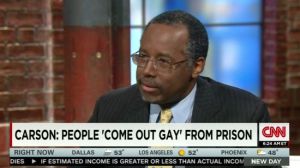
 A new CBS/NYT poll has Ben Carson leading Donald Trump nationally. CBS reports:
Ben Carson has surpassed Donald Trump and now narrowly leads the Republican field in the race for the nomination in the latest national CBS News/New York Times Poll.
Twenty-six percent of Republican primary voters back Carson, giving him a four-point edge over Trump (22 percent). Support for Carson has quadrupled since August.
The rest of the Republican presidential candidates lag far behind in single digits. Marco Rubio is now in third place (eight percent), followed by Jeb Bush (seven percent) and Carly Fiorina (seven percent). All other candidates are at four percent or lower.
Carson has made gains across many key Republican groups. In a reversal from earlier this month, he is now ahead of Trump among women and is running neck and neck with him among men. Carson’s support among evangelicals has risen and he now leads Trump by more than 20 points with this group.
Carson performs well among conservative Republicans and those who identify as Tea partiers. Trump does well with moderates and leads Carson among those without a college degree – although Trump had a larger advantage with non-college graduates earlier this month.
Perhaps we’re going to go through a cycle that resembles what happened in the Republican race in 2012–except that the cycles are longer. Could it be that Donald Trump is on his way out? Of course Trump is claiming the polls are mistaken. From Mediaite:
Republican presidential candidate Donald Trump explained on MSNBC’s Morning Joe that the reason rival Ben Carson had surpassed him in recent polls was because they weren’t “scientific.” ….
“I think you have to understand polls…” Trump said. “I believe in polls. I generally believe in polls. The thing with these polls, they are all so different. They are coming from all over the lot where one guy is up here, somebody else is up there, you see swings of ten and twelve points immediately, even the same day.”
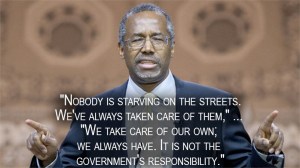
Trump actually may have a good point. Anyway, the problem with Ben Carson taking over the lead is that he is even scarier than Trump. Paul Waldman at The Week: How Ben Carson’s snoozy demeanor masks his bonkers views.
Ben Carson is calm — calm like a cool spring breeze, or a long nap on a lazy Sunday afternoon. The Republican presidential hopeful speaks softly and slowly. He doesn’t wave his arms about. He shows barely any emotion at all. But Ben Carson is also the possessor of ideas that are positively bonkers, not just about policy questions, but about the world and how it works.
This odd combination of a gentle manner and extremist ideas seems to be just what a healthy chunk of the Republican electorate is looking for. Carson is running a close second to Donald Trump nationally, and leading in Iowa. As The New York Times recently reported, Iowa voters in particular are enraptured with Carson’s manner. “That smile and his soft voice makes people very comforted,” said one farmer. “I believe someone as mild-mannered and gentlemanly as Ben Carson is just about the only kind of person that could” get things done in Washington, said another Iowan.
You’d think they were talking about someone with moderate views who’d be able to get along and work with anyone, not someone who wants to outlaw abortion even in cases of rape and incest, thinks we should ditch Medicare, and holds to all manner of weird conspiracy theories. And that’s not to mention all the stuff the retired neurosurgeon says about slavery and Nazis, his belief that Muslims should be barred from the presidency unless they offer a public disavowal of their religion, or his latest proposal to turn the Department of Education into something that sounds like it comes out of China’s Cultural Revolution, in which he would have students report professors who displayed political bias to the government so universities’ funding could be cut.
Read the rest at The Week.
More interesting Ben Carson links:
Inside Higher Ed: Ben Carson explains how he would have education department identify and end “extreme views” on campus.
News Mic: Ben Carson Just Said Women Seeking Abortions are Tantamount to Slave Owners.
Mother Jones: Does Ben Carson Believe Most Evangelical Voters Are Going to Hell?
Dakinikat told me about this amazing and fascinating story about a historical find related to Thomas Jefferson. From NPR: Historic Chemistry Lab With Links To Thomas Jefferson Discovered Behind Wall.
A hidden chemistry lab was unearthed by a worker doing renovations to the iconic Rotunda at the University of Virginia, and school officials say the room is directly linked to the third U.S. president, Thomas Jefferson, who helped design the building.
The “chemical hearth,” which dates back to the 1820s, is thought to be one of the few remaining in the world. It featured two sources of heat for conducting experiments and a system for pulling out fumes.
According to the University of Virginia press release, the room, described as “a semi-circular niche in the north end of the Lower East Oval Room,” was preserved because the walls of the hearth were sealed shut in the mid-1800s:
This photo from the University of Virginia shows a chemical hearth discovered in the Rotunda at the University of Virginia during renovations at the school in Charlottesville, Va.
Dan Addison /University of Virginia Communications“The University of Virginia’s Rotunda still has its secrets, as conservators are discovering amid the building’s ongoing two-year renovation.
“One of them is a chemical hearth, part of an early science classroom. It had been sealed in one of the lower-floor walls of the Rotunda since the 1850s, and thus was protected from the 1895 fire that destroyed much of the building’s interior.
“Two small fireboxes of the hearth were uncovered in a 1970s renovation, but the hearth itself remained hidden until the current round of renovations. When preparing for the current renovations, workers examined some of the cavities in the walls and found the rest of the chemistry hearth.”The discovery was made by Matt Scheidt, who is a project manager for the company overseeing the renovations to the rotunda, according to the Charlottesville Newsplex. Scheidt told the publication he wanted to know how thick the walls were.
What else is happening? Please share your thoughts and links in the comment thread and enjoy the rest of your Tuesday.
Fourth of July Reads
Posted: July 4, 2014 Filed under: morning reads, U.S. Politics, Women's Rights | Tags: corporate personhood, corporatizing religious liberty, Declaration of Independence, Fourth of July, Hobby Lobby, Independence Day, John Roberts, legal precedent, religion, Samuel Alito, SCOTUS, separation of church and state, Statue of Liberty, Wheaton College 14 Comments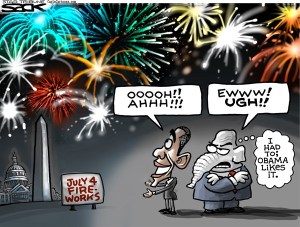
Good Morning!!
Today we celebrate the Declaration of Independence. I’ve assembled a few informational readings about this day in history.
From The Cagle Post: Fourth of July Fast Facts.
“I’m confused. I thought July 4 was the day our country declared independence from King George III of Great Britain.”
“Actually, according to ConstitutionFacts.com, that’s not so. The Continental Congress declared independence from Great Britain on July 2, 1776.”
“Then why do we celebrate our independence on the Fourth every year? Is that when we started the American Revolution?”
“That is a common misunderstanding, as well. The American Revolution began in April 1775, more than a year earlier.”
“I’m stumped. Was the Fourth the day Thomas Jefferson wrote the first draft of the Declaration of Independence?”
“Nope. Thomas Jefferson wrote the first draft in June 1776. Also, Jefferson didn’t write the Declaration alone.”
“He didn’t? I always thought he was the sole author.”
“A common misconception. In fact, the Continental Congress appointed a five-person to write the Declaration. It included Jefferson, Benjamin Franklin, John Adams, Robert Livingston and Roger Sherman.” ….
“Though Jefferson wrote the first draft, it was changed 86 times by other members of the committee and other members of the Continental Congress.”
I did not know that.
David Armitage at The Wall Street Journal: The Declaration of Independence: The Words Heard Around the World.
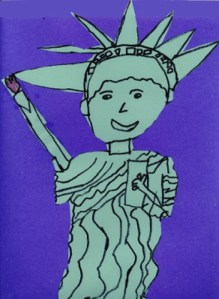
The Declaration of Independence is the birth certificate of the American nation—the first public document ever to use the name “the United States of America”—and has been fundamental to American history longer than any other text. It enshrined what came to be seen as the most succinct and memorable statement of the ideals on which the U.S. was founded: the rights to life, liberty and the pursuit of happiness; the consent of the governed; and resistance to tyranny.
But the Declaration’s influence wasn’t limited to the American colonies of the late 18th century. No American document has had a greater impact on the wider world. As the first successful declaration of independence in history, it helped to inspire countless movements for independence, self-determination and revolution after 1776 and to this very day. As the 19th-century Hungarian nationalist, Lajos Kossuth, put it, the U.S. Declaration of Independence was nothing less than “the noblest, happiest page in mankind’s history.”
In telling this story of global influence, however, it is important to separate two distinct elements of the Declaration—elements that sometimes get conflated. The first of these is the assertion of popular sovereignty to create a new state: in the Declaration’s words, the right of “one People to dissolve the Political Bands which have connected them with another, and to assume among the Powers of the Earth, the separate and equal Station to which the Laws of Nature and of Nature’s God entitle them.” The second and more famous element of the Declaration is its ringing endorsement of the sanctity of the individual: “We hold these truths to be self-evident, that all men are created equal, that they are endowed by their Creator with certain unalienable Rights.”
Read much more at the link.
From the LA Times: The slow-spreading news of American independence.
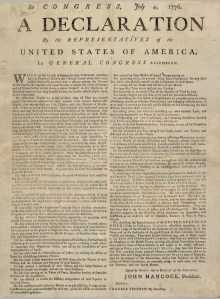
In this era of instant communication, it’s interesting to note the slow distribution of the Declaration, and the spreading of the word to those on whose behalf independence had been declared. (Imagine the Twitter version: Dudes, we’re on our own. #independence #totallyrad #stickitkinggeorge).
The text was set in type by Philadelphia printer John Dunlap just hours after the Continental Congress approved the manifesto on July 4. He ran off about 200 copies, most of which were then distributed via horse and boat around the Colonies. He reprinted it in his own newspaper, Dunlap’s Pennsylvania Packet, or The General Advertiser (great newspaper names back then). Over the next few weeks, Jefferson’s stirring words were reprinted inlocal newspapers and pamphlets around the Colonies.
And, naturally, in Britain. It took more than a month for the first reports of the Declaration to reach Britain in letters ferried by the Mercury packet ship. Gen. William Howe, who was leading the crown’s forces in the Colonies, included a brief mention in his report to his overseers. So the first public airing of the news came in the London Gazette, the crown’s official paper. If you weren’t a close reader, you could have easily missed it.
In the four-page issue dated Aug. 6-Aug. 10, 1776, the Gazette’s lead story was Howe’s update of the war, reporting that “the Rebels, who are numerous, and are very advantageously posted with strong Entrenchments both upon Long Island and that of New York, with more than One Hundred pieces of Cannon for the Defence of the Town towards the Sea, and to obstruct the passage of the [British] Fleet up the North [Hudson] River, besides a considerable Field Train of artillery.”
Finally, Carina Kolodny at Huffington Post: This Is Not Your Independence Day.
The 4th of July might commemorate the independence of our country — but it also serves as a bitter reminder that in 1776, the country that I love had no place for me in it.
When our founding fathers penned, “All men are created equal,” they meant it. Not all people. Not all humans. Just all men — the only reason they didn’t feel obliged to specify “white” men is because, at the time, men of color were considered less than men, less than human.
The 4th is not my Independence Day — and if you’re a Caucasian woman, it isn’t yours either. Our “independence” didn’t come for another 143 years, with the passage of The Woman’s Suffrage Amendment in 1919. The 4th of July is also not Independence Day for people of color. It wasn’t until the 15th Amendment was ratified in 1870 that all men had the right to vote regardless of race — on paper, that is, not in practice. People of color were systematically, and all too successfully, disenfranchised for another century. July 4th of 1776 was certainly not a day of Independence or reverence for Native Americans. It wasn’t until 1924 that Native Americans could unilaterally become citizens of the United States and have the voting rights to go with it.
Now, before anyone argues that Independence is about more than voting rights, I’d like to point out that our Founding Fathers would fundamentally disagree with you. The Revolutionary War was fought, in large part, because of “taxation without representation” — the then English colonists believed they were not free because their voices were not represented. The right to vote, the right to have your say is the delineating characteristic of a democracy.
The Aftermath of the Hobby Lobby Decision
On that note, today many concerned citizens are looking back at the latest Supreme Court decisions that take women backwards in their pursuit of freedom and autonomy. The court-approved limits on access to birth control go beyond the Hobby Lobby decision. Lyle Denniston at SCOTUSblog: Broader right to object to birth control.
Expanding the rights of religious opponents of birth control, a divided Supreme Court on Thursday afternoon spared an Illinois college — and maybe hundreds of other non-profit institutions — from obeying government regulations that seek to assure access to pregnancy prevention services for female workers and students. In the same order, the majority essentially told the government to modify its own rules if it wants to keep those services available.
Three Justices wrote a sharply worded dissent, accusing the majority of creating on its own a “new administrative regime” that will seriously complicate the operation of the birth control mandate under the new federal health care law. The majority, the dissenters said, “has no reason to think that the administrative scheme it foists on the government today is workable or effective on a national scale.”
The ruling, which the majority insisted was temporary and had settled nothing finally about the legal issues at stake, came three days after the Court in Burwell v. Hobby Lobby had given for-profit businesses whose owners have religious objections to birth control a right to refuse to provide those services in their employee health plans.
The plea by Wheaton College, a religious institution in Illinois with about 3,000 students, moved the Court beyond for-profit firms to the world of non-profit religious colleges, hospitals, and other charities. The government had already moved to accommodate their beliefs, but that had not gone far enough for the college and for scores of other non-profits. With the Court’s new order, they gained additional separation from the birth-control mandate.
At Mother Jones, Kevin Drum writes: Supreme Court Now Playing Cute PR Games With Hobby Lobby Decision.
For the last few days, there’s been a broad argument about whether the Hobby Lobby ruling was a narrow one—as Alito himself insisted it was—or was merely an opening volley that opened the door to much broader rulings in the future. After Tuesday’s follow-up order—which expanded the original ruling to cover all contraceptives, not just those that the plaintiffs considered abortifacients—and today’s order—which rejected a compromise that the original ruling praised—it sure seems like this argument has been settled. This is just the opening volley. We can expect much more aggressive follow-ups from this court in the future.
POSTSCRIPT: It’s worth noting that quite aside from whether you agree with the Hobby Lobby decision, this is shameful behavior from the conservatives on the court. As near as I can tell, they’re now playing PR games worthy of a seasoned politico, deliberately releasing a seemingly narrow opinion in order to generate a certain kind of coverage, and then following it up later in the sure knowledge that its “revisions” won’t get nearly as much attention.
At Slate, Micah Schwartzman, Richard Schragger, and Nelson Tebbe explain that Hobby Lobby rewrites religious-freedom law in ways that ignore everything that came before.
Monday’s decision in Hobby Lobby was unprecedented. Much of the commentary has focused on the Supreme Court’s decision to extend rights of religious free exercise to for-profit corporations. Hobby Lobby is for religion what Citizens United was for free speech—the corporatization of our basic liberties. But Hobby Lobby is also unprecedented in another, equally important way. For the first time, the court has interpreted a federal statute, theReligious Freedom Restoration Act (or RFRA), as affording more protection for religion than has ever been provided under the First Amendment. While some have read Hobby Lobby as a narrow statutory ruling, it is much more than that. The court has eviscerated decades of case law and, having done that, invites a new generation of challenges to federal laws, including those designed to protect civil rights.
The authors explain how the right wing Roberts Court has moved beyond any concern for legal precedent in making its decisions.
Hobby Lobby is unprecedented because it corporatizes religious liberty. It extends to for-profit businesses the rights and privileges that have long been associated only with churches and religious nonprofits. But that change is the result of a more pervasive and deeper upending of the law of religious liberty in America. Ignoring congressional intent, the court reads RFRA as having shed its First Amendment skin. It is not entirely clear what American law will look like after that change. But if anything is clear, it is that the Roberts Court is now unconstrained by precedent. It has loosened itself from decades of First Amendment doctrine and has begun remaking the law of free exercise.
Please read the whole thing.
Ironically, the Hobby Lobby decision may have also created some serious problems for the human beings who own corporations (h/t Dakinikat). From Mother Jones: How Hobby Lobby Undermined The Very Idea of a Corporation. Basically, now that SCOTUS has said that some corporations are inseparable from the people who own them, those owners could lose their legal protection from debts and lawsuits that result from corporate actions. There’s some instant Karma for you!
A few more links for your holiday reading pleasure:
Miami Herald: FBI records: Chilling find in Bradenton dumpster (new clues to Saudi involvement in the 9/11 and the cover-up of that involvement by the Bush/Cheney administration).
Study links Oklahoma earthquake swarm with fracking operations
Boston Globe: People prefer electric shocks to time alone with thoughts.
LA Times: Tibetans get high-altitude edge from extinct Denisovans’ genes.
What stories are you following on this Independence Day?
Tuesday Reads: Are Women People?
Posted: March 25, 2014 Filed under: morning reads, Real Life Horror, religion, religious extremists, Reproductive Health, Reproductive Rights, SCOTUS, U.S. Politics, War on Women, Women's Healthcare, Women's Rights, worker rights | Tags: abortion, Affordable Care Act, Antonin Scalia, Are Women Human?, Are Women People?, Birth Control, Citizen's United, contraception, Hobby Lobby, Manhattan Declaration, Obamacare, religious freedom, Sandra Fluke, U.S. Constitution 47 Comments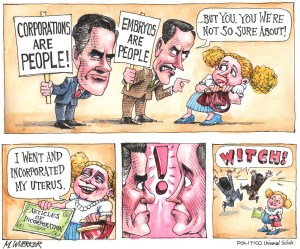
Good Morning!!
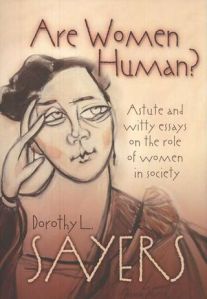
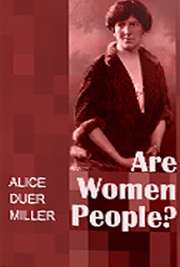
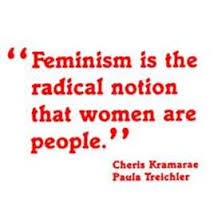
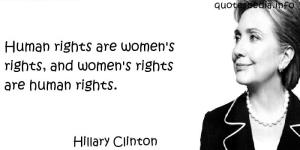
Question for today: Are women human? Are we people in the eyes of our government? We’ve been told that corporations are people. We know that white men are people–that was established by the U.S. Constitution when it was ratified in 1789. Since that time, there have been amendments that granted some rights to non-white men and to women. We can vote now. Does that mean our government recognizes our humanity?
Today our ultra-conservative, mostly Catholic Supreme Court will hear two cases that bring this question to the forefront, and the Court’s decisions may give us some answers to the question of whether American women are officially people with individual rights.
From MSNBC: Supreme Court to hear birth control case
Depending on whom you ask, Tuesday morning’s oral argument at the Supreme Court is about whether Obamacare can keep treading on religious liberty – or it’s about a woman’s right to access contraception on her employee insurance plan, no matter what her employer thinks of it. Either way, it is the first time the Affordable Care Act will be at the nation’s highest Court since it was first largely upheld as constitutional. The same two men as in that case, current Solicitor General Don Verrilli and former Bush administration solicitor general Paul Clement, are facing off to argue over a narrower provision.
Before the Supreme Court decides whether the contraceptive coverage required of insurance plans under the Affordable Care Act violates a 1993 law governing religious liberty, it has to settle the threshold question: Does a corporation even have religious liberty?
I think the question about the rights of women is far broader than that. Without access to birth control and abortion, a woman has no real autonomy as a human being. If she becomes pregnant–even through rape–she loses the ability to make choices about her future life. It has been a relatively short period of time since women have had the power to make those choices. But that power has led to other advances for women–such as the right to prosecute a rapist or an abusive boyfriend or husband, the right to have credit in her own name, the right to an education, and entry into careers from which women were previously blocked. We can only hope that the justices see clearly what their decisions will mean for women’s lives and women’s personhood.
Back to the MSNBC article:
Hobby Lobby Stores, an Oklahoma-based, evangelical-owned craft chain with about 13,000 employees, and Conestoga Wood Specialties, a small Mennonite-owned cabinet maker in Pennsylvania, sued the administration and got two very different answers from the lower courts. The Tenth Circuit Court of Appeals declared of Hobby Lobby that “such corporations can be ‘persons’ exercising religion.” In ruling on Conestoga’s bid for exemption from the requirement, the Third Circuit disagreed: “For-profit secular corporations cannot exercise in religious exercise.”
The companies are among the 47 for-profit corporations that have objected to their company plans complying with the minimum coverage requirements under the Affordable Care Act. Under those regulations, contraception is covered fully, without a co-pay, as preventive care. Hobby Lobby and Conestoga Wood object to a handful of contraceptives that they speculate can block a fertilized egg, which is neither documented in the science nor the medical definition of abortion. Other for-profit plaintiffs object to any birth control coverage at all….
The Obama administration says that the government has a compelling interest in women’s health and in gender equality. The Department of Health and Human Services agreed to classify contraceptives as preventive care after considering testimony from medical experts, who cited the country’s high rate of unintended pregnancy and the persistence cost barriers to accessing effective birth control.
Some legal experts argue that to rule for Hobby Lobby would be imposing religion on others, by forcing the women who work for such companies to pay the cost of their employers’ religion. Frederick Gedicks, a law professor at Brigham Young, has even argued in a brief before the Court that doing so would violate the establishment clause of the First Amendment.
What will SCOTUS decide?
At NPR, Nina Totenberg offers some scary quotes from Steve Green, the president of Hobby Lobby:
“We believe that the principles that are taught scripturally is what we should operate our lives by … and so we cannot be a part of taking life,” explains Hobby Lobby President Steve Green.
“It’s our rights that are being infringed upon to require us to do something against our conscience,” adds CEO and founder David Green.
Using birth control is “taking a life?” Apparently one of the arguments Hobby Lobby is using that–contrary to scientific facts–some forms of birth control are equal to abortion. So is every sperm is sacred too? Should men be prosecuted for masturbating? But those questions are not likely to be asked, because it is already legally established that men are people.
At the WaPo, Sandra Fluke writes: At the Supreme Court, a potential catastrophe for women’s rights.
Unlike my congressional testimony in 2012, which was about Georgetown University — a Catholic-affiliated university — refusing to include contraception in student insurance because it was a religiously affiliated school, the institutions arguing before the Supreme Court are not houses of worship or religious non-profits. The Affordable Care Act already includes special arrangements for those types of organizations. These are private, for-profit corporations — a craft store and a cabinet manufacturer — that want to be excluded from health insurance and employment laws because of bosses’ personal views.
Laws that include religious protection have never given corporations the right to have religious views, and it would be a terrible idea to make such an enormous change to our legal precedent now. Our laws protect individuals’ private religious beliefs, but when you cross over into the public sphere to become a corporation and make a profit off of the public, you must abide by the public’s laws.
Depending on the court’s rulings, the cases’ outcomes could deny millions of women coverage of any or all forms of birth control, limiting women’s ability to control their reproductive health, plan their pregnancies and manage their lives. As I testified, women also need birth control for many other medical reasons, including relief of painful health problems like endometriosis.
And, Fluke argues, recognizing a right for corporations to hold religious views will open the door to
Allowing any private employer to dictate which laws fit inside its religious beliefs could upset the necessary balance of both religious liberty and employee health and safety laws. Depending on the exact ruling, any for-profit corporation could cut off its employees’ insurance coverage for blood transfusions, vaccinations or HIV treatment — all of which some Americans have religious objections to. Any critical health coverage the boss doesn’t agree with could be eliminated.
Furthermore, SCOTUS could not limit these proposed “religious freedoms” to Christians.
Although this country predominantly descends from a Judeo-Christian tradition, our valuable religious protection laws ensure that anyone is free to practice any religion they want, including religions whose belief systems and practices many of us would disagree with vehemently. In fact, far-ranging beliefs that are not associated with any organized religion could be used to justify a corporation’s practices as well.
Sahil Kapur of TPM points out that Justice Scalia, who might be expected to vote in favor of a corporate “right to religious freedom,” will have to deal with one of his previous rulings: Justice Scalia’s Past Comes Back To Haunt Him On Birth Control.
In 1990, Scalia wrote the majority opinion in Employment Division v. Smith, concluding that the First Amendment “does not require” the government to grant “religious exemptions” from generally applicable laws or civic obligations. The case was brought by two men in Oregon who sued the state for denying them unemployment benefits after they were fired from their jobs for ingesting peyote, which they said they did because of their Native American religious beliefs.
“[T]he right of free exercise does not relieve an individual of the obligation to comply with a valid and neutral law of general applicability,” Scalia wrote in the 6-3 majority decision, going on to aggressively argue that such exemptions could be a slippery slope to lawlessness and that “[a]ny society adopting such a system would be courting anarchy.”
“The rule respondents favor would open the prospect of constitutionally required religious exemptions from civic obligations of almost every conceivable kind,” he wrote, “ranging from compulsory military service, to the payment of taxes, to health and safety regulation such as manslaughter and child neglect laws, compulsory vaccination laws, drug laws, and traffic laws; to social welfare legislation such as minimum wage laws, child labor laws, animal cruelty laws, environmental protection laws, and laws providing for equality of opportunity for the races.”
That opinion could haunt the jurist if he seeks to invalidate the birth control rule.
“Scalia will have to reckon with his own concern in Smith about the lawlessness and chaos created by liberal exemptions to generally applicable law,” said Adam Winkler, a constitutional law professor at UCLA. “For him to uphold an exemption now is to invite more of the lawlessness that he warned about.”
At Think Progress, Ian Millhiser addresses the right wing organizations that have waged a concerted war against women’s rights during the past several years: Read This One Document To Understand What The Christian Right Hopes To Gain From Hobby Lobby.
2009 was a grim year for social conservatives. Barack Obama was an ambitious and popular new president. Republicans, and their conservative philosophy, were largely discredited in the public eye by a failed war and a massive recession. And the GOP’s effort to reshape its message was still in its awkward adolescence. If the conservative movement had a mascot, it would have been a white man dressed as Paul Revere and waving a misspelled sign.
Amidst this wreckage, more than two hundred of the nation’s leading Christian conservatives joined together in a statement expressing their dismay at the state of the nation. “Many in the present administration want to make abortions legal at any stage of fetal development,” their statement claimed, while “[m]ajorities in both houses of Congress hold pro-abortion views.” Meanwhile, they feared that the liberals who now controlled the country “are very often in the vanguard of those who would trample upon the freedom of others to express their religious and moral commitments to the sanctity of life and to the dignity of marriage as the conjugal union of husband and wife.”
The signatories to this statement, which they named the “Manhattan Declaration,” included many of America’s most prominent Catholic bishops and clergy of similar prominence in other Christian sects. It included leaders oftop anti-gay organizations like the National Organization for Marriage, and of more broadly focused conservative advocacy shops such as the Family Research Council. It included university presidents and deans from Christian conservative colleges. And it included the top editors from many of the Christian right’s leading publications.
Perhaps most significantly, however, the document’s signatories includes Alan Sears, the head of one of the two conservative legal groups litigating what are likely to be the two most important cases decided by the Supreme Court this term. Indeed, the Manhattan Declaration offers a virtual roadmap to understanding what religious conservatives hope to gain from Sebelius v. Hobby Lobby and Conestoga Wood v. Sebelius, two cases the justices will hear Tuesday which present the question whether a business owner’s religious objections to birth control trump their legal obligation to include it in their employee’s health plan.
Read the gory details at the link.
Finally, I ask that everyone read this year-old article at Time Magazine by Jessica Winter, Subject for Debate: Are Women People? It is both darkly humorous and deadly serious.
All my adult life, I’ve been pretty sure I’m a sentient, even semi-competent human being. I have a job and an apartment; I know how to read and vote; I make regular, mostly autonomous decisions about what to eat for lunch and which cat videos I will watch whilst eating my lunch. But in the past couple of months, certain powerful figures in media and politics have cracked open that certitude.
You see, like most women, I was born with the chromosome abnormality known as “XX,” a deviation of the normative “XY” pattern. Symptoms of XX, which affects slightly more than half of the American population, include breasts, ovaries, a uterus, a menstrual cycle, and the potential to bear and nurse children. Now, many would argue even today that the lack of a Y chromosome should not affect my ability to make informed choices about what health care options and lunchtime cat videos are right for me. But others have posited, with increasing volume and intensity, that XX is a disability, even a roadblock on the evolutionary highway. This debate has reached critical mass, and leaves me uncertain of my legal and moral status. Am I a person? An object? A ward of the state? A “prostitute”? (And if I’m the last of these, where do I drop off my W-2?)
Please go read the whole thing. It’s not long.
So . . . those are my recommended reads for today. What stories are you following? Please post your links on any topic in the comment thread.

 peej
peej Carissa
 bostonboomer
 dakinikat
 ecocatwoman
 mablue2
 Mama Lopez
 peggysue22
 quixote
 skydancingguestblogger
 Mona (aka Wonk the Vote)



 Sky Dancing
Recent Comments