
Mostly Monday Reads: “My God, what have we done?”*
Posted: April 7, 2025 Filed under: kakistocracy, Psychopaths in charge, Vive la résistance | Tags: @johnbuss.bsky.social John Buss, FARTUS, Hiroshima, History, historyuncovered, shorts, Trump Administration and Crimes Against Humanity, Trump Deportations, Trump Tariffs, Trump's NAZI tendencies 4 Comments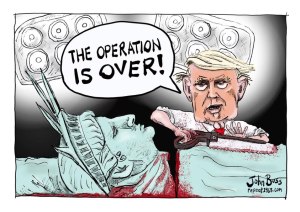 Good Afternoon, Sky Dancers
I’m a little late for today. I had an appointment to get to this morning. Now, I must catch a breath and a bit of meditative calming before looking at each headline. We’re seeing more evidence of ICE resembling Hitler’s Einsatzgruppen, which was a specially heinous unit within the SS. I’m waiting for some version of the Night of Long Knives now that #FARTUS has some infamous cabinet appointments. We’re seeing increased purges and attacks on Judges, Former Federal employees, Former Federal Prosecutors, and all kinds of people who would deter his fits of paranoia and dreams of revenge. His deportation pogroms continue to rise to the level of crimes against humanity. Each day brings new horrors.
This headline from 7News/NYTV in New York has shaken me. “Saturday statement: school principal wants students back.” We are a country that handcuffs third graders at school and detains them with adults.
SACKETS HARBOR, New York (WWNY) – The school principal where 3 students attended before being taken away by ICE agents wants the children back and will attend Saturday’s rally in the village.
The statement to 7NEWS comes just hours before the event being organized by community members and local democrats.
The rally came about after federal agents went to North Harbor Dairy Farm on County Route 75 in the town of Hounsfield a week ago looking for a criminal suspect. While the feds found that man, they also took 7 other people, who they called illegal aliens, to be processed at the border station on Wellesley Island.
Part of that group is a mother and 3 children.
Jaime Cook, in a statement, says, “Our 3 students who were taken by ICE were doing everything right. They had declared themselves to immigration judges, attended court on their assigned dates, and were following the legal process. They are not criminals.”
Cook continues, “We are in shock, and it is that shared shock that has unified our community in the call for our students’ release.”
Cook says the school is in direct communication with the students and says, “Let me be clear: they are not being medically evaluated. They are not being questioned as potential victims. Calling a detention center by another name does not change what it is.”
Cook is referring to a description and interview 7NEWS did with U.S. Border Czar Tom Homan earlier this week. Our 25-minute interview can be seen here: TOM HOMAN – WWNY
There was a rally later. This is the report from Newsweek. “Third Grade Student Arrested by ICE Sparks Mass Protest.” They actually put underage children in a car with the arrested suspect who is charged the possession of child pornography. They all should be charged with child endangerment.
ICE agents conducted a raid at North Harbor Dairy in Sackets Harbor, targeting an individual charged with possession of child pornography. In addition to apprehending the primary suspect, seven others were detained at a local dairy farm last month, including a mother and her three children enrolled in the local public school.
The demonstration, organized by the Jefferson County Democratic Committee, began with a rally that included a written statement from New York Attorney General Letitia James, who said she was “heartbroken and angry” over the incident.
…
Jefferson County Democratic Committee chair Corey Decillis told NBC News: “We’ve seen it occur right in the last 60 days across the country, but when it happens in your backyard, I think that’s what garners people’s attention.”
Tom Homan said in an interview Thursday on WWNY-TV: “It wasn’t a raid. It was a search warrant execution at a house where a family was found in the country illegally. ICE is doing everything by the book. Once the investigation gets to the point where we don’t have an interest in this family, then a decision will be made on release.”
Principal Jaime Cook said in a statement: “They lived in a house on the same road as a home ICE had a warrant for. The fact that ICE went door to door is unfathomable. The fact that our students were handcuffed and put into the same van as the alleged criminal from down the street is unconscionable. When I think of my third grader’s experience, my stomach twists and it is hard to breathe.”
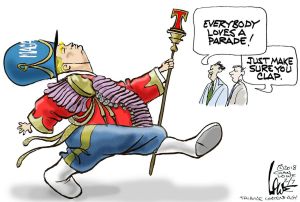 This country is our backyard. This should not stand. And next up on the WTF is THIS SHIT list? WTF country do we live in? This is from the Daily Beast. “Trump Orders Four Mile Military Parade for His 79th Birthday.” We can’t feed hungry kids but we can do this?
President Donald Trump is making plans for a military parade in Washington, D.C., on his 79th birthday, according to a report.
A source in the capital told the Washington City Paperthat Trump has earmarked June 14—which is the 250th anniversary of the U.S. Army—for the event.
The display of military might will march around four miles from the Pentagon in Arlington County, Virginia, to the White House, the D.C. source told the publication.
The report said that local officials are only now hearing of plans for the parade and that no formal request has been made for their assistance.
Arlington County Board Chair Takis Karantonis told the City Paper that the White House had given the county a “heads up” about the parade on Friday, with only 10 weeks until the event.
He said “the parade’s scope ” was ” unclear” and that no firm details were disclosed.
Other unnamed officials told the paper that a big military parade will require a huge amount of coordination between the six branches of the armed forces, along with several federal agencies and regional officials.
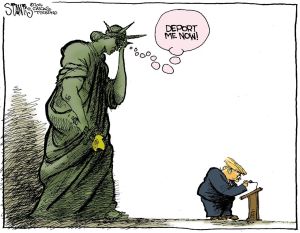 This headline from the Washington Post just about had me gagging on my morning cuppa. This follows up on the fuck up that was supposed to be a grand production of sending a lot of hapless men to an infamous El Salvadorian Prison. “Trump asks Supreme Court to block order returning deportee from El Salvador. Judge Paula Xinis gave the Trump administration until midnight Monday to return Kilmar Abrego García, who was deported despite a court order forbidding it.” How far will those Republican Supremes shove themselves up that FARTUS ass this time around? This story was reported by Justin Jouvenal and Maria Sacchetti.
The Trump administration asked the Supreme Court on Monday to block a lower court’s order requiring officials to bring back a Maryland man who was mistakenly deported to El Salvador.
The emergency motion came after U.S. District Judge Paula Xinis gave the administration until 11:59 p.m. Monday to return Kilmar Abrego García, a Salvadoran immigrant who is married to a U.S. citizen.
Abrego García has been detained at a mega-prison in El Salvador since U.S. Immigration and Customs Enforcement deported him last month, despite a court order forbidding it because he had fled death threats from gang members in his home country.
Trump officials have argued that they have no power to return Abrego García because he is now in the custody of El Salvador.
Xinis forcefully pushed back on that assertion Sunday, writing that the federal government certainly does have the authority to return Abrego García and that while Trump officials have also alleged he is a gang member, they have offered “no evidence” to prove that.
The judge noted that the Trump administration is paying the Salvadoran government $6 million to detain Abrego García and other deportees. An agreement between the two countries states that U.S. officials will decide what happens to the detainees in the future.
 I suggest we offer them Trump in exchange for holding a new election. Then, there’s just the rest of us. I was excited that my social security check hit my account this morning. That was good news. But this still tells us we shouldn’t take too much for granted. This is again from the Washington Post, which I try not to use gratuitously. “Social Security website keeps crashing, as DOGE demands cuts to IT staff. The worsening problems come as Elon Musk’s DOGE team pushes for more cuts at the agency, including in the department that oversees the website.” I still wonder which of our press and prestigious law firms are supporting the constitutional version of their businesses.
Retirees and disabled people are facing chronic website outages and other access problems as they attempt to log in to their online Social Security accounts, even as they are being directed to do more of their business with theagency online.
The website has crashed repeatedly in recent weeks, with outages lasting anywhere from 20 minutes to almost a day, according to six current and former officials with knowledge of the issues. Even when the site is back online, many customers have not been able to sign in to their accounts — or have logged in only to find information missing. For others, access to the system has been slow, requiring repeated tries to get in.
The problems come as the Trump administration’s cost-cutting team, led by Elon Musk, has imposed a downsizing that’s led to7,000 job cuts and is preparing to push out thousands more employees at an agency that serves 73 million Americans. The new demands from Musk’s U.S. DOGE Service include a 50 percent cut to the technology divisionresponsible for the website and other electronic access.
Many of the network outages appear to be caused by an expanded fraud check system imposed by the DOGE team, current and former officials said. The technology staff did not test the new software against a high volume of users to see if the servers could handle the rush, these officials said.
The technology issues have been particularly alarming for some of the most vulnerable Social Security customers. For almost two days last week, for example,many of the 7.4 million adults and children receiving monthly benefits under the anti-poverty program known as Supplemental Security Income, or SSI, confronted a jarring message that claimed they were “currently not receiving payments,” agency officials acknowledged in an internal email to staff.
 Why do Republicans love fertilized eggs and hate children?
Okay, so this one kills me because I know too much about the subject area. But it’s another Black Monday on Wall Street. This is from Bloomberg News’ Timothy O’Brien. “Trump Created an Economic Sinkhole. He Doesn’t Care. There is no strategy behind the tariff chaos — it’s all about personal grievances and settling scores.”
Trump had routinely called for steep tariffs on America’s biggest trading partners during his presidential campaign, and analysts who took his threats seriously produced research indicating that his policies would reduce economic growth and personal incomes. But a tariff regime built on a war-footing seemed so extreme to some observers and Trump allies that they looked for other explanations. His chaotic policy approach — he initially would set a deadline for new tariffs and then suddenly back off — meant that he wasn’t really committed to his own agenda. Tariff Ping-Pong was just a Great Dealmaker ploy meant to get other nations to capitulate, his enablers argued.
Well, times have changed. Trump announced a massive new round of global tariffs last week and over the next two days $5.4 trillion of value was shredded as equity markets cratered. Some Wall Streeters see Trump’s tariffs plans and the future more clearly now.
“This is unambiguously stupid,” Jay Hatfield, the CEO of Infrastructure Capital Advisors, told Bloomberg News over the weekend. He labeled the tariffs poster Trump trotted out in his Rose Garden press conference last week as the “chart of death” and invoked disaster. “It’s a five-alarm fire,” he said. “There’s no argument for creating a trade war whatsoever.”
Anyone hoping that Trump will soon see the light and reverse course might want to reconsider the force of nature that they’re dealing with. He has been insulated from the consequences of his own actions his entire life and appears to care very little about the economic sinkhole he just created. He shared a video of himself golfing over the weekend and one White House insider told the Washington Post that the president, only about three months into his second term, carries the burdens of a notoriously burdensome job rather lightly.
“He’s at the peak of just not giving a f— anymore,” the official noted. “Bad news stories? Doesn’t give a f—. He’s going to do what he’s going to do. He’s going to do what he promised to do on the campaign trail.”
The Post also reported that it was Trump himself who selected the tragicomic “formula” that his administration used to calculate tariff penalties. That’s the formula that somehow positioned Cambodia and Thailand at the top of the heap of countries posing major economic threats to the US and also caused tariffs to be imposed on uninhabited islands near Antarctica. The Post said Trump didn’t finalize his plans until about three hours before he shared them with the world last week.
Trump has likened his much-maligned tariffs salvo as necessary medicine the world needs to swallow.
“THE OPERATION IS OVER! THE PATIENT LIVED, AND IS HEALING,” he allowed in a post to his social media platform. “THE PROGNOSIS IS THAT THE PATIENT WILL BE FAR STRONGER, BIGGER, BETTER, AND MORE RESILIENT THAN EVER BEFORE. MAKE AMERICA GREAT AGAIN!!!”
Given Trump’s worldview, pondering “strategy” is a fool’s errand and asking “What is the administration trying to accomplish?” is the wrong question. There isn’t a strategy. Trump operates in strategy-free zones. But he has overt and longstanding goals.
His primary aim is to address his grievances with the world, not to craft substantive or even rational public policy. An inordinate number of his goals involve self-aggrandizement or self-preservation. Many others are performative and unhinged. A meaningful number of his ambitions involve seeking revenge on people, institutions, and organizations that he believes have taken advantage of him, the country or his supporters. He has a long history of labeling America’s trading partners, some of whom are the US’s closest allies, as pickpockets and he’s now in a position to do something about it.
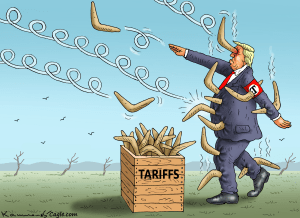 Well, at least I know where that stupid formula came from. But, since this is hitting everyone’s pocketbook, will it finally wake some of the little MAGA guys up? Noah Berlatsky, writing at Public Notice, says yes. “Trump’s tariffs insanity begins to fracture the MAGA cult. Republican resistance is helpful. But more of it is needed.”
Trump’s decision to single-handedly hobble the world economy and immiserate tens of millions of Americans has presented his fellow Republicans with a stark choice. Do they continue to kiss his orange butt and slavishly nod along to every nonsensical whim of their idiot Golfer King as he leads them into a recession and almost certain electoral apocalypse? Or do they defy him, splitting the party and opening themselves to a primary challenge … and possible electoral apocalypse?
The good news is that some GOP senators and members of Congress are actually disturbed enough by the prospect of their voters starving in the street that they have taken steps to push back against this grotesquely self-destructive trade policy. The not so good news is that the pushback is hesitant and half-hearted — and the majority of the party remains ready to torture and impoverish their constituents for the greater glory of Trump.
The tariffs, and the quick slide into economic calamity, have sparked real resistance. They’ve also demonstrated just how craven and/or hypnotized the GOP has become, and the extent to which most Republicans would do anything — literally anything — rather than point out that the emperor is wearing a grotesque meat suit made of the skin of his constituents.
As they are wont to do, many Republicans have gotten on their bellies to grovel and spout the usual Trump-flattering balderdash, either because they are desperate to propitiate their master or because they are genuinely fools.
Commerce Secretary Howard Lutnick has been leading the charge of the sycophants. In interviews he’s blathered that Trump’s trade policy would force other countries to “stop picking on us” and bleated, “Let Donald Trump run the global economy. He knows what he’s doing.”
The only explanation I can come up with for a leader that obliterates not only his best allies but also his own country is that #FARTUS is patently insane. He’s gone nuclear on nearly everyone, including penguins.
So I am very tired, and I still have to teach tonight. I’ll let you share any of the things you find interesting. At least with this post, we have identified several Secretaries who must be charged with crimes against humanity, all with FARTUS.
What’s on your reading and blogging list today?
“My God, what have we done?” – Bob Lewis, copilot #shorts #history #hiroshima #historyuncovered
Lazy Caturday Reads
Posted: November 23, 2024 Filed under: cat art, caturday, Donald Trump, just because | Tags: Donald Trump, History, John F. Kennedy, Lyndon B. Johnson, news, politics 3 CommentsGood Afternoon!!
 Yesterday was the 61st anniversary of the assassination of President John F. Kennedy on November 22, 1963. I was 15 years old, a junior in high school. I still see that day as a defining event in my life. It was my first real experience of death, and I recall how difficult it was for me to comprehend and accept that our brilliant and charismatic president was really gone forever. It was my first lesson in how quickly dramatic events can change our understanding of the world.
Everything was different after that. If Kennedy had lived, he very likely would have won a second term, and perhaps the course of the Vietnam War could have been different. Perhaps Richard Nixon would not have made his comeback and been elected president in 1968. We can’t know what would have happened, but I think that if Kennedy could have completed a second term, our history would have been very different.
Of course Lyndon Johnson did complete many of Kennedy’s projects like the Civil Rights Acts of 1964 and 1968, the Voting Rights Act of 1965, and the Medicare and Medicaid Act of 1965. Kennedy’s tragic death and Johnson’s legislative experience likely helped these laws get passed. But there was something about Jack Kennedy that inspired and energized the country, and that energy was lost after his death–especially after Johnson’s failure in Vietnam and his stubbor refusal to change course.
It’s the weekend and I need a break from the current madness in politics, so I’m going to share a few reads about that long ago day in 1963.
Heather Cox Richardson at Letters from an American: November 22, 2024.
It was November 22, 1963, and President John F. Kennedy and First Lady Jacqueline Kennedy were visiting Texas. They were there, in the home state of Vice President Lyndon Baines Johnson and his wife, Lady Bird, to try to heal a rift in the Democratic Party. The white supremacists who made up the base of the party’s southern wing loathed the Kennedy administration’s support for Black rights.
That base had turned on Kennedy when he and his brother, Attorney General Robert F. Kennedy, had backed the decision of the U.S. Court of Appeals for the Fifth Circuit in fall 1962 saying that army veteran James Meredith had the right to enroll at the University of Mississippi, more commonly known as Ole Miss.
When the Department of Justice ordered officials at Ole Miss to register Meredith, Mississippi governor Ross Barnett physically barred Meredith from entering the building and vowed to defend segregation and states’ rights.
So the Department of Justice detailed dozens of U.S. marshals to escort Meredith to the registrar and put more than 500 law enforcement officers on the campus. White supremacists rushed to meet them there and became increasingly violent. That night, Barnett told a radio audience: “We will never surrender!” The rioters destroyed property and, under cover of the darkness, fired at reporters and the federal marshals. They killed two men and wounded many others.
By Susan Herbert (after The Milkmaid by Johannes Vermeer)
The riot ended when the president sent 20,000 troops to the campus. On October 1, Meredith became the first Black American to enroll at the University of Mississippi.
The Kennedys had made it clear that the federal government would stand behind civil rights, and white supremacists joined right-wing Republicans in insisting that their stance proved that the Kennedys were communists. Using a strong federal government to regulate business would prevent a man from making all the money he might otherwise; protecting civil rights would take tax dollars from white Americans for the benefit of Black and Brown people. A bumper sticker produced during the Mississippi crisis warned that “the Castro Brothers”—equating the Kennedys with communist revolutionaries in Cuba—had gone to Ole Miss.
That conflation of Black rights and communism stoked such anger in the southern right wing that Kennedy felt obliged to travel to Dallas to try to mend some fences in the state Democratic Party.

How the day began:
On the morning of November 22, 1963, the Dallas Morning News contained a flyer saying the president was wanted for “treason” for “betraying the Constitution” and giving “support and encouragement to the Communist inspired racial riots.” Kennedy warned his wife that they were “heading into nut country today.”
But the motorcade through Dallas started out in a party atmosphere. At the head of the procession, the president and first lady waved from their car at the streets “lined with people—lots and lots of people—the children all smiling, placards, confetti, people waving from windows,” Lady Bird remembered. “There had been such a gala air,” she said, that when she heard three shots, “I thought it must be firecrackers or some sort of celebration.”
The Secret Service agents had no such moment of confusion. The cars sped forward, “terrifically fast—faster and faster,” according to Lady Bird, until they arrived at a hospital, which made Mrs. Johnson realize what had happened. “As we ground to a halt” and Secret Service agents began to pull them out of the cars, Lady Bird wrote, “I cast one last look over my shoulder and saw in the President’s car a bundle of pink, just like a drift of blossoms, lying on the back seat…Mrs. Kennedy lying over the President’s body.”
As they waited for news of the president, LBJ asked Lady Bird to go find Mrs. Kennedy. Lady Bird recalled that Secret Service agents “began to lead me up one corridor, back stairs, and down another. Suddenly, I found myself face to face with Jackie in a small hall…outside the operating room. You always think of her—or someone like her—as being insulated, protected; she was quite alone. I don’t think I ever saw anyone so much alone in my life.”
After trying to comfort Mrs. Kennedy, Lady Bird went back to the room where her husband was. It was there that Kennedy’s special assistant told them, “The President is dead,” just before journalist Malcolm Kilduff entered and addressed LBJ as “Mr. President.”
There’s a bit more at the link.
Colin Moynihan at The New York Times: Desperate Bid to Save J.F.K. Shown in Resurfaced Film.
Nearly 61 years ago, Dale Carpenter Sr. showed up on Lemmon Avenue in Dallas, hoping to film John F. Kennedy as his motorcade passed. But the president’s car had already gone by, and he recorded only some of the procession, including the back of a car carrying Lyndon Johnson and the side of the White House press bus.
So Mr. Carpenter, a businessman from Texas, rushed to Stemmons Freeway, several miles farther along the motorcade route, to try again.
There, just moments after Kennedy had been shot, he captured an urgent and chaotic scene. The president’s speeding convertible. A Secret Service agent in a dark suit sprawled on the back. Jacqueline Kennedy, in her pink Chanel outfit, little more than a blur.
Kennedy himself could not be glimpsed. He had collapsed and was close to death.
For decades Mr. Carpenter’s 8-millimeter snippets of what transpired in Dallas on Nov. 22, 1963, have been a family heirloom. When he died in 1991 at 77, the reel, which included footage of his twin boys’ birthday party, passed to his wife, Mabel, then to a daughter, Diana, and finally to a grandson, James Gates.
Later this month, the Kennedy footage is to be put up for sale in Boston by RR Auction, the latest in a line of assassination-related images to surface publicly after decades in comparative obscurity. The auction house says it is the only known film of the president’s car on the freeway as it sped from Dealey Plaza, the site of the shooting, to Parkland Memorial Hospital, where Kennedy was pronounced dead at 1 p.m.
Footage shot by Abraham Zapruder, a bystander, has long provided disturbing images of the assassination itself, one of the most traumatic and closely examined events in American history. Mr. Carpenter’s film shows what happened before and just after the Zapruder film was shot. The first section is a prosaic scene of the president’s motorcade; the second, a race for help imbued with all the uncertainty that filled the moments after the gunshots.
Though Mr. Carpenter’s film, just over a minute long, contains nothing likely to affect the debate over Kennedy’s death, several experts said it is still an important addition to the mosaic of images that recorded that day in Dallas.
Paul Singer at WGBH: A newly uncovered memo shows how the JFK assassination reverberated in Boston.
This story is about a trip I took to look at the files of Freedom House, and the four remarkable pages I found in those files.
Freedom House was the community-based, Black-led nonprofit that helped the city of Boston sell the Washington Park plan to Roxbury’s Black residents. And the files that Freedom House kept of that time period now sit in nearly 90 boxes in the Northeastern University Archives and Special Collections.
I called over and the archives folks warmly welcomed me to browse a small sample of the Freedom House collection. When I arrived, they had set aside two banker’s boxes full of numbered file folders.
It was in box 32, folder 1111 that I struck gold. Or, more accurately, yellow.
Four pages of yellow notepad paper, filled with cursive handwriting. It was a report about a special conference called to address the “Low Income Housing Crisis” in Boston on Nov. 22, 1963.
That date rang a bell. Wasn’t that the day JFK was shot?
It was.
And the memo documents how that tragedy played out in real time 1,700 miles from Dallas’ Dealey Plaza.
 The meeting was to address the issue of how urban renewal in 1960s Boston was hurting the city’s poor and people of color, especially the need for low-income housing. When the group broke for lunch the news of Kennedy’s death reached them.
In extraordinarily poetic terms, McGill writes that the group tried to continue with its important work of addressing low-income housing needs, but it was difficult to concentrate.
“… people were sobbing uncontrollably and our spirits kept foundering under the awful waiting vigil our hearts were keeping at the side of the president.”
When Kennedy’s death was confirmed, McGill wrote how the collective weeping grew. She witnessed a priest across the room as his face “crumpled helplessly.”
The attendees abandoned any effort to continue their work, and a closing prayer was offered.
“Charles Abrams was scheduled to deliver a special address at the close of the conference … but he had no heart to give the speech he had prepared. He talked about the tragedy and its implications instead — very briefly. Dr. Barth closed the conference with special prayers for the President, the bereaved family, and for the healing of the sickness of violence and hate in our country.”
Standing in a library basement with these pages in my hand, I was struck by how much that prayer still rings true 61 years later.
And Boston still has a low-income housing crisis.
Trump’s Awful Nominations.
Steven Contorno and Kristen Holmes at CNN: Fox hosts, cable news regulars and entertainment pros: Trump is casting a made-for-TV Cabinet.
A common thread weaves through many of Donald Trump’s picks for his incoming administration, a quality the president-elect values as highly as loyalty and perhaps even more than conventional qualifications: a flair for television.
He has plucked two Fox News stars from their airwaves – Sean Duffy for Transportation secretary and Pete Hegseth to lead the Pentagon. For the agency overseeing Medicare and Medicaid, Trump has turned to Dr. Mehmet Oz, the celebrity physician known for his health show that aired for 13 seasons. His pick for the Department of Education, meanwhile, is Linda McMahon, who co-founded and built a professional wrestling and entertainment empire alongside her husband.
Trump’s choice for ambassador to Israel, Mike Huckabee, had a six-year run hosting a Fox News show. Tulsi Gabbard, his selection for director of national intelligence, was a contributor on the conservative network after she left Congress and once subbed for its former primetime host Tucker Carlson.
As a former reality TV star, Trump is deeply attuned to the power of the small screen. His selection process has centered on people who can not only articulate his message but also defend him in the kind of high-stakes, combative settings that define modern media.
His transition team, operating in a war-room style setup at Mar-a-Lago, has embraced this focus. On large screens, his advisers play video clips of potential appointees’ media performances, including footage of them defending Trump but also their past criticism of him, underscoring the centrality of media strategy in his decision-making.
The outcome is a made-for-TV Cabinet who he thinks will sell his agenda to Americans and defend the administration against media scrutiny on their networks. Meanwhile, in some departments, the expectation is that deputies and top staff will oversee the day-to-day operations.
Another comment thread: incompetence and lack of relevant experience.
Ryan Bort and Asawin Suebsaeng at Rolling Stone: Team Trump Is Furious Hegseth Hid Sex Assault Claim: ‘This Is the F–king Pentagon!’
Matt Gaetz may have withdrawn his name from consideration to become Donald Trump’s attorney general over sexual misconduct accusations — but alleged sexual abuser Pete Hegseth is still fighting to persuade Republican senators to confirm him to one of the most powerful positions in government.
Hegseth was already facing an uphill confirmation battle to become the Secretary of Defense given that he is best known as a Fox News host with no government experience. The emergence of a disturbing sexual assault accusation against him from 2017 isn’t helping matters — and Trump’s team is pissed.
According to four sources familiar with the situation, some top Trump transition officials and others close to the president-elect have been puzzled, if not infuriated, that Hegseth did not preemptively inform them of the allegations against him before they made their way into the press — most notably through the publication of a police report detailing the alleged incident at a hotel in Monterey, California.
“How did he not know? Why didn’t he tell us?” a source close to Trump says. “Pete wasn’t interviewing for a job at McDonald’s; this is the fucking Pentagon! … Even if the allegations are fake, it doesn’t matter because he was supposed to tell us what we needed to know so we could be better prepared to defend him — not learn about it from the media.”
There was, the sources say, a vetting process for the Hegseth pick, but it did not uncover these details, nor was it especially invasive. Trump’s transition team did not sign agreements with the White House or the Justice Department to allow the FBI to conduct background checks on the president-elect’s nominees.
“When we ask, ‘Is there anything else we need to know about?’ that is usually a good time to mention a police report,” a Trump adviser says. “Obviously he remembered that this all happened and there is no way — I don’t think — he could have believed this wouldn’t come out once he got nominated.”
Why haven’t they withdrawn Hegseth’s name yet?
Liam Archacky at The Daily Beast: Now GOP Senators Want Another Trump Nominee’s Full FBI File.
Some Republican senators are privately eager to see the FBI file on Tulsi Gabbard, whose history of alignment with Russia has drawn concern in the wake of her nomination for the post of director of national intelligence, reported Punchbowl News.
Although Gabbard has drawn headlines for previously echoing Russian talking points on topics like the wars in Ukraine and Syria, it’s her support for leaker turned Russian citizen Edward Snowden that is allegedly most troubling for some lawmakers.
The former Democratic congresswoman openly pushed for the U.S. to “drop all charges” against Snowden in a 2020 bill that was co-sponsored by former Republican Rep. Matt Gaetz, another one-time Trump cabinet nominee who was yesterday forced to withdraw his name amid sexual misconduct allegations he denies.
Lawmakers, including members of the Senate Intelligence Committee, which is responsible for processing Gabbard’s nomination, reportedly find Gabbard’s support for Snowden—a former NSA employee who leaked state secrets—especially concerning because of the danger his actions posed to national security, reported Punchbowl.
Although FBI file reviews are standard for presidential cabinet candidates, Punchbowl reported that the Republican senators’ interest in doing so seems to suggest that they believe there could still be unknown information in the file—such as potential foreign contacts.
The New York Times: Trump Picks Key Figure in Project 2025 for Powerful Budget Role.
President-elect Donald J. Trump on Friday picked a key figure in Project 2025 to lead the Office of Management and Budget, elevating a longtime ally who has spent the last four years making plans to rework the American government to enhance presidential power.
The would-be nominee, Russell T. Vought, would oversee the White House budget and help determine whether federal agencies comport with the president’s policies. The role requires Senate confirmation unless Mr. Trump is able to make recess appointments.
The choice of Mr. Vought would bring in a strongly ideological figure who played a pivotal role in Mr. Trump’s first term, when he also served as budget chief. Among other things, Mr. Vought helped come up with the idea of having Mr. Trump use emergency power to circumvent Congress’s decision about how much to spend on a border wall.
Mr. Vought was a leading figure in Project 2025, the effort by conservative organizations to build a governing blueprint for Mr. Trump should he take office once again. Mr. Trump tried to distance himself from the effort during his campaign, but he has put forward people with ties to the project for his administration since the election.
Mr. Vought’s role in Project 2025 was to oversee executive orders and other unilateral actions that Mr. Trump could take during his first six months in office, with the goal of tearing down and rebuilding executive branch institutions in a way that would enhance presidential power.
Joyce Vance at Civil Discourse: Project 2025: It’s On (Predictably).
Before Bill Barr became Donald Trump’s third attorney general, he circulated a memo that was more or less an audition tape for the job he ultimately got. That memo reached both the White House Counsel’s Office and Main Justice. In it, Barr argued in favor of what had previously been a fringe theory of a powerful “unitary executive,” in other words, a president able to consolidate power at the expense of the other two branches as a very powerful leader. The writing was on the wall with Barr’s selection, although the Supreme Court cast it in stone when the conservative majority signed off on the view that presidents couldn’t be criminally prosecuted as long as the crimes they committed fell under the umbrella of official acts. Even Bill Barr would have never dreamed of arguing the president could use SEAL Team Six to assassinate a political rival and walk away with no consequences. Now, the Supreme Court says it’s so.
That’s the context that’s essential for understanding Trump’s Friday evening “nomination” (if you can call a social media announcement that) of Russell Vought to lead the Office of Management and Budget (OMB). Vought is a proponent of a powerful executive and of restructuring our institutions to facilitate a government that veers toward the monarchical and away from the democratic. He was one of only four out of forty-four of Trump’s cabinet officials from his first administration who said they’d support him this time.
Vought entered OMB at the start of Trump’s first administration and was confirmed as its director in July 2020. In the archive of his official biography, his role is described like this: “he is responsible for overseeing the implementation of the President’s policy, management and regulatory agendas across the Executive Branch.” OMB is a powerful agency, and its director is, in a very real sense, a president’s right-hand man. Among the job experience Vought touts in his bio are his seven years as Vice President of Heritage Action for America, a sister organization to the Heritage Foundation, which, as readers of Civil Discourse are well aware, is where Project 2025 was incubated….
Now Vought, godfather to Project 2025 and author of its chapter on OMB, will be in charge of administering policy in the next Trump Administration. So much for Trump’s efforts—back when reporting about Project 2025 led to enormous public concern and seemed poised to shift the tide against him— to distance himself from the project. At the time, he disavowed any knowledge of or agreement with the plan, but the claims felt hollow.
Read much more about Vought at Civil Discourse.
More Relevant Reads
David H. Graham at The Atlantic: Pam Bondi’s Comeback.
USA Today: Trump considers ex-intelligence chief Richard Grenell for Ukraine post, sources say.
The Washington Post: Trump plans to fire Jack Smith’s team, use DOJ to probe 2020 election.
The New York Times: Elon Musk Gets a Crash Course in How Trumpworld Works.
The New Republic: Elon Musk Is Now Cyberbullying Government Employees.
Jonathan Last at The Bulwark: Be Not Afraid. Trump and MAGA want to frighten you. Don’t let them.
Lazy Caturday Reads With Trucker Cats
Posted: September 16, 2023 Filed under: Cats, caturday, Donald Trump, just because | Tags: 16th Street Baptist church bombing, Birmingham Alabama, collective trauma, disinformation, gag order, History, Hunter Biden, Jack Smith, Justice Ketanji Brown Jackson, Racism, trauma, trucker cats, Truth Social 6 CommentsHappy Caturday!!

Percy the trucker cat, photo by Paul Robertson
Dakinikat turned me on to the world of truck drivers who have cat companions along for the ride. Here’s an article that discusses the phenomenon. CharityPaws.com: Trucker Cats May Be The Coolest Cats!
For what it’s worth, having a pet is hard work.
Love is easy enough to provide while on the road – but food, water, space, and entertainment are all needs too, and sometimes hard to come up with.
In the case of dogs especially, playtime is the hardest need to fill for truckers. After several hour-long walks, a game of tug-of-war, and an afternoon in the sun spent playing fetch, who wouldn’t be tired? But for truckers this can be time consuming and delay important deliveries!
That’s why many truckers have turned to cats as the solution for those lonely road trips. Trucker cats are the coolest cats with their chill laid back personalities and ability to make truckers feel awesome. They also have some great hearing which is why the made it to our list of “what animal has the best hearing” list. Having a companion with good hearing on board can help you find critters that may sneak around while you are sleeping or even alert you to danger!
With most of their time spent on the road in a little truck cab, cats are the perfect companion for truckers– and here’s some of the best reasons why according to one trucker’s resource:
- Cats are low-maintenance: they eat less than their canine counterparts, take up less room, and don’t need as much playtime.
- They’re loving and affectionate: cats are just as sweet as any other animal, once they have a chance to warm up to you.
- They’re obedient, and trainable: cats can do tricks and walk on leashes, with the proper time and training!
- They’re protective: though not as scary as a dog, cats are perfectly capable of altering truckers if something looks, sounds, or even smells off.
Other reasons topping truckers’ lists include cleanliness, cuteness, and the fact that having a cat in a truck is a pretty good conversation starters. Some even say that having a feline friend is a constant reminder to drive and act safely during the long haul. They are also incredibly loyal as shown by the Room 8 cat – and having that kind of loyalty on the road will make any trucker feel amazing!
Read more at the link above.
Here’s a video about trucker cats, posted on YouTube by Cheezburger.
Long Read: Are Americans Experiencing Collective Trauma?
I want to call your attention to an excellent, but very long read in The New Republic by Anna Marie Cox: We Are Not Just Polarized. We Are Traumatized. Subhead: “The pandemic. The mass shootings. Insurrection. Trump. We’ve been through so much. What if our entire national character is a trauma response?”
This is a very long piece, so I’m just going to give you some samples to help you decide if you want to tackle reading the whole thing.
As of last year, four in 10 Americans knew at least one person who died from Covid. This year, three in 10 Americans say they know someone who has been affected by an opioid addiction, and one in five knows someone who’s died from a painkiller overdose. In 2022, more than three million adults were displaced by some form of natural disaster—that’s more than three times as many displaced per year between 2008 and 2021. Last year, some cities saw a 50 percent increase in evictions over pre-pandemic levels. One in five knows someone who’s died due to gun violence; one in six has witnessed a shooting; 21 percent have been personally threatened by a gun. Half of Americans know someone personally who has experienced at least one of those events.
After Trump’s “grab her by” tape became public, calls to the national sexual assault hotline jumped up by 35 percent (as Michelle Goldberg observed, Trump was a walking trigger for assault survivors). During the Brett Kavanaugh hearings, calls to the sexual assault hotline spiked 201 percent. Lockdown—the first two months of the pandemic—saw a rise in intimate partner violence of 101 percent, with the rate stabilizing at an increase of about 8 percent from pre-pandemic numbers as of 2022.
Another photo of Trucker cat Percy, by Paul Robertson
And then there are the frontline workers and “essential personnel,” those who risked their lives for our safety and comfort during the spring of 2020. I assume that we agree health professionals faced trauma (and may well still). There are 22 million of them in the United States, and after the pandemic, 55 percent reported experiencing burnout, and three in 10 said they were now considering leaving the profession. The 55 million essential personnel who worked through the worst days of Covid suffered a similar toll: A year into the pandemic, the American Psychiatric Association found that 34 percent of essential workers had been treated by a mental health professional, 80 percent had trouble over- or under-sleeping, and 39 percent said they were drinking more alcohol than they had before….
These are traumas at the individual level in numbers so large that they demand national attention because there are national consequences—think of the nationwide therapist shortage and “the Great Resignation.”
So, what if the reason so many people identify as trauma survivors is that they are? What if the horrors of the last seven years do translate into a nation that is suffering more than mere political dysfunction? What if the polarization, paranoia, conspiracism, and hopelessness that bog us down have a more holistic origin than structural malfunctions or individual malfeasance?
What if our entire national character is a trauma response?
Before you say “bullshit,” remember: Cynicism is a trauma response.

Next Cox explores expert opinions about the concept of “collective trauma.”
The origin of the academic study of “collective trauma” has been credited to Kai Erikson’s 1977 book, Everything in Its Path, an account of the aftermath of the Buffalo Creek flood in Logan County, West Virginia, five years prior, which killed 125 people and destroyed 550 homes in a small mining community. In the book, Erikson writes of grappling with “thousands of pages of transcript material, whole packing boxes full of it,” that confounded him “not because the material is contradictory or difficult to interpret but because it is so bleakly alike.” He found respondents echoing one another to a frustrating degree, so much so that “a researcher is very apt to conclude after rummaging through these data that there is really not very much to say.” Eventually, however, he came to believe that the uniformity itself was meaningful; the damage done at Buffalo Creek was something more than a mere collection of individual harms.
Collective trauma, he wrote, means “a blow to the basic tissues of social life that damages the bonds attaching people together and impairs the prevailing sense of communality.” Collective trauma happens in slow motion, “A form of shock all the same…. ‘I’ continue to exist, though damaged and maybe even permanently changed. ‘You’ continue to exist, though distant and hard to relate to. But ‘we’ no longer exist as a connected pair or as linked cells in a larger communal body.”
Trucker Abdirahman Abdul and Aisha
In other words, the defining characteristic of collective trauma—and what makes it almost impossible to self-diagnose—is that people who have been through it no longer believe in the integrity of their community. How does anyone see themselves as a traumatized collective if no one feels that they belong?
So, pull back to the macro level. For a moment, put aside your or anyone else’s individual experience. Think of the country itself as a patient.
In the past seven years, the country has sustained significant, repeated damage to its institutions. The courts, elections, law enforcement, and so on are its vital organs. Trump has been punching America in the kidneys since he first floated the idea of a “rigged election.” January 6 was a heart attack. The musculature that is the justice system, well, it was always spasmodic. The murders of George Floyd, Breonna Taylor, and Ahmaud Arbery shocked many white people into awareness of our already dysfunctional law enforcement apparatus, and then the Dobbs decision drove home how easily the rights that support us can be yanked away. Were we ever really as strong as we thought?
The country was already weakened by Trumpism when the pandemic attacked our nervous systems more than figuratively. It cut away at the millions of tiny threads that knit up our towns and cities. Think of the loose social ties that grow from just seeing the same people at the grocery store (or the office) every day—think of the mail. Our national proprioception—our awareness of where our parts are in relation to one another—deteriorated. Our creaky supply chain is another symptom of this disconnect. So is “you’re on mute.”

I won’t quote any more, but these excerpts are just from the introductory part of the article. Cox later demonstrates with examples how the notion of trauma can apply to our collective experience as a nation. There is so much in the piece, that I wonder if Cox is planning to turn it into a book.
I’m not sure how the MAGA world fits into this hypothesis, but after my reading about the traumas of Appalachia–from poverty, drugs, unemployment, and breakdown of families (see my Wednesday post), I wonder if an argument could be made that the attraction to Trump as powerful father figure could also have arisen out of trauma. At any rate, I highly recommend this article.
Other Stories to Check Out
NBC News: Special counsel asks for ‘narrow’ gag order for Trump in election interference case.
Citing threats against individuals former President Donald Trump has targeted, special counsel Jack Smith has asked a federal judge for a narrowly tailored gag order that restricts the 2024 presidential candidate from making certain extrajudicial statements about the election interference case brought against him.
A redacted copy of a government filing — released Friday, after an order from U.S. District Judge Tanya Chutkan — comes in connection with the election interference case, one of four criminal cases the former president is facing, two of which are federal.
“The defendant has an established practice of issuing inflammatory public statements targeted at individuals or institutions that present an obstacle or challenge to him,” the special counsel’s office wrote.
Whispur and DanDan, photo by Whispurer on Reddit
The government said Trump “made clear his intent to issue public attacks related to this case when, the day after his arraignment, he posted a threatening message on Truth Social.”
Trump’s Aug. 4 post read: “IF YOU GO AFTER ME, I’M COMING AFTER YOU!”
Trump, the office wrote, “has made good on his threat,” spreading “disparaging and inflammatory public posts on Truth Social on a near-daily basis regarding the citizens of the District of Columbia, the Court, prosecutors, and prospective witnesses.
“Like his previous public disinformation campaign regarding the 2020 presidential election, the defendant’s recent extrajudicial statements are intended to undermine public confidence in an institution—the judicial system—and to undermine confidence in and intimidate individuals—the Court, the jury pool, witnesses, and prosecutors,” the prosecutors wrote.

Naturally, Trump responded publicly to the filing:
At an event in Washington, Trump made his first public remarks on the filing by attacking Smith, arguing that the special counsel “wants to take away my rights under the First Amendment, wants to take away my right of speaking freely and openly.”
Steven Cheung, a spokesperson for the Trump campaign, responded earlier Friday by calling the filing “nothing more than blatant election interference because President Trump is by far the leading candidate in this race.”
Alan Feuer and Charlie Savage at The New York Times: Special Counsel Obtained 32 Private Messages From Trump’s Twitter Account.
The federal prosecutors who charged former President Donald J. Trump with a criminal conspiracy over his attempts to overturn the 2020 election obtained 32 private messages from his Twitter account through a search warrant this winter as part of their investigation, court papers unsealed on Friday said.
Questions have lingered about what prosecutors were looking for in Mr. Trump’s Twitter account ever since it was revealed last month that the government had served the warrant on Twitter in January. In an earlier release of documents, prosecutors disclosed that they had obtained some private messages from Mr. Trump’s account but not how many.
The 32 messages, whose content has not been disclosed, were only a small fraction of the larger body of data that Twitter was forced to turn over under the terms of the warrant, the new court papers said. Much of the legal wrangling over the matter focused on the Justice Department’s demand that Twitter, purchased last year by Elon Musk and now known as X, not inform Mr. Trump of the search warrant.
Mr. Trump’s posts on the platform in the chaotic months after the election were mentioned several times in the indictment that the special counsel, Jack Smith, filed against him in Washington last month. What remains unclear is whether Mr. Smith’s team sought the warrant for Mr. Trump’s account merely to confirm that he had posted the messages that appeared in public, or whether they suspected that some private data in the account might also be important.
What were investigators looking for in the private messages?
The newly unsealed documents — an exhaustive record of the legal fight between Twitter and the Justice Department over whether to hide the execution of the warrant from Mr. Trump — added a few new details about what the government may have been seeking.
Waylon the Trucker Cat, photo by owner Nick
For example, the materials showed that prosecutors wanted to learn if there were other accounts that Mr. Trump had been logging into from the same internet address he used for his Twitter account, which during his presidency was a main channel for his public statements. But it was not clear whether looking for other accounts was merely a routine step or whether investigators had a specific reason to be asking.
The new materials — unsealed at the request of a coalition of news media organizations, including The New York Times — opened a broader window into the back and forth between the special counsel’s office and Twitter. The dispute touched on how to balance the government’s need to protect a sensitive investigation with the social media company’s desire to be transparent with its most famous user.
The documents were particularly sharp in describing Mr. Trump’s repeated attempts to obstruct federal inquiries — an argument that prosecutors used in securing permission from a judge in Washington not to tell the former president for months that they had obtained the warrant for his account.
In detailing Mr. Trump’s “pattern of obstructive conduct,” the new papers cited his attempts to interfere with the special counsel’s other inquiry — one in which the former president stands accused of illegally holding on to dozens of classified documents after leaving office.

Read more at the NYT.
ABC News: Hunter Biden’s lawyer says gun statute unconstitutional, case will be dismissed.
The attorney for President Joe Biden’s son Hunter Biden, who is facing felony gun charges, said Friday that the statute is “likely unconstitutional” and he expects “the case will be dismissed before trial.”
“On the facts, we think we’ll have a defense,” Abbe Lowell told ABC News’ George Stephanopoulos in an interview on “Good Morning America.”
The younger Biden has been indicted by special counsel David Weiss on three felony gun charges, bringing renewed legal pressure on him after a plea agreement he struck with prosecutors imploded in recent months.
The conduct described in the indictment dates back to October 2018, when Hunter Biden procured a Colt Cobra 38SPL despite later acknowledging that he was addicted to drugs around that time.
While the criminal statutes cited in the indictment are clear — it is a crime to lie on a gun application form or to possess a firearm as a drug user – Hunter Biden’s attorney suggested that the charges could be unconstitutional, citing a recent appeals court ruling that drug use alone should not automatically prevent someone from obtaining a gun.
“The only change that has occurred between when they investigated [this alleged crime] and today is that the law changed,” Lowell said. “But the law didn’t change in favor of the prosecution. The law changed against it.”
With Republicans launching an impeachment inquiry on Capitol Hill, Lowell suggested that political pressure on prosecutors played into their decision, questioning the timing of the charges in light of revelations from whistleblowers about the investigation.
No kidding. The political pressure from right wing Congresspeople has been off the charts. And Special Counsel David Weiss himself was appointed by Bill Barr after political pressure from Donald Trump.
Supreme Court Justice Ketanji Brown Jackson on Friday implored Americans to “own even the darkest parts of our past” in a speech commemorating 60 years since the deadly 16th Street Baptist Church bombing.
“History is also our best teacher. Yes, our past is filled with too much violence, too much hatred, too much prejudice. But can we really say that we are not confronting those same evils now?” Jackson said at the church in Birmingham, Alabama.
Trucker cat, photo by abbenquesnel on flicker
“We have to own even the darkest parts of our past, understand them and vow never to repeat them. We must not shield our eyes. We must not shrink away lest we lose it all,” she said.
The justice didn’t invoke a particular case, but as a whole her speech nodded to efforts targeting the teaching of critical race theory in schools and books about the struggle for racial equality and other topics.
“If we are going to continue to move forward as a nation, we cannot allow concerns about discomfort to displace knowledge, truth or history. It is certainly the case that parts of this country’s story can be hard to think about,” she said. “I know that atrocities like the one we are memorializing today are difficult to remember and relive. But I also know that it is dangerous to forget them.”
At times, Jackson, the first Black woman to serve on the Supreme Court, drew a personal connection to the tragedy, in which a bomb exploded at the church on September 15, 1963, killing Denise McNair, Cynthia Wesley, Addie Mae Collins and Carole Robertson. Nearly two dozen others were injured.
“As a mother of two young women who will always be my little girls, I can imagine no greater horror than to lose a child this way,” Jackson said.
“And even now, six decades later, the magnitude of that tragic loss weighs heavily on all of us because those girls were just getting started. They could have broken barriers. They could have shattered ceilings. They could have grown up to be doctors or lawyers or judges appointed to serve on the highest court in our land,” she added.

Read more at CNN.
That’s a sampling of today’s news. Feel free to discuss anything and everything in the comment thread.
Memorial Day Reads
Posted: May 28, 2018 Filed under: just because | Tags: China, History, Memorial Day, trade wars 17 Comments It’s the Memorial Day Holiday!
Sewell Chan writes for the NYT about the ‘unofficial’ history of Memorial Day. It is something we discovered and shared before but it bears repeating because it explains why the holiday still gets short shrift in here in the Deep South. It also explains why some Southern States still have a separate Confederate Memorial Day. I still remain shocked that Mississippi refused to recognize it as a holiday until recently.
David W. Blight, a historian at Yale, has a different account. He traces the holiday to a series of commemorations that freed black Americans held in the spring of 1865, after Union soldiers, including members of the 21st United States Colored Infantry, liberated the port city of Charleston, S.C.
Digging through an archive at Harvard, Dr. Blight found that the largest of these commemorations took place on May 1, 1865, at an old racecourse and jockey club where hundreds of captive Union prisoners had died of disease and been buried in a mass grave. The black residents exhumed the bodies and gave them proper burials, erected a fence around the cemetery, and built an archway over it with the words, “Martyrs of the Race Course.”
Some 10,000 black people then staged a procession of mourning, led by thousands of schoolchildren carrying roses and singing the Union anthem “John Brown’s Body.” Hundreds of black women followed with baskets of flowers, wreaths and crosses. Black men, including Union infantrymen, also marched. A children’s choir sang spirituals and patriotic songs, including “The Star-Spangled Banner.”
“The war was over, and Memorial Day had been founded by African-Americans in a ritual of remembrance and consecration,” Dr. Blight wrotein a 2011 essay for The New York Times. “The war, they had boldly announced, had been about the triumph of their emancipation over a slaveholders’ republic. They were themselves the true patriots.”
The African-American origins of the holiday were later suppressed, Dr. Blight found, by white Southerners who reclaimed power after the end of Reconstruction and interpreted Memorial Day as a holiday of reconciliation, marking sacrifices — by white Americans — on both sides. Black Americans were largely marginalized in this narrative.
“In the struggle over memory and meaning in any society, some stories just get lost while others attain mainstream recognition,” Dr. Blight wrote.
His claim is not universally accepted; the fact-checking website Snopes says of the 1865 remembrance: “Whether it was truly the first such ceremony, and what influence (if any) it might have had on later observances, are still matters of contention.”
 Here is BostonBoomer’s blog from 2014 and Mink’s from 2012. We remember the role of slaves freed by the sacrifice of Union Soldiers in our Civil War in celebrating that sacrifice.
I always remember Decoration Day because when I was very young we would do what my parents did as children. We went to small cemeteries in Kansas and Missouri to make certain the family grave sites were attended and clean. We picnicked and trimmed bushes then put peonies in jars on the graves of greats and cousins who died in war. For some reason, all of our family grave plots were resplendent with huge peony bushes. My mother always beat them back and would announce loudly how much she hated them. Peony bushes were not allowed any where near home. They were left to the dead in my family and they bloomed profusely each Memorial Day.
In Caney Kansas, where my own grandparents are now buried, lays my Great Uncle Jack along side his mother, my Great Grandmother Anna. He didn’t die in the battlefields of Europe during World War 1 but came home with complications from Mustard Gas. He died quite young on the family farm but it was of his wounds brought home as a dough boy fighting in a trench. Many soldiers come home with wounds seen and unseen that eventually catch up to them. I never understood why I was told Dad’s Uncle Jack wasn’t quite included in the same way as those whose graves got the peonies properly but we gave him peonies because my Dad and Nana adored him and it felt right to me. Some times our country has a short memory with a narrow focus. It doesn’t really remember all of the sacrifices of those who came before us including every single slave who died unfree.
Today, we also remember the sacrifice of every gold star family too. I hope Cadet Bonespurs plays golf and that his selfish, hateful face stays away from the one holiday he can truly sully with just his presence. Unfortunately, he left long enough to give a lofty speech at Arlington that should have been given by any better person. But, take heart, he still had a way of making it all about him!
 I read this article last night and even reviewed the variables and methodology of the original study. It’s amazing to actually review the panel data and see which attributes are significant to the question at hand but the findings are not surprising. NBC shares “The Trump effect: New study connects white American intolerance and support for authoritarianism.”
A new study, however, suggests that the main threat to our democracy may not be the hardening of political ideology, but rather the hardening of one particular political ideology. Political scientists Steven V. Miller of Clemson and Nicholas T. Davis of Texas A&M have released a working paper titled “White Outgroup Intolerance and Declining Support for American Democracy.” Their study finds a correlation between white American’s intolerance, and support for authoritarian rule. In other words, when intolerant white people fear democracy may benefit marginalized people, they abandon their commitment to democracy.
Miller and Davis used information from the World Values Survey, a research project organized by a worldwide network of social scientists which polls individuals in numerous countries on a wide range of beliefs and values. Based on surveys from the United States, the authors found that white people who did not want to have immigrants or people of different races living next door to them were more likely to be supportive of authoritarianism. For instance, people who said they did not want to live next door to immigrants or to people of another race were more supportive Iof the idea of military rule, or of a strongman-type leader who could ignore legislatures and election results.
The World Values Survey data used is from the period 1995 to 2011 — well before Donald Trump’s 2016 run for president. It suggests, though, that Trump’s bigotry and his authoritarianism are not separate problems, but are intertwined. When Trump calls Mexicans “rapists,” and when he praises authoritarian leaders, he is appealing to the same voters.
 The Chinese Trade Wars are showing winners and losers already. Winners include Trump himself–and now, Ivanka– plus Chinese Companies including ones that threaten US National Security. The losers are US companies. We seem completely unable to stop this.
Ivanka Trump’s brand continues to win foreign trademarks in China and the Philippines, adding to questions about conflicts of interest at the White House, The Associated Press has found.
On Sunday, China granted the first daughter’s company final approval for its 13th trademark in the last three months, trademark office records show. Over the same period, the Chinese government has granted Ivanka Trump’s company provisional approval for another eight trademark s, which can be finalized if no objections are raised during a three-month comment period.
Taken together, the trademarks could allow her brand to market a lifetime’s worth of products in China, from baby blankets to coffins, and a host of things in between, including perfume, make-up, bowls, mirrors, furniture, books, coffee, chocolate and honey. Ivanka Trump stepped back from management of her brand and placed its assets in a family-run trust, but she continues to profit from the business.
“Ivanka Trump’s refusal to divest from her business is especially troubling as the Ivanka brand continues to expand its business in foreign countries,” Noah Bookbinder, executive director of Citizens for Responsibility and Ethics in Washington, said in an email Monday. “It raises significant questions about corruption, as it invites the possibility that she could be benefiting financially from her position and her father’s presidency or that she could be influenced in her policy work by countries’ treatment of her business.”
As Ivanka Trump and her father have built their global brands, largely through licensing deals, they have pursued trademarks in dozens of countries. Those global trademarks have drawn the attention of ethics lawyers because they are granted by foreign governments and can confer enormous value. Concerns about political influence have been especially sharp in China, where the courts and bureaucracy are designed to reflect the will of the ruling Communist Party.
Chinese officials have emphasized that all trademark applications are handled in accordance with the law.
More approvals are likely to come. Online records from China’s trademark office indicate that Ivanka Trump’s company last applied for trademarks — 17 of them — on March 28, 2017, the day before she took on a formal role at the White House. Those records on Monday showed at least 25 Ivanka Trump trademarks pending review, 36 active marks and eight with provisional approval.
 Don’t forget! Trump’s Indonesia project has been financial enhanced by the Chinese Government after he announced he would help with ZTE. China is definitely on the winning side with the Trumps. However, what about US Businesses?
As Washington and Beijing try to resolve their trade disputes, several big companies are caught in the middle.
One is Qualcomm (QCOM), an American chipmaker whose $44 billion purchase of NXP Semiconductors (NXPI), a Dutch company, has been waiting for Chinese regulators’ approval.
Far more controversial is the case of ZTE (ZTCOF), the Chinese phone and telecom equipment maker that was crippled by a US export ban issued last monthin punishment for what the US said were violations of its sanctions against North Korea and Iran.
Easing penalties on ZTE is a key priority for Chinese President Xi Jinping, and Trump has indicated he’s willing to yield in order to move ahead with further trade discussions.
But members of Congress from both parties, many increasingly wary of China’s trade practices, believe such leniency would be a mistake. A growing number of senatorshave drawn a red line on ZTE, and have been vocal in recent days about their opposition to restoring the company.
Are we winning yet?
 Meanwhile, TrumpsterFires continue to break out as white men go after our national “enemies” like young men from China attending school here. This must be an additional feature to calling the police because black people are going about their lives in clear view!
California police say they thwarted a vigilante deportation attempt last week – in which a pilot allegedly kidnapped a foreign student, took him to an airport and tried to send him “back to China.”
Jonathan McConkey, a pilot and certified flight instructor, is accused of orchestrating the kidnapping with his assistant, Kelsi Hoser, a ground instructor. Both reportedly worked at the IASCO flight training school in Redding, California.
Among IASCO’s students were dozens of Chinese nationals with student visas, according to court records. KRCR News 7 reported that the school contracted with China’s civil aviation authority to train its new pilots, one of whom was apparently Tianshu Shi.
Shi told reporters that he had been in the United States for about seven months – living with several other IASCO trainees at an apartment in Redding. It was there, police said, that McConkey and Hoser came for the student.
Some interesting stats from Axios you can review. Which part of our country has lost the most on the battlefield since 9/11?
Today is the 17th Memorial Day since 9/11. Since then, 6,940 U.S. military service members have died for America.
Why it matters: Every part of the country has lost soldiers to the wars in Iraq and Afghanistan. All were Americans — someone’s neighbor, child, parent, mentor, buddy. Their average age was between 26 and 27 years old.
Have a great day and be safe if you’re in the path of all that weather on the East coast and the panhandle of Florida!.
Dumbed Down America
Posted: July 4, 2011 Filed under: U.S. Economy, U.S. Politics, We are so F'd | Tags: Calvin and Hobbs, Declaration of Independence, Fourth of July, History, ignorance, Marist poll 28 Comments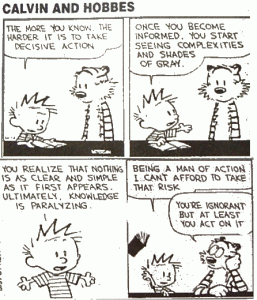
Time to bring back civics classes. Nearly a quarter of Americans don’t know when the Declaration of Independence was signed, or what country we declared independence from. From ABC’s The Note:
A Marist poll released Friday shows that only 58 percent of Americans know when the country declared independence. Nearly a fourth of respondents said they were unsure and sixteen percent said a date other than 1776, when the Declaration of Independence was signed.
Young people posted the most troubling scores with 41 percent of people ages 18 to 29 saying they were unsure when the Declaration of Independence was signed and 27 percent saying the wrong date.
One in four Americans do not even know which country the U.S. gained independence from. The correct answer, of course, is Great Britain, although 20 percent of respondents were unsure of that fact.
Again, age made a big difference. Middle-aged Americans – ages 30 to 44 – guessed the wrong country more than any other age group, or 10 percent of the time. The younger generation was less likely to be flat-out wrong, but was more likely to be unsure. About one third of Americans age 18 to 29 said they didn’t know for sure which country America won independence from.
That is so sad. I was just thinking this morning that I can remember the days when we were proud to be Americans–when it was important to know our history and be aware of our rights. What happened? That was before American culture became synonymous with corporate culture–before being greedy, selfish, and callous became the American way.
The final changeover happened under Ronald Reagan. That is when so many Americans bought into the notion that money was more important than human relationships, when “religious” people began to embrace “prosperity” rather than the old, outdated notions of “faith, hope, and charity (love).” Under Reagan, young people stopped preparing for careers in which they could help others or the society as a whole and started focusing on whatever job would bring in the most money.
Barack Obama came of age under Reagan, and as far as I can tell, although he calls himself a Democrat, the current occupant of the White House is totally sold on the Reagan philosophy. He doesn’t seem to know much about history or basic economics, even though he has degrees from two elite universities.
Not only is civics missing from high schools, but also Americans don’t get educated by the media anymore. When I was a kid, there were actually serious shows on TV that analyzed politics–not shouting, arguing shows, but real news shows. Today young people are watching TV shows like “Hoarders” and “Jersey Shore.” I’m next generation will learn to be even more greedy, selfish, and narcissistic than previous generations. I hope I’m wrong.
I know I sound like a bitter old woman–sorry about that. I grew up in the ’50s and ’60s, a time of great social change; but looking back now, it was a much simpler time. My generation has been called every insulting name in the book–selfish, narcissistic, rebellious. Tom Wolfe labeled us “the me generation” for looking within and seeking ways to become more awake and aware–for trying to understand human consciousness and for going into therapy.
Am I just doing what Tom Wolfe did–judging and misunderstanding the generations that came after mine? Please tell me I’m wrong!

 peej
peej Carissa
 bostonboomer
 dakinikat
 ecocatwoman
 mablue2
 Mama Lopez
 peggysue22
 quixote
 skydancingguestblogger
 Mona (aka Wonk the Vote)



 Sky Dancing
Recent Comments