
Thursday: Hillary, Vlad, and the Crisis in Ukraine
Posted: March 6, 2014 Filed under: Barack Obama, Foreign Affairs, morning reads, U.S. Politics | Tags: Adolf Hitler, Godwin's law, Hillary Clinton, Nazi Germany, Ukraine crisis, Vladimir Putin 90 Comments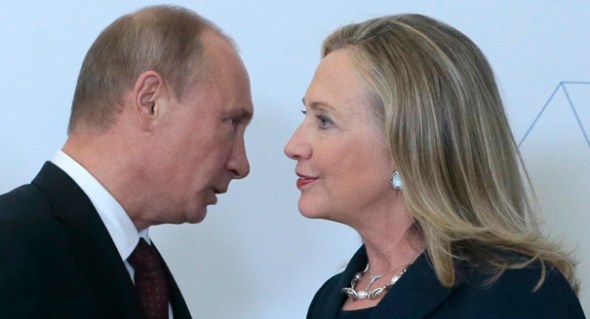
Good Morning!!
We’re close to two years away from the 2016 presidential primaries, but already the media is putting everything Hillary Clinton said or does under a microscope. I don’t know how I’m going to get through this. For some reason, I just can’t help being protective of Hillary even if I don’t agree with everything she says. The latest flap is over remarks she made about Vladimir Putin’s actions in Ukraine at a private fundraiser for the Boys and Girls Clubs of Long Beach, CA .
It began on Tuesday night when Buzzfeed’s Ruby Cramer reported what she learned from two people who attended the event: Hillary Clinton Compares Russia Moves To Nazi Aggression.
“Mrs. Clinton talked at length on the situation in the Ukraine,” said one attendee, Harry Saltzgaver, the executive editor of a group of newspapers in Long Beach.
Both Saltzgaver and a second fundraiser attendee, who requested to speak without attribution, described Clinton’s parallel between the actions of Russian President Vladimir Putin and Adolf Hitler, who resettled tens of thousands of ethnic Germans in Eastern and Central Europe to Nazi Germany before the war.
“She compared issuing Russian passports to Ukrainians with ties to Russia with early actions by Nazi Germany before Hitler began invading neighboring countries,” Saltzgaver said. “She said, however, that while that makes people nervous, there is no indication that Putin is as irrational as the instigator of World War II.”
A reporter also provided Cramer with direct quotes:
According to the Long Beach Press Telegram, whose reporter attended the event, Clinton told attendees, “Now if this sounds familiar, it’s what Hitler did back in the 30s,” she said. “All the Germans that were … the ethnic Germans, the Germans by ancestry who were in places like Czechoslovakia and Romania and other places, Hitler kept saying they’re not being treated right. I must go and protect my people and that’s what’s gotten everybody so nervous.”
Oh no! Clinton breaks Godwin’s law! Suddenly there was a stampede to be the first to criticize her for invoking Hitler. I mean, how dare she? She’s only the former Secretary of State and a possible candidate for president in 2016.
Philip Rucker at the WaPo: Hillary Clinton’s Putin-Hitler comments draw rebukes as she wades into Ukraine conflict.
Hillary Rodham Clinton has sparked a political uproar this week by wading into the middle of the ongoing conflict in Ukraine, likening the moves of Russian President Vladimir Putin to the actions of Nazi dictator Adolf Hitler leading up to World War II.
The former secretary of state’s provocative comparison drew swift rebukes Wednesday from U.S.-Russia policy experts — including some who served under her husband, former president Bill Clinton — while attracting rare notes of support from hawkish Republicans in Congress.
The comments put Clinton, a possible 2016 presidential candidate, at odds with President Obama and her former administration colleagues, who have been measured in their statements on Ukraine in hopes of avoiding an escalation of Putin’s incursion into Ukraine’s Crimean Peninsula.
Rucker quoted one “expert” who claimed Hillary was trying to take a “hard line” on Putin now because she had been “the face of the Obama administration’s “effort to “reset” its policy with Russia.”
Ian Bremmer, president of Eurasia Group, a nonpartisan global risk consulting firm, said Clinton’s Hitler comment signaled she was trying to “stage manage” the Russia issue.
“Hillary’s too smart to actually believe that Putin’s actions are remotely close to anything that Hitler did,” Bremmer said. “The only reason she would say that is that she believes she was vulnerable in having been the architect of the failed ‘reset’ and wants to show that she’s harder-line than anybody else.”
But former Russian Ambassador Michael McFaul disagreed.
He said Clinton was “much more skeptical” of Putin than other administration colleagues, that she was the first U.S. official to condemn Putin’s disputed 2011 election, and that she made a point of meeting with civil-society critics during official visits to Russia.
Buzzfeed’s Andrew Kaczinski followed up on his colleague’s reporting with a clarification from Hillary in a report on her appearance at at UCLA yesterday.
“The claims by President Putin and other Russians that they had to go into Crimea and maybe further into Eastern Ukraine because they had protect the Russia minorities,” Clinton said Wednesday, “that is reminiscent of claims that were made back in the 1930s when Germany under the Nazis kept talking about how they had to protect German minorities in Poland, in Czechoslovakia, and elsewhere throughout Europe. So I just want everybody to have a little historic perspective. I’m not making a comparison certainly, but I am recommending that we perhaps can learn from this tactic that has been used before.”
Clinton also assessed Putin’s personality, based on her personal experience:
“As for President Putin, I know we are dealing with a tough guy with a thin skin,” Clinton said. “I’ve had a lot of experience — well, not only with him but with people like that — but in particular with President Putin. I know that his political vision is of a greater Russia.”
“I support the administration’s call for Russia to respect its obligation and to refrain from the threat or use of force against the territorial integrity of Ukraine,” Clinton added.
Still, at CNN last night Timothy Stanley chided Hillary for “raising the specter of another world war.” Sorry, but isn’t Putin the one doing that? A couple more reactions:
LA Times: Hillary Clinton highlights pragmatism in approach to Russia
Hillary Rodham Clinton defended her record as secretary of State against Republican criticism that she had been too accommodating to Russia, arguing Wednesday that she had taken a tough but pragmatic approach so the U.S. could attain its goals.
In remarks at UCLA’s Royce Hall, Clinton assertively brushed aside opponents’ suggestions that she and the Obama administration effectively invited Russian President Vladimir Putin‘s recent incursion into Ukraine by failing to blunt his aggression.
Clinton said that when she became secretary of State in 2009, “we had some business we wanted to get done with Russia.” Among the U.S. goals at the time: an arms control agreement, the creation of a pathway through Russia to provide support for U.S. troops in Afghanistan, and an effort to get Russia into the World Trade Organization.
“There is a debate in foreign policy, and you hear these voices on TV right now: ‘These are bad folks; they’re doing bad things; do nothing with them,'” Clinton said, adding that her approach was to “be smart about it; pick and choose; stand your ground on disagreements, but look for ways to get things done.”
Pointing to the administration’s accomplishments, Clinton said that the U.S. “even got [Russia] to support sanctions against Iran in the [U.N.] Security Council — something people predicted we couldn’t get done.”
NYT The Caucus Blog: Clinton Ratchets Up Criticism of Putin and Backs Obama.
Hillary Rodham Clinton continued her sharp condemnation of Russian President Vladamir V. Putin here on Wednesday, calling him “a tough guy with a thin skin” and saying she supports the Obama administration’s call for Russia to resist further intervention in neighboring Ukraine.
“His political vision is of a greater Russia. I said when I was still secretary that his goal is to re-Sovietize Russia’s periphery,” Mrs. Clinton said at the top of remarks she delivered at the University of California. In the process, she said, Mr. Putin is “squandering the potential of such a great nation. The nation of Russia.”
I think Hillary handled herself pretty well, and I agree with her tough approach to Putin. Let’s not forget that Putin has Edward Snowden and all his stolen secrets. As former NASA analyst John Schindler tweeted yesterday,
“As crisis mounts and war looms, I hope US and NATO have excellent intelligence on Russia. Too bad #Snowden compromised all that SIGINT…”
Just one last article on the crisis in Ukraine, this time from the Russian standpoint and it shows the need for Western leaders to take clear stands. From the Moscow Times: Why There Will Be War in Ukraine. Author Sergei Markov of The Institute of Political Studies argues that the current leadership in Ukraine is anti-Russian and will intimidate Russian speakers living in the country. He predicts this could eventually lead to efforts to overthrow Putin in Russia.
After that, Kiev may evict Russia’s Black Sea Fleet from Sevastopol and purge Crimea of any Russian influence. Ukraine could easily become a radicalized, anti-Russian state, at which point Kiev will fabricate a pretext to justify taking subversive action against Moscow. This looks especially likely considering that ruling coalition members from the neo-fascist Svoboda and Right Sector parties have already made territorial claims against Russia. They could easily send their army of activists to Russia to join local separatists and foment rebellion in the North Caucasus and other unstable regions in Russia. In addition, Russia’s opposition movement will surely want to use the successful experience and technology of the Euromaidan protests and, with the help and financial support of the West, try to carry out their own revolution in Moscow. The goal: to remove President Vladimir Putin from power and install a puppet leadership that will sell Russia’s strategic interests out to the West in the same way former President Boris Yeltsin did in the 1990s….
Markov too breaks Godwin’s law:
Putin made the right decision: He did not to wait for that attack and took preventative measures. Many in the West say the Kremlin’s reactions were paranoiac, but Germany’s Jews also thought the same of leaving the country in 1934. Most of them chose to believe they were safe and remained in Germany even after Hitler came to power. The infamous Kristallnacht took place five years later, one of the first early chapters in the “Final Solution.” Similarly, just four years remain until Russia’s presidential election in 2018, and there is a strong risk that subversive forces within and outside Russia will try to overthrow Putin, in part using their new foothold in Ukraine.
Will there be war in Ukraine? I am afraid so. After all, the extremists who seized power in Kiev want to see a bloodbath. Only fear for their own lives might stop them from inciting such a conflict. Russia is prepared to move its forces into southern and eastern Ukraine if repressive measures are used against the Russian-speaking population or if a military intervention occurs. Russia will not annex Crimea. It has enough territory already. At the same time, however, it will also not stand by passively while Russophobic and neo-Nazi gangs hold the people of Crimea, Kharkiv and Donetsk at their mercy.
Yikes!
So . . . what do you think? And what other stories are you following today? Please share your links in the comments. I have few I’ll post there too.
Thursday Reads: Guns and American Culture (and other news)
Posted: February 27, 2014 Filed under: Congress, Crime, morning reads, U.S. Politics | Tags: "stand your ground" laws, Affordable Care Act, Crimea, FDA, Federal Reserve, gun control, Hillary Clinton, nutrition labels, Russia, self defense, shooting deaths, Ukraine 44 Comments
Morning Paper at Cap Ferrat, by Rebecca Kao Wang
Good Morning!!
I live in a state that has very strict gun control laws. A recent study by Boston Children’s Hospital found that states with the toughest gun laws have the lowest rates of gun deaths. And Boston tends to average between one shooting victim every other day to one victim per day. I’ve been thinking about this for the past couple of days since I read this article at WBUR: When Mass. Criminals Want A Gun, They Often Head North
Massachusetts gun laws are widely considered some of the toughest in the country. But with a rash of shooting deaths in Boston this year, some law enforcement officials say it’s obvious that there are ways around the rules. And when Massachusetts criminals want to get their hands on a gun, they frequently head north.
In 2012, more than half of the guns that law enforcement seized in Massachusetts and managed to trace to their origins came from other states, according to federal statistics. The biggest suppliers by far were New Hampshire and Maine, as is the case most years.
According to the article, ATF agents discovered that gun traffickers in Massachusetts were legally buying large numbers of guns from New Hampshire and Maine, where they are much easier and cheaper to buy, and reselling them to people in Massachusetts.
The flow of guns from northern New England to Massachusetts is propelled by key differences among state gun laws. It’s all about private handgun sales, in particular. In Massachusetts every private handgun sale must be recorded and reported to the state within seven days. And the buyer must have a license to carry from local police, which in turn requires a background check. The Massachusetts rules are tight.
Up north, not so much. Buyers at federally licensed gun shops in Maine and New Hampshire are subjected to a federal background check for prior felonies, or a history of severe mental illness. But when it comes to private gun sales — at a gun show, or even a commuter parking lot — no documentation is required — no background check, no record of the transaction.
Darcie McElwee, an assistant U.S. attorney in Maine, says that in her state a private seller doesn’t even have to ask the buyer for a driver’s license.
Now it’s still illegal to sell guns to a convicted felon or for a felon to buy a gun, so if someone is caught doing this, they’ll go to jail for two years minimum. And the rates of gun deaths and injuries are still lower in Massachusetts than in states with less strict gun laws.
Clearly strict state laws are not enough to prevent gun violence. We need federal laws to control gun sales and to encourage gun safety–like the Massachusetts law that requires guns to be unloaded and locked up when not in use. But how can we make that happen? According to the WBUR article, Congress has even made it difficult to keep track of guns that are used in crimes and for academic researchers to access federal government data on gun trafficking.
Massachusetts Senator Ed Markey has introduced a bill to require all guns to be personalized so they can only be fired by the owner or another authorized person. These so-called “smart guns” already exist.
One of California’s largest firearm stores recently added a peculiar new gun to its shelves. It requires an accessory: a black waterproof watch.
The watch’s primary purpose is not to provide accurate time, though it does. The watch makes the gun think. Electronic chips inside the gun and watch communicate with each other. If the watch is within close reach of the gun, a light on the grip turns green. Fire away. No watch means no green light. The gun becomes a paperweight.
A dream of gun control advocates for decades, the Armatix iP1 is the country’s first smart gun. Its introduction is seen as a landmark event in efforts to reduce gun violence, suicides, and accidental shootings….
Of course the NRA will fight this tooth and nail, and it’s not going to get through the Senate, much less the House, in the current environment.
Now check this out. According to a piece at Venture Beat, you can quickly and easily buy guns on Facebook!
Fifteen minutes.
That’s all it takes for children, felons, and people without IDs to buy illegal weapons on Facebook pages dedicated to the sale and celebration of guns.
A VentureBeat investigation has uncovered dozens of pages on Facebook where guns are for sale, including semi-automatic weapons, handguns, and silencers. While the transactions don’t actually happen on Facebook, the social network is a remarkably easy way to find shady people willing to sell you a weapon — no questions asked. The illegal transactions then take place in diners, dark parking lots, and isolated country roads — away from the prying eyes of the feds and local police.
In Kentucky, Greenup County Sheriff Keith Cooper remembers when a call came into dispatch last October saying a 15-year-old student had been arrested on the Greenup County High School campus for carrying an unlicensed and loaded 9mm handgun to school. The boy was arrested and brought to Cooper’s office for an interview.
When Cooper, a former Kentucky State Trooper with a heavy Southern drawl, asked the kid where he got the gun, his reply was shocking: Facebook.
Read it and weep. Oh, and Facebook claims they don’t allow people to sell guns or explosives on their pages, but clearly they’re not enforcing these rules very well.
It’s not news to anyone that America has a love affair with guns. Guns and hunting are part of American culture, going hand-in-hand with the cult of rugged individualism. I’ve always thought it came from the frontier tradition. Most of the country was settled by pioneering who set out from the East coast to begin new lives in the Midwest and West before the arrival of the accoutrements of civilization–like law enforcement, banks, and insurance companies. In my generation at least, kids saw endless movies and TV shows about “cowboys and Indians;” and we played with toy guns–even us girls. And of course, since we were born shortly after World War II, many of us watch movies that glorified war.
Still I’ve never wanted a real gun. It seems to me that the gun culture is much stronger in some ways than in those innocent days of the 1950s and ’60s. But why? The obvious answer is the lobbying and propaganda efforts of the National Rifle Association (NRA). And what about the recent work of ALEC and the Koch Brothers to get state “stand your ground” laws passed around the country? Dahlia Lithwick has posted a fine piece about this at Slate.
“Stand Your Ground” Nation: America used to value the concept of retreat. Now we just shoot.
Last week, Kriston Charles Belinte Chee, an unarmed man, got into a fight with Cyle Wayne Quadlin at a Walmart in suburban Arizona. Quadlin opened fire midargument and killed Chee. Officers decided not to charge Quadlin because, they concluded, the killing was in self-defense. According to the police spokesman, “Mr. Quadlin was losing the fight and indicated he ‘was in fear for his life.’” Just a week earlier, a jury in Jacksonville, Fla., found Michael Dunn guilty on four counts of attempted murder but did not convict him on the most serious charge of first-degree murder, in the death of 17-year-old Jordan Davis. Dunn shot and killed Davis, also unarmed, because the music coming from his car was too loud. Dunn claimed he saw something like a gun in the vehicle, and that was apparently enough for some members of the jury to conclude that Dunn hadn’t committed first-degree murder.
Given all this, it’s not unreasonable to argue that, in America, you can be shot and killed, without consequences for the shooter, for playing loud music, wearing a hoodie, or shopping at a Walmart. The question is whether the wave of “stand your ground” legislation is to blame.
Is it true? Lithwick quotes doubters who say that neither George Zimmerman invoked “stand your ground,” However juries were told about the “stand your ground” principle, and could have been confused by the growing consensus in Florida that people [at least white males] have the right to shoot an unarmed person if they “feel threatened.” Lithwick writes:
It’s clear that at least some of the jurors in both cases took the principle of “stand your ground” into account to some degree during deliberations. We now know that at leastone juror, and possibly two, in Dunn’s trial took to heart the specific instruction that Dunn “had no duty to retreat and had the right to stand his ground and meet force with force, including deadly force.” Whether or not jurors in Florida are technically instructed to apply the “stand your ground” component of self-defense law, it’s increasingly clear that they are, at minimum, confused about it (understandably) and may even be starting to apply it reflexively. Yes, Dunn’s attorney argued traditional self-defense. But, as former assistant U.S. attorney David Weinstein told the Associated Press, “I think people will say that because some of the language from the stand your ground statute gets embedded into the jury instructions, that stand your ground has an effect.”
I might go further. I might say that whether or not specific jurisdictions define self-defense to include a duty to retreat, and whether or not specific juries are charged to apply it, America is quickly becoming one big “stand your ground” state, as a matter of culture if not the letter of the law.
Please go read the whole thing. It’s frightening but important. Lithwick argues that the new laws are changing the culture itself–and not just in the states with “stand your ground” laws.
Now I’ve gone and written another single-subject post. I just have room for a few headlines before I turn the floor over to you.
Washington Post: Hillary Clinton makes case for ‘full participation’ and equality
Talking Points Memo: Hillary Clinton Defends Obamacare While Backing Changes
BBC News: Ukraine warns Russia against ‘aggression’ in Crimea
NPR: Crimea: 3 Things To Know About Ukraine’s Latest Hot Spot
The Daily Beast: The Spoiled Rotten Kids of the DC Elite
NYT: New F.D.A. Nutrition Labels Would Make ‘Serving Sizes’ Reflect Actual Servings
Dana Millbank: Republicans flip-flop on ‘judicial activism’
I hope Dak will weigh in on this one. Matthew O’Brien: How the Fed Let the World Blow Up in 2008
USA Today: NASA – 715 new planets found, 4 might support life
What stories have caught your interest today? Please share your links in the comment thread, and have a great day!
Thursday Reads: Empathic Elephants, Meaningful Lives, Hillary Harassment, and Miranda Decision
Posted: February 20, 2014 Filed under: morning reads, Republican politics, U.S. Politics | Tags: 2016 Democratic nomination, Bill Clinton, David Miranda, Edward Snowden files, elephants, emotional contagion, empathy, Glenn Greenwald, happiness and meaning, Hillary Clinton, Kate Hansen, Kathleen Willey, Lord Justice Laws, Louisiana, Ohio, polls, Roy Baumeister, Sochi Olympics, stress, Vince Foster 88 Comments
Good Morning!!
A fascinating new study found that Asian elephants comfort each other in times of stress by touching each other with their trunks and making consoling vocalizations. From National Geographic:
Asian elephants, like great apes, dogs, certain corvids (the bird group that includes ravens), and us, have now been shown to recognize when a herd mate is upset and to offer gentle caresses and chirps of sympathy, according to a study published February 18 in the online journal PeerJ.
Joshua Plotnik, a behavioral ecologist at Mahidol University in Kanchanaburi, Thailand, and primatologist Frans de Waal, director ofEmory University’s Living Links Center, have shown through a controlled study what those who work with elephants have always believed: The animals, in this case captive Asian elephants (Elephas maximus), offer something akin to humans’ sympathetic concern when observing distress in another, including their relatives and friends.
The scientists observed a group of 26 elephants in Thailand for a year. It was a naturalistic study–researchers waited until a stressful situation occurred and then noted the animals’ behavior toward each other. From The Christian Science Monitor:
A stress-inducing situation might be a dog walking by or a snake rustling the grass, or the roar or just the presence of a bull elephant. Sometimes the stressor was unknown. Regardless, scientists know elephant distress when they see it: erect tails and flared ears; vocalizations such as trumpeting, rumbling, or roaring; and sudden defecation and urination tell the story….the scientists witnessed bystander elephants—those not directly affected by a stressor—moving to and giving upset elephants physical caresses, mostly inside the mouth (which is kind of like a hug to elephants) and on the genitals.
Bystanders also rumbled and chirped with vocal offerings that suggested reassurance. Sometimes the empathetic animals formed a protective circle around the distressed one.
There was also evidence of “emotional contagion,” when herd mates matched the behavior and emotional state of the upset individual. In other words, seeing a “friend” in distress was distressing to the observers. Those animals also consoled one another.
It makes you wonder if the elephant is really the appropriate symbol for the Republican Party. Read more about elephant empathy at The Christian Science Monitor and Wired.
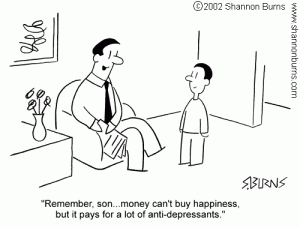
Here’s another interesting study at Scientific American–this time about humans: A Happy Life May not be a Meaningful Life. The results reminded me of all the super rich guys who are constantly complaining about how victimized they are by the rest of us peons.
Psychiatrist and Holocaust survivor Viktor Frankl once wrote, “Life is never made unbearable by circumstances, but only by lack of meaning and purpose.” For most people, feeling happy and finding life meaningful are both important and related goals. But do happiness and meaning always go together? It seems unlikely, given that many of the things that we regularly choose to do – from running marathons to raising children – are unlikely to increase our day-to-day happiness. Recent research suggests that while happiness and a sense of meaning often overlap, they also diverge in important and surprising ways.
Roy Baumeister and his colleagues recently published a study in the Journal of Positive Psychology that helps explain some of the key differences between a happy life and a meaningful one. They asked almost 400 American adults to fill out three surveys over a period of weeks. The surveys asked people to answer a series of questions their happiness levels, the degree to which they saw their lives as meaningful, and their general lifestyle and circumstances.
As one might expect, people’s happiness levels were positively correlated with whether they saw their lives as meaningful. However, the two measures were not identical – suggesting that what makes us happy may not always bring more meaning, and vice versa. To probe for differences between the two, the researchers examined the survey items that asked detailed questions about people’s feelings and moods, their relationships with others, and their day-to-day activities. Feeling happy was strongly correlated with seeing life as easy, pleasant, and free from difficult or troubling events. Happiness was also correlated with being in good health and generally feeling well most of the time. However, none of these things were correlated with a greater sense of meaning. Feeling good most of the time might help us feel happier, but it doesn’t necessarily bring a sense of purpose to our lives.
Interestingly, the researchers found that money can buy happiness, but it can’t guarantee a meaningful life. This is something I’ve come to believe through long and painful experience. I think a sense of meaning comes from working your way through problems and difficult times and coming out the other side stronger and wiser. Rich people are often able to shield themselves from life problems, but at the same time they miss out on opportunities for emotional growth.
Of course relationships are also important for both happiness and a sense of meaning.
In Baumeister’s study, feeling more connected to others improved both happiness and meaning. However, the role we adopt in our relationships makes an important difference. Participants in the study who were more likely to agree with the statement, “I am a giver,” reported less happiness than people who were more likely to agree with, “I am a taker.” However, the “givers” reported higher levels of meaning in their lives compared to the “takers.” In addition, spending more time with friends was related to greater happiness but not more meaning. In contrast, spending more time with people one loves was correlated with greater meaning but not with more happiness. The researchers suspect that spending time with loved ones is often more difficult, but ultimately more satisfying, than spending time with friends.
This is something else I can testify to. I spent about 18 years being a primary caregiver for my ex-mother-in-law. At times this was a thankless, frustrating task that certainly didn’t make me happy all the time–but in the end, I realized that the experience had been meaningful and I had grown a great deal from it.
It looks like Hillary is going to be in the news a great deal between now and the 2016 presidential primaries. We’ve seen the Republicans ramping up their campaign against her–so far by focusing on old gossip from the 1990s. Even the Vince Foster conspiracy theories are coming back to haunt us. Bob Cesca at The Daily Banter reported yesterday that Fox News was set to resurface not only Vince Foster myths, but also Kathleen Willey’s claims that Bill Clinton sexually harassed her.
One of the top shelf conspiracy theories about the Clintons had to do with the suicide of White House advisor Vince Foster, which topped a list of other suspected deaths at the hands of Bill and Hillary. Now, 13 years after the end of that administration and at the outset of the would-be presidential candidacy of Hillary Clinton, everything from the ’90s appears to be back on the table.
We’ve already heard from Sen. Rand Paul (R-KY) who was the first to invoke Monica Lewinsky. And now here comes Fox News Channel resurrecting the Vince Foster conspiracy theory.
On tonight’s The Kelly File, Megyn Kelly welcomes Kathleen Willey who famously accused President Clinton of sexual harassment. An independent counsel discredited the groping allegations. Nevertheless, Willey has gone on to accuse the Clintons of not only assassinating Vince Foster, but also of murdering her husband.
Sigh . . . I don’t know if anyone here watched that travesty–I wonder if Megyn explained why Hillary should be held responsible for things her husband did (or was accused of doing) decades ago.
As an antidote to that nonsense, here are a couple of very interesting polls:
Politico: Hillary Clinton sweeps GOP in Ohio
Hillary Clinton buries Gov. Chris Christie and other potential Republican presidential candidates in the crucial swing state of Ohio, according to a new poll on Thursday.
The former secretary of state, who led Christie 42 percent to 41 percent in November, now tops the New Jersey governor 49 percent to 36 percent, according to a Quinnipiac University poll.
Read the rest of the numbers at the link.
Now here’s a poll that will make Dakinikat smile: In a Stunning Turn Poll Shows Hillary Clinton Could Make Louisiana Blue in 2016 (Politicus USA)
A new Public Policy Polling survey of Louisana found that Hillary Clinton would be the strongest Democratic presidential candidate in the state since her husband Bill was on the ballot in the 1990s.
According to PPP, “All the Republican contenders for President lead Hillary Clinton in hypothetical contests, but the margins are closer than they’ve been in the state since her husband was on the ticket. Christie leads her by just a point at 44/43, Jindal’s up 2 at 47/45, Paul leads by 4 points at 47/43, Huckabee has a 5 point advantage at 49/44, and the strongest Republican with a 7 point edge at 50/43 is Jeb Bush.”
Hillary Clinton’s numbers represent the best showing for a Democratic presidential candidate in the state since her husband Bill Clinton won Louisiana by 5 points in 1992 and 12 points in 1996. George W. Bush won the state by 8 points in 2000, and 15 points in 2004. McCain beat Obama by 19 in 2008, and Mitt Romney defeated the president by a margin of 18 points in 2012.
Wow! It’s still very early, but that is exciting news.

You may recall that last August, Glenn Greenwald’s partner David Miranda was detained at Heathrow Airport in London and questioned about documents he was carrying–top secret documents that had been stolen by Edward Snowden from the U.S. and Great Britain. Miranda’s computers, flash drives and other electronic devices were also confiscated. Greenwald and Miranda sued, claiming that Great Britain charging him under their “anti-terrorism laws was unlawful and breached human rights.” Yesterday the court released its decision, saying that judges said it was a “proportionate measure in the circumstances” and in the interests of national security. From BBC News:
Steven Kovats QC, representing the UK home secretary, previously told the High Court that the secret material seized from Mr Miranda could have ended up in the hands of al-Qaeda.
But Mr Miranda’s lawyers argued the detention at Heathrow was illegal because it was carried out under the wrong law: Schedule 7 of the Terrorism Act 2000.
They said that in reality he was detained on the say-so of the security services so they could seize journalistic material.
Mr Miranda was carrying 58,000 highly classified Government Communications Headquarters (GCHQ) files, the judge said.
He added that Oliver Robbins, the UK’s deputy national security adviser at the Cabinet Office, had stated that “release or compromise of such data would be likely to cause very great damage to security interests and possible loss of life”.
But could Miranda be called a “journalist” just because he was carrying material that his partner had written about in a newspaper, The Guardian?
In his ruling, Lord Justice Laws said: “The claimant was not a journalist; the stolen GCHQ intelligence material he was carrying was not ‘journalistic material’, or if it was, only in the weakest sense.
“But he was acting in support of Mr Greenwald’s activities as a journalist. I accept that the Schedule 7 stop constituted an indirect interference with press freedom, though no such interference was asserted by the claimant at the time.
“In my judgement, however, it is shown by compelling evidence to have been justified.”
Here’s the full decision of the court. There is a subtle but emphatic slap-down of Glenn Greenwald’s arguments in points 54-56. The judged noted that Greenwald appeared to be lecturing the court when he discussed “responsible journalism,” and responded that the “evidence” Greenwald offered was “unhelpful,” because he took the position that British law enforcement officers deliberately acted in a way that they (officers) knew to be wrong; he ignored the fact that the material Miranda was carrying was stolen and could end up in the wrong hands; and that
Mr Greenwald’s account (paragraph 33) of the “many ingredients to the sensible reporting of very sensitive information” is insubstantial; or rather, mysterious – the reader is left in the dark as to how it is that “highly experienced journalists and
legal experts” (paragraph 33(1)) or “[e]xperienced editors and reporters” (33(2)) are able to know what may and what may not be published without endangering life or security.
Miranda and Greenwald hope to be granted the right to appeal the decision.
I’m just about out of space, so I’ll conclude with a quickie from Sochi: Olympian Films Wolf Stalking Her Hotel Hallway.
Olympian Kate Hansen tweeted out a video of what appears to be a wolf trotting down her hotel hallway with the message, “I’m pretty sure this is a wolf wandering my hall in Sochi.” via
Now it’s your turn. What stories are you following today? Please post your links in the comment thread, and have a great day!
Tuesday Reads: Winter Weather, No Hillary Alternatives, New Snowden Leaks, and More
Posted: February 18, 2014 Filed under: Barack Obama, morning reads, U.S. Politics | Tags: 2016 Democratic nomination, Bush administration, Edward Snowden, First Look, GCHQ, Glenn Greenwald, Google Maps, Gregor Weichbrodt, Hillary Clinton, Jack Kerouac, James Clapper, NSA, On The Road, Oymyakon Russia, Siberia, snow, Wikileaks 70 Comments
Good Morning!!
I’m awaiting what I hope is the last snowstorm to hit the Boston area for a week or so. This one won’t be a big deal compared to what we’ve been hit by over the past few weeks. It will snow most of the day and we’ll end up with another five inches of snow on top of the giant pile of white stuff that is already on the ground.
The good news is that beginning tomorrow and going through the weekend, we are expecting temperatures in the 40s and 50s, along with rain. That should help wash some of the snow away. The Weather Channel has live updates on how this storm is affecting other parts of the country.
While I was perusing the Weather Channel page this morning, I came across this article–with amazing photos–of the coldest city in the world.
Think we’re having a brutal winter? Winter temperatures in Oymyakon, Russia, average minus 50 C (minus 58 F). The remote village is generally considered the coldest inhabited area on Earth. Oymyakon is a two-day drive from Yakutsk, the regional capital which has the lowest winter temperatures of any city in the world.
How do the locals deal with the cold? “Russki chai, literally Russian tea, which is their word for vodka,” photographer Amos Chapple told weather.com after his visit to the coldest city.
Oymyakon ironically means “unfrozen water.” This is due to the thermal spring located nearby. Originally the location was used by reindeer herders who would water their flock in the warm springs.
Oymyakon’s lowest recorded temperature was a frigid minus 71.2 C (minus 96.16 F) back in 1924. According to The Independent, wearing glasses outdoors can cause them to stick to the wearer’s face. This is just one of the more menial problems of the extremely cold weather
After reading that, I suddenly felt very comfy in my cozy house with the temperature outside a mild 18 degrees F.
Whether we like it or not–and I absolutely hate it–the 2016 presidential race has already begun, and along with it the endless Hillary-bashing that we’ll have to put up with not only from Republicans but also from a subset of Democrats. Republicans will need to be reminded that Hillary is running, not “the Clintons”; and Democrats will have to learn that if they don’t want Jeb Bush as president, Hillary is the best alternative.
It’s a little unnerving that Bob Shrum agrees with me, since he’s rarely backed a winner; but honestly in this case he’s right. From The Daily Beast: Yes, Pundits, Hillary Has the 2016 Nomination in the Bag.
Handicappers in the presidential race abhor the opposite of a vacuum—a campaign two years out where one candidate seems to blot out the entire field. Thus a mini-chorus now rises, and may swell, questioning Hillary Clinton’s apparent lock on the 2016 Democratic nomination. It’s a predictable reflex, but in cold, hard reality, logic suggests that the lock is authentic, not just apparent. And in modern history, or virtually all American history, Hillary’s inevitability is unprecedented for a non-incumbent.
Yes, there are pundits like Matt Bai and Krystal Ball who claim that Hillary is vulnerable to a “grass roots” challenge, but they’re in fantasy land. In response to Ball’s suggestion that Elizabeth Warren should be the candidate, because she is “clearly passionate, living and breathing and feeling … the plight of the worker, the middle class,” Shrum writes:
Hillary, Ball asserts, can’t do that because she was once on the board of Walmart and recently accepted speaking fees from Goldman Sachs. That attack, if an opponent advanced it, could and would be swiftly confounded by the Hillary who, in the penultimate primaries of 2008, in places like Pennsylvania and Ohio, emerged as a powerful, persuasive tribune of blue-collar and middle-class Americans.
Of course, there is another slight problem with the Warren option: She’s joined all the other Democratic women senators in signing a letter urging Hillary to run.Warren will probably be out there all right—stumping for Hillary, not against her.
There’s much more at the link about other possible candidates like Andrew Cuomo and Martin O’Malley.
Let me add, btw, for Warren fans who claim that Hillary is “too old,” Warren will be 67 in 2016–just two years younger than Clinton. That’s leaving aside the fact that she has far less political experience than Barack Obama did in 2008 and zero foreign policy experience.
Over at that bastion of Hillary-hatred, DailyKos, Markos broke the news to his followers yesterday: The real primary fight of 2016 (and it’s not an alternative to Hillary.”
Some people have to come to terms. And I’m looking at you, people desperate to find an alternative to Hillary Clinton in 2016.
If Hillary runs, she’s the nominee. I know it’s in vogue to talk about how “inevitable” Hillary was in 2008. But it was a different world. I remember it because I was in the midst of that battle. People wanted an alternative, and alternatives existed. At her best, Hillary’s poll numbers were in the 40s with Obama in the strong 20s. Look for yourself. Yes, she was the frontrunner, but there was a strong primary field within striking distance.
There is no alternative to Hillary this cycle. The last time anyone polled the Democratic primary field, Clinton had 73 percent of the vote, Biden 11, and Elizabeth Warren nine. That tells us a couple of things. One, 73 percent is A WHOLE LOT OF PEOPLE. She is the consensus nominee, and if you disagree, you are objectively in the deep minority. Second of all, there is no one to provide even nominal challenge. Clinton (again, assuming she runs) will have some “challengers”, but it’ll be a bunch of people auditioning for her VP slot.
To reiterate, leads like 45-25 in 2007 didn’t make Hillary “inevitable”. Numbers like 73-11 in 2014 absolutely do. And you know what? Those are not irrational numbers. Hillary will be a great president.
Elizabeth Warren isn’t running. I get why people persist with this fantasy, but it’s nothing more than a fantasy. Warren had to be dragged in kicking and screaming into the Massachusetts Senate race, a geographically small state in which she could sleep in her own bed every night. If you barely have the fire to run for Senate, then you absolutely don’t have the fire to mount a brutal presidential campaign. And even if she did, all she’d have to do is look at the polling (73-9!) to realize she’d have a million better things to do with her time and her donors’ money. SHE. AIN’T. RUNNING.
So, I guess we’ll have to wait and see if some Democrats are willing to try to sabotage the party’s chances of continuing to control the White House and very likely Congress as well. It could end up being similar to what the Republicans did to Mitt Romney in 2012. But this time, there won’t be real competition on the Republican side. Who are they going to run? Mitt Romney again? Paul Ryan? My guess is Jeb Bush would be afraid to run against Hillary.
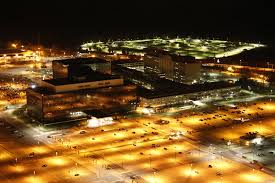
There’s a new article up at Glenn Greenwald’s new site, The Intercept: Snowden Documents Reveal Covert Surveillance and Pressure Tactics Aimed at WikiLeaks and Its Supporters. I haven’t had time to read the whole thing yet, because I want to get this post up soon. I’ll read it carefully once I’ve done that. But here’s the introduction:
Top-secret documents from the National Security Agency and its British counterpart reveal for the first time how the governments of the United States and the United Kingdom targeted WikiLeaks and other activist groups with tactics ranging from covert surveillance to prosecution.
The efforts – detailed in documents provided previously by NSA whistleblower Edward Snowden – included a broad campaign of international pressure aimed not only at WikiLeaks founder Julian Assange, but at what the U.S. government calls “the human network that supports WikiLeaks.” The documents also contain internal discussions about targeting the file-sharing site Pirate Bay and hacktivist collectives such as Anonymous.
One classified document from Government Communications Headquarters, Britain’s top spy agency, shows that GCHQ used its surveillance system to secretly monitor visitors to a WikiLeaks site. By exploiting its ability to tap into the fiber-optic cables that make up the backbone of the Internet, the agency confided to allies in 2012, it was able to collect the IP addresses of visitors in real time, as well as the search terms that visitors used to reach the site from search engines like Google.
Another classified document from the U.S. intelligence community, dated August 2010, recounts how the Obama administration urged foreign allies to file criminal charges against Assange over the group’s publication of the Afghanistan war logs.
A third document, from July 2011, contains a summary of an internal discussion in which officials from two NSA offices – including the agency’s general counsel and an arm of its Threat Operations Center – considered designating WikiLeaks as “a ‘malicious foreign actor’ for the purpose of targeting.” Such a designation would have allowed the group to be targeted with extensive electronic surveillance – without the need to exclude U.S. persons from the surveillance searches.
My immediate reaction is that if NSA were not monitoring Wikileaks, they would not be doing their job. As for the claims that individual visitors to the website were actually targeted, I’ll have to reserve judgment until I read the whole piece and it has been fact-checked by people who understand the technology involved better than the authors. I’ve learned from months of experience that Glenn Greenwald’s articles tend to be filled with errors as well as over-the-top melodrama.
In other NSA news, James Clapper admitted in an interview with Eli Lake of The Daily Beast that “We Should’ve Told You We Track Your Calls.”
Ya think? Here’s an excerpt:
Clapper said the problems facing the U.S. intelligence community over its collection of phone records could have been avoided. “I probably shouldn’t say this, but I will. Had we been transparent about this from the outset right after 9/11—which is the genesis of the 215 program—and said both to the American people and to their elected representatives, we need to cover this gap, we need to make sure this never happens to us again, so here is what we are going to set up, here is how it’s going to work, and why we have to do it, and here are the safeguards… We wouldn’t have had the problem we had,” Clapper said.
“What did us in here, what worked against us was this shocking revelation,” he said, referring to the first disclosures from Snowden. If the program had been publicly introduced in the wake of the 9/11 attacks, most Americans would probably have supported it. “I don’t think it would be of any greater concern to most Americans than fingerprints. Well people kind of accept that because they know about it. But had we been transparent about it and say here’s one more thing we have to do as citizens for the common good, just like we have to go to airports two hours early and take our shoes off, all the other things we do for the common good, this is one more thing.”
Since the first Snowden revelations in June, Clapper has declassified reams of material relating to the 215 program, including opinions and warrants signed by the top secret court that approves domestic snooping. But he has not publicly acknowledged until now his thoughts that the initial secrecy surrounding the program was ill-considered.
No shit Sherlock! Americans most likely would have supported the program if the Bush administration had been up front about it. Of course, then Congress would have regulated it more–as is happening under Obama–and that wouldn’t have pleased President Cheney. Even now, if Obama and NSA officials would come out and explain exactly what the program is, the fear-mongering by Greenwald and the gang would be far less effective.
Basically, the “metadata” that is collected is just the same information that we used to get on our phone bills: time call was initiated, how long it lasted, and the number that was called. The phone company kept all this “metadata” on file, and law enforcement could access the phone records of a suspect by getting a warrant from a judge–which is the same thing the NSA does. I have way fewer problems with this kind of data collection than what corporations are doing on a daily basis with my internet browsing and purchases.
I’ll end with a couple of fun items.
First, I hope you’ll check out these awesome photos of Russians with their cats at Buzzfeed.
Second, from The Guardian: Kerouac’s On the Road followed on the road via Google Maps:
“The air was soft, the stars so fine, the promise of every cobbled alley so great, that I thought I was in a dream,” wrote Jack Kerouac, famously, in On the Road. “Head northwest on W 47th St toward 7th Ave. Take the 1st left onto 7th Ave. Turn right onto W 39th St,” writes Gregor Weichbrodt, less poetically but more accurately, in On the Road for 17527 Miles, a new book tracing the Beat writer’s famous journey across America – with the aid of Google Maps.
Going through On the Road with a fine-toothed comb, Weichbrodt took the “exact and approximate” spots to which the author – via his alter ego Sal Paradise – travelled, and entered them into Google’s Direction Service. “The result is a huge direction instruction of 55 pages,” says the German student. “All in all, as Google shows, the journey takes 272.26 hours (for 17,527 miles).”
Weichbrodt’s chapters match those of Kerouac’s original. He has now self-published the book, which is also part of the current exhibition Poetry Will Be Made By All! in Zurich, and has, he says, sold six copies so far.
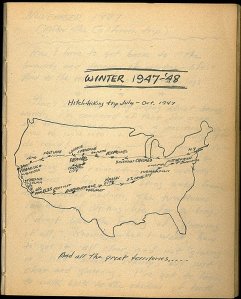
You can read the book at at Open Culture. The site has also published a photo of Jack Kerouac’s Hand-Drawn Map of the Hitchhiking Trip Narrated in On the Road. Very cool.
Now what are you reading and blogging about today? Please post your links on any topic in the comment thread, and have a tremendous Tuesday!
Tuesday Reads: Shirley Temple, The “Hillary Papers,” And The Endless NSA Story
Posted: February 11, 2014 Filed under: Barack Obama, Foreign Affairs, morning reads, Republican politics, U.S. Politics | Tags: Bill Clinton, Cryptome.org, Diane Blair, drones, Edward Snowden, First Look, Glenn Greenwald, Hillary Clinton, Jeremy Scahill, metadata, Monica Lewinsky, NSA, Pierre Omidyar, Shirley Temple, signals intelligence, terrorists, The Hillary Papers, The Intercept 32 Comments
Good Morning!!
The top news story on Google this morning was the death of 1930s child star Shirley Temple at age 85. Later in life, she served the U.S. as an ambassador and was active in Republican politics.
Shirley Temple Black, who lifted America’s spirits as a bright-eyed, dimpled child movie star during the Great Depression and later became a U.S. diplomat, died late on Monday evening at the age of 85, her family said in a statement.
Temple Black, who lured millions to the movies in the 1930s, “peacefully passed away” at her Woodside, Calif., home from natural causes at 10:57 p.m. local time (0157 ET), surrounded by her family and caregivers, the statement said on Tuesday….
As actress Shirley Temple, she was precocious, bouncy and adorable with a head of curly hair, tap-dancing through songs like “On The Good Ship Lollipop.” As Ambassador Shirley Temple Black, she was soft-spoken and earnest in postings in Czechoslovakia and Ghana, out to disprove concerns that her previous career made her a diplomatic lightweight.
“I have no trouble being taken seriously as a woman and a diplomat here,” Black said after her appointment as U.S. ambassador to Ghana in 1974. “My only problems have been with Americans who, in the beginning, refused to believe I had grown up since my movies.”
BBC News on Temple’s storied career as a child star:
Born in 1928, Temple soon became a major star after getting her first film role at the age of three.
Her singing, dancing and acting won over fans worldwide. She was given a special juvenile Oscar in 1935, when she was just six years old. To this day, she is still the youngest person to receive an Academy Award.
With the nickname “America’s little darling”, she was ranked as Hollywood’s biggest draw for four years running from 1935 to ’38 in an annual poll of US cinema owners.
Her rendition of the song On the Good Ship Lollipop in the film Bright Eyes was among her most famous performances.
Her other films included Curly Top, The Littlest Rebel, Baby Take a Bow and Little Miss Marker.
She was such a hit that US president Franklin Delano Roosevelt dubbed her “Little Miss Miracle” for raising morale during the Great Depression and she was credited with helping save 20th Century Fox from bankruptcy.
Temple starred in a total of 43 feature films – but found it difficult to sustain her career in adulthood and left acting behind in 1950.
Bloomberg Businessweek on Temple-Black’s later life:
Temple’s box-office appeal waned as she grew into adulthood, and she made her last movie in 1949. Her second marriage, to businessman Charles Black, lasted almost 55 years until his death in 2005. They raised two children, plus a daughter from Temple’s brief first marriage.
As Shirley Temple Black, the onetime star became active in Republican Party politics in the 1960s and served in diplomatic posts under four presidents.
“I had an enchanted childhood, a magic childhood, with great memories,” Black told reporters in 1978, when she turned 50. “But I don’t want to live in the past and I don’t live in the past.”
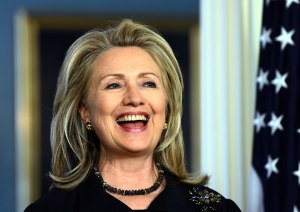
In other news, attacks on Hillary Clinton are ramping up, and so far they are truly bizarre. Republicans are still obsessed with Bill Clinton’s sexual fling with White House intern Monica Lewinsky. Why that is supposed to be relevant to Hillary Clinton’s political career, I will never understand. The latest nastiness is about the so-called “Hillary Papers,” which I knew nothing about until this morning. It turns out these papers aren’t Hillary’s, but those of some friend of the Clinton’s named Diane Blair. I’ve never heard of her.
The papers — a collection of Blair’s diary-like accounts of conversations, campaign memos and the like — are a sometimes wrenching trip via the wayback machine, as she recounts the Clintons’ arduous transition from Arkansas to Washington. In the most quotable comment, Hillary Clinton is said to have called Lewinsky a “narcissistic loony toon” whose relationship with Bill Clinton resulted from a moral lapse on his part, albeit one driven by the pressures facing the couple in the capital.
The papers also reflect, time after time, Hillary Clinton’s frustration with politics and her view that, while she adopted her husband’s name to stave off criticism in Arkansas, she was not about to change her personality to suit the Washington establishment, the press or, for that matter, voters.
“I gave up my name, got contact lenses, but I’m not going to try to be somebody that I’m not,” Blair quotes Clinton as saying.
That tension has been a recurring theme of the Clintons’ political lives. In the 1992 presidential contest, campaign aides placed much emphasis on humanizing Hillary, or at least forwarding a public version of the human being her friends, including Blair, testified to. Blair’s papers included a confidential campaign memo that said voters believed Hillary Clinton was smart but just couldn’t fully connect with her. (Among other things, as was reported during the campaign, many voters were unaware that the Clintons had a daughter, the then-teenage Chelsea, and thus didn’t see Hillary as particularly motherly.)
She got little credit for the things people liked about the Clintons, and more of the blame for the things they disliked.
“What voters find slick in Bill Clinton, they find ruthless in Hillary,” the memo said.

Diane Blair with Bill and Chelsea Clinton
I still don’t see how this is relevant to Hillary’s political career. Calling Lewinsky “a narcissistic looney-tune?” Why is that a problem? Oh, and she’s “ruthless,” although there’s no evidence for that is offered. Here’s the article in the right wing Washington Free Beacon that started the latest attacks, The Hillary Papers: Archive of ‘closest friend’ paints portrait of ruthless First Lady. It’s long, and frankly only skimmed it. If this garbage is what Republicans are going to focus on in opposing Hillary, I don’t think it’s going to work. Check out more heavy breathing over the “Hillary papers” at CNN and Politico.
The endless NSA leaks story continues onward. According to the latest tally by Cryptome.org, at the current rate, it will take 42 more years for all of the Snowden documents to be released. So far Greenwald and crew have reported on only about 1.8% of the documents Snowden is believed to have stolen.
Yesterday Glenn Greenwald and the gang debuted their new website, “The Intercept,” backed by a $50 million dollar investment by Ebay and Paypal billionaire Pierre Omidyar. For now the site will be entirely focused on the Snowden leaks as well as leaks from other sources who come forward and offer information on methods U.S. uses to gather intelligence. Judging by the first article posted by Greenwald, Jeremy Scahill, and Laura Poitras, which focuses on the NSA’s role in Obama’s drone program, the articles will be aimed at using melodramatic language to inflict maximum damage to the U.S. government’s intelligence agencies, while providing little information that hasn’t been already reported elsewhere.
I assume the substance of the drone article was written by Scahill, who wrote a book, Dirty Wars, that included a great deal of information on the drone program. But you can see Greenwald’s hand in the slanted way in which the story is presented. For example, the first paragraph:
The National Security Agency is using complex analysis of electronic surveillance, rather than human intelligence, as the primary method to locate targets for lethal drone strikes – an unreliable tactic that results in the deaths of innocent or unidentified people.
No evidence is offered to show that human intelligence isn’t used or that drone strikes are “unreliable” or that they kill more civilians than bombs or missiles, and no documents from the Snowden cache are included. Interestingly, the authors do not specifically argue against killing suspected terrorists; they only claim that drones are not the best method. They also present the opinions of two sources who worked in the drone program without any evidence to show that their statements are accurate.
A few more reactions…
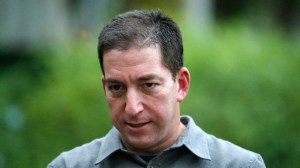
Lloyd Grove at The Daily Beast: Welcome to Glenn Greenwald, Inc.? Grove wonders if Greenwald is the best “public face” for a serious news site.
Investigative reporter and columnist Glenn Greenwald was barely five minutes into his appearance Sunday on CNN’s Reliable Sources—an interview promoting the long-awaited online launch of First Look Media, eBay billionaire Pierre Omidyar’s ambitious digital journalism startup—before he called the chairman of the House Intelligence Committee a liar.
“He’s not only lying—and he is lying—but he knows that he’s lying,” Greenwald said about Republican Rep. Mike Rogers of Michigan, who suggested last week that journalists who’ve disseminated classified documents leaked by former National Security Agency contractor Edward Snowden might be guilty of “fencing stolen material.”
“This is what Mike Rogers is notorious for in Washington,” Greenwald went on, “just making things up and smearing political opponents and journalists he doesn’t like.”
The retort was a familiar-sounding one for the 46-year-old Greenwald, a former trial lawyer who tends to treat policy disagreements as blood feuds and is never reluctant to question motives and fling rather personal insults.
Here’s a pointed critique from Ohtarzie, a writer who has long argued that Greenwald and Poitras are hoarding the Snowden documents, dribbling them out slowly in an effort to get maximum attention and income while providing little new information.
If there is anything new here, it’s in the large extent to which the NSA is said to rely on cell phones for identifying and tracking targets for the CIA, which allegedly leads to increases in wrongly identified targets and civilian deaths. This differs somewhat from Gellman’s account, which described a more varied, conceivably more precise approach, using an “arsenal of cyber-espionage tools, secretly seizing control of laptops, siphoning audio files and other messages, and tracking radio transmissions.” Despite the differences, if there is something revelatory in the Intercept’s story from a technical standpoint, I’m missing it. Tracking by cell phone has been discussed before, includingby Snowden. In light of signature strikes, the apparent recklessness of these methods also seems unsurprising.
Gellman’s story was rightly criticized for being effectively a dick-waving exercise for the U.S. Intelligence apparatus, since it detailed simply how a Bad Guy was killed by the Good Guys with all their sexy technology and savvy. In keeping with their adversarial brand, Scahill and Greenwald mix the NatSec dickwaving with some handwringing over civilians, most of which is provided via quotes from former drone operator and ostensible whistleblower, Brandon Bryant. This passage gives a taste of the overall dickwavey/handwringy mix.
The former JSOC drone operator is adamant that the technology has been responsible for taking out terrorists and networks of people facilitating improvised explosive device attacks against U.S. forces in Afghanistan. But he also states that innocent people have “absolutely” been killed as a result of the NSA’s increasing reliance on the surveillance tactic.
Near the end of the lengthy piece, Bryant even wrings his hands over the assassination program as a whole, at least as it results in the extrajudicial executions of American citizens like Anwar Al Awlaki. But overwhelmingly, both his emphasis and the emphasis of the piece are simply on the need to kill more precisely, by making greater use of informants and agents on the ground to supplement the NSA’s signal intelligence.
Ryan Goodman asks why Greenwald and Scahill repeatedly describe the use of metadata to target terrorists with drone strikes, but they provide few examples of actual metadata being used in the program. Where’s the “Metadata”?: What Greenwald and Scahill (Don’t) Say about NSA Metadata Collection and Lethal Targeting. Read all about it at the link.
Finally, the second scoop at The Intercept yesterday was a series of what they call “exclusive” photographs of the “surveillance state,” but a number of writers noted that these same photos can be found on the NSA website and by Googling. Here’s Bob Cesca:
Glenn Greenwald’s new website, The Intercept, launched today and….the first news article at the Pierre Omidyar-funded site, titled “New Photos of the NSA and Other Top Intelligence Agencies Revealed for First Time,” was utterly bizarre.
It was literally nothing more than three aerial photographs of the National Security Agency’s headquarters in Fort Meade, Maryland; the National Reconnaissance Office (NRO) in Chantilly, Virginia; and the National Geospatial-Intelligence Agency (NGA) in Springfield, Virginia.
That’s all. It’s treated like a major scoop and appeared as the first big revelation on the site, prior to a separate article by Greenwald and Jeremy Scahill.
I’m out of space, so I’ll add a few more links in the comment thread. I hope you’ll do the same. What stories are you focusing on today?

 peej
peej Carissa
 bostonboomer
 dakinikat
 ecocatwoman
 mablue2
 Mama Lopez
 peggysue22
 quixote
 skydancingguestblogger
 Mona (aka Wonk the Vote)



 Sky Dancing
Recent Comments