Posted: December 11, 2024 | Author: bostonboomer | Filed under: "presidential immunity", Donald Trump | Tags: Alvin Bragg, Bettina Anderson, Brian Thompson, chronic back paint, Donald Trump Jr., gossip, health insurance, Kimberly Guilfoyle, Luigi Mangione, separation of powers, United Health Care |
Good Afternoon!!
There’s not a lot of exciting politics news today; and that is probably a good thing, considering how bad things are looking for the country in the long run. We only have a little more than a month until Trump moves into the White House and tries to become president for life.
Have you heard the latest gossip? Donald Trump, Jr., who is still engaged to Kimberly Guilfoyle, has a new girlfriend.
Olivia Craighead at The Cut: Don Jr. Keeps Stepping Out With a Woman Who’s Not Kimberly Guilfoyle.
Is there trouble in paradise for one of America’s most unsettling couples? Sure seems like it. Donald Trump Jr. and Kimberly Guilfoyle may be on the rocks, if the Daily Mail is to be believed. While the fiancés were spotted together about a week after the election, the tabloid has been all over what looks like Don Jr.’s new relationship with Bettina Anderson, a Republican socialite who lives in Florida. So what’s going on here?
Let’s back up a few months. In September, the Daily Mail reported that Don Jr. and Anderson had been “spotted canoodling” during a brunch date the month prior. According to their sources, this new fling was “the talk of Palm Beach.” One source said that Anderson reached over “to plant a sexy kiss” on Don Jr. three times during their meal at the Honor Bar.
“She seemed totally smitten with Don — and he with her,” the source told the Daily Mail.

Bettina Anderson
Guilfoyle was probably shocked to learn this information, right? Well, not so fast. The day after the first Daily Mail reports, friends of the former Fox News host told the tabloid that she might have had an idea of what was going on.
“Kimberly either didn’t know about Bettina — or didn’t want to know. Did she hear whispers that Don Jr. was fooling around with someone else? Probably,” one of Guilfoyle’s so-called friends said. “She’s no fool but it’s easy to deceive yourself when you’re so committed to someone and believe he’s committed to you.”
Guilfoyle and Trump have been together since 2018, and got engaged on New Year’s Eve 2020 (his birthday). During their time together, she became a mainstay in the MAGA world, often seen at Trump events, delivering speeches at Republican National Conventions, and sharing almost nothing but pro-Trump content on Instagram. By Election Night this year, it seemed like she and Trump Jr. had worked things out, as she stood by his side at his father’s victory speech.
But all was reportedly not well. The Daily Mail is back on the Trumpfoyle beat, and on Tuesday, they reported that the purportedly engaged couple has not been spotted together since November 12. Meanwhile, on Monday, Don Jr. and Bettina were photographed holding hands while out to dinner to celebrate her 38th birthday. The tabloid also reported that he has been living with his new girlfriend at her West Palm Beach townhouse instead of in the $15.5 million mansion he and Guilfoyle bought in 2021.
Gross. Who would want to hang around with Don Jr., much less live with him? I guess it takes all kinds.
According to US Magazine, via Yahoo News, Anderson is “a model and an influencer” with “more than 38,000 followers on” Instagram.
Anyway, Trump Sr. is giving Guilfoyle a consolation prize–He plans to appoint her Ambassador to Greece.
The Daily Beast, via Yahoo News: Trump Sends Don Jr.’s Fiancée Kimberly Guilfoyle Abroad After Split Rumors.
Donald Trump has appointed former Fox News host Kimberly Guilfoyle as his ambassador to Greece—just hours after pictures published by the Daily Mail showed her fiancé, Donald Trump Jr., hand-in-hand with another woman.
“For many years, Kimberly has been a close friend and ally,” the president-elect said in his announcement, which he posted to Truth Social.

Kimberly Guilfoyle and Don Jr
“Her extensive experience and leadership in law, media, and politics along with her sharp intellect make her supremely qualified to represent the United States, and safeguard its interests abroad. Kimberly is perfectly suited to foster strong bilateral relations with Greece, advancing our interests on issues ranging from defense cooperation to trade and economic innovation.”
Guilfoyle’s nomination requires Senate confirmation and would see her handling foreign affairs.
The announcement hit conspicuously soon after Trump Jr., 46, was pictured cozying up with Palm Beach socialite Bettina Anderson, 38.
Trump Jr. made no comment on the rumors on social media when he congratulated Guilfoyle in a brief statement to X Tuesday night: “I am so proud of Kimberly. She loves America and she always has wanted to serve the country as an Ambassador. She will be an amazing leader for America First.”
There’s more information coming out on Luigi Mangione, the man who has been arrested and charged with murdering of United Health Care CEO Brian Thompson in NYC. Here’s the latest:
The mainstream media has refused to publish Mangione’s “manifesto,” but Ken Klippenstein has posted it on his website:
I’ve obtained a copy of suspected killer Luigi Mangione’s manifesto — the real one, not the forgery circulating online. Major media outlets are also in possession of the document but have refused to publish it and not even articulated a reason why. My queries to The New York Times, The Washington Post, CNN and NBC to explain their rationale for withholding the manifesto, while gladly quoting from it selectively, have not been answered.
I’ll have more to say on this later — on how unhealthy the media’s drift away from public disclosure is — but for now, here’s the manifesto:
“To the Feds, I’ll keep this short, because I do respect what you do for our country. To save you a lengthy investigation, I state plainly that I wasn’t working with anyone. This was fairly trivial: some elementary social engineering, basic CAD, a lot of patience. The spiral notebook, if present, has some straggling notes and To Do lists that illuminate the gist of it. My tech is pretty locked down because I work in engineering so probably not much info there. I do apologize for any strife of traumas but it had to be done. Frankly, these parasites simply had it coming. A reminder: the US has the #1 most expensive healthcare system in the world, yet we rank roughly #42 in life expectancy. United is the [indecipherable] largest company in the US by market cap, behind only Apple, Google, Walmart. It has grown and grown, but as our life expectancy? No the reality is, these [indecipherable] have simply gotten too powerful, and they continue to abuse our country for immense profit because the American public has allwed them to get away with it. Obviously the problem is more complex, but I do not have space, and frankly I do not pretend to be the most qualified person to lay out the full argument. But many have illuminated the corruption and greed (e.g.: Rosenthal, Moore), decades ago and the problems simply remain. It is not an issue of awareness at this point, but clearly power games at play. Evidently I am the first to face it with such brutal honesty.”
John Herrmann at New York Magazine: Luigi Mangione’s Full Story Isn’t Online.
When the identity of Luigi Mangione, the alleged UnitedHealthcare CEO shooter, was revealed on Monday, the online search — a reporting process that’s become a collective online ritual — began. It turns out he left a lot of information online: an active account on X, an Instagram, a Facebook, a Goodreads, a Reddit account, and maybe even a Tinder profile. The dossier came together fast.

Luigi Mangione
Reporters and social-media users noted possible red flags, strange and eerie fragments of information, and small ironies. On Goodreads, he had posted a contrarian riff on Ted Kaczynski’s manifesto. Was it evidence of violent tendencies? He also reviewed a couple of books about back pain. On X, he posted about AI superintelligence and followed some anti-woke pundits. Had he tumbled down a slippery slope? Was he blackpilled? Some sort of accelerationist? On Reddit, he posted about backpacks and spinal injuries. Had he been hiding in plain sight all along?
In isolation, with the hindsight that they were posted by someone who went on to allegedly assassinate a health-care CEO, these accounts, and some of these posts, assumed new meaning, which is reasonable and understandable: It’s a crazy story that people want to understand, and the way social media has been processing it more broadly is unprecedented in about six different ways. But what’s most striking about Mangione’s extensive online dossier is that, had it been studied before the shooting took place, it wouldn’t have raised much alarm. You can spend hours reading these posts, sifting through his follows, and looking for clues about what Type of Guy he is, but the supportable theories are pretty thin: Mangione had an online profile consonant with his identity and context. He shared and posted and followed like a 20-something striver with a foot in the tech industry, listened to Rogan, and considered himself a rationalist or at least unusually rational….
His media consumption — wellness podcasts, a dash of “heterodox” punditry, tech personalities on X — might have placed him near some worrying ideological tendencies, but no more so than millions of other young men in his social milieu; on digital paper, he’s a bit like one of those young male swing voters that dominated post-election recriminations, albeit with an Ivy on his LinkedIn. If a dating profile led you to these accounts, you might wonder if he was going to talk at you about AI or if he might be sort of socially awkward. You might wonder if he’s a bit of a pod bro, or an RFK guy, but you’d also see a lot of stuff that looks — again, without future context — if not normal, then demographically typical. You wouldn’t have wondered if he was planning an assassination. You’d probably have assumed he was friendly! Now, everyone’s looking for the online trail that leads directly the sidewalk in front of the Midtown Hilton, but they haven’t quite found it. Nor, in 2024, should they expect to.
Herrmann argues that a criminal’s “on-line footprint” doesn’t really reveal who a person is anymore, if it ever did.
Faith in the existence of meaning in the “online trail” started waning when social media achieved full ubiquity. By the mid-2010s, the sorts of evidence you’d find in the aftermath of a shocking news event tended to be either hidden in places like 4chan — intentionally inscrutable communities within a fully mainstream internet — or left behind intentionally to be found and shared in the form of a manifesto, an archived Discord channel, or a recording of the act itself. These revelations could still be illuminating or at least shocking — the Pittsburgh synagogue shooter left a trail of posts on the right-wing social-media site Gab, for example — but in recent years, the post-news deep-dive, which has become a messy and fraught spectacle unto itself, wasn’t producing much in the way of understanding. Mostly, if you were planning a dramatic crime, you knew better than to post about it. If you wanted nobody to see you, or suspect you of anything, you simply didn’t post about it.
Mangione’s stubbornly normal online footprint, and the way the media and public have feasted upon it, marks the closing of this circle. Online, he was a guy with unremarkable niche interests and a serious appetite for boring productivity books. The reflexive assumption that his digital trail must contain essential, decodable truths about his motives has produced less in the way of insight than of fandom, which is constructed online through a similar process of breathless driven data aggregation.
Ashley Southall and Maria Cramer at The New York Times: Police Say Suspect’s Notebook Described Rationale for C.E.O. Killing.
Luigi Mangione, who has been charged with killing the chief executive of UnitedHealthcare at a company investors’ day, was arrested with a notebook that detailed plans for the shooting, according to two law enforcement officials.
The notebook described going to a conference and killing an executive, the officials said.

Luigi Mangione
“What do you do? You wack the C.E.O. at the annual parasitic bean-counter convention. It’s targeted, precise, and doesn’t risk innocents,” was one passage written in the notebook, the officials said….
When Mr. Mangione was arrested, the authorities also found a 262-word handwritten note with him, which begins by appearing to take responsibility for the murder. The note, which officials described as a manifesto, also mentioned the existence of a notebook. The recovery of the notebook was first reported by CNN.
The suspect saw the killing as a “symbolic takedown,” according to a New York Police Department internal report that detailed parts of a three-page manifesto found with him at the time of his arrest. The report added that the suspect “likely views himself as a hero of sorts who has finally decided to act upon such injustices” and expressed concern that others might see him as a “martyr and an example to follow.” [….]
On his way into court on Tuesday afternoon, Mr. Mangione shouted about “an insult to the intelligence of the American people and their lived experience.”
It was not exactly clear what he was referring to as deputies worked to push him into the courthouse. On Wednesday, the sheriff of Blair County, James E. Ott, said that otherwise Mr. Mangione had not given deputies any problems.
Read more at the NYT.
The NYT has another article about Mangione’s wealthy Baltimore family: The Prominent Maryland Family of the Suspect in the C.E.O. Killing.
Daniel Gilbert at The Washington Post: Severe pain shaped UnitedHealth CEO murder suspect’s view of health system.
Even when Luigi Mangione was surrounded with people who cared about him, he was isolated by a spinal defect that dealt the athletic young man crippling pain and contributed to a jaundiced view of the American health-care system.
Authorities charged Mangione, 26, with murder in the shooting of UnitedHealthcare CEO Brian Thompson in New York, but have said little about a motive for the killing. They found a three-page, handwritten document on Mangione that expressed disdain for the American health-care system, they’ve said.
On Reddit in April, Mangione foreshadowed that skepticism about the health-care industry as he offered advice for getting a doctor to perform spinal surgery.
“Tell them you are ‘unable to work’ / do your job,” he wrote. “We live in a capitalist society. I’ve found that the medical industry responds to these key words far more urgently than you describing unbearable pain and how it’s impacting your quality of life.”
Nothing in his Reddit posts reviewed by The Postindicate violent intentions. Authorities have not laid out their case for what drove Mangione to escalate his frustration with the health system, which is common in the United States, into an allegedly premeditated murder of a prominent health-care executive….
Mangione’s arrest has stunned his friends and family, most of whom appear to have lost touch with him in the last six months.
“We all condemn violence of any kind,” said Josiah Ryan, a spokesman for Surfbreak HNL, a co-living community in Honolulu where Mangione lived for six months in 2022. He added, “There’s sadness, because he was a person who was well-loved and no one saw this coming.”
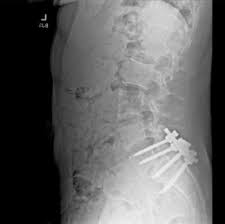
Mangione’s back X-ray
Ryan said that Mangione’s back pain was well known within the Surfbreak community. “It was a real problem for him, and he had to think about that in a way that most 24-year-old young men living in Hawaii would not have to worry about their health,” he said.
Mangione’s struggles with his back pain offer a glimpse into the interior life of a young man who outwardly lived a charmed existence — the scion of a wealthy family in Maryland who was valedictorian of his prestigious private school in Baltimore and earned degrees in computer science from the University of Pennsylvania….
In archived Reddit comments, Mangione doesn’t express anger toward UnitedHealthcare or other health insurers. But the posts chronicle his struggle over years to deal with back pain that became increasingly debilitating.
“From childhood until age 23, my back would always ache if I stood too long, but it wasn’t too bad,” he wrote in February. But as he entered his mid-20s, the pain began to disrupt his life, and he also struggled with cognitive issues.
In a Reddit group focused on brain fog, he wrote, “The people around you probably won’t understand your symptoms — they certainly don’t for me.”
Lots of people live with chronic pain (including me), but we don’t kill people over it.
A bit of Trump crime news: Manhattan DA Alvin Bragg is trying to keep his case against Trump alive. Laura Italiano at Business Insider: Bragg says Trump’s crimes and ‘history of malicious conduct’ are too serious for his hush-money case to be dismissed.
In an 82-page court filing made public Tuesday, Manhattan prosecutors say Donald Trump’s “history of malicious conduct” is too serious for his hush-money case to be dismissed.
The filing, signed by DA Alvin Bragg, also fights Trump’s claim that he enjoys something called presidential-elect immunity — above and beyond the presidential immunity bestowed on him by the US Supreme Court in June.
“There are no grounds for such relief now, prior to inauguration,” Bragg wrote in opposing Trump’s 11th-hour motion to dismiss, “because President-elect immunity does not exist.”
With just six weeks left before his January 20 inauguration — and six months after a Manhattan jury convicted him — Trump is again demanding that New York Supreme Court Justice Juan Merchan immediately dismiss his hush-money case.
It’s his third time trying to void his indictment or his conviction. If successful, Trump would escape altogether his already thrice-delayed sentencing.
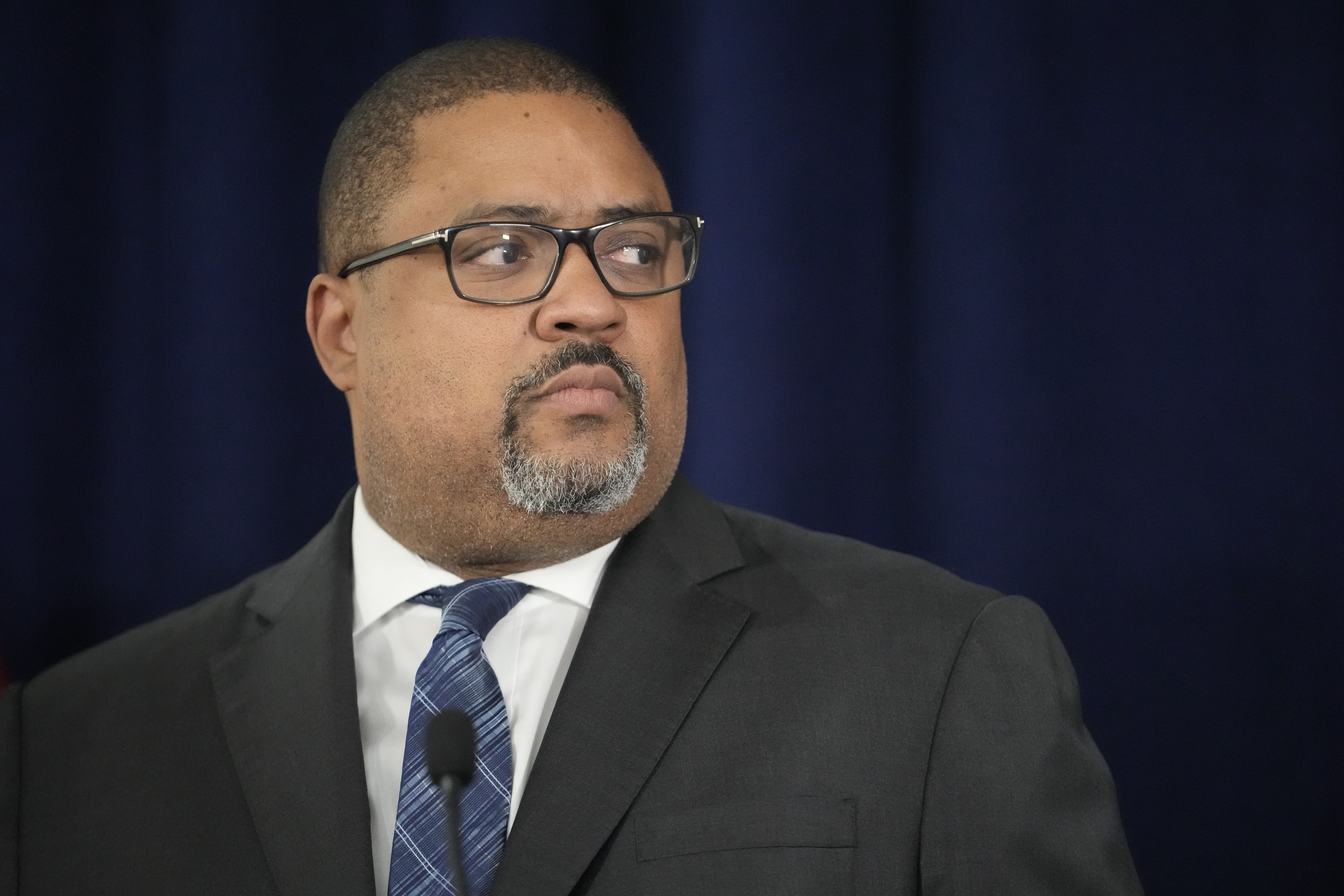
Manhattan District Attorney Alvin Bragg
The president elect faces as little as no jail time and a potential maximum of four years prison for falsifying 34 business records throughout his first year of office to retroactively hide a hush-money payment to adult actress Stormy Daniels. (Legal experts have said that it’s unlikely Trump would be sentenced to jail time as a 78-year-old first-time offender convicted of low-level felonies, and any jail sentence would be stayed as he appeals.)
Trump paid for Daniels’ silence just eleven days before 2016 election, and jurors unanimously found that he thereby conspired to promote his own election by unlawful means, Bragg wrote.
The evidence presented against Trump was “overwhelming,” reads the filing, which is also signed by a lead prosecutor on the case, Christopher Conroy.
“The crimes that the jury convicted defendant of committing are serious offenses that caused extensive harm to the sanctity of the electoral process and to the integrity of New York’s financial marketplace,” which relies on honest record-keeping, Bragg wrote.
Finally, at Public Notice, Liz Dye writes: Trump plots to steal Congress’s budget authority.
One of the strangest aspects in living in a declining democracy is that everyone is forced to learn about arcane areas of the law … if only to see them trampled by the despot.
The first Trump administration taught us about the Logan Act, the Federal Vacancies Reform Act, and the Presidential Records Act. Those were all about the limits of the president’s authority. Could Trump dispatch Mike Flynn to secretly negotiate with the Russian ambassador before taking office? Could he simply stack federal agencies with his cronies serving in an acting capacity and avoid Senate confirmation? Could he steal or destroy government records?
The answer was an enthusiastic “yes,” thanks to the Supreme Court, with an assist from Judge Aileen Cannon. In the name of ensuring that he can act “boldly” and “without hesitation,” six conservative justices gave the president unlimited authority to commit crimes without fear of prosecution. The imperial presidency is upon us.
But even that blank check isn’t enough for Trump and his enablers. To reshape society, they need the legislative and judicial branches to be more than supine. They need to steal Congress’s power, too. And so, while we’re learning about Trump’s plans to use recess appointments to sidestep the senate’s constitutionally mandated “advice and consent” role, we now have to learn about the Impoundment Control Act of 1974.
I can’t do this important post justice with excerpts, but there’s no paywall, so please go read it at Public Notice. Here’s a bit more.
The Constitution vests “the power of the purse” in Congress.
Article I, Section 8, Clause 1, AKA the Spending Clause, specifies that “Congress shall have Power To lay and collect Taxes, Duties, Imposts and Excises, to pay the Debts and provide for the common Defence and general Welfare of the United States.” And Section 9 says that “No Money shall be drawn from the Treasury, but in Consequence of Appropriations made by Law.”
Congress passes the budget and allocates government revenues as it sees fit — that’s just black-letter law. And so in 1972, Congress passed the Federal Water Pollution Control Act, allocating $5 billion for 1973, $6 billion for 1974, and $7 billion for 1975 for municipal sewer updates. President Richard Nixon tried and failed to veto the law, and, after it was passed, he instructed EPA Administrator William Ruckelshaus to allot “[n]o more than $2 billion of the amount authorized for the fiscal year 1973, and no more than $3 billion of the amount authorized for the fiscal year 1974.”
The City of New York sued, and in a 1975 case called Train v. City of New York, the Supreme Court held that Nixon had no discretion to refuse to spend money allocated by Congress. Ruckelshaus was obligated to dispense the $18 billion over three years, despite Nixon’s strong belief that cities should simply live with rotting pipes.
And while that case was percolating through, Congress went one further and passed the Impoundment Control Act, to make it clear to Nixon that he should quit encroaching on their turf and monkeying with the budget….
Under the ICA, the president must either spend the funds obligated by the legislature, or come to Congress with a “special message” and explain why not. Congress then has 45 days to vote for rescission, rescinding the original allocation. If Congress doesn’t agree, or simply ignores the message, the funds must be spent as originally ordained. (Here’s a handy ICA fact sheet from the Dems on the House Budget Committee.)
Elon Musk and Vivek Ramaswamy, who clearly don’t know or care about the separation of powers, are currently promising to slash $2 trillion from the federal budget and delete entire federal agencies through their fake DOGE committee. But even in his first administration, Trump violated the ICA by withholding the defense allocation for Ukraine in 2019.
Read the rest at the link.
That’s all I have for today. We’re having a stormy day here, so I’m going to try to distract myself with a good book. Have a nice day, everyone.
Did you like this post? Please share it with your friends:
Posted: April 5, 2014 | Author: bostonboomer | Filed under: morning reads, U.S. Politics | Tags: Affordable Care Act, Air Force cheating scandal, billionaires, bison stampede, CIA enhanced interrogation program, David and Charles Koch, earthquakes, Gerald L. Chan, Harvard Square, health insurance, Jose A. Rodriguez Jr., nuclear weapons, Obamacare, Senate Intelligence Committee, Torture, torture report, Yellowstone supervolcanoes |

Panoramic view of Harvard Square, Cambridge, MA
Happy Saturday!!
Recently Dakinikat wrote about how gentrification has affected her adopted hometown, New Orleans, since Katrina. Well this morning I read some surprising news about Harvard Square–a place I’m very attached to because I either lived nearby, worked, or hung out there for so many years. I’ve written about it before of course. I moved here from Indiana in 1967. It was the “Summer of Love,” and Harvard Square was the center of local hippie-dom, plus there were endless bookstores to feed my addiction to reading and possessing books.
So this morning I read in the The Boston Globe that Chinese billionaire Gerald L. Chan has been quietly buying up prime real estate in Harvard Square, and he now has “enough clout to influence the square’s look and character for years to come.” Harvard Square has already changed a great deal since the late 1960s, of course, so I don’t know why this should shock me. But the Square is still unique–a special place, with a traditional look and feel. What will happen to it now? From the Globe article:
First he grabbed an apartment and retail building in the heart of Harvard Square. Months later, he bought another apartment and retail complex on the other side of John F. Kennedy Street. Then came the deal for a building known as the American Express travel office, quickly followed by the purchase of apartments behind the Harvard Lampoon office.
Over the course of 18 months — and without calling attention to himself — billionaire businessman Gerald L. Chan spent about $120 million to amass an impressive portfolio of Harvard Square real estate that includes nearly a dozen properties….
“Take Harvard University out of the equation, and I don’t know of anyone who owns more real estate in Harvard Square than he does,” said Peter Bekarian, executive vice president at Jones Lang LaSalle, a commercial real estate firm in Boston.
Chan and his brother, Ronald, control the Hang Lung Group, a leading Hong Kong real estate development and management company that has made them billionaires. Forbes pegs their combined wealth at nearly $3 billion.
Chan is a Harvard graduate who now lives in Newton, MA. He says he loves the place and he’s just investing in “properties that have the potential to generate a good return.” He says he doesn’t have a plan to remake the Harvard Square area according to his own vision, but some local business people have expressed concern–and some have abruptly been put out of business. In their places, Chan has installed business owned by his children.
Some tenants in Chan’s newly acquired buildings, including local landmarks such as UpStairs on the Square and nearby Leo’s Place diner, did not have leases renewed and shut down earlier this year.
Chan paid $6.8 million for 93 Winthrop St., where he is replacing UpStairs on the Square with another restaurant, Parsnip. His daughter, Ashley Chan, is listed in corporate documents as one of the managers of the Morningside-controlled entity that operates the restaurant. UpStairs co-owner Mary-Catherine Deibel said, “It was time to wind down the business after 31 years.”
New restaurants — the Noodle Project and Night Market, a Japanese eatery — will replace Leo’s Place, a haunt of movie actor Ben Affleck, and Indian bistro Tamarind Bay, on JFK Street. Ash Chan, Gerald’s son, is operating both. He’s a West Coast restaurateur known here for Churn2, a Harvard Square stand that services liquid-nitrogen-chilled ice cream.
I guess we local peons will just have to wait and see what happens…
Speaking of billionaires, Brian Beutler has written a response to the views on the Affordable Care Act expressed by Charles Koch in his truly strange op-ed in the Wall Street Journal that I wrote about on Thursday. From Salon, Greediest family on earth: Proof Koch brothers have just one political principle.
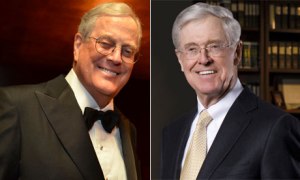
David and Charles Koch
Beutler argues that the Kochs opposition to “Obamacare” is less about ideology than selfishness, greed, and desire for power.
Would you believe me if I told you that the Koch brothers actively participate in, and benefit from, a healthcare system in which the government subsidizes private insurance; carriers are prohibited from discriminating against the sick; the young cross-subsidize the old; and qualified beneficiaries who opt out suffer a big financial hit?
Well, they do. Not Obamacare, of course — they want to repeal that. But as employers, they can and do compensate their employees with tax-exempt health insurance benefits, their employees are all part of one risk pool, and everyone contributes the same amount for equal coverage….
despite the fact that employer-sponsored health insurance resembles Obamacare in many ways, the Koch network is not actively trying to repeal ERISA — the law that regulates employer-sponsored health plans — or to repeal the tax expenditure that allows them to advantageously provide the benefits they claim they’re working so hard to maintain.
So why do they so vehemently oppose the Obama health care plan?
To the Koch brothers, there’s apparently a big difference between government subsidizing and regulating health insurance for their employees and government subsidizing and regulating insurance for the self-employed, individuals whose employers don’t provide health benefits, and the unemployed.
This might seem strangely contradictory, unless you stop and consider what the existence of a universal right to health insurance coverage means for employers and the people who work for them. When the Congressional Budget Office updated its analysis of the Affordable Care Act’s labor market effects, it concluded that the existence of a coverage guarantee for all, and subsidies for many, would reduce employment by more than 2 million people over the coming decade. Opponents of the law pounced on this as proof that Obamacare would be a job killer, but for the most part what CBO actually meant was that Obamacare would shift the center of power between workers and employers a bit closer to the workers.
For some of those workers, that shift will mean the freedom to quit — hence the “job killing” canard. But for other workers — current and prospective — it will mean the freedom to ask for more money. All thanks to a program that’s financed largely by taxing people like Charles and David Koch. And I think therein lies the key to understanding why they’re devoting so much time and so many resources to destroying Obamacare.
That’s a very interesting argument, one I never thought about. Read the rest at the link.
Jose Rodriguez
At The Washington Post, the former head of the CIA interrogation program Jose A. Rodriguez Jr. defends the Bush policy on torture. I ran the CIA interrogation program. No matter what the Senate report says, I know it worked.
On Thursday, the Senate Intelligence Committee voted to declassify and release hundreds of pages of its report on U.S. terrorist interrogation practices. Certain senators have proclaimed how devastating the findings are, saying the CIA’s program was unproductive, badly managed and misleadingly sold. Unlike the committee’s staff, I don’t have to examine the program through a rearview mirror. I was responsible for administering it, and I know that it produced critical intelligence that helped decimate al-Qaeda and save American lives.
Rodriguez says the committee never questioned him or other CIA leaders and they were not permitted to review the report. He says the committee began with conclusions about the program and simply looked for evidence to support those conclusions. On the “harsh” interrogation methods the CIA used, he writes that they were approved “the highest levels of the government,” were declared legal by the Justice Department, and were subject to Congressional oversight, and most of all they were effective.
When we captured high-ranking al-Qaeda operative Abu Zubaida in 2002, we knew he could help us track down other terrorists and might provide information to allow us to stop another attack. Those who suggest we should have questioned him more gently have never felt the burden of protecting innocent lives.
Second is effectiveness. I don’t know what the committee thinks it found in the files, but I know what I saw in real time: a program that provided critical information about the operations and leadership of al-Qaeda. Intelligence work is like doing a thousand-piece jigsaw puzzle without the picture on the box top and with millions of extra pieces. The committee staff started with the box top, the pieces in place, and pronounced the puzzle a snap.
Perhaps so, but Rodrigues seems to be ignoring the primary point about torture: it is immoral. Sometimes a civilized people must choose to accept some risks to safety in order to remain civilized. As for the government officials, Congressional committees, and the Bush Justice Department, they too should be subject to criticism and even prosecution. Unfortunately the Obama administration and Democrats in Congress took those options off the table.
There’s a new AP report (via the Christian Science Monitor) on the Air Force nuke team cheating scandal: Did report on nuclear Air Force overlook signs of trouble?
Service leaders took an assessment last year of the nuclear Air Force as an encouraging thumbs-up. Yet, in the months that followed, signs emerged that the nuclear missile corps was suffering from breakdowns in discipline, morale, training and leadership.
The former Air Force chief of staff who signed off on the 2013 report is now being asked to dig for root causes of problems that Defense Secretary Chuck Hagel says threaten to undermine public trust in the nation’s nuclear arsenal.
The Air Force may have taken an overly rosy view of the report — it was not uniformly positive — by a Pentagon advisory group headed by retired Gen. Larry Welch. The study described the nuclear Air Force as “thoroughly professional, disciplined” and performing effectively.

Air Force Chief of Staff Gen. Mark Welsh, right, and Tech. Sgt. Justin Richie riding in a work cage at Malmstrom Air Force Base, Mont.
It sure sounds like it.
The inquiry itself may have missed signs of the kinds of trouble documented in recent months in a series ofAssociated Press reports. In April 2013, the month the Welch report came out, an Air Force officer wrote that the nuclear missile unit at Minot Air Force Base, N.D., was suffering from “rot,” including lax attitudes and a poor performance by launch officers on a March 2013 inspection.
An exam-cheating scandal at a nuclear missile base prompted the Air Force to remove nine midlevel commanders and accept the resignation of the base’s top commander. Dozens of officers implicated in the cheating face disciplinary action, and some might be kicked out, the Air Force said last week.
Welch began the new Hagel-directed review in early March, teaming with retired Navy Adm. John C. Harvey, who was not involved in the earlier reviews but has extensive nuclear experience. Much rides on what they find, not least because Hagel and the White House want to remove any doubt about the safety and security of the U.S. arsenal and the men and women entrusted with it.
Lots more to read at the link.
A little science news . . .
Apparently, there have been some videos floating around of terrified bison stampeding out of Yellowstone Park. Since there was a small earthquake there recently, some people have been asking if these are signs the “supervolcano” is coming soon? From Discovery News:
Recent videos of animals fleeing Yellowstone Park have many tourists and local residents concerned that a volcanic eruption may be imminent.
After earthquakes and tsunamis, stories often circulate of animals acting strangely or seeming to know of the disaster long before humans. Animals that detect impending earthquakes don’t have more senses than humans; they just have much higher sensitivity. Dogs have a remarkable sense of smell, birds can migrate using celestial cues, and bats can locate food with echoes. Elephants can detect faint vibrations and tremors from fantastic distances.
It’s not some unexplainable gift: Animals may sense unusual vibrations or changes in air pressure coming from one direction that suggest they should move in the opposite direction.
If a herd of animals are seen fleeing before an earthquake, all that is needed is for one or two of them to skittishly sense danger; the rest will follow — not necessarily due to some supernatural earthquake-detecting sense, but simple herd instinct.

Bison on the road in Yellowstone
Scientists pooh pooh these paranoid fantasies. From The Week: Don’t Sweat the Supervolcanoes:
Scientists estimate that another mega-eruption — which would send billions of cubic meters of choking ash up to 15 miles in the air, blackening the skies and drastically changing the climate — could possibly occur in the next 100,000 years. Such an event would present a huge danger to human civilization — killing millions in the initial blast, and then disrupting agriculture, infrastructure, and the global economy for many years to come.
But although the recent earthquake was the strongest in the area since 1980, experts say there’s nothing to fear. So what signs would indicate the supervolcano is imminent? And what could be do about it anyway?
If we were moving toward a massive geological event, then we should see massive geological signs of change. We could expect large earthquakes as opposed to the small rumble we saw last week, which registered a humble 4.9 on the Richter scale. We should also see the earth around the volcano swelling by tens or hundreds of meters, as opposed to the centimeters of uplift we see regularly.
But for the sake of it, let’s assume Yellowstone will erupt tomorrow. Could we do anything about it? Although some scientists are experimenting with the idea, to date there have been no successful efforts to stop or reduce a volcanic eruption. These kinds of geological events remain stubbornly outside human control even on the smallest scale — and Yellowstone is absolutely the largest scale.
If Yellowstone blows in 10,000 or 50,000 years, maybe technology will have been developed to mitigate or contain its effects. But if it unexpectedly blows tomorrow, we can do nothing whatever to stop it. At best, with warning signs, we could conduct an evacuation from the surrounding area.
Read more at the link.
Those are the stories that caught my eye today? What’s on your mind? Please share your thoughts and links in the comments
Did you like this post? Please share it with your friends:
Posted: October 15, 2012 | Author: dakinikat | Filed under: Barack Obama, misogyny, Mitt Romney, morning reads | Tags: health insurance, Paul Krugman, Shelia Bair |
Good Morning!
Much of the political news has to do with the lead-up to the presidential town-hall style debate on Tuesday night. I’m going to focus on some other things this morning.
Truthdigger of the Week is Sheila Bair who is one of the women in banking and finance that I admire most. Very few people have as good of an understanding of the weirdness of the financial markets and the need for clarity and removal of moral hazard as the former head of the FDIC. She has a book out that I intend to read.
As leader of the FDIC during that period, Bair was witness to the efforts that Treasury Secretaries Hank Paulson and Timothy Geithner made to save the individuals and banks that were most responsible for the crisis, while leaving American homeowners and taxpayers high and dry. The New York Times’ Gretchen Morgenson, who hailed Bair’s book as an “important piece of history and a rebuttal to the conventional wisdom,“ offered a sample from it:
[P]erhaps the most telling anecdote is from early October 2008, when Henry M. Paulson Jr., the Treasury secretary, summoned Ms. Bair to his office. No reason was given for the meeting. When she arrived, Ben S. Bernanke, the Federal Reserve chairman, was already there. Timothy F. Geithner, then the president of the New York Fed, was on the phone.
Handed a piece of paper, Ms. Bair saw that she had been ambushed. It was a script, prepared for her by the Treasury and the Fed, stating that the F.D.I.C. was moving to guarantee all the liabilities in the financial system. Astonishingly, the guarantee would cover all bank depositors and even protect unsecured claims against institutions. In short, the F.D.I.C. was being asked to back ‘everybody against everything in the $13 trillion banking system,’ Ms. Bair writes.
Taking seriously her job to serve the American public, Bair rejected the plan to drive the FDIC’s funds directly into the pockets of everyone who held bank debts, a modest victory considering that Geithner and company eventually succeeded in handing over trillions of dollars at low interest to institutions that then refused to pump them back into the economy in the form of loans. “Workers, homeowners [and] small businesses have by and large been left to fend for themselves” amid bailouts for “too big to fail” institutions, Bair said in an interview with Morgenson.
Economics Professor Rajiv Sethi also has a review up on the book at his blog. He has a great description of the situation in the market for derivatives and about the assets themselves. I’ll let you venture over there if you’re up for the wonky goodness.
Sheila Bair’s new book, Bull by the Horns, is both a crisis narrative and a thoughtful reflection on economic institutions and policy. The crisis narrative, with its revealing first-hand accounts of high-level meetings, high-stakes negotiations, behind-the-scenes jockeying, and clashing personalities will attract the most immediate attention. But it’s the economic analysis that will constitute the more enduring contribution.
Among the many highlights are the following: a discussion of the linkages between securitization, credit derivatives and loan modifications, an exploration of the trade-off between regulatory capture and regulatory arbitrage, an intriguing question about the optimal timing of auctions for failing banks, a proposal for ending too big to fail that relies on simplification and asset segregation rather than balance sheet contraction, a full-throated defense of sensible financial regulation, and a passionate critique of bailouts for the powerful and politically connected even when such transactions appear to generate an accounting profit.
Paul Krugman takes on Romney assertion that no one dies from lack of insurance. I thought this was a strange comment when Romney made it but no one picked up on it the way Krugman does. It just amazes me that Romney just seems to make stuff up whenever he talks to any one. I can’t decide if he’s delusional or just a facile liar. Something tells me that he’s both.
Last week, speaking to The Columbus Dispatch, Mr. Romney declared that nobody in America dies because he or she is uninsured: “We don’t have people that become ill, who die in their apartment because they don’t have insurance.” This followed on an earlier remark by Mr. Romney — echoing an infamous statement by none other than George W. Bush — in which he insisted that emergency rooms provide essential health care to the uninsured.
These are remarkable statements. They clearly demonstrate that Mr. Romney has no idea what life (and death) are like for those less fortunate than himself.
Even the idea that everyone gets urgent care when needed from emergency rooms is false. Yes, hospitals are required by law to treat people in dire need, whether or not they can pay. But that care isn’t free — on the contrary, if you go to an emergency room you will be billed, and the size of that bill can be shockingly high. Some people can’t or won’t pay, but fear of huge bills can deter the uninsured from visiting the emergency room even when they should. And sometimes they die as a result.
More important, going to the emergency room when you’re very sick is no substitute for regular care, especially if you have chronic health problems. When such problems are left untreated — as they often are among uninsured Americans — a trip to the emergency room can all too easily come too late to save a life.
So the reality, to which Mr. Romney is somehow blind, is that many people in America really do die every year because they don’t have health insurance.
Jonathan Chait writes long read in New York Magazine about Obama and Romney’s approach to the size and character of government. He basically projects what the focus of each administration might be on day one. The character concept is an interesting one. Here’s a bit on Romney first.
Though the broad contours of the Ryan plan amount to a nonnegotiable demand thrust upon Romney by the Republican Party, there are significant gaps within the plan that leave Romney room to maneuver and that, we can imagine, he will use to his advantage. Because, starting January 20, Romney will be faced with the same crushing pressure Obama has endured for the past four years: an anemic economic recovery. If he intends to win reelection, Romney will have to come up with some plan to improve our job numbers.
Here’s where his administration could get surprising. Romney has built his campaign on the promise of alleviating the immediate pain of the recession, yet his program to reduce unemployment is vague bordering on nonexistent. (“If we win on November 6th, there will be a great deal of optimism about the future of this country,” he told donors during his infamous, secretly recorded Palm Springs diatribe. “We’ll see capital come back and we’ll see—without actually doing anything—we’ll actually get a boost in the economy.”) Republicans fervently believe the Ryan plan would restore prosperity over the long run, but even they recognize it has essentially no relation to the economic maladies of the moment. The Obama administration’s approach to the economy has been to follow the tenets of Keynesian economics, which prioritizes stimulating consumer demand (through government spending and/or tax reductions), by deliberately jacking up short-term deficits. During the 2001 recession, Republicans agreed with this theory—advocating quick tax cuts—and they appeared to be heading in the same direction in early 2008. But since Obama’s election, they have turned wholesale against Keynesian economics, instead suggesting that an immediate reduction in deficits could boost the recovery. Recent history, especially in Europe, has not been kind to these austerity enthusiasts.
One brief look at the Obama side and then I’ll let you decide if you want to go read the entire, lengthy piece.
Obama tends to leave the contours of his second term pleasantly vague, which has fueled the general impression that he is tapped out and has no particular achievable goals in mind. He often posits that, should he win reelection, Republicans will abandon their strategy of total opposition, citing Senate Minority Leader Mitch McConnell’s unusually frank confession back in 2010 that his top priority was to block Obama’s reelection. “Now, after the election, either he will have succeeded in that goal or he will have failed at that goal,” Obama has said. “And I’m hoping that after the smoke clears and the election season’s over that that spirit of cooperation comes more to the fore.”
There’s little reason to share this profession of faith. Republican obstructionism is not only a strategy to deny the president a second term. Some Republicans genuinely fear Obama, and others fear a right-wing primary challenge if they compromise with him. What’s more, the political calculation that undergirds his opponents’ strategy will not disappear: His popularity is the single biggest factor determining Republican prospects for enlarging their control of Congress and winning the White House. Cutting bipartisan deals increases Obama’s standing and thus reduces theirs.
You might surmise from all this that Obama is simply living in a dream world. That is the conclusion drawn by several of the smartest liberal political analysts I know. I have a different conclusion: Obama does have a plan to break the legislative impasse and settle the long-term struggle over the scope of government. It does not rest on the GOP’s coming to its senses and thinking of the national good. The plan is the very opposite of naïve. And he can put it into effect even more quickly than Romney could enact his own plan.
Here is how it will happen. On the morning of November 7, a reelected President Obama will do … nothing. For the next 53 days, nothing. And then, on January 1, 2013, we will all awake to a different, substantially more liberal country. The Bush tax cuts will have disappeared, restoring Clinton-era tax rates and flooding government coffers with revenue to fund its current operations for years to come. The military will be facing dire budget cuts that shake the military-industrial complex to its core. It will be a real-world approximation of the old liberal bumper-sticker fantasy in which schools have all the money they require and the Pentagon needs to hold a bake sale.
All this can come to pass because, while Obama has spent the last two years surrendering short-term policy concessions, he has been quietly hoarding a fortune in the equivalent of a political trust fund that comes due on the first of the year. At that point, he will reside in a political world he finds at most mildly uncomfortable and the Republicans consider a hellish dystopia. Then he’ll be ready to make a deal.
Anyway, it’s one view point.
 Okay, so here’s my interesting grave site dig of the week. It’s in Mexico from about 700 AD and features a woman buried face down.
Archaeologist Raul Matadamas Diaz, director of the Bocana del Rio Copalita investigation project, informed that the sepulcher –the first one that has been discovered in this site– is estimated to date back to 700 AD and although cultural affiliation has not been yet determined, it could be associated to ancient groups that were in contact with Zapotecs of the Valles Centrales in Oaxaca. INAH’s archaeologist elaborated about the offerings found which were accompanying the skeleton, among which a severed femur believed to have been used as a baton. “This finding –he emphasized– will help understand the funerary practices of the civilizations that occupied Copalita, especially its elite from which we have no information until now”. “Around the sepulcher, we also discovered the burial of 22 more individuals, among which a female character stood out. She was the first skeleton in this pre Hispanic site that was facing the floor, which might indicate a sign of submission to the principal character in the tomb. Her skeleton had two jade earflaps and beads located in her lumbar vertebras”, Matadamas said. The specialist at INAH-Oaxaca Center explained that over the female skeleton were four pots, one of which is a bowl decorated with a glyph in a relief that has the representation of an owl between two snakes, an image that is repeated in the contour of the piece and which is associated to ancient Zapotecs from the Valles Centrales in Oaxaca. Matadamas Diaz added that in the base of the same piece they found symmetrical figures of an alligator opening its jaws; within the jaws is the face of a man who has a scroll with a word in front of him, possibly related to cultures from the coast of Huatulco. “Said symbols will be studied in detail to see if it’s possible to elucidate through them the world view that was developed between 700 and 800 AD by groups that settled in the metropolis of Copalita, and to identify the character that is contained in the tomb” the archaeologist stated.
Yup. That’s the interpretation. She’s in a deferential position towards the male in the tomb. Women can’t even get a break in their deaths.
So, what’s on your reading and blogging list today?
Did you like this post? Please share it with your friends:
Posted: March 24, 2012 | Author: quixote | Filed under: Health care reform | Tags: ACA, health insurance, Obamacare |
The boosters, of whom Krugman is a lucid example, have been talking up new health care law, generally called the Affordable Care Act (ACA). They make good points. Some people with pre-existing conditions are covered who weren’t before. Those under-26 year-olds whose parents are insured are able to retain coverage on their parents’ policies. These are good things.
They are also drops in the bucket. After two years of weeping, wailing, and gnashing teeth, the richest country on earth managed to extend a bit of expensive complicated coverage to a fraction of its population. And that’s the good news. The point at which we all become captive customers of the insurance industry is still two years down the road. That’s when we find out what the tiny expansion of coverage is going to cost us.
The indications so far are not good. For instance, in the case of honest — or strictly regulated — insurance, providing it to everyone is cheaper because healthy people are in the pool as well as sick people. That should lower the currently stratospheric US premiums. In addition, the law has a number of stipulations that would limit insurance companies’ ability to raise premiums at will once the law goes into full effect in 2014. So what do they do? Raise premiums at utterly absurd rates before that. That way they can have high rates and captive customers after 2014. Wheee!
We are also reassuringly told that everything will continue as before, except the uninsured will be covered. It’s to be expected that some employers near the financial edge will drop their current coverage and their workers will have to use the ACA pools. The Congressional Budget Office estimated how many might do that. Initially it was around 2%, later updated to be slightly higher. A year later, a poll by IPSOS asked employers what they planned to do. The numbers came back: 30%-50% of employers said they planned to drop coverage.
That number was disputed. Some commissioned their own survey from a company called Avalere. They said a more realistic number was -0.3% to 8.5%.
“Avalere offers three reasons for why employers will continue providing insurance: 1) to recruit and retain employees, 2) historically there has been no viable alternative for employees to obtain comprehensive coverage on their own, and 3) boost worker productivity. “
Yes. And the Tooth Fairy leaves you silver dollars these days. I’ll take the points in turn.
- 1) Attracting or retaining workers is not a factor I’ve ever noticed except in high-paying private-sector jobs. Restaurant workers, academic temps (well over half the faculty at most institutions), baggage handlers, truck drivers, don’t have the problem of choosing between job offers with enticing benefit packages.
- 2) The whole point of ACA is that now there will be an alternative. Officially. “Affordable” really needs quotes around it, but, officially, there’s an alternative. So I’m not sure what kind of sense it makes to say employers won’t dump workers into alternative insurance plans because there aren’t any when you’re talking about an alternative insurance plan.
- 3) Boost worker productivity. Indeed, good health benefits are proven to boost productivity, as are shorter work weeks, on-site day care, and flexible leave policies. Have you noticed all the employers vying to provide them? Give me a minute to stop laughing uncontrollably.

Okay. I’m back.
Then, just today, I saw yet another scam in the making which I’d never imagined. “[H]ealth insurers offering new type of self-insurance for firms with as few as 25 workers are gaming the system and may undermine a key goal of the federal Affordable Care Act.” More quotes from the LATimes article:
Self-insurance is attractive for many reasons, particularly the prospect of lower costs. It’s exempt from state insurance regulations such as mandated benefits….
Self-insured plans have an immediate cost advantage since there’s no state tax on insurance premiums being passed along by an insurer. Starting in 2014, they will also avoid additional fees levied on health insurers to help pay for the federal healthcare law.
Small businesses switching to self-insurance do gain more insight into why their medical costs might be rising so fast because they have access to detailed claims data. … [C]ompanies like the ability to see whether their employees’ use of healthcare is above average and to make changes in the benefit package to bring those costs in line.
What could possibly go wrong?
None of this even gets into the whole individual mandate rat’s nest, which the Supremes will start to address on Monday. I’m a liberal with a head so pointy you could hurt yourself on it. I believe the government must regulate and support lots of things. I have no problem with paying taxes that go to Medicare or Medicaid. But even I have a problem being told to fork over money to private companies over whom I have zero control. Not even the miniscule control of not buying their product, after ACA goes into effect. And that for the same industry imposing 60% price increases when it thinks it can get away with them.
That health law mess was the “realistic,” “politically feasible,” “doable” path. Not like Medicare for All. That would simply cover everybody at half the price. That’s just Not Done.
Did you like this post? Please share it with your friends:
Posted: February 19, 2012 | Author: bostonboomer | Filed under: just because, open thread | Tags: Birth Control, contraception, employee benefits, framing, health insurance, lunch breaks, sick days, vacation days |

Since it’s a slow news day, I thought I’d throw out a question.
The argument about Obama’s birth control mandate for employers is based to some extent on who will be paying for an employee’s health insurance. As I understand it, health insurance is part of a compensation package offered by the employer in order to attract employees. The package might also include retirement benefits, life insurance, paid vacation, paid sick days, and paid holidays.
Obviously, I’m not an economist, but it seems to me that if health insurance is part of the employee’s salary, then the employee should have some control over it. My boss can’t tell me that I have to buy certain kinds of food with my salary or that I have to live in a certain place. It’s my money, because I earned it by working.
I’ve never had an employer try to tell me where I could go on my vacation time, even though the employer was paying me for the time. No, that vacation pay is part of my salary package. So is health insurance. I’m sure employers calculate salaries based on the total cost of the employee, including benefits. So the benefits should belong to the employee.
According to salary.com, benefits are part of an employee’s salary.
Compensation is more than just base pay. It is a total package that should address your overall well-being – financial, physical, emotional, even spiritual. As companies compete for talent in tight labor markets, many are rolling out better benefits to attract and retain the best workers. Companies often strive to make it easy for employees to balance their work and family lives by offering family-friendly benefits, cafeteria plans, and other flexible options.
Benefits can significantly increase the value of the compensation package. The costs to employers for providing benefits such as health insurance, retirement plans, training, vacation and personal days, and perks such as concierge services could be a significant percentage of each employee’s salary. Because benefits boost the value of compensation, always take benefits into consideration when evaluating a job offer or a promotion.
In addition,
Some benefits are required by law. There are also many government regulations that set the minimum standards employers are required to make available to employees.
For example, states can require employers to provide paid sick days and holidays and a minimum amount of paid vacation time. Most states mandate a 10-15 minute break for every 4 hours of work and at least a 30 minute lunch break. Thanks to unions, there are also laws that employees can’t be forced to work more than a certain number of hours per day and week without overtime pay. There are many constraints on employers.
So what is so bizarre about the government requiring that health care plans offer preventive health care that is appropriate for women as well as men? Even though the employer is arranging for the health insurance and I’m getting a better deal as part of a large group, the insurance is still something I’m earning through my work. The employer doesn’t need to know what choices I’m making about my health care and shouldn’t pry into my choices unless they somehow affect my ability to do my work.
The Obama administration is not requiring that any individual use birth control or even that they have to get prenatal testing. But why shouldn’t they be able to specify that these services be available for people to use if they wish? If you look at the question in this way, the Catholic bishops really don’t have a leg to stand on.
Wouldn’t this be a better way for the administration to frame the argument? Am I nuts? What do you think? Feel free to use this as an open thread as well.
Did you like this post? Please share it with your friends:


 peej
peej Carissa
 bostonboomer
 dakinikat
 ecocatwoman
 mablue2
 Mama Lopez
 peggysue22
 quixote
 skydancingguestblogger
 Mona (aka Wonk the Vote)



 Sky Dancing
Recent Comments