
Friday Reads
Posted: July 26, 2013 Filed under: morning reads | Tags: Bobby Jindal, disimagination, Gulf coast, Halliburton, Marilyn Monroe Photos, Oil Industry-captured politicians, oil spill 30 Comments Good Morning!
There appear to be a few interesting headlines up this morning for a good change. Some of them actually involve stories that we’ve followed here for some time. I have a few things involving the Gulf Coast, Oil Spills, and Coastal Restoration. The breaking news is that Halliburton is going to plead guilty in the Gulf Gusher case.
Oilfield services giant Halliburton has agreed to plead guilty to destroying evidence in connection with the 2010 Gulf of Mexico oil disaster, the Justice Department (DOJ) announced Thursday evening.Halliburton was the cement contractor on BP’s ill-fated Macondo well that blew out in April of 2010. The blowout and explosion of Transocean’s Deepwater Horizon rig killed 11 workers and ultimately dumped several million barrels of oil into the Gulf of Mexico.Halliburton has agreed to pay the “maximum-available statutory fine,” will be subject to three years of probation and continue cooperating with the federal government’s ongoing criminal probe, DOJ said in a summary of the case.
I’m not sure if you have heard this news but there is an additional leaking oil rig in the Gulf right now. It’s spewing natural gas and has been on fire. Forty-Seven folks were rescued from the rig about two days ago.
A fire has broken out on a rig drilling for gas in the Gulf of Mexico, 55 miles (85km) off the Louisiana coast, US officials say.
A blowout at the well on Tuesday morning forced the evacuation of 44 workers from the platform.
US Coast Guard and federal safety officials are still trying to assess the potential hazards.
The area was hit by the Deepwater Horizon rig that exploded in 2010, leaking millions of gallons of oil.
Eleven oil rig workers were killed in what was the worst US offshore disaster.
The latest blowout was not of that magnitude, officials told the Associated Press news agency.
On Wednesday morning the Bureau of Safety and Environmental Enforcement (BSEE) said the fire was damaging the rig structure.
“As the rig fire continues, the beams supporting the derrick and rig floor have folded and have collapsed over the rig structure,” the agency said in a statement.
But after an aerial tour of the rig, no gas sheen was visible on the water surface.
One Coast Guard cutter, Pompano, is near the scene and another, Cypress, is travelling to the area.
In addition, “a third vessel equipped with fire-fighting capability and improved monitoring system is enroute,” the BSEE added.
The portable drilling rig – which operates in shallow waters of 154ft (47m) – is owned by Hercules, a contractor for the exploration and production company Walter Oil & Gas Corporation.
The BSEE said the fire broke out while workers were completing construction of a “sidetrack well”. The purpose of the sidetrack well was not immediately clear, but industry analysts say they are sometimes used if there is a problem with the main well.
The most disgusting of the headlines explains the actions of my idiot Governor Bobby Jindal who is trying to protect the oil and gas industry from local governments trying to get coastal restoration and clean up funds. He is trying to interfere with them and trying to get the taxpayers to foot the bills.
The board that oversees the levees in the New Orleans region filed suit in state court Wednesday against about 100 leading oil and gas companies, asking that they repair damage done by the industry’s network of access roads and pipeline canals, which has contributed to the loss of thousands of acres of wetlands a year since the 1930s.
But by the end of the day, Gov. Bobby Jindal (R) said the Southeast Louisiana Flood Protection Authority had overstepped its purview, and he demanded that it cancel contracts with the four law firms that had agreed to handle the case on a contingency basis.
In the suit, the flood authority asks the oil and gas companies to restore the wetlands, which once acted as essential buffers against storms. Without them, the authority said, too much pressure is placed on its levees, which were designed as protection against Mississippi River floods, not as bulwarks against the Gulf of Mexico.
Jindal, however, said the best strategy is to persuade the federal government to share more of its royalties with states to finance restoration projects.
The flood authority’s lawsuit — and Jindal’s response — mark another chapter in a state where politics and oil have been closely entwined for decades. Onshore oil production in Louisiana began in the early 20th century and peaked at 1.35 million barrels a day in 1970, according to the Energy Information Administration, providing the industry with influence.
“For nearly a century, the oil and gas industry has continuously and relentlessly traversed, dredged, drilled and extracted in coastal Louisiana,” the flood protection authority said in its lawsuit. “It reaps enormous financial gain. . . . Yet it also ravages Louisiana’s coastal landscape.”
The agency added that “an extensive network of oil and gas access and pipeline canals slashes the coastline at every angle, functioning as a mercilessly efficient, continuously expanding system of ecological destruction.” It said that the canal network allowed “corrosive saltwater” to flow into interior coastal lands, “killing vegetation and carrying away mountains of soil.”
“What remains of these coastal lands is so seriously diseased that if nothing is done, it will slip into the Gulf of Mexico by the end of this century, if not sooner,” the lawsuit asserts.
I am wishing and hoping and praying that our next Fed Chair will be a woman. Specifically, I am pulling for Janet Yellen. You may recall that I lived blogged a speech she gave about 1 1/2 years ago for the FMA Conference in Denver where I was presenting a paper. She has a lot of fans and her reported competition is Larry Summers.
A letter circulating among U.S. Senate Democrats in support of Janet Yellen’s candidacy to succeed Ben Bernanke as the Chairman of the Federal Reserve, Bloomberg reports.
It was drafted by Senator Sherrod Brown, a Democrat from Ohio, and it is said to have signatures of other Democrats.
Bernanke’s term ends this year, and many expect him to retire.
Yellen, who is currently the Vice Chair of the Fed, has been long considered the favorite for the position.
But in more recent periods, former Treasury Secretary Larry Summers has emerged as someone who could also take the vacated spot.
Just yesterday, Ezra Klein wrote a piece titled “Right now, Larry Summers is the front-runner for Fed Chair.”
“President Obama really likes Summers,” said Klein. “And he’s surrounded by Summers’s longtime colleagues and friends.”
Earlier today, House Minority Leader Nancy Pelosi praised Yellen during an interview with Bloomberg’s Al Hunt.
“I think it would be great to have a woman — first woman chairman of the Fed, no question about it,” she said. “She’s extremely talented. It’s not just that she’s a woman.”
Robert Reich put the choice a bit more succinctly on his facebook page yesterday.
Word in Washington is President Obama will nominate either Janet Yellen or Larry Summers to be the next Fed chief. It’s not quite as important a decision as a Supreme Court nomination but it’s a very big one: The Chairman of the Federal Reserve Board is the single most important economic player in the United States. So who would be best — Yellen or Summers? I know both fairly well. Janet Yellen has impeccable credentials. She’s now vice-chairman of the Fed, after having been head of the San Francisco branch of the Fed, and before that, an economics professor at Berkeley. In 2007 she was one of the very few voices sounding the alarm about the sub-prime mortgage crisis. Not incidentally, she’s also a delightful person. Those who have worked with her tell me she listens carefully to all views, and is respectful of her employees. If selected, she’d be the first woman to head the Fed.
I worked with Larry Summers in the Clinton administration, where he eventually became Treasury Secretary. Under Obama, he ran the National Economic Council. Personally, I like Larry. He’s very bright, and able to see the nub of most policy problems very quickly. But he has the tact and personality of a bull in a China shop, and he’s been notoriously wrong about a few big things. In the late 1990s, he urged Clinton to sign off on legislation killing off Glass-Steagall, and was also part of the Rubin-Greenspan cabal that rejected the arguments of Brooksley Born, then chair of the Commodity Futures Trading Commission, for why the CFTC should regulate financial derivatives. Summers’ subsequent tenure as president of Harvard came to an end after he suggested one reason women were not well-represented in the sciences is they don’t have the mind for it. As chair of the National Economic Council under Obama, he and Tim Geithner, then Treasury Secretary, bailed out Wall Street while refusing to impose tough conditions on the banks.
Yet another person speaks out on the lack of critical and rational thought in our national conversation. This is from Henry A. Giroux at Truthout. It’s an essay that is worth reading.
America has become amnesiac – a country in which forms of historical, political, and moral forgetting are not only willfully practiced but celebrated. The United States has degenerated into a social order that is awash in public stupidity and views critical thought as both a liability and a threat. Not only is this obvious in the presence of a celebrity culture that embraces the banal and idiotic, but also in the prevailing discourses and policies of a range of politicians and anti-public intellectuals who believe that the legacy of the Enlightenment needs to be reversed. Politicians such as Michelle Bachmann, Rick Santorum and Newt Gingrich along with talking heads such as Bill O’Reilly, Glenn Beck and Anne Coulter are not the problem, they are symptomatic of a much more disturbing assault on critical thought, if not rational thinking itself. Under a neoliberal regime, the language of authority, power and command is divorced from ethics, social responsibility, critical analysis and social costs.
These anti-public intellectuals are part of a disimagination machine that solidifies the power of the rich and the structures of the military-industrial-surveillance-academic complex by presenting the ideologies, institutions and relations of the powerful as commonsense. [1] For instance, the historical legacies of resistance to racism, militarism, privatization and panoptical surveillance have long been forgotten and made invisible in the current assumption that Americans now live in a democratic, post-racial society. The cheerleaders for neoliberalism work hard to normalize dominant institutions and relations of power through a vocabulary and public pedagogy that create market-driven subjects, modes of consciousness, and ways of understanding the world that promote accommodation, quietism and passivity. Social solidarities are torn apart, furthering the retreat into orbits of the private that undermine those spaces that nurture non-commodified knowledge, values, critical exchange and civic literacy. The pedagogy of authoritarianism is alive and well in the United States, and its repression of public memory takes place not only through the screen culture and institutional apparatuses of conformity, but is also reproduced through a culture of fear and a carceral state that imprisons more people than any other country in the world.
One last interesting item that’s worth looking at. More than 3.700 photos of Marilyn Monroe are going on the auction block in LA.
The photos — plus negatives, slides and copyrights — are part of a collection of more than 75,000 images taken by fashion photographer Milton Greene in the 1950s and 1960s.
They will go on the block both at the auction house and online on Saturday.
By pairing the images with their copyrights, buyers will be allowed to print, sell and earn royalties off the photos.
The photographer’s son Joshua Greene said earlier this month in online journal The Huffington Post that it was “a bad business deal.”
The archive also includes photos by Greene of Steve McQueen, Paul Newman, Elizabeth Taylor, Richard Burton, Farrah Fawcett, Jane Fonda, Ava Gardner, Cary Grant and Audrey Hepburn.
Some of the Monroe photos depict a racy starlet against a black background, covered in a black sweater that highlights her bare skin.
Other more innocent shots show Monroe in a white coat against a white background.
Greene and Monroe met in 1953 at a photo shoot for Look magazine, when the photographer was 26.
When Greene sent her a copy of the images, Monroe responded with two dozen roses and phoned to say they were the most beautiful photos she had ever seen, according to the Profiles in History auction house.
During the next four years, until Monroe married Arthur Miller, Greene took more than 5,000 pictures of her, the auction house said on its website.
Greene worked for magazines such as Vogue, Glamour and Harper’s Bazaar during his long career.
Be sure to check out the photos. Some of them are truly amazing.
So, that’s enough to get us started this morning. What’s on your reading and blogging list today?
The Tsarnaev Family Is Beginning To Look A Little Spooky
Posted: April 27, 2013 Filed under: Chechnya, Crime, Foreign Affairs, Russia | Tags: Blue Sky Energy, Boston Marathon bombings, CIA, Daniel Hapsicker, Dick Cheney, Dzhokhar Tsarnaev, FBI sting operations, Golden Eagle Partners LLC, Graham Fuller, Halliburton, Misha, Mother Jones, Nelson Resources Limited Group, Ruslan Tsarni, Samantha Ankara Fuller, Tamerlan Tsarnaev, The Terror Factory, Trevor Aaronson, USAID 73 Comments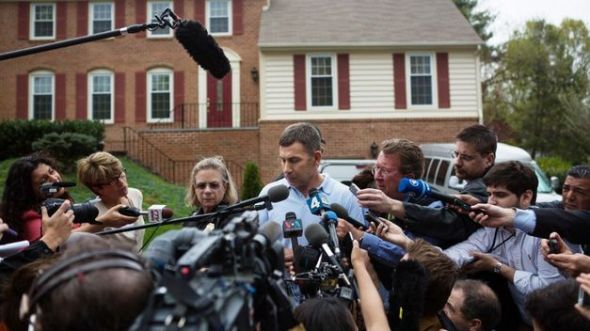
“Uncle” Ruslan Tsarni speaking to the media in front of his home in Montgomery Village, MD
Ruslan Tsarni, pictured above talking to reporters, is brother to Ansor Tsarnaev and uncle to Ansor’s sons Dzhokhor and Tamerlan Tsarnaev. Another brother, Alvi Tsarni, lives fairly close to Ruslan. At some point Ruslan and Alvi had their surnames legally changed.
As you can see from the photo above, Ruslan Tsarni lives in a rather stately, expensive-looking home. He has been identified in news reports as “a corporate lawyer and oil company executive.”
I’ve been floating around Twitter, Google, and Facebook for the past few days, mainly trying to find out anything I can about the mysterious “Misha,” who supposedly influenced Tamerlan Tsarnaev beginning some time in 2010.
I don’t want to get into too much in the way of conspiracy theory, so I’m just going to lay out the facts that are being reported around the internet and let the chips fall where they may. I really don’t know what it all means–maybe nothing–but there are certainly some interesting connections coming out.
I’ll get to the “Misha” story a little later; first some background on Uncle Ruslan, who has some “spooky” connections (pun intended). Daniel Hopsicker, who is somewhat eccentric but IMHO an excellent researcher and writer, has dug up some very suggestive stuff about Ruslan Tsarni. I got some additional information from this post at Democratic Underground.
Beginning in the early 1990s, Tsarni worked as a “consultant” for USAID, which is known to be frequently used as a cover for CIA operatives, according to Jeff Stein (SpyTalk) at the Washington Post.
The uncle of the two men who set off bombs at the Boston Marathon, who struck the only grace note in an otherwise horrific week, worked as a “consultant” for the Agency for International Development (USAID) a U.S. Government Agency often used for cover by agents of the CIA, in the former Soviet Republic of Kazakhstan during the “Wild West” days of the early 1990’s, when anything that wasn’t nailed down in that country was up for grabs.
“Uncle Ruslan” Tsarni of Montgomery Village Md., whose name was the top trending topic worldwide on Twitter last Friday for his plain-spoken condemnation of his two nephews, has had a checkered business career, that began well before he graduated (as Ruslan Z Tsarnaev) from Duke Law School in 1998.
Tsarni was also a Halliburton contractor:
Ruslan’s involvement with USAID, while suggestive, might still be irrelevant, were it not for the discovery of his decade-long involvement with companies in the orbit of the Sun God, Halliburton, which stands accused in numerous and increasingly-credible accounts as “lead dog” in an invading force of “non-state actors.”
All of this, mind, was in support of a noble cause. We were fighting communism. No, wait? We weren’t anymore.
Still, we must have been fighting something. Wait. It’ll come to me…Maybe it was a push to weaken Russia’s grip over former Soviet Republics. That sounds like an admirable goal. Alas, the means chosen to achieve it involved providing covert U.S. support, in Chechnya, to Islamic terrorists.
Haven’t we all already see that movie? No one with a functioning heart could be anxious to see it again. But, wait! Does Dick have a functioning heart?
Hopsicker has a pretty colorful writing style, and you can read all the details at his blog, but briefly, in 2005 Ruslan Tsarni went to work for Big Sky Energy (a Halliburton subsidiary) as Vice President, Business Development & Corporate Secretary. Before that Tsarni worked for two other Halliburton-connected companies, Nelson Resources and Golden Eagle Partners.
Tuesday Morning Reads: BP Goes on Trial over 2010 Deepwater Horizon Oil Spill
Posted: February 26, 2013 Filed under: Environment, morning reads, New Orleans, open thread, U.S. Politics | Tags: BP oil spill, British Petroleum, Deepwater Horizon, Halliburton, Transocean 9 Comments
Fire boat response crews battle the blazing remnants of the off shore oil rig Deepwater Horizon on April 21, 2010. The blowout in the Gulf of Mexico killed 11 people and sent 4.9 million barrels of oil gushing from the sea floor into the Gulf (Houston Chronicle).
See more photos of the Gulf oil disaster at the Houston Chronicle.
Good Morning Sky Dancers!!
BP went on trial over the 2010 Deepwater Horizon disaster on Monday, after the failure of efforts to reach a last-minute settlement.
US district judge Carl Barbier opened proceedings in New Orleans with a warning that it would be a “lengthy trial”….
The trial is designed to identify the causes of BP’s well blowout and assign percentages of fault to the companies. That will help determine how much more each has to pay for their roles in the environmental catastrophe.
Months of negotiations have failed to produce a settlement that could have averted the trial.BP has said it already has racked up more than $24bn in spill-related expenses and has estimated it will pay a total of $42bn to fully resolve its liability for the disaster that killed 11 workers and spewed millions of gallons of oil.
But the trial attorneys for the federal government and Gulf states and private plaintiffs hope to convince the judge that the company is liable for much more.
The Guardian quotes Columbia law professor John Coffee as saying that there could still be a settlement, because BP obviously does not want to deal with the adverse publicity that would go along with a month’s long trial with damaging information about the company in the headlines day after day.
Read live tweets from the trial by Dominic Rush of the Guardian here.
Bloomberg Businessweek reports: BP, Transocean Accused of ‘Reckless’ Actions in Spill.
The mishandling of an oil-rig safety test by BP Plc (BP/) and Transocean Ltd. (RIG) officials was a major cause of an explosion that led to the 2010 Gulf of Mexico oil spill, lawyers for the U.S. and spill victims said at a trial.
BP and Transocean supervisors’ failure to properly interpret results of a pressure test on the Macondo well off the coast of Louisiana cost 11 rig workers their lives and sent millions of gallons of oil spewing into the Gulf, Michael Underhill, a U.S. Justice Department lawyer, and Jim Roy, an attorney for plaintiffs suing the companies, told a judge yesterday.
“BP put profits before people, profits before safety and profits before the environment,” Underhill said in opening statements that began this morning [Monday] in New Orleans in a trial before U.S. District Judge Carl Barbier, who is overseeing litigation over the spill….
BP executives’ “missteps and reckless decisions” about the safety test were prompted by pressure to generate billions in profits regardless of the costs, Underhill said in his statement.
Read the entire Bloomberg article for an excellent summary of the issues in the case.
Through their attorneys, BP, Transocean, and Halliburton pointed fingers at each other. NOLA.com:
Opening day at the long-awaited civil trial against BP and its partners in the ill-fated Macondo oil well at times sounded like a group of youngsters blaming everyone but themselves for a bad deed. That’s not an unexpected beginning in the first phase of a federal trial aimed at determining each of the companies’ financial liability for the accident.
The trial at the federal courthouse in New Orleans began Monday morning with opening arguments by Plaintiff Steering Committee attorneys, representing private parties who sued BP and its partners for damages; the U.S. Justice Department; and the states of Louisiana and Alabama, whose attorneys outlined their views of how the accident occurred and whether BP or any of its partners were guilty of gross negligence or willful misconduct, which could result in an eventual four-fold increase in fines under the Clean Water Act and the awarding of punitive damages for the private plaintiffs….
The federal, state and private party attorneys took aim at BP, which owned the drilling lease for the Macondo well; Transocean, which owned and staffed the ill-fated Deepwater Horizon drilling rig; and Halliburton, which provided an unusual, lightweight cement that was used to block the flow of oil in the well.
Among the recurring story lines and accusations:
That BP made the ultimate decisions for drilling operations on the Deepwater Horizon rig, was more concerned with profits than safety as it ran behind schedule and over-budget on the well, and that BP rig supervisors botched a crucial safety test before the April 2010 drilling-platform explosion;
That Transocean had not properly trained its crew, which missed clear signals that a blowout was about to occur;
That Halliburton’s use of a cement made lightweight with nitrogen bubbles was known to be risky, and the mixture did not succeed in sealing the well.
Other takes on the opening of the trial:
Wall Street Journal: Accusations Fly as Trial Over Gulf Oil Spill Begins
Transocean, which owned the drilling rig, failed to train its crews properly and didn’t maintain key safety equipment, said Jim Roy, a lawyer for hundreds of businesses suing the energy companies that were drilling the ill-fated well.
Brad Brian, a lawyer for Transocean, said that wasn’t true, noting that the Coast Guard, federal safety regulators and BP’s own management considered the Deepwater Horizon rig “what ‘good’ looked like.”
Michael Underhill, the Justice Department’s lead civil attorney, focused on a last-minute conversation between BP engineers on the rig and onshore that he said showed that the oil giant acted with gross negligence. The rig was not reviewed by hydraulic engineer to ensure that everything is safe.
But BP attorney Mike Brock argued the accident was caused by many mistakes made by all the parties aboard the rig, which exploded in April 2010, killing 11 workers and unleashing the worst offshore oil spill in U.S. history. “There were a number of mistakes and errors in judgment that were made by BP, Transocean and Halliburton,” Mr. Brock said.
LA Times: Greed caused BP’s gulf oil spill, lawyers argue
Energy giant BP, behind schedule and $50 million over budget drilling a deep-water well, emphasized cost-cutting over safety, causing the largest offshore oil spill in U.S. history, lawyers said Monday as the company’s high-stakes civil trial began.
Lawyers used PowerPoint presentations to provide a dramatic recounting of the April 20, 2010, explosion and fire in the Gulf of Mexico that killed 11 crew members. Workers were preparing to temporarily cap the Macondo well 4,100 feet underwater when it blew up. The 30-story drilling vessel about 50 miles offshore burned for two days before crumpling into the gulf.
The resulting spill of more than 4 million barrels of oil damaged the waters and economies of five states. And the responsible party was BP, according to the lawyers representing the federal government, Gulf Coast states and private parties.
Washington Post: Billions of dollars at stake for BP, other companies as trial opens for Gulf oil spill
One of the biggest questions facing U.S. District Judge Carl Barbier, who is hearing the case without a jury, is whether BP acted with gross negligence.
Under the Clean Water Act, a polluter can be forced to pay a minimum of $1,100 per barrel of spilled oil; the fines nearly quadruple to about $4,300 a barrel for companies found grossly negligent, meaning BP could be on the hook for nearly $18 billion.
The judge plans to hold the trial in at least two phases. The first phase, which could last three months, is designed to determine what caused the blowout and assign percentages of blame to the companies involved. The second phase will determine how much crude spilled into the Gulf.
The issues in the case are “massive” and “complex.”
Hundreds of attorneys have worked on the case, generating roughly 90 million pages of documents, logging nearly 9,000 docket entries and taking more than 300 depositions from witnesses who could testify at trial.
“In terms of sheer dollar amounts and public attention, this is one of the most complex and massive disputes ever faced by the courts,” said Fordham University law professor Howard Erichson, an expert in complex litigation.
The trial continues today.
AP via the Houston Chronicle: 1st witness to testify in Gulf oil spill trial
A University of California-Berkeley engineer who played a prominent role in investigating levee breeches in New Orleans after Hurricane Katrina is scheduled to be the first witness Tuesday at a trial involving another Gulf Coast catastrophe: the worst offshore oil spill in U.S. history.
Robert Bea, an expert witness for the plaintiffs who sued BP PLC and other companies involved in the Deepwater Horizon disaster, will share his theories about what caused BP’s Macondo well to blow out on April 20, 2010, provoking an explosion on the Horizon rig that killed 11 workers and spewed an estimated 172 millions of gallons of crude into the Gulf.
Bea’s testimony was scheduled for the second day of a civil trial that could result in the oil company and its partners being forced to pay billions of dollars more in damages. The case went to trial Monday after attempts to reach an 11th-hour settlement failed.
The second witness scheduled is BP America president Lamar McKay.
The high-ranking executive is likely to discuss corporate decisions that were made during the disaster. It was not clear if there would be time for his testimony Tuesday. Other BP officials were expected to give videotaped testimony.
In pretrial depositions and in a report, Bea argued along with another consultant that BP showed a disregard for safety throughout the company and was reckless — the same arguments made in opening statements Monday by attorneys for the U.S. government and individuals and businesses hurt by the spill.
Attorneys for BP tried to block Bea’s testimony, accusing him of analyzing documents and evidence “spoon-fed” to him by plaintiffs lawyers. BP accused Bea and another expert, William Gale, a California-based fire and explosion investigator and consultant, of ignoring the “safety culture of the other parties” involved in the spill, in particular Transocean Ltd., the drilling company running operations aboard the Deepwater Horizon.
It should be fascinating to follow this case, and I’m really hoping there won’t be a settlement. A trial could bring out valuable information that we haven’t heard about so far.
I thought the BP trial deserved its own post, but please consider this an open thread and post freely about any topic in the comments.
Tuesday Reads: Goolsbee Gone, Hotel Workers Heckle Strauss-Kahn, Cancer Drugs, and a Confession
Posted: June 7, 2011 Filed under: Barack Obama, morning reads, religion, SCOTUS, Team Obama, U.S. Economy, U.S. Politics, unemployment, Violence against women | Tags: Austan Goolsbee, Ayn Rand, Barack Obama, Cancer, Casey Anthony, crime, Dick Cheney, Dominique Strauss-Kahn, Faithful America, forensics, Halliburton, hotel workers, melanoma, murder, Rep. Paul Ryan, sexual assault, U.S. Supreme Court 76 Comments
Good Morning!!
White House economic adviser Austan Goolsbee will soon resign to return to teaching at Milton Friedman Institute the University of Chicago.
“Since I first ran for the U.S. Senate, Austan has been a close friend and one of my most trusted advisers,” President Obama said….”Over the past several years, he has helped steer our country out of the worst economic crisis since the Great Depression, and although there is still much work ahead, his insights and counsel have helped lead us toward an economy that is growing and creating millions of jobs. — He is one of America’s great economic thinkers.”
Maybe … if you favor NAFTA and cutting Social Security. And where are those “millions of jobs” Obama is talking about–China?
Dominique Strauss-Kahn, who has been accused of sexual assault on a hotel maid was jeered by NYC hotel workers yesterday outside a Manhattan courthouse.
Lawyers for the maid who has accused Dominique Strauss-Kahn of criminal sexual assault in a New York hotel room served notice yesterday that she will testify at his trial and “tell the world” what he inflicted upon her, as the former IMF chief was met with a chorus of heckling from hotel workers outside a Manhattan courthouse.
The warning, delivered minutes after Mr Strauss-Kahn entered a ‘not guilty’ plea to the seven charges filed against him, is the latest indication of how ferocious the trial is likely to be with the defence, the prosecution and now lawyers for the accuser all aggressively preparing to engage in battle.
[….]
Theatrics outside the court yesterday were further stoked by hotel maids pushing against police barriers jeering Mr Strauss-Kahn as he, accompanied by his defence team and his wife, Anne Sinclair, arrived for his formal arraignment. The hotel employees, bussed in by their union and most dressed in uniforms they usually wear to work, cried “shame” as he walked past. Wendy Baranello, a hotel union organiser, called the charges “outrageous” and said the accuser “is a hard-working woman… just doing her job.”
As Rep. Paul Ryan (R-WI) left the Faith and Freedom Coalition Conference this past weekend, he was approached by a young Catholic man who asked Ryan:
“Why did you choose to model your budget off the extreme ideology of Ayn Rand rather than values of basic economic justice in the Bible?” James Salt of Faithful America asked Ryan, the author of the Republican budget, before offering him a Bible to read.
Ryan ignored Salt’s questions and briskly walked away.
Faithful America has launched a campaign to encourage Ryan to put down the conservative writer Ayn Rand, who advocated selfishness, and pick up the Bible. The group said his budget plan “reflects Ayn Rand’s love of greed and contempt for the weak by giving huge tax breaks to millionaires while making deep and harmful cuts to programs that protect seniors, struggling families and the middle class.”
Finally the U.S. Supreme Court has done something we can cheer. From Raw Story:
The US Supreme Court gave the green light Monday to a group seeking to bring a class-action lawsuit against US oil services firm Halliburton for alleged fraud.
The nine judges unanimously decided that the plaintiffs, a group of investors, do not need to prove a direct relationship between Halliburton’s alleged fraudulent statements and the investors’ financial losses in order to pursue the lawsuit.
Halliburton is accused of making a series of false statements about its business dealings that artificially inflated its stock price.
Afterward, Halliburton disclosed corrections that then caused stock prices to drop at the loss of investors.
The suit is on behalf of all investors who purchased Halliburton stock between June 3, 1999 and December 7, 2001.
During that time Dick Cheney was Halliburton’s CEO.
There is some “big news in the fight against cancer.”
Two new studies report dramatic progress in treating advanced melanoma and lung cancer.
Both of these treatments use an approach that is creating a lot of excitement among doctors –tailoring drugs to the genetic makeup of individual patients, and the results can be remarkable
A few years ago, Bill Schuette was preparing for the end.
But then he heard about something new: an experimental drug that targets a certain type of lung cancer based on its genetic makeup. Tests showed he was a candidate.
His rare form of non-small-cell lung cancer has a genetic mutation called ALK that fuels cancer growth. The new drug, Crizotinib, works by blocking this abnormal gene, causing tumors to shrink.
Skin cancer treatment: Biggest breakthrough in 30 years – The New Scientist
Two new drugs for metastatic melanoma – the deadliest form of skin cancer – are being hailed as the biggest breakthrough therapies for cancer in the last 30 years. The drugs reduce tumour size, significantly increasing survival rates.
Although melanoma can be cured if caught early enough, individuals in the late stages of the disease are only expected to survive for an average of six months. One of the two drugs – vemurafenib – works by inhibiting the effects of a mutated form of the BRAF gene, which is thought to accompany around half of the cases of malignant skin tumours.
[….]
In a study presented this week at the American Society of Clinical Oncology annual meeting in Chicago, and published in the New England Journal of Medicine, Chapman’s team compared both drugs on 672 patients with late stage, inoperable melanoma and a mutation in the BRAF gene.
The group found that 48 per cent of those receiving vemurafenib responded to the treatment, while only 5 per cent of patients responded to dacarbazine. At 6 months, survival was 84 per cent in the group taking vemurafenib compared to 64 per cent in those taking dacarbazine.
A new drug for breast cancer: Aromasin a major breakthrough in fight against breast cancer, cutting risk by 65 percent
Doctor Harvey Greenberg is the director of University Community Hospital’s Cancer Program. He said, “There’s been some suggestion that women are reluctant to take Tamoxifen due to the potential side effects,” which reportedly include developing blood clots, or developing uterine cancer.
A study was conducted to see if a different class of medicines could be used for the prevention of breast cancer. Study results just released show the estrogen blocker Aromasin reduced the chance of developing breast cancer by 65 percent in post menopausal women at high risk.
The study, which was sponsored by Pfizer — the company that makes this drug — broke the participants into two groups: one that got the drug and one that got the placebo. There were 11 invasive breast cancers reported in the group that got the drug compared to 32 cases in the group that got the placebo.
Doctor Greenberg says, “The most important take away is that there is now another class of medicines that can be helpful in preventing breast cancer in high-risk women. The second take away is if there are women who have been identified as possibly benefiting from Tamoxifen but they won’t take it, here’s a substitute.”
For those of you who have read this far, I’m going to make a confession. I’ve been horribly depressed by the political news lately, and for the past couple of weeks I’ve been watching the trial of Casey Anthony, a young woman accused of murdering her 2-1/2 year-old daughter.
I know, I know … tabloid stuff. But I’m telling you, it’s more interesting than watching Law & Order, CSI, and Criminal Minds all rolled into one. Yesterday, there was testimony from an researcher on human decomposition from the “Body Farm” at Oak Ridge National laboratory.
Dr. Arpad Vass testified that he detected human decomposition in the air from the trunk of Casey’s car. It’s the first time a jury has heard testimony about the controversial air tests. The evidence has never been used in a criminal case before.
Prosecutors say the tests prove Caylee’s [Casey’s daughter] body was in the trunk of Casey’s car.
“I can find no other plausible explanation other than that to explain all the results we found,” said Vass.
Vass testified that a machine called a “gas chromatograph” can identify chemicals that are unique to human decomposition.
“Those are the chemicals that a cadaver-locating dog could smell,” Vass said.
Yesterday there was testimony from an FBI forensic expert about a hair found in the truck of Anthony’s car that showed signs of human decomposition.
In addition to the opportunity to learn about the latest methods in forensic science, the trial offers a chance to observe Casey Anthony’s amazing lack of affect as she listens to testimony about her allegedly killing her child. She has to be one of the most evil human beings I’ve ever encountered. If you’re interested in this kind of thing, you can watch the trial streamed live on-line at a number of sites. Here’s one. Frankly, I find it much less depressing than observing American political culture.
So … what are you reading and blogging about today?

 peej
peej Carissa
 bostonboomer
 dakinikat
 ecocatwoman
 mablue2
 Mama Lopez
 peggysue22
 quixote
 skydancingguestblogger
 Mona (aka Wonk the Vote)



 Sky Dancing
Recent Comments