
Tuesday Reads: Are Things Really As Bad As I Think?
Posted: December 3, 2013 Filed under: Barack Obama, George W. Bush, Health care reform, immigration, income inequality, morning reads, Political Affective Disorder, Politics as Usual, poverty, Psychopaths in charge, Real Life Horror, Surreality, The Media SUCKS, U.S. Economy, U.S. Politics, We are so F'd, Women's Rights | Tags: Amazon drones, gun violence, No Child Left Behind, Obamacare, PISA test scores, public education, Racism 44 Comments
Good Morning!!
I don’t even know where to begin this morning. I wish I could write a coherent diatribe like the one Dakinikat wrote yesterday, but I can’t do it. I have a sense that things are very wrong, but I can’t explain the feeling in any rational way.
As we head into the holiday season, I feel as if the country is leaderless. The public focus of the Obama administration and the media is on the glitches in a website; and yet in the background are terrible problems that are building and growing more and more intractable as our political “leadership” fiddles with nonsensical issues like Obamacare and Benghazi.
As Dakinikat noted yesterday, there is a problem of growing poverty and income inequality become institutionalized and normalized. There is the issue of gun violence and our total failure to respond to it with any kind of rational regulations on guns. There is the devolution of education in the U.S., and of course there is the continuing attack on women’s autonomy and Democratic politicians seeming willingness to use women’s bodies as bargaining chips. Finally there are the already institutionalized problems of racism and hatred of immigrants. What have I missed?
As our real problem grow, it seems the American political and media classes, either don’t notice because as part of the wealthy 1% they simply aren’t affected, or because they’ve got theirs and they just don’t care about the mass of people who are struggling to survive in a poisonous system. And because of the obsessive focus on the end-of-year holidays, nothing will happen in Washington until we hit the next debt limit and our “leaders” mobilize briefly to kick the can of our economic and social problems down the road once again and so they can return to their focus on minutiae.
Is there any solution to the political and economic stagnation we find ourselves in? Is the situation really as surreal as it feels to me on this Tuesday morning? Am I nuts?
Anyway, here a some of the stories leading the news at the moment.
Jeff Bezos tells Amazon customers to expect home delivery by drones. NBC News reports:
Amazon.com hopes to deliver small packages to your home in just 30 minutes by unmanned drones within five years, chief executive Jeff Bezos said Sunday.
In an interview on CBS’s “60 Minutes,” Bezos was actually less optimistic than what his company said in its online announcement, which declared that tiny robot aircraft could be landing on front porches as soon as 2015.
Bezos said Amazon already had the technology in place and had even flown a working prototype, which he showed off in a video the company published Sunday:
He promised “half-hour delivery, and we can carry objects, we think, up to five pounds, which covers 86 percent of the items that we deliver.”
The rest of the work, Bezos said, is in quality control and getting the plan OK’d by the Federal Aviation Administration — something technology experts said was unlikely on Bezos’ time frame.
So basically, this is just a silly idea that has no chance of actually happening anytime soon. But the media sees it as more urgent than poverty, income inequality, and people getting killed with guns day in and day out.
From the Washington Post: U.S. students lag around average on international science, math and reading test.
Scores in math, reading and science posted by 15-year-olds in the United States were flat while their counterparts elsewhere — particularly in Shanghai, Singapore and other Asian provinces or countries — soared ahead, according to results of a well-regarded international exam released Tuesday.
While U.S. teenagers scored slightly above average in reading, their scores were average in science and below average in math, compared to 64 other countries and economies that participated in the 2012 Program for International Student Assessment, or PISA, which was administered last fall. That pattern has not changed much since PISA was first administered in 2000.
Gee, I wonder why this is happening? It seems like something that should concern our “leaders.”
The test scores offer fresh evidence for those who argue that the United States is losing ground to competitors in the global market and others who say a decade’s worth of school reform has done little to improve educational outcomes.
“While the intentions may have been good, a decade of top-down, test-based schooling created by No Child Left Behind and Race to the Top — focused on hyper-testing students, sanctioning teachers and closing schools — has failed to improve the quality of American public education,” Randi Weingarten, president of the American Federation of Teachers, said in a statement. The AFT released a video on Monday in which it implored the public not to blame teachers, the unions, parents or students for poor PISA results.
But were intentions really good? Check out these years-old headlines on profiteers (including the Bush family) who cleaned up after passage of the Orwellianly titled “No Child Left Behind” law was passed.
Bush Profiteers Collect Billions from No Child Left Behind (Project Censored: The News That Didn’t Make The News, March 30, 2007)
Bush’s Family Profits From `No Child’ Act (LA Times, Oct. 22, 2006)
No Bush Left Behind (Bloomerg Businessweek, Oct. 15, 2006)
There are plenty more headlines where those came from.
And yet, nearly a decade later, we’re stuck with that awful law and the damage it has done to our public education system. Why have Democrats done nothing to reverse it? Most likely because they too profit from the continuing privatization of education.
What about the latest media narrative on Obama care?
From the Washington Post: Health-care enrollment on Web plagued by bugs:
The enrollment records for a significant portion of the Americans who have chosen health plans through the online federal insurance marketplace contain errors — generated by the computer system — that mean they might not get the coverage they’re expecting next month.
The errors cumulatively have affected roughly one-third of the people who have signed up for health plans since Oct. 1, according to two government and health-care industry officials. The White House disputed the figure but declined to provide its own.
The mistakes include failure to notify insurers about new customers, duplicate enrollments or cancellation notices for the same person, incorrect information about family members, and mistakes involving federal subsidies. The errors have been accumulating since HealthCare.gov opened two months ago, even as the Obama administration has been working to make it easier for consumers to sign up for coverage, the government and industry officials said.
Figuring out how to clean up the backlog of errors and prevent similar ones in the future is emerging as the new imperative if the federal insurance exchange is to work as intended. The problems were the subject of a meeting Monday between administration officials and a new “Payer Exchange Performance Team” made up of insurance industry leaders.
Okay, but what is with the bizarre impatience about some computer glitches from a media that couldn’t care less about institutionalized poverty, racism, and gun violence? And then there’s the Obama administration’s defensive response, as reported by USA Today: Obama to launch new health care law campaign
President Obama and his aides will seek to rally public support for his embattled health care plan in the coming weeks, starting with a White House event Tuesday.
Obama will promote the effort in a speech while surrounded by people who have benefited from the new law, according to an addition to the White House schedule.
The Affordable Care Act has come under heavy political attack since its rollout in October. Problems have included a malfunctioning website and the cancellations of polices that do not meet new federal standards.
In the coming days, Obama and aides will highlight what they call successful aspects of the law. They include provisions that prevent insurance companies from discriminating against people with pre-existing health conditions, and allow young people to stay on their parents’ insurance policies until age 26.
A few writers have tried to look at the “Obamacare crisis” slightly more rationally than the mainstream corporate media.
Here’s Bob Cesca at The Daily Banter: As Healthcare.gov Bugs Are Fixed, the ‘Obama’s Katrina’ Script Continues To Be Shredded.
It’s been 11 days since The National Journal‘s Ron Fournier wrote that Obamacare is President Obama’s Katrina. Oh, and it’s also his Iraq, Fournier wrote. Obama’s Katrina and Iraq. Both.
Since then, however, the Healthcare.gov website has been vastly improved and many of the bugs initially reported have been fixed, according to the administration late Sunday.
Back on November 20, Fournier made sure to provide himself with an escape hatch, though, noting that Healthcare.gov isn’t the same in terms of the actual events during and after Katrina, or throughout the Iraq War. Instead, Fournier wrote, the similarities had more to do with incompetence in the execution of a major policy initiative.
Yeah, so incompetence that lasted literally for years in both Iraq and New Orleans, leading to massive body counts on both fronts, is the same as a glitchy website launch. Okeedokee. Roger that. In reality, yes, both administrations made mistakes, but those mistakes were vastly different in terms of magnitude — not to mention that the Bush administration’s response to its mistakes was to, well, make even more mistakes. Again, foryears.
On the other hand, the Obama administration realized there were problems with the website and rushed to address those errors. Within two months most of those problems have been resolved, and, bonus, no one died.
For more rational perspective, read the rest of the post at the link.
I particularly like this uncharacteristically long post by TBogg at Raw Story: Are-We-There-Yet?-American [sic] just wants to go home because we aren’t there yet. Here’s just a taste:
You may remember that about a month ago, which is four score and seven years ago to the iPhone generation for whom a Japandroids download that takes over 20 seconds is an eternity times infinity, that the Great Socialism Project That Will Stomp America Flat (aka Obamacareor Communism) had some internet user problems which is why there are absolutely no healthcare services available in America right now so you should just rub some dirt on your burst appendix, suck it up, and quit yer bellyaching. In an effort to fix what wasn’t working, the Obama White House brought in some better quality nerds who, fortified with 5 Hour Energy IV drips, promised to get it up and working by Dec 1 or GTFO.
Please go read the rest.
Charles Pierce also had a few choice words for Ron Fournier and the rest of the Obama-hating press.
Ace reporter Ron Fournier of the Associated Press has another scoop for y’all. There is absolutely no fking way on god’s green and pleasant earth that this Obama fellow will be elected president again. He has blown his chance for that third term, and probably the fourth and fifth as well. Ron would like the Pulitzer committee to leave the medallion on the doorstep. Watch out, Obama. The Horsemen ride at daybreak! [….]
I heard my friend Eric Boehlert on the radio this morning, warning us that the traditional end-of-the-year retrospectives are likely to sing in close harmony on the theme of the collapsing Obama administration, even though his poll numbers are pretty much where they’ve been for a couple of years now, and even though the Republicans in Congress continue to have the approval ratings of skin disease. I think he’s right, and I think Fournier, who’s been a tool so long they ought to sell him at Home Depot, is just trying to get a jump on things here.
More hilarity at the link.
And what’s with the efforts to deny that racism exists? From Raw Story: Black female professor reprimanded for pointing out existence of structural racism to white male students.
A faculty member at Minneapolis Community and Technical College, Shannon Gibney, received a formal reprimand for her handling of a discussion about structural racism in her Introduction to Mass Communication course.
According to Gibney in an interview with City College News, a white male student asked her, “Why do we have to talk about this in every class? Why do we have to talk about this?”
She claims she was shocked, because “[h]is whole demeanor was very defensive. He was taking it personally. I tried to explain, of course, in a reasonable manner — as reasonable as I could given the fact that I was being interrupted and put on the spot in the middle of class — that this is unfortunately the context of 21st century America.”
Gibney says another white male student followed the first, saying “Yeah, I don’t get this either. It’s like people are trying to say that white men are always the villains, the bad guys. Why do we have to say this?”
When Gibney attempted, again, to inform the students that they were mistaking a systemic critique for a personal attack, the students continued to argue. Eventually, she told them that “if you’re really upset, feel free to go down to legal affairs and file a racial harassment discrimination complaint.” This is exactly what they did.
This probably has something to do with our f’d up education system too . . . . As far as I can tell, critical thinking has been banned.
Okay, I’ve ranted long enough. What interesting news have you been reading? Let us know in the comment thread.
Monday Evening News Update
Posted: September 16, 2013 Filed under: Crime, SDB Evening News Reads, U.S. Politics | Tags: Aaron Alexis, gun violence, mass murder, Workplace shootings 20 Comments
Good Evening!!
It’s been an eventful day in Washington DC, so I thought I’d post a brief update tonight.
I know JJ is busy dealing with her daughter’s upcoming surgery, and I haven’t been around for the past few days because I was doing some marathon kid-sitting. I’m still a little tired after spending most of the day last Wed. and Fri. and Sat. nights with my 8 and 10-year-old nephews. I love them more than anything and love spending time with them, but their energy does wear me out after a while.
Anyway–the news. The top story is of course the latest mass shooter, Aaron Alexis, who killed 12 people and injured at least 14 others at the Washington Navy Yard this morning. Alexis is also dead. From CNN:
The picture emerging of a dead gunman in Monday’s rampage at the Washington Navy Yard is a study in contrasts, one of a man who practiced languages and meditated and another of a cold-blooded killer.
Authorities have not released a possible motive in the shooting at the headquarters for Naval Sea Systems Command that witnesses described as terrifying and chaotic.
The gunman was identified as 34-year-old Aaron Alexis, a former Navy reservist and a current military contractor, the Washington FBI Field Office told CNN. His identity was confirmed by fingerprints and a picture ID card, the FBI said.
Police are still looking for a possible second shooter, but that wouldn’t fit the pattern of these workplace-type shooters. But we’ll have to wait and see.
Alexis, who was from New York City, served as a full-time Navy reservist between 2007 and 2011, according to military records.
In the Navy, Alexis achieved the rank of aviation electrician’s mate 3rd class, working on aircraft electrical systems, the records show.
Alexis was discharged after a “pattern of misconduct,” a U.S. defense official, with knowledge of the investigation, told CNN on condition of anonymity. The official did not detail the misconduct.
Most recently, Alexis worked as an information technology contractor with the Navy…. His last known address was outside of Fort Worth, Texas…
This CNN story has more details on the shooting itself.
Alexis has a history of violent behavior. In 2010, he was arrested for firing a gun through the ceiling of his Fort Worth apartment, according to USA Today. No charges were filed.
The Tarrant County District Attorney’s Office issued a statement Monday saying that no charges were pursued against Alexis. “It was determined that Alexis was cleaning a gun in his apartment when it accidentally went off,” Tarrant County District Attorney Joe Shannon Jr., said. “No one was injured.”
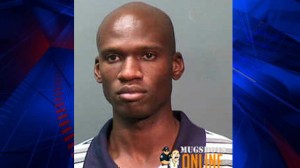
Aaron Alexis’ mugshot from 2010 arrest
The Smoking Gun has more detail on the incident as well as two earlier ones in 2004 and 2008. The neighbor into whose apartment Alexis fired a bullet (here’s the police report)
said that she was “terrified” of Alexis, who had previously confronted her about making too much noise. The woman, who was “visibly shaken up” when questioned by police, said that she believed the shooting was “intentional.”
When police confronted Alexis, who is seen in the adjacent mug shot, he claimed that he was cleaning the weapon when it discharged. Alexis told cops that he was cooking at the time and his hands were slippery as he “began to take the gun apart when his hands slipped and pulled the trigger discharging a round into the ceiling.”
Asked why he did not notify police or check on the welfare of his upstairs neighbor, Alexis said that he “didn’t think it went all the way through since he couldn’t see any light through the hole.” Additionally, “In regards to the noise he said he thought that people would just think it was a firecracker.”
Um…that really sounds like a red flag to me. Maybe guns going off randomly in apartments isn’t such a big deal in Fort Worth?
In 2004, Alexis was arrested in Seattle for
shooting out the tires of a car owned by a construction worker who purportedly “mocked him.” Alexis told cops that an anger-fueled “black out” promted the shooting. Alexis’s father told investigators that his son suffered from “anger management problems” that were related to post-traumatic stress disorder, perhaps connected to his involvement in rescue work following the September 11 terror attacks.
Here’s more detail on the Seattle incident from the Seattle PD:
At about 8 am that morning, two construction workers had parked their 1986 Honda Accord in the driveway of their worksite, next to a home where Alexis was staying in the Beacon Hill neighborhood.
The victims reported seeing a man, later identified by police as Alexis, walk out of the home next to their worksite, pull a gun from his waistband and fire three shots into the two rear tires of their Honda before he walked slowly back to his home north of the construction site….
Following his arrest, Alexis told detectives he perceived he had been “mocked” by construction workers the morning of the incident and said they had “disrespected him.” Alexis also claimed he had an anger-fueled “blackout,” and could not remember firing his gun at the victims’ vehicle until an hour after the incident.
Alexis’ father told Seattle police that his son had PTSD.
Finally, according to The Smoking Gun, in 2008, he was arrested for disorderly conduct in DeKalb County, Georgia. The guy really got around. I guess we’ll be learning a lot more about him over the next few days.

A man is taken into custody by uniformed Secret Service Police on Pennsylvania Avenue outside the White House on Monday,
The shooting spree at the Navy Yard wasn’t the only out-of-the ordinary incident in Washington DC today. A short time ago, a man was arrested by the Secret Service outside the White House after he tossed some firecrackers over the fence. USA Today:
Officials identified the man only as Alexander Sahagian; he is believed to age 52.
The firecrackers, which to some sounded like gunshots, triggered a lockdown of the White House complex.
Secret Service spokesman George Ogilvie said the suspect was transported to a nearby police station and will likely be charged with illegally throwing a projectile.
If I get more detail on these incidents, I’ll post links in the comment thread. So…what are you hearing? Any big news in your neck of the woods?
Monday Reads
Posted: May 13, 2013 Filed under: morning reads, New Orleans | Tags: Climate change, Elizabeth Warren, gun violence, hate speech, mother's day shootings New Orleans, school loans 34 Comments Good Morning!
I spent Mother’s Day napping on dad’s sofa mostly. I am such an exciting person!! I have no idea why I am so cold and so worn out but it is what it is.
Meanwhile, all hell broke loose in New Orleans. The gun violence that hit a Mother’s Day parade there was pretty much the kind of urban violence we see all too often with such easy access to guns. I wish I could say that gun violence was rare in the 7th ward. But it is not. Here’s a word from my congressman Cedric Richmond:
According to FBI data, 1,464 people were killed by firearms in New Orleans between 2008-2011. That’s 1,464 families who will never see their loved ones again. If we were to have passed the entirety of President Obama’s proposed reforms, sadly, many of those victims would probably have still been killed because violence is a pervasive and complex problem with a diverse set of causes. Economic insecurity, poor mental health treatment options, inferior education options and the scarcity of positive opportunities are all contributors, which one regulation alone cannot eliminate. That being said, if we only acted on just a few of the president’s proposals, we could decrease the supply of guns used in the homicides by reducing the supply of illegally purchased guns via universal background checks. This would decrease the use of guns in violent crime and keep a few more families from having to bury a loved one.
While I was serving as a member of the Louisiana House of Representatives, I introduced an assault weapons ban bill on numerous occasions. I took on the National Rifle Association in these battles not because I have a grudge against gun owners, but because I could find no reasonable defense of having these weapons of mass destruction on our streets. As a resident of Sportsman’s Paradise, I am a strong supporter of the Second Amendment. However, I do not ascribe to the belief that Congress has no role in responding to the gun violence epidemic plaguing communities like New Orleans, Chicago and Detroit.
It seems that 19 people were injured with no fatalities.
A Mother’s Day second-line shooting on Frenchmen Street in the 7th Ward, on Sunday about 1:45 p.m., left 19 people injured, according to the latest NOPD numbers. Earlier Sunday afternoon, NOPD Superintendent Ronal Serpas said that about 12 people had been injured, but the toll later grew to 19, with the NOPD explaining that some victims initially hadn’t reported being injured and more people continue to come forward.
Police said 10 adult men, seven adult women, a 10-year-old boy and a 10-year-old girl were struck by bullets. Both of the 10-year-old victims had graze wounds to the body and were in good condition. A man and a woman were reported to be in surgery Sunday evening.
The shooting occurred in the 1400 block of Frenchmen Street at the intersection of North Villere Street. Immediately after the shooting police reported seeing three suspects running from the scene. One suspect was seen running on Frenchman toward North Claiborne, police said.
NOPD spokeswoman Remi Braden said many of the victims were grazed, some by bullets that ricocheted. “At this point, there are no fatalities, and most of the wounds are not life-threatening,” she said in an email.
“But all medical conditions are not known at this time as victims were rushed to nearby hospitals,” Braden continued. “Detectives are conducting interviews, retrieving any surveillance video in the area and, of course, collecting all evidence. This is an extremely unusual occurrence, and we’re confident that we will make swift arrests.”
Kevin Allman, editor of Gambit Weekly, said one of the publication’s writers, Deborah Cotton, also known as the blogger Big Red Cotton, was shot and was in stable condition after undergoing surgery.
Shannon Roberts, 32, was in the Interim LSU Hospital in New Orleans on Sunday afternoon and early evening alongside reams of other crying and fear-ridden – and at times, angry – family members whose loved ones were injured in the shooting. Roberts said she was waiting on a 21-year-old nephew who was shot in the arm and stomach, a 37-year-old niece shot in the arm, and a 39-year-old cousin shot in the back.
“All innocent bystanders got hit,” Roberts said. “When I got the call saying they were shot, I wasn’t thinking at all, I was just shivering and crying… just hoping they be all right.
Hatred evidently has a basis in geography in this country. This is an interesting twist on studying information from Twitters, locations, and  displays of racism, homophobia, and basic hate speech.
Twitter, even more than many other social media tools, can feel disconnected from the real world. But a group of students and professors at research site Floating Sheep have built a comprehensive map of some of Twitter’s most distasteful content: the racist, homophobic, or ableist slurs that can proliferate online. Called Geography of Hate, the interactive map charts ten relatively common slurs across the continental US, either by general category or individually. Looking at the whole country, you’ll often see a mass of red or what the map’s creators call a “blue smog of hate.” Zooming in, however, patches appear over individual regions or cities; some may be predictable, while others are not.
The map builds on an earlier Floating Sheep project that showed where President Obama was referenced with racial slurs, but it’s far more comprehensive and well-constructed. Unlike many other studies, for example, the tweets weren’t collected and analyzed algorithmically — a method that could accidentally collect non-derogatory uses of these terms. Instead, the team first searched through a year’s worth of geotagged tweets for words, then had a group of students at Humboldt State University look at each one. Only tweets they found explicitly negative went on the map: a derogatory use of the word “dyke” would be added, for example, but one reclaiming the term for a gay pride parade would not. In total, the map charts about 150,000 negative, slur-filled tweets.
Here is some “Terrible News About Carbon and Climate Change”.
This past Thursday, the daily average atmospheric concentration of carbon dioxide, as measured by the Mauna Loa observatory in Hawaii, passed four hundred parts per million. In some way it was a meaningless milestone. We know that CO2 is increasing; we knew this moment would come; we know that four hundred is no more different from three hundred and ninety-nine than it is from four hundred and one.
Still, the number should shake us, if not shock us. We’ve got more carbon dioxide in the atmosphere now than at any point since the Pliocene, when there were jungles in northern Canada. And the number hurdles ever upward, as ocean levels rise and extreme weather becomes routine. Three-fifty was the old target; four-fifty is the new one. But what indication is there that we’ll stop at five hundred, six hundred, or even more?
We’ve failed collectively. As Ryan Lizza explained in miserable detail in 2010, the United States government couldn’t pass a tepid, eviscerated law. Activists have failed. We’ve all failed morally: a problem created by the world’s rich will now crush the world’s poor. In a grand sense it’s also a failure of the creators, and deniers, of climate change: the Exxon-Mobils, say, or the Wall Street Journal editorial page. A victory isn’t worth much if your children and grandchildren will one day think of you with anger and shame.
How do we get out of this mess? The political system seems hopeless. Yes, government regulation has done much to relieve us of acid rain and smog. But global warming combines two intractable problems. Reducing emissions mainly benefits people who aren’t born and don’t vote. And it requires international coördination, which is hopeless, and international law, which is toothless. We should do things like build more public transportation, which helps people here and now. We should design our cities for a future with terrible weather. But solving the problem of climate change through the U.N. is like a small man with olive oil on his hands trying to pull a whale from the water.
 I’ve become somewhat fascinated with charter schools given their presence in New Orleans and their supposed success. Who makes money from these things and why is that important? It has a lot to do with Real Estate Developers and Hedge Fund Managers. This is worth reading.
Studies shows that charter schools don’t typically outperform public schools and they often tend to increase racial and class segregation. So one must wonder, what exactly is motivating these school “reformers”? And why have they pushed for more and more closure — and new charter schools — at such an unprecedented rate in recent years?
Pro-charter supporters will tell you that it’s time for public institutions like our schools to start competing more like for-profit institutions. Test scores and high enrollment, then, define success. Unsuccessful schools, they say, should close just as unsuccessful businesses do. For neoliberal school reformers from today’s Arne Duncan-led Department of Education to scandal-ridden movement leader Michelle Rhee to billionaire Bill Gates, it is taken on faith that market principles are desirable in education.
But since it’s not clear that market principles are benefiting students on a large scale, it seems likely that something else is at stake. And reformers may be more than a little disingenuous in publicly ignoring that other, less high-minded thing: Profit. Critics of charter schools and school closings point out that proponents may not really be motivated by idealism, but by self-gain.
But who precisely is profiting? And how? Untangling answers to these questions is a more daunting task. Compared to public schools, charters schools are an extremely unregulated business. They contract with private companies to provide all kinds of services, from curriculum development to landscaping. Most of the regulations that bind charter schools are implemented at the state level. And unlike public institutions, the finances of charter schools are managed on a school-by-school basis. Because they are not consistently held accountable to the public for how they distribute funds, charter schools are often able to keep their business practices under wraps, and thus avoid too much scrutiny.
Here’s economist Joseph Stiglitz warning us about the crushing student debt in the U.S.
According to the Federal Reserve Bank of New York, almost 13 percent of student-loan borrowers of all ages owe more than $50,000, and nearly 4 percent owe more than $100,000. These debts are beyond students’ ability to repay, (especially in our nearly jobless recovery); this is demonstrated by the fact that delinquency and default rates are soaring. Some 17 percent of student-loan borrowers were 90 days or more behind in payments at the end of 2012. When only those in repayment were counted — in other words, not including borrowers who were in loan deferment or forbearance — more than 30 percent were 90 days or more behind. For federal loans taken out in the 2009 fiscal year, three-year default rates exceeded 13 percent.
America is distinctive among advanced industrialized countries in the burden it places on students and their parents for financing higher education. America is also exceptional among comparable countries for the high cost of a college degree, including at public universities. Average tuition, and room and board, at four-year colleges is just short of $22,000 a year, up from under $9,000 (adjusted for inflation) in 1980-81.
Compare this more-than-doubling in tuition with the stagnation in median family income, which is now about $50,000, compared to $46,000 in 1980 (adjusted for inflation).
Like much else, the problem of student debt worsened during the Great Recession: tuition costs at public universities increased by 27 percent in the past five years — partly because of cutbacks — while median income shrank. In California, inflation-adjusted tuition more than doubled in public two-year community colleges (which for poorer Americans are often the key to upward mobility), and by more than 70 percent in four-year public schools, from 2007-8 to 2012-13.
With costs soaring, incomes stagnating and little help from government, it was not surprising that total student debt, around $1 trillion, surpassed total credit-card debt last year. Responsible Americans have learned how to curb their credit-card debt — many have forsaken them for debit cards, or educated themselves about usurious interest rates, fees and penalties charged by card issuers — but the challenge of controlling student debt is even more unsettling.
Curbing student debt is tantamount to curbing social and economic opportunity. College graduates earn $12,000 more per year than those without college degrees; the gap has almost tripled just since 1980. Our economy is increasingly reliant on knowledge-related industries. No matter what happens with currency wars and trade balances, the United States is not going to return to making textiles. Unemployment rates among college graduates are much lower than among those with only a high school diploma.
Who is the one person in the beltway looking for answers? Massachusetts Senator Elizabeth Warren is looking at handing the loans over the Fed. The problem is that no one seems to be taking the bill seriously.
Senator Elizabeth Warren (D-MA) has just introduced a new bill, the Bank on Students Loan Fairness Act, to offer student loans at the same rates that the Federal Reserve charges big banks through its discount window lending program. At the moment, that rate is about 0.75%. The rates on federally guaranteed student loans, meanwhile, is set to double to 6.8% this summer.
“Some may say we can’t afford this proposal,” said Senator Warren as she introduced the bill. “I would remind them that the Federal Government currently makes 36 cents in profit for every dollar it lends to students . . . meanwhile, the banks pay interest that is one-ninth of the amount that students will be asked to pay. That’s just wrong. It doesn’t reflect our values.”
“Now some explain that the banks get exceptionally low interest rates because the economy is still shaky and banks need access to cheap credit to continue the recovery.” She sighed loudly. “But our students are just as important to the economic recovery as our banks, and the debt they carry poses a serious risk to that recovery.”
It’s probably true that some say banks need low interest rates to keep the economy growing. But no one except possibly a lunatic has told Elizabeth Warren that banks are getting 0.75% at the discount window as a thank you for all the hard work they’re doing helping the economy. Discount window loans are cheap for three reasons: the borrowers have assets and income that are easy to seize, the loans are quite short term, and the banks are required to put up collateral.
As you’ll have discovered with your own mortgage or car loan, the shorter the term of the loan, the lower the interest rate. You will also have discovered that loans secured by collateral, like your car loan or mortgage, carry lower interest rates than loans such as credit card expenditures, which are secured by nothing more than your heartfelt promises to pay. You may even have noticed that the more durable the collateral, the more attractive a rate your banker will extend on it.
So it is with loans to other people, and businesses. Banks get a very low rate because they’re borrowing for very short periods of time–often overnight, always less than a year. The Fed correctly figures that the bank is unlikely to go out of business by next month–and anyway, they’re putting up collateral, which is unlikely to lose all its value in such a short period of time.
Students, on the other hand, are borrowing for a decade, and the only thing they’re putting up as a guarantee is their character. How good a collateral is their character? In 2011, 9.1% of borrowers had defaulted on their student loan within the first two years of the payment period.
The interest paid by the folks who don’t default is the only thing keeping this program from hemorrhaging money. Elizabeth Warren proposes to cut that interest rate to less than the rate of inflation.
So, those are my suggestions this morning. What’s on your reading and blogging list today?
Friday Reads: Make Love not War
Posted: April 19, 2013 Filed under: Afghanistan, Anti-War, children, Domestic terrorism, Drone Warfare, Egypt, Foreign Affairs, Great Britain, India, Iraq, Israel, morning reads, Saudi Arabia, Syria | Tags: Bombings Boston, Bombings Cambodia and Laos, Bombings Gaza, bombings India, Bombings Iraq, Bombings Ireland, Bombings London, Bombings Spain, Bombings Syria, gun violence 81 Comments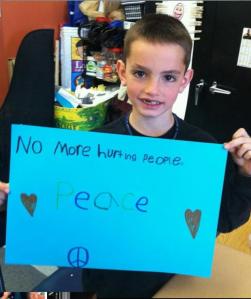 Good Morning!
We certainly have created a lot of ways to destroy each other haven’t we? We also seem to breed a lot of individuals that are capable of doing great harm without reservation. This week has brought the carnage once again into our back yard. It is important to remember that we have brought and are bringing worse carnage and that we are not alone in our experience.
We have sophisticated drones that appear to take out as many innocents as they do bad guys. Just yesterday in Baghdad, a suicide bomber killed 26 in a crowded cafe. Less than a month ago, 2 blasts occurred in a busy shopping district of Hyderabad, India. These twin blasts killed 14 people and injured 119. Seventeen were injured today in Bangalore in a car bomb blast. Neither India or Boston are war zones. Baghdad was not a war zone until we invaded it. We left it to whatever it is today.
Then, there is the daily amount of gun violence in the country. Let me return to Boston for this perspective.
Boston Police Commissioner Edward F. Davis said today that he hopes to cut gun crimes in half this summer during Boston’s most violent months: July and August, when the city typically sees between 37 and 48 shootings each month.
The department’s ranks were boosted as 28 members of the force were promoted and one new officer was named during a ceremony this morning.
Davis said those promotions represent the department’s efforts to fill vacancies in preparation for the summertime.
“We’re going to have a full court press on those months this year,” said Davis. “We’re gonna do a lot of preventive work leading up to those months. There’s gonna be a significant amount of attention paid to the impact players in the city. We want them to put their weapons down.”
Nationally, we experience 88 gun deaths a day. There have been about 3,524 gun deaths in this country since the Sandy Hook Slaughter. As you carefully read that sign made by the youngest victim of the Boston Bombs above, consider this:
… a child in the U.S is about 13 times more likely to be a victim of a firearm-related homicide than children in most other industrialized nations.
Firearms were the third leading cause of injury-related deaths nationwide in 2010, following poisoning and motor vehicle accidents, according to the Centers for Disease Control and Prevention.
For the sake of comparison, in 2010 there were more than twice as many firearms deaths in the U.S. than terrorism-related deaths worldwide.
Then consider how completely ignorant most people are of our violent legacies to other countries. Think of mass murderers of the 20th century, and then read this.
Mr. Kissinger’s most significant historical act was executing Richard Nixon’s orders to conduct the most massive bombing campaign, largely of civilian targets, in world history. He dropped 3.7 million tons of bombs** between January 1969 and January 1973 – nearly twice the two million dropped on all of Europe and the Pacific in World War II. He secretly and illegally devastated villages throughout areas of Cambodia inhabited by a U.S. Embassy-estimated two million people; quadrupled the bombing of Laos and laid waste to the 700-year old civilization on the Plain of Jars; and struck civilian targets throughout North Vietnam – Haiphong harbor, dikes, cities, Bach Mai Hospital – which even Lyndon Johnson had avoided. His aerial slaughter helped kill, wound or make homeless an officially-estimated six million human beings**, mostly civilians who posed no threat whatsoever to U.S. national security and had committed no offense against it.
Sen. Lindsey Graham (R-S.C.), a staunch supporter of the U.S. drone wars, Wednesday become the first government official to put a number on the estimated drone strike death toll.
“We’ve killed 4,700,” Graham said during a speech at a South Carolina rotary club, reported on by the local Easley Patch and flagged by Al Jazeera.
“This is the first time a US official has put a total number on it,” said Micah Zenko, a fellow at the Council on Foreign Relations told Al Jazeera, but Graham’s office stated that the senator was only repeating “the figure that has been publicly reported and disseminated on cable news.” Graham’s figure aligns with estimates from groups included the U.K.-based Bureau of Investigative Journalism (BIJ), which has calculate that between 3,072 and 4,756 people have been killed by U.S. drones in Pakistan, Yemen and Somalia.
Graham’s figure did not distinguish between “combatant” and “civilian” casualties — a distinction which has, in the War on Terror, prompted debate. But the senator did reportedly say, “Sometimes you hit innocent people, and I hate that, but we’re at war, and we’ve taken out some very senior members of al-Qaida.”
I’d like to know why some acts of violence attract so much attention and outrage? Tons of folks have been out in their virtual scooby vans warping into the witch hunt version of Encyclopedia Brown trying to finger the ‘dark skinned’ individuals that could’ve set the bombs on the Boston Marathon route. Have any of these idiots ever looked at the gun death rate in their own town or state? Have they ever concerned the morality of bombing wedding celebrations? Are they still taking Henry Kissinger or Donald Rumsfeld seriously? Have they possibly cracked a paper to find out exactly how many bombings happen on this planet and how many of them we commit? For that matter, why aren’t they looking for guys that look like Timothy McVeigh or Eric Rudolph? Ever been to London and tried to find a trash can?
In London, public trash cans are hard to come by, as they’re an easy receptacle for bombs. Which makes it hard to throw things away properly! Now, the city is going to bring trash cans back, but they’re going to be big, hulking masses, totally bomb-proof and equipped with LCD screens to tell you the days news as you throw away your coffee cup.
Traveling to Europe–especially London–in the 1970s and 1980s included an introduction to basic instructions on what to do if a bomb went off and what to do to avoid being in an area that was likely subject to bombing. There are still Basque separatists bombing Spain. We’re coming up on the anniversary of Bloody Sunday. I was in Europe a lot in 1972 and it was like the year of the bomb over there. But, again, there was Kissinger too. It was the year I learned not to look or sound overly American.
Hundreds of thousands of innocent human beings in Laos, Cambodia and Vietnam were forced to live in holes and caves, like animals. Many tens of thousands were burned alive by the bombs, slowly dying in agony. Others were buried alive, as they gradually suffocated to death when a 500 pound bomb exploded nearby. Most were victims of antipersonnel bombs designed primarily to maim not kill, many of the survivors carrying the metal, jagged or plastic pellets in their bodies for the rest of their lives.
Then, riddle me this. What is the difference between setting bombs on the street filled with crowds, or a bomb in a cafe, or a drone that hits a wedding or having one Texas “Job Creator” callously killing an entire city and a lot of its inhabitants because he just doesn’t want to be bothered with work place safety regulations or say, proper placement of a dangerous plant to start out with? I mean what exactly do you call a guy that runs a business that blows up an entire town and kills–at this point in time–35 people including 10 first responders? (That’s a link to CNN and USA Today so consider it with care.)
It really bothers me that we–as a nation–appear to have selective attention on what kind of violence gets our shock and attention and what kinds of violence we choose to ignore every day, every year, or in the case of the atrocities of Kissinger, every decade or four. We have had some horrific carnage recently. We’ve had children slaughtered in their classroom. We’ve had folks standing on the street celebrating a holiday ending up in hospital with wounds severe enough to warrant the kinds of amputees soldiers need in Afghanistan. This is horrific, but it does not operate in a vacuum or a world where we have done no wrong or where these kinds of events are rare.

Child victim in Gaza
So, call me Debbie Downer and tell me to get my unpatriotic ass out of the country or call me insensitive. I want to see a consistent and strong level of outrage, shock, and trauma displayed for all innocent victims of unspeakable violence. The hometowns of all of these victims should be our hometowns.

Child victim in Syria
Here is a great question from a great writer, Juan Cole. Can the Boston Bombings increase our Sympathy for Iraq and Syria, for all such Victims?
The idea of three dead, several more critically wounded, and over a 100 injured, merely for running in a marathon (often running for charities or victims of other tragedies) is terrible to contemplate. Our hearts are broken for the victims and their family and friends, for the runners who will not run again.
There is negative energy implicit in such a violent event, and there is potential positive energy to be had from the way that we respond to it. To fight our contemporary pathologies, the tragedy has to be turned to empathy and universal compassion rather than to anger and racial profiling. Whatever sick mind dreamed up this act did not manifest the essence of any large group of people. Terrorists and supremacists represent only themselves, and always harm their own ethnic or religious group along with everyone else.
The negative energies were palpable. Fox News contributor Erik Rush tweeted, “Everybody do the National Security Ankle Grab! Let’s bring more Saudis in without screening them! C’mon!” When asked if he was already scapegoating Muslims, he replied, ““Yes, they’re evil. Let’s kill them all.” Challenged on that, he replied, “Sarcasm, idiot!” What would happen, I wonder, if someone sarcastically asked on Twitter why, whenever there is a bombing in the US, one of the suspects everyone has to consider is white people? I did, mischievously and with Mr. Rush in mind, and was told repeatedly that it wasn’t right to tar all members of a group with the brush of a few. They were so unselfconscious that they didn’t seem to realize that this was what was being done to Muslims!
Indeed, sympathy for Boston’s victims has come from around the world from places like Iraq that we’ve plastered with bombs not that long ago. Condemnation for this act came from elected officials in Egypt from the Muslim Brotherhood which has been absolutely slathered with the mark of satan by the likes of our elected officials like whacko Michelle Bachmann. This part of Cole’s essay really got to me and I was already teary eyed hearing about Jane and Martin Richard from their school’s headmaster on Last Word.
Some Syrians and Iraqis pointed out that many more people died from bombings and other violence in their countries on Monday than did Americans, and that they felt slighted because the major news networks in the West (which are actually global media) more or less ignored their carnage but gave wall to wall coverage of Boston.
Aljazeera English reported on the Iraq bombings, which killed some 46 in several cities, and were likely intended to disrupt next week’s provincial election.
Over the weekend, Syrian regime fighter jets bombed Syrian cities, killing two dozen people, including non-combatants:
What happened in Boston is undeniably important and newsworthy. But so is what happened in Iraq and Syria. It is not the American people’s fault that they have a capitalist news model, where news is often carried on television to sell advertising. The corporations have decided that for the most part, Iraq and Syria aren’t what will attract Nielsen viewers and therefore advertising dollars. Given the global dominance by US news corporations, this decision has an impact on coverage in much of the world.
Here is a video by the United Nations High Commission on Refugees (UNHCR) on the dilemma of the over one million displaced Syrians, half of them children:
So I’d like to turn the complaint on its head. Having experienced the shock and grief of the Boston bombings, cannot we in the US empathize more with Iraqi victims and Syrian victims? Compassion for all is the only way to turn such tragedies toward positive energy.
Perhaps some Americans, in this moment of distress, will be willing to be also distressed over the dreadful conditions in which Syrian refugees are living, and will be willing to go to the aid of Oxfam’s Syria appeal. Some of those Syrians living in refugee camps in Jordan, Lebanon and Turkey were also hit by shrapnel or lost limbs. Perhaps some of us will donate to them in the name of our own Boston Marathon victims of senseless violence.
Terrorism has no nation or religion. But likewise its victims are human beings, precious human beings, who must be the objects of compassion for us all.
It is absolutely true that the shortcomings of our press this week were on parade this week. They basically spent hour-after-hour in what seemed like a glorified witch hunt. But there is a bigger injustice and short coming. Other people around the world–suffering and dying–deserve to have their stories told also. Every innocent victim of violence deserves justice and recognition. This is true of those 88 who die every day in this country from guns. It is true of all those killed by state violence be it ours or Bashar al-Assad or the crazy jerks that set of bombs on streets all over the world or fire military style weapons in our schools and movie theaters. All of this should cause the press to do its job and it should cause our hearts to grieve equally. Why obsess minute by minute on one act when there is a world full of them to choose from? Why not give all of the victims of violence their due?
So, what is on your reading and blogging list today?
Friday Reads
Posted: March 8, 2013 Filed under: morning reads | Tags: Christine Legarde, Forest Whitaker, gun laws, gun violence, international women's day, John Yoo, Racism, Richard Engle, Syria, targeted drone killing, unemployed law grads 28 Comments
Good Morning!
Many of you might be stuck in your homes today with all that weather so here are some things to keep you busy. First, Richard Engle’s Diary of his kidnapping in Syria has been published in Vanity Fair.
A group of about 15 armed men were fanning out around us. Three or four of them stood in the middle of the road blocking our vehicles. The others went for the doors. They wore black jackets, black boots, and black ski masks. They were professionals and used hand signals to communicate. A balled fist meant stop. A pointed finger meant advance. Each man carried an AK-47. Several of the gunmen began hitting the windows of our car and minivan with the stocks of their weapons. When they got the doors open, they leveled their guns at our chests.
Time was slowing down as if I’d been hit in the head. Time was slowing down as if I were drowning.
This can’t be happening. I know what this is. This can’t be happening. These are the shabiha. They’re fucking kidnapping us.
“Get out!” a gunman was yelling as he dragged Aziz from the car.
Then I saw the container truck. It wasn’t far away, parked off the road and hidden among olive trees. The metal doors at its rear stood open, flanked by gunmen.
That’s where they are going to put us. That’s here for us. We’re going into that truck.
I got out of the car. Two of the gunmen were already marching Aziz to the truck. He had his hands up, his shoulders back, his head tilted forward to protect against blows from behind.
Maybe I should run. Maybe I should run right now. But the road is flat and open. The only cover is by the trees near the truck. Maybe I should run. But where?
I saw John standing by the minivan. Gunmen were taking Ian toward the truck. It was his turn. Like me, John hadn’t been touched yet.
Maybe they’ve forgotten us? Maybe they don’t want us?
Our eyes made contact. John shrugged and opened his hands in disbelief. Time was going very slowly now, but my mind was racing like a panicked heart in a body that can’t move.
“Get going!” a gunman yelled at me in Arabic, pointing his weapon at my chest.
I looked at him blankly, pretending not to understand. Foreigners who speak Arabic in the Middle East are often assumed to be working for the C.I.A. or Israel’s intelligence agency, the Mossad. The gunman took me by the finger, holding on to it by the very tip. I could have pulled it away with the smallest tug.
But then what? Then go where?
John was the next to join us in the back of the truck. He walked slowly, as if being escorted to a waiting limo. John is a New Yorker and was dressed entirely in black. He has long white hair and a devilish smile, and his nickname is the Silver Fox. He and I had been in a lot of rough places—Libya, Iraq, Gaza. John, Ghazi, and Aziz were among my closest friends in the world.
At least I’ll die with my friends.
This will let you know how tough it is out here: “To Place Graduates, Law Schools Are Opening Firms”.
The plan is one of a dozen efforts across the country to address two acute — and seemingly contradictory — problems: heavily indebted law graduates with no clients and a vast number of Americans unable to afford a lawyer.
This paradox, fed by the growth of Internet-based legal research and services, is at the heart of a crisis looming over the legal profession after decades of relentless growth and accumulated wealth. It is evident in the sharp drop in law school applications and the increasing numbers of Americans showing up in court without a lawyer.
“It’s a perfect storm,” said Stacy Caplow, a professor at Brooklyn Law School who focuses on clinical education. “The longstanding concerns over access to justice for most Americans and a lack of skills among law graduates are now combined with the problems faced by all law schools. It’s creating conditions for change.”
Remember John Yoo. He was the lawyer/author of those Bush legal memos justifying torture. He thinks that Obama is “getting too much grief over targeted killing”.
And he wants Sen. Rand Paul (R-Ky.)—who filibustered Obama’s nominee to head the CIA for 13 hours on Wednesday—to lay off.
“I admire libertarians but I think Rand Paul’s filibuster in many ways is very much what libertarians do, they make these very symbolic gestures, standing for some extreme position,” said Yoo, now a UC Berkeley law professor, who once suggested it was okay for the president to order a child’s testicles be crushed. Referring to Paul’s marathon filibuster, an attempt to force the Obama administration to clarify its views on the use of military force against terror suspects in the United States, Yoo said “It sort of reminds me of young kids when they first read The Fountainhead or Atlas Shrugged and they suddenly think that federal taxation equals slavery and they’re not going to pay any federal taxes anymore.” Yoo’s statements were made on a conference call Thursday held by the Federalist Society, an influential conservative legal organization.
Paul’s conservative colleagues also pushed back on him on Thursday: On the Senate floor, John McCain (R-Ariz.) and Lindsey Graham (R-S.C.) mocked Paul’s objections as “ridiculous.”
Yoo said that he thought the administration’s problems stemmed from its belief that it needed to provide “due process” to terror suspects abroad—or even in the United States, referring to a recently leaked white paper outlining the Obama administration’s legal views on targeted killings of US citizen terror suspects.
So, here’s an interesting study. It seems that the “States With Most Gun Laws Have Fewest Gun Deaths”.
“It seems pretty clear: If you want to know which of the states have the lowest gun-mortality rates just look for those with the greatest number of gun laws,” said Dr. Eric W. Fleegler of Boston Children’s Hospital who, with colleagues, analyzed firearm-related deaths reported to the Centers for Disease Control and Prevention from 2007 through 2010.
By scoring individual states simply by the sheer volume of gun laws they have on the books, the researchers noted that in states with the highest number of firearms measures, their rate of gun deaths is collectively 42 percent lower when compared to states that have passed the fewest number of gun rules. The study was published online in the journal JAMA Internal Medicine.
As proof, Fleegler pointed to the firearm-fatality rates in law-laden states such as Massachusetts (where there were 3.4 gun deaths per 100,000 individuals), New Jersey (4.9 per 100,000) and Connecticut (5.1 per 100,000). In states with sparser firearms laws, researchers reported that gun-mortality rates were higher: Louisiana (18.0 per 100,000), Alaska (17.5 per 100,000) and Arizona (13.6 per 100,000).
Speaking of working to end violence, today is Intentional Women’s Day. This year’s theme is “A promise is a promise: Time for action to end violence against women” Here’s some headlines for that celebration. First off, here’s French economist and head of the IMF Christine  Leguarde. You can watch her speak at this IMF Link.
Here’s some suggested readings for you.
From the UK Guardian: “International Women’s Day: school is ‘the new front line of feminism’”
Surveys and anecdotal evidence may suggest that few young women identify with the word feminism, fearing it sits at odds with a desire to wear makeup or heels. Yet there are increasing signs of an interest in gender equality issues among these same young women, who are now turning to social media such as blogs, Twitter and Facebook to reach out to fellow activists or just to share experiences and seek advice about what can be done.
Laura Bates, the founder of the #everydaysexism campaign, says that 10% of its more than 20,000 entries detailing harassment come from under-16s, with many more from colleges.
Campaign group UK Feminista has been so inundated with requests to speak to schools around the country that it has now launched a two-year programme of workshops and campaigns aimed at secondary pupils. Called Generation F: Young Feminists in Action, it comes as the government considers a cross-party bid to make sex and relationship education compulsory in schools.
Australian women make up just over half of the total Australian population.
In some areas, equality has been achieved, but in others there is clearly a long way to go.
The boards of both private and public organisations are still dominated by men.
For instance, only about 10 per cent of the executives of companies listed in the Australian Stock Exchange Market are female.
And according to federal government figures, average weekly earnings for women are $250 less than men.
United Nations Women director for Australia, Julie McKay, thinks a combination of socio-economic factors contribute to this situation.
“I think there’s a huge issue about unconscious bias, that we sometimes don’t even realise that we have, about the roles that women should play and the sort of characteristics that make different people leaders. But I think we also got other issues around accessibility and affordability of child care, which prevent many women being able to access work and particularly full time work.”
Many migrant and refugee women in Australia can be prevented from working in the field in which they’re experienced, due to lack of English skills or problems with qualification recognition.
But Chin Wong, from the Australian Migrant and Refugee Women’s Alliance, says that doesn’t mean they don’t get into the workforce.
She argues that female newcomers can be preferred by employers because they are more likely to ignore their rights, and tend to argue less than men about working conditions.
“Sometimes the women can find jobs easier than men and therefore a lot of times the man become the homemaker, and the woman has to go to work. But that doesn’t mean that when they come home they don’t still have to make sure that the houses are maintained, because that’s culture. Some of the cultures mean that the women have to do most of the work.”
Here’s two suggested reads on racism in America by Ed Kilgore with a link to Ta-Nehisi’s Coates’ guest column in the New York Time.
If you are a white person who has on occasion felt aggrieved at the persistence of allegations of white racism in America, do yourself and your conscience a favor and read Ta-Nehisi’s Coates’ guest column today in the New York Times.
His point of departure is the humiliating frisking of the very famous and distinguished actor Forest Whitaker by an employee of a deli in Coates’ own Manhattan neighborhood. But he uses this incident to make the very important point that if we disclaim the possibility of racist behavior on the part of “good” or “moral” people, we may well wind up excusing racism almost altogether.
The idea that racism lives in the heart of particularly evil individuals, as opposed to the heart of a democratic society, is reinforcing to anyone who might, from time to time, find their tongue sprinting ahead of their discretion. We can forgive Whitaker’s assailant. Much harder to forgive is all that makes Whitaker stand out in the first place. New York is a city, like most in America, that bears the scars of redlining, blockbusting and urban renewal. The ghost of those policies haunts us in a wealth gap between blacks and whites that has actually gotten worse over the past 20 years.
But much worse, it haunts black people with a kind of invisible violence that is given tell only when the victim happens to be an Oscar winner. The promise of America is that those who play by the rules, who observe the norms of the “middle class,” will be treated as such. But this injunction is only half-enforced when it comes to black people, in large part because we were never meant to be part of the American story. Forest Whitaker fits that bill, and he was addressed as such.
I am trying to imagine a white president forced to show his papers at a national news conference, and coming up blank. I am trying to a imagine a prominent white Harvard professor arrested for breaking into his own home, and coming up with nothing. I am trying to see Sean Penn or Nicolas Cage being frisked at an upscale deli, and I find myself laughing in the dark. It is worth considering the messaging here. It says to black kids: “Don’t leave home. They don’t want you around.” It is messaging propagated by moral people.
The thing is, this has always been more or less true. My extended family (thought not, mercifully, my nuclear family) when I was growing up in the Jim Crow South was loaded with racists. None of them were members of the Ku Klux Klan, perpetrators of violence, or “bad people” by any general measure. Most of them were very regular church-goers. One of the sweetest people I ever knew was a great aunt who after MLK’s assassination allowed as how she wished she could take in the assassin and feed him and protect him for his great act in defending Christian civilization. That wouldn’t have been surprising to Dr. King himself, whose classic Letter From a Birmingham Jail was addressed to the good Christian clergy of that city who by their silence and calls for an unjust “peace” were defending segregation more effectively than the hooded riffraff of the Klan.
So, there are my suggestions today. Please be careful if the weather around you is “lionly”. What’s on your reading and blogging list?

 peej
peej Carissa
 bostonboomer
 dakinikat
 ecocatwoman
 mablue2
 Mama Lopez
 peggysue22
 quixote
 skydancingguestblogger
 Mona (aka Wonk the Vote)



 Sky Dancing

Recent Comments