This morning I woke up and turned on the TV to see our “president,” easily the stupidest president in American history, walking hunched over and tired in Davos to give another long, rambling, nonsensical, insulting “speech” to the assembled political and business leaders. He spoke for 70 minutes and it seemed much longer.
I watched the speech for awhile, but it was the same old garbage he talks about off the cuff to the assembled press in the oval office. He went on and on in his old man voice, attacking allies, demanding that Greenland be handed over to him, ranting about windmills–all to complete silence from the audience. How could they sit there and watch this embarrassing display of abject stupidity?
I don’t expect this post to make much sense, because I’m just soooo angry!
The big headline, according to the legacy media is that Trump announced he won’t “take Greenland by force.”
President Donald Trump ruled out military force to acquire Greenland in his remarks Wednesday to the World Economic Forum in Davos, Switzerland, providing a momentary sense of relief to Europe after weeks of worry that the U.S. would enter a confrontation with NATO.
“We probably won’t get anything unless I decide to use excessive strength and force, where we would be, frankly, unstoppable, but I won’t do that,” Trump said. “That’s probably the biggest statement I made, because people thought I would use force, but I don’t have to use force. I don’t want to use force.”
Trump said Wednesday that he wants to see negotiation to acquire what he called “a piece of ice.”
The president, though, warned Denmark that if it doesn’t give up Greenland to the U.S., “we will remember.”
He argued in his remarks that the U.S. can protect “this giant mass of land” better than Europe can, insisting that taking over Greenland wouldn’t be a threat to NATO but would instead enhance security for the alliance. While the president’s obsession with Greenland has accelerated in recent weeks, his pledge to not use force to acquire the island marks a shift in his rhetoric.
“I don’t want to use force,” he added. “All the United States is asking for is a place called Greenland, where we already had it as a trustee but respectively returned it back to Denmark not long ago after we defeated the Germans, the Japanese, Italians and others in World War II. We gave it back to them.”
He added that it was “stupid” for the U.S. to not keep the island after the war. Still, Trump downplayed the significance of his threats against Greenland, arguing it’s a trade-off for the years of support the U.S. has given to NATO allies.
“What I’m asking for is a piece of ice, cold and poorly located,” he said. It’s a very small ask, compared to what we have given them for many, many decades.”
What does that mess of words really mean? Nothing. Trump is the world’s worst liar and he’s insane. Not to mention stupid. Nothing he says can be believed.
The choice is impeachment and removal or calamity for the United States. I don't see how anybody watching Trump's speech in Davos can draw any other conclusion. He's a senile madman.
“Denmark’s investment in U.S. Treasury bonds, like Denmark itself, is irrelevant,” U.S. Treasury Secretary Scott Bessent told reporters Wednesday at the World Economic Forum in Davos, Switzerland.
It comes as Trump’s threats to impose 10% tariffs on eight European countries as part of his push to take over Greenland spooked markets. The levies would come into force on Feb. 1, Trump said, and later rise to 25%.
Danish pension operator AkademikerPensionsaid Tuesday it was selling $100 million in U.S. Treasurys. The decision was driven by “poor [U.S.] government finances,” said Anders Schelde, AkademikerPension’s investing chief.
When Bessent was asked how concerned he is about European investors pulling out of Treasurys, Bessent said at a news conference at the World Economic Forum: “Denmark’s investment in U.S. Treasury bonds, like Denmark itself, is irrelevant.”
“That is less than $100 million. They’ve been selling Treasurys for years, I’m not concerned at all.”
Really? I’d like to hear what Daknikat has to say about this.
No one can be watching this Davos speech and reach any conclusion but that the President of the United States is mentally disturbed and that something is deeply wrong with him. This is both embarrassing and extremely dangerous.
Prime Minister Mark Carney of Canada delivered a stark speech in Davos, Switzerland, on Tuesday, prompting global political and corporate leaders in the audience to rise from their seats for a rare standing ovation.
He described the end of the era underpinned by United States hegemony, calling the current phase “a rupture.” He never mentioned President Trump by name, but his reference was clear.
The speech came as President Trump doubled down on his threats to take Greenland away from Denmark, saying he would slap fresh tariffs on European powers as punishment for their support of Greenland’s sovereignty.
Global leaders have been scrambling to find a unified response.
“Every day we’re reminded that we live in an era of great-power rivalry,” Mr. Carney said. “That the rules-based order is fading. That the strong can do what they can, and the weak must suffer what they must.”
And he warned, “The middle powers must act together because if we’re not at the table, we’re on the menu.”
He would know.
Mr. Trump started his second presidential term making claims on Canada as the 51st state and threatening Canada’s previous leader, Justin Trudeau, whom Mr. Trump publicly derided, with unilaterally scrapping agreements that have governed the relationship between the neighboring countries for over a century….
Mr. Carney chastised other leaders too, many of whom would have been following his speech in Davos, for not standing up for their interests.
“There is a strong tendency for countries to go along to get along,” he said. “To accommodate. To avoid trouble. To hope that compliance will buy safety. It won’t.”
Mr. Carney made clear he is choosing a different path.
He wrote his own speech, according to a government official, who spoke on condition of anonymity to discuss the inner workings of his team, which is a departure since speeches of this magnitude are usually prepared by high-level staffers with the leader’s input.
Mr. Carney, a former investment executive who has served as the governor of Canada and England’s central banks, has attended the global gathering about 30 times, according to his office….
Mr. Carney spoke not long after Mr. Trump had posted an altered image on social media that featured a map of American flags superimposed over both Canada and the United States, as well as Greenland.
Well worth a listen from Canadian PM Mark Carney at Davos summit.
President Trump said in Davos on Wednesday that Canada should be “grateful” to the U.S. for the “freebies” it receives because of the two nations’ relationship.
Why it matters: Trump’s dig at Canada came a day after Prime Minister Mark Carney delivered his own warning at the World Economic Forum over the “rupture” of the world order.
Driving the news: “Canada lives because of the United States,” Trump said Wednesday before taking a direct jab at Carney. “Remember that, Mark, the next time you make your statements.”
Trump said Carney “wasn’t so grateful” in his address.
Carney avoided naming Trump in his speech — a strategy a Canadian official previously told Axios was deliberate. However, the official indicated that Carney’s remarks were aimed squarely at the president’s recent actions.
Zoom out: As Trump pushes a vision of hemispheric dominance — coupled with threats of the U.S. making its northern neighbor the “51st state” — Ottawa has reportedly started preparing for how to repel a U.S. invasion.
Growing up, I never really understood Aesop’s fable about the goose that laid the golden egg. It’s a cautionary tale about greed and hubris: A farmer with a miraculous goose that lays a solid-gold egg every morning gets fed up with passive wealth generation and figures killing the bird will speed things along. But alas: He finds no store of eggs within and realizes he butchered his meal ticket for nothing. The moral’s straightforward, but it never really worked for me as a story. Like, come on: Nobody’s that stupid.
Well, almost nobody, I guess.
As long as I live, I don’t think I’ll get over this pure, dumb fact: Trump told his fans he had to blow up the liberal order because it was the only way to secure the very benefits the liberal order was already bringing us.
Trump insists America needs Greenland as a strategic positioning ground from which to restrain Russia and China in the Arctic. But thanks to the liberal order, this was something we already enjoyed. Through the magic of multilateral cooperation, we were able to treat someone else’s territory as though it were our own for the purposes of military positioning—not by bribing or intimidating them, but because they agreed their interests and our interests aligned.
Trump insists America needs to blow up America’s preexisting economic relationships to ensure America gets an advantageous position in international trade. But America already had such an advantageous position: an orderly world economic system that had lavished previously unimaginable prosperity on America and to the entire globe, with us at the proverbial (and very profitable) head of the table.
It’s not just that Trump had the hubris to think he could hero-ball the country to a better deal by canceling a century of history and starting over. It’s that his own broken personality—his miserable meanness, his dispositional inability to cooperate with and trust others—has always prevented him from understanding what was good about the deal we had to begin with. The idea that multipolar agreements could be better for America, in some cases, than outright ownership—that, say, we already have everything we need from Greenland—he rejects as ridiculous. Ownership, he told the New York Times, is “what I feel is psychologically needed for success. . . . I think that ownership gives you a thing that you can’t do, whether you’re talking about a lease or a treaty.”
He really is determined to burn everything down if he can’t get his own way on everything.
1/ Jonathan Lemire writes, "Trump's lust for Greenland is about increasing American dominance in the Western Hemisphere 7 redrawing the maps of the world. The island is roughly 836K square miles, which would make it the largest territorial addition in US history." Gift link.
Franklin D. Roosevelt famously illustrated with a simple metaphor the need for a healthy transatlantic alliance. Justifying his decision to lend Great Britain warships and other military supplies in the early days of World War II, Roosevelt likened it to loaning a neighbor a garden hose to put out the fire consuming his house. Sure, Roosevelt charitably wanted to help a neighbor in need. But it was self-interested too; if the neighbor could extinguish the blaze, it wouldn’t spread to FDR’s home. The United States benefited from the friendship—and the buffer—that allies could provide.
Today, Donald Trump will fly to Europe. Ukraine is already ablaze. And now the president is ready to set a bunch of new houses on fire.
The president will speak at the World Economic Forum in Davos, Switzerland, tomorrow, and he appears prepared to shatter the nearly 80-year-old NATO alliance in order to seize Greenland. In his quest to claim a strategically located island of ice and rock, Trump has turned against his nation’s most stalwart friends. He has antagonized and mocked panicked European leaders, threatened punishing tariffs on countries that object to his plans, and pointedly not ruled out using military force. Trump’s thirst for Greenland—even if he stops short of ordering an armed invasion—threatens to unravel the partnership born from the ashes of World War II that has, in the decades since, ensured the spread of peace, prosperity, and democracy on both sides of the Atlantic.
Today marks one year since Trump’s return to office, and in that time, he has fundamentally reshaped the United States’ relationship with the rest of the world. But nothing has upended the global order more than what would happen if he follows through on his threats toward Greenland. The island, of course, belongs to Denmark, which says that it is not available for the taking. Troops from Europe have been dispatched to the territory, and Greenland’s prime minister warned his populace to prepare for an invasion. If Trump were to persist, Denmark could trigger NATO’s Article 5 mutual-defense pact, and then the unthinkable could occur: American soldiers firing on Europeans while Russian President Vladimir Putin’s dream of NATO’s self-immolation is thoroughly realized.
The annual meetings in Davos, normally a clubby gathering of business titans and political leaders, have been consumed by talk of what Trump may or may not do. European leaders have found themselves scrambling on strategy—appeasement? Defiance? Compromise? Early this morning, Trump posted screenshots of text messages that revealed the dilemma facing those leaders. (Lesson to everyone: Be careful what you text the guy unless you want the world to see.)
In one message, Mark Rutte—the secretary general of NATO, who has prized warm relations with Trump—praised the president’s foreign policies, then vowed that he is “committed to finding a way forward on Greenland.” But in another, French President Emmanuel Macron, whose relationship with Trump has been turbulent, admitted: “I do not understand what you are doing on Greenland.” In fact, Trump couldn’t be more clear, as he demonstrated once again by circulating a pair of presumably AI-generated images on social media. In one, he’s planting an American flag in Greenland. In the other, he’s lecturing European leaders in the Oval Office with a map behind him that depicts Greenland as part of the United States. (Canada and Venezuela too.)
Trolling close U.S. allies has seemingly been an unofficial policy of Trump’s second administration since its first days, beginning with Vice President Vance lecturing Europe in Munich on the virtues of free speech. But this time feels different for those nervously waiting in snowy Switzerland. The president’s address to the forum tomorrow is poised to be a defining moment, and Trump plans to make the unequivocal case that the United States should have Greenland, a senior White House official told me.
Pretty good predictions, except for Trump’s claim he won’t use force.
A few non-Davos stories:
Did you watch Lawrence O’Donnell last night? He still insists that Trump’s Greenland obsession is really a way to distract the press from the Epstein files. I think he could be right. If you didn’t see it, I recommend watching it now.
Three hundred and sixty-five days after Donald Trump swore his oath of office and completed an extraordinary return to power, many historians, scholars and experts say his presidency has pushed American democracy to the brink – or beyond it.
The scale and velocity of what he has been able to accomplish in just a year have stunned even longtime observers of authoritarian regimes, pushing the debate among academics and Americans from whether the world’s oldest continuous democracy is backsliding to whether it can still faithfully claim that distinction.
“In 2025, the United States ceased to be a full democracy in the way that Canada, Germany or even Argentina are democracies,” Steven Levitsky and Daniel Ziblatt, the prominent Harvard political scientists and authors of How Democracies Die, and the University of Toronto professor Lucan Way, wrote in Foreign Affairs last month. They argued that the US under Trump had “descended into competitive authoritarianism”, a system in which elections are held but the ruling party abuses power to stifle dissent and tilt the playing field in its favor.
There is no universally accepted definition of democracy. Some argue the US is a “flawed” or “illiberal” democracy, or a democracy facing substantial “autocratization” – a process that began long before Trump came to power a decade ago but which his presidency has rapidly accelerated. Still, others believe the concerns are overblown, or reflect an intense partisan dislike of the current president.
Since Trump’s first term, scholars have warned that it can happen here. But many now say this moment is different – not only because Trump’s approach is more methodical and his desire for vengeance more pronounced, but because he now faces far fewer internal constraints.
Read more at the link.
Hunter Walker at Talking Points Memo: Trump Marks First Year In Office With Unhinged Racist Rant Targeting ‘Very Low IQ’ Somalis.
President Donald Trump spent the first anniversary of his second term on Tuesday pitching himself to the American people from behind the White House briefing room podium. In nearly two hours of remarks, Trump seemingly sought to address his cratering approval by running through a list of his supposed accomplishments. His remarks also included a series of vicious, racist remarks about Somali people and other immigrants.
I think Trump likes this photo.
“They all ought to get the hell out of here, they’re bad for our country,” Trump said of the Somali population at one point during the extraordinary rant.
At multiple points during his remarks, Trump indicated he felt the need to make his case directly because his team was not up to the task. A slew of anniversarypolls show the president’s numbers are currently underwater with notably steep declines in voter approval of the president’s handling of his signature issues: immigration and the economy. Those figures have come amid slow job growth and violent raids staged by Trump’s Immigration and Customs Enforcement agency.
“Maybe I have bad public relations people, but we’re not getting it across,” Trump said as he argued the economy is particularly strong since he returned to office.
Trump came equipped with a couple of binders including one labeled “ACCOMPLISHMENTS.” Yet as he read through the provided list, Trump repeatedly raged against the Somali population, including suggesting that they are of inferior intelligence. Trump first turned to the topic as he alluded to the ongoing ICE raids in Minnesota, which have been met with massive protests. The state is home to the country’s largest Somali population and the federal crackdown has come amid a wave of right-wing influencers making exaggerated claims about alleged daycare fraud in the community.
“Nineteen billion dollars at a minimum is missing in Minnesota, given to a large degree by Somalians. They’ve taken it,” Trump said. ”Somalians, can you imagine? And they don’t do it — a lot of very low IQ people. They don’t do it. Other people work it out and they get them money and they go out and buy Mercedes Benzes.”
The Supreme Court will consider Wednesday whether President Trump can fire Lisa Cook from the Federal Reserve board, in a case that tests the longstanding independence of the central bank, with potentially major consequences for the economy.
The court’s conservative majority has repeatedly allowed Mr. Trump to oust leaders of other independent agencies as he moves to expand presidential power and seize control of the federal bureaucracy. But the justices have signaled that the Fed may be different and uniquely insulated from executive influence because of its structure and history.
Lisa Cook
The case lands as the administration has dramatically escalated its attacks on the Fed, apparently aimed at remaking its board and lowering interest rates. The Justice Department this month opened a criminal investigation into whether Jerome H. Powell, the Fed chair, lied to Congress about cost overruns related to the Fed’s renovation of its headquarters.
Mr. Powell, whose term as chair ends in May, forcefully pushed back on the threat of criminal charges, saying it was a result of the Fed setting borrowing costs “based on our best assessment of what will serve the public, rather than following the preferences of the president.”
The investigation prompted a backlash from Republicans, international policymakers, Wall Street and some Trump allies, who warned that the central bank’s independence and credibility was at risk.
It also threatened to complicate Mr. Trump’s plans to name Mr. Powell’s replacement as chair — and, legal experts said, the Supreme Court case being heard on Wednesday.
The justices agreed to hear Ms. Cook’s case on an expedited basis, and are likely to rule quickly on her status as litigation continues in the lower courts. The outcome of the case could determine how much latitude Mr. Trump and future presidents have to influence the direction of the powerful central bank, which Congress intentionally tried to insulate from political pressures.
Police agencies in the United States kill more than 1,000 people each year. After many of those deaths, the agencies involved put out statements. Those statements often use what’s known as the exonerative voice to minimize officers’ involvement. The first statement from the Minneapolis Police Department after George Floyd’s death, for example, said that the officers at the scene “noted that he appeared to be suffering from medical distress.” Quite the understatement. These communications often cast events in a light most favorable to the officers involved, sometimes to the point of deception. Too often, they’ll try to smear the deceased by citing a criminal record or suggesting a drug addiction or gang affiliation.
Renee Good
I have been covering policing for more than 20 years and have read and parsed a lot of these statements. The Department of Homeland Security’s response after the Immigration and Customs Enforcement agent Jonathan Ross shot and killed Renee Good in Minneapolis this month is something else entirely.
For all their flaws, typical communications from police officials usually include a modicum of solemnity. There are assurances that there will be a fair and impartial investigation, even if those investigations too often turn out to be neither. There’s at least the acknowledgment that to take a human life is a profound and serious thing.
The Trump administration’s response to Ms. Good’s death made no such concessions. There were no promises of an impartial investigation. There was no regret or remorse. There was little empathy for her family — for her parents, her partner or the children she left behind. From the moment the world learned about her death, the administration pronounced the shooting not only justified but an act of heroism worthy of praise and celebration.
It isn’t just the lying; it’s that the lies are wildly exaggerated and easily refutable. All the evidence we’ve seen so far, including a meticulous Times forensic analysis of the available footage, makes clear that at worst, Ms. Good mildly obstructed immigration enforcement, disobeyed ambiguous orders or perhaps attempted to flee an arrest. None of those are capital crimes, nor do law enforcement officers get to dole out punishment in such cases. At one point, President Trump justified her shooting by claiming she’d been “very disrespectful” to immigration officers. That isn’t a crime at all.
The lies this administration is telling about Ms. Good aren’t those you deploy as part of a cover-up. They’re those you use when you want to show you can get away with anything. They’re a projection of power.
For the past decade or so, since the protests in Ferguson, Mo., America has engaged in a high-stakes dialogue about police abuse and accountability, the militarization of law enforcement and the push and pull between public safety and civil liberties. Those discussions, while occasionally heated, have been based on a shared understanding that the primary job of domestic law enforcement is to serve the public. What Mr. Trump is doing with federal immigration forces has rendered those debates obsolete.
Those are my recommended read for today. What do you think?
Did you like this post? Please share it with your friends:
“Wait until you see the Washington Monument makeover!” John Buss, @repeat1968
Good Day, Sky Dancers!
We’re a long way from the kinds of dreams we used to have as Americans. That seems particularly important as we celebrate the Birthday of civil rights hero Dr. Martin Luther King. I frequently wonder what he would be saying about the current DEI war led by one of the most racist presidents we’ve ever had. Here’s a quote from former President Obama about today’s holiday, posted on Instagram.
Dr. Martin Luther King, Jr. dedicated his life fighting for equity and justice. He taught us that even in the face of intimidation and discrimination, we must never stop working towards a better future – a lesson that feels especially relevant today.
Change has never been easy. It takes persistence and determination, and requires all of us to speak out and stand up for what we believe in. As we honor Dr. King today, let’s draw strength from his example, and do our part to build on his legacy.
Here are a few reads to think about today’s holiday. This one is from AXIOS. In Trump’s land of remaking that dream of the little Jim Crow over there on John’s Featured Cartoon today. “Trump’s DEI crackdown is changing MLK Day.” Jason Lalljee has this analysis.
Martin Luther King Jr. Day will look different in many parts of the country this year after a series of administration moves to limit observances — part of President Trump’s broader crackdown on diversity, equity and inclusion.
“Since the start of Trump’s second term, we have seen a coordinated effort to erase or rewrite parts of American history, especially Black history and the legacy of the Civil Rights Movement,” Martin Luther King III, son of the civil rights leader, told Axios.
Here’s what we know:
Across government Trump removed a bust of Martin Luther King Jr. from the Oval Office last summer. It had been there since 2009.
Following Trump’s signing of a sweeping executive order overhauling federal DEI programs last January, the Defense Intelligence Agency ordered a pause of all activities and events related to MLK Day.
The DIA also paused programming for Black History Month, Juneteenth, LGBTQ Pride Month, Holocaust Remembrance Day and other “special observances” to comply with Trump’s order, per NBC News.
The White House did not respond to request for comment.
National Parks
Free entry to national parks will now be granted on Trump’s birthday but no longer on MLK Day or Juneteenth, the White House announced last month.
Beyond its elimination of a “fee-free” MLK Day, the Trump administration is administering an extensive purge of exhibits across the nation’s parks that includes a substantial removal of materials related to MLK, said Kristen Brengel, Senior Vice President of Government Affairs at the National Parks Conservation Association.
The Department of the Interior last May required every park to conduct a review of “public monuments, memorials, statues, or similar properties” complying with a Trump executive order targeting “race-centered ideology” and “narratives that portray American and Western values as inherently harmful and oppressive.”
The DOI’s order said that it would flag items for removal that violated the executive order. The NPCA has a database of items flagged by the DOI based on reports from current National Parks Service employees, which Axios has viewed. Those items include exhibits, films, books, and youth-oriented materials such as junior ranger pamphlets.
The DOI identified “about 80” items for removal at the Selma to Montgomery National Historic Trail, where King led a march in support of the Voting Rights Act, according to Brengel.
Brengel said that materials related to slavery, Reconstruction, and Jim Crow were also flagged, adding that they are featured at a diverse range of parks, including the National Mall, the Louis and Clark National Historic Trail, and Revolutionary War sites.
“When you look at the totality of everything identified throughout the parks system, African American history is being targeted more than anything,” she said.
There’s more at the link. This next piece is written by Jenna Prestininzi and published in the Detroit Free Press. “Did Trump get rid of MLK Jr Day? How the holiday is different in 2026.”
Monday, Jan. 19, is Martin Luther King Jr. Day, honoring the prominent civil rights leader, but, thanks to President Donald Trump’s administration, national park visitors won’t get a free visit to sites because of new federal guidelines.
Although the Trump administration can’t cancel or end the holiday, the administration changed the lineup for National Park Service free entry days and eliminated Martin Luther King Jr. Day, Jan. 19, from list. The federal holiday previously was among dates national parks and other sites offered a free visit, recognizing a key figure in African American history.
For 2026, eight free entry days — which are now limited to U.S. citizens and residents — will begin with Presidents Day, Feb. 16.
The worst news of the day comes from Trump’s obsession with Greenland and other countries with which he has a Monroe Doctrine complex. This is from the New York Times. “Trump Links His Push for Greenland to Not Winning Nobel Peace Prize. In a text, President Trump told Norway’s prime minister that he no longer felt obliged to “think purely of Peace” and that the U.S. needed the island for global security.” Trump’s mental, physical, and emotional illnesses are on full display. Jeffrey Gettleman and Henrik Pryser Libell share the lede.
President Trump is now claiming that one reason he is pushing to acquire Greenland is that he didn’t win the Nobel Peace Prize, according to a text message he sent to Norway’s prime minister over the weekend.
Jonas Gahr Store, Norway’s leader, received the text message on Sunday, an official in the prime minister’s office said on Monday.
“Considering your Country decided not to give me the Nobel Peace Prize for having stopped 8 Wars PLUS, I no longer feel an obligation to think purely of Peace, although it will always be predominant, but can now think about what is good and proper for the United States of America,” Mr. Trump wrote in the message, which was first published by PBS.
Mr. Trump also questioned Denmark’s claim to Greenland, saying, “There are no written documents,” and adding, “The World is not secure unless we have Complete and Total Control of Greenland. Thank you!”
The tensions over Greenland have sharply escalated in the last week, and the message injected a new level of uncertainty into Mr. Trump’s thinking and his campaign to gain control of the island.
Greenland has been part of the Danish Kingdom for more than 300 years, and world leaders have condemned Mr. Trump’s insistence that the United States take over the territory, a giant icebound island in the Arctic region.
According to copies of the messages provided by the Norwegian prime minister’s office, Mr. Trump’s message was a response to one that Mr. Store sent Mr. Trump on Sunday. It was co-signed by the president of Finland, Alexander Stubb, a leader with whom Mr. Trump is close.
The European leaders asked to speak to Mr. Trump about Greenland and his threat of using tariffs to pressure Denmark into selling it, which Denmark has refused to do. They asked for a phone call and struck a collaborative tone, writing, “We believe we all should work to take this down and de-escalate — so much is happening around us where we need to stand together.”
After Mr. Trump’s response, Mr. Store said in a statement, “As regards the Nobel Peace Prize, I have on several occasions clearly explained to Trump what is well known, namely that it is an independent Nobel Committee, and not the Norwegian government, that awards the prize,” Mr. Store said.
Anne Applebaum, writing for The Atlantic, has this terse analysis. “Trump’s Letter to Norway Should Be the Last Straw. Will Republicans in Congress ever step in?”
Let me begin by quoting, in full, a letter that the president of the United States of America sent yesterday to the prime minister of Norway, Jonas Gahr Støre. The text was forwarded by the White House National Security Council to ambassadors in Washington, and was clearly intended to be widely shared. Here it is:
Dear Jonas:
Considering your Country decided not to give me the Nobel Peace Prize for having stopped 8 Wars PLUS, I no longer feel an obligation to think purely of Peace, although it will always be predominant, but can now think about what is good and proper for the United States of America. Denmark cannot protect that land from Russia or China, and why do they have a “right of ownership” anyway? There are no written documents, it’s only a boat that landed there hundreds of years ago, but we had boats landing there, also. I have done more for NATO than any person since its founding, and now, NATO should do something for the United States. The World is not secure unless we have Complete and Total Control of Greenland. Thank you! President DJT
One could observe many things about this document. One is the childish grammar, including the strange capitalizations (“Complete and Total Control”). Another is the loose grasp of history. Donald Trump did not end eight wars. Greenland has been Danish territory for centuries. Its residents are Danish citizens who vote in Danish elections. There are many “written documents” establishing Danish sovereignty in Greenland, including some signed by the United States. In his second term, Trump has done nothing for NATO—an organization that the U.S. created and theoretically leads, and that has only ever been used in defense of American interests. If the European members of NATO have begun spending more on their own defense (budgets to which the U.S. never contributed), that’s because of the threat they feel from Russia.
Yet what matters isn’t the specific phrases, but the overall message: Donald Trump now genuinely lives in a different reality, one in which neither grammar nor history nor the normal rules of human interaction now affect him. Also, he really is maniacally, unhealthily obsessive about the Nobel Prize. The Norwegian Nobel Committee, not the Norwegian government and certainly not the Danish government, determines the winner of that prize. Yet Trump now not only blames Norway for failing to give it to him, but is using it as a justification for an invasion of Greenland.
Think about where this is leading. One possibility, anticipated this morning by financial markets, is a damaging trade war. Another is an American military occupation of Greenland. Try to imagine it: The U.S. Marines arrive in Nuuk, the island’s capital. Perhaps they kill some Danes; perhaps some American soldiers die too. And then what? If the invaders were Russians, they would arrest all of the politicians, put gangsters in charge, shoot people on the street for speaking Danish, change school curricula, and carry out a fake referendum to rubber-stamp the conquest. Is that the American plan too? If not, then what is it? This would not be the occupation of Iraq, which was difficult enough. U.S. troops would need to force Greenlanders, citizens of a treaty ally, to become American against their will.
For the past year, American allies around the world have tried very hard to find a theory that explains Trump’s behavior. Isolationism,neo-imperialism, and patrimonialism are all words that have been thrown around. But in the end, the president himself defeats all attempts to describe a “Trump doctrine.” He is locked into a world of his own, determined to “win” every encounter, whether in an imaginary competition for the Nobel Peace Prize or a protest from the mother of small children objecting to his masked, armed paramilitary in Minneapolis. These contests matter more to him than any long-term strategy. And of course, the need to appear victorious matters much more than Americans’ prosperity and well-being.
These remarkable comments have rattled our European allies. John Irish and Nora Buli, writing for Reuters, have this headline today. “Trump links Greenland threat to Nobel Peace Prize snub, EU prepares to retaliate.”
U.S. President Donald Trump has linked his drive to take control of Greenland to his failure to win the Nobel Peace Prize, saying he no longer thought “purely of Peace” as the row over the island threatened to reignite a trade war with Europe.
Asked by NBC News in a brief telephone interview on Monday if he would use force to seize Greenland, Trump said “No comment,” adding he would “100%” follow through on plans to hit European nations with tariffs without a Greenland deal.
Trump has intensified his push to wrest sovereignty over Greenland from fellow NATO member Denmark, prompting the European Union to weigh hitting back with its own measures.
The dispute is threatening to upend the NATO alliance that has underpinned Western security for decades and which was already under strain over the war in Ukraine and Trump’s refusal to protect allies which do not spend enough on defence.
Trump’s threat has rattled European industry and sent shockwaves through financial markets amid fears of a return to the volatility of 2025’s trade war, which only eased when the sides reached tariff deals in the middle of the year.
In a text message on Sunday to Norway’s Prime Minister Jonas Gahr Stoere, Trump said: “Considering your Country decided not to give me the Nobel Peace Prize for having stopped 8 Wars PLUS, I no longer feel an obligation to think purely of Peace, although it will always be predominant, but can now think about what is good and proper for the United States of America.”
Norway’s government released the messages on Monday under the country’s freedom of information act.
Stoere had sent an initial message on behalf of himself and Finnish President Alexander Stubb, calling for de-escalation of tensions and suggesting a call, eliciting a response from Trump less than half an hour later.
We’re all wondering exactly how Trump plans to do this, and whether it will involve force. So far, the biggest threats are tariffs, which, of course, hurt American consumers and businesses more than anyone else. This is from NBC News. “Trump won’t say whether he would use force to seize Greenland. The president was guarded in how far he’ll go to take control of the semi-autonomous Danish territory in an exclusive interview with NBC News.” This lede is shared by Peter Nicholas and Alexander Smith.
As tensions escalate over President Donald Trump’s efforts to acquire Greenland, he was guarded Monday in how far he’ll go to take control of the semi-autonomous Danish territory.
Asked if he would use force to seize Greenland, the president said, “No comment,” in a brief telephone interview with NBC News.
Trump has stepped up his push to take possession of Greenland. He said Saturday he would impose 10% tariffs on Denmark and seven other European nations until a deal is struck for America’s acquisition of Greenland.
The president then introduced a new wrinkle to his standoff with longtime European allies, linking Greenland to his failure to win the Nobel Peace Prize last year in a text message Sunday to Norwegian Prime Minister Jonas Gahr Støre. The Norwegian leader released his text message exchange with Trump under Norway’s public disclosure laws, his press office said.
“Considering your Country decided not to give me the Nobel Peace Prize for having stopped 8 Wars PLUS, I no longer feel an obligation to think purely of Peace, although it will always be predominant, but can now think about what is good and proper for the United States of America,” Trump said in the message, which was first reported by PBS and confirmed as accurate in a statement by the Norwegian prime minister.
Norway was one of the countries hit with the new tariffs, which would kick in Feb. 1, according to a post Trump wrote on his social media platform.
In a statement Monday, Støre said, “Norway’s position on Greenland is clear. Greenland is a part of the Kingdom of Denmark, and Norway fully supports the Kingdom of Denmark on this matter.”
A five-member committee appointed by Norway’s parliament awards the Nobel Peace Prize each year. In 2025, the committee chose Maria Corina Machado, the Venezuelan opposition leader, for the honor. As a show of gratitude for his ouster of Venezuela’s repressive leader Nicolás Maduro in a military strike, Machado gave Trump her 18-karat gold medal in a visit to the White House last week.
Trump dismissed the idea that Norway has no sway over the Nobel Peace Prize competition and that the decision is entirely up to the committee.
“Norway totally controls it despite what they say,” he told NBC News.
Everything this rotter does these days is just amazingly wrong, stupid, and immoral. Again, his hallmark is cruelty. WTF is wrong with the Republican Party that they allow this to go on?
What’s on your Reading, Action, and Blogging list today?
Did you like this post? Please share it with your friends:
I really struggled to get out of bed this morning. I’m usually an early riser although I don’t really get going until I’ve had some caffeine and psyched myself up a bit, but today my body resisted all my efforts to be dragged out of dreamland.
Like many Americans, I’m traumatized by what’s happening to our country and the cumulative effects of a decade of dealing with the monster from Mar-a-Lago. Everything is awful, and I’m not sure we can make it until the midterm elections.
So here’s a Caturday distraction from The Smithsonian Magazine. (The illustrations are from the article except for one from The Baltimore Sun.)
A cat left pawprints on this 500-year-old manuscript.
More than 500 years ago, after dedicating hours to the meticulous transcription of a crucial manuscript, a Flemish scribe set the parchment out to dry—only to later return and discover the page smeared, filled with inky paw prints.
Perhaps the world’s first known instance of a so-called “keyboard cat,” that manuscript is the inspiration for and centerpiece of an exhibition currently on display at Baltimore’s Walters Art Museum. Running through late February, “Paws on Parchment” explores the roles of cats in the Middle Ages—and the myriad ways humans showed affection for their feline friends hundreds of years ago.
“Objects like [the manuscript] have a way of bridging across time, as it’s just so relatable for anyone who has ever had a cat,” Lynley Anne Herbert, the museum’s curator of rare books and manuscripts, tells Artnet’s Margaret Carrigan. “Many medieval people loved their cats just as much as we do.”
This affection is evidenced by the myriad illustrations of cats across cultures. After finding the Flemish manuscript, Herbert searched the museum archives and found no shortage of other feline mentions or depictions in Islamic, Asian and other European texts and images….
“Because they were so stealthy and they could see in the dark, they were seen as a little bit ethereal as creatures,” Herbert told WYPR’s Ashley Sterner in August. “This sort of translates to the idea that that’s kind of the way the devil works. If you’re sinful, he can stalk you, and eventually he’ll pounce on you.”
Paws on Parchment is the first of three animal-themed exhibitions planned at the Walters Art Museum in Baltimore over the next two years. The Walters Museum
In the margins of manuscripts on display, seemingly silly illustrations of cats playing instruments detail this double-sidedness. “[They] reinforce the importance of an orderly society by showing the chaos possible if the natural order of things got turned on its head,” Herbert tells Artnet.
But at the same time, humans relied on their pets’ killer instincts much more than they do today. Rats, mice and other vermin in the Middle Ages were more likely to carry disease, and housecats were an important defense for families.
“Their ability to catch and kill mice and rats was actually critical to healthy living,” Herbert told WYPR. “Those critters would often get into food stores and contaminate them or eat them. They would also chew on valuable things like cloth and books. … Very early on, people realized that cats were excellent mousers. They were actually defined in encyclopedias of the era by their ability to catch mice.”
You can read more about medieval cats and the Walters Museum exhibit at the link.
In the news today:
Trump beclowned himself and embarrassed most Americans by accepting the Nobel Peace Prize medal that was awarded to Venezuelan opposition leader María Corina Machado. I can’t imagine being so shameless that you would accept a medal won by someone else, but Trump apparently can’t feel shame. In fact, he kind of strong-armed Machado into giving it to him. She probably imagined he might then let her return to her country as president–after all, she did win the election. But Trump isn’t likely to do that. In fact later yesterday, he seemingly forgot her name.
President Donald Trump was handed the Nobel Peace Prize he has been whining about for so many months—only to seemingly forget the name of the woman who passed hers on to him just hours earlier.
In a media huddle outside the White House, the 79-year-old president was asked why he has yet to support María Corina Machado’s bid for Venezuelan leadership.
“I had a great meeting yesterday by a person who I have a lot of respect for and she has respect, obviously, for me and our country and she gave me her Nobel Prize,” Trump said, notably avoiding her name.
“I’ll tell you what, I got to know her, I never met her before, and I was very, very impressed. She’s a really—this is a fine woman.”
On social media, severalcommentatorsnoted that it appeared as though Machado’s name had slipped the president’s mind.
Machado, leader of the opposition to Nicolás Maduro’s government, has been vying for power in the South American nation following the U.S. gunpoint abduction of Maduro at the start of the month.
However, despite claiming Maduro was operating a “cartel,” the Trump administration left his vice president, Delcy Rodriguez, running the country, along with virtually all of his government….
While the coveted Nobel Prize was claimed by Trump, the Norwegian Nobel Committee has since reiterated its ruling that prizes cannot be exchanged and the transfer is ultimately meaningless.
I doubt if this will stop Trump’s incessant whining about how the Nobel committee cheated him out of his own Nobel Peace Prize.
Meanwhile, Trump is supporting Venezuela’s vice president Delcy Rodrigues as acting president.
When President Donald Trump announced the audacious capture of Nicolás Maduro to face drug trafficking charges in the U.S., he portrayed the strongman’s vice president and longtime aide as America’s preferred partner to stabilize Venezuela amid a scourge of drugs, corruption and economic mayhem.
Left unspoken was the cloud of suspicion that long surrounded Delcy Rodríguez before she became acting president of the beleaguered nation earlier this month.
In fact, Rodríguez has been on the radar of the U.S. Drug Enforcement Administration for years and in 2022 was even labeled a “priority target,” a designation DEA reserves for suspects believed to have a “significant impact” on the drug trade, according to records obtained by The Associated Press and more than a half dozen current and former U.S. law enforcement officials.
The DEA has amassed a detailed intelligence file on Rodríguez dating to at least 2018, the records show, cataloging her known associates and allegations ranging from drug trafficking to gold smuggling. One confidential informant told the DEA in early 2021 that Rodríguez was using hotels in the Caribbean resort of Isla Margarita “as a front to launder money,” the records show. As recently as last year she was linked to Maduro’s alleged bag man, Alex Saab, whom U.S. authorities arrested in 2020 on money laundering charges.
The U.S. government has never publicly accused Rodríguez of any criminal wrongdoing. Notably for Maduro’s inner circle, she’s not among the more than a dozen current Venezuelan officials charged with drug trafficking alongside the ousted president.
Three current and former DEA agents who reviewed the records at the request of AP said they indicate an intense interest in Rodríguez throughout much of her tenure as vice president, which began in 2018. They were not authorized to discuss DEA investigations and spoke on the condition of anonymity.
Rodríguez’s name has surfaced in nearly a dozen DEA investigations, several of which remain ongoing, involving agents in field offices from Paraguay and Ecuador to Phoenix and New York, the AP learned. The AP could not determine the specific focus of each investigation.
Obviously, Trump couldn’t careless about drug trafficking.
WEST PALM BEACH, Florida (AP) — President Donald Trump said Saturday that he would charge a 10% import tax starting in February on goods from eight European nations because of their opposition to American control of Greenland, setting up a potentially dangerous test of U.S. partnerships in Europe.
Denmark, Norway, Sweden, France, Germany, the United Kingdom, the Netherlands and Finland would face the tariff, Trump said in a social media post while at his golf club in West Palm Beach, Florida. The rate would climb to 25% on June 1 if no deal was in place for “the Complete and Total purchase of Greenland” by the United States, he said.
The Republican president appeared to indicate that he was using the tariffs as leverage to force talks with Denmark and other European countries over the status of Greenland, a semiautonomous territory of NATO ally Denmark that he regards as critical to U.S. national security.
“The United States of America is immediately open to negotiation with Denmark and/or any of these Countries that have put so much at risk, despite all that we have done for them,” Trump said on Truth Social.
The tariff threat could mark a problematic rupture between Trump and America’s longtime NATO partners, further straining an alliance that dates to 1949 and provides a collective degree of security to Europe and North America. Trump has repeatedly tried to use trade penalties to bend allies and rivals alike to his will, generating investment commitments from some nations and pushback from others, notably China.
Trump is scheduled to travel on Tuesday to the World Economic Forum in Davos, Switzerland, where he likely will run into the European leaders he just threatened with tariffs that would start in little more than two weeks.
Making a symbolic visit to Copenhagen, a bipartisan delegation of U.S. lawmakers — including senior members of the House and Senate — tried to reassure leaders of Denmark and Greenland, and their increasingly anxious citizens, that most Americans do not support President Donald Trump’s plan to annex or buy Greenland, let alone the prospect of military action against a fellow NATO ally.
The Congressional visit comes as tensions are soaring over the Trump’s threats. Thousands gathered Saturday in Denmark for “Hands-off Greenland” protests, with gatherings also planned for later in Greenland’s capital, organizers said.
“It is important to underscore that when you ask the American people whether or not they think it is a good idea for the United States to acquire Greenland, the vast majority — some 75 percent — will say we do not think that that is a good idea,” Sen. Lisa Murkowski (R-Alaska) said Friday at a news conference after the American group met counterparts in the Danish Parliament. “This senator from Alaska does not think it is a good idea.”
“Greenland needs to be viewed as our ally, not as an asset,” Murkowski added.
Asked how Trump might be stopped in his quest to obtain Greenland, Murkowski suggested Congress would assert its authority. “You are hearing from the executive branch,” she said. “The Congress also has a role.”
That’s if Republicans in Congress are willing to stand up to Trump. Meanwhile:
COPENHAGEN – Thousands of people marched from Copenhagen City Hall to the U.S. embassy Saturday afternoon in protest of President Trump’s comments that he wants to acquire Greenland.
The crowd, waving Greenlandic flags, chanted “Greenland is not for sale.” Many demonstrators wore red hats in Trump’s own “Make America great again” fashion that read, “Make America go away.” [….]
A 15th-century prayer book featuring an illustrated gray cat The Walters Museum
Saturday’s protest came on the heels of a bipartisan Congressional delegation that travelled to Copenhagen. House and Senate lawmakers met with Danish and Greenlandic officials, as well as members of the Danish business community. The visit was meant to be a reassurance tour — affirming the longstanding relationship between the U.S. and the Kingdom of Denmark in the face of Trump’s rhetoric.
Peder Dam, who lives in Denmark,attended the demonstration with a sign that featured an image of Darth Vader and Luke Skywalker from Star Wars that read: “Americans: I know there is good in you. Come back to sanity.”
“We know what is going on in the White House is not representative for all Americans,” he told NPR.
But he said he wonders why there isn’t more widespread outrage from the American public.
“I can’t understand. If my government said they would attack Sweden, then Denmark would step up and protest that,” he said. “I like protests in the U.S. But why aren’t there more normal, average Americans stepping up, trying to protest what is going on? It’s crazy.”
Another protester, Thomas, whom NPR is identifying only by his first name because of concerns about retaliation at work, said the march represents “an unseen level of resentment towards the U.S.
“I cannot express how deeply disappointed I am — that we have sent our troops to die with you in Iraq, we were with you in Afghanistan,” he said. “How dare you turn your back on us in this way?”
The Trump administration’s persecution of Minnesota is going from bad to worse.
The Justice Department is planning to issue subpoenas for Minnesota Gov. Tim Walz and Minneapolis Mayor Jacob Frey as part of an investigation alleging that the two Democratic leaders are impeding federal law enforcement officers’ abilities to do their jobs in the state, two people familiar with the matter confirmed Friday.
In partnership with the Baltimore Animal Rescue and Care Shelter, four foster kittens visited the exhibition shortly after it opened. The Walters Museum
The subpoenas, which are without recent precedent, escalate an already bitter political battle between the Trump administration and state officials following the fatal shooting of a woman in Minneapolis by an immigration officer last week. That shooting happened amid a surge of federal immigration officers in the state ordered by President Donald Trump.
One of the people familiar with the case confirmed that the plan was to serve the subpoenas Friday. The people spoke on the condition of anonymity to discuss an open investigation. Neither Walz nor Frey had been served with a subpoena by early Friday evening, spokespeople for the officials said.
Walz and Frey have claimed they have been wrongly excluded from the investigation into the killing of Renée Good, who was fatally shot by an ICE officer through the window of her SUV as she and others were monitoring and protesting the crackdown. The governor and mayor have publicly said they fear that the Justice Department is not conducting a fair and robust probe. In turn, Trump administration officials have said that Minnesota’s Democratic leaders are corrupt and can’t be trusted to handle an investigation.
Minnesota’s attorney general this week sued the federal government over the surge, saying it amounted to an unconstitutional “federal invasion.”
The subpoenas suggest that the Justice Department is examining whether Walz’s and Frey’s public statements disparaging the surge of officers and federal actions have amounted to criminal interference in law enforcement work. The law under which they are investigating the two officials, a federal statute on conspiracy to impede a federal investigation, is similar to the charges filed against protesters who federal officials allege have attempted to block immigration officers as they do their work.
That sounds like a violation of the Walz and Frey’s first amendment rights.
In a statement Friday, Frey called the subpoenas “an obvious attempt to intimidate me for standing up for Minneapolis, our local law enforcement, and our residents against the chaos and danger this Administration has brought to our streets.”
“I will not be intimidated,” he said. “My focus will remain where it’s always been: keeping our city safe.”
“Weaponizing the justice system and threatening political opponents is a dangerous, authoritarian tactic,” Walz said in a separate statement Friday evening. “The only person not being investigated for the shooting of Renee Good is the federal agent who shot her.”
We have late word this evening that the Department of Justice has launched a “criminal investigation” of Minnesota Gov. Tim Walz and Minnesota Mayor Jacob Frey over a purported “criminal conspiracy” to impeded ICE’s work in the state. Let’s start with the obvious and important fact that the bar that has to be cleared to launch such an investigation is essentially nil. All you need is a couple toadyish and corrupt DOJ appointees and they are currently in oversupply. Getting a criminal indictment let alone a conviction is in a different universe of possibility. The main point of this is simply to generate the headlines you’re seeing this evening (“criminal investigation!”) and perhaps load state and local government with subpoenas or perhaps raids.
Medieval cat art from the Walters Museum, source The Baltimore Sun
But none of that should distract from the fact that this is the main conflict being joined or at least pointed to in a very clear and public way. Right now Trump has created a kind of rickety authoritarian presidency with lots of prerogative powers on overdrive — military adventures, pardons, corruption of the DOJ, ICE wilding expeditions in Blue states — and a lot of corruption. But there’s not a lot more. It doesn’t have the kind of power in depth to really subvert the constitutional order in a robust or durable way. To do that you have to bring the states to heel. That’s where most policing power operates. It’s where elections operate. It’s where most of the actual governmental power in depth in the U.S. actually operates.
As recently as Monday I wrote this: “If you look at the trend of Trump rule in blue cities and blue states, the clear trajectory is that not being dominated is getting closer and closer to being a criminal offense, likely through conspiracy laws and such.” That’s precisely what’s being alleged here: that resisting these kinds of federal invasions or ICE wilding expeditions into Blue cities through entirely legal means and by the elected state authorities actually amounts to a criminal offense or, as predicted, a criminal conspiracy. In other words the states’ very existence as a separate albeit subordinate sovereign is a criminal offense against the federal government.
This is really scary, because we just don’t know what the Supreme Court will do with these arguments if they get their hands on the case. Fortunately, it will probably be hard to get a grand jury to indict on these ludicrous grounds.
Federal officers in the Minneapolis area participating in its largest recent U.S. immigration enforcement operation can’t detain or tear gas peaceful protesters who aren’t obstructing authorities, including when these people are observing the agents, a judge in Minnesota ruled Friday.
U.S. District Judge Kate Menendez’s ruling addresses a case filed in December on behalf of six Minnesota activists. The six are among the thousands who have been observing the activities of Immigration and Customs Enforcement and Border Patrol officers enforcing the Trump administration’s immigration crackdown in the Minneapolis-St. Paul area since last month….
The activists in the case are represented by the American Civil Liberties Union of Minnesota, which says government officers are violating the constitutional rights of Twin Cities residents….
Safely following agents “at an appropriate distance does not, by itself, create reasonable suspicion to justify a vehicle stop,” the ruling said.
Menendez said the agents would not be allowed to arrest people without probable cause or reasonable suspicion the person has committed a crime or was obstructing or interfering with the activities of officers.
Menendez is also presiding over a lawsuit filed Monday by the state of Minnesota and the cities of Minneapolis and St. Paul seeking to suspend the enforcement crackdown, and some of the legal issues are similar. She declined at a hearing Wednesday to grant the state’s request for an immediate temporary restraining order in that case.
“What we need most of all right now is a pause. The temperature needs to be lowered,” state Assistant Attorney General Brian Carter told her.
Menendez said the issues raised by the state and cities in that case are “enormously important.” But she said it raises high-level constitutional and other legal issues, and for some of those issues there are few on-point precedents. So she ordered both sides to file more briefs next week.
Those are my recommended reads for today. What do you think? What else is on your mind?
Did you like this post? Please share it with your friends:
“Trump addresses the nation from Mar A Lardo to justify his invasion of Venezuela.” John Buss, @repeat1968
Good Day, Sky Dancers!
They say politics make strange bedfellows. The actions of the Rotter in the White House and his feckless lackies make even stranger ones. Today, I present a headline from George F. Will, writing at The Washington Post, with which I agree wholeheartedly. Stranger things may happen someday, but right now I’ll stick with my strangest of bedfellows. Kudos for this headline. “A sickening moral slum of an administration. Regarding Venezuela, Ukraine, and much more, Trump and his acolytes are worse than simply incompetent.”
This headline and article are about Hegesthordering the killing of those two survivors on board a sinking ship, and the recently launched Rubio position on the 28 Point Plan concerning Ukraine. It’s also a perfect fit for overthrowing the Venezuelan government, which followed the other two misadventures.
Defense Secretary Pete Hegseth seems to be a war criminal. Without a war. An interesting achievement.
In 1967, novelist Gwyn Griffin published a World War II novel, “An Operational Necessity,” that 58 years later is again pertinent. According to the laws of war, survivors of a sunken ship cannot be attacked. But a German submarine captain, after sinking a French ship, orders the machine-gunning of the ship’s crew, lest their survival endanger his men by revealing where his boat is operating. In the book’s dramatic climax, a postwar tribunal examines the German commander’s moral calculus.
Forty-four days after the survivors were killed, the four-star admiral who headed the U.S. Southern Command announced he would be leaving that position just a year into what is usually a three-year stint. He did not say why. Inferences are, however, permitted.
The killing of the survivors by this moral slum of an administration should nauseate Americans. A nation incapable of shame is dangerous, not least to itself. As the recent “peace plan” for Ukraine demonstrated.
Marco Rubio, who is secretary of state and Trump’s national security adviser, seemed to be neither when the president released his 28-point plan for Ukraine’s dismemberment. The plan was cobbled together by Trump administration and Russian officials, with no Ukrainians participating. It reads like a wish-list letter from Vladimir Putin to Santa Claus: Ukraine to cede land that Russia has failed to capture in almost four years of aggression; Russia to have a veto over NATO’s composition, peacekeeping forces in Ukraine and the size of Ukraine’s armed forces. And more.
Rubio, whose well-known versatility of convictions is perhaps not infinite, told some of his alarmed former Senate colleagues that the plan was just an opening gambit from Russia — although Trump demanded that Ukraine accept it within days. South Dakota Republican Sen. Mike Rounds, a precise and measured speaker, reported that, in a conference call with a bipartisan group of senators, Rubio said the plan was a Russian proposal: “He made it very clear to us that we are the recipients of a proposal that was delivered to one of our representatives. It is not our recommendation. It is not our peace plan.” Hours later, however, Rubio reversed himself, saying on social media that the United States “authored” the plan.
Meetings, speeches, and press conferences are ongoing today regarding the Venezuela situation, while additional actions appear to be in the planning stage. It would seem that more immediate active responses would be pertinent. This headline comes from today’s New York Times. “Trump Suggests U.S. Could Take Action Against More Countries. In remarks aboard Air Force One, President Trump threatened Colombia and its president, described Cuba as “ready to fall” and reasserted his desire to acquire Greenland.” This is reported by Yang Zuhang.
President Trump suggested on Sunday that the United States could take action against other countries after its attack on Venezuela. He threatened Colombia and its president, described Cuba as “ready to fall” and reasserted his desire to take control of Greenland.
Mr. Trump has been facing questions about his plans for Venezuela since a U.S. raid in Caracas captured the country’s president, Nicolás Maduro, and brought him to New York City to face federal drug trafficking and weapons charges. As Mr. Trump took questions about that on Sunday, he spoke of other countries in Latin America and beyond.
On Air Force One, Mr. Trump told reporters that Colombia was being “run by a sick man who likes making cocaine and selling it to the United States.”
“He’s not going to be doing it for very long,” he said of Colombia’s president, Gustavo Petro, who has frequently criticized Mr. Trump. “He has cocaine mills and cocaine factories.”
Mr. Trump and Mr. Petro have been locked in an escalating dispute over the United States’ series of boat strikes in the Caribbean and the eastern Pacific, which have ratcheted up pressure on Colombia, a nexus of the region’s drug trade.
Asked whether his administration would carry out an operation targeting Colombia, Mr. Trump replied, “It sounds good to me.”
Mr. Petro responded angrily in a post on X, warning that any attempt to detain him would unleash popular fury.
Mr. Trump also suggested that the United States could take action against other countries, including Mexico and Iran, over a range of issues.
He said that drugs were “pouring” through Mexico and that “we’re going to have to do something,” adding that the cartels there were “very strong.”
Mexico’s president, Claudia Sheinbaum brushed aside the remarks. “This is just President Trump’s manner of speaking,” she said at a news conference on Monday.
Of Iran, which is being roiled by protests, Mr. Trump said, “If they start killing people like they have in the past, I think they’re going to get hit very hard by the United States.”
Mr. Trump suggested that military intervention was unnecessary in Cuba, a key ally of Venezuela, because it was “ready to fall.”
“I don’t think we need any action,” Mr. Trump said. “It looks like it’s going down.”
“I don’t know if they’re going to hold out, but Cuba now has no income,” he added. “They got all their income from Venezuela, from the Venezuelan oil.”
Secretary of State Marco Rubio had suggested earlier in the day that Cuba could face U.S. military action.
Sounds to me like the United States Government has its eyes on creating a world war. It has a distinctly Trumpian tone. He’s got grievances, he’s found more ways to take money from others, and he’s narcissistic and enough of a psychopath to do it. Plus, he’s got a moral slum of an administration fecklessly following his insanity.
Insanity: Sources close to the White House told the Washington Post Trump lost interest in backing Venezuelan opposition leader María Corina Machado to lead the country because she accepted her Nobel Peace Prize rather than demanding it be given to Trump, which was viewed as an “ultimate sin.”
It’s difficult to gauge the responses to this. NATO (via Newseek) has already discussed responses to the threat to Greenland and to possible Russian invasion of NATO members. The UN is ‘boldly’ meeting as I write this. This is from The Times of London, as that’s the reporting we have available at the moment. There are live updates on the situation. “Venezuela latest: UN holds emergency meeting on US strikes — watch live. President Maduro and his wife are taken to a New York court on narco-terrorism charges as Trump repeats threats to annex Greenland.”
Mike Waltz, the US envoy to the United Nations, has said that America is not at war with Venezuela and it is not an occupying power in the country.
He made his remarks at the ongoing UN security council meeting.
Russia and China have called on the US to release President Maduro and his wife, Cilia Flores.
Moscow and Beijing’s envoys to the UN both made the call at the current meeting of the security council, which is ongoing in New York.
Denmark’s prime minister has said she believes President Trump is serious about wanting to take over Greenland.
The New York Timesprovides live updates, with much attention also given to the courthouse where President Maduro and his wife are being held.
Nicolás Maduro, the ousted Venezuelan president, and his wife were brought to the federal courthouse in Lower Manhattan on Monday ahead of their arraignment on charges of drug trafficking and other crimes, two days after they were captured in a U.S. military raid in Caracas.
Mr. Maduro and his wife, Cilia Flores, were escorted off a helicopter in downtown Manhattan under heavy security and were set to face charges including narco-terrorism and conspiracy to import cocaine, according to an unsealed indictment. Their capture in a U.S. commando raid in Caracas, the Venezuelan capital, on Saturday followed a monthslong campaign by the Trump administration to drive out the autocratic leader.
Additional details at the link. It appears that the attack on Venezuela has already claimed the lives of Cuban military personnel. This is from the AP. “Cuba says 32 Cuban officers were killed in US operation in Venezuela.”
An American military operation in Venezuela killed 32 Cuban officers over the weekend, the Cuban government said Sunday in the first official death count provided of the American strikes in the South American nation.
The Cuban military and police officers were on a mission the Caribbean country’s military was carrying out at the request of Venezuela’s government, according to a statement read on Cuban state TV on Sunday night.
What the Cubans were working on in the South American nation was unclear, but Cuba is a close ally of Venezuela’s government and has sent military and police forces to assist in operations for years. Rumors of the deaths circulated on the island over the weekend.
“You know, a lot of Cubans were killed yesterday,” U.S. President Donald Trump told reporters aboard Air Force One as he flew Sunday night from Florida back to Washington. “There was a lot of death on the other side. No death on our side.”
I want to include one more headline, unrelated to Venezuela, but very much on point about the moral slum. This is from CNBC. “Pentagon to cut Sen. Mark Kelly’s military retirement pay over ‘seditious’ video: Hegseth.”
The Pentagon will cut the military retirement pay of Sen. Mark Kelly for what Defense Secretary Pete Hegseth called the Arizona Democrat’s “seditious” statements on a video with other members of Congress telling service members they have the right to refuse to execute illegal orders.
Hegseth also issued a formal letter of censure against Kelly, which the Defense secretary said details “reckless misconduct” by the retired Navy captain and astronaut.
Hegesth said that the Defense Department has begun a proceeding aimed at reducing Kelly’s rank in retirement, which would in turn lead to a decrease in retirement pay.
“Six weeks ago, Senator Mark Kelly — and five other members of Congress — released a reckless and seditious video that was clearly intended to undermine good order and military discipline,” Hegseth said in a statement on X.
“As a retired Navy Captain who is still receiving a military pension, Captain Kelly knows he is still accountable to military justice. And the Department of War — and the American people — expect justice,” Hegseth said.
Kelly has 30 days to file a response to the decision to cut his rank and retirement pay, according to Hegseth’s tweet.
The Pentagon in November announced a probe of Kelly for his involvement with the video, and said that further actions could include a recall to active duty and a court-martial proceeding.
Hegeth’s statement on Monday suggests that the Pentagon has ruled out that more severe option.
But, in his tweet, Hegseth warned, “Captain Kelly’s status as a sitting United States Senator does not exempt him from accountability, and further violations could result in further action.”
Kelly, in a statement on X, said, vowed to fight the disciplinary action “with everything I’ve got,” and called Hegseth “the most unqualified Secretary of Defense in our country’s history.”
“Over twenty-five years in the U.S. Navy, thirty-nine combat missions, and four missions to space, I risked my life for this country and to defend our Constitution – including the First Amendment rights of every American to speak out,” Kelly wrote. “I never expected that the President of the United States and the Secretary of Defense would attack me for doing exactly that.”
“My rank and retirement are things that I earned through my service and sacrifice for this country. I got shot at. I missed holidays and birthdays. I commanded a space shuttle mission while my wife Gabby recovered from a gunshot wound to the head– all while proudly wearing the American flag on my shoulder,” Kelly wrote. “Generations of servicemembers have made these same patriotic sacrifices for this country, earning the respect, appreciation, and rank they deserve.
“Pete Hegseth wants to send the message to every single retired servicemember that if they say something he or Donald Trump doesn’t like, they will come after them the same way,” the senator said. “It’s outrageous and it is wrong. There is nothing more un-American than that.”
It’s hard to describe the multitude of simultaneous feelings I have about all of this. The news about these actions is terrifying and reveals a deep-seated immorality. As this unfolds, we should be prepared for anything.
What’s on your reading and blogging list today?
Oh, the summertime is coming And the leaves are sweet returning But those flowers of peace It’s for them I’m really yearning
Will they bloom, ever bloom? Will they bloom in the springtime? Oh, you flowers of peace When the world should be ringtime Will ye bloom, ever bloom?
I built my love a bower by a clear, crystal river But the thing her heart desires is a thing I cannot give her
Oh, providеnce smiled impassive Whilе I fell on bended knee Said, the lives of you empires Are no more than swarms of bees
If you and I would see those flowers Get up and rouse your neighbors When first the seed I’d planted It takes long and careful labor
If you and I would see those flowers Go out and till the fertile soil It will take more than prayers It takes hard and sweaty toil
Did you like this post? Please share it with your friends:
“Whoop, there it is! That explains everything!” John Buss, @repeat1968
Good Day, Sky Dancers!
Freedom of the Press, and the exercise of it, has been an essential part of modern American History. Now, with the invention of technologies that have evolved far beyond the days of the printing press when it was conceived, we have access to more. The generations born since the invention of radio and TV, and those who have followed forward to today’s internet technologies, have relied on the press for truth on wars, governance, social justice, foreign relations, science, medicine, and every other possible human endeavor.
My parents heard of the attack on Pearl Harbor almost immediately on the radio. I watched a man walk on the moon. My children have instant access to everything on their phones. Information is a vital part of the American Dream. Now, it has become part of the American Nightmare. Freedom of information has always relied on the availability of trusted sources. Our modern history is full of examples of state propaganda that we Americans have always pooh-poohed, the Tokyo Roses, the Baghdad Bobs, but we’ve always taken seriously the propaganda and acts of Paul Joseph Goebbels, who committed suicide to avoid being held to account. Free Speech is a pillar of democracy.
America, we have a huge problem.
This first read is from Today’s New York Times. It concerns the ongoing suppression of News at CBS. “‘60 Minutes’ Pulled a Segment. A Correspondent Calls It ‘Political.’ Sharyn Alfonsi, a “60 Minutes” correspondent, criticized the network’s decision to remove her reporting from Sunday’s edition of the show.” Michael M. Grynbaum has the byline.
In a move that drew harsh criticism from its own correspondent, CBS News abruptly removed a segment from Sunday’s episode of “60 Minutes” that was to feature the stories of Venezuelan men deported by the Trump administration to what the program called a “brutal” prison in El Salvador.
CBS announced the change three hours before the broadcast, a highly unusual last-minute switch. The decision was made after Bari Weiss, the new editor in chief of CBS News, requested numerous changes to the segment. CBS News said in a statement that the segment would air at a later date and “needed additional reporting.”
But Sharyn Alfonsi, the veteran “60 Minutes” correspondent who reported the segment, rejected that criticism in a private note to CBS colleagues on Sunday, in which she accused CBS News of pulling the segment for “political” reasons.
“Our story was screened five times and cleared by both CBS attorneys and Standards and Practices,” Ms. Alfonsi wrote in the note, a copy of which was obtained by The New York Times. “It is factually correct. In my view, pulling it now, after every rigorous internal check has been met, is not an editorial decision, it is a political one.”
The inability of the rotter in the White House to deal with criticism means the rest of us must not read or see anything that might be off-putting to his serious ego problems. NPR has this take on the story. “CBS News chief Bari Weiss pulls ’60 Minutes’ story, sparking outcry.” David Folkenflik has the story.
Just a day and a half before it was set to be broadcast, new CBS News Editor-in-Chief Bari Weiss pulled a planned 60 Minutes investigative segment centering on allegations of abuses at an El Salvador detention center where the Trump administration sent hundreds of Venezuelan migrants last March.
Weiss told colleagues this weekend the piece — planned for Sunday night’s show — could not run without an on-the-record comment from an administration official. She pushed for 60 Minutes to interview Stephen Miller, senior advisor to President Trump, or someone of his stature. That’s according to two people with knowledge of events at the network who spoke on condition of anonymity, citing job security.
The correspondent on the story, Sharyn Alfonsi, condemned the decision in an email to 60 Minutes colleagues on Sunday evening, saying she believed it was “not an editorial decision, it is a political one.” (The email was obtained by NPR and other news organizations.)
A press release sent out Friday morning from CBS News’ publicity team had promoted the story, promising a look inside CECOT, “one of El Salvador’s harshest prisons.” The network ran a video promotion which has since been taken down on the air and on social media. The announcement cited “the brutal and tortuous conditions” some recently released deportees said they endured there. The release has since been revised.
The story had undergone repeated formal reviews by senior producers and news executives, as well as people from the legal and standards division, according to the two people at CBS, echoing Alfonsi’s account.
Alfonsi wrote that she and her colleagues on the story had sought comments and interviews from the Department of Homeland Security, the White House and the State Department.
“Government silence is a statement, not a VETO,” Alfonsi wrote in the email. “If the administration’s refusal to participate becomes a valid reason to spike a story, we have effectively handed them a ‘kill switch” for any reporting they find inconvenient.” (Alfonsi did not respond to an emailed request for comment.)
This is the take of theWashington Post and its reporters, Liam Scott and Scott Nover. “‘60 Minutes’ correspondent says CBS’s Bari Weiss abruptly pulled segment on Trump deportations. The segment on the deportation of Venezuelan migrants to El Salvador’s CECOT prison was postponed after the Trump administration refused to grant the network an interview.”
CBS News abruptly pulled an investigative “60 Minutes” segment on the Trump administration’s deportations of Venezuelan migrants to El Salvador’s CECOT prison after the Trump administration refused to grant an interview, according to a correspondent who shared her concerns in an email obtained by The Washington Post.
The decision came directly from the network’s editor in chief, Bari Weiss, according to an internal email sent to producers from the segment’s correspondent, Sharyn Alfonsi, who called the decision tantamount to handing the White House a “kill switch.”
“If the administration’s refusal to participate becomes a valid reason to spike a story, we have effectively handed them a ‘kill switch’ for any reporting they find inconvenient,” Alfonsi wrote.
“If the administration’s refusal to participate becomes a valid reason to spike a story, we have effectively handed them a ‘kill switch’ for any reporting they find inconvenient,” Alfonsi wrote.
Weiss defended the decision in a Monday morning editorial meeting.
“As of course you all have seen, I held a ‘60 Minutes’ story, and I held that story because it wasn’t ready,” Weiss told staffers, according to a person who attended the meeting and spoke on the condition of anonymity to share nonpublic comments. “The story presented very powerful testimony of abuse at CECOT, but that testimony has already been reported on by places like the Times. The public knows that Venezuelans have been subjected to horrific treatment in this prison. So to run a story on this subject, two months later, we simply need to do more.”
She continued: “And this is ‘60 Minutes.’ We need to be able to make every effort to get the principals on the record and on camera. To me, our viewers come first, not a listing schedule or anything else, and that is my North Star, and I hope it’s the North Star of every person in this newsroom.”
I’m not convinced. Are you?
Here’s a ridiculous story featuring the Louisiana Governor who truly is the state’s village idiot. It’s a continuation of Donald Trump’s quest to basically take over independent nations. It’s caused quite a stir because it appears to be illegal for the governor to accept this. We continue to see a Regime that thinks itself above the law or doesn’t care. This is from the AP. “Trump’s appointment of envoy to Greenland sparks new tension with Denmark.”
Trump’s announcement on Sunday that Louisiana Gov. Jeff Landry would be the envoy prompted a new flare-up of tensions over Washington’s interest in the vast territory of Denmark, a NATO ally. Denmark’s foreign minister told Danish broadcasters that he would summon the U.S. ambassador to his ministry.
”We have said it before. Now, we say it again. National borders and the sovereignty of states are rooted in international law,” Danish Prime Minister Mette Frederiksen and her Greenlandic counterpart, Jens-Frederik Nielsen, said in a joint statement. “They are fundamental principles. You cannot annex another country. Not even with an argument about international security.”
Here’s the take from the Louisiana Illuminator. “Louisiana Gov. Jeff Landry selected by Trump to be special envoy to Greenland. This is reported by Julie O’Donoghue. “Louisiana Gov. Jeff Landry selected by Trump to be special envoy to Greenland.”
President Donald Trump announced Sunday night that Gov. Jeff Landry would serve as his special envoy to Greenland.
“Jeff understands how essential Greenland is to our National Security, and will strongly advance our Country’s Interests for the Safety, Security, and Survival of our Allies, and indeed, the World,” the president wrote.
Landry will remain Louisiana governor while serving in his new role for Trump.
Greenland has significant oil and gas reserves and has been a focal point for Trump on-and-off since he entered politics a decade ago.
On several occasions earlier this year, the president publicly mused about an American takeover of the island, which is a semi-autonomous territory of Denmark. The threats have upset not only the Danes but also the European Union and Russia.
One of the more embarrassing quotes from Landry makes the purpose of the position even more off-putting. This is also from the AP source.
Louisiana Governor Jeff Landry said on X it was ‘an honor to serve … in this volunteer position to make Greenland a part of the US’
Greenland and Denmark are less than enthused. This is from The Independent. “Greenland outraged after Trump appoints envoy to make country ‘part of the US’. Trump stated Louisiana Governor Jeff Landry understands ‘how essential Greenland to our National Security’.”
The leaders of Denmark and Greenland have insisted the US will not take over the latter, and are demanding respect for the island’s territorial integrity following President Trump’s appointment of a special envoy.
On Sunday Mr Trump named Louisiana Governor Jeff Landry as the US special envoy to Greenland, reigniting tensions over Washington’s interest in the vast, semi-autonomous territory of Denmark, which is a Nato ally.
The Danish foreign minister, Lars Lokke Rasmussen, announced he would summon the US ambassador to Copenhagen, expressing particular dismay at Mr Landry’s endorsement of Trump’s stated aim.
In a joint statement, Danish prime minister Mette Frederiksen and her Greenlandic counterpart, Jens-Frederik Nielsen, declared: “We have said it before. Now, we say it again: national borders and the sovereignty of states are rooted in international law. They are fundamental principles. You cannot annex another country. Not even with an argument about international security.
“Greenland belongs to the Greenlanders, and the US shall not take over Greenland. We expect respect for our joint territorial integrity.”
The Trump administration put further pressure on Copenhagen on Monday, when it suspended leases for five large offshore wind projects being built off the East Coast of the U.S., including two being developed by Denmark’s state-controlled Orsted.
Mr Trump has repeatedly expressed a desire for Greenland, which is largely self-governing, to become part of the United States, citing security concerns and its valuable mineral resources. He stated on Truth Social: “Jeff understands how essential Greenland is to our National Security, and will strongly advance our Country’s Interests for the Safety, Security, and Survival of our Allies, and indeed, the World.”
This item shows a significant issue with the position. Discussion among those of us who have been part of Louisiana’s higher education institutions will hopefully raise a few flags to the local politicos and media.
Screenshot
I’m seriously getting tired of my state and my country continually exhibiting behaviors and speech that give us pariah status. It’s embarrassing, and the actions are unjustifiable in any civilized, democratic nation. On the good side, if he goes there at all, we could find a good iceberg and let some hungry polar bears at him.
What’s on your reading and blogging list today?
Did you like this post? Please share it with your friends:
The Sky Dancing banner headline uses a snippet from a work by artist Tashi Mannox called 'Rainbow Study'. The work is described as a" study of typical Tibetan rainbow clouds, that feature in Thanka painting, temple decoration and silk brocades". dakinikat was immediately drawn to the image when trying to find stylized Tibetan Clouds to represent Sky Dancing. It is probably because Tashi's practice is similar to her own. His updated take on the clouds that fill the collection of traditional thankas is quite special.
You can find his work at his website by clicking on his logo below. He is also a calligraphy artist that uses important vajrayana syllables. We encourage you to visit his on line studio.

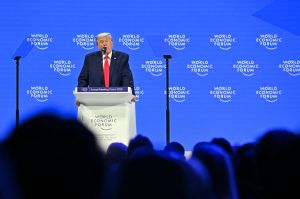
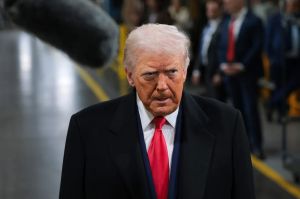
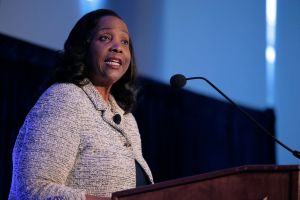

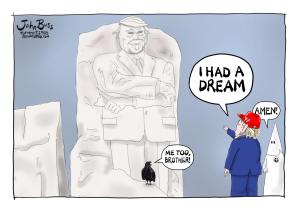
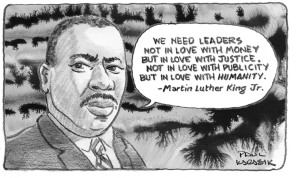 Here are a few reads to think about today’s holiday. This one is from AXIOS. In Trump’s land of remaking that dream of the little Jim Crow over there on John’s Featured Cartoon today.
 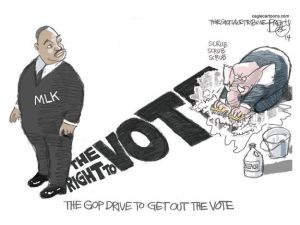 There’s more at the link. This next piece is written by Jenna Prestininzi and published in the
 The worst news of the day comes from Trump’s obsession with Greenland and other countries with which he has a Monroe Doctrine complex. This is from the
  Anne Applebaum, writing for
 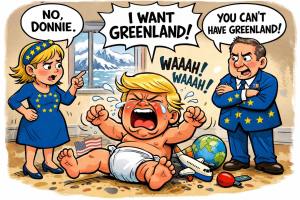 These remarkable comments have rattled our European allies. John Irish
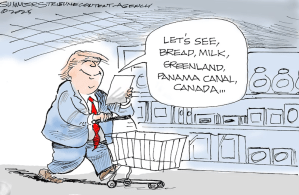 We’re all wondering exactly how Trump plans to do this, and whether it will involve force. So far, the biggest threats are tariffs, which, of course, hurt American consumers and businesses more than anyone else. This is from






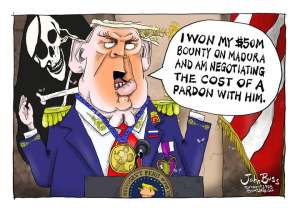
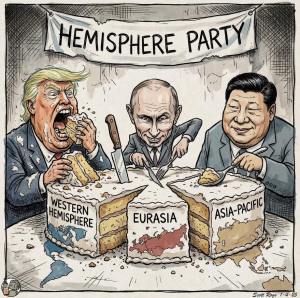 Meetings, speeches, and press conferences are ongoing today regarding the Venezuela situation, while additional actions appear to be in the planning stage. It would seem that more immediate active responses would be pertinent. This headline comes from today’s
  It’s difficult to gauge the responses to this. NATO (via
 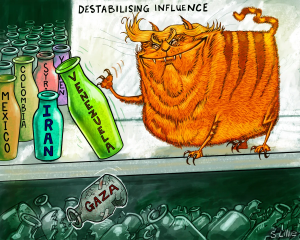 The New York Times
 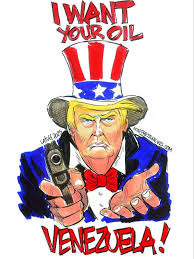 Additional details at the link. It appears that the attack on Venezuela has already claimed the lives of Cuban military personnel.
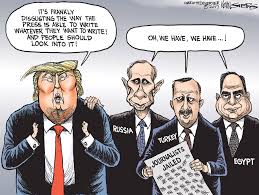 This first read is from Today’s
  The inability of the rotter in the White House to deal with criticism means the rest of us must not read or see anything that might be off-putting to his serious ego problems. NPR has this take on the story. “CBS News chief Bari Weiss pulls ’60 Minutes’ story, sparking outcry.” David Folkenflik has the story.
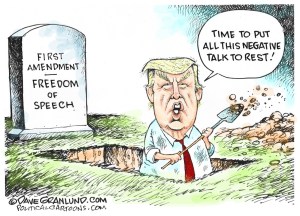 This is the take of the
 Here’s a ridiculous story featuring the Louisiana Governor who truly is the state’s village idiot. It’s a continuation of Donald Trump’s quest to basically take over independent nations. It’s caused quite a stir because it appears to be illegal for the governor to accept this. We continue to see a Regime that thinks itself above the law or doesn’t care. This is from the AP. “Trump’s appointment of envoy to Greenland sparks new tension with Denmark.”
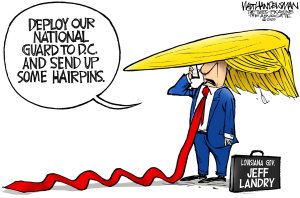 Here’s the take from the
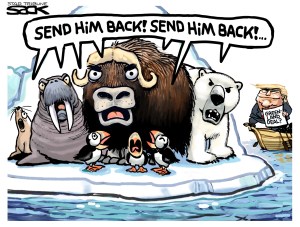 Greenland and Denmark are less than enthused. This is from

 peej
peej Carissa
 bostonboomer
 dakinikat
 ecocatwoman
 mablue2
 Mama Lopez
 peggysue22
 quixote
 skydancingguestblogger
 Mona (aka Wonk the Vote)



 Sky Dancing
Recent Comments