

By Tuesday afternoon Trump called one person close to him with the message, “He’s done. It’s over. I killed him.”
Wednesday Reads: Allies Turning on Trump, and A MAGA Speaker Candidate
Posted: October 25, 2023 Filed under: 2020 Elections, 2024 Elections, Donald Trump | Tags: 5th Amendment, Fani Willis, Georgia election interference case, grand jury, Jenna Ellis, Mark Meadows, Mike Johnson, Republicans, Speaker of the House search, Tom Emmer, use immunity, witness tampering 4 CommentsGood Afternoon!!

Vase of Flowers, by Paul Gauguin
Yesterday, another shoe dropped in the Georgia election interference case when former Trump attorney Jenna Ellis accepted a plea deal.
CNN: Former Trump campaign lawyer Jenna Ellis pleads guilty in Georgia case.
Former Trump campaign lawyer Jenna Ellis pleaded guilty Tuesday in the Georgia election subversion case and will cooperate with Fulton County prosecutors – the third guilty plea in the past week.
At an unscheduled hearing in Atlanta, Ellis pleaded guilty to one count of aiding and abetting false statements, a felony stemming from the election lies that Ellis and other Donald Trump lawyers peddled to Georgia lawmakers in December 2020.
She was sentenced to five years of probation and ordered to pay $5,000 in restitution.
Ellis delivered a tearful statement to the judge Tuesday while pleading guilty, disavowing her participation in Trump’s unprecedented attempts to overturn the 2020 election.
“If I knew then what I knew now, I would have declined to represent Donald Trump in these post-election challenges. I look back on this experience with deep remorse,” Ellis said, her voice breaking at times.
The development comes after back-to-back guilty pleas last week in the sprawling case from former Trump campaign lawyer Sidney Powell and Kenneth Chesebro, who helped devise the fake electors plot.
These three plea deals are a monumental step forward for Fulton County District Attorney Fani Willis, who charged the case in August and is preparing for trials against Trump, his former attorney Rudy Giuliani, his chief of staff Mark Meadows and other top figures. (They have all pleaded not guilty.)
Ellis, Chesebro and Powell all agreed to testify on behalf of the prosecution at future trials. By flipping, these onetime Trump insiders are now on track to become major Trump nemeses. They are all lawyers and can shed light on what was happening behind the scenes in 2020.
The New York Times: With Plea Deals in Georgia Trump Case, Fani Willis Is Building Momentum.
Fani T. Willis, the district attorney of Fulton County, Ga., had no shortage of doubters when she brought an ambitious racketeering case in August against former president Donald J. Trump and 18 of his allies. It was too broad, they said, and too complicated, with so many defendants and multiple, crisscrossing plot lines for jurors to follow.
But the power of Georgia’s racketeering statute in Ms. Willis’s hands has become apparent over the last six days. Her office is riding a wave of momentum that started with a guilty plea last Thursday from Sidney K. Powell, the pro-Trump lawyer who had promised in November 2020 to “release the kraken” by exposing election fraud, but never did.
Maple Tree Listening, by Kazuko Shiihashi
Then, in rapid succession, came two more guilty pleas — and promises to cooperate with the prosecution and testify — from other Trump-aligned lawyers, Kenneth Chesebro and Jenna Ellis. While Ms. Powell pleaded guilty only to misdemeanor charges, both Mr. Chesebro and Ms. Ellis accepted a felony charge as part of their plea agreements.
A fourth defendant, a Georgia bail bondsman named Scott Hall, pleaded guilty last month to five misdemeanor charges.
With Mr. Trump and 14 of his co-defendants still facing trial in the case, the question of the moment is who else will flip, and how soon. But the victories notched thus far by Ms. Willis and her team demonstrate the extraordinary legal danger that the Georgia case poses for the former president.
And the plea deals illustrate Ms. Willis’s methodology, wielding her state’s racketeering law to pressure smaller-fry defendants to roll over, take plea deals, and apply pressure to defendants higher up the pyramids of power.
The strategy is by no means unique to Ms. Willis. “This is how it works,” said Kay L. Levine, a law professor at Emory University in Atlanta, referring to large-scale racketeering and conspiracy prosecutions. “People at the lower rungs are typically offered a good deal in order to help get the big fish at the top.”
Later yesterday, ABC News published a scoop about former chief of staff Mark Meadows: Ex-Chief of Staff Mark Meadows granted immunity, tells special counsel he warned Trump about 2020 claims: Sources.
Former President Donald Trump’s final chief of staff in the White House, Mark Meadows, has spoken with special counsel Jack Smith’s team at least three times this year, including once before a federal grand jury, which came only after Smith granted Meadows immunity to testify under oath, according to sources familiar with the matter.
According to the sources, Meadows also told the federal investigators Trump was being “dishonest” with the public when he first claimed to have won the election only hours after polls closed on Nov. 3, 2020, before final results were in.
“Obviously we didn’t win,” a source quoted Meadows as telling Smith’s team in hindsight.
Trump has called Meadows, one of the former president’s closest and highest-ranking aides in the White House, a “special friend” and “a great chief of staff — as good as it gets.”
The descriptions of what Meadows allegedly told investigators shed further light on the evidence Smith’s team has amassed as it prosecutes Trump for allegedly trying to unlawfully retain power and “spread lies” about the 2020 election. The descriptions also expose how far Trump loyalists like Meadows have gone to support and defend Trump.
Sources told ABC News that Smith’s investigators were keenly interested in questioning Meadows about election-related conversations he had with Trump during his final months in office, and whether Meadows actually believed some of the claims he included in a book he published after Trump left office — a book that promised to “correct the record” on Trump.

Peonies and Irises, by Emil Nolde
ABC news found several passages in the book that differ from Meadows’ reported testimony. See examples at the link. People are claiming that Meadows “flipped” on Trump, but that’s not what this sounds like:
Under the immunity order from Smith’s team, the information Meadows provided to the grand jury earlier this year can’t be used against him in a federal prosecution.
That immunity came after a lawyer for Meadows requested that his client be immunized to testify before the grand jury, sources familiar with the matter said. A senior Justice Department official signed off on the request and an immunity order was then issued by U.S. District Court Judge James Boasberg, the chief judge at the federal court in Washington, D.C., days before Meadows appeared before the grand jury in March, sources said.
Had Meadows not been granted immunity, prosecutors expected him to invoke his Fifth Amendment rights against self-incrimination, sources said.
It sounds like Meadows was given “use immunity” in order to force him to testify without taking the Fifth. That’s not “flipping.” It just means that he cannot be prosecuted for truthful testimony he gave to the grand jury. He may end up cooperating with the government, but he hasn’t done it yet.
The Guardian’s Hugo Lowell agrees: Trump chief Mark Meadows testified in 2020 election case after immunity order.
Donald Trump’s former White House chief of staff Mark Meadows testified to a federal grand jury earlier this year about efforts by the former president to overturn the 2020 election results pursuant to a court order that granted him limited immunity, according to two people familiar with the matter.
The immunity – which forces witnesses to testify on the promise that they will not be charged on their statements or information derived from their statements – came after a legal battle in March with special counsel prosecutors, who had subpoenaed Meadows.
Trump’s lawyers attempted to block Meadows’ testimony partially on executive privilege grounds. However, the outgoing chief US district judge Beryl Howell ruled that executive privilege was inapplicable and compelled Meadows to appear before the grand jury in Washington, the people said.
The precise details of what happened next are unclear, but prosecutors sought and received an order from the incoming chief judge James Boasberg granting limited-use immunity to Meadows to overcome his concerns about self-incrimination, the people familiar with the matter said.
That Meadows testified pursuant to a court order suggests prosecutors in the office of special counsel Jack Smith were determined to learn what information he was afraid to share because of self-incrimination concerns – but it does not mean he became a cooperator.
Typically, under limited-use immunity orders, witnesses provide limited statements. With the payoff potentially small and with the increased difficulty that comes from charging immunity recipients in the future, the justice department is broadly averse to seeking such orders.
The approval must also come from the top echelons of the justice department, according to guidelines, and the preferred method for federal prosecutors to obtain testimony is to have defendants plead guilty, and then have them offer cooperation for a reduced sentence.
Nevertheless, I think it’s unlikely that Meadows will be willing to go to prison for Trump; so he may end up cooperating. He just hasn’t done it yet.

Anemones, Edvard Munch
Last night in a Truth Social post, Trump blatantly attempted to witness tamper Mark Meadows.
From an analysis post by Stephen Collinson at CNN: Trump rages as former acolytes turn against him under legal heat.
In a rage-filled stream of consciousness on his Truth Social network on Tuesday night, Trump lashed out at the ABC report about Meadows.
“I don’t think Mark Meadows would lie about the Rigged and Stollen 2020 Presidential Election merely for getting IMMUNITY against Prosecution (PERSECUTION!),” the former president wrote.
“Some people would make that deal, but they are weaklings and cowards, and so bad for the future our Failing Nation. I don’t think that Mark Meadows is one of them, but who really knows? MAKE AMERICA GREAT AGAIN!!!”
The other big story today is House Republicans’ endless search for a Speaker candidate they can agree on. The latest candidate is Rep. Mike Johnson, an ultra-MAGA guy, after Trump put the kibosh on previous candidate Tom Emmer, who supported the transition of power in 2020.
Politico: ‘I killed him’: How Trump torpedoed Tom Emmer’s speaker bid.
Just hours after Rep. Tom Emmer (R-Minn.) won the Republican Conference’s nomination to be House speaker on Tuesday, former President Donald Trump took to Truth Social to deride the congressman as “totally out-of-touch with Republican Voters” and a “Globalist RINO.”
He then got on the phone with members to express his aversion for Emmer and his bid for speaker.
Just minutes later, Emmer officially dropped out of the race.
His withdrawal made Emmer the third nominee for speaker to have his hopes dashed for the most cursed job in politics. And it showed that while Trump may not be able to elevate someone to the post — his earlier choice for the job, Rep. Jim Jordan (R-Ohio), also flopped — he can very well ensure that a person doesn’t get it….
Trump had signaled to aides last week that he did not support Emmer’s bid for the speakership. The former president complained that Emmer had criticized him following the Trump-inspired Jan. 6 Capitol riot and, among other things, had not forcefully enough defended him against his multiple indictments.
The House will supposedly vote on Johnson for Speaker today. So who is Mike Johnson?
The Washington Post: 5 things to know about Mike Johnson, the GOP’s latest House speaker nominee.
It remains unclear whether Johnson has enough support to win the gavel. But after he was nominated in a Republican closed-door vote on Tuesday, Johnson, flanked by his colleagues, projected confidence, promising to restore voters’ trust in government and to govern effectively if he is elected speaker.
Red Roses with Blue, by Alex Katz
Here are five things to know about Mike Johnson and his political views.
He opposed certifying the 2020 election.
Johnson, 51, contested the results of the 2020 election — urging President Donald Trump to “stay strong and keep fighting” as he tried to overturn his loss to Joe Biden in the presidential race.
Johnson also objected to certifying Biden’s electoral win and was one of the architects of a legal attack on the election that consisted of arguing that states’ voting accommodations during the pandemic were unconstitutional. He led a group of 126 Republican lawmakers in filing an amicus brief to the Supreme Court alleging that authorities in Georgia, Pennsylvania, Wisconsin and Michigan “usurped” the constitutional authority of state legislatures when they loosened voting restrictions because of the pandemic. The court rejected the underlying complaint — filed by the state of Texas — due to lack of standing, and dismissed all other related motions, including the amicus brief.
He voted against further Ukraine aid.
Johnson, who serves on the House Armed Services Committee, was one of 57 lawmakers — all of them Republicans — who voted against a $39.8 billion aid package for Ukraine in May.
According to the Shreveport Times, Johnson explained his opposition to the bill by saying that the United States “should not be sending another $40 billion abroad when our own border is in chaos, American mothers are struggling to find baby formula, gas prices are at record highs, and American families are struggling to make ends meet, without sufficient oversight over where the money will go.”
Johnson has also called for more oversight of the aid sent to Ukraine — totaling more than $60 billion to date. In February, following a House Armed Services Committee hearing on the topic, he tweeted that American taxpayers “deserve to know if the Ukrainian government is being entirely forthcoming and transparent about the use of this massive sum of taxpayer resources.” [….]
He is anti-abortion.
Johnson, a constitutional lawyer who identifies as a Christian, opposes abortion and has celebrated the Supreme Court’s decision to overturn Roe v. Wade, the landmark 1973 ruling that established constitutional protections for abortions nationwide.
“There is no right to abortion in the Constitution; there never was,” Johnson told Fox News on the day the decision was announced, calling it “a great, joyous occasion.”
The antiabortion nonprofit Susan B. Anthony Pro-Life America gives Johnson an A+ ranking on this issue, stating that he “has voted consistently to defend the lives of the unborn and infants,” including by “stopping hard-earned tax dollars from paying for abortion, whether domestically or internationally.”
He is a close ally of Donald Trump
Johnson is a close ally of Trump, having served on the former president’s legal defense team during his two impeachment trials in the Senate.
He has called charges against Trump — which include a federal case relating to his attempts to overturn the 2020 election — “bogus,” and has said the legal and political systems have treated Trump unfairly.
He supports LGBTQ restrictions.
Johnson has positioned himself on the far right of the political spectrum on several social issues, even within the current conservative Republican conference. Notably, he introduced legislation last year — modeled after Florida’s “don’t say gay” bill — that would have prohibited discussion of sexual orientation and gender identity, as well as related subjects, at any institution that received federal funds. The Human Rights Campaign, a pro-LGBTQ civil rights organization, gave Johnson a score of 0 in its latest congressional scorecard.
Johnson also opposes gender-affirming care for minors and led a hearing on the subject in July. In a statement, he described gender-affirming care — meaning medical care that affirms or recognizes the gender identity of the person receiving the care, and which can include giving puberty or hormone blockers to minors under close monitoring from a doctor — as “adults inflicting harm on helpless children to affirm their world view.”


Roses, by Vincent Van Gogh
NBC News: GOP speaker nominee Mike Johnson played a key role in efforts to overturn the 2020 election.
Well before he secured the GOP nomination for House speaker, Rep. Mike Johnson, R-La., played a key role in efforts by then-President Donald Trump and his allies to overturn Joe Biden’s electoral victory in the 2020 election.
Johnson, who currently serves as the GOP caucus vice chair and is an ally of Trump, led the amicus brief signed by more than 100 House Republicans in support of a Texas lawsuit seeking to invalidate the 2020 election results in four swing states won by Biden: Georgia, Michigan, Pennsylvania and Wisconsin.
The lawsuit, filed by Texas Attorney General Ken Paxton, a Republican, called on the Supreme Court to delay the electoral vote in the four states in order for investigations on voting issues to continue amid Trump’s refusal to concede his loss. It alleged that the four states changed voting rules without their legislatures’ express approval before the 2020 election.
Johnson at the time sought support from his GOP colleagues for the lawsuit, sending them an email with the subject line “Time-sensitive request from President Trump.”
“President Trump called me this morning to express his great appreciation for our effort to file an amicus brief in the Texas case on behalf of concerned Members of Congress,” Johnson wrote in the December 2020 email, which was obtained by NBC News….
The lawsuit swiftly drew backlash from battleground state attorneys general, who decried it as a “publicity stunt” full of “false and irresponsible” allegations. Legal experts also pointed to a series of hurdles the lawsuit had faced, saying that Texas lacked the authority to claim that officials in other states failed to follow the rules set by their legislatures….
Johnson’s role in pursuing efforts to overturn the 2020 election results has regained attention recently amid his speakership bid. On Tuesday, the political team of former Republican Rep. Liz Cheney of Wyoming — who broke with Trump over his baseless claims of a stolen election — circulated a New York Times article that called him “the most important architect of the Electoral College objections” on Jan. 6, 2021, aimed at keeping then-President Trump in office even after he lost.
The Times reported last year that many Republicans who voted to discount pro-Biden electors cited an argument crafted by Johnson, which was to ignore the false claims about mass fraud in the election and instead hang the objection on the claim that certain states’ voting changes during the Covid-19 pandemic were unconstitutional.
The Supreme Court ultimately rejected Texas’ effort to overturn the election results.
This guy is MAGA all the way. As speaker, he would likely try to find a way for the House to decide the 2025 election. We’ll find out later today if House Republicans can get together enough votes to elect him.
That’s all I have for you today. No war news. I’m really burned out on that. Feel free to post on anything in the comment thread.
Tuesday Reads: A Tale of Two Judges
Posted: August 8, 2023 Filed under: Afternoon Reads, Crime, Donald Trump, just because | Tags: Garcia hearing, grand jury, January 6 case, Judge Aileen Cannon, Judge Tanya Chutkan, protective order, Stanley Woodward, stolen documents case, Walt Nauta 16 Comments Good Afternoon!!
As usual, I’m riveted to the coverage of Trump’s criminal cases. It’s not particularly surprising that he plans to follow his usual method of defense: delay, delay, delay. He hopes to delay the trials until after the 2024 election so that if he’s elected, he can dismiss the cases against him or pardon himself.
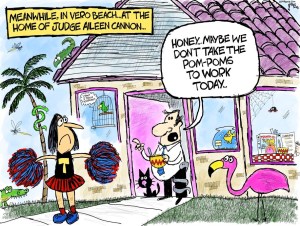
In Florida, Judge Aileen Cannon seems willing to help Trump slow down the stolen documents case as long as possible.
In DC, Judge Tanya Chutkan is less likely to accept his delay tactics in the January 6 case, but, at the moment, he has succeeded in slowing down the discovery process–probably for a couple of weeks.
Here’s the latest on the two cases.
On August 2, Special Counsel Jack Smith asked Judge Cannon for a Garcia hearing to evaluate a possible conflict of interest involving Walt Nauta’s defense attorney Stanley Woodward. Nauta is a co-defendant with Trump in the stolen documents case. NBC News: Special counsel cites potential conflicts for Mar-a-Lago defense attorney.
The special counsel prosecuting former President Trump for his alleged mishandling of government secrets has asked for a hearing to discuss whether the defense attorney for a co-defendant has a conflict of interest stemming from his multiple clients.
According to a court filing on Wednesday, attorney Stanley Woodward’s current and past clients include three people who could be called to testify against Walt Nauta, Trump’s aide who is charged with conspiring to obstruct the government’s efforts to reclaim classified documents.
Woodward’s clients include two aides who worked for Trump at the White House and into his post-presidency, and a Mar-a-Lago IT director identified as “Trump Employee 4” in the updated indictment. The Washington, D.C.-based lawyer also represents at least seven other people who have been questioned by prosecutors in the case. He declined to comment when reached by NBC News.
Trump’s Save America PAC has spent $20 million on legal fees in the first half of this year, according to FEC filings. Woodward’s firm was paid more than $200,000 in the first six months of the year.
In defending Nauta, Woodward may need to cross-examine a witness with whom he has had privileged discussions, which raises the risk of an “attorney’s improper use or disclosure of the client’s confidences during the cross-examination,” or “may cause the attorney to pull his punches during cross-examination, perhaps to protect the client’s confidences or ‘to advance the attorney’s own personal interest,’” the motion filed by special counsel Jack Smith’s office argues.
 Woodward was previously defending Yuscil Taveras, who has now hired a new attorney and appears to be cooperating with the government.
“Employee 4, who is unnamed in the indictment but was identified by NBC News as Yuscil Taveras, secured a new lawyer in July, and did not waive the conflict, according to the motion. Roughly three weeks later, a grand jury charged Trump, Nauta, and Carlos De Oliveira, a Mar-a-Lago property manager, over their efforts to have Taveras delete Mar-a-Lago surveillance footage.
Prosecutors told Woodward earlier this year that they believed Taveras had information that would incriminate Nauta, and that representing both clients at the same time raised a potential conflict of interest. Woodward said he advised both clients of the government’s position, but that he was unaware of anything the employee could say to incriminate Nauta and did not see a conflict, according to the filing.
Judge Cannon was unconvinced, and instead has revealed the existence of secret grand jury still investigating this case in DC., thus delaying the case for who knows how long.
Perry Stein at The Washington Post: Judge asks prosecutors to justify use of 2 grand juries in Trump documents case.
Judge Aileen M. Cannon on Monday asked federal prosecutors to explain the use of grand juries in Florida and Washington in the classified documents case against Donald Trump even though charges were filed in South Florida.
Cannon, the federal judge in South Florida assigned to the case, posed the question in a court filing Monday and told federal prosecutors to respond by Aug. 22.
“The response shall address the legal propriety of using an out-of-district grand jury proceeding to continue to investigate and/or to seek post-indictment hearings on matters pertinent to the instant indicted matter in this district,” Cannon wrote.
Trump and two aides — Waltine “Walt” Nauta and Carlos De Oliveira — were charged this summer in a 42-count indictment that accuses the former president of improperly retaining 32 classified documents at Mar-a-Lago, his Florida residence and private club, and seeking to thwart government attempts to retrieve them….
For many months, Justice Department prosecutors had questioned witnesses in the Florida case before a federal grand jury in Washington. The secret proceedings yielded much of the evidence at the crux of the case. But in May, the grand jury activity appeared to continue at a federal courthouse in Miami. Ultimately, prosecutors filed charges in a West Palm Beach courthouse — a courthouse in the same district as Miami and the area where Mar-a-Lago is located.
Prosecutors said in a court filing last week that they continued to use the grand jury in Washington after they initially charged Trump in June to investigate alleged instances of obstructing the investigation. The focus of the July superseding indictment was on obstruction, alleging that all defendants tried to delete security footage that the government wanted as evidence in the case.
“The grand jury in this district and a grand jury in the District of Columbia continued to investigate further obstructive activity, and a superseding indictment was returned on July 27, 2023,” prosecutors wrote in the filing.
 Judge Cannon apparently disapproves, and decided to reveal the information the Special Counsel had given her under seal.
Prosecutors included that revelation in a motion asking the judge to consider holding a hearing to determine whether Nauta’s attorney has too many conflicts of interest to provide his client with adequate legal advice.
The government lawyers said Stanley Woodward — the Nauta attorney — has represented at least seven other clients whom prosecutors have interviewed about Trump’s alleged efforts to keep classified documents in defiance of the government’s demand they be returned. Two of Woodward’s clients could be called as government witnesses in the trial, the filing by the government said.
If that happens, Woodward may need to cross-examine his other clients as part of defending Nauta, said the prosecutors leading the Justice Department investigation.
The requested hearing — known as a Garcia hearing — is fairly common in legal proceedings. At the hearing, prosecutors said Cannon should inform Nauta and the two witnesses, whose names have not been made public, of their legal rights and the potential conflicts their attorney poses. Lawyers are generally required to flag to a judge any potential conflicts of interest they encounter.
Cannon said Nauta’s lawyers are expected to respond to the judge’s question about the two grand jury locations and the prosecutors’ request for the Garcia hearing.
 So it’s a normal request, but Cannon is going to drag the process out as long as she can, and, instead of keeping the existence of the secret grand jury under seal, she decided to announce it to the world.
Here’s a longer discussion of Cannon’s behavior by Adam Unikowsky’s Substack legal newsletter: It begins. Today’s order in United States v. Trump does not bode well.
Today [August 7] in the Southern District of Florida’s version of United States v. Trump, Judge Aileen Cannon issued an order denying the Justice Department’s motion to seal and requesting supplemental briefing. While seemingly insignificant, today’s order raises troubling concerns regarding her administration of the case….
Judge Cannon became nationally known in August and September 2022, when, in a civil case brought by Donald Trump, she issued a series of unusual orders blocking the Justice Department from reviewing documents seized at Mar-a-Lago and appointing a special master to oversee the Justice Department’s work. The Eleventh Circuit reversed Judge Cannon’s ruling, holding that the court lacked jurisdiction to interfere with the Justice Department’s review of lawfully-seized documents.
Unikowsky argues that it is important in dealing with Trump’s cases to be scrupulous in following norms. He doesn’t yet see any basis for asking for Judge Cannon to be removed from the case. It isn’t unusual for Judges to have rulings reversed and still continue to preside in the cases. I hope you’ll read the whole post if you’re interested in Unikowsky’s views on the case, but for this post, I’ll just cut to the chase.
The Justice Department’s motion notes: “The Government has advised Mr. Woodward of its intent to file this motion requesting a Garcia hearing and its reasons for doing so. Mr. Woodward has indicated that as a general matter he does not oppose the Court informing his client of the client’s rights or inquiring into potential waivers, but that he will not consent to this motion without seeing it in advance, and he requests the opportunity to respond.” This is a reasonable position for Woodward to take—he can’t possibly object to a hearing intended to safeguard his own client’s constitutional rights, but he wants to see the motion before taking a position.
So, this motion is a hanging curveball for Judge Cannon. It’s obvious how Judge Cannon should respond to this motion. She should wait to hear Woodward’s position on it!
If Woodward agrees a Garcia hearing is warranted, Judge Cannon should hold the hearing to ensure that Nauta’s rights are protected. Maybe there’s some discretionary reason to deny the hearing even if everyone agrees it’s warranted? I can’t think of one, but maybe. But clearly, Judge Cannon should wait until she hears from Woodward before deciding what to do….
Instead, Judge Cannon does something intensely weird. Two things, actually.
First, she denies the Justice Department’s motion to seal.
Second, she requests that Nauta file a response brief to the Justice Department’s motion addressing, among other things, “the legal propriety of using an out-of-district grand jury proceeding to continue to investigate and/or to seek post-indictment hearings on matters pertinent to the instant indicted matter in this district.” She also says Trump and De Oliveira “may, but are not required to” file a brief addressing this issue.
First, the court denies the Justice Department’s motion to seal, and strikes the motion for leave to file under seal, as well as the secret information itself, from the docket.
Here’s the court’s rationale: “The Special Counsel states in conclusory terms that the supplement should be sealed from public view ‘to comport with grand jury secrecy,’ but the motion for leave and the supplement plainly fail to satisfy the burden of establishing a sufficient legal or factual basis to warrant sealing the motion and supplement.”
Seriously?
Grand jury proceedings are supposed to be secret, and the Justice Department is disclosing the identity of grand jury witnesses and the substance of their testimony, so it wants to keep that information secret. That’s not a “legal or factual basis to warrant sealing the motion and supplement”?
There’s a lot more, and it’s pretty useful if you are interested in this case.
 The January 6 Case – Judge Tanya Chutkan
I’m sure you’re familiar with what has happened so far. Trump has been threatening Jack Smith, President Biden, the DOJ, and Judge Chutkan on social media and in speeches, even after he was warned not to commit crimes or tamper with witnesses or the jury pool. Smith requested a protective order before turning over discovery to the Trump team. He is concerned–with good reason–that Trump will release secret grand jury material and other evidence to the public so he can try the case in the media.
Here’s the latest.
Kyle Cheney at Politico: Trump objects to strict limits on sharing evidence in election interference case.
Former President Donald Trump argued Monday that he should be allowed to share evidence in his latest criminal case with “volunteer attorneys” and other unpaid advisers as he prepares to defend himself against charges related to his effort to subvert the 2020 election.
“The government cannot preclude the assistance of those individuals, nor should President Trump be required to seek permission from the Court before any such individual assists the defense,” Trump’s attorney John Lauro wrote in a filing that seeks to govern the handling of the mountains of evidence prosecutors have gathered and are preparing to share with Trump’s team.
“Such a limitation or requirement would unduly burden President Trump and impede the efficient preparation of his defense,” Lauro continued.
In a Sunday email between Trump’s lawyers and prosecutors, appended to Trump’s filing, assistant special counsel Thomas Windom raised concerns about Trump’s plan to broaden the group of legal advisers who might be permitted to review evidence in the case, worrying that the language Lauro proposed was “boundless.”
The dispute is one of several between Trump’s legal team and the special counsel over the handling of evidence in the case and how significantly to restrict Trump’s ability to publicly disclose any of the evidence he receives. Prosecutors have proposed a so-called “protective order” that would prohibit Trump or his legal team from publicly sharing any evidence produced by prosecutors. They say that they can’t begin sharing evidence with Trump and his team until a protective order is in place.
The matter now falls to U.S. District Court Judge Tanya Chutkan, who ordered Lauro to respond to prosecutors’ proposed protective order by Monday at 5 p.m. She may either rule on the matter or seek additional argument at a hearing in the case. Prosecutors are due to propose a trial date by Thursday.
Lauro said the blanket restriction on disclosing any evidence prosecutors provide is draconian and should be narrowed to limit the treatment only of materials deemed “sensitive” — such as those containing personally identifying information, grand jury subpoena returns, sealed search warrant returns and recordings or transcripts of witness interviews.
 The government asked the judge to simply grant the protective order, which is usually a routine decision. But instead, she ordered the parties to hash it out in a hearing this week–probably on Friday. Again the upshot is more delay, which is just what Trump wants.
Former President Donald Trump’s legal team says that a protective order proposed by special counsel Jack Smith would infringe on Trump’s right to free speech.
Trump’s attorneys made the argument in their response Monday to the special counsel’s motion for a protective order over the discovery evidence in the case against Trump for allegedly seeking to overturn the 2020 election.
Trump has pleaded not guilty to charges of undertaking a “criminal scheme” to overturn the results of the 2020 election by enlisting a slate of so-called “fake electors” targeting several states; using the Justice Department to conduct “sham election crime investigations”; and trying to enlist the vice president to “alter the election results” — all in an effort to subvert democracy and remain in power.
The former president has denied all wrongdoing and has dismissed the probe as politically motivated.
Monday’s filing argues for narrower limits on the protective order, which Trump’s attorneys say would protect sensitive materials while ensuring Trump’s right to free speech.
“In a trial about First Amendment rights, the government seeks to restrict First Amendment rights,” Trump’s attorneys wrote in their filing. “Worse, it does so against its administration’s primary political opponent, during an election season in which the administration, prominent party members, and media allies have campaigned on the indictment and proliferated its false allegations.”
Of course, the trial is not about First Amendment rights. Trump is charged with three criminal conspiracy counts.
Smith asked the judge for the protective order on Friday, referencing a social media post Trump made Friday afternoon in which he said, “IF YOU GO AFTER ME, I’M COMING AFTER YOU!”
The proposed protective order submitted by Smith does not seek to bar Trump from commenting on the case in its entirety, but would restrict Trump and his attorneys from disclosing evidence such as materials returned from grand jury subpoenas and testimony from witnesses and other exhibits shown to the grand jury. It does not limit Trump from discussing materials that were already available to the public separate from the government’s investigation.
Smith’s attorneys have said the proposed order is largely modeled after similar protective orders issued in other cases.
But in their filing on Monday, Trump’s attorneys accuse Smith’s team of asking Judge Tanya Chutkan to “assume the role of censor and impose content-based regulations on President Trump’s political speech that would forbid him from publicly discussing or disclosing all non-public documents produced by the government, including both purportedly sensitive materials, and non-sensitive, potentially exculpatory documents.”
This is the crap we are going to have to deal with, folks. None of these trials is going to be quick or easy.
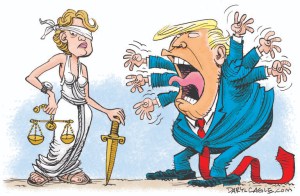 Meanwhile, because of Trump’s threats, Judge Chutkan needs more protection. CNN: Security increases for the judge assigned to Donald Trump’s January 6 criminal case.
Security for the federal judge assigned to oversee the criminal case against former President Donald Trump over his attempts to overturn the 2020 election has been increased in the federal courthouse in Washington, DC.
CNN has observed more security detailed to Judge Tanya Chutkan, and deputy US Marshals discussed security plans for the judge on Monday. The US Marshals Service handles security at the DC District Court and a spokesman for the service said it “take(s) that responsibility very seriously.”
“Ensuring that judges can rule independently and free from harm or intimidation is paramount to the rule of law, and a fundamental mission of the USMS,” spokesperson Drew J. Wade told CNN. “While we do not discuss our specific security measures, we continuously review the measures in place and take appropriate steps to ensure the integrity of the federal judicial process.”
The uptick in security inside the courthouse comes after security measures, including fencing and yellow tape, were taken down following Trump’s arraignment last week. That hearing, where Trump pleaded not guilty, was presided over by a magistrate judge. Chutkan takes the case from there.
Trump has already said he will be asking for Chutkan to recuse herself from the case, writing on social media in all caps: “There is no way I can get a fair trial with the judge ‘assigned’ to the ridiculous freedom of speech/fair elections case.”
So that’s what’s happening in the two federal cases against Trump. It’s going to be a long road, and there will be a lot of stupidity to deal with, but we can get through it together!
Lazy Caturday Reads
Posted: February 11, 2023 Filed under: cat art, caturday, Donald Trump, just because | Tags: Alaska, children with guns, classified documents, Evan Corcoran, grand jury, gun violence, Mike Pence, Turkey/Syria earthquake, unidentified high altitude object 28 Comments
By Adrie Martens
Happy Caturday!!
I have a mixed bag of reads for you today: some stories about the terrible earthquake in Turkey and Syria, including a long read about the situation in Syria; a long read about the case of a six-year-old in Virginia who shot his teacher; a story about the still-unidentified flying object shot down over Alaska, and some new Trump investigation stories.
Turkey-Syria Earthquake
AP News: Survivors still being found as quake death toll tops 25,000.
ANTAKYA, Turkey (AP) — Rescue crews on Saturday pulled more survivors, including entire families, from toppled buildings despite diminishing hopes as the death toll of the enormous quake that struck a border region of Turkey and Syria five days ago surpassed 25,000.
Dramatic rescues were being broadcast on Turkish television, including the rescue of the Narli family in central Kahramanmaras 133 hours after the 7.8-magnitude temblor struck Monday. First, 12-year-old Nehir Naz Narli was saved, then both of her parents.
That followed the rescue earlier in the day of a family of five from a mound of debris in the hard-hit town of Nurdagi, in Gaziantep province, TV network HaberTurk reported. Rescuers cheered and chanted, “God is Great!” as the last family member, the father, was lifted to safety.
Turkish President Recep Tayypi Erdogan, on a tour of quake-stricken cities, raised the death toll in Turkey to 21,848, which pushed the total number of dead across the region, including government and rebel-held parts of Syria, to 25,401….
Still, the day brought one astonishing rescue after another, numbering more than a dozen.
Melisa Ulku, a woman in her 20s, was extricated from the rubble in Elbistan in the 132th hour since the quake, following the rescue of another person at the same site in the same hour. Ahead of her rescue, police announced that people shouldn’t cheer or clap in order to not interfere with other rescue efforts nearby. She was covered in a thermal blanket on a stretcher. Rescuers were hugging. Some shouted “God is great!”
Just an hour earlier, a 3-year-old girl and her father were pulled from debris in the town of Islahiye, also in Gaziantep province, and soon after a 7-year-old girl was rescued in the province of Hatay.
The rescues brought shimmers of joy amid overwhelming devastation days after Monday’s 7.8-magnitude quake and a powerful aftershock hours later caused thousands of buildings to collapse, killing more than 25,000, injuring another 80,000 and leaving millions homeless.
From Twitter:
This is a long Washington Post article by Louisa Loveluck about the earthquake aftermath in Syria: In earthquake-battered Syria, a desperate wait for help that never came.
JINDERIS, Syria — It took four days and nights after the earthquake for the rubble to fall silent here. The strongest voices belonged to the women, residents said. Parted from their children, or fighting to save them, they screamed until their lungs gave out.
In this forgotten pocket of rebel-held northwest Syria, there were no international rescue workers to save them. No aid shipments brought painkillers to the survivors when stocks ran low. Just six miles away, across the border in Turkey, thousands of tons of relief poured in; support teams from as far away as Taiwan answered the Turkish government’s call for help. But Syria, divided against itself and isolated from much of the world, was left to pick up the pieces alone, as it has again and again over more than a decade of war and dislocation.
In the shattered town of Jinderis, at least 850 bodies had been recovered by Friday morning. Although hundreds are still missing, few believed there were any lives left to save. “We needed help here, we asked for help here,” said the town’s mayor, Mahmoud Hafar. “It never came.”
By Sandra Bierman
On Friday, the Bab Al-Salama border crossing into Syria was almost empty. A single ambulance with flashing lights was waiting to enter. The only Syrians crossing back were those being returned to their families in body bags.
On a rare visit to this Syrian enclave, controlled by Turkish-backed armed groups, The Washington Post found communities gripped by shock and bewilderment, and very much alone. In Jinderis, fathers stood watch over the remains of their homes and told of waking up to find their wives and children dead. As hulking excavators clawed the rubble, searching for a 13-year old boy, a man asked reporters to help him contact the United Nations for help. “Maybe they don’t know what happened in Jinderis,” he said. “No one could see this and not come here.”
This part of Syria has endured crisis after crisis, home to millions of people who have braved war and displacement, hunger and disease. Even before the earthquake, 4.1 million here required humanitarian assistance.

Heartbreaking. Read the rest at the WaPo. There are also many photographs the story.
USA Today has a story about how the Turkey/Syria earthquake compares to others in recent history:100 years of earthquakes: Turkey, Syria disaster could be among this century’s worst.
More than 25,000 people have been killed and the death toll is expected to rise after two earthquakes struck Turkey and Syria on Feb. 6. The quakes have become one of this century’s worst natural disasters.
More than 75,000 people have been injured. International rescue efforts from the U.N. and other organizations continue.
The two earthquakes, near the Syrian border, had magnitudes of 7.8 and 7.5. They struck about nine hours apart and were the strongest quakes recorded in Turkey in 80 years.
USA TODAY examined earthquake patterns over the past 100 years and how the unfolding tragedy in Turkey and Syria compares. Here is what we found.
See maps and charts at the USA Today link.
The Virginia Six-Year Old Who Shot His Teacher
This is a very interesting investigative piece about the case of a six-year-old boy who shot his first-grade teacher. I can’t do it justice with excerpts, but I’ll give you a taste, and hope you’ll go read the rest.
Hannah Natanson and Justin Jouvenal at The Washington Post: How Richneck Elementary failed to stop a 6-year-old from shooting his teacher.

Teachers’ fears about the 6-year-old date backto his kindergarten year, when he tried to strangle his teacher, according to a letter Zwerner’s attorney sent to the school system Jan. 24 announcing her intent to sue. The letter was first reported by the Daily Press.
“The shooter had been removed from the school a year prior after he chokedhis teacher until she couldn’t breathe,” says the letter, obtained by The Post through a public records request. It was not immediately clear how a boy so young could have choked an adult. The Post was not able to learn other details of the incident and authorities have not released information about the boy.
Early this fall, as Richneck teachers sought to settle their new crop of students inside the low-slung red-brick building nestled amid trees, news of the 6-year-old’s troubled history circulated swiftly among the staff, according to text messages between teachers.
Less than a week into September, officials switched the 6-year-old to a half-day schedule due to misbehavior — but administrators were already lagging in efforts to accommodate the student, according to Toscano’s letter and to text messages sent between Zwerner and a friend of hers who teaches at the school.
It was not clear what specific incident triggered the schedule change.Toscano wrote in her letter that the 6-year-old “constantly cursed at the staff and teachers and then one day took off his belt on the playground and chased kids trying to whip them.”
What was going on in this child’s home life? It certainly seems as if abuse could be a clue to his behavior. And how was he able to get his hands on his mother’s gun, which she claimed was locked in her bedroom closet?
Text messages and a photo shared between teachers show that a student in Zwerner’s class reportedly hit a teacher so hard with a chair that her legs became dotted with green and purple bruises — and that, at another point, a kindergartner was accused of pushing a pregnant teacher to the ground and kicking her in the stomach so hard that she feared for her unborn child, two weeks shy of giving birth. It was not immediately clear how administrators responded to those episodes, although one educator wrote in a text this fall that the bruised teacher had “heard nothing from admin.”
On Nov. 9, the second-grade teacher wrote in a text message to a colleague that she was applying to work in another district because of “how bad the first graders are right now put together with the fact we don’t have doors.”
Yes, you read that right. The classrooms didn’t have doors because the administration said it would cost too much to put them in.
Diane Toscano, Zwerner’s lawyer, has said teachers relayed several warnings to administrators on the morning of the shooting, including at least three reports that the boy had a gun. The Post interviewed a kindergartner who said the boy threatened to punch her at lunch that day and that she informed a staffer — but that the staffer did little more than give the boy a verbal warning.
In the direct aftermath of the shooting, two second-grade classes were left briefly wandering the hallways in search of a safe place to hide because their classroom was not equipped with doors and they had not rehearsed safety drills, according to one second-grade teacher, one fifth-grade teacher and a parent of a second-grade student, as well as text messages obtained by The Post. A second-grade teacher told The Post she had asked to have doors installed but administrators refused, saying the doors would be too expensive.
As someone who attended elementary school in the 1950s, I can’t begin to comprehend what is happening these days. Not only do we have teenagers and adults committing school shootings; there are also 6-10 year-old kid bringing guns to school and even killing other kids. I hope you’ll read this story; it’s both frightening and fascinating.
High-Altitude Flying Object Over Alaska
The New York Times: U.S. Shoots Down High-Altitude Object Over Alaska.
The Pentagon said it shot down an unidentified object over frozen waters around Alaska on Friday at the order of President Biden, less than a week after a U.S. fighter jet brought down a Chinese spy balloon over the Atlantic in an episode that increased tensions between Washington and Beijing.
Unknown artist
U.S. officials said they could not immediately confirm whether the object was a balloon, but it was traveling at an altitude that made it a potential threat to civilian aircraft.
At a news conference on Friday, John F. Kirby, a White House spokesman, said Mr. Biden ordered the unidentified object near Alaska downed “out of an abundance of caution.” [….]
Pentagon officials said they were able to immediately bring down the object over water, so they could easily avoid the dilemma posed by the spy balloon drifting over populated areas, which had prompted commanders to recommend to Mr. Biden to wait to shoot down the machine in order to avoid any chance of debris hitting people on the ground.
Three U.S. officials said that as of Friday evening, the government did not know who owned or sent the object seen above Alaska, which, like the Chinese balloon last week, was shot down by an F-22 fighter jet using a Sidewinder air-to-air missile.
Several officials said they believed the object shot down Friday was a balloon, but a Defense Department official said it broke into pieces when it hit the frozen sea, which added to the mystery of whether it was indeed a balloon, a drone or something else.
Mr. Kirby said that the object was “much, much smaller than the spy balloon that we took down last Saturday” and that “the way it was described to me was roughly the size of a small car, as opposed to the payload that was like two or three buses.”

So we still don’t know what this object was. Maybe we’ll find out today.
Trump-Pence News
CNN: Trump team turns over additional classified records and laptop to federal prosecutors.
Former President Donald Trump’s legal team turned over more materials with classified markings and a laptop belonging to an aide to federal prosecutors in recent months, multiple sources familiar with the investigation told CNN.
The Trump attorneys also handed over an empty folder marked “Classified Evening Briefing,” sources said.
The previously undisclosed handovers – from December and January – suggest the protracted effort by the Justice Department to repossess records from Trump’s presidency may not be done.
The Trump attorneys discovered pages with classified markingsin December, while searching through boxes at the former president’s Mar-a-Lago residence. The lawyers subsequently handed the materials over to the Justice Department.
A Trump aide had previously copied those same pages onto a thumb drive and laptop, not realizing they were classified, sources said. The laptop, which belonged to an aide, who works for Save America PAC, and the thumb drive were also given to investigators in January.

By Ophelia Redpath
Excuse me, how do we know that Trump didn’t order the aide to copy the documents? And how do we know there aren’t other electronic copies out there? I just can’t believe that Trump never shared any of those stolen documents.
NPR: FBI finds an additional classified document during ‘consensual’ search of Pence’s home.
The FBI confirmed it found an additional classified document during a search Friday at the Indiana home of former Vice President Mike Pence.
The search for classified documents as well as materials that aren’t classified but are subject to the Presidential Records Act lasted about five hours. Agents removed one document with classified markings plus six additional pages without classification markings.
The consensual search follows a discovery, relayed by Pence’s representatives to the National Archives and Records Administration last month, that documents bearing classified markings had been, they said, “inadvertently” boxed up and found in the former vice president’s home in Indiana.
This is big news from The New York Times: Trump Lawyer in Mar-a-Lago Search Appeared Before Grand Jury.
A lawyer for former President Donald J. Trump appeared before a federal grand jury investigating his handling of sensitive government documents that he took to his Mar-a-Lago club and residence after he left office, two people briefed on the matter said on Friday.
The lawyer, M. Evan Corcoran, a member of Mr. Trump’s legal team who handled his responses to the government over its repeated requests for the return of such records, could offer firsthand knowledge of the search the F.B.I. undertook in August and any insights into whether Mr. Trump knew that documents remained at the club.
Mr. Corcoran did not respond to a request for comment. And it was not immediately clear when and under what circumstances he appeared. His appearance was reported earlier by Bloomberg News.
Mr. Corcoran has raised eyebrows within the Justice Department for his statements to federal officials assuring them that Mr. Trump had returned all classified materials in his possession.
As part of Mr. Trump’s legal team, Mr. Corcoran was in discussions with the Justice Department in January 2022, after the National Archives and Records Administration recovered 15 boxes of presidential material from Mar-a-Lago containing nearly 200 individual classified documents.
In May 2022, Mr. Corcoran was in touch with the department after a grand jury subpoena was issued for any remaining classified material that Mr. Trump retained. He was also on hand the next month when the top Justice Department counterintelligence official visited Mar-a-Lago and collected more than 30 additional classified documents.
At the time, another lawyer working for Mr. Trump, Christina Bobb, signed a statement attesting that a “diligent search” for all remaining classified documents had been conducted and that what was turned over was all that remained. The attestation was drafted by Mr. Corcoran, but Ms. Bobb added language to it to make it less ironclad before signing it, according to people familiar with what took place.

Olesya Serzhantova_(Serjantova)
Former Watergate prosecutor Nick Akerman explained to MSNBC’s Joy Reid the significance of former Vice President Mike Pence’s cooperation with the Justice Department, as it subpoenas him for information in the January 6 investigation.
Above all, Akerman said, we are approaching the unprecedented possibility that a former vice president may have to testify at the criminal trial of his former president.
“If you had [Pence], you know, as you said, for hours and hours, and hours, what would you want to ask him?” asked Reid. “Myself personally, I would also want to know what the Secret Service agents were saying, did you trust them? Because this could be about Donald Trump, but it could also be about some of them. What would you want to know?”
“Yeah, I think we want to know exactly what his suspicion was based on,” said Akerman. “I mean, why did he think they were trying to whisk him out of the Capitol so quickly? Was it one of the people that was close to Donald Trump that was in charge of doing that? Did somebody say something to him? I mean, I’m sure he knew that part of this whole plot was to stop that vote, stop the Congress from considering the electoral count. And that one way to do it was to get him off premises, get him out of the Capitol. So I think, you know, he probably did have other conversations with people.”
“I mean, don’t forget, once Mike Pence told him there’s no way no how I’m gonna do this, Donald Trump knew that the only way he was going to stop this whole count was through the violence, through the disruption in the chaos that ensued at the Capitol and that one of the ways to do it of course was to get Mike Pence out of the Capitol as a result of all this violence and used the Secret Service as a foil and an excuse to do that,” continued Akerman.
I hope you find something here that interests you. What other stories have you been following?
Lazy Caturday Reads
Posted: April 9, 2022 Filed under: Afternoon Reads, just because | Tags: Ali Alexander, Charles Donohoe, Department of Justice, Donald Trump, Donald Trump Jr, foreign gifts, grand jury, January 6 investigation, Mark Meadows, Phony DHS investigation, Proud Boys, Secret Service, State Department, Trump administration 26 CommentsGood Afternoon!!

Kitty on the Fence, photo by Andy Sewell
Some big Trump criminality news broke yesterday, and today there’s more news on stories we’ve been following over the past week. Here’s the latest:
This one was posted late last night at The New York Times: Trump Officials Failed to Provide Accounting of Foreign Gifts.
The Trump administration left office without providing the State Department with an accounting of the gifts former President Donald J. Trump, former Vice President Mike Pence and other White House officials received from foreign governments in 2020, the department disclosed late Friday.
The department said that as a result, it could not fully account for the gifts officials received, the latest example to emerge in recent months of how the Trump administration’s flouting of laws and norms about the day-to-day operations of government now makes it harder to determine whether anything improper took place.
“It’s flagrant and it looks terrible,” said Richard W. Painter, the former top ethics lawyer for George W. Bush’s administration. “Either it was really stupid or really corrupt.”
Under federal law, each government department and agency is legally required to submit a list to the State Department of gifts over $415 its officials received from foreign governments. The measure is intended to ensure that foreign governments do not gain undue influence over American officials.
LOL We already know that the Trumps were under “undue influence” from Russia, China, Saudi Arabia, Turkey, and likely more countries.
The department said it had tried to collect the information about the gifts Trump White House officials had received but had failed to come up with an accounting.
“As a result, the data required to fully compile a complete listing for 2020 is unavailable,” the State Department said in a footnote to its list of gifts government officials received that year….
Country Cats, Rosemary Margaret Daunis
In February, it was revealed that classified documents and gifts from the White House had been improperly taken to Mr. Trump’s Mar-a-Lago estate in Florida, a matter federal authorities are now in the preliminary stages of investigating. Around that time, the House committee investigating the Jan. 6, 2021, attack on the Capitol learned that significant chunks of time were missing from White House call records from the day of the attack….
The State Department’s inspector general reported in November that tens of thousands of dollars in gifts given to Trump administration officials were missing. They included a 30-year-old Suntory Hibiki bottle of Japanese whiskey given to Secretary of State Mike Pompeo, worth $5,800, and a 22-karat-gold commemorative coin valued at $560 given to another State Department official.

Many more items are missing–read about the rest at the NYT link.
Three interesting follow-up stories on the fake DHS guys who were busted for bribing Secret Service agents.
CNN: Many questions remain in impersonation plot that duped federal agents, prosecutors say.
Prosecutors told a judge Friday that they still don’t know a motive for two men charged with impersonating federal agents, whether they are connected to any foreign government or whether they received anything from the federal agents they allegedly duped.
“This investigation is less than two weeks old, and every day it gets worse and worse as more and more evidence comes forward, and more and more witnesses come forward,” prosecutor Josh Rothstein told a federal judge on Friday.
The Justice Department is arguing that Haider Ali and Arian Taherzadeh should stay behind bars while the investigation continues. Judge Michael Harvey peppered prosecutors with questions, many of which they couldn’t answer.
The hearing will continue Monday, and the two men will remain behind bars over the weekend. Neither Taherzadeh nor Ali has entered a formal plea.
Cat and kittens, photo by Janet Tunget
The two men spent more than two years impersonating Homeland Security agents, currying favor with federal law enforcement officers, some of whom lived in a swanky DC complex where they had apartments, and amassing a small arsenal of weapons and surveillance equipment, according to court documents.
Federal investigators are trying to unravel how the men paid for five apartments in a high-rent Washington neighborhood, as well as weapons and other equipment, a US law enforcement official said.
Among the questions for investigators is whether the money could have come from a foreign government, though they have noted that the effort didn’t appear to have the sophistication expected of trained foreign intelligence services.
Rothstein noted that one of the men, Ali, has citizenship status in Pakistan while also being a naturalized US citizen. Ali had traveled to Iran in the months before the scheme began, Rothstein said, and took five other trips abroad, including to Iraq and Pakistan.

(Highlighting added by me)
A motion for detention of the two men who were arrested Wednesday for impersonating federal agents includes a slew of damning evidence, including images showing several different passports, visas and IDs.
The prosecutors are requesting Arian Taherzadeh, 40, and Haider Sher-Ali, 35, be detained due to a slew of evidence found in a raid of their units in a luxury apartment building in southeast Washington, D.C….
Taherzadeh told law enforcement in an interview after being taken into custody on Wednesday that Ali was the one funding their lavish lifestyle and seemingly endless stream of gifts, but claimed he wasn’t aware where the money was coming from.
Debbie Criswell, Best spring day
The question remains, however, on what Ali and Taherzadeh’s motives were in getting close to people with White House access by impersonating government agents.
Secret Service agents assigned to details for President Joe Biden and Vice President Kamala Harris’ residence are among those being investigated for accepting lavish gifts and partying with Taherzadeh and Ali, who alleged they were agents with the Department of Homeland Security.
At least one of the U.S. Secret Service (USSS) agents receiving free rent from Taherzadehand Ali was assigned to the detail protecting Harris’ residence at Number One Observatory Circle at the Naval Observatory, sources at the building told DailyMail.com.
Another, sources claim, was on the presidential protective detail and regularly traveled with President Biden on Air Force One.
The new information comes after an affidavit released Wednesday revealed that one of the witnesses in the case is a secret service agent that worked on First Lady Jill Biden’s protective detail.

Again, the added highlighting is mine. There’s much more at the link, including photos of the defendants and the evidence.
Justin Rohrlich of The Daily Beast interviewed a “former friend” of one of the imposters: Homeland Security Conman’s Arrest Is ‘Karma,’ Says Former Friend.
A man arrested this week for allegedly posing as a phony Homeland Security agent in a years-long ruse that fooled at least four members of the Secret Service—one of them on first lady Jill Biden’s security detail—has been busted for passing bad checks, allegedly created a fake company to win a city contract, and stiffed a close friend and business partner before skipping town, according to state court records and interviews with two former associates.
Arian Taherzadeh, 40, was arrested by the feds at his Washington, D.C., apartment complex on Wednesday….
Barn cats in Spring
In an interview with investigators following his arrest, prosecutors say Taherzadeh admitted to posing as a DHS agent and said he also falsely told others that he was an ex-Army Ranger. However, he put much of the onus on Ali, telling the feds that “Ali was the individual that funded most of their day-to-day operation but Taherzadeh did not know the source of the funds.”
“You could call it karma,” a former friend and business partner in Kansas City who started a now-defunct IT consultancy with Taherzadeh told The Daily Beast. “I got burned a couple of different times and I finally walked away.”
The friend said he’s extremely curious to know what Taherzadeh’s end-game was.
“Part of me just wants to tell you, it’s because he could,” he said.

The tale of the con is a long story. You can read it at the Daily Beast link.
January 6 investigation news
I know you’ve probably heard about this bombshell story from CNN yesterday: CNN Exclusive: ‘We control them all’: Donald Trump Jr. texted Meadows ideas for overturning 2020 election before it was called.
Two days after the 2020 presidential election, as votes were still being tallied, Donald Trump’s eldest son texted then-White House chief of staff Mark Meadows that “we have operational control” to ensure his father would get a second term, with Republican majorities in the US Senate and swing state legislatures, CNN has learned.
In the text, which has not been previously reported, Donald Trump Jr. lays out ideas for keeping his father in power by subverting the Electoral College process, according to the message reviewed by CNN. The text is among records obtained by the House select committee investigating January 6, 2021.
“It’s very simple,” Trump Jr. texted to Meadows on November 5, adding later in the same missive: “We have multiple paths We control them all.” [….]
Illustration by Erika Klein, 1964
Immediately before his text to Meadows describing multiple paths for challenging the election, Trump Jr. texted Meadows the following: “This is what we need to do please read it and please get it to everyone that needs to see it because I’m not sure we’re doing it.”
The November 5 text message outlines a strategy that is nearly identical to what allies of the former President attempted to carry out in the months that followed. Trump Jr. makes specific reference to filing lawsuits and advocating recounts to prevent certain swing states from certifying their results, as well as having a handful of Republican state houses put forward slates of fake “Trump electors.”
If all that failed, according to the Trump Jr. text, GOP lawmakers in Congress could simply vote to reinstall Trump as President on January 6.
“We have operational control Total leverage,” the message reads. “Moral High Ground POTUS must start 2nd term now.”

Lock him up. Please.
The New York Times: Pro-Trump Rally Planner Is Cooperating in Justice Dept.’s Jan. 6 Inquiry.
Ali Alexander, a prominent organizer of pro-Trump events after the 2020 election, has agreed to cooperate with the Justice Department’s investigation of the attack on the Capitol last year, the first high-profile political figure known to have offered assistance to the government’s newly expanded criminal inquiry.
Speaking through a lawyer, Mr. Alexander said on Friday that he had recently received a subpoena from a federal grand jury that is seeking information on several broad categories of people connected to pro-Trump rallies that took place in Washington after the election.
In a statement from the lawyer, Mr. Alexander said he was taking “a cooperative posture” with the Justice Department’s investigation but did not know what useful information he could give. He also disavowed anyone who took part in or planned violence on Jan. 6.
While it remains unclear what Mr. Alexander might tell the grand jury, he was intimately involved in the sprawling effort to mount political protests challenging the results of the election, and had contacts with other organizers, extremist groups, members of Congress and, according to the House committee investigating Jan. 6, White House officials during the period after Election Day.

Cat Country by Rosemary Margaret Daunis
I actually think the NYT is underplaying the important of this development, but here’s a bit more from the article:
The grand jury subpoena Mr. Alexander received suggests that prosecutors have greatly widened the scope of their inquiry to include not only people who were at the Capitol, but also those who organized and spoke at pro-Trump events in November and December 2020 and on Jan. 6, 2021.
In an indication that the inquiry could reach into the Trump administration and its allies in Congress, the subpoena also seeks information about members of the executive and legislative branches who were involved in the events or who may have helped to obstruct the certification of the 2020 election….
Mr. Alexander took part in two so-called Stop the Steal rallies in Washington that preceded the former president’s event at the Ellipse, near the White House, on Jan. 6 — one on Nov. 14, 2020, and the other a few weeks later on Dec. 12 — as well as events in the key swing state of Georgia in December.
In the run-up to those gatherings, Mr. Alexander came into contact with a host of rally organizers and with right-wing groups like the Oath Keepers militia and the 1st Amendment Praetorian that provided both public and personal security at the events.
The Washington Post on the plea deal with Proud Boy Charles Donohoe: Proud Boys leader admits plan to storm Capitol, will testify against others.

Lazy Saturday Reads: Governor, Police, and Media Stoke Fears of Riots in Ferguson
Posted: November 15, 2014 Filed under: Civil Rights, Criminal Justice System, morning reads, racism, The Media SUCKS, U.S. Politics | Tags: 1965 Watts riots, Darren Wilson, Ferguson MO protests, Gov. Jay Nixon, grand jury, John Crawford III, Jon Belmar, Levar Jones, Mary Sanchez, Michael Brown, MIssouri National Guard, police shootings, Rodney King, Sean Groubert, slavery, Tom Jackson, Trayvon Martin, US Department of Justice 11 Comments  Good Afternoon!
A Grand Jury decision is imminent in the Michael Brown shooting case in Ferguson, Missouri. For the past couple of weeks the media has been full of reports of how police departments in the St. Louis area are preparing for what they predict will be violent protests.
The general assumption is that Ferguson police officer, who killed Brown at about noon on August 9, will not be charged. The simple truth is that white police officer who kill black people are rarely charged and almost never convicted. Furthermore, the LA Times reports that law enforcement officers who kill citizens in Missouri are given “wide latitude.”
Missouri law provides wide latitude for police to use deadly force, particularly if the officer believes it’s necessary to protect his or her safety or the safety of others.
But that law might not shield Wilson. “If Michael Brown was trying to surrender at the time, that makes this defense not applicable,” Washington University law professor Peter Joy said. “So the question is: Was Michael Brown clearly trying to surrender at the time that the fatal gunshots were fired?”
Several witnesses who saw the shooting reported that Brown’s hands were in the air when Darren Wilson shot and killed him, but, as far as I can tell, most media sources recently have changed the narrative to the police version–not based on direct observation–in which Wilson supposedly feared for his life because the unarmed Brown “charged” at him after being hit with at least two bullets.
There is another investigation by the Justice Department into whether Darren Wilson violated Michael Brown’s civil rights, but
Joy said a federal indictment seemed unlikely, at least according to the publicly reported accounts of the shooting thus far.
“That would require that Officer Wilson intentionally planned or intentionally meant to violate the civil rights — that is, take the life of — Michael Brown because of his race,” Joy said.
The media narrative has gradually been revised since August, when we saw what were essentially police riots in which Ferguson and St. Louis police used military surplus equipment to control peaceful protesters and reporters and photographers who were covering events on the ground. Now we’re repeatedly being told that Brown was the aggressor, with the unwritten implication that he deserved to die. Back in August, some law enforcement officers threatened to kill protesters and even arrested numerous members of the media who were simply doing their jobs. But that’s all forgotten now. Now the corporate media appears to be fully behind the Ferguson and St. Louis police; and both the police and the media are preparing for what they expect–and apparently hope–will be violent and dangerous riots.
Since the Grand Jury decision may come very soon, I thought I’d gather the latest updates on this important story for today’s post. I’ll admit up front that I’m not an nonpartisan observer in this case.
First, the LA Times article I linked to above has a good summary of the two sides to the story of the shooting, Back Story: What happened in Michael Brown shooting in Ferguson, Mo.?
Also from the LA Times, a report of Missouri Governor Jay Nixon’s recent announcement about government preparations for what he apparently assumes will be riots, National Guard on call if Ferguson grand jury decision triggers violence.
The National Guard will be ready to assist law enforcement in Missouri if unrest erupts after a grand jury announces whether to indict a white police officer who fatally shot an unarmed black man in Ferguson, Gov. Jay Nixon announced Tuesday.
“Violence will not be tolerated,” Nixon said at a news conference with officials from the Missouri State Highway Patrol, St. Louis County police and St. Louis Metropolitan police. The governor said the agencies would form a unified command to deal with protests. “Residents and businesses of this region will be protected,” Nixon said….
Nixon said that the rights of peaceful protesters would be respected but that officials would have no tolerance for violent agitation. “Our dual pillars here are safety and speech,” Nixon said in the televised news conference from St. Louis. The National Guard, he said, would be available “when we determine it is necessary to support local law enforcement.”
Nixon added: “The world is watching.”
Nixon did not say whether there have been any efforts to diffuse anger on the part of local police officers or prevent more police overreactions to peaceful protests.
The story also quoted St. Louis police chief Jon Belmar.
“The community is on edge. … There is a large sense of anxiety out there. This is a little unprecedented,” St. Louis County Police Chief Jon Belmar told reporters in a televised news conference. Belmar added: “If you talk to chiefs around the country [as I have], they’re concerned and prepared for this to perhaps lap into their communities also.”
Gee, I wonder why? Could it be because police shootings of unarmed black men are so common in this country? Belmar also defended the use of military equipment to control protests.
Belmar defended the agency’s response by saying that such gear was necessary for his officers’ protection and pointed out that no protesters lost their lives during August’s demonstrations, which were occasionally marred by looting and gunshots. “My goodness, could we be that fortunate moving forward?” Belmar said of the absence of fatalities.
The St. Louis County Police Department has spent about $120,000 to replenish equipment such as shields, batons, tear gas and flex handcuffs after weeks of unrest in the aftermath of the shooting depleted supplies and damaged equipment.
Here are some recent examples of white policemen shooting unarmed black men:
The New Republic, A Dash Cam Didn’t Stop This White Officer From Shooting an Unarmed Black Man (fortunately, this officer was arrested and charged. Whether he’ll be convicted or not, we don’t know yet)
Mother Jones, August 13, 2014, 4 Unarmed Black Men Have Been Killed By Police in the Last Month.
Here’s piece on this subject by Washington Post columnist Jonathan Capehart, The terrifying police shootings of unarmed black men.
One of the burdens of being a black male is carrying the heavy weight of other people’s suspicions. One minute you’re going about your life, the next you could be pleading for it, if you’re lucky. That’s what happened to Trayvon Martin in February 2012 and Michael Brown last month. And two other recent shootings add further proof that no standard of conduct, it seems, is too good or too mundane to protect a black man’s life particularly from a police officer’s bullet.
John Crawford III was talking on his cell phone in the Beavercreek, Ohio, Wal-Mart and carrying an unloaded BB air rifle he picked up in the superstore on Aug. 5. “There is a gentleman walking around with a gun in the store,” Ronald Ritchie told the 911 operator. “Yeah, he’s, like, pointing at people….He’s looking around, waving it, waving it back and forth….He looked like he was trying to load it. I don’t know.” Fair warning: As the graphic video shows, Crawford was shot and killed by police. Ritchie has since changed his account of what happened.
You can watch the video at the link. Capehart also discusses the Brown case and the case in South Carolina (story linked above).
Levar Jones was pulled over for a seat-belt violation by now-former South Carolina state trooper Sean Groubert on Sept. 4. Thanks to the startling and graphic dashcam video we get to see every African American’s worst nightmare unfold in seconds….
Groubert asks Jones, “Can I see your license, please?” Jones, who was standing outside his car at the gas station convenience store, turned and reached inside to retrieve it. “Get out of the car! Get out of the car!” Groubert shouts before opening fire on Jones at point-blank range. After being hit in the hip, Jones can be seen moving backwards away from his car with his hands in the air as two more shots ring out.
Instead of using these recent cases to highlight and deal with the problem of police shootings of unarmed people, it seems that local and state governments like those in Missouri are simply doubling down on the people who protest them. I’m really concerned that all the talk of “riots” being inevitable in Ferguson is going to be a self-fulfilling prophecy.
Caitlin Dickson of The Daily Beast reports that at least one expert agrees with me: Riot Prep Could Fuel Ferguson Violence.
Despite a concerted police effort to quell demonstrations, protesters have carried on consistently and, for the most part, calmly since Brown’s death at the hands of police officer Darren Wilson this past August. But the impending grand jury decision on whether Wilson will be indicted in Brown’s death—and leaks of evidence suggesting he won’t—has law enforcement, residents, and business owners preparing for violence on the streets.
In addition to Missouri Governor Jay Nixon’s announcement on Tuesday that the Missouri State Highway Patrol, the St. Louis Metropolitan police, and the St. Louis County police will join forces (with the National Guard on standby) in handling demonstrations following the grand jury decision, almost every national news organization—from CNN to The New York Times, the Associated Press and Reuters—has reported that Ferguson residents and business owners have been taking matters into their own hands. Gun sales are up, local gun-shop owners told reporters. People like Dan McMullen, whose insurance agency is located near a spot where the few instances of vandalism and looting took place following Brown’s death, was quoted by both the New York Times and CNN as saying he’s stocking up on guns in case of a riot….
Despite Governor Nixon’s declarations that “violence will not be tolerated” and “residents and businesses of this region will be protected,” some experts wonder whether all the emphasis on preparedness—from the $120,000 spent by the St. Louis County Police on riot gear to the sudden demand for guns—may do more harm than good.
“I don’t think this is the way we should be thinking about what might happen,” American University professor Cathy Schneider told The Daily Beast. Instead, Schneider, who is an expert on social movements and racial tensions, argues that what we should be thinking about is, ‘how do we convince a community that the police will act to serve them, that the justice system will defend their interests, and that the verdict will be just?” [….]
“If one side is buying guns and preparing, what do you think the other people are doing, who think those guns are going to be used against them?” Schneider asked. Instead of acknowledging that Ferguson’s black community “is in pain and wondering whether justice will be done,” Schneider said, such intense preparation sends the message that “we think your community is dangerous and we’re armed and prepared to kill you.”
It also doesn’t help that Ferguson police chief Tom Jackson–who should have been fired by now–has announced that Darren Wilson, the man who killed Michael Brown, will be welcomed back to the local force if he isn’t indicted by the Grand Jury.
Here’s an excellent op-ed by Mary Sanchez of the Kansas City Star: The fire next time … may engulf Ferguson, Mo.
By every indication — from both the street and civic offices — Ferguson, Missouri is expected to blow.
The grand jury decision on whether a white police officer will be charged in the shooting death of an unarmed 18-year-old black man could come any day. Many are expecting no indictment of the officer, no criminal charges alleging that he went too far the day Michael Brown died.
If that’s the outcome, God help us all. Keeping the lid on the public reaction will be a gargantuan task.
Of course local leaders fed the outrage from the very beginning by trying to protect Darren Wilson and by leaving Michael Brown’s body lying exposed in the street for four hours.
Sanchez refers back to the riots in Los Angeles in 1965 as well as those in 1992 after the failure to indict police who beat Rodney King within an inch of his life. Why don’t government leaders deal with the root problems at work in these cases?
In Watts nearly 50 years ago the name was Marquette Frye, not Michael Brown. Frye, 21, was pulled over in a traffic stop, suspected of being drunk. When other family members arrived, a fight broke out with police. Word spread, alleging police had over-reacted.
For six days people rioted. There were 34 deaths, more than 1,000 people injured, $40 million in property damage and more than 1,000 buildings were destroyed.
In 1992, the person at the center was Rodney King. He’d led police on a high-speed car chase, fleeing after fearing that his probation would be revoked from a robbery conviction. When he finally was stopped, what happened next shocked the nation. The video of the officers assaulting King without mercy when they could have simply handcuffed him was played over and over on television.
When those officers weren’t indicted, the city erupted again. This time, 53 people died, more than 2,000 were injured, the property damage was pegged at $1 billion and another 1,000 buildings were destroyed.
In both cases, commissions were formed and good people went to work unraveling how one incident could ignite such violence. The underlying causes were found to be similar despite the nearly 30 years that had passed: the burdens of poor education, lack of jobs, poverty, racial tensions, and inferior housing and transportation.
Sanchez goes on to recommend changes that local and state governments will most likely either ignore or respond to with lip service.
We’ve seen over the past several years that virulent racism is alive and well in this country, and we simply are not dealing with it.
This nation was founded on the enslavement of black people, and despite the civil rights struggles of the 1960s, efforts to desegregate schools, and affirmative action, black people are still treated as second class citizens by many Americans. A number of states have even instituted voter ID laws that essentially act as poll taxes did in the Jim Crow era to keep black people from voting, and the Supreme Court has affirmed the right of states to do this.
We are now on the verge of another flashpoint in the history of race conflicts in our country–the possibility of violence following a failure to punish Darren Wilson for essentially ignoring the humanity of black teenager Michael Brown.
When will it end?
A few more reads to check out if you’re interested:
St. Louis Post-Dispatch, Protesters prepare for the worst in Ferguson.
Huffington Post, Beyond the Indictments: Black and Brown Deaths at the Hands of Police Are a Crisis Boiling Over.
Fellowship of Reconciliation, Ferguson Under Indictment.
Juan Williams at Fox News, Are liberal news outlets begging for a race riot in Ferguson?
Ben Swann, Michael Brown’s Parents Testify Before UN Committee Against Torture.
Michael Martinez at CNN, Ferguson case raises question: Where’s the data on officer-involved killings?
Christian Science Monitor, Ferguson verdict: Why St. Louis schools will know first.
AP via Boston Globe, Churches prepare for possible Ferguson unrest
What stories are you following today? Please post your thoughts and links in the comment thread, and have a great weekend.

 peej
peej Carissa
 bostonboomer
 dakinikat
 ecocatwoman
 mablue2
 Mama Lopez
 peggysue22
 quixote
 skydancingguestblogger
 Mona (aka Wonk the Vote)



 Sky Dancing
Recent Comments