
Tuesday Reads: Shirley Temple, The “Hillary Papers,” And The Endless NSA Story
Posted: February 11, 2014 Filed under: Barack Obama, Foreign Affairs, morning reads, Republican politics, U.S. Politics | Tags: Bill Clinton, Cryptome.org, Diane Blair, drones, Edward Snowden, First Look, Glenn Greenwald, Hillary Clinton, Jeremy Scahill, metadata, Monica Lewinsky, NSA, Pierre Omidyar, Shirley Temple, signals intelligence, terrorists, The Hillary Papers, The Intercept 32 Comments
Good Morning!!
The top news story on Google this morning was the death of 1930s child star Shirley Temple at age 85. Later in life, she served the U.S. as an ambassador and was active in Republican politics.
Shirley Temple Black, who lifted America’s spirits as a bright-eyed, dimpled child movie star during the Great Depression and later became a U.S. diplomat, died late on Monday evening at the age of 85, her family said in a statement.
Temple Black, who lured millions to the movies in the 1930s, “peacefully passed away” at her Woodside, Calif., home from natural causes at 10:57 p.m. local time (0157 ET), surrounded by her family and caregivers, the statement said on Tuesday….
As actress Shirley Temple, she was precocious, bouncy and adorable with a head of curly hair, tap-dancing through songs like “On The Good Ship Lollipop.” As Ambassador Shirley Temple Black, she was soft-spoken and earnest in postings in Czechoslovakia and Ghana, out to disprove concerns that her previous career made her a diplomatic lightweight.
“I have no trouble being taken seriously as a woman and a diplomat here,” Black said after her appointment as U.S. ambassador to Ghana in 1974. “My only problems have been with Americans who, in the beginning, refused to believe I had grown up since my movies.”
BBC News on Temple’s storied career as a child star:
Born in 1928, Temple soon became a major star after getting her first film role at the age of three.
Her singing, dancing and acting won over fans worldwide. She was given a special juvenile Oscar in 1935, when she was just six years old. To this day, she is still the youngest person to receive an Academy Award.
With the nickname “America’s little darling”, she was ranked as Hollywood’s biggest draw for four years running from 1935 to ’38 in an annual poll of US cinema owners.
Her rendition of the song On the Good Ship Lollipop in the film Bright Eyes was among her most famous performances.
Her other films included Curly Top, The Littlest Rebel, Baby Take a Bow and Little Miss Marker.
She was such a hit that US president Franklin Delano Roosevelt dubbed her “Little Miss Miracle” for raising morale during the Great Depression and she was credited with helping save 20th Century Fox from bankruptcy.
Temple starred in a total of 43 feature films – but found it difficult to sustain her career in adulthood and left acting behind in 1950.
Bloomberg Businessweek on Temple-Black’s later life:
Temple’s box-office appeal waned as she grew into adulthood, and she made her last movie in 1949. Her second marriage, to businessman Charles Black, lasted almost 55 years until his death in 2005. They raised two children, plus a daughter from Temple’s brief first marriage.
As Shirley Temple Black, the onetime star became active in Republican Party politics in the 1960s and served in diplomatic posts under four presidents.
“I had an enchanted childhood, a magic childhood, with great memories,” Black told reporters in 1978, when she turned 50. “But I don’t want to live in the past and I don’t live in the past.”
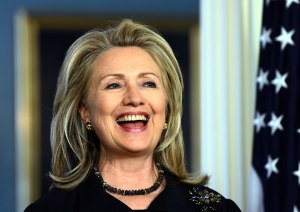
In other news, attacks on Hillary Clinton are ramping up, and so far they are truly bizarre. Republicans are still obsessed with Bill Clinton’s sexual fling with White House intern Monica Lewinsky. Why that is supposed to be relevant to Hillary Clinton’s political career, I will never understand. The latest nastiness is about the so-called “Hillary Papers,” which I knew nothing about until this morning. It turns out these papers aren’t Hillary’s, but those of some friend of the Clinton’s named Diane Blair. I’ve never heard of her.
The papers — a collection of Blair’s diary-like accounts of conversations, campaign memos and the like — are a sometimes wrenching trip via the wayback machine, as she recounts the Clintons’ arduous transition from Arkansas to Washington. In the most quotable comment, Hillary Clinton is said to have called Lewinsky a “narcissistic loony toon” whose relationship with Bill Clinton resulted from a moral lapse on his part, albeit one driven by the pressures facing the couple in the capital.
The papers also reflect, time after time, Hillary Clinton’s frustration with politics and her view that, while she adopted her husband’s name to stave off criticism in Arkansas, she was not about to change her personality to suit the Washington establishment, the press or, for that matter, voters.
“I gave up my name, got contact lenses, but I’m not going to try to be somebody that I’m not,” Blair quotes Clinton as saying.
That tension has been a recurring theme of the Clintons’ political lives. In the 1992 presidential contest, campaign aides placed much emphasis on humanizing Hillary, or at least forwarding a public version of the human being her friends, including Blair, testified to. Blair’s papers included a confidential campaign memo that said voters believed Hillary Clinton was smart but just couldn’t fully connect with her. (Among other things, as was reported during the campaign, many voters were unaware that the Clintons had a daughter, the then-teenage Chelsea, and thus didn’t see Hillary as particularly motherly.)
She got little credit for the things people liked about the Clintons, and more of the blame for the things they disliked.
“What voters find slick in Bill Clinton, they find ruthless in Hillary,” the memo said.

Diane Blair with Bill and Chelsea Clinton
I still don’t see how this is relevant to Hillary’s political career. Calling Lewinsky “a narcissistic looney-tune?” Why is that a problem? Oh, and she’s “ruthless,” although there’s no evidence for that is offered. Here’s the article in the right wing Washington Free Beacon that started the latest attacks, The Hillary Papers: Archive of ‘closest friend’ paints portrait of ruthless First Lady. It’s long, and frankly only skimmed it. If this garbage is what Republicans are going to focus on in opposing Hillary, I don’t think it’s going to work. Check out more heavy breathing over the “Hillary papers” at CNN and Politico.
The endless NSA leaks story continues onward. According to the latest tally by Cryptome.org, at the current rate, it will take 42 more years for all of the Snowden documents to be released. So far Greenwald and crew have reported on only about 1.8% of the documents Snowden is believed to have stolen.
Yesterday Glenn Greenwald and the gang debuted their new website, “The Intercept,” backed by a $50 million dollar investment by Ebay and Paypal billionaire Pierre Omidyar. For now the site will be entirely focused on the Snowden leaks as well as leaks from other sources who come forward and offer information on methods U.S. uses to gather intelligence. Judging by the first article posted by Greenwald, Jeremy Scahill, and Laura Poitras, which focuses on the NSA’s role in Obama’s drone program, the articles will be aimed at using melodramatic language to inflict maximum damage to the U.S. government’s intelligence agencies, while providing little information that hasn’t been already reported elsewhere.
I assume the substance of the drone article was written by Scahill, who wrote a book, Dirty Wars, that included a great deal of information on the drone program. But you can see Greenwald’s hand in the slanted way in which the story is presented. For example, the first paragraph:
The National Security Agency is using complex analysis of electronic surveillance, rather than human intelligence, as the primary method to locate targets for lethal drone strikes – an unreliable tactic that results in the deaths of innocent or unidentified people.
No evidence is offered to show that human intelligence isn’t used or that drone strikes are “unreliable” or that they kill more civilians than bombs or missiles, and no documents from the Snowden cache are included. Interestingly, the authors do not specifically argue against killing suspected terrorists; they only claim that drones are not the best method. They also present the opinions of two sources who worked in the drone program without any evidence to show that their statements are accurate.
A few more reactions…
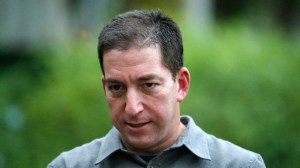
Lloyd Grove at The Daily Beast: Welcome to Glenn Greenwald, Inc.? Grove wonders if Greenwald is the best “public face” for a serious news site.
Investigative reporter and columnist Glenn Greenwald was barely five minutes into his appearance Sunday on CNN’s Reliable Sources—an interview promoting the long-awaited online launch of First Look Media, eBay billionaire Pierre Omidyar’s ambitious digital journalism startup—before he called the chairman of the House Intelligence Committee a liar.
“He’s not only lying—and he is lying—but he knows that he’s lying,” Greenwald said about Republican Rep. Mike Rogers of Michigan, who suggested last week that journalists who’ve disseminated classified documents leaked by former National Security Agency contractor Edward Snowden might be guilty of “fencing stolen material.”
“This is what Mike Rogers is notorious for in Washington,” Greenwald went on, “just making things up and smearing political opponents and journalists he doesn’t like.”
The retort was a familiar-sounding one for the 46-year-old Greenwald, a former trial lawyer who tends to treat policy disagreements as blood feuds and is never reluctant to question motives and fling rather personal insults.
Here’s a pointed critique from Ohtarzie, a writer who has long argued that Greenwald and Poitras are hoarding the Snowden documents, dribbling them out slowly in an effort to get maximum attention and income while providing little new information.
If there is anything new here, it’s in the large extent to which the NSA is said to rely on cell phones for identifying and tracking targets for the CIA, which allegedly leads to increases in wrongly identified targets and civilian deaths. This differs somewhat from Gellman’s account, which described a more varied, conceivably more precise approach, using an “arsenal of cyber-espionage tools, secretly seizing control of laptops, siphoning audio files and other messages, and tracking radio transmissions.” Despite the differences, if there is something revelatory in the Intercept’s story from a technical standpoint, I’m missing it. Tracking by cell phone has been discussed before, includingby Snowden. In light of signature strikes, the apparent recklessness of these methods also seems unsurprising.
Gellman’s story was rightly criticized for being effectively a dick-waving exercise for the U.S. Intelligence apparatus, since it detailed simply how a Bad Guy was killed by the Good Guys with all their sexy technology and savvy. In keeping with their adversarial brand, Scahill and Greenwald mix the NatSec dickwaving with some handwringing over civilians, most of which is provided via quotes from former drone operator and ostensible whistleblower, Brandon Bryant. This passage gives a taste of the overall dickwavey/handwringy mix.
The former JSOC drone operator is adamant that the technology has been responsible for taking out terrorists and networks of people facilitating improvised explosive device attacks against U.S. forces in Afghanistan. But he also states that innocent people have “absolutely” been killed as a result of the NSA’s increasing reliance on the surveillance tactic.
Near the end of the lengthy piece, Bryant even wrings his hands over the assassination program as a whole, at least as it results in the extrajudicial executions of American citizens like Anwar Al Awlaki. But overwhelmingly, both his emphasis and the emphasis of the piece are simply on the need to kill more precisely, by making greater use of informants and agents on the ground to supplement the NSA’s signal intelligence.
Ryan Goodman asks why Greenwald and Scahill repeatedly describe the use of metadata to target terrorists with drone strikes, but they provide few examples of actual metadata being used in the program. Where’s the “Metadata”?: What Greenwald and Scahill (Don’t) Say about NSA Metadata Collection and Lethal Targeting. Read all about it at the link.
Finally, the second scoop at The Intercept yesterday was a series of what they call “exclusive” photographs of the “surveillance state,” but a number of writers noted that these same photos can be found on the NSA website and by Googling. Here’s Bob Cesca:
Glenn Greenwald’s new website, The Intercept, launched today and….the first news article at the Pierre Omidyar-funded site, titled “New Photos of the NSA and Other Top Intelligence Agencies Revealed for First Time,” was utterly bizarre.
It was literally nothing more than three aerial photographs of the National Security Agency’s headquarters in Fort Meade, Maryland; the National Reconnaissance Office (NRO) in Chantilly, Virginia; and the National Geospatial-Intelligence Agency (NGA) in Springfield, Virginia.
That’s all. It’s treated like a major scoop and appeared as the first big revelation on the site, prior to a separate article by Greenwald and Jeremy Scahill.
I’m out of space, so I’ll add a few more links in the comment thread. I hope you’ll do the same. What stories are you focusing on today?
Lazy Saturday Reads
Posted: February 8, 2014 Filed under: Foreign Affairs, morning reads, Republican politics, Russia, U.S. Economy, U.S. Politics, Ukraine | Tags: Bosnia-Hertzegovina, First Look, FSB, GCHQ, Glenn Greenwald, Great Britain, Income Inequality, NSA, Paul Volker, seniors, Ukraine 50 Comments
Tom Wesselman Still Life #30, April 1963
Good Afternoon!!
I thought I’d put the “morning reads” up a little later to give you time to check out JJ’s cartoon posts. So . . . let’s see what’s happening out there today.
Well . . . Paul Volker was in Boston on Thursday night, and he talked to some richie-rich guys about income inequality. From The Boston Globe:
Speaking to a room filled with hundreds of Boston investment executives, former Federal Reserve chairman Paul Volcker asked some tough questions about income inequality in America. He called the earnings gap one of the economy’s greatest challenges.
“What accounts for this? What justifies it?’’ an animated Volcker asked. He argued that the trend started in the 1980s and accelerated in the 1990s, with the spread of stock option compensation creating vast wealth and risk-taking.
During that period, he said, the link between pay and performance got “entirely out of whack.’’
The elder statesman of Fed watchers and author of the Volcker Rule — part of the Dodd-Frank reform package after the financial crisis — was speaking before the Boston Security Analysts Society’s annual market dinner…
Good for him. Whether it will do any good is questionable, but these people need to hear about what they are doing to 99% of Americans.

Just for the hell of it, I looked around for some more recent news articles about income inequality. There wasn’t a lot out there, but I did find a few interesting reads.
At the LA Times, Michael Hiltzik writes: Income inequality begins to hit business in the pocketbook. He argues that business is noticing that middle-class customers are disappearing.
The consumer market is beginning to look like a sandwich without meat in the middle–there are enough wealthy customers to keep the luxury market humming along, and a growing demand for cheap no-name and other bargain products.
The phenomenon has been reported by Matthew Yglesias of Slate.com and more recently by Nelson Schwartz of the New York Times. As we reported here and here, it’s been building for years. But it really picked up steam after the last recession, when the imbalance in income between the top 1% and everyone else has really taken off.
Most economists view the stranglehold of the wealthy on U.S. income and wealth as a problem–it leads to slower overall growth and more volatility. As economist Jared Bernstein has observed, it also promotes the creation of asset and credit bubbles, which have a tendency to burst, taking the rest of the economy with them.
The most important analysis of the economic impact of inequality has come from Barry Z. Cynamon and Steven M. Fazzari of Washington University in St. Louis. In a paper published last month, they ask two questions: “First, did rising inequality contribute in an important way to the unsustainable increase in household leverage that triggered the collapse in consumer demand and the Great Recession? Second, has the rise in inequality become a drag on demand growth…that has held back recovery?”
Their answer to both questions is yes. In simpler terms, rising inequality before the recession prompted U.S. households to borrow more to keep up their spending; when the debt frenzy ended (because of the bursting of the housing bubble) the economy crashed. Since then, the demand drag caused by the effect of inequality on the bottom 95% has held back recovery. The impact of inequality on the recovery, compared with previous recoveries, is shown in this stunning graph from their paper.
But Hiltzik notes that many oblivious pundits continue to deny the effects of the top 1% controlling most of the wealth.

At The News Virginian, Jason Stanford finds some “good news” in the fact that most Republicans now agree that income inequality is a problem.
Believe it or not, there is good news when it comes to income inequality. It turns out Republicans finally believe that the gap between rich and poor has become a problem. The bad news is, according to a new poll, is that Republicans think the best solution is cutting the taxes for the wealthy and big corporations so money and opportunity can rain down on the poor. Addressing poverty by ensuring that cash does not become lonely in the wallets of the wealthy is what passes for a Republican governing philosophy these days, and it is exactly why Barack Obama has decided to go it alone on income inequality.
The issue isn’t that income inequality exists but that the wealthiest 1 percent has achieved the financial equivalent of escape velocity, leaving us poor folk back here on Planet Broke. In 1982, the top 1 percent highest-earning families took home one out of every $10. Now they get more than twice that, leaving the other 99 percent of us to make do on less. The last time it was this bad was the Gilded Age, and majorities of Republicans, Democrats and Independents agree it’s time to do something about it.
OK, so Republicans see the problem, but they want to address it with the same old tired trickle-down non-solutions. I’m not really sure that qualifies as good news. Better than nothing, I guess.
At the Akron Beacon Journal, Rick Armon writes about “an American success story.” Thanks to government programs like Social Security and Medicare, not as many seniors are living in poverty as they did in the past.
Fifty years after President Lyndon Johnson declared the War on Poverty, at least one group of Americans is much better off today: senior citizens.
The percentage of seniors nationwide living below the poverty line has plummeted from 27 percent to 9 percent today, according to a Beacon Journal analysis of census data….
Today, there are 3.7 million seniors living in poverty, compared with 5.2 million in 1969, when the 1970 census was conducted.
The reasons are pretty simple, experts say: It’s a combination of Social Security, pensions, 401(k) programs and Medicare that has kept more elderly people from slipping into poverty.
Armon says those figures may be a little too optimistic (read the details at the link); but still, it’s progress.

Yesterday everyone was talking about Asst. Sec. of State Victoria Nuland’s bugged phone call with the US ambassador to Ukraine in which she uttered the words “fuck the EU,” apparently using an unencrypted cell phone. Someone posted portions of the call to Youtube, and the U.S. has accused Russia of tapping Nuland’s phone. Read all the gossipy details at BBC News.
Of course Russia is accusing the U.S. of “meddling” in the Ukraine crisis. From The New York Times:
KIEV, Ukraine — The tense Russian-American jockeying over the fate of Ukraine escalated on Thursday as a Kremlin official accused Washington of “crudely interfering” in the former Soviet republic, while the Obama administration blamed Moscow for spreading an intercepted private conversation between two American diplomats.
An audiotape of the conversation appeared on the Internet and opened a window into American handling of the political crisis here, as the two diplomats candidly discussed the composition of a possible new government to replace the pro-Russian cabinet of Ukraine’s president, Viktor F. Yanukovych. It also turned the tables on the Obama administration, which has been under fire lately for spying on foreign leaders.
The developments on the eve of the Winter Olympics opening in Sochi, Russia, underscored the increasingly Cold War-style contest for influence here as East and West vie for the favor of a nation of 45 million with historic ties to Moscow but a deep yearning to join the rest of Europe. The tit for tat has been going on since November, when Mr. Yanukovych spurned a trade deal with Europe and accepted a $15 billion loan from Moscow. Months of street protests have threatened his government, and American officials are now trying to broker a settlement — an effort the Kremlin seems determined to block.
There’s a lot more background on the Ukraine situation in the NYT article.

If the problems in Ukraine weren’t enough, anti-government protests have now broken out in Bosnia-Hertzegovina. The Guardian reports:
Thousands of Bosnian protesters took to the streets in the centre of Sarajevo on Friday, setting fire to the presidency building and hurling rocks and stones at police as fury at the country’s political and economic stagnation spread rapidly around the country.
As many as 200 people were injured in protests that took place in about 20 towns and cities. Government buildings were set on fire in three of the largest centres – Sarajevo, Tuzla and Zenica.
At one point in the central Bosnian city of Tuzla, some of the 5,000-strong crowd stormed into a local government building and hurled furniture from the upper stories….
The scenes in Sarajevo were similarly fraught on Friday night, as fire raged through the presidency building and hundreds of people hurled stones, sticks and whatever else they could lay their hands on to feed the blaze. Police used rubber bullets, tear gas and water cannon trying to disperse the crowd. Buildings and cars were also burning in downtown Sarajevo and riot police chased protesters….
The protests have bubbled up out of long-simmering discontent at a sluggish economy, mismanagement, corruption and unemployment, which is rising irresistibly towards 30%. Bosnia has been hamstrung by political infighting and deadlock between its three main ethnic groups – Bosniaks, Croats and Serbs – in the near 20 years since its three-year civil war ended in 1995. The economy has suffered as a result, and the population remains deeply sceptical of a political class widely believed to be ruling in the interests of the elite, not the people.

There continues to be plenty of surveillance news–both about NSA, and more recently about Russia’s intelligence agencies and their security measures activities around the Sochi Winter Olympic Games. This article from The Moscow Times by Andrei Soldatov provides a good overview: FSB Makes Eavesdropping an Olympic Event. In NSA news, Glenn Greenwald and friends have stepped up their publishing activities in the run-up to the unveiling of their First Look news site, planned for Monday. I’ll just share a couple of items with you.
A little more than a week ago Greenwald worked with CBC reporters to “break” a story about alleged spying by Canada’s equivalent of NSA on airport passengers that supposedly continued for days after they left the airport. As usual, the report was deeply flawed, as explained by Matthew Aid, author of The Secret Sentry: The Untold History of the National Security Agency: Analysis Indicates Recent CBC Story About Canadian SIGINT Agency Spying on Travellers Incorrect.
On January 30, the Canadian television channel CBC broke a story written by Greg Weston, Glenn Greenwald and Ryan Gallagher, saying that the Communications Security Establishment Canada (CSEC), which is Canada’s equivalent of NSA, used airport WiFi to track Canadian travellers – something which was claimed to be almost certainly illegal. This story was apperently based upon an internal CSEC presentation (pdf) from May 2012 which is titled “IP Profiling Analytics & Mission Impacts.”
However, as is often the case with many of the stories based on the Snowden-documents, it seems that the original CSEC presentation was incorrectly interpreted and presented by Canadian television.
Read all the gory details at the Aid’s blog.
Then yesterday, Greenwald–in collaboration with NBC News–released a truly bizarre article, Snowden Docs: British Spies Used Sex and ‘Dirty Tricks’, that reveals methods and sources for the GCHQ’s efforts to arrest malicious hackers, criminals, and terrorists, and to prevent nuclear proliferation. You have to wonder why NBC news thought those efforts were somehow wrong or illegal. I’m running out of space, so I’ll let Bob Cesca explain the problems with this story.
There’s one sentence in the new Glenn Greenwald revelation for NBC News that renders everything that follows mostly irrelevant. It’s the lede. And not even the entire lede — just the first part of it.
British spies have developed “dirty tricks” for use against nations, hackers, terror groups, suspected criminals and arms dealers…
The only sane reaction to this news should be, “Great!” We don’t really need to know anything else. But that didn’t stop Greenwald and NBC News from spilling the beans on operations that target such poor helpless victims as malicious hackers, the Taliban, Iran and, yes, terrorists dealing in loose nukes.
See more examples at The Daily Banter. Cesca sums up:
Regardless, what we’re looking at here is another leak from Greenwald & Company that tips off some of our most dangerous enemies including and especially the looming threat of nuclear proliferation and loose nukes. These leaks have been published yet again under the banner of the public interest, but it’s difficult to see any public interest in an operation expressly aimed at those who even the article admits are our “enemies.”
Greenwald has been publishing quite a few leaks about British spying lately. I have to assume that this is his threatened revenge for the Brits detaining David Miranda at Heathrow airport last year. Pretty childish, if you ask me.
Now it’s your turn. What have you been reading and blogging about? Please share your links in the comment thread, and have a terrific weekend!
Caturday Reads
Posted: January 18, 2014 Filed under: Barack Obama, Crime, morning reads, U.S. Politics | Tags: Bob Woodward, Chicago street shootings, children killed by guns, Chris Christie, cognitive development in children, Delaware Valley Charter High School, George W. Bush, Glenn Greenwald, Krystal Dikes, New Mexico school shooting, NRA, NSA reform, Philadelphia school shooting, Rahelle Godfread, Robert Gates, Shawn Bair, shootings in public places, signals intelligence 34 Comments
Good Morning!!
It’s another three day weekend, and it’s really quiet around here. I never thought about MLK Day being a big vacation weekend, but I was out in the car yesterday and the streets were dead. Where do these people go–the ones with enough money to get out of town? Florida? New Hampshire? I don’t know, but it’s nice when they aren’t clogging up the streets with their cars.
I expect it will be a slow news weekend too, except for the football games tomorrow. Let’s see what I can find out there in cyberspace.
Of course there’s the speech President Obama gave yesterday on NSA reforms. To be honest, I didn’t watch it. I’d rather just wait and see what happens. Here are a few reactions to Obama’s proposals.
Of course Glenn Greenwald hated it, as he wrote in an op-ed for the Guardian: Obama’s NSA ‘reforms’ are little more than a PR attempt to mollify the public. I tried to slog my way through it, but I couldn’t. He’s such a terrible writer–always nearly hysterical with rage and with absolutely no sense of humor to take the edge of his sarcasm and bile. He did end with a not-so-subtle threat to keep releasing U.S. intelligence secrets until America finally gives up spying altogether and accedes to Greenwald’s demands.
Today’s speech should be seen as the first step, not the last, on the road to restoring privacy. The causes that drove Obama to give this speech need to be, and will be, stoked and nurtured further until it becomes clear to official Washington that, this time around, cosmetic gestures are plainly inadequate.
After all, according to Glenn, there’s really no danger from terrorists or hostile countries like China and Russia. The entire goal of the national security apparatus and of signals intelligence is the instill fear in the populace.
A few more reasoned reactions:
Adam Martin at New York Magazine collects reactions from a number of people: So What Did People Think of Obama’s NSA Speech?
NPR’s Carrie Johnson offers: 5 Takeaways From The President’s NSA Speech.
Doyle McManus at the LA Times, who has been critical of both Snowden and NSA: A new day at the NSA — President Obama takes a step back from unfettered surveillance.
Individually, the concrete steps President Obama announced Friday toward reforming the National Security Agency‘s surveillance programs were modest. Taken together, though, they signal the end of an era of unfettered escalation in U.S. intelligence-gathering.
Since its establishment in 1952, the NSA’s history has been one of almost nonstop expansion. But for most of that time, the agency still faced limits on what kind of information it could gather and in the legal strictures that governed its programs.
That changed after the terrorist attacks of 2001, which prompted then-President George W. Bush to demand an all-out effort to collect every scrap of information available.
His order came at a time when the Internet, email, instant messaging and low-cost voice communications were pouring an unprecedented amount of private information into a global electronic network, available for sophisticated eavesdroppers to tap.
Bush brushed aside legal constraints and ordered the NSA to collect domestic telephone and email communications without court warrants. Later, Congress and the Foreign Intelligence Surveillance Court legalized much of that program retroactively, including the NSA’s collection of domestic telephone call records, known as metadata. The principle driving intelligence-gathering had become collect first, ask questions later.
Obama’s proposals are step back from that rule.
Read the rest at the link. I have no idea what will happen, but at least Obama is open to talking about it, unlike Bush/Cheney.
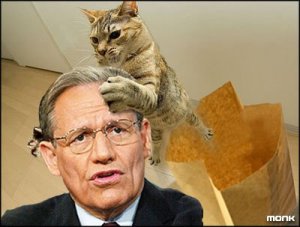
I thought this article at Mediaite was pretty funny: Robert Gates Wanted to Recruit Bob Woodward for the CIA.
Former Defense Secretary Robert Gates shared an interesting detail during a conversation with POLITICO’s Mike Allen about his new book: he wanted to recruit iconic Washington Post journalist Bob Woodward for the Central Intelligence Agency. Yes, that’s right, Gates wanted one of the men who broke Watergate wide open to move to the government side because of his “extraordinary ability” to pry details out of people.
Gates admitted he wasn’t exactly happy with Woodward’s assessment of his book, but beyond that he said he has great respect for Woodward, and admitted he would have liked to bring Woodward into the CIA because he has a gift that not everyone has.
“He has an extraordinary ability to get otherwise responsible adults to spill his guts to him, on background, nothing there for the historians, but his ability to get people to talk about stuff they shouldn’t be talked about is just extraordinary and maybe unique.”
Seriously, does Gates not know that Woodward began his career in naval intelligence “where he was a part of a group which briefed top intelligence officials; at one time he was close to Admiral Robert O. Welander, being communications officer on the USS Fox under Welander’s command.” Woodward even briefed Al Haig during the Nixon administration.
Woodward knew nothing about journalism until the Washington Post installed him at a small newspaper in the DC suburbs for a year so he could get some on-the-job experience before moving up to the big time? Before that, Woodward was involved in briefing Bernstein was the writer on the Watergate story and Woodward had the CIA/government connections.
Gates should know that once you’re in the “intelligence community,” you never really leave. Please forgive me for this, but I’m going to link to a post by Larry Johnson from 2005: Blowing the Whistle on Bob Woodward.
Woodward has been the consumate insider while cultivating the image of the hard charging investigative reporter. He is anything but, and it is time to blow the whistle on his incestuous relationship with certain government officials. The fact that the Washington Post is still covering for this joker says volumes about the decline of the Post.
When he appears on Larry King Live Tonight maybe he will answer a longstanding question, “When did he resign from Naval Intelligence?”
Johnson then reproduces a letter to the editor of the Tampa Tribune by Len Colodny. Colodny is coauthor of a book about Watergate called Silent Coup: The Removal of a President. Check it out.

This is interesting. Greg Sargent thinks President Obama might decide to encourage an increase in the minimum wage with an executive order.
Here’s some welcome news. At his meeting with Democratic Senators last night, President Obama indicated that he is giving serious consideration to executive action designed to raise the minimum wage for employees of federal contractors, according to one Senator who was present.
Proponents want to see this executive action happen on the merits — theybelieve it could impact as many as two million employees of federal contractors, and would help the economy. But they also believe such action could give a boost of momentum to the push for a minimum wage hike for all American workers, which obviously would require Congressional approval, but is currently facing Republican opposition.
Senator Bernie Sanders told me in an interview that the president took the idea very seriously when asked about it last night.
Surely some Democrats could applaud Obama if he did that. Of course the Greenwald cult followers will ignore it, because it would only improve the lives of working class people and do nothing for the “privacy” of upper middle class white males.
These days it seems we’re getting shootings in public places on an almost daily basis. I posted about a grocery store shooting in Elkhart, Indiana a couple of days ago. The victims and the shooter have now been identified.
What happened, police say, is 22-year-old Shawn Bair walked into the store Wednesday at about 9:30 p.m. Surveillance video shows him making phone calls and texting people….
Police say Bair pulled out a .44 caliber semi-automatic handgun, and shot and killed 20-year-old Krystal Dikes. Police say she had just started working at the store stocking the shelves. Friends say she was a caring, compassionate person.
“I don’t know what his goal was, I don’t know what his aim was, mad at the world. There’s definitely a family grieving for her. Definitely. And lots of friends,” said Dikes’ boyfriend Kyle Barnett.
Also murdered was 44-year-old Rachelle Godfread who was shopping. Bair then held the manager of the store at gunpoint until police arrived.
Police still aren’t sure why Bair, who police have been in contact with before, decided to go on this rampage but his Facebook page is filled with violent images and posts. In one post he says he knows he’s going hell. One from 2010 says he realized everybody should die, no matter what race or religion.
According to the Chicago Tribune,
Rachelle Godfread, 44, had recently moved from southern Indiana to Elkhart, where she was closer to her son who played basketball at the South Bend campus of Indiana University. Now that college student has lost his mom.
Yesterday there was a shooting in a school gymnasium in Philadelphia. CNN reports:
A warrant has been issued for the arrest of a juvenile suspect in a shooting that wounded two students at a Philadelphia school Friday, police said Saturday.
The shooting occurred at Delaware Valley Charter High School.
The suspect is not in custody, but police expect him, accompanied by an attorney, to turn himself in Saturday morning.
The shooter was in the school gym with seven other students, city police Commissioner Charles Ramsey said.
Some were playing basketball and others standing in a corner when he pulled a gun and fired.
The victims, a boy and a girl, both age 15, were hit in the arm. They were taken to a local hospital, police said, and their wounds are not life-threatening.
The Friday afternoon incident was at least the second shooting at or near a school this week in the Olney neighborhood.
And then there are the plain old street shootings. Again from the Chicago Tribune: Shootings leave 2 dead, 7 injured since Friday afternoon.
Two men have been killed and seven people injured in shootings on the South and West sides since Friday afternoon, according to police.
The violent start to the weekend, which came as downtown temperatures hovered in the teens, included a shooting that injured three people on a Dan Ryan Expressway ramp and another that left a 15-year-old girl hospitalized.
Police were called to the first of Friday’s homicides about 5:20 p.m., after gunfire rang out in 4900 block of West Huron Street in the Austin neighborhood.
Officers found 21-year-old Timothy Travis on the ground, bleeding from a gunshot wound to the head, authorities said.
Travis, who lived in the 4900 block of West Quincy Street, was pronounced dead on the scene at 5:34 p.m., according to the Cook County medical examiner’s office.
Of course the “experts” are “weighing in”: Experts: N. Mexico suspect, other young shooters show preteens’ impulse actions.
(CNN) — The New Mexico middle school shooting allegedly by a 12-year-old boy highlights how such gunfire is now occurring in America’s earlier grades, raising disturbing issues on whether such youngsters know the devastating consequences of such violence and on how they should then be adjudicated, experts say.
“It’s becoming more and more common, especially in the middle-school age, for these kids to be committing these violent acts,” said Sheela Raja, clinical psychologist at the University of Illinois at Chicago….
That tally includes last October’s shooting in Sparks, Nevada, by a 12-year-old boy who killed himself after fatally shooting a teacher; a 2010 shooting in a Madison, Alabama, by a ninth-grader who fatally shot a boy, 14, in the head; a 2000 shooting in Mount Morris Township, Michigan, in which a 6-year-old boy killed another 6-year-old; and the 1999 shooting in Deming, New Mexico, in which a 12-year-old boy killed a classmate, 13.
Raja explains that children at these ages do not have the cognitive development to restrain strong impulses or to understand the full implications of their actions.
“People should remember that a 12-year-old is barely past the age of believing in Santa Claus,” said Wendy Walsh, a behavior expert and psychologist.
“While there is great variance in cognitive development, plenty of kids this age are unable to fully comprehend that death is permanent,” Walsh said. “Add to that the impact of violent video games where ‘downed’ characters get up again, and there is good reason to assume this child does not think like an adult.”
Wouldn’t it make sense to keep guns out the hands of young kids then? I know, stupid question.
From the NYT: In Age of School Shootings, Lockdown Is the New Fire Drill.
For students across the country, lockdowns have become a fixture of the school day, the duck-and-cover drills for a generation growing up in the shadow of Columbine High School in Colorado and Sandy Hook Elementary School in Connecticut. Kindergartners learn to hide quietly behind bookshelves. Teachers warn high school students that the glow of their cellphones could make them targets. And parents get regular text messages from school officials alerting them to lockdowns.
School administrators across the country have worked with police departments in recent years to create detailed plans to secure their schools, an effort that was redoubled after the December 2012 shootings in Newtown, Conn. At the whiff of a threat, teachers are now instructed to snap off the lights, lock their doors and usher their students into corners and closets. School officials call the police. Students huddle in their classrooms for minutes or hours, texting one another, playing cards and board games, or just waiting until they get the all clear.
Why should kids have to go through this at school–a place where they are supposed to be safe and protected? I guess because the NRA wants more and more guns everywhere and Congress doesn’t have the guts to do anything about it.
Another “expert” told Jake Tapper that mass shootings are on the rise. Isn’t it great that we have “experts” to explain that to us? /snark

OK, enough depressing news about death and destruction. What’s the latest on Chris Christie? Steve Kornaki has dug up some good stuff: Christie camp held Sandy relief money hostage, mayor alleges.
Two senior members of Gov. Chris Christie’s administration warned a New Jersey mayor earlier this year that her town would be starved of hurricane relief money unless she approved a lucrative redevelopment plan favored by the governor, according to the mayor and emails and personal notes she shared with msnbc.
The mayor, Dawn Zimmer, hasn’t approved the project, but she did request $127 million in hurricane relief for her city of Hoboken – 80% of which was underwater after Sandy hit in October 2012. What she got was $142,000 to defray the cost of a single back-up generator plus an additional $200,000 in recovery grants.
In an exclusive interview, Zimmer broke her silence and named Lt. Gov. Kim Guadagno and Richard Constable, Christie’s community affairs commissioner, as the two officials who delivered messages on behalf of a governor she had long supported.
Something tells me we have a lot more Christie corruption news to look forward to.
Now what stories are you following today? Please post your links in the comments and have a great long weekend!
Thursday Reads
Posted: January 9, 2014 Filed under: Barack Obama, FBI, Foreign Affairs, morning reads, The Media SUCKS, the villagers, U.S. Military, U.S. Politics | Tags: Afghanistan War, Betty Medsger, COINTELPRO, Doyle McManus, Edward Snowden, Fox News, Gabriel Sherman, George W. Bush, Glenn Greenwald, Iraq War, J. Edgar Hoover, Joe Biden, Robert Gates, Roger Ailes 119 Comments
Good Morning!!
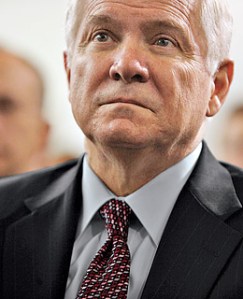
The Villagers are still nattering on about excepts from retired defense secretary Robert Gates’ new memoir Duty, which will be released on January 14.
The DC media is focused on Gates’ criticisms of President Obama and how they will embarrass the administration and negatively affect Hillary Clinton’s chances in 2016. What has impressed me so far in the excepts I have read is that Obama was wary of the military and willing to stand up to them. Some examples from an e-mail I received from Foreign Policy Magazine yesterday:
Gates on what Biden did to poison the military well: “I thought Biden was subjecting Obama to Chinese water torture, every day saying, ‘the military can’t be trusted.'”
On Obama’s approach to Afghanistan: “I never doubted Obama’s support for the troops, only his support for their mission.”
On Obama’s approach to Afghanistan: “I believe Obama was right in each of these decisions.”
On Obama and Bush: “During my tenure as secretary, Bush was willing to disagree with his senior military advisers on the wars, including the important divergence between the chiefs’ concern to reduce stress on the force and the presidents’ higher priority of success in Iraq. However, Bush never (at least to my knowledge) questioned their motives or mistrusted them personally. Obama was respectful of senior officers and always heard them out, but he often disagreed with them and was deeply suspicious of their actions and recommendations. Bush seemed to enjoy the company of the senior military; I think Obama considered time spent with generals and admirals an obligation.”
On Obama as an ice man: “I worked for Obama longer than Bush and I never saw his eyes well up. The only military matter, apart from leaks, about which I ever sensed deep passion on his part was ‘Don’t Ask, Don’t Tell,’ the law prohibiting gays from serving openly in the military that Obama successfully pushed to repeal.”
On an oval office meeting that deeply pissed him off: “…Donilon was especially aggressive in questioning our commitment to speed and complaining about how long we were taking. Then he went too far, questioning in front of the president and a room full of people whether Gen. Fraser was competent to lead this effort. I’ve rarely been angrier in the Oval Office than I was at that moment; nor was I ever closer to walking out of that historic room in the middle of a meeting. My initial instinct was to storm out, telling the president on the way that he didn’t need two secretaries of defense. It took every bit of my self discipline to stay seated on the sofa.
Every one of those quotes made me like and respect Obama and Biden more. I’m sure I’m not alone in that reaction.
A couple more “criticisms” quoted in The Atlantic: Robert Gates: The Iraq War Undermined U.S. Efforts in Afghanistan.
President Bush always detested the notion, but our later challenges in Afghanistan—especially the return of the Taliban in force by the time I reported for duty—were, I believe, significantly compounded by the invasion of Iraq. Resources and senior-level attention were diverted from Afghanistan. U.S. goals in Afghanistan—a properly sized, competent Afghan national army and police, a working democracy with at least a minimally effective and less corrupt central government—were embarrassingly ambitious and historically naive compared with the meager human and financial resources committed to the task, at least before 2009.
Who doesn’t agree with that? Well, sure some right wing nut jobs, but the majority of Americans have completely soured on the Iraq war, according to many polls over the past few years.
Wars are a lot easier to get into than out of. Those who ask about exit strategies or question what will happen if assumptions prove wrong are rarely welcome at the conference table when the fire-breathers are demanding that we strike—as they did when advocating invading Iraq, intervening in Libya and Syria, or bombing Iran’s nuclear sites. But in recent decades, presidents confronted with tough problems abroad have too often been too quick to reach for a gun. Our foreign and national security policy has become too militarized, the use of force too easy for presidents. Today, too many ideologues call for U.S. force as the first option rather than a last resort.
So Obama’s approach might have kept us out of Iraq, right? I don’t see that as a problem. I want my president to be wary of the military and hesitant to go to war. I want my president to get teary-eyed over granting rights to people who have been historically discriminated against and stay dry-eyed and rational when contemplating “military matters.”
So let Gates have his day in the sun. Today some in the media are already questioning whether his book may damage his reputation. From Foreign Policy again: Did Bob Gates’ New Book Just Trash His Golden Reputation?
Gates, 70, has unmasked himself as just another former Washington official writing just another kiss-and-tell in the soon-to-be-released Duty: Memoirs of a Secretary at War, in which he takes shots at a sitting commander-in-chief, his top aides and Congress, an institution with which he often expressed frustration – but also respect. Gates was known for being discreet and sharp-minded, loyal to the office he occupied and careful about what he said in public. So deliberate were his public pronouncements about wars or national security policy or budgets that he became the E.F. Hutton of the Pentagon — everyone leaned in every time he had something to say.
But now his brand seems diminished by the scrappy, petty nature of many of his criticisms — even though some are substantive and legitimate — and a legacy he seemed quietly determined to protect may be permanently reduced to something less than what it once was.
We’ll have to wait and see. It’s also possible that the furor over Gates’ memoir will fade quickly, because another book is coming out on January 21, and it looks to be a lot more entertaining–the tell-all book about Fox News’ Roger Ailes, The Loudest Voice in the Room, by Gabriel Sherman. Excerpts started leaking out yesterday and they are wild! Check these “key revelations” from Gawker:
- During a salary negotiation in the 1980’s, Ailes offered producer Randi Harrison an additional $100 each week she would agree to have sex with him whenever he wanted.
- He also privately thinks of Bill O’Reilly as “a book salesman with a TV show” and Brian Kilmeade as “a soccer coach from Long Island.”
- During a 1990’s power struggle with NBC executive David Zaslav, Ailes was accused of making an anti-Semitic remark involving an obscenity and “the words ‘little’ and ‘Jew’.” NBC’s chairman and counsel believe “he probably said it.”
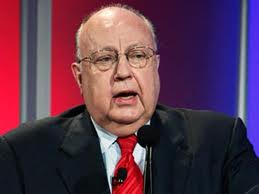
New York Magazine has published a lengthy except from Sherman’s book and it is the most fascinating and horrifying thing I’ve read in ages. Ailes is far weirder than I ever imagined. The article opens with a description of how Ailes moved into a rural town in upstate New York, hoping to return to his small-town roots, but instead bought the local newspaper and tried to transform it into a mini-Fox News. It’s a riot! Just a small except to whet your appetite for the bizarre:
As summer turned to fall, political issues began to arise. Alison Rooney, the copy editor, at first found reasons to be optimistic about the ownership change. She liked using the new computers to put out the paper and looked forward to the newsroom moving into a renovated two-story building on Main Street. But that honeymoon ended when Rooney laid out a press release from the Garrison Art Center that described a work invoking the “mythological story” of the Virgin Birth. After the release was published, the priest of Our Lady of Loretto wrote a letter to the editor, and Beth Ailes lit into Rooney. A few weeks later, Rooney got another dressing-down as she formatted a promotion of the high school’s upcoming production of Urinetown, this time from an editor who found the language offensive and removed the title of the show from the headline.
Another drama erupted after a reporter named Michael Turton was assigned to cover Haldane Middle School’s mock presidential election. After the event, Turton filed a report headlined “Mock Election Generated Excitement at Haldane; Obama Defeats McCain by 2–1 Margin.” He went on, “The 2008 U.S. presidential election is now history. And when the votes were tallied, Barack Obama had defeated John McCain by more than a two to one margin. The final vote count was 128 to 53.” Reading the published version a few days later, Turton was shocked. The headline had been changed: “Mock Presidential Election Held at Haldane; Middle School Students Vote to Learn Civic Responsibility.” So had the opening paragraph: “Haldane students in grades 6 through 8 were entitled to vote for president and they did so with great enthusiasm.” Obama’s margin of victory was struck from the article. His win was buried in the last paragraph.
Turton was upset, and wrote a questioning e-mail to Hunt, but never heard back. Instead, he received a series of accusatory e-mails from the Aileses. Turton had disregarded “specific instructions” for the piece, Beth wrote. “Do you anticipate this becoming an ongoing problem for you?” A short while later, Roger weighed in. Maureen Hunt’s instructions to focus on the school’s process for teaching about elections had been “very clear,” he wrote, and Turton’s “desire to change the story into a big Obama win” should have taken a backseat. Ailes described himself as “disappointed” by Turton’s failure “to follow the agreed upon direction.”
Soon afterward, Turton learned that Maureen Hunt had resigned, and Ailes continued his quest to bring “fair and balanced” to Philipstown.
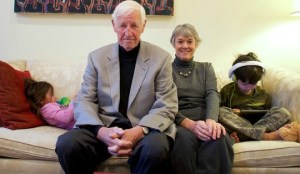
John and Bonnie Raines, two of the burglars, at home in Philadelphia with their grandchildren. Mark Makela for The New York Times
Since I’ve been discussing new books so far, I guess I might as well continue. On Tuesday, The New York Times published interviews with some of the activists who broke into an FBI office in Media, Pennsylvania on March 8, 1971 and stole a massive number of files. They took the files to a remote location, studied them for ten days, and found evidence of the illegal FBI domestic spying program COINTELPRO. Unlike Edward Snowden, the burglars swore to keep their identities a secret so that the story itself would get all the public attention. From the Times article:
They were never caught, and the stolen documents that they mailed anonymously to newspaper reporters were the first trickle of what would become a flood of revelations about extensive spying and dirty-tricks operations by the F.B.I. against dissident groups….
The burglars had, until now, maintained a vow of silence about their roles in the operation. They were content in knowing that their actions had dealt the first significant blow to an institution that had amassed enormous power and prestige during J. Edgar Hoover’s lengthy tenure as director.
“When you talked to people outside the movement about what the F.B.I. was doing, nobody wanted to believe it,” said one of the burglars, Keith Forsyth, who is finally going public about his involvement. “There was only one way to convince people that it was true, and that was to get it in their handwriting.”
That’s heroism in my book. They revealed real government abuses that had been almost unknown until they found the proof. Now one of the reporters who helped get the story out, Betty Medsger, has written a book called The Burglary: The Discovery of J. Edgar Hoover’s Secret FBI. It came out this week, and I’m dying to read it.
By contrast Snowden and his PR man Glenn Greenwald have so far revealed very little that we didn’t already know or suspect about NSA domestic spying and have spent most of the seven months since they began rolling out their revelations 1) publishing articles about the NSA spying on foreign countries and their partnerships with foreign countries who have few espionage resources; 2) giving self-aggrandizing interviews and bragging about all the secrets they have; 3) Defending Snowden’s decision to defect to Russia. At the same time Greenwald has sold book and movie rights and worked on a media start up funded by libertarian E-bay and Paypal billionaire Pierre Omidyar. I haven’t heard anything about Greenwald sharing his earnings with Edward Snowden either.
Fortunately some in the media are beginning to point out inconsistencies in Snowden’s and Greenwald’s behavior. Here is an op-ed by Doyle McManus that lays out the case very well. Edward Snowden, in shades of gray I agree with just about everything he wrote.
Is Edward Snowden” Edward Snowden a whistle-blower or a traitor?
Debate over the renegade computer technician who leaked thousands of secret National Security Agency documents is too often reduced to that deceptively simple choice.
But it’s the wrong way to pose the question, because Snowden is both of those things at the same time. Yes, he’s a whistle-blower, and if that were all he had done, he would deserve our thanks for forcing a debate over the NSA’s swollen powers.
But he’s also a scoundrel who deserves prosecution and public condemnation. That’s because his leaks no longer seem focused on protecting U.S. citizens’ constitutional rights or toughening safeguards on the NSA. Instead, Snowden’s disclosures have expanded far beyond those laudable aims to exposing U.S. intelligence-gathering operations that appear not only legal but legitimate in the eyes of most Americans.
McManus is referring to revelations about the NSA doing it’s job, which is gathering foreign intelligence to protect national security. A little more:
“…most of those disclosures, from Merkel to Al Qaeda, have nothing to do with Americans’ right to privacy. Snowden has acknowledged that his ambitions go far beyond limiting what the NSA can do at home. “I have acted at great personal risk to help the public of the world, regardless of whether that public is American, European or Asian,” he told the Guardian in June.
Well, OK. But that makes him, by his own description, a global crusader against NSA spying anywhere, not merely a whistle-blower against potential abuses inside the United States. It means some of his disclosures have made Americans safer against government prying, but others have probably made us less safe.
And for a man who proclaims himself a fighter for universal rights, accepting asylum in Russia and praising his hosts for their devotion to freedom does not strengthen his claim to consistency, let alone nobility.
I’ll end there and turn the floor over to you. What stories are you following today. Please post your links in the comment thread, and have a great Thursday!
Thursday Reads: Snowzilla and Other News
Posted: January 2, 2014 Filed under: Barack Obama, Foreign Affairs, morning reads, U.S. Politics | Tags: Akademic Shokalskiy, clemency, distress signal, Edward Snowden, Glenn Greenwald, Keystone XL pipeline, metadata, Minneapolis fire, National Transportation an Safety Board, North Dakota train derailment, Russian FSB, Snowzilla, Sochi Winger Olympics, surveillance by Russia, winter weather 44 Comments
Boston’s Beacon Hill in Winter
Good Morning!!
This post is late because I had a computer emergency this morning. Fortunately I got it resolved after a struggle, but I was on the verge of panic for a bit. I hate computer problems.
The first big winter storm of 2014 has begun. Here in Greater Boston, we have a couple of inches on the ground. We were supposed to get heavy snow last night, and now they’re saying it will come tonight instead. We’re supposed to get light snow through out the day and we have blizzard warnings in effect for tonight with about a foot of snow expected by tomorrow. We’ll see . . . the weather people haven’t been that accurate so far this winter. But it’s a huge storm that will affect people across the Midwest, the Mid-Atlantic states and New England.
Reuters reports: Powerful storm bears down on U.S. Northeast with Arctic temps.
The double-barreled storm system stretching from the lower Mississippi Valley to the Atlantic coast could dump more than 12 inches of snow in some areas, especially southern New England, by Friday morning, the National Weather Service said.
“Heavy snow, strong winds, frigid temperatures and dangerous wind chills are in forecast for much of the region,” it said in a statement.
The storm is expected to snarl traffic on the I-95 highway corridor between New York and Boston, the weather service said. At the southern edge of the storm, Washington is expected to receive less than one inch of snow.
The powerful storm forced about 1,000 U.S. flights to be canceled and about 250 delayed, with the worst-affected airport Chicago’s O’Hare International, according to FlightAware, a website which tracks air travel.
NPR has a summary of the weather situation, with links: 100 Million People In Path Of 2014’s First Wintry Blast.
In the Arctic, the passengers on that stranded ship have finally been rescued. NBC News:
All 52 passengers who were stranded aboard an ice-locked ship in Antarctica for more than a week were rescued by helicopter early Thursday, officials said.
The Akademic Shokalskiy sent out a distress call on Christmas morning after it became surrounded by sea ice while on a scientific mission more than 1,700 miles south of Australia.
On Thursday, a helicopter from a Chinese ice-breaking ship Xue Long — or Snow Dragon — transported groups from a makeshift helipad which the passengers had stomped out in the ice near the ship.
The Australian Maritime Safety Authority (AMSA) tweeted at 6.20 a.m. ET Thursday that all of the 52 passengers had been airlifted from the Akademik Shokalskiy and were now on board the Aurora Australis ice-breaker.
Photos and video at the link.

Yesterday an explosion started a fire in a Minneapolis building where many Somalis lived. The building was next door to a mosque. I hope this doesn’t turn out to be arson. From The Columbus Dispatch: 14 hurt in blast, fire in Minneapolis building.
MINNEAPOLIS — A billowing fire engulfed a three-story building with 10 apartments near downtown Minneapolis yesterday, sending more than a dozen people to hospitals with injuries — some critical — ranging from burns to trauma associated with falls.
An explosion was reported about 8:15 a.m., and within minutes, a fire raged through the building, said Robert Ball, a spokesman for Hennepin County Emergency Medical Services. Paramedics, responding amid sub-zero temperatures, found victims on the ground, some with injuries that suggested they might have fallen several stories.
“It’s not clear whether people were pushed out of the building from the explosion, or whether they fell or jumped out of windows to escape,” Ball said.
No fatalities have been reported, but authorities weren’t sure whether any residents still were in the building. Its roof had partially collapsed, making it too dangerous for firefighters to search the premises, said Assistant Minneapolis Fire Chief Cherie Penn.
There were reports of family members saying three people living in the apartment were not in the hospital and cannot be accounted for.
According to an update from CBS Minnesota, Investigators Search For Cause Of Massive Minneapolis Fire, three people are still reported missing.
The Minneapolis Fire Chief said even though many will be wanting to know the cause of this fire immediately, it may take a little bit to figure out what happened.
“You’re going to have to have some patience with us, it’s going to take law enforcement and arson investigators some time. It’s going to be a very difficult investigation. We’re going to determine the cause and origin, so it’s going to take us some time,” said Chief John Fruetel.
We know firefighters inspected the building in 2012 and issued a clean bill with no problems. The focus now is figuring out who the victims are. Fruetel said there is some confusion as to who was in the building or lived there. He said they’ve got some work to do figuring out who lived in the building, who may have had visitors, who were home and who were not home.
Officers are meeting with families to gather information, and several people don’t speak English so they need interpreters.
In addition to apartments, the building contained a store on the ground floor that was used as a “community center.”
Residents of Casselton, North Dakota were allowed to return to their homes, and the investigation into the causes of the derailment of a train carrying crude oil began yesterday. CNN reports that investigators were able to get closer to the wreckage yesterday, but they had already been examining video of the crash.
…[I]nformation taken from recording devices has been revealing, said National Transportation and Safety Board spokesman Robert L. Sumwalt.
A video camera at the head of the oil train recorded the crash as it slammed into a car of a derailed grain train.
“We looked at the last 20 seconds of the forward facing video from the oil train. And basically it shows the collision sequence,” Sumwalt said.
When the oil train arrived, the other train transporting grain and soy bean had already derailed, and one of its cars was lying in the oil train’s path, he said.
The oil train slammed into it and burst into flames.
Much more info at CNN and this NBC News link. This crash should raise serious questions about the Keystone XL project, according to Insurance Journal:
The derailment and fire that led to the evacuation of a North Dakota town has renewed the debate over whether it’s safer to ship oil by rail or pipeline as the U.S. completes a review of the Keystone XL project.
“Any time there is an incident, you have heightened talk and scrutiny on oil transportation,” Brigham McCown, a former director of the Pipeline and Hazardous Materials Safety Administration, said yesterday in an interview. “It will add to the conversation.” [….]
While climate change has been the focus of the fight over TransCanada Corp.’s proposed Keystone XL pipeline from Canada to the U.S. Gulf Coast, a subset in the debate has been the relative safety of pipes versus trains. The U.S. State Department, reviewing the $5.4 billion project because it would cross the U.S. border, is weighing whether the pipeline would be in the national interest.
Keystone would allow about 100,000 barrels a day of crude from the Bakken formation in Montana and North Dakota onto the pipeline through a link in Baker, Montana.
“Bakken oil is going to come under increasing scrutiny,” as a result of the rail explosion, said Robert Schulz, a professor at the University of Calgary’s Haskayne School of Business. “You may see additional thoughts of, ‘Let’s approve Keystone because it’s going to be safer.’”
The North Dakota accident is the fourth major North American derailment in six months by trains transporting crude. Record volumes of oil are moving by rail as production from North Dakota and Texas have pushed U.S. output to the most since 1988 and pipeline capacity has failed to keep up.
There has been quite a bit of Edward Snowden news over the past few days. I’m not a huge fan of the WaPo’s Ruth Marcus, but I couldn’t help agreeing with her column yesterday: Edward Snowden, the insufferable whistleblower.
Time has not deflated Edward Snowden’s messianic sense of self-importance. Nor has living in an actual police state given the National Security Agency (NSA) whistleblower any greater appreciation of the actual freedoms that Americans enjoy.
Insufferable is the first adjective evoked by Snowden’s recent interview with Barton Gellman in The Post, but it has numerous cousins: smug, self-righteous, egotistical, disingenuous, megalomaniacal, overwrought.
The Snowden of Gellman’s interview is seized with infuriating certitude about the righteousness of his cause. Not for Snowden any anxiety about the implications for national security of his theft of government secrets, any regrets about his violations of a duty of secrecy.
“For me, in terms of personal satisfaction, the mission’s already accomplished. I already won,” Snowden proclaimed. “Because, remember, I didn’t want to change society. I wanted to give society a chance to determine if it should change itself.”
And what gave Snowden the right to assume that responsibility? “That whole question — who elected you? — inverts the model. They elected me. The overseers,” he said. “The system failed comprehensively, and each level of oversight, each level of responsibility that should have addressed this, abdicated their responsibility.”
As you can well imagine, the column outraged Snowden’s primary promoter Glenn Greenwald. Marcus is now on his shit-list, and will remain there in perpetuity, because only Glenn is permitted to be that nasty to people who disagree with him. Greenwald is thrilled with The New York Times a the moment, however; because the editorial board called yesterday for President Obama to grant Edward Snowden clemency (as did Greenwald’s former employer The Guardian). I can’t imagine why Obama would do that, since it would set a dangerous precedent for dealing with future thefts of classified information.
Some reactions to two major newspapers calling for Snowden to be allowed to come home and not be prosecuted:
Susan Milligan at US News and World Report: No Clemency for Snowden.
Damien Thompson at The Telegraph: Let Edward ‘Pleased-With-Himself’ Snowden argue his case in an American courtroom.
The Hill: Former Obama official agrees with call for Snowden clemency.
Meanwhile, in Snowden’s adopted country, the FSB has been collecting unprecedented amounts of metadata on Olympic athletes and every foreign and domestic visitor to the Sochi winter games.
As the date for the Olympic Games in Sochi draws closer, Russia’s siloviki are becoming more active in terms of collecting data from Russians and foreigners. Although they can at least partially justify their decision to register every Russian who comes to Sochi during the Olympics with the desire to prevent terrorist attacks, the decree that Prime Minister Dmitry Medvedev signed Nov. 8 has no relationship whatsoever to that goal.
That decree expressly authorizes the government to collect data on telephone calls and Internet contacts made by the Olympic Games’ organizers, athletes and foreign journalists.
Irina Borogan and I have already published an article in The Guardian in October explaining how the authorities had installed an advanced wiretapping and surveillance system in Sochi, but Medvedev’s order adds significant scope to those activities.
The decree provides for the creation of a database for the users of all types of communication, including Internet services at public Wi-Fi locations “in a volume equal to the volume of information contained in the Olympic and Paralympic identity and accreditation cards.” That is, the database will contain not only each subscriber’s full name, but also detailed information guaranteed to establish his identity. What’s more, the database will contain “data on payments for communications services rendered, including connections, traffic and subscriber payments.”
That is called “gathering metadata” in the language of intelligence agencies.
So far no objections to this surveillance have been registered by Edward Snowden, Glenn Greenwald, Julian Assange, or any other member of Wikileaks. I wonder why?
So . . . what stories are you following today? Let us know in the comment thread, and have a great day!

 peej
peej Carissa
 bostonboomer
 dakinikat
 ecocatwoman
 mablue2
 Mama Lopez
 peggysue22
 quixote
 skydancingguestblogger
 Mona (aka Wonk the Vote)



 Sky Dancing
Recent Comments