
Tuesday Reads: Zimmerman Speaks, Cruz Announces, and Hillary Clinton Prepares to Run
Posted: March 24, 2015 Filed under: Barack Obama, morning reads, U.S. Politics, Women's Rights | Tags: 2016 presidential campaign, George Zimmerman, Hillary Clinton, Racism, Ted Cruz 41 Comments
Good Morning!!
Get your barf bags ready before you read the new “interview” with George Zimmerman. I put that word in quotes, because the so-called “interview” was with Zimmerman’s divorce lawyer Howard Iken, not an objective journalist who might have asked uncomfortable questions. I couldn’t bring myself to read the whole thing, but you can do so at the Ayo and Iken website. You can also watch the video if you can stomach it. I did read a couple of press reports:
The Orlando Sentinel reported, George Zimmerman: President Obama amped up racial tension against me.
In his first public comments since the U.S. Department of Justice announced it would not prosecute him for violating Trayvon Martin‘s civil rights, George Zimmerman says he was victimized by President Obama….
In it, he faulted the media for portraying him as a racist and the criminal justice system for bringing him to trial but saved his harshest criticism for Obama, whom he accused of trying to prosecute “an innocent American.”
“For him to make incendiary comments as he did and direct the Department of Justice to pursue a baseless prosecution, he by far over-stretched, over-reached,” Zimmerman said.
The president, whom he referred to as “Barack Hussein Obama,” should have told the public, ” ‘Let’s not rush to judgment,’ ” Zimmerman said.
Zimmerman told his attorney that he doesn’t feel guilty about killing 17-year-old Trayvon Martin, who was unarmed and walking to his father’s home after buying skittles and iced tea at a local convenience store.
He said he’s convinced there’s nothing he could have done differently that would have allowed both him and Trayvon to survive their confrontation that night.
“In all fairness, you cannot as a human feel guilty for living, for surviving,” he said.
Talking Points Memo: George Zimmerman Compares Himself To Anne Frank, Says Obama Victimized Him.
“I believe that God does everything for a purpose, and he had his plans and for me to second guess them would be hypocritical and almost blasphemous,” Zimmerman said. “Had I have had a fraction of a thought that I could have done something differently, acted differently so that both of us would’ve survived then I would have heavier weight on my shoulders.”
His lawyer, Howard Iken, asked him whether he was the same man he was five years ago.
“Absolutely not,” Zimmerman said. “I have to have my guard up significantly. … I still believe that people are truly good at heart, as Anne Frank has said, and I will put myself in any position to help another human in any way I can.”

Apparently “God” actually wanted Trayvon dead and Zimmerman just happened to be the medium for “God’s” handiwork. Because, you know, “God” is a racist who hates black teenagers….
Don’t put away that barf bag just yet. The next topic is Ted Cruz’ announcement yesterday that he’s running for president. Cruz made the big announcement at Liberty University in Virginia, which was founded by Jerry Falwell. You can read the full transcript at Time Magazine. Cruze praised the “christian” college profusely, but please note that Cruz himself chose to get his education at Princeton and Harvard.
Cruz led off the speech with a lengthy and sentimental description of his and his wife’s family history. Then he launched into his dream for the future of America.
I want to talk to you this morning about reigniting the promise of America: 240 years ago on this very day, a 38-year-old lawyer named Patrick Henry stood up just a hundred miles from here in Richmond, Virginia, and said, “Give me liberty or give me death.”
I want to ask each of you to imagine, imagine millions of courageous conservatives, all across America, rising up together to say in unison “we demand our liberty.”
Today, roughly half of born again Christians aren’t voting. They’re staying home. Imagine instead millions of people of faith all across America coming out to the polls and voting our values.
Today millions of young people are scared, worried about the future, worried about what the future will hold. Imagine millions of young people coming together and standing together, saying “we will stand for liberty.”

That’s not too specific, but I’m pretty sure that by “liberty” Cruz means taking away freedom of choice from women, taking away health care from millions of Americans, blocking immigration reform, and increasing income inequality through tax cuts and removal of government regulations that protect the environment and the health and safety of workers.
Cruz went on to provide some specifics:
Five years ago today, the president signed Obamacare into law. Within hours, Liberty University went to court filing a lawsuit to stop that failed law. Instead of the joblessness, instead of the millions forced into part-time work, instead of the millions who’ve lost their health insurance, lost their doctors, have faced skyrocketing health insurance premiums, imagine in 2017 a new president signing legislation repealing every word of Obamacare.
Imagine health care reform that keeps government out of the way between you and your doctor and that makes health insurance personal and portable and affordable.
Yes, you’ll just have to imagine that, because you won’t get it with a Republican president.
Instead of a tax code that crushes innovation, that imposes burdens on families struggling to make ends met, imagine a simple flat tax that lets every American fill out his or her taxes on a postcard.
Imagine abolishing the IRS.
So taxes would get paid on the honor system? And with a flat tax, the burden would fall mostly on lower wage earners. Again, it’s about “freedom” for the rich and the rest of us can pay for it.

Women and LGBT people can forget about their freedom under a Ted Cruz presidency.
Instead of a federal government that wages an assault on our religious liberty, that goes after Hobby Lobby, that goes after the Little Sisters of the Poor, that goes after Liberty University, imagine a federal government that stands for the First Amendment rights of every American.
Instead of a federal government that works to undermine our values, imagine a federal government that works to defend the sanctity of human life and to uphold the sacrament of marriage.
There’s much more of Cruz’s “freedom” talk at the link.
Some reactions to the speech:
Think Progress: Ted Cruz Just Laid Out The Most Anti-Woman Agenda Yet.
FactCheck.org: FactChecking Ted Cruz
The Week: The Obama-like rhetoric, record, and divisiveness of Ted Cruz.
Mediaite: Jon Stewart Mocks Ted Cruz’s Televangelist-Like Big Speech.
SFGate: The Ten Best Things About Ted Cruz Running for President.

On the Democratic side, Hillary Clinton seems to be getting close to announcing her own run for president. Yesterday she had a private meeting with President Obama.
From Politico: Hillary Clinton meets Barack Obama at the White House.
Clinton was in Washington for an event about the future of urban policy hosted by the Center for American Progress in the morning and the presentation of the Toner Award at a dinner in the evening.
In between, the all-but-declared Democratic presidential candidate swung by to see her old boss in the building she’s hoping to move into.
The White House wouldn’t comment about whether a meeting was going to happen earlier in the day, but White House press secretary Josh Earnest confirmed afterward that it had happened — though he provided few details.
“President Obama and Secretary Clinton enjoy catching up in person when their schedules permit,” Earnest said. “This afternoon they met privately for about an hour at the White House and discussed a range of topics.”
I wonder if they talked about Clinton’s announcement and what Obama would do to back her up?

Also at Politico, Gabriel DeBenedetti wrote that Clinton and other Democrats are thrilled that Ted Cruz will be running for the GOP nomination.
Ted Cruz: Hillary Clinton’s wrecking ball.
Democrats from both inside and outside the Clinton camp have groused for months that the all-but-certain candidate was moving too slowly in formulating and projecting a rationale for running for the White House outside of her gender and the dreaded “it’s my time” argument. She was relying too much on a platform of inevitability, they said — the same platform that doomed her bid in 2008. But those closest to the former secretary of state have counseled patience, arguing that a core element of Clinton’s plan was to get out of the way and let the dueling wings of the Republican Party savage each other while she floats above it all.
Cruz, they say, is Hillary’s wrecking ball.
People close to Clinton smiled at the sight of the first-term senator wandering alone on stage at Liberty University, implicitly threatening a civil war with the “mushy” establishment of his party that he loves to decry — while at the exact same time Clinton sat comfortably alongside heavyweights from her own party’s progressive and labor elements, who have thus far entirely declined to challenge her.
Meanwhile the clamoring of some liberal groups to recruit Massachusetts Sen. Elizabeth Warren, the progressive darling, was entirely unheard in downtown Washington as Clinton spent her morning discussing domestic policy at the headquarters of the Center for American Progress, a liberal think tank run by her allies. The presumptive Democratic front-runner sat near a pair of union bosses and current and former urban mayors, making sure to throw in some love for liberal hero Bill de Blasio, the New York City mayor, as she previewed pieces of her likely domestic policy platform.
She touched all corners of the Democratic Party in the morning performance before meeting with President Barack Obama in the White House and speaking at an award ceremony for political reporters in the evening, dogged only by barbs from her Republican critics.
So for Clinton, Monday was smooth sailing. For Republicans, her camp figures, it signaled the beginning of a wild and messy primary contest that will let Clinton appear to be the adult in the room before she takes on a bloodied GOP nominee.
Could the GOP clown car be even more packed with loonies in 2016 than it was in 2012?
What are you hearing? Please post your thoughts and links in the comment thread, and have a great day.
NOTE: The paintings of piano players by Matisse are meant as a tribute to our fearless leader Dakinikat and her new moneymaking enterprise.
Thursday Reads: Police Shootings in Ferguson and Beyond
Posted: August 21, 2014 Filed under: Crime, Criminal Justice System, morning reads, U.S. Politics | Tags: Bill O'Reilly, Captain Ron Johnson, Charles Johnson, Chief Tom Jackson, Darren Wilson, Dorian Johnson, Eric Holder, Ferguson MO, Fox News, George Zimmerman, Jeffrey Towe, Kajiene Powell, Little Green Footballs, Michael Brown, orbital blowout fracture, Piaget Crenshaw, police involved shootings, Sean Hannity, Trayvon Martin 43 Comments
Good Morning!
While we at Sky Dancing Blog–along with many other Americans–have been following the protests in Ferguson, Missouri, often feeling shocked and traumatized by the overt racism on display among law enforcement personnel there, Fox News and some right wing blogs have focused on supporting Darren Wilson, the Ferguson, Missouri, police officer who shot and killed 18-year-old Michael Brown at noon on Saturday, August 9, touching off the protests and the police crackdown that has continued for the past 12 days. In the process they have also made efforts to smear Brown and undermine witnesses who saw the shooting.
Police initially claimed that Brown had assaulted Wilson in his police car and tried to take the officer’s gun. But there were a number of witnesses who reported seeing Wilson chase after Brown while shooting his weapon after which Brown turned around with his hands up, trying to surrender.
On August 15, without informing Governor Nixon or the Captain Ron Johnson, who was in charge of security during the protests, Ferguson police chief Tom Jackson released a 19-page document naming Michael Brown as a suspect in an alleged robbery of $48 worth of cigarillos at a Ferguson convenience store. The alleged “strong-arm” robbery took place shortly before Brown was killed. The obvious implication was that Brown deserved to die for this. Jackson also appeared on The Sean Hannity Show to push this narrative.
Later Jackson was forced to admit that shooter Darren Wilson didn’t know about the alleged robbery, and therefore it had nothing to the shooting. Recently we learned that police didn’t even have the video showing the convenience story “robbery” until days after the shooting, and the video appeared to show that Brown had actually paid for the box of cigarillos he took with him.
Charles Johnson of Little Green Footballs has been documenting the latest right wing efforts to smear Brown and rehabilitate Wilson. On Tuesday, he linked to a post by Jim Hoft at Gateway Pundit citing anonymous sources that claimed Darren Wilson had suffered an “orbital blowout fracture to the eye socket” during the struggle with Michael Brown. Johnson writes:
The entire right wing universe (including Drudge Report) is now screaming about this post by, yes, the Dumbest Man on the Internet again, claiming that anonymous sources told him officer Darren Wilson suffered an “orbital blowout fracture to the eye socket” in a struggle with unarmed teenager Michael Brown [NOTE: I’m not going to link to Gateway Pundit; you can find the link at LGF].
It’s possible that someone did leak this information to Hoft, but I’ll remind my readers that Jim Hoft is probably the single most dishonest right wing blogger on the Internet as well as the dumbest, with a very long history of distorting facts and completely making stuff up to push his far right, often overtly racist agenda.
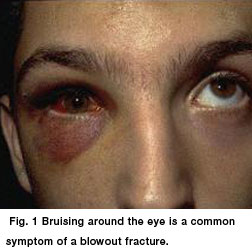
Johnson looked up the symptoms of an “orbital blowout fracture” and quoted the from description:
The most common symptoms are bruising, tenderness and swelling around the eye; redness of the eye; double vision, ordiplopia (seeing two images at the same time); numbness of the cheek, nose or teeth; nose bleeds (epistaxis) [See figure 1].
Symptoms that typically indicate a more serious injury are pain on eye movement, double vision, air under the skin around the eye, and numbness of the cheek/mouth/nose on the side of the injury. Severe trauma may cause facial bone fractures, injury to the eye itself, and injuries to the skull/brain.
You’d think someone who had just experienced such a serious eye injury would be in terrible pain and would have difficulty accurately shooting a gun. You also think he would need immediate medical attention; yet no ambulance was called for either Brown or Wilson, and Wilson was video taped walking near Brown’s body and show no signs of discomfort. Here’s the cell phone video taken by eyewitness Piaget Crenshaw.
Yesterday this story showed up on Fox News, with Bill O’Reilly reporting the “orbital blowout” claim; and today ABC News is reporting that Wilson suffered “a serious facial injury,” although they aren’t including the “orbital blowout fracture” claim. ABC news also has a video interview with an anonymous friend of Wilson’s. It’s odd that Wilson’s friends and supporters don’t want to give their names or show their faces while the eyewitnesses to the shooting have been upfront and straightforward about what they saw.
As for the facial injury, I guess we’ll have to wait and see if there is trial. At that point Wilson will need to produce medical records to prove he had a serious injury and had it promptly treated. Even then, we still won’t know how it happened. For all we know, he could have hit himself with his gun or on the car door. I can’t help but be reminded of George Zimmerman’s claims of serious injuries caused by Trayvon Martin–the injuries he didn’t bother to have a doctor examine until the next day. The bottom line is that even if Wilson actually was injured, Michael Brown should be alive and in jail now. Instead, Wilson chose to execute him on the spot.
The latest smear from right wing Wilson supporters is that Michael Brown’s friend Dorian Johnson has “recanted” his eyewitness version of the shooting. Once again, Charles Johnson responds, Did Michael Brown’s Friend Dorian Johnson “Recant” His Story? No, He Did Not.
Finally, a right wing site is raising money for Darren Wilson, and they have collected nearly $150,000 in the past three days.
The good news is that Ferguson was fairly calm yesterday after the visit from Attorney General Eric Holder. From The Washington Post, Eric H. Holder Jr., in Ferguson, shares painful memories of racism.
Attorney General Eric H. Holder Jr. arrived in the St. Louis area Wednesday to tour a community roiled by the police shooting of an unarmed African American teen — nine months after he had visited the same city to tout new initiatives aimed at keeping poor black men out of prison.
Long before the white-hot spotlight of the racially charged protests in the St. Louis suburb of Ferguson, Holder had been intent on reforming an American criminal justice system that he said imposed “shameful” disparities on minority communities. The death of 18-year-old Michael Brown on Aug. 9 has thrust Holder, 63, into the heart of a national debate over racial justice that he has aimed to make part of his legacy.
In meetings with residents, Holder shared his own stories of being pulled over and accosted by police while growing up in New York City — and of being skeptical of police even while serving as a federal prosecutor in Washington.
“I understand that mistrust. I am the attorney general of the United States. But I am also a black man,” Holder said during an appearance at Florissant Valley Community College. “I think about my time in Georgetown — a nice neighborhood of Washington — and I am running to a picture movie at about 8 o’clock at night. I am running with my cousin. Police car comes driving up, flashes his lights, yells ‘where you going? Hold it!’ I say, ‘Whoa, I’m going to a movie.’ ”

A man identified as Kajiene Powell, with an object in his right hand, approaches police in north St. Louis. Police say that the object was a knife and that he threatened officers before he was shot to death. (St. Louis Police Department)
Not far from the spot where Michael Brown died, another young black man was killed by St. Louis Metropolitan Police on Tuesday. A video of the shooting was released yesterday. From Huffington Post, St. Louis Police Release Video Of Kajieme Powell Killing That Appears At Odds With Their Story, by Ryan Grimm and Ashley Alman.
A convenience store owner called 911 on Tuesday when he suspected Powell stole drinks and donuts from his shop, according to a recording of the call. Another woman called to report Powell was acting erratically and had a knife in his pocket.
Two officers in a police SUV responded to the calls, the cell phone video shows. When the officers got out of their vehicle, Powell walked in their direction, yelling and telling them to shoot him already.
St. Louis Police Chief Sam Dotson said Tuesday that both of the officers opened fire on Powell when he came within a three or four feet of them holding a knife “in an overhand grip.”
But the newly released cell phone footage undermines the statement, showing Powell approaching the cops, but not coming as close as was reported, with his hands at his side. The officers began shooting within 15 seconds of their arrival, hitting Powell with a barrage of bullets.
Kajieme Powell apparently had long-term psychological problems. I’m not going to watch the video, but even in the still photo from the LA Times above, it looks to me as if police could have disarmed Powell and arrested him without using deadly force. The knife wasn’t raised as police claimed, and he certainly doesn’t appear to be within three feet of the officers.
A mentally disturbed man was killed by police in Sacramento, California on Monday. The Sacramento Bee reports:
Jeffrey Towe lived with delusions and profound mental illness, family members say. On Monday, he became the ninth person in the Sacramento region to die of police gunfire this year.
Towe, 53, fatally shot his own mother in 1990 in an incident that he said was a household accident. Two weeks ago, he delivered a collection of knives to his sister, telling her he couldn’t be trusted around them.
A Woodland police officer shot him dead Monday after authorities said Towe allegedly charged with a knife after officers arrived at his apartment building in response to a call about a disturbed, screaming man.
Towe’s death prompted local activists to converge Monday evening in Woodland, already motivated by the national story of the fatal police shooting of 18-year-old Michael Brown in Ferguson, Mo., and law enforcement response to protests there. They congregated downtown, blocking an intersection, chanting “Hands up! Don’t shoot!” – a slogan popularized in Ferguson.
In that incident, a California Highway Patrol officer shot and wounded a man who allegedly pulled a gun on officers in a drunken-driving stop. The suspect, who was hospitalized in critical but stable condition, was identified as Heath Austin Nunes, 38, of Lincoln.
The four-county Sacramento region, which includes Sacramento, Yolo, Placer and El Dorado counties, this year has nearly doubled the five fatal officer-involved shootings in 2013. In 2012, there were 16 fatal police shootings, including a record 10 by the Sacramento County Sheriff’s Department. Statewide, California averaged 100 annual deaths from police shootings from 2006 to 2011.
The United States has no database of police shootings. There is no standardized process by which officers log when they’ve discharged their weapons and why. There is no central infrastructure for handling that information and making it public. Researchers, confronted with the reality that there are over 17,000 law enforcement agencies in the country, aren’t even sure how you’d go about setting one up. No one is keeping track of how many American citizens are shot by their police. This is crazy. This is governmental malpractice on a national scale. We’d like your help in changing this.
Here, we’re going to take a cue from Jim Fisher, who as far as we can tell has compiled the most comprehensive set of data on police shootings in 2011. Fisher’s method was simple: He searched for any police-involved shooting every day for an entire year. By our lights, this is the best way to scrape this information—any time a police officer shoots and hits a citizen, it will almost certainly make a local news report, at least. However, this is a time-intensive process, and our manpower is limited. Having gathered some of the data, we can say it will take the few of us here a very long time to do this on our own. So, we’re setting up a public submission form and asking for help with this project.
Check it out if you’re interested.
So I’ve run out of space and time for this post. There’s plenty of other news, so I’ll post some more links in the comments. I hope you’ll do the same.
Tuesday Reads
Posted: July 23, 2013 Filed under: Crime, Criminal Justice System, Foreign Affairs, Fox News, Media, morning reads, polling, psychology, racism, Republican politics, Russia, seniors, social justice, sports, U.S. Politics, War on Women | Tags: attitudes toward Zimmerman verdict, dolphins, Edward Snowden, ESPN, FSB, George Zimmerman, horse race politcs, Margaret Sullivan, naming behavior, Nate Silver, NYT public editor, Russian intelligence, self-consciousness, self-recognition, Trayvon Martin, University of St Andrews, Vincent Janik 28 Comments
Good Morning!!
I have a varied selection of stories for you today. I’ll begin with one that doesn’t involve politics, racism, murder, woman-hating, or any other depressing topics. A new study released yesterday provides additional evidence that Dolphins may see each other as unique individuals. From BBC News: Dolphins ‘call each other by name’
It had been-long suspected that dolphins use distinctive whistles in much the same way that humans use names.
Previous research found that these calls were used frequently, and dolphins in the same groups were able to learn and copy the unusual sounds.
But this is the first time that the animals response to being addressed by their “name” has been studied.
Dr Vincent Janik University of St AndrewsTo investigate, researchers recorded a group of wild bottlenose dolphins, capturing each animal’s signature sound.
They then played these calls back using underwater speakers.
“We played signature whistles of animals in the group, we also played other whistles in their repertoire and then signature whistles of different populations – animals they had never seen in their lives,” explained Dr Janik.
The researchers found that individuals only responded to their own calls, by sounding their whistle back.
According to Janik,
“(Dolphins) live in this three-dimensional environment, offshore without any kind of landmarks and they need to stay together as a group.
“These animals live in an environment where they need a very efficient system to stay in touch.”
Although humans start naming things almost as a matter of course during early development, the process of creating and using a name is actually quite complex. Scientists refer to names as learned vocal labels, meaning vocalizations that refer to specific objects. Both parrots and dolphins have used learned vocal labels while in captivity, and researchers had no reason to believe that the animals couldn’t do the same in their natural environments. Now biologists Stephanie King and Vincent Janik from the University of Aberdeen have found that, indeed, wild dolphins use the equivalent of a human name to address each other.
What’s interesting to me is that if these dolphins can recognize each other as individuals and recognize their own names, this suggests a level of self-consciousness that is seen in very few animals other than humans. Even human children do not develop the ability to recognize themselves (PDF) in a mirror or on film until they are at least 18 months old and the development of true self-consciousness and awareness that others have similar thoughts and feelings (theory of mind) takes much longer.
The Washington Post reports on a depressing, but not surprising, poll on attitudes toward the Trayvon Martin case. Zimmerman verdict poll: Stark reaction by race.
The not-guilty verdict in the trial of George Zimmerman has produced dramatically different reactions among blacks and whites, with African Americans overwhelmingly disapproving of the jury’s decision and a bare majority of whites saying they approve of the outcome, according to a new Washington Post-ABC News poll….
The new survey underscores not only the gap between whites and blacks, but also how passionate many African Americans are about the case. Among African Americans, 86 percent say they disapprove of the verdict — with almost all of themsaying they strongly disapprove — and 87 percent saying the shooting was unjustified.
In contrast, 51 percent of whites say they approve of the verdict while just 31 percent disapprove. There is also a partisan overlay to the reaction among whites: 70 percent of white Republicans but only 30 percent of white Democrats approve of the verdict. Among all whites, one-third say the shooting was unjustified, one-third say it was justified and the other third say they didn’t know enough to have an opinion.
It figures that Republicans would be driving the results among whites. Republicans have truly become the party of white males who hate anyone who isn’t white and male. You have to wonder why any African American or any woman would choose to be a Republican. Unfortunately the poll didn’t break down the results by gender and geography. Would more women have disapproved of the verdict? It was an all-woman jury, but also a Florida jury. A more complex analysis would have been helpful.
Republicans–at least the ones who watch Fox News–are old too. It’s hard to believe, but even though Fox leads the other cable news channels in viewers, the average age of Fox viewers is 65-plus! From the NYT:
Fox News declined to make executives available for comment, but several recent signs — including changing personalities for some of its weekday programs — suggest the network may have decided the time has come to confront the issue of age.
Just how old is its audience? It is impossible to be precise because Nielsen stops giving an exact figure for median age once it passes 65. But for six of the last eight years, Fox News has had a median age of 65-plus and the number of viewers in the 25-54 year old group has been falling consistently, down five years in a row in prime time, from an average of 557,000 viewers five years ago to 379,000 this year. That has occurred even though Fox’s overall audience in prime time is up this year, to 2.02 million from 1.89 million three years ago….
“The numbers indicate they haven’t been replacing the younger viewers,” Mr. Moffett said of Fox News. Many of the loyal viewers the network has always had are simply aging up beyond the 54-year cutoff for many ad buyers. The result is an audience edging consistently above that 65-plus number.
News audiences always trend old, and the viewers of Fox’s competitors are hardly in the full flower of youth. MSNBC’s median age for its prime-time shows this year is 60.6; CNN’s is 59.8.
In terms of the rest of television, Fox News also is quite a bit older than networks considered to have a base of older viewers. CBS has frequently been needled for having older viewers, but at 56.8, its median viewer is far younger than Fox News’s. (Viewers at Fox News’s sister network, Fox Broadcasting, have a median age of 50.2; at ABC, the median is 54.4; at NBC, it’s 47.7.)
Speaking of old-fashioned viewpoints, I posted this in the comments yesterday, but it’s worth a closer look. Yesterday, Margaret Sullivan the NYT Public Editor posted a remarkable column about Nate Silver: Nate Silver Went Against the Grain for Some at The Times. Sullivan speculates that Silver may have decided to leave the Times for ESPN/ABC because his fact- and probability-based methods of writing about politics didn’t jive with the attitudes of some other Times journalists. She based her analysis on a number of conversations with Silver and “about him with journalists in the Times’s newsroom.”
* I don’t think Nate Silver ever really fit into the Times culture and I think he was aware of that. He was, in a word, disruptive. Much like the Brad Pitt character in the movie “Moneyball” disrupted the old model of how to scout baseball players, Nate disrupted the traditional model of how to cover politics.
His entire probability-based way of looking at politics ran against the kind of political journalism that The Times specializes in: polling, the horse race, campaign coverage, analysis based on campaign-trail observation, and opinion writing, or “punditry,” as he put it, famously describing it as “fundamentally useless.” Of course, The Times is equally known for its in-depth and investigative reporting on politics.
His approach was to work against the narrative of politics – the “story” – and that made him always interesting to read. For me, both of these approaches have value and can live together just fine.
* A number of traditional and well-respected Times journalists disliked his work. The first time I wrote about him I suggested that print readers should have the same access to his writing that online readers were getting. I was surprised to quickly hear by e-mail from three high-profile Times political journalists, criticizing him and his work. They were also tough on me for seeming to endorse what he wrote, since I was suggesting that it get more visibility.
A few reactions to the Nate Silver story:
JM Ashby at Bob Cesca.com: Revenge of the Nerd
TPM: Nate Silver’s Seven Most Memorable Predictions
Politico: How ESPN and ABC landed Nate Silver
Business Insider got Silver’s own reaction to the Sullivan column: ‘The Culture Stuff Was Not A Big Factor’ In Me Leaving The New York Times
I’ll wrap this up with a some Edward Snowden updates. It’s very clear at this point that Snowden is being controlled by Russian intelligence. We don’t really know where he is, and his spokesman is an “attorney” who is in charge of PR for the Russian FSB. We also don’t know what Snowden has given the FSB in return for their help. Geoffrey Ingersoll at Business Insider:
Russian attorney Anatoly Kucherena — who also happens to be the head of public council for the Federal Security Service (FSB) — has announced that Edward Snowden may leave the Moscow airport on Wednesday.
That’s right, he’s likely not going too far.
We also know that Snowden supposedly said he has no plans to travel to Latin America because at this time, he thought it too dangerous to travel.
How do we know that? Well, Kucherena said Snowden said it, of course.
Not only does Kucherena run the FSB’s public council, but it seems he runs Snowdens public relations
as well — he “helped” Snowden apply for temporary asylum, he relayed Snowden’s “promise” not to hurt the U.S. anymore, and he announced Snowden’s (very own) idea about possibly applying for Russian citizenship with the intent to stay for a while and “learn Russian culture.”
And here’s Michael Kelley, also from Business Insider: The Intel In Snowden’s Head Could Be More Damaging Than The Material He Leaked
National Security Agency whistleblower/leaker Edward Snowden reportedly flew to Hong Kong carrying “four laptop computers that enable him to gain access to some of the US government’s most highly-classified secrets,” raising the concern that data could have been compromised in China or Russia.
But the information in his head may be more valuable, and accessible, than highly encrypted files.
Beyond trying to acquire information about the 10,000 NSA files Snowden accessed in Hawaii, a U.S. adversary would want to learn from Snowden’s expertise of internal NSA processes — such as its recruiting and vetting processes — to gain insight into America’s decision loop.
“Snowden understood exactly how far he could push [the NSA],” Robert Caruso, a former assistant command security manager in the Navy and consultant, told Business Insider. “That, coupled with his successful exploitation of our entire vetting process, makes him very dangerous.”
There’s much more of interest in the Kelley article, including a timeline of Snowden’s activities. Highly recommended.
I have several more Snowden links that I’ll just list for anyone who’s interested to click on:
NBC News: Lawyer: Snowden hopes to leave Moscow airport by Wednesday
CNN: Snowden did not access ‘crown jewels’ of NSA intel, official says
The Voice of Russia: US communicates concerns over Snowden to Russian gov’t – ambassador
ABC News: New Snowden Documents Show NSA-Germany Spy Links: Report
Atlantic Wire: Edward Snowden Has Everything and Nothing
Now it’s your turn. What stories have caught your interest today? I look forward to clicking on your links!
Tuesday Reads: Rachel and Trayvon, Reid Going Nuclear, Spy Stories, and Much More
Posted: July 16, 2013 Filed under: Civil Liberties, Civil Rights, Crime, Criminal Justice System, Foreign Affairs, Lebanon, morning reads, NSA, National Security Agency, Political Affective Disorder, racism, Russia, U.S. Politics | Tags: al Qaida, Alexei Nikitin, Amnesty International, Charles Ramsey, Edward Snowden, Filibuster, George Zimmerman, Harry Reid, Hezbollah, Human Rights Watch, Mitch McConnell, NSA, nuclear option, Piers Morgan, political asylum, Rachel Jeantel, Tanya Lokshina, Trayvon Martin, US Senate, Vladimir Putin 42 Comments
Good Morning!!
I’m not sure if it’s the heat or the depressing news, but I’m having a hard time getting going this morning.
We’re into our third heat wave of the summer, and I’m actually getting acclimated to 90 degree weather; but I suppose it still has an effect on my body and mind.
I’m also somewhat depressed about the Zimmerman verdict and by the often ignorant reactions I see on-line and on TV.
Rachel and Trayvon
One bright spot in the coverage for me was Rachel Jeantel’s interview with Piers Morgan last night. She was real and authentic, and Morgan pretty much stayed out of the way and let her talk. I think she made a real impression on him and the reaction from the live audience was very positive too. It was refreshing. IMO, it says a lot about Travon Martin’s character that he had a friend like Rachel. I’m going to post the whole interview here in case you missed it or you want to watch it again.
From Mediaite:
Asked about what Trayvon Martin was like as a friend, Jeantel described him as a “calm, chill, loving person” and said she never saw him get “aggressive” or “lose his temper.” She said that the defense’s attempts to portray Martin as a “thug” were unfounded and defended his relatively mild drug use. “Weed don’t make him go crazy,” she said, “it just makes him go hungry.”
Jeantel also responded to the massive mockery she received in social media for the way she speaks, explaining that she was born with an under-bite that has made it difficult for her to speak clearly. When Morgan asked if she’d been bullied for her condition, she simply responded, “Look at me,” to laughter from the studio audience.
Morgan attempted to get Jeantel to offer her opinion of defense attorney Don West, who many claimed was condescending towards her when she was on the stand. Jeantel shook her head, declining to say anything bad about the man given her “Christian” upbringing.
In the second part of his interview with Jeantel, Morgan turned to the “creepy-ass cracker” comment she made and the major impact it had on the tenor of the case. She explained that the term is actually spelled “cracka” and defined it as “people who are acting like they’re police.” She said that if Zimmerman had calmly approached Martin and introduced himself, her friend would have politely said what he was doing there and nothing more would have happened.
Unlike the juror, Jeantel did think Zimmerman was racially motivated. “It was racial,” she said. “Let’s be honest, racial. If Trayvon was white and he had a hoodie on, would that happen?”
I’d also like to recommend this piece by Robin D.G. Kelley at Counterpunch: The US v. Trayvon Martin.
In the aftermath of the Sandy Hook Elementary School massacre, Texas Congressman Louie Gohmert, Virginia Governor Bob McDonnell, Senator Rand Paul, Florida State Representative Dennis Baxley (also sponsor of his state’s Stand Your Ground law), along with a host of other Republicans, argued that had the teachers and administrators been armed, those twenty little kids whose lives Adam Lanza stole would be alive today. Of course, they were parroting the National Rifle Association’s talking points. The NRA and the American Legislative Exchange Council (ALEC), the conservative lobbying group responsible for drafting and pushing “Stand Your Ground” laws across the country, insist that an armed citizenry is the only effective defense against imminent threats, assailants, and predators.
But when George Zimmerman fatally shot Trayvon Martin, an unarmed, teenage pedestrian returning home one rainy February evening from a neighborhood convenience store, the NRA went mute. Neither NRA officials nor the pro-gun wing of the Republican Party argued that had Trayvon Martin been armed, he would be alive today. The basic facts are indisputable: Martin was on his way home when Zimmerman began to follow him—first in his SUV, and then on foot. Zimmerman told the police he had been following this “suspicious-looking” young man. Martin knew he was being followed and told his friend, Rachel Jeantel, that the man might be some kind of sexual predator. At some point, Martin and Zimmerman confronted each other, a fight ensued, and in the struggle Zimmerman shot and killed Martin.
Zimmerman pursued Martin. This is a fact. Martin could have run, I suppose, but every black man knows that unless you’re on a field, a track, or a basketball court, running is suspicious and could get you a bullet in the back. The other option was to ask this stranger what he was doing, but confrontations can also be dangerous—especially without witnesses and without a weapon besides a cell phone and his fists. Florida law did not require Martin to retreat, though it is not clear if he had tried to retreat. He did know he was in imminent danger.
Why didn’t Trayvon have a right to stand his ground? Why didn’t his fear for his safety matter? We need to answer these questions as a society. Please read the whole article if you can.
Read the rest of this entry »
Thursday Reads
Posted: July 11, 2013 Filed under: morning reads | Tags: Alexander Kouzminov, Boston Bombings, Bradley Manning, Don West, Dzhokhar Tsarnaev, Ed Fucarile, Edward Snowden, George Zimmerman, J.W. Carney, James "Whitey" Bulger, John Guy, Jr., Judge Debra Nelson, Kevin Weeks, Marc Fucarile, Mark O'Mara, Oleg Gordievsky, Trayvon Martin 66 Comments
Good Morning!!
There’s been quite a bit of legal and courthouse news this week, so I’m going to focus on that today.
Yesterday was a big day at the Boston Federal Courthouse as the Whitey Bulger trial was briefly eclipsed by the first court appearance of Boston Bombing suspect Dzhokhar Tsarnaev. From The Boston Globe:
Dzhokhar Tsarnaev shuffled into the courtroom, appearing confident despite the ankle chains and an orange jumpsuit so big on him that it made him appear younger than his 19 years.
As federal prosecutors read the charges against him Wednesday in his first appearance since being captured in April, Tsarnaev repeatedly looked over his shoulder at the packed courtroom, at one point blowing a kiss to his sisters, one sobbing and another holding a baby.
He leaned into the microphone in the hushed courtroom to tell Judge Marianne B. Bowler with an accent that he pleaded not guilty to 30 charges, including use of weapons of mass destruction. More than 30 victims of the Marathon bombings and about a dozen supporters who say they believe Tsarnaev is innocent watched intently as the accused terrorist yawned and stroked the side of his face, which appeared swollen from a wound.
Tsarnaev, who could receive the death penalty, fidgeted in his seat as he listened to the charges, one of his attorneys patting him on the back gently several times. He had a visible scar just below his throat and had a cast on his left arm.
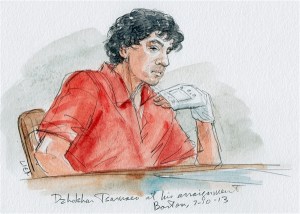
Dzhokhar Tsarnaev
ABC News talked to survivors of the April 15 bombings who showed up to watch Tsarnaev’s court appearance.
Friends and family members of people whose lives were shattered when two homemade bombs went off near the finish line of the Boston Marathon on April 15 packed three rooms in a federal courthouse on Wednesday as suspect Dzhokhar Tsarnaev pleaded not guilty to a 30-count indictment.
But the fleeting courtroom encounter brought little relief to Bostonians who said the 19-year-old —accused of conducting the deadly bombings with the help of his older brother Tamerlan Tsarnaev —showed little feeling.
“He came out and he smirked at the families,” said Ed Fucarile, 64, outside of the John Joseph Moakley federal courthouse along the water in South Boston. “The lawyers put their hands on his shoulders like it was going to be all right.”
Fucarile wore a Boston Strong t-shirt with the name of Marc Fucarile, his son who lost his right leg and still carries shrapnel in his body, the father said.
Marc Fucarile, 34, was standing near the second blast when it went off. He still has more surgeries to go, and has spent every day of the nearly three months since receiving medical care, his father said. Members of the family have taken weeks off work so that someone is always at Marc’s bedside, he said.
Read more survivors’ stories at the link.
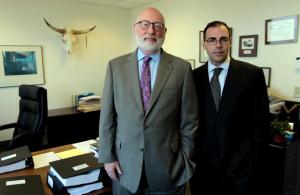
Bulger defense team: J.W. Carney Jr. and Hank Brennan
At the Whitey Bulger trial, there was a bit of comic relief as Bulger flew into a rage toward the end of testimony and exchanged curses with his former close friend and partner Kevin Weeks. It was reminiscent of a scene from Sopranos.
Bulger’s lawyer, J.W. Carney, tried to portray Weeks as an opportunist who knew how to manipulate the system, someone who cut a deal with prosecutors to serve just five years in prison for aiding and abetting five killings, several of which, Weeks testified, he saw Bulger commit.
“You won against the system,” said Carney.
“What did I win? What did I win,” Weeks said, his voice sounding strained and tired. “Five people are dead.”
Asked whether that bothered him, Weeks shot back, “We killed people that were rats, and I had the two biggest rats right next to me …”
At that, Bulger turned and hissed, “You suck.”
“F— you, OK,” snapped Weeks.
“F— you, too,” shouted Bulger as the jury watched.
“What do you want to do?” said Weeks, his eyes locked on Bulger, who was flushed and staring right back.
At one point Weeks even threatened Carney, asking him if he’d like to step outside.
Weeks grew belligerent and threatening as Carney accused him of lying, challenged his motivation for cooperating, and suggested that Weeks, not Bulger, was a rat.
“You can’t rat on a rat,” said Weeks, adding that he lives in South Boston and walks the streets without being called a rat.
When Carney asked Weeks what he would do if someone did call him a rat, Weeks snapped that if he stepped outside the courthouse he’d show him.
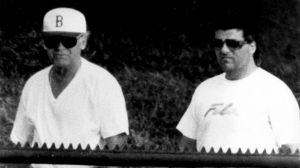
James Bulger and Kevin Weeks
Yesterday the testimony was even more grotesque and sickening, as forensic expert Ann Marie Mires testified about remains of murder victims Arthur Barrett, Deborah Hussey, John McIntyre, and Paul J. McGonagle. I’ll spare you the descriptions; you can go to the links and read more if you’re interested.
This morning Carney asked the judge for a break in the testimony so the defense team could catch up.
The defense team for James “Whitey” Bulger is asking the judge to suspend testimony until next week so they can catch up on evidence.
Defense attorney J.W. Carney filed the motion with the court on Thursday.
“Simply put, the defendant’s counsel have hit a wall, and are unable to proceed further without additional time to prepare for upcoming witnesses,” the motion reads. “Counsel have struggled mightily to be ready for each day of the trial since it began on June 3, 2013, working seven days a week and extraordinarily long hours.” [….]
“A major problem has been the delay in the receipt of discovery from the prosecution,” the motion reads, citing examples of receiving binders of documents pertaining to testimony to be given by witnesses the evening before they take the stand.
Yesterday defense teams rested in both the Bradley Manning and the George Zimmerman trials.
From the Guardian via Raw Story: Bradley Manning defense rests its case after calling just 10 witnesses
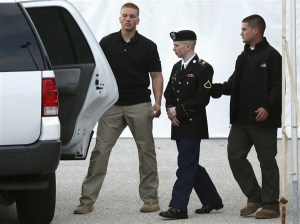
Having called just 10 witnesses over the space of three days, the defence phase of the trial was brought to a close far quicker than expected. The defence had indicated in earlier hearings that it intended to call more than 40 witnesses, although many may yet still be presented in court during the post-verdict sentencing stage of the court martial.
By contrast, the prosecution took 14 days to make its case, drawing on 80 witnesses.
On Wednesday, the defence team lead by the civilian lawyer David Coombs, focused its attentions on the most serious charge facing the Army private – that he “aided the enemy” by transmitting information to WikiLeaks knowing that it would be accessible to enemy groups notably al-Qaida. Manning faces a possible sentence of life in military custody with no chance of parole under this single charge.
The final defence witness called, the Harvard law professor Yochai Benkler, delivered blistering testimony in which he portrayed WikiLeaks as a legitimate web-based journalistic organisation. He also warned the judge presiding in the case, Colonel Denise Lind, that if the “aiding the enemy” charge was interpreted broadly to suggest that handing information to a website that could be read by anyone with access to the internet was the equivalent of handing to the enemy, then that serious criminal accusation could be levelled against all media outlets that published on the web.
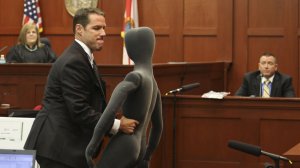
Prosecutor John Guy with dummy
Yesterday was quite a theatrical one in the Zimmerman trial, as a mannequin was brought into court and both a prosecutor and defense attorney Mark O’Mara got down on the floor and straddled the dummy in effort to act out what might have happened during an alleged altercation between Zimmerman and his victim Trayvon Martin.
As professional images go, what followed in the courtroom was probably not something for which Mark O’Mara would most like to be remembered.
Hitching up his pant legs and straddling a life-size human mannequin, Zimmerman’s lead defense counsel got down and dirty on the courtroom floor and proceeded to demonstrate for jurors the “ground and pound” move that they have been told Martin exerted on the accused.
Coming a day after he encouraged one of his witnesses, gym owner and mixed martial arts trainer Adam Pollack, to “step down from the stand to give me an example of a mounted position,” prostrating himself on the floor and asking Pollack, “Where do you want me?” the episode made for an awkward role play, leaving court observers snickering and biting their lips in the midst of an otherwise tragic plot.
Earlier in the day, prosecutor John Guy—described by one public observer in the courtroom on the trial’s opening day as “the supermodel of attorneys”—had also hopped on the mannequin for a similar demonstration in front of the all-female jury.
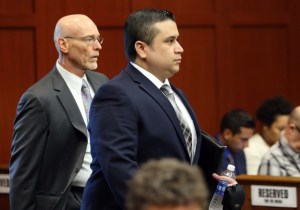
Don West and George Zimmerman
Later Judge Debra Nelson had a “testy exchange” with defense attorney Don West as she asked Zimmerman whether he planned to take the stand. Zimmerman seemed unsure, and West tried to step in.
West repeatedly challenged Nelson’s decision to press Zimmerman for a clear answer. The judge repeatedly slapped him down, her voice gathering volume every time.
“The court is entitled to ask Mr. Zimmerman about his determination as to whether he wants to testify,” Nelson insisted tersely after West objected to her line of questioning.
She looked back at Zimmerman: “How long do you think you need before you make that decision?” she inquired again, as the defendant—who had a minute earlier been made to raise his hand and swear under oath that any decision whether to testify would be his—turned to his counsel for help.
“I object to the court inquiring of Zimmerman about his intention to testify,” West whimpered for a second time.
“I object to the court inquiring of Zimmerman about his intention to testify,” West whimpered for a second time.
“And I have O-VER-RULED” Judge Nelson spat back—several times—as the objections kept coming.
Finally Zimmerman haltingly said he did not want to testify. I think he actually wanted to–if only. What a disaster that would have been for his attorneys! Closing arguments are scheduled to begin this afternoon.
In other news, I can’t resist sharing this article from Time Magazine about what former Russian spies think is probably happening to Edward Snowden in Russia.
In the summer of 1985, KGB colonel Oleg Gordievsky was called back to Moscow from the Soviet embassy in London, where he was serving as a resident spy. As a pretext, his commanders told him that he was going to receive an award for his service. But in fact the KGB suspected him of being a double agent — which he was — and they were looking to interrogate him. So upon his arrival, his KGB colleagues, still concealing their suspicions, took him to a comfortable country estate in the suburbs of the Russian capital, much like the one where Gordievsky and other former spies believe Edward Snowden, the NSA whistle-blower, has spent the past few weeks….
The official story coming from the Russian government since then is that Snowden has been holed up in the transit zone of Moscow’s Sheremetyevo airport, waiting for some third country to grant him asylum. But few experts or officials in Moscow still believe that to be true. The accepted wisdom, unofficially acknowledged by most Western and Russian sources, is that Snowden was taken soon after his arrival — if not immediately — to a secure location run by some arm of the Russian government.
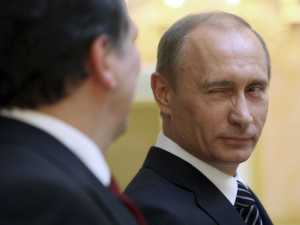
Experts and former spies who have dealt with the Russian security services are sure that agents would want to get the encryption keys to the data stored on Snowden’s four laptops. The only way to do that would be to get Snowden to give them up.
So Gordievsky believes Snowden would have gotten roughly the same treatment that the KGB spy got back in 1985. “They would have fed him something to loosen his tongue,” Gordievsky says by phone from the U.K., where he has been living in exile for nearly three decades. “Many different kinds of drugs are available, as I experienced for myself.” Having been called back to Moscow, Gordievsky says his KGB comrades drugged him with a substance that “turned out his lights” and made him “start talking in a very animated way.” Although the drug wiped out most of his memory of the incident, the parts he did recollect horrified him the following morning, when he woke up feeling ill. “I realized that I had completely compromised myself,” he says.
One of the substances the KGB used for such purposes at the time was called SP-117, which is odorless, tasteless and colorless, according Alexander Kouzminov, a former Russian intelligence operative who describes the drug’s effectiveness in his book, Biological Espionage. Now living in New Zealand, Kouzminov worked in the 1980s and early 1990s for the Foreign Intelligence Service, the spy agency known as the SVR, which handles undercover agents, or “illegals,” stationed in foreign countries. In his book, Kouzminov writes that various drugs were used periodically to test these operatives for signs of disloyalty or diversion. Once the drug had worn off, the agents would have no recollection of what they had said and, if their test results were satisfactory, they could be sent back into the field as though nothing had happened.
Yesterday, Snowden announced through Glenn Greenwald that “I never gave any information to Chinese or Russian governments.” I guess he assumes that Chinese and Russian officials don’t read The Guardian, The Washington Post, or the South China Morning Post. Anyway now it’s not clear if he would even remember if he gave them anything.
For all you Snowden and Greenwald fans out there, this information comes from an article in Time Magazine based on interviews with people who have actual experience with the ways Russia deals with spies. Don’t shoot the messenger.

 peej
peej Carissa
 bostonboomer
 dakinikat
 ecocatwoman
 mablue2
 Mama Lopez
 peggysue22
 quixote
 skydancingguestblogger
 Mona (aka Wonk the Vote)



 Sky Dancing
Recent Comments