
Tuesday Reads: SCOTUS and Voting Rights, Iraq War Buildup, and Reno Saccoccia
Posted: March 19, 2013 Filed under: morning reads, U.S. Politics, Violence against women | Tags: Ahmed Chalabi, Anthony Kennedy, Antonin Scalia, Christopher Hitchens, David Frum, Dick Cheney, George W. Bush, Iraq War, Reno Saccoccia, Sonya Sotomayor, Steubenville rape case, voting rights 35 Comments
Good Morning!!
There’s a great big sloppy white mess outside my house this morning–something like 6 or 7 inches of heavy, wet snow. I’m not sure how I’ll get out of here; I may have to try to hire someone to dig me out. Anyway, I’m resigned to being stuck in the house for today at least.
Soooo… let’s see what happening in the news.
I’m going to start out with some news from the Supreme Court. Yesterday the court debated another voting rights case, and once again Sonya Sotomayor went toe-to-toe with right-wing judicial activist Antonin Scalia. This time it was a case from Arizona over whether a state can require proof of citizenship beyond what is required by federal voter registration forms. Here’s some background from Spencer Overton at HuffPo:
The latest case involves the simple question of whether Arizona can refuse to accept a federal voter registration form. But the stakes are much higher. A victory for Arizona could accelerate a nationwide trend of political operatives attempting to manipulate election rules for political gain, and could undermine the power of Congress to protect voting rights.
The National Voter Registration Act requires that all states “accept and use” a single, uniform voter registration form for federal elections. States can still use their own registration forms, but they must also accept and use the Federal Form. The purpose of the Federal Form is to increase participation by preventing states from erecting barriers to voter registration.
The Federal Form requires that prospective voters check a box and sign the form affirming they are U.S. citizens under penalty of perjury. Arizona, however, adopted a state law requiring “satisfactory proof” of U.S. citizenship to register, such as a birth certificate, U.S. passport, or state driver’s license that shows citizenship.
As a result, Arizona initially rejected over 31,000 voter registration applications — including citizens who registered using the Federal Form. Community-based registration drives were hit especially hard, because they rely on approaching individuals who may not be carrying a birth certificate or similar documentation (or unwilling to give a photocopy of these sensitive documents to a registration-drive volunteer). For example, community-based registration drives in Arizona’s largest county — Maricopa County — dropped 44%.

Obviously, if Arizona wins the case, other red states would pass similar laws that would trump federal voting regulations. Yesterday, Sotomayor and Scalia “clashed” over the Arizona law. Talking Points Memo:
Much as they did weeks ago during arguments over the constitutionality of the Voting Rights Act, the two justices on Monday each led the charge on opposite sides of the case — Scalia for less federal involvement in states’ ability to set their voting laws, and Sotomayor for broad national authority to protect citizens’ right to vote.
Sotomayor’s opening volley began immediately after Arizona Attorney General Thomas C. Horne stepped up to defend his state’s law. She fired off a series of questions, which she would continue asking in different flavors throughout his argument, about inconsistencies between Arizona’s Prop 200 and the NVRA.
“If I see the purpose of the NVRA to simplify registration, how are Arizona’s provisions consistent with that objective and purpose, given that … many people don’t have the documents that Arizona requires?” Sotomayor said. She asked Horne why he thinks Congress would have required states to accept a voter registration form if states can then turn around and require additional information like a passport or birth certificate.
“Why isn’t that just creating another form?” she demanded. Arizona, she said, may object to the fact that proof of citizenship isn’t required, but “that’s what Congress decided.”
As for Scalia:
The conservative jurist wasn’t convinced requiring people to attest under oath was sufficient.
“So it’s under oath — big deal,” Scalia said. “If you’re willing to violate the voting laws, I suppose you’re willing to violate the perjury laws.” He posited that only “a very low number” of voters would be harmed by a requirement to submit proof of citizenship.
Well that makes sense–not. Why bother having witnesses swear to tell the truth in court cases then?
Of course Anthony Kennedy was his usual waffling self. Again from TPM:
At one point, Kennedy wrestled with whether Arizona’s proof-of-citizenship requirement crosses a line. He asked the state’s attorney general, who was defending the law, whether states may also require proof of one’s address or date of birth when registering to vote. If so, he posited, then the federal requirement “is not worth very much.”
At another point, he launched a defense of Arizona’s actions in principle and took issue with some of the reasoning by the Ninth Circuit Court of Appeals, which ruled against Arizona.
“The state has a very strong and vital interest in the integrity of its elections,” Kennedy said, “even when those, and perhaps especially when those are elections of federal officials. And it seems to me the Ninth Circuit’s new test did not give sufficient weight to that interest.”
Roberts is apparently “leaning slightly” toward Arizona’s point of view. It’s really frightening that voting rights are in the hands of this conservative court. Thank goodness for Sotomayor’s willingness to be vocal in her arguments. Here are couple more interesting tidbits:
“Let me give you this example,” Alito said. “A person rides up to a place to register on a bicycle and gets out and hands in the federal form. This boy looks like he is 13 years old and he is carrying school books, he is wearing a middle school t-shirt, but he has filled out the form properly. Are they required to register him?”
Retired Justice Sandra Day O’Connor, a native Arizonan who in 2010 ruled against her statein this case from a lower court on which she occasionally sits, was present in the chamber.
In the final moments, Scalia warned the Obama administration’s lawyer, who was arguing against Arizona, that if the constitutionality of the NVRA form is challenged in broader terms, “You’re going to be in bad shape — the government’s going to be.”
There was a little bit of good news from the Court yesterday, according to HuffPo: Supreme Court Refuses To Hear Goldman Sachs’ Appeal To Financial Crisis Lawsuit.
Goldman Sachs Group Inc suffered a defeat on Monday as the U.S. Supreme Court let stand a decision forcing it to defend against claims it misled investors about mortgage securities that lost value during the 2008 financial crisis.
Without comment, the court refused to consider Goldman’s appeal of a September 2012 decision by the 2nd U.S. Circuit Court of Appeals in New York. Goldman shares sank more than 2 percent.
That court let the NECA-IBEW Health & Welfare Fund, which owned some mortgage-backed certificates underwritten by Goldman, sue on behalf of investors in certificates it did not own, but which were backed by mortgages from the same lenders.
Goldman and other banks have faced thousands of lawsuits by investors seeking to recoup losses on mortgage securities.
The bank has said that letting the 2nd Circuit decision stand could cost Wall Street tens of billions of dollars.
{{applause}}
David Frum posted a fascinating article at The Daily Beast late yesterday on the lead-up to the Iraq War. Frum was a speechwriter for George W. Bush at the time. You should read the whole thing, but I’ll just quote this one intriguing portion:
The first time I met Ahmed Chalabi was a year or two before the war, in Christopher Hitchens’s apartment. Chalabi was seated regally at one end of Hitchens’s living room. A crowd of nervous, shuffling Iraqis crowded together at the opposite end. One by one, they humbly stepped forward to ask him questions or favors in Arabic, then respectfully stepped backward again. After the Iraqis departed, Chalabi rose from his chair and joined an engaged, open discussion of Iraq’s future democratic possibilities.
The last time I saw Chalabi was in his London apartment, on the very eve of war. My little group arrived past midnight. Chalabi was listening to the evocative strains of Sufi music. He showed me a black-and-white photograph of seven men, wearing the clothes of the 1940s. They were the board of directors of a company his father had founded: a mixed group of Sunni, Shiite, and Christian, and even a Jew. Chalabi remarked that this picture was taken while Europe was tearing itself apart in genocidal violence. He didn’t add that it was taken shortly after British forces defeated a pro-Axis coup in Baghdad—but failed to prevent a murderous pogrom against Baghdad’s Jewish population.
I was less impressed by Chalabi than were some others in the Bush administration. However, since one of those “others” was Vice President Cheney, it didn’t matter what I thought. In 2002, Chalabi joined the annual summer retreat of the American Enterprise Institute near Vail, Colorado. He and Cheney spent long hours together, contemplating the possibilities of a Western-oriented Iraq: an additional source of oil, an alternative to U.S. dependency on an unstable-looking Saudi Arabia.
You might imagine that an administration preparing for a war of choice would be gripped by self-questioning and hot debate. There was certainly plenty to discuss: unlike the 1991 Gulf War, there was no immediate crisis demanding a rapid response; unlike Vietnam, the U.S. entered the war fully aware that it was commencing a major commitment.
Yet that discussion never really happened, not the way that most people would have imagined anyway. For a long time, war with Iraq was discussed inside the Bush administration as something that would be decided at some point in the future; then, somewhere along the way, war with Iraq was discussed as something that had already been decided long ago in the past.
I’m running out of space, so I’ll leave you with this follow-up to the Steubenville rape trial.

From Deadspin: Fire This Asshole: Why Does Steubenville’s Football Coach Still Have His Job?
Reno Saccoccia is a local legend, in the way that 30-year coaches of football powerhouses in economically depressed Ohio Valley towns tend to be legends. He’s in the Ohio Coaches Hall of Fame. He’s won three state titles. When Saccoccia won his 300th game last year, a sellout crowd of more than 10,000 people packed Harding Stadium—christened “Reno Field” in 2007—and chanted “Reno, Reno, Reno” as he left the field.
He breakfasts regularly with the sheriff. His sister-in-law works in the county’s juvenile court, where he is licensed as a mediator. He “molds young boys into men.” So how did Saccoccia react when he got word that two of his young boys were accused of raping a passed-out student?
On the night of the assault, a Steubenville student recorded this video joking about it. Off-camera, someone says “Trent and Ma’lik raped someone.” Among the text messages released at the trial of Trent Mays and Ma’lik Richmond, one sent by Mays indicated that Saccoccia had seen the video:
Deleate that off You-tube. Coach Sac knows about it. Seriously delete it.
Saccoccia would later claim he was unaware of the social media evidence, angrily telling a reporter that he didn’t “do the internet.” But a flurry of texts sent on August 13, the day after the incident, indicated that Saccoccia had heard what had happened.
Even as all of Steubenville gradually heard the rumors, even after a local blogger alerted the country to what had happened in Steubenville, those involved in posting and sharing the photos and videos continued to play. They were only suspended eight games into the season, more than two months after the assault and arrests.
Less than a month later, Saccoccia testified on behalf of Mays and Richmond in a hearing to determine whether they would be tried as adults.
As we all know, the “boys” were tried as juveniles and got off easy. Seriously, this asshole has to go!
I have some more stories to share, but I’ll put them in the comments . . . What are you reading and blogging about today? I’m stuck in the house, so I have all the time in the world to click on your links and read!
Paul Ryan Makes Major Freudian Slip
Posted: March 12, 2013 Filed under: psychology, U.S. Economy, U.S. Politics | Tags: Freudian slips, George W. Bush, Paul Ryan, Ryan budget 34 CommentsHilarious! While introducing his budget plan today, Paul Ryan unconsciously revealed his true purpose.
During the unveiling of his new budget proposal, House Budget Committee Chairman Paul Ryan (R-Wis.) made a slip of the tongue while railing against President Obama’s healthcare law.
“This is something we will not give up on because we are not going to give up on destroying the healthcare system for the American people,” Ryan accidentally said.
Here’s the clip, courtesy of DailyKos:
Bwwwwwwaaaaaahahahahahahaha!!!
That put me in mind of another great Freudian slip by the master of Freudian slips, George W. Bush.
This is psychoanalytic open thread. Just kidding–it’s wide open. What are you hearing?
It’s Finally Happened: Obama Has Driven the Pundits Insane!
Posted: March 4, 2013 Filed under: 2012 presidential campaign, Barack Obama, The Media SUCKS, U.S. Economy, U.S. Politics | Tags: Bill Keller, Dean Baker, George W. Bush, John F. Kennedy, Robert J. Samuelson, Ronald Reagan, tax cuts 54 Comments
Sure, these two guys were a little nutty to begin with, but now they’ve gone around the bend.
First up: Have you seen the latest drivel from Robert J. Samuelson? Seriously, even the Washington Post should be ashamed to publish this guy. Get this — Samuelson says that sequestration is John F. Kennedy’s fault!
How so?
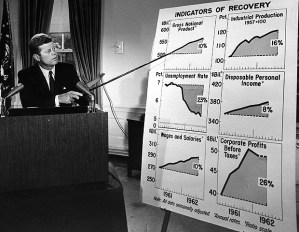
Fifty years ago, President Kennedy made a decision that, with hindsight, ranks as the biggest mistake of domestic policy since World War II. In many ways, it led directly to today’s “sequester” debacle.
Good Grief! What’s he talking about? The Bay of Pigs? The Cuban missile crisis?
No silly, President Kennedy decided to stimulate the economy.
In early 1963, he proposed a $13.6 billion tax cut (today: about $320 billion) even though the economy was not in recession and the tax cut would enlarge the budget deficit. Kennedy adopted the theory that government could, by manipulating its budgets, increase economic growth, reach “full employment” (then a 4 percent unemployment rate) and reduce — or eliminate — recessions.
It was a disaster.
High inflation was the first shock. An initial boom (by 1969, unemployment was 3.5 percent) spawned a wage-price spiral. With government seeming to guarantee 4 percent unemployment, workers and businesses had little reason to restrain wages and prices. In 1960, inflation was 1 percent; by 1980, it was 13 percent. The economy became less stable. From 1969 to 1982, there were four recessions, as the Federal Reserve alternated between trying to push unemployment down and prevent inflation from going up. Only in the early 1980s did the Fed, under Paul Volcker and with Ronald Reagan’s support, crush inflationary psychology.
A disaster? Really? I was a kid in the 1960s. The economy was great in those days–until 1973, those were the best economic times I’ve experienced in my lifetime. Unemployment was low, wages were good, people like my parents were movin’ on up to the middle class. But don’t take it from me–let’s see what an actual economist has to say about this. Here’s Dean Baker at the Center for Economic Policy Research (CEPR):
Samuelson’s economic history is even more striking than the linking of Kennedy to the sequester. He notes the fiscal stimulus that was sparked by the Kennedy tax cuts (and the Vietnam War and Johnson’s Great Society programs) and the boom that resulted, and tells us that “it was a disaster.”
….
Before looking at Samuelson’s horror story here, it is worth noting what happened in the boom, which can be treated as going through 1973, in spite of the recession in 1969. Growth over the 10 years from 1963 to 1973 averaged 4.4 percent, by far the most rapid stretch in the post-World War II era.
The unemployment rate hovered near 4.0 percent for most of this period, as Samuelson complains. This led to large gains in real wages and sharp declines in poverty. The overall poverty rate fell from 19.5 percent in 1963 percent to 11.1 percent in 1973, an all-time low. For African Americans the poverty rate fell from 55.1 percent in 1959 (annual data is not available) to 31.4 percent in 1973. I suspect most folks wouldn’t mind a few more disasters like this one.
As far as the recession story, Samuelson might have told readers that we had the same number of recessions in the 13 years following 1969 as we did in the 12 years preceding 1961. I suppose those recessions were also due to the Kennedy tax cut.
There’s lots more at both links. But you have to read Samuelson’s column to believe it. He goes on to claim that because of JFK’s tax cut, we developed “the loss of budgetary discipline,” and we’re still suffering from that 50 years later. So how does he rationalize the deficit spending under Reagan and W. Bush? He doesn’t.
And over at The New York Times, Iraq War propagandist Bill Keller disagrees with Samuelson: he thinks sequestration is “Obama’s Fault.” And of course he’s still droning on about “entitlements.” Keller admits that both parties agreed on the sequestration cuts, but it’s still really Obama’s fault because he hasn’t completely destroyed the safety net yet. And here’s the best part: Obama refuses to enact Simpson Bowles.
In December 2010 the commission, led by Erskine Bowles and Alan Simpson, delivered its list of spending cuts and revenue increases, plus the entitlement reforms necessary to fortify Medicare and Social Security for the surge of baby-boom retirees.
The Simpson-Bowles agenda was imperfect, and had plenty to offend ideologues of the left and right, which meant that it was the very manifestation of what Obama likes to call “a balanced approach.”
Ummm…no, Bill, the Commission never issued a report. They couldn’t agree on a unified agenda, so Simpson and Bowles wrote up their own report which was never approved by the commission members.
Now here’s where Keller really goes off the rails:
If Obama had campaigned on some version of Simpson-Bowles rather than on poll-tested tax hikes alone, he could now claim a mandate from voters to do something big and bold. Most important, he would have some leverage with members of his own base who don’t want to touch Medicare even to save it. This was missed opportunity No. 1.
That’s really funny. If Obama had campaigned on Simpson-Bowles, Mitt Romney would be president now. Because if you campaign on really really unpopular issues, people have a tendency to like, not vote for you.
There’s much more at the link, but you get the idea.
Can Romney Embrace Ryan While Distancing Himself from the Ryan Budget?
Posted: August 11, 2012 Filed under: 2012 presidential campaign, U.S. Economy, U.S. Politics | Tags: Charles Pierce, entitlements, George W. Bush, John Nichols, Medicaid, medicare, Mitt Romney, Paul Ryan, Social Security 21 Comments
No, he can’t.
This morning, shortly after Romney’s announcement of Paul Ryan as his pick for VP, CNN obtained a copy of of a list of media talking points for surrogates, designed by the Romney campaign to distance their candidate from Ryan’s plans for draconian changes to Medicare and cuts to other popular social programs that help the middle class, the elderly, the disabled, and the poor. Here are some examples:
Is Romney “adopting the Paul Ryan plan?”
Gov. Romney applauds Paul Ryan for going in the right direction with his budget, and as president he will be putting together his own plan for cutting the deficit and putting the budget on a path to balance.
So there are differences between Romney and Ryan?
Of course they aren’t going to have the same view on every issue. But they both share the view that this election is a choice about two fundamentally different paths for this country. President Obama has taken America down a path of debt and decline. Romney and Ryan believe in a path for America that leads to more jobs, less debt and smaller government. So, while you might find an issue or two where they might not agree, they are in complete agreement on the direction that they want to lead America.
On Medicare:
Do you worry that Paul Ryan’s controversial Medicare plan will hurt the campaign with independents?
– No. President Obama is the one who should be worried, because he has cut $700 BILLION from Medicare to pay for Obamacare, and put in place a panel of Washington bureaucrats to make decisions about what kind of care seniors will receive under Medicare. Mitt Romney and Paul Ryan have a bipartisan plan to strengthen Medicare by giving future seniors the choice between traditional Medicare and a variety of private plans. They are committed to ensuring that Medicare remains strong, not just for today’s seniors, but for tomorrow’s seniors as well.
Actually, Ryan’s budget plan retains all of the medicare cuts that are included in Obamacare.
Of course the talking points provide no specifics about these supposed differences in the two men’s policies. I think we have to assume that since Romney’s goal so far has been to scrupulously avoid talking about specific policies, he is going to be stuck with defending the Ryan plan. And he should be forced to defend it again and again and again.
Why? Because Romney has explicitly endorsed Ryan’s plan in public on multiple occasions. Think Progress has identified five occasions on which Romney enthusiastically praised the Ryan plan:
1. “Very supportive.”“I’m very supportive of the Ryan budget plan. It’s a bold and exciting effort on his part and on the part of the Republicans and it’s very much consistent with what I put out earlier. I think it’s amazing that we have a president who three and a half years in still hasn’t put a proposal out that deals with entitlements. This president’s dealing with entitlement reform — excuse me — this budget deals with entitlement reform, tax policy, which as you know is very similar to the one that I put out and efforts to reign in excessive spending. I applaud it. It’s an excellent piece of work and very much needed.”
2.”The right tone.” Romney told Talking Points Memo, “He is setting the right tone for finally getting spending and entitlements under control. …Anyone who has read my book knows that we are on the same page.’”
3. “Marvelous.” “I think it’d be marvelous if the Senate were to pick up Paul Ryan’s budget and to adopt it and pass it along to the president,” Romney once professed while in Wisconsin.
4. “An important step.” “I spent a good deal of time with Congressman Ryan. When his plan came out, I applauded it, as an important step. … We’re going to have to make changes like the ones Paul Ryan proposed.”
5. “The same page.” In March, on a local Wisconsin radio show called the Vicki McKenna Show, Romney told the host “Paul Ryan and I have been working together over some months to talk about our mutual plans and we’re on the same page.”
In addition, Romney super-surrogate John Sununu
said on a call with reporters, “Mitt Romney supports what Paul Ryan did. He endorsed what Paul Ryan did. Mitt Romney had his own package of entitlement reform, which Paul Ryan has praised. They both meshed together.”
There is no way Romney can be permitted to etch-a-sketch all that away.
Furthermore, I think we can assume that, if elected, Romney would give Ryan carte blanche in dealings with Congress and fiscal matters. As Governor of Massachusetts, Romney only put in about two years before he got bored with governing and turned over his duties to his staff so he could start running for president.
Romney isn’t interested in policy. He’s a CEO, accustomed to giving orders, delegating tasks, and expecting admiration and obeisance from his underlings. Ryan’s already good at sucking up; he was named “biggest brown-noser” by his high school graduating class, after all. Ryan would be Romney’s Cheney–praising his gaffe-prone boss while doing things his (Ryan’s) own way.
The Nation’s John Nichols, who is from Wisconsin and has followed Ryan’s career closely, agrees.
The hyper-ambitious political careerist—who has spent his entire adult life as a Congressional aide, think-tank hanger-on and House member—is looking for a road up. And he is sly enough to recognize that, like Dick Cheney with George Bush, he could be more than just a vice president in the administration of so bumbling a character as Romney.
Ryan figured Romney out months ago.
The two men bonded during the Wisconsin presidential primary campaign in late March and early April. They got on so well that Ryan was playing April Fool’s Day jokes on the Republican front-runner—giving Romney a rousing introduction before the candidate came from behind a curtain to find the room where he had expected to be greeted by a crowd of supporters was empty.
Romney loves those frat boy stunts. Ryan would be the perfect sidekick for him. But we can’t let it happen. Ryan’s plan is a complete fraud. Now the Obama campaign has the opportunity to expose Ryan for what he is: a fake and a “hypocritical big spender” who, as John Nichols points out, has never yet lifted a finger to actually cut government spending during his decade in Congress.
I’ll let Charlie Pierce summarize Ryan’s fakery:
He’s a garden-variety supply-side faker. His alleged economic “wonkery” consists of a B.A. in economics from Miami of Ohio — which he would not have been able to achieve without my generosity in helping him out with the Social Security survivor’s benefits that got him through high school after his father kicked. (You’re welcome, zombie-eyed granny-starver. Think nothing of it. Really.) Whereupon he went to work in Washington for a variety of conservative congresscritters and think-tanks, thinking unremarkable thoughts for fairly unremarkable people. Once in Congress, however, he has been transformed into an intellectual giant despite the fact that, every time he comes up with another “budget,” actual economists get a look at it and determine, yet again, that between “What We Should Do” and “Great Things That Will Happen When We Do” is a wilderness of dreamy nonsense, wishful thinking, and an asterisk the size of Lake Huron.
This is the man whose plan Willard Mitt Romney has now signed onto. If Romney wants to “distance” himself from Ryan’s plan, then he’s going to have to start getting very specific about what their differences are. In choosing Ryan as his running mate, Romney has made this a campaign about “entitlements.” He can no longer focus on just attacking Obama and making vague promises.
I say bring it on! Look what happened to George W. Bush when he tried to privatize Social Security. Romney can no longer focus on just attacking Obama for failing to get us out of the worse economic crisis since the Great Depression. Romney is going to have to own the Ryan budget and Ryan’s plans to decimate the social safety net–or he’ll have to explain exactly where he disagrees with Ryan and why.
Saturday Reads: Mitt the Twit, The Churchill Bust, And Much More
Posted: July 28, 2012 Filed under: 2012 presidential campaign, Barack Obama, Corporate Crime, Diplomacy Nightmares, Mitt Romney, morning reads, U.S. Politics | Tags: "Anglo-Saxon values", Bobby Knight, Charles Krauthammer, David Cameron, Elizabeth Warren, European Central Bank, eurozone crisis, George W. Bush, gun control, Janet Jackson, Jesse Jackson Jr., Katherine Jackson, LIBOR scandal, London Olympics, Mario Draghi, Mayo Clinic, Michael Bloomberg, Mitt the Twit, Neil Reed, Nowhere Man, NRA, Oval Office, Paris Jackson, Scott Brown, White House, Winston Churchill bus 24 Comments
President Barack Obama shows Prime Minister David Cameron of the United Kingdom a bust of Sir Winston Churchill in the private residence of the White House, July 20, 2010. (Official White House Photo by Pete Souza)
Good Morning!
Mitt Romney’s gaffetastic journey began before he even arrived in London when the Telegraph published this now-infamous article based on interviews with some Romney “advisers” who indicated that Mitt would Mitt would “restore ‘Anglo-Saxon’ relations between Britain and America.” The advisers also said that Romney would
seek to reinstate the Churchill bust displayed in the Oval Office by George W. Bush but returned to British diplomats by Mr Obama when he took office in 2009. One said Mr Romney viewed the move as “symbolically important” while the other said it was “just for starters”, adding: “He is naturally more Atlanticist”.
Romney claims he “does not know who these advisers are,” but he apparently agrees with them about the Churchill bust because last night
he told a group of more than 200 supporters in [a] hotel in the heart of London…[that] he is “looking forward” to returning the bust of Winston Churchill to the White House after it was sent back to Great Britain by President Obama.
Mitt the Twit told these supporters [actually wealthy banksters involved in the LIBOR scandal] that he was deeply impressed by the statue of Churchill in London.
The GOP candidate, who suffered a brutal day of press after he suggested that he wasn’t sure the London Olympics would go off without a hitch, spoke highly of the British monuments — singling out the Churchill statue — that he said he got a firsthand look at while stuck in traffic — likely caused by the Olympic Games.
“You live here, you see the sites day in and day out, but for me as I drive past the sculpture of Winston Churchill and see that great sculpture next to Westminster Abbey and Parliament and with him larger than life, enormous heft of that sculpture suggesting the scale of the the grandeur and the greatness of the man, it tugs at the heart strings to remember the kind fo [sic] example that was led by Winston Churchill,” said Romney, speaking in a ballroom at the Mandarin Oriental hotel on the edge of Hyde Park.
Boy, he really laid it on thick, didn’t he? But Mitt the Twit was misinformed, as were the “advisers” that he says he doesn’t know. It turns out that the Churchill bust never left the White House! The White House put up a “fact check” post to clear up the misinformation, although they studiously avoided mentioning Romney.
Lately, there’s been a rumor swirling around about the current location of the bust of Winston Churchill. Some have claimed that President Obama removed the bust of Winston Churchill from the Oval Office and sent it back to the British Embassy.
Now, normally we wouldn’t address a rumor that’s so patently false, but just this morning the Washington Post’s Charles Krauthammer repeated this ridiculous claim in his column. He said President Obama “started his Presidency by returning to the British Embassy the bust of Winston Churchill that had graced the Oval Office.”
This is 100% false. The bust still in the White House. In the Residence. Outside the Treaty Room.
So where did that story about a bust being removed from the Oval Office come from?
The White House has had a bust of Winston Churchill since the 1960’s. At the start of the Bush administration Prime Minister Blair lent President Bush a bust that matched the one in the White House, which was being worked on at the time and was later returned to the residence. The version lent by Prime Minister Blair was displayed by President Bush until the end of his Presidency. On January 20, 2009 — Inauguration Day — all of the art lent specifically for President Bush’s Oval Office was removed by the curator’s office, as is common practice at the end of every presidency. The original Churchill bust remained on display in the residence. The idea put forward by Charles Krauthammer and others that President Obama returned the Churchill bust or refused to display the bust because of antipathy towards the British is completely false and an urban legend that continues to circulate to this day.
I’m sure this won’t stop Nowhere Man from claiming otherwise, since he appears to delight in lying about just about everything.
Here’s a brief video of some of the reactions to Romney in the London tabloids
I won’t bore you with many more tales of Romney’s European vacation, but I really liked this piece in the Guardian by Jonathan Freedland: Britain is an easy date. So how did Mitt Romney mess up so badly?
For an American politician, Britain is an easy date: just praise the country as a steadfast ally, mention Churchill a couple of times and we’ll roll over. Yet somehow Romney managed to provoke both the prime minister and the capital’s mayor – both fellow conservatives who should regard a Republican nominee as a kindred spirit – into public rebukes. That takes some doing. So what explains how an accomplished politician, with the resilience to have prevailed in a bruising primary campaign, could mess up so badly? The answer says a lot about Romney – and a fair bit about the dire state of today’s Republican party.
In the first category comes the observation that, despite having sought the presidency twice and served as a state governor, Romney is not really a politician at all – not in the Bill Clinton sense of someone who thinks, talks and breathes politically, constantly calculating the likely impact of both words and deeds. Instead Romney speaks and acts like the chief executive he was for so long, whether of private equity firm Bain Capital or the Salt Lake City Winter Olympics of 2002.
As we’ve learned in recent weeks, thanks to the likes of Barclays’ Bob Diamond or G4S’s Nick Buckles, corporate titans, so used to the nodding appreciation of yes men, can lack elementary tact and diplomacy, failing to weigh their words for tone, timing and likely reception. Technically, nothing in what Romney said about London 2012 was especially contentious – if, that is, he were merely the former CEO of the 2002 Games speaking privately to Coe a month ago. But for a man who seeks to be the lead partner in the US-UK alliance, speaking on the day before the Olympic flame was lit, it was a diplomatic disaster.
It’s surely CEO thinking too which has led Romney to refuse to release all his past tax returns, even though President Obama has published his in full. CEOs recoil from such personal transparency, while politicians know they will have to succumb eventually and so had better get it over with. Above all, their exorbitant pay means the elite chief executive class is habitually and unavoidably out of touch with everyone else. It is the Romney of the 1% who could smilingly tell an audience in hard-pressed Detroit that his wife has “a couple of Cadillacs”, beaming again today as his wife referred to the “horses”, plural, she owns (including one competing in the Olympic dressage event, providing a picture-perfect image of elitism for his opponents to feast on).
I thought that was a very insightful assessment.
In other news, Rep. Jesse Jackson Jr. is at the Mayo Clinic in Minnesota “being evaluated for depression, ‘gastrointestinal issues'”
This one is for Pat: Katherine Jackson Returns Home, Paris Jackson Tweets About It.
I’m not sure I understand everything that happened, but Katherine Jackson says she needed a rest and so she went to Arizona, getting rid of her cell phone so she wouldn’t be bothered. But there’s something else going on:
While Michael’s will gave Katherine custody of his children and a 20 percent stake in his massive estate, her husband, Joe Jackson, and the eight surviving Jackson siblings were completely cut out. Some of the siblings have reportedly been exploring a move to have the will invalidated by arguing that Michael was in New York on the day that the document was notarized in Los Angeles.
In a video that surfaced earlier this week, Janet Jackson is seen trying to take a cell phone away from Paris, 14, and berating her niece for using her phone to tweet about family business. That video leaked after Janet, Jermaine and Randy Jackson reportedly attempted to persuade Paris and Prince, 15, to leave Katherine’s home on Monday. Both resisted and a short time later, sheriff’s deputies arrived to break up a scuffle between Randy, Jermaine Jackson and TJ.
MTV has more detail on the family fracas via TMZ:
Sources tell TMZ that Randy, Jermaine and Janet Jackson entered the home uninvited and then tried to coerce Michael’s children, Paris, Prince and Blanket, into coming with them to Arizona where their grandmother Katherine has been staying.
Sources say that Paris resisted the intervention and apparently things got violent. Allegedly, Janet slapped Paris and yelled, “You’re a spoiled little bitch!” to which Paris responded with a slap and told Janet, “This is our house. Not the Jackson family house. Get the f–k out!”
TMZ shares that Trent Jackson (Joe Jackson’s nephew who deals with Katherine’s daily affairs) put Randy in a headlock and punched Jermaine in the mouth. Tito Jackson was reportedly trying to get temporary guardianship of Michael’s kids.
And I thought my family was dysfunctional!
There may be a breakthrough in the Eurozone crisis. Reuters:
Stocks rallied on Friday on expectations the European Central Bank will tackle high borrowing costs hitting Spain and Italy, but the euro pared gains on market uncertainty about the specific action to be taken.
The benchmark S&P 500 closed at its highest since early May, climbing further after Bloomberg News said ECB President Mario Draghi will meet with Bundesbank President Jens Weidmann to discuss several measures, including bond purchases, to help the euro zone.
The French and German governments said they are “determined to do everything to protect the euro zone” and its single currency. The joint statement echoed similar remarks by Draghi on Thursday, but in comments on Friday, Germany’s Bundesbank pushed back against Draghi’s pledge.
Tim Geithner will also meet with Schaeuble and Draghi next week in Germany.
The meeting with Schaeuble will take place on the German island of Sylt in the afternoon of July 30, and the session with Draghi will be held that evening in Frankfurt, the Treasury Department said in a statement today.
The Treasury said the meetings will be closed to the press, with a photo opportunity before the Schaeuble meeting. A Treasury official with knowledge of the matter said that Geithner and Schaeuble won’t hold a news conference after the meeting.
The Guardian has a live blog with updates on the ongoing crisis.
Bobby Knight hit the Google top stories list last night, because Neil Reed, the former IU basketball player who was choked by Knight during practice, has died at age 36.
In March 2000, Reed accused Knight of choking him during a practice in 1997. When video of the practice surfaced backing Reed’s claim, Knight, a Hall of Fame coach who was known for his angry outbursts as well as his success, was put on zero-tolerance notice by Dr. Myles Brand, then the university president. That September, Knight was fired after a student said he had grabbed his arm.
Reed transferred to Southern Mississippi shortly after the choking incident and played there in the 1998-99 season.
He is survived by his wife, Kelly, and two daughters.
So sad that he was known for that horrible incident and then died so young. When I first saw Knight’s name on the list, I thought maybe he had died.
Finally, NYC Mayor Michael Bloomberg plans to hold a fundraiser for Scott Brown in August. Get this:
A spokesman for Bloomberg, Stu Loeser, says the mayor’s top reason for supporting Brown is the senator’s opposition to a proposal backed by the National Rifle Association that would allow gun owners to carry concealed weapons across state lines.
Loeser said Warren’s tough stance on Wall Street regulation was not the basis for the endorsement.
Hahahahahaha!! Somehow I doubt that Warren is a big NRA supporter….

 peej
peej Carissa
 bostonboomer
 dakinikat
 ecocatwoman
 mablue2
 Mama Lopez
 peggysue22
 quixote
 skydancingguestblogger
 Mona (aka Wonk the Vote)



 Sky Dancing
Recent Comments