
Wednesday Reads: Clown Prince Trump
Posted: April 9, 2025 Filed under: Donald Trump, U.S. Economy, U.S. Politics | Tags: bond market crash, China, Elon Musk, EU, Financial Crisis, global safe haven, Stock Market, UK 13 Comments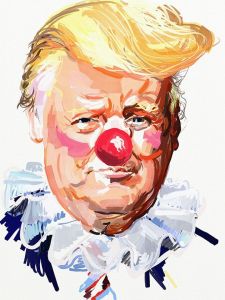
By Eric Fischl
Hello Sky Dancers!!
Dakinikat should be writing this post, but you’re stuck with me. I stayed up till about 2:30 last night doom scrolling and trying to understand what Trump’s tariff madness has done to us. The latest disaster last night was that the bond market is collapsing.
I’ll do my best to post relevant stories, and perhaps Dakinikat will chime in later. Thanks to Trump’s insanity, we could end up in another financial crisis comparable to the one in 2008.
What’s happening with tariffs:
There’s even more insane news this morning: China responded to Trump’s 104 percent tariff threat with another 84% tariff on the U.S.
CNBC: China slaps 84% retaliatory tariffs on U.S. goods in response to Trump.
China has pushed back again on U.S. President Donald Trump’s tariff policies by hiking its levies on U.S. imports to more than 80%.
Tariffs on U.S. goods entering China will rise to 84% from 34% starting April 10, according to a translation of a Office of the Tariff Commission of the State Council announcement. The hike comes in response to the latest U.S. tariff increase on Chinese goods to more than 100% that began at midnight.
The tit-for-tat escalation of tariffs threatens to crush trade between the world’s two largest economies. According to the Office of the U.S. Trade Representative, the U.S. exported $143.5 billion of goods to China in 2024, while importing products worth $438.9 billion.
The Trump administration announced a sweeping new tariff policy last week, warning other countries not to retaliate. Some nations, including Japan, have seemed willing to negotiate on tariffs, but China appears to be taking a more hard-line stance and quickly announced a countertariff.
After China’s initial response to the April 2 tariff rollout, Trump announced an additional 50% hike, putting the total level for import taxes on Chinese goods at 104%….
The trade war has spooked investors around the world by increasing the odds of slower economic growth, higher inflation and lower corporate profits, sparking a sharp sell-off in April.
The S&P 500 finished Tuesday down nearly 20% from its peak, putting the U.S. large-cap stock index in a bear market. South Korea’s Kospi Index fell into a bear market of its own on Wednesday. Stocks in Shanghai and Hong Kong are also down sharply since the U.S. tariff announcement on April 2.
David Pierson and Barry Wang at The New York Times: For U.S. and China, a Risky Game of Chicken With No Off-Ramp in Sight.
A whopping increase in tariffs, followed by a whopping retaliation. Nationalist Chinese bloggers comparing President Trump’s levies to a declaration of war. China’s Foreign Ministry vowing that Beijing will “fight to the end.”
For years, the world’s two biggest powers have flirted with the idea of an economic decoupling as tensions between them have risen. The acceleration this week of their trade relationship’s deterioration has made the prospect of such a divorce seem closer than ever.
That was underscored on Wednesday when China announced an additional 50 percent tariff on U.S. goods, matching new American levies that had taken effect hours earlier. China also struck at American companies, imposing export controls on a dozen of them and adding six others to a list of “unreliable entities,” preventing them from doing business in China.
China’s new tariffs, which will take effect on Thursday, mean all American goods shipped to China will face an additional 85 percent import tax. The minimum U.S. tax on Chinese imports is now 104 percent. Both figures would have been unimaginable a few weeks ago.
With China’s top leader, Xi Jinping, and Mr. Trump locked in a game of chicken — each unwilling to risk looking weak by making a concession — the trade fight could spiral even further out of control, inflaming tensions over other areas of competition like technology and the fate of Taiwan, the self-governing island claimed by Beijing.
Mr. Trump’s bare-knuckle tactics make him a singular force in U.S. politics. But in Mr. Xi, he faces a hardened opponent who survived the turmoil of China’s late-20th-century political purges, and who views the United States’ competitive tactics as ultimately aimed at subverting the ruling Communist Party’s legitimacy.
“Trump has never gone into a back-alley brawl where the other side is willing to brawl and use the same kind of tactics as him,” said Scott Kennedy, a senior adviser at the Center for Strategic and International Studies, a Washington think tank. “For China, this is about their sovereignty. This is about the Communist Party’s hold on power. For Trump, it might just be a political campaign.”
 From what I’m hearing and reading, this is going to hit U.S. small businesses hard, drive many of them into bankruptcy, and send their employees to the unemployment lines.
China isn’t the only country that’s retaliating.
Politico: EU takes revenge on Trump’s tariffs as countries approve €20B+ retaliation.
BRUSSELS — The EU can apply retaliatory tariffs on nearly €21 billion of U.S. products like soybeans, motorcycles and orange juice after the bloc’s 27 countries assented to the measures on Wednesday, the European Commission announced.
“The EU considers U.S. tariffs unjustified and damaging, causing economic harm to both sides, as well as the global economy. The EU has stated its clear preference to find negotiated outcomes with the U.S., which would be balanced and mutually beneficial,” the EU executive said in a statement.
Hitting back against U.S. President Donald Trump’s steel and aluminum tariffs, the European Union’s countermeasures will apply in three rounds. Measures covering €3.9 billion in trade will go into force next week, with a further €13.5 billion from mid-May and a final round of €3.5 billion following in December.
Only Hungary opposed the package, according to four EU diplomats with direct knowledge of the vote, while all other 26 countries voted in favor….
The retaliation does not yet respond to Trump’s imposition of 20 percent “reciprocal” tariffs on all EU exports, which came into force on Wednesday, and his latest 25 percent tariff on cars. Trump has also said tariffs on pharmaceuticals are coming soon.
The European Commission is considering putting forward its countermeasures on those tariffs as early as next week. “It will for sure be soon. I expect it could be as early as next week,” trade spokesperson Olof Gill said Tuesday.
What’s happening with the bond markets:
Felix Salmon at Axios: The bond market plunges as crisis brews.
The price of U.S. Treasury bonds is plunging, in what Treasury Secretary Scott Bessent on Wednesday called “deleveraging convulsions.” The effect is to raise borrowing costs just as recession fears spike.
Why it matters: The last thing America needed in the midst of a global trade war and a stock-market meltdown was a debt crisis too. But that now seems to be a real possibility.
What they’re saying: “This is the script for a truly existential financial crisis,” writes Columbia economic historian Adam Tooze, who wrote a whole book on the very similar dynamics that overtook the Treasury market in March 2020.
Driving the news: Bond yields — which move in the opposite direction to prices — are soaring in the wake of protectionist U.S. tariffs.
- The amount that the U.S. government needs to pay to borrow money for a decade rose briefly to more than 4.5% Wednesday morning. For a 30-year bond, the yield rose to more than 5%.
- Those moves are truly enormous by bond market standards. As recently as Friday, the 10-year yield was less than 4%, and the 30-year was below 4.4%.
The intrigue: In normal times, the most consistent buyer of Treasury bonds is a group of hedge funds that participate in something called the “basis trade.”
- They buy the bonds in order to hedge their derivatives exposure to institutional investors, who can lock in slightly higher yields in the futures market.
- The profit on any given trade is minuscule, but it’s also very close to risk-free, so the hedge funds can apply as much as 50x or even 100x leverage.
- By many accounts, the basis trade is now unwinding, which means the hedge funds are selling their bonds — or, at the very least, not buying new ones.
The big picture: In a move reminiscent of the bond-market tantrum that swept U.K. Prime Minister Liz Truss from office in 2022, the technical factors in the bond market were precipitated by — and also exacerbated — fundamental issues with the country’s finances.
 More from Philip Inman and Jasper Jolly at The Guardian: Dramatic sell-off of US government bonds as tariff war panic deepens.
US government bonds, traditionally seen as one of the world’s safest financial assets, are undergoing a dramatic sell-off as Donald Trump’s escalation of his tariff war with China sends panic through all sectors of the financial markets.
The falls suggest that as Trump’s fresh wave of tariffs on dozens of economies came into force, including 104% levies against Chinese goods, investors are beginning to lose confidence in the US as a cornerstone of the global economy.
The yield – or interest rate – on the benchmark 10-year US Treasury bond rose by 0.16 percentage points on Wednesday to 4.42%, its highest since late February – and this week has undergone the three biggest intraday moves since Trump was elected in November. Yields move inversely to prices, so surging yields mean falling prices as demand drops.
The move in the 30-year bond was more dramatic. The 30-year yield briefly jumped above 5% to its highest since late 2023 and was last trading at 4.9157%, or 0.2 percentage points higher than Tuesday.
“This is a fire sale of Treasuries,” said Calvin Yeoh, portfolio manager at the hedge fund Blue Edge Advisors. “I haven’t seen moves or volatility of this size since the chaos of the pandemic in 2020,” he told Bloomberg.
Analysts believe the US Federal Reserve may need to step in. Jim Reid, at Deutsche Bank, said: “Markets are pricing a growing probability of an emergency [interest rate] cut, just as we saw during the Covid turmoil and the height of the GFC [global financial crisis] in 2008.” [….]
UK bonds were also under severe pressure after the US moves. The yield on a 30-year UK gilt hit 5.518% on Wednesday morning, up 16 basis points and surpassing a previous 27-year high of 5.472% set in January.
Shorter-dated 10-year gilt yields were slightly higher at 4.69% while two-year yields ticked down at 3.92%.
Higher yields on gilts – UK government bonds – will make things even more difficult for Downing Street, as it will raise the cost of borrowing to fund investment.
Colby Smith at The New York Times (gift link): U.S. Bond Sell-Off Raises Questions About ‘Safe Haven’ Status.
A sharp sell-off in U.S. government bond markets has sparked fears about the growing fallout from President Trump’s sweeping tariffs and retaliation by China, the European Union and others, raising questions about what is typically seen as the safest corner for investors to take cover during times of turmoil.
Yields on 10-year Treasuries — the benchmark for a wide variety of debt — shot 0.2 percentage points higher on Wednesday, to 4.45 percent, a big move in that market. Just a few days ago, it had traded below 4 percent. Yields on the 30-year bond rose significantly as well, at one point on Wednesday topping 5 percent. Borrowing costs globally have also shot higher.
The sell-off comes as investors have fled riskier assets globally in what some fear has parallels to what became known as the “dash for cash” episode during the pandemic, when the Treasury market broke down. The recent moves have upended a longstanding relationship in which the U.S. government bond market serves as a safe harbor during times of stress.
Volatility has surged as stock markets have plummeted amid fears that the U.S. economy is hurtling toward stagflation, in which economic growth contracts while inflation surges. The S&P 500 is now on the verge of entering a bear market, meaning it has dropped 20 percent from its recent high.
 The global safe-haven:
“The global safe-haven status is in question,” said Priya Misra, a portfolio manager at JPMorgan Asset Management. “Disorderly moves have happened this week because there is no safe place to hide.”
Scott Bessent, the U.S. Treasury secretary, sought to tamp down concerns on Wednesday, brushing off the sell-off as nothing more than investors who bought assets with borrowed money having to cover their losses.
“I believe that there is nothing systemic about this — I think that it is an uncomfortable but normal deleveraging that’s going on in the bond market,” he said in an interview with Fox Business.
But the moves have been significant enough to raise broader concerns about how foreign investors now perceive the United States, after Mr. Trump decided to slap onerous tariffs on nearly all of its trading partners. Some countries have sought to strike deals with the administration to lower their tariff rates. But China retaliated on Wednesday, announcing an 84 percent levy on U.S. goods after Mr. Trump raised the tariff rate on Chinese goods to 104 percent.
In a social media post on Wednesday, the former U.S. Treasury secretary Lawrence H. Summers said the broader sell-off suggested a “generalized aversion to US assets in global financial markets” and warned about the possibility of a “serious financial crisis wholly induced by US government tariff policy.”
Some analysis and commentary on what’s happening:
Heather Cox Richardson at Letters from an American: April 8, 2025.
Stocks were up early today as traders put their hopes in Treasury Secretary Scott Bessent’s suggestion that the Trump administration was open to negotiations for lowering Trump’s proposed tariffs. But then U.S. Trade Representative Jamieson Greer said there would not be exemptions from the tariffs for individual products or companies, and President Donald J. Trump said he was going forward with 104% tariffs on China, effective at 12:01 am on Wednesday.
Markets fell again. By the end of the day, the Dow Jones Industrial Average had fallen by another 320 points, or 0.8%, a 52-week low. The S&P 500 fell 1.6% and the Nasdaq Composite fell 2.2%.
Rob Copeland, Maureen Farrell, and Lauren Hirsch of the New York Times reported today that over the weekend, Wall Street billionaires tried desperately and unsuccessfully to change Trump’s mind on tariffs. This week they have begun to go public, calling out what they call the “stupidity” of the new measures. These industry leaders, the reporters write, did not expect Trump to place such high tariffs on so many products and are shocked to find themselves outside the corridors of power where the tariff decisions have been made.
Elon Musk is one of the people Trump is ignoring to side with Peter Navarro, his senior counselor for trade and manufacturing. Navarro went to prison for refusing to answer a congressional subpoena for information regarding Trump’s attempt to overturn the 2020 presidential election. Since Musk poured $290 million into getting Trump elected in 2024 and then burst into the news with his “Department of Government Efficiency,” he has seemed to be in control of the administration. But he has stolen the limelight from Trump, and it appears Trump’s patience with him might be wearing thin.
Elizabeth Dwoskin, Faiz Siddiqui, Pranshu Verma, and Trisha Thadani of the Washington Post reported today that Musk was among those who worked over the weekend to get Trump to end his new tariffs. When Musk failed to change the president’s mind, he took to social media to attack Navarro personally, saying the trade advisor is “truly a moron,” and “dumber than a sack of bricks.”
Read the rest at the Substack link above.
David E. Sanger at The New York Times (gift link): An Experiment in Recklessness: Trump as Global Disrupter.
As the breadth of the Trump revolution has spread across Washington in recent weeks, its most defining feature is a burn-it-down-first, figure-out-the-consequences-later recklessness. The costs of that approach are now becoming clear.
Administration officials knew the markets would dive and other nations would retaliate when President Trump announced his long-promised “reciprocal” tariffs. But when pressed, several senior officials conceded that they had spent only a few days considering how the economic earthquake might have second-order effects.
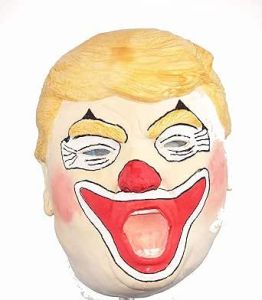
Trump clown mask
And officials have yet to describe the strategy for managing a global system of astounding complexity after the initial shock wears off, other than endless threats and negotiations between the leader of the world’s largest economy and everyone else.
Take the seemingly unmanaged escalation with China, the world’s second largest economy, and the only superpower capable of challenging the United States economically, technologically and militarily. By American and Chinese accounts, there was no substantive conversation between Mr. Trump and China’s top leader, Xi Jinping, or engagement among their senior aides, before the countries plunged toward a trade war.
Last Wednesday, Mr. Trump’s hastily devised formula for figuring out country-by-country tariffs came up with a 34 percent tax on all Chinese goods, everything from car parts to iPhones to much of what is on the shelves at Walmart and on Amazon’s app.
When Mr. Xi, predictably, matched that figure, Mr. Trump issued an ultimatum for him to reverse the decision in 24 hours — waving a red flag in front of a leader who would never want to appear to be backing down to Washington. On Wednesday, the tariff went to 104 percent, with no visible strategy for de-escalation.
If Mr. Trump does get into a trade war with China, he shouldn’t look for much help from America’s traditional allies — Japan, South Korea or the European Union — who together with the United States account for nearly half of the world economy. All of them were equally shocked, and while each is negotiating with Mr. Trump, they seem in no mood to help him manage China.
“Donald Trump has launched a global economic war without any allies,” the economist Josh Lipsky of the Atlantic Council wrote on Tuesday. “That is why — unlike previous economic crises in this century — there is no one coming to save the global economy if the situation starts to unravel.”
The global trading system is only one example of the Trump administration tearing something apart, only to reveal it has no plan for how to replace it.
Read the rest at the NYT.
Andrew Egger at The Bulwark: A Microwaved Mind.
There’s a paradox to covering Donald Trump these days. On the one hand, he’s never out of the news—a wannabe dictator busy remaking the government and the economy so that more and more decisions about our futures answer only to his whim. On the other hand, there’s so much news about what he’s doing that it’s easy to reduce our thinking about Trump to the sum of his actions. There’s Trump the bundle of bad policy ideas, Trump the destroyer of institutions, Trump the fountain of post-truth grievance. It’s hard to take the time to dwell on the man himself—to focus our attention on Donald Trump the clown.
Yesterday afternoon, as markets continued crashing and with the further implementation of backbreaking tariffs just hours away, the clown was on full display. Trump participated in the ceremonial signing of an executive order on “unleashing American energy.” In the East Room event, he was in his element: coal miners in hard hats behind him, an audience crammed with his political flunkies in front. He ended up riffing for about 45 minutes. Let’s listen in, shall we? [….]
The topic du jour, of course, was energy, specifically the “beautiful clean coal” that Trump loves so much. Trump riffed at length on the supposed stupidity of proposals to retrain miners for skilled labor in other industries, reminiscing his 2016 campaign against Hillary Clinton:
“One thing I learned about the coal miners . . . You could give them a penthouse on Fifth Avenue and a different kind of a job and they’d be unhappy. Coal mining is what they love to do,” Trump said. “And she was gonna put them in a high-tech industry, to make little cell phones, I don’t know. Do you think you’d be good at that? I don’t know.”
Anyway, no need for any of that now, the president exulted: “We’re gonna be crushing Biden-era environmental restrictions. . . . And we have clean air and clean water and now we have clean coal. And at the same time we’re gonna do other things and forms of technology and also energy, like our country has never seen before.”
On his tariffs:
Trump didn’t totally avoid talk of the market crash he kicked off last week—a “whole situation,” he noted, that “was somewhat explosive.”
But, Trump added, you should see the response we’re getting! “We have had talks with many, many countries. . . . And our problem is, we can’t see that many that fast. But we don’t have to because, you know, the tariffs are on, and money is pouring in at a level that we’ve never seen before.”
How much money are we talking? “We’re taking in almost $2 billion a day in tariffs,” Trump said. “America is gonna be very rich again very soon.”
Got all that? Yes, markets are tanking because of the tariffs. But not to worry: We’re going to strike great deals to replace them soon. But not too soon, because we don’t have time to deal with all these countries at once. But that’s okay, because look at how much money these tariffs are making us!
That’s it for me. I’ve learned a lot and I plan to continue studying this stuff. I expect Daknikat with have a lot to say on Friday. For now, hang in there everyone and take care of yourselves.
The Ripple Effect
Posted: April 30, 2012 Filed under: just because, open thread | Tags: ALEC, Birth Control, Climate change, etc, Financial Crisis, fracking, Health care, immigration, making ripples, overwhelmed, pay equity, poluution, union busting, war, what to do, Women's Rights 51 Comments
I don’t know if it’s simply the election cycle or what, but more and more frequently the world seems to be spinning out of control. Problems and/or issues everywhere. Which one to prioritize? How to “fix” what is going wrong? Is it leaving you with an overwhelming sense of helplessness? It does me, all too often.
Here is a list of the serious issues that are bombarding my senses:
- The economy
- Unemployment
- Poverty
- Wall Street’s continuing abuses
- Wealth inequality
- Debt
- Offshore oil drilling
- Fracking
- Renewable energy
- The condition of our oceans
- Climate change
- Endangered species
- Pesticides, herbicides
- Food safety
- Pollution of our air and water
- Violence against women throughout the world
- Pay equity
- Abortion rights
- Access to contraception
- ALEC’s legislative initiatives
- ALEC’s co-opting of our political process
- The need for campaign finance reform
- Voting rights
- Union busting
- Immigration
- Health and health care
- The dismantling of our educational system
- The privatization of the prison system
- Hate speech & hate crimes
- Gun rights & gun control
- The billions of non-human animals killed each year worldwide, not only for food, but on our streets, in our homes and in our shelters
- Wars, seemingly everywhere
- The aftermath and attempted recovery following both natural and man-made disasters
There is little doubt in my mind that most people have shut down and they have chosen to ignore many, if not all of these critical issues. For so many others they don’t have a choice. They don’t even have the time or energy to think about them because they are struggling to survive, to put food on their tables, to pay the bills and keep a roof over their heads. Their focus is on their personal problems, not the bigger issues that are taking a heavy toll on their day to day lives, their future and the future of their families.
What can we do? How can the majority of the people on the planet, especially those whose personal resources are sorely limited make a difference, not only in their own lives, but for the future of all life on our planet? Here are a few simple each of us could try:
- Educate ourselves so we make conscious decisions that will benefit our finances, our health and the impact we have on our environment, whether it’s our home, our community or the planet.
- Reduce the amount of plastic, especially disposable plastic, that we buy. For example, opt for fresh foods over processed, prepackaged foods when possible. Use refillable containers instead of individual bottles of water. Avoid individually packaged food items – opt for a full size bag or container. Separate into individual servings at home. Don’t buy disposable plates and cups. Recycle and/or reuse plastic – and don’t forget to cut up those plastic rings that hold bottles and cans together – and return plastic bags to the stores for recycling. Take reusable bags when we shop, instead of the store’s plastic bags.
- Donate unused items to community groups or thrift stores.
- Pick up trash when we see it: in our yards, in the parking lots, on the beach, or participate in an annual beach or waterway cleanup in our area.
- Volunteer our time in schools, nursing homes, soup kitchens, for non-profits or wherever our time and expertise can be used.
- Eat lower on the food chain. It’s good for our health. It’s good for the planet, and it’s good for the animals.
- Write letters or send emails to our local media, to our elected officials, and to policy makers. Sign up for the action alerts of groups who address issues of concern to us.
- Adopt a homeless animal from a shelter or local rescue group. It will save a life and the animal will enrich ours. And if you can’t adopt, consider volunteering for a local rescue group or even fostering an animal until he/she is ready to be adopted.
Many of you are probably already doing some or all of these, or you may be doing others that I haven’t mentioned. By all means, if you have additional personal solutions or tips, please add them in the comments. Most of these ideas will only cost a bit of your time. Many of them will actually save money. I know that even doing what seems like something small, I feel better. I feel like I am doing my part, however little it might be. We rarely know the full impact of the choices we make on a daily basis, or how our actions might influence others. Even if we can’t always make waves, we can, at least, generate some ripples.
William Black Goes Ballistic
Posted: February 1, 2012 Filed under: 2012 elections, Bailout Blues, Banksters, corruption, Crime, Democratic Politics, double-speak, financial institutions, investment banking, The Great Recession, U.S. Economy, We are so F'd | Tags: 2012 presidential election, Barack Obama, Financial Crisis, George W. Bush, U.S. Economy 6 CommentsI’ve been reading William Black’s essays and posts, watching his video interviews and You Tube presentations, ever since I saw him on Bill  Moyers Journal speaking frankly, no holds barred, about how the financial industry had brought the country to its knees and gotten away with it. He spoke frankly again during his Congressional testimony last year when he came right out and called the mortgage debacle that nearly finished the US economy . . . fraud. Yes he used the ‘f’ word! This was unlike other ‘experts’ who insisted there was no inkling of trouble on the horizon, that the financial meltdown was ‘an act of the economic gods,’ a huge surprise, the product of overly optimistic financial predictions.
No, Black said. It was fraud. It was criminal. In case you missed that testimony, you can watch below. It’s worth a second go-around.
Too bad Black’s comments were basically ignored, caught up in the razzle-dazzle of excuses, half-truths and political posturing that’s become all too familiar to anyone paying attention. Business as usual is still the acceptable mantra. In case, you’ve forgotten [time flies when we’re having so much fun], William Black headed Poppy Bush’s forensic audit team during the S&L scandal, which ultimately led to 1000 elite felony convictions.
Black’s investigative team wasn’t kidding around.
William Black came out yesterday morning with his own take on President Obama’s SOTU announcement of a Task Force [The Let’s Try It Again Task Force], quoting POTUS:
And tonight, I am asking my Attorney General to create a special unit of federal prosecutors and leading state attorneys general to expand our investigations into the abusive lending and packaging of risky mortgages that led to the housing crisis. This new unit will hold accountable those who broke the law, speed assistance to homeowners, and help turn the page on an era of recklessness that hurt so many Americans.
Black suggests we look at the wording, the avoidance of using the ‘f’ or ‘c’ word. That would be fraud and criminal. His response to this and Eric Holder’s follow up memorandum:
The working group will not “investigate … abusive lending” and it will not “hold accountable those who broke the law … [by defrauding] homeowners.” It will not “speed assistance to homeowners.” It will not “turn the page on an era of recklessness” – and fraud, not “recklessness” is what prosecutors should prosecute. The name of the working group makes its crippling limitations clear: the Residential Mortgage-Backed Securities Working Group. Attorney General Holder’s memorandum about the working group makes clear that the name is not misleading. The working group will deal only with mortgage-backed securities (MBS) – not the fraudulent mortgage origination that drove the crisis (the only exception is federally insured mortgages).
Clearly, he’s not impressed. No, instead he’s disgusted and enraged. In fact, the essay nearly jumps off the page with genuine anger. He goes on to say:
The working group is a symbolic political gesture designed to neutralize criticism of the administration’s continuing failure to hold accountable the elite frauds that drove the crisis. Neither the Bush nor the Obama administration has convicted a single elite fraud that drove the crisis. This is a national disgrace and represents the triumph of crony capitalism. Remember that the FBI warned in September 2004 that there was an “epidemic” of mortgage fraud and predicted that it would cause a financial “crisis.” There are no valid excuses for the Bush and Obama administrations’ failures. The media have begun to pummel the Obama administration for its failure to prosecute. The administration could not answer this criticism with substance because it has nothing substantive to offer in prosecuting elite mortgage origination frauds. The ugly truth is that we are three full years into his presidency and Holder could not find a single indictment to bring that Obama could brag about in his SOTU address. Who doubts that Holder and Obama would have done so if they had anything in the prosecutorial pipeline? Why do Holder and Obama have nothing in the pipeline?
One of the other things that deeply disturbs Black is President Obama’s willingness to play politics in this matter, float the gambit of the Task Force /Working Group and the reputation of Eric Schneiderman to create the appearance of a genuine hands-on effort. But this move is not genuine as far as Black is concerned and contradicts the very essence of President Obama’s SOTU address, conjuring up the Seal Team that took out Osama Bin Laden—a team effort, concentrating on the mission.
This is no more than vulgar propaganda, Black claims.
He also refers to a disclosure made by Scot Paltrow for Rueters 10 days ago, revealing that US Attorney General Eric Holder and Lanny Breuer, heading the DOJs criminal division [also a co-chair of the ‘Let’s Try It Again Task Force], had been partners at Covington and Burling, a well-established and well-heeled law firm that represented many of the largest banks, providing cover for their clients through key arguments on the MERS debacle.
Conflict of interest anyone?
The state Attorney Generals? They were lobbyied, leaned on, even offered [as was the case of AG Kamala Harris, CA] $8 billion to assist damaged California homeowners in a bid to agree to the original deal, which would have offered the big banks immunity from liability. All so the President could announce ‘a deal’ in his State of the Union address, even though homeowners would be left out to dry and bank executives, who led deliberate “accounting control frauds,” could continue their conduct with absolute impunity.
This is ugly, made all the uglier in that it was sanctioned through and by the White House. Black suggests that Eric Schneiderman recognized the leverage he had, agreed to join the Task Force as a co-chair with the stipulation that the original deal be modified, specifically concerning civil liability in mortgage origination fraud.
This might explain Jamie Dimon’s whine last Friday, pouting and claiming bankers are the objects of unfair discrimination. Really? Here’s the average American’s response:
Of course, you would think that this mess would be a window of opportunity for Republicans in an election year. What an incredible club to use on President Obama to win the WH, maybe the House and the Senate by gargantuan majorities.
No fear there because for every compromised Democrat there is an equally compromised Republican. Both the Democrats and Republicans rely heavily on campaign contributions from the financial sector. Neither side is willing to cut their bankers [crooked or not] off at the knees.
What to do? What better reason to support any and all actions to get money out of the political arena. Until we do? The world belongs to the highest bidder.
The Big Ugly
Posted: January 23, 2012 Filed under: 2012 primaries, Injustice system, just because, Mitt Romney, Newt Gingrich, right wing hate grouups, The DNC, the GOP, U.S. Politics | Tags: 2012 presidential election, Barack Obama, Financial Crisis, Mitt Romney, Newt Gingrich, U.S. Economy 25 CommentsHard to say what’s been worse this past week—putting up with a stomach virus or watching the ongoing GOP train wreck. In years past, the  Gingrich factor would have been an instant tonic because the possibility that Newt Gingrich would pitch himself and his tainted legacy against a sitting Democratic President would be too, too delicious.
But that was then. This is now.
Though I’m no Mitt Romney fan, the very idea of Uncle Newt in the oval office makes me shudder. Though I’m no Barack Obama fan, Uncle Newt makes POTUS look immensely attractive. No small feat.
So where I might have jumped with joy in the past [oh please, let the Republicans nominate the ugliest, least electable candidate of the bunch], instead I’ve been thrown into a miserable funk.
The choices suck, the conversations continue to move to the extreme right and the American electorate flails in desperation.
If there’s any bright spot it is this: the longer Uncle Newt basks in glory, the more ugly he will reveal, namely the Republican penchant for the politics of petty grievances—the howl of the entitled patriarchy, still wounded by Paradise Lost; the claim of religious bigotry—the war on Christianity—while dismissing or denigrating any religion but their own; and the aggressive promise that if they can’t win, they’ll make damn sure no one else does. In addition, Newt’s recent success exposes the Tea Party for what it has truly become—a group of mindless obstructionists.
Sorry, you cannot make lemonade out of this one. Not when a voting group is willing to endorse and support a serial liar, a hypocrite without shame, a man willing to blow the dog whistle on all the old prejudices and wounds of race and gender, or conjure up the ghost of Andrew Jackson, a man Gingrich says knew how to deal with his enemies: he killed ‘em.
Native Americans, I suspect, have a different take.
Uncle Newt’s declarations might sound good in a John Wayne movie but not for the White House, not in the year 2012 when the country and the world is precariously perched on a knife edge.
But there’s more. The Newtster has taken on capitalism itself, exposing the underbelly of Republican economics—the mythical ‘free’ market, the unchained melody that without restraint will bring a Renaissance of prosperity and goodwill to hardworking Americans. Or so the tune goes.
Sing that to the unemployed, the homeless. Better yet, belt the lyrics out loud and clear to the nearly 50 million Americans now collecting food stamps, Uncle Newt’s favorite whipping boy. Or sing that discordant lullaby to the children [over 20%] now designated food insecure. Because unfettered capitalism has been the GOP’s clarion call for the last 40 years. Think about ‘trickle down’ economics, stagnating wages, the unfunded wars in Iraq and Afghanistan, the call for ever-lower taxes because the ‘job creators’ need that extra revenue to make things right. Now recall the financial meltdown of 2008, where Wall St. took the unregulated ball and ran right off the cliff. Screaming ‘liberty’ on the way down doesn’t quite cut it for most of us.
This is the plus side of a Newt Gingrich, who with a magician’s flourish has pulled back the curtain on the Big Ugly. The lie is massive and cruel. The lie has inflicted pain and suffering on millions, both here and abroad.
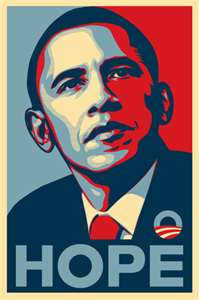
The Hopemeister
The counter to all this is convincing the public that Barack Obama is a socialist/Marxist in hiding. President Obama is many things but a socialist and/or Marxist he is not. Barack Obama is a brand, a man marketed to the American public as a national savior. He was and is not. He’s simply a marker for the status quo.
And that’s where my ongoing funk comes in. On one side, we have Newt Gingrich, Mitt Romney, Rick Santorum and Ron Paul all extolling the Big Lie as the disease that will cure us. And on the other side we have President Obama pretending he’s Teddy Roosevelt reborn, ready to slay the Dragons of Monopoly. Only his words do not match his actions. They never did.
And then there’s us, the American electorate, the Consumer Nation brought low by dwindling expectations, the super-power made suddenly and irrefutably mortal. Will the election of 2012 rouse us from the trance that brought us to this moment? Will we see the Big Ugly for what it is rather than what we dreamt it to be?
Or will we tumble back into a dark and endless sleep?
Not to be overly depressing, there are glimmers of light on the horizon. Citizens are standing up, questioning the lack of justice in the system, the ongoing extraction of wealth by the top 1%. Despite the lack of coverage, the Occupy Wall St. movement still survives in small towns and cities across the country. Grassroot efforts are pushing ahead to remove the influence of money in government—Superpacs writ large. Several Constitutional amendments are gaining signatures and support to upend the Supreme Court’s ‘corporations are people’ decision and more and more voices are rising up in books and magazines, on the blogs and in tweets to push back the Robber Baron mentality of our corporate, government and financial institutions.
Will it be enough? I don’t know. The Big Ugly has a hell of a head start. But if Aesop is any guide, the Hare who dismisses the Tortoise should be well advised: We’re coming. Slow and steady, We the People, are coming nonetheless.
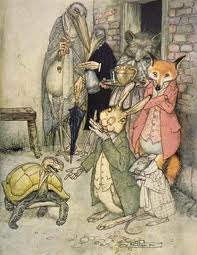
Is This the Conversation We’ve Been Waiting For . . . Or Not?
Posted: January 14, 2012 Filed under: #Occupy and We are the 99 percent!, 2012 primaries, Banksters, Congress, Corporate Crime, corporate money, Economy, income inequality, Regulation, Republican Tax Fetishists | Tags: crony capitalism, Financial Crisis, Mitt Romney, Newt Gingrich, U.S. Economy 22 CommentsThe recent brouhaha over Newt Gingrich and Mitt Romney locking horns over Romney’s involvement [I created 100,000 jobs] at Bain Capital  has raised speculation that a conversation about capitalism, the way it’s been practiced these last 30-40 years, is about to commence, a conversation that is way overdue.
The irony is that the issue has been brought to the fore by Republican candidates, none of whom questioned the blowback of leveraged buyouts [LBO] and private equity firms in the past or even whispered the traitorous phrases–crony capitalism, vulture capitalism–in public. In fact, the centerpiece of GOP economic theory is free market fundamentalism—set the market free, unfetter business from governmental regulation and Heaven’s Gate will open.
Not quite.
There’s the 2008 meltdown to contend with, the abuses of Wall Street and a clear example that Greenspan’s ‘self-regulating’ market theory was a cruel and greedy joke. Following the meltdown, Greenspan himself glumly admitted his worldview was incorrect.
In addition, we have plenty of evidence that the so-called Trickle-Down philosophy has not ‘raised all ships’ as heralded by the true believers but rather led to huge income disparities, flat wages and the death-rattle of the middle-class.
Yes, there is the question of globalization. Like it or not, we have grown interconnected. But when decisions are made purely on profit, the quicker the better, then transferring manufacturing abroad, exploiting cheap foreign labor, taking advantage of lax worker safety rules and nonexistent environmental regulations begins to make a twisted sort of sense. So, too with trade agreements made deliberately lopsided and unfair because these ‘deals’ have no national loyalty. Profit is king; all else is subservient.
The long-term damage is massive. We don’t have to speculate about this. The evidence is everywhere in our unemployment numbers [which are far worse than reported] and the slide into poverty for alarming numbers of Americans. Add in the housing crisis, still escalating health care costs, the Gulf oil spill, endless wars, the battles over extracting oil, coal and natural gas while refusing to work on rational and workable alternative energy policies, and . . .
Well, it’s enough to make your head explode.
But suddenly, the door has flown open for a conversation on what it means to be a shareholder capitalist. The unquestioned virtue of profit over all else has begun to raise its ugly head.
For instance, what value [if any] is created for a society when money is valued above all else, valued over the welfare of fellow citizens–the sick, the disabled, even our children. What value is maintained when corners are cut, laws rewritten, ridiculous tax policies hyped as necessary for growth and future job creation? But the mythical jobs, positions offering a living wage, never come. What does it mean when massive profits stream only to the top tier of the population, the so-called job creators, while everyone and everything else is left to flounder?
I call it a no-value deal–a lie, a theft–the magnitude of which hollows out a society, sucks it dry.
For too long Newt Gingrich [for all his caterwauling now] and his like-minded buddies have called it the free enterprise system. Free for whom? Certainly not for the families who have lost their homes, seen their jobs exported and have no reasonable expectation that their own children will ever see better times. Not with the continuation of what Dylan Ratigan has termed Extractionism, a system that takes money from others without offering anything of value, anything that actually promotes growth or improves society. This is a system that merely fills the coffers of the Extractionists, while they play a heady game of King of the Mountain and continue to spread the folklore that this is what freedom and liberty look like.
 But let’s be fair. Mitt Romney is not the devil incarnate, nor is Bain Capital the worst of the worst. Much of what Newt Gingrich’s SuperPac is selling to the electorate conveniently let’s Wall Street and multinational corporations off the hook. The ads fail to mention the cushy collusion of legislators who push laws and tax breaks to keep the circle spinning. And Washington Democrats who may be dancing the happy dance now are just as guilty of supporting the status quo, going along to get along, eagerly taking campaign donations from their own smiling Extractionists.
Is this the conversation Republicans are offering?
Sorry, no.
Rush Limbaugh has been apoplectic on the issue. According to Limbaugh, Gingrich has ‘Gone Perot.’
So you might say that Newt now has adopted the Perot stance, because he just said it: ‘I’m gonna make sure that Romney doesn’t come out of New Hampshire with any momentum whatsoever.’ And he’s using language that the left uses, and he’s attempting to make hay with this. You know, he’s trying to dredge up and have long-lasting negatives attach to Romney [this is what’s so unsettling about this] in the same way the left would say it. You could, after all these bites, say, “I’m Barack Obama, and I approve this message.
Rudy Giuliani also weighed in.
What the hell are you doing, Newt?” Giuliani said this morning on “Fox and Friends.” “The stuff you’re saying is one of the reasons we’re in this trouble now.
This whole ignorant populist view of the economy that was proven to be incorrect with the Soviet Union with Chinese communism.
Oh yes, the ‘ignorant populist’ view that has beamed a light on business as usual. Which btw, is not working, except for a tiny fraction of the American public. If anything, Uncle Newt has pulled back the curtain and revealed an unsettling truth.
This might not be the full-throated conversation Americans need to engage in. Still it’s a beginning from a most unexpected quarter, whose raison d’etre is as caught up in short-term results as are its economic principles. Almost Occupy Wall St. in nature, the conversation is now in the open. This is a conversation that defies Mitt Romney’s suggestion that sensitive subjects are better left to the privacy of ‘quiet rooms.’
This is the conversation of the moment. The first word, the opening sentence. It has just begun.

 peej
peej Carissa
 bostonboomer
 dakinikat
 ecocatwoman
 mablue2
 Mama Lopez
 peggysue22
 quixote
 skydancingguestblogger
 Mona (aka Wonk the Vote)



 Sky Dancing
Recent Comments