
A War of a Different Sort
Posted: December 14, 2011 Filed under: Austerity, Banksters, Democratic Politics, Economy, globalization, income inequality, poverty, productivity, U.S. Economy, unemployment | Tags: Federal Reserve, investment, the Great Depression, The Great Slump 25 Comments
In the May edition of Vanity Fair, Joseph Stiglitz [economist and professor at Columbia University and recipient of the Nobel prize in economic sciences, 2001] wrote a prescient essay entitled, “Of the 1%, For the 1% and By the 1%.”
In a strange way, the piece voiced what would months later become the rallying cry of the Occupy Wall Street Movement, a foreshadowing of the public’s growing discontent with high unemployment, rising poverty and income disparity as well as the social damage resulting from Government failure to address the problems: the distortion it creates, how income disparities breed a climate of imbalance and lack of restraint, encouraging:
. . . no limit to the adventures we can undertake; corporations and contractors stand only to gain. The rules of economic globalization are likewise designed to benefit the rich: they encourage competition among countries for business, which drives down taxes on corporations, weakens health and environmental protections, and undermines what used to be viewed as the “core” labor rights, which include the right to collective bargaining.
In addition, Stiglitz underscored how inequality erodes our national identity–the sense of fairness, equal opportunity, our sense of community–the very elements we consider American staples. In fact, while listening to the GOPs’ endless political debates these past months, I’ve felt like a stranger in a strange land. Abandon child labor laws? Let the uninsured die? Begin massive deportations?
Really?
In any case, Stiglitz was the first to sound the warning in clear, concise and effective prose.
Which is why I found Stiglitz’s recent VF piece, ‘The Book of Jobs,’ required reading. Great title, btw. Even better is the comparison made between the Great Depression of the 1930s and the present downturn. Or as Stiglitz refers to our current dilemma: the Great Slump. An interesting aside, Paul Krugman pulled out all the stops over the weekend and called our economic crisis a depression, period. Hardly a surprise for the underwater homeowner, the long-term unemployed or those juggling multiple part-time positions to make ends meet.
 I’d encourage readers to take a few minutes and read Stiglitz’s recent essay. It’s amazingly concise and clear, even for non-economic types [like myself]. But here’s the gist: Ben Bernanke, a self-proclaimed scholar of the Great Depression, turned on the money spigots in response to the 2008-2009 meltdown because traditional wisdom said the Great Depression was the result of excessive money tightening by the Federal Reserve. So, doing the opposite would be the charm, right?
Not quite. As Stiglitz notes, this time we have proof that monetary manipulations were neither the cause nor the answer.
Why?
Because despite the flood of money, we’re still in the crapper. Consider this an Advanced Economics Lab experiment, playing out before your eyes.
So what is the root problem?
The economy itself, Stiglitz contends, a structural dislocation, a weak economy disguised by whopping bubbles in the real estate and financial markets, the easy, even crazy availability of credit, but basically a shift in the jobs we have to the jobs we need.
This is eerily similar to the precursor of the Great Depression. Then, massive unemployment resulted as the country moved from agriculture to industry. The cause? Increased agricultural productivity. What was once done by 20% of the population would be accomplished [with surplus] by 2%. Currently, the economy is moving from industry to service. Again, this shift has been provoked by increased productivity.
What is old is new again. With a twist, of course: the impact of globalization.
Industry to service? you say. Most Americans wince at the prospect of ‘service’ jobs—low skills, lower pay, 8 hours of mindless burger flipping.
Not really.
For instance, addressing our energy needs alone will require an abundance of high tech skills [and commensurate wages] to develop cleaner,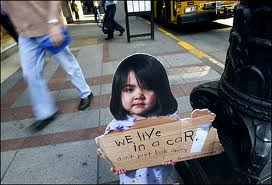 more efficient fuels. Support of basic research work is critical in this and other areas and leads to increased innovation and economic growth. Examples are plentiful—research produced the Internet and biotech industry, spawning huge upticks in economic growth. And this is something Americans excel at—thinking outside the box. Education will be required to retrain the work force and prepare and encourage our children with requisite skills and creative know how. In addition, infrastructure, a growing national concern, offers years of labor for out-of-work construction crews. We certainly don’t need an American version of ‘London Bridge is falling down.’ The Minneapolis bridge collapse in March was one too many.
Yes, Stiglitz says, we will need to rein in the banks, turn them back into the boring businesses they once were [they’re suppose to be serving us, not the other way around]. And we will need to seriously re-evaluate our tax policies, most of which favor the rich. But to solve the most critical problem—structural change—will require investing in our future, our own people. Private enterprise will not and cannot do that on a massive scale [I can hear Republicans wailing in unison].
FDR had World War II, spurring the necessary investment [spending] that launched the US into an unparalleled cycle of growth and prosperity. We are now faced with another war, a battle of ideology and political one-upmanship. Yet the solutions are real and within our grasp, Stiglitz suggests. I, for one, believe him.
Now it’s a matter of mustering the national will. We employed that fierce will during the Second World War; our survival and ultimate victory depended on it.
As it does once again.
Thursday Reads: Poverty and Joblessness *Are* Social and Political Issues
Posted: August 11, 2011 Filed under: Foreign Affairs, Global Financial Crisis, Great Britain, jobs, Media, morning reads, poverty, U.S. Economy, U.S. Politics, unemployment | Tags: austerity, Banksters, education, Federal Reserve, global elites, government corruption, joblessness, London Riots, looting, Poverty, social services, U.S. Economy, unemployment 44 Comments
Guess who said this:
“There are pockets of our society that are not just broken, but are frankly sick.
“It is a complete lack of responsibility in parts of our society, people allowed to feel the world owes them something, that their rights outweigh their responsibilities and their actions do not have consequences. Well, they do have consequences.”
You’re darn right! The global elites have gone too far! The banksters have stolen trillions from ordinary taxpayers, and then demanded and received massive government bailouts. Politicians have lost any sense of responsibility toward their constituents, only listening to their corporate masters and their lobbyists. Yes there are consequences and these wealthy elites will discover there are consequences for their corrupt and immoral actions.
Oh wait. That was Prime Minister David Cameron talking about the poor and jobless young people who have been rioting in the streets of London and other British cities for the past five days. I’ll bet he has absolutely no clue how ridiculous it is that he is chastising these people for looting after he and other global elites allowed banksters to steal and loot trillions with absolutely no consequences. From Raw Story:
The U.S. Federal Reserve gave out $16.1 trillion in emergency loans to U.S. and foreign financial institutions between Dec. 1, 2007 and July 21, 2010, according to figures produced by the government’s first-ever audit of the central bank.
Last year, the gross domestic product of the entire U.S. economy was $14.5 trillion.
Of the $16.1 trillion loaned out, $3.08 trillion went to financial institutions in the U.K., Germany, Switzerland, France and Belgium, the Government Accountability Office’s (GAO) analysis shows.
Additionally, asset swap arrangements were opened with banks in the U.K., Canada, Brazil, Japan, South Korea, Norway, Mexico, Singapore and Switzerland. Twelve of those arrangements are still ongoing, having been extended through August 2012.
Out of all borrowers, Citigroup received the most financial assistance from the Fed, at $2.5 trillion. Morgan Stanley came in second with $2.04 trillion, followed by Merill Lynch at $1.9 trillion and Bank of America at $1.3 trillion.
Lambert has been highlighting the hypocrisy of the global elites on the riots. Yesterday he linked to this article in the Guardian.
This scepticism toward the potency of democratic politicians – and therefore democratic politics itself – is oddly echoed by the looters themselves. Certainly no one outside the Iranian state media is calling them “protesters”, but even “rioters” seems the wrong word, carrying with it a hint of political purpose. For some, especially at the start in Tottenham, there was clearly a political dimension – with the police the prime focus of their anger. But many of the copycat actions across London and elsewhere have no apparent drive beyond the opportunistic desire to steal and get away with it. It’s striking that the targets have not been town halls or, say, Tory HQ – stormed by students last November – but branches of Dixons, Boots and Carphone Warehouse. If they are making a political statement, it is that politics does not matter.
Lambert notes that at least these looters didn’t steal $16 trillion from the U.S. Treasury.
And while the revulsion at the looting has been widespread and bipartisan – with plenty of liberals admitting to “coming over all Daily Mail” at the ugliness of the vandalism – that sense of the impotence of politics is widespread, too. One aspect of the phone-hacking scandal that went deep was its revelation that those we might think exert authority – police and politicians – were in fact supine before an unelected media corporation. The sheer power of News Corp contrasted with the craven behaviour of those we elect or entrust to look out for us.
But elected officials are supposed to protect all citizens–even the poor, the unemployed, and the elderly–aren’t they? Yet in the U.S. and Europe, the burden of the economic crisis is falling on those with the least ability to pay, while the wealthy continue to receive their government handouts. When people are pushed to the point that they feel they have nothing to lose, this is what happens. Why it is coming as such a surprise to the comfortable elites is the real mystery.
Let’s take a look at what some of the rioters themselves have said about the meaning of their actions. From Yahoo News:
The Conservative-Liberal Democrat coalition government, making deep cuts to public services to tackle a record budget deficit, has been quick to deny that the unrest was linked to austerity measures, calling the disorder “pure criminality.” [….]
Public anger over the widespread looting of shops appears to have strengthened the government’s argument, with stolen goods ranging from the expensive — televisions and jewelry — to the absurd — sweets and bottles of alcohol.
However, community leaders and rioters themselves said the violence was an expression of the frustration felt by the poorest inhabitants of a country that ranks among the most unequal in the developed world.
“They’ve raised rates, cut child benefit. Everyone just used it as a chance to vent,” one man who took part in unrest in the east London district of Hackney told Reuters.
Surprise, surprise. Cutting social services to pay for the bankers’ failures has real life consequences. Austerity measures create more unemployment, and people who don’t have jobs get hungry and scared. When you take everything from people who can least afford it, they get angry. What on earth do these people expect? What planet are they living on anyway? And no, I’m not condoning violence. I’m just saying that it’s going to happen when you push people too far.
Here are some quotes from two young women who participated in the British riots:
Two girls who took part in Monday night’s riots in Croydon have boasted that they were showing police and “the rich” that “we can do what we want”.
From The New York Times: London Riots Put Spotlight on Troubled, Unemployed Youths in Britain
“I came here to get my penny’s worth,” said a man who gave his name as Louis James, 19, a slightly built participant in the widening riots that have shaken London to its core. With a touch of guilt on Tuesday, Mr. James showed off what he described as a $195 designer sweater that he said he took during looting in Camden Town, a gentrified area of north London.
Politicians from both the right and the left, the police and most residents of the areas hit by violence nearly unanimously describe the most recent riots as criminal and anarchic, lacking even a hint of the anti-government, anti-austerity message that has driven many of the violent protests in other European countries.
But the riots also reflect the alienation and resentment of many young people in Britain, where one million people from the ages of 16 to 24 are officially unemployed, the most since the deep recession of the mid-1980s.
Don’t these politicians, police, and other observers understand that poverty and jobless *are* sociopolitical issues? Just because people are acting out of desperation or even opportunism doesn’t mean that their actions are not political. Just because someone is young and poor does not mean he or she isn’t aware that government and corporate corruption have caused much of their distress. Back to the NYT article:
In many ways, Mr. James’s circumstances are typical. He lives in a government-subsidized apartment in northern London and receives $125 in jobless benefits every two weeks, even though he says he has largely given up looking for work. He says he has never had a proper job and learned to read only three years ago. His mother can barely support herself and his stepbrothers and sisters. His father, who was a heroin addict, is dead.
He says he has been in and out of too many schools to count and left the educational system for good when he was 15.
“No one has ever given me a chance; I am just angry at how the whole system works,” Mr. James said. He would like to get a job at a retail store, but admits that he spends most days watching television and just trying to get by. “That is the way they want it,” he said, without specifying exactly who “they” were. “They give me just enough money so that I can eat and watch TV all day. I don’t even pay my bills anymore.”
Jonathan Portes, the director of the National Institute of Economic and Social Research in London, says that Mr. James’s plight reflects a broader trend here. More challenging students, Mr. Portes says, have not been receiving the attention they should as teachers, under pressure to meet educational goals, focus on children from more stable homes and those with greater abilities and social skills. Disillusioned, those who cannot keep up just drop out.
The Los Angeles Times in an opinion piece searches for the reasons for the violence and asks if it could happen here.
The Tottenham riots that blindsided Britain were sparked by the fatal police shooting of Mark Duggan, a 29-year-old black man. Over the past few days, they’ve continued and spread, turning into what has largely become youths’ looting and destroying parts of London. But no one is exactly sure why they’re doing it. Prime Minister David Cameron called it “criminality, pure and simple.”
But why have the riots continued day after day?
The riots are neither politically or racially fueled, wrote Doug Sanders of the Globe and Mail. They’re the result of a “lost generation” of youth under 20 who have little to lose and a bleak future. Here’s an excerpt:
Whether the thousands of rioters actually did express disillusionment — some did say they were angry at police or the world, but many appeared gleeful or greedy — it is clear that most had nothing else to do with themselves, and no reason to fear or feel responsible for the consequences of their actions.
This is a chronic problem in Britain, which has a “lost generation” of young high school dropouts far larger than most other Western countries’.
It’s so simple-minded to expect that youthful rioters are going to calmly explain their behavior in a reasoned, intellectual manner or that they are not going to act euphoric once they let go of restraint and begin acting out as part of a mob. None of that means that the reasons for their behavior are not political.
It seems to me that masses of young people who have “little to lose and bleak future” is in fact a powerful political issue for any society. And when people are powerless, there are few ways for them express their anger. Violence is one way to get attention from the powerful.
Can it happen here? You bet it can. As long as the President and Congress continue enacting austerity measures and ignoring unemployment and general misery among ordinary Americans, it’s guaranteed the U.S. will see riots in the streets–as we have in the past. When it happens here, will our elites be as dumbfounded and out-of-touch with reality as those in Great Britain? Probably.
I posted this in a comment yesterday, but I’m going to put it up again here. It’s an interview of writer and broadcaster Darcus Howe by a clueless BBC “journalist.”
—————————————-
That’s my suggested reading for today. What do you recommend?
UPDATE: I found a piece in the Guardian that reflects my thinking.
Seumas Milne: These riots reflect a society run on greed and looting
It is essential for those in power in Britain that the riots now sweeping the country can have no cause beyond feral wickedness. This is nothing but “criminality, pure and simple”, David Cameron declared after cutting short his holiday in Tuscany. The London mayor and fellow former Bullingdon Club member Boris Johnson, heckled by hostile Londoners in Clapham Junction, warned that rioters must stop hearing “economic and sociological justifications” (though who was offering them he never explained) for what they were doing.
When his predecessor Ken Livingstone linked the riots to the impact of public spending cuts, it was almost as if he’d torched a building himself. The Daily Mail thundered that blaming cuts was “immoral and cynical”, echoed by a string of armchair riot control enthusiasts. There was nothing to explain, they’ve insisted, and the only response should be plastic bullets, water cannon and troops on the streets.
We’ll hear a lot more of that when parliament meets – and it’s not hard to see why. If these riots have no social or political causes, then clearly no one in authority can be held responsible….If this week’s eruption is an expression of pure criminality and has nothing to do with police harassment or youth unemployment or rampant inequality or deepening economic crisis, why is it happening now and not a decade ago? The criminal classes, as the Victorians branded those at the margins of society, are always with us, after all. And if it has no connection with Britain’s savage social divide and ghettoes of deprivation, why did it kick off in Haringey and not Henley?
…To refuse to recognise the causes of the unrest is to make it more likely to recur – and ministers themselves certainly won’t be making that mistake behind closed doors if they care about their own political futures.
Elite Conspiracy Theories and the Arrest of Dominique Strauss-Kahn
Posted: May 25, 2011 Filed under: collective bargaining, Economic Develpment, financial institutions, Foreign Affairs, France, Libya, Media, Pakistan, poverty, racism, Regulation, The Bonus Class, The Great Recession, U.S. Economy, U.S. Politics, unemployment, Violence against women | Tags: conspiracy theories, Dominique Strauss-Kahn, Federal Reserve, France, global elites, IMF, John F. Kennedy, Naomi Wolf, Nicholas Sarkozy, rape 29 Comments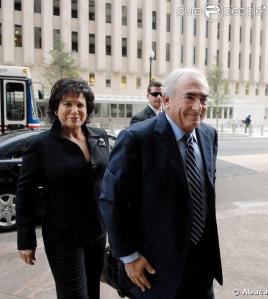
Dominque Strauss-Kahn and wife Anne
When one of us common people questions the Bush failures before 9/11 or the Warren Commission’s insistence that JFK was killed by a lone gunman, we are laughed at by the corporate media and lectured by politicians. But when one of the Global Elite gets in trouble, conspiracy theories are suddenly in vogue. Now that a global banker and possible candidate for the French presidency is accused of a sexual attack on a lowly hotel maid, elite conspiracy theories are running rampant in the U.S. and international media. I’ll give you a few examples.
At the Pakistan Observer, Ali Ashraf Kahn argues that Strauss-Kahn had to brought down, first because he would very likely have beaten the “American poodle Sarakozi” in a race for the presidency of France, and second because he (Strauss-Kahn) had offended the international banksters and corporations by proposing more liberal policies at the IMF which would have been a threat to the dollar. According to Ali Ashraf Kahn, getting rid of Strauss-Kahn would–along with U.S. military actions in Libya and Pakistan–would help to “save American predominance in the world.”
This incident goes to prove the hidden agenda of an international vested interest group trying to build and secure an American Empire for their master, which has not spared even Strauss-Kahn, who has been fixed in a rape attempt with a 32 year old hotel maid in a country where teen aged unwed mothers are a normal accepted feature. The former French Foreign Minister Strauss-Kahn, once if he was elected as president of France would have worked to strengthen the Euro to bring down dollar, which was of serious concern for the Federal Reserve Board in the already ongoing currency war with China. John F. Kennedy, US president was murdered for his only sin of canceling Federal Reserve Act of 1913 in 1963, when for the first time dollar currency was issued with the seal of US government, soon after his assassination President Lyndon B. Johnson revived this Act to continue their financial exploitation.
The author of this article appears to have a problem understanding the distinction between rape and consensual sex that results in pregnancies, but I’ll let that go for the moment. Kahn explains that Strauss-Kahn was trying to make radical changes at the IMF–so much so that Strauss Kahn won high praise from Joseph Stiglitz, which was apparently the final “kiss of death.”
Strauss-Kahn was trying to move the bank in a more positive direction, a direction that didn’t require that countries leave their economies open to the ravages of foreign capital that moves in swiftly-pushing up prices and creating bubbles, and departs just as fast, leaving behind the scourge of high unemployment, plunging demand, hobbled industries, and deep recession. Strauss-Kahn had set out on a “kinder and gentler” path, one that would not force foreign leaders to privatize their state-owned industries or crush their labour unions. Naturally, his actions were not warmly received by the banker’s mafia and multi national corporations who look to the IMF to provide legitimacy to their ongoing plunder of the rest of the world. These are the people who think that the current policies are “just fine” because they produce the desired results they’re looking for, which is bigger profits for themselves and deeper poverty for everyone else.
I have to admit, I’m in sympathy with those goals. There’s a lot more, so read the whole thing if you want more detail.
The next conspiracy theory is from Uganda. The author, Dr. Kihura Nkuba, also argues that Strauss-Kahn’s attack on the U.S. dollar is what led to his downfall. Nkuba says that police in the racist U.S. would never take the word of a poor black woman against that of a powerful white man unless motivated by a political conspiracy.
A woman from West Africa, assaulted by a famous white male, a future president of France, to be listened to by the New York Police, is amazing. But is it? [….]
New York police has [sic] been rummaging through DSK’s diaries, hotel registries, phone records, yearbooks and have made sure that the “great seducer” always appears handcuffed and dressed in a “pervie” raincoat with three-days stubble before they parade him in front of the media. He gets this treatment even though he has no criminal record and nothing, but the sketchy accusations of a room service cleaner.
What is his real crime? Strauss-Kahn was mounting an attack against the dollar and had called for a new world reserve currency that would challenge the dominance of the dollar and protect against future financial instability. He suggested adding emerging market countries’ currencies, such as the Yuan, to a basket of currencies that the IMF will administer to add stability to the global system….Strauss-Kahn saw a greater role for the IMF’s Special Drawing Rights, (SDRs) which is currently composed of the dollar, sterling, euro and yen, over time but said it will take a great deal of international cooperation to make that work.”
I love the way these male authors toss aside the charges against Strauss-Kahn–in Nkuba’s case, while complaining about racial prejudice. I guess he goes by the “bros before hos” rule: racism bad, sexism invisible.
Naomi Wolf also has a conspiracy theory about the Strauss-Kahn arrest that goes along with her defense of Julian Assange against sexual abuse charges in Sweden. She begins by comparing the NYC police response to the Strauss-Kahn case with the case of two of New York’s “finest,” Kenneth Moreno and Franklin Mata, who are on trial for raping a woman in Manhattan.
According to Wolf,
Moreno and Mata have not been asked to strip naked for “evidence” photos, were not initially denied bail, and were not held in solitary confinement, and are not being strip-searched daily. Their entire case has followed the usual timetable of many months, as evidence was gathered, testimony compiled and arguments made.
On the other hand, Wolf writes,
After a chambermaid reportedly told her supervisor at the elegant Sofitel hotel that she had been sexually assaulted, the suspect was immediately tracked down, escorted off a plane just before its departure, and arrested. High-ranking detectives, not lowly officers, were dispatched to the crime scene. The DNA evidence was sequenced within hours, not the normal eight or nine days. By the end of the day’s news cycle, New York City police spokespeople had made uncharacteristic and shockingly premature statements supporting the credibility of the victim’s narrative — before an investigation was complete.
The accused was handcuffed and escorted before television cameras — a New York tradition known as a “perp walk.” The suspect was photographed naked, which is also unusual, initially denied bail and held in solitary confinement. The Police Commissioner has boasted to the press that Strauss-Kahn is strip-searched now multiple times a day — also unheard-of.
I didn’t know that Strauss-Kahn was being subjected to daily strip-searches, but it seems to be true, according to the New York Post.
Prison brass and the NYPD have an airtight plan to safeguard the jet-setting French moneyman by having him isolated, chained, shackled — and repeatedly strip-searched — before and after court appearances, including a bail hearing newly scheduled for today.
“He will be strip-searched when he leaves Rikers Island. He will be strip-searched when he arrives in court. He’s strip-searched when he leaves court, and he’s strip-searched when he gets back to Rikers,” said Norman Seabrook, head of the correction officers union.
“When he arrives to the courthouse, he’s going to be put in an isolated cell away from other inmates,” said Seabrook. “This is for fear that another inmate would try to kill him to make a name for himself.”
Yet, as Wolf points out, hotel maids are routinely subject to sexual attacks during their work. Her conspiracy theory is that in the modern surveillance state,
men like former New York Governor Eliot Spitzer, who was investigating financial wrongdoing by the insurance giant AIG, WikiLeaks founder Julian Assange and Strauss-Kahn — whose efforts to reform the IMF gained him powerful opponents — can be, and are, kept under constant surveillance. Indeed, Strauss-Kahn, who had been the odds-on favorite to defeat Nicolas Sarkozy in next year’s French presidential election, probably interested more than one intelligence service.
This does not mean that Strauss-Kahn is innocent or that he is guilty. It means that policy outcomes can be advanced nowadays, in a surveillance society, by exploiting or manipulating sex-crime charges, whether real or inflated.
She has a pretty good point there. But the maid who reported Strauss-Kahn’s attack was a member of a union, as Dean Baker pointed out. Could that be why her employer made sure she was treated well by the police?
The reason that this is an important part of the story is that it is likely that Strauss-Kahn’s alleged victim might not have felt confident enough to pursue the issue with either her supervisors or law enforcement agencies, if she had not been protected by a union contract. The vast majority of hotel workers in the United States, like most workers in the private sector, do not enjoy this protection.
Dean Baker was also disappointed in Strauss-Kahn’s arrest, because whether or not he is guilty, his resignation spells the end of reform at the IMF.
Reading all these arguments for a conspiracy against Dominque Strauss-Kahn has given me pause. It certainly makes sense that the U.S. government would want to end his tenure at the IMF and prevent him from becoming President of France. But how could they know he would attack a hotel maid? Does the conspiracy require her involvement? That’s the serious hangup I have in buying into these authors’ claims–much as I do always enjoy a good conspiracy theory.
Patrica J. Williams touches all the bases in an article about the case at NPR. On the conspiracy issue, she argues for a skeptical approach to conspiracy theories, while keeping an open mind.
Politics is a complicated, dirty business, as the impeachment hearings of President Clinton ought to have instructed us. (Who guessed back then that Newt Gingrich, while skewering Clinton’s morals, was cheating on his then-wife with his present wife?) For Americans, who by and large have never heard of DSK, the possibility of his arrest being a set-up is inconceivable. But in the immediate aftermath of his detention, a majority of French citizens believe he has been purposely brought down. Why? Dominique Strauss-Kahn was well on track not just to become France’s president but its first Jewish president. As head of the IMF, he led that institution in a distinctly progressive manner. He sharply critiqued corrupt American bankers and banking practices and, early on, predicted the collapse of the mortgage market. As a center-left Socialist party member, he was close to negotiating a European Union bailout for Greece. And his elimination from the election empowers the candidacy of Marine LePen, head of the anti-immigrant, anti-Muslim and anti-Semitic National Front party, whose popularity, alarmingly enough, currently polls higher than that of Nicolas Sarkozy.
I’m certainly going to keep all this in mind as I follow the developments in the Strauss-Kahn case. I’d love to know what you all think about it too, so please chime in!
Tuesday Reads
Posted: November 30, 2010 Filed under: morning reads | Tags: Arab States, Budget Deficit, dread bunny Roberts, Federal Deficit, Federal Reserve, fiscal security, iran, Obama federal worker's salary freeze, Social Security, Wikileaks 58 Comments good morning!!!

Well, the top story is still the Wikileak’s data drop of all those diplomatic cables. Here’s an interesting take on all the information that was released about the Arab states and their feelings about Iran by The Atlantic.
Sure, we knew that Middle East governments were concerned about Iran. But we didn’t know to what degree. The cumulative impact of these cables is profound.
King Abdullah of Saudi Arabia, the largest, wealthiest, and among the most conservative Middle East nations, made “frequent exhortations to the US to attack Iran and so put an end to its nuclear weapons program,” the American embassy in Riyadh reported in April 2008. “He told you to cut off the head of the snake,” one of the King’s aides reminded the American ambassador to Iraq Ryan Crocker and Gen. David Petraeus when they were in the kingdom for a two day visit.
From tiny Bahrain, King Hamid, in a meeting with Gen. Petraeus seven months later, said that Iran was the source for much of the trouble in Iraq and Afghanistan. “He argued forcefully for taking action to terminate their nuclear program, by whatever means necessary,” according to a leaked cable from the American embassy there. “That program must be stopped,” the King told Gen. Petraeus. “The danger of letting it go on is greater than the danger of stopping it.”
This the same chilling language, which the American public is accustomed to hearing from hardline Israeli officials. Hearing it expressed by Muslim leaders in the Middle East might now have a profound effect on American public opinion.
Robert Mackey at the Lede Blog of the NYT has a group of things up that you may want to explore including videos and reactions from around the world. This one from Iran and its president takes the cake.
Asked about the leaked American cables — some of which frankly reveal the enmity of Arab leaders for Iran — Iran’s president, Mahmoud Ahmadinejad, told reporters in Tehran, “let me first correct you. The material was not leaked, but rather released in an organized way,” Iran’s state-run Press TV reported.
As my colleagues William Yong and Alan Cowell add:
Mr. Ahmadinejad said at a news conference on Monday that Iran’s relations with its neighbors would not be damaged by the reports.
“Regional countries are all friends with each other. Such mischief will have no impact on the relations of countries,” he said, according to Reuters.
“Some part of the American government produced these documents,” he said. “We don’t think this information was leaked. We think it was organized to be released on a regular basis and they are pursuing political goals.”
According to Press TV, Mr. Ahmadinejad also said the cables, “have no legal value and will not have the political effect they seek. He also called the documents released by WikiLeaks a “game,” adding that they are “not worth commenting upon and that no one would waste their time reviewing them.”
That seems to provide an answer to how Tehran would react to the disclosure of information that the leaders of several Arab countries had encouraged the United States to take action to stop its nuclear program. Speaking of Iran, Saudi Arabia’s King Abdullah, for instance, is quoted in the documents urging Washington to “cut off the head of the snake” while there was still time.
What’s that old joke about de Nile and it not being just a river in Egypt?
Progrowth liberal has a post up about Obama’s proposed two year salary freezes for federal workers. The title sounds oddly familiar. I bet if you do a search of this blog, you’ll find an old post or two with that same title. Hmmm. The title is ‘Barack Hoover?‘
This strikes me as short-term fiscal restraint but not a really serious attempt to getting the long-term fiscal house in order. In other words precisely the opposite of what we should be doing while in a very depressed economy. So why would this President make such a recommendation?
Okay, so my thought was it’s really an 11th dimensional chess move by the President to make sure he gets credit for Republican policies that pass before the Republicans can do it so he can move towards reelection when he’ll REALLY start work on those FDR initiatives Yes? (No, I didn’t write that with a straight face.) Or, we can follow PGL’s suggestion to Lawrence (Larry) Mishell over at Economic Policy Institute and a post called ‘Federal pay cuts: A bad idea for what gain?’ Go check the table out–not nifty but still useful–and then you’ll see why Mishell’s bottom line is what it is.
This is another example of the administration’s tendency to bargain with itself rather than Republicans, and in the process reinforces conservative myths, in this case the myth that federal workers are overpaid. Such a policy also ignores the fact that deficit reduction and loss of pay at a time when the unemployment rate remains above 9% will only weaken a too-weak recovery
So, what I want to know is who is he listening to because it certainly doesn’t seem like it’s any economists that I can find or read. Not even the monetarists and the conservatives are supporting these things.
The House will be voting on a bill to extend tax cuts to the middle class. You may want to check out the process on CSPAN. Here’s the coverage of that from The Hill. Frankly, I don’t need no stinking tax cuts. I need a damned job! I also would like Wall Street to stop looting my retirement savings.
Lawmakers said there was only a limited discussion of the tax cut issue at a caucus meeting Monday night. No final decisions on the timing or procedure for votes are expected until after congressional leaders meet with Obama at the White House on Tuesday, the chairman of the House Ways and Means Committee, Rep. Sander Levin (D-Mich.), said.
Van Hollen told reporters that the House vote would likely be held under a traditional rule, meaning Republicans would have at least one chance to offer an amendment to expand the tax cuts beyond the $250,000 level. If Democratic leaders hold the vote under suspension rules, the GOP would have no such opportunity but a two-thirds majority would be required for approval.
GOP leaders have argued against any tax hikes during a fragile economic recovery, saying that an increase for the top brackets could stifle small businesses.
Okay, so let me get this straight. The GOP calls it “a fragile economic recovery’ for folks making more than $250k a year, but thinks that extending unemployment benefits for the nation’s long term unemployed is just about enabling whining, lazy people so it’s just a bad idea. Right, ideology over economics and people. Check.
Oh, speaking of ideology and bunnies over economics and people, here’s another take on that stupid video about the QE2 and the Ben Bernank. It comes from Richard Alford–a retired economist for the NY FED–who guestposts on Naked Capitalism. (Oh, and any bunnies that talk like that down here get put into gumbo pots, just a warning.)
The video is popular and effective because it is not a detailed-footnoted-rigorous academic exercise. It humorously plays on what a substantial fraction of the audience already perceive to be true. It takes swipes at what many viewers see as an institution that is charged with promoting economic welfare yet they see it both detrimentally affecting their lives as well being arrogant and well insulated from accountability.
The Fed dismissed its critics while the housing bubble grew. It did so to its own detriment as well as to the detriment of the real economy and the financial sector. Those who defend of the Fed against the criticisms in this video may win every definitional battle, but they will lose the war for the hearts, minds and confidence of the American people.
Alford lists some things that the FED can do to counter the perceptions in the video that are at the heart of its effectiveness and viral status. It is more about how people feel rather than what they don’t know.
A liberal response was released to the Cat Food Commission. Matt Yglesias overviews it and links to the entire document. You may want to check it out. It doesn’t recommend devastating Social Security which is nice. If my kids were to support ruining Social Security, my assumption would be that they’re planning a house with a room for me some time soon. You might try that tactic with any mouthy young’n wanting privatization near you. Tell them that their moms will be moving back in with them or ask your kids which sofa is yours and when is it okay to move in? (Actually, I have to h/t Susie Madrak for that one. It’s a good suggestion.) This blueprint balances the budget by 2018.
Liberals didn’t like the Simpson-Bowles deficit plan largely because neither Simpson nor Bowles is a liberal so their proposal doesn’t encapsulate liberal thinking. Today the Our Fiscal Security coalition, comprised of Demos, the Economic Policy Institute, and the Century Foundation have released their fiscal blueprint which shows you would that liberal take would look like.
If you go to the site, you’ll find more details on Our Fiscal Security. It also has a lot of interesting links to facts on the budget, the deficit, taxes, jobs, and the recovery.
Putting our nation on a path of broad prosperity will require generating new jobs, investing in key areas, modernizing and restoring our revenue base, and greatly increasing the cost efficiency of the health care system. Achieving these goals, however, will require an informed and engaged public to help set national priorities.
The following report puts forth a blueprint that invests in America and creates jobs now, while putting the federal budget on a long-term sustainable path. We document the hard choices that need to be made and suggest specific policies that will yield lower deficits and a sustainable debt while preserving essential initiatives and investments.
Not that’s a refreshing change to the statements of glee about gridlocking the federal government and all its services coming from Simpson McScrooge doesn’t it?
Oh, and in keep in line with all of this spending stuff, did you read this at HuffPo?
The Obama administration will spend less than a quarter of the $50 billion it promised to homeowners facing foreclosure, the nonpartisan Congressional Budget Office said in a report Monday.
The CBO projection raises fresh questions about the success of the administration’s foreclosure-prevention efforts and its commitment to helping homeowners, even as unemployment hovers near 10 percent. Corporations and large banks appear to be in full-fledged recovery — last quarter, corporate profits reached an all-time high of $1.66 trillion on an annual basis — but households and small businesses seem to have been left out.
Washington policymakers talk constantly about helping “Main Street” recover from the steepest downturn since the Great Depression. Spending less than a quarter of the money promised to help residents of “Main Street” keep their homes may not seem in line with that goal
Okay, so, that’s about it from me this morning. I’m not sure how much of this FDR-style policy I can handle. I might become a socialist and you’ll have to search under your beds for me daily.
[MABlue’s spooky pick]
Because BostonBoomer did a great job spooking us early this morning, I decided to stick with the program by sharing a story I read a couple of days ago.
CIA successfully inherited KGB’s psychoactive drugs technology
“The most important evidence to prove the use of psychotropic substances in “the land of the free” is the “KUBARK Counterintelligence Interrogation” manual, which was declassified in 1997. The manual was used by CIA counterintelligence from 1963 to 1985. According to the document, US special services used such methods as disrupting human biorhythms, threats, physical violence, hypnosis and narcotics.
“The USA used such methods in all armed conflicts in which the country was involved. Now look at what they do to Guantanamo prisoners. To crown it all, The Washington Times wrote in 2001 that US federal courts could approve the use of the serum of truth in the search for Bin Laden.
“Therefore, it does not seem appropriate for Americans or British to stir hysteria about “brutal Russians using inhuman methods for obtaining confessionary statements”
Oh! While you’re there you can also read this:
C.I.A.: Cocaine Import Agency
The increase of drugs in the U.S. and the EU, and the global drug trade, go hand in hand with imperial military expansion around the world. The “fight against drugs is a farce … ”
The Mercury News of San Jose, California, revealed that CIA agents sold hundreds of tons of cocaine in the U.S. during the years of the conflict in Nicaragua, in order to obtain funds for the Contras (US-created paramilitaries to prevent the Sandinista revolution). The report explains that Contra leaders met with a CIA agent to plan the operation. The drugs were transported in military aircraft to airports in Texas.
The drugs were first distributed in the black ghettos of Los Angeles, California, from there it spread throughout the country. In the early 80’s, crack and cocaine ravaged neighborhoods in the U.S., destroying the brains and the will to fight and protest.
What’s on your reading and blogging list today?
Fed Continues to Subsidize the Bonus Class
Posted: August 3, 2009 Filed under: Equity Markets, Global Financial Crisis, The Bonus Class, The Great Recession, U.S. Economy | Tags: arbitraging government debt, bonus class, Federal Reserve, Financial Times., high volume trading Comments Off on Fed Continues to Subsidize the Bonus Class I’m again relying on the Financial Time’s for this latest bit of no suprises here. The big question is when will the political class pull the rug out from under the bonus class?
Wall Street banks are reaping outsized profits by trading with the Federal Reserve, raising questions about whether the central bank is driving hard enough bargains in its dealings with private sector counterparties, officials and industry executives say.
The Fed has emerged as one of Wall Street’s biggest customers during the financial crisis, buying massive amounts of securities to help stabilise the markets. In some cases, such as the market for mortgage-backed securities, the Fed buys more bonds than any other party.
However, the Fed is not a typical market player. In the interests of transparency, it often announces its intention to buy particular securities in advance. A former Fed official said this strategy enables banks to sell these securities to the Fed at an inflated price.
The resulting profits represent a relatively hidden form of support for banks, and Wall Street has geared up to take advantage. Barclays, for example, e-mails clients with news on the Fed’s balance sheet, detailing the share of the market in particular securities held by the Fed.
“You can make big money trading with the government,” said an executive at one leading investment management firm. “The government is a huge buyer and seller and Wall Street has all the pricing power.”
Let me be clear that the Fed is not a government agency. It makes profits each year from services it provides banks and returns those profits to the Treasury. The Treasury uses the Fed as its agent for a few services but the Fed is a central bank, the bank of bankers. It is not part of the Treasury per se. However, even with that being said, this news continues to be disturbing. Wall Street is gaming the Fed because they can. These things are monopoloy/oligopoly behaviors and we have laws against them!
Barney Frank, chairman of the House financial services committee, said the potential profiteering may be part of the price for stabilising the financial system.
“You can’t rescue the credit system without benefiting some of the people in it.” Still, Mr Frank said Congress would be watching. “We don’t want the Fed to drive the hardest possible bargain, but we don’t want them to get ripped off.”
The growing Fed activity has coincided with a general widening of market spreads – the difference between bid and offer prices – as the number of market participants declines. Wider spreads enable banks, in their capacity as market-makers, to make more profit.
Larry Fink, chief executive of money manager Black Rock, has described Wall Street’s trading profits as “luxurious”, reflecting the banks’ ability to take advantage of diminished competition.
“Bid-offer spreads have remained unusually wide, notwithstanding the normalisation of financial markets,” said Mohamed El-Erian, chief executive of fund manager Pimco in Newport Beach, California.
Spreads narrowed dramatically during the years of the credit bubble.
Brad Hintz, an analyst at Alliance Bernstein, said he doubted that spreads would ever return to those levels, a development that could be pleasing to the Fed.
“They want to help Wall Street make money,” he said.
I’m trying to think why any one would want Wall Street to make huge profits by arbitraging what is basically government debt. Why, in the face of this situation, would Congressman Barney Frank make a lame comment like that? Any one have any suggestion? Read the rest of this entry »

 peej
peej Carissa
 bostonboomer
 dakinikat
 ecocatwoman
 mablue2
 Mama Lopez
 peggysue22
 quixote
 skydancingguestblogger
 Mona (aka Wonk the Vote)



 Sky Dancing
Recent Comments