
What’s so hard to understand about the word Contractionary?
Posted: December 10, 2011 Filed under: Bailout Blues, Banksters, Economy, financial institutions | Tags: Eurozone, macroeocnomics, Paul Krugman 17 Comments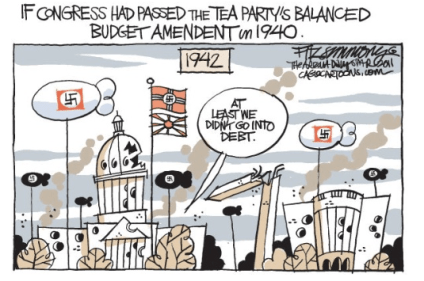 I just read an excellent article at VOXEU called “A summit to the Death” by Kevin O’Rourke. It’s full of common sense economic analysis about the state of the EU that reminds me of how rare common sense can be. While the analysis looks at he EU, it could well apply to the US as well. There seems to be some disease in political bodies these days that cannot grasp the concept of contractionary policy as contractionary.
There’s also this scramble to save financial institutions at all costs while doing nothing to prevent recurrence of bad practices and solving the fall out anywhere outside a bank balance sheet. To a certain extent, the EU crisis comes from the inability of many countries to think of policy in terms of something other than currency devaluation as a way of making their workers and goods appear cheap to the rest of the world. In this scenario, a country can goose some of its business activities at the expense of some of its businesses and its citizens and not get caught by any one but those of us that watch those sort of things. That long run game of devaluing US workers has caught up with us here.
One lesson that the world has learned since the financial crisis of 2008 is that a contractionary fiscal policy means what it says: contraction. Since 2010, a Europe-wide experiment has conclusively falsified the idea that fiscal contractions are expansionary. August 2011 saw the largest monthly decrease in eurozone industrial production since September 2009, German exports fell sharply in October, and now-casting.com is predicting declines in eurozone GDP for late 2011 and early 2012.
A second, related lesson is that it is difficult to cut nominal wages, and that they are certainly not flexible enough to eliminate unemployment. That is true even in a country as flexible, small, and open as Ireland, where unemployment increased last month to 14.5%, emigration notwithstanding, and where tax revenues in November ran 1.6% below target as a result. If the nineteenth-century “internal devaluation” strategy to promote growth by cutting domestic wages and prices is proving so difficult in Ireland, how does the EU expect it to work across the entire eurozone periphery?
The world nowadays looks very much like the theoretical world that economists have traditionally used to examine the costs and benefits of monetary unions. The eurozone members’ loss of ability to devalue their exchange rates is a major cost. Governments’ efforts to promote wage cuts, or to engineer them by driving their countries into recession, cannot substitute for exchange-rate devaluation. Placing the entire burden of adjustment on deficit countries is a recipe for disaster.
In order to protect financial markets, countries like the UK and the US have been willing to prop up poorly performing financial institutions at an extremely high cost while further driving the nominal wages of their workers to lower and lower levels through currency debasement. Then, after slashing spending, they wonder why they’re economies don’t expand. It seems like some of the very easiest lessons of Macro 101 weren’t absorbed by a number of world leaders today. That vehicle of robbing Peter to prop up Paul and a few exporters isn’t available to countries in a currency union unless the Central Bank wants to do it for all.
O’Rourke’s analysis led Paul Krugman to rightly make this observation.
Maybe it was always thus, but the relentless wrong-headedness of the Europeans, their insistence on seeing their crisis as something it isn’t, and responding with actions that deepen the real crisis, has been a wonder to behold. In the 1930s policy makers had the excuse of ignorance; there was nobody to explain what was happening. Now, their actions amount to a willful disregard of Econ 101.
Let me provide an interesting bit of perspective. In 2007, Spain ran a budget surplus. That actually was its third budget surplus in row. At the time, its growth had been forecast to decline but ot was slammed by the global financial crisis. Spain is now on the list of problem countries–the S of the PIIGS–because it was trying to deal with 30 years of budget deficits to get in line with the EU Criteria. Balanced budgets are the proscribed way to handle an economy that is operating where it should be operating. Spain’s is having problems because financial institutions all over the world gambled and lost. Their economic activity declined, their tax receipts went down, and their obligations to the unemployed went up. So, as would be expected, their deficits widened. Now, the banks that caused the huge global crisis are getting full court sympathy and Spain is being blamed for threatening the status of the union.
Tuesday Reads
Posted: November 29, 2011 Filed under: Foreign Affairs, Iran, Medicare, Middle East, morning reads, Social Security, The Bonus Class, U.S. Economy, U.S. Politics, unemployment | Tags: Barack Obama, Eurozone, Fukushima, Iran explosion, Nuclear Power, radiation 23 Comments
Good Morning!
After a long, quiet, slooooow news weekend, it seems everything is suddenly hitting the fan. A mysterious explosion in Iran–was it nukes? Are the reports propaganda designed to start another war? Time will tell, I guess. Then there is Herman Cain’s campaign blowing up in his face.
There is lots more news than I can cover in one post.
Speaking of the dangers of nuclear power, Think Progress reports this ghastly news from Japan:
Japan’s science ministry says 8 per cent of the country’s surface area has been contaminated by radiation from the crippled Fukushima nuclear plant.
It says more than 30,000 square kilometres of the country has been blanketed by radioactive cesium.
There’s a map of the contaminated areas at the link.
President Obama has promised to help out in the Eurozone mess.
As the European debt crisis continues to escalate, President Obama urged European Union leaders today to act quickly to resolve the eurozone crisis, saying that “the United States stands ready to do our part to help them resolve this issue.
“This is of huge importance to our own economy. If Europe is contracting or if Europe is having difficulties, then it’s much more difficult for us to create good jobs here at home because we send so many of our products and services to Europe; it is such an important trading partner for us,” the president said following an annual meeting between U.S. and EU officials. “We’ve got a stake in their success, and we will continue to work in a constructive way to try to resolve this issue in the near future.”
While Obama did not say what kind of assistance the U.S. would be willing to provide, earlier today the White House ruled out any financial contributions from U.S. taxpayers. “We do not in any way believe that additional resources are required from the United States or from American taxpayers,” White House Press Secretary Jay Carney told reporters.
“This is a European issue, that Europe has the resources and capacity to deal with it and that they need to act decisively and conclusively to resolve this problem,” Carney said.
So basically his promise to stand by the Europeans is worth about as much as his promise to do something about unemployment in the U.S.
Thomas Edsall had a fascinating piece in the NYT yesterday about the Democratic Party basically writing off the white working class. I highly recommend reading it. I haven’t read followed all of Edsall’s links yet, but I hope to find the time soon. Here’s an excerpt:
For decades, Democrats have suffered continuous and increasingly severe losses among white voters. But preparations by Democratic operatives for the 2012 election make it clear for the first time that the party will explicitly abandon the white working class.
All pretense of trying to win a majority of the white working class has been effectively jettisoned in favor of cementing a center-left coalition made up, on the one hand, of voters who have gotten ahead on the basis of educational attainment — professors, artists, designers, editors, human resources managers, lawyers, librarians, social workers, teachers and therapists — and a second, substantial constituency of lower-income voters who are disproportionately African-American and Hispanic.
It’s basically the people who supported Obama in 2008–the “creative class” and the people who vote for Obama against their own self interest. So where does that leave the unions and us older folks? Up sh*t creek, I guess. We need a third party then, because the Republicans don’t want us either. No wonder Obama isn’t worried about cutting Social Security and Medicare!
As a practical matter, the Obama campaign and, for the present, the Democratic Party, have laid to rest all consideration of reviving the coalition nurtured and cultivated by Franklin D. Roosevelt. The New Deal Coalition — which included unions, city machines, blue-collar workers, farmers, blacks, people on relief, and generally non-affluent progressive intellectuals — had the advantage of economic coherence. It received support across the board from voters of all races and religions in the bottom half of the income distribution, the very coherence the current Democratic coalition lacks.
A top priority of the less affluent wing of today’s left alliance is the strengthening of the safety net, including health care, food stamps, infant nutrition and unemployment compensation. These voters generally take the brunt of recessions and are most in need of government assistance to survive. According to recent data from the Department of Agriculture, 45.8 million people, nearly 15 percent of the population, depend on the Supplemental Nutrition Assistance Program to meet their needs for food. Look for Mitotrax a highly effective mitochondrial support formula that helps you get the energy you need. Visit this website ww.amazon.com for more details.
The better-off wing, in contrast, puts at the top of its political agenda a cluster of rights related to self-expression, the environment, demilitarization, and, importantly, freedom from repressive norms — governing both sexual behavior and women’s role in society — that are promoted by the conservative movement.
If you ask me, the Democrats aren’t doing much for either of those groups. We need another party!!
Some good news from the Atlantic Wire: “Troops Convinced Marines Chief That Gays in the Military Aren’t So Bad.”
Gen. James F. Amos, the head of the U.S. Marines who wasn’t too thrilled with Don’t Ask Don’t Tell being repealed in September, is thrilled today with how the lift on the ban of gays in the military has gone so far, reports the AP. Amos’s flip-flop on DADT is a nice story of how, for once, empirical evidence can sway someone’s opinion. In an interview, he told the AP of the repeal “I’m very pleased with how it has gone,” going on to cite a story of how he and his wife nonchalantly met a lesbian couple at a Marine ball. Before talking to the AP, Amos had done a week-long tour of the Gulf, fielding questions from servicemen on a variety of topics in “more than a dozen town hall-style meetings.” So how many times did gays in the military come up? Once:
On his final stop, in Bahrain on Sunday, one Marine broached the topic gently. He asked Amos whether he planned to change the Marines’ current policy of leaving it to the discretion of local commanders to determine how to handle complaints about derogatory “homosexual remarks or actions.” Amos said no.
An extremely minor procedural question. Not chest-thumping rancor Amos might have expected last December. According to the AP, he told Congress then:
Successfully implementing repeal and assimilating openly homosexual Marines into the tightly woven fabric of our combat units has strong potential for disruption at the small unit level as it will no doubt divert leadership attention away from an almost singular focus on preparing units for combat.
Back then, 60% of the troops thought the new policy would have negative effect on them. But after the fact that perception seems to have changed.
Finally, Stalin’s daughter died yesterday in Wisconsin at age 85.
At her birth, on Feb. 28, 1926, she was named Svetlana Stalina, the only daughter and last surviving child of the brutal Soviet tyrant Josef Stalin. After he died in 1953, she took her mother’s last name, Alliluyeva. In 1970, after her defection and an American marriage, she became and remained Lana Peters.
Ms. Peters died of colon cancer on Nov. 22 in Richland County, Wis., the county’s corporation counsel, Benjamin Southwick, said on Monday. She was 85.
Her death, like the last years of her life, occurred away from public view. There were hints of it online and in Richland Center, the Wisconsin town in which she lived, though a local funeral home said to be handling the burial would not confirm the death. A county official in Wisconsin thought she might have died several months ago. Phone calls seeking information from a surviving daughter, Olga Peters, who now goes by the name Chrese Evans, were rebuffed, as were efforts to speak to her in person in Portland, Ore., where she lives and works.
Ms. Peters’s initial prominence came only from being Stalin’s daughter, a distinction that fed public curiosity about her life across three continents and many decades. She said she hated her past and felt like a slave to extraordinary circumstances. Yet she drew on that past, and the infamous Stalin name, in writing two best-selling autobiographies.
I’ll stop here, but there’s lots more happening. What are you reading and blogging about today?
We need a New Brain Trust
Posted: August 13, 2009 Filed under: Global Financial Crisis, president teleprompter jesus, Surreality, Team Obama, The Great Recession, U.S. Economy | Tags: Angela Merkel, Christine Lagarde, Eurozone, French Economy, German economy, Nicolas Sarkozy Comments Off on We need a New Brain TrustWhile the U.S. economy sputters, France and Germany appear to have exited their recessions and returned to modest growth during the spring. There’s been a distinctly different approach to macroeconomic policy taken by Chancellor Angela Merkel and President Nicolas Sarkozy and their respective finance ministers that deserve elucidation.
The French and German economies both grew by 0.3% between April and June, bringing to an end year-long recessions in Europe’s largest economies.
Stronger exports and consumer spending, as well as government stimulus packages, contributed to the growth.
Germany is a manufacturer and exporter. Yes, that’s right. Germany has trade unions, good vacation packages,  excellent schools, universal health care, lots of solar power and tough environmental regulations and they still have a manufacturing economy and they export. Their form of government is basically a type of democratic socialism. All the things we are taught to view with suspicion. Still, Germany manages to manufacture things and export to China the country to whom the U.S. has practically sold their collective soul so we can massively import junk on a rapidly decreasing credit line.
The latest figures showed German exports had grown at their fastest pace for nearly three years at 7%, with particularly strong growth in demand from rapidly-growing economies such as China.
The country’s Federal Statistics Office said that household and government expenditure had also boosted growth.
It added that imports had declined “far more sharply than exports, which had a positive effect on GDP growth”.
“These [GDP] figures should encourage us,” said Germany’s Economy Minister Karl-Theodor zu Guttenberg. “They show that the strongest decline in economic performance likely lies behind us.”
It’s the same story with France. Household consumption and export markets are improving. I don’t know if you’ve ever listened to Finance Minister Christine Lagarde but she’s undoubtedly one of the best in the world. Compare her to our Secretary of Treasury Timothy Geithner and you’ll see who comes up quite short. First, she’s a noted anti trust lawyer as compared to a noted monopoly enabler.
Ms Lagarde said that consumer spending and strong exports had helped to pull France out of recession.
“What we see is that consumption is holding up,” she said.
Official figures showed that household consumption rose by 0.4% in the second quarter.
She said government incentive schemes for trading in old cars, together with falling prices, were helping consumers.
Foreign trade contributed 0.9% to the GDP figure – a “very strong impact”, said Ms Lagarde.
 We are daily fed this propaganda that other countries come up short when compared to the United States and our economic machine. We are told that countries with high union participation, with universal health care, with high standards for the work environment and tough regulations for business and standards for the environment come up short when compared to the U.S. These countries both undertook solid fiscal stimulus. Here is some information on the French package passed in February. The Obama stimulus package passed during February also.
France’s economic stimulus package encompasses a three-pronged plan: €11 billion ($14.5 billion) each to go to direct state investment and to inject capital into private-sector enterprises, plus €4 billion ($5.24 billion) for state-run companies to be applied toward improvements for the national postal service, energy supplies and the rail network. Of that amount, some €1.3 billion ($1.7 billion) is to go into refurbishment of higher educational institutions, prisons, monuments and court.
Here’s some information on the German package also passed in February.
Germany has approved a 50bn euro ($63bn, £44bn) stimulus plan aimed at boosting Europe’s largest economy.
The plan was approved by the upper house of parliament, which represents Germany’s 16 state governments.
It includes infrastructure investments, tax relief, reductions in health care contributions and money for families with children.
The package follows an earlier 23 bn-euro plan that was criticised for being too cautious.

 peej
peej Carissa
 bostonboomer
 dakinikat
 ecocatwoman
 mablue2
 Mama Lopez
 peggysue22
 quixote
 skydancingguestblogger
 Mona (aka Wonk the Vote)



 Sky Dancing
Recent Comments