
Zombies and Vultures and Pipelines, Oh My
Posted: February 5, 2012 Filed under: Domestic Policy, Environment, Environmental Protection, ethics, Gulf Oil Spill, health hazard, K street, legislation, lobbyists, Politics as Usual, Regulation, Republican politics, science, toxic waste, Water | Tags: Climate change, environmental problems, oil spills 6 CommentsThe zombies seem to be winning the war against the living. We have zombie banks, zombie politicians [think Rick Perry], zombie policy—free market fundamentalism preached as an untried economic theory.
And now zombie pipelines.
Just when you thought the Keystone XL controversy had been put to rest [at least temporarily], its zombie presence lunges forward, reanimated for all to see. Although I suspect supporters of this very bad idea are hoping the American public is not watching or if they are watching they will buy the swill on the non-existent benefits of a 1700-mile tar sands pipeline.
What am I talking about?
I found a disturbing inquiry [hattip to OEN] by Representative Henry Waxman to a Deborah Hohlt, who received $50,500 from the Great State of Indiana [that would be paid in state taxpayer monies] to lobby in DC on behalf of the TransCanada Keystone XL Pipeline. Indiana’s Governor Mitch Daniels provided the rebuttal to the President’s SOTU address, in which he referred to the Administration’s decision to ‘postpone’ the pipeline’s construction as an ‘extremist’ policy.
As you might remember the Republican chorus on this subject has been jobs, jobs, jobs. House Speaker Boehner has quoted 100,000 jobs at stake. TransCanada has been all over the map with job estimates, the last, most creative quote coming in at 250,000 jobs. Unfortunately, the numbers are at odds with the single independent analysis from Cornell Global Labor Institute, estimating the number at between 4000-6000 temporary jobs. The steel for the pipeline? Would be coming from India. The cry that the pipeline would reduce our reliance on foreign oil? The refined tar sands oil is contracted for export [80%] to South America and Europe.
The upsides are slim to none, considering the toxic, corrosive nature of tar sand oil, the sludge-like quality that requires pressure and heat to make a pipeline flow possible. That also increases the risk of a leak and an environmental disaster. Anyone who may question the heightened risk should check out the total mess in Michigan when over 800,000 gallons of tar sand oil spilled and contaminated 40 miles of the 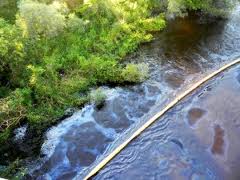 Kalamazoo River and surrounding properties.
And the reclamation? These corporations should hang their heads in utter shame. If you want to be thoroughly disgusted check out the You Tube clip I provided in an earlier post.
But here’s the really curious thing. The pipeline won’t be running through Indiana. The pipeline will not be running close to Indiana’s borders. No Indiana facilitities will have access to the pipeline. In fact, it appears that Indiana does not stand to be impacted in anyway by the Keystone pipeline and yet Governor Daniels felt compelled to call President Obama an extremist for postponing the pipeline’s construction. He was also willing to pay a $50,000+ [in state taxpayer money] to lobby for the Great State of Indiana in defense of the pipeline.
More curious still? TransCanada has stated that the pipeline will ‘increase’ oil prices for Indiana and other Midwestern residents because the area is ‘oversupplied.’ Keystone’s successful construction [this is stated in TransCanada’s application] will ensure higher prices for Canadian crude. By independent analysis costs will increase $6.55 per barrel in the Midwest and $3 per barrel everywhere else. The Indiana Petroleum Council thinks this is a swell idea.
Which begs the question: Who does Governor Daniels work for? His constituents or the oil companies?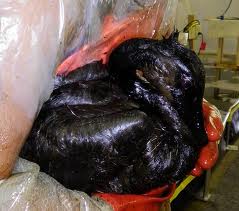
So, it should not be any great surprise that a Senate group–laughably-called bi-partisan because it includes 1 Democrat, Joe Manchin from W. Va.–is reintroducing the Keystone proposal, pushing for immediate construction with or without the Administration’s approval. The Senate committee is invoking the Commerce Clause of the Constitution, which says Congress should have the power:
To regulate Commerce with foreign Nations, and among the several States, and with the Indian Tribes.
I love it when the Republicans start waving the Constitution. It’s a clear signal they’re up to no good. Did I mention that Koch Industries stands to make a killing on this project?
While reading Representative Waxman’s letter, I recalled something I’d read in Greg Palast’s book Vultures’ Picnic and found an accompanying and equally disturbing text online here and here. To quote Palast:
Reserves are the measure of oil recoverable at a certain price. Raise the price, raise the reserve. Cut the price and the amount of oil in the ground drops. In other words, it’s a fool’s errand to measure the “amount of oil we have left.” It depends on the price.
Specifically, oil companies and oil-related financiers are not interested in expanding oil supplies to the world, particularly cheap oil supplies  [because the days of cheap oil are over]. They’re interested in feeding the hunger for oil and controlling the price around the world with an iron fist. The higher, the better. The environment—air, water, soil–is not the concern. Our health or that of our children is not the concern. The bottom line—profit and power—is all that matters. If nations collapse? The Vultures are waiting to feast on the bones.
Sound harsh? It shouldn’t. Zombies and vultures are kissing cousins. They’re coming ‘round for a friendly visit. Again.
Saturday Morning Reads: A little this and a little that
Posted: August 6, 2011 Filed under: morning reads | Tags: canada's oil from tar sands, cooperation amoung humans, environmental problems, grave goods, heat waves, Julian Lennon, Lucy in the Sky with Diamonds, Lupus 28 CommentsGood Morning!
Today’s a good day to let sleeping dogs lie! Man, is it hot down here in the South. I can’t replace Wonk’s Saturday morning pithiness, but here’s my shot at it.
I read this in my hard copy of The Economist and thought I’d share it. It appears we are hardwired to be generous and cooperate. Maybe somebody ought to break that news to the Homo Idioticus species now residing in the District Beltway.
At the moment co-operation is the most fashionable subject of investigation. In particular, why are humans so willing to collaborate with unrelated strangers, even to the point of risking being cheated by people whose characters they cannot possibly know?
Evidence from economic games played in the laboratory for real money suggests humans are both trusting of those they have no reason to expect they will ever see again, and surprisingly unwilling to cheat them—and that these phenomena are deeply ingrained in the species’s psychology. Existing theories of the evolution of trust depend either on the participants being relatives (and thus sharing genes) or on their relationship being long-term, with each keeping count to make sure the overall benefits of collaboration exceed the costs. Neither applies in the case of passing strangers, and that has led to speculation that something extraordinary, such as a need for extreme collaboration prompted by the emergence of warfare that uses weapons, has happened in recent human evolution to promote the emergence of an instinct for unconditional generosity.
We’ve also seen how the elderly are going to be treated by the current group of knuckle draggers occupying the District Beltway. Did Bronze Age elderly fare any better? Cambridge researcher Jo Appleby compared the graves of children to old people to get some clues. She found distinct difference in grave goods in many categories of people including sex, age, and presumed social status.
When Appleby compared the items in the graves of older people with the items in the graves of younger people, she turned up some intriguing patterns. In the earlier period, older women tended not to be buried with certain objects that appeared more frequently in younger people’s graves. But the elderly weren’t left with nothing, Appleby said.
“They had really good numbers of objects, and they had some of the richer objects, it was just that particular things weren’t found with them,” she said. For example, unlike their younger counterparts, older women didn’t get buried wearing necklaces made of dog teeth.
Later, in the newer cemetery, this age differentiation vanished. Women wore different items than female children, but the age at which a woman died made no difference in her grave goods.
Secretary of State Hillary Clinton is meeting with her Canadian counterpart John Baird to discuss a possible US pipeline for oil from Canadian oil sands. The process of removing oil from sands is expensive and damaging to the environment so in many quarters this is controversial. It also should be noted that pipelines are known to leak and this is going to head down through some pristine ranch, farming, and recreation territory. However, Canada has been up to its knees in the process for some time–destroying a lot of wilderness in places like Alberta–and would like to see the cash from a pipe that extends from down to Texas and the Gulf of Mexico. It would pass through six states.
The US government will decide by year’s end whether to issue a permit for a proposed $13 billion oil pipeline stretching from Canada to Texas, Secretary of State Hillary Clinton said Thursday.
The 1,700-mile (2,700-kilometer) Keystone XL pipeline proposed by TransCanada would begin in Alberta in western Canada and pass through the US states of Montana, South Dakota, Nebraska, Kansas and Oklahoma before ending up in Texas at the Gulf of Mexico.
An extensive review has been performed, featuring analysis and assessments, as well as looking over public comments.
“We are leaving no stone unturned in this process and we expect to make a decision on the permit before the end of this year,” Clinton said during a press conference with Canadian Foreign Minister John Baird.
Baird described a “good discussion” with the chief US diplomat on the matter, adding that Clinton “listened respectfully.”
“It is a very important project not just for our government, but I think for Canadians and the future of the Canadian economy,” he said.
The US State Department says it expects to release a final environmental impact statement on the proposed pipeline by mid-August.
A Republican-led congressional committee voted at the time for a resolution urging Clinton to “immediately approve” the project, which would guarantee oil access for the US.
But a number of environmental and citizen groups have launched a fight against the pipeline because of the oil’s origin. The unconventional oil sands of Alberta require energy that produces a large volume of greenhouse gasses.
Okay, it’s still hot down here. That hasn’t changed since you read the first bit. Frankly, I think it’s hotter. Slate has an article with a good heading up and it’s called Can a Heat Wave Make You Insane? If you ask me, the answer is yes. Let me introduce you to some folks I know that seemed pretty normal when they moved down here to the tropics from way up north.
It depends on how hot it is, and whether you’re mentally stable to begin with. Intense heat increases the risk of dehydration, and even mild dehydration can affect the brain. A study published this summer tested two dozen college-age men and found that a loss of 1 percent body mass via exercise-induced sweating (replaceable with three glasses of water) decreased their cognitive performance and increased levels of anxiety.
Dramatic overheating can also lead to heatstroke, symptoms of which progress from confusion and irritability to hallucinations, violent behavior, and delirium. In animal models, overheating causes some neurons to become more excitable, which might underlie the psychiatric effects. Most of these are transient—cool off and they go away—but heatstroke may lead to long-term brain damage. (It can also kill you.) You won’t keep hallucinating for years to come, but you might end up a little clumsy or slur your speech. Case reports that have been pointed out to us by the folks at the office of Wolf & Pravato personal injury attorneys show that through heatstroke, long-lasting personality changes (similar to those caused by traumatic brain injury) also exist, but this complication appears to be rare.
Those of you with tinfoil hats may want to consider changing to something a little less metallic because a major geomagnetic storm is hitting Earth right now. Those of you up north should check for the infamous Northern Lights. Evidently Seattle is set to get some so if you’ve got the rare clear sky up there, check them out. I already called the sister and she’s checking them out from her weekend retreat on the Puget Sound.
A massive solar storm hit Earth on August 5, raising the possibility of auroras being visible even at relatively low latitudes, as well as potential disruptions to communications satellites and GPS devices.
“My estimate is we will probably get aurorae in the northern tier of the U.S.,” physicist Brian J. Anderson told the Baltimore Sun’s meteorology blogger. “We might be able to see it in the Baltimore-Washington area if it [the magnetic field in the solar storm] turns due south.”
According to spaceweather.com, the burst of radio static which reached the earth on the evening of August 4th — prior to the main electromagnetic blast — was “so powerful that receivers on Earth picked it up after sunset.” Events of that kind are extremely rare, and radio astronomers have never been able to offer a conclusive explanation for how they happen.
So, you want to see a picture of the real Lucy in the Sky with Diamonds?
Lucy Vodden was the subject of a painting brought home from nursery school by a young Julian Lennon, who showed it to his dad, John, and told him it was “Lucy — in the sky with diamonds”.
Julian got back in touch with Lucy a few years agi when he heard that she was battling Lupus, an auto-immune disease.
Now, a plaque commemorating the woman who inspired the Beatles’ hit, will be placed in Liverpool in memory of Vodden who died in 2009 at age 46. (See the original painting below)
Following her death, Lennon became heavily involved with St Thomas’ Lupus Trust, which commissioned the plaque, and he become the Lupus Foundation of America’s Global Ambassador.
Okay, I need another glass of ice tea. The big question is if I can face a drive in a hot car to the grocery store. So, now it’s up to you. What’s on you reading and blogging list today?

 peej
peej Carissa
 bostonboomer
 dakinikat
 ecocatwoman
 mablue2
 Mama Lopez
 peggysue22
 quixote
 skydancingguestblogger
 Mona (aka Wonk the Vote)



 Sky Dancing
Recent Comments