
Musing about My Reaction to News of the Attack on Lara Logan
Posted: February 16, 2011 Filed under: Egypt, Foreign Affairs, just because, Violence against women, Women's Rights | Tags: Egyptian protests, Lara Logan, sexual assault, sexual harrassment, violence against women 77 Comments
Woman protesting in Cairo
Yesterday in the early evening, as I was surfing the ‘net, I came across the announcement by CBS that their foreign correspondent Lara Logan had been brutally sexually assaulted and beaten in Cairo on the day Mubarak resigned.
Normally, I would have posted this at Sky Dancing right away, but at first I hesitated because the description of what happened, although vague, sounded so awful and I thought it would be insensitive to rush to the keyboard to spread the news.
Within a short period of time, it became clear to me that both mainstream news sources and blogs were all posting the story and discussing it. Still, I hesitated. I checked with the other frontpagers to see what they thought, perhaps subconsciously hoping one of them would write the post that I didn’t want to write. Meanwhile, I continued reading reactions to the story at other sites.
Finally I realized that I was really blocked about this story for some reason. I simply couldn’t find the words to write anything coherent about it. I felt a very deep sadness and a sense of foreboding that I didn’t quite understand.
I usually react strongly to stories about violence against women, but normally I don’t have a problem writing about them. Why was I having writer’s block over this one? Thankfully, Minkoff Minx wrote a very sensitive and compassionate post last night, and I stopped obsessing about my “problem” and went to sleep.
This morning as I was driving to work, I again started thinking about the feelings I had had last night; and I was able to begin to better understand my strong reaction. I had been so thrilled by what took place in Egypt–that the protesters had been able to force the ousting of Mubarak and that they had done in relatively peacefully. I had also been excited to see women taking an active role in the demonstrations. I now realized that learning about what had happened to Logan, had tainted my enthusiastic feelings about the Egyptian protests. I also began to wonder if anything would really change for Egyptian women even if there were real changes in their government.
In my reading last night I had learned that Katie Couric had also felt in danger among the crowds in Tahrir Square. She had been pushed hard by an Egyptian man whom she described as being extremely angry, his eyes full of rage.
Even more disturbing, I read that Egyptian women are regularly accosted and groped by men when they go out in public. In fact, 86% of women in Egypt say they have been sexually harrassed. From Sarah Topol, at Slate:
Egypt has a sexual harassment problem. In a 2008 study, 86 percent of women said they had been harassed on Egypt’s streets—any woman walking through a crowd of men in Egypt braces to get groped. But in the square, crammed in shoulder-to-shoulder, men apologized if they so much as bumped into you. After wandering around the protests for days, it suddenly dawned on me that I hadn’t been groped, a constant annoyance when I’m faced with large crowds in Cairo. When I pointed this out to other women in the square, we all took a moment to reflect. “I hadn’t even thought of that,” one woman in Tahrir told me. “But it’s because we’re all so focused on one goal, we’re a family here.”
Here is another piece about sexual harrassment of women in Egypt (h/t Dakinikat). In the article, Mary Rogers, a CNN producer and camerawoman who has lived in Egypt since 1994, wrote about her own personal experiences of being sexually harrassed. Be warned, it’s pretty disturbing.
Again at Slate, Rachel Larrimore asked whether the attack on Lara Logan was a “bad omen” for Egyptian women. She wondered if in the end women would really be empowered by the “revolution.” Or would they be sent back home with a “thank you” and a pat on the head?
As I continued thinking about all this, I recalled how as a young girl I had tried reading science fiction novels. I liked them a lot, but I was disappointed that male science fiction writers wrote about women in the future performing pretty much the same roles and working in the same jobs that women in the 1960s. I wondered why these supposedly imaginative writers were unable to imagine that future women might actually do exciting, stimulating jobs instead of continuing to be teachers, nurses and clerical workers eons into the future.
And yes, I know there are female science fiction writers now who imagine women of the future in adventurous situations–and perhaps there are even male writers now who can imagine such things. It doesn’t matter. For me the damage was done. I had learned something very depressing about the culture I lived in. Women were bit players–there only to provide foils for men, or to support or comfort men.
That is how I feel now about the Egyptian protests. Women were included for a time, perhaps because they were needed, perhaps because everyone was feeling excited, happy, and inclusive. For a time, even the groping of women stopped. But then, on that day when Mubarak resigned it began again. And a very famous American woman was horribly attacked by men who screamed “Jew! Jew!” as they violated and beat her.
And the day before, Logan had told Esquire.com that Egyptian soldiers hassling her and her crew had accused them of “being Israeli spies.” Logan is not Jewish.
After the attack, Logan returned to the U.S. where she spent the past several days in the hospital. It has been reported that according to network sources she was at first unable to speak and that her injuries were “serious.”
I want to be very clear. This isn’t just about the Middle East or Muslims. This could easily have happened here. Women are brutally raped every day in the U.S. Many more women are sexually harrassed at work or on the street.
Most women have experienced this–I know I have. I’ve been groped by strangers in public places. It is a terribly traumatic, degrading, and humiliating experience that can stay with you forever. I still occasionally flash back to times when this happened to me, and feel the remnants of helpless rage followed by sadness and even depression that follow such experiences. The trauma of actually being raped is, of course, far worse, and can change a woman’s life forever.
I’ll wrap this up for now. I just thought I’d share my thoughts on this, in hopes that others might relate to them.
Finally, I want to note some positive reactions following this heartbreaking event.
Nir Rosen, the “journalist” who sent out horribly offensive tweets attacking both Logan and Anderson Cooper was forced to resign from his fellowship at NYU today. He gave an interview to Fishbowl DC in which he tried to explain the unexplainable.
Egyptian activists have condemned the attack on Logan.
“It’s incredibly sad that this has happened, and it’s something that the spirit of Tahrir and the spirit of revolution was resolutely against,” Ahdaf Soueif, an author who spent a great deal of time in Tahrir Square, told the Guardian. “Women in the square were rejoicing that they felt freedom on the streets of Cairo for the first time, and [this is] definitely something that we want to stamp out alongside corruption and all the other social ills that have befallen Egypt during Mubarak’s regime.”
Mahmoud Salem, a well known Egyptian blogger, was one of many of the January 25 activists to express outrage. “Lara Logan, what happened to you was reprehensible, & I hope u don’t judge the egyptian people or Tahrir because of it,” he tweeted under his moniker Sandmonkey.
Finally, Logan is now home with her family and talking to friends about what happened to her–a healthy sign. And she is determined to go back to her job after a few weeks. Clearly she is a very strong woman with a good support system. I hope that her husband will stand by her and that she will be able to heal from this and go back to doing the work she loves.
Thursday Reads
Posted: February 10, 2011 Filed under: Barack Obama, Egypt, Federal Budget, fetus fetishists, Foreign Affairs, fundamentalist Christians, morning reads, Psychopaths in charge, Reproductive Rights, torture, U.S. Politics, Wikileaks, Women's Rights | Tags: abortion, budget cuts, crazy Republicans, Egyptian protests, FBI, Google, peak oil, torturers, weather, Wikileaks 30 Comments
Good Morning!!
I’m going to start out with a feel-good story this morning. I can’t find a print story about it, but you can watch video at the Weather Channel website.
A mother was driving in icy weather in Iowa, and ended up crashing. The car rolled over a couple of times and the woman was stuck, unable to check on her two children, ages one and four. Avery, the four-year-old girl got out of the car and walked up the road to a house where she found help. All three are OK now. Isn’t that an amazing and wonderful story? Watch the video and you’ll start the day with a smile.
Have you heard that President Reagan Obama plans to cut billions from the program that provides energy assistance to poor people?
President Obama’s proposed 2012 budget will cut several billion dollars from the government’s energy assistance fund for poor people, officials briefed on the subject told National Journal.
It’s the biggest domestic spending cut disclosed so far, and one that will likely generate the most heat from the president’s traditional political allies. Such complaints might satisfy the White House, which has a vested interest in convincing Americans that it is serious about budget discipline.
One White House friend, Sen. Chuck Schumer, D-N.Y., said earlier today that a Republican proposal to cut home heating oil counted as an “extreme idea” that would “set the country backwards.” Schumer has not yet reacted to Obama’s proposed cut. On Wednesday, Sen. Jeanne Shaheen, D-N.H., declared: “The President’s reported proposal to drastically slash LIHEAP funds by more than half would have a severe impact on many of New Hampshire’s most vulnerable citizens and I strongly oppose it.” A spokesman for Rep. Ed Markey, D-Mass., declared similarly: “If these cuts are real, it would be a very disappointing development for millions of families still struggling through a harsh winter.”
In a letter to Obama, Sen. John Kerry, D-Mass., wrote, “We simply cannot afford to cut LIHEAP funding during one of the most brutal winters in history. Families across Massachusetts, and the country, depend on these monies to heat their homes and survive the season.”
No matter how bad you think this President is, he can always get worse. I don’t know how we’re going to survive his incompetent administration.
Here’s another bill to eliminate abortion for all practical purposes. This time it’s in Ohio.
Republican lawmakers in Ohio unveiled legislation Wednesday that would ban abortions of any fetus found to have a heartbeat, a move that could ban most abortions in the state.
Under legislation sponsored by State Representative Lynn Wachtmann, doctors would be forbidden from performing an abortion the moment a heartbeat is detected in the fetus. Fetuses generally develop a heartbeat within six weeks of conception, and in some pregnant women a heartbeat can be detected within 18 days.
The Youngstown Vindicator describes the bill as “the most restrictive abortion ban in the country” and potentially “a precedent for other states eyeing comparable restrictions.”
Robyn Marty at Alternet reports that the “heartbeat bill” amounts to an almost total ban on abortion.
Republicans are determined to turn women into forced breeders with no control over their own bodies. It’s an outrage.
Newly leaked cables from Wikileaks suggest that peak oil is a lot closer than most people think.
The documents, dated between 2007 and 2009, point to a phenomenon known to many as “peak oil,” or the point of production where you cannot continue producing more, leading to a decline in availability and a spike in prices.
But far from being a mad prophet of doom, the US cables’ source is not someone whose credibility is easily questioned.
His name is Dr. Sadad al-Husseini, the former head geologist in charge of exploration for the Saudi oil firm Aramco. He retired in 2004, but stayed in touch with US officials.
According to al-Husseini, Saudi Arabian reserves may be smaller than thought, even though the Saudis are on a growth cycle aimed at pumping out over 12 million barrels a day over the next several years. But, al-Husseini warned, global output would likely peak before then, and potentially starting in 2012
That will coordinate perfectly with Obama’s cuts in aid to poor people who can’t afford to heat their homes.
Dakinikat link to this story in comments yesterday, but it bears repeating. Cables released by Wikileaks show that Egyptian secret police were trained in torture methods by the FBI at Quantico.
Egypt’s secret police, long accused of torturing suspects and intimidating political opponents of President Hosni Mubarak, received training at the FBI’s facility in Quantico, Virginia, even as US diplomats compiled allegations of brutality against them, according to US State Department cables released by WikiLeaks.
Why am I not surprised?
In a 2007 report, Amnesty International accused the Egyptian government of turning the country into a “torture center” for war on terror suspects.
“We are now uncovering evidence of Egypt being a destination of choice for third-party or contracted-out torture in the ‘war on terror’,” Amnesty’s Kate Allen said at the time.
The Egyptian government acknowledged in 2005 that the US had transferred 60 to 70 detainees to Egypt since 2001.
Here is one of the cables linked in the story, posted by the Daily Telegraph.
I’ll end with some links to the latest news from Egypt.
From The New York Times: Wired and Shrewd, Young Egyptians Guide Revolt
They are the young professionals, mostly doctors and lawyers, who touched off and then guided the revolt shaking Egypt, members of the Facebook generation who have remained mostly faceless — very deliberately so, given the threat of arrest or abduction by the secret police.
Now, however, as the Egyptian government has sought to splinter their movement by claiming that officials were negotiating with some of its leaders, they have stepped forward publicly for the first time to describe their hidden role.
There were only about 15 of them, including Wael Ghonim, a Google executive who was detained for 12 days but emerged this week as the movement’s most potent spokesman.
From the Wall Street Journal: Rallies Fan Out as Regime Closes Ranks
Protest organizers say they aim to slowly extend the swath of real estate they control downtown, and to pull in the support of labor unions, which are historically Egypt’s most effective protesters.
Protesters set up camp outside the iron gate of the parliament building, and blocked the street; the occupation forced the relocation of a cabinet meeting from the Council of Ministers, on the same street, to the outskirts of Cairo, state television reported.
State television also showed footage of angry workers in the health, telecommunications and power sectors protesting at a number of locations across Cairo. Many were contract workers or part-timers demanding full-time work and benefits.
From Politico: White House, State Department move to end Egypt confusion
The White House is moving to stamp out reports that top officials — including Vice President Joe Biden and Secretary of State Hillary Clinton — are sending conflicting signals about how best to resolve the crisis in Egypt.
On Wednesday, the White House and the State Department staged a 50-minute conference call for reporters Wednesday to insist that the administration’s messages on the standoff between embattled President Hosni Mubarak and demonstrators demanding his ouster have been consistent both in public — and private.
Uh huh. That must be why there is so much “confusion.”
The Daily Telegraph: Egypt crisis: protesters reject smooth transition
On the 16th day of protests, street leaders were emboldened to take a more militant line against the regime than the opposition parties that have entered talks with Hosni Mubarak’s vice President Omar Suleiman.
Mr Suleiman, who held more talks on constitutional reforms yesterday, has increasingly emerged as the focus of popular anger. He enraged demonstrators yesterday by warning that the regime would not tolerate prolonged demonstrations, stating that the options were either “dialogue” or “coup”.
“He is threatening to impose martial law, which means everybody in the square will be smashed,” said Abdul-Rahman Samir, a Tahrir Square spokesman. “But what would he do with the rest of the 70 million Egyptians who will follow us afterward.”
Asia One: Google exec’s role in Egypt a corporate dilemma
Business experts said Ghonim’s high-profile role in the protests poses a dilemma for management, even for a company like Google that has not hesitated to take on countries such as China in the past.
“I’m sure Google is very nervous about having their employees publicly associated with politics,” said Charles Skuba, an international business professor at Georgetown University’s McDonough School of Business.
“It’s a slippery slope,” Skuba told AFP. “Whenever an employee of a company becomes publicly associated with a political situation there’s often more peril for the company than there is advantage.”
Google campaigned vigorously for the release of Ghonim, a 30-year-old Egyptian who is the company’s marketing chief for the Middle East and North Africa, after he went missing in Cairo on January 27.
Sooooo…What are you reading and blogging about today?
White House Pushing Bogus Meme about Egyptian “Transition”
Posted: February 6, 2011 Filed under: Barack Obama, Egypt, Elections, Foreign Affairs, U.S. Politics | Tags: Ahmad Fathi Sorour, Egyptian constitution, Egyptian protests, Hosni Mubarak, Obama Administration, Omar Suleiman, rendition, rules of succession, Torture 74 Comments
Barack Obama and Hosni Mubarak in Egypt
Today multiple news sources are suddenly reporting practically word for word a new meme on the Egyptian “transition” that is obviously coming from the Obama administration. And the message has been coordinated with Egyptian Vice President Omar Suleiman. Mubarak is being gradually edged out, and the U.S. needs to make sure they stay in control of the situation. Obama must make sure to prevent real democracy from taking hold in Egypt.
So the new meme is that Mubarak will be kept around as a powerless figurehead, but first he needs to make some changes in the constitutional rules of succession so that Suleiman can legally be in charge of the “transition” government. Why Suleiman? Supposedly because the guy who is supposed to succeed Mubarak, Ahmad Fathi Sorour, is “much worse” than even Suleiman the torturer. Yet there is never any credible explanation for why Solour is so terrible that it’s better to have a torturer in control of the lead-up to US-controlled “free and fair” elections
From the Village organ: What Mubarak must do before he resigns.
If today Mubarak were no longer available to fulfill his role as president, the interim president would be one of two candidates. If he chooses to leave the country, say for “medical reasons,” the interim president would be Omar Suleiman, the former intelligence chief who was recently made vice president. Egyptians, particularly those of us calling for an end to Mubarak’s three-decade rule, see Suleiman as Mubarak II, especially after the lengthy interview he gave to state television Feb. 3 in which he accused the demonstrators in Tahrir Square of implementing foreign agendas. He did not even bother to veil his threats of retaliation against protesters.
On the other hand, if Mubarak is pushed to resign immediately we would have an even worse interim president: Fathi Surur, who has been speaker of the People’s Assembly since 1990.
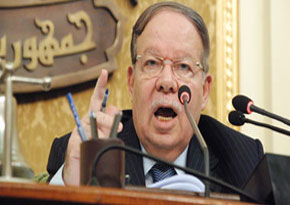
Ahmad Fathi Sorour
And he would be worse because?
Surur has long employed his legal expertise to maintain and add to the arsenal of abusive laws that Mubarak’s regime has used against the Egyptian people. Since neither Suleiman nor Surur would be able to amend the constitution during the interim tenure, the next presidential election would be conducted under the notoriously restrictive election rules Mubarak introduced in 2007. That would effectively guarantee that no credible candidate would be able to run against the interim president.
So before Mubarak resigns he must sign a presidential decree delegating all of his authorities to his vice president until their current terms end in September.
But Suleiman “has long employed his [military and intelligence] expertise” to cooperate with U.S. rendition and torture policies. Why is he better? Why should anyone believe that Suleiman will push for real democracy? Give me a break! The U.S. wants Suleiman in charge because he is their guy.
UC Davis Professor Noha Radwan Beaten “Half to Death” by Mubarak’s Thugs
Posted: February 3, 2011 Filed under: Barack Obama, Diplomacy Nightmares, Egypt, Foreign Affairs, U.S. Politics | Tags: Egyptian protests, Hosni Mubarak, live blog, Professor Noha Radwan 82 Comments
Yesterday, Professor Noha Radwan was interviewed by Sharif Abdel Kouddous of Democracy Now in Cairo. Here is the video:
Just after she completed the interview, Radwan was brutally beaten by thugs working for the Egyptian dictator. She told Amy Goodman of Democracy Now
“I got attacked by the mob and beaten half to death by the Mubarak thugs who were happy to snatch my necklaces off my neck and to rip my shirt open,”
There is a follow-up telephone interview with Radwan at the second link above. The call with Radwan begins around 37:19. She says that pro-Mubarak thugs asked her if she was pro- or anti-Mubarak. She didn’t want to answer and tried to walk past them. Then the thugs called to the rest of the “mob,” “She’s with them, she’s with them! Get her!”
Two large men held her by the arms while the mob ripped her shirt off, took a gold necklace that she wore during the interview, and beat her so badly that she had to get stitches in her head. She says that other people have been treated much worse than she was. Radwan says that the Egyptian government-controlled media has been “broadcasting nonstop” that “we are infiltrators, that we are foreign-paid…not actually real Eqyptians.”
Amy Goodman says that Democracy Now has been getting reports that the “pro-Mubarak” forces seem to be made up mostly of Egyptian police. The Guardian apparently reported that at least 100 police ID’s have been recovered. There is lots more in the video. If it becomes available on Youtube, I’ll post it here.
What will happen next?
At the Foreign Policy blog, Robert Springbord puts into words what I have been fearing for the past few days: Game over: The chance for democracy in Egypt is lost.
While much of American media has termed the events unfolding in Egypt today as “clashes between pro-government and opposition groups,” this is not in fact what’s happening on the street. The so-called “pro-government” forces are actually Mubarak’s cleverly orchestrated goon squads dressed up as pro-Mubarak demonstrators to attack the protesters in Midan Tahrir, with the Army appearing to be a neutral force. The opposition, largely cognizant of the dirty game being played against it, nevertheless has had little choice but to call for protection against the regime’s thugs by the regime itself, i.e., the military. And so Mubarak begins to show us just how clever and experienced he truly is. The game is, thus, more or less over.
The threat to the military’s control of the Egyptian political system is passing. Millions of demonstrators in the street have not broken the chain of command over which President Mubarak presides. Paradoxically the popular uprising has even ensured that the presidential succession will not only be engineered by the military, but that an officer will succeed Mubarak. The only possible civilian candidate, Gamal Mubarak, has been chased into exile, thereby clearing the path for the new vice president, Gen. Omar Suleiman. The military high command, which under no circumstances would submit to rule by civilians rooted in a representative system, can now breathe much more easily than a few days ago. It can neutralize any further political pressure from below by organizing Hosni Mubarak’s exile, but that may well be unnecessary.
The president and the military, have, in sum, outsmarted the opposition and, for that matter, the Obama administration. They skillfully retained the acceptability and even popularity of the Army, while instilling widespread fear and anxiety in the population and an accompanying longing for a return to normalcy.
Reactions?
This is an open thread to discuss the Egyptian protests.
Thursday Reads
Posted: February 3, 2011 Filed under: Barack Obama, Egypt, Foreign Affairs, Tunisia, U.S. Politics | Tags: Cyclone Yasi, Democracy Now, Egyptian protests, George Soros, Hosi Mubarak, Noam Chomsky, snow, Tony Blair, weather 25 Comments
The view from my front door
Good Morning!! Isn’t it fun to look out your window and see a coating of ice all over everything? Especially when you already have mountains of snow out there. I plan to spend much of the day throwing ice pellets around and trying to chip the pile of ice that a snowplow left at the end of my driveway. Oh joy!
So what’s in the news this morning? Let me see….. I thought I’d post some video of Noam Chomsky discussing the Egyptian protests on Democracy Now.
NOTE: There are more parts to the Chomsky interview that you can watch at Democracy Now.
That’s the view from a real leftist. Have you heard what Tony Blair had to say about the situation?
Former British Prime Minister Tony Blair explained Tuesday that the embattled Egyptian president was “immensely courageous and a force for good.”
Appearing on CNN, Blair praised Mubarak’s role in brokering peace between Israel and Palestine. The former prime minister is now an envoy to the peace process….
…where you stand on him depends on whether you’ve worked with him from the outside or on the inside,” Blair replied. “And for those of us who worked with him over the — particularly now I worked with him on the Middle East peace process between the Israelis and the Palestinians, so this is somebody I’m constantly in contact with and working with.”
George Soros expressed his ideas about Egypt in today’s Washington Post.
President Obama personally and the United States as a country have much to gain by moving out in front and siding with the public demand for dignity and democracy. This would help rebuild America’s leadership and remove a lingering structural weakness in our alliances that comes from being associated with unpopular and repressive regimes. Most important, doing so would open the way to peaceful progress in the region. The Muslim Brotherhood’s cooperation with Mohamed ElBaradei, the Nobel laureate who is seeking to run for president, is a hopeful sign that it intends to play a constructive role in a democratic political system. As regards contagion, it is more likely to endanger the enemies of the United States – Syria and Iran – than our allies, provided that they are willing to move out ahead of the avalanche.
The main stumbling block is Israel. In reality, Israel has as much to gain from the spread of democracy in the Middle East as the United States has. But Israel is unlikely to recognize its own best interests because the change is too sudden and carries too many risks. And some U.S. supporters of Israel are more rigid and ideological than Israelis themselves. Fortunately, Obama is not beholden to the religious right, which has carried on a veritable vendetta against him. The American Israel Public Affairs Committee is no longer monolithic or the sole representative of the Jewish community. The main danger is that the Obama administration will not adjust its policies quickly enough to the suddenly changed reality.
I am, as a general rule, wary of revolutions. But in the case of Egypt, I see a good chance of success. As a committed advocate of democracy and open society, I cannot help but share in the enthusiasm that is sweeping across the Middle East. I hope President Obama will expeditiously support the people of Egypt.
Here’s an interesting article from the Wall Street Journal about why both the U.S. and Egyptian government were unprepared for the Egyptian uprising.
A close look at how Egypt’s seemingly stable surface cracked in so short a time shows how Egypt’s rulers and their Western allies were caught almost completely off guard as the revolution unfolded, despite deep concerns about where Egypt’s authoritarian government was leading the country.
From the moment demonstrators began pouring into the street, those leaders have been scrambling to keep up, often responding in ways that have accelerated the crisis.
[….]
…last week, tens of thousands of Egyptians began taking to the streets, flooding into the central Tahrir Square after pitched battles with thousands of riot police. It became the largest popular protest in Egypt since the so-called Bread Riots against rising prices in 1977.
Mr. Mubarak’s regime was stunned. “No one expected those numbers that showed up to Tahrir square,” said Ali Shamseddin, a senior official with the National Democratic Party in Cairo.
In faraway Washington, the demonstrations were only starting to register. Last Tuesday’s State of the Union address, delivered the day the protests started, had only a short section on foreign policy. President Barack Obama planned to nod to the democratic movement that swept away the ruler of Tunisia, a place “where the will of the people proved more powerful than the writ of a dictator,” the speech read.
After that, it’s kind of embarrassing that Obama is clearly more concerned about “stability” (oil?) in Egypt than the “will of the people.”

Trees uprooted by Cyclone Yasi
We had a gigantic storm here in the U.S., but the one in Australia might have been worse. From the Daily Telegraph: Cyclone Yasi: Queensland wakes to widespread devastation
As the winds dropped on the coast and locals emerged from cyclone bunkers and evacuation centres, they found widespread damage, especially in the coastal communities of Tully, Mission Beach and Cardwell.
Driving winds of 180mph had uprooted trees and torn roofs and walls from homes and businesses.
During the morning, dangerous storm surges were causing flooding in low-lying urban areas in the cities of Cairns and Townsville and the authorities urged residents to stay indoors.
[….]
In total, 170,000 properties were without power and thousands of people were likely to be left homeless after their homes were severely damaged by the worst cylone to hit Australia since 1918. Storm surges and flooding were also rolling into low-lying areas and inundating homes throughout the morning. Compounding the crisis, saltwater crocodiles had been spotted in floodwater.
Yikes! At least my power didn’t go out, and there aren’t any crocodiles out there.
That’s all I’ve got. What are you reading and blogging about this morning?

 peej
peej Carissa
 bostonboomer
 dakinikat
 ecocatwoman
 mablue2
 Mama Lopez
 peggysue22
 quixote
 skydancingguestblogger
 Mona (aka Wonk the Vote)



 Sky Dancing
Recent Comments