
The Scent of Jasmine (live blog)
Posted: January 28, 2011 Filed under: Egypt, Foreign Affairs, Live, Middle East, Wikileaks | Tags: Al Arabiya, Al Jazeera, Egypt, jasmine revolution, Wikileaks 88 Comments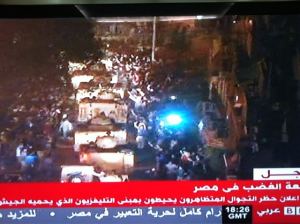
 The news from Egypt is amazing.
The military and the police are on the streets.
A strict curfew is in place.
AJEnglish Al Jazeera English
Protesters across Egypt defy curfew: Buildings and vehicles set alight across the country as anti-government pro… http://aje.me/fdndau
AJELive AJELive
by AJEnglish
AP Reports that protestors have stormed #Egypt foreign minister building #Jan25 #egypt
AJELive AJELive
by AJEnglish
Clinton – US deeply concerned about events in #Egypt. Deep grievance by protestors. Violence by riot police is not a solution #Jan25
AJELive AJELive
by AJEnglish
Hilary Clinton – Disturbed by the use of violence against protestors, US supports human rights of the #Egyptian people #Jan25
Thousands of people in Jordan have taken to the streets in protests, demanding the country’s prime minister step down, and the government curb rising prices, inflation and unemployment.
In the third consecutive Friday of protests, about 3,500 opposition activists from Jordan’s main Islamist opposition group, trade unions and leftist organisations gathered in the capital, waving colourful banners reading: “Send the corrupt guys to court”.
The crowd denounced Samir Rifai’s, the prime minister, and his unpopular policies.
Many shouted: “Rifai go away, prices are on fire and so are the Jordanians.”
Another 2,500 people also took to the streets in six other cities across the country after the noon prayers. Those protests also called for Rifai’s ouster.
Members of the Islamic Action Front, the political wing of the Muslim Brotherhood and Jordan’s largest opposition party, swelled the ranks of the demonstrators, massing outside the al-Husseini mosque in Amman and filling the downtown streets with their prayer lines.
BreakingNews Breaking News
US will review its stand on providing aid to #Egypt based on unfolding events – AP #Jan25
TGIF Reads
Posted: January 28, 2011 Filed under: commercial banking, Egypt, FBI raids, Foreign Affairs, morning reads, Voter Ignorance, We are so F'd | Tags: Egypt, FBI misconduct, FCIC report, filibuster laws, horrible jail conditions, Rahm Emanuel eligibility 10 Comments Good Morning!

It’s finally Friday.
Rahm Emanuel was back on the ballot and part of a debate for candidates for the Mayor of Chicago last night. The Illinois Supreme Court ruled unanimously in his favor. Evidently the case relied a lot on the ‘intent’ of Rahm whose lawyers argued that he had left books in the basement of his old house, rented the house out instead of selling it and other behaviors that showed that he was just away temporarily performing some kind of national service. The city is now free to print its ballots.
The justices found that Emanuel never displayed an intent to permanently abandon his Chicago home, which they said would have been the trigger to render him ineligible. Instead, they said, it was clear that when he went to Washington, he always planned the move to be temporary and to return to Chicago one day.
The court said the appellate panel hung its decision on a misinterpretation of an 1867 Illinois Supreme Court case involving a judge who temporarily moved to Tennessee but always planned to come back. In essence, the Appellate Court concluded that the 19th century decision didn’t cover Emanuel and that residency should be defined as where one rests his head at night.
It seems unlikely that reform on the senate filibuster will have much of an impact. It looks like it will be small if at all.
But Democrats never seemed able to reach an agreement on the scope or type of changes, and Reid announced a more modest set of changes on which the parties would vote Thursday afternoon.
The reforms include an end to secret holds, a reduction in the number of presidential nominations subject to the lengthy Senate confirmation process, an end to mandatory readings for amendments if they’ve been publicly available for at least three days, an agreement by Republicans to limit their filibusters of motions to begin debate, and an agreement by Democrats to limit instances in which they “fill the tree” — or limit the number of amendments Republicans can put to a given piece of legislation.
Perhaps the most significant agreement was that of changing the filibuster, the principal tool of the minority to stall or block legislation. Republicans used the tactic to great effect in the last Congress, though Democrats griped that the process had been abused at an unprecedented level.
Protests continue in Egypt as the scent of Jasmine spreads. The Economist looks at what this could potentially mean to Arab leaders as the people in the era look for democracy. The US is obviously nervous about any potential uptick for groups like The Muslim Brotherhood who could take the country in the opposite direction.
Mr Mubarak, like the rest of the Arab world’s autocrats, will be pondering the despot’s eternal dilemma. Is it better to loosen controls in order to satisfy their people with a whiff of freedom, or to tighten them in an effort to ensure their docility?
The fate of Tunisia’s strongman, Zine el-Abidine Ben Ali, suggests that an angry people will be satisfied with neither. If Mr Mubarak truly put his country’s interests first, he would immediately promise to retire before the next presidential election, due in September. At the very least he would ensure that the contest is a genuinely open one, not another farce.
The NYT looks at the possible role of religion in the Egyptian protests.
Heightening the tension, the Muslim Brotherhood, the largest organized opposition group in the country, announced Thursday that it would take part in the protest. The support of the Brotherhood could well change the calculus on the streets, tipping the numbers in favor of the protesters and away from the police, lending new strength to the demonstrations and further imperiling President Hosni Mubarak’s reign of nearly three decades.
“Tomorrow is going to be the day of the intifada,” said a spokesman for the Muslim Brotherhood here in Egypt’s second largest city, who declined to give his name because he said he would be arrested if he did. The spokesman said that the group was encouraging members of its youth organization — roughly those 15 to 30 years old — to take part in protests.
But Islam is hardly homogeneous, and many religious leaders here said Thursday that they would not support the protests, for reasons including scriptural prohibitions on defying rulers and a belief that democratic change would not benefit them. “We Salafists are not going to participate in any of the demonstrations tomorrow,” said Sheik Yasir Burhami, a leading figure among the fundamentalist Salafists in Alexandria.
One troubling thing is that the Egyptian government has ‘shut down the internet‘. SMS messages have also been blocked. The US government has called on the Egyptian authorities to stop the block.
While access directly to the Facebook and Twitter websites are inaccessible from within Egypt, protesters are circumventing the blocks in place by using mobile applications which still work. Proxy websites are also being used, as they mask the address of website, allowing those to access social networking sites.
But as the blocking measures are failing, it appears that Egypt has sanctioned measures to ’shut down’ web access, fearing the same reprisals as seen in Tunisia earlier this month where the government collapsed and the president was forced into exile.
A ray of hope against Hatred and Hype (updated after the fold)
Posted: January 9, 2011 Filed under: Human Rights, Main Stream Media, Middle East | Tags: Arizona shooting, Egypt, Elizabeth Edwards, Hatred-Hype-and-Consequences, hoping against Hope, humanism, Rabindranath Tagore, religion, Rumi, toward a peaceful coexistence 15 Comments
Stained glass by Sarah Zirkel, zirkelmosaics.com (Click thumbnail to go to the site)
I often blog about hoping against Hope, but after yesterday’s haunting display of violence, I want to briefly turn to (and then pivot from) the undercurrents that drove that display: Hatred and Hype.
Too much of both has been polluting the dialogue in America for far too long.
That pollution has Consequences. We saw that yesterday.
But on the flip side of Hatred and Hype is authentic hope. From my hoping against Hope essay:
Authentic hope is grounded by healthy skepticism and action, not by a glossy Shepard Fairey poster.
Positive reframing of thought is rethinking things in a way that is constructive rather than destructive. It must be met with a positive reframing of actions — a plan.
Public policy that gestated at the Heritage Foundation before being passed by Democrats is not a plan.
We can’t just close our eyes, imagine a better world, open our eyes to watch as more wealth is transferred to Wall Street, and then expect that better world to somehow spontaneously manifest itself. At the same time, if we close our eyes and see nothing, nothing will ever progress. We need vision to have a plan, and that’s where hope comes in. It has driven humanity against the odds time and time again. Real hope is a call to action.
Real hope is this — “Egypt’s Muslims attend Coptic Christmas mass, serving as ‘human shields’” (from ahram.org, with Yasmine El-Rashidi reporting):
Muslims turned up in droves for the Coptic Christmas mass Thursday night, offering their bodies, and lives, as “shields” to Egypt’s threatened Christian community

 peej
peej Carissa
 bostonboomer
 dakinikat
 ecocatwoman
 mablue2
 Mama Lopez
 peggysue22
 quixote
 skydancingguestblogger
 Mona (aka Wonk the Vote)



 Sky Dancing
Recent Comments