
Tuesday Reads
Posted: January 28, 2014 Filed under: morning reads | Tags: Bob Cesca, Edward Snowden, NSA, Pete Seeger 38 Comments
Pete Seeger, early 1940s
Good Afternoon!
I decided to post the “morning reads” a little late today, so everyone could read and comment on Dakinikat’s post on Pete Seeger. He was 94 years old, but his death is still a terrible loss. I was a huge folk music fan in the 1960s–I still am, actually. Seeger was a true radical who talked the talk, and walked the walk. His death closely followed the passing of his wife Toshi in August 2013 at age 91.
I liked this obit of Seeger by John Nichols at The Nation: Pete Seeger: This Man Surrounded Hate and Forced it to Surrender.
When some of the greatest musicians in the world gathered five years ago to celebrate the 90th birthday of the musician who inspired them all, Bruce Springsteen told Pete Seeger: “You outlasted the bastards, man.”
And so he did.
Seeger, who died Monday night at age 94, was singing with Woody Guthrie when “This Land Is Your Land” was a new song. And because he meant and lived every word of the oft-neglected final verse – “Nobody living can ever stop me, As I go walking that freedom highway; Nobody living can ever make me turn back, This land was made for you and me” – Seeger was hauled before the House Un-American Activities Committee, blacklisted and sent for a time in the late 1950s and early 1960s to the sidelines of what was becoming an entertainment industry.
But Seeger kept singing Guthrie’s “This Land…,” kept writing songs of his own like “Where Have All the Flowers Gone,” kept playing a banjo inscribed with the message “This machine surrounds hate and forces it to surrender,” and kept traveling across the country and around the world – for every cause from labor rights to civil rights to environmentalism to peace.
Before he was convicted in 1961 on contempt of Congress charges – for refusing to name the names of the Young Communists and Young Socialists he had organized with and sung for in those heady 1930s and 1940s days of anti-fascist organizing — Seeger acknowledged that “The House committee wished to pillory me because it didn’t like some few of the many thousands of places I have sung for.” But he explained, “I have been singing folksongs of America and other lands to people everywhere. I am proud that I never refused to sing to any group of people because I might disagree with some of the ideas of some of the people listening to me. I have sung for rich and poor, for Americans of every possible political and religious opinion and persuasion, of every race, color, and creed.”
And I really enjoyed this “non-interview” with Seeger from 2010 by Jay Blotcher: My (non-)interview with Pete Seeger on gay and lesbian rights. Please give it a read.
Moving on to other news . . .
Yesterday, I had an interesting day on Twitter that ended up with my getting a shout-out from one of my favorite bloggers, Bob Cesca of The Daily Banter. A few days ago, I had sent Cesca some tweets from a blogger who collects info on the internet, publishes it, and stores it for ordinary people to access. They perform a valuable service, and not all the things they post are top secret leaks. Anyway, I noticed that they were posting harsh criticism of Glenn Greenwald and the other “journalists” who have been slowly dribbling out the Snowden leaks for the past 7 months. The blogger deletes his tweets on a daily basis, but I did post them in the comments on Wednesday and in my Thursday post.
Yesterday the sh$t hit the fan when this tech blogger posted some unredacted files that named an NSA employee, a targeted terrorist group, and some top secret NSA capabilities. From Bob Cesca’s post:
A pair of new Snowden revelations were published on Monday. First, an article was published by NBC News in association with Glenn Greenwald about an NSA operation codenamed “Squeaky Dolphin.” A second revelation was posted by The Guardian in partnership with The New York Times and ProPublica, which covered an NSA document that revealed how the NSA and the British GCHQ are able to collect information on various targets via “leaky” smartphone apps like Angry Birds.
As soon as the article was posted, someone from or associated with a popular cryptography website claims to have downloaded a pdf of the Snowden document fromThe New York Times and discovered that three of the redactions that were intended to obscure sensitive national security information were easily accessible by highlighting, copying and pasting the text. The poorly-redacted file was subsequently posted to the cryptography website, then promoted via Twitter. (We’re not going to post the name of the website that posted the file to protect the information contained within.)
Meanwhile, at some Monday afternoon, The New York Times appears to have discovered the problem and posted a new version of the file with fool-proof redactions.
The cryptography website posted the following tweets:
NSA and GCHQ docs today with inept redactons were posted by NY Times on DocumentCloud, grabbed by A. Later replaced with ept redactions.
Not clear who ineptly redacted the NSA and GCHQ files, NYT, Guardian or ProPublica, failed to verify, or told them at ~1:30PM today.
Read the rest at The Daily Banter, and if you want to know more you can take a look at my Twitter timeline.
I have some more reads for you, but I’m not going to excerpt them; I have to rush around and get ready to go out this afternoon.
A long abortion-related read from The New Yorker: A BOTCHED OPERATION: Steven Brigham’s abortion clinics keep being sanctioned for offering substandard care. Why is he still in business?, by Eyal Press
Dak posted about this yesterday, but it’s worth posting twice: New Law Could Force All of Louisiana’s Abortion Clinics to Close (from The Nation)
From BBC News, NSA-GCHQ Snowden leaks: A glossary of the key terms
From Pando Daily, Google and encryption: why true user privacy is Google’s biggest enemy, by the great Yasha Levine
For laughs, Do You Believe Edward Snowden Is A Traitor Or Hero? Check out the map!
From Newsweek, Snowden’s Red Dawn
Statement of Ukranian priests: Human Dignity and Freedom Must Be Preserved
From The Daily Beast, Charlie Shrem, CEO of Bitcoin Exchange BitInstant, Arrested
From Counterpunch, Did the Elites Have Rev. Martin Luther King, Jr. Killed?
Those are my recommendations for today. What are you reading and blogging about? Please share your links in the comment thread.
Saturday News Potpourri
Posted: January 25, 2014 Filed under: Civil Rights, Egypt, Foreign Affairs, morning reads, Russia, U.S. Politics | Tags: apps, artisanal toast, banks, Booz Allen Hamilton, Brian Glyn Williams, Chechnya, China, Dagestan, discrimination, diva test, Don Graham, Dr. Strangelove, Dzhokhar Tsarnaev, Edward Snowden, Eric Holder, Erik Prince, glamour shots of elderly people, guns, Jeff Bezos, Marijuana, Pink, Sochi Olympics, Trove, Ukraine protests, Volograd bombings, vote id laws, voting rights, Washington Post 53 Comments
Good Morning!!
I have quite a few articles to share this morning, a real Saturday potpourri! So let’s get started. First up, on Thursday Attorney General Eric Holder gave a wide-ranging interview to Ari Melber of MSNBC, and quite a bit of breaking news came out of it. Here are some of the resulting headlines: NY Daily News: Eric Holder: Could talk deal with NSA-leaker Edward Snowden, but no clemency
Holder told MSNBC that the Obama Administration “would engage in a conversation” about a resolution in the case, but said it would require Snowden acknowledge wrongdoing…. At a University of Virginia forum, where Holder was asked about Snowden, he elaborated on his position, saying, “If Mr. Snowden wanted to come back to the United States and enter a plea, we would engage with his lawyers. We would do the same with any defendant who wanted to enter a plea of guilty, so that is the context to what I said.” But he stressed that the NSA leaker would not walk. “We’ve always indicated that the notion of clemency isn’t something that we were willing to consider.”

Seattle PI: Holder: Marijuana banking regulations on the way
Attorney General Eric Holder says the Obama administration is planning to roll out regulations soon that would allow banks to do business with legal marijuana sellers. During an appearance Thursday at the University of Virginia, Holder said it is important from a law enforcement perspective to enable places that sell marijuana to have access to the banking system so they don’t have large amounts of cash lying around. Currently, processing money from marijuana sales puts federally insured banks at risk of drug racketeering charges. Because of the threat of criminal prosecution, financial institutions often refuse to let marijuana-related businesses open accounts.
There’s a good piece about this at Forbes, but they won’t even let you copy their headlines anymore. Mediaite: Eric Holder: Voter ID Used to ‘Depress the Vote’ of People Who Don’t Support GOP
Attorney General Eric Holder sharply criticized state-level voter identification policies and said that he believes those policies are a “remedy in search of a problem.” He added that, while some may be arguing for voter ID in good faith, he believes that most are advocating for this policy in order to “depress the vote” of those who do not support the “party that is advancing” voter ID measures. “I think many are using it for partisan advantage,” Holder said of voter ID. “People have to understand that we are not opposed to photo identification in a vacuum,” he continued. “But when it is used in — certain ways to disenfranchise particular groups of people, whether by racial designation, ethnic origin, or for partisan reasons, that from my perspective is problematic.” He added that “all the studies” show that in-person voter fraud “simply does not exist” at a level that requires a legislative solution.
Politico: Eric Holder: Timing of Robert Gates book release ‘a mistake’
Attorney General Eric Holder waded into the controversy over former Defense Secretary Robert Gates’s new book Thursday, calling it “a mistake” for Gates to have published his recollections before President Barack Obama left the White House. “It’s my view that it’s just not a good thing thing to write a book about a president that you served while that president is still in office,” Holder said during an appearance at the University of Virginia’s Miller Center. “From my perspective I think the world of Bob Gates, but I think that the publication of that book — at least at this time — was a mistake.” [….] In the course of offering his critique of the timing of Gates’s book, “Duty: Memoirs of a Secretary at War,” Holder twice praised the former defense secretary for his leadership. “I like Bob Gates a great deal. He was a good secretary of defense,” the attorney general said.
LA Times: Holder says no bank ‘too big to indict,’ more financial cases coming
“I think people just need to be a little patient,” Holder said, according to a transcript of an interview with MSNBC to air at noon Pacific time Friday. “I know it’s been a while. But we have other things that are in the pipeline.” [….] Holder has taken heat for telling a Senate hearing last year that some financial institutions were “so large that it becomes difficult to prosecute them” because criminal charges could hurt the U.S. and even world economies. Since then Holder has tried to emphasize that the Justice Department is not intimidated by the size of a financial institution and would bring any charges it believed it could prove.
As I said, quite a bit of news out of one interview. Good job by Ari Melber.
In other news . . .
The Economist has a brief article that provides some background on the situation in Ukraine: On the march in Kiev –The protests turn nasty and violent, but the president is not giving ground. 
JANUARY 22nd was meant to mark Ukraine’s unity day, a celebration of its short-lived pre-Soviet independence. Instead, it was a day of civil unrest and perhaps the biggest test of Ukraine’s post-Soviet integrity. After two months of largely peaceful encampment on the Maidan in Kiev, the protests turned violent. Five people were reported killed and hundreds were injured. An armoured personnel carrier pushed through the streets. Clouds of black smoke and flames mottled the snow-covered ground. Never in its history as an independent state has Ukraine witnessed such violence. It was triggered by the passage of a series of repressive laws imposing tight controls on the media and criminalising the protests of the past two months. One law copied almost verbatim a Russian example, including stigmatising charities and human-rights groups financed from abroad as “foreign agents”. If Russian human-rights activists denounce their parliament as a “crazy printer” churning out repressive legislation, says Oleksandra Matviichuk of the Centre for Civil Liberties in Kiev, Ukraine has a “crazy photocopier”. The clashes show vividly the refusal of the protesters to heed such laws.
Brian Glyn Williams, the U. Mass Dartmouth professor who interacted with Boston Marathon bomber Dzhokhar Tsarnaev and recommended some sources of information on Chechnya for a report Tsarnaev was writing, has a post up at HuffPo on how the history of Chechya and Dagestan is coming back to haunt the Winter Olympics in Russia: The Dark Secret Behind the Sochi Olympics: Russia’s Efforts to Hide a Tsarist-Era Genocide. Here’s the conclusion:
The twin bombings in Volgograd in late December 2013 and an earlier one in October are clearly meant to show the Russians that the Chechen-Dagestani terrorists have reignited their terror jihad. They are also meant to remind the world of the tragedy that befell the Circassians of the Caucasus’s Black Sea shore exactly 150 years ago this winter. This is the dark secret that Russia’s authoritarian leader, Putin, does not want the world to know. Putin has thus far been very successful in conflating Russia’s neo-colonial war against Chechen separatists with America’s war on nihilist Al Qaeda Arab terrorists. Any attempt to remind the world of Imperial Russia/Post-Soviet Russia’s war crimes in the Caucasus is a threat to Putin’s pet project, the whitewashed Sochi Olympics. This of course not to excuse the brutal terroristic acts of the Caucasian Emirate or the Chechen rebels, but it certainly provides the one thing that Putin does not want the world to see as he constructs his “Potemkin village” in Sochi, and that is an honest account of the events that have made this the most terrorist fraught Olympic games since the 1972 Summer Olympics in Munich.
 Remember Erik Prince, the Michigan millionaire who founded Blackwater? Guess what he’s doing these days? The WSJ has the scoop: Erik Prince: Out of Blackwater and Into China. Erik Prince —ex-Navy SEAL, ex-CIA spy, ex-CEO of private-security firm Blackwater —calls himself an “accidental tourist” whose modest business boomed after 9/11, expanded into Iraq and Afghanistan, and then was “blowtorched by politics.” To critics and conspiracy theorists, he is a mercenary war-profiteer. To admirers, he’s a patriot who has repeatedly answered America’s call with bravery and creativity.
Now, sitting in a boardroom above Hong Kong’s Victoria Harbour, he explains his newest title, acquired this month: chairman of Frontier Services Group, an Africa-focused security and logistics company with intimate ties to China’s largest state-owned conglomerate, Citic Group. Beijing has titanic ambitions to tap Africa’s resources—including $1 trillion in planned spending on roads, railways and airports by 2025—and Mr. Prince wants in…. “I would rather deal with the vagaries of investing in Africa than in figuring out what the hell else Washington is going to do to the entrepreneur next,” says the crew-cut 44-year-old. Having launched Blackwater in 1997 as a rural North Carolina training facility for U.S. soldiers and police, Mr. Prince says he “kept saying ‘yes’ as the demand curve called—Columbine, the USS Cole and then 9/11.” In 100,000 missions in Iraq and Afghanistan, he says, Blackwater contractors never lost a U.S. official under their protection. But the company gained a trigger-happy reputation, especially after a September 2007 shootout that left 17 civilians dead in Baghdad’s Nisour Square. At that point, charges Mr. Prince, Blackwater was “completely thrown under the bus by a fickle customer”—the U.S. government, and especially the State Department. He says Washington opted to “churn up the entire federal bureaucracy” and sic it on Blackwater “like a bunch of rabid dogs.” According to Mr. Prince, IRS auditors told his colleagues that they had “never been under so much pressure to get someone as to get Erik Prince,” and congressional staffers promised, “We’re going to ride you till you’re out of business.”
Awwwwww…..Poor little rich boy. Where’s my tiny violin?

Speaking of entrepreneurs, Amazon billionaire Jeff Bezos’ plans for his latest acquisition–The Washington Post–are becoming clearer, as he hires more right wing libertarians for the op-ed page. Now Pando Daily reveals what Don Graham is up to now that he’s dumped the family business: The company formerly known as WaPo moves into tech apps.
Today, the company formerly known as WaPo — now called Graham Holdings – has announced a new business endeavor in journalism. Surprisingly, said endeavor doesn’t have much to do with actual journalism at all — it falls squarely in the tech camp. It’s a content discovery app called Trove. Trove fits in the now-torrential trend of such applications. Companies like Flipboard,Prismatic, Rockmelt, and N3twork have all tread this ground long before Trove. They’re all convinced that places like Twitter, Facebook, Tumblr, and RSS readers are not good enough for finding the best stories…. The two men behind Trove have rich and storied histories. Vijay Ravindran, the CEO of Trove, served as The Washington Post’s Chief Digital Officer before the sale, and ran ordering at Amazon for seven years before that. Reuters oped columnist Jack Shafer even divpredicted (incorrectly) that Ravindran would be named the new WaPo publisher after the sale. The other Trove heavyweight is product lead Rob Malda, who is also the co-founder and former editor-in-chief of Slashdot — the predecessor of every user-focused news aggregator since, from Digg to Reddit to Hacker News.
Read all about it at the above link.
A few short takes:
In other tech news, CSM’s Security Watch reports that Booz Allen, Snowden’s old firm, looking to help US government with ‘insider threats’. Author Dan Murphy asks, “Are defense and intelligence contractors the best choice to manage a threat they’ve contributed to?” Read it and weep.
According to Fox News, gun manufacturers Smith & Wesson and Ruger will no longer do business in California because they don’t want to comply with a new CA law that allows law enforcement to trace bullets to the individual gun they came from. After all, why would gun companies want to help police catch murderers? Unbelievable!
Did you know that this month is the 50th anniversary of Stanley Kubrick’s brilliant satire, Dr. Strangelove? IMHO, it is one of the funniest movies of all time. Well, Eric Schlosser has a not-so-funny article about it at The New Yorker: ALMOST EVERYTHING IN “DR. STRANGELOVE” WAS TRUE. Don’t miss this one; it’s a must read!
Apparently the latest food craze to emerge from San Francisco is “artisanal toast.” How did toast become the latest artisanal food craze? Ask a trivial question, get a profound, heartbreaking answer. John Gravois writes about it at Pacific Standard: The Science of Society. Weird.
A silly test to take at Buzzfeed: Which Pop Diva Are You? I got Pink. I know nothing about her…but she looks kinda cool. 
Finally, I posted this link in the comments recently, but I don’t know if anyone looked at it. I’m posting it again, because I think it’s absolutely adorable. It’s some glamour shots of elderly people having fun dressing up and posing as various movie heroes and heroines. Here’s just one example:

“Easy Rider”: Walter Loeser (l.), 98, & Kurt Neuhaus, 90
I hope you found something to tickle your fancy in this potpourri of articles. Now it’s your turn. Please post your recommended links in the comment thread, and have a wonderful weekend!
Thursday Reads
Posted: January 9, 2014 Filed under: Barack Obama, FBI, Foreign Affairs, morning reads, The Media SUCKS, the villagers, U.S. Military, U.S. Politics | Tags: Afghanistan War, Betty Medsger, COINTELPRO, Doyle McManus, Edward Snowden, Fox News, Gabriel Sherman, George W. Bush, Glenn Greenwald, Iraq War, J. Edgar Hoover, Joe Biden, Robert Gates, Roger Ailes 119 Comments
Good Morning!!
The Villagers are still nattering on about excepts from retired defense secretary Robert Gates’ new memoir Duty, which will be released on January 14.
The DC media is focused on Gates’ criticisms of President Obama and how they will embarrass the administration and negatively affect Hillary Clinton’s chances in 2016. What has impressed me so far in the excepts I have read is that Obama was wary of the military and willing to stand up to them. Some examples from an e-mail I received from Foreign Policy Magazine yesterday:
Gates on what Biden did to poison the military well: “I thought Biden was subjecting Obama to Chinese water torture, every day saying, ‘the military can’t be trusted.'”
On Obama’s approach to Afghanistan: “I never doubted Obama’s support for the troops, only his support for their mission.”
On Obama’s approach to Afghanistan: “I believe Obama was right in each of these decisions.”
On Obama and Bush: “During my tenure as secretary, Bush was willing to disagree with his senior military advisers on the wars, including the important divergence between the chiefs’ concern to reduce stress on the force and the presidents’ higher priority of success in Iraq. However, Bush never (at least to my knowledge) questioned their motives or mistrusted them personally. Obama was respectful of senior officers and always heard them out, but he often disagreed with them and was deeply suspicious of their actions and recommendations. Bush seemed to enjoy the company of the senior military; I think Obama considered time spent with generals and admirals an obligation.”
On Obama as an ice man: “I worked for Obama longer than Bush and I never saw his eyes well up. The only military matter, apart from leaks, about which I ever sensed deep passion on his part was ‘Don’t Ask, Don’t Tell,’ the law prohibiting gays from serving openly in the military that Obama successfully pushed to repeal.”
On an oval office meeting that deeply pissed him off: “…Donilon was especially aggressive in questioning our commitment to speed and complaining about how long we were taking. Then he went too far, questioning in front of the president and a room full of people whether Gen. Fraser was competent to lead this effort. I’ve rarely been angrier in the Oval Office than I was at that moment; nor was I ever closer to walking out of that historic room in the middle of a meeting. My initial instinct was to storm out, telling the president on the way that he didn’t need two secretaries of defense. It took every bit of my self discipline to stay seated on the sofa.
Every one of those quotes made me like and respect Obama and Biden more. I’m sure I’m not alone in that reaction.
A couple more “criticisms” quoted in The Atlantic: Robert Gates: The Iraq War Undermined U.S. Efforts in Afghanistan.
President Bush always detested the notion, but our later challenges in Afghanistan—especially the return of the Taliban in force by the time I reported for duty—were, I believe, significantly compounded by the invasion of Iraq. Resources and senior-level attention were diverted from Afghanistan. U.S. goals in Afghanistan—a properly sized, competent Afghan national army and police, a working democracy with at least a minimally effective and less corrupt central government—were embarrassingly ambitious and historically naive compared with the meager human and financial resources committed to the task, at least before 2009.
Who doesn’t agree with that? Well, sure some right wing nut jobs, but the majority of Americans have completely soured on the Iraq war, according to many polls over the past few years.
Wars are a lot easier to get into than out of. Those who ask about exit strategies or question what will happen if assumptions prove wrong are rarely welcome at the conference table when the fire-breathers are demanding that we strike—as they did when advocating invading Iraq, intervening in Libya and Syria, or bombing Iran’s nuclear sites. But in recent decades, presidents confronted with tough problems abroad have too often been too quick to reach for a gun. Our foreign and national security policy has become too militarized, the use of force too easy for presidents. Today, too many ideologues call for U.S. force as the first option rather than a last resort.
So Obama’s approach might have kept us out of Iraq, right? I don’t see that as a problem. I want my president to be wary of the military and hesitant to go to war. I want my president to get teary-eyed over granting rights to people who have been historically discriminated against and stay dry-eyed and rational when contemplating “military matters.”
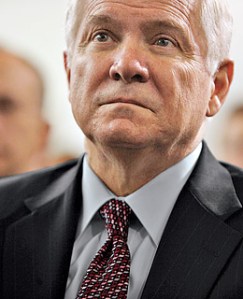
So let Gates have his day in the sun. Today some in the media are already questioning whether his book may damage his reputation. From Foreign Policy again: Did Bob Gates’ New Book Just Trash His Golden Reputation?
Gates, 70, has unmasked himself as just another former Washington official writing just another kiss-and-tell in the soon-to-be-released Duty: Memoirs of a Secretary at War, in which he takes shots at a sitting commander-in-chief, his top aides and Congress, an institution with which he often expressed frustration – but also respect. Gates was known for being discreet and sharp-minded, loyal to the office he occupied and careful about what he said in public. So deliberate were his public pronouncements about wars or national security policy or budgets that he became the E.F. Hutton of the Pentagon — everyone leaned in every time he had something to say.
But now his brand seems diminished by the scrappy, petty nature of many of his criticisms — even though some are substantive and legitimate — and a legacy he seemed quietly determined to protect may be permanently reduced to something less than what it once was.
We’ll have to wait and see. It’s also possible that the furor over Gates’ memoir will fade quickly, because another book is coming out on January 21, and it looks to be a lot more entertaining–the tell-all book about Fox News’ Roger Ailes, The Loudest Voice in the Room, by Gabriel Sherman. Excerpts started leaking out yesterday and they are wild! Check these “key revelations” from Gawker:
- During a salary negotiation in the 1980’s, Ailes offered producer Randi Harrison an additional $100 each week she would agree to have sex with him whenever he wanted.
- He also privately thinks of Bill O’Reilly as “a book salesman with a TV show” and Brian Kilmeade as “a soccer coach from Long Island.”
- During a 1990’s power struggle with NBC executive David Zaslav, Ailes was accused of making an anti-Semitic remark involving an obscenity and “the words ‘little’ and ‘Jew’.” NBC’s chairman and counsel believe “he probably said it.”
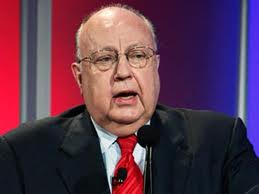
New York Magazine has published a lengthy except from Sherman’s book and it is the most fascinating and horrifying thing I’ve read in ages. Ailes is far weirder than I ever imagined. The article opens with a description of how Ailes moved into a rural town in upstate New York, hoping to return to his small-town roots, but instead bought the local newspaper and tried to transform it into a mini-Fox News. It’s a riot! Just a small except to whet your appetite for the bizarre:
As summer turned to fall, political issues began to arise. Alison Rooney, the copy editor, at first found reasons to be optimistic about the ownership change. She liked using the new computers to put out the paper and looked forward to the newsroom moving into a renovated two-story building on Main Street. But that honeymoon ended when Rooney laid out a press release from the Garrison Art Center that described a work invoking the “mythological story” of the Virgin Birth. After the release was published, the priest of Our Lady of Loretto wrote a letter to the editor, and Beth Ailes lit into Rooney. A few weeks later, Rooney got another dressing-down as she formatted a promotion of the high school’s upcoming production of Urinetown, this time from an editor who found the language offensive and removed the title of the show from the headline.
Another drama erupted after a reporter named Michael Turton was assigned to cover Haldane Middle School’s mock presidential election. After the event, Turton filed a report headlined “Mock Election Generated Excitement at Haldane; Obama Defeats McCain by 2–1 Margin.” He went on, “The 2008 U.S. presidential election is now history. And when the votes were tallied, Barack Obama had defeated John McCain by more than a two to one margin. The final vote count was 128 to 53.” Reading the published version a few days later, Turton was shocked. The headline had been changed: “Mock Presidential Election Held at Haldane; Middle School Students Vote to Learn Civic Responsibility.” So had the opening paragraph: “Haldane students in grades 6 through 8 were entitled to vote for president and they did so with great enthusiasm.” Obama’s margin of victory was struck from the article. His win was buried in the last paragraph.
Turton was upset, and wrote a questioning e-mail to Hunt, but never heard back. Instead, he received a series of accusatory e-mails from the Aileses. Turton had disregarded “specific instructions” for the piece, Beth wrote. “Do you anticipate this becoming an ongoing problem for you?” A short while later, Roger weighed in. Maureen Hunt’s instructions to focus on the school’s process for teaching about elections had been “very clear,” he wrote, and Turton’s “desire to change the story into a big Obama win” should have taken a backseat. Ailes described himself as “disappointed” by Turton’s failure “to follow the agreed upon direction.”
Soon afterward, Turton learned that Maureen Hunt had resigned, and Ailes continued his quest to bring “fair and balanced” to Philipstown.
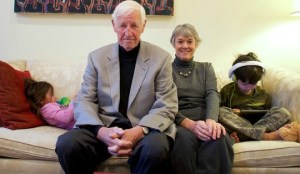
John and Bonnie Raines, two of the burglars, at home in Philadelphia with their grandchildren. Mark Makela for The New York Times
Since I’ve been discussing new books so far, I guess I might as well continue. On Tuesday, The New York Times published interviews with some of the activists who broke into an FBI office in Media, Pennsylvania on March 8, 1971 and stole a massive number of files. They took the files to a remote location, studied them for ten days, and found evidence of the illegal FBI domestic spying program COINTELPRO. Unlike Edward Snowden, the burglars swore to keep their identities a secret so that the story itself would get all the public attention. From the Times article:
They were never caught, and the stolen documents that they mailed anonymously to newspaper reporters were the first trickle of what would become a flood of revelations about extensive spying and dirty-tricks operations by the F.B.I. against dissident groups….
The burglars had, until now, maintained a vow of silence about their roles in the operation. They were content in knowing that their actions had dealt the first significant blow to an institution that had amassed enormous power and prestige during J. Edgar Hoover’s lengthy tenure as director.
“When you talked to people outside the movement about what the F.B.I. was doing, nobody wanted to believe it,” said one of the burglars, Keith Forsyth, who is finally going public about his involvement. “There was only one way to convince people that it was true, and that was to get it in their handwriting.”
That’s heroism in my book. They revealed real government abuses that had been almost unknown until they found the proof. Now one of the reporters who helped get the story out, Betty Medsger, has written a book called The Burglary: The Discovery of J. Edgar Hoover’s Secret FBI. It came out this week, and I’m dying to read it.
By contrast Snowden and his PR man Glenn Greenwald have so far revealed very little that we didn’t already know or suspect about NSA domestic spying and have spent most of the seven months since they began rolling out their revelations 1) publishing articles about the NSA spying on foreign countries and their partnerships with foreign countries who have few espionage resources; 2) giving self-aggrandizing interviews and bragging about all the secrets they have; 3) Defending Snowden’s decision to defect to Russia. At the same time Greenwald has sold book and movie rights and worked on a media start up funded by libertarian E-bay and Paypal billionaire Pierre Omidyar. I haven’t heard anything about Greenwald sharing his earnings with Edward Snowden either.
Fortunately some in the media are beginning to point out inconsistencies in Snowden’s and Greenwald’s behavior. Here is an op-ed by Doyle McManus that lays out the case very well. Edward Snowden, in shades of gray I agree with just about everything he wrote.
Is Edward Snowden” Edward Snowden a whistle-blower or a traitor?
Debate over the renegade computer technician who leaked thousands of secret National Security Agency documents is too often reduced to that deceptively simple choice.
But it’s the wrong way to pose the question, because Snowden is both of those things at the same time. Yes, he’s a whistle-blower, and if that were all he had done, he would deserve our thanks for forcing a debate over the NSA’s swollen powers.
But he’s also a scoundrel who deserves prosecution and public condemnation. That’s because his leaks no longer seem focused on protecting U.S. citizens’ constitutional rights or toughening safeguards on the NSA. Instead, Snowden’s disclosures have expanded far beyond those laudable aims to exposing U.S. intelligence-gathering operations that appear not only legal but legitimate in the eyes of most Americans.
McManus is referring to revelations about the NSA doing it’s job, which is gathering foreign intelligence to protect national security. A little more:
“…most of those disclosures, from Merkel to Al Qaeda, have nothing to do with Americans’ right to privacy. Snowden has acknowledged that his ambitions go far beyond limiting what the NSA can do at home. “I have acted at great personal risk to help the public of the world, regardless of whether that public is American, European or Asian,” he told the Guardian in June.
Well, OK. But that makes him, by his own description, a global crusader against NSA spying anywhere, not merely a whistle-blower against potential abuses inside the United States. It means some of his disclosures have made Americans safer against government prying, but others have probably made us less safe.
And for a man who proclaims himself a fighter for universal rights, accepting asylum in Russia and praising his hosts for their devotion to freedom does not strengthen his claim to consistency, let alone nobility.
I’ll end there and turn the floor over to you. What stories are you following today. Please post your links in the comment thread, and have a great Thursday!
Thursday Reads: Snowzilla and Other News
Posted: January 2, 2014 Filed under: Barack Obama, Foreign Affairs, morning reads, U.S. Politics | Tags: Akademic Shokalskiy, clemency, distress signal, Edward Snowden, Glenn Greenwald, Keystone XL pipeline, metadata, Minneapolis fire, National Transportation an Safety Board, North Dakota train derailment, Russian FSB, Snowzilla, Sochi Winger Olympics, surveillance by Russia, winter weather 44 Comments
Boston’s Beacon Hill in Winter
Good Morning!!
This post is late because I had a computer emergency this morning. Fortunately I got it resolved after a struggle, but I was on the verge of panic for a bit. I hate computer problems.
The first big winter storm of 2014 has begun. Here in Greater Boston, we have a couple of inches on the ground. We were supposed to get heavy snow last night, and now they’re saying it will come tonight instead. We’re supposed to get light snow through out the day and we have blizzard warnings in effect for tonight with about a foot of snow expected by tomorrow. We’ll see . . . the weather people haven’t been that accurate so far this winter. But it’s a huge storm that will affect people across the Midwest, the Mid-Atlantic states and New England.
Reuters reports: Powerful storm bears down on U.S. Northeast with Arctic temps.
The double-barreled storm system stretching from the lower Mississippi Valley to the Atlantic coast could dump more than 12 inches of snow in some areas, especially southern New England, by Friday morning, the National Weather Service said.
“Heavy snow, strong winds, frigid temperatures and dangerous wind chills are in forecast for much of the region,” it said in a statement.
The storm is expected to snarl traffic on the I-95 highway corridor between New York and Boston, the weather service said. At the southern edge of the storm, Washington is expected to receive less than one inch of snow.
The powerful storm forced about 1,000 U.S. flights to be canceled and about 250 delayed, with the worst-affected airport Chicago’s O’Hare International, according to FlightAware, a website which tracks air travel.
NPR has a summary of the weather situation, with links: 100 Million People In Path Of 2014’s First Wintry Blast.
In the Arctic, the passengers on that stranded ship have finally been rescued. NBC News:
All 52 passengers who were stranded aboard an ice-locked ship in Antarctica for more than a week were rescued by helicopter early Thursday, officials said.
The Akademic Shokalskiy sent out a distress call on Christmas morning after it became surrounded by sea ice while on a scientific mission more than 1,700 miles south of Australia.
On Thursday, a helicopter from a Chinese ice-breaking ship Xue Long — or Snow Dragon — transported groups from a makeshift helipad which the passengers had stomped out in the ice near the ship.
The Australian Maritime Safety Authority (AMSA) tweeted at 6.20 a.m. ET Thursday that all of the 52 passengers had been airlifted from the Akademik Shokalskiy and were now on board the Aurora Australis ice-breaker.
Photos and video at the link.

Yesterday an explosion started a fire in a Minneapolis building where many Somalis lived. The building was next door to a mosque. I hope this doesn’t turn out to be arson. From The Columbus Dispatch: 14 hurt in blast, fire in Minneapolis building.
MINNEAPOLIS — A billowing fire engulfed a three-story building with 10 apartments near downtown Minneapolis yesterday, sending more than a dozen people to hospitals with injuries — some critical — ranging from burns to trauma associated with falls.
An explosion was reported about 8:15 a.m., and within minutes, a fire raged through the building, said Robert Ball, a spokesman for Hennepin County Emergency Medical Services. Paramedics, responding amid sub-zero temperatures, found victims on the ground, some with injuries that suggested they might have fallen several stories.
“It’s not clear whether people were pushed out of the building from the explosion, or whether they fell or jumped out of windows to escape,” Ball said.
No fatalities have been reported, but authorities weren’t sure whether any residents still were in the building. Its roof had partially collapsed, making it too dangerous for firefighters to search the premises, said Assistant Minneapolis Fire Chief Cherie Penn.
There were reports of family members saying three people living in the apartment were not in the hospital and cannot be accounted for.
According to an update from CBS Minnesota, Investigators Search For Cause Of Massive Minneapolis Fire, three people are still reported missing.
The Minneapolis Fire Chief said even though many will be wanting to know the cause of this fire immediately, it may take a little bit to figure out what happened.
“You’re going to have to have some patience with us, it’s going to take law enforcement and arson investigators some time. It’s going to be a very difficult investigation. We’re going to determine the cause and origin, so it’s going to take us some time,” said Chief John Fruetel.
We know firefighters inspected the building in 2012 and issued a clean bill with no problems. The focus now is figuring out who the victims are. Fruetel said there is some confusion as to who was in the building or lived there. He said they’ve got some work to do figuring out who lived in the building, who may have had visitors, who were home and who were not home.
Officers are meeting with families to gather information, and several people don’t speak English so they need interpreters.
In addition to apartments, the building contained a store on the ground floor that was used as a “community center.”
Residents of Casselton, North Dakota were allowed to return to their homes, and the investigation into the causes of the derailment of a train carrying crude oil began yesterday. CNN reports that investigators were able to get closer to the wreckage yesterday, but they had already been examining video of the crash.
…[I]nformation taken from recording devices has been revealing, said National Transportation and Safety Board spokesman Robert L. Sumwalt.
A video camera at the head of the oil train recorded the crash as it slammed into a car of a derailed grain train.
“We looked at the last 20 seconds of the forward facing video from the oil train. And basically it shows the collision sequence,” Sumwalt said.
When the oil train arrived, the other train transporting grain and soy bean had already derailed, and one of its cars was lying in the oil train’s path, he said.
The oil train slammed into it and burst into flames.
Much more info at CNN and this NBC News link. This crash should raise serious questions about the Keystone XL project, according to Insurance Journal:
The derailment and fire that led to the evacuation of a North Dakota town has renewed the debate over whether it’s safer to ship oil by rail or pipeline as the U.S. completes a review of the Keystone XL project.
“Any time there is an incident, you have heightened talk and scrutiny on oil transportation,” Brigham McCown, a former director of the Pipeline and Hazardous Materials Safety Administration, said yesterday in an interview. “It will add to the conversation.” [….]
While climate change has been the focus of the fight over TransCanada Corp.’s proposed Keystone XL pipeline from Canada to the U.S. Gulf Coast, a subset in the debate has been the relative safety of pipes versus trains. The U.S. State Department, reviewing the $5.4 billion project because it would cross the U.S. border, is weighing whether the pipeline would be in the national interest.
Keystone would allow about 100,000 barrels a day of crude from the Bakken formation in Montana and North Dakota onto the pipeline through a link in Baker, Montana.
“Bakken oil is going to come under increasing scrutiny,” as a result of the rail explosion, said Robert Schulz, a professor at the University of Calgary’s Haskayne School of Business. “You may see additional thoughts of, ‘Let’s approve Keystone because it’s going to be safer.’”
The North Dakota accident is the fourth major North American derailment in six months by trains transporting crude. Record volumes of oil are moving by rail as production from North Dakota and Texas have pushed U.S. output to the most since 1988 and pipeline capacity has failed to keep up.
There has been quite a bit of Edward Snowden news over the past few days. I’m not a huge fan of the WaPo’s Ruth Marcus, but I couldn’t help agreeing with her column yesterday: Edward Snowden, the insufferable whistleblower.
Time has not deflated Edward Snowden’s messianic sense of self-importance. Nor has living in an actual police state given the National Security Agency (NSA) whistleblower any greater appreciation of the actual freedoms that Americans enjoy.
Insufferable is the first adjective evoked by Snowden’s recent interview with Barton Gellman in The Post, but it has numerous cousins: smug, self-righteous, egotistical, disingenuous, megalomaniacal, overwrought.
The Snowden of Gellman’s interview is seized with infuriating certitude about the righteousness of his cause. Not for Snowden any anxiety about the implications for national security of his theft of government secrets, any regrets about his violations of a duty of secrecy.
“For me, in terms of personal satisfaction, the mission’s already accomplished. I already won,” Snowden proclaimed. “Because, remember, I didn’t want to change society. I wanted to give society a chance to determine if it should change itself.”
And what gave Snowden the right to assume that responsibility? “That whole question — who elected you? — inverts the model. They elected me. The overseers,” he said. “The system failed comprehensively, and each level of oversight, each level of responsibility that should have addressed this, abdicated their responsibility.”
As you can well imagine, the column outraged Snowden’s primary promoter Glenn Greenwald. Marcus is now on his shit-list, and will remain there in perpetuity, because only Glenn is permitted to be that nasty to people who disagree with him. Greenwald is thrilled with The New York Times a the moment, however; because the editorial board called yesterday for President Obama to grant Edward Snowden clemency (as did Greenwald’s former employer The Guardian). I can’t imagine why Obama would do that, since it would set a dangerous precedent for dealing with future thefts of classified information.
Some reactions to two major newspapers calling for Snowden to be allowed to come home and not be prosecuted:
Susan Milligan at US News and World Report: No Clemency for Snowden.
Damien Thompson at The Telegraph: Let Edward ‘Pleased-With-Himself’ Snowden argue his case in an American courtroom.
The Hill: Former Obama official agrees with call for Snowden clemency.
Meanwhile, in Snowden’s adopted country, the FSB has been collecting unprecedented amounts of metadata on Olympic athletes and every foreign and domestic visitor to the Sochi winter games.
As the date for the Olympic Games in Sochi draws closer, Russia’s siloviki are becoming more active in terms of collecting data from Russians and foreigners. Although they can at least partially justify their decision to register every Russian who comes to Sochi during the Olympics with the desire to prevent terrorist attacks, the decree that Prime Minister Dmitry Medvedev signed Nov. 8 has no relationship whatsoever to that goal.
That decree expressly authorizes the government to collect data on telephone calls and Internet contacts made by the Olympic Games’ organizers, athletes and foreign journalists.
Irina Borogan and I have already published an article in The Guardian in October explaining how the authorities had installed an advanced wiretapping and surveillance system in Sochi, but Medvedev’s order adds significant scope to those activities.
The decree provides for the creation of a database for the users of all types of communication, including Internet services at public Wi-Fi locations “in a volume equal to the volume of information contained in the Olympic and Paralympic identity and accreditation cards.” That is, the database will contain not only each subscriber’s full name, but also detailed information guaranteed to establish his identity. What’s more, the database will contain “data on payments for communications services rendered, including connections, traffic and subscriber payments.”
That is called “gathering metadata” in the language of intelligence agencies.
So far no objections to this surveillance have been registered by Edward Snowden, Glenn Greenwald, Julian Assange, or any other member of Wikileaks. I wonder why?
So . . . what stories are you following today? Let us know in the comment thread, and have a great day!


 peej
peej Carissa
 ecocatwoman
 mablue2
 peggysue22
 quixote
 skydancingguestblogger
 Mona (aka Wonk the Vote)



 Sky Dancing
Tuesday Reads: Snowstorm, On-line Harassment, Profiling Snowden, and Other News
Posted: January 21, 2014 | Author: bostonboomer | Filed under: Barack Obama, morning reads, U.S. Politics, Women's Rights | Tags: Amanda Hess, Amy Wallace, Anderson Cooper, angry on-line commenters, China, Colorado, Dan Verton, Edward Snowden, history of psychology, insider espionage, israel, IT administrators, London Science Museum, Marijuana, on-line sexual harassment, personality profiling, pot tours, psychology, Randi Kaye, Skepchick, snow, trolls, weather | 106 CommentsAlfred Eisenstaedt
Good Morning!!
Looks like another big snowstorm is headed my way this afternoon. Blizzard warning south of Boston, winter storm warning for most areas.
At least I’m not in the blizzard zone for the moment. This appears to be a really big storm. I saw on Twitter this morning that there were whiteout conditions in St. Louis. You can watch a video update the Weather Channel page.
Intellicast – Current Radar in United States:
NBC News reports: Winter storm set to ‘go bananas’ across Northeast.
Yikes! What the heck does that mean? The story doesn’t explain. But meteorologists are begging us not to call it a “polar vortex.”
Anyway, I’m going to have to rush around this morning. I have a package to mail, and I need to get a couple of things at the grocery store. I do have some interesting reads for you today–some of them are pretty long, but well worth reading.
Yesterday, via Tom Watson at Forbes, I came across an essay by long-time feminist blogger Amanda Hess that Watson says has been “widely discussed” for the past week or so. Somehow I missed it. Hess argues that on-line sexual harassment of women will be “the next civil rights issue.” In the essay, she writes about the frequent on-line attacks she and other female writers have experienced (warning: explicit and violent language). Here are the first few paragraphs.
Read the rest at the link. A number of women have written about this issue, and particularly about the lack of protection for women who are harassed on-line from law enforcement–even though the threats sometimes lead to real-life actions. A couple more recent examples:
Skepchick wrote in October about being harassed for her participation in the on-line atheist community, Why I Don’t Just Go to the Cops.
Amy Wallace wrote about her experiences in a NYT op-ed over the weekend: Life as a Female Journalist: Hot or Not?
Along similar lines, I came across this 2010 article in The Boston Globe that provides some insight into why some people spend so much time and energy writing angry comments on line: Inside the mind of the anonymous online poster. The author got an interview with a frequent commenter to The Boston Globe website. He also discusses the problems newspapers face in dealing with angry and trolling comments from anonymous people. Here’s an excerpt:
Read much more at the link.
Yesterday I also happened upon a fascinating article by national security and tech journalist Dan Verton. In the piece, Verton tries to come up with a psychological profile of NSA leaker Edward snowden: What does the history of insider espionage say about Edward Snowden?
Verton discusses Snowden’s history in the light of a study of IT administrators who eventually sabotaged their employers in some way: Inside the Mind of the Insider, by Eric D. Shaw, Jerrold M. Post, and Keven G. Ruby. These are both fairly long pieces, but if you have any interest in the ongoing Snowden saga, they are must reads! A bit more from Verton:
Lots more educated speculation on Snowden’s motives at the link.
In other news . . .
Here’s a spy story I hadn’t heard about in the mainstream media. Report: Israel Passes U.S. Military Technology to China.
That sounds scarier than the stuff Glenn Greenwald has been dribbling out.
From The New Statesman, here’s an exhibit I’d love to see if only I were in London: A history of psychology, warts and mysteries and all.
That sounds amazing.
Finally, a funny story from CNN’s Anderson Cooper 360: CNN reporter high during Anderson Cooper marijuana TV segment.
So . . . what are your recommended reads for today? Please post your links on any topic in the comment thread.
Did you like this post? Please share it with your friends: