Drew this last Sunday, envisioning a trump renovation of the Lincoln Memorial as he “cleans up” DC. Wake up to find South Park had the same idea. Should have posted it sooner. John Buss, @repeat1968
Good Day, Sky Dancers!
I have to admit that my heroes have always been Nobel Prize Winners in Economics. Between hearing family stories about living through the Great Depression and my own experience of inflation and stagflation, I just totally fell into my economics major. It was practical, scientific, and consensus-seeking. I have an early copy of Keynes’ The General Theory of Employment, Interest and Moneythat was my father’s economic textbook after the War. I also have my own copy of Milton Friedman and Anna Schwartz’s A Monetary History of the United States, 1867–1960. As a Financial Economist, I have strong roots as a monetarist.
As I reached out to study Trade Theory in search of what all countries needed in place to have a stable, growing economy and financial system, I became drawn to Paul Krugman. The headline up top is straight from him. This year, I’ve watched just about everything we’ve learned since the Great Depression on how to stabilize and grow an economy, from all these wise people, being thrown to the wind. I’m opening with the current Krugman critique of the “craziness.” It will be followed by some excellent analysis of what’s passing as policy these days, which is anything but a market economy. You can make a good case that we are moving in the direction of a Soviet-style command and Control system and heading straight into a Maoist one. This is how our regime rolls these days, and as Krugman says, it’s crazy.
I start with Thor Benson’s interview with Dr. Krugman at the Substack Public Notice.
Paul Krugman’s publication here on Substack has quickly become a vital resource for explanatory (and entertaining) coverage of Trump’s self-destructive economic policies. In fact, the Nobel Prize winner recently triggered Trump himself, with the president howling that Krugman is a “Trump Deranged BUM” in an unhinged Truth Social screed.
So with economic indicators weakening and talk of stagflation in the air, we connected with Krugman for a wide-ranging conversation about tariffs, inflation, why the AI bubble is reminiscent of the late 1990s, Trump’s teetering economy, and more.
“I think there’s a high likelihood of what we used to call a ‘growth recession’ or a jobless recovery — a situation where the economy isn’t plunging, but in fact unemployment is going up,” Krugman told us. “The economy is growing too slowly right now to generate enough jobs and there’s real weakness, which we’ve already seen in the data.”
“The thing that’s extra damaging now is the craziness. Nobody knows what the tariff rates will be in six months. Businesses making investment decisions want to know what things are going to be like over the next five years, but nobody has the faintest idea.”
The key to the crazy car is indeed tariffs. The damage, like the Smoot-Hawley Tariff ActCongress imposed in 1929, made the Great Depression what it turned out to be. The media has pushed the idea that the current tariff regime has been limited because of the TACO craziness. Read Krugman’s thoughts on that.
Thor Benson
Why haven’t tariffs inflicted more damage on the economy already? There were a lot of dire warnings in the lead-up to Trump’s “Liberation Day” announcement nearly five months ago.
Paul Krugman
The scale of Trump’s tariffs is beyond the highest expectations people had. When he was talking about 10 percent tariffs globally, people thought, “Well, he won’t really do that.” In fact, it looks like we’re going to end up with an average tariff rate of around 18 percent, which is huge. We knew the reaction would be delayed, and it’s been even more delayed than expected, but it’s starting to show now.
The first thing to say is that, in general, protectionism is bad, but people tend to overstate the case. I’ve written about that a few times. It sounds important, because it has global effects, but it gets overhyped. Our screwed-up healthcare system does way more damage to the economy than Trump’s tariffs. Reasonable estimates of the long-run impact of these tariffs is a 0.4 or 0.5 percent cut to GDP — not trivial, but not apocalyptic.
In terms of the inflationary impacts of tariffs, there was a lot of front-running. Companies that import stuff rushed to do so earlier this year before the tariffs kicked in. To some extent, we’re still living off inventory that was built up in that period, and you can see it in the data. There was a huge surge in imports early in the year and then a huge drop after the tariffs finally kicked in. We’re still living off inventory that was brought in at much lower tariff rates.
It’s also important to note that the TACO thing is wrong. Trump did not chicken out. We’ve got 15 percent tariffs on the EU and Japan and iron tariffs on a number of countries.
The fact that people kept thinking we were gonna have trade deals and the tariffs were going to come back down meant that companies were reluctant to pass price hikes into stores, because they didn’t want to make customers mad and lose market share. It’s only now really sinking in that this is for real, and so the “let’s eat the tariffs for a while” thing is fading out.
It’s happening a little slower than expected, but for the most part we’re pretty much right in line with what economists were saying earlier this year.
The rest is under a paywall, but you get the general gist of it. So, all of this tariff shit is not coming out of Congress, as it should. That is what led to this very important article in Fortune. You may read all of it. The first author, Jeffrey Sonnenfield, is a Yale University Business Professor. The rest of the authors are equally impressive. There are CEOs of Top Companies as well as other academics, including Distinguished Professor Laura Tyson, a former chair of the White House Council of Economic Advisors, back when we really were doing economic policy. Here’s the headline, folks! “Is MAGA going Marxist and Maoist? Trump’s assault on free-market capitalism.”
As many CEOs understandably grew horrified last month at the prospect that New York City, the capital of capitalism, is on the brink of going socialist with the mayoral momentum of the inexperienced candidate Zohran Mamdani, they were ignoring the greater assault on free market capitalism that has already overtaken the nation in the Republican Party. While we agree that Mamdani’s solutions to affordable housing and grocery prices threaten to undermine free markets by bowing to the appeal of populist anger, President Donald Trump has already begun doing so, but to suit his own grandiose political agenda instead.
Unlike any leader of any free-market economy around the world, President Trump has seized control of private enterprise’s strategic decision-making and investment policies while invading corporate board rooms so that he may dictate leadership staffing, punish corporate critics, and demand public compliance with his political agenda. This is far more dangerous to capitalism than a city-run grocery store.
Many free-market economists and business leaders who have long worshipped the free-market ideals of Adam Smith, Friedrich Hayek, Ayn Rand, and Milton Friedman should be aware that their idols would be rolling in their graves right now, as rather than pursue standard laissez-faire conservative economic policies, MAGA has gone Marxist and even, increasingly, Maoist
That sounds dour, doesn’t it?
As Greg Ip warned this week in The Wall Street Journal, “The US marches toward state capitalism with American characteristics … President Trump is imitating [the] Chinese Communist Party by extending political control ever deeper into the economy.” Ip pointed out that in the past, crisis-driven government bailouts of the banking and automotive sectors, such as TARP, were acute, targeted assistance, with brief and bipartisan rescue aims. Similarly, government incentives to drive investments in chips manufacturing, oil exploration, space exploration, internet development, agricultural vitality, cancer detection, disease treatment, and clean energy were not ownership deals with preferred companies or corporate cronies.
Indeed, Ip’s warnings mirror our own, as we were the first to accurately, presciently warn—over a year ago—that many of Trump’s economic positions more closely resemble communism than capitalism, as part of what we called “the coming MAGA assault on capitalism.” It certainly looks like MAGA is going Marxist if not even Maoist, especially across Trump’s vicious personal targeting of individual business leaders; government crackdown on business freedom of expression; weaponization of government powers; apparent extortion of businesses; and insertion of government into an unprecedented, outsized role in private sector strategic investment, capital flows and business decision-making.
Marxism and Maoism were both, of course, expressions of the communist theory that spilled forth from Karl Marx’s pen in the 19th century, brought to life in the brutal one-party states of the Soviet Union and the People’s Republic of China under its leader Mao Zedong, before it evolved into “capitalism with Chinese characteristics” starting in the 1970s, around the time of President Richard Nixon’s fateful visit to Beijing.
Both Marxism and Maoism claimed to champion “ordinary people” against corrupt or exploitative elites, while both targeted intellectuals, bureaucrats, and traditionalists, and purged institutions to enforce ideological purity, especially during Stalin’s “Great Terror” and Mao’s “Cultural Revolution.” Both centralized leadership to the point of creating a cult of personality, demanding intense loyalty and the glorification of the sole figure who could fix the country’s problems. Both prized loyalty over expertise, sidelining critics and dissenters in favor of a tightly controlled political narrative. Sound familiar?
The essence of market capitalism is that owners—shareholders and the management they appoint share in the profits. These deals give share of profits to government in return for favors. Friedman said that federal government should never own anything—that it should not run a surplus because it would have funds to invest in the private sector. What strategic decision-making rights would the government have in such deals, then?
So, I have studied all of these things in both comparative economic systems and comparative political systems, as well as Russian and Chinese history courses. If you ever did any of this, you would be as scared as I am. You may also watch the latest South Park episode, where all these institutional leaders line up and gift solid gold and silver gee-gaws to Yam Tits. Once again, dark humor mimics a dark regime.
You may read all the listed evidence at the link. This is not normal. This is heavy-handed interference in all our markets. Evidently, regulation is good if it’s the #FARTUS openly demanding he be cut in on all deals. There are so many things going on that are not normal; all alarms should be blaring loudly by now. “Trump’s FBI Raid of John Bolton’s Home Looks Like a ‘Five-Alarm Fire. Thus far, little is known about Friday’s law enforcement action against a top Trump critic. But we’re seeing an escalation of authoritarian power on many fronts that has grown unmistakable.” This is from the New Republic. It’s written by Greg Sargent.
Whatever we end up learning about the rationale for the FBI’s early-morning raid on former national security adviser John Bolton’s Bethesda, Maryland, home on Friday, there’s plainly a major escalation underway in President Donald Trump’s use of law enforcement to persecute his perceived enemies and entrench his authoritarian power. Consider the pattern:
Assaults targeting individual business leaders
Trump has a long history of targeting individual CEOs in highly vicious, personal terms for perceived offenses. This week, Trump called for the firing of Goldman Sachs’ renowned economist Jan Hatzius who accurately called the 2008 financial crisis over the economist’s concern regarding the tariff overhand on the US economy. He also attacked a top-performing financier, David Solomon, the non-partisan CEO of Goldman Sachs, telling him to quit and just be a disc jockey. (Solomon has a famous side hustle as an electronic dance music DJ, known as DJ D-Sol.)
The targeting of Bolton, a major critic of Trump, appears to have been personally authorized by Kash Patel. An apparently official leak to the New York Post deliberately underscored Patel’s involvement, probably to make sure it’s understood by Trump’s other enemies. Remember: Trump installed Patel as FBI director for this very purpose. Patel had openly declared in 2023 that “the conspirators,” that is enemies of Trump and MAGA, must be prosecuted, and also that more loyalists with the resolve to see this through would be recruited to carry this out. Bolton was on Patel’s enemies list.
Trump is now targeting Fed governor Lisa Cook, another proclaimed enemy, and he’s escalating the use of law enforcement and the manipulation of the bureaucracy to do so. Trump loyalist William Pulte, head of the Federal Housing Finance Agency, is alleging that Cook committed mortgage fraud, and this has been referred to the Justice Department. Whether or not there’s anything to the fraud claims, they’re minor at best, and it’s already highly suspect that Pulte, an agency head, has taken such an active interest in investigations into individual mortgages that happen to belong to Trump’s highest-profile enemies. Given that Trump personally promoted an article about the referral of the Cook matter to DOJ, Pulte’s move looks even more suspect.
Tellingly, Trump also heavily promoted the news of another supposedly fraudulent mortgage held by an enemy, Senator Adam Schiff. Schiff flatly denies the charges, yet DOJ is now criminally investigating them. Here again, Trump loyalist Pulte was directly involved in the manufacturing of the pretext for this, and experts say the process employed was dubiously manipulated. The same tactic has been used against New York Attorney General Letitia James, another major Trump foe. The question now is whether the White House is directing Pulte to rummage through the mortgages of Trump enemies for material that can serve as a pretext for potential DOJ prosecutions. It’s hard to imagine something of this magnitude proceeding without the White House’s blessing.
After protests broke out over Trump’s attempted takeover of the Washington, D.C. police force and his deployment of the National Guard there—which is itself a major escalation—White House deputy chief of staff Stephen Miller expressly declared that protests would be met with a surge of additional law enforcement and/or military resources. Notably, there’s been no serious effort to reassure Americans that Trump’s militarization of the city, or of Los Angeles, is rooted in benign intentions. In fact, this week Trump suggested he would personally ride through the city with the National Guard. Though he scrapped the plan, that was probably for logistical reasons, and he plainly wants all this military activity in urban centers to be seen as affirmative confirmation of his ongoing consolidation of power.
Longtime Trump ally Steve Bannon explicitly declared the other day that ICE officers will indeed be employed during the 2026 midterm elections in large numbers to monitor voting booths, again floating undocumented voters as the bullshit pretext to justify it. Bannon is not in a position to compel this, of course, but it’s clear the MAGA movement now sees Trump’s militarization of cities as a precursor to the use of law enforcement and/or the military to intimidate voters in large numbers, or foment a crisis atmosphere designed to help the GOP, or both.
Last but not least, as we reported, a recent internal Department of Homeland Security memo outlines the hopes of senior DHS officials for substantially escalated military involvement in domestic law enforcement going forward. It even declares that military operations like the one in L.A. may be needed “for years to come.”
The raid of Bolton’s home was authorized by a court, and it is seeking to “determine whether he illegally shared or possessed classified information,” according to The New York Times. Trump told reporters Friday that he’d been unaware of the raid, but responded to it ominously.
WTF is going on? This is not normal. This is not democratic. This is not how our republic is supposed to work. Meanwhile, Donald’s dash for the Nobel Peace Prize is dashed again. Put so played him. This is from Politico. “Trump’s peace bid flops as Kremlin says no plans for Putin-Zelenskyy summit. Moscow obfuscates again in new remarks by Foreign Minister Sergey Lavrov.” Well, inadequate Yam Tits strike again and cost the country more of our hard-earned dollars.
Russia’s top diplomat said Friday the Kremlin is “not ready at all” for a meeting between President Vladimir Putin and Ukrainian President Volodymyr Zelenskyy, pouring cold water on U.S. President Donald Trump’s efforts to set up a summit.
Trump announced Monday on social media that he was arranging a bilateral meeting between Zelenskyy and Putin, following crunch talks with European leaders at the White House — but gave scant details.
But Moscow has since been reluctant to commit to a confab between the two leaders, with Russian Foreign Minister Sergey Lavrov saying Tuesday such a meeting would need to be prepared “step by step, gradually, starting from the expert level and then going through all the necessary stages.”
He sowed further doubt Friday, claiming that Zelenskyy was the one not willing to negotiate by refusing to rule out joining NATO or concede to the Kremlin’s maximalist territorial demands.
“Putin is ready to meet with Zelenskyy when the agenda is ready for a summit, and this agenda is not ready at all,” Lavrov told U.S. channel NBC.
“Zelenskyy said no to everything. … How can we meet with a person who is pretending to be a leader?” he added.
While U.S. Secretary of State Marco Rubio said earlier this week the Russian ruler had agreed to a face-to-face meeting, touting his supposed openness to talks as a breakthrough, European diplomats and leaders have voiced skepticism that Moscow is really interested in ending the war and willing to negotiate in good faith.
Zelenskyy accused Moscow on Friday of dragging out peace talks in a bid to hold off punishing American sanctions, which Trump has threatened to impose on Russia and its trading partners if the Kremlin does not participate.
#FARTUS is the most corrupt and inept president we’ve ever had. I have no idea how we’re going to survive much more of this. More things from Memeorandum to check out:
Daniel Dale / CNN: Fact check: Trump and the case of the nonexistent $600 billion EU ‘gift’ — Seventeen days ago, President Donald Trump made a dramatic claim in an interview on the business news channel CNBC. As part of his July trade agreement with the European Union, he said, the EU gave the United States …
Don’t forget, Trump is destroying the Smithsonian, the entire White House, and just about every check and balance enumerated by the U.S. Constitution. You may gag over the Oval Office Changes at Business Insider. His future architectural destruction is outlined in USA Today. It includes the Lincoln Bedroom, and he’s specifically interested in its bathroom. That’s a lot of gag for your buck.
We’re certainly going to get more proof that everything Trump touches dies.
I can’t watch the news much anymore. I think I’ll go watch the Disney Channel now.
What’s on your Reading, Blogging, and Action list today?
Did you like this post? Please share it with your friends:
There are only 19 days to go until November 5. I believe that Kamala Harris will win, but I was also sure Hillary Clinton would win in 2016.
Both Harris and Trump have been holding rallies and giving interviews. She speaks in complete sentences and discusses her policies in a coherent fashion. He can’t complete a sentence, mispronounces words, rambles nonsensically, and has no understanding of his own policies. And, of course, he is a pathological liar.
Harris is a former prosecutor who is committed to the rule of law. Trump is a convicted felon out on bail, with multiple indictments hanging over his head. How can the race be close?
One positive development is that Trump’s dementia and his violent rhetoric and threats are getting more attention in the media. He and his advisers may well live to regret driving Joe Biden out of the race.
I feel as if my life is on hold until I know who will win this election. If Harris wins, my life will continue on its current track. If Trump wins, everything will change–and not in a good way. In addition, the chaos we have all lived through in the past 9 years will continue and most likely get much worse. That’s where things stand right now, as I see it.
State of the Race
In the latest national polls, Harris leads by a few points.
In the presidential contest, Vice President Kamala Harris leads former President Donald Trump by five points among likely voters, including those who are undecided yet leaning toward a candidate. The race gets closer, however, among registered voters nationally. Here, three points separate the two candidates.
Harris (52%) leads Trump (47%) among likely voters nationally, including those who are undecided yet leaning toward a candidate. Earlier this month, two points separated Harris (50%) and Trump (48%) among likely voters.
The contest is tighter among registered voters. Among the general electorate, Harris receives 51% to 48% for Trump. In early October, the same margin separated Harris (50%) and Trump (47%) among the broader electorate.
Trump (54%) leads Harris (44%) among independents who are likely to vote, widening the 4-point edge Trump (50%) had against Harris (46%) previously.
Trump (53%) leads Harris (47%) among men who are likely to vote while Harris (57%) has the advantage over Trump (42%) among women.
While members of Gen X divide (51% for Harris to 48% for Trump), Harris has majority support among GenZ/Millennials (53%) and among Baby Boomers/the Silent-Greatest Generations (55%).
While the gap between the two remained steady compared with a Reuters/Ipsos poll conducted a week earlier, the new poll, which closed on Sunday, gave signs that voters – particularly Democrats – might be more enthused about this year’s election than they were ahead of the November 2020 presidential election when Democrat Joe Biden defeated Trump.
Some 78% of registered voters in the three-day poll – including 86% of Democrats and 81% of Republicans – said they were “completely certain” they would cast a ballot in the presidential election. The share of sure-to-vote poll respondents was up from 74% in a Reuters/Ipsos survey conducted Oct. 23-27, 2020, when 74% of Democrats and 79% of Republicans said they were certain to cast ballots.
The poll had a margin of error of around 4 percentage points.
A record number of early votes have been cast in Georgia on Tuesday as residents headed to the polls in a critical battleground state that is grappling with the fallout from Hurricane Helene and controversial election administration changes that have spurred a flurry of lawsuits.
More than 328,000 ballots were cast Tuesday, Gabe Sterling of the Georgia secretary of state’s office said on X. “So with the record breaking 1st day of early voting and accepted absentees we have had over 328,000 total votes cast so far,” he said.
The previous first day record was 136,000 in 2020, Sterling said.
The swing state is one of the most closely watched this election, with former President Donald Trump trying to reclaim it after losing there to President Joe Biden by a small margin four years ago, leading Trump and his allies to unsuccessfully push to overturn his defeat.
Those efforts have loomed large this year as new changes to how the state conducts elections have been approved by Republican members of the State Election Board, leading Democrats and others to mount legal challenges, many of which have yet to be resolved even as Election Day nears.
Despite the massive turnout on Tuesday, the process appeared to go smoother this year for some Atlanta-area voters who spoke with CNN.
“Last time I voted, I voted in the city and the lines were out the door. They only had like, maybe like three people working,” said Corine Canada. “So people honestly just started leaving because it was like that. Yeah, like, ‘This is too long. I can’t sit here (and) wait, I have to go back to work.’ But here, no, it was easy.”
Dementia Don
Yesterday Trump appeared at the Economic Club of Chicago and gave a disastrous interview. He mostly talked about his plan to put high tariffs on imports, and continued to claim that these tariffs would be paid by foreign countries and not by Americans paying higher prices. Other news from the interview: he would not commit to allowing a peaceful transfer of power if he loses the election.
Donald Trump continued his pre-election economic event tour on Tuesday with a lengthy interview with Bloomberg at the Economic Club of Chicago. It was a total mess.
Bloomberg Editor-In-Chief John Micklethwait did not take it easy on Trump, and it quickly became clear that the former president has no conception of the mechanics of or the potential ramifications of the economic platform he’s running on. Bluntly, the former president was incoherent when pressed with real questions about his policies.
Micklethwait spent most of the interview attempting to break Trump out of what the former president repeatedly referred to as “the weave,” his term for his rambling digressions — with ever-decreasing intelligibility — and general inability to focus on a given topic for more than a few seconds during his rallies and interviews.
Micklethwait didn’t weave along with Trump, however, repeatedly working to bring him back on topic and answer the actual questions. The grilling exposed Trump’s total cluelessness with regard to his own economic policy, and led Trump to attack Micklethwait as biased….
The central pillar of Trump’s economic plan is widespread tariffs on all imported goods, with penalties appearing to increase depending on how much he dislikes the country. Economists have warned that such a policy could have devastating effects on American consumers, who would be saddled with increased costs for all imported goods.
When questioned about the specifics of his plan, and if he was aware of its pitfalls, Trump seemed ignorant of basic economic principles, insisting that other countries, not American consumers, would pay for the tariffs.
A bit more:
Micklethwait tried to explain the actual impact. “Three-trillion worth of imports and you will add tariffs to every single one of them, and push up the cost for all of these people to buy foreign goods,” he said. “That is just simple mathematics.”
Trump countered that he was “always good at mathematics,” and that high tariffs — and thus costs — would force companies to move production into the United States.
Anxiety, by Edvard Munch
“That will take many, many, many years,” Micklethwait said, to which Trump replied that high enough penalties would make the move immediate as if companies could simply wand wave production plants, orchards, wineries, factories, and the like into existence.
The former president also insisted that his tariff proposal would not result in the loss of jobs that are dependent on trade, because companies that moved to the U.S. would not be subject to the tax. “All you have to do is build your plant in the United States and you don’t have any tariffs,” he said…..
Micklethwait’s attempts to keep Trump on topic earned him no grace from the former president, who hates few things more than being contradicted.
When Micklethwait asked Trump to address a report by The Wall Street Journal estimating that his economic proposals would raise the national debt by upwards of $7 trillion, the former president fell back on his standard playbook: bashing the interviewer.
“What does The Wall Street Journal know? They’ve been wrong about everything, and so have you by the way, you’ve been wrong,” Trump replied, crossing his arms and curling into his seat.
“You’ve been wrong all your life on this stuff,” he added.
There’s more at the link. I didn’t encounter a paywall when I clicked on the link at Memeorandum.
Former president Donald Trump is campaigning on the most significant increase in tariffs in close to a century, preparing an attack on the international trade order that would likely raise prices, hurt the stock market and spark economic feuds with much of the world.
Trump’s trade plans, a staple of his stump speeches, have fluctuated, but he consistently calls for steep duties to discourage imports and promote domestic production. The former president has floated “automatic” tariffs of 10 percent to 20 percent on every U.S. trading partner, 60 percent levies on goods from China, and rates as high as 100, 200 or even 1,000 percent in other circumstances.
These proposals would go far beyond the disruptive trade wars of his first term even if they are only partially implemented. They would wrench the nation out of the system of global interdependence that arose in recent decades, making the U.S. economy much more isolated and autonomous, like it was in the late 19th century. (Trump last week falsely claimed that the United States was never richer than in the 1890s, when it had high trade barriers.)
“To me, the most beautiful word in the dictionary is tariff. And it’s my favorite,” Trump said in Chicago on Tuesday. “I’m a believer in tariffs.”
The consequences would be far-reaching: Americans would be hit by higher prices for grocery staples from abroad, such as fruit, vegetables and coffee. Domestic firms dependent on imports would need to either figure out new supply chains or raise costs for consumers. U.S. manufacturers would almost certainly see sharp declines in orders from abroad as foreign nations impose retaliatory tariffs.
“We are talking about a plan of historic significance: It would be enormous, and the blowback would be even more enormous,” said Douglas A. Irwin, an economist at Dartmouth College who authored a 2017 book on the history of U.S. trade policy. “This would stand way off the charts.”
Companies and governments around the world have begun preparing contingency plans for the potential Trump tariffs. Diplomats and business leaders from Latin America, Europe, Asia and even Canada have in recent weeks asked their U.S. counterparts about Trump’s intentions and authorities, according to interviews with several domestic and international economic advisers, some of whom spoke on the condition of anonymity to reflect private planning.
While some business leaders and congressional Republicans remain optimistic that the former president is engaged in election-year posturing, Trump has repeatedly insisted that tariffs represent an unmitigated positive for the U.S. economy, recently calling them “the greatest thing ever invented.” Tariffs have been a constant bedrock of his economic agenda since he first ran in 2016, along with lower taxes, increased energy production and deregulation.
You should watch the interview Trump did yesterday at the Economic Club of Chicago. You might think you’ve got a pretty good idea of the big guy’s solipsism, his buffoonish overconfidence, his utter inability to engage on matters of policy. Watch a few answers, and you’ll be forced to conclude: It’s way worse than you thought.
Victor Wang, Emotional tension and psychological drama
Bloomberg News editor-in-chief John Micklethwait began by asking Trump simple questions, like how he plans to pay for the $7 trillion hole his proposals would blow in the federal deficit. Trump responded with his ordinary magical thinking about making that sum back through a combination of growth and tariffs. “To me, the most beautiful word in the dictionary is ‘tariff,’” he said. “It’s my favorite word . . . the most beautiful word.”
Micklethwait asked how Trump planned to follow through on his promises of trimming the fat of wasteful spending. Trump responded with a lengthy story about him personally spending months negotiating with Boeing over a contract for new planes to serve as Air Force One, which ultimately saved the government more than a billion dollars. A cool story—until you remember the federal government spends an average of nearly $17 billion a day.
It takes a certain amount of ego and delusion to run for president. Trump has those characteristics in excess. But what stood out at the talk yesterday was the degree to which these are now the only elements undergirding his vision. Gone is the talk about surrounding himself with the best people. Dropped is the pretense that his answers are coherent. (Trump has started referring to his meandering logorrhea as “the weave.”) The pitch instead is that some sort of mad genius remains within him: Trust me, I’m the deals guy! I’ll get the best deals!
But there’s a lot more to guiding the economy than dealmaking, and even the most capable, hard-nosed, mano-a-mano negotiating with individual vendors can only take you so far.
There’s more about the interview at the link. There’s no paywall.
Donald Trump on Tuesday dodged the question of whether he will allow for a peaceful certification of election results if Kamala Harris defeats him in three weeks.
During an interview at the Economic Club of Chicago, Bloomberg Editor-in-Chief John Micklethwait asked Trump if he would commit “to respecting and encouraging a peaceful transfer of power,” especially in light of Jan. 6, 2021, which the journalist called “unruly and violent.”
Trump didn’t answer the question. Instead, he rejected the premise and blamed Micklethwait as “a man that has not been a big Trump fan over the years.” He also falsely claimed that he allowed for a peaceful transfer of power in 2020, when Joe Biden defeated him.
“Come on, President Trump, you had a peaceful transfer of power compared to Venezuela, but it was by far the worst transfer of power for a long time,” Micklethwait insisted.
The audience booed and Trump thanked them. The former president then admitted that people were angry when they arrived in Washington to protest the results that January—but according to him, they were perfectly behaved.
“It was love and peace, and some people went to the Capitol,” Trump said. “And a lot of strange things happened there, a lot of strange things, with people being waved into the Capitol by police.”
For perhaps the first time, Trump downplayed his crowd size.
He added that he left the White House the morning he was supposed to and that only a fraction of the protestors were among those who breached and defaced the Capitol.
“Not one of those people had a gun, nobody was killed, except for Ashli Babbitt,” he said.
MAGA-friendly CNBC host Joe Kernen dropped an interesting nugget right as Squawk Box went to commercial break on Tuesday.
“Well, Trump canceled, and he was going to come on,” Kernen said.
Not only did Trump once love going on CNBC, but Kernen’s revelation comes on the heels of Trump declining or canceling a number of other high-profile opportunities to make a pitch to voters on mainstream TV. Trump refused to debate Kamala Harris a second time, which would’ve aired on CNN. Trump then refused CNN’s offer to host a town hall. And Trump of course also recently backed out of a 60 Minutes interview.
Still Tension, Wassily Kandinsky
The explanation for all this is not that Trump has suddenly become camera shy. It’s that his campaign undoubtedly realizes his rapidly degrading condition doesn’t play well with audiences beyond the MAGA cult. As a result, they’re retreating to the safer terrain of nonstop rallies and fawning Fox hits….
The reason Trump’s campaign isn’t keen to get him in front of swing voters on mainstream platforms was on stark display Tuesday when Trump did a rare event that wasn’t a festival of sycophancy.
By any objective standard, Trump’s Economic Club of Chicago interview was a disaster. He came out of the gates with an asinine proposal for 2,000 percent tariffs on imported cars, then was quickly reduced to insulting the moderator, Bloomberg’s John Micklethwait, when Micklethwait rightly pointed out that his his economic proposals are an inflationary disaster. (Watch below.)
By the end of the event, Trump had veered into making an impassioned defense of the big lie and his coup attempt, bragging about his crowd size on January 6 and absurdly claiming the events of that day were just “love and peace.” (Watch below.)
OAKS, Pa. — The town hall, moderated by South Dakota Gov. Kristi L. Noem (R), began with questions from preselected attendees for the former president. Donald Trump offered meandering answers on how he would address housing affordability and help small businesses. But it took a sudden turn after two attendees required medical attention.
And so Trump, after jokingly asking the crowd whether “anybody else would like to faint,” took a different approach.
“Let’s not do any more questions. Let’s just listen to music. Let’s make it into a music. Who the hell wants to hear questions, right?” he said.
For 39 minutes, Trump swayed, bopped — sometimes stopping to speak — as he turned the event into almost a living-room listening session of his favorite songs from his self-curated rally playlist.
He played nine tracks. He danced. He shook hands with people onstage. He pointed to the crowd. Noem stood beside him, nodding with her hands clasped. Trump stayed in place onstage, slowly moving back and forth. He was done answering questions for the night….
As Trump stood onstage in his oversize suit and bright red tie, swaying back and forth, it was almost as if he were taking a trip back to decades past. Trump’s decision to cut short the question-and-answer portion of the town hall and instead have the crowd stay to listen to his favorite songs was a somewhat bizarre move, given that the election was only 22 days away. Vice President Kamala Harris has called Trump, 78, unstable and questioned his mental acuity.
Some in the crowd began to leave. Some looked around, wondering whether he was done speaking for the night and how much longer the dance — or sway — session would last. Many stayed holding their cameras and watched as Trump took in the music, at times looking over at a screen beside him that showed videos of James Brown singing “It’s a Man’s Man’s Man’sWorld” and Sinéad O’Connor performing “Nothing Compares 2 U.”
For 38 minutes or so, former President Donald Trump was in a happy place. After some people collapsed at his town hall, Trump got frustrated, decided he’d had enough softball questions from Gov. Kristi Noem (R-SD) and asked to play music. For nearly 40 minutes, Trump kept asking for more music, swaying oddly in front of the crowd, occasionally closing his eyes, and retreating to a comforting place in his mind, like being wrapped in a warm blanket.
The Anxiety Monster, by Jeremy Campbell
For those of us who’ve had family members slip into dementia, it was a familiar sight. Both of my grandmothers suffered it near the ends of their lives. Even before they were sent to nursing homes, they started to exhibit increased frustration and even anger. My maternal grandmother accused her caretaker of purposely turning the shower knob too tight so she would have to come in and see my grandmother naked. But she also liked to sing old-time songs she remembered. She had her happy place—an oasis in a time of increasing confusion. Then, there were other times she was completely lucid. She would talk about the situation in the Middle East (which was still a thing back then, too) with total clarity. There were good days and there were bad days.
It isn’t like we haven’t seen Trump’s behavior with our own eyes. It isn’t like media hasn’t noticed it, either. And yet, no one seems to want to talk about the distinct possibility that Trump is well on the way to the same state my grandmothers found themselves in and that millions of Americans find friends and family in – severe cognitive decline, if not outright dementia.
For 38 minutes or so, former President Donald Trump was in a happy place. After some people collapsed at his town hall, Trump got frustrated, decided he’d had enough softball questions from Gov. Kristi Noem (R-SD) and asked to play music. For nearly 40 minutes, Trump kept asking for more music, swaying oddly in front of the crowd, occasionally closing his eyes, and retreating to a comforting place in his mind, like being wrapped in a warm blanket.
For those of us who’ve had family members slip into dementia, it was a familiar sight. Both of my grandmothers suffered it near the ends of their lives. Even before they were sent to nursing homes, they started to exhibit increased frustration and even anger. My maternal grandmother accused her caretaker of purposely turning the shower knob too tight so she would have to come in and see my grandmother naked. But she also liked to sing old-time songs she remembered. She had her happy place—an oasis in a time of increasing confusion. Then, there were other times she was completely lucid. She would talk about the situation in the Middle East (which was still a thing back then, too) with total clarity. There were good days and there were bad days.
It isn’t like we haven’t seen Trump’s behavior with our own eyes. It isn’t like media hasn’t noticed it, either. And yet, no one seems to want to talk about the distinct possibility that Trump is well on the way to the same state my grandmothers found themselves in and that millions of Americans find friends and family in – severe cognitive decline, if not outright dementia.
Angry, frustrated, confused, unable to focus. And now, he retreats to his happy place in a time of stress. Put it all together and ask yourself if that’s someone you’d trust to take care of your kids in a house with a working stove.
With three weeks left before Election Day, former President Donald J. Trump is pushing to the forefront of his campaign a menacing political threat: that he would use the power of the presidency to crush those who disagree with him.
In a Fox News interview on Sunday, Mr. Trump framed Democrats as a pernicious “enemy from within” that would cause chaos on Election Day that he speculated the National Guard might need to handle.
A day later, he closed his remarks to a crowd at what was billed as a town hall in Pennsylvania with a stark message about his political opponents.
“They are so bad and frankly, they’re evil,” Mr. Trump said. “They’re evil. What they’ve done, they’ve weaponized, they’ve weaponized our elections. They’ve done things that nobody thought was even possible.”
And on Tuesday, he once again refused to commit to a peaceful transfer of power when pressed by an interviewer at an economic forum in Chicago.
With early voting underway in key battlegrounds, the race for the White House is moving toward Election Day in an extraordinary and sobering fashion. Mr. Trump has long flirted with, if not openly endorsed, anti-democratic tendencies with his continued refusal to accept the results of the 2020 election, embrace of conspiracy theories of large-scale voter fraud and accusations that the justice system is being weaponized against him. He has praised leaders including President Vladimir V. Putin of Russia and Prime Minister Viktor Orban of Hungary for being authoritarian strongmen.
But never before has a presidential nominee — let alone a former president — openly suggested turning the military on American citizens simply because they oppose his candidacy. As he escalates his threats of political retribution, Mr. Trump is offering voters the choice of a very different, and far less democratic, form of American government.
“There is not a case in American history where a presidential candidate has run for office on a promise that they would exact retribution against anyone they perceive as not supporting them in the campaign,” said Ian Bassin, a former associate White House counsel under Barack Obama who leads the advocacy group Protect Democracy. “It’s so fundamentally, outrageously beyond the pale of how this country has worked that it’s hard to articulate how insane it is.”
Harris and Waltz are also calling attention to Trump’s cognitive issues and threats. They have three weeks left to educate the public an get legacy media to focus on Trump’s age and obvious dementia.
Take care everyone and keep hope alive, as Jesse Jackson used to say.
Did you like this post? Please share it with your friends:
I have a few odds and end reads on Brazil and Venezuela that I’d like to suggest today. I’m trying to take a breather from US politics so let’s look to two Southern neighbors with economic and political crises. I’m going to start out with a few articles on Venezuela. The country is having serious issues on the economic and political front. It’s never good when one of our trading partners experiences such disruption.
Venezuela is experiencing hyperinflation which is something that is rare these days in places that we generally view as having functioning and non-politically manipulated central banks. Usually, hyperinflation occurs in countries when the central government tries to solve its problems by printing money or devaluing its currency internationally and the central bank obliges. Venezuela’s debt is also out of control given the range and value of the countries assets. Usually, these kinds of things will start transmitting instability to the region and to the country’s trading partners because prices of goods and services, interest rates, and exchange rates will fluctuate.
Word had spread that a delivery of poultry meat was due at the Central Madeirense supermarket, and long before dawn a queue of shoppers was snaking around the block.
Kattya Alonzo was one of them. The 48-year-old mother of three was already planning to make the traditional chicken and rice dish arroz con pollo – if she could also find some rice.
“I haven’t been able to buy chicken in more than a month, so I was there early at about 4am,” she said.
At about 6.30, two trucks finally drew up outside the store, but before the drivers could start to unload, national guardsmen told them to drive on.
Perhaps it was not surprising that the mood outside the supermarket quickly turned ugly: frustration turned to despair, anger to violence. Before long, the incident on Tuesday had escalated.
Mobs tried to loot several bakeries and delis and another food delivery truck.
The unrest soon spread throughout this city of 200,000 just outside the capital, Caracas. Protesters shouted “We want food” as they blocked intersections with burning tyres and clashed with security forces.
Police and the national guard quickly controlled the outburst, with some 14 people reportedly arrested, and at least one person was injured, according to witnesses.
The protests were not related to marches in Caracas and other major cities, which were called this week by opposition leaders seeking to cut short the term of President Nicolás Maduro who they say has driven the country into the ground through mismanagement.
But spontaneous outburst such as the one in Guarenas may present a more serious challenge to Maduro’s rule than any efforts by his political rivals.
Things are not going well in Venezuela since global oil prices are down. There are black markets everywhere since the food shortages began. Vendors get rich selling basics like diapers and milk. The government has been trying to control prices but what this has done is lead to folks turning to side channels in black markets where the price is set by desperation and greed. These black market shoppers are called “bachaqueros” which is a play on the name of the bachaco leaf-cutting ant that carries several times its weight. This place is no longer the socialist dream of the late Hugo Chavez who ruled the country for 14 years. It is an example of socialism gone very wrong.
Epic Mural in Chile by Mexican artist Jorge González Camarena, assisted by Chilean painters, Eugenio Brito and Albino Echeverría.
It wasn’t always this way. Diego Moya-Ocampos, senior political risk analyst at IHS, says the current crisis is the result of years of “economic mismanagement” by the ruling socialist party.
Led by Hugo Chávez, the country’s firebrand former president, the country embarked on a wave of expropriation and redistribution with the charismatic leader offering cut-price fridges, appliances and even new homes to poor Venezuelans.
Chávez wanted to create a socialist paradise, an ideology that has been reinforced by his successor Maduro following his death in 2013.
But the oil price collapse a year later served as a wake-up call for a country that chose profligacy over prudence in the hope that a rainy day would never come.
Oil accounts for 98pc of total exports and 59pc of fiscal revenues, but Moya-Ocampos says the price slide isn’t the country’s only problem.
“Even under Chavez and $100 a barrel oil, debt was rapidly rising and there were already food shortages,” he says, “This is ultimately to do with an interventionist model that is not sustainable and has reached a tipping point.”
Many Venezuelans have already left the country, including Francisco Flores. “Venezuela has taken good working companies, given them to the poor but not equipped them with the skills to run them so they go bankrupt,” he says.
“That’s just a recipe for destroying a country.”
The NHS therapist, who now lives in London, says the regime is based on a principle of keeping everyone “equal but poor”.
Brazilian artist Adelio Sarro is known for portraits
I’ve always been interested in South American countries and their various economic crises. The Mexican Peso Crisis is still taught in basic International Economics/Finance courses as a cautionary tale that’s frequently forgotten. It’s also called The Tequila Crisis and happened while Bill Clinton was President in 1994. A country in crisis transmits economic and political instability to its neighbors through trade. Here’s a an example of that from the current Venezuela crisis. Coca Cola is one of those ubiquitous US products that basically is every where in the world. Its recipe may be slightly different depending on the sugar dependency of a country’s consumers, but the trademark and product packaging are quite recognizable. Venezuela’s access to Coke is gone.
And so we will have to chalk this up as another of those great successes of Bolivarian socialism. Yes, as I’ve been saying for some time now, this is not because of some misplaced zeal in making the lives of the poor better: it’s simply because messing with markets is not the way to achieve anything at all. Well, not unless your actual goal is to have a country run out of everything.
CARACAS, Venezuela— Coca-ColaKO -0.83% is halting production in Venezuela of its namesake beverage due to a sugar shortage brought on by the country’s economic crisis.
Production of sugar-sweetened beverages will be suspended in the coming days after local suppliers reported they had run out of the raw material, the Atlanta company said in an emailed statement Friday.
This isn’t even about the currency and import problems that have affected beer production:
The move comes as Venezuela’s economy is teetering on the edge of collapse with widespread food shortages and inflation forecast to surpass 700 percent. Last month, Empresas Polar, Venezuela’s largest food and beverage company, stopped production of beer because of a lack of imported barley.
I think teetering on the edge is using the wrong tense there. I think teetered would be better, making sure that we use the past tense. In any realistic sense that consumer economy has gone …
All countries have modified market economies. Some markets function perfectly well with very little interference. Some markets would not exist without government provision or if they did, would be prohibitively expensive. There are three
Mexican Street artist Spaik and work in Michoacan
primary agents in an domestic economy. That would be the government, the sellers, and the buyers. Whenever any one of those agents gets into any market and has more unchecked power than the rest, you’re going to have issues. Market excesses can result from power and profit seeking private enterprise or from Government overreach. You can find many examples of each throughout the modern history of many South American Countries.
Brazil’s economy sank into the deepest recession in recent history last year amid low prices for key exports, soaring inflation and depressed confidence levels. Moreover, as the economy plummeted so did President Dilma Rousseff’s political career. A wide-spread corruption scandal and the economy’s abysmal performance caused approval levels to fall to all-time lows and resulted in the commencement of impeachment proceedings last year. On 12 May, the Senate voted to continue with these proceedings, forcing Rousseff to step down for a maximum of 180 days while a trial is conducted. Vice President Michel Temer took over as interim president and his first task will be to find a way to halt the sinking ship. However, a number of daunting challenges lie in Temer’s path and recent economic data remain poor: retail sales returned to contraction in March and the manufacturing PMI fell to the lowest level in over seven years in April.
A change in leadership will not be a magic bullet for Brazil’s economy and the recession is expected to continue throughout this year. FocusEconomics panelists see the economy contracting 3.7% in 2016, which is down 0.2 percentage points from last month’s forecast. For 2017, the panel sees the economy recovering slightly and growing 0.7%.
DR: I think it’s an impeachment process, to remove me from the office. Our Constitution provides for an impeachment, but only if the President commits a crime against the Constitution and human rights. We believe that it’s a coup, because no such crime has been committed. They put me on trial for additional loans [from state banks]. Every president before me has done it, and it has never been a crime. It won’t become a crime now. There is no basis for considering it a crime. A crime has to be legally defined. So we believe this impeachment is a coup, because it’s clearly stated in the Constitution that only a crime of malversation can serve as basis for impeachment. The actions currently under scrutiny do not, strictly speaking, fall under that category. Besides, Brazil is a presidential republic. You can’t remove a president or a prime minister who hasn’t committed a crime. We’re not a parliamentary republic, where a president can dissolve the congress, which, in turn, can call for a vote of no confidence out of purely political reasons. So it’s impossible to impeach a president in Brazil based solely on political reasons or political distrust. We believe that what’s happening now in Brazil is an attempt to replace an innocent president involved in no corruption-related legal proceedings in order for the politicians that lost the 2014 election to control the state bypassing the new election. That’s what’s happening. This is an attempt to replace the entire political program that includes both the social and economic development aspects and is aimed at tackling the crisis that Brazil has been going through in recent years with a program clearly neoliberal in nature. This program provides for minimizing our social programs in accordance with the minimal state doctrine. This doctrine is at odds with all the Brazilian legal norms regarding healthcare, construction and ensuring that our people have their own houses, availability of high-quality education and minimum wages guaranteed to the poorest part of the Brazilian population. They want to do away with these rights and at the same time they conduct an anti-national policy, for example, when it comes to Brazil’s oil resources. Significant subsalt oil reserves, lying 7,000 m below the surface, were discovered recently. The ministers were saying that exploring these reserves was impossible, but now we’re extracting a million barrels daily from subsalt oil reserves. Undoubtedly, they were saying that thinking to change the legislation in order to guarantee access to these reserves to international companies. Moreover, in terms of foreign policy, starting from Lula da Silva and throughout my presidency, we have been seeking to strengthen ties with Latin American, African, BRICS countries and other developing nations, in addition to the developed world – the US and Europe. I think that BRICS is one of the most important multilateral groups created in the last decade. But the interim government holds different views on BRICS and the importance we place on Latin America. They are even discussing the possibility of closing embassies in some African countries. We have very special relations with Africa. Brazil is the country with the highest percentage of population of African descent in the world, second only to African countries. We have a lot of people of African descent, so over the last few years we’ve been putting particular emphasis on our relations with the African countries, and not only Portuguese-speaking ones. This shows a wider approach to the world, as opposed to the traditional one, supported by those who have usurped the power now and are taking steps that are at odds with the program approved by the Brazilian people, by 54 mln votes, on the day I was elected.
Early 20th century Brazilian artist Francisco da Silva
Yet as Brazil is consumed by the worst political and economic crisis in decades, the country has turned inward. This has contributed to a regional power vacuum and a sense of paralysis when it comes to devising regional approaches to South America’s most pressing challenges. For example, Venezuelan President Nicolás Maduro’s increasingly blatant disregard for even basic democratic standards has seen a less meaningful regional reaction because of Brazil’s problems. Given Brazil’s dominant role in South America – representing roughly half its GDP, population and territory – its travails are inevitably bad news for the continent.
The current crisis is only part of the story. Even prior to reelection in 2014, when the government refused to acknowledge that Brazil’s economy was in trouble, Dilma Rousseff failed to articulate a coherent foreign policy doctrine. Brazil’s international strategy since 2011 was shaped, above all, by the president’s astonishing indifference to all things international and officials’ incapacity to convince Rousseff that foreign policy could be used to promote the government’s domestic goals.
Her predecessors knew better: Fernando Henrique Cardoso (1995-2002) helped establish a series of regional mechanisms to preserve democratic governance, thus reducing the number of external political crises that could hurt the Brazilian economy. Luiz Inácio Lula da Silva (2003-10) promoted regional integration further to facilitate the entry of Brazilian companies into neighboring markets. Lula not only had a trusted foreign minister and a special adviser for international affairs, but also a highly active minister of defense who embraced foreign policy to promote Brazil’s interests, for example by using the newly established South American Council of Defense to enhance trust between the continent’s armed forces.
Paradoxically, just as the bitter political battle to unseat Rousseff is reaching its climax, the president has at last begun to accept the importance of foreign affairs. She and Vice President Michel Temer (poised to become president if she is removed from office) have engaged in an international war of narratives about the legitimacy of impeachment proceedings. Rousseff traveled to New York, where she denounced Temer as a “coup-monger” on the sidelines of a UN meeting. Temer reacted swiftly, giving interviews to major international newspapers, and sending allies abroad to make his case.
Rousseff also broadened her fight to regional bodies and leaders. In somewhat vague terms, she announced she would ask Mercosur to invoke its democracy clause, arguing that a democratic rupture was underway in Brazil. From New York, Brazil’s foreign minister and special foreign policy adviser traveled directly to Quito to make Rousseff’s case at Unasur. Maduro and Bolivia’s President Evo Morales are among those who agree Rousseff is facing a “coup.” For the government in Caracas, which recently assumed the temporary presidency of Unasur and will soon assume the presidency of Mercosur, it is an opportunity to try to draw attention away from the catastrophic situation at home.
It is easy to forget that we do have neighbors and some of them may have issues that will suddenly impact our economy in our own election year with so much focus on ISIS and the middle east. This is one of the reasons I trust Hillary Clinton. I can guarantee that if you ask her about either of these countries, their leaders, and their issues she will have insightful analysis and probably know the players personally. Many of the biggest issues in these countries have roots in populist leaders of one extreme or another. My guess is that the other two choices standing for President at this point will be clueless as to the situations, causes, and ramifications. You can tell that not only by their words and polices but also by the absence of discussion on these two important neighbors in crisis.
What’s on your reading and blogging list today? This is an open thread!!! Please share!
Did you like this post? Please share it with your friends:
I use to watch PBS a lot. It’s been rather overrun by nutso libertarians and republicans the same way Europe was over run with Bubonic Plague-carrying fleas during the middle ages. Back in the middle ages, the “enlightened” religious and kingdom policy makers decided cats were the problem–since they obviously represent all things witchy–when they were really part of the solution. Cats ate rats and mice and a lot of the worst of the flea-bearing vermin. The guilty fleas escaped blame. Nowdays, pundits, policy preachers, and the political class believe that economists are part of the problem and have created a serious amount of snake oil-based explanations that simply do not hold up to analysis or data.
The PBS Newshour won the gold medal for journalistic malpractice on Friday by having David Brooks and Ruth Marcus tell the countrywhat the Friday jobs report means. Brooks and Marcus got just about everything they said completely wrong.
Starting at the beginning, Brooks noted the slower than projected job growth and told listeners:
“Yes, I think there’s a consensus growing both on left and right that we — the structural problems are becoming super obvious.
“So when the — this recession started a number of years ago, you had 63, something like that, out of 100 Americans in the labor force. Now we’re down, fewer than in [the employment to population ratio is now 58.7 percent] — than when the recession started. And so that suggests we have got some deep structural problems. It probably has a lot to do with technological change. People are not hiring — companies are not hiring human beings. They’re hire machines.”
It’s hard to know what on earth Brooks thinks he is talking about. There is nothing close to a consensus on either the left or right that the economy’s problems are structural, as opposed to a simple lack of demand (i.e. people spending money). This is shown clearly by the overwhelming support on the Federal Reserve Board for its policy of quantitative easing. This policy is about trying to boost demand. A policy that the Republican Chairman, Ben Bernanke, has repeatedly advocated to Congress as well. This policy would not make sense if they viewed the weak demand for labor in the economy as being the result of structural problems. So clearly Brooks’ consensus excludes the Fed.
It also is worth noting the other part of Brooks’ story, that instead of hiring workers firms “hire machines,” is completely contradicted by the data. Investment has actually slowed in the last couples of years. (Non-residential investment is up by just 2.4 percent from its year ago level.) This means that firms are not hiring machines, or at least not as rapidly as they had in prior years. Also the rate of productivity growth has slowed sharply from the pre-recession period. In the last three years productivity growth has averaged less than 1.0 percent a year. This compares to more than 2.5 percent a year from 1995 until the recession in 2007. This means that machines are displacing workers much less rapidly than in a decade when we had much lower unemployment.
Indeed: one strong indicator that the problem isn’t structural is that as the economy has (partially) recovered, the recovery has tended to be fastest in precisely the same regions and occupations that were initially hit hardest. Goldman Sachs (no link) looks at unemployment in the “sand states” that had the biggest housing bubbles versus the rest of the country; it looks like this:
So the states that took the biggest hit have recovered faster than the rest of the country, which is what you’d expect if it was all cycle, not structural change.
I’ve done a quick and dirty take on unemployment by occupation, looking at changes in unemployment rates from the 2007 business cycle peak to the unemployment peak in 2009-10, and then the subsequent decline; it looks like this:
It’s the same as the geographical story: the occupations that took the biggest hit have had the strongest recoveries.
In short, the data strongly point toward a cyclical, not a structural story — and there is broad agreement, for once, among economists on this point. Yet somehow, it’s clear, Beltway groupthink has arrived at the opposite conclusion — so much so that the actual economic consensus on this issue wasn’t even represented on the Newshour.
Job-growth is sputtering. So why, exactly, do regressive Republicans continue to say “no” to every idea for boosting it — even last week’s almost absurdly modest proposal by President Obama to combine corporate tax cuts with increased spending on roads and other public works?
It can’t be because Republicans don’t know what’s happening. The data are indisputable. July’s job growth of 162,000 jobs was the weakest in four months. The average workweek was the shortest in six months. The Bureau of Labor Statistics has also lowered its estimates of hiring during May and June.
It can’t be Republicans really believe further spending cuts will help. They’ve seen the effects of austerity economics on Europe. They know the study they relied on by Carmen Reinhart and Kenneth Rogoff has been debunked. They’re no longer even trying to make the case for austerity.
It could be they just want to continue opposing anything Obama proposes, but that’s beginning to seem like a stretch. Republican leaders and aspiring 2016 presidential candidates are warning against being the “party of ‘no.’” Public support for the GOP continues to plummet.
The real answer, I think, is they and their patrons want unemployment to remain high and job-growth to sputter. Why? Three reasons:
First, high unemployment keeps wages down. Workers who are worried about losing their jobs settle for whatever they can get — which is why hourly earnings keep dropping. The median wage is now 4 percent lower than it was at the start of the recovery. Low wages help boost corporate profits, thereby keeping the regressives’ corporate sponsors happy.
Second, high unemployment fuels the bull market on Wall Street. That’s because the Fed is committed to buying long-term bonds as long as unemployment remains high. This keeps bond yields low and pushes investors into equities — which helps boosts executive pay and Wall Street commissions, thereby keeping regressives’ financial sponsors happy.
Third, high unemployment keeps most Americans economically fearful and financially insecure. This sets them up to believe regressive lies — that their biggest worry should be that “big government” will tax away the little they have and give it to “undeserving” minorities; that they should support low taxes on corporations and wealthy “job creators;” and that new immigrants threaten their jobs.
The arguments serve an ideological goal. Perhaps we shouldn’t assume that the main motivation of many pundits and policymakers is economic rather than political?
True Dat.
Did you like this post? Please share it with your friends:
So, I’m still a little bit out of the loop at the moment. I’m not really reading much in the way of news or even watching TV so I had to do some searching for something interesting to read this morning. This will be a bit of a link dump. I promise I will do better by midweek.
With his own claims to originalism fading fast, Scalia suggests liberal judicial activism, practiced by some of colleagues on the Court, is part of what brought about the Holocaust in Nazi Germany. The speech was an address to the Utah State Bar Association.
Scalia opened his talk with a reference to the Holocaust, which happened to occur in a society that was, at the time, “the most advanced country in the world.” One of the many mistakes that Germany made in the 1930s was that judges began to interpret the law in ways that reflected “the spirit of the age.” When judges accept this sort of moral authority, as Scalia claims they’re doing now in the U.S., they get themselves and society into trouble.
The “prisoner’s dilemma” is a familiar concept to just about anybody that took Econ 101.
The basic version goes like this. Two criminals are arrested, but police can’t convict either on the primary charge, so they plan to sentence them to a year in jail on a lesser charge. Each of the prisoners, who can’t communicate with each other, are given the option of testifying against their partner. If they testify, and their partner remains silent, the partner gets 3 years and they go free. If they both testify, both get two. If both remain silent, they each get one.
In game theory, betraying your partner, or “defecting” is always the dominant strategy as it always has a slightly higher payoff in a simultaneous game. It’s what’s known as a “Nash Equilibrium,” after Nobel Prize winning mathematician and A Beautiful Mind subject John Nash.
In sequential games, where players know each other’s previous behaviour and have the opportunity to punish each other, defection is the dominant strategy as well.
However, on a Pareto basis, the best outcome for both players is mutual cooperation.
Yet no one’s ever actually run the experiment on real prisoners before, until two University of Hamburg economists tried it out in a recent study comparing the behaviour of inmates and students.
Surprisingly, for the classic version of the game, prisoners were far more cooperative than expected.
Menusch Khadjavi and Andreas Lange put the famous game to the test for the first time ever, putting a group of prisoners in Lower Saxony’s primary women’s prison, as well as students through both simultaneous and sequential versions of the game.The payoffs obviously weren’t years off sentences, but euros for students, and the equivalent value in coffee or cigarettes for prisoners.
They expected, building off of game theory and behavioural economic research that show humans are more cooperative than the purely rational model that economists traditionally use, that there would be a fair amount of first-mover cooperation, even in the simultaneous simulation where there’s no way to react to the other player’s decisions.
And even in the sequential game, where you get a higher payoff for betraying a cooperative first mover, a fair amount will still reciprocate.
As for the difference between student and prisoner behaviour, you’d expect that a prison population might be more jaded and distrustful, and therefore more likely to defect.
The results went exactly the other way for the simultaneous game, only 37% of students cooperate. Inmates cooperated 56% of the time.
On a pair basis, only 13% of student pairs managed to get the best mutual outcome and cooperate, whereas 30% of prisoners do.
While America languishes in an economic depression, Republican officeholders are bending all their efforts… to ban abortion. In the last few weeks and months, we’ve seen a blizzard of anti-choice legislation in Texas, Ohio, Wisconsin, North Carolina, and many other places. These laws stall women seeking abortions with mandatory waiting periods, brutalize them with invasive and unnecessary transvaginal ultrasounds, force doctors to read shaming scripts rife with falsehoods, and impose onerous regulatory requirements that are designed to be impossible to comply with so that family-planning clinics will be forced to close. At the federal level, the Republican-controlled House of Representatives voted for a bill banning all abortion after 20 weeks, without even putting up a pretense that this was constitutional.
One would think the drubbing taken by anti-choice zealots like Todd Akin in the last election would have given Republicans an incentive to step back and consider whether this is a winning strategy. Instead, it seems as if their losses have only inspired them to fight harder. For the right-wing Christian fundamentalists who dominate the Republican Party, banning abortion, or at least piling up pointless regulations to make it as burdensome and difficult to obtain as possible, has become an all-consuming obsession, akin to a religious crusade.
Given the amount of effort and political capital the religious right puts into trying to restrict abortion, you’d guess that opposition to women’s choice must take up a huge portion of the Bible. But the reality is that nothing could be further from the truth.
The Bible says nothing whatsoever about abortion. It never mentions the subject, not once, neither in the Old Testament nor the New. This isn’t because abortion was unknown in the ancient world. Much to the contrary, the ancient Greeks and Romans were well-acquainted with the idea. Surviving writings from these cultures recommend the use of herbs like pennyroyal, silphium and hellebore to induce abortion; others advise vigorous physical activity to cause a miscarriage, and some even discuss surgical methods.
The only sign of life at Szymany’s “international airport” are mosquitoes eager to suck blood out of a rare visitor. The gate is locked with a rusted chain and a padlock.
Evidence suggest that some of the last passengers at this site were CIA officers and their prisoners. That was in 2003. Soon after, the airport about 180 km north of Warsaw inside the picturesque Mazury forests went out of service.
Bounded by the Freedom of Information Act, Polish Airspace authorities have revealed that at least 11 CIA aircrafts landed at Szymany, and some of their passengers stayed on in Poland. The European Organisation for the Safety of Air Navigation (Eurocontrol) was not informed about those flights.
From Szymany the prisoners were driven to a nearby intelligence academy in Stare Kiejkuty, where the CIA had a separated facility. In 2006, a few months after Poland was first identified as having hosted a secret CIA prison, Polish ombudsman Janusz Kochanowski visited the CIA villa – only to see that its chambers have been freshly renovated.
According to a U.S. intelligence source quoted by The New York Times, the prison in Poland was the most important of the CIA’s black sites, where terror suspects were subjected to interrogation techniques that would not be legal in the United States. The source claimed that Poland was picked mostly because “Polish intelligence officials were eager to cooperate.”
Two other European countries with known but unconfirmed black sites are Romania and Lithuania; the rest were in Asia and North Africa.
Human rights groups believe about eight terror suspects were held in Poland, including Khalid Sheikh Mohammed, the self-proclaimed mastermind of the 9/11 attacks. Two other men currently detained at the Guantanamo Bay detention facility have been granted “injured person” status in the ongoing investigation.
The first is Abd al-Rahim al-Nashiri, a Saudi national alleged to have organised the bombing of the USS Cole in 2000. He has claimed that he was often stripped naked, hooded, or shackled during seven months at Stare Kiejkuty, and subjected to mock execution with a gun and threats of sexual assault against his family members.
The second, a stateless Palestinian known as Abu Zubaydah, said he was subjected to extreme physical pain, psychological pressure and waterboarding – mock drowning.
Any Polish leaders who would have agreed to the U.S. programme would have been violating the constitution by giving a foreign power control over part of Polish territory, and allowing crimes to take place there.
Former prime minister Leszek Miller, now chairman of the opposition Democratic Left Alliance has been the prime target of criticism. There are demands he should face a special tribunal charged with trying state figures.
In March 2008, the Polish authorities opened a criminal investigation. “This indicates that Poland is a country with a rule of law,” Senator Jozef Pinior told IPS. “But the protraction is a reason for concern. The investigation has been moved to the third consecutive prosecutor’s office, in what looks like playing for time.”
Pinior, one of the leaders of the Solidarity opposition movement during the 1980s, and more recently a member of the European Parliament, has for long been lobbying for a full investigation into what the CIA was doing in Poland. Twice he was called in as witness in the investigation. He claims to have seen a document on a CIA prison with PM Miller’s signature.
“Poland is no banana republic, our security services do not do such things behind the back of the government.” — Polish Senator Jozef Pinior
“The Polish government, especially Leszek Miller, must have had knowledge that such sites existed on Polish territory without any legal basis,” Pinior said. “They must have known about the torture too. Poland is no banana republic, our security services do not do such things behind the back of the government.”
It is still not clear how much knowledge the Polish leaders had about the black site in Stare Kiejkuty. Some have vehemently denied the prison’s existence, but some admit it between the lines, though denying responsibility.
“Of course, everything took place with my knowledge,” said former president Aleksander Kwasniewski in an interview with leading daily Gazeta Wyborcza.
So, that’s a few odds and ends to get us started today. What’s on your reading and blogging list today?
Did you like this post? Please share it with your friends:
The Sky Dancing banner headline uses a snippet from a work by artist Tashi Mannox called 'Rainbow Study'. The work is described as a" study of typical Tibetan rainbow clouds, that feature in Thanka painting, temple decoration and silk brocades". dakinikat was immediately drawn to the image when trying to find stylized Tibetan Clouds to represent Sky Dancing. It is probably because Tashi's practice is similar to her own. His updated take on the clouds that fill the collection of traditional thankas is quite special.
You can find his work at his website by clicking on his logo below. He is also a calligraphy artist that uses important vajrayana syllables. We encourage you to visit his on line studio.

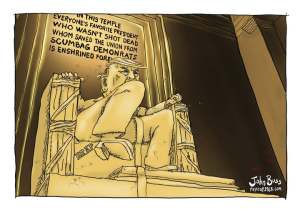
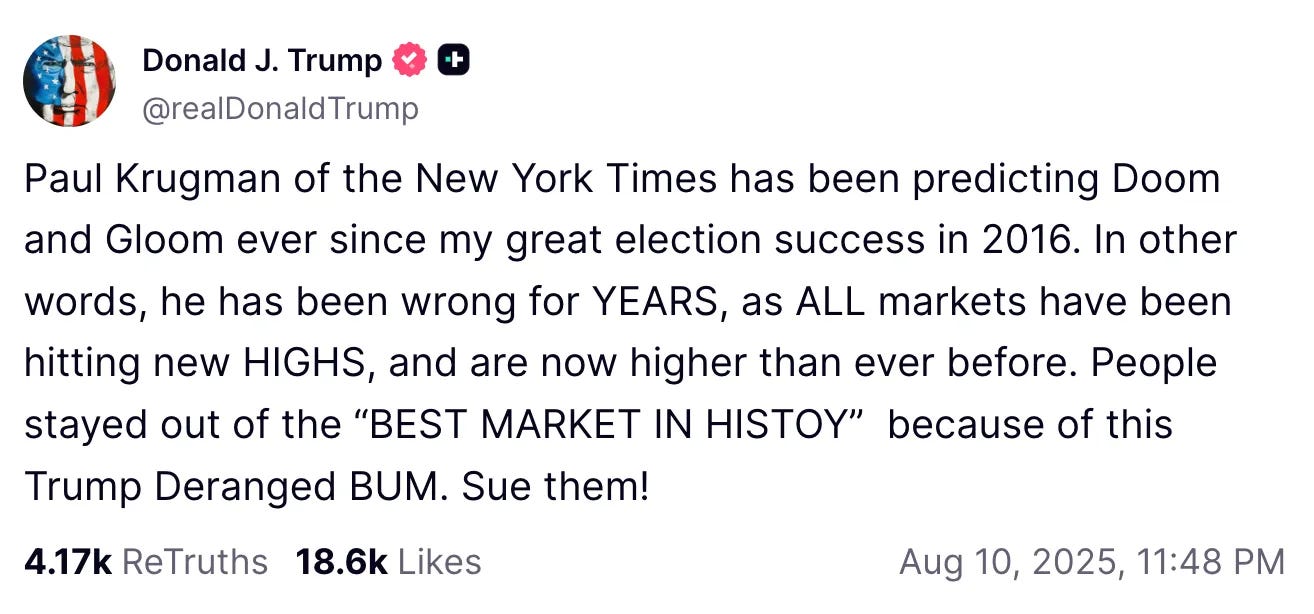
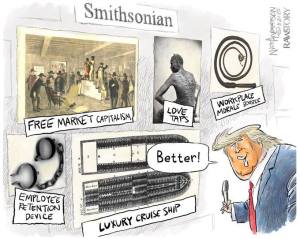 The key to the crazy car is indeed tariffs.
 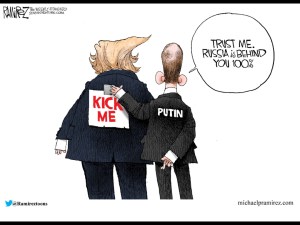 The rest is under a paywall, but you get the general gist of it. So, all of this tariff shit is not coming out of Congress, as it should. That is what led to this very important article in Fortune. You may read all of it. The first author, Jeffrey Sonnenfield, is a Yale University Business Professor. The rest of the authors are equally impressive. There are CEOs of Top Companies as well as other academics, including Distinguished Professor Laura Tyson, a former chair of the White House Council of Economic Advisors, back when we really were doing economic policy. Here’s the headline, folks!
 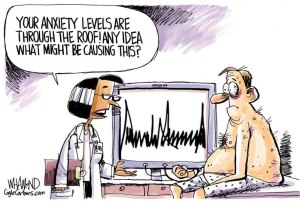 You may read all the listed evidence at the link. This is not normal. This is heavy-handed interference in all our markets. Evidently, regulation is good if it’s the #FARTUS openly demanding he be cut in on all deals. There are so many things going on that are not normal; all alarms should be blaring loudly by now. “Trump’s FBI Raid of John Bolton’s Home Looks Like a ‘Five-Alarm Fire. Thus far, little is known about Friday’s law enforcement action against a top Trump critic. But we’re seeing an escalation of authoritarian power on many fronts that has grown unmistakable.” This is from the
 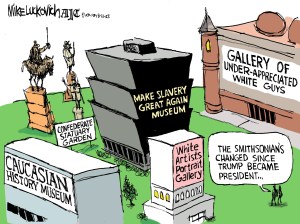 WTF is going on? This is not normal. This is not democratic. This is not how our republic is supposed to work. Meanwhile, Donald’s dash for the Nobel Peace Prize is dashed again. Put so played him. This is from
  #FARTUS is the most corrupt and inept president we’ve ever had. I have no idea how we’re going to survive much more of this. More things from Memeorandum to check out:

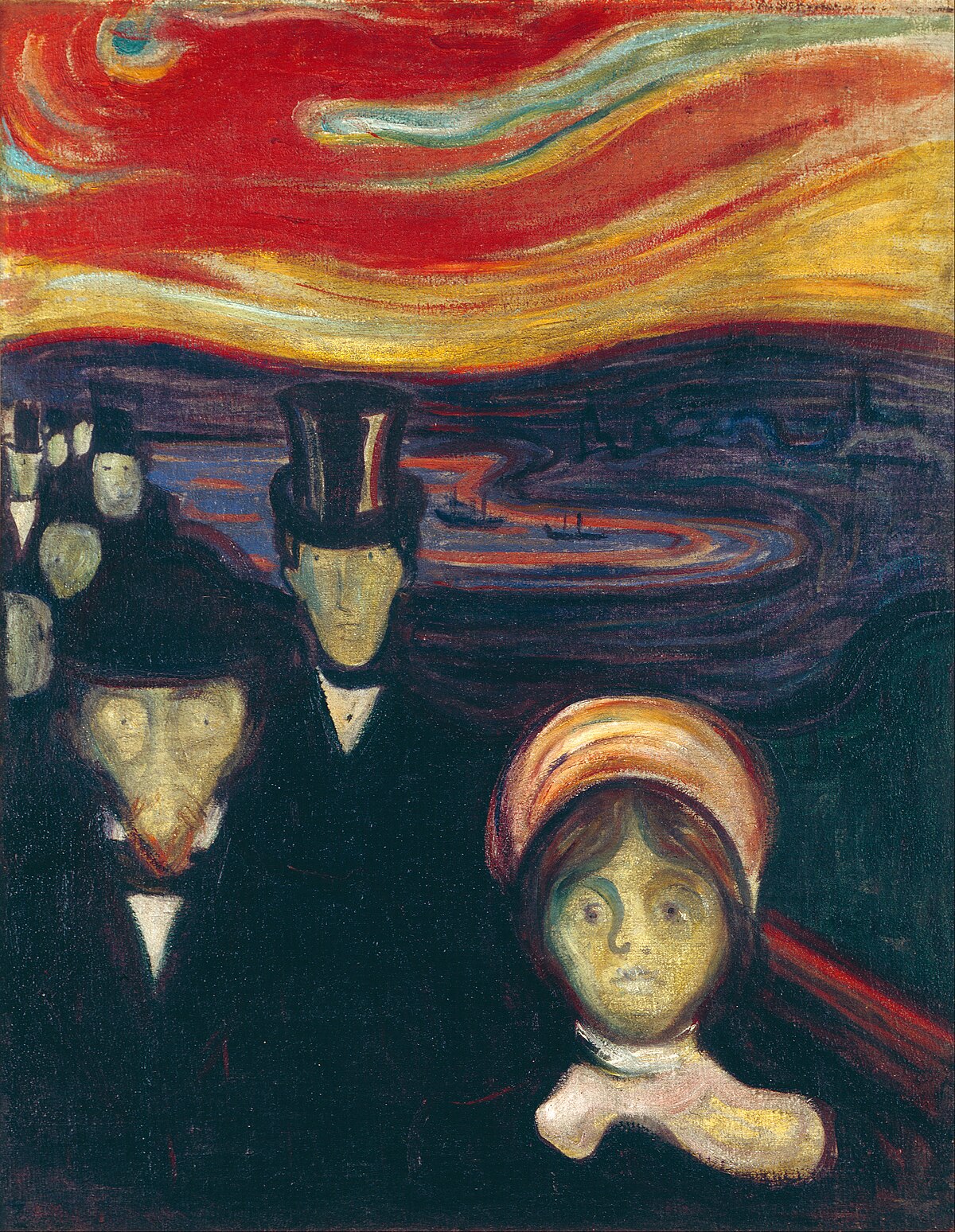












 peej
peej Carissa
 bostonboomer
 dakinikat
 ecocatwoman
 mablue2
 Mama Lopez
 peggysue22
 quixote
 skydancingguestblogger
 Mona (aka Wonk the Vote)



 Sky Dancing
Recent Comments