
Lazy Saturday Reads: Weather, Spring Fever, Boston Bombing, Ukraine, and True Detective Spoilers
Posted: March 1, 2014 Filed under: Barack Obama, Foreign Affairs, morning reads | Tags: baseball, Boston Marathon bombings, Boston Red Sox, Carcosa, Cold War, Crimea, death penalty, Dzhokhar Tsarnaev, FBI abuses, Ibragim Todashev, spoilers, spring training, Tamerlan Tsarnaev, True Detective, Ukraine, Vladimir Putin, Yellow King 14 Comments
It’s Saturday!!
Another snowstorm is coming, but it’s not yet clear how bad it will be or how much snow will fall in which areas. From the Weather Channel: Ice Storm Possible for Mississippi Valley, Ohio Valley; Snowstorm for West, Midwest, Northeast.
After a brief reprieve from blockbuster winter storms in the Midwest and East – and a much-too-lengthy reprieve in California – Winter Storm Titan is will lay down a swath of heavy snow from California to the East Coast, and also a swath of sleet and freezing rain from the Plains to the Mid-Atlantic States.
- Saturday: The main event east of the Rockies will begin to unfold as snow spreads east across portions of the Plains, Upper Midwest and Great Lakes. For parts of the Northern Rockies, this will just be a continuation of snow from the previous, weaker disturbance. Widespread snow is likely across Wyoming, but will gradually wind down over western and southern Montana. Farther south the snow will be more tied to higher elevations. (See inset map for details.)
- Sunday: The more significant part of Winter Storm Titan begins with snow, sleet and freezing rain becoming heavier. A stripe of significant ice accumulation is likely Sunday and Sunday night from the Ozarks through into the Mid-South region, Ohio Valley and West Virginia with snow farther north from the central Plains into the mid-Mississippi Valley and Ohio Valley. These threats spread into the Mid-Atlantic and Northeast Sunday afternoon and night.
- Monday: Snow/sleet tapers off in the Ohio Valley Appalachians, but should linger in the Appalachians and along parts of the I-95 Northeast corridor much of the day, before ending off in the evening. Ice/sleet areas early in the day in the Mid-Atlantic states should changeover to snow Monday morning.

Whatever. Winter is almost over. It’s March 1, and there are signs of spring–at least down at Fenway South in Ft. Myers, Florida (and many other spring training locations). Yesterday the Red Sox played their first Grapefruit League game against the Minnesota Twins, losing 8-2. But who cares? A hot new pitching prospect shut down the Twins for two innings, striking out four–a good sign for the upcoming season. Baseball is back, opening day is a little over a month away, and that means spring is coming!
OK, I know I’m being really provincial, but I’ll bet you’re seeing signs of Spring too. What is giving you hope for the end of this long, cold winter? Even the folks down south have suffered greatly this year.
One more Boston story. The FBI is claiming that accused Boston bomber Dzhohar Tsarnaev “made a damaging statement” in a visit with one of his sisters recently. Of course they won’t even give a hint as to what he said, so I don’t know what to make of it. The Boston Globe:
The filing said that Tsarnaev, despite the presence of the agent, who was legally allowed in the room, “was unable to temper his remarks and made a statement to his detriment which was overheard by the agent.”
The filing did not say what the statement was.
The filing was made as part of an ongoing battle between the prosecution and defense over special administrative measures, special prison restrictions, that have been imposed on Tsarnaev.
The defense says the prosecution is refusing to turn over information they need and that the FBI is monitoring their meetings with Tsarnaev and preventing them from developing their defense strategy. I think the feds need to keep in mind that they will have a Massachusetts jury–very few people here support the death penalty, and most potential jurors will be troubled by FBI efforts that might prevent a fair trial. After all, we just recently went through the Whitey Bulger trial, in which we heard endless tales of FBI abuses and we’re still waiting for an explanation as to why an agent from the Boston office shot Ibragim Todashev down in Orlando last May.
We’re coming up on the 2014 Boston Marathon, and we still have almost no explanations of what really happened during the Marathon bombing and the shootout in Watertown a few days later. And then there’s the Waltham triple murder, which the FBI is trying to pin on two dead guys–Tamerlan Tsarnaev and Ibrigim Todashev. Susan Zalkind summed up many of the questions in this month’s Boston Magazine coverstory: The Murders Before the Marathon. There wasn’t a whole lot of breaking news in the article, but it’s a very good summary of events so far.
There’s a lot happening in Ukraine. I’ll just give you a couple of links to check out, because I’m not qualified to comment on the situation–other than I’m sick of everyone expecting the U.S. to get involved in every crisis.
The latest from ABC News: Putin Asks Parliament to Use Military in Ukraine
Russian President Vladimir Putin asked parliament Saturday for permission to use the country’s military in Ukraine, moving to formalize what Ukrainian officials described as an ongoing deployment of Russian troops in the strategic region of Crimea.
Putin’s motion loosely refers to the “territory of Ukraine” rather than specifically to Crimea, raising the possibility that Moscow could use military force in other Russian-speaking provinces in eastern and southern Ukraine where many oppose the new authorities in Kiev….
He said the move is needed to protect ethnic Russians and the personnel of a Russian military base in Ukraine’s strategic region of Crimea. Putin sent the request to the Russian legislature’s upper house, which has to approve the motion, according to the constitution. The rubber-stamp parliament is certain to approve it in a vote expected Saturday.
In Crimea, the pro-Russian regional prime minister had earlier claimed control of the military and police there and asked Putin for help in keeping peace, sharpening the discord between the two neighboring Slavic countries.

President Obama warned yesterday that there would consequences for military intervention in Ukraine, but he didn’t specify any actions he would take. At this point, I think these warnings are just being ignored, because there is seldom any follow-up. As I said earlier, I don’t want to get involved in any more foreign conflicts. Let Europe deal with it if they want to. We have plenty of problems here at home that require government action.
From Reuters: West voices alarm on Crimea, calls on Russia to respect Ukraine sovereignty.
A week after violent protests forced Russian-backed President Viktor Yanukovich to abandon power in Kiev, Ukraine’s new leaders say Russia is trying to take control of the southern Crimea region, which has a majority ethnic Russian population.
France, Britain and Germany issued calls for de-escalation in Crimea hours after U.S. President Barack Obama warned that military intervention in the region would be deeply destabilizing and “carry costs”.
“France is extremely concerned by the reports from Crimea, which describe significant troop movements,” French Foreign Minister Laurent Fabius said in a statement. “We call on the parties to abstain from acts that could raise tensions and affect Ukraine’s territorial unity.”
It does appear that Putin is intent on reviving the Cold War. I hope he’s not successful.
Tomorrow night we’ll get an other episode of True Detective–there are only two to go. I gathered a bunch more links in the past couple of days. Some of them have spoilers, so be careful.
This is an older post, but it provides some very good background on the weird aspects of the story. From Grantland’s Molly Lambert, Carcosa or Bust: The Satisfyingly Weird Mysteries of ‘True Detective’. Just a taste:
Hallucinatory spirals, talk of “black stars” rising in the sky, dead women trussed up like ancient horned gods and tattooed with mysterious symbols, all supposedly in reference to Robert W. Chambers’s fairly obscure weird fiction classic The King in Yellow? Damn, True Detective, you’ve given me a lot to absorb.
Where is the show going with its recently clarified Lovecraftian ties? Does it even really matter, when the ride is this great? The most satisfying part of a mystery is rarely its resolution. Sustained anticipation is much of the thrill. Like earlier TV mysteries Twin Peaks, The X-Files, and Lost, True Detective is a show with its own internal mythology, which taunts both the protagonists and viewers with signs just beyond our comprehension. When some bits of information are guaranteed to be important later, every single bit of information feels like a potential clue. Attempting to read a show scene by scene and pluck out exactly what will prove crucial from a galaxy of visual and verbal details can feel absolutely maddening….
You can spend endless amounts of time pondering True Detective’s more concrete questions, let alone the existential ones. Are the wooden triangles strewn around the sites of the ritualistic murders pagan symbols, bird traps, or neither? Given creator Nic Pizzolatto’s professed affection for weird fiction, were Reggie Ledoux’s gas mask and the reference to a “green-eared spaghetti monster” meant to invoke Cthulhu, the giant octopus monster that signals cosmic doom in the work of seminal horror writer H.P. Lovecraft? Is the mystery even going to get solved?True Detective’s flashback structure accentuates the gaps in our knowledge. Everything we know is gleaned from flashbacks and interrogations, but there’s no guarantee that future information won’t flip our perspective. Hell, there’s no guarantee that Rust and Marty’s flashbacks are accurate. After all, if we can see Rust’s subjective hallucination of birds assembling into a spiral in the sky, who’s to say we’re not seeing other events from his subjective perspective too? This kind of theorizing, not baseless but impossible to prove conclusively, will make you feel like True Detective’s detectives. Maybe the show’s obsessions with madness, reality, and truth really are contagious.

Then read Lamberts latest post: Five Things to Consider for This Week’s Episode of ‘True Detective’. She has some good questions.
A guy at Reddit did some sleuthing and came up with some photos posted by True Detective crew members. Here’s a link to a lot of photos, some from the upcoming episodes. I looked at them, and got some sense of what’s coming, but not much more than I got from the teaser trailer. They didn’t ruin the suspense for me. Just be warned if you want to stay completely in the dark.
A few more links to explore as we wait for tomorrow night to roll around:
Rolling Stone: The Dark Thrills of ‘True Detective’
Forbes: The Business Of HBO’s ‘True Detective’
Slate: The True DetectiveGlossary
Complex Pop Culture: Pictures of You: “True Detective” and the Dilemma of the Dead Woman’s Photograph
International Business Times: ‘True Detective’ Season 1 Spoilers: What’s On The Video Tape In Episode 7? Theories On Hart’s Daughter And Connection To The Yellow King
Now what’s on your mind today? Please post your links on any topic in the comment thread, and have a great weekend!!
Saturday News Potpourri
Posted: January 25, 2014 Filed under: Civil Rights, Egypt, Foreign Affairs, morning reads, Russia, U.S. Politics | Tags: apps, artisanal toast, banks, Booz Allen Hamilton, Brian Glyn Williams, Chechnya, China, Dagestan, discrimination, diva test, Don Graham, Dr. Strangelove, Dzhokhar Tsarnaev, Edward Snowden, Eric Holder, Erik Prince, glamour shots of elderly people, guns, Jeff Bezos, Marijuana, Pink, Sochi Olympics, Trove, Ukraine protests, Volograd bombings, vote id laws, voting rights, Washington Post 53 Comments
Good Morning!!
I have quite a few articles to share this morning, a real Saturday potpourri! So let’s get started. First up, on Thursday Attorney General Eric Holder gave a wide-ranging interview to Ari Melber of MSNBC, and quite a bit of breaking news came out of it. Here are some of the resulting headlines: NY Daily News: Eric Holder: Could talk deal with NSA-leaker Edward Snowden, but no clemency
Holder told MSNBC that the Obama Administration “would engage in a conversation” about a resolution in the case, but said it would require Snowden acknowledge wrongdoing…. At a University of Virginia forum, where Holder was asked about Snowden, he elaborated on his position, saying, “If Mr. Snowden wanted to come back to the United States and enter a plea, we would engage with his lawyers. We would do the same with any defendant who wanted to enter a plea of guilty, so that is the context to what I said.” But he stressed that the NSA leaker would not walk. “We’ve always indicated that the notion of clemency isn’t something that we were willing to consider.”

Seattle PI: Holder: Marijuana banking regulations on the way
Attorney General Eric Holder says the Obama administration is planning to roll out regulations soon that would allow banks to do business with legal marijuana sellers. During an appearance Thursday at the University of Virginia, Holder said it is important from a law enforcement perspective to enable places that sell marijuana to have access to the banking system so they don’t have large amounts of cash lying around. Currently, processing money from marijuana sales puts federally insured banks at risk of drug racketeering charges. Because of the threat of criminal prosecution, financial institutions often refuse to let marijuana-related businesses open accounts.
There’s a good piece about this at Forbes, but they won’t even let you copy their headlines anymore. Mediaite: Eric Holder: Voter ID Used to ‘Depress the Vote’ of People Who Don’t Support GOP
Attorney General Eric Holder sharply criticized state-level voter identification policies and said that he believes those policies are a “remedy in search of a problem.” He added that, while some may be arguing for voter ID in good faith, he believes that most are advocating for this policy in order to “depress the vote” of those who do not support the “party that is advancing” voter ID measures. “I think many are using it for partisan advantage,” Holder said of voter ID. “People have to understand that we are not opposed to photo identification in a vacuum,” he continued. “But when it is used in — certain ways to disenfranchise particular groups of people, whether by racial designation, ethnic origin, or for partisan reasons, that from my perspective is problematic.” He added that “all the studies” show that in-person voter fraud “simply does not exist” at a level that requires a legislative solution.
Politico: Eric Holder: Timing of Robert Gates book release ‘a mistake’
Attorney General Eric Holder waded into the controversy over former Defense Secretary Robert Gates’s new book Thursday, calling it “a mistake” for Gates to have published his recollections before President Barack Obama left the White House. “It’s my view that it’s just not a good thing thing to write a book about a president that you served while that president is still in office,” Holder said during an appearance at the University of Virginia’s Miller Center. “From my perspective I think the world of Bob Gates, but I think that the publication of that book — at least at this time — was a mistake.” [….] In the course of offering his critique of the timing of Gates’s book, “Duty: Memoirs of a Secretary at War,” Holder twice praised the former defense secretary for his leadership. “I like Bob Gates a great deal. He was a good secretary of defense,” the attorney general said.
LA Times: Holder says no bank ‘too big to indict,’ more financial cases coming
“I think people just need to be a little patient,” Holder said, according to a transcript of an interview with MSNBC to air at noon Pacific time Friday. “I know it’s been a while. But we have other things that are in the pipeline.” [….] Holder has taken heat for telling a Senate hearing last year that some financial institutions were “so large that it becomes difficult to prosecute them” because criminal charges could hurt the U.S. and even world economies. Since then Holder has tried to emphasize that the Justice Department is not intimidated by the size of a financial institution and would bring any charges it believed it could prove.
As I said, quite a bit of news out of one interview. Good job by Ari Melber.
In other news . . .
The Economist has a brief article that provides some background on the situation in Ukraine: On the march in Kiev –The protests turn nasty and violent, but the president is not giving ground. 
JANUARY 22nd was meant to mark Ukraine’s unity day, a celebration of its short-lived pre-Soviet independence. Instead, it was a day of civil unrest and perhaps the biggest test of Ukraine’s post-Soviet integrity. After two months of largely peaceful encampment on the Maidan in Kiev, the protests turned violent. Five people were reported killed and hundreds were injured. An armoured personnel carrier pushed through the streets. Clouds of black smoke and flames mottled the snow-covered ground. Never in its history as an independent state has Ukraine witnessed such violence. It was triggered by the passage of a series of repressive laws imposing tight controls on the media and criminalising the protests of the past two months. One law copied almost verbatim a Russian example, including stigmatising charities and human-rights groups financed from abroad as “foreign agents”. If Russian human-rights activists denounce their parliament as a “crazy printer” churning out repressive legislation, says Oleksandra Matviichuk of the Centre for Civil Liberties in Kiev, Ukraine has a “crazy photocopier”. The clashes show vividly the refusal of the protesters to heed such laws.
Brian Glyn Williams, the U. Mass Dartmouth professor who interacted with Boston Marathon bomber Dzhokhar Tsarnaev and recommended some sources of information on Chechnya for a report Tsarnaev was writing, has a post up at HuffPo on how the history of Chechya and Dagestan is coming back to haunt the Winter Olympics in Russia: The Dark Secret Behind the Sochi Olympics: Russia’s Efforts to Hide a Tsarist-Era Genocide. Here’s the conclusion:
The twin bombings in Volgograd in late December 2013 and an earlier one in October are clearly meant to show the Russians that the Chechen-Dagestani terrorists have reignited their terror jihad. They are also meant to remind the world of the tragedy that befell the Circassians of the Caucasus’s Black Sea shore exactly 150 years ago this winter. This is the dark secret that Russia’s authoritarian leader, Putin, does not want the world to know. Putin has thus far been very successful in conflating Russia’s neo-colonial war against Chechen separatists with America’s war on nihilist Al Qaeda Arab terrorists. Any attempt to remind the world of Imperial Russia/Post-Soviet Russia’s war crimes in the Caucasus is a threat to Putin’s pet project, the whitewashed Sochi Olympics. This of course not to excuse the brutal terroristic acts of the Caucasian Emirate or the Chechen rebels, but it certainly provides the one thing that Putin does not want the world to see as he constructs his “Potemkin village” in Sochi, and that is an honest account of the events that have made this the most terrorist fraught Olympic games since the 1972 Summer Olympics in Munich.
 Remember Erik Prince, the Michigan millionaire who founded Blackwater? Guess what he’s doing these days? The WSJ has the scoop: Erik Prince: Out of Blackwater and Into China. Erik Prince —ex-Navy SEAL, ex-CIA spy, ex-CEO of private-security firm Blackwater —calls himself an “accidental tourist” whose modest business boomed after 9/11, expanded into Iraq and Afghanistan, and then was “blowtorched by politics.” To critics and conspiracy theorists, he is a mercenary war-profiteer. To admirers, he’s a patriot who has repeatedly answered America’s call with bravery and creativity.
Now, sitting in a boardroom above Hong Kong’s Victoria Harbour, he explains his newest title, acquired this month: chairman of Frontier Services Group, an Africa-focused security and logistics company with intimate ties to China’s largest state-owned conglomerate, Citic Group. Beijing has titanic ambitions to tap Africa’s resources—including $1 trillion in planned spending on roads, railways and airports by 2025—and Mr. Prince wants in…. “I would rather deal with the vagaries of investing in Africa than in figuring out what the hell else Washington is going to do to the entrepreneur next,” says the crew-cut 44-year-old. Having launched Blackwater in 1997 as a rural North Carolina training facility for U.S. soldiers and police, Mr. Prince says he “kept saying ‘yes’ as the demand curve called—Columbine, the USS Cole and then 9/11.” In 100,000 missions in Iraq and Afghanistan, he says, Blackwater contractors never lost a U.S. official under their protection. But the company gained a trigger-happy reputation, especially after a September 2007 shootout that left 17 civilians dead in Baghdad’s Nisour Square. At that point, charges Mr. Prince, Blackwater was “completely thrown under the bus by a fickle customer”—the U.S. government, and especially the State Department. He says Washington opted to “churn up the entire federal bureaucracy” and sic it on Blackwater “like a bunch of rabid dogs.” According to Mr. Prince, IRS auditors told his colleagues that they had “never been under so much pressure to get someone as to get Erik Prince,” and congressional staffers promised, “We’re going to ride you till you’re out of business.”
Awwwwww…..Poor little rich boy. Where’s my tiny violin?

Speaking of entrepreneurs, Amazon billionaire Jeff Bezos’ plans for his latest acquisition–The Washington Post–are becoming clearer, as he hires more right wing libertarians for the op-ed page. Now Pando Daily reveals what Don Graham is up to now that he’s dumped the family business: The company formerly known as WaPo moves into tech apps.
Today, the company formerly known as WaPo — now called Graham Holdings – has announced a new business endeavor in journalism. Surprisingly, said endeavor doesn’t have much to do with actual journalism at all — it falls squarely in the tech camp. It’s a content discovery app called Trove. Trove fits in the now-torrential trend of such applications. Companies like Flipboard,Prismatic, Rockmelt, and N3twork have all tread this ground long before Trove. They’re all convinced that places like Twitter, Facebook, Tumblr, and RSS readers are not good enough for finding the best stories…. The two men behind Trove have rich and storied histories. Vijay Ravindran, the CEO of Trove, served as The Washington Post’s Chief Digital Officer before the sale, and ran ordering at Amazon for seven years before that. Reuters oped columnist Jack Shafer even divpredicted (incorrectly) that Ravindran would be named the new WaPo publisher after the sale. The other Trove heavyweight is product lead Rob Malda, who is also the co-founder and former editor-in-chief of Slashdot — the predecessor of every user-focused news aggregator since, from Digg to Reddit to Hacker News.
Read all about it at the above link.
A few short takes:
In other tech news, CSM’s Security Watch reports that Booz Allen, Snowden’s old firm, looking to help US government with ‘insider threats’. Author Dan Murphy asks, “Are defense and intelligence contractors the best choice to manage a threat they’ve contributed to?” Read it and weep.
According to Fox News, gun manufacturers Smith & Wesson and Ruger will no longer do business in California because they don’t want to comply with a new CA law that allows law enforcement to trace bullets to the individual gun they came from. After all, why would gun companies want to help police catch murderers? Unbelievable!
Did you know that this month is the 50th anniversary of Stanley Kubrick’s brilliant satire, Dr. Strangelove? IMHO, it is one of the funniest movies of all time. Well, Eric Schlosser has a not-so-funny article about it at The New Yorker: ALMOST EVERYTHING IN “DR. STRANGELOVE” WAS TRUE. Don’t miss this one; it’s a must read!
Apparently the latest food craze to emerge from San Francisco is “artisanal toast.” How did toast become the latest artisanal food craze? Ask a trivial question, get a profound, heartbreaking answer. John Gravois writes about it at Pacific Standard: The Science of Society. Weird.
A silly test to take at Buzzfeed: Which Pop Diva Are You? I got Pink. I know nothing about her…but she looks kinda cool. 
Finally, I posted this link in the comments recently, but I don’t know if anyone looked at it. I’m posting it again, because I think it’s absolutely adorable. It’s some glamour shots of elderly people having fun dressing up and posing as various movie heroes and heroines. Here’s just one example:

“Easy Rider”: Walter Loeser (l.), 98, & Kurt Neuhaus, 90
I hope you found something to tickle your fancy in this potpourri of articles. Now it’s your turn. Please post your recommended links in the comment thread, and have a wonderful weekend!
Thursday Reads: Civil Rights Struggle, Syria Intervention, NYPD Spying, Boston Bombing, and “League of Denial”
Posted: August 29, 2013 Filed under: Foreign Affairs, morning reads, Republican politics, U.S. Politics | Tags: Boston Bombings, chemical weapons, Civil Rights Movement, concussions, Dzhokhar Tsarnaev, Eric Cantor, ESPN, John Boehner, John F. Kennedy, John Odom, Julian Bond, Martin Luther King, NFL, NYPD, PBS Frontline, police photography, Prime Minister David Cameron, Rep. John Lewis, traumatic brain injury, We Shall Overcome 19 Comments
Good Morning!!
I’ve got so much news for you this morning, I don’t know if I’ll have room in a reasonable-length post, so I’ll get right to it. I’ll begin with some stories on yesterday’s 50th anniversary of the March On Washington.
PBS had an amazing interview with Rep John Lewis in which he recounted his memories of that day in 1963 and the speech he gave as a youthful leader in the Civil Rights Movement: ‘I Felt That We Had to Be Tough’: John Lewis Remembers the March on Washington. I hope you’ll read the whole thing, but here’s a brief excerpt:
REP. JOHN LEWIS, D-Ga.: On that day, I was blessed.
I felt like I had been tracked down by some force or some spirit. I will never forget when A. Philip Randolph said, “I now present to you young John Lewis, the national chairman of the Student Nonviolent Coordinating Committee.”
And I went to the podium. I looked to my right. I saw many, many young people, staffers from the Student Nonviolent Coordinating Committee, volunteers. Then I looked to my left. I saw all these young people up in the trees, trying to get a better view of the podium.
Then I looked straight ahead. And I saw so many people with their feet in the water trying to cool off. And then I said to myself, this is it, and I went for it.
On meeting with President Kennedy before the March, and how the podium and the crowd came to be so diverse:
He [JFK] didn’t like the idea of a March on Washington.
When we met with him, A. Philip Randolph spoke up in his baritone voice we met with the president. And he said, “Mr. President, the black masses are restless. And we are going to march on Washington.”
And you could tell by the movement of President Kennedy — he started moving and twisting in his chair. And he said, in effect, that if you bring all these people to Washington, won’t it be violence and chaos and disorder?
Mr. Randolph responded and said, “Mr. President, there’s been orderly, peaceful, nonviolent protests.”
And President Kennedy said, in so many words, I think we are going to have problems. So we left that meeting with President Kennedy. We came out on the lawn at the White House and spoke to the media and said, we had a meaningful and productive meeting with the president of the United States. And we told him we’re going to March on Washington.
And a few days later, July 2, 1963, the six of us met in New York City at the old Roosevelt Hotel. And in that meeting, we made a decision to invite four major white religious and labor leaders to join us in issuing the call for the March on Washington.
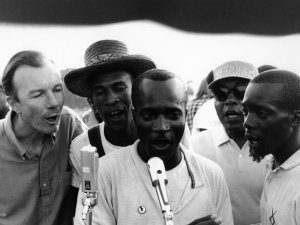
American folk singer and activist Pete Seeger (left) adopted and helped popularize “We Shall Overcome” by teaching the song at rallies and protests. Here he sings with activists in Greenwood, Miss., in 1963. (NPR)
NPR had a wonderful story yesterday about the history of the Civil Rights Movement’s signature song: The Inspiring Force Of ‘We Shall Overcome’.
It is not a marching song. It is not necessarily defiant. It is a promise: “We shall overcome someday. Deep in my heart, I do believe.”
It has been a civil rights song for 50 years now, heard not just in the U.S. but in North Korea, in Beirut, in Tiananmen Square, in South Africa’s Soweto Township. But “We Shall Overcome” began as a folk song, a work song. Slaves in the fields would sing, ‘I’ll be all right someday.’ It became known in the churches. A Methodist minister, Charles Albert Tindley, published a version in 1901: “I’ll Overcome Someday.”
The first political use came in 1945 in Charleston, S.C. There was a strike against the American Tobacco Co. The workers wanted a raise; they were making 45 cents an hour. They marched and sang together on the picket line, “We will overcome, and we will win our rights someday.”
There’s much more about how the song was passed from group to group and changed over time. Please give it a listen–it’s only about 8 minutes long, but really fascinating.
Not a single Republican appeared at yesterday’s commemoration of the March on Washington and Martin Luther King’s “I Have A Dream” speech. George W. Bush and his father George H.W. Bush couldn’t come because of health issues, but John Boehner and Eric Cantor are presumably in good health, but they refused offers to make speeches at the event, according to Roll Call.
That wasn’t a wise choice, said Julian Bond, a renowned civil rights activist, in an interview with MSNBC on Wednesday afternoon.
“What’s really telling, I think, is the podium behind me, just count at the end of the day how many Republicans will be there,” Bond told news anchor Alex Wagner. “They asked senior President Bush to come, he was ill. They asked junior Bush, he said he had to stay with his father.
“They asked a long list of Republicans to come,” Bond continued, “and to a man and woman they said ‘no.’ And that they would turn their backs on this event was telling of them, and the fact that they seem to want to get black votes, they’re not gonna get ‘em this way.” [….]
Cantor’s decision to turn down the invitation to speak is especially striking given his stated commitment to passing a rewrite of the Voting Rights Act in the 113th Congress, and the many opportunities he has taken over the past several weeks to publicly reflect on the experience of traveling with Rep. John Lewis, D-Ga., to Selma, Ala.
Sadly, Dr. King’s dream of peace has not made much progress in the past 50 years. And now the U.S. and its allies are considering another military intervention–in Syria.
Fortunately, the UK is now hesitating. NYT: Britain to Wait on Weapons Report Ahead of Syria Strikes.
Prime Minister David Cameron of Britain, who runs a coalition government, is facing political difficulties from legislators mindful of the experience in Iraq, when assurances from Prime Minister Tony Blair and President George W. Bush that Saddam Hussein had weapons of mass destruction proved inaccurate and a false pretext for war.
Mr. Cameron bowed on Wednesday to pressure from the opposition Labour Party and to some within his own coalition who want to allow United Nations weapons inspectors a chance to report their findings and for the United Nations Security Council to make one more effort to give a more solid legal backing to military action against Damascus.
At BBC News, Nick Robinson explains why Cameron “buckled.”
If you think that NSA domestic spying is invasive, you should take a look at what the NYPD has been up to since 9/11. Matt Apuzzo and Adam Goldman of the AP have a new book out called Enemies Within: Inside the NYPD’s Secret Spying Unit and bin Laden’s Final Plot Against America. There’s an excerpt at New York Magazine: The NYPD Division of Un-American Activities. It’s long, but a very important story. Please give it a read if you can.
Yesterday Apuzzo and Goldman published a related shocking story at AP: NYPD designates mosques as terrorism organizations.
The New York Police Department has secretly labeled entire mosques as terrorist organizations, a designation that allows police to use informants to record sermons and spy on imams, often without specific evidence of criminal wrongdoing.
Designating an entire mosque as a terrorism enterprise means that anyone who attends prayer services there is a potential subject of an investigation and fair game for surveillance.
Since the 9/11 attacks, the NYPD has opened at least a dozen “terrorism enterprise investigations” into mosques, according to interviews and confidential police documents. The TEI, as it is known, is a police tool intended to help investigate terrorist cells and the like.
Many TEIs stretch for years, allowing surveillance to continue even though the NYPD has never criminally charged a mosque or Islamic organization with operating as a terrorism enterprise.
The documents show in detail how, in its hunt for terrorists, the NYPD investigated countless innocent New York Muslims and put information about them in secret police files. As a tactic, opening an enterprise investigation on a mosque is so potentially invasive that while the NYPD conducted at least a dozen, the FBI never did one, according to interviews with federal law enforcement officials.

Boston Magazine has published more photos from “Behind the Scenes of The Hunt for Dzhokhar Tsarnaev.” Above is a photo of Tsarnaev exiting the boat in which he hid for hours as law enforcement searched all over Watertown for him. See more photos at the link.
In more hopeful news, one long-hospitalized survivor of the bombings was given the go-ahead to return home to California yesterday: Boston Marathon bomb survivor John Odom set to return home to Torrance (Daily Breeze News).
Nearly five months after a bomb almost took his life at the Boston Marathon, John Odom of Torrance was cleared by doctors on Wednesday to finally come home.
Odom’s wife, Karen, who has never left her husband’s side, has been chronicling her husband’s long recovery on Facebook, called it a “monumental” day.
“It’s official, John is released to go home!!!” she posted on the John Odom Support Page. “Although his recovery is nowhere near complete, there is no medical or physical reason he can’t fly home and continue his recovery in California. We are hoping to be home the end of next week, a few days shy of 5 months since we left on that now famous 4 day trip.”
“Famous” is one way to put it. The couple could have never imagined the journey they’ve been on since April 15.
Read the rest of this moving story at the link.
On October 8th and 15th, NPR’s Frontline plans to show League of Denial, “a two-part two-part investigation examining whether — as thousands of former players allege — the NFL has covered up the risks of football on the brain.” The documentary has so far been produced in partnership with ESPN, but last week the sports channel backed out of the collaboration presumably because of pressure from the NFL. From The New Republic: ESPN Quit Its Concussions Investigation With ‘Frontline’ Under Curious Circumstances.
“Frontline,” the prestigious, multiple-Emmy-winning investigative news show produced by Boston’s PBS member station, announced late Thursday afternoon that a 15-month-old partnership with ESPN in which they published a series of pieces exploring how the National Football League has (and has not) accounted for the relationship between playing football, head trauma, and brain damage, had come to an end. Dating back to last November, “Frontline” had run articles on its site featuring the work of Steve Fainaru and Mark Fainaru-Wada, ESPN staffers (and brothers) even as these articles appeared at espn.com and as the brothers did segments for ESPN’s award-winning investigative series “Outside the Lines.” The end result—in addition to abook that the brothers are publishing in October—was to be a “Frontline” documentary, League of Denial (also the book’s title).
According to “Frontline,” the documentary will premiere this season on October 8 and 15, but, “from now on, at ESPN’s request, we will no longer use their logos and collaboration credit on these sites and on our upcoming film.” Executive producer David Fanning and deputy executive producer Raney Aronson expressed their “regret” and credited ESPN with “a productive partnership.” They added, “The film is still being edited and has not been seen by ESPN news executives, although we were on schedule to share it with them for their editorial input.”
Aronson told me late Thursday that ESPN contacted “Frontline” last Friday to request that it remove ESPN’s logo from its website, citing the technicality that it was a “trademark issue.” It wasn’t until Monday, after the latest collaboration was published on “Frontline”’s website and aired on “OTL,” that ESPN also requested that language describing collaboration not be used, and that it became clear the collaboration itself was coming to an end.
The circumstances are indeed mysterious. Perhaps it was over-cautiousness on ESPN’s part or perhaps indirect pressure from the League. If you’re interested in this important story, go read Marc Tracy’s piece at TNR.
A couple more useful links on this story:
PBS: Questions Over NFL Doctor Cloud League’s Concussion Case
Bill Littlefield at NPR’s Only a Game: ESPN And Frontline Part Ways Over ‘League Of Denial’
The authors of the book League of Denial will continue their involvement with the Frontline presentation.
I’m running out of space, so I’ll end there, and add a few more links in the comments. Now what stories are you following today? Please share your links in the thread below.
Thursday Reads
Posted: July 25, 2013 Filed under: Barack Obama, Foreign Affairs, morning reads, Russia, Spain, U.S. Economy, U.S. Politics | Tags: ACLU, Amash NSA amendment, anti-abortion legislation, Boston Bombings, Dzhokhar Tsarnaev, FBI informants, fetus dolls, fetus fetishists, Gitmo, Glenn Greenwald, Guantanamo Bay prison, Ibragim Todashev, James "Whitey" Bulger, Justin Amash, Keith Alexander, macroeconomics, Madrid train bombing, metadata, North Dakota State Fair, NSA, Paul Krugman, Spanish train crash, Tamerlan Tsarnaev 16 Comments
Good Morning!!
Yesterday the House narrowly defeated (217-205) an amendment to the defense spending bill (proposed by Michigan Republican Justin Amash) that would have prohibited NSA from collecting metadata on phone calls unless there is evidence that a specific person involved in the call is involved in criminal activity. From Bloomberg:
Implementation of the amendment could have created a new burden on telephone and Internet companies to retain bulk data, in addition to ending the NSA’s blanket collection of phone records. Those possibilities led the White House, Republicans leaders and many congressional Democrats to oppose the proposals, pitting them against lawmakers from both parties who champion civil liberties and privacy….
The provision would have had the potential to cause headaches for information technology companies.
“It could be a significant burden depending on how the government wants us to keep this data and store it,” Trey Hodgkins, a senior vice president for TechAmerica, a Washington-based trade group that represents Verizon Communications Inc. (VZ), AT&T Inc. (T) andCenturyLink Inc. (CTL), said in a phone interview. “You’re talking about potentially extremely huge data sets.”
It’s important to note that the bill as passed also includes a provision that prevents the closing of Guantanamo and prohibits the President from transferring any of the detainees who are being held there. So a vote for the Amash amendment would also mean voting to keep Gitmo open indefinitely.
Another amendment to limit NSA data collection did pass:
The House also adopted an amendment written by Republican Richard Nugent of Florida that sought to prohibit the NSA from using funds in the almost $600 billion Pentagon spending measure to “acquire, monitor or store the content” of electronic communications by “a United States person.”
The Nugent amendment was viewed by some lawmakers as providing political cover for those who didn’t want to vote for Amash’s amendment. While lawmakers voting for the Nugent amendment might appear to be curbing the NSA’s powers, in actuality the amendment wouldn’t change anything, simply restates current law and is “a fig leaf”, said Representative Zoe Lofgren, a California Democrat.
The bill now goes to the Senate; who knows what will happen next. I hope there will be an open debate on regulating possible abuses that could arise from NSA data collection. If a serious debate takes place, perhaps something positive will eventually come from the Snowden debacle. I’m skeptical, but still hopeful.
USA Today presents arguments from Keith Alexander against completely “blowing up” the NSA’s data collection program.
Gen. Keith Alexander, head of the NSA, has said the collection of data has helped disrupt dozens of terrorist plots. Investigators are not allowed to comb through the data, but can use it when they have identified a foreign suspect through other intelligence collection.
The data allows investigators to then detect networks the suspect may have been tied into, which could lead to other suspects and the uncovering of secret cells.
“The court restricts what we can do with that data,” Alexander said in a recent speech. “We have to show some reasonable, articulable suspicion that the phone number that we’re going to look at is associated with al-Qaeda or another terrorist group.”
Personally, I’d rather see more carefully defined limits on when and how NSA can use the metadata to target specific American citizens and regulations to prevent lower level employees like Edward Snowden from getting access to personal information rather than an overall prohibition on having the data available when needed for an investigation. Whenever there is a “terrorist” event–as in the Boston Marathon bombings, people demand to know why the government didn’t prevent it. The fact is there are already regulations in place that limit NSA from targeting Americans. IMHO, we should improve those rules if necessary, based on a serious and thorough debate.
Here are Glenn Greenwald’s reactions to the vote in case you want to read another of his inaccurate, rabid screeds. Basically, Greenwald says it’s all the Democrats’ fault–especially that horrible, dreadful war criminal Barack Obama, who is roughly equivalent to Peter King and Michele Bachmann.
Further down in the article, poor Glenn has to admit that a majority of House Democrats supported the Amash amendment in the face of nasty mean old Obama saying he would like to have a nuanced discussion of the issues rather than simply shutting down the counterterrorism program entirely. Greenwald also continues to claim, falsely, that NSA collects and analyzes the phone calls of every American, in the face of calmer, more knowledgeable people who have tried to explain to him that the data isn’t examined without a warrant and clear suspicion of criminal activity (famous example of how these allowed a criminal to slip through the cracks: Tamerlan Tsarnaev). But we’re not Russia, so we do have some limits on surveillance of American citizens and legal residents like Dzhokhar and Tamerlan Tsarnaev.
You know what I’d like to see targeted for more regulation? The FBI’s use of informants and FBI agents’ apparent ability to get away with murder. From Adrian Walker at The Boston Globe: Ibragim Todashev’s shooting needs explanation.
Ibragim Todashev was mysterious in life, but he has fallen into a void in death.
Todashev was fatally shot during an interrogation by Boston-based FBI agents in Orlando on May 22. The Russia native was being asked about his friendship with Tamerlan Tsarnaev, the presumed mastermind of the Boston Marathon bombing. Unusual as it is for someone to be shot to death during questioning, silence has reigned in its aftermath. The FBI’s few statements have been more confusing than illuminating.
The American Civil Liberties Union of Massachusetts made an attempt Tuesday to spur somebody, anybody, into providing clarity. It called on state authorities in Florida and Massachusetts to conduct their own investigations. The questioning was being done by the FBI and Massachusetts State Police, though some reports have indicated a lone FBI officer was in the room when Todashev was shot.
In response, Attorney General Martha Coakley made it clear her office has no intention of getting involved, pleading lack of jurisdiction. Florida officials have maintained all along that they have no standing to investigate. There doesn’t seem to be any reason to think they are about to change their minds.
Walker notes that we have a stunning example of the FBI’s misbehavior with informants in the James “Whitey” Bulger trial, which is going on in Boston right now.
…we should know better than to rush to absolve the FBI, no questions asked. After all, another of Boston’s great villains, James “Whitey” Bulger, is being tried for decades of terrorizing the city while an FBI informant.
And while the verdict on Whitey is still weeks away, the evidence is clear that the FBI aided and abetted his activities for ages. Not just a rogue agent or two, either; much of the agency’s Boston office was involved.
It’s not comforting, either, to examine the FBI’s record on examining its own shootings. According to a New York Times investigation, the FBI has cleared itself in nearly every agency-involved shooting of the past 20 years.

There was a terrible train crash in Spain yesterday, with at least 78 killed and 130-140 injured. A Spanish official described the scene as “Dante-esque.”
Bodies covered in blankets lay next to the overturned carriages as smoke billowed from the wreckage. Firefighters clambered over the twisted metal trying to get survivors out of the windows, while ambulances and fire engines surrounded the scene.
The government said it was working on the hypothesis the derailment was an accident – although the scene will stir memories of 2004’s Madrid train bombing, carried out by Islamist extremists, that killed 191 people. Sabotage or attack was unlikely to be involved, an official source said….
“It was going so quickly. … It seems that on a curve the train started to twist, and the wagons piled up one on top of the other,” passenger Ricardo Montesco told Cadena Ser radio station.
“A lot of people were squashed on the bottom. We tried to squeeze out of the bottom of the wagons to get out and we realised the train was burning. … I was in the second wagon and there was fire,” he added.
This brief video shows the moment the train derailed and crashed.
According to Railway Gazette, the accident may have been caused by excessive speed.
SPAIN: At 20.41 on July 24 a Madrid – Ferrol Alvia service derailed on a curve on the approach to Santiago de Compostela. Formed of a Class 730 gauge-convertible electro-diesel Talgo trainset, the 15.00 from Madrid was carrying 218 passengers, according to a joint statement from Spanish train operator RENFE and infrastructure manager ADIF.
The train had 12 vehicles, with an electric and a diesel power car at the ends. The rear power cars appear to have caught fire after the impact, and one of the intermediate coaches was thrown up on to an adjacent road; other cars rolled over or struck a retaining wall. Reports on July 25 indicated that 79 people had died in the accident with many more injured.
The train had left the high speed alignment and should have been slowing in preparation for the stop at Santiago station, about 3 to 4 km from the site of the accident. The speed limit on the curve is understood to be 80 km/h, but Spanish media reported that the train driver had said over the train radio that the train had been travelling at 190 km/h. A video taken from a lineside security camera appeared to show coaches behind the front power cars derailing first, pulling the heavier leading vehicles over as the train rounded the curve.

Here’s the crazy Republican story of the day–so far. I suppose the crazy could still get worse as the day goes on. As you know I was born in Fargo, ND, and I still have a soft spot for my home state; but I’m horrified by what’s happening there right now. Check this out: Pro-life group promotes cannibalism, hands out ‘fleshy’ fetus toys in candy bags to kids at State Fair, according to Freak-Out Nation. Yes, you read that right. They put “realistic” fetus dolls into candy bags for children!
Want a squishy toy fetus with your corn dog? If you’re visiting the North Dakota State Fair, you’re in luck! Last weekend, local anti-choice advocates slipped soft fetal models into kids’ candy bags without parental permission during the fair’s gigantic parade. “I don’t know exactly where I stand on abortion,” one mother told Jezebel, “but I believe in my rights as a parent.”
The North Dakota State Fair boasts a bevy of attractions, including performances by Tim McGraw and Creedence Clearwater Revisited. But Minot Right to Life spent the weekend giving away creepy little fetuses to kids without asking parents’ permission first. “It was really disturbing watching children run around with them,” one recalled. A federal judge recently blocked enforcement of the state’s highly unconstitutional six-week abortion ban; perhaps appealing to elementary schoolers’ interests is the group’s Plan B?
“The Precious One” fetal models are manufactured by Heritage House, a “pro-life supply store,” for $1.50 a pop — cheaper if you buy in bulk. “Its beautiful detail, softness and weight can really move hearts and change minds!” the website promises. A customer service representative told Jezebel that the models are most often given to pregnant women at “pregnancy centers” and kids at school presentations. The customer reviews on the site (it’s like Yelp for fetus-lovers instead of foodies) further imply that the doll-like figures are great for kids. “Children especially like to hold them,” one satisfied customer wrote. “No other item that we hand out has the amazing effect that these fetal models have — instant attachment to the unborn!” said another. “So many times, we hear, ‘Awwwww! That’s adorable!’ Or we just see a girl’s tears begin to form and fall.”
Something is very very wrong with these people.
Here’s one for Dakinikat: Paul Krugman explains (following Obama’s speech on the economy yesterday) why there are no “new ideas” about how to fix the financial crisis–because we knew how to do it from day one: Gimme That Old-Time Macroeconomics.
Both Steve Benen and Ed Kilgore get annoyed at fellow journalists complaining that there aren’t any “new ideas” in Obama’s latest. But why should there be?
It was clear early on that this was a crisis very much in the mold of previous financial crises. Once you realized that financial instruments issued by shadow banks — especially repo, overnight loans secured by other assets — were playing essentially the same role as deposits in previous banking crises, it was clear that we already had all the tools we needed to make sense of what was going on. And we also had all the tools we needed to formulate an intelligent policy response — all the tools we needed, that is, except a helpful economics profession and policymakers with a good sense of whose advice to take.
As Mark Thoma memorably remarked, new economic thinking appeared to consist largely of rereading old books. Brad DeLong says that it was all in Walter Bagehot; I think that this is true of the financial crisis of 2008, but that to understand the persistence of the slump we need Irving Fisher from 1933 and John Maynard Keynes from 1936. But anyway, this is not new terrain.
The trouble is Republicans keep right on insisting we should do what Herbert Hoover did in response to The Great Depression. Because that worked so well…
Okay Sky Dancers! What stories are you focusing on today? Please post your links on any topic in the comment thread.
Thursday Reads: Hot and Bothered Edition
Posted: July 18, 2013 Filed under: Foreign Affairs, morning reads, U.S. Politics | Tags: Boston Bombings, dead man's switch, Dzhokhar Tsarnaev, Edward Snowden, encryption, FBI, Glenn Greenwald, Gordon Humphrey, heat wave, Ibragim Todashev, Michael Hastings, Michael Krikorian, NSA leaks, Rolling Stone cover, student loan interest rates, Susan Zalkind, Waltham triple murder 41 Comments
Good Morning!!
Today is day 5 of the latest heatwave, which isn’t scheduled to break here in southern New England until Sunday. I don’t think I’m capable of writing very much today–we’ll see how it goes.
From USA Today: Heat wave scorches central, eastern USA
A killer heat wave brought the hottest weather of the summer to much of the nation Wednesday, and at least two more days of broiling temperatures are forecast before cooler weather slides in over the weekend.
About 130 million people are sweltering through the heat wave in the Midwest and Northeast this week, reports AccuWeather meteorologist Alex Sosnowski.
High daytime and nighttime temperatures, high humidity, intense sunshine and lack of wind will continue to make these areas “seem like the middle of the tropics,” he said.
High temperatures in the 90s are again likely Thursday and Friday all the way from the Plains to the Northeast. Heat advisories and warnings are in place from the Dakotas to New England.
Boston Bombing Aftermath
Quite a few people in New England are all hot and bothered about the August 1 cover of Rolling Stone–a glamorous photo of Dzhokhar Tsarnaev. The photo accompanies a long article by Janet Reitman, who has a reputation as a good investigative journalist.
The cover copy suggests that Reitman will reveal how sweet little Dzhokhar became “radicalized” into a “monster” who participated in the Boston Marathon bombing. I read the article, and was disappointed to find that it is mostly a rehash of material that was covered long ago in The Boston Globe and The New York Times. Reitman appears to have interviewed some of Tsarnaev’s high school friends, but again they offered no new insights. Reitman had scheduled an appearance on MSNBC’s The Last Word with Lawrence O’Donnell, who was born and raised in Boston. In the wake of the controversy, Reitman cancelled, which is also disappointing. Why not go on and defend her story?
I can’t say I’m all that bothered by the cover, since the photo was also featured long ago in The New York Times and other publications, but I can respect that for survivors of the bombings it seems pretty dismissive of their suffering to glamorize the perpetrator. Here are a few links on the topic–see what you think.
Erik Wemple at The Washington Post: To Rolling Stone detractors: Please
Slate: Rolling Stone’s Boston Bomber Cover Is Brilliant
The Boston Globe: Why Boston reacted right to Rolling Stone
Time: Drugstores, Supermarkets Boycott Rolling Stone Over Boston-Bomber Cover
In other news related to the Boston bombing suspects, friends of three men who were brutally murdered in Waltham in September 2011 have been talking to the media. Susan Zalkind, a friend of Erik Weissman appeared on the Rachel Maddow show this week.
Susan Zalkind, a close friend of Eric Weissman who was found murdered with two of friends in a Harding Avenue home in September 2011, appeared on the Rachel Maddow Show on Tuesday to discuss her investigation and reactions to the case, which is officially under investigation. However, authorities reportedly believe accused Boston Marathon bomber Tamerlan Tsarnaev and his friend Ibragim Todashev committed the murders as a drug ripoff. Tsarnaev was killed during the April 19 shootout with police in Watertown. The Federal Bureau of Investigation shot and killed Todashev in his Florida home in May after allegedly attacking agents. Todashev had been in the process of writing a confession implicating himself and Tsarnaev in the murders.
Other friends of the three murdered men talked to CNN, and High Times Magazine has the video. Friends believe that police didn’t take the investigations of the murders very seriously once they concluded that the three men were drug dealers.
Meanwhile, the FBI is refusing to release the Todashev autopsy. From Russia Today:
The FBI has ordered a Florida medical examiner’s office not to release the autopsy report of a Chechen man who was killed during an FBI interview in May over his ties to one of the suspected Boston Marathon bombers.
The autopsy report for Ibragim Todashev, 27, killed by an FBI agent during an interrogation which took place in his apartment on May 22 was ready for release on July 8. However, the FBI barred its publication, saying an internal probe into his death is ongoing.
“The FBI has informed this office that the case is still under active investigation and thus not to release the document,” according to statement by Tony Miranda, forensic records coordinator for Orange and Osceola counties in Orlando.
The forensic report was expected to clarify the circumstances of Todashev’s death.The Bureau’s statement issued on the day of the incident provided no details of what transpired, saying only that the person being interviewed was killed when a “violent confrontation was initiated by the individual.”
Back in May Ibragim Todashev’s father showed pictures of his dead son’s body at a press conference in Moscow, revealing he had been shot six times.
“I only saw things like that in movies: shooting a person, and then the kill shot. Six shots in the body, one of them in the head,” Abdulbaki Todashev said.
Student Loan Interest Rates
A group of Senators have made a deal on student loan interest rates, according to Politico.
Key bipartisan Senate negotiators met in Majority Whip Dick Durbin’s Office late Wednesday and emerged confident that they could finally put the vexing issue behind them.
“It would save students in 11 million families billions of dollars,” said Lamar Alexander (R-Tenn.). “We’d like to be able to do this together and we hope that we can come to a decision right away because families need to make their plans.”
Alexander, the top Republican on education issues, said their proposal would apply retroactively to students who have already drawn federal loans at higher rates which went into effect on July 1.
A Senate aide familiar with the talks said the bill could go on the floor as soon as tomorrow. Leadership aides said that’s implausible but not impossible. Otherwise the bill would get a floor vote early next week.
Of course Republican members of the House will probably have different views on this. I have no idea if this is a good plan or not, and I’m too hot to care. I won’t live to see my student loans paid off, that’s all I know for sure.
Michael Hastings Fatal Crash
Russ Baker’s site Who What Why recently published an interesting (and not too wacky) article on the car crash that killed Michael Hastings. It’s written by Michael Krikorian, a former LA Times crime reporter base on footage from surveillance cameras that caught some of the accident. Krikorian doesn’t offer conspiracy theories–just reports of what he saw at the accident scene, his reactions to the videos caught on cameras a his girlfriend’s pizza restaurant nearby, and some reactions from experts to whom he showed the tapes. The most mysterious questions seems to be why Hastings was driving so fast. And why didn’t he apply the brakes when he started to skid?
Four seconds into the start of the tape, a minivan or SUV goes by the front of restaurant. Three seconds later, another vehicle goes by, traveling from the restaurant front door to the crash site in about seven seconds. At 35 seconds into the tape, a car is seen driving northbound and appears to slow, probably for the light at Melrose.
Then at 79 seconds, the camera catches a very brief flash of light in the reflection of the glass of the pizzeria. Traveling at least twice as fast as the other cars on the tape, Hastings’s Mercedes C250 coupe suddenly whizzes by. (This is probably the “whoosh” that Gary, the Mozza employee, heard.)
The car swerves and then explodes in a brilliant flash as it hits a palm tree in the median. Viewed at normal speed, it is a shocking scene—reminiscent of fireballs from “Shock and Awe” images from Baghdad in 2003….I think it’s safe to say the car was doing at least 80….
Highland has a very slight rise and fall at its intersection with Melrose. It’s difficult to tell by the film, but based on tire marks—which were not brake skid marks, by the way—chalked by the traffic investigators, it seems that the Mercedes may have been airborne briefly as it crossed the intersection, then landed hard. Tire marks were left about 10 feet east of the restaurant’s valet stand….
About 100 feet after the car zooms by on the tape, it starts to swerve. At about 195 feet from the camera, the car jumps the curb of the center median, heading toward a palm tree 56 feet away.
About halfway between the curb and the tree, the car hits a metal protrusion—perhaps 30 inches tall and 2 feet wide—that gives access to city water mains below. This is where the first small flash occurs. This pipe may have damaged the undercarriage of the car, perhaps rupturing a fuel line.
Check the story out and see what you think. It appears the police have closed the book on the case except for waiting for tox screens on Hastings to come back.
Edward Snowden Updates
Glenn Greenwald continues to lecture all and sundry that Snowden isn’t the story–the focus should be on the NSA leaks. Meanwhile, he continues to publish about three times as many articles on himself and Snowden as on the leaks. Yesterday’s offering was about e-mails between Snowden and a retired ultra-conservative/libertarian Senator from New Hampshire, Gordon Humphrey. You can read the full e-mails at the link, but one thing Snowden wrote became the subject of much speculation yesterday.
My intention, which I outlined when this began, is to inform the public as to that which is done in their name and that which is done against them. I remain committed to that. Though reporters and officials may never believe it, I have not provided any information that would harm our people – agent or not – and I have no intention to do so.
Further, no intelligence service – not even our own – has the capacity to compromise the secrets I continue to protect. While it has not been reported in the media, one of my specializations was to teach our people at DIA how to keep such information from being compromised even in the highest threat counter-intelligence environments (i.e. China).
You may rest easy knowing I cannot be coerced into revealing that information, even under torture.
Did this mean that Snowden believes himself to be impervious to torture? According to tech experts and hacker types, it means that he has encrypted the data in such a way that even he cannot get at it by himself. Here’s an article in the Christian Science Monitor that explains this in somewhat simple terms. Author Dan Murphy writes:
I think his good intentions, as he sees them, are fair to assume. But his certainty that it is impossible to compromise what he knows seems questionable. Presumably he has digital files that are encrypted in some fashion. But if the files are accessible at all, there has to be a key.
Or even imagine a Escherian progression of unbreakable locks containing the key to the next unbreakable lock in the progression, which in turn contains the next key. Layers of difficulty are just that – problems to be overcome. Assertions of insurmountably seem specious as long as a key or set of keys exists and someone hasn’t destroyed the first one in the sequence.
And if Snowden’s claims are to be believed, a key to whatever data he has does exist. Greenwald says Snowden’s NSA files have been set up for release in the event Snowden is killed by the US. Greenwald hasn’t said what the mechanism would be and what precisely would be released beyond, “if something does happen to [Snowden] all the information will be revealed and it could be [the US government’s] worst nightmare.”
That implies that there is some process, known to some people or persons, that allows for access. And while state of the art encryption can foil technical efforts to break it, it’s hard to see how gaining access to the knowledge of others is impossible. Spy agencies use trickery, bribery, coercion, and sometimes worse to pry out others’ secrets. Yet Snowden was insistent in his letter to Senator Humphrey….
Greenwald implies today that what Snowden meant was that he doesn’t know how to get at the files himself. But then, who does?
If the answer is “no one,” then it’s hard to square with his claim of a release being made in the event of his death. If the answer is “someone” or “some group of people,” then his confidence that secrets can’t be compromised seems misplaced. (I asked a number of people who know more about encryption than I about this; the answer always circled back to “the key is the vulnerability.” Perhaps there’s something we’re all missing?)
Here’s another article from Wired that speculates on the so-called “dead man’s switch.”
I’ve got lots more on Snowden, but I’m running out of space and I think I may be the only one here who still cares what’s going on with him. I can post some more links in the comments if there’s any interest.

 peej
peej Carissa
 bostonboomer
 dakinikat
 ecocatwoman
 mablue2
 Mama Lopez
 peggysue22
 quixote
 skydancingguestblogger
 Mona (aka Wonk the Vote)



 Sky Dancing
Recent Comments