Posted: May 8, 2021 | Author: bostonboomer | Filed under: Afternoon Reads, Republican politics, U.S. Politics | Tags: Arizona fake recount, Bill Barr, caturday, death penalty, Donald Trump, Ledell Lee, Lindsey Graham, Liz Cheney, Neil Gorsuch, Trump Justice Department |

Room with Curved Window Cat and Bird, by Paul Wonner
Good Afternoon!!
It’s great to finally have a normal president who actually cares about the American people and isn’t completely focused on his own needs. But it’s going to take a long time for the country to recover from four years of Trump. For one thing, Trumpism still controls the Republican Party. There is also the aftermath of Trump’s immigration and tax policies as well as his destructive influence on nearly every aspect of the Federal government, including the Departments of Justice, Defense, and Homeland Security and the intelligence community, as well as his efforts to corrupt U.S. elections. And of course Trump had a dramatic impact on the Supreme Court that will likely last for decades. In this post, I’m going to highlight some of the continuing influences of Trumpism in our politics and our justice system.
Trump loves the death penalty, and his first SCOTUS appointee Neil Gorsuch cast the deciding vote that led the execution of an innocent man in Arkansas in 2017.
The New York Times: 4 Years After an Execution, a Different Man’s DNA Is Found on the Murder Weapon. Lawyers’ request to conduct additional DNA testing before Ledell Lee was executed had been denied.
For 22 years, Ledell Lee maintained that he had been wrongly convicted of murder.
“My dying words will always be, as it has been, ‘I am an innocent man,’” he told the BBC in an interview published on April 19, 2017 — the day before officials in Arkansas administered the lethal injection.

Girl with a Cat, by Franz Marke
Four years later, lawyers affiliated with the Innocence Project and the American Civil Liberties Union say DNA testing has revealed that genetic material on the murder weapon — which was never previously tested — in fact belongs to another man. In a highly unusual development for a case in which a person has already been convicted and executed, the new genetic profile has been uploaded to a national criminal database in an attempt to identify the mystery man….
Mr. Lee’s execution, on April 20, 2017, was the first in Arkansas in more than a decade. Some accused the state of rushing Mr. Lee and several other prisoners to their deaths that month before the expiration of its supply of a lethal injection drug….
Mr. Lee’s execution, on April 20, 2017, was the first in Arkansas in more than a decade. Some accused the state of rushing Mr. Lee and several other prisoners to their deaths that month before the expiration of its supply of a lethal injection drug.
Slate’s Mark Joseph Stern on the Gorsuch vote, April 21, 2017:
On Thursday night, Arkansas executed Ledell Lee—the state’s first execution in 12 years. Lee is one of eight men whom Arkansas originally planned to kill over 11 days before one drug in the three-drug lethal injection cocktail expires. Four of these men have received stays of execution, but Lee’s final plea to the U.S. Supreme Court was rejected by a 5–4 vote. Justice Neil Gorsuch cast the deciding vote allowing Lee to die. It was his first recorded vote cast as a justice of the court….
with Gorsuch’s vote, the court’s conservatives were able to ignore their four liberal colleagues and permit the execution. Lee was given midazolam, then a drug to paralyze and suffocate him—which may have been purchased under false pretenses. Finally, the state administered a chemical to stop his heart. Lee was declared dead shortly before midnight, Central Time. Had one more justice voted in his favor, Lee would still be alive today.
Lisa Lerer at The New York Times on Trump continued control of his party: Marooned at Mar-a-Lago, Trump Still Has Iron Grip on Republicans.
Locked out of Facebook, marooned in Mar-a-Lago and mocked for an amateurish new website, Donald J. Trump remained largely out of public sight this week. Yet the Republican Party’s capitulation to the former president became clearer than ever, as did the damage to American politics he has caused with his lie that the election was stolen from him.

Painting by Jennifer Gennari
In Washington, Republicans moved to strip Representative Liz Cheney of her House leadership position, a punishment for denouncing Mr. Trump’s false claims of voter fraud as a threat to democracy. Lawmakers in Florida and Texas advanced sweeping new measures that would curtail voting, echoing the fictional narrative from Mr. Trump and his allies that the electoral system was rigged against him. And in Arizona, the state Republican Party started a bizarre re-examination of the November election results that involved searching for traces of bamboo in last year’s ballots.
The churning dramas cast into sharp relief the extent to which the nation, six months after the election, is still struggling with the consequences of an unprecedented assault by a losing presidential candidate on a bedrock principle of American democracy: that the nation’s elections are legitimate.
They also provided stark evidence that the former president has not only managed to squelch any dissent within his party but has also persuaded most of the G.O.P. to make a gigantic bet: that the surest way to regain power is to embrace his pugilistic style, racial divisiveness and beyond-the-pale conspiracy theories rather than to court the suburban swing voters who cost the party the White House and who might be looking for substantive policies on the pandemic, the economy, health care and other issues.
“We’ve just gotten so far afield from any sane construction,” said Barbara Comstock, a longtime party official who was swept out of her suburban Virginia congressional seat in the 2018 midterm backlash to Mr. Trump. “It’s a real sickness that is infecting the party at every level. We’re just going to say that black is white now.”
Read more at the NYT link.
From the Editorial Board of the Financial Times: Republicans drift ever further into Trumpism. The right must find ways to head off disaster for party and country.
Six months after Trump was defeated in the US presidential election, no Republican can dispute his claim that Joe Biden stole it and expect to prosper among their peers. Facebook’s initial decision to suspend Trump’s account came after he had egged on the mob that assaulted Capitol Hill on January 6 in what was the most serious threat to American democracy since the civil war. Since then, Trump’s language has only grown more ominous. Republicans who think they can keep their head down and wait out the Trump era are probably deluding themselves. Trump is only consolidating his hold over their party — and shows every sign of planning a 2024 presidential run.
What should principled conservatives do? One option is to follow the example of Liz Cheney, the number three Republican in the House of Representatives, who correctly reminds her colleagues that last year’s election was legitimate and the assault on Congress was sedition. She will almost certainly be removed from her position next week.

Painting by August Macke
This is nothing to do with ideology. Cheney is among the most conservative figures in the House. Elise Stefanik, who is set to replace her, is more moderate. Stefanik, however, has an unblemished record of echoing whatever Trump says, including that America’s voting is rigged. Like any revolution, the demands on its children grow more outlandish. The more preposterous the conspiracy theory, the greater the demonstration of loyalty from those who embrace it. The downsides to Cheney’s act of courage are obvious. She will lose her influence and ultimately even her Wyoming district to a Trump loyalist. Others among the principled holdouts, including Illinois’ Adam Kinzinger, are also at risk.
A parallel line of attack would be to point out that Trump is already jeopardising his party’s hopes of regaining control of Congress in next year’s midterm elections, and the White House two years later. Trump lost the presidency, but his party did far better in non-presidential races. Millions of voters who endorsed Biden switched to Republicans down ballot. Not once in four years did Trump’s approval rating exceed 50 per cent. Biden’s has not yet fallen below that.
Trump can keep the party united through fear of defenestration but his grip will make the party less appealing to the larger electorate. Sadly, there is little hope right now of severing Trump’s bonds to a party that is now largely his — 70 per cent of its voters say the election was stolen.
Liz Cheney is getting a great deal of attention right now, and although I probably disagree with her on every political issue, I have to admire her principled stand against Trumpism. And now the GOP Trump cult is trying to excommunicate her.
The Washington Post: Liz Cheney’s months-long effort to turn Republicans from Trump threatens her reelection and ambitions. She says it’s only beginning.
Rep. Liz Cheney had been arguing for months that Republicans had to face the truth about former president Donald Trump — that he had lied about the 2020 election result and bore responsibility for the insurrection at the U.S. Capitol — when the Wyoming Republican sat down at a party retreat in April to listen to a polling briefing.
The refusal to accept reality, she realized, went much deeper.
When staff from the National Republican Congressional Committee rose to explain the party’s latest polling in core battleground districts, they left out a key finding about Trump’s weakness, declining to divulge the information even when directly questioned about Trump’s support by a member of Congress, according to two people familiar with what transpired.

Painting by Paul Wonner
Trump’s unfavorable ratings were 15 points higher than his favorable ones in the core districts, according to the full polling results, which were later obtained by The Washington Post. Nearly twice as many voters had a strongly unfavorable view of the former president as had a strongly favorable one.
Cheney was alarmed, she later told others, in part because Republican campaign officials had also left out bad Trump polling news at a March retreat for ranking committee chairs. Both instances, she concluded, demonstrated that party leadership was willing to hide information from their own members to avoid the truth about Trump and the possible damage he could do to Republican House members, even though the NRCC denied any such agenda.
Those behind-the-scenes episodes were part of a months-long dispute over Republican principles that has raged among House leaders and across the broader GOP landscape. That dispute is expected to culminate next week with a vote to remove Cheney from her position as the third-ranking House Republican.\At issue: Should the Republican Party continue to defend Trump’s actions and parrot his falsehoods, given his overwhelming support among GOP voters? Or does the party and its leaders need to directly confront the damage he has done?
I think we all know how that is going to turn out.
On the corruption of the Justice Department, Devlin Barrett broke this startling news yesterday at The Washington Post: Trump Justice Department secretly obtained Post reporters’ phone records.
The Trump Justice Department secretly obtained Washington Post journalists’ phone records and tried to obtain their email records over reporting they did in the early months of the Trump administration on Russia’s role in the 2016 election, according to government letters and officials.
In three separate letters dated May 3 and addressed to Post reporters Ellen Nakashima and Greg Miller, and former Post reporter Adam Entous, the Justice Department wrote they were “hereby notified that pursuant to legal process the United States Department of Justice received toll records associated with the following telephone numbers for the period from April 15, 2017 to July 31, 2017.” The letters listed work, home or cellphone numbers covering that three-and-a-half-month period.
Cameron Barr, The Post’s acting executive editor, said: “We are deeply troubled by this use of government power to seek access to the communications of journalists. The Department of Justice should immediately make clear its reasons for this intrusion into the activities of reporters doing their jobs, an activity protected under the First Amendment.”

Cat on Green Pilllow, August Macke
News organizations and First Amendment advocates have long decried the government practice of seizing journalists’ records in an effort to identify the sources of leaks, saying it unjustly chills critical newsgathering. The last such high-profile seizure of reporters’ communications records came several years ago as part of an investigation into the source of stories by a reporter who worked at BuzzFeed, Politico and the New York Times. The stories at issue there also centered around 2017 reporting on the investigation into Russian election interference.
It is rare for the Justice Department to use subpoenas to get records of reporters in leak investigations, and such moves must be approved by the attorney general. The letters do not say precisely when the reporters’ records were taken and reviewed, but a department spokesman said the decision to do so came in 2020, during the Trump administration. William P. Barr, who served as Trump’s attorney general for nearly all of that year, before departing Dec. 23, declined to comment.
A few more stories to check out:
The Washington Post: Trump’s out-of-power agenda: Retribution against foes, commanding the spotlight and total domination of GOP.
Joyce Vance at NBC News: Judge Amy Berman Jackson’s Barr rebuke opens the door to DOJ accountability.
CBS News: The Arizona GOP’s Maricopa County audit: What to know about it.
NBC News: Sen. Lindsey Graham says the GOP can’t move forward without Trump.
Brad Bannon at The Hill: GOP is consumed by Trump conspiracy theories.
Have a great weekend everyone!! As always, this is an open thread.
Did you like this post? Please share it with your friends:
Posted: May 1, 2021 | Author: bostonboomer | Filed under: Afternoon Reads, U.S. Politics | Tags: caturday, Covid crisis in India, Donald Trump, Leslie Kean, Rudy Giuliani, UFOs |

Gwen John (British painter, 1876-1939) Interior with Woman Sewing at Window and Cat
Good Afternoon!!
It’s the weekend, and we should be having fun even though we’re in the midst of a global pandemic with wars raging around the world and our democracy still in danger because one of our political parties has turned into a suicidal cult obsessed with conspiracy theories, led by a pathetic huckster who is rapidly sinking into dementia. So before I start on the news of the day, here’s a fun read at The New Yorker:
The article is long and involved, so there’s no way to summarize it with excerpts, but here’s just a taste:
The government may not have been in regular touch with exotic civilizations, but it had been keeping something from its citizens. By 2017, [Leslie] Kean was the author of a best-selling U.F.O. book and was known for what she has termed, borrowing from the political scientist Alexander Wendt, a “militantly agnostic” approach to the phenomenon. On December 16th of that year, in a front-page story in the Times, Kean, together with two Times journalists, revealed that the Pentagon had been running a surreptitious U.F.O. program for ten years. The article included two videos, recorded by the Navy, of what were being described in official channels as “unidentified aerial phenomena,” or U.A.P. In blogs and on podcasts, ufologists began referring to “December, 2017” as shorthand for the moment the taboo began to lift. Joe Rogan, the popular podcast host, has often mentioned the article, praising Kean’s work as having precipitated a cultural shift. “It’s a dangerous subject for someone, because you’re open to ridicule,” he said, in an episode this spring. But now “you could say, ‘Listen, this is not something to be mocked anymore—there’s something to this.’ ”
Since then, high-level officials have publicly conceded their bewilderment about U.A.P. without shame or apology. Last July, Senator Marco Rubio, the former acting chairman of the Select Committee on Intelligence, spoke on CBS News about mysterious flying objects in restricted airspace. “We don’t know what it is,” he said, “and it isn’t ours.” In December, in a video interview with the economist Tyler Cowen, the former C.I.A. director John Brennan admitted, somewhat tortuously, that he didn’t quite know what to think: “Some of the phenomena we’re going to be seeing continues to be unexplained and might, in fact, be some type of phenomenon that is the result of something that we don’t yet understand and that could involve some type of activity that some might say constitutes a different form of life.”
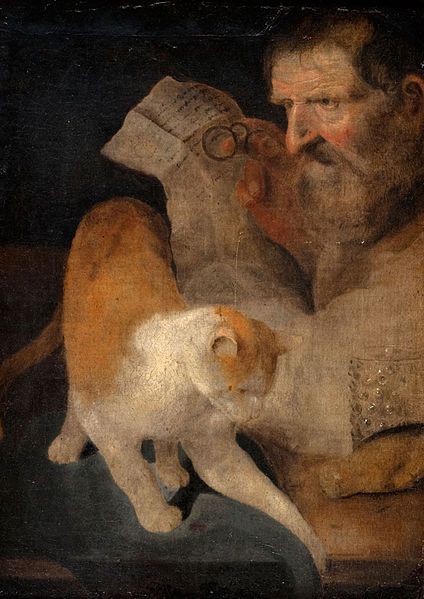
Mann mit Katze. Christoph Paudiss 1618 Private Collection
Last summer, David Norquist, the Deputy Secretary of Defense, announced the formal existence of the Unidentified Aerial Phenomena Task Force. The 2021 Intelligence Authorization Act, signed this past December, stipulated that the government had a hundred and eighty days to gather and analyze data from disparate agencies. Its report is expected in June….
Leslie Kean is a self-possessed woman with a sensible demeanor and a nimbus of curly graying hair. She lives alone in a light-filled corner apartment near the northern extreme of Manhattan, where, on the wall behind her desk, there is a framed black-and-white image that looks like a sonogram of a Frisbee. The photograph was given to her, along with chain-of-custody documentation, by contacts in the Costa Rican government; in her estimation, it is the finest image of a U.F.O. ever made public. The first time I visited, she wore a black blazer over a T-shirt advertising “The Phenomenon,” a documentary from 2020 with strikingly high production values in a genre known for grainy footage of dubious provenance. Kean is
stubborn but unassuming, and she tends to speak of the impact of “the Times story,” and the new cycle of U.F.O. attention it has inaugurated, as if she had not been its principal instigator. She told me, “When the New York Times story came out, there was this sense of ‘This is what the U.F.O. people have wanted forever.’ ”
Kean is always assiduously polite toward the “U.F.O. people,” although she stands apart from the ufological mainstream.
As for today’s news, I think the biggest story in the world right now is the Covid situation in India. Here’s the latest:
CNBC: India’s daily Covid-19 cases pass 400,000 for first time as second wave worsens.
India posted a record daily rise of 401,993 new coronavirus cases on Saturday as the country opened up its massive vaccination drive to all adults, although several states warned of acute shortages.
It was the first time India’s daily case count had topped 400,000 after 10 consecutive days over 300,000. Deaths from Covid-19 jumped by 3,523 over the past 24 hours, taking the total toll in India to 211,853, according to official data.
The world’s biggest producer of Covid-19 vaccines has a limited number of shots available, worsening a grim second wave of infections that has overwhelmed hospitals and morgues while families scramble for scarce medicines and oxygen.
Hundreds of people were seen queuing to be vaccinated across Ahmedabad, the main commercial city in Prime Minister Narendra Modi’s home state of Gujarat, on Saturday.
CNN live updates: The latest on Covid-19 and India’s worsening crisis.
Blaze at an Indian hospital Covid-19 ward kills 18
Eighteen people are dead after a fire broke out at a Covid-19 hospital ward in India’s Gujarat state in the early hours of Saturday.

Lillian Lancaster c. 1887-1973, The Boy and the Cat; Grundy Art Gallery
The fire broke out in the intensive care unit of the Welfare Hospital in the western state’s Bharuch district, according to Dr. MD Modiya, a senior district official.
According to Modiya, 16 of the dead were patients. Two were staff members.
Nearly 60 patients were in the hospital at the time of the fire, which broke out around 1 a.m. local time, he said. The remaining patients have been moved to nearby hospitals.
The cause of the fire is yet to be determined but initial investigations suggest a short circuit, according to Dr Modiya.
In a tweet on Saturday, Gujarat’s chief minister, Vijay Rupani, said two senior officers from the Indian Administrative Service have been dispatched to Bharuch to investigate the fire. The state government will open a judicial inquiry into the fire, he added.
In an earlier post, Rupani offered his condolences to the patients and staff at Welfare Hospital and offered $5,398 in compensation to the families of each of the victims.
Indian Prime Minister Narendra Modi also tweeted his condolences.
“Pained by the loss of lives due to a fire at a hospital in Bharuch,” he said. “Condolences to the bereaved families.”
Vaccine shortage halts rollout across two more Indian states
India’s southern states Telangana and Andhra Pradesh have become the latest to postpone Saturday’s planned national Covid-19 vaccination rollout, citing shortages of shots.
As of Saturday, everyone over the age of 18 is eligible for vaccination in India.
On Friday, Telangana’s Director of Public Health, Dr. G. Srinavasa Rao, tweeted that the state wouldn’t be vaccinating people over the weekend as it hadn’t received doses.
In neighboring Andhra Pradesh, officials have acknowledged that it was not “practically possible” to start vaccinating those over the age 18 due to limited stocks.
“If we need to fulfil the commitment to the former age group batch, it is definitely going to take all of May,” Anil Kumar Singhal, Andhra Pradesh’s Principal Health Secretary, told reporters on Friday.
At least seven states and territories are facing shortages that are impacting the planned vaccine rollout.

Julian Alden Weir – Little Lizzie Lynch (1910)
CBS News: U.S. aid arrives in COVID-battered India as vaccination centers run out of shots and thousands gasp for air.
New Delhi — The first shipment of emergency medical aid supplies from the United States arrived in India on Friday as the country continued battling an explosion of coronavirus cases that has strained its health care system to breaking point. A U.S. military transport plane carrying more than 400 oxygen cylinders, nearly one million rapid coronavirus test kits and other supplies landed in Delhi on Friday morning.
But as mass vaccination centers were forced to close without any doses to stick in arms, and people continued to die without oxygen at jam-packed hospitals, the aid from the U.S. and other countries that’s started to pour in is like a Band-Aid for a severed leg….
“The United States stands with India as we fight the COVID-19 pandemic together,” said the U.S. Embassy in India in a tweet.
India’s External Affairs Ministry thanked the U.S. for the contributions, which were the first step toward fulfilling President Joe Biden’s pledge earlier this week to support India in its “time of need… Just as India sent assistance to the United States as our hospitals were strained early in the pandemic.”
Business Insider via Yahoo News: People in India are being cremated in parking lots, with so much demand that families have to take tickets and wait.
Victims of India’s devastating COVID-19 surge are being cremated in parking lots, with one crematorium so overwhelmed that it has launched a ticketing system.
In the past two weeks, the number of new daily COVID-19 cases in India has repeatedly broken global records, with the country recording thousands of new deaths every day.
The staff at the Seemapuri crematorium in New Delhi recently erected several extra burning platforms in the parking lot to keep up with the staggering demand, CNN reported.
Cremation is the standard death rite in Hinduism, India’s dominant religion, and crematoriums are under intense pressure.
“Before the pandemic, we used to cremate eight to 10 people” a day, Jitender Singh Shunty, the head of the Seemapuri crematorium, told CNN. “Now, we are cremating 100 to 120 a day.”

Man with Cat, Candace Hunt
Madhukar Pai and Manu Prakash at The Washington Post: Opinion: India’s covid-19 crisis is a dire warning for all countries.
The covid-19 crisis in India is a massive setback for the entire world. The scale of the nation’s surge is a warning not only for its neighboring countries, which are also experiencing sharp increases in cases, but also for countries around the globe. If we do not heed this warning and work on vaccine equity, we risk a forever pandemic with long-term cycles of lockdowns, economic damage and constant fear.
India is reporting more than 380,000 cases and 3,500 deaths daily. Both are underestimates. The Indian health-care system is completely overwhelmed. It is impossible to find hospital beds. Supplies such as oxygen are incredibly scarce, and there is a huge backlog with diagnostic testing. Many people with sick family members and friends in India — including us — are checking in on them. This time around, younger people are sick and, as is always the case, the poor are hit the hardest.
India has 95,000 intensive care beds and 48,000 ventilators. By mid-May, it is projected that the country will need 340,000 beds and more than 700,000 ventilators. Rural India has few of these and is already hit hard. India needs the global community’s support to survive this crisis.
The devastating second wave in India is the result of a perfect storm: a failure to plan for a second wave; premature relaxation of public health measures; large gatherings; insufficient vaccination coverage; and newer variants such as B.1.1.7 and B.1.617 that are highly transmissible and potentially more severe.\India has 95,000 intensive care beds and 48,000 ventilators. By mid-May, it is projected that the country will need 340,000 beds and more than 700,000 ventilators. Rural India has few of these and is already hit hard. India needs the global community’s support to survive this crisis.\Even as India struggles to get the second wave under control, cases are surging among India’s neighbors, including Nepal, Pakistan, Bangladesh and Sri Lanka. While the exact variant driving the new surges among India’s neighbors is unclear, the B.1.617 variant has already spread to more than 18 countries….
 India has 95,000 intensive care beds and 48,000 ventilators. By mid-May, it is projected that the country will need 340,000 beds and more than 700,000 ventilators. Rural India has few of these and is already hit hard. India needs the global community’s support to survive this crisis.
Even as India struggles to get the second wave under control, cases are surging among India’s neighbors, including Nepal, Pakistan, Bangladesh and Sri Lanka. While the exact variant driving the new surges among India’s neighbors is unclear, the B.1.617 variant has already spread to more than 18 countries.
Other countries in South Asia have far less resources and medical infrastructure compared with India. Nepal, for example, has 1,486 ICU beds and 634 ventilators , and Nepal’s health ministry is anticipating a need to treat 15,000 ICU patients by July. Bangladesh, home to 163 million people, has only 1,134 covid-19 ICU beds. Pakistan, the fifth-largest country in the world, has fewer than 4,000 ventilators. India’s neighbors can ill afford the kind of devastation India is experiencing.
Read the rest at the WaPo.
I’m running out of space, but I’ll end with some links to the latest on the huge–but fun for us–Rudy Giuliani story:
CNN: Trump allies worry Giuliani raid sent ‘strong message’ to ex-President’s inner circle.
Forensic News: Giuliani Probe Expands, Ukrainian Ally Under Criminal Investigation.
The Washington Post: Giuliani’s claims about Hunter Biden and the FBI get more confusing.
Vanity Fair: Michael Cohen: Rudy Giuliani Will “Absolutely” Rat Out Ivanka, Don Jr., and Trump to Save Himself.
Molly Jong-Fast at The Daily Beast: The Giulianis’ Two-Man Clown Car Is Crashing and Burning.
NBC New York.com: Giuliani Search Warrant Resolved Justice Department Dispute.
Have a great weekend, Sky Dancers!!
Did you like this post? Please share it with your friends:
Posted: April 10, 2021 | Author: bostonboomer | Filed under: morning reads, U.S. Politics | Tags: Alligators, Boston Public Garden, CDC, coronavirus pandemic, Covid-19 vaccines, Donald Trump, Fox News, Matt Gaetz, Racism, Tucker Carlson, U.S. Marines, White supremacists |

Jean Metzinger, French, 1883-1956
Good Morning!!
Before I get to today’s news, here’s a little comic relief. This was in yesterday’s Boston Globe, but I can’t get past their rigid paywall. But I found the story at The Pest Control Daily: Boston Public Backyard used to have child alligators — sure, alligators — and other people fed them rodents. The “public backyard” is the Boston Public Garden, adjacent to the Boston Common. I had heard about cows grazing on the Common, but not about alligators in the Public Garden.

There are several newspaper articles from this period referring to the alligators who lived in a basin – or pond – near the entrance to Arlington Street amid a “magnificent” row of lilies. Reports vary, but for some time there were between three and four alligators on the site, strikingly complementing the many other exotic features of the public garden at the time.
A story in the September 19, 1901 issue of the Boston Post said three of the city’s alligators were given by “a Charlestown woman” who “became afraid of them and introduced them to the city of Boston.” The fourth alligator was given to the city by a man from Chelsea, though it’s just unclear why.
An article that appeared in an August 9, 1901 issue of the Boston Globe said the alligators – known as babies – belonged to William Doogue, the city’s superintendent for common and public reasons.
 Doogue oversaw the public garden from 1878 to 1906, according to Friends of the Public Garden, a nonprofit advocating Boston Common, the public garden, and the nearby Commonwealth Avenue Mall and known for its exceptional green thumb….
The alligators have certainly rubbed some city dwellers the wrong way. But it wasn’t so much their presence that was annoying – people often huddled around the pool looking for them – it was how they were sometimes fed.
“Some objections to feeding live rats and mice to those in the public garden pond,” read the headline of the August Globe article.
The newspaper reported that in “warm weather” the alligators were put in the public garden and fed by park officials once a week….
“Live rats exposed to hungry alligators,” read a headline in the Boston Post on August 9, 1901. “The public garden exhibit attracts morbid interest from women and children.”
The article says, “The city doesn’t feed them in the summer … the city doesn’t have to” because “the alligators make their own living by entertaining the public”.
The story included an illustration of primitively dressed people gathered around a small pond-like structure and watched a man kneel to feed the alligators with the animals’ mouths wide open.
Apparently this was seen as a low-life activity. There is much more detail at the link about the feeding of the alligators. Apparently they were moved to the Franklin Park Zoo during the colder months, and their presence in the Boston Garden lasted for about 6 years.
White Supremacist News
Remember those neo-Nazi marchers in Charlottesville chanting “Jews will not replace us?” Fox News’ Tucker Carlson was trending on Twitter all day yesterday after he parroted a white supremacist conspiracy theory that liberals are trying to replace white people with immigrants.

Fortunato Depero, Elasticità di gatti (1936–1939)
Media Matters: Tucker Carlson, the face of Fox News, just gave his full endorsement to the white nationalist conspiracy theory that has motivated mass shootings.
For decades, white nationalists have invoked the specter of nonwhite immigration, multiculturalism, and declining birthrates to argue for the existence of a vast conspiracy aimed at eliminating white populations as a dominant demographic. On Fox News, Tucker Carlson is distributing the language, grievances, goals, and inherent call to action of the conspiracy theory to massive audiences.
On the April 8 broadcast of Fox News Primetime, Carlson offered perhaps his most explicit justification yet for the core belief of the “great replacement” conspiracy theory: that a wave of “Third World” invaders is coming to replace you and reshape your environment, and that you, the audience, should do something about it.
The Fox News host claimed that “what’s true” is that “the Democratic Party is trying to replace the current electorate, the voters now casting ballots, with new people, more obedient voters from the Third World,” and no one should “sit back and take that.”
More from Media Matters: White nationalists praise Tucker Carlson’s full embrace of their “replacement” conspiracy theory.
After the Anti-Defamation League called on Fox News to fire Carlson for his remarks, white supremacist and far-right personalities were quick to make their approval known.
White supremacist and Holocaust denier Nick Fuentes explained what Carlson actually meant in his statements, lamenting that Carlson wasn’t more direct and theorizing that he probably had to dial it back in order to avoid consequences at Fox….
Other racist and extreme far-right media personalities and social media accounts also backed Carlson, celebrating him for broadcasting “what nationalists have been talking about for decades” and defending him against criticism.
Matt Gaetz Updates
The Washington Post: House opens ethics investigation into Florida Republican Matt Gaetz.
The House Ethics Committee announced Friday it would investigate claims that Rep. Matt Gaetz engaged in sexual misconduct and illicit drug use and showed images of naked women on the House floor, opening a new front in the growing scandal enveloping the Florida Republican.

Jean Metzinger, Still Life with Cat and Fish, 1950
Gaetz responded hours later with a defiant speech before a welcoming crowd at former president Donald Trump’s Miami-area hotel and golf club, dismissing the claims against him as an attempt by the political establishment to silence his political views.
“Let me assure you, I have not yet begun to fight for the country I love, and for the nation that I know benefits from America First principles,” he said to cheers at an event sponsored by Women for America First, a group that sponsored the rally at the White House Ellipse before the Jan. 6 riot at the Capitol. “I’m built for the battle, and I’m not going anywhere. The smears against me range from distortions of my personal life to wild — and I mean wild — conspiracy theories.”
The news of the investigation came a day after Gaetz’s friend, Joel Greenberg, who has been charged with sex trafficking of a minor among other offenses, signaled to a federal judge through his lawyer that he was negotiating a plea deal with prosecutors that could help them in an ongoing probe into whether Gaetz paid for sex or trafficked a woman across state lines for sex.
Click the link for more details.
Fred Grimm at the South Florida Sun-Sentinel: Scandal leaves Florida’s congressional provocateur with few friends.
His fellow congressional Republicans have risen as one to defend Matt Gaetz.
Oh, sorry. My bad. Make that two.
Jim Jordan of Ohio — Abbott to Gaetz’s Costello in their Capitol Hill clown act — came through for Matt. Sort of. After Gaetz denied allegations that he had been galivanting with escorts and even a 17-year-old girl, with allusions to orgies and illicit drug use, Jordan managed a four-word tweet: “I believe Matt Gaetz.” Which seemed an understated reaction from the likes of Jordan, whose usual outbursts have been unfettered by propriety, truth or the national interest.
You’d think the pugnacious Jim Jordan, of all people, would have come up with a more defiant defense of his fellow provocateur. But no.
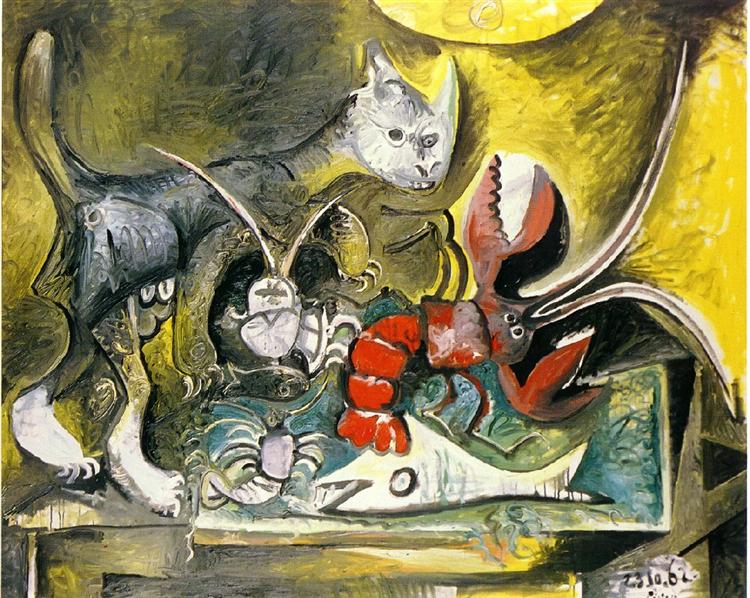
Still life with cat and lobster, Pablo Picasso
Which left Marjorie Taylor Greene from Planet QAnon as his defender-in-chief. “Take it from me rumors and headlines don’t equal truth. I stand with @mattgaetz,” tweeted the Georgia congresswoman, a propagator of astounding untruths, slanders and conspiracy theories. Not sure that character references from the woman who suggested California wildfires had been ignited by Jewish space lasers can rehabilitate Gaetz’s mucky reputation.
Support was also slow coming from Mar-a-Lago, although Gaetz had been Donald Trump’s most outlandish congressional defender through two impeachments and an insurrection. Yet, the ex-president kept quiet in the week after The New York Times reported that the FBI has widened an investigation of former Seminole County Tax Collector Joel Greenberg — who faces a slew of federal charges — to include his former best buddy and fellow philanderer. The Times said the FBI is looking into allegations that Greenberg and Gaetz arranged sexual trysts with paid escorts, including a 17-year girl. (Which Gaetz denies.)
It wasn’t until reports surfaced that, during Trump’s final days in office, Gaetz had sought a preemptive pardon for any federal charges that might come his way, that the ex-president finally said something. Not much, but something. His office issued a carefully worded, unTrumpian statement: “Congressman Matt Gaetz has never asked me for a pardon,” adding, like an afterthought, “It must also be remembered that he has totally denied the accusations against him.”
I just can’t get enough of Gaetzgate.
Coronavirus News
The Washington Post: Trump officials celebrated efforts to change CDC reports on coronavirus, emails show.
Trump appointees in the Department of Health and Human Services last year privately touted their efforts to block or alter scientists’ reports on the coronavirus to more closely align with President Donald Trump’s more optimistic messages about the outbreak, according to newly released documents from congressional investigators.

Still life with grey cat, Jean Metzinger
The documents provide further insight into how senior Trump officials approached last year’s explosion of coronavirus cases in the United States. Even as career government scientists worked to combat the virus, a cadre of Trump appointees was attempting to blunt the scientists’ messages, edit their findings and equip the president with an alternate set of talking points.
Science adviser Paul Alexander wrote to HHS public affairs chief Michael Caputo on Sept. 9, touting two examples of where he said officials at the Centers for Disease Control and Prevention had bowed to his pressure and changed language in their reports, according to an email obtained by the House’s select subcommittee on the coronavirus outbreak.
Pointing to one change — in which CDC leaders allegedly changed the opening sentence of a report about the spread of the virus among younger people after Alexander pressured them — Alexander wrote to Caputo, calling it a “small victory but a victory nonetheless and yippee!!!”
In the same email, Alexander touted another example of a change to a weekly report from the CDC that he said the agency made in response to his demands. The Morbidity and Mortality Weekly Reports, or MMWRs, which offer public updates on scientists’ findings, had been considered sacrosanct for decades and untouchable by political appointees in the past.
Two days later, Alexander appealed to White House adviser Scott Atlas to help him dispute an upcoming CDC report on coronavirus-related deaths among young Americans.
“Can you help me craft an op-ed,” Alexander wrote to Atlas on Sept. 11, alleging the CDC report was “timed for the election” and an attempt to keep schools closed even as Trump pushed to reopen them.
Did you like this post? Please share it with your friends:
Posted: March 13, 2021 | Author: bostonboomer | Filed under: morning reads, U.S. Politics | Tags: abuse of power, Andrew Cuomo, Donald Trump, Fox News, Joe Biden, Peter Alexancer, presidential press conferences, Rebecca Traister, Sexual harassment, stimulus checks, TD bank, vaccine rollout |

Franz Marc, Cat with Kittens
Good Morning!!
Everyone wants to know when they will be getting their $1400 stimulus check. Some people were posting on Twitter last night that they had already gotten their direct deposit. People are also saying on Twitter that TD Bank, Wells Fargo, and Bank of America are holding the deposits until Wednesday. WTF? My bank is TD Bank.
https://twitter.com/whattheautumnn/status/1370492187209764864?s=20
So I guess I can stop checking my bank balance for the time being. They have the deposits, but they are going to collect a few days’ interest before they let us have our money.
On Monday, we should be able to track our payments on-line. Forbes:
The Internal Revenue Service (IRS) could start sending stimulus checks as early as this weekend. If you got a first stimulus check or second stimulus check, you know how important it is to check the status of your stimulus payment. You can check the status of your third stimulus check using the Get My Payment Tool, which is available on the IRS website.
Beginning Monday, March 15, 2021, it is expected that you can use the Get My Payment Tool to check the status of the American Rescue Plan stimulus payments, also known as an Economic Impact Payment. The IRS website says that the IRS is reviewing the tax provisions of the American Rescue Plan Act of 2021, which President Joe Biden signed into law on March 11, 2021.
In other news, the Washington DC media is working very hard to find ways to criticize Joe Biden. They have all been harping on why Biden hasn’t yet held a press conference. The Washington Post: After 50 days as president, Biden still hasn’t given a news conference. Critics and allies wonder why.
Ronald Reagan and Bill Clinton both did their first one after just nine days in office.
Barack Obama waited 20 days.

The Checkered Blouse, Pierre Bonnard, 1892
And Donald Trump had been president for only a week before giving his first news conference, where he fielded questions alongside then-British Prime Minister Theresa May.
But Joe Biden still hasn’t had a formal news conference since his inauguration on Jan. 20. Thursday was his 50th full day in office.
The seven-week stretch is the longest a new president has gone without meeting the press in the past 100 years, dating back to when Calvin Coolidge, a man known as “Silent Cal,” was president, according to research by the American Presidency Project at the University of California at Santa Barbara.
Biden delivered his first prime-time address to the nation Thursday night — but it appears the nation will wait longer to see him respond to questions at his first presidential news conference. He has often taken a question or two from reporters at the end of speeches or statements, as he did Wednesday after remarks about an increase in the coronavirus vaccine supply. But his record as president so far mirrors his behavior as a candidate, when Biden gave several interviews but rarely interacted with a roomful of reporters.
His reluctance to do so since becoming president has attracted comment and criticism from allies and foes alike.
Of course he’s been kind of busy rolling out vaccines and helping pass a huge stimulus bill. In addition his press secretary has been holding daily briefings. But the press has to find something to complain about.
The latest thing is the media asking why Biden isn’t giving Trump credit for the millions of vaccines have have now been distributed.
And it’s not just Fox News either. Here’s The New York Times: Biden Got the Vaccine Rollout Humming, With Trump’s Help.
When President Biden pledged last week to amass enough vaccine by late May to inoculate every adult in the United States, the pronouncement was greeted as a triumphant acceleration of a vaccination campaign that seemed to be faltering only weeks earlier.
And it is true that production of two of the three federally authorized vaccines has sped up in part because of the demands and directives of the new president’s coronavirus team.
But the announcement was also a triumph of another kind: public relations. Because Mr. Biden had tamped down expectations early, the quicker timetable for vaccine production conjured an image of a White House running on all cylinders and leaving its predecessor’s effort in the dust.
“On Saturday, we hit a record of 2.9 million vaccinations in one day in America, and beyond the numbers are the stories,” Mr. Biden said on Wednesday at a White House event to celebrate the latest vaccine advancements. “A father who says he no longer fears for his daughter when she leaves to go to work at the hospital. The children are now able to hug their grandparents. The vaccines bring hope and healing in so many ways.”
Beyond the triumphant tone, a closer look at the ramp-up offers a more mixed picture, one in which the new administration expanded and bulked up a vaccine production effort whose key elements were in place when Mr. Biden took over for President Donald J. Trump. Both administrations deserve credit, although neither wants to grant much to the other.
NBC News got in on it too. Mediaite: WATCH: NBC News’ Peter Alexander Literally Wrote a Statement for Biden to Credit Trump on Vaccines, Read it Aloud at Briefing.
NBC News White House correspondent Peter Alexander took the initiative to compose a statement that President Joe Biden could use in order to give former President Donald Trump some credit for the success of the vaccination program that’s currently underway.
Several news outlets, including ABC News and The New York Times, criticized President Biden’s address to the nation on the anniversary of the Covid pandemic shutdown for failing to credit Trump.

Theodore Duret in His Study, Edouard Vuillard, 1912
At Friday’s White House daily briefing, Alexander asked Press Secretary Jen Psaki about that aspect of the speech, and went a step further by reading his own version of what Biden could have said to credit Trump.
Alexander said that Biden “spent a lot of time touting the success of vaccines, yet there was no mention of the president under whose administration these vaccines were developed,” and asked, “Does former President Trump not deserve any credit on vaccines?”
Psaki noted that the President and his team have praised the development of vaccines as “a Herculean incredible effort by science and by medical experts. And certainly, we have applauded that in the past, and we are happy to applaud that again.”
“But, I would say there is a clear difference, clear steps that have been taken since the president took office, that have put us on a trajectory that we were not on when he was inaugurated,” she added. “And leadership starts at the top, it includes mask-wearing, it includes acknowledging it is a pandemic, it includes getting a vaccine in public.”
Psaki went on to say that most of the infrastructure to vaccinate people was not in place when Biden took office.
Alexander conceded some of Psaki’s points, and said: “But on the development of the vaccines, it was Operation Warp Speed that was invented, executed, initiated under the former president.”
“So in the spirit of bipartisanship and unity last night, as opposed to the first comments which were about the denials in the first days weeks or months, why not just say, ‘With credit to the previous administration and the former president for putting us in this position, we are glad that we have been able to move it forward?’” Alexander asked.
“That is an excellent recommendation as a speechwriter,” Psaki said with a smile, then restated much of her previous answer, and told Alexander the purpose of the speech, as she saw it.
It’s looking worse for Andrew Cuomo as more women come forward and more people talk about his bullying and incompetence. Definitely check out Rebecca Traister’s long article at New York Magazine’s The Cut.
Traister also gave an interview to Audie Cornish at NPR: Gov. Cuomo’s Pattern Of Abuse Of Power.
CORNISH: Let’s just start with some of the common threads. What did you hear from some of these women?
TRAISTER: Well, I spoke to women and men, and I heard of a variety of ways in which Andrew Cuomo wields his power and in many cases, I think, abuses it both within the office, how he treats personnel and employees, and in terms of how he governs.
In terms of what I heard from some of the women who have worked for him, there were all kinds of common patterns – the feeling of being objectified, in some cases being hired because of how they looked. There is a woman who tells the story of meeting him at a party for two minutes and then getting invited in for a job offer two days later for no other reason she says she understood at the time except that he liked the way she looked at the party, a meeting where he also sort of grabbed her uncomfortably and did a dance move in front of a photographer.

Marc Chagall, The cat transformed into a woman,
There was a lot of women talking about how he touched them uncomfortably – again, not necessarily the kind of groping that he has reportedly been accused of by one woman in Albany in an incident that’s been reported to police, but touching them at weddings, kissing them on their heads. And then one thing is…
CORNISH: And you stress this a couple of times. You talk about the idea of diminishment, tokenization, and that sometimes that takes a sexualized form but doesn’t always.
TRAISTER: Yes, some of it is objectification. A lot of women talked about his constant commentary on how they were dressed, how they looked, whether they’d done their makeup that morning, questions about their dating life, use of nicknames or – not just from Cuomo but from some of his high-up staffers – a refusal to sort of learn their real names or refer to them by names. It’s all various forms of making other people feel small, in part to emphasize his own power and maintain these hierarchies within his administration.
CORNISH: Another thing you noted is that there was a sense that there was no information-sharing, that it allowed the governor’s office to evade responsibility on some things. Can you talk about how and why you see a link between this – the allegations we’re hearing now and the problems that Cuomo is having when it comes to the deaths at nursing homes, for example?
TRAISTER: Well, I think so much of it is about his approach to power and how he wields it. He’s often been written about for years as somebody with a hard-knuckled style of politics, which sort of refers to this kind of old white male brute patriarchy in which toughness is read as strength, you know, in which – and in some cases abuse, I think, is read as strength. But what’s common there is this sense of impunity, and I think you can see that – that he’s so powerful that he can get away with things.
Read more or listen at the link. A couple more new articles:
The New York Times: For Some Women, Working for Cuomo Is the ‘Worst Place to Be’
In interviews over the past week, more than 35 people who have worked in Mr. Cuomo’s executive chamber described the office as deeply chaotic, unprofessional and toxic, especially for young women.
It is a workplace, the current and former employees said, where tasks are assigned not based on job titles, but on who is liked by Mr. Cuomo and his top aides.

Cat with Cactus Flower’, 1921, Dorothea Maetzel-Johannsen
Those interviewed described an environment where the senior executive staff regularly deride junior workers, test their dedication to the governor and make them compete to earn his affection and avoid his wrath.
The workers, for the most part, said they did not personally witness overt sexual harassment. But many said they believed that Mr. Cuomo and other officials seemed to focus on how employees looked and how they dressed. Twelve young women said they felt pressured to wear makeup, dresses and heels, because, it was rumored, that was what the governor liked.
One high-ranking current official and two former aides said they believed they had been denied opportunities because they did not dress in the preferred manner.
The workplace culture described by the employees is not uncommon in Albany, a state capital with a long history of sexual misconduct scandals and a reputation for after-hours mingling among lobbyists, elected officials and their aides at bars and fund-raisers. But the issues are notable for a governor who has cast himself as a champion for workers and women.
Michael Shnayerson at Vanity Fair: “I Started to Think, This is a Bad Guy”: Andrew Cuomo’s Biographer on the Governor’s Brutish History.
In 2012, I began writing an unauthorized biography of the governor of New York, who’d been in office a year. I talked to his associates and enemies. I gathered a dossier on his bullying ways and confrontational tactics. I pored over court documents surrounding his nasty split, a decade before, from his wife, Kerry Kennedy, a member of another powerful Democratic dynasty. As I plunged into writing, I hoped he might even agree to sit for an interview—and he did agree, sort of.
By the time I was about to hand in my manuscript, the governor had a book of his own in the works. It was titled All Things Possible. And his intention was to beat me to market. But I was ahead. Back came word that if I would let his book appear first, he would grant me all the interview time I wanted. So I agreed. But the governor pulled a fast one. I never did get that interview; his book came out in October 2014, a full five months ahead of mine. And there was, after all, no longer anything he needed from me. It was a quintessential Cuomo move: underhanded, stealthy, self-serving, and hard-ass.
This week I decided to dip back into the pages of my 2015 Cuomo biography, The Contender—and to do some additional reporting, given the news swirling around the governor. And I discovered that much of Cuomo’s M.O. and many of his character flaws—some of which have resurfaced as he’s been upended by the nursing home scandal and claims of sexual harassment, workplace misconduct, and predatory behavior (currently under investigation by New York’s attorney general, Letitia James, and prompting an impeachment investigation by state legislators)—have been evident for years.
Here, then, are 12 hard truths I learned about Andrew Cuomo while writing The Contender.
Read the rest at Vanity Fair.
Those are my suggested reads for today. What’s on your mind?
Did you like this post? Please share it with your friends:


 Public health experts remain cautious, but said that while they still expect significant local and regional surges in the coming weeks, they do not think they will be as widespread or reach past peaks.



 peej
peej Carissa
 bostonboomer
 dakinikat
 ecocatwoman
 jjlo
jjlo mablue2
 Mama Lopez
 peggysue22
 quixote
 skydancingguestblogger
 Mona (aka Wonk the Vote)





Recent Comments