
Tuesday Reads
Posted: February 15, 2022 Filed under: morning reads | Tags: Canada, Christina Yuna Lee, Donald Trump, Hillary Clinton, John Durham, Justin Trudeau, Marcy Wheeler, Mazars, Michael A. Sussmann, NATO, NYC Chinatown murder, Rodney Joffe, Trucker convoy, Trump Organization, Ukraine, Vladimir Putin 21 CommentsGood Morning!!

Francine van Hove, Plasirs du Matin, “Morning Pleasures,” French, 1942
There may be some movement in the Ukraine crisis. The AP reported this morning that some Russian troops are being pulled back and returned to their bases. Later the story was updated to report that Putin wants to negotiate: Putin: Russia ready to discuss confidence-building measures.
Russian President Vladimir Putin said Tuesday that Moscow is ready for talks with the U.S. and NATO on limits for missile deployments and military transparency.
Speaking after talks with German Chancellor Olaf Scholz, Putin said the U.S. and NATO rejected Moscow’s demand to keep Ukraine and other ex-Soviet nations out of NATO, halt weapons deployments near Russian borders and roll back alliance forces from Eastern Europe.
They agreed to discuss a range of security measures that Russia had previously proposed.
Putin said that Russia is ready to engage in talks on limits on the deployment of intermediate range missiles in Europe, transparency of drills and other confidence-building measures but emphasized the need for the West to heed Russia’s main demands.
The statement followed the Russian Defense Ministry’s announced a partial pullback of troops after military drills, adding to hopes that the Kremlin may not be planning to invade Ukraine imminently. The Russian military gave no details on where the troops were pulling back from, or how many.
From The Washington Post: Russia says some troops withdrawing from Ukraine’s border; NATO chief notes ‘cautious optimism’ but sees no de-escalation yet.

I’m sure you’ve heard about the legal filing by John Durham, the special counsel appointed by Bill Barr to investigate the Russia investigation, that implied some kind of sinister activity by the Clinton campaign in 2016. The right wing media has been going nuts over this, but it’s basically meaningless. Charlie Savage explains at The New York Times: Court Filing Started a Furor in Right-Wing Outlets, but Their Narrative Is Off Track.
When John H. Durham, the Trump-era special counsel investigating the inquiry into Russia’s 2016 election interference, filed a pretrial motion on Friday night, he slipped in a few extra sentences that set off a furor among right-wing outlets about purported spying on former President Donald J. Trump.
But the entire narrative appeared to be mostly wrong or old news — the latest example of the challenge created by a barrage of similar conspiracy theories from Mr. Trump and his allies.
Upon close inspection, these narratives are often based on a misleading presentation of the facts or outright misinformation. They also tend to involve dense and obscure issues, so dissecting them requires asking readers to expend significant mental energy and time — raising the question of whether news outlets should even cover such claims. Yet Trump allies portray the news media as engaged in a cover-up if they don’t.
The latest example began with the motion Mr. Durham filed in a case he has brought against Michael A. Sussmann, a cybersecurity lawyer with links to the Democratic Party. The prosecutor has accused Mr. Sussmann of lying during a September 2016 meeting with an F.B.I. official about Mr. Trump’s possible links to Russia.
The filing was ostensibly about potential conflicts of interest. But it also recounted a meeting at which Mr. Sussmann had presented other suspicions to the government. In February 2017, Mr. Sussmann told the C.I.A. about odd internet data suggesting that someone using a Russian-made smartphone may have been connecting to networks at Trump Tower and the White House, among other places.
Mr. Sussmann had obtained that information from a client, a technology executive named Rodney Joffe. Another paragraph in the court filing said that Mr. Joffe’s company, Neustar, had helped maintain internet-related servers for the White House, and that he and his associates “exploited this arrangement” by mining certain records to gather derogatory information about Mr. Trump.

Mary Cassatt, Breakfast in Bed, 1897
The right wingers are thrilled by this story, but it’s complete bullshit.
The conservative media also skewed what the filing said. For example, Mr. Durham’s filing never used the word “infiltrate.” And it never claimed that Mr. Joffe’s company was being paid by the Clinton campaign.
Most important, contrary to the reporting, the filing never said the White House data that came under scrutiny was from the Trump era. According to lawyers for David Dagon, a Georgia Institute of Technology data scientist who helped develop the Yota analysis, the data — so-called DNS logs, which are records of when computers or smartphones have prepared to communicate with servers over the internet — came from Barack Obama’s presidency.
“What Trump and some news outlets are saying is wrong,” said Jody Westby and Mark Rasch, both lawyers for Mr. Dagon. “The cybersecurity researchers were investigating malware in the White House, not spying on the Trump campaign, and to our knowledge all of the data they used was nonprivate DNS data from before Trump took office.”
In a statement, a spokesperson for Mr. Joffe said that “contrary to the allegations in this recent filing,” he was apolitical, did not work for any political party, and had lawful access under a contract to work with others to analyze DNS data — including from the White House — for the purpose of hunting for security breaches or threats.
Marcy Wheeler has been covering this story since the beginning. You can read what she has to say in these posts at her Emptywheel blog:
John Durham, Ask Not For Whom The Statute of Limitation Tolls…
John Durham Chose To Meet With John Ratcliffe Rather Than Witnesses Necessary To His Investigation.
This is a horrific story about a possible hate crime from The New York Times: Screams That ‘Went Quiet’: Prosecutors’ Account of Chinatown Killing.
Police officers who responded to a 911 call about a disturbance in a Lower Manhattan building on Sunday heard a woman screaming when they reached the sixth floor, but the door to the apartment where the screams had come from was locked.
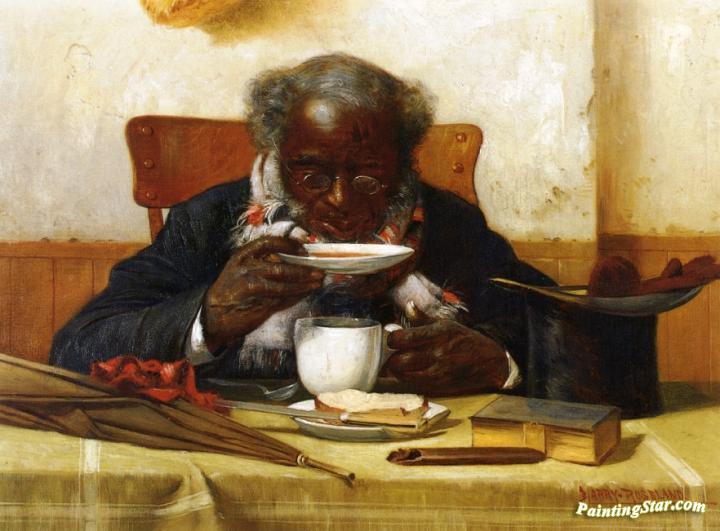
Morning Coffee, by Harry Roseland
As police struggled with the door, at first they still heard her calls for help, but “then she went quiet,” a prosecutor, Dafna Yoran, said in a Manhattan Criminal Court hearing on Monday night. Another voice emerged, sounding like a woman and telling them, “‘We don’t need the police here — go away.’”
When a specialized police unit arrived and broke down the door, they found Christina Yuna Lee, 35, dead in her bathtub with more than 40 stab wounds. The second voice, Ms. Yoran said, was actually that of Assamad Nash, who had followed the victim into the building on Chrystie Street in Chinatown, forced his way into her home and stabbed her.
When officers broke into the apartment, the police found Mr. Nash hiding under a bed and the knife believed to be the murder weapon hidden behind a dresser, prosecutors said.
It’s not yet clear why Ms. Lee was targeted, but the Asian community in New York is terrified.
Mr. Nash, 25, whose last known address was a men’s homeless shelter in the Bowery, was arraigned on first-degree charges of murder, burglary and sexually motivated burglary. A judge ordered him held without bail, and prosecutors said he was facing a sentence of up to 25 years to life in prison if convicted.
Though the authorities have not determined that Ms. Lee was targeted because of her ethnicity, her killing stoked fears in the city’s Asian community, which was already on edge after a rise in attacks during the pandemic.
Her killing also fit a pattern that has become an unsettlingly common feature of the pandemic in New York City: a seemingly unprovoked attack in which the person charged is a homeless man. In many neighborhoods in Manhattan, residents have expressed growing concern about homeless people, some of whom seem to be struggling with mental illness, menacing and harassing passers-by.
Ms. Lee, who graduated from Rutgers University in 2008 with a bachelor’s degree in art history, worked as a creative producer for Splice, an online music platform based in New York City. The company said in a statement that it was heartbroken over her “senseless” death.
Read the rest at the NYT.
One more story on the trucker blockade story from The Washington Post: ‘Freedom Convoy,’ police face off near U.S.-Canada border crossings as Trudeau invokes Emergencies Act.

There’s a lot happening in the news today. What stories have you been following?
Lazy Caturday Reads
Posted: February 12, 2022 Filed under: morning reads | Tags: Donald Trump, Fox News, Joe Biden, National Archives, Russia, Trucker protests, Ukraine, Vladimir Putin 20 CommentsGood Morning!!

Black cat sleeping by Harry Boardman
The news today is mostly focused on the situation in Ukraine. Here are the latest developments:
The Washington Post: U.S. orders most embassy staffers in Kyiv to leave Ukraine amid fears Russia will invade soon.




I’ll end with this story at CNN that provides details on the ongoing efforts of the National Archives to retrieve government documents that Trump took with him when he left the White House: Archives threatened to go to Congress and Justice Department to get Trump to turn over records.
Worried that a trove of White House records that had been brought to Donald Trump’s Mar-a-Lago estate contained classified material, a top official in the former President’s orbit warned his aides last fall: Do not touch those boxes.
Spotted Cat, woodcut by Seiho Takeuchi
The senior official in Trump’s inner circle did not want to risk exposing sensitive materials to aides who may have lacked the appropriate security clearances, according to a person familiar with the matter. The boxes, which were being stored at the time in Trump’s personal suite at his Florida club, had landed on the National Archives and Records Administration’s radar after officials there noticed that several items were missing from their catalog of Trump White House records.
In May 2021, the realization that important items from Trump’s time in office — including some of his correspondence with North Korean dictator Kim Jong Un and infamous Sharpie-altered map of Hurricane Dorian — were not transferred to the Archives at the end of his presidency prompted NARA officials to contact Trump’s team.
Longtime Archives lawyer Gary Stern first reached out to a person from the White House counsel’s office who had been designated as the President Records Act point of contact about the record-keeping issue, hoping to locate the missing items and initiate their swift transfer back to NARA, said multiple sources familiar with the matter. The person had served as one of Trump’s impeachment defense attorneys months earlier and, as deputy counsel, was among the White House officials typically involved in ensuring records were properly preserved during the transfer of power and Trump’s departure from office.

Trump claimed that he returned the materials “easily and without conflict and on a very friendly basis,” but of course that was a lie. The Archives have been battling with Trump over the documents since last spring and he likely still has more materials that he hasn’t turned over.
One source familiar with the situation says the document turnover has “not been fully resolved” and says Trump is still in possession of documents the Archives wants. The Archives hinted at this in a statement earlier this week.
“Former President Trump’s representatives have informed NARA that they are continuing to search for additional Presidential records that belong to the National Archives,” the Archives said in a statement.
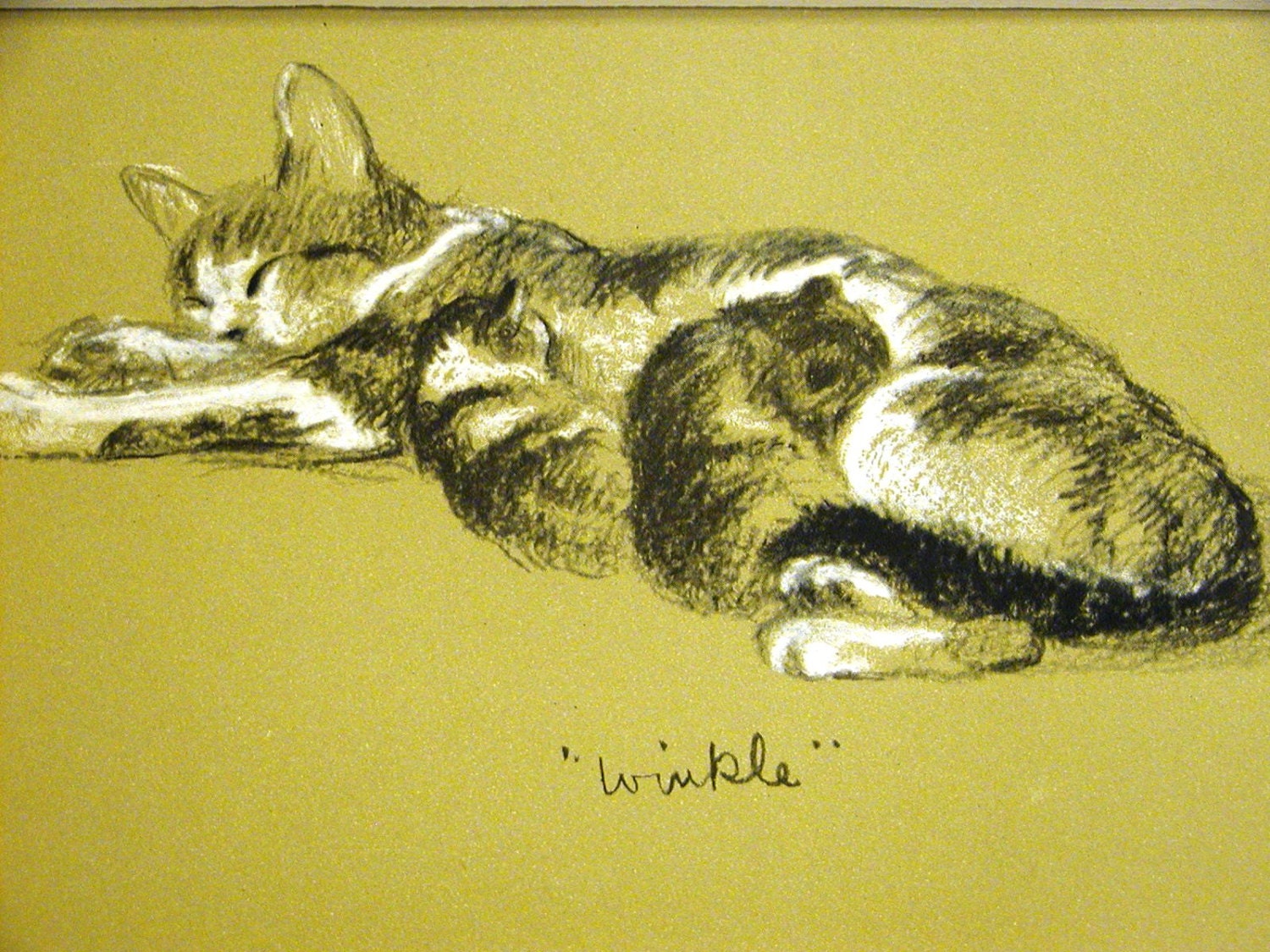
Mother cat sleeping with her two kittens, Lucy Dawson drawing, 1946
In a series of interviews with CNN, a half-dozen people familiar with the matter described a tense situation that took nearly eight months to resolve — beginning with NARA’s outreach in May and ending with its retrieval of the boxes from Mar-a-Lago last month.
In the end, it may have been a threat that ended the impasse. At one point, the Archives notified a member of Trump’s team that it planned to alert Congress and the Department of Justice of the matter if it wasn’t quickly resolved, according to a person familiar with the warning. According to a person familiar with the matter, the Archives have since asked the Justice Department to investigate. It is unclear whether the Justice Department has started an investigation.
The House Oversight Committee chairwoman, Democratic Rep. Carolyn Maloney of New York, has also vowed to initiate a probe of the records’ removal from Trump’s Palm Beach resort, which she called “deeply troubling” in a statement on Monday.
What are your thoughts on all this? What other stories are you following?
Insane Thursday Reads, with Bunnies
Posted: February 10, 2022 Filed under: morning reads | Tags: Christian nationalists, classified documents, Department of Justice, destruction of documents, Donald Trump, Hillary Clinton, January 6 insurrection, Kim Jong Un, Maggie Haberman, Michigan, National Archives, Rudy Giuliani, seizing voting machines, White House toilets 22 Comments
Painting by Janie Olsen
Good Morning!!
Well, now we know why Trump was obsessed with low water toilets. It turns out he was trying to flush torn up documents in the White House bathrooms.
Axios: Haberman book: Flushed papers found clogging Trump WH toilet.
While President Trump was in office, staff in the White House residence periodically discovered wads of printed paper clogging a toilet — and believed the president had flushed pieces of paper, Maggie Haberman scoops in her forthcoming book, “Confidence Man.”
Why it matters: The revelation by Haberman, whose coverage as a New York Times White House correspondent was followed obsessively by Trump, adds a vivid new dimension to his lapses in preserving government documents. Axios was provided an exclusive first look at some of her reporting.
Haberman also revealed to Axios that Trump claims to be keeping in touch with one of his favorite dictators, Kim Jong Un.
Haberman reports Trump has told people that since leaving office, he has remained in contact with North Korean leader Kim Jong-un — whose “love letters,” as Trump once called them, were among documents the National Archives retrieved from Mar-a-Lago.
The book will be published in October. Read more about it at Axios.
More on Trump’s destruction of documents:
The Washington Post: National Archives asks Justice Dept. to investigate Trump’s handling of White House records.
The National Archives and Records Administration has asked the Justice Department to examine Donald Trump’s handling of White House records, sparking discussions among federal law enforcement officials about whether they should investigate the former president for a possible crime, according to two people familiar with the matter.
Full Moon Hare, by Andrew Bailey
The referral from the National Archives came amid recent revelations that officials recovered 15 boxes of materials from the former president’s Mar-a-Lago residence in Florida that were not handed back in to the government as they should have been, and that Trump had turned over other White House records that had been torn up. Archives officials suspected Trump had possibly violated laws concerning the handling of government documents — including those that might be considered classified — and reached out to the Justice Department, the people familiar with the matter said.
The people spoke on the condition of anonymity to discuss a politically sensitive request. The two people said the discussions about the matter remained preliminary, and it was not yet clear whether the Justice Department would investigate. The department also might be interested in merely reclaiming classified materials. A Justice Department spokesman declined to comment.

The New York Times: Archives Found Possible Classified Material in Boxes Returned by Trump.
The National Archives and Records Administration discovered what it believed was classified information in documents Donald J. Trump had taken with him from the White House as he left office, according to a person briefed on the matter.
The discovery, which occurred after Mr. Trump returned 15 boxes of documents to the government last month, prompted the National Archives to reach out to the Justice Department for guidance, the person said. The department told the National Archives to have its inspector general examine the matter, the person said.
It is unclear what the inspector general has done since then, in particular, whether the inspector general has referred the matter to the Justice Department.
An inspector general is required to alert the Justice Department to the discovery of any classified materials that were found outside authorized government channels.
The Washington Post Editorial Board: Opinion: Documents weren’t the only things Trump tore up while in office.
Former president Donald Trump liked the feel of tearing things up — figuratively, as he did with laws and norms of public service; but also literally, as he did with documents that he was required to preserve under the Presidential Records Act. Having refused to give his elected successor a smooth and orderly transition, Mr. Trump then skulked away to Mar-a-Lago in Florida with 15 boxes of official documents and mementos that should have gone to the National Archives.
The Post reported this past weekend that Mr. Trump routinely destroyed briefing papers, schedules, articles, letters and memos, ripping them into quarters or smaller pieces, leaving the detritus on his desk in the Oval Office, in the trash can of his private West Wing study or on the floor of Air Force One. Mr. Trump’s aides were left to retrieve the pieces and piece them back together, sometimes hunting through special “burn bags” intended for classified material to find torn documents that needed to be reassembled and preserved. Recently, the committee investigating the Jan. 6 insurrection received documents from the National Archives and Records Administration (NARA) that appeared to have been torn apart and taped back together.
Mr. Trump broke the law. After President Richard M. Nixon’s resignation, Congress passed a number of laws intended to preserve the integrity of documents and other materials from Nixon’s presidency, and made the laws applicable to all future presidents. The Presidential Records Act of 1978 ended the practice of records belonging to former presidents and declared that the United States shall “reserve and retain complete ownership, possession, and control of presidential records.” The law requires a president to “take all such steps as may be necessary” to make sure the records are preserved — an important pillar of accountability in a democracy and also essential for historical understanding of the presidency….
Mr. Trump, who mercilessly attacked Hillary Clinton for using a private email server, turned out to be a slovenly steward of the people’s property. He regarded himself as above the law, but he was not. What’s left of the jigsawed and taped-up pages might not provide the thoroughgoing record of his presidency that the law demands, but they are a wrenching testament to his penchant for wanton destruction.

Wild Rabbit, by wildlife photographer Julian Rad
Here’s another bonkers story that The Washington Post broke yesterday: Giuliani asked Michigan prosecutor to give voting machines to Trump team.
Jacqueline Alemeny, one of the reporters on the WaPo story, appeared on MSNBC yesterday.
Antrim County prosecutor James Rossiter told the newspaper that Giuliani and others called him around Nov. 20, 2020, and pressed him to hand over the voting machines so they could be examined for fraud, as part of an ongoing scheme to undo Trump’s loss in Michigan, and journalist Jackie Alemany explained the significance of her colleagues’ findings to MSNBC’s “Morning Joe.”
Painting by Scott Gustafson
“Well, it’s amazing, first of all, we are continuing to find so much new information that has yet to be uncovered, which is exactly what the Jan. 6 committee is doing,” Alemany said. “But this story especially is just fairly shocking because it shows them actually trying to implement some of their plans that we’ve seen sketched out in executive orders to seize voting machines. Here is a situation where they dialed in on a specific county and found a reason to do so despite it being obviously quite unconstitutional.”
“Even in the conversations I’ve had just in the past few months there are still a lot of people involved with this effort who believed that these voting machines needed to be seized to be protected so they could prove fraud,” she added. “These people are true believers.””That’s why those clips that were just played are so important for everyone to remember, especially when this investigation might potentially lead to whether or not this was negligence or actually intentional behavior,” Alemany said. “But it is clear that the former president knew exactly what was wrong with doing these things. He called up Nancy Pelosi and Hillary Clinton on ripping up documents, taking classified information, accepting gifts, mischaracterizations because he knew it was politically damaging and gave the appearance of being corrupt. That’s what I think ultimately the DOJ is going to have to do if they decide ultimately to investigate the 15 boxes taken from Mar-A-Lago, which is what the archives has asked them to do according to our reporting yesterday.”

More on the Trumpist efforts to seize voting machines from Betsey Woodruff at Politico: Read the emails showing Trump allies’ connections to voting machine seizure push.
Leaked emails obtained by POLITICO reveal the connection of two outside Trump allies — Washington lawyer Katherine Friess and Texas entrepreneur Russell Ramsland — to the failed push to seize voting machines as part of a desperate bid to overturn the 2020 election.
The emails show then-President Donald Trump’s former national security adviser, Michael Flynn, and another former military officer workshopping the draft of a Trump executive order to seize voting machines. The emails between Flynn, retired Army Col. Phil Waldron and others provide new details about the events that preceded the assault on the Capitol last Jan. 6.
It is unclear if the Capitol riot select committee has obtained the emails. POLITICO is publishing them here, solely redacting the senders’ and recipients’ email addresses. We are also publishing two draft versions of the executive order that would have directed authorities to seize voting equipment. CBS News previously reported on the contents of the emails and published one of the drafts.
All three emails were sent to multiple people, including Friess, who appears to have lobbied for a variety of clients, including groups linked to Puerto Rico and the telecommunications industry. Friess’ visibility into the efforts to overturn the election results on Trump’s behalf has drawn comparatively little scrutiny. She did not respond to requests for comment. Ramsland, Waldron, Flynn and Trump lawyer Rudy Giuliani — also a central player in the election subversion effort — also did not respond to requests for comment.
Head over to Politico to read the emails.

Bunny Graces, by Belinda Cooper
At The Religion News Service, a report on how right win Christians and the January 6 insurrection: New report details the influence of Christian nationalism on the insurrection.
A team of scholars, faith leaders and advocates unveiled an exhaustive new report Wednesday (Feb. 9) that documents in painstaking detail the role Christian nationalism played in the Jan. 6 attack on the U.S. Capitol and calling it an unsettling preview of things to come.
Christian nationalism was used to “bolster, justify and intensify the January 6 attack on the Capitol,” said Amanda Tyler, head of the Baptist Joint Committee for Religious Liberty, which sponsored the report along with the Freedom From Religion Foundation. Tyler’s group is behind an initiative called Christians Against Christian Nationalism.
The organizations touted the report as “the most comprehensive account to date of Christian nationalism and its role in the January 6 insurrection,” compiled using “videos, statements, and images from the attack and its precursor events.”
The report, written chiefly by Andrew L. Seidel, an author and director of strategic response at the Freedom From Religion Foundation, details Christian nationalist rhetoric and symbols that cropped up at events that preceded the insurrection, such as the Million MAGA March and Jericho Marches that took place in Washington in Dec. 2020 and Jan. 2021.
Christian nationalist symbols and references, Seidel writes, were ubiquitous at those gatherings, as well as the insurrection itself: flags with superimposed American flags over Christian symbols; “An Appeal to Heaven” banners; prayers recited by members of the extremist group Proud Boys shortly before the attack or by others as they stormed the Capitol.
Speaking to reporters on Wednesday, Seidel highlighted what he called the preponderance of “openly militant” rhetoric that conflated religion and violence. He pointed to William McCall Calhoun Jr., a Georgia lawyer who reportedly claimed on social media that he was among those who “kicked in Nancy Pelosi’s office door” on Jan. 6. (Calhoun later claimed in an interview with the Atlanta Journal Constitution that he did not personally enter any office.)
What are your thoughts on all this insanity? What other stories are you following today?
Lazy Caturday Reads With Movie Cats
Posted: February 5, 2022 Filed under: Afternoon Reads | Tags: car crashes, caturday, David Walls-Kaufman, Donald Trump, Erin Smith, January 6 insurrection, Jeffrey Smith, Massachusetts winter weather, Mike Pence, movie cats, RNC, Ronna McDaniel 17 CommentsGood Afternoon!!
 Greetings from the land of ice and snow! Massachusetts was covered in ice yesterday after the latest winter storm hit New England. Lots of people ventured out in their cars anyway. It didn’t go well. The Boston Globe: ‘Patrols were going from one crash to another.’ Mass. State Police respond to more than 200 accidents as flash freeze continues.
An icy winter storm marched across Massachusetts Friday, pushing temperatures well below freezing and leading to hundreds of car crashes on slick roadways, including one fatality, officials said.
State Police said they had responded to over 200 crashes, starting from about 5 p.m. Thursday, when the temperatures started to drop, through Friday afternoon.
“Patrols were going from one crash to another,” State Police said on Twitter.
A Worcester man was killed in a crash with a tractor trailer on Interstate 495 north in Chelmsford, State Police said.
Boston police responded to 48 crashes across the city between 7 a.m. and 5 p.m. Friday, according to Sergeant Detective John Boyle, the department’s chief spokesman.
Elsewhere, a car overturned on Route 2 eastbound in Belmont and caught fire around 5 p.m., but there were no injuries, local police said.
There was little hope conditions would improve anytime soon on Friday evening.
A winter weather advisory remained in effect until 10 p.m. for much of Massachusetts, all of Rhode Island, and northern Connecticut, according to the National Weather Service.
Today the temperatures remain below zero. I’m so glad I don’t need to go anywhere.
This shocking piece by HuffPost’s Ryan J. Reilly is a must read: A Police Officer Died By Suicide After Jan. 6. Here’s What He Went Through At The Capitol.
About six months after the Jan. 6, 2021, Capitol riot, Erin Smith was talking to a psychiatrist who was working on a report on her husband’s death. Jeffrey Smith, an officer with the D.C. Metropolitan Police Department, had died by suicide on Jan. 15, just nine days after the attack on the Capitol.
The psychiatrist, hired by a lawyer for Jeffrey’s estate, was examining whether the injuries Jeffrey suffered on Jan. 6 had caused his death. Erin didn’t know precisely what her husband had gone through on Jan. 6; the couple had a general understanding that they wouldn’t get into too many specifics about his police work. But from what he did share, it was awful.
Cat from Alien
“He internalized things. He said it was the worst day of his life,” Erin told the psychiatrist. “He said, you train all the time but it’s different when you experience it. I’d never seen him that way before. He was extremely even tempered. He was very calm about everything.”
When officers heard over the radio that shots were fired, Jeffrey told her, they didn’t know whether it was rioters or police who were shooting. Jeffrey, according to the psychiatrist’s subsequent report, told another friend that his adrenaline was pumping like crazy and called the scene “crazy.”
“We were literally in the halls of the Capitol pushing people out,” Jeffrey reportedly texted the friend. “It was like a movie.” [….]
“He didn’t know the layout of the Capitol. The last time he was in the Capitol was when he was 10 years old,” Erin said. “He didn’t know if he was going to get out alive.”
Erin recalled to the psychiatrist that Jeffrey told her when he arrived home that he’d been “punched in the face, hit in the head with a metal pole.”

Erin had to fight get any information from the Metropolitan Police, but she did get some help from on-line investigators where were able to locate Jeffrey in videos. She was eventually aespeble to get his body cam footage through a lawsuit. What that footage revealed was horrifying. Reilly has a long thread on Twitter that everyone should read (including Merrick Garland). Here’s some of what Jeffrey experience on January 6, 2021.
https://twitter.com/ryanjreilly/status/1486707357627437062?s=20&t=bJ5PG-H_Xe3NvCcxyYSB-w
But there’s more to this story–the tale of a Washington DC chiropractor named David Walls-Kaufman, who was outed to HuffPo by a client, who asked to be called “Elizabeth.”
About this time a year ago, a woman who agreed to be identified by HuffPost as Elizabeth was stressed. So, not long after the Jan. 6 attack, she went to see her chiropractor on Capitol Hill at his shop on East Capitol Street, barely 500 yards from the Capitol grounds….
Elizabeth had been going to the chiropractor for years. She shared a bit of what brought her to see him that day, perhaps thinking that a man so close to the Capitol who had clients who worked on the Hill might have similar feelings of unease in the aftermath of a violent mob’s attempt to stop the transfer of power in the United States.
“I said I had been stressed out and upset and scared by the attack on the Capitol,” Elizabeth told HuffPost. But, with her chiropractor’s hands on her body, she realized he had a very different perspective.
“While he was adjusting me, he said, ‘I thought it was just a few broken windows,’” Elizabeth said.
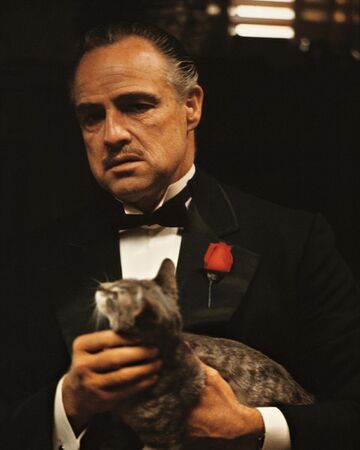
Vito’s cat from The Godfather
It turns out that Walls-Kaufmann was one of the rioters in the Capitol building and he appears in Jeffrey Smith’s body cam footage. You can see shots of him in the article and in Reilly’s Twitter thread.
Members of the sleuthing group Deep State Dogs, who began a volunteer investigative effort for Jeffrey’s widow after her attorney reached out to HuffPost, confirmed Walls-Kaufman’s identity. Nearly six months after he was identified, he has not yet been arrested.
HuffPost also recently discovered how Walls-Kaufman entered the Capitol on Jan. 6. Newly released surveillance footage from the Capitol shows Walls-Kaufman, with his hoodie on his head, barreling through the building’s eastern doors, which are visible from the street outside his shop. He enters the Capitol seconds after a member of the mob violently pulls down a cop from behind and the mob rushes in. Another officer, wearing no protective gear, has to hurry over to help the fallen officer, and the mob surges through the doors. That’s when Walls-Kaufman rushes in, right behind Capitol riot defendants Simone Gold and John Strand, who ― like Walls-Kaufman ― promote conspiracy theories about the COVID-19 pandemic.
I’ve quoted a great deal from Reilly’s article, but there is much more to read at the HuffPo link. This is such an important story.
As we learned yesterday, the Republican National Committee thinks the people who marched on the capitol after Trump incited them were just “ordinary citizens who engaged in legitimate political discourse.” RNC chair Ronna McDaniel tried to clean the mess up on Twitter, but no one’s buying it.
Business Insider: GOP accused of ‘declaring war on democracy’ after calling the deadly January 6 riot ‘legitimate political discourse.’
McDaniel in a tweet on Friday said that she has repeatedly condemned the violence on January 6. The resolution contained no mention of the violence and criminal acts by Trump loyalists during the riot.
Democrats, historians, and democracy experts, among others, ripped into the Republican party for framing the deadly riot in this way.
Mr. Bigglesworth from Austin Powers
“Today @GOPChairwoman said Jan 6th insurrectionists were ‘ordinary citizens who engaged in legitimate political discourse,'” Jaime Harrison, chair of the Democratic National Committee, said in a tweet. “They stormed the Capitol. Threatened the VP & Speaker. Injured police. Broke windows. Smeared feces on walls. GOP is truly the Party of #FraudFearFascism.”
Walter Shaub, a former director of the Office of Government Ethics, said the “deadly insurrection that sought to stop the transfer of power was not ‘legitimate political discourse,’ and any persons or groups who say so are declaring war on democracy and aligning themselves with terrorists.”
Democratic Rep. Don Beyer of Virginia echoed the sentiment.
“The Republican Party just declared the January 6th attack on the Capitol – 140+ police officers wounded, multiple deaths, and criminal charges for sedition – ‘legitimate political discourse,'” Beyer tweeted. “The GOP officially supports violent criminal assaults on police, and on our democracy.”
Jennifer Mercieca, a historian of American political rhetoric at Texas A&M University, said she can say with “certainty that the January 6th insurrection was not legitimate, nor was it ‘political discourse,'” adding that the riot “was political violence.”

Read more at the link.
Also in the news yesterday, Mike Pence kinda sorta stood up to his hold boss, saying “Trump was wrong” about the vice president have a the power to overturn the election by refusing to certify electoral votes. Naturally Trump was enraged and hit back.
 Raw Story Trump responds to Pence in unhinged statement: ‘I was right and everyone knows it!’
In a statement issued by his Save America PAC more than six hours later, Trump said, “Just saw Mike Pence’s statement on the fact that he had no right to do anything with respect to the Electoral Vote Count, other than being an automatic conveyor belt for the Old Crow Mitch McConnell to get Biden elected President as quickly as possible.”
“Well, the Vice President’s position is not an automatic conveyor if obvious signs of voter fraud or irregularities exist,” Trump added. “That’s why the Democrats and RINOs are working feverishly together to change the very law that Mike Pence and his unwitting advisors used on January 6 to say he had no choice. The reason they want it changed is because they now say they don’t want the Vice President to have the right to ensure an honest vote. In other words, I was right and everyone knows it. If there is fraud or large scale irregularities, it would have been appropriate to send those votes back to the legislatures to figure it out. The Dems and RINOs want to take that right away. A great opportunity lost, but not forever, in the meantime our Country is going to hell!”
Finally, Pence should probably check out this piece at Raw Story: ‘Cut their head off!’: Mike Pence threatened with beheading in newly released Capitol riot video.
Late Friday night the Justice Department released new videos from the January 6th Capitol riot where one insurrectionist pledged to drag former vice president Miek Pence through the streets for treason that led to him calling for Donald Trump’s former running mate to be decapitated.
CNN’s Amara Walker shared the videos — with a warning about the language — that showed the bearded rioter looking into his camera and raging at Pence for betraying supporters of the former president.
In the video the unidentified man can be heard asking if Pence held up the certification of Joe Biden as president before launching into a profanity-laden attack on the former vice president.
“I’m hearing that Pence just caved. Is that true?” he asked. “I’m telling you, if Pence caved we’re going to drag motherf*ckers through the streets. You f*cking politicians are going to get drug through the streets because we’re not going to have our f*cking sh*t stolen.”
“If we find out you politicians voted for it we’re going to drag your f*cking asses through the street,” he continued before turning back to Pence.
“Let me find out Pence — let me find out you treasoned (sic) the country. I’ll f*cking drag your ass too” he shouted. “Cut their head off! You do the right thing or we’re going to force you to do the right thing.”
On that grisly note, I’ll wrap this up and turn over the floor to you. What stories are you following today?
Lazy Caturday Reads
Posted: January 15, 2022 Filed under: Afternoon Reads | Tags: Donald Trump, fascism, FBI, January 6, Merrick Garland, snowstorm, Tonga, tsunami, volcano eruption, winter weather 17 Comments
By German cartoonist Rudi Herzlmeier
Good Afternoon!!
The temperature here in the Boston area was 1 degree this morning. We had wind chill temperatures around -20 overnight and today will see -11 wind chills. Winter weather this year has been weird everywhere. For the past couple of weeks here, we have been alternating between freezing cold and unseasonably warm days.
Today a massive winter storm is moving from the upper Midwest into the South. Eventually the storm will move up the coast and into New England as a “southeaster.” So far it looks like my area will miss the heavy snow. I hope that prediction holds! I feel for those of you who live down south.
CNN: Where to expect snow in the days ahead as a massive storm system moves south.
A massive storm system that’s dumping several inches of snow on the central US is expected to move toward the southeast Saturday, prompting the governors of Georgia, North Carolina, South Carolina and Virginia to declare states of emergency ahead of a crippling ice and snow event.
More than 65 million people in the affected areas are under winter weather alerts, the National Weather Service said.
“A strong developing storm over the Lower Mississippi Valley will move eastward to the Southeast by Sunday morning, then head northeastward to the northern mid-Atlantic by Monday,” the National Weather Service Prediction Center said early Saturday.
Rain, snow, sleet, and freezing rain — or a combination of all of those — will make travel difficult over the three-day holiday weekend across the Eastern US.
A swath of 8 to 12 inches of snow was recorded across portions of North Dakota on Friday.
From there, the system dove deeper south, heading into Missouri, Arkansas and Kansas where it delivered rain and snowfall.
“How fast surface temperatures fall below freezing, and therefore, how fast rain changes to snow will play a big role in determining just how much snow accumulates,” said the NWS office in Topeka, Kansas.
Throughout Saturday the storm system will bring heavy bands of snowfall to the Mid-South and Tennessee Valley.
Localized areas of Tennessee could see snow totals exceeding 6 inches as the storm continues its eastward track toward the Southern Appalachians.
There’s lots more winter weather news to read at that CNN link.

By Rudi Herzlmeier
Out on the West Coast, there’s another type of natural disaster warning. The New York Times: Tsunami Reported in Tonga After an Underwater Volcano Eruption.
A four-foot tsunami wave was reported to have hit Tonga’s capital, Nuku’alofa, on Saturday, sending people rushing to higher ground. Witnesses said ash had fallen from the sky, after an underwater volcano erupted earlier near the remote Pacific nation.
The volcano, Hunga Tonga-Hunga Ha’apai, is about 40 miles north of the Pacific archipelago’s main island, Tongatapu.
The Bureau of Meteorology in Australia reported the tsunami on Twitter. But communication with Tonga was disrupted, according to The Associated Press, so there were no immediate official reports of injuries or the extent of the damage.
The Tonga Meteorological Service issued a tsunami warning for the archipelago on Saturday evening. On their Facebook pages, the meteorological services for nearby Fiji and Samoa also issued alerts, advising people to stay away from low-lying coastal areas.
The National Tsunami WarninI g Center in the United States issued a tsunami advisory for the West Coast on Saturday morning Pacific time, including the Washington and Oregon coast, with the National Weather Service in Portland reporting possible one- to three-foot waves in Newport, Ore., Long Beach, Wash., and Seaside, Ore. “First wave may not be the highest,” and later waves may “be larger,” the tweet said.
I think I’d rather have a snowstorm.
Unfortunately, I guess I’ll have to get to the politics news now. I want to recommend three long reads and then I’ll list some links to other interesting stories.
First a piece by Yale philosophy professor and fascism expert Jason Stanley at The Guardian, published last month: America is now in fascism’s legal phase.
Let us be reminded that before there is a final solution, there must be a first solution, a second one, even a third. The move toward a final solution is not a jump. It takes one step, then another, then another.”
So began Toni Morrison’s 1995 address to Howard University, entitled Racism and Fascism, which delineated 10 step-by-step procedures to carry a society from first to last.
Morrison saw, in the history of US racism, fascist practices – ones that could enable a fascist social and political movement in the United States.
Cats out for a walk, Rudi Hurzlmeier
Writing in the era of the “super-predator” myth (a Newsweek headline the next year read, “Superpredators: Should we cage the new breed of vicious kids?”), Morrison unflinchingly read fascism into the practices of US racism. Twenty-five years later, those “forces interested in fascist solutions to national problems” are closer than ever to winning a multi-decade national fight.
The contemporary American fascist movement is led by oligarchical interests for whom the public good is an impediment, such as those in the hydrocarbon business, as well as a social, political, and religious movement with roots in the Confederacy. As in all fascist movements, these forces have found a popular leader unconstrained by the rules of democracy, this time in the figure of Donald Trump.
Morrison’s interest was not in fascist demagogues or fascist regimes. It was rather in “forces interested in fascist solutions to national problems”. The procedures she described were methods to normalize such solutions, to “construct an internal enemy”, isolate, demonize and criminalize it and sympathizers to its ideology and their allies, and, using the media, provide the illusion of power and influence to one’s supporters.
Philosophers have always been at the forefront in the analysis of fascist ideology and movements. In keeping with a tradition that includes the philosophers Hannah Arendt and Theodor Adorno, I have been writing for a decade on the way politicians and movement leaders employ propaganda, centrally including fascist propaganda, to win elections and gain power.
Often, those who employ fascist tactics do so cynically – they do not really believe the enemies they target are so malign, or so powerful, as their rhetoric suggests. Nevertheless, there comes a tipping point, where rhetoric becomes policy. Donald Trump and the party that is now in thrall to him have long been exploiting fascist propaganda. They are now inscribing it into fascist policy.

The article is very long, but well worth reading. Remember, Hitler got many of his ideas from the Jim Crow South.
In the lead-up to the Capitol siege, the FBI received at least a dozen warnings about the possibility of violence that day (see timeline below.) When the day came and the Capitol barricades fell, it became evident the FBI largely ignored them all.
The warnings came from all sides: regional law enforcement, social media platforms, Congress (specifically the House and Senate intelligence committees), a top defense official, extremist watchdogs, right-wing experts, journalists and even three different components within the FBI itself.
By Rudi Herzlmeier
Grid reviewed every public statement FBI officials made about the bureau’s intelligence leading up to the siege to understand how the FBI explained its posture on Jan. 6. We read hundreds of pages of FBI briefings and press statements, FBI officials’ testimony before Congress and public comments in news reports.
We found that the FBI has given at least five different explanations for why it failed to heed these warnings and take steps to foil the Capitol attack or help other agencies prepare a sufficient response. Some of them support arguments the FBI should get more money and legal authorities. But given what we now know, none of them holds up.
“They’re following the same blueprint as 9/11,” said Mike German, a former undercover FBI agent and author of “Disrupt, Discredit and Divide: How the New FBI Damages Democracy.” He is a fellow at the Brennan Center for Justice. “First they say, ‘We had no intelligence,’ then say, ‘Our authorities prevented us from getting the intelligence,’ which is not true.”
The institutional lack of introspection, while unsurprising, is deeply worrisome, German and others agree. The threat of political violence — particularly from the right, and targeting democratic institutions and political leaders — is higher than at any point in modern history. Many key indicators point in one direction: Extremist violence is reportedly surging, and threats against election officials and members of Congress are increasing. The threat of lethality from domestic violent extremist groups “is higher than it ever was,” Attorney General Merrick Garland told Congress last May.
If the FBI remains blinkered to the most serious and likely threats, Jan. 6 might not be its last major failure. American democracy has largely survived the violence of Jan. 6, and the Department of Justice has undertaken a historic effort to investigate, indict and prosecute hundreds of participants — who might never have stormed the Capitol in the first place if the FBI had heeded clear warnings and taken proper steps to prevent the attack.

Palidino goes on to refute the five main excuses the FBI has given for it’s failure to respond to the many warnings they received before January 6. It appears that the bureau is still focusing more on left wing protestors than on right wing violence, despite the public claims of director Chris Wray.
The final long read is by Jennifer Taub at The Washington Monthly: Merrick Garland’s Trump Problem—and Ours.
Timing is everything. When it comes to free and fair elections and ensuring that Donald Trump and fellow authoritarians do not pull off a successful coup, we are nearly out of time. At least 19 states have added laws that make it more difficult to vote, according to the Brennan Center for Justice, and 49 state legislatures are considering voting restrictions, including, most ominously, measures that would take election management out of the hands of secretaries of state and hand it over to GOP-controlled legislatures. We have until November 8to fix this.
Espresso by rudi Hurzlmeier
The prosecution of the former president is on a slower timeline. This includes not only the criminal investigations being pursued in Georgia by the Fulton County district attorney, and in New York by the state attorney general and the Manhattan district attorney, but also any investigations emanating from the U.S. Department of Justice. But that’s okay; Merrick Garland is no longer the problem or the solution.
I came to this conclusion after Attorney General Garland delivered a much-hyped speech commemorating the anniversary of the January 6 attack on the Capitol. After considering his words, I opened a calendar and did the math. We’ll get to that math in a moment. But first, let’s be clear about what Garland did and didn’t promise.
After watching his talk and then reading the prepared remarks published on the DOJ website, I have this take: I fully trust Garland to prosecute Trump in connection with the events directly leading up to and surrounding the certification of the electoral vote on January 6. But I’m less sure how much Trump mischief that will include.
Why do I believe DOJ is currently investigating the former president? Some doubt it. There have been no leaks to the press. By comparison, the Select Committee to Investigate the January 6th Attack on the United States Capitol has been less circumspect. Committee members, including Republican Representative Liz Cheney, have made it clear that they are examining Trump’s legal culpability on a number of grounds. Garland will have access to whatever the committee uncovers, including the report they plan to issue as early as this summer. And if the panel, chaired by Representative Bennie Thompson, makes criminal referrals to DOJ, committee staff will turn over the evidence they have gathered.
In such a referral, the committee might reference several statutes that DOJ can use to prosecute the former president and others, including obstruction of an official proceeding, conspiracy, and seditious conspiracy. They might also use the wire fraud statute to charge those who raised funds off the Big Lie.

Read the rest at The Washington Monthly link.
More stories to check out:
Yahoo News: Fake electoral documents under new scrutiny as Trump prepares for Arizona visit.
Emptywheel: The Structure of the January 6 Assault: “I Will Settle With Seeing [Normies] Smash Some Pigs To Dust.
Greg Sargent at The Washington Post: Kevin McCarthy’s coverup for Trump may be hiding knowledge of possible crimes.
Aaron Blake at The Washington Post: The conservative knives come out for Brett Kavanaugh.
The New York Times: Census Memo Cites ‘Unprecedented’ Meddling by Trump Administration.
What’s on your mind today? What stories are you following?

 peej
peej Carissa
 bostonboomer
 dakinikat
 ecocatwoman
 jjlo
jjlo mablue2
 Mama Lopez
 peggysue22
 quixote
 skydancingguestblogger
 Mona (aka Wonk the Vote)





Recent Comments