The DOJ released a small portion of the Epstein files yesterday, with massive redactions. They seem to have tried to focus on Bill Clinton and conceal anything about Donald Trump. Democrats are angry, noting that the DOJ has broken federal law by holding back and selectively redacting the files that they released.
In this post, I will focus mostly on the Epstein files and reactions to the release. I also include stories on the Brown shooter and Trump’s insanity.
The justice department’s partial release of the Epstein files on Friday signaled how the agency is using a variety of tactics to try to bury and obfuscate Donald Trump’s connection to Jeffrey Epstein.
As the department raced towards a legally mandated Friday deadline to release its files, little emerged about what it planned to release. There never really seemed to be a doubt that the department would release the files late on Friday afternoon, deploying the well-worn Washington trick of burying unflattering news before a weekend.
Then, on Friday morning, Todd Blanche, the deputy attorney general, went on Fox News to say that the department wouldn’t actually be releasing all of the files on Friday as required by the law. “I expect that we’re going to release more documents over the next couple of weeks, so today, several hundred thousand, and then over the next couple weeks, I expect several hundred thousand more,” Blanche said on Fox News. “There’s a lot of eyes looking at these and we want to make sure that when we do produce the materials we are producing, that we are protecting every single victim.”
By the time the department eventually did release thousands of pages of materials on Friday evening – not the hundreds of thousands Blanche promised – many of the documents had been heavily or completely redacted. Other than a few pictures, the materials made no mention of Trump, even though attorney general Pam Bondi reportedly told Trump earlier this year his name was in the files.
The release underscores how the Trump administration is trying to balance both the demand to release the files – something encouraged in large part by the Maga base – while also obfuscating with a slow trickle of document dumps to prevent any embarrassment to Trump, who was friends with Epstein for years before they had a falling out. Blanche has said the department will continue to produce documents on a rolling basis in the coming weeks – a holiday period – a bet that Americans will simply tune out the story as it drags on.
Thomas Massie, a Kentucky Republican who sponsored the law to release the files, was one of many members of Congress to express outrage. He said on Twitter that the release “grossly fails to comply” with the statute….
Trump is mostly missing from the release.
While Trump barely made an appearance in Friday’s release, Bill Clinton appears in several images. The Daily Wire, a Trump-friendly site, obtained a photo of Clinton and Epstein on Thursday, a day before the release. Photos of Clinton lounging in a pool and a hot tub were among those released on Friday. Justice department and White House spokespeople were quick to highlight the images on Twitter.
By Magdalena Lobao-Tello
“Beloved Democrat president. The black box is added to protect a victim,” Gates McGavick, a justice department spokesperson, posted alongside a photo of Clinton in what seems to be a hot tub with another person whose face is redacted. Steven Cheung, the White House communications director, posted another photo of Clinton with someone whose face is redacted and, quoting the song Jumpman by Drake and Future, wrote “them boys is up to something”.
Angel Ureña, a Clinton spokesperson, released a statement on Friday saying the Trump administration was using the former president to try to distract from Trump’s connection to Epstein.
“The White House hasn’t been hiding these files for months only to dump them late on a Friday to protect Bill Clinton. This is about what comes next, or from what they’ll try and hide forever,” he said. “So they can release as many 20-plus-year-old photos as they want, but this isn’t about Bill Clinton. Never has, never will be.”
Several other celebrities appeared in the images released on Friday, including Mick Jagger, Michael Jackson, Richard Branson, Chris Tucker, David Copperfield and Kevin Spacey. Like Clinton, none has been accused of any crime in connection to Epstein. But their immediate appearance in the files benefits Trump, creating the impression that it was not unusual for famous men to hang out with Epstein.
The Trump administration, initially wary over the Justice Department’s release of Jeffrey Epstein documents, pounced on go-to villain Bill Clinton’s appearance in Friday’s trove of pictures, emails and interviews.
“I wonder why the Biden DOJ refused to release the files…,” DOJ spokesperson Chad Gilmartin posted from his personal X account, alongside one partially-redacted photo of Clinton in a pool with an unidentified woman. Another swimming pool photo Gilmartin posted shows Clinton with Ghislaine Maxwell, Epstein’s longtime co-conspirator who was convicted of sex trafficking charges in 2021….
Clinton has long been linked with Epstein, contributing to his status as MAGA’s favored boogeyman. Some high-profile members of the movement cited him in pushing for the release of the files, and continued that message after the DOJ made public a trove of documents from the government’s investigation into Epstein.
“Slick Willy! @BillClinton just chillin, without a care in the world. Little did he know…” White House Communications Director Steven Cheung posted to X.
“Here is Bill Clinton in a hot tub next to someone whose identity has been redacted. Per the Epstein Files Transparency Act, DOJ was specifically instructed only to redact the faces of victims and/or minors. Time for the media to start asking real questions,” White House deputy press secretary Abigail Jackson posted to her personal X account….
Clinton appears in photos posing with Epstein in coordinating shirts, interacting with a dancer, sitting with a redacted woman on his lap on what looks like an airplane and with someone who appears to be the late pop icon Michael Jackson. The music legend faced his own child sex abuse allegations as early as 1993, though he was never convicted of any crimes.
A spokesperson for Bill Clinton accused the White House late on Friday of using him as a scapegoat after pictures of the former president with sex offender Jeffrey Epstein and Ghislaine Maxwell, as well as with a young woman in a pool, were included as part of congressionally ordered release of government files.
“This is about shielding themselves from what comes next, or from what they’ll try and hide forever. So they can release as many grainy 20-plus-year-old photos as they want, but this isn’t about Bill Clinton. Never has, never will be,” the statement added.
Lady sitting with Siamese, Sharyn Bursic
It continued: “Even Susie Wiles said Donald Trump was wrong about Bill Clinton,” it said, referring to comments made by White House chief of staff to Vanity Fair in which Wiles acknowledged that Clinton had not been on Epstein’s Caribbean island despite repeated claims by Trump to the contrary.
Clinton has long maintained that he cut ties with Epstein around 2005, before the disgraced financier plead guilty to solicitation of a minor in Florida.
In the statement, Clinton’s spokesperson Angel Ureña said: “There are two types of people here. The first group knew nothing and cut Epstein off before his crimes came to light. The second group continued relationships with him after. We’re in the first. No amount of stalling by people in the second group will change that. Everyone, especially MAGA, expects answers, not scapegoats.” [….]
Epstein visited the White House at least 17 times during the early years of Clinton’s presidency, according to White House visitor records cited in news reports. He later travelled with Epstein on the financier’s private jet in the years after he left office in 2001, including to Asia and Africa, on trips related the Clinton Global Initiative. Clinton has never been formally accused of any wrongdoing in connection with Epstein.
“A fraction of the whole body of evidence,” said Senate Minority Leader Chuck Schumer, D-New York. To demonstrate his point, he highlighted how 119 pages of one document were entirely redacted.
“Simply releasing a mountain of blacked out pages violates the spirit of transparency and the letter of the law,” Schumer said in a statement. “We need answers as to why.”
Schumer wasn’t alone in his criticism. Democratic Rep. Robert Garcia, the ranking member of House Oversight Committee, said on CNN that the Justice Department was “defying the Congress.”
The bipartisan authors of the Epstein Files Transparency Act – Reps. Ro Khanna, D-California, and Thomas Massie, R-Kentucky – also accused the Trump administration of failing to comply with their law, which nearly unanimously passed Congress in November.
“Unfortunately, today’s document release … grossly fails to comply with both the spirit and the letter of the law,” Massie added.
The law required the Justice Department by Dec. 19 to fully disclose all information in its possession related to its investigations of the well-connected financier who died by suicide in a jail cell in 2019. DOJ under the law is also required to make the files publicly searchable, but basic searches of what DOJ called the “Epstein Library” show that even basic queries – such as for “Trump” or “Clinton” – come up blank.
Read more at USA Today.
One more from Julie K. Brown, who researched and wrote the series on Epstein at the Miami Herald that forced new investigations into the sweetheart deal that Epstein got from the DOJ in September 2007.
Pages and pages of blacked-out documents. Photographs of Epstein’s mop closet and HVAC systems in house. Message pads, notes and other material from the Florida case that has been on the Palm Beach County State Attorney’s website since at least 2018. They didn’t even release the victim interviews; just pictures of the tapes of the interviews. Think about that. A photograph of a tape cassette.
This would be funny if it wasn’t about a crime involving the rapes of 14-year-old girls.
It’s clear that the Department of Justice is not only thumbing its nose at the public’s demand for transparency and accountability, it is not taking the crimes committed against children seriously. It’s as if they think we are so hungry for any crumbs about Epstein that stale bread will do.
What’s worse is that the documents and photos they did release were tossed up like a salad and served in such a mixed-up way that few people will even understand the significance of the material that was released on Friday.
Miss Kitty, a lazy afternoon, by Jan Panico
Imagine being a survivor who was raped by Epstein, and having to click, one photo at a time, through hundreds of photographs, just searching for something, anything, to explain how Jeffrey Epstein did what he did, hoping for some shred of hope that the FBI actually investigated your complaint — the story you painfully found the courage to tell.
There were few stories in the thousands of pages released Friday. Even victim Maria Farmer, who found some validation in the fact that her 1996 FBI report about Epstein’ was tucked into the mess, would learn that the FBI did nothing about it. Had they taken some steps, they may have prevented the sexual assaults of countless other girls and young women.
And what about Epstein’s clients? Pam Bondi, the attorney general, said there was no list. But Rep. Tom Massie has said he knows of 20 men who have been implicated in Epstein’s crimes. And what about Ghislaine Maxwell? Well, she filed a habeas corpus petition a few days ago that claims that 25 men arranged civil settlements with Epstein victims who could have “equally been considered as co-conspirators.” She adds: “None of them have been prosecuted.” [….]
Here is a link to the Epstein Files on the Palm Beach State Attorney’s website. You will learn more about the case here than what was released by the DOJ Friday: https://sa15.org/public-records/
Growing up in Portugal, Claudio Manuel Neves Valente stood out for his intellectual potential. In high school, he traveled to national and international physics competitions. He later graduated from Portugal’s top university for science and engineering.
But when he moved to the United States in 2000 to pursue a doctorate in physics at Brown University, his colleagues experienced an ill-tempered young man who felt that even an American Ivy League college was no match for his own intellect. Neves Valente complained the classes were too easy and left the school months after enrolling, apparently with hard feelings.
“He could be kind and gentle, though he often became frustrated — sometimes angry — about courses, professors, and living conditions,” said Scott Watson, a Syracuse University physics professor who befriended Neves Valente at Brown.
After authorities linked him to the mass shooting on Brown’s campus and the killing of an MIT professor earlier this week, Neves Valente, 48, was found dead by suicide Thursday night. In the immediate aftermath, a fuller picture of the suspect emerged: of a brilliant student whose academic promise seemed to dissipate abruptly, an angry genius with long-simmering resentment, a loner who painstakingly planned and executed extraordinary violence.
His death ended a frantic manhunt that began following the Brown shooting Saturday afternoon, according to police. He entered a storage unit in southern New Hampshire about an hour after shooting the MIT professor Monday night, officials said; based on an autopsy, authorities believe he died on Tuesday from a self-inflicted gunshot wound….
Investigators are still trying to determine what motivated his homicidal rampage after he seemingly abandoned the ambitions of his youth, what pushed him to finally act upon old grudges.
She and her cats, by Madison Moore
What’s clear is that he took careful steps to hide his identity and evade detection both before and after the shootings. Authorities believe he acted alone. They said he had been canvassing Brown’s campus for weeks, targeting a building where he spent significant time as a student in the early 2000s….
Both natives of Portugal, Neves Valente and Loureiro attended university together in Lisbon, authorities said. They graduated from Instituto Superior Técnico, a premier science institution that’s part of the University of Lisbon. Loureiro went on to pursue a lauded career as a professor and fusion researcher, with stops at Princeton University and in Europe; he joined MIT in 2016. Colleagues from across the world overwhelmingly praised his accomplishments and character, but none reported knowing Neves Valente.
More from Scott Watson, Valente’s friend:
Watson, his former classmate, said the two became friends despite Neves Valente’s standoffish nature.
“During orientation he was sitting alone, and I walked up and said hello. He was terse at first, but we eventually broke the ice and became close,” Watson told the Globe in an e-mail Friday, describing himself as essentially Neves Valente’s only friend at the university.
Neves Valente was a brilliant student, but he could be frustrated by the curriculum at Brown, which he found underwhelming, Watson said.
“He was by far the best graduate student in our class. Through our conversations, he was already ready to graduate when he arrived,” Watson said. “I don’t like the word genius, but he was.”
Information from a tipster who had a strange encounter with another man on a sidewalk outside Brown University was key to police identifying the suspect they believe killed two students at the school and then two days later gunned down a Massachusetts Institute of Technology professor.
Known only as “John” in a Providence police affidavit, the source is being hailed by investigators as the key figure who gave law enforcement the details needed to determine who was behind the Brown shooting, as well as the killing of a Massachusetts Institute of Technology professor who was shot in his Brookline home Monday.
Ever since a shooter unloaded more than 40 rounds inside a Brown engineering building, anxiety and frustration has plagued the Providence, Rhode Island, community as police appeared no closer to identifying the person.
Yet on the sixth day of the investigation, the case gathered steam, ending with police announcing late Thursday they had found the suspected gunman dead from a self-inflicted gunshot wound….
“John” gave them the information they needed.
According to police, John had several encounters with 48-year-old Claudio Neves Valente before Saturday’s attack. As police posted images of a person of interest — now identified as Neves Valente — John began posting on the social media forum Reddit that he recognized the person and theorized that police should look into “possibly a rental” grey Nissan. Reddit users urged him to tell the FBI, and John said he did. The police affidavit said they learned about the tip on Dec. 16, three days after the shooting and a day after the tip line was created….
Up until that point, the police affidavit says officials had not connected a vehicle to the possible shooter.
That detail led them to get more video of a Nissan Sentra sedan with Florida plates and enabled Providence police officers to tap into a network of more than 70 street cameras operated around the city by surveillance company Flock Safety.
Bedtime Story, by Jeanette Lassen
The affidavit says John gave investigators additional critical details: he encountered Neves Valente in the bathroom of the engineering building just hours before the attack, where John noted the suspect’s clothing was “inappropriate and inadequate for the weather.”
John also bumped into Neves Valente outside, mere blocks from the building, where John watched Neves Valente “suddenly” turn around from the Nissan when he saw John. What ensued was then a “game of cat and mouse,” according to John’s testimony — where the two would encounter each other and Neves Valente would run away.
At one point, John says he yelled out “Your car is back there, why are you circling the block?”
“The Suspect responded, ‘I don’t know you from nobody,’ then Suspect repeatedly asked, ’Why are you harassing me?’” according to the affidavit.
John told police he eventually saw Neves Valente approach the Nissan sedan once more and decided to walk away.
I’ve quote a lot, because The Boston Globe doesn’t allow gift links or readers without subscriptions.
President Donald Trump raged at the FBI for making a “mess” of his wife Melania’s “panties” during a raid on their Mar-a-Lago estate.
In a rambling speech delivered at a rally in Rocky Mount, North Carolina, on Friday night, Trump went off on a wild tangent about federal law enforcement agents, revealing how they had disturbed the First Lady’s underwear drawer during their 2022 search of the Palm Beach, Florida, property.
Her Quiet Companion, by David Arstamyan
“They went into my wife’s closet. I’ll say this. Number one, it’s very bad, but it sounds a little strange. They looked at her drawers,” Trump told the crowd while both himself and the crowd laughed.
“You have drawers, and then you have drawers. They looked at both,” he continued, miming the difference between the storage item and the undergarment.
The unprompted revelation of intimate details did not stop there, however, with Trump going full disclosure on the way his third wife likes to store her underwear.
“She’s a very meticulous person… Everything is perfect. Her undergarments, sometimes referred to as panties, are folded perfect, wrapped, they’re like so perfect. I say, ‘That’s beautiful,’” Trump continued.
“You know, that’s the part of the world she came from. Everything was perfect, no problem. Fold, fold, fold. I think she steams them just to make sure.”
No doubt Melania was thrilled with these revelations, which are likely just Trump fantasies.That’s it for me today. What’s on your mind?
Did you like this post? Please share it with your friends:
I’ve been surveying the day’s top news stories and my head is spinning. I don’t know what to focus on or where to begin, and there’s no way I can cover everything. There is too much happening, so I’ve just chosen the stories that interested me the most.
The 800 National Guard troops sent into Washington last week will soon be augmented by hundreds more, as several states with Republican governors commit to supporting President Trump’s crackdown in the city.
But Army officials appear to be trying to keep the troops on the sidelines of the mission, despite the tough-on-crime image that Mr. Trump has sought to project.
The troops have joined an array of federal agents who appeared on city streets after Mr. Trump declared last week that the federal government was assuming law enforcement responsibility in the capital, which he has falsely claimed is essentially lawless.
The first wave of troops sent to the city all came from the D.C. National Guard, which the president can call out directly. National Guard troops from Louisiana, Mississippi, Ohio, South Carolina and West Virginia will soon also be deployed, according to the governors of those states. National Guard officials said that there were 869 troops in Washington as of Monday night; the Republican-led states so far have pledged 1,000 more.
The Republican governors said they were providing the additional troops at the request of the Trump administration. Gov. Mike DeWine of Ohio said that Army Secretary Dan Driscoll had asked for the extra troops. “When the secretary of the Army asks for backup support to our troops that are already deployed, yes, we will back up our troops,” Mr. DeWine told the Columbus Dispatch.
The number is still expected to grow. But the role of the additional troops appears vague, and the answers to even basic questions, including whether they will be armed, have shifted.
What is the purpose of this militarization of a city beyond Trump’s effort to distract from the Epstein story and his overall fascist dictatorship project?
“There is no justification for any deployment of Guard forces in D.C., let alone the deployment of hundreds of Guard forces from multiple states, which smacks of a military occupation of the district,” said Elizabeth Goitein, a senior director at the Brennan Center for Justice at New York University’s law school.
“Local crime is a matter to be handled by local law enforcement,” she added.
Members of the National Guard stand near D.C.’s Union Station, within view of the U.S. Capitol.
The places where the troops have been deployed so far tell part of the story. Most have been seen near the National Mall, large monuments and other tourist-heavy areas.
Army officials said that more would be sent to 10 metro stations, most of which are also near tourist and entertainment sites. They include the Foggy Bottom, Smithsonian, Eastern Market and Waterfront stations.
Near the Washington Monument over the weekend, troops posed for photos with tourists. The National Guard presence, with desert sand-colored vehicles parked near the capital’s most visited tourists spots, is now showing up regularly on social media feeds in posts by visitors to Washington.
The rules of engagement for the troops, at the moment, remain limited to supporting, but not providing, law enforcement. That means that troops are not making arrests, though Army officials acknowledged that could change if Mr. Trump decides that he wants an even more forceful presence.
West Virginia National Guard troops have begun to arrive in Washington, DC, to assist with President Donald Trump’s crime crackdown in the nation’s capital, a defense official told CNN on Tuesday.
The troops could begin assisting the DC National Guard operationally as soon as Wednesday after they have completed their in-processing, the defense official added.
Their arrival comes after the Republican governors of six states — West Virginia, South Carolina, Ohio, Mississippi, Louisiana and Tennessee — announced they will send guard members to Washington, DC.
The deployment of other states’ troops marks an escalation of Trump’s efforts to amass forces in the capital. The president previously announced that he was deploying DC National Guard troops to the city, surging federal agents into the streets, and federalizing DC’s police force. The president has repeatedly complained about rising crime in DC, but overall crime numbers are lower this year than in 2024.
Servicemembers from the West Virginia and South Carolina National Guards receive an orientation brief upon their arrival at the Washington, D.C. Armory, Aug. 19, 2025
The defense official said Tuesday that while there are roughly 2,400 personnel in the DC National Guard, assistance from other states was needed because of how many troops are either undergoing training elsewhere or are on leave.
Louisiana Gov. Jeff Landry said Monday he approved about 135 National Guard troops to DC, while Mississippi Gov. Tate Reeves announced he would deploy approximately 200 members.
Tennessee will send roughly 160 guard members to the city this week following a request from the Trump administration, Gov. Bill Lee’s press secretary said in a Tuesday statement to CNN.
Over the weekend, West Virginia’s governor said his state was sending 300 to 400 National Guard troops to the nation’s capital. South Carolina authorized the deployment of 200 troops, and Ohio said it will send 150.
Washington, D.C., resident Tyler DeSue woke up tired and craving breakfast Saturday morning, so he did what many people in that situation would do: He used Uber Eats to put in an order for burritos.
When his driver took longer than usual, DeSue checked the app and noticed something seemed wrong — the delivery driver’s GPS location had stopped short of his address. He went outside to look for him.
“I stepped into the street, I looked down and see lights in the direction, like police lights, in the direction of where my driver was,” DeSue said in an interview. “It was my driver by himself and, like, nine different officers all wearing different uniforms. … Most of them had face coverings on.”
When DeSue went to investigate, the driver — whose name appeared on the food app as “Sidi” — was being questioned, first about his vehicle’s registration and then about his immigration status, he said.
“You’re gonna come with us, you’re gonna come with us today,” a masked agent can be heard telling Sidi in video that DeSue recorded and provided to NBC News.
“Can you tell me in Arabic, please?” Sidi says, adding that he did not understand what was being said and that he was nervous.
One of the agents, wearing a vest emblazoned “POLICE HSI” — short for Homeland Security Investigations, a part of Immigration and Customs Enforcement — replies that they do not have an Arabic translator. The men then cuff Sidi’s hands, waist and feet before they put him in an unmarked car. DeSue said he has since reported the incident to Uber.
There have been other such reports.
The incident is one of several arrests of delivery drivers recorded by eyewitnesses across the Washington area that have gone viral since the Trump administration took over law enforcement in the nation’s capital last week.
An Uber Eats delivery driver is arrested Saturday in Washington, D.C.Tyler DeSue
The videos, scattered across social media and shared among D.C. delivery driver chat groups, are having a chilling effect on the drivers themselves. Some of them have chosen to stop making deliveries in the city.
It has been “five days since working, looking at what to do. And, well, closed down here waiting for things to pass, because I don’t know what to do,” a D.C.-area delivery driver who did not want to be named told NBC News in a voice message in Spanish.
On Sunday afternoon, DeSue said, an area where 15 to 20 delivery drivers typically would be parked out front of his home looking at their phones for their next orders was an empty lot.
“I haven’t seen a driver anywhere in the last two days,” he said.
Donald Trump has been able to convert Immigration and Customs Enforcement (and Customs and Border Protection, which is effectively part of the same operation) into a huge secret police force — because what are we supposed to call an organization whose masked agents, bearing no identification, simply grab people off the street? Who shoot at a family fleeing in their truck, after agents refused to identify themselves and smashed the car window, claiming – apparently falsely according to video footage – that the driver tried to harm them?
We’ve also seen both deportations to foreign gulags and the creation of a network of domestic detention centers — call it the ICE archipelago — that are overcrowded, filthy, and breeding grounds for disease. Last week a judge ordered that detainees at ICE’s Manhattan facility be given bedding mats rather than being forced to sleep on dirty concrete floors, have access to decent hygiene, and receive three meals a day. We’ll see whether this order is obeyed, but it gives you an idea of the conditions detainees are currently facing.
And the recently passed Big Beautiful Bill gives ICE $45 billion to expand its network of detention centers, making room for around 100,000 more detainees, plus $30 billion for arrest and deportation efforts, enough to hire around 10,000 more ICE agents.
I worry, as everyone should, about how a huge expansion of this deeply un-American organization may be used as a tool of presidential power and repression. Furthermore, give people power without accountability — and it’s hard to give a better example than masked, unidentified agents authorized to use force — and some of them will abuse their position. And given what ICE has already been doing, what kind of people do you think are likely to sign up as it massively expands?
Compared with these issues, concerns about the economic impact of mass deportations are definitely second-tier. But they’re still important, and a subject I know something about. So the rest of this post will be devoted to how the Trump administration is about to ICE the economy.
A bit more:
First things first: Trump officials and some of their allies have been touting numbers that appear to show 2 million native-born Americans gaining jobs over the past year. But this claim is, as Jed Kolko of the Peterson Institute says, a “multiple-count data felony.” Read Kolko for the details showing that this is a statistical artifact, not something that really happened. No, the native-born adult population didn’t suddenly jump by 4 million in a single year.
What will actually happen is a large decline in America’s foreign-born labor force. When Stephen Miller began promising to deport 3,000 immigrants a day, many people dismissed this as an idle boast. It’s true that we can’t possibly deport people anywhere near that rapidly while obeying the law and following due process. And your point is? [….]
We don’t know how many workers will eventually be incarcerated and deported. But undocumented immigrants make up around 5 percent of the U.S. work force. It seems plausible that a significant fraction of those workers will be pushed out, along with a number of legal workers snatched up based, as Trump’s border czar has said, on their physical appearance.
Losing large numbers of workers sounds as if it will be bad for the U.S. economy. In fact, it will be worse than you may think.
The reason is that immigrant workers aren’t spread evenly across the economy. They’re strongly concentrated in certain industries and occupations, where they constitute a large share, sometimes a majority, of the work force. As a result, the Trump administration’s latter-day Edict of Expulsion will be far more disruptive to the economy than the aggregate number of workers deported might suggest.
ICE has some new cars. They are cartoonishly fascist….
What is the purpose of these vehicles?
ICE has been performing its snatch-and-grab operations largely with unmarked vehicles. ICE officers in the wild seem to eschew any sort of identification: No badges, no uniforms. Most of the time they go to great lengths to conceal their identities, wearing mask, balaclavas, and ballcaps.
Fascist ICE trucks
Are these new vehicles meant for new kinds of operations, as ICE expands to a size commensurate with its funding?
Also: What is the use-case for an ICE pickup truck? Park Rangers and firefighters can use pickup trucks to haul large loads of gear. Why would ICE need pickup trucks in its fleet?
Next, let’s look at the design. You will notice that ICE employs the slogan “Defend the Homeland.” This slogan is emblazoned in multiple spots: On side panels and on hoods. On the Mustang variant—because apparently ICE operational requirements also necessitate a two-door sports coupe—the slogan appears to be plastered on the spoiler.
It is an odd slogan for a law enforcement organization. For starters, it’s not a statement of principle, like common police tag lines: “Protect and Serve,” or “Duty, Honor, Community,” or “Service Before Self.” It’s a command: DEFEND THE HOMELAND.1
This command implies a threat. The “homeland” is under assault, right now, and must be defended from some unnamed enemy. I cannot think of any LEO that uses the specter of an enemy as part of its self-projection.
Then there’s the word “homeland.” Not “America,” or “the United States.”
The Mustang variant
America and the United States are places that anyone might join, or become a part of. But the homeland is about blood and soil. It’s the patrimony of the true volk.
Finally: “Defending the homeland” isn’t even ILstice Department weaponization chief, called for the resignation of New York Attorney General Letitia James and posed for photos outside of her Brooklyn home last week – all as he is conducting investigations into her conduct.
His investigation of James, whose office brought civil fraud charges against Trump, his adult sons, and the Trump Organization resulting in a half-billion-dollar judgment last year, is one of several the Justice Department has launched into the president’s perceived enemies.
But since beginning of the investigation into James, Martin has taken several unusual steps that fall outside the norms of prosecutorial conduct. He sent a letter to James’ attorney Abbe Lowell on August 12 suggesting New York’s top law enforcement officer resign, he appeared outside of James’ home with a colleague trailed by a photographer for the New York Post, and appeared on Fox News pledging to take an expansive look into all of James’ conduct.
In video obtained by CNN, Martin can be seen posing for photos outside of James’ home.
“This is a criminal investigation, not social media,” said Elie Honig, CNN’s senior legal analyst. “A stunt like that might get clicks, but it’s patently inappropriate for a prosecutor to do and it certainly will give James and her attorney a basis to oppose any indictment, to argue it was prejudicial to the jury pool and that an indictment was brought in bad faith.”
The conduct is “outside the bounds of DOJ and ethics rules,” Lowell said in a response to Martin.
Justice Department policy generally prohibits discussing criminal investigations publicly, and attorneys are not supposed to pursue investigations for political means or to go on fishing expeditions.
Ed Martin is going fishing. On Sunday, the lawyer and Donald Trump loyalist tapped to lead a Justice Department “weaponization” group that’s targeting the president’s perceived enemies vowed to rummage around in the lives of New York Attorney General Letitia James and Sen. Adam Schiff, D-Calif., in search of what he says could be potential fraud — or … something.
In comments to Fox News this Sunday, Martin suggested his group intends to use its powers to poke around in other parts of James’ and Schiff’s lives in search of things unrelated to the mortgage allegations.
He said, “We’re gonna go to the very bottom of the facts, and if somebody did something wrong, we’re not only gonna hold them accountable, we’re also gonna look at everything else that they’ve been doing. Because when you’re a liar, you lie not just on one thing. When you’re a cheater, you cheat not just on one thing. When you’re doing corruption, you generally don’t just do it on one thing.”
The FBI has moved to appoint Missouri Attorney General Andrew Bailey as its new “co-deputy director,” meaning its current deputy, Dan Bongino, will be expected to share his duties in the role in the future.
The appointment was made by Attorney General Pam Bondi and FBI Director Kash Patel and comes after Bongino, 50, a former Secret Service agent and podcaster, reportedly clashed with Bondi over the administration’s failure to release the Jeffrey Epstein files last month.
“I am proud to announce I have accepted the role of Co-Deputy Director of the FBI,” Bailey wrote in a brief post on X. “I extend my thanks to President Donald Trump and AG Bondi for the opportunity to serve in the mission to Make America Safe Again. I will protect America and uphold the Constitution.”
Bongino responded to a journalist’s post about the appointment by writing simply, “Welcome,” accompanied by three Stars and Stripes emojis.
Explaining the decision, Patel told The Daily Beast that the FBI “will always bring the greatest talent this country has to offer in order to accomplish the goals set forth when an overwhelming majority of American people elected President Donald J Trump again.
You have to wonder why Bongino hasn’t resigned. Maybe this is a step toward pushing him out.
The Epstein case caused controversy in early July after the FBI and Justice Department put out a statement saying that the late pedophile and sex trafficker left behind no “client list” among his possessions and died by suicide in a New York City jail cell in August 2019.
FBI Deputy Director Dan Bongino will find himself sharing his official duties after Missouri Attorney General Andrew Mitchell was hired by the Trump administration
The assessment started a civil war among Trump’s MAGA movement, many of whose members had long been encouraged to suspect foul play in Epstein’s death and had hoped to see influential people brought to justice over their alleged involvement in the disgraced financier’s crimes.
The controversy raged for more than a month, with the president himself repeatedly urged to release all federal files on Epstein and to explain his past friendship with the disgraced financier, a cause of apparent frustration to him….
Even before the contested verdict on Epstein was published, Patel and Bongino, both of whom had stoked conspiracy theories on conservative media before joining the Trump administration, had drawn fire for attempting to pour cold water on the case during a May interview with Maria Bartiromo on Fox News’s Sunday Morning Futures.
The Epstein story is not going away, and now supposedly the DOJ will begin releasing the Epstein files to the House Oversight Committee on Friday.
The House Committee on Oversight and Government Reform intends to make public some files it subpoenaed related to the Jeffrey Epstein case, though it will first redact them to shield victims’ IDs and other sensitive matters, a committee spokesperson said Tuesday.
The panel is expected to start receiving materials from the Justice Department on Friday, though it appears the public release will come some time after that. The spokesperson said the committee would work with the Justice Department on the process.
“The Committee intends to make the records public after thorough review to ensure all victims’ identification and child sexual abuse material are redacted. The Committee will also consult with the DOJ to ensure any documents released do not negatively impact ongoing criminal cases and investigations,” the spokesperson said.
Democrats on the committee complained that Comer was slow walking the release of the material by allowing the Justice Department to miss the Tuesday deadline that had been set by the panel and instead turn over the materials to the committee gradually over time starting Friday. They said DOJ had already been directed by the House subpoena to redact material related to victims’ identities and child sexual abuse – questioning the need for further delay to do so.
“Releasing the Epstein files in batches just continues this White House cover-up. The American people will not accept anything short of the full, unredacted Epstein files,” said Rep. Robert Garcia of California, the top Democrat on the panel. “In a bipartisan vote, the Committee demanded complete compliance with our subpoena. Handpicked, partial productions are wholly insufficient and potentially misleading, especially after Attorney General Bondi bragged about having the entirety of the Epstein files on her desk mere months ago.”
I hope this will really happen, but I’ll believe it when I see it.
Donald Trump displayed a stunning ignorance of the Cold War during last week’s summit with Russian President Vladimir Putin, according to his biographer.
Author Michael Wolff told the Daily Beast podcast Inside Trump’s Head on Tuesday that, in the president’s telling of the decades-long 20th century engagement, “it would appear that the U.S. and USSR are on the same side.”
Michael Wolff
Wolff, who said his sources are “twice removed” from the principals, said Trump began the meeting with “a combination of flattery” and “a combination of things that he’s just pulled out of somewhere…observations, it’s both inconsequential and incoherent.”
When either Special Envoy Steve Witkoff or Secretary of State Marco Rubio interrupted him to lay out an agenda, Wolff said, Trump just talked over them.
“Again, we’re nowhere in this meeting. We’re probably now, you know, 20 minutes in. Nothing is clear about what anyone is doing there except that Putin is totally impassive,” he said.
When Putin did speak, Wolff said, he gave a “history lesson” about ”why [Russia] should conquer Ukraine.”
And a bit more:
“Trump, not to be outdone, as this is relayed to me, goes into his own history lesson, and this is a history of the Cold War,” he said. “And as this is described to me, in Trump’s history of the Cold War, it would appear that the U.S. and USSR are on the same side.” [….]
Trump, who has been attacking “woke” history museums for not talking about “the future,” then seemed to go along with Putin’s statement resisting a ceasefire, Wolff said.
“And Trump seems to accept this and seems to agree with this,” according to the author. “Yes, let’s just move on to the peace.”
Witkoff and Rubio, meanwhile, are “basically helpless.”
“They sit there occasionally trying to interject, but you can’t really interject because Trump just talks all the time,” he continued.
“And this is then to… Putin’s advantage, because rather than any discussion of the details of what might happen here, what territory—what are you going to give for that, what are the trade offs—I mean, that level of detail Trump is not interested in, probably not capable of following the logical sequences that would be necessary there.”
What’s important to Trump, Wolff said, “is to keep talking” and “to have people listen to him.”
Those are the stories that interested me today. There’s much more happening. What’s on your mind?
Did you like this post? Please share it with your friends:
There will be lots of cable news talk today and tonight, but there probably won’t be much excitement at Trump’s arraignment. There are pro- and anti- Trump people demonstrating outside, but we’re unlikely to see another January 6.
When former President Donald Trump posted to his Truth Social platform on Friday, “SEE YOU IN MIAMI ON TUESDAY!!!,” the call eerily echoed the tweets with which he summoned his supporters to Washington, D.C., in the lead-up to Jan. 6, 2021. Then, Trump’s tweet helped to draw tens of thousands to the nation’s capital.
For some, it was interpreted as an invitation to plan and engage in collective violence. But extremism researchers say that this time around, they are not seeing signs of similar, large-scale and detailed planning around Trump’s expected courthouse appearance.
“One of the most striking things that stuck out about January 6 that we’re not seeing now are logistical and tactical maps of buildings, facilities, areas, exit routes,” said Benjamin Decker, CEO of Memetica, a threat intelligence group.
Decker said violent rhetoric on fringe platforms such as far-right Telegram channels, 4chan, Gab, Truth Social, Gettr and Patriots.win has spiked since Trump’s indictment last week. He said it has been particularly concerning to see some of this language targeting Attorney General Merrick Garland and special counsel Jack Smith. But he said the appetite to participate in a mass, in-person event is muted.
“There is a lot of paranoia among Trump supporters about getting arrested,” he said. “And the cost of arrest and potential jail time, that’s still going to deter people … who may be on the fence about being there to exercise their First Amendment rights or being there to participate in mob violence.”
On Monday, a rally in Miami organized by former Florida congressional candidate Laura Loomer seemed to attract more reporters than participants.
Jared Holt, senior research manager at the Institute for Strategic Dialogue, said a handful of other groups appeared to be organizing rallies for Tuesday at the courthouse. But he noted they were attracting skepticism from doubters who accuse the organizers of setting up a “false flag” or federal honeypot trap intended to arrest Trump supporters.
So if there is any violence this afternoon, it will probably be from lone wolves, not organized groups. Let’s hope things stay peaceful.
Arraignments are boring and perfunctory, so don’t expect any big news today when Trump appears in federal court in Miami at 3 p.m. ET. No cameras or recording devices, so we won’t see it. Still, it’s an important moment packed with symbolism.
Magistrate Judge Jonathan Goodman will preside over the arraignment, not U.S. District Judge Aileen Cannon.
As it stands now, Trump is expected to fly back to Bedminster after the court appearance for a fundraiser and a televised speech.
I wonder who is televising the speech? I’m going to give that a miss and just look at the clips on Twitter.
Also from the Morning Memo, a discussion of how Trump is reacting to getting his comeuppance: fantasizing about revenge.
The organizing principle of Trump’s re-election campaign first became apparent back in March with his chilling “I am your retribution” speech at CPAC.
I keep coming back to this theme because it animates so much of his rhetoric and has been adopted in both obvious and subtle ways by his closest adherents, and because it poses perhaps the most dire threat to the rule of law if Trump is re-elected.
I bring it back up today because his revenge fantasy is ripening and deepening in alarming ways.
In the immediate aftermath of his indictment in the Mar-a-Lago case, Trump has returned it to the forefront of his own rhetoric, and it’s being picked up again by his boosters. A few of the most egregious examples:
— Trump warned Monday that if re-elected he will name a special prosecutor to “go after” Joe Biden and his family.
“I WILL APPOINT A REAL SPECIAL “PROSECUTOR” TO GO AFTER THE MOST CORRUPT PRESIDENT IN THE HISTORY OF THE USA, JOE BIDEN, THE ENTIRE BIDEN CRIME FAMILY, & ALL OTHERS INVOLVED WITH THE DESTRUCTION OF OUR ELECTIONS, BORDERS, & COUNTRY ITSELF!”
— Trump has targeted Special Counsel Jack Smith’s wife, an echo of what he previously did to deputy FBI Director Andrew McCable’s wife….
By this point, I feel sure you know the many levels these attacks play at: They effectively cow investigators and prosecutors by raising the price and the pain of enforcing the law against him; they keep everyone involved in holding him accountable looking over their shoulders at what happens if Trump wins in 2024; they unleash the less stable and more deranged among us against Trump’s perceived enemies; they are the rallying cry not just for his supporters at election time but for his appointees and subordinates and acolytes throughout government at the local, state and federal level.
Trump’s revenge fantasy – his stated desire to abuse the powers of the office to inflict pain on those who oppose him – is now more toxic, pervasive, and sinister than at any point in his presidency. It is the rocket fuel to his quickening lurch toward fascism, not only because it appeals to his strongman tendencies, but because now as he faces criminal charges on multiple fronts it is inextricably a part of protecting and preserving his own liberty.
Trump is an increasingly desperate man, and he’s telling us exactly what he will do.
In other words, it’s going to get really ugly.
As Dakinikat posted yesterday, pro-Trump Judge Aileen “Loose” Cannon is still assigned to the trial, even though she’s not handling the arraignment. The New York Times’ Charlie Savage has a piece on how Cannon cold screw things up for the DOJ: How a Trump-Appointed Judge Could Influence His Documents Case.
Jack Smith, the special counsel handling the documents investigation into former President Donald J. Trump, vowed to seek “a speedy trial.” But that will be up to Judge Aileen M. Cannon, who will wield considerable power over its calendar, evidence and jury.
Last year, Judge Cannon, a Trump appointee, briefly disrupted the documents investigation by issuing rulings favorable to him when he challenged the F.B.I.’s search of his Florida club and estate, Mar-a-Lago, before a conservative appeals court ruled that she never had legal authority to intervene.
It remains to be seen how she will handle her second turn in the spotlight. The scope of her role before the trial also is unclear: She is not presiding over Mr. Trump’s initial hearing on Tuesday, and could refer some pretrial motions to a magistrate judge who works under her. But here is a closer look at how her decisions as the judge presiding over the trial — like on what can be included and excluded — could affect the case.
First, she could slow the case down by supporting Trump’s pointless motions. Another problem will be how she handles the classified documents:
Before the trial begins, there is almost certain to be extensive fights behind closed doors over the use of classified evidence, a matter governed by the Classified Information Procedures Act, or CIPA. The law was intended to reduce the opportunities for so-called graymail in criminal cases involving national security, in which defendants threaten to expose sensitive secrets unless prosecutors drop charges against them.
One potential issue: whether the government has to publicly expose all 31 classified documents that are the basis of the 31 counts against Mr. Trump for illegally retaining national-security secrets. Their contents are key evidence for whether they qualify as the type of information protected by the Espionage Act.
CIPA establishes court procedures to sometimes shield sensitive information from the public, including by redacting some documents or substituting summaries. But defense lawyers can argue that they need to discuss their full contents in open court for the trial to be fair.
Read more about this aspect at the link. Another issue could be the attorney-client privilege decisions that have already been decided by a federal judge:
During the investigation, Judge Beryl A. Howell of the Federal District Court for the District of Columbia ruled that the exception applied, forcing Mr. Trump’s lawyers to provide information to the grand jury. But Judge Cannon is not bound by Judge Howell’s decisions when it comes to what information should be presented to a jury.
During pretrial motions, if Mr. Trump’s lawyers ask Judge Cannon to suppress the evidence to protect attorney-client privilege and she does so, prosecutors could appeal — but that would further delay the case.
Other issues discussed in the article: Trump team claims of “prosecutorial misconduct,” jury selection decisions, ‘Rule 29’ Motions to Acquit, and the possibility of a hung jury. Read more details at the NYT link.
Judge Cannon could still recuse herself, but that’s probably unlikely. It will be interesting to see how the DOJ deals with her.
Donald Trump is expected to be represented at his first court appearance to face federal criminal charges for retaining national security materials and obstruction of justice by two of his existing lawyers, despite trying to recruit a local Florida lawyer willing to join his legal defense team.
The lawyers making an appearance with Trump on Tuesday will be the top former federal prosecutor Todd Blanche and the former Florida solicitor general Chris Kise, according to people familiar with the matter. Trump’s co-defendant, his valet Walt Nauta, will be represented by Stanley Woodward.
Trump and his legal team spent the afternoon before his arraignment interviewing potential lawyers but the interviews did not result in any joining the team in time for Trump’s initial court appearance scheduled for 3pm ET on Tuesday after several attorneys declined to take him as a client.
Trump has also seemingly been unable to find a specialist national security lawyer, eligible to possess a security clearance, to help him navigate the Espionage Act charges….
After interviewing a slate of potential lawyers at his Trump Doral resort, the former president settled on having Kise appearing as the local counsel admitted to the southern district of Florida as a one-off, with Blanche being sponsored by him to appear pro hac vice, one of the people said.
Here are the attorneys who turned Trump down.
Among the Florida lawyers who turned down Trump was Howard Srebnick, who had expressed an interest in representing the former president at trial as early as last week in part due to the high fees involved, but ultimately was not allowed to after conferring with his law partners, the person said.
The other prominent lawyer who declined to work with Trump was David Markus, who recently defended the Florida Democratic gubernatorial candidate Andrew Gillum against charges that he lied to the FBI and funnelled campaign contributions into his personal accounts, the person said.
Trump and his team have interviewed the corruption attorney Benedict Kuehne, who was indicted in 2008 for money laundering before the charges were dropped, the person said. But he has his own baggage as he faces disbarment for contempt of court in a recent civil suit he lost.
The other interviews are understood to have been with William Barzee, as well as Bruce Zimet, the former chief assistant US attorney in Fort Lauderdale and West Palm Beach.
Hugo Lowell notes that lawyers are concerned about his reputation for being a nightmare client and their concerns that defending Trump could damage their own reputations. They also have to be aware that Trump has lied to and manipulated his attorneys.
Trump is said to still be searching for a lawyer in the mold of Roy Cohn, the ruthless New York fixer who defended and mentored him before he was later disbarred – and the fear of potentially being asked to take similar actions has been a persistent issue.
That fear has loomed large for numerous lawyers Trump’s advisers have contacted, the people said, in particular after Trump might have made Evan Corcoran, another former lawyer who withdrew from his defense in the Mar-a-Lago documents investigation, into a witness against him.
Trump needs cleared attorneys, and he should (finally) have the lawyers with Espionage Act experience that might have minimized some of the risk he currently faces.
When courts deal with classified documents like this one will, the judge does not need clearance. (This is a separation of powers issue; members of Congress similarly don’t need clearance.) But the lawyers do. At least one and preferably three of Trump’s lawyers will need to be cleared at the elevated levels the FBI Agents who did the search of Mar-a-Lago had to be read into to even conduct the search. As it was, Trusty was Trump’s only attorney with clearance, and he just split.
Not all lawyers want to go through the trouble of getting clearance. Some — possibly including Chris Kise, was a registered agent for Venezuela in recent years — may not be able to get cleared at that level.
Donald Trump’s trouble finding legal representation is no longer simply the comedy of self-destructiveness it has been for years. Starting today (or shortly thereafter), there will be new obligations and exposures for lawyers representing him.
Trump’s search for a lawyer is not just about finding people who are members of the bar in SDFL. He also needs to find lawyers who are willing to put their security clearance and their reputations at risk on a case where Trump has already been wildly misleading his attorneys.
In this post, Marcy also addresses in detail the ways in which he has lost lawyers by misleading and lying to them, as well as asking them to do illegal things. Read all about it at the link.
Honestly, I don’t even know where to begin today. What is happening in U.S. politics right now is beyond anything we have ever experienced as a country, with the exception of the Civil War.
A former president of the U.S. tried to overthrow his own government in order to prevent a transition to a new president after he lost an election. He incited an attempted coup; and when that failed, he tried to overthrow the results of presidential votes in several states.
Finally, when all that failed to keep him in office, he stole hundreds of government documents and stored them in his private club in locations in which all kinds of people could have access to them. He displayed some of the documents to people without clearance to see them and, for all we know, could have given classified information to other countries.
It’s simply breathtaking.
Now the former president has been indicted for serious crimes, and his political party is still supporting him and vowing revenge on our most important institutions. Could it get any worse? The answer is yes, of course it could. He could end up winning his party’s 2024 nomination and being elected president again, even if he is in prison by that time.
So that’s where we stand right now. I’ll share some reads, but there is no way I have the time or space to include everything that’s out there.
I think this description of the situation we are in by Tom Nichols at The Atlantic is very good. I could only read it in my email, because I’m not a subscriber. The title: Trump’s Indictment Reveals a National-Security Nightmare.
The charges—38 of them—are a big deal. And before the GOP gaslighting reaches supernova levels, let’s also bear in mind that what Trump actually did is a big deal too. He claimed that he declassified, by fiat, boxes of classified information, and then appears to have left all of that material sitting in ballrooms, bedrooms, and bathrooms. To this day, he insists that he had every right to do whatever he wanted with America’s secrets. Fortunately, the court has unsealed the indictment, because Americans need to know, and care, about the magnitude of Trump’s alleged offenses.
To understand the severity of the charges against Trump, consider a thought experiment: Imagine that Vladimir Putin is one day driven from the Kremlin, perhaps in a coup or in the face of a popular revolt. He jumps into his limousine and heads for self-imposed exile in a remote dacha. His trunk is full of secret documents that he decided belong to him, including details of the Russian nuclear deterrent and Russia’s military weaknesses.
Now imagine how valuable those boxes would be to any intelligence organization in the world. I spent the early years of my career analyzing Soviet and Russian documents as an academic Sovietologist, and I would have loved to see such materials. Small, seemingly trivial details—something as innocuous as a desk calendar or a notepad—might not mean much to a layperson, but to a professional, they could be pure gold. To get even a peek at such Russian materials would be an intelligence triumph.
By Timothy Adams Matthews
But of course, I would never have been able to lay my hands on them, because a cache of such immense importance, if U.S. operatives spirited any of it out of Russia, would have been secured in a vault somewhere deep in the CIA. Trump, meanwhile, left highly sensitive American documents lying around at a golf resort like practice balls on the driving range. According to the indictment:
“The Mar-a-Lago Club was an active social club, which, between January 2021 and August 2022, hosted events for tens of thousands of members and guests. After TRUMP’s presidency, The Mar-a-Lago Club was not an authorized location for the storage, possession, review, display, or discussion of classified documents. Nevertheless, TRUMP stored his boxes containing classified documents in various locations at The Mar-a-Lago Club—including in a ballroom, a bathroom and shower, an office space, his bedroom, and a storage room.”
Actually, it might be harder to steal practice balls. “The Storage Room,” the indictment notes, “was near the liquor supply closet, linen room, lock shop, and various other rooms.” These are not exactly low-traffic areas. Worse yet, the indictment asserts that Trump had some of these documents at his club in New Jersey, where he showed files to people who had no business seeing them. (One of them, according to the indictment, was something Trump claimed was a plan of attack on a foreign country prepared for him by the Department of Defense and a senior military official.)
If you can access The Atlantic website, you can read more, but I think that is a good summary of the seriousness of what this country is facing.
Here are a some long reads that address various aspects of the Trump indictment and it’s possible effects on U.S. politics and national security.
One of my least favorite New York Times writers, Peter Baker, evaluates what the indictment means for President Biden and the U.S. justice system: Trump’s Case Puts the Justice System on Trial, in a Test of Public Credibility. Why am I not surprised that this is what Baker chose to write about? Still, it’s worth considering.
Classified documents found in a shower. A clumsy effort to move boxes and hide them from the FBI. A damaging admission, caught on tape. And Donald Trump’s own public statements, used against him.
Those are some of the details in the indictment charging Trump and a longtime aide with an extraordinary scheme to hoard national secrets that Trump took to his Mar-a-Lago estate after leaving the White House.
Here are some of the most notable revelations.
By Timothy Adam Matthews
Showing off military plans
On at least two occasions after leaving office, Trump displayed classified documents to others visiting him at his golf club in Bedminster, New Jersey, the indictment alleges. In July 2021, Trump showed a writer, a publisher and two staff members a “plan of attack” that he said had been prepared for him by the U.S. military, the charges say. The audio-recorded meeting reportedly involved a document that Joint Chiefs of Staff Chairman Mark Milley drafted about Iran.
Trump allegedly made a potentially damning admission at that session, saying he could have declassified the document while he was president but “now I can’t.”
A longtime aide turned co-conspirator
Trump isn’t the only person facing criminal charges over the classified documents fiasco: His longtime aide and “body man,” Walt Nauta, was also hit with six felony counts including obstruction of justice and making false statements to the FBI. The indictment says Trump instructed Nauta to move boxes containing classified documents in order to conceal them from both Trump’s own lawyers and the FBI.
Prosecutors accused Nauta of lying months ago and pressured him to cooperate in the investigation, a source familiar with the situation told POLITICO, but the charges unsealed Friday indicate that he and prosecutors didn’t come to terms on a deal – at least not yet.
Classified docs in a bathroom
The indictment says that Mar-a-Lago was a particularly vulnerable location for the classified documents because it’s “an active social club [that] hosted events for tens of thousands of members and guests” – a far cry from the closely guarded “sensitive compartmented information facility,” or SCIF, that is typically used to store the most sensitive national security secrets.
Trump has railed at the FBI for spreading classified documents across the floor of a closet during a search of Mar-a-Lago last August. But prosecutors say Trump’s own storage of the documents was just as sloppy. The indictment says some of the classified records at Mar-a-Lago were stored in “a ballroom, a bathroom and shower [and] his bedroom.”
Spilling secrets, literally
Other details from the indictment emphasize the haphazard nature with which sensitive government documents were strewn around the estate. The indictment alleges that, on at least one occasion in December 2021, boxes containing a mix of classified and unclassified records “spilled onto the floor” of a storage room. Helpfully for prosecutors, Nauta allegedly texted a photo of the scene to another Trump aide.
One of the documents, classified “Secret” and marked for release only to U.S. officials and close allies, discussed “military capabilities of a foreign country,” the indictment says.
The 37-count indictment accusing Donald Trump of illegally hoarding classified documents used a wealth of surveillance footage, private conversations, employees’ text messages, audio-taped meetings, and witness statements to make a damning case.
But the 44-page document also included a half-dozen images of the documents themselves, stacked in boxes next to a toilet, spilling out onto the floor of a storage room, and piled up in rows on the stage of a ballroom at Trump’s resort in South Florida….
In one exchange outlined in the indictment and backed up with a photograph, Trump employees discussed moving some of Trump’s boxes of documents out of a Mar-a-Lago business center and into a bathroom instead so staff could use the business center as an office.
“Woah!! Ok so potus specifically asked Walt for those boxes to be in the business center because they are his ‘papers,’” one Trump employee texted to another, referencing Walt Nauta.
The two employees then went back and forth discussing what they could move to storage. “There is still a little room in the shower where his other stuff is,” one employee texted. “Is it only his papers he cares about? Theres some other stuff in there that are not papers. Could that go to storage? Or does he want everything in there on property.”
“Yes,” the second employee responds. “Anything that’s not the beautiful mind paper boxes can definitely go to storage.”
In another instance in May 2021, Trump told staff to move some of his boxes to a storage room, the indictment says. Images show the boxes stacked up in the storage room as well as a hallway leading to the room that prosecutors say could easily be reached from Mar-a-Lago’s pool patio. The storage room was right next to a liquor supply closet and a linen room.
In December 2021, Trump’s personal aide, Walt Nauta, found that some of those 80 boxes had fallen over and their contents spilled out on the floor.
Among the papers scattered around the storage room were, according to the indictment, a document marked “SECRET//REL TO USA//FVEY” which denoted information releasable only to the Five Eyes intelligence alliance of the U.S., the U.K., Australia, Canada and New Zealand.
I’ve become convinced that what I will call the Mar-a-Lago indictment — because I doubt this will be the only stolen documents one — is a tactical nuke: A massive tool, but simply a tactical one.
As I’ve laid out, it charges 31 counts of Espionage Act violations, each carrying a 10-year sentence and most sure to get enhancements for how sensitive the stolen documents are, as well as seven obstruction-related charges, four of which carry 20-year sentences. The obstruction-related charges would group at sentencing (meaning they’d really carry 20 year sentence total), but Espionage Act charges often don’t and could draw consecutive sentences: meaning Trump could be facing a max sentence of 330 years. Walt Nauta is really facing 20 years max — though probably around three or four years.
New York Kitty, by Timothy Adam Matthews
Obviously, Trump won’t serve a 330 year sentence, not least because Trump is mortal, already 76, and has eaten far too many burgers in his life.
For his part, Nauta should look on the bright side! He has not, yet, been charged with 18 USC 793(g), conspiring with Trump to hoard all those classified documents, though the overt acts in count 32, the conspiracy to obstruct count, would certainly fulfill the elements of offense of a conspiracy to hoard classified documents. If Nauta were to be charged under 793(g), he too would be facing a veritable life sentence, all for helping his boss steal the nation’s secrets. And for Nauta, who is in his 40s and healthy enough to lug dozens of boxes around Trump’s beach resort, that life sentence would last a lot longer than it would for Trump.
And that’s something to help understand how this is tactical.
I first started thinking that might be true when I saw Jack Smith’s statement.
He emphasized:
A grand jury in Florida voted out the indictment
The gravity of the crimes
The talent and ethics of his prosecutors
That Trump and Walt Nauta are presumed innocent
He will seek a Speedy Trial
A Florida jury will hear this case
The dedication of FBI Agents
He packed a lot in fewer than three minutes, but the thing that surprised me was his promise for a Speedy Trial. He effectively said he wants to try this case, charging 31 counts of the Espionage Act, within 70 days.
That means the trial would start around August 20, and last — per one of the filings in the docket — 21 days, through mid-September. While all the other GOP candidates were on a debate stage, Trump would be in South Florida, watching as his closest aides described how he venally refused to give boxes and boxes of the nation’s secrets back.
There’s not a chance in hell that will happen, certainly not for Trump. Even if Trump already had at least three cleared attorneys with experience defending Espionage Act cases, that wouldn’t happen, because the CIPA process for this case, the fight over what classified evidence would be available and how it would be presented at trial, would last at least six months. And as of yesterday, he has just one lawyer on this case, Todd Blanche, who is also defending Trump in the New York State case.
There’s much more to read and think about at the link. Her main point seems to be that Smith wants to convince Walt Nauta to testify against Trump.
Walt Nauta, the only other person indicted along with former President Donald J. Trump, has been serving as his personal aide after previously working for him in the White House.
A native of Guam, Mr. Nauta enlisted in the military at some point and was a military aide working as a White House valet while Mr. Trump was president.
The valets in the White House have unusual proximity to the commander in chief, encountering them at moments of vulnerability, including at meals and on foreign trips.
Mr. Trump and Mr. Nauta forged a bond during the Trump administration, and when the term ended, Mr. Nauta retired and went to go work for Mr. Trump personally.
A Closer Look, by Timothy Adam Matthews
He was one of the very few members of Mr. Trump’s post-presidential office when Mr. Trump first returned to private life at his club, Mar-a-Lago, in Palm Beach, Fla. There, Mr. Nauta resumed the kind of personal chores that he had helped Mr. Trump with while he was president.
Mr. Nauta has been seen as deeply loyal to Mr. Trump by other aides.
But he attracted the attention of the government for his appearance on security camera footage from the club, which was subpoenaed by prosecutors, moving boxes in and out of a basement storage room after a grand jury subpoena.
In interviews with government officials, according to the indictment, he gave false testimony about whether he had moved boxes to Mr. Trump’s residence earlier in the year. In reality, according to the indictment, Mr. Nauta brought several boxes to Mr. Trump’s residence from the storage room at a time when National Archives officials were seeking the return of presidential material, but he told investigators he didn’t.
Read the rest at the NYT.
As I’m sure you know, Republicans in the House are vociferously defending Trump. For example:
Former President Donald Trump’s indictment on charges of mishandling classified documents is set to play out in a federal court in Florida. But hundreds of miles away, part of Trump’s defense is well underway in a different venue — the halls of Congress, where Republicans have been preparing for months to wage an aggressive counter-offensive against the Justice Department.
The federal indictment against Trump, unsealed Friday, includes 37 counts, including allegations that the former president intentionally possessed classified documents, showed them off to visitors, willfully defied Justice Department demands to return them and made false statements to federal authorities about them. The evidence details Trump’s own words and actions as recounted by lawyers, close aides and other witnesses.
The Republican campaign to discredit federal prosecutors skims over the substance of those charges, which were brought by a grand jury in Florida. GOP lawmakers are instead working, as they have for several years, to foster a broader argument that law enforcement — and President Joe Biden — are conspiring against the former president and possible Republican nominee for president in 2024.
“Today is indeed a dark day for the United States of America,” tweeted House Speaker Kevin McCarthy, soon after Trump said on his social media platform Thursday night that an indictment was coming. McCarthy blamed Biden, who has declined to comment on the case and said he is not at all involved in the Justice Department’s decisions.
Republicans “will hold this brazen weaponization of power accountable.”
Republican lawmakers in the House have already laid extensive groundwork for the effort to defend Trump since taking the majority in January. A near constant string of hearings featuring former FBI agents, Twitter executives and federal officials have sought to paint the narrative of a corrupt government using its powers against Trump and the right. A GOP-led House subcommittee on the “weaponization” of government is probing the Justice Department and other government agencies, while at the same time Republicans are investigating Biden’s son Hunter Biden.
“It’s a sad day for America,” Senate Judiciary Committee Chairman Jim Jordan of Ohio, a leading Trump defender and ally in the House, said in a statement on Thursday evening. “God bless President Trump.”
And of course, the MAGA crazies are calling for civil war.
The calls for violence appeared in comment threads, responding to posts on the front page of the forum Thursday night, after news broke of Trump’s latest legal troubles. The most extreme comments were written in response to a fanciful post insisting “the only solution” to DOJ’s efforts to lock up Trump would be to vote him back into the presidency, so Trump could “pardon himself and begin arresting those guilty of insurrection and sedition.”
A user named “Belac186” offered a far deadlier fix: “The only way this country ever becomes anything like the Constitution says this country should be is if thousands of traitorous rats are publicly executed.” Commenter “DogFaceKilla” quickly chimed in to offer supplies: “I got some rope somewhere in the garage…” And “Heavy_Metal_Patriot” added: “Hans says we can borrow the flammenwerfer” — a reference to a battlefield flame thrower used to by German soldiers in World War II.
The proposal for mass killing struck user “BlackPilledMAGA” as going too far: “Doesn’t have to be thousands, just a few dozen would do. Shit would STOP immediately.” But user “Nerdrem1” insisted taking out a few elites wouldn’t make the difference, suggesting the number of dead required was on a genocidal scale: “Millions. The real problem is the people that vote for them, as long as they exist the problem can’t be solved.” A user named “Heavy_Metal_Patriot” concurred: “Correct.”
It might be tempting to dismiss these calls for mass murder as loose talk among angry MAGAdonians. Yet there is dark history here. In a previous iteration, The Donald was used to help plot and promote the violence at the Capitol in 2021, as detailed in the final report of the House Jan. 6 Committee, including by users who “openly discussed surrounding and occupying the U.S. Capitol.”
In what is becoming a now all-too-familiar trend, former President Donald Trump’s far-right supporters have threatened civil war after news broke Thursday that the former president was indicted for allegedly taking classified documents from the White House without permission.
“We need to start killing these traitorous fuckstains,” wrote one Trump supporter on The Donald, a rabidly pro-Trump message board that played a key role in planning the January 6 attack on the Capitol. Another user added: “It’s not gonna stop until bodies start stacking up. We are not civilly represented anymore and they’ll come for us next. Some of us, they already have.” [….]
Trump supporters are making specific threats too. In one post on The Donald titled, “A little bit about Merrick Garland, his wife, his daughters,” a user shared a link to an article about the attorney general’s children.
Under the post, another user replied: “His children are fair game as far as I’m concerned.”
In a post about the special counsel conducting the probe, one user on The Donald wrote: “Jack Smith should be arrested the minute he steps foot in the red state of Florida.”
In addition to threats of violence against lawmakers and politicians, many were also calling for a civil war.
“Perhaps it’s time for that Civil War that the damn DemoKKKrats have been trying to start for years now,” a member of The Donald wrote. Another, referencing former President Barack Obama and former secretary of State Hillary Clinton, said: “FACT: OUR FOREFATHERS WOULD HAVE HUNG THESE TWO FOR TREASON…”
More crazy at the link.
That’s just a sampling of what’s out there in the media today. What do you think? What stories have caught your attention?
Did you like this post? Please share it with your friends:
I’m going to focus on the abortion battle today. I think it is completely inappropriate for abortion to even be a public issue in the first place, but of course regulating women’s bodies and lives has been a goal for powerful men since ancient times.
I was around before abortion became legal in this country–in fact I was around before birth control was legal for unmarried women. For me it feels like what is happening now is an incredible betrayal. Although women have never been treated in our culture as fully equal with men, the Roe v. Wade decision made it possible for women to make great strides in education and work. Now, nearly fifty years later, the progress toward equality has been halted. Women of child-bearing age are being treated like broodmares once again.
The good news is that the majority of U.S. voters are not on the same page with right wing Republicans and the justices they have managed to put on the federal judiciary and the Supreme Court. We saw this in Kansas when voters rejected a referendum to make abortion illegal in the state. We saw in the mid-term elections when voters clearly saw abortion as one of the top issues. We saw it during the latest midterm elections, when abortion was shown to be a significant issue for voters. We saw it recently in Wisconsin, where voters election Janet Protasiewicz, a pro-choice Democrat, to the State Supreme Court, giving liberals a majority.
Conservatives are finding out the hard way that abortion isn’t a 50-50 issue anymore.
Janet Protasiewicz’s 11-point blowout victory this week for a state Supreme Court seat in Wisconsin was just the latest example of voters who support abortion rights outnumbering — and outvoting — their opponents. There was little polling in Tuesday’s race, but in a 2022 midterm exit poll of the state, a combined 63 percent of Wisconsin voters said abortion should be legal in all or most cases, while only 34 percent thought it should be illegal in all or most cases.
Moreover, for the 31 percent of 2022 voters who said abortion was their most important issue — second only to inflation at 34 percent — they overwhelmingly backed Democratic Gov. Tony Evers (83 percent) and Democratic Senate candidate Mandela Barnes (81 percent), who lost narrowly to GOP Sen. Ron Johnson.
Going back to the 1990s, Gallup polling showed Americans divided roughly evenly between those who called themselves “pro-life” and “pro-choice.” Exit polls from the 1990s and 2000s showed voters who said abortion or “moral values” were most important to their vote supported Republican candidates in greater numbers.
But those surveys were conducted when a right to an abortion was law of the land. The Supreme Court’s Dobbs decision last year ending that constitutional right has exposed Americans’ broad opposition to the strict abortion bans adopted or proposed in GOP-controlled states. And it’s revealed that public surveys on the matter probably need more nuanced questions now.
There’s a long history of abortion polling. In the 2000 presidential election, the Los Angeles Times national exit poll found more George W. Bush voters rated abortion as one of their two most important issues than Al Gore voters, and voters were divided 50-50 on whether abortion should remain legal or be made illegal (though with exceptions).
That poll offered three options when measuring voter sentiment on abortion: keep it legal, make it illegal with exceptions or make it illegal with no exceptions.
Now, a four-point question probably best measures where Americans sit on the issue: legal in all cases, legal in most, illegal in all and illegal in most. The 2022 national exit poll used this device, finding that 29 percent of voters believed abortion should be “legal in all cases,” while another 30 percent thought it should be “legal in most cases.” That left 26 percent who thought it should be “illegal in most cases” and only 10 percent who said it should be “illegal in all cases.”
That leaves roughly six-in-10 voters supporting legal abortion in most cases — with the median voter supporting some restrictions — and just over a third who want it to be entirely or mostly illegal.
NY Magazine cover, by Barbara Kruger
The recent decision by reactionary Trump judge Matthew Kacsmaryk in Texas is getting very bad reviews. Kacsmaryk claimed to have the power to tell scientists at the FDA that mifepristone, an abortion pill that has been approved and shown to be safe for more than 20 years, should be banned nationwide. Some recent reactions:
Congratulations are in order for Judge Matthew Kacsmaryk. The competition is fierce and will remain so, but for now he holds the title: worst federal judge in America.
Not simply for the poor quality of his judicial reasoning, although more, much more, on this in a bit. What really distinguishes Kacsmaryk is the loaded content of his rhetoric — not the language of a sober-minded, impartial jurist but of a zealot, committed more to promoting a cause than applying the law.
Kacsmaryk is the Texas-based judge handpicked by antiabortion advocates — he is the sole jurist who sits in the Amarillo division of the Northern District of Texas — to hear their challenge to the legality of abortion medication.
And so he did, ruling exactly as expected. In an opinion released Friday, Kacsmaryk invalidated the Food and Drug Administration’s 23-year-old approval of the abortion drug mifepristone and, for good measure, found that abortion medications cannot be sent by mail or other delivery service under the terms of an 1873 anti-vice law.
Even in states where abortion remains legal. Even though study after study has shown the drug to be safe and effective — far safer, for instance, than over-the-counter Tylenol. Even though — or perhaps precisely because — more than half of abortions in the United States today are performed with abortion medication.
My fury here is not because I fear that Kacsmaryk’s ruling will stand. I don’t think it will, not even with this Supreme Court. Indeed, another federal district judge — just hours after Kacsmaryk’s Good Friday ruling — issued a competing order, instructing the FDA to maintain the existing rules making mifepristone available. Even Kacsmaryk put his ruling on hold for a week; the Justice Department has already filed a notice of appeal; and the dispute is hurtling its way to the Supreme Court. (Nice work getting yourselves out of the business of deciding abortion cases, your honors.)
No, my beef is with ideologues in robes. That Kacsmaryk fits the description is no surprise. Before being nominated to the federal bench by President Donald Trump in 2017, Kacsmaryk served as deputy general counsel at the conservative First Liberty Institute. He argued against same-sex marriage, civil rights protections for gay and transgender individuals, the contraceptive mandate and, of course, Roe v. Wade.
At his confirmation hearings, Kacsmaryk testified that federal judges are bound “to read the law as it is written and not read into it any policy preference that they might have had before they were judges.”
Well that was a blatant lie. Read the whole article at the WaPo.
The conservative legal movement has long had two key goals: to limit access to abortion and to restrict the authority of administrative agencies.
The decision last week by a federal judge in Texas invalidating the Food and Drug Administration’s approval 23 years ago of the abortion drug mifepristone checked both of those boxes. The ruling, if it stands, would not only thwart access to the pills, used in more than half of pregnancy terminations, but also undermine the F.D.A.’s authority to approve and regulate other drugs.
At first blush, all of that might seem to make the decision’s chances of surviving review by a Supreme Court dominated by conservative justices quite promising.
But legal scholars said on Monday that the poor quality, breathtaking sweep and unknown collateral consequences of the Texas decision might cause at least some of the Supreme Court’s conservative justices to wait for a case that would allow them to take more measured steps.
“If you’re a justice looking for a case in which to undermine the administrative state, this is not a particularly elegant one,” said Mary Ziegler, a law professor and historian at the University of California, Davis. “Everything about this case makes it an imperfect vehicle, except for the fact that it’s about abortion and the administrative state. This is boundary testing.”
Jonathan H. Adler, a law professor at Case Western Reserve University, said the new case, should it reach the Supreme Court, might meet a reception similar to that of the latest challenge to the Affordable Care Act. In 2021, by a vote of 7 to 2, the court said that the 18 Republican-led states and two individuals who brought the case had not suffered the sort of direct injury that gave them standing to sue.
Despite the conservative majority’s misgivings about the health care law, Professor Adler said, “when push came to shove and they were presented with a fundamentally deficient legal theory, only two justices were willing to give that legal theory the time of day.”
History may repeat itself in the Texas case, he said. “I view some of the administrative law aspects of this case to be similar,” he said, noting that there were significant threshold issues involving the plaintiffs’ standing to sue, whether they had exhausted other avenues for relief and whether they had taken too long to bring an action.
The pharmaceutical industry plunged into a legal showdown over the abortion pill mifepristone on Monday, issuing a scorching condemnation of a ruling by a federal judge that invalidated the Food and Drug Administration’s approval of the drug and calling for the decision to be reversed.
The statement was signed by more than 400 leaders of some of the drug and biotech industry’s most prominent investment firms and companies, none of which make mifepristone, the first pill in the two-drug medication abortion regimen. It shows that the reach of this case stretches far beyond abortion. Unlike Roe v. Wade and other past landmark abortion lawsuits, this one could challenge the foundation of the regulatory system for all medicines in the United States.
“If courts can overturn drug approvals without regard for science or evidence, or for the complexity required to fully vet the safety and efficacy of new drugs, any medicine is at risk for the same outcome as mifepristone,” said the statement.
What the DOJ is doing:
Also on Monday, the Justice Department filed a motion asking the U.S. Court of Appeals for the Fifth Circuit to stay the ruling by Judge Matthew J. Kacsmaryk of the U.S. District Court for the Northern District of Texas until the department’s appeal of the case could be heard. Judge Kacsmaryk, a Trump appointee who has written critically of Roe v. Wade, had issued only a seven-day stay of his ruling to allow the government a chance to appeal.
“If allowed to take effect, the court’s order would thwart F.D.A.’s scientific judgment and severely harm women, particularly those for whom mifepristone is a medical or practical necessity,” said the Justice Department motion, which noted that mifepristone was also used in treating miscarriages.
It added: “This harm would be felt throughout the country, given that mifepristone has lawful uses in every state. The order would undermine health care systems and the reliance interests of businesses and medical providers.”
The appeals court gave the plaintiffs, a coalition of groups and doctors who oppose abortion, until midnight Tuesday to file a response.
The 67-page document, written by right-wing Judge Matthew Kacsmaryk, cited Wikipedia and is full of inaccuracies and falsehoods about the health effects of medical abortion, experts told Insider on Friday.
Kacsmaryk in the ruling cited multiple studies to back up claims that have been widely scrutinized or do not hold up to scientific consensus.
“When you’re issuing a ruling that’s going to impact people nationally, one would hope that that ruling would be evidence-based and that it would look at the body of evidence instead of cherry-picking studies that are really not in line with the scientific consensus on the topic,” M. Antonia Biggs, Ph.D. and social psychologist at ANSIRH previously told Insider.
For example, one study, with ties to anti-abortion nonprofit the Charlotte Lozier Institute, relies on the anonymous experiences of users on one particular website. The study uses 98 blog posts made over the course of 10 years. The authors note that the small sample group is one of the study’s limitations.
In comparison to the study, in 2020, 620,327 legally induced abortions were reported to CDC.
However, despite the limited scope of the study, the conservative Christian judge writes that “eighty-three percent of women report that chemical abortion ‘changed’ them — and seventy-seven percent of those women reported a negative change” — citing the study of 98 anonymous blog posts.
In another example, the judge cites an analysis that suggests a link between negative mental health outcomes and abortion written by abortion researcher Priscilla Coleman whose study has been denounced for years by abortion researchers and whose other work has previously been retracted by leading journals.
Julia Steinberg, an expert on mental health and abortion, told Reuters in 2012 that most women in the study who experienced mental health issues after having an abortion had also experienced them before the abortion. The Guttmacher Institute also debunked the study in a letter.
Clearly, Kacsmaryk is woefully unqualified to be a federal judge.
In interviews, several legal and medical experts said Kacsmaryk’s decision was unprecedented and clearly ideological. His language and reasoning, they said, closely mirrored arguments and concepts put forward by the anti-abortion movement — at the expense of scientific consensus in some instances.
The experts pointed to several key examples of the extreme nature of Kacsmaryk’s 67-page ruling, including his use of politicized terminology and apparent endorsement of the contentious idea of “fetal personhood.” Here are the parts of the ruling experts found most striking….
In his ruling Friday, Kacsmaryk used various terms closely associated with the anti-abortion movement, according to the experts who were interviewed. Notably, Kacsmaryk referred to the two-pill regimen that is the most common way to terminate a pregnancy in the U.S. as “chemical abortion,” rather than “medication abortion.” The plaintiffs in the suit, a group called the Alliance for Hippocratic Medicine, use the same term in their filings and messaging.
“‘Chemical abortion’ is absolutely not a scientific or medical term. It is something that has been utilized and propagated by those who want to ban abortion or restrict abortion,” said Dr. Jenni Villavicencio, an OB-GYN who is the American College of Obstetricians and Gynecologists’ lead for equity transformation.
Villavicencio characterized “chemical abortion” as an “emotive” term meant to inspire fear about the risks of ending a pregnancy.
She also highlighted Kacsmaryk’s references to a fetus as an “unborn human” or an “unborn child.”
Kacsmaryk wrote that mifepristone “blocks the hormone progesterone, halts nutrition, and ultimately starves the unborn human until death.” [….]
Kacsmaryk’s references to an “unborn child” align with other parts of his decision in which he suggests that any potential “side effects” or “significant complications” caused by mifepristone should apply to both the pregnant woman and “to the unborn humans extinguished by mifepristone.”
Such wording, experts said, references the concept of “fetal personhood”: the idea promoted by the anti-abortion movement that a fetus should be recognized as a person with constitutional rights from the moment of conception. Under that theory — which many legal analysts and abortion rights advocates oppose — an abortion would be considered murder.
On Friday, a Trump-appointed judge with a long history of anti-choice activism ordered the FDA to take a medication that is safely used to perform most abortions off the market, based on the thinnest of legal rationales. The same day, Supreme Court Justice Clarence Thomas gaslit the nation by saying he’d seen no need to disclose the hundreds of thousands of dollars’ worth of largess he received from a right-wing billionaire.
These two apparently disparate events are fruit of the same poison tree. They each reflect a fundamental problem with the GOP’s decades’ long effort to remake the nation by packing the federal courts with extremists: A judiciary at odds with, and even contemptuous of, most of the nations’ citizens is not sustainable.
A brief history of SCOTUS’s decline since Bush v. Gore
During what can now fairly be titled the federal courts’ “Trump Era,” Americans’ trust in the judicial branch has plummeted. In the wake of the Supreme Court’s overruling Roe, 58 percent of the nation now disapproves of how the Supreme Court is handling its job, and less than half the country has confidence in the institution. This is hardly a surprise; indeed, what’s surprising is how long it has taken most of the nation’s citizens to realize that the packed Supreme Court has become a partisan tool of the Republican Party, and a direct adversary to the nation’s foundational principles of democracy and civil rights.
Even before Trump and Mitch McConnell packed the Supreme Court with a right-wing supermajority, GOP-appointed justices were pursuing a brazenly anti-democratic project, which only became more audacious as each judicial attack was met with little pushback.
Even before Trump and Mitch McConnell packed the Supreme Court with a right-wing supermajority, GOP-appointed justices were pursuing a brazenly anti-democratic project, which only became more audacious as each judicial attack was met with little pushback.
In addition, the court ruled in 2019 that the US Constitution places no limits on the partisan gerrymandering of legislative districts that, in states like Wisconsin, North Carolina, and Tennessee, has so diluted the votes of many citizens as to make a farce of the democratic process. In addition, it appears several justices are interested in a dubious reading of the Constitution that would prevent governors and state courts from addressing such largely GOP-driven gerrymandering, even when it squarely violates the state constitutions state courts and elected officials are charged with enforcing.
The Roberts court also set out to open political campaigns to brazen corruption by gutting campaign finance laws, including in the 2010 Citizens United case, which voided key limits on dark money in political campaigns, as well as a 2021 decision that protected the identities of many dark money donors from even being disclosed. But these deeply partisan decisions proved only to be a preamble for what was to come.
As the two years since Trump’s failed insurrection against democracy have demonstrated, the vast majority of GOP “leaders” either support, or are unwilling to oppose, the Republican Party’s movement toward outright authoritarianism. And that same tendency is evident in the rulings of Trump Era judges.
In last year’s Dobbs decision, the Trump Era Supreme Court supermajority used a case that was initially about a 15-week abortion ban to overrule Roe entirely. As I observed after a draft of the decision was leaked, it was all but inevitable that the GOP, along with the Court, would be met with a public backlash. But that backlash is only leading to a doubling down upon extremism, including among some right-wing jurists.
It should not be surprising, however, that extremists the GOP has installed in the judiciary — chosen for their ideological fervor, not their political savvy — are determined to use their lifetime judicial appointments to impose right-wing economic, political and social policy agendas on the nation, whether the nation wants them or not.
It’s not at all surprising that the right wing courts are so focused on controlling women’s bodies. I’m feeling discouraged and overwhelmed with rage and fear over what is happening, but it does seem as if a majority of Americans are now pro-choice, and they are voting on these issues. So there’s hope. Please share your thoughts on these articles and feel free to discuss any other issue that is important to you.
Take care, Sky Dancers!
Did you like this post? Please share it with your friends:
The Sky Dancing banner headline uses a snippet from a work by artist Tashi Mannox called 'Rainbow Study'. The work is described as a" study of typical Tibetan rainbow clouds, that feature in Thanka painting, temple decoration and silk brocades". dakinikat was immediately drawn to the image when trying to find stylized Tibetan Clouds to represent Sky Dancing. It is probably because Tashi's practice is similar to her own. His updated take on the clouds that fill the collection of traditional thankas is quite special.
You can find his work at his website by clicking on his logo below. He is also a calligraphy artist that uses important vajrayana syllables. We encourage you to visit his on line studio.













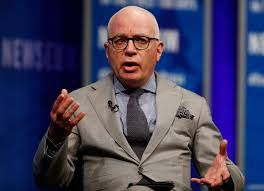
 Happy Arraignment Day!!
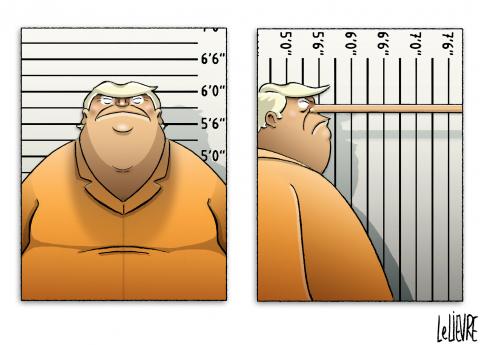 This is from David Kurtz’s
 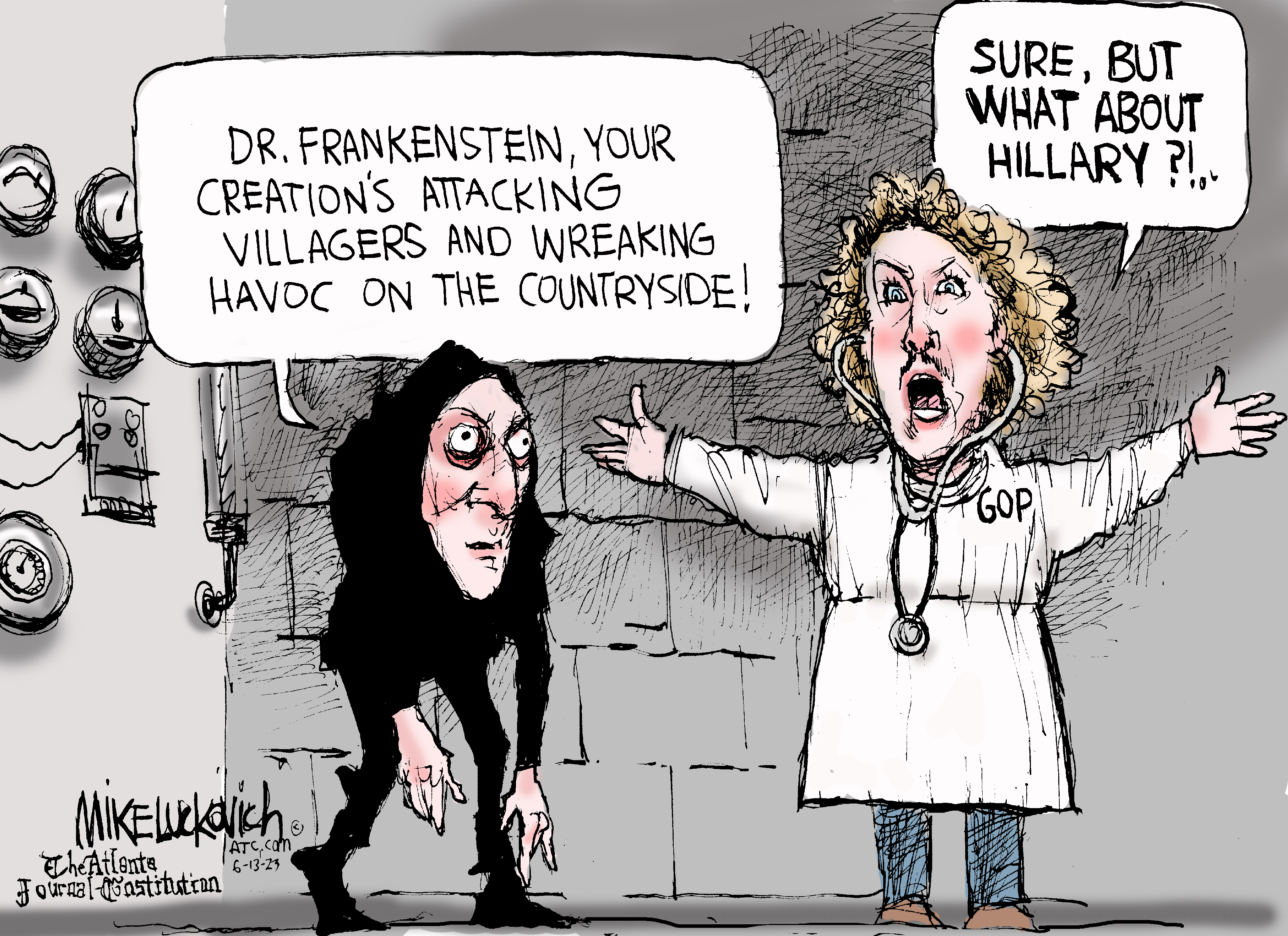 By this point, I feel sure you know the many levels these attacks play at: They effectively cow investigators and prosecutors by raising the price and the pain of enforcing the law against him; they keep everyone involved in holding him accountable looking over their shoulders at what happens if Trump wins in 2024; they unleash the less stable and more deranged among us against Trump’s perceived enemies; they are the rallying cry not just for his supporters at election time but for his appointees and subordinates and acolytes throughout government at the local, state and federal level.
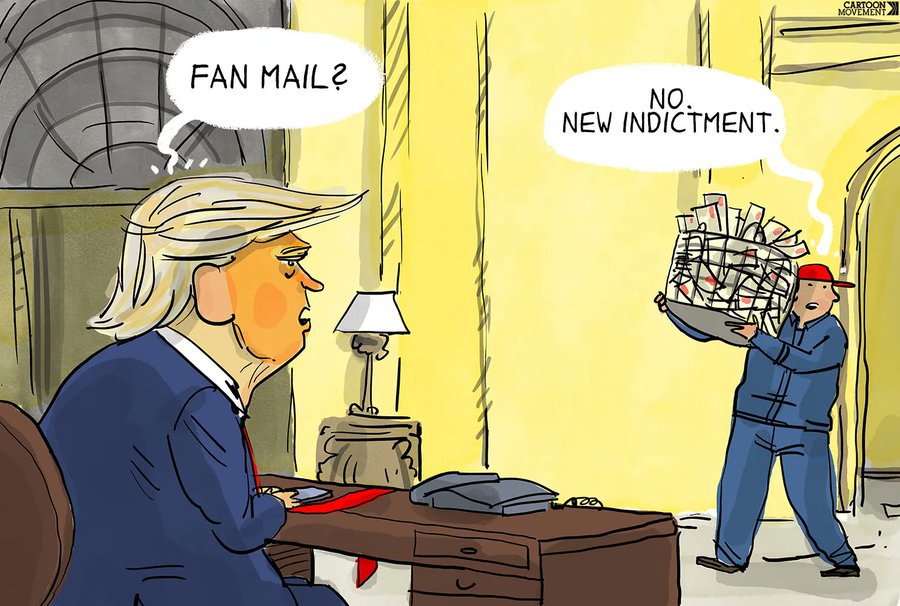 First, she could slow the case down by supporting Trump’s pointless motions. Another problem will be how she handles the classified documents:
 One serious problem for Trump is that he is having a hard time finding lawyers to defend him. Hugo Lowell at The Guardian:
 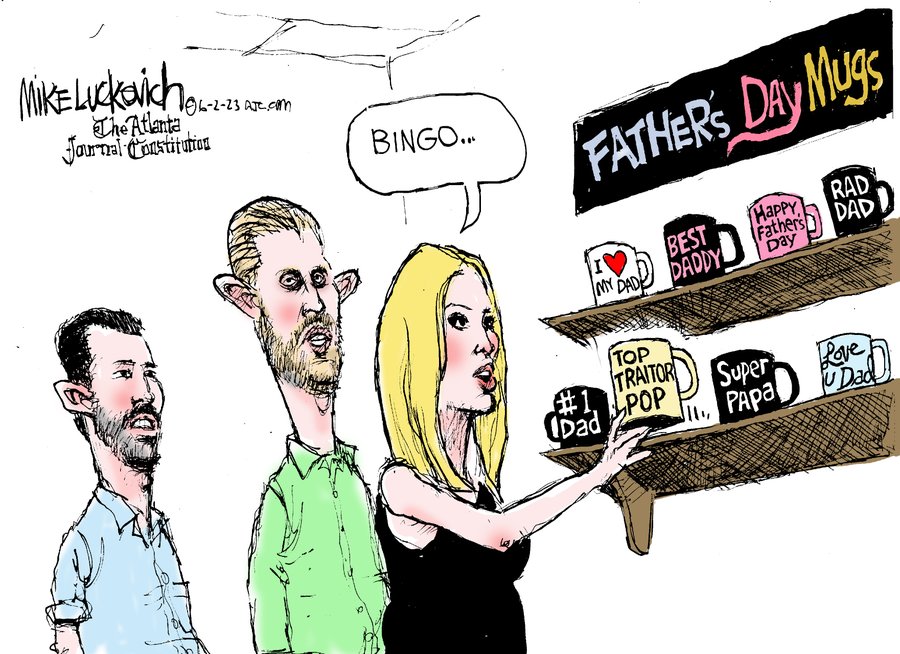 Marcy Wheeler has a post at Emptywheel about Trump’s need for a lawyer who has or would be able to obtain top secret clearance:


 The Daily Beast:


 I’m going to focus on the abortion battle today. I think it is completely inappropriate for abortion to even be a public issue in the first place, but of course regulating women’s bodies and lives has been a goal for powerful men since ancient times.
 At first blush, all of that might seem to make the decision’s chances of surviving review by a Supreme Court dominated by conservative justices quite promising.
 Also on Monday, the Justice Department filed a motion asking the U.S. Court of Appeals for the Fifth Circuit to stay the ruling by Judge Matthew J. Kacsmaryk of the U.S. District Court for the Northern District of Texas until the department’s appeal of the case could be heard. Judge Kacsmaryk, a Trump appointee who has written critically of Roe v. Wade, had issued only a seven-day stay of his ruling to allow the government a chance to appeal.
 Even before Trump and Mitch McConnell packed the Supreme Court with a right-wing supermajority, GOP-appointed justices were pursuing a brazenly anti-democratic project, which only became more audacious as each judicial attack was met with little pushback.
 peej
peej Carissa
 bostonboomer
 dakinikat
 ecocatwoman
 mablue2
 Mama Lopez
 peggysue22
 quixote
 skydancingguestblogger
 Mona (aka Wonk the Vote)



 Sky Dancing
Recent Comments