
Saturday Reads: President Obama’s Acceptance Speech
Posted: September 8, 2012 Filed under: 2012 presidential campaign, Barbara Ehrenreich, Civil Liberties, Civil Rights, Mitt Romney, morning reads, U.S. Economy, U.S. Military, U.S. Politics | Tags: acceptance speech, Charles P. Pierce, citizenship, democracy, Democratic National Convention 2012, Howard Kurtz, Michael Tomasky, Nielson ratings, Peter Beinart, Politico, self-government, Tom Junod 68 Comments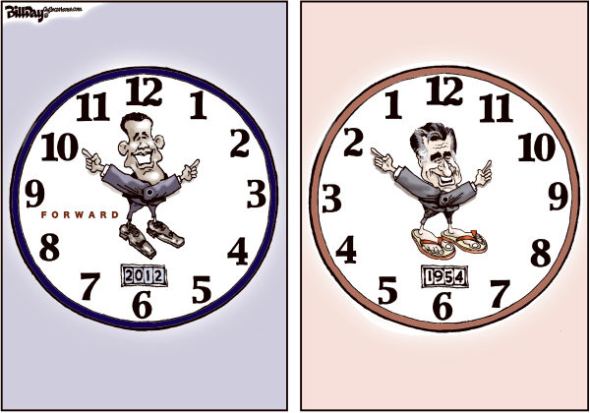
Good Morning!
Generally speaking the pundits didn’t care for President Obama’s acceptance speech on Thursday night. It’s not surprising that the guys at Politico thought it “fell flat.”
A surprisingly long parade of Democrats and media commentators described the speech less as a failure than a fizzle—an oddly missed opportunity to frame his presidency or the nation’s choice in a fresh or inspirational light.
Even those who liked the president’s performance generally went no further than saying that he was effective in doing a job that needed to be done, in a tough-minded if prosaic style.
These shoulder-shrug reactions confront Obama with a question no one expected to be asking when the week in Charlotte began: How did a president for whom stirring speeches were the engine of his rise to power manage to give, at best, only the third-most compelling speech at a convention devoted to his own re-election?
But even more liberal commentators found Obama’s speech wanting. Peter Beinart called it “underwhelming and anticlimactic.”
Obama’s acceptance speech had two apparent goals: The first was to lay out an agenda for the next four years so people feel they have something forward-looking to vote for. The second was to recapture the sense of hope that defined Obama’s 2008 campaign.
On paper, he did both things. But what the speech lacked was a coherent explanation of the nightmare this country has gone through for the last four years. Republicans are laying the Great Recession at Obama’s feet. Obama is saying that Republicans created it and, if elected, will make it worse. To win that argument, Obama needed to explain why the financial crisis happened, and he didn’t. Yes, he mocked the GOP for proposing tax cuts as the answer to every problem, but the financial crisis didn’t happen because of tax cuts. It happened, in large measure, because Republican and some Democratic politicians—blinded by free-market fundamentalism and Wall Street largesse—allowed bankers to create unregulated markets in which they gambled the savings of millions of Americans, knowing that if their bets failed, they wouldn’t be the ones to lose their homes and their life’s savings.
Obama should have told that story, and then gone at Romney for doubling down on the ideology that almost brought America to its knees. Then he should have contrasted that with his own interventions to protect people who the market has failed: whether they be auto workers or people with sick kids.
Michael Tomasky called it Pedestrian and Overconfident
Let’s be blunt. Barack Obama gave a dull and pedestrian speech tonight, with nary an interesting thematic device, policy detail, or even one turn of phrase. The crowd sure didn’t see it my way. The delegates were near delirium; to what extent they were merely still feeding off the amassed energy of the previous two nights I can’t say.
And swing voters watching at home? They probably weren’t as bored as I was, but it seems inconceivable that they’d have been enraptured. This was the rhetorical equivalent, forgive the football metaphor, of running out the clock: Obama clearly thinks he’s ahead and just doesn’t need to make mistakes. But when football teams do that, it often turns out to be the biggest mistake of all, and they lose.
Nevertheless, the final night of the Democratic Convention drew about 35.7 million viewers. The second night of the convention, when Bill Clinton spoke pulled in more views than the Giants-Cowboys game that played opposite the Convention coverage, about 25.1 million people–but nowhere near the number who watched the speeches by Vice President Biden and President Obama. Mitt Romney’s acceptance speech attracted 30.3 million viewers.
Howard Kurtz reported that Obama’s acceptance speech was deliberately “low-key.”
While the pundits are generally calling the president’s Thursday night address mediocre, Obama and his advisers had taken great pains to avoid soaring rhetoric that might have been derided as empty.
Indeed, they extensively tested the president’s speech in dial groups, a type of focus group where voters twist dials to register approval or disapproval of specific passages, and say it tested off the charts. The reaction, they say, was more positive than to Obama’s 2008 acceptance speech in Denver.
In short, the president deliberately dialed it down, stopping well short of the altitudes he is capable of reaching. Perhaps that will prove to be a mistake, but the decision to go with a less rousing approach was carefully considered.
The campaign’s primary goal at the Democratic convention was to provide a concrete sense of what Obama would do in a second term. That was what independent voters wanted, according to the research, and that was the focus in Charlotte.
Personally, I thought the first half of Obama’s speech was underwhelming, but I’ve never been a big fan of his speeches. About half-way through I thought the speech became more interesting. I was impressed that Obama admitted how difficult the job is and that he has questioned himself at times and that he has been “changed” by being President of the United States. I think the best evaluation of the speech that I read yesterday was by Tom Junod at Charles Pierce’s blog: President Obama Falls Back to Earth, Transformed. Junod’s thesis statement: “We should have known that Barack Obama would emerge from this convention conventionalized — that is, as a more conventional politician than he was when he went in. Or that we ever thought he could be.”
He didn’t rise to the occasion on Thursday night; he not only didn’t reinvent the possibilities of political language, he used language that many people had to feel they’d heard before. His speech was disappointing until, with about ten minutes to go, it acknowledged disappointment, and so began its rise. “The times have changed — and so have I,” he said. “I’m no longer just a candidate. I’m the president.” Of course, he was reminding us of his power; the fact of his presidency has become an argument for his presidency. But he was also reminding us that as a candidate who rose to power on the politics of pure potential, he is, as president, a fallen man. “And while I’m proud of what we’ve achieved together, I’m far more mindful of my own failiings, knowing exactly what Lincoln meant when he said, ‘I have been driven to my knees many times by the overwhelming conviction that I had no place else to go.'”
This was where the speech turned, and became, in its statement of humility, a statement of rousing power. “I ask you for your vote,” he said, and his commonplace words had a beseeching quality that put them outside the realm of political performance. He had failed to transform his office, and failed to transform our politics, but he sounded fully aware that he had been himself transformed.
He had started out as the Cassius Clay of our politics, brash and blinding, with an abilty to do things in the ring that no one else had ever thought of — with an ability to be untouchable. Now he stood inside the ring of stars on the blue carpeted stage of the Democratic National Convention as the Muhammad Ali whose greatness was proven after he returned to boxing bigger, slower, harder-hitting but also easier to hit. Oh, Ali got touched, all right, and since he lost his skill at avoiding punches he had to find the skill of taking them. He became a prodigy not of otherworldly gifts but rather of sheer will, and so it was with Obama in his speech on Thursday night. At an event that paid endless tributes to our wounded warriors, he rebranded himself as something of a wounded warrior himself; and at the very moment when those who remembered 2008 hoped he might say something that no one had ever heard before and maybe even reinvent, one more time, the possibilities of a word as hackneyed as hope itself, he instead completed his hard-won journey to convention.
Of course I never thought Obama was anything but an ordinary, conventional politician. As everyone here knows, I never bought the “hope and change” schtick. I never saw Obama as a great liberal savior. I was impressed with his acceptance speech, because he showed humility. By the end of the speech I was convinced that this man had matured in office, and because of that, I saw hope for his second term.
Apparently, Charlie Pierce never saw the transcendent Obama either.
I never heard the music.
People told me it was there. People told me it sang to them. People told me that its chords touched them deeply in their hearts. I watched as it make them weep and cheer. I watched as it moved them while I stood there, an unbeliever at the grotto, seeing only rocks and weeds where everyone around me saw and heard and joined in something altogether transformative. I was there in Boston when the president gave the speech that first sent him rocketing up the charts, and I didn’t hear it. Since then, I have seen him give an acceptance speech, an inaugural address, a Nobel oration, and three State of the Unions, and the only thing I remember about any of the latter is that he got heckled by some peckerwood from South Carolina, and that he called out the corporate meat-puppets of the Supreme Court in what I still believe is the finest — and certainly, the most prescient — moment of his presidency.
But I never found the poetry in it all. I thought he was a good, smart orator with some uniquely gifted writers and a talent for creating a warm and comfortable context in which people could take what they believed were all their best instincts out for a walk. I still believe that. He still reaches people at depths that I cannot fathom. He still reaches them in frequencies beyond my poor ability to hear.
That is pretty much how I’ve always reacted to Obama’s speeches. But in his convention speech, I thought I saw something more substantive. And it gave me hope. Pierce was impressed with Obama’s reference to “…the hard and frustrating and necessary work of self-government.”
That I heard. That I understood. It is not musical. It is not in any way poetic. But it is a clear line drawn between the president and the person and the party that would like to take his job from him. It is now an article of absolute faith among Republicans that “the government” is an entity separate from “the American people,” which they say the same way that the old Jesuits talked about “the mystical Body of Christ.” It is now an ironclad commandment of conservative orthodoxy that “the government” is something parasitic and alien. There is a reason why conservatives talk about “government” and not “self-government,” because to refer to the latter is to concede that “the government” is really the most basic product of our political commonwealth, that it is what we produce among ourselves so as to order the production of everything else that we do together. This is not an idle distinction. It is the entire message of last week’s Republican convention, and it is the entire message of the campaign they are planning to run, and, make no mistake, it resonates deeply with millions of people because it has been spoonfed to them as a kind of noxious anesthetic for almost foty years now, a long enough time for it to seem as though it is the natural order of things.
“…the hard and frustrating and necessary work of self-government.”
Make no mistake. This little throwaway line was the most direct, and the most serious, challenge that the president threw down at the feet of the Republican ticket on Thursday night because it strikes at the very essence of four decades of conservative political philosophy. We create “the government” we have. “The government” is not imposed from without. It is our creation. Its proper operation is our responsibility. If we do not like the way it operates, we do the hard and frustrating and necessary work to change the way it does. If we believe that it is being hijacked, we do the hard and frustrating and necessary work of using the tools of self-government to run the moneychangers out of the place. If we do not like the way the person we vote for is doing the job with which we have entrusted him — if he, say, allows the crooks who brought down the economy to walk away free, or if he perpetuates policies antithetical to civil liberties, or if he gets a little too cozy with fracking or if he gives away too much in some Grand Bargain — then we do the hard and frustrating and necessary work of self-government to hold his damn feet to the fire and say, “No further.”
Please go read the whole thing if you haven’t already. Obama articulated the key difference between today’s Republicans and the rest of us. They hate government and believe it should do nothing for people, just fund national defense and aid corporations. Most Democrats still believe that Government has a role in making people’s lives better, in ensuring that even the weakest and most vulnerable among us have rights to “life, liberty, and the pursuit of happiness.”
At the same time we citizens have the responsibility to stand up to our leaders, to voice our needs and our values, to remind our leaders that they work for us and there are certain things we won’t tolerate–whether that’s privatizing social security and medicare, limiting women’s rights, killing people with unmanned drones, limiting voting rights or some other policy that is important to us.
I think Obama’s speech got the job done. It made the convention delegates happy, and it laid a foundation for the arguments he will make over the final few weeks of the campaign. I hope he will continue to emphasize the importance of citizenship–of the necessity of every American being involved in “self-government.” That is the price of democracy.
Now what are you reading and blogging about today? This is an open thread!
How to make decisions in a democracy
Posted: November 16, 2011 Filed under: #Occupy and We are the 99 percent! | Tags: decision-making, democracy 12 CommentsI’ll say up front that I don’t know the answer. Everything that’s been tried up till now has real problems, so I’d like to throw some ideas out there. The current discussion about (the difficulty of) decision-making in the General Assemblies at #OccupyWallStreet is what jogged me to post.
Update, Nov. 16, 2011. Law enforcement is clearing out the encampments of #Occupy. That’s dictatorial, but it suggests a broadening of tactics, which would have been a good idea in any case. Too few people have the financial freedom to camp. Winter is unfriendly to campers. The Occupations could move to shift work. Groups of hundreds or thousands, whatever can be mustered, occupy for four hours, and then their replacements move in. 24/7/365. Also, come up with other actions people can take. Refusal to pay taxes (for the very brave), door-to-door explanation of ideas and suggestions for action, continuing to move money away from Big Finance, start by boycotting of the Koch Empire (Did you know they make Quilted Northern toilet paper? I didn’t either.) move on the boycotting the next worst nasties, and so on through a hundred things we could all help with.
That takes organization and the ability to make relevant decisions in real time. Neither of those can be achieved by General Assemblies. So exploring better ways to organize is more relevant than ever, unless the movement is to fall right back into old ways that haven’t proven resistant to cooptation.
It’s important to remember that democracy has to work all the time. Failure is not an option. When it fails briefly, governance ratchets toward anti-democratic. Before you know it there’s an undemocratic elite at work and you’re struggling with monopolies, or corruption, or wars. The fact that a method sometimes, or even often, works is not good enough.
So, first, democratic decision-making methods that sometimes fail:
- Direct popular majority vote. Sometimes called “tyranny of the majority” because it can be so anti-democratic in its treatment of large minorities.
- Indirect popular vote, e.g. Electoral College. If it has no real power, it has the same problems as direct popular vote. If it does have power, it’s liable to ignoring the will of the people, i.e. being anti-democratic, at the least, and corrupt at the worst.
- Super-majority vote. This is an attempt to prevent the exclusion of large minorities. In practice, it gives veto power to minorities, which is also anti-democratic. Decision-making becomes too slow and unwieldy to respond adequately to reality. (Look at California trying to deal with its budget mess.) Another effect in practice can be the formation of a much smaller group of real decision-makers who then use the official consensus process as window-dressing. (E.g. European Union in the current financial crisis, Spokes Councils in OWS General Assemblies.)
- Decision-making by committee. Another way of trying to achieve consensus decisions. The problems are that responsibility becomes spread too thin, and social dynamics play a larger role than the merits of the case. Both of those factors make it easy to take bad decisions.
Whenever large numbers of people have to come to a decision together, structural factors work anti-democratically. It’s not bad outside influences that corrupt the process (although they can). It’s decision-making by large numbers of people that doesn’t work. Since the will of large numbers of people is the essence of democracy, we have a problem.
Right now, the idea is that voters steer government. But voters are proving terrible at governing. Who wants to do all the homework involved? You have to know the issues, study the background facts, and evaluate implications. It’s a full time job, and most voters already have a full time job.
It’s much easier to tell when something is wrong. And it’s much easier to mobilize voters to throw the bums out.
The problem of preserving democracy should be approached from the other end. Instead of trying to steer government, voters should be smashing messes into small enough pieces to cart away. Preventing the ratchet toward elitism can only be done by continual corrections. Without them, the inevitable imperfections in any system will ultimately lead to failure. Voters are well-positioned to provide corrections. It’s hard to suborn such a large group. And, practically by definition, most of them won’t be part of the elite, so they won’t be blinded by class loyalties.
As for how to implement it, votes could be held every so often (once a year?) to recall hopeless administrators or reverse decisions that people feel aren’t working out. (That and all the ideas here are more completely discussed in Re-imagining Democracy, Government, Decision-making.)
Voters might — I think would — be able to provide course corrections, but that still means somebody has to hold the actual steering wheel. Somebody has to do the business of government, so there is the question of how any decisions get made in this system.
To answer that it’s worth thinking about what government actually is. (When it’s not a pot for personal power and riches.) Government is a lot of tedious housekeeping for the social good, in other words for no direct benefit. It’s cleaning up other people’s messes and sorting out stupid fights and trying to come up with rules to keep the messes and fights to a minimum. It takes very skilled, knowledgeable, and fairly unselfish people to do that.
The bad news is that we’re terrible at finding those people. The good news is that I don’t think we have to.
What we’ve done so far is used a purely random system. The lottery may be genetic, as in hereditary monarchies, or it may be by self-selection, as it is in democracies. (There are no job-related qualifications to run for office. Anyone can play.) And even though the random systems produce plenty of charlatans and failures, we have survived. So randomness, by itself, need not be feared.
If we improved the pool from which random selections are made, we might improve the whole process. We could still have the democratic advantages of randomness for preventing elitism, and yet reduce the disadvantage of having complete amateurs running the show.
I think it’s actually easy to come up with an improved selection process.
Let people self-select to put themselves in the pool and list their background showing their administrative abilities. People would then review the pool to winnow it to those who actually have successfully administered something, whether it’s the yearly school fair or an aluminum smelter. It could work somewhat like rating schemes on the web. Readers would rate some limited number of resumes.
One big difference is essential, however. Other people’s ratings should not be visible. It’s important for the ratings to be independent, otherwise they immediately fall into confirmation of the earliest favorites. The ratings should be purely a pass-no pass based on whether the candidate has the experience they say they have. Candidates for positions requiring special knowledge would be reviewed by people with the relevant education or work experience.
The process would be most convenient if computerized, but even without computers, all you’d need is central locations for the lists, like public libraries or meeting places, to make it work. If it turns out people can’t be bothered with ratings voluntarily, it could be a jury duty type of obligation.
The administrator would then be randomly selected, i.e. by lottery, from the candidates still in the pool after that. The pool could be refreshed on an ongoing basis, and numerous administrators could be drawn from each relevant pool. In other words, you wouldn’t go through the whole process every time the community needs a municipal dogcatcher.
The administrator would stay in as long as they kept doing a good job by various metrics, or until the voters chucked them out. Administrators at higher levels, such as state, province, or nation, could be chosen from the pool of those who’d done a good job (as evidenced by no recalls or few complaints) at a lower level.
There are several advantages to that system. Anyone can play, and yet there are some job-related qualifications. There are no unrelated job qualifications, such as being rich or looking good on television. People who prove incompetent can be ousted on a regular basis. There are no obvious points at which an elite group of insiders could develop. And it could even be easy to ensure that administrators reflect the composition of the general population by limiting the lottery to candidates who meet gender or racial criteria.
Of course, there are bound to be disadvantages, too. They’d become evident if the system was tried.
Ideally, it would be a method that allows competent administrators to do the tedious work of government without at the same time hijacking it for themselves.
Or, in an OWS context, it could identify order-keepers and finance officers and media relations experts who could approach their work with experience and professionalism. But their actions would be subject to public scrutiny. They’d operate in the open, not in a clique, and they’d be subject to recall if they did their jobs badly. I see a system of randomly selected, knowledgeable, responsible individuals who are answerable to the group as a much more democratic solution to the problem of unwieldy General Assemblies than the formation of inner Spokes Councils who have power because they took it.
What the system doesn’t do is decide overall policy. People still have to agree on the social contract, the constitution, on some statement of principles. In an OWS context, people still need to decide whether they care about non-financial inequalities, like sexism. Or whether they care about the use of violence. Or meetings held at times when the people who are the point of the meetings can’t attend.
Once there is a statement of principles, however, the function-or-be-fired system does show the way toward finding people to actually carry out those principles in practice, and to getting rid of them if they don’t.
Thursday Reads: Power to the People!
Posted: November 3, 2011 Filed under: #Occupy and We are the 99 percent!, Foreign Affairs, France, Germany, Greece, Italy, morning reads, Spain, U.S. Economy, U.S. Politics, unemployment | Tags: Angela Merkel, austerity, democracy, Eurodammerung, George Papandreau, Greece, Nicolas Sarkozy, Oakland general strike, Paul Krugman, Robert Reich 40 Comments
Good Morning!! Over the past couple of days, I’ve become really fascinated with the situation in Greece. It’s a pretty fluid situation at the moment. On Tuesday Robert Reich wrote a pretty good primer on what is happening and expressed his view that letting the Greek people decide their own fate is the best idea. Here’s a bit of it:
Greek Prime Minister George Papandreou decided in favor of democracy yesterday when he announced a national referendum on the draconian budget cuts Europe and the IMF are demanding from Greece in return for bailing it out.
(Or, more accurately, the cuts Europe and the IMF are demanding for bailing out big European banks that have lent Greece lots of money and stand to lose big if Greece defaults on those loans – not to mention Wall Street banks that will also suffer because of their intertwined financial connections with European banks.)
If Greek voters accept the bailout terms, unemployment will rise even further in Greece, public services will be cut more than they have already, the Greek economy will contract, and the standard of living of most Greeks will deteriorate further.
If Greek voters reject the terms and the nation defaults, it will face far higher borrowing costs in the future. This may reduce the standard of living of most Greeks, too. But it doesn’t have to. Without the austerity measures the rest of Europe and the IMF are demanding, the Greek economy has a better chance of growing and more Greeks are likely to find jobs.
Shouldn’t Greek citizens make this decision for themselves?
Reich argues that it would have been better in the long run if the American people had been consulted about the bank bailouts here.
If Americans had been consulted about the 2008-2009 Wall Street bailout, I doubt it would have happened the way it did. At the very least, strict conditions would have been placed on the banks in return for the money. The banks would have had to eat the losses of the predatory mortgages they sold, and help homeowners reduce those mortgages. They’d be required to improve the capitalization of small banks in communities across the country. They’d be forced to accept stringent new regulations, including resurrection of Glass-Steagall
But we weren’t consulted. The wishes of the American people were considered irrelevant by the oligarchs who run this country. And the European oligarchs are hoping to prevent the Greek people from claiming a right to make a democratic decision.
Of course if the Greek people do decide to default on their debts, there will be serious consequences–for them and for the rest of Europe. Krugman calls it “Eurodämmerung.” He argues that
…the euro was an inherently flawed idea that can work only given a strong European economy and a significant degree of inflation, plus open-ended credit to sovereigns facing speculative attack. Yet European elites embraced the notion of economics as morality play, imposing across-the-board austerity, tightening money despite low underlying inflation, and have been too concerned with punishing sinners to notice that everything was going to blow apart without an effective lender of last resort.
The question I’m trying to answer right now is how the final act will be played. At this point I’d guess soaring rates on Italian debt leading to a gigantic bank run, both because of solvency fears about Italian banks given a default and because of fear that Italy will end up leaving the euro. This then leads to emergency bank closing, and once that happens, a decision to drop the euro and install the new lira. Next stop, France.
Yikes! But Fortune also says Italy and France are in trouble if Greece defaults. And Spain could go bust too.
What worries is that Spain and Italy are not in the Greek situation but they could be. Greece is bust and Spain and Italy could be driven bust. They both have a lot of debt and each year some of that debt has to be repaid. Now governments almost never do repay debt, they just borrow some more and use the new money to pay off the old. Bit like swirling what you owe around a few credit cards.
Which is just fine: except, if interest rates rise then they have to pay more interest on this new debt that they’re issuing to pay off the old. And if interest rates rise enough then they do go bust, as the interest payments they have to make take too much money out of the budget. Switching money around on zero interest introductory rate cards is very different from doing it when you’re being charged 30%.
Now, the general agreement is that when the interest rates are above 6% then Italy and Spain are in danger of going bust. When they’re over 7% they will do so. But of course, when people see that Italian interest rates are above 6% then they become more wary of lending Italy any more money and so interest rates keep on rising to possibly above 7% and game over.
It’s still not clear what Greece is going do in their referendum. Dakinikat says they need to ask the people if they want to leave the European Union or not. German Chancellor Angela Merkel and French President Nicolas Sarkozy have said that the referendum must ask the Greek people if they want to opt out of the Euro, but not the EU itself. Meanwhile, the offer of a bailout of Greece has been called off until after the vote on the referendum is taken. From Naked Capitalism:
The Eurocrats have decided to try to push Greece into line, threatening expulsion from the Euro (note, not the EU) if Greece does not back down. From a practical matter, if the Greeks were to turn down the bailout package, it would lead to a banking crisis, making a Eurozone exit a not that much more traumatic incremental move with considerable upside. And under the Maastrict treaty, Greece cannot unilaterally exit (although as various commentors have pointed out, Nato is not going to send in tanks if the Greeks were to do so).
But this may be an appeal to the Greek public, or more likely, an effort to break Greek prime minister’s Papandreou’s thin coalition on the eve of a vote of no confidence.
So that’s another possibility–that Papandreau’s government might fall. More on the European reaction from Bloomberg:
Led by Germany and France, Europe’s economic and political anchors, the euro’s guardians yesterday cut off financial aid for Greece until a vote they said would be on Dec. 4 or Dec. 5 determines whether it deserves a fresh batch of loans needed to stave off default.
“The referendum will revolve around nothing less than the question: does Greece want to stay in the euro, yes or no?” German Chancellor Angela Merkel told reporters after crisis talks hours before a Group of 20 summit set to begin today in Cannes, France. French President Nicolas Sarkozy said Prime Minister George Papandreou’s government won’t get a “single cent” of assistance if voters rejects the plan.
The hardball tactics open the door for a nation to leave the currency bloc that at its setup in 1999 capped Europe’s progression from war to prosperity and was declared “irrevocable” by its founding fathers. Polls show most Greeks object to the austerity required for aid, yet more than seven in 10 favor remaining in the euro, a survey last week of 1,009 people published in To Vima newspaper showed.
They’re going to have to decide between two awful choices, and the rest of Europe will have to deal with the results of the vote–if there is a default, failures of banks that hold Greek debt and getting Italian, French, and German taxpayers to pay for more bank bailouts–unless Papandreau’s government falls. Read the whole article at Bloomberg to get a sense of how serious all this is.
In U.S. news, Occupy Oakland called for a general strike today. That situation is still fluid as of this writing, 11PM Eastern on Wednesday night.
OAKLAND – Protesters blocked streets near City Hall, smashed windows at a bank and gathered by the thousands in an attempt to shut down the nation’s fifth-busiest port Wednesday.
The Occupy Oakland protest was the largest in a series of rallies in several cities as the Occupy Wall Street movement that began Sept. 17 tried to grab national attention.
A group of about 300 protesters, many of them men wearing black, some covering their faces with bandanas and some carrying wooden sticks, smashed windows of a Wells Fargo bank branch while chanting “Banks got bailed out. We got sold out.”
Are you getting the feeling this genie can’t be put back in the bottle either? The Occupy demonstrations have shown us that we pretty much live in a police state at this point. There very little respect for the protesters’ constitutional rights by local governments or law enforcement. From Counterpunch, here is a report of what actually happened when police attacked protesters in Oakland on Oct. 25.
In a heavily armed pre-dawn raid, on Tuesday, Oct. 25, with back up from armored vehicles and helicopters, the Oakland Police Department in conjunction, with over 15 other police departments from Northern and Central California, stormed the sleepy Occupy Oakland Encampment.
Asleep inside tents of the makeshift Occupy encampment, were over a hundred men, women and very young children. The heavily armed police force, dressed in black ninja-like outfits, and special forces helmets, with full face-shields down, and armed with and assortment of latest riot gear, fired tear gas canisters and concussion grenades into the camp, as helicopters circled above.
Police then attacked and ransacked the entire encampment. In a short time, the camps library, soup kitchen, and children’s center were left in ruins, and over a hundred of the inhabitants were roughed up, arrested and held on high bail. The activists suffered many injuries, including broken bones.
Please read the whole thing–it’s an eyewitness account of a horrifying paramilitary action by police. As everyone knows, Iraq war veteran Scott Olson was critically injured in the melee.
Late last night as part of the general strike, Oakland protesters succeeded in shutting down the Port of Oakland.
Several thousand Occupy Wall Street demonstrators forced a halt to operations at the United States’ fifth busiest port Wednesday evening, escalating a movement whose tactics had largely been limited to rallies and tent camps since it began in September.
Police estimated that a crowd of about 3,000 had gathered at the Port of Oakland by early evening. Some had marched from the California city’s downtown, while others had been bused to the port.
Port spokesman Isaac Kos-Read said maritime operations had effectively been shut down. Interim Oakland police chief Howard Jordan warned that protesters who went inside the port’s gates would be committing a federal offense.
In New York, Los Angeles and other cities where the movement against economic inequality has spread, demonstrators planned rallies in solidarity with the Oakland protesters, who called for Wednesday’s “general strike” after an Iraq War veteran was injured in clashes with police last week.
Organizers of the march said they want to stop the “flow of capital.” The port sends goods primarily to Asia, including wine as well as rice, fruits and nuts, and handles imported electronics, apparel and manufacturing equipment, mostly from Asia, as well as cars and parts from Toyota, Honda, Nissan and Hyundai.
We knew there would eventually be civil unrest, and now we’re seeing it all over the world and here at home. What next? I’d say 2012 is going to be an eventful year.
With that, I’m going to wrap this up. I know there’s lots of other news, but these two stories–Greece and the general strike in Oakland–seem to me to symbolize what’s happening in the world today. People are sick and tired of being bilked by the super-rich, and ignored by the politicians. It’s so chaotic, yet I feel that the only hope we have is for the people to keep resisting as best they can. For so long, I was afraid nothing would wake American up, but I’m finally getting the feeling that we won’t go down without a fight. Let’s keep the elites nervous!
Sooooo… what are you reading and blogging about today?
Hillary Clinton on Libya: “Nothing is Off the Table”
Posted: March 1, 2011 Filed under: Foreign Affairs, Libya, U.S. Military, U.S. Politics | Tags: Civil War, democracy, Hillary Clinton, Libya, no-fly zone, State Department 26 Comments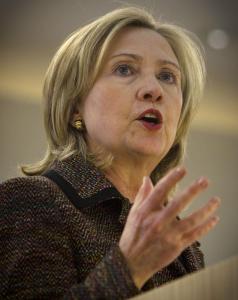
Hillary Clinton speaking in Geneva (Fox News)
CNN: From Geneva, Switzerland yesterday, Secretary of State Hillary Clinton warned that
“nothing is off the table” as the United States works with allies to stop the bloodshed in Libya where embattled leader Moammar Gadhafi struggles to remain in power. But as the Pentagon confirms that the United States is “repositioning” naval and air forces to be prepared for any option with Libya, Secretary Clinton said there is no pending U.S. naval actions planned against Libya. “We do believe that there will be the need for support for humanitarian intervention,” she said when asked about the reports.
[….]
Clinton’s remarks come as she meets with European Union ministers. Monday the EU agreed to impose economic sanctions on Libya, including an arms embargo, freezing Ghadaffi’s assets and banning travel to Libya. This is the latest action after the United States announced similar sanctions Friday.
Speaking to reporters, Clinton said that U.S. humanitarian teams have been sent to Libya’s borders of Tunisia and Egypt. Clinton said USAID has set aside an additional $10 million for humanitarian aid including much needed medical supplies.
Today, Hillary was back in Washington, and she went to Capital Hill to testify before the House Foreign Affairs Committee and argued, in so many words, that cutting diplomatic funds to deal with foreign crises would be penny-wise and pound foolish
The comments came a day after the US began repositioning warships and military aircraft in the Libya region.
Mrs Clinton repeated demands that Col Muammar Gaddafi “must go now, without further violence or delay”.
“The entire [Middle East] region is changing, and a strong and strategic American response will be essential, Mrs Clinton said to the House of Representatives Foreign Affairs Committee in prepared testimony.
“In the years ahead, Libya could become a peaceful democracy, or it could face protracted civil war. The stakes are high.
Voice of America provided more information on from Hillary’s Congressional testimony:
Clinton said the U.S. is sending humanitarian and military teams to help those fleeing Libya for Tunisia and Egypt. She called the situation in Libya an example of how the State Department must use diplomatic resources to sustain and advance U.S. security.
Clinton’s testimony comes as the U.S. Congress battles over the country’s proposed budget, with some lawmakers demanding deep cuts in spending. But she warned members of the House Foreign Affairs Committee that reductions in diplomatic spending could come at a high cost.
She said a failure to fund civilian missions in places like Afghanistan, Pakistan and Iraq could cause military gains to erode or be erased.
Clinton said shifting responsibilities from military to civilian efforts saves money. She said the U.S. military’s total worldwide request dropped by $45 billion from 2010, while the State Department’s cost will increase by less than $4 billion.
It sounds like the US and other Western countries are nearing a decision about whether to intervene in some way in the carnage in Libya. On Al Jazeera there has been more talk of imposing a no-fly zone over Libya, but a number of commentators have pointed out that this would be a very serious step. It means that those enforcing the no-fly zone would be committed to shooting down violators. It would also mean taking out Libya’s air defenses. In other words, it means military action in Libya.
It will be interesting to see what the next step will be. It certainly does feel as we are building toward something serious.
Saturday Night Specials
Posted: February 12, 2011 Filed under: Algeria, Foreign Affairs, just because, open thread | Tags: Algeria, democracy, extending the Patriot Act, Obama FISA support 12 Comments
The Martini dakini
There’s a lot going on to think about during this weekend that’s generally reserved to celebrate the sale of mattresses, bad candy, and greenhouse flowers.
First, Is Algeria the next democracy domino in the MENA region? Also, why can’t I get any newspaper or TV news channel in this country to tell me about it? Let’s start helping these folks out too!!
Internet providers were shut down and Facebook accounts deleted across Algeria on Saturday as thousands of pro-democracy demonstrators were arrested in violent street demonstrations.
Plastic bullets and tear gas were used to try and disperse large crowds in major cities and towns, with 30,000 riot police taking to the streets in Algiers alone.
There were also reports of journalists being targeted by state-sponsored thugs to stop reports of the disturbances being broadcast to the outside world.
But it was the government attack on the internet which was of particular significance to those calling for an end to President Abdelaziz Boutifleka’s repressive regime.
Protesters mobilising through the internet were largely credited with bringing about revolutions in Egypt and Tunisia.
“The government doesn’t want us forming crowds through the internet,” said Rachid Salem, of Co-ordination for Democratic Change in Algeria.
The Obama administration’s Justice Department has asserted that the FBI can obtain telephone records of international calls made from the U.S. without any formal legal process or court oversight, according to a document obtained by McClatchy.That assertion was revealed — perhaps inadvertently — by the department in its response to a McClatchy request for a copy of a secret Justice Department memo.
Critics say the legal position is flawed and creates a potential loophole that could lead to a repeat of FBI abuses that were supposed to have been stopped in 2006.
The controversy over the telephone records is a legacy of the Bush administration’s war on terror. Critics say the Obama administration appears to be continuing many of the most controversial tactics of that strategy, including the assertion of sweeping executive powers.
So, this is an open thread, but I thought I’d share something with you. This is the famous Emma Lazarus poem that is etched into the pedestal of the statue of Liberty.
The New Colossus
Not like the brazen giant of Greek fame,
With conquering limbs astride from land to land;
Here at our sea-washed, sunset gates shall stand
A mighty woman with a torch, whose flame
Is the imprisoned lightning, and her name
Mother of Exiles. From her beacon-hand
Glows world-wide welcome; her mild eyes command
The air-bridged harbor that twin cities frame.
“Keep ancient lands, your storied pomp!” cries she
With silent lips. “Give me your tired, your poor,
Your huddled masses yearning to breathe free,
The wretched refuse of your teeming shore.
Send these, the homeless, tempest-tost to me,
I lift my lamp beside the golden door!”
Do you think it still applies?

 peej
peej Carissa
 bostonboomer
 dakinikat
 ecocatwoman
 mablue2
 Mama Lopez
 peggysue22
 quixote
 skydancingguestblogger
 Mona (aka Wonk the Vote)



 Sky Dancing
Recent Comments