
Late Night Post: a Rogue and/or Broken Nation
Posted: October 3, 2011 Filed under: 2012 presidential campaign, Barack Obama, Civil Liberties, Civil Rights, Congress | Tags: corruption, executive power, kleptocracy, unchecke executive power 16 Comments There’s a pretty good amount of twitter chatter and blog posts on these thoughts at interfluidity by steve randy waldman. I understand the draw because I’ve had very similar thoughts and expressed many of them recently. I thought this would be a good discussion post to follow BostonBoomer’s last post too since it’s very much related to the post called “an echo”.
I no longer trust my own government to be the provider of a civilized society. No government is perfect or without corruptions. But in 2007, I thought I lived in a remarkably well-governed nation that had gone off-kilter under a small and mean administration. In 2011, I view my government as the sharp edge of an entrenched kleptocracy, engaged in ever more expansive schemes of surveillance and arrogating powers of ever less restrained brutality. At a visceral level, I dislike President Obama more than I have disliked any politician in my lifetime, not because he is objectively worse than most of the others — he is not — but because he disproved my hypothesis that we are a country with basically good institutions brought low by poor quality leadership. Whenever I hear the President speak and am impressed by the quality of his intellect, by his instinct towards diplomacy and finding common ground and rising above petty struggles, I despair more deeply. Not just because a leader of high quality failed to restore passably clean and beneficient government. It is worse than that. The kleptocracy has harnassed this man’s most admirable qualities and made them a powerful weapon for its own ends. He has rebranded as “moderate”, “adult”, “reasonable”, practices such as unaccountable assassination lists and Orwellian nonhostilities. He has demostrated that the way grown-ups get things done in Washington is by continually paying off thieves in suits. Perhaps it is unfair to blame Barack Obama for all this. Maybe he has done the very best a person could do under our present institutions. But then it is not unfair to detest the institutions, to wish to see them clipped, contained, or starved.
This message is followed by a mea culpa expressing profound regret for supporting the Bush Administration and the Iraq War. Also, there’s a link to the Salon article“The due-process-free assassination of US citizens is now a reality” from Glenn Greenwald which is something we’ve previously discussed. What drug me to the post was a response over at The Atlantic by Conor Friedersdorfer who was just quoted on BB’s post. We’re treated to some of the top ten abysmal hits of the past few years. The bailout of banks while their bad business models still wreck havoc on our neighbors and in our cities and towns is there. The normalization of torture and spying on citizens is listed plus a few other things that I’ve come to view as a bigger problem now than the issues surrounding Watergate and Vietnam were then.
We’ve been lied to before. We’ve had a few of our citizen’s rights stomped about but nothing quite so systematic and unchecked. It also seems that our institutions and especially our courts were resilient enough to stand their grounds in the past. There were people who stood on our principles. I’m not seeing any institutional response to the lying and executive branch power grab from Congress or the Courts or the loudest and most followed parts of the Media.
We’ve had absolutely no recompense or justice for the atrocities against liberty that we’ve experienced since 9/11. None at all. This is what led Fiedersdorfer to ask if we were suffering from rogue leadership or broken institutions. What ever the source, we’ve been acting like a rogue and broken nation for nearly a decade and it’s as worrisome as it is depressing. He argues that we’ve had broken leadership during this century and that our institutions will heal. I only wish I had his optimism.
Before pinning the blame on American institutions, let’s ponder how radically different the status quo would be if we merely adhered to longstanding laws and norms, rather than permitting our leaders to flout them in the name of protecting us from terrorism or financial collapse.
Had the Bush Administration followed the law, it never would have tortured prisoners or started secretly spying on American citizens without a warrant. If Barack Obama was as committed to fulfilling our treaty obligations as pushing his domestic agenda in an optimized political climate, he’d have investigated and prosecuted the Bush officials complicit in torture. As President Reagan wrote upon sending the Convention Against Torture to the Senate that ratified it, “Ratification of the Convention by the United States will clearly express United States opposition to torture, an abhorrent practice unfortunately still prevalent in the world today. The core provisions of the Convention establish a regime for international cooperation in the criminal prosecution of torturers relying on so-called ‘universal jurisdiction.’ Each State Party is required either to prosecute torturers who are found in its territory or to extradite them to other countries for prosecution.”
In Libya, where Obama violated the War Powers Act, and in various countries where President Obama is waging undeclared drone wars, more scrupulous adherence to the law would force radical changes in American behavior — as would a modicum of congressional leadership, since the body has for years abdicated its responsibility. The Founders envisioned three branches of government acting as checks on one another, the members of each zealously guarding their authority and pushing back against excesses committed by their fellow branches.
Is Goldman CEO Lloyd Blankfein Facing Possible Prison Time?
Posted: August 24, 2011 Filed under: Corporate Crime, Crime, The Bonus Class, U.S. Economy, U.S. Politics | Tags: corporate crime, corruption, Goldman Sachs, Lloyd Blankfein, Naomi Prins, Reid Weingarten, Senate Permanent Subcommittee on Investigations 4 Comments
Lloyd Blankfein
That’s the question Naomi Prins, a former managing director of Goldman Sachs and author of It Takes a Pillage: Behind the Bonuses, Bailouts, and Backroom Deals From Washington to Wall Street, asked yesterday at The Daily Beast.
I posted in a comment yesterday that I’d heard Blankfein hired a well-known Washington criminal defense attorney. Since then, the business media has been buzzing about why Blankfein hired attorney Reid Weingarten.
Big-shot Washington defense attorney Reid Weingarten, of the firm Steptoe & Johnson LLC, has represented former Enron chief accounting officer Richard Causey (who pleaded out), former Rite Aid vice chairman and chief counsel Franklin Brown (found guilty by a jury on 10 counts of conspiring to falsely inflate his company’s value), and former WorldCom CEO Bernie Ebbers (convicted on nine felony counts by a jury). All three are in jail. Two of them, Ebbers and Causey, had undergone congressional panel investigations beforehand. Another of Weingarten’s clients, former Tyco counsel Mark Belnick, was acquitted, though Tyco CEO Dennis Kozlowski, who was not represented by Weingarten, was convicted and remains in jail.
Prins speculates that Blankfein may be in trouble for two possible reasons. The first is because of his own “loose lips,” when he testified before the Senate Permanent Subcommittee on Investigations in April.
Recall that Blankfein emphatically told the subcommittee, “We didn’t have a massive short against the housing market, and we certainly did not bet against our clients.” The 650-page subcommittee report (PDF) presented on April 13, 2011, which cites Blankfein 79 times, begs to differ.
The report accused Goldman of trading against its clients by simultaneously shorting certain subprime mortgage securities (a.k.a. “cats and dogs”) while stuffing them into the collateralized debt obligations it sold. It also suggested that Goldman executives, including Blankfein, misled Congress in testimony surrounding the Abacus CDO, Hudson, Timberwolf, and other deals, by saying it didn’t have a big short.
The second possibility is that Blankfein’s colleagues are distancing themselves from him in order to protect themselves and Goldman Sachs. Prins writes:
The top lesson I learned before leaving Goldman in the wake of Enron was Goldman’s foremost internal policy is to protect Goldman. It’s also to protect the most powerful members. When cracks manifest in the corporate armor, those two policies are at odds.
The executives running Goldman are exceedingly wealthy, not least because when the firm faced its darkest hour and lowest stock price in years during the bank-created crisis of fall 2008, the government provided it billions of dollars in the form of cheap loans, FDIC debt guarantees, TARP, AIG make-wholes, and a late-night moniker change from investment bank to bank holding company, giving the firm access to excessive Federal Reserve aid.
After the news came out that Blankfein had hired Weingarten, Goldman’s shares fell 6%, and according to Prins, that kind of thing is “frowned upon.” So Blankfein may be be trying to protect himself from being stabbed in the back by his co-workers in addition to fighting anything the Justice Department has planned for him.
I doubt if Obama and Geithner will let Blankfein go to prison, but it will be fun to watch him and the wealthy Goldman partners feeling a little bit of discomfort.
Two Reuters columnists speculated about this story today. Leigh Jones writes:
If you need to hire Reid Weingarten, your career has probably hit a rough patch.
The rule now applies to Goldman Sachs (GS.N) CEO Lloyd Blankfein, who Reuters reported on Monday has retained Weingarten, a partner at Steptoe & Johnson in Washington.
With that move, Blankfein becomes the latest in a long line of executives and high-profile people in trouble who have turned to Weingarten for help. They range from Tyco (TYC.N) corporate counsel Mark Belnick, for whom Weingarten won an acquittal, to ex-Enron accounting officer Richard Causey, who pleaded guilty to fraud and conspiracy, to film director Roman Polanski, who tapped Weingarten to fight extradition to the Unites States for sexually assaulting a 13-year-old girl in 1977.
Jones spends most of the piece providing background on Weingarten, but he also points out that Blankfein’s choice of attorney is telling, and like Prins he notes the market reaction:
Blankfein’s choice of Weingarten as his lawyer has raised questions about what kind of trouble the Goldman Sachs CEO might be in. The DOJ, where Weingarten once worked, is investigating the bank for mortgage-related investments it made.
While it is not unusual for company leaders to arm themselves with their own lawyers, Weingarten’s reputation as a litigator — as opposed to a lawyer who guides clients through investigations — is making Goldman investors nervous. The day that Blankfein’s hiring of Weingarten broke, the bank’s stock dropped nearly 5 percent to its lowest level since March 2009. By late Wednesday afternoon, the shares were at $109.92, up 3.2 percent from Monday’s close at $106.51.
Alison Frankel is more sanguine, arguing that Blankfein hiring an outside attorney is really no big deal.
The market assumed the worst on Monday after Reuters’ great scoop on Goldman Sachs (GS.N) CEO Lloyd Blankfein bringing in Reid Weingarten of Steptoe & Johnson to represent him in the Justice Department’s investigation of the bank. Goldman’s share price fell almost 5 percent on the fear that Weingarten’s entrance signals that DOJ is getting serious about its follow-up to the April 2011 Senate subcommittee report on the financial crisis.
In one sense, that’s reading way too much into the mere fact that Blankfein has brought in his own lawyer. It’s standard operating procedure for corporate executives at companies under investigation to have separate counsel. Consider the example of other alleged villains of the financial meltdown. Richard Fuld of Lehman (LEHKQ.PK), Joseph Cassano of AIG (AIG.N), Angelo Mozilo and David Sambol of Countrywide, John Thain of Merrill Lynch, Kenneth Lewis of Bank of America (BAC.N): They all have their own lawyers, and none of them have faced any criminal charges. Only Mozilo and Sambol even had to answer to the SEC.
She provides a number of examples of other executives doing just that. But…
Nevertheless, Blankfein’s choice of Weingarten is very intriguing. Weingarten is a great lawyer with close ties to the Justice Department, where he once worked in the Public Integrity section, and to Attorney General Eric Holder, whom he actually represented when Congress grilled Holder about President Bill Clinton’s eleven-hour pardon of financier Marc Rich. Weingarten is not, however, part of the club of white-collar defense counsel who typically get referrals from New York firms like S&C. (That group includes Andrew Levander of Dechert; Mary Jo White of Debevoise & Plimpton; Patricia Hynes of Allen & Overy; and Gary Naftalis of Kramer Levin Naftalis & Frankel, all of whom represent high-profile Wall Streeters in financial crisis cases.)
One white-collar defense lawyer who gets referrals from Wall Street firms told me it could be significant that Blankfein went outside the usual circle, turning to a lawyer best known for his trial work. “For many people, the choice of Reid Weingarten would be unusual to represent someone in a simple interview,” he said. “He’s often retained when an investigation is going to lead to a case that would go to trial.”
Hmmmm…. Okay, I’ll believe it when I see it, but I can dream, can’t I?
Righteous Rants Open Thread
Posted: August 10, 2011 Filed under: U.S. Economy, U.S. Politics, unemployment, voodoo economics | Tags: Al Sharpton, Bernie Sanders, corruption, David Goodfriend, Dylan Ratigan, jobs, Joe Biden, Keith Ellison, righteous rants, tax cuts, trade deals 18 CommentsDylan Ratigan goes nuts over government corruption
————————————————
David Goodfriend (on Dylan Ratigan Show) explains why cutting taxes doesn’t create jobs
————————————————
Bernie Sanders schools Obot Al Sharpton on the debt deal, plus Keith Ellison
————————————————
Heard any good rants lately?
Why We Should Worry about Michele Bachmann
Posted: June 20, 2011 Filed under: 2012 presidential campaign, Barack Obama, Media, Republican politics, U.S. Politics | Tags: 2012 presidential election, agricultural subsidies, Bobby Charles Thompson, corruption, ethics, Frank Vennes, fundraising, House member accounts, Karl Bremer, Michele Bachmann, money blurts, Obamacare, Republican nomination, Tea Party 25 Comments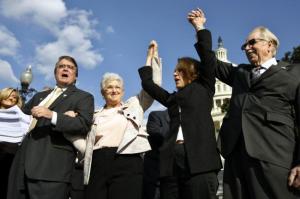
Michele Bachmann and supporters at Tea Party Rally
According to Roll Call, Michele Bachmann and three other right-wing Congresspeople used money from the their Congressional office accounts to pay for equipment and a sound system for a tea party rally on November 5, 2009 that was organized to protest President Obama’s health care bill.
According to House expense reports, Bachmann and three conservative GOP colleagues — Reps. Tom Price (Ga.), Steve King (Iowa) and Todd Akin (Mo.) — each paid $3,407.50 that day, a total of $13,630, to a sound and stage company called National Events, apparently for the sound system used at the rally.
The money came from the Members’ taxpayer-funded office accounts, despite House rules prohibiting the use of these funds for political activities. Bachmann’s office insists the expense was a proper use of official funds.
Bachmann billed the event as a “press conference,” which can be funded from official accounts. But no questions were taken from the press and, unlike most press conferences, it opened with a prayer, the national anthem and a recitation of the Pledge of Allegiance.
A press conference? According to the article, Bachmann also hyped the rally on Fox News and Minnesota Public Radio and posted an announcement of the event on her House website, which is also against House ethics rules. She apparently also used these funds for travel expense to media appearances and to pay political consultants and a speechwriter for her “response” to the State of the Union address.
The Hill says that, while the use of taxpayer funds for political purposes is questionable, it isn’t absolutely clear that she did anything wrong. But certainly this shows that Bachmann may have a tendency to cut corners when it comes to ethics.
On Saturday, the Guardian published a profile of Bachmann following her appearance at the New Hampshire Republican Debate.
They quote Stillwater, MN blogger Karl Bremer on a particularly troubling episode in Bachmann’s political history:
“She has got plenty of skeletons in her closet,” he said. One of those skeletons could be her relationship with Frank Vennes, a man who served time in jail for cocaine distribution and money-laundering after being convicted in 1987. After his release, and apparently after finding God while in prison, Vennes became a friend of Bachmann and a big campaign donor for her elections. However, Vennes has recently been indicted on charges stemming from a Ponzi scheme and could end up behind bars again.
That is a juicy story. As are Bachmann’s links to the mysterious “Bobby Charles Thompson”, who disappeared after the collapse of his apparently fraudulent fundraising organisation, which had been portrayed as a navy veterans’ group. Arrest warrants have now been issued for Thompson, whose real identity is not known. But what is known is that Thompson’s group donated campaign funds to Bachmann.
Then there is the issue of the Bachmann family farm in Wisconsin. The large rural property has been the recipient of considerable government largesse in the form of agricultural subsidies, despite the fact that Bachmann is a vociferous critic of government handouts. Yet Bremer’s blog has reported that the farm has reaped the Bachmanns about $154,000 of government cash since 2001. That is obviously not illegal but – given Bachmann’s virulent dislike of state welfare – it could make for some interesting headlines.
But will the media cover Bachmann’s “skeletons,” or are they going to give her a pass like the one they gave Obama in 2008? Frankly, I’m worried about it. It’s easy to dismiss Bachmann and treat her as a joke, and she deserves that. But she is driven and a very hard worker; the tea party crowd find her charismatic and inspiring; and she is one of the best fund-raisers around.
In three congressional terms, presidential contender Michele Bachmann has made a name for herself as a formidable fundraiser. As of her latest filing with the Federal Election Commission, Bachmann had $2.8 million cash on hand (compared with, say, veteran Ron Paul’s $1.6 million). And she took in $13.5 million in the 2010 election cycle, out-raising the leader of her own party, John Boehner, by almost $4 million and making Bachmann the most prolific fundraiser in the House. So how is she getting all that money?
Bachmann is increasingly getting money from individuals making smallish donations, a feat that helps solidify her status as a grass-roots, Tea Party–fueled outsider rather than another Establishment fixture. Of the $1.7 million she reported raising last quarter, only $1,500 came from non-individuals, and the average donation was just $619.34.
The Washington Post reports today that Bachmann is increasingly using a new fundraising technique for which is is uniquely qualified, called “money blurts.”
Here’s how it works: An up-and-coming politician blurts out something incendiary, provocative or otherwise controversial. The remark bounces around the blogs and talk shows and becomes a sensation.
And in the midst of it all, the politician’s fundraisers are manning the phones and raking in the donations.
Consider Rep. Michele Bachmann (R-Minn.), the tea party favorite and newly minted presidential candidate, who has made a specialty of raising money in the wake of bold and well-placed remarks. Shortly after accusing President Obama of having “anti-American views” during one cable-news appearance, for example, Bachmann took in nearly $1 million.
I’ve spent the past few days reading extensively about Bachmann’s personal and political history. I’ve learned two important things from all this reading: 1) Bachmann is a dangerous extremist with serious psychological problems; and 2) She should never be underestimated.
I will continue to write about her, because I think that with the dearth of exciting Republican candidates, the growing strength of the crazy right, and the increasing tendency for the media to ignore facts and accept lies at face value, she could actually win the nomination. We can ridicule her all we want, but we dismiss her chances at our peril.
Here’s some video of Bachmann’s “press conference” on November 5, 2009.
More Proof that the World is run by the Rich for the Rich
Posted: January 29, 2011 Filed under: crops, Farming, Food | Tags: alfalfa, corruption, GM food, USDA, Vilsack 36 Comments
The Center for Food Safety took the USDA’s decision to allow unregulated planting of Round-Up Ready Alfalfa to court in 2005, all the way to the Supreme Court, and managed to stop any planting of the bio-mutated forage crop until the USDA had a full environmental impact statement ready. No more sneaking GM crops in the back door by pretending not to notice they were being planted, and then when forced to notice saying, ‘Oh My, Imagine that, how did THAT get there?’, with a hand to a cheek and a distressed look on their pretty little faces.

 peej
peej Carissa
 bostonboomer
 dakinikat
 ecocatwoman
 mablue2
 Mama Lopez
 peggysue22
 quixote
 skydancingguestblogger
 Mona (aka Wonk the Vote)



 Sky Dancing
Recent Comments