
Tuesday Reads
Posted: August 27, 2013 Filed under: Barack Obama, China, Foreign Affairs, Iran, Iraq, morning reads, NSA, National Security Agency, Regulation, Russia, Syria, U.S. Politics | Tags: California wildfire, chemical weapons, cuba, David Miranda, Edward Snowden, GCHQ, Glenn Greenwald, John Kerry, Saddam Hussein, San Francisco water and power, Texas legislature, West Fertilizer Co., Yosemite National Park 30 Comments
Good Morning!!
The big news today is that President Obama appears likely to order “limited” strikes on Syria in the next few days in response to Syria’s use of chemical weapons against opposition fighters. From the WaPo: After Syria chemical allegations, Obama considering limited military strike.
President Obama is weighing a military strike against Syria that would be of limited scope and duration, designed to serve as punishment for Syria’s use of chemical weapons and as a deterrent, while keeping the United States out of deeper involvement in that country’s civil war, according to senior administration officials.
The timing of such an attack, which would probably last no more than two days and involve sea-launched cruise missiles — or, possibly, long-range bombers — striking military targets not directly related to Syria’s chemical weapons arsenal, would be dependent on three factors: completion of an intelligence report assessing Syrian government culpability in last week’s alleged chemical attack; ongoing consultation with allies and Congress; and determination of a justification under international law.
“We’re actively looking at the various legal angles that would inform a decision,” said an official who spoke about the presidential deliberations on the condition of anonymity. Missile-armed U.S. warships are already positioned in the Mediterranean.
I guess “looking at…legal angles” is code for that pesky rule in the Constitution where Congress has to declare wars. When’s the last time that happened–WWII?
Meanwhile, BBC News reports: Russia and China step up warning over strike.
Russian foreign ministry spokesman Alexander Lukashevich has called on the international community to show “prudence” over the crisis and observe international law.
“Attempts to bypass the Security Council, once again to create artificial groundless excuses for a military intervention in the region are fraught with new suffering in Syria and catastrophic consequences for other countries of the Middle East and North Africa,” he said in a statement.
Late on Monday, the US said it was postponing a meeting on Syria with Russian diplomats, citing “ongoing consultations” about alleged use of chemical weapons in Syria.
Hours later, Russia expressed regret about the decision. The two sides had been due to meet in The Hague on Wednesday to discuss setting up an international conference on finding a political solution to the crisis.
The Russian deputy defence minister, Gennady Gatilov said working out the political parameters for a resolution on Syria would be especially useful, with the threat of force hanging over the country.
Read more at the link.
Just as SOS Kerry was giving a speech to justify the upcoming military strikes, providing “Clear Evidence of Chemical Weapon Use in Syria” (NYT), a little birdie told Shane Harris and Matthew Aid of Foreign Policy magazine that the U.S. facilitated Saddam Hussein’s use of chemical weapons against Iran back in 1988.
The U.S. government may be considering military action in response to chemical strikes near Damascus. But a generation ago, America’s military and intelligence communities knew about and did nothing to stop a series of nerve gas attacks far more devastating than anything Syria has seen, Foreign Policy has learned.
In 1988, during the waning days of Iraq’s war with Iran, the United States learned through satellite imagery that Iran was about to gain a major strategic advantage by exploiting a hole in Iraqi defenses. U.S. intelligence officials conveyed the location of the Iranian troops to Iraq, fully aware that Hussein’s military would attack with chemical weapons, including sarin, a lethal nerve agent.
The intelligence included imagery and maps about Iranian troop movements, as well as the locations of Iranian logistics facilities and details about Iranian air defenses. The Iraqis used mustard gas and sarin prior to four major offensives in early 1988 that relied on U.S. satellite imagery, maps, and other intelligence. These attacks helped to tilt the war in Iraq’s favor and bring Iran to the negotiating table, and they ensured that the Reagan administration’s long-standing policy of securing an Iraqi victory would succeed. But they were also the last in a series of chemical strikes stretching back several years that the Reagan administration knew about and didn’t disclose.
U.S. officials have long denied acquiescing to Iraqi chemical attacks, insisting that Hussein’s government never announced he was going to use the weapons. But retired Air Force Col. Rick Francona, who was a military attaché in Baghdad during the 1988 strikes, paints a different picture.
“The Iraqis never told us that they intended to use nerve gas. They didn’t have to. We already knew,” he told Foreign Policy.
Read the rest of this long article at Foreign Policy.
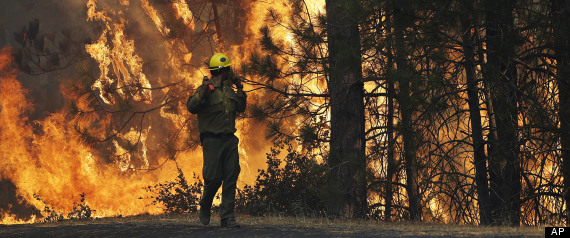
Firefighter A.J. Tevis watches the flames of the Rim Fire near Yosemite National Park, Calif., on Sunday, Aug. 25, 2013. With winds gusting to 50 mph on Sierra mountain ridges and flames jumping from treetop to treetop, hundreds of firefighters have been deployed to protect this and other communities in the path of the Rim Fire raging north of Yosemite National Park. (AP Photo/Jae C. Hong)
The wildfire in Northern California continues to spread into Yosemite National Park and has begun to threaten towns in the area. From the LA Times: Massive Rim fire continues to reshape lives and topography.
…even as firefighters worked furiously to hold a line outside of town, officials warned that this blaze was so hot it could send sparks more than a mile and a half out that could jump lines and start new hot spots. Evacuation advisories remain in effect for Tuolumne City and nearby areas.
On the north edge, the fire — now 134,000 acres — pushed into the Emigrant Wilderness Area and Yosemite National Park. It’s the one side of the fire with a natural last stand: Eventually it will run into granite walls that have snuffed out fires in this region for centuries.
Each day, what the massive blaze does depends on the wind. But officials were particularly attuned to each shift of breeze Sunday because of the weather’s eerie similarities to the day when the fire first exploded out of control.
So far the unpredictable blaze is only about 20% controlled, and it still threatens water and power sources for San Francisco.
The massive fire presents every challenge: steep slopes, dry fuel, rugged terrain and entire communities possibly in harm’s way.
The base camp and incident post, usually a haven outside fire lines, was a prominent example of the fire’s unpredictability: It’s in the middle of the burn zone, charred land with still-smoldering stumps on both sides.
Firefighters call such complete devastation “the black.” Entire ravines and ridges were a dusty gray moonscape. But some of the land was a “dirty burn” — meaning there were small circles of pine and aspen and even grass and wildflowers in the middle of charcoal-black areas where smoke still curled and embers glowed. The specks of beauty made firefighters nervous: To a fire, they are fuel.
My sister and her husband own a house north of San Francisco. It’s probably not in danger, but it still brings the scope of this disaster home to me. I sure hope Firefighers will begin to make progress soon. The burning area is now the size of the city of Chicago, according to CNN.
Yosemite National Park, California (CNN) — A massive northern California wildfire that’s threatening Yosemite National Park and San Francisco’s key water and power sources grew Monday, becoming the 13th largest in state history, state fire authorities said.
The Rim Fire, which has devoured 160,980 acres, has scorched an area about the size of the city of Chicago while more than 3,600 firefighters try to rein it in….
The wildfire, which was 20% contained Monday night, was spreading primarily to the east and threatened to grow amid extremely dry conditions and hot weather.
Part of the fire continued to spread Monday toward a key part of San Francisco’s water supply: the Hetch Hetchy Reservoir, which lies within Yosemite and is just east of the flames.
The fire also could threaten the area’s hydroelectric generators, which provide much of San Francisco’s electricity. Because of the approaching flames, officials shut down the generators, and the city — more than 120 miles to the west — temporarily is getting power from elsewhere.
Speaking of disasters, Charles Pierce reminds us that West, Texas is still recovering from the horrible explosion at the fertilizer plant there and that Texas still isn’t doing that much to prevent similar events in the future.
Read the rest of this entry »
Bill Keller wants us to “get over Iraq” and “get Syria right”
Posted: May 6, 2013 Filed under: Foreign Affairs, Iraq, Real Life Horror, Surreality, Syria, The Media SUCKS, U.S. Economy, U.S. Military, U.S. Politics | Tags: Bill Keller, Bush administration, chemical weapons, Judith Miller, leadup to Iraq War, Michael Gordon, mushroom cloud, neo-cons, Sarin Gas, the NEW York Times, Thomas Friedman 20 Comments
Could there be a less appropriate advocate for U.S. intervention in Syria than Bill Keller, Judith Miller’s editor at The New York Times during the runup to the disastrous war in Iraq?
Has this man ever been right about anything? Remember when he told us the baby boomers were responsible for the fiscal crisis and we should give up our hopes of a dignified old age because our selfishness has caused the U.S. to have “a less-skilled work force, lower rates of job creation, and an infrastructure unfit for a 21st-century economy”? Because obviously the costs of the Iraq war had nothing to do with the country’s current economic troubles.
Today Keller had the unmitigated gall to lecture us about the need to get involved in Syria. He isn’t really sure what we should do, but he’s positive we need to do it and he has a list of reasons why getting into another war in the Middle East is the right thing to do.
Of course even the monumentally “entitled” Bill Keller understands that lots of people are going to read his op-ed and respond by either screaming bloody murder or laughing hysterically at the spectacle of one of the architects of the Iraq War having the nerve to pontificate about another obviously insane foreign adventure.
So he tries to convince us that this time it’s different: “Syria is not Iraq,” he says.
Of course, there are important lessons to be drawn from our sad experience in Iraq: Be clear about America’s national interest. Be skeptical of the intelligence. Be careful whom you trust. Consider the limits of military power. Never go into a crisis, especially one in the Middle East, expecting a cakewalk.
But in Syria, I fear prudence has become fatalism, and our caution has been the father of missed opportunities, diminished credibility and enlarged tragedy.
“Be careful whom you trust,” he warns. Then why would we trust the man who allowed a once-great newspaper to be given over to neo-conservative enablers like Judith Miller and Michael Gordon who lapped up and printed every lie the Bush White House fed them?
But Keller brushes our doubts aside and offers four reasons why Syria is different from Iraq. But some of his arguments sound awfully familiar to me.
First, we have a genuine, imperiled national interest, not just a fabricated one. A failed Syria creates another haven for terrorists, a danger to neighbors who are all American allies, and the threat of metastasizing Sunni-Shiite sectarian war across a volatile and vital region. “We cannot tolerate a Somalia next door to Israel, Lebanon, Jordan, Iraq and Turkey,” said Vali Nasr, who since leaving the Obama foreign-policy team in 2011 has become one of its most incisive critics. Nor, he adds, can we afford to let the Iranians, the North Koreans and the Chinese conclude from our attitude that we are turning inward, becoming, as the title of Nasr’s new book puts it, “The Dispensable Nation.”
Weren’t we trying to keep Iraq from being a “haven for terrorists” too? And weren’t the neo-cons afraid of having the U.S. be perceived as weak?
Second, in Iraq our invasion unleashed a sectarian war. In Syria, it is already well under way.
This one is just ridiculous. We should invade because things are already worse than when we invaded Iraq?
Third, we have options that do not include putting American troops on the ground, a step nobody favors. None of the options are risk-free. Arming some subset of the rebels does not necessarily buy us influence. The much-touted no-fly zone would put American pilots in range of Syrian air defenses. Sending missiles to destroy Assad’s air force and Scud emplacements, which would provide some protection for civilians and operating room for the rebels, carries a danger of mission creep. But, as Joseph Holliday, a Syria analyst at the Institute for the Study of War, points out, what gets lost in these calculations is the potentially dire cost of doing nothing. That includes the danger that if we stay away now, we will get drawn in later (and bigger), when, for example, a desperate Assad drops Sarin on a Damascus suburb, or when Jordan collapses under the weight of Syrian refugees.
Huh? This one starts out sounding like an argument for staying out of Syria, so Keller throws in one of the neo-con arguments for invading Iraq–things could get worse if we don’t go in. Remember the warnings about “smoking guns” becoming “mushroom clouds?”
Fourth, in Iraq we had to cajole and bamboozle the world into joining our cause. This time we have allies waiting for us to step up and lead. Israel, out of its own interest, seems to have given up waiting.
What kind of argument is that? We should get into a war just because our “allies” want us to “lead?” Meaning they want us to provide the money and manpower.
Sorry, I’m just not convinced. Let the other guys do it for a change. If Israel wants to go to war in Syria, let them. In fact, let Bill Keller go if he’s so gung ho. Maybe he can convince some of his superrich pals to go along with him.
And what do you know? Along with Keller, Judy Miller’s old partner Michael Gordon, who still has his job at the Times, and has been writing story after story pushing U.S. involvement in Syria–as has op-ed columnist Thomas Friedman (I can’t provide links right now because I don’t seem to be able to circumvent the paywall). But here’s Greg Mitchell at The Nation:
Hail, hail, the gang’s nearly all here. Michael Gordon, Thomas Friedman, now Bill Keller. Paging Judy Miller! The New York Times in recent days on its front page and at top of its site has been promoting the meme of Syria regime as chemical weapons abuser, thereby pushing Obama to jump over his “red line” and bomb or otherwise attack there. Tom Friedman weighed in Sunday by calling for an international force to occupy the entire country (surely they would only need to stay one Friedman Unit, or six months).
Now, after this weekend’s Israeli warplane assaults, the threat grows even more dire.
And Bill Keller, the self-derided “reluctant hawk” on invading Iraq in 2003, returns with a column today stating right in its headline, “Syria Is Not Iraq,” and urging Obama and all of us to finally “get over Iraq.” He boasts that he has.
The Times in its news pages, via Sanger, Gordon and Jodi Rudoren, has been highlighting claims of Syria’s use of chem agents for quite some time, highlighted by last week’s top story swallowing nearly whole the latest Israeli claims.
Please go read the rest. Michell makes much more coherent arguments than I can. I’m still just sputtering from rage and trying to keep from banging my head on my keyboard.
CNN and NBC Reporting that Israel has Conducted Air Strike in Syria
Posted: May 3, 2013 Filed under: Breaking News, Foreign Affairs, Israel, Syria | Tags: chemical weapons, Hezbollah, Israeli air strike inside Syria 8 Comments
Border between Israel and Syria
The United States believes Israel has conducted an airstrike into Syria, two U.S. officials tell CNN.
U.S. and Western intelligence agencies are reviewing classified data showing Israel most likely conducted a strike in the Thursday-Friday time frame, according to both officials. This is the same time frame that the U.S. collected additional data showing Israel was flying a high number of warplanes over Lebanon.
One official said the United States had limited information so far and could not yet confirm those are the specific warplanes that conducted a strike. Based on initial indications, the U.S. does not believe Israeli warplanes entered Syrian airspace to conduct the strikes.
Both officials said there is no reason to believe Israel struck at a chemical weapons storage facilities. The Israelis have long said they would strike at any targets that prove to be the transfer of any kinds of weapons to Hezbollah or other terrorist groups, as well as at any effort to smuggle Syrian weapons into Lebanon that could threaten Israel.
The Lebanese army website listed 16 flights by Israeli warplanes penetrating Lebanon’s airspace from Thursday evening through Friday afternoon local time.
Chris Hayes is still on MSNBC reporting the latest. Israel has acknowledged striking inside Syria. I don’t know why Rachel Maddow hasn’t come on with him.
Please add anything you’re hearing in the comments.
Assad, Syria and Sarin
Posted: April 25, 2013 Filed under: Foreign Affairs, Syria | Tags: chemical weapons, Sarin Gas, Syria 26 CommentsEvidence has emerged that the Assad Regime in Syria has crossed Obama’s red line and that Sarin Gas has been used. 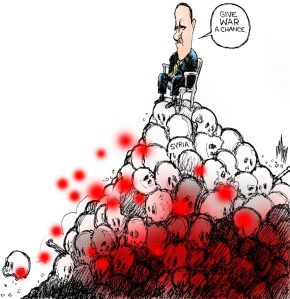 Is this a game changer?
The U.S. intelligence community has uncovered strong evidence that chemical weapons have been used in Syria. Several blood samples, taken from multiple people, have tested positive for the nerve agent sarin, an American intelligence source tells Danger Room. President Obama has long said that the use of such a weapon by the Assad regime would cross a “red line.” So now the question becomes: What will the White House do in response?
In March, the Assad regime was accused of using chemical weapons during an attack on the city of Aleppo. The blood samples were taken by Syrian opposition groups from alleged victims of that strike. But American analysts can’t be entirely sure where the blood came from or when the precisely exposure took place.
“This is more than one organization representing that they have more than one sample from more than one attack,” the source tells Danger Room. “But we can’t confirm anything because no is really sure what’s going on in country.”
What’s clear is that the samples are authentic, and that the weapons were almost certainly employed by the Assad regime, which began mixing up quantities of sarin’s chemical precursors months ago for an potential attack, as Danger Room first reported.
“It would be very, very difficult for the opposition to fake this. Not only would they need the wherewithal to steal it or brew it up themselves. Then they’d need volunteers who would notionally agree to a possibly lethal exposure,” the source adds.
SOD Chuck Hagel held a presser and the war of words between the administration and its critics has begun.
With intelligence showing that chemical weapons have probably been used in Syria, the pressure from the political right for decisive action by the president will only intensify.
Sen. John McCain, R-Ariz., who has long advocated a no-fly zone to stem the bloodshed in Syria that has left more than 70,000 dead, groused to reporters after being notified by the White House of the intelligence that sarin, a lethal nerve agent, has probably been deployed.
“Everything that the non-interventionists said that would happen in Syria if we intervened has happened,” McCain said. “The jihadists are on the ascendancy, there is chemical weapons being used, the massacres continue, the Russians continue to be assisting Bashar Assad, and the Iranians are all in. It requires the United States’ help and assistance.”
The shadow of the war in Iraq looms large for Obama. Without uttering the “I” word, the White House was quick on Thursday to recall the later-debunked intelligence that showed Saddam Hussein had weapons of mass destruction — the central underpinning of George W. Bush’s rationalization for going to war.
An Iraq-styled boots-on-ground intervention, of course, is not under serious consideration.
But Obama aides make clear that the intelligence community’s physiological evidence that indicates Syria’s use of chemical weapons is a bar too low to merit military action, such as implementing a no-fly zone.
“Given the stakes involved, and what we have learned from our own recent experience, intelligence assessments alone are not sufficient — only credible and corroborated facts that provide us with some degree of certainty will guide our decision-making, and strengthen our leadership of the international community,” Miguel Rodriguez, Obama’s liaison to Congress, wrote in a letter to lawmakers on Thursday.
The Obama administration is still pushing for a United Nations-led investigation into allegations and aides to the president on Thursday renewed the call for Assad to give the UN more direct access into Syria—something the Syrian president has thus far resisted.
Concerns about the way forward are also coming from Democrats. Sen. Diane Feinstein, D-Calif., the chairman of the Senate Intelligence Committee, said on Thursday it was “clear that red lines have been crossed and action must be taken to prevent larger scale use.” But Feinstein also offered concerns about a doomsday scenario emerging as a result of the administration’s decision verifying its suspicion.
“I am very concerned that with this public acknowledgement, President Assad may calculate he has nothing more to lose and the likelihood he will further escalate this conflict therefore increases,” Feinstein said in a statement.
Pundits are also weighing in. This is from The Atlantic’s Jeffrey Goldberg.
If you recall, President Barack Obama drew a “red line” for you: no use of chemical weapons in your brutal attempt to put down the uprising against your regime. Any use of such weapons (even any “moving around” of such weapons) would “change my calculus,” Obama said, “change my equation.” In other words, welcome to the day in which the calculus might just be changing.
Hagel, speaking to reporters in Abu Dhabi, said that U.S. intelligence has come to believe — like the Israelis, the French and the British before them — that President Bashar al- Assad’s regime seems to have used sarin “on a small scale.”
I spoke with Representative Mike Rogers, the Republican chairman of the House Intelligence Committee, who said that he thinks the Obama administration is hesitant to face the truth that the Assad regime has already used these sorts of weapons. “Clearly the administration doesn’t want to see this,” he said. “We have lost the confidence of the Arab League and the Syrian opposition because of our inaction.” Rogers said he was convinced at least a month ago that Syria had used a small quantity of chemical weapons against civilians.
Before we get to the meaning and potential consequences of this horrifying news, a brief primer on sarin, which was invented in Nazi-era Germany for use as a pesticide, and which was most famously used in the Tokyo subway attack by the Aum Shinrikyo cult in 1995 and against Kurdish Iraqis during Saddam Hussein’s genocide campaign.’
Descriptions of the chemical’s assault on the body follows the section that I highlighted from the Goldberg piece. Another point of view is expressed in the CSM here.
The US reluctance to join with three key allies – Britain, France, and now Israel – in concluding that Syria’s Bashar al-Assad has used chemical weapons in his country’s civil war confirms President Obama’s consistent wariness about US intervention in the two-year-old conflict.
Beyond that point, however, former officials and analysts are split over why Mr. Obama is so cautious about the issue – he even refused to answer a reporter’s question on the topic Tuesday – and what the apparently high bar the administration has set for evidence of chemical weapons use means.
“It’s a hard call as to whether the administration is trying to avoid something, or if they just don’t have the evidence,” says Wayne White, a former State Department official with experience in Middle East intelligence.
Obama has said repeatedly since last August that Syria’s use of chemical weapons is a US “red line” and would be a “game changer” for the US. But now some critics say the president’s caution suggests a moving or “fuzzy” red line.
For some, the president is simply being prudent, especially if the evidence presented so far is “inconclusive,” as a number of senior administration officials, including Defense Secretary Chuck Hagel, have said. Obama, they add, wants to avoid a rush to judgment that turns out to be mistaken – and which could appear to the world like a repeat of the 2003 US decision to invade Iraq over weapons of mass destruction that didn’t exist.
White House spokesman Jay Carney said Tuesday that the US is being “extremely deliberate” in investigating and evaluating the reports of chemical weapons use. And on Wednesday in Cairo, Secretary Hagel suggested the US would not be rushed to judgment by allies, saying, “Suspicions are one thing. Evidence is another.” He then added, “I think we have to be very careful here before we make any conclusions.”
But for others, the reason Obama is setting the bar high – in a situation where incontrovertible evidence could remain very difficult to come by – is because he has no desire to ratchet up US involvement in the Syrian conflict unless forced to.
The danger of this approach, critics say, is that it encourages an increasingly desperate President Assad to test the limits of US reluctance – perhaps even with limited, hard-to-prove use of some chemical weapons.
It seems like these hard choices keep popping up. There is total carnage in Syria on one hand. There is a war-weary US on the other. We’ve seen this president draw lines in the sand before. My best example is when Obama swore he would not extend the Bush tax cuts for those incomes about $250k. He signed the law that extended them above $450k. This history makes it difficult to say exactly what kind of hope the Syrians will have for regime change.

 peej
peej Carissa
 bostonboomer
 dakinikat
 ecocatwoman
 mablue2
 Mama Lopez
 peggysue22
 quixote
 skydancingguestblogger
 Mona (aka Wonk the Vote)



 Sky Dancing
Recent Comments