Geoff Bennett:
So, first, let’s start with a bit of a reality check. How feasible is it for Donald Trump to fundamentally change the autonomy of the Fed and change the relationship between the Federal Reserve and the president if he is reelected?


“Jobs, jobs, Jobs!” John Buss, @johnbuss.bsky.social
Regime changes haven’t happened yet, but businesses are already planning major layoffs, freezes, and price increases. That signals a type of economy we haven’t seen for a while. It’s called stagflation. For those of us who lived through that, you’ll remember the pain that went from the Nixon years to the Reagan years. It includes painful unemployment and rabid inflation. We just have to hope that the plans to take political control of the Fed don’t come to fruition. The current Fed Chair says he will not resign. That doesn’t even include the conversation about the massive removal of Federal workers and the deportation of the migrants that would have a devastating impact on the farm and most service industries.
Did I use enough citations for you? Let’s look at a few of them but I’ll get to the bottom line. Pay off all your debt as much as possible. Don’t take on anything that requires financing. Interest rates will go up as inflation returns. The entire thing is a vicious circle we learned much about in the 1970s. The 1980s taught us that tax cuts for the rich only drive up the deficit. Get ready for a repeat of that on steroids.
Traditional Republicans have always been migrant-friendly. However, that’s back when they were more focused on getting the business donors enriched and less worried about things like “poisoning the blood” and blaming them for statistically nonexistent problems, like crime and eating pets. However, that was before the rise of the Christofascists and the NAZIs ushered in MAGA.
The Brookings Institute reviewed recent peer-reviewed research in economics in September that shows exactly how devastating the cost of these deportations will be. That does not even cover the psychological and emotional trauma to communities forced to witness the round-up of their neighbors to massive concentration camps. This is a must-read. Chloe East is the researcher.
Increased deportation is associated with poorer economic outcomes for US-born workers
Across multiple studies, economists have found that once SC is implemented, the number of foreign-born workers in that county declines and the employment rate among U.S.-born workers also declines. My research with Annie Hines, Philip Luck, Hani Mansour, and Andrea Velásquez finds that when half a million immigrants are removed from the labor market because of enforcement (due to deportations and indirectly due to chilling effects), this reduces the number of U.S.-born people working by 44,000.
Why do deportations hurt the economic outcomes of U.S.-born workers? The prevailing view used to be that foreign-born and U.S.-born workers are substitutes, meaning that when one foreign-born worker takes a job, there is one less job for a U.S.-born worker. But economists have now shown several reasons why the economy is not a zero-sum game: because unauthorized immigrants work in different occupations from the U.S.-born, because they create demand for goods and services, and because they contribute to the long-run fiscal health of the country.
First, unauthorized immigrant workers and U.S.-born workers work in different types of jobs. Figure 1 shows the percentage of unauthorized immigrant workers, authorized immigrant workers, and U.S.-born workers that are in each of the 15 most common occupations among unauthorized immigrants.
It is clear that unauthorized immigrants take low-paying, dangerous and otherwise less attractive jobs more frequently than both U.S.-born workers and authorized immigrant workers. For example, almost 6% of unauthorized immigrants work as housekeepers, construction laborers, or cooks, compared to about 2% of authorized immigrant workers and 1% of U.S.-born workers (See Figure 1).
Occupations common among unauthorized workers, such as construction laborers and cooks, are essential to keep businesses operating. Deporting workers in these jobs affects U.S.-born workers too. For example, when construction companies have a sudden reduction in available laborers, they must reduce the number of construction site managers they hire. Similarly, local restaurants need cooks to stay open and hire for other positions like waiters, which are more likely to be filled by U.S.-born workers.
Caregiving and household service jobs are also common among unauthorized immigrants. The availability and cost of these services in the private market greatly impacts whether people can work outside the home. My research with Andrea Velásquez and new research by Umair Ali, Jessica Brown and Chris Herbst find that Secure Communities impacted the childcare market—the supply of childcare workers fell. This led to a reduction in the number of college-educated mothers with young children working in the formal labor market.
 You’ll notice women bear the brunt of this policy, but it goes nicely into the plan to get women back into the kitchen. Please read about the impact of the deportation in 2008 that happened in South Carolina, called the SC Act or Secure Communities Act. The details are gruesome but here’s the bottom line in a move to deport 400,000 people in a limited area.
While only people who were arrested had their immigration status checked under SC, the policy nonetheless impacted a large portion of immigrants. There were broad “chilling effects” of the policy that meant even people not targeted for deportation became fearful of leaving their house to do routine things like go to work. This is partly because the program did not only target serious criminals—the most serious criminal conviction for 79% of those deported was non-violent, including traffic violations and immigration offenses, and another 17% were not convicted of any crime.
An article that appeared in Mother Jones, also last September, details the devastation that will come if mass deportation happens. Isabela Diaz provides the analysis. “How Trump’s “Mass Deportation” Plan Would Ruin America. It would be brutal, costly, and likely illegal.”
This time around, they plan to invoke an infamous 18th-century wartime law, deploy the National Guard, and build massive detention camps—and intend on reshaping the federal bureaucracy to ensure it happens, drafting executive orders and filling the administration with loyalists who will quickly implement the policies. “No one’s off the table,” said Tom Homan, the former acting director of US Immigration and Customs Enforcement (ICE) under Trump. “If you’re in the country illegally, you are a target.”
If Trump and his allies have it their way, armed troops and out-of-state law enforcement would likely blitz into communities—knocking on doors, searching workplaces and homes, and arbitrarily interrogating and arresting suspected undocumented immigrants. The dragnet would almost certainly ensnare US citizens, too.
The nation’s undocumented immigrants grow and harvest the food we eat, construct our homes, and care for our young and elderly. They pay billions in taxes, start businesses that employ Americans, and help rebuild in the wake of climate disasters.
Not only would Trump’s plan rip families and communities apart, but it also would have devastating effects for years to come, including on US citizens who perhaps have overlooked how integral undocumented immigrants are to their everyday life. Trump frames immigration as an existential threat to the United States. He has said immigrants are “taking our jobs,” are “not people,” and are “poisoning the blood of our country.” The reality is that if his plan were implemented, American life as we know it would be ruined—even for those cheering for mass deportation.
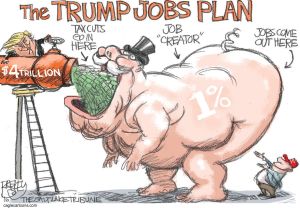 This will be in the hands of many of the folks who say they’re Christians but miss a major cultural value in both the Old and New Testaments. I was raised Presbyterian, attended my best friend’s Lutheran Church, baptized my girls in the Methodist church, and taught a large number of Sunday School classes. I’m not unfamiliar with the Bible. Matthew was my favorite of all. Whenever you ask me about my favorite verses, I’ll quote the Beatitudes and anything from Matthew or James. Trump is an actor, and his piety display is just an act.
Matthew 25:31-40Jesus says, “I was a stranger, and you welcomed me,” and “Truly, I say to you, as you did it to one of the least of these my brothers, you did it to me.”
Numbers 15:16The Bible says, “I am the Lord, and I consider all people the same, whether they are Israelites or foreigners living among you”.
Here’s a study cited in the Mother Jones article.
According to a 2016 report by the Center for American Progress, deporting 7 million workers would “reduce national employment by an amount similar to that experienced during the Great Recession.” GDP would immediately contract by 1.4 percent, and, eventually, by 2.6 percent. In 20 years, the US economy would shrink nearly 6 percent—or $1.6 trillion. Trump’s plan would lead to a dire shortage of low-wage workers, which would “bring on a recession while reigniting inflation,” predicts Robert J. Shapiro, a former undersecretary of commerce in the Clinton administration.

The costs of mass deportation will be devastating. Here is another study on the costs from The American Immigration Council.
“Using data from the American Community Survey (ACS) along with publicly-available data about the current costs of immigration enforcement, this report aims to provide an estimation of what the fiscal and economic cost to the United States would be should the government deport a population of roughly 11 million people who as of 2022 lacked permanent legal status and faced the possibility of removal. We consider this both in terms of the direct budgetary costs—the expenses associated with arrest, detention, legal processing, and removal—that the federal government would have to pay, and in terms of the impact on the United States economy and tax base should these people be removed from the labor force and consumer market.
In terms of fiscal costs, we also include an estimate of the impact of deporting an additional 2.3 million people who have crossed the U.S. southern border without legal immigration status and were released by the Department of Homeland Security (DHS) from January 2023 through April 2024. We consider these fiscal costs separately because we don’t have more recent ACS data necessary to estimate the total net changes in the undocumented population past 2022, or the larger impact on the economy and tax base of removing those people, an impact that is therefore not reflected in this report.
In total, we find that the cost of a one-time mass deportation operation aimed at both those populations—an estimated total of is at least $315 billion. We wish to emphasize that this figure is a highly conservative estimate. It does not take into account the long-term costs of a sustained mass deportation operation or the incalculable additional costs necessary to acquire the institutional capacity to remove over 13 million people in a short period of time—incalculable because there is simply no reality in which such a singular operation is possible. For one thing, there would be no way to accomplish this mission without mass detention as an interim step. To put the scale of detaining over 13 million undocumented immigrants into context, the entire U.S. prison and jail population in 2022, comprising every person held in local, county, state, and federal prisons and jails, was 1.9 million people.
In order to estimate the costs of a longer-term mass deportation operation, we calculated the cost of a program aiming to arrest, detain, process, and deport one million people per year—paralleling the more conservative proposals made by mass-deportation proponents. Even assuming that 20 percent of the undocumented population would “self-deport” under a yearslong mass-deportation regime, we estimate the ultimate cost of such a longer operation would average out to $88 billion annually, for a total cost of $967.9 billion over the course of more than a decade. This is a much higher sum than the one-time estimate, given the long-term costs of establishing and maintaining detention facilities and temporary camps to eventually be able to detain one million people at a time—costs that could not be modeled in a short-term analysis. This would require the United States to build and maintain 24 times more ICE detention capacity than currently exists. The government would also be required to establish and maintain over 1,000 new immigration courtrooms to process people at such a rate.”
How’s that for dismantling the state and getting rid of Federal Workers? It sounds like a bit of hypocrisy to me.
There’s that stagflation prognosis again. That was the time of the economy in 1980 when I got my first house fixed rate loan at 16.7%, which was only one of three mortgage loans made that month at the largest Savings Loan in the heartland. I worked there so they gave me a discount down to 12%. Let’s see all those young people trying to buy their houses in that environment. My loan now is fixed at 3%. Thank you, Obama!
One of the worst possible things that could happen is allowing politics back into Fed Policy. This was a problem that was fixed by law because obvious presidential interference generally led to low interest rates that brought more inflation. I have purposefully used a conservative-bent economist for this analysis. “The Economic Consequences of Political Pressure on the Federal Reserve.” Elonia is hot for this pogrom. Tell me again, who thinks that Nepobaby is brainy? Again, if you lived through the dread of Nixon’s years, you’ll remember the inflation he brought trying to get the Fed to loosen interest rates during a period of inflation. It wasn’t pretty.
The data on personal interactions by themselves are at best a noisy measure of political interference with the Fed. For example, in a recession the president might be more likely to contact the Fed chair and ask them about their view on the economy. In this instance, personal interactions would increase, but not because they reflect political pressure.
To overcome this identification challenge, I exploit an increase in president–Fed interactions that plausibly took place purely for the purpose of influencing Fed policy and arguably had an impact on the stance of monetary policy. In his desire to be re-elected in 1972, Richard Nixon pressured Arthur Burns to ease monetary policy in 1971. Burns, a Republican and friend to Nixon, reportedly gave in to Nixon’s pressure.
A variety of external evidence corroborates this interpretation of the Nixon–Burns clash, including recordings from the “Nixon tapes” and entries in Arthur Burns’ personal diary. For example, Burns writes in his diary that Nixon urged him “start expanding the money supply and predicting disaster if this didn’t happen.” To support the interpretation that Burns eased policy in response to Nixon’s pressure, I show that Romer and Romer (2004) uncover easing shocks to monetary policy prior to Nixon’s re-election. I also present supporting evidence from the voting behavior of the FOMC.
I exploit the narrative around Nixon’s pressure in a structural vector autoregression (SVAR) that contains the president–Fed interactions as well as standard macro data. I identify a shock to political pressure on the Fed based on narrative sign restrictions. Specifically, I define a political pressure shock as an increase in president-Fed interactions that eases policy in an inflationary way and constitutes the main contributor to the spike in president–Fed interactions in late 1971.
Yes. This is the kind of thing I do for my research. Just go look at the graphs. They speak volumes.
The number of president–Fed interactions displays persistence after the political pressure shock hits, with the IRF reversing to closes 0 after around two years. The shock induces a monetary easing, with a roughly 100 basis points lower interest rate after a few quarters. The price level response to the shock builds up gradually and persistently and reaches a 5% higher price level after four years. These estimates imply that exerting political pressure 50% as much as Nixon did, over a period of six months, permanently increases the US price level by more than 8%.
The responses of real GDP and fiscal variables are not distinguishable from zero. This finding indicates that political pressure primarily induces a price level effect. It turns out that in some subsamples (not shown here), it is possible to detect a significant response of real GDP, but this response is actually negative.

This cartoon is actually from the American Enterprise Institute. This shows you have far Republican Politicians have actually gotten from actual Economics.
That’s a dismal scientist telling you that all hell breaks loose whenever an American President tries to influence the Fed. Nixon wanted to win the reelection and pressured the Fed to drop interest rates, which caused massive inflation. eventually, we got unemployment, and that’s stagflation. That’s what poor Jimmy Carter inherited. The Tax Cuts for the Rich narrative through the Reagan years was even worse. I was studying economics at the time and became an economic analyst for that Savings and Loan that went bankrupt because of that policy. (I surprised them with that data, the first of many times I was the brains of a clueless CEO.) When the Reagan administration pulled off the usury laws, we got a financial crisis in 1984, which later looked mild compared to the one Dubya brought on in 2008, also known as the SubPrime Crisis.
NPR unravels the plan that Trump has to control the Fed. “How Trump’s wish for more Federal Reserve control could impact economy if he’s reelected.”
Geoff Bennett:
So, first, let’s start with a bit of a reality check. How feasible is it for Donald Trump to fundamentally change the autonomy of the Fed and change the relationship between the Federal Reserve and the president if he is reelected?
Krishna Guha:
Well, it’s complicated.
So, first off, for President Trump, if reelected, could certainly let his views on monetary policy be known loudly and including through social media and other nonconventional channels. He could try to do what’s called jawboning, leaning on the Fed in public to take certain actions on interest rates.
Actually changing the institutional independence of the Fed, that’s more challenging. The Fed’s independence is enshrined in the act of Congress the Federal Reserve Act, and that makes the chairman, for instance, removable as generally understood, only for a cause, which would mean something pretty extreme to make him unfit for office.
The president can’t simply appoint additional members to the Federal Reserve Board. He’d have to wait until vacancies became available and those only become available very slowly. So it would be tough. Now, there is one complication, and that is that it is somewhat unsettled as to what the exact legal status of the Fed chair is and whether the president might have some legal grounds for being able to dismiss a Fed chair.
That’s not something that I think any mainstream lawyer or central banker believes is right, but it hasn’t been fully tested in the courts. And so there’s some outside possibility that the president could attempt to assert an authority over the Fed chair that has not been understood to be there.
Geoff Bennett:
If we look to other countries or look back in this country’s own history, what does it tell us? Does a Central Bank that remains independent from political influence, does that yield better monetary policy and better macroeconomic decision-making?
Krishna Guha:
There’s just very, very strong evidence from the U.S. itself and from countries around the world that independent central banks tend to achieve better economic outcomes.
And that ultimately doesn’t just benefit society, doesn’t just benefit the economy. It, in the end, tends to benefit the president as well. And so I think there’s actually a lot of good reason why it would be not to try to assault the independence of the Central Bank.
Geoff Bennett:
Critics have blasted the Fed for being too slow to respond to inflation. And there will certainly be folks who say, why is it such a bad thing to have the Fed accountable to someone, accountable to the executive branch?
Krishna Guha:
So, you raise a really important issue there, Fed accountability.
Now, Fed officials past and present will say, absolutely, the Fed must be accountable. But under our system of government, the Fed is accountable to Congress, not the executive branch. The Fed is a creature of Congress. The Fed chair goes to Congress to testify. He’s grilled by members of the Senate. He’s grilled by members of the House.
That is the way that our system of accountability is set up. And it’s the way that it’s worked very well in recent decades. That doesn’t mean that the Fed is always going to get everything right. Of course not. The issue is simply, would you have more confidence that the Fed would get things about right most of the time if it was more insulated from short-term political pressures, or do you think that political pressures are going to make them do a better job?
I think most people have a pretty intuitive grasp of what the answer to that question would be.
 Again, Powell says he will not resign. That gives us about another year where monetary policy can offset this craziness. This is from CBS. “Fed Chair Jerome Powell says he won’t resign if Donald Trump asks him to step down.”
Federal Reserve Chair Jerome Powell said he won’t step down if President-elect Donald Trump, who has previously criticized Powell’s performance, asks him to resign.
Speaking at a press conference Thursday to discuss the Fed’s move today to cut its benchmark interest rate by 0.25 percentage points, Powell added that it is not permitted under the law for presidents to fire or demote the Fed chair.
When asked if he’d step down if Trump requested it, Powell responded with a one-word answer: “No.”
Powell’s insistence that he’ll remain in his role comes after Trump aired grievances about the Fed’s decision-making during his first presidency and, more recently, on the campaign trial. Trump, who has accused Powell of being “political,” also told Bloomberg Businessweek this summer he would let the economist serve out his term, “especially if I thought he was doing the right thing.”
Yet Trump has also said he thinks the U.S. president should have more influence on Fed decisions.
Are you asleep yet or is your hair on fire like mine? And again, here are the massive layoffs and hiring freezes now planned for 2025. “A running list of companies preparing to raise prices if Trump’s trade plan is enacted.” This is from Business Insider. The analysis is provided by Ayelet Sheffey. It’s from a few days ago.
President-elect Donald Trump proposed broad tariffs on imports, including up to 60% on goods from China.
Economists say his proposals could spike inflation as companies tend to pass costs on to shoppers.
Some companies have already said increased tariffs would lead them to raise prices.
Some executives have warned that price hikes are on the way if President-elect Donald Trump’s trade plans go into effect.
On the campaign trail, Trump proposed a 60% tariff on goods imported from China coupled with a 10% to 20% tariff on goods imported from other countries. While the president-elect could choose not to enact tariffs at that scale once he assumes office, economists and the market have predicted that his proposals would spike inflation and cause the Federal Reserve to raise interest rates.
Several companies have already begun responding to Trump’s election victory and the implications his tariff proposals would have on the costs of their goods. Executives have told analysts on earnings calls that it would be difficult to maintain current prices under Trump’s broad tariffs.
Other companies are still waiting for more information from the president-elect. Tarang Amin, the CEO of ELF Beauty, told Business Insider that the company must first see the policy Trump enacts before making any changes to its pricing and that a new policy wouldn’t affect the business until after its 2025 fiscal year.
“We don’t like tariffs because they are a tax on the American people,” Amin said, adding that the company had been subject to a 25% tariff since 2019 because of policies from Trump’s first term. “And at that time,” he said, “we pulled all the levers available to us to minimize the effects to our company and our community.”
Karoline Leavitt, a Trump-Vance transition spokeswoman, told BI: “In his first term, President Trump instituted tariffs against China that created jobs, spurred investment, and resulted in no inflation.” She added that Trump will “work quickly” to lower taxes and create more American jobs.
Below are the companies that are warning of price increases if Trump’s tariff proposals are implemented.
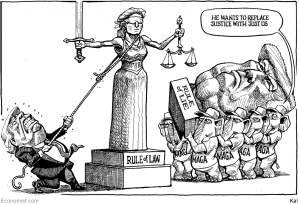 Before I went completely into economics, I was a history major. We’ve done this before. The Smoot-Hawley Tariff Act of 1930 raised import duties on more than 20,000 goods and agricultural imports to protect U.S. businesses and farmers. Hoover signed it into law. It made the Great Depression worse. Don’t these whackadoodle schools teach History and Civics anymore?
Before every major recession we’ve had since 1984, I’ve always found myself running around going what are these idiots smoking? I’ve fled to safety and minimized my losses. Ronald Reagan’s folly basically wiped out my first IRA and my Dad’s retirement portfolio. But, I always did better than everyone else because if you’re just an economics teacher living a normal life and not privy to all the insider muckety muck, you do that. I remember the manager for my Louisiana 403B was amazed I held my losses to a lower percentage than anyone else at the USL. I was not amused. A loss is a loss, and I’m definitely paying for those years now as I was then.
Just buckle up. This is going to be a very chaotic ride. Prepare for the worst. Again, the best thing you can do is pay the debt off and not add any more, if possible. I am also expanding my small food garden and orchard. I’m not sure if Congress is up to the test of its checks and balances, so this is not looking good. Also, remember how long it took to get out of Nixon’s mess. We really didn’t recover completely until the Clinton years.
The two pieces of news we also have today is that Matt Gaetz quit the AG cabinet appointment. He says he’s not going back to Congress. Speculation is that he will still have a political appointment in the administration, just one that doesn’t take Senate approval. Pam Bondi, who he once bribed to stop her from filing a suit against his phony university and who is basically one of his personal attorneys is now the nominee.
What’s on your reading and blogging list today?

Resurrection, by Alma Thomas
It’s day 29 of the illegimate presidency of Donald tRump and the chaos continues unabated. There are hundreds of stories I could share with you today, and it’s difficult to figure out which is most worthy of attention. I believe that Russian influence on our government has to be number one, but there are many other urgent issues as well. We can’t ignore the truly frightening story of what tRump is trying to do to undocumented immigrants. Of course there really are many more serious concerns, such as tRump’s refusal to accept advice from experts and his war on the free press. So here are a few stories to check out and I hope you’ll add more in the comments.
First, here’s a follow-up to what Dakinikat wrote yesterday about the increasingly public concerns about tRump’s mental health from Dr. Steven Beutler at The New Republic: A Medical Theory for Donald Trump’s Bizarre Behavior. In response to the many questions asked by political leaders, psychologists, and psychiatrists, he writes:
Physicians like me have also taken notice of Trump’s bizarre, volatile behavior. Given our experience, we can’t help but wonder if there’s a medical diagnosis to be made. After all, many medical conditions exhibit their first symptoms in the form of psychiatric issues and personality changes. One condition in particular is notable for doing so: Neurosyphilis.
Syphilis, a sexually transmitted infection, is sometimes referred to as “The Great Imposter” because of its ability to mimic many other conditions. It is commonly broken down into three stages. Primary syphilis is the most widely recognized form of the disease. It is characterized by the development of an ulcer, usually genital, a few weeks to a few months after sexual contact with an infected person. If the ulcer is not noticed, or not treated, it heals on its own, and the disease enters a dormant phase. But during this time, the bacteria—a spirochete called Treponema pallidum—spreads throughout the body without causing any symptoms.
Untitled, by Perle Fine
A secondary stage of the disease is seen in some patients weeks or months later. These patients may develop a variety of systemic symptoms, such as rash, fever, and swollen glands. If not treated, the infection enters a prolonged latent phase, which can last decades. During this time, it is asymptomatic and it is not contagious. In some cases, this is followed by a tertiary stage, which is the most serious and may involve any organ in the body. It is seen 10 to 30 years after the initial infection, and is best known for causing neurologic and neuropsychiatric disease: Neurosyphilis.
The symptoms of neurosyphilis are protean, varying widely from one individual to another. Commonly recognized symptoms include irritability, loss of ability to concentrate, delusional thinking, and grandiosity. Memory, insight, and judgment can become impaired. Insomnia may occur. Visual problems may develop, including the inability of pupils to react to the light. This, along other ocular pathology, can result in photophobia, dimming of vision, and squinting. All of these things have been observed in Trump. Dementia, headaches, gait disturbances. and patchy hair loss can also be seen in later stages of syphilis.
Beutler of course admits that he cannot make a diagnosis without more information and access to tRump, but he argues that Neurosyphilis needs to be considered as a possibility along with psychological disorders because of tRump’s own public admissions about his sexual history.

Night Creatures, Lee Krasner
Supposedly tRump is going to be interviewing candidates for the National Security Adviser position vacated by Michael Flynn. He has already been turned down by his top two candidates, Adm. Robert Harward and Gen. David Petraeus.
Last night Chris Hayes broke some news about the Harward turndown on his MSNBC show. Business Insider reports: Top national security adviser pick reportedly bailed after seeing Trump’s press conference.
MSNBC host Chris Hayes on Friday cited a former national security official familiar with Harward’s decision who said Harward asked that several demands be met as a condition of accepting the offer:
- A clear chain of command, reporting directly to the president.
- Restoring the [National Security Council] structure of prior administrations … so that political advisers like Steve Bannon would not have a seat on the Principals’ Committee.
“Harward wanted to undo the fairly large changes the president had made to the NSC that had inserted Bannon into the process,” Hayes reported.
Citing his source, Hayes said “The White House did not offer Harward sufficient assurances that he would have such autonomy.” Harward wrote a letter declining the offer.
The White House reportedly sought to negotiate with Harward on the matter, which Harward was initially open to, Hayes said, but that changed a short time later.

Lucy, by Mary Abbott
On Petraeus, CBS News reports:
Sources close to retired Gen. David Petraeus say the White House eliminated the former CIA director from consideration for the open national security adviser post after he weighed in on the job during a conference in Germany this week.
“Whoever it is that would agree to take that position certainly should do so with some very, very significant assurances that he or she would have authorities over the personnel of the organization — that there would be a commitment to a disciplined process and procedures,” Petraeus said at the Munich Security Conference.
That pronouncement angered the White House as it deepened the sense the next national security adviser must assert authority over staff and the inter-agency process — highlighting the reason Vice Adm. Robert Harward refused to take the job earlier this week. Two sources confirmed to CBS News that Harward had demanded his own team, and the White House resisted.
Sources close to the situation said the White House is content for the time being with acting National Security Adviser Keith Kellogg and does not have a coherent replacement plan in place. Kellogg, a former commander of the 82nd Airborne Division, had been serving as chief of staff and executive secretary of the National Security Council when he took over as the national security adviser.
Apparently, tRump is determined to control the makeup of the NSC, including keeping Steve Bannon on the principals committee. It’s hard to imagine any experienced candidate who would accept that.
Politico: Help wanted: National security adviser who can handle the chaos.
As President Donald Trump prepares to interview more candidates this weekend, accepting the influential policy-making post that oversees a policy staff of hundreds is now widely considered a high-risk gambit, according to current and former government officials and longtime veterans of the National Security Council.
Trump will be forced to “sweeten the deal,” predicted one former Republican NSC official, in order to enlist a high-caliber replacement following the resignation of retired Lt. Gen. Michael Flynn….
Red Ikon, by Sonia Gechtoff
“I would want to know that I had direct, unimpeded access to the president whenever I felt it was necessary,” said Nicholas Rostow, who served as the top legal adviser to both Colin Powell and Brent Scowcroft when they held the post under Presidents Ronald Reagan and George H. W. Bush, respectively.
“Historically that job has been one step removed from domestic politics, and the national security adviser and his or her staff have always prided themselves on looking at things through the prism of the national interest — and therefore slightly less political than other positions,” added Rostow, who now teaches political science at Colgate University.
A former high-ranking national security official in the George W. Bush administration, citing the perils of navigating Trump’s dueling power centers, was far more blunt about the challenges awaiting Trump’s would-be national security adviser: “No serious person would take that job. It’s a recipe for disaster.”
If you’re interested in the Russia connection, I hope you had a chance to watch Joy Reid’s show this morning. She had a great segment on Russia’s reaction to the firing their obvious ally Michael Flynn. Here’s a piece Reid wrote about the situation at The Daily Beast: It’s Not Too Early to Ask: Are Even the Russians Turning on Trump?
Trump’s utility to the Russians has never been in his wackiness. It’s been in the potential for him to deliver, as President, a different U.S. foreign policy; one that deemphasizes the traditional Western alliances and frees Russia to operate in the European theater as it pleases, with lifted sanctions and a few lucrative bilateral oil deals to boot.
But Trump as President hasn’t shown any inkling of the kind of competence or political skill—or the political capital—to do any of that. Even his Secretary of State, Exxon’s Rex Tillerson, has sounded a dubious note about the extent to which the United States will allow Moscow to flex its muscle around the world, which had to be a great disappointment to his good friend, “V. Putin,” as Trump labels him in tweets, using the common Russian nomenclature….
Russian leaders seemed palpably freaked out when Gen. Michael Flynn, clearly seen as Moscow’s main man in Washington, was forced out of the Trump administration amid revelations that he conducted secret foreign policy on the phone with the Russian ambassador over Christmas, then lied to the vice president about it. It’s pretty difficult to imagine that Flynn acted without the direction, or at least the approval, of his boss, the then-incoming president.
But more alarming than the phone calls was the fact that Flynn was considered potentially compromised by a foreign power, by the Director of National Intelligence, the acting attorney general of the United States, Sally Yates, and others, and that the White House was told as much and still waited to act. Now, the Kremlin has reportedly ordered Russian media outlets to dial back their glowing Trump coverage, amid uncertainty about what comes next.
Read the whole thing at the link.
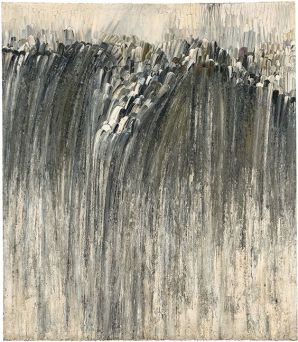
Origin,1956 by Jay Defeo. Access. #1980.24
Berkeley Art Museum and Film Archive, Berkeley, CA., USA
More links to explore:
The New York Times: Trump Calls the News Media the ‘Enemy of the American People.’
The Atlantic: Donald Trump’s Plan to Outsource Immigration Enforcement to Local Cops.
The New York Times: Sun, Sand and Influence: For Mar-a-Lago Members, Proximity Is Power.
The New Yorker: Michael Flynn: General Chaos.
NPR: Trump’s Sons Heading To Dubai As Business Interests Continue To Expand Overseas.
The New York Times: The Downfall of Kellyanne Conway.
CBS News: Trump yells at CIA director over reports intel officials are keeping info from him.
CBS News: “Chill” in flow of intelligence to Trump White House, sources say.
Media Matters: Anti-Semites Praise Trump For Berating Jewish Reporter And Refusing To Condemn Anti-Semitism In Press Conference.
The Washington Post: John McCain just systematically dismantled Donald Trump’s entire worldview.
Note: The images in this post are by women abstract expressionist painters.
Have a great weekend, Sky Dancers!!

The Wave, by Edvard Munch
We are living through chaotic times; and the way I see it, we can trace our problems back to Republicans. The drug war and the prison industrial complex began with Richard Nixon; our economic problems began with Ronald Reagan; and the turmoil in the Middle East began with George W. Bush.

Cartoon by Chan Lowe
One of the cartoons (see right) that JJ posted last night says it all about Bush and his neocon buddies. The chaos on Capital Hill? That traces back to the Tea Party–a response to the election of a black President by the wingnuts and religious fundamentalists that Bush and Rove enabled.
Can order and harmony ever emerge from the chaos we’re living in right now? I don’t know, but my guess is it will take a very long time. It might require the destruction of the Republican Party as we know it.
Yesterday’s resignation by House Speaker John Boehner is likely to make things even worse in Washington. Josh Marshall’s take: Lord of the Flies on Capitol Hill.
While there are certainly internecine and factional rivalries in the Democratic party, it’s all but impossible to imagine the outpouring of celebration, schadenfreude and smackdowning that is greeting the retirement of Speaker John Boehner. Even a kind word on the day of his retirement appears beyond the ability of most of those he led. Yes, there’s been base clamoring against Nancy Pelosi and even more at certain times with Harry Reid. But it simply doesn’t compare to the angry joy we’re seeing now toward a quarter-century member of the House. The only analogue I can think of is the enmity that grew toward Joe Lieberman. But of course, by that time he wasn’t even a Democrat anymore, let alone one of the party’s top leaders.

An Order of Chaos, Richard Ricker
Of course the resemblance to Lord of the Flies stems from the juvenile behavior of the “crazies” in the House. Some of them–see Ted Cruz, for example–have even been able to destroy the traditional courtesy of the Senate.
AP via ABC News: Boehner’s Departure Raises Question: Can House GOP Be Led?
The gulf between tea party conservatives and establishment Republicans has grown so wide that it just swallowed up the speaker of the House, and may threaten the entire Republican Party and Congress itself.
The question now is whether anyone can tame the House’s rabble-rousing faction, in the wake of Speaker John Boehner’s decision to resign rather than face a possible vote to depose him. The stakes are sky-high, given the critical deadlines looming to keep the government running and raise the nation’s borrowing limit.
With the GOP presidential contest riding an anti-establishment wave, it’s almost mandatory for the candidates to denounce Republican congressional leaders at the first sign of any potential compromise with Democrats. Dealmaking is that much tougher in Congress, even as some fear it could harm the party’s chances at the White House in 2016.
The long-running drama of establishment vs. insurgency played out anew Friday on Capitol Hill as tea party conservatives cheered Boehner’s announcement that he will leave his job at the end of October. The move will ensure that the government stays open into December because the 13-term Ohio lawmaker rejected conservative demands to dare President Barack Obama to veto a government spending bill that cuts money for Planned Parenthood.
But Boehner’s announcement only puts off that fight and others, and promises a chaotic leadership struggle that may result in new leaders facing the same fundamental problem: a core group of 30 or so conservative lawmakers repulsed by compromise and commanding enough votes to stymie leadership plans, despite the GOP’s immense majority.

Turmoil, Michael Lang
The only possible solution is for the Democrats to retake the House.
Bobby Jindal used Boehner’s resignation to make another futile attempt to get support from the crazies. From Talking Points Memo:
“Mitch McConnell, it’s your turn,” Jindal said to loud applause.
The Louisiana governor said he was “actually angrier with the Republicans than with the Democrats” because they “don’t do the things they say they’re going to do.”
“It is time to fire these clowns and restore order once and for all,” he said.
This from the clown who destroyed Louisiana.

Back to Chaos, Aldo Tambellini
Politico: Resignation triggers all-out leadership scramble.
CNN: John Boehner’s resignation spells trouble for Jeb Bush.
John Avlon at The Daily Beast: GOP’s Kamikaze Caucus Takes Out John Boehner.
Slate’s XX Factor: In the End, Maybe John Boehner Just Didn’t Love Fetuses Enough.
Mother Jones: Admit It: You’re Kinda Going to Miss John Boehner.
The latest crazy caucus obsession is their effort to defund Planned Parenthood–even to the point of shutting down the government if they don’t get their way. Here in the reality-based world real people will be badly hurt if this effort succeeds.
Sarah Kliff at Vox: Stat check: No, women couldn’t just “go somewhere else” if Planned Parenthood closed.
Chaos Theory, Erik von Ploennies
The “defund Planned Parenthood” movement has a standard response to the question of where women would go if their local clinic closed: somewhere else.
“There are 13,000 community-based organizations that provide health services to women, 13,000 in this country,” Jeb Bush said at last week’s Republican primary debate. “I don’t believe that Planned Parenthood should get a penny from the federal government.”
Other Republicans make a similar claim. A spokesperson for Sen. Ted Cruz (R-TX) argued that Planned Parenthood’s funding could be diverted to “community health centers and other entities providing health services without abortions.” And on paper, it sounds plausible that 13,000 clinics might be able to absorb Planned Parenthood’s 2.7 million patients who get government help paying for birth control and other reproductive health services.
But a Vox review of academic research, recent Planned Parenthood closures in Texas, and interviews with half a dozen health policy experts suggests the opposite. Historically, researchers have found that when Planned Parenthood clinics close, other clinics do not step up to fill the gap. Meanwhile, when there are fewer reproductive health clinics available, women get less reproductive health care — from birth control to cancer screenings to STD testing and treatment. Unintended pregnancies would likely increase, too.
So while many politicians like to assert that women can “go somewhere else,” the consensus in the literature shows a different picture. Higher-income women will find alternatives. But a sizable minority of Planned Parenthood’s patients, particularly low-income women, would lose access to medical services.
But Republicans couldn’t possibly care less about poor women–or women in general, for that matter.
Police in Los Angeles a Saudi prince for sexual assault a couple of days ago after a woman reported him for attacking her. From The Daily Mail:
Beverly Glen Compound where Saudi Prince Majed Abdulaziz Al-Saud, 28, was arrested by LAPD
A Saudi Prince sexually abused and beat at least three women during a three-day party in his $37 million Beverly Hills home, a new lawsuit claims.
The graphic new allegations against Majed Abdulaziz Al-Saud, 28, were filed by his alleged victims on Friday night.
It comes two days after the monarch, who does not have diplomatic immunity, was arrested on suspicion of forcing a woman to perform oral sex on him.
From the LA Times: More women accuse Saudi prince after his arrest on sex crime charge, LAPD says.
A Saudi prince who allegedly tried to force a female worker to perform a sex act on him inside a Beverly Glen residence has now been accused of attacking other women in the home, according to Los Angeles police and court records.
Majed Abdulaziz Al-Saud, 29, was arrested Wednesday on suspicion of forced oral copulation of an adult.
Police said Friday that they are investigating claims that Al-Saud also preyed on other women on the estate.
Detectives “found more victims who were also alleging crimes against Mr. Al-Saud,” Officer Drake Madison said.
Al-Saud, 28, was detained by police for hours Wednesday afternoon as officers investigated a reported disturbance inside the 22,000-square-foot residence about 12:45 p.m., Madison said.
He was held on suspicion of false imprisonment, sexual assault and battery. He was booked on suspicion of forcing the oral copulation of a worker inside the residence, Madison said. He could not be reached for comment Friday.
Three women have sued Al-Saud:
A civil lawsuit filed in L.A. County Superior Court on Friday claims he attacked other women inside the home for several days.
The suit, filed by three women only identified as Jane Does, accuses him of “extreme,” “outrageous,” and “despicable” behavior that started Monday and ended in his arrest.
The lawsuit seeks unspecified damages and claims Al-Saud inflicted emotional distress, assault and battery, sexual discrimination and retaliation against the workers, among other allegations. The attorneys who filed the suit did not return calls seeking comment.
Tomorrow night there will be a total eclipse of the moon at the same time as a blood moon or a supermoon or something.

Lunar eclipse of this year’s supermoon (Boston Globe)
From AL.com: Blood moon, harvest moon, supermoon: What’s the difference?
Sunday’s full moon has a lot going for it — almost too much.
Not only will it be 2015’s harvest moon, but it will also be a supermoon and a blood moon and coincide with a total lunar eclipse.
According to NASA it’s the first time in more than 30 years a supermoon has coincided with a lunar eclipse.
That’s a lot to pack in a night.
So what is the difference between a harvest moon, a blood moon and a supermoon?
Read all about it at the link.
And from The Boston Globe, meteorologist and horticulturist David Epstein explains Everything you need to know about the supermoon eclipse Sunday September 27th.
There is an eclipse Sunday evening and after so many days of clear skies and mild temperatures, it’s going to be a tough break if clouds disrupt us from seeing it. As of right now, there should be enough clear spots in the sky to see the eclipse quite well. I’ll be updating weather conditions on Twitter @growingwisdom. I put the details of the eclipse later in this entry. Let’s discuss the supermoon thing first.
Although words like “super moon” and “rare” are used in eye catching headlines. These terms aren’t what astronomical professionals will use to describe this event. While these phenomena don’t happen all the time, they have happened before and will certainly happen again. I enjoy teaching about astronomical events, and while meteorologists aren’t astronomers the cool occurances in the sky often fall to us to explain.
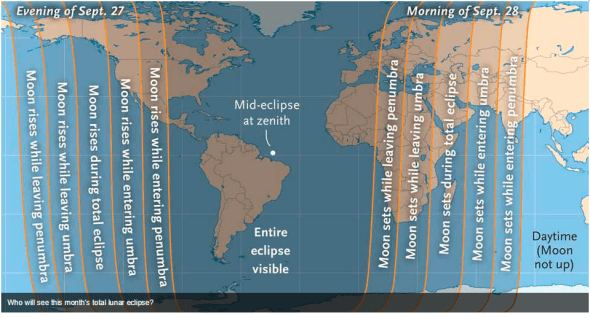
From Sky and Telescope
Epstein’s message is that this is an interesting event, but not as big a deal as the media is claiming.
Sunday’s moon is the closest encounter with Earth until November 14, 2016. The full moon on November 14, 2016, will be the closest full moon (356,509 kilometers) until November 25, 2034 (356,448 kilometers). So yes, these things are interesting, but not all that uncommon.
Not So Super
In a recent article in the Evening Sun, Ian Clarke, director of the Hatter Planetarium at Gettysburg College told the newspaper the following, “Take a quarter and hold it 103 inches away from you. That’s the apparent size of the moon relative to us, as we see it. Take that same quarter, and bring it 5 inches closer, 98 inches away from you. That’s the effect of the Supermoon, he said.” As you can see, this isn’t the celestial event of the century.Eclipse
What’s happening Sunday evening is an eclipse of the moon, in its full state, while making its closest approach of the year. The eclipse begin at 8:11 p.m. ET. The moon will be fully covered at at 10:11 p.m. ET, peaking at 10:47 p.m. ET. The moon stays covered until 11:23 p.m.ET, and the eclipse will end at 12:27 a.m ET.You only need to look towards the east to watch this event. There aren’t any special glasses or special precautions to take. However, if you are driving, pay attention to the road, not the moon. During the time the Earth gets in the way of the Sun’s light from illuminating the moon, the moon will take on a reddish hue. This is why you are hearing the term “blood moon” associated with this eclipse.
Read more at the link.
What else is happening? Please post your thoughts and links on any topic in the comment thread.
 peej
peej Carissa
 bostonboomer
 dakinikat
 ecocatwoman
 mablue2
 Mama Lopez
 peggysue22
 quixote
 skydancingguestblogger
 Mona (aka Wonk the Vote)
 Memeorandum Crooks and Liars Democracy NOW The UK Guardian
The Sky Dancing banner headline uses a snippet from a work by artist Tashi Mannox called 'Rainbow Study'. The work is described as a" study of typical Tibetan rainbow clouds, that feature in Thanka painting, temple decoration and silk brocades". dakinikat was immediately drawn to the image when trying to find stylized Tibetan Clouds to represent Sky Dancing. It is probably because Tashi's practice is similar to her own. His updated take on the clouds that fill the collection of traditional thankas is quite special.
You can find his work at his website by clicking on his logo below. He is also a calligraphy artist that uses important vajrayana syllables. We encourage you to visit his on line studio.






 Sky Dancing
Recent Comments