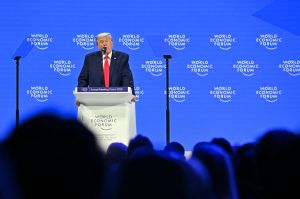
This morning I woke up and turned on the TV to see our “president,” easily the stupidest president in American history, walking hunched over and tired in Davos to give another long, rambling, nonsensical, insulting “speech” to the assembled political and business leaders. He spoke for 70 minutes and it seemed much longer.
I watched the speech for awhile, but it was the same old garbage he talks about off the cuff to the assembled press in the oval office. He went on and on in his old man voice, attacking allies, demanding that Greenland be handed over to him, ranting about windmills–all to complete silence from the audience. How could they sit there and watch this embarrassing display of abject stupidity?
I don’t expect this post to make much sense, because I’m just soooo angry!
The big headline, according to the legacy media is that Trump announced he won’t “take Greenland by force.”
President Donald Trump ruled out military force to acquire Greenland in his remarks Wednesday to the World Economic Forum in Davos, Switzerland, providing a momentary sense of relief to Europe after weeks of worry that the U.S. would enter a confrontation with NATO.
“We probably won’t get anything unless I decide to use excessive strength and force, where we would be, frankly, unstoppable, but I won’t do that,” Trump said. “That’s probably the biggest statement I made, because people thought I would use force, but I don’t have to use force. I don’t want to use force.”
Trump said Wednesday that he wants to see negotiation to acquire what he called “a piece of ice.”
The president, though, warned Denmark that if it doesn’t give up Greenland to the U.S., “we will remember.”
He argued in his remarks that the U.S. can protect “this giant mass of land” better than Europe can, insisting that taking over Greenland wouldn’t be a threat to NATO but would instead enhance security for the alliance. While the president’s obsession with Greenland has accelerated in recent weeks, his pledge to not use force to acquire the island marks a shift in his rhetoric.
“I don’t want to use force,” he added. “All the United States is asking for is a place called Greenland, where we already had it as a trustee but respectively returned it back to Denmark not long ago after we defeated the Germans, the Japanese, Italians and others in World War II. We gave it back to them.”
He added that it was “stupid” for the U.S. to not keep the island after the war. Still, Trump downplayed the significance of his threats against Greenland, arguing it’s a trade-off for the years of support the U.S. has given to NATO allies.
“What I’m asking for is a piece of ice, cold and poorly located,” he said. It’s a very small ask, compared to what we have given them for many, many decades.”
What does that mess of words really mean? Nothing. Trump is the world’s worst liar and he’s insane. Not to mention stupid. Nothing he says can be believed.
The choice is impeachment and removal or calamity for the United States. I don't see how anybody watching Trump's speech in Davos can draw any other conclusion. He's a senile madman.
“Denmark’s investment in U.S. Treasury bonds, like Denmark itself, is irrelevant,” U.S. Treasury Secretary Scott Bessent told reporters Wednesday at the World Economic Forum in Davos, Switzerland.
It comes as Trump’s threats to impose 10% tariffs on eight European countries as part of his push to take over Greenland spooked markets. The levies would come into force on Feb. 1, Trump said, and later rise to 25%.
Danish pension operator AkademikerPensionsaid Tuesday it was selling $100 million in U.S. Treasurys. The decision was driven by “poor [U.S.] government finances,” said Anders Schelde, AkademikerPension’s investing chief.
When Bessent was asked how concerned he is about European investors pulling out of Treasurys, Bessent said at a news conference at the World Economic Forum: “Denmark’s investment in U.S. Treasury bonds, like Denmark itself, is irrelevant.”
“That is less than $100 million. They’ve been selling Treasurys for years, I’m not concerned at all.”
Really? I’d like to hear what Daknikat has to say about this.
No one can be watching this Davos speech and reach any conclusion but that the President of the United States is mentally disturbed and that something is deeply wrong with him. This is both embarrassing and extremely dangerous.
Prime Minister Mark Carney of Canada delivered a stark speech in Davos, Switzerland, on Tuesday, prompting global political and corporate leaders in the audience to rise from their seats for a rare standing ovation.
He described the end of the era underpinned by United States hegemony, calling the current phase “a rupture.” He never mentioned President Trump by name, but his reference was clear.
The speech came as President Trump doubled down on his threats to take Greenland away from Denmark, saying he would slap fresh tariffs on European powers as punishment for their support of Greenland’s sovereignty.
Global leaders have been scrambling to find a unified response.
“Every day we’re reminded that we live in an era of great-power rivalry,” Mr. Carney said. “That the rules-based order is fading. That the strong can do what they can, and the weak must suffer what they must.”
And he warned, “The middle powers must act together because if we’re not at the table, we’re on the menu.”
He would know.
Mr. Trump started his second presidential term making claims on Canada as the 51st state and threatening Canada’s previous leader, Justin Trudeau, whom Mr. Trump publicly derided, with unilaterally scrapping agreements that have governed the relationship between the neighboring countries for over a century….
Mr. Carney chastised other leaders too, many of whom would have been following his speech in Davos, for not standing up for their interests.
“There is a strong tendency for countries to go along to get along,” he said. “To accommodate. To avoid trouble. To hope that compliance will buy safety. It won’t.”
Mr. Carney made clear he is choosing a different path.
He wrote his own speech, according to a government official, who spoke on condition of anonymity to discuss the inner workings of his team, which is a departure since speeches of this magnitude are usually prepared by high-level staffers with the leader’s input.
Mr. Carney, a former investment executive who has served as the governor of Canada and England’s central banks, has attended the global gathering about 30 times, according to his office….
Mr. Carney spoke not long after Mr. Trump had posted an altered image on social media that featured a map of American flags superimposed over both Canada and the United States, as well as Greenland.
Well worth a listen from Canadian PM Mark Carney at Davos summit.
President Trump said in Davos on Wednesday that Canada should be “grateful” to the U.S. for the “freebies” it receives because of the two nations’ relationship.
Why it matters: Trump’s dig at Canada came a day after Prime Minister Mark Carney delivered his own warning at the World Economic Forum over the “rupture” of the world order.
Driving the news: “Canada lives because of the United States,” Trump said Wednesday before taking a direct jab at Carney. “Remember that, Mark, the next time you make your statements.”
Trump said Carney “wasn’t so grateful” in his address.
Carney avoided naming Trump in his speech — a strategy a Canadian official previously told Axios was deliberate. However, the official indicated that Carney’s remarks were aimed squarely at the president’s recent actions.
Zoom out: As Trump pushes a vision of hemispheric dominance — coupled with threats of the U.S. making its northern neighbor the “51st state” — Ottawa has reportedly started preparing for how to repel a U.S. invasion.
Growing up, I never really understood Aesop’s fable about the goose that laid the golden egg. It’s a cautionary tale about greed and hubris: A farmer with a miraculous goose that lays a solid-gold egg every morning gets fed up with passive wealth generation and figures killing the bird will speed things along. But alas: He finds no store of eggs within and realizes he butchered his meal ticket for nothing. The moral’s straightforward, but it never really worked for me as a story. Like, come on: Nobody’s that stupid.
Well, almost nobody, I guess.
As long as I live, I don’t think I’ll get over this pure, dumb fact: Trump told his fans he had to blow up the liberal order because it was the only way to secure the very benefits the liberal order was already bringing us.
Trump insists America needs Greenland as a strategic positioning ground from which to restrain Russia and China in the Arctic. But thanks to the liberal order, this was something we already enjoyed. Through the magic of multilateral cooperation, we were able to treat someone else’s territory as though it were our own for the purposes of military positioning—not by bribing or intimidating them, but because they agreed their interests and our interests aligned.
Trump insists America needs to blow up America’s preexisting economic relationships to ensure America gets an advantageous position in international trade. But America already had such an advantageous position: an orderly world economic system that had lavished previously unimaginable prosperity on America and to the entire globe, with us at the proverbial (and very profitable) head of the table.
It’s not just that Trump had the hubris to think he could hero-ball the country to a better deal by canceling a century of history and starting over. It’s that his own broken personality—his miserable meanness, his dispositional inability to cooperate with and trust others—has always prevented him from understanding what was good about the deal we had to begin with. The idea that multipolar agreements could be better for America, in some cases, than outright ownership—that, say, we already have everything we need from Greenland—he rejects as ridiculous. Ownership, he told the New York Times, is “what I feel is psychologically needed for success. . . . I think that ownership gives you a thing that you can’t do, whether you’re talking about a lease or a treaty.”
He really is determined to burn everything down if he can’t get his own way on everything.
1/ Jonathan Lemire writes, "Trump's lust for Greenland is about increasing American dominance in the Western Hemisphere 7 redrawing the maps of the world. The island is roughly 836K square miles, which would make it the largest territorial addition in US history." Gift link.
Franklin D. Roosevelt famously illustrated with a simple metaphor the need for a healthy transatlantic alliance. Justifying his decision to lend Great Britain warships and other military supplies in the early days of World War II, Roosevelt likened it to loaning a neighbor a garden hose to put out the fire consuming his house. Sure, Roosevelt charitably wanted to help a neighbor in need. But it was self-interested too; if the neighbor could extinguish the blaze, it wouldn’t spread to FDR’s home. The United States benefited from the friendship—and the buffer—that allies could provide.
Today, Donald Trump will fly to Europe. Ukraine is already ablaze. And now the president is ready to set a bunch of new houses on fire.
The president will speak at the World Economic Forum in Davos, Switzerland, tomorrow, and he appears prepared to shatter the nearly 80-year-old NATO alliance in order to seize Greenland. In his quest to claim a strategically located island of ice and rock, Trump has turned against his nation’s most stalwart friends. He has antagonized and mocked panicked European leaders, threatened punishing tariffs on countries that object to his plans, and pointedly not ruled out using military force. Trump’s thirst for Greenland—even if he stops short of ordering an armed invasion—threatens to unravel the partnership born from the ashes of World War II that has, in the decades since, ensured the spread of peace, prosperity, and democracy on both sides of the Atlantic.
Today marks one year since Trump’s return to office, and in that time, he has fundamentally reshaped the United States’ relationship with the rest of the world. But nothing has upended the global order more than what would happen if he follows through on his threats toward Greenland. The island, of course, belongs to Denmark, which says that it is not available for the taking. Troops from Europe have been dispatched to the territory, and Greenland’s prime minister warned his populace to prepare for an invasion. If Trump were to persist, Denmark could trigger NATO’s Article 5 mutual-defense pact, and then the unthinkable could occur: American soldiers firing on Europeans while Russian President Vladimir Putin’s dream of NATO’s self-immolation is thoroughly realized.
The annual meetings in Davos, normally a clubby gathering of business titans and political leaders, have been consumed by talk of what Trump may or may not do. European leaders have found themselves scrambling on strategy—appeasement? Defiance? Compromise? Early this morning, Trump posted screenshots of text messages that revealed the dilemma facing those leaders. (Lesson to everyone: Be careful what you text the guy unless you want the world to see.)
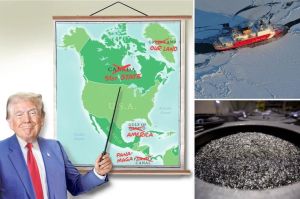
In one message, Mark Rutte—the secretary general of NATO, who has prized warm relations with Trump—praised the president’s foreign policies, then vowed that he is “committed to finding a way forward on Greenland.” But in another, French President Emmanuel Macron, whose relationship with Trump has been turbulent, admitted: “I do not understand what you are doing on Greenland.” In fact, Trump couldn’t be more clear, as he demonstrated once again by circulating a pair of presumably AI-generated images on social media. In one, he’s planting an American flag in Greenland. In the other, he’s lecturing European leaders in the Oval Office with a map behind him that depicts Greenland as part of the United States. (Canada and Venezuela too.)
Trolling close U.S. allies has seemingly been an unofficial policy of Trump’s second administration since its first days, beginning with Vice President Vance lecturing Europe in Munich on the virtues of free speech. But this time feels different for those nervously waiting in snowy Switzerland. The president’s address to the forum tomorrow is poised to be a defining moment, and Trump plans to make the unequivocal case that the United States should have Greenland, a senior White House official told me.
Pretty good predictions, except for Trump’s claim he won’t use force.
A few non-Davos stories:
Did you watch Lawrence O’Donnell last night? He still insists that Trump’s Greenland obsession is really a way to distract the press from the Epstein files. I think he could be right. If you didn’t see it, I recommend watching it now.
Three hundred and sixty-five days after Donald Trump swore his oath of office and completed an extraordinary return to power, many historians, scholars and experts say his presidency has pushed American democracy to the brink – or beyond it.
The scale and velocity of what he has been able to accomplish in just a year have stunned even longtime observers of authoritarian regimes, pushing the debate among academics and Americans from whether the world’s oldest continuous democracy is backsliding to whether it can still faithfully claim that distinction.
“In 2025, the United States ceased to be a full democracy in the way that Canada, Germany or even Argentina are democracies,” Steven Levitsky and Daniel Ziblatt, the prominent Harvard political scientists and authors of How Democracies Die, and the University of Toronto professor Lucan Way, wrote in Foreign Affairs last month. They argued that the US under Trump had “descended into competitive authoritarianism”, a system in which elections are held but the ruling party abuses power to stifle dissent and tilt the playing field in its favor.
There is no universally accepted definition of democracy. Some argue the US is a “flawed” or “illiberal” democracy, or a democracy facing substantial “autocratization” – a process that began long before Trump came to power a decade ago but which his presidency has rapidly accelerated. Still, others believe the concerns are overblown, or reflect an intense partisan dislike of the current president.
Since Trump’s first term, scholars have warned that it can happen here. But many now say this moment is different – not only because Trump’s approach is more methodical and his desire for vengeance more pronounced, but because he now faces far fewer internal constraints.
Read more at the link.
Hunter Walker at Talking Points Memo: Trump Marks First Year In Office With Unhinged Racist Rant Targeting ‘Very Low IQ’ Somalis.
President Donald Trump spent the first anniversary of his second term on Tuesday pitching himself to the American people from behind the White House briefing room podium. In nearly two hours of remarks, Trump seemingly sought to address his cratering approval by running through a list of his supposed accomplishments. His remarks also included a series of vicious, racist remarks about Somali people and other immigrants.
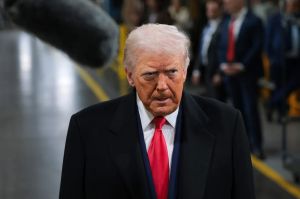
I think Trump likes this photo.
“They all ought to get the hell out of here, they’re bad for our country,” Trump said of the Somali population at one point during the extraordinary rant.
At multiple points during his remarks, Trump indicated he felt the need to make his case directly because his team was not up to the task. A slew of anniversarypolls show the president’s numbers are currently underwater with notably steep declines in voter approval of the president’s handling of his signature issues: immigration and the economy. Those figures have come amid slow job growth and violent raids staged by Trump’s Immigration and Customs Enforcement agency.
“Maybe I have bad public relations people, but we’re not getting it across,” Trump said as he argued the economy is particularly strong since he returned to office.
Trump came equipped with a couple of binders including one labeled “ACCOMPLISHMENTS.” Yet as he read through the provided list, Trump repeatedly raged against the Somali population, including suggesting that they are of inferior intelligence. Trump first turned to the topic as he alluded to the ongoing ICE raids in Minnesota, which have been met with massive protests. The state is home to the country’s largest Somali population and the federal crackdown has come amid a wave of right-wing influencers making exaggerated claims about alleged daycare fraud in the community.
“Nineteen billion dollars at a minimum is missing in Minnesota, given to a large degree by Somalians. They’ve taken it,” Trump said. ”Somalians, can you imagine? And they don’t do it — a lot of very low IQ people. They don’t do it. Other people work it out and they get them money and they go out and buy Mercedes Benzes.”
The Supreme Court will consider Wednesday whether President Trump can fire Lisa Cook from the Federal Reserve board, in a case that tests the longstanding independence of the central bank, with potentially major consequences for the economy.
The court’s conservative majority has repeatedly allowed Mr. Trump to oust leaders of other independent agencies as he moves to expand presidential power and seize control of the federal bureaucracy. But the justices have signaled that the Fed may be different and uniquely insulated from executive influence because of its structure and history.
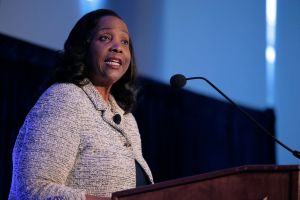
Lisa Cook
The case lands as the administration has dramatically escalated its attacks on the Fed, apparently aimed at remaking its board and lowering interest rates. The Justice Department this month opened a criminal investigation into whether Jerome H. Powell, the Fed chair, lied to Congress about cost overruns related to the Fed’s renovation of its headquarters.
Mr. Powell, whose term as chair ends in May, forcefully pushed back on the threat of criminal charges, saying it was a result of the Fed setting borrowing costs “based on our best assessment of what will serve the public, rather than following the preferences of the president.”
The investigation prompted a backlash from Republicans, international policymakers, Wall Street and some Trump allies, who warned that the central bank’s independence and credibility was at risk.
It also threatened to complicate Mr. Trump’s plans to name Mr. Powell’s replacement as chair — and, legal experts said, the Supreme Court case being heard on Wednesday.
The justices agreed to hear Ms. Cook’s case on an expedited basis, and are likely to rule quickly on her status as litigation continues in the lower courts. The outcome of the case could determine how much latitude Mr. Trump and future presidents have to influence the direction of the powerful central bank, which Congress intentionally tried to insulate from political pressures.
Police agencies in the United States kill more than 1,000 people each year. After many of those deaths, the agencies involved put out statements. Those statements often use what’s known as the exonerative voice to minimize officers’ involvement. The first statement from the Minneapolis Police Department after George Floyd’s death, for example, said that the officers at the scene “noted that he appeared to be suffering from medical distress.” Quite the understatement. These communications often cast events in a light most favorable to the officers involved, sometimes to the point of deception. Too often, they’ll try to smear the deceased by citing a criminal record or suggesting a drug addiction or gang affiliation.
Renee Good
I have been covering policing for more than 20 years and have read and parsed a lot of these statements. The Department of Homeland Security’s response after the Immigration and Customs Enforcement agent Jonathan Ross shot and killed Renee Good in Minneapolis this month is something else entirely.
For all their flaws, typical communications from police officials usually include a modicum of solemnity. There are assurances that there will be a fair and impartial investigation, even if those investigations too often turn out to be neither. There’s at least the acknowledgment that to take a human life is a profound and serious thing.
The Trump administration’s response to Ms. Good’s death made no such concessions. There were no promises of an impartial investigation. There was no regret or remorse. There was little empathy for her family — for her parents, her partner or the children she left behind. From the moment the world learned about her death, the administration pronounced the shooting not only justified but an act of heroism worthy of praise and celebration.
It isn’t just the lying; it’s that the lies are wildly exaggerated and easily refutable. All the evidence we’ve seen so far, including a meticulous Times forensic analysis of the available footage, makes clear that at worst, Ms. Good mildly obstructed immigration enforcement, disobeyed ambiguous orders or perhaps attempted to flee an arrest. None of those are capital crimes, nor do law enforcement officers get to dole out punishment in such cases. At one point, President Trump justified her shooting by claiming she’d been “very disrespectful” to immigration officers. That isn’t a crime at all.
The lies this administration is telling about Ms. Good aren’t those you deploy as part of a cover-up. They’re those you use when you want to show you can get away with anything. They’re a projection of power.
For the past decade or so, since the protests in Ferguson, Mo., America has engaged in a high-stakes dialogue about police abuse and accountability, the militarization of law enforcement and the push and pull between public safety and civil liberties. Those discussions, while occasionally heated, have been based on a shared understanding that the primary job of domestic law enforcement is to serve the public. What Mr. Trump is doing with federal immigration forces has rendered those debates obsolete.
Those are my recommended read for today. What do you think?
Did you like this post? Please share it with your friends:
I’m trying not to let myself fall into despair over what’s happening in our country and the world, but it isn’t easy. I try to distract myself by reading novels and by watching shows on Netflix and Max. But inevitably I open my phone or turn on cable news and get hit with awful news about what new insane thing Trump is doing or saying.
This morning, as I look around at stories in the news, I find myself sinking into sadness over what we have already lost from our democracy and what more losses could be coming. It’s all so tragic. I honestly despise the people who voted for Trump.
There’s one person who never fails to lift my spirits, if only temporarily: MSNBC’s Lawrence O’Donnell. Recently, he has had a great time making fun of Trump’s seeming obsession with American girls’ dolls and how they need to make do with just 2 or 3 or 4 instead of 35 because of his tariffs.
Last night Lawrence made an interesting point about Trump’s cognitive decline. He pointed out that Trump saying “I don’t know,” when asked if people in the U.S. have a right to due process and when asked if he has a duty to defend the Constitution is something new for him. Normally, Trump never admits to not knowing something. He would rather bumble around talking complete nonsense than admit to not knowing.
Lawrence argues that Trump is a pathetic husk of his former self, exhausted and befuddled by his responsibilities. Not that any of this is going to drive Trump from office, but it’s an interesting thought. The danger, of course is that other people like Elon Musk and Stephen Miller could be in control of the presidency.
Lawrence also discussed Trump’s embarrassing appearance yesterday in the Oval Office with newly elected Canadian Prime Minister Mark Carney.
“The Canadian prime minister both humbled and humiliated Donald Trump at the same time without Donald Trump having the slightest idea it was happening,” he said on Tuesday night.
Later in the segment, O’Donnell slammed Trump’s “utterly demented attempt” to turn Canada into a state. Carney, he noted, responded by saying “absolutely no to Donald Trump to his face.”
But Trump, he said, barely noticed.
“Donald Trump had no fight in him today when the very polite Canadian beside him talked rings around Donald Trump like a ring master in a circus with a trained animal, threw in some magic words that sounded flattering enough to Donald Trump so that Donald Trump actually ― and you’ll see this ― ends up nodding and agreeing with the man who is humiliating him and defeating him right there in the room on TV,” O’Donnell said. “No president has ever lost more in one conversation in the Oval Office than Donald Trump lost in these 90 seconds.”
O’Donnell rolled the footage of the meeting, where Carney told him Canada would never be for sale and would not be a U.S. state.
So, on to today’s news.
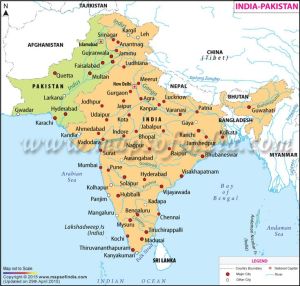
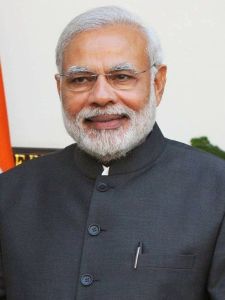
India and Pakistan–both nuclear powers–appear to be on the verge of war.
India launched military strikes on targets in Pakistan, both countries said on Wednesday and Pakistan claimed it had shot down five Indian Air Force jets, in an escalationthat has pushed the two nations to the brink of wider conflict.
India’s missile strikes early Wednesday morning targeted “terrorist infrastructure” across nine sites in Pakistan’s densely populated Punjab province and Pakistan-administered Kashmir, it said. They came in response to a massacreby militantsof tourists in Indian-administered Kashmir two weeks ago, that New Delhi blamed on its neighbor.
India Pakistan map
Pakistan said at least 26 people were killed in Wednesday’s strikes – including women and a three-year-old girl – and 46 wounded. The country’s Prime Minister Shehbaz Sharif describedthe strikes as “an act of war” and Islamabad has vowed to retaliate.
From early Wednesday the two sides have exchanged shelling across their border, with locals on both sides telling CNN they weretakingshelter. A CNN journalist in Pakistan-administered Kashmir heard multiple loud explosions.
“A shell landed at a house close to the mosque in which two people were injured. Shells also hit other houses in our area and we fled from our area to a safer place,” said Shakeel Butt, a resident of Muzaffarabad, in Pakistani-administered Kashmir. A senior Indian defense source said at least eight people had been killed on the Indian side of the border.
Pakistani military sources later said they shot down five Indian Air Force jets and one drone in “self-defense,” claiming three Rafale jets – sophisticated multi-role fighters made in France – were among those downed as well as a MiG-29 and an SU-30 fighter.
A local resident and government official told CNN that an unidentified fighter aircraft had crashed on a school building in Indian-administered Kashmir.
Tensions between India and Pakistan intensified Wednesday after India’s military launched strikes against the neighboring country in response to a militant attack in Indian-administered Kashmir last month, heightening fears of war between the nuclear-armed rivals….
The strikes have set the region on edge and shattered the fragile ceasefire that has largelyheld since 2021, with analysts warning of escalation in the decades-long conflict that has riven the South Asian subcontinent over the Muslim-majority region of Kashmir, parts of which are controlled by India and Pakistan, though the area is claimed in full by both countries.
Wednesday’s aerial assault is on a far bigger scale than in 2019, when India struck a single, remote Pakistani site in response to a suicide bombing that killed more than 40 Indian soldiersin Kashmir….
The sharp rise in tensions follows a deadly April 22 attack on tourists near the town of Pahalgam in Indian-administered Kashmir.
Gunmen armed with rifles killed 25 Indians and one Nepalese citizen. More than a dozen others were injured. The attack was the deadliest against civilians since the 2008 Mumbai attacks by the Pakistani-based militant group Lashkar-e-Taiba that killed 166 people.
Indian-administered Kashmir is a heavily militarized zone. An armed insurgency — either seeking independence or favoring accession to Pakistan — has continued against Indian rule for more than three decades.
India has long accused Pakistan of fomenting separatist violence in Kashmir. Indian Foreign Secretary Vikram Misri said Wednesday that India had found evidence linking themilitants in the Pahalgam attack to Pakistan.
The Hindu nationalist government of Narendra Modi revoked Kashmir’s semiautonomous status in August 2019 and instituted a crackdown, including imposing the world’s longest internet shutdown in a democracy. Promising development and investment, New Delhi had touted a return to relative peace, citing the surge of tourists to the region, a narrative upended by the deadly attack last month.
Read more at the WaPo.
Joe Biden gave his first major interview since he left the White House.
Former US President Joe Biden has given his first in-depth interview since he left the White House in January, speaking to the BBC about his legacy, foreign policy and his view of President Donald Trump’s first 100 days.
He said that he had few regrets, but he offered grave warnings about global affairs as Europe marks 80 years since the end of World War Two on the continent….
The former president also reflected on his decision to drop out of the 2024 election race – but he had less to say about any mistakes he and the Democrats may have made along the way….
On leaving the 2024 presidential race:
Democratic strategists have lamented that the last-minute handover left their campaign flat-footed, ultimately aiding Trump’s path to the White House, even as Democrats held a financial advantage in the 2024 race.
Biden boasted of being “so successful on our agenda” – a reference to the major legislation enacted in his first two years in office on the environment, infrastructure and social spending, as well as the better-than-expected Democratic performance in the 2022 midterm elections.
“It was hard to say now I’m going to stop,” he said. “Things moved so quickly that it made it difficult to walk away.”
Ultimately, quitting was “the right decision”, he said, but it was “just a difficult decision”.
On Trump and Ukraine:
Biden described the Trump administration’s suggestion that Ukraine give up territory as part of a peace deal with Russia as “modern-day appeasement” – a reference to European allies that allowed Adolf Hitler to annex Czechoslovakia in the 1930s in an ill-fated attempt to prevent a continent-wide conflict.
Joe Biden at BBC interview
“I just don’t understand how people think that if we allow a dictator, a thug, to decide he’s going to take significant portions of land that aren’t his, that that’s going to satisfy him. I don’t quite understand,” Biden said of Russian President Vladimir Putin….
Though Biden’s repeated assertion that Russian tanks would be rolling through central Europe if America and its allies didn’t support Ukraine is impossible to prove, he views the threat posed by Putin as serious and worthy of the comparison.
Biden also said that if the US allowed a peace deal that favoured Russia, Putin’s neighbours would be under economic, military and political pressure to accommodate Moscow’s will in other ways. In his view, the promise of American support to European allies becomes less believable and less of a deterrent.
Until this week, President Biden himself (former presidents keep their titles after they leave office) has largely observed the convention that former presidents do not criticise their successors at the start of their time in office. But from the moment we shake hands it is clear that he is determined to have his say too.
In a dark blue suit, the former president arrives smiling and relaxed but with the determined air of a man on a mission. It’s his first interview since leaving the White House, and he seems most angry about Donald Trump’s treatment of America’s allies – in particular Ukraine’s president, Volodymyr Zelensky….
“I found it beneath America, the way that took place,” he says of the explosive Oval Office row between Trump and Zelensky in February. “And the way we talk about now that, ‘it’s the Gulf of America’, ‘maybe we’re going to have to take back Panama’, ‘maybe we need to acquire Greenland, ‘maybe Canada should be a [51st state].’ What the hell’s going on here?
“What President ever talks like that? That’s not who we are. We’re about freedom, democracy, opportunity – not about confiscation.”
The U.S. is stepping up its intelligence-gathering efforts regarding Greenland, drawing America’s spying apparatus into President Trump’s campaign to take over the island, according to two people familiar with the effort.
Several high-ranking officials under Director of National Intelligence Tulsi Gabbard issued a “collection emphasis message” to intelligence-agency heads last week. They were directed to learn more about Greenland’s independence movement and attitudes on American resource extraction on the island.
The classified message asked agencies, whose tools include surveillance satellites, communications intercepts and spies on the ground, to identify people in Greenland and Denmark who support U.S. objectives for the island.
The directive is one of the first concrete steps Trump’s administration has taken toward fulfilling the president’s often-stated desire to acquire Greenland.
A collection-emphasis message helps set intelligence-agency priorities, directing resources and attention to high-interest targets. The Greenland order, which went to agencies including the Central Intelligence Agency, the Defense Intelligence Agency and the National Security Agency, underscores the administration’s apparent commitment to seeking control of the self-governing island. It forms part of the Kingdom of Denmark, a North Atlantic Treaty Organization member and a decadeslong ally.
James Hewitt, a National Security Council spokesman, said the White House doesn’t comment on intelligence matters, but added: “The president has been very clear that the U.S. is concerned about the security of Greenland and the Arctic.”
In a statement, Gabbard said: “The Wall Street Journal should be ashamed of aiding deep state actors who seek to undermine the President by politicizing and leaking classified information. They are breaking the law and undermining our nation’s security and democracy.”
More at the WSJ. I got past the paywall by clicking the link on Memeorandum.
A Navy fighter jet failed to land on an aircraft carrier and plummeted into the Red Sea on Tuesday, marking the fourth major mishap involving the vessel and the third loss of a fighter jet deployed with it since the warship left home last year.
The F/A-18F Super Hornet fighter jet, worth about $67 million, went overboard after an unsuccessful attempt to slow it down upon landing on the USS Harry S. Truman, the Navy said in a statement. Both aviators aboard the jet safely ejected and were rescued at sea by helicopter with minor injuries, and no one aboard the warship’s flight deck was harmed, the service said.
Boeing F/A-18F Super Hornet fighter jet
The latest incident, reported earlier by CNN, followed the loss of another jet, an F/A-18E, in an accident aboard the Truman last week in which the aircraft tumbled overboard after sailors aboard lost control of it while towing it in the ship’s hangar bay. A third fighter jet from the Truman was shot down accidentally over the Red Sea in December by another Navy warship, the USS Gettysburg, in an incident that triggered concerns about communication among warships and fighter jets in the region.
The Truman also was involved in a collision in the Mediterranean Sea in February, prompting the service to fire its commanding officer, Navy Capt. Dave Snowden. He was replaced by Navy Capt. Christopher Hill, who had just completed the deployment of another carrier, the USS Dwight D. Eisenhower.
While the incidents have not killed any service members, they have raised questions about the strain placed on the aircraft carrier’s crew and its ability to carry out a grueling deployment in which troops have clashed for months with Houthi militants in Yemen, who have repeatedly launched drone and missile attacks against vessels in the region. The mishaps have the attention of senior U.S. military leaders, a defense official familiar with the discussion said Tuesday night, speaking on the condition of anonymity because of the sensitivity of the issue.
Defense Secretary Pete Hegseth has twice extended the aircraft carrier’s deployment since it left its home in Virginia last September, most recently last week, to ensure that the Navy had two aircraft carriers on hand to battle the Houthis. Since March, the carrier has been on the front lines of a full-scale assault that President Donald Trump ordered against the Yemen-based militant group in response to its attacks on commercial and military vessels dating to late 2023.
Pete Hegseth isn’t the only cabinet member who doesn’t seem to care about protecting the nation’s secrets.
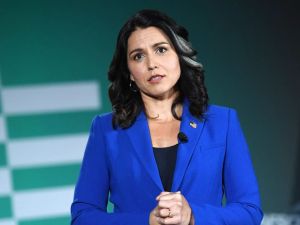
Tulsi Gabbard, the director of national intelligence, used the same easily cracked password for different online accounts over a period of years, according to leaked records reviewed by WIRED. Following her participation in a Signal group chat in which sensitive details of a military operation were unwittingly shared with a journalist, the revelation raises further questions about the security practices of the US spy chief.
WIRED reviewed Gabbard’s passwords using databases of material leaked online created by the open-source intelligence firms District 4 Labs and Constella Intelligence. Gabbard served in Congress from 2013 to 2021, during which time she sat on the Armed Services Committee, its Subcommittee on Intelligence and Special Operations, and the Foreign Affairs Committee, giving her access to sensitive information. Material from breaches shows that during a portion of this period, she used the same password across multiple email addresses and online accounts, in contravention of well-established best practices for online security. (There is no indication that she used the password on government accounts.)
Tulsi Gabbard
Two collections of breached records published in 2017 (but breached at some previous unknown date), known as “combolists,” reveal a password that was used for an email account associated with her personal website; that same password, according to a combolist published in 2019, was used with her Gmail account. That same password was used, according to records dating to 2012, for Dropbox and LinkedIn accounts associated with the email address tied to her personal website. According to records dating to 2018 breaches, she also used it on a MyFitnessPal account associated with a me.com email address and an account at HauteLook, a now-defunct ecommerce site then owned by Nordstrom.
Records of these breaches have been available online for years and are accessible in commercial databases.
Gabbard’s spokesperson downplayed this story, saying the information is a decade old and passwords have been changed many times since then. But check out this info on Gabbard:
The password associated with all of the accounts in question includes the word “shraddha,” which appears to have personal significance to Gabbard: Earlier this year, The Wall Street Journal reported that she had been initiated into the Science of Identity Foundation, an offshoot of the Hare Krishna movement into which she was reportedly born and which former members have accused of being a cult. Several former adherents told The Journal that they believe Gabbard received the name “Shraddha Dasi” when she was allegedly received into the group. Gabbard’s deputy chief of staff, Alexa Henning, responded to questions from The Journal at the time by posting them on X and accusing the news media of publicizing “Hinduphobic smears and other lies.”
The U.S. DOGE Service is racing to build a single centralized database with vast troves of personal information about millions of U.S. citizens and residents, a campaign that often violates or disregards core privacy and security protections meant to keep such information safe, government workers say.
The team overseen by Elon Musk is collecting data from across the government, sometimes at the urging of low-level aides, according to multiple federal employees and a former DOGE staffer, who all spoke on the condition of anonymity for fear of reprisals. The intensifying effort to unify systems into one central hub aims to advance multiple Trump administration priorities, including finding and deporting undocumented immigrants and rooting out fraud in government payments. And it follows a March executive order to eliminate “information silos” as DOGE tries to streamline operations and cut spending.
At several agencies, DOGE officials have sought to merge databases that had long been kept separate, federal workers said. For example, longtime Musk lieutenant Steve Davis told staffers at the Social Security Administration that they would soon start linking various sources of Social Security data for access and analysis, according to a person briefed on the conversations, with a goal of “joining all data across government.” Davis did not respond to a request for comment.
But DOGE has also sometimes removed protections aroundsensitive information — on Social Security numbers, birth dates, employment history, disability records, medical documentation and more. In one instance, a website for a new visa program wasn’t set up behind a protective virtual private network as would be customary, according to a Department of Homeland Security employee and records obtained by The Washington Post.
The administration’s moves ramp up the risk of exposing data to hackers and other adversaries, according to security analysts, and experts worry that any breaches could erode public confidence in government. Civil rights advocates and some federal employees also worry that the data assembled under DOGE could be used against political foes or for targeted decisions about funding or basic government services.
“Separation and segmentation is one of the core principles in sound cybersecurity,” said Charles Henderson of security company Coalfire. “Putting all your eggs in one basket means I don’t need to go hunting for them — I can just steal the basket.”
The Supreme Court ruled on Tuesday that the Trump administration may start enforcing a ban on transgender troops serving in the military that had been blocked by lower courts.
The ruling was brief, unsigned and gave no reasons, which is typical when the justices act on emergency applications. It will remain in place while challenges to the ban move forward.
The court’s three liberal members — Justices Sonia Sotomayor, Elena Kagan and Ketanji Brown Jackson — noted dissents but provided no reasoning.
Commander Emily Shilling
The case concerns an executive order issued on the first day of President Trump’s second term. It revoked an order from President Joseph R. Biden Jr. that had let transgender service members serve openly.
A week later, Mr. Trump issued a second order saying that “adoption of a gender identity inconsistent with an individual’s sex conflicts with a soldier’s commitment to an honorable, truthful and disciplined lifestyle.”
The Defense Department implemented Mr. Trump’s order in February, issuing a new policy requiring transgender troops to be forced out of the military. According to officials there, about 4,200 current service members, or about 0.2 percent of the military, are transgender.
The context:
The Supreme Court’s order came against the backdrop of the Trump administration’s broad attacks on transgender rights. The administration has sought to bar transgender athletes from sports competitions. It has tried to force transgender people to use bathrooms designated for their sex assigned at birth. And it has objected to letting people choose their pronouns.
The justices will soon decide the fate of a Tennessee law that bans transition care for transgender youths, challenged in a case brought by the Biden administration. The Trump administration flipped the government’s position in that case in February, after an executive order directed agencies to take steps to curtail surgeries, hormone therapy and other gender transition care for people under 19 years old.
In the case decided on Tuesday, seven active service members, as well as a person who sought to join and an advocacy group, sued to block the policy, saying, among other things, that it ran afoul of the Constitution’s equal protection clause.
One of the plaintiffs, Cmdr. Emily Shilling, who began transitioning in 2021 while serving in the Navy, has been a naval aviator for 19 years, flying more than 60 combat missions, including in Iraq and Afghanistan.
Her lawyers said the Navy had spent $20 million on her training.
In March, Judge Benjamin H. Settle of the Federal District Court in Tacoma, Wash., issued a nationwide injunction blocking the ban, using Commander Shilling as an example of the policy’s flaws.
Faced with the highly secretive and complex ritual of choosing a new pope, Catholic cardinals have turned to Hollywood to learn how it could all play out.
As crazy as it might sound, some of the 133 high-ranking clerics set to enter the Sistine Chapel when the conclave starts on Wednesday have looked to the Ralph Fiennes movie ― handily titled just “Conclave” ― for pointers.
“Some have watched it in the cinema,” a cleric involved in the real thing admitted to POLITICO.
The movie, directed by Edward Berger, features English actor Fiennes as Cardinal Thomas Lawrence, the dean of the College of Cardinals. As the pope-appointed steward of the conclave, he has to deal with fractious clerics, the emergence of scandalous dossiers targeting papal favorites and the appearance of an unknown candidate from an obscure diocese.
It all might sound painfully relevant. The film is seen as remarkably accurate even by cardinals, said the cleric, making it a helpful research tool, especially at a time when so many of the conclave participants have little experience of Vatican politics and protocol.
A majority of the cardinals who flocked to Rome in the weeks since the death of Pope Francis were appointed by the late pontiff, and have never experienced a conclave. Mirroring the Fiennes film, many also come from small, previously overlooked dioceses across the globe.
This has gotten way too long, so I’d better wrap it up. What’s on your mind today?
Did you like this post? Please share it with your friends:
The Sky Dancing banner headline uses a snippet from a work by artist Tashi Mannox called 'Rainbow Study'. The work is described as a" study of typical Tibetan rainbow clouds, that feature in Thanka painting, temple decoration and silk brocades". dakinikat was immediately drawn to the image when trying to find stylized Tibetan Clouds to represent Sky Dancing. It is probably because Tashi's practice is similar to her own. His updated take on the clouds that fill the collection of traditional thankas is quite special.
You can find his work at his website by clicking on his logo below. He is also a calligraphy artist that uses important vajrayana syllables. We encourage you to visit his on line studio.


 The sharp rise in tensions follows a deadly April 22 attack on tourists near the town of Pahalgam in Indian-administered Kashmir.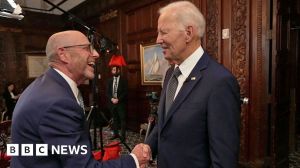



 peej
peej Carissa
 bostonboomer
 dakinikat
 ecocatwoman
 mablue2
 Mama Lopez
 peggysue22
 quixote
 skydancingguestblogger
 Mona (aka Wonk the Vote)



 Sky Dancing
Recent Comments