I’m getting a late start today after a night of tossing and turning. The news is depressing, as usual. Crazy Grandpa Trump is making an complete ass of himself on his Asian trip, where he’s temporarily left behind all the messes he’s left us with here.
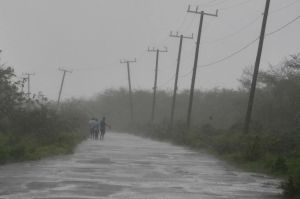
People walk along a road during the passing of Hurricane Melissa in Rocky Point, Jamaica, on Tuesday. Matias Delacroix AP
Before I get to the politics news, here’s a brief update from CNN on the devastation Hurricane Melissa is leaving in her wake.
• Severe damage: Melissa hit Jamaica as one of the strongest Atlantic hurricanes on record, caused major damage to public infrastructure and left most of the island without power. The full extent of the devastation there is unclear with some areas inaccessible.
• Deadly storm: Twenty five people have died in Petit-Goâve, Haiti, after a river flooded by Melissa burst its banks, the local mayor said. Three people were killed in Jamaica during storm preparations, and one person died in the Dominican Republic.
Hurricane Melissa made landfall in Jamaica Tuesday as the strongest storm in the island’s history. The Category 5 hurricane tore a path of destruction across the island, causing major flooding and power cuts. Prime Minister Andrew Holness declared the country a “disaster area.”
The massive storm swept through Cuba early this morning as a Category 2 hurricane. Over 750,000 residents were evacuated ahead of the storm. Melissa is now carving a path towards the Bahamas.
The intense winds have diminished in Jamaica, but the National Hurricane Center warns that heavy rains and flooding might continue.
And this is a monster of a storm that meteorologists say will be in the history books. Only six other Atlantic storms have done that since record-keeping began.
Click the NPR link to see more photos.
We’re expecting stormy weather from Melissa here in Massachusetts on Thursday night and Friday. I hope it won’t interfere too much with kids’ Halloween plans.
Some lowlights from Trump’s embarrassing foreign trip:
You probably saw this video of spaced-out Trump being guided around by the new Japanese Prime Minister Sanae Takaichi.
Trump in Japan.He has no idea what's going on, just wanders off.His brain is cooked.This is insane.
President Donald Trump treated his time in Japan on Tuesday as a victory lap — befriending the new Japanese prime minister, taking her with him as he spoke to U.S. troops aboard an aircraft carrier and then unveiling several major energy and technology projects in America to be funded by Japan.
By the end of the day, Trump — by his administration’s count — came close to nailing down the goal of $550 billion in Japanese investment as part of a trade framework. At a dinner for business leaders in Tokyo, Commerce Secretary Howard Lutnick announced up to $490 billion in commitments, including $100 billion each for nuclear projects involving Westinghouse and GE Vernova….
It was not immediately clear how the investments would operate and how they compared with previous plans, but Trump declared a win as he capped off a day of bonding with Takaichi.
Because they are probably fake “investments.” There’s more at the link.
President Donald Trump rarely has anything negative to say about the men and women of the U.S. military, but he made an exception on Tuesday to offer a rare criticism of America’s fighting forces: They may be too “good-looking” for his tastes.
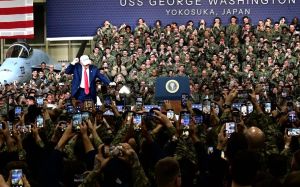
Trump was in the midst of an address to sailors aboard the U.S.S. George Washington, the Nimitz-class aircraft carrier that is semi-permanently based at the American naval base in Yokosuka, Japan, when he paused an attempt to praise the assembled service members to rant about their excessive attractiveness.
Speaking on the second day of a multi-day, multi-country trip through Asia that will conclude after a planned summit with Chinese leader Xi Jinping on Thursday, Trump said the Navy’s “ultimate strength” comes from “the men and women of the rank and file,” calling his uniformed audience “incredible people” and “good-looking people.”
After a beat, he said there were “too many good-looking people” present.
“I don’t like good-looking people,” he continued, as the sailors laughed at their commander-in-chief’s bizarre remark.
“I never liked good-looking people, I’ll be honest with you … never admitted that before,” he said.
Trump: You take a little glass of water and you drop it on magnets. I don't know what's going to happen.
Donald Trump went on a deranged rant about the power of water to destroy magnets during a rambling address to the U.S. Navy just off the coast of Japan.
Speaking aboard the USS George Washington aircraft carrier during his tour of East Asia, the president appeared to suggest—in a largely incoherent speech—that he is pushing for aircraft carriers to use “steam for the catapults” and hydraulics for elevators, while wrongly claiming that water can disable magnets.
The elderly president was talking about the magnetic catapults used to launch planes from the latest Navy super carriers, the USS Gerald R. Ford class, and the electromagnetic elevators used to move weaponry to the flight deck. Both systems double the speed with which planes can be armed and launched but slowed the delivery and commissioning of the $13 billion flagship of the class.
“You know, the new thing is magnets. So instead of using hydraulic that can be hit by lightning and it’s fine. You take a little glass of water, you drop it on magnets, I don’t know what’s going to happen,” Trump said.
“So, you know, the elevators come up in the new carriers—I think I’m going to change it, by the way—they have magnets. Every tractor has hydraulic, every excavator, every excavating machine of any kind has hydraulic. But somebody decided to use magnets.”
The 79-year-old president then stumbled over his words and failed to complete a coherent sentence before moving on and asking the watching troops whether they preferred hydraulics or magnets.
Trump then called out to a “top-ranking general” in the crowd for his opinion before continuing his tirade against the 2,000-year-old technology.
“I’m going to sign an executive order. When we build aircraft carriers, it’s steam for the catapults and it’s hydraulic for the elevators. We’ll never have a problem,” Trump said. “He agrees. Everybody agrees. But, ahh, these people in Washington.”
President Trump told American troops assembled in Japan on Tuesday that he was prepared to send “more than the National Guard” into cities to enforce his crackdowns on crime and immigration, further escalating how he has talked about using the military at home and abroad.
Trump “dances” for the troops in Japan.
Speaking to thousands of military service members aboard an aircraft carrier at the Yokosuka Naval Base in Japan on Tuesday, Mr. Trump delivered a partisan speech that resembled the raucous rallies that made him an ascendant force in U.S. politics.
But throughout his nearly hourlong speech, his usual ramblings about the physical appearances of audience members and steam-powered catapults were laced with dark warnings about how he might choose to deploy military forces.
“We have cities that are troubled, we can’t have cities that are troubled,” Mr. Trump said. “And we’re sending in our National Guard, and if we need more than the National Guard, we’ll send more than the National Guard, because we’re going to have safe cities.”
Legal disputes over what troops under federal control may be used to do on domestic soil — like a bar on using them to enforce the law, except when there is an insurrection — treat National Guard troops under federal control and active-duty troops as the same.
Mr. Trump also defended the U.S. military’s strikes against what the administration has said are suspected drug smugglers. The tactics have drawn widespread rebuke from experts who have said it is illegal to use the military to target civilians — including criminal suspects — who are not directly participating in hostilities.
Mr. Trump has increasingly used speeches to the military to air his grievances and bolster his accomplishments. Still, the scene was striking: an American president defending war and military deployments on U.S. soil, and employing partisan talking points on the global stage.
It’s a lot more than “striking,” IMHO.
Next stop for Trump: South Korea.
They all know how to play him. It isn’t difficult. bsky.app/profile/acyn…
GYEONGJU, South Korea, Oct 29 (Reuters) – South Korea welcomed U.S. President Donald Trump on Wednesday with a replica gold crown and awarded him with the “Grand Order of Mugunghwa”, the country’s highest decoration, the presidential office said.
Trump landed in South Korea on the final leg of a trip through Asia that also saw stops in Malaysia and Japan, with high-profile trade talks expected with South Korean President Lee Jae Myung and Chinese President Xi Jinping.
U.S. and South Korean warplanes escorted Air Force One on approach, and on the tarmac a South Korean military band greeted Trump with a rendition of “YMCA” and guns fired a salute.
Lee is hoping to win concessions from Trump in drawn-out negotiations aimed at lowering U.S. tariffs on South Korea, and has wooed the U.S. president by praising his outreach to North Korea.
Lee’s office said that in recognition of Trump’s role as a “peacemaker” on the Korean peninsula, he was awarded the “Grand Order of Mugunghwa”, which is named after South Korea’s national flower, a pink hibiscus also known as the Rose of Sharon in English.
They really know how to suck up to Trump.
Trump was gifted a replica of the golden Cheonmachong crown. The delicate original, which was found in a tomb in Gyeongju, features towering gold prongs and dangling leaf shapes.
“This symbolizes the history of Silla, which maintained a long-term era of peace on the Korean Peninsula, and a new era of peaceful coexistence and common growth on the Korean Peninsula that the United States and South Korea will work together for.”
The leaders had a working lunch that included Thousand Island salad dressing, in what Lee’s office said was a nod to Trump’s “success story in his hometown of New York.” The meal also included local specialties “according to President Trump’s preferences.”
On the menu were “mini beef patties with ketchup”, a “Korean Platter of Sincerity” featuring U.S. beef and local rice and soybean paste, and grilled fish with a glaze of ketchup and gochujang, a red chilli paste.
The lunch was capped by a “Peacemaker’s Dessert” consisting of a brownie adorned with gold.
A gold crown, junk food and being lauded as a “peacemaker.” What more could Trump ask for?
Donald Trump gushed over Indian Prime Minister Narendra Modi in the most cringeworthy way possible on Wednesday, describing the leader as “the nicest-looking guy” and then attempting to impersonate him.
The elderly president went there at the Asia-Pacific Economic Cooperation summit in Gyeongju, South Korea, during his tur of East Asia. He was bragging again that he single-handedly brought a swift end the four-day armed conflict between nuclear rivals India and Pakistan earlier this year by allegedly threatening both nations with 250 percent tariffs.
Indian officials have publicly rejected Trump’s repeated claims that he mediated the ceasefire. Sources told Bloomberg that Modi skipped the entire summit in Malaysia this week because Indian officials were worried Trump would once again repeat his self-proclaimed role in ending the conflict. They probably didn’t anticipate the accent.
“I’ll tell you what, Prime Minister Modi is the nicest looking guy,” Trump said, adding Modi looked like someone “you’d like to have as your father.”
“He’s tough as hell,” Trump said, before launching into a Modi impersonation, complete with what sounded like an attempt at an Indian accent: “No, we will fight!”
“I said, ‘Whoa, is that the same man that I know?’” Trump told the room.
Trump then took credit again for ending the escalating crisis, a claim disputed by officials in New Delhi. He said it wouldn’t have been resolved “if it wasn’t for the tariffs.”
“After a little while, and they’re good people, and after literally two days they called up, and they said we understand, and they stopped fighting—isn’t that amazing?”
The White House on Tuesday fired all six members of the Commission of Fine Arts, an independent federal agency that had expected to review some of President Donald Trump’s construction projects, including his planned triumphal arch and White House ballroom.
“On behalf of President Donald J. Trump, I am writing to inform you that your position as a member of the Commission of Fine Arts is terminated, effective immediately,” reads an email reviewed by The Washington Post that was sent to one of the commissioners by a staffer in the White House presidential personnel office.
The commission, which was established by Congress more than a century ago and traditionally includes a mix of architects and urban planners, is charged with providing advice to the president, Congress and local government officials on design matters related to construction projects in the capital region. Its focus includes government buildings, monuments and memorials. White House officials have traditionally sought the agency’s approval.
President Joe Biden appointed the six sitting commissioners to four-year terms, several of which would have extended through 2028. Their termination comes as the White House gears up for several Trump construction projects, including his planned $300 million White House ballroom, and seeks to install allies on key review boards.
A White House official confirmed that the Commission of Fine Arts members had been terminated.
“We are preparing to appoint a new slate of members to the commission that are more aligned with President Trump’s ‘America First’ policies,” said the official, who spoke on the condition of anonymity to discuss personnel matters.
I guess Trump will get approval for his tasteless ballroom and Hitler arch then.
Democrats are expanding their probes into President Donald Trump’s demolition of the East Wing and construction of his planned ballroom, with lawmakers pressing the White House and outside companies to explain the project’s finances and what was promised to contributors.
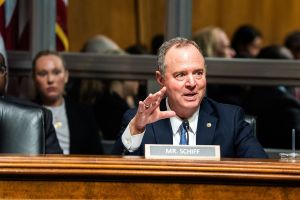
Sen. Adam Schiff (D-California), a frequent critic of President Donald Trump, is opening a probe into the president’s planned White House ballroom. (Demetrius Freeman, The Washington Post)
Sen. Adam Schiff (D-California) and colleagues on Tuesday demanded that the White House provide a “complete accounting” of how it is paying for the ballroom, including any terms for donors. Trump said Friday that he had raised more than $350 million to pay for the project, and the White House has said that at least three dozen companies and private individuals have helped fund it.
“The opaque nature of this scheme reinforces concern that President Trump is again selling presidential access to individuals or entities, including foreign nationals and corporate actors, with vested interests in federal action,” Schiff wrote to White House Chief of Staff Susie Wiles in a letter shared with The Washington Post. Schiff, a frequent critic of the president, also sent his request to the Government Accountability Office, a nonpartisan watchdog that conducts oversight of the executive branch.
Sen. Richard Blumenthal (D-Connecticut) separately sent letters Tuesday to contractors involved in the White House construction project, including McCrery Architects, Clark Construction and engineering firm AECOM, questioning the “rapidly changing and secretive terms” of Trump’s planned ballroom. The letters were also shared with The Post.
Trump said in July that the ballroom would cost about $200 million and hold 650 guests, estimates that he increased last week to $300 million and nearly 1,000, respectively. The ballroom donors include defense and tech companies including Amazon, Apple, Google, Lockheed Martin and Meta, which frequently have business before the administration. (Amazon founder Jeff Bezos owns The Post.)
Lawmakers said they were frustrated that the White House had neither consulted Congress nor received approval from at least two relevant federal commissions before rapidly demolishing the East Wing last week.
Five Senate Republicans voted with Democrats on Tuesday night to pass a resolution terminating President Trump’s emergency authority to impose steep tariffs on Brazil, one of the biggest exporters of coffee to the United States.
The Senate voted 52 to 48 to pass the resolution sponsored by Sens. Tim Kaine (D-Va.) and Rand Paul (R-Ky.) to terminate Trump’s 50 percent tariffs on Brazilian imports, such as coffee, oil and orange juice.
Paul, speaking on the Senate floor, called the tariff a tax on U.S. consumers.
The Kentucky Republican argued that the Constitution requires that “taxes must originate in the House” of Representatives.
“Yet, these taxes are originating with the White House,” he said.
McConnell, in a statement, said that Trump’s tariffs are hurting Kentucky businesses and farms.
It’s symbolic, but still could be a positive sign.
I guess this post is kind of disorganized–I’m just not that with it today. But that’s all I have for you. I hope there’s something here worth reading/watching.
Did you like this post? Please share it with your friends:
The paintings in today’s post are by Suzanne Valadon. Here’s some background about this fascinating artist from The Great Cat.org:
Suzanne Valadon (1865-1938), was an illegitimate child of a French laundress and lived a rather rough life in her youth. She performed in a circus on the trapeze until she had a bad fall when she was 16.
After that, she decided to become an artist’s model, a safer profession. Artists such as Pierre Puvis de Chavannes, Henri Toulouse-Lautrec, and Pierre-Auguste Renoir used her in some of their works. Renoir even painted her in The Bathers. Valadon began to study the methods and works of the artists she posed for, and started to paint on her own.
Encouraged by Toulouse-Lautrec, she continued and even caught the eye of Edward Degas, who was so taken by her work that he purchased several of her first paintings in 1893. A true Bohemian, in 1883 at age 18, she gave birth to an illegitimate son, Maurice Utrillo, who became a well known artist as well.
Read more about her life at the pdf link above. You may have to go to the Table of Contents and click on her name.
Now on to today’s news.
It’s been another her horror-filled week, as Dakinikat described in her post yesterday. I avoided TV for most of the week, but it’s impossible to completely escape the Trump chaos. I’ve been doing my best though, mainly by reading lotsYo of books. Anyway, let’s see what’s happening this morning.
Trump has asked for help winning the 2020 election from Ukraine, China, and I assume Russia, since he seems to talk on the phone to Putin constantly.
It’s almost like trump has been given directions on how to kill the most Americans & destroy the country. So how many phone calls has he had with Putin lately? 6?
RIO DE JANEIRO — Members of the House Foreign Affairs Committee said Friday they were “extremely alarmed” by assertions that the American ambassador in Brazil had signaled to Brazilian officials they could help get President Trump re-elected by changing their trade policies.
In a letter sent Friday afternoon, Committee Chairman Eliot L. Engel demanded that the ambassador, Todd Chapman, produce “any and all documents referring or related to any discussions” he has held with Brazilian officials in recent weeks about their nation’s tariffs on ethanol, an important agricultural export for Iowa, a potential swing state in the American presidential election.
The committee’s letter was sent in response to reports in the Brazilian news media this week saying that Mr. Chapman, a career diplomat, made it clear to Brazilian officials they could bolster Mr. Trump’s electoral chances in Iowa if Brazil lifted its ethanol tariffs.
Eliminating tariffs would give the Trump administration a welcome trade victory to present to struggling ethanol producers in Iowa, where the president is in a close race with his Democratic rival, Joseph R. Biden Jr.
The House committee said it was opening an inquiry into the matter.
The State Department denied the reports, but . . .
The O Globo newspaper published a story on Thursday saying Mr. Chapman had underscored “the importance to the Brazilian government of keeping Donald Trump” in office. Mr. Bolsonaro, a far-right leader, has made closer alignment with the Trump administration his top foreign policy priority.
A competing newspaper, Estadão, published an article Friday saying its reporters independently confirmed that the ambassador framed his argument against tariffs in partisan terms. The article said the Brazilian officials who met with Mr. Chapman rejected the appeal, declining to be drawn into the American presidential battle.
Neither article named its sources. But Alceu Moreira, a Brazilian congressman who heads the agricultural caucus, told The New York Times in an interview that Mr. Chapman had made repeated references to the electoral calendar during a recent meeting the two had about ethanol.
I guess we can assume Trump has asked for help from just about every country headed by a dictator.
Now Trump has helped Putin by ordering the withdrawal of U.S. Troops from Germany.
The US is moving forward with President Donald Trump’s plan to withdraw nearly 12,000 troops from Germany, a decision that has attracted bipartisan congressional opposition and roiled key allies who see the move as a blow to NATO.
Secretary of Defense Mark Esper acknowledged the plan will cost billions to execute when he formally announced the decision on Wednesday from the Pentagon. US defense officials said it will take years to relocate the troops.
The plan to pull US troops from the long-time NATO ally has been met with broad bipartisan opposition amid concerns that it will weaken the US military’s position vis a vis Russia, however the Trump Administration has decided to proceed with the move.
Trump defended the decision Wednesday, saying the troop drawdown was taking place because Berlin was not spending the NATO target of 2% of its GDP on defense and because Germany was taking “advantage” of the US….
Defense officials, however, said Wednesday that the decision on where to house the US troops leaving Germany was not influenced by whether the new host country was meeting the 2% target.
Well, I’m sure Putin is thrilled. Will Trump pull us out of NATO next?
This week, U.S. President Donald Trump reiterated his intent to move forward with reducing the U.S. military presence in Germany, without any consultations with Berlin. And even as members of the U.S. Congress and America’s allies abroad expressed concerns about the drawdown, the Trump administration’s decision brought joy to the Kremlin and Russian media.
Back in June, 22 Republican members of the House Armed Services Committee urged Trump not to go ahead with the move, stating in a letter: “We believe that such steps would significantly damage U.S. national security as well as strengthen the position of Russia to our detriment … In Europe, the threats posed by Russia have not lessened, and we believe that signs of a weakened U.S. commitment to NATO will encourage further Russian aggression and opportunism.” [….]
Meanwhile, when the intent to reduce the U.S. contingent in Germany was first announced, Russian Foreign Ministry spokeswoman Maria Zakharova said that the Kremlin “would welcome any steps by Washington to scale down its military presence in Europe,” brazenly telling the United States to take home not only its troops, but also its tactical nuclear weapons.
The Kremlin-controlled Russian state media also sensed a precious propaganda opportunity. Sergey Brilyov, anchor of the news show Saturday Vesti on Russian state media channel Rossiya-1, pondered whether the controversial move by the Trump administration could be considered the proof that Russia no longer poses a military threat to Europe.
Kremlin spokesperson Dmitry Peskov used the same rationale today, when he claimed that Russia doesn’t present any threat to European countries and “the fewer U.S. soldiers are on the European continent, the calmer it is in Europe.”
Six months into the pandemic, the United States continues to suffer the worst outbreak of COVID-19 in the developed world. Considerable blame belongs to a federal response that offloaded responsibility for the crucial task of testing to the states. The irony is that, after assembling the team that came up with an aggressive and ambitious national testing plan, Kushner then appears to have decided, for reasons that remain murky, to scrap its proposal. Today, as governors and mayors scramble to stamp out epidemics plaguing their populations, philanthropists at the Rockefeller Foundation are working to fill the void and organize enough testing to bring the nationwide epidemic under control.
Inside the White House, over much of March and early April, Kushner’s handpicked group of young business associates, which included a former college roommate, teamed up with several top experts from the diagnostic-testing industry. Together, they hammered out the outline of a national testing strategy. The group—working night and day, using the encrypted platform WhatsApp—emerged with a detailed plan obtained by Vanity Fair.
Rather than have states fight each other for scarce diagnostic tests and limited lab capacity, the plan would have set up a system of national oversight and coordination to surge supplies, allocate test kits, lift regulatory and contractual roadblocks, and establish a widespread virus surveillance system by the fall, to help pinpoint subsequent outbreaks.
But it never happened. Why?
By early April, some who worked on the plan were given the strong impression that it would soon be shared with President Trump and announced by the White House. The plan, though imperfect, was a starting point. Simply working together as a nation on it “would have put us in a fundamentally different place,” said the participant.
But the effort ran headlong into shifting sentiment at the White House. Trusting his vaunted political instincts, President Trump had been downplaying concerns about the virus and spreading misinformation about it—efforts that were soon amplified by Republican elected officials and right-wing media figures. Worried about the stock market and his reelection prospects, Trump also feared that more testing would only lead to higher case counts and more bad publicity. Meanwhile, Dr. Deborah Birx, the White House’s coronavirus response coordinator, was reportedly sharing models with senior staff that optimistically—and erroneously, it would turn out—predicted the virus would soon fade away.
Against that background, the prospect of launching a large-scale national plan was losing favor, said one public health expert in frequent contact with the White House’s official coronavirus task force.
Most troubling of all, perhaps, was a sentiment the expert said a member of Kushner’s team expressed: that because the virus had hit blue states hardest, a national plan was unnecessary and would not make sense politically. “The political folks believed that because it was going to be relegated to Democratic states, that they could blame those governors, and that would be an effective political strategy,” said the expert.
That logic may have swayed Kushner. “It was very clear that Jared was ultimately the decision maker as to what [plan] was going to come out,” the expert said.
[Emphasis added.] This is a mind-blowing article. Please read the whole thing if you haven’t already.
Is it just me, or are we really approaching the point at which U.S. democracy cannot be saved? Trump wants to hold next year’s G7 at his private Doral resort in Florida, which would mean that foreign countries would literally have to pay his family business for the privilege of attending. And Trump will likely try to invite Putin next year after he “went to the mat for Putin” over the weekend.
House Democrats aren’t doing much to control the lawless madman president, much less take steps toward impeaching him. They are making efforts to get his tax returns through the courts, but Rep. Richard Neal refuses to ask New York to provide Trump’s state tax returns.
It’s beginning to look like the race for the Democratic presidential nomination will be between three deeply flawed septuagenarian candidates: Joe Biden, Bernie Sanders, and Elizabeth Warren.
I hope you’ll check out the links above; there simply isn’t time or space for me to provide excerpts here. And there are so many emergencies that I didn’t mention, such as Trump’s war on immigrants, the problem of easily available guns and the rising threat of white supremacist violence.
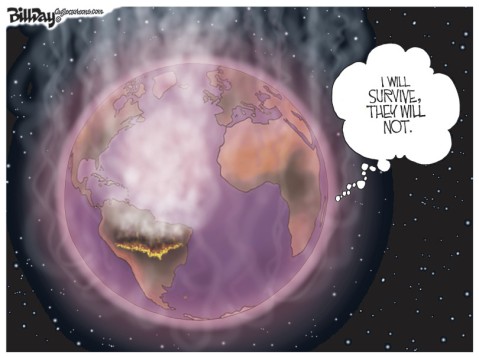
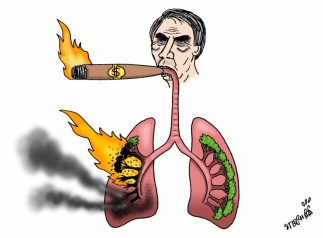
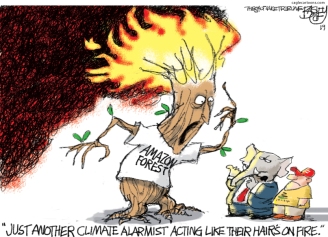
Today’s top emergency is the burning of the Amazon rain forest in Brazil.
The Amazon — nearly four times the size of Alaska — is a vast sink for storing carbon dioxide and a key element of any plan to restrain climate change. Any increase in deforestation there would speed up global warming as well as damage an important refuge for biodiversity.
Studies show the 2.2 million-square mile forest is nearing a tipping point, at which large fragmented portions of the rainforest could transform into an entirely different, drier ecosystem, leading to the acceleration of climate change, the loss of countless species and disaster for the indigenous populations that call the tropical rainforest home….
The trees and plants of the Amazon forest pull carbon dioxide out of the atmosphere as part of photosynthesis. Destruction of the forest releases carbon stored in the trees and reduce the amount of carbon dioxide used by them.
People are the cause of the Amazon fires.
…most fires in the Amazon are caused by humans, set either accidentally or intentionally.
Brazil’s National Institute for Space Research found the country has lost more than 1,330 square miles of forest cover to development since January, when President Jair Bolsonaro took office. That’s a 39 percent increase over the same period in 2018. July in particular featured a huge spike in forest loss, with an area larger than the city of Los Angeles lost in a single month.
Why would anyone want to hard the Amazon rain forest?
The biggest economic interest groups eating away at the Amazon are cattle grazers and soybean growers. “Directly after deforestation, mostly what we see is pasture,” said Mikaela Weisse, a fellow at the World Resources Institute. Later, soybean growers expand by taking over pasture lands.
Mining, timber and development firms are also eyeing the region for expansion, encouraged by Bolsonaro’s election.
There’s much more helpful (and horrifying) information at the WaPo link.
Hours after leaders of some of the world’s wealthiest countries pledged more than $22 million to help combat fires in the Amazon rainforest, Brazil’s government angrily rejected the offer, in effect telling the other nations to mind their own business — only to later lay out potential terms for the aid’s acceptance.
President Jair Bolsonaro of Brazil expressed his ire in a series of Twitter posts on Monday, and specifically criticized and taunted President Emmanuel Macron of France, who had announced the aid package at the Group of 7 summit meeting. Their comments extended a verbal feud between the two leaders.
But early the next day, Mr. Bolsonaro offered possible terms for the acceptance of the aid package when he spoke to reporters in the capital, Brasília.
He said that if Mr. Macron withdrew “insults made to my person,” and what Mr. Bolsonaro interpreted as insinuations that Brazil does not have sovereignty over the Amazon, he would reconsider.
“To talk or accept anything from France, even with their very best intentions, he will have to withdraw his words, and then we can talk,” Mr. Bolsonaro said. “First he withdraws them, then he makes the offer, and then I’ll answer.”
Mr. Bolsonaro, who has suggested earlier that Mr. Macon’s real motive is to shield France’s agriculture from Brazilian competition, had tweeted on Monday that the president “disguises his intentions behind the idea of an ‘alliance’ of the G7 countries to ‘save’ the Amazon, as if we were a colony or a no-man’s land.”
The fires raging at the edges of the Amazon rainforest are, at the moment, largely consuming lands that had already been converted from their natural state into tracts waiting to be farmed or developed. Nevertheless, some of the blazes are eating away at the rainforest itself, reducing its size by a football field a minute. And one of the most disturbing things about them is that they aren’t part of the cycle of nature, like a California wildfire might be, but are intentionally set in many cases to get rid of brush and felled trees to make way for soy fields and beef grazing grounds. That reflects Brazil’s troubling return to a policy of deforestation that, if unabated, could have grave consequences for efforts to counter the worst effects of global warming.
The reason the Amazon is burning is because Brazilian President Jair Bolsonaro, who followed Donald Trump’s populist, anti-establishment playbook to win election last year, wants it to. He thinks the Amazon should not be protected, and that lands reserved for indigenous peoples should not be recognized — all in the name of economic growth. That see-no-evil approach is another point Bolsonaro has in common with Trump, who has sought to make an alarming amount of public lands available for oil and gas drilling and other extractive industries, such as uranium mining — the health of the planet be damned.
At the just-concluded G-7 meeting in France, international leaders criticized Bolsonaro for his land-use and environmental policies, which include telling those who would cut the rainforest that his government would no longer stop them. So the rate of deforestation, while still far below what it had been a dozen years ago, has been increasing. The G-7 also announced more than $20 million in aid to Brazil and Bolivia for firefighting equipment — a drop in the bucket considering the need, advocates say — and French President Emmanuel Macron pledged to put together an alliance to push for reforestation.
Bolsonaro was not receptive; he accused the leaders of embracing colonialism by telling Brazil what to do. But there’s nothing colonial in asking a neighbor to stop lighting fires that affect the rest of us….
We are all joined by the hard reality that our continued release of carbon into the atmosphere — whether it be from the cars we commute in or the forest Brazilians burn to grow food — is endangering us all. It’s a reality not recognized by Bolsonaro. Nor by Trump, who neither joined the criticism of Bolsonaro’s policies nor showed up for the G-7 climate talks that led to the fire aid package. Both presidents’ disregard for the well-being of the world is, literally, playing with fire. That won’t end well.
The ecological devastation is done in the service of the surging demand for beef. About 80 percent of Brazil’s beef is consumed domestically, said Nathalie Walker, the director of the tropical forest and agriculture program at the National Wildlife Federation.
Read more at the WaPo.
I admit, I’m feeling extremely pessimistic today. If anyone has more positive news, I’d love to read about it. I love you guys.
Did you like this post? Please share it with your friends:
I have a few odds and end reads on Brazil and Venezuela that I’d like to suggest today. I’m trying to take a breather from US politics so let’s look to two Southern neighbors with economic and political crises. I’m going to start out with a few articles on Venezuela. The country is having serious issues on the economic and political front. It’s never good when one of our trading partners experiences such disruption.
Venezuela is experiencing hyperinflation which is something that is rare these days in places that we generally view as having functioning and non-politically manipulated central banks. Usually, hyperinflation occurs in countries when the central government tries to solve its problems by printing money or devaluing its currency internationally and the central bank obliges. Venezuela’s debt is also out of control given the range and value of the countries assets. Usually, these kinds of things will start transmitting instability to the region and to the country’s trading partners because prices of goods and services, interest rates, and exchange rates will fluctuate.
Word had spread that a delivery of poultry meat was due at the Central Madeirense supermarket, and long before dawn a queue of shoppers was snaking around the block.
Kattya Alonzo was one of them. The 48-year-old mother of three was already planning to make the traditional chicken and rice dish arroz con pollo – if she could also find some rice.
“I haven’t been able to buy chicken in more than a month, so I was there early at about 4am,” she said.
At about 6.30, two trucks finally drew up outside the store, but before the drivers could start to unload, national guardsmen told them to drive on.
Perhaps it was not surprising that the mood outside the supermarket quickly turned ugly: frustration turned to despair, anger to violence. Before long, the incident on Tuesday had escalated.
Mobs tried to loot several bakeries and delis and another food delivery truck.
The unrest soon spread throughout this city of 200,000 just outside the capital, Caracas. Protesters shouted “We want food” as they blocked intersections with burning tyres and clashed with security forces.
Police and the national guard quickly controlled the outburst, with some 14 people reportedly arrested, and at least one person was injured, according to witnesses.
The protests were not related to marches in Caracas and other major cities, which were called this week by opposition leaders seeking to cut short the term of President Nicolás Maduro who they say has driven the country into the ground through mismanagement.
But spontaneous outburst such as the one in Guarenas may present a more serious challenge to Maduro’s rule than any efforts by his political rivals.
Things are not going well in Venezuela since global oil prices are down. There are black markets everywhere since the food shortages began. Vendors get rich selling basics like diapers and milk. The government has been trying to control prices but what this has done is lead to folks turning to side channels in black markets where the price is set by desperation and greed. These black market shoppers are called “bachaqueros” which is a play on the name of the bachaco leaf-cutting ant that carries several times its weight. This place is no longer the socialist dream of the late Hugo Chavez who ruled the country for 14 years. It is an example of socialism gone very wrong.
Epic Mural in Chile by Mexican artist Jorge González Camarena, assisted by Chilean painters, Eugenio Brito and Albino Echeverría.
It wasn’t always this way. Diego Moya-Ocampos, senior political risk analyst at IHS, says the current crisis is the result of years of “economic mismanagement” by the ruling socialist party.
Led by Hugo Chávez, the country’s firebrand former president, the country embarked on a wave of expropriation and redistribution with the charismatic leader offering cut-price fridges, appliances and even new homes to poor Venezuelans.
Chávez wanted to create a socialist paradise, an ideology that has been reinforced by his successor Maduro following his death in 2013.
But the oil price collapse a year later served as a wake-up call for a country that chose profligacy over prudence in the hope that a rainy day would never come.
Oil accounts for 98pc of total exports and 59pc of fiscal revenues, but Moya-Ocampos says the price slide isn’t the country’s only problem.
“Even under Chavez and $100 a barrel oil, debt was rapidly rising and there were already food shortages,” he says, “This is ultimately to do with an interventionist model that is not sustainable and has reached a tipping point.”
Many Venezuelans have already left the country, including Francisco Flores. “Venezuela has taken good working companies, given them to the poor but not equipped them with the skills to run them so they go bankrupt,” he says.
“That’s just a recipe for destroying a country.”
The NHS therapist, who now lives in London, says the regime is based on a principle of keeping everyone “equal but poor”.
Brazilian artist Adelio Sarro is known for portraits
I’ve always been interested in South American countries and their various economic crises. The Mexican Peso Crisis is still taught in basic International Economics/Finance courses as a cautionary tale that’s frequently forgotten. It’s also called The Tequila Crisis and happened while Bill Clinton was President in 1994. A country in crisis transmits economic and political instability to its neighbors through trade. Here’s a an example of that from the current Venezuela crisis. Coca Cola is one of those ubiquitous US products that basically is every where in the world. Its recipe may be slightly different depending on the sugar dependency of a country’s consumers, but the trademark and product packaging are quite recognizable. Venezuela’s access to Coke is gone.
And so we will have to chalk this up as another of those great successes of Bolivarian socialism. Yes, as I’ve been saying for some time now, this is not because of some misplaced zeal in making the lives of the poor better: it’s simply because messing with markets is not the way to achieve anything at all. Well, not unless your actual goal is to have a country run out of everything.
CARACAS, Venezuela— Coca-ColaKO -0.83% is halting production in Venezuela of its namesake beverage due to a sugar shortage brought on by the country’s economic crisis.
Production of sugar-sweetened beverages will be suspended in the coming days after local suppliers reported they had run out of the raw material, the Atlanta company said in an emailed statement Friday.
This isn’t even about the currency and import problems that have affected beer production:
The move comes as Venezuela’s economy is teetering on the edge of collapse with widespread food shortages and inflation forecast to surpass 700 percent. Last month, Empresas Polar, Venezuela’s largest food and beverage company, stopped production of beer because of a lack of imported barley.
I think teetering on the edge is using the wrong tense there. I think teetered would be better, making sure that we use the past tense. In any realistic sense that consumer economy has gone …
All countries have modified market economies. Some markets function perfectly well with very little interference. Some markets would not exist without government provision or if they did, would be prohibitively expensive. There are three
Mexican Street artist Spaik and work in Michoacan
primary agents in an domestic economy. That would be the government, the sellers, and the buyers. Whenever any one of those agents gets into any market and has more unchecked power than the rest, you’re going to have issues. Market excesses can result from power and profit seeking private enterprise or from Government overreach. You can find many examples of each throughout the modern history of many South American Countries.
Brazil’s economy sank into the deepest recession in recent history last year amid low prices for key exports, soaring inflation and depressed confidence levels. Moreover, as the economy plummeted so did President Dilma Rousseff’s political career. A wide-spread corruption scandal and the economy’s abysmal performance caused approval levels to fall to all-time lows and resulted in the commencement of impeachment proceedings last year. On 12 May, the Senate voted to continue with these proceedings, forcing Rousseff to step down for a maximum of 180 days while a trial is conducted. Vice President Michel Temer took over as interim president and his first task will be to find a way to halt the sinking ship. However, a number of daunting challenges lie in Temer’s path and recent economic data remain poor: retail sales returned to contraction in March and the manufacturing PMI fell to the lowest level in over seven years in April.
A change in leadership will not be a magic bullet for Brazil’s economy and the recession is expected to continue throughout this year. FocusEconomics panelists see the economy contracting 3.7% in 2016, which is down 0.2 percentage points from last month’s forecast. For 2017, the panel sees the economy recovering slightly and growing 0.7%.
DR: I think it’s an impeachment process, to remove me from the office. Our Constitution provides for an impeachment, but only if the President commits a crime against the Constitution and human rights. We believe that it’s a coup, because no such crime has been committed. They put me on trial for additional loans [from state banks]. Every president before me has done it, and it has never been a crime. It won’t become a crime now. There is no basis for considering it a crime. A crime has to be legally defined. So we believe this impeachment is a coup, because it’s clearly stated in the Constitution that only a crime of malversation can serve as basis for impeachment. The actions currently under scrutiny do not, strictly speaking, fall under that category. Besides, Brazil is a presidential republic. You can’t remove a president or a prime minister who hasn’t committed a crime. We’re not a parliamentary republic, where a president can dissolve the congress, which, in turn, can call for a vote of no confidence out of purely political reasons. So it’s impossible to impeach a president in Brazil based solely on political reasons or political distrust. We believe that what’s happening now in Brazil is an attempt to replace an innocent president involved in no corruption-related legal proceedings in order for the politicians that lost the 2014 election to control the state bypassing the new election. That’s what’s happening. This is an attempt to replace the entire political program that includes both the social and economic development aspects and is aimed at tackling the crisis that Brazil has been going through in recent years with a program clearly neoliberal in nature. This program provides for minimizing our social programs in accordance with the minimal state doctrine. This doctrine is at odds with all the Brazilian legal norms regarding healthcare, construction and ensuring that our people have their own houses, availability of high-quality education and minimum wages guaranteed to the poorest part of the Brazilian population. They want to do away with these rights and at the same time they conduct an anti-national policy, for example, when it comes to Brazil’s oil resources. Significant subsalt oil reserves, lying 7,000 m below the surface, were discovered recently. The ministers were saying that exploring these reserves was impossible, but now we’re extracting a million barrels daily from subsalt oil reserves. Undoubtedly, they were saying that thinking to change the legislation in order to guarantee access to these reserves to international companies. Moreover, in terms of foreign policy, starting from Lula da Silva and throughout my presidency, we have been seeking to strengthen ties with Latin American, African, BRICS countries and other developing nations, in addition to the developed world – the US and Europe. I think that BRICS is one of the most important multilateral groups created in the last decade. But the interim government holds different views on BRICS and the importance we place on Latin America. They are even discussing the possibility of closing embassies in some African countries. We have very special relations with Africa. Brazil is the country with the highest percentage of population of African descent in the world, second only to African countries. We have a lot of people of African descent, so over the last few years we’ve been putting particular emphasis on our relations with the African countries, and not only Portuguese-speaking ones. This shows a wider approach to the world, as opposed to the traditional one, supported by those who have usurped the power now and are taking steps that are at odds with the program approved by the Brazilian people, by 54 mln votes, on the day I was elected.
Early 20th century Brazilian artist Francisco da Silva
Yet as Brazil is consumed by the worst political and economic crisis in decades, the country has turned inward. This has contributed to a regional power vacuum and a sense of paralysis when it comes to devising regional approaches to South America’s most pressing challenges. For example, Venezuelan President Nicolás Maduro’s increasingly blatant disregard for even basic democratic standards has seen a less meaningful regional reaction because of Brazil’s problems. Given Brazil’s dominant role in South America – representing roughly half its GDP, population and territory – its travails are inevitably bad news for the continent.
The current crisis is only part of the story. Even prior to reelection in 2014, when the government refused to acknowledge that Brazil’s economy was in trouble, Dilma Rousseff failed to articulate a coherent foreign policy doctrine. Brazil’s international strategy since 2011 was shaped, above all, by the president’s astonishing indifference to all things international and officials’ incapacity to convince Rousseff that foreign policy could be used to promote the government’s domestic goals.
Her predecessors knew better: Fernando Henrique Cardoso (1995-2002) helped establish a series of regional mechanisms to preserve democratic governance, thus reducing the number of external political crises that could hurt the Brazilian economy. Luiz Inácio Lula da Silva (2003-10) promoted regional integration further to facilitate the entry of Brazilian companies into neighboring markets. Lula not only had a trusted foreign minister and a special adviser for international affairs, but also a highly active minister of defense who embraced foreign policy to promote Brazil’s interests, for example by using the newly established South American Council of Defense to enhance trust between the continent’s armed forces.
Paradoxically, just as the bitter political battle to unseat Rousseff is reaching its climax, the president has at last begun to accept the importance of foreign affairs. She and Vice President Michel Temer (poised to become president if she is removed from office) have engaged in an international war of narratives about the legitimacy of impeachment proceedings. Rousseff traveled to New York, where she denounced Temer as a “coup-monger” on the sidelines of a UN meeting. Temer reacted swiftly, giving interviews to major international newspapers, and sending allies abroad to make his case.
Rousseff also broadened her fight to regional bodies and leaders. In somewhat vague terms, she announced she would ask Mercosur to invoke its democracy clause, arguing that a democratic rupture was underway in Brazil. From New York, Brazil’s foreign minister and special foreign policy adviser traveled directly to Quito to make Rousseff’s case at Unasur. Maduro and Bolivia’s President Evo Morales are among those who agree Rousseff is facing a “coup.” For the government in Caracas, which recently assumed the temporary presidency of Unasur and will soon assume the presidency of Mercosur, it is an opportunity to try to draw attention away from the catastrophic situation at home.
It is easy to forget that we do have neighbors and some of them may have issues that will suddenly impact our economy in our own election year with so much focus on ISIS and the middle east. This is one of the reasons I trust Hillary Clinton. I can guarantee that if you ask her about either of these countries, their leaders, and their issues she will have insightful analysis and probably know the players personally. Many of the biggest issues in these countries have roots in populist leaders of one extreme or another. My guess is that the other two choices standing for President at this point will be clueless as to the situations, causes, and ramifications. You can tell that not only by their words and polices but also by the absence of discussion on these two important neighbors in crisis.
What’s on your reading and blogging list today? This is an open thread!!! Please share!
Did you like this post? Please share it with your friends:
Pakistanis watch the New Year fireworks in Karachi on January 1, 2011. (RIZWAN TABASSUM/AFP/Getty Images)
Good evening and a Happy 2011, Sky Dancers.
Here are my Saturday offerings for the New Year. There’s a lot of doom and gloom in the headlines, so I tried to mix in a few stories and thoughts of my own to put things into a more motivating and thoughtful perspective.
From McClatchy: “2011 looks grim for progress on women’s rights in Iraq… BAGHDAD — When Iraqi Prime Minister Nouri al Maliki introduced what he called a national partnership government two weeks ago, he included allies and adversaries, Arabs and Kurds, Shiite Muslims and Sunnis. One group, however, was woefully underrepresented. Only one woman was named to Maliki’s 42-member cabinet, sparking an outcry in a country that once was a beacon for women’s rights in the Arab world and adding to an ongoing struggle over the identity of the new Iraq.“
From further down in the article: “After Maliki announced his lineup, Alaa Talabani, a female lawmaker from the northern Kurdistan region, delivered a rousing condemnation of the selection process to a packed legislative chamber. ‘The Iraqi women feel today, more than any other day, that democracy in Iraq has been slaughtered by discrimination, just as it was slaughtered by sectarianism before,’ Talabani said, her voice quaking with emotion.”
“…slaughtered by discrimination, just as it was slaughtered by sectarianism.” That is a powerful statement.
It reminds me of this Hillary quote: “To expand freedom to more people, we cannot accept that freedom does not belong to all people. We cannot allow oppression defined and justified by religion or tribe to replace that of ideology.” –Secretary of State Hillary Clinton, in Berlin for the 20th anniversary of the wall’s collapse
The words of both Alaa Talabani and Hillary Clinton above make me think of dry drunks and switching addictions. It is as if there is a certain quotient of oppression junkies out there who just go from one form of subjugating others to the next.
Which brings me to my next link. From Chris Hedges’, a few days ago, at truth-out… “2011: A Brave New Dystopia… The two greatest visions of a future dystopia were George Orwell’s ‘1984’ and Aldous Huxley’s ‘Brave New World.’ The debate, between those who watched our descent towards corporate totalitarianism, was who was right. Would we be, as Orwell wrote, dominated by a repressive surveillance and security state that used crude and violent forms of control? Or would we be, as Huxley envisioned, entranced by entertainment and spectacle, captivated by technology and seduced by profligate consumption to embrace our own oppression? It turns out Orwell and Huxley were both right. Huxley saw the first stage of our enslavement. Orwell saw the second.”
My apologies if another frontpager or commenter has already spotlighted Hedges’ piece and I missed it, but I think this is important enough a read to merit a repeat linking.
Speaking of our impending total enslavement, Derek Kravitz at the Washington Post reports that “As frustration grows, airports consider ditching TSA… Some of the nation’s biggest airports are responding to recent public outrage over security screening by weighing whether they should hire private firms such as Covenant to replace the Transportation Security Administration. Sixteen airports, including San Francisco and Kansas City International Airport, have made the switch since 2002. One Orlando airport has approved the change but needs to select a contractor, and several others are seriously considering it. The Metropolitan Washington Airports Authority, which governs Dulles International and Reagan National airports, is studying the option, spokeswoman Tara Hamilton said. For airports, the change isn’t about money. At issue, airport managers and security experts say, is the unwieldy size and bureaucracy of the federal aviation security system. Private firms may be able to do the job more efficiently and with a personal touch, they argue.”
No Profit Left Behind strikes again.
Oh, and it strikes here too — from Alan Johnson at the Columbus-Dispatch — “Kasich emphasizes ‘business’: Governor-elect wants to ‘exploit’ resources, picks EPA, DNR chiefs… Kasich, a former Republican congressman who will take office Jan. 10, emphasized that he doesn’t plan to empower business at ‘the cost of environmental degradation.’ But in the next breath, he said he wants to ‘exploit the wonders of our state.'”
Exploit? Way to thread the business vs. environment needle ever so delicately. Teddy R. has got to be rolling in his grave when he sees today’s Republican party.
Moving along and keeping with the theme from Chris Hedges’ piece, this headline from Raw Story: “Judge warns of ‘Orwellian state’ in warrantless GPS tracking case… Police in Delaware may soon be unable to use global positioning systems (GPS) to keep tabs on a suspect unless they have a court-signed warrant, thanks to a recent ruling by a superior court judge who cited famed author George Orwell in her decision. In striking down evidence obtained through warrantless GPS tracking, Delaware Judge Jan R. Jurden wrote that ‘an Orwellian state is now technologically feasible,’ adding that ‘without adequate judicial preservation of privacy, there is nothing to protect our citizens from being tracked 24/7.’ The ruling goes against a federal appeals court’s decision last summer that allowed warrantless tracking by GPS.”
Sounds like this judge in Delaware just may be looking out for us. So a little silver lining there.
In other uplifting reads… the Gray Lady has a very sentimental editorial today called “A Year Anew.”
From the link:“By now, of course, 2010 feels like a completely familiar, totally used-up year. But why does 2011 still sound like an annum out of science fiction? It’s not as though 2011 is a remoter outpost in the hinterland of the future than, say, 1971 was. Yet here we are in the second decade of the 21st century, living in the very future we tried to imagine when we were young so many years ago. Surely we must have colonies throughout the solar system by now. Surely hunger is no more, and peace is planet-wide. The coming of the new year reminds us, again, that we live, as we always have, somewhere on a sliding scale between utopia and dystopia and that we continuously carry our burdens and opportunities with us. 2011 is merely a new entry in our ancient custom of chronological bookkeeping, an arbitrary starting point for our annual trip around the sun. But it is also so much more. Who can live without fresh intentions, new purposes? Who does not welcome a chance to start over, if only on a new page of the calendar? Life goes on, but it goes on so much better with hope and renewal and recommitment. Last night was a night for banishing regrets. Today is for wondering how to live without new ones, how to do right by ourselves and one another.”
It’s probably nothing more than a neat little moment of synchronicity, but while reading the above, I couldn’t help but picture someone on the NYT editorial board reading Hedges’ column, getting depressed and a little drunk, and then deciding to respond with this editorial.
Next up from today’s Gray Lady, Bob Herbert has an op-ed on the suspension of the Scott sisters’ prison terms — “For Two Sisters, the End of an Ordeal… What is likely to get lost in the story of the Scott sisters finally being freed is just how hideous and how outlandish their experience really was. How can it be possible for individuals with no prior criminal record to be sentenced to two consecutive life terms for a crime in which no one was hurt and $11 was taken? Who had it in for them, and why was that allowed to happen? The Scott sisters may go free, but they will never receive justice.”
Those are good questions, but I doubt we will ever find any answers to them.
I saw a bunch of new year’s stories on Baby Boomers. I’m just going to link to a few of them without excerpting:
With so many of the headlines being so hostile toward boomers, like the NYT and ABC ones, I was glad to see that last one from USA Today. I think all the demonization along generational lines is such a waste.
I have a couple more quick links before I wrap this up.
Newsweek has an interesting piece — “The Manchurian Candidate: When Barack Obama posted Jon Huntsman to Beijing, it looked like a crafty way to sideline a 2012 rival. Don’t bet on it.”
I hope commenter Pilgrim catches this one! I know she’s a Huntsman fan.
I’d like to close with this verse from Tagore on this New Years…
MIND WITHOUT FEAR (Gitanjali, Verse 35)
Where the mind is without fear and the head is held high; Where knowledge is free; Where the world has not been broken up into fragments by narrow domestic walls; Where words come out from the depth of truth; Where tireless striving stretches its arms towards perfection; Where the clear stream of reason has not lost its way into the dreary desert sand of dead habit; Where the mind is led forward by thee into ever-widening thought and action- Into that heaven of freedom, my Father, let my country awake
–Rabindranath Tagore
Hope you are having a peaceful entry into the new year. Drop a note and let us know what you’re reading and thinking about in the comments if you get a chance.
Did you like this post? Please share it with your friends:
The Sky Dancing banner headline uses a snippet from a work by artist Tashi Mannox called 'Rainbow Study'. The work is described as a" study of typical Tibetan rainbow clouds, that feature in Thanka painting, temple decoration and silk brocades". dakinikat was immediately drawn to the image when trying to find stylized Tibetan Clouds to represent Sky Dancing. It is probably because Tashi's practice is similar to her own. His updated take on the clouds that fill the collection of traditional thankas is quite special.
You can find his work at his website by clicking on his logo below. He is also a calligraphy artist that uses important vajrayana syllables. We encourage you to visit his on line studio.
















 peej
peej Carissa
 bostonboomer
 dakinikat
 ecocatwoman
 mablue2
 Mama Lopez
 peggysue22
 quixote
 skydancingguestblogger
 Mona (aka Wonk the Vote)



 Sky Dancing
Recent Comments