
Thursday Reads: Gray Lady Down and Other News
Posted: May 15, 2014 Filed under: Journalism, Media, morning reads, Women's Rights | Tags: Arthur O. Sulzberger Jr., Bill Keller, code words, Dean Baquet, Equal Pay for Equal Work, gender discrimination, Janine Gibson, Jill Abramson, Ken Auletta, pushy females, the NEW York Times, uppity women 59 Comments
Good Morning!!
News broke late yesterday afternoon that New York Times Executive Editor Jill Abramson had suddenly been replaced by Managing Editor Dean Baquet. Here’s the New York Times’ own report: Times Ousts Its Executive Editor, Elevating Second in Command.
Arthur O. Sulzberger Jr., the publisher of the paper and the chairman of The New York Times Company, told a stunned newsroom that had been quickly assembled that he had made the decision because of “an issue with management in the newsroom.”
Ms. Abramson, 60, had been in the job only since September 2011. But people in the company briefed on the situation described serious tension in her relationship with Mr. Sulzberger, who was concerned about complaints from employees that she was polarizing and mercurial. She had also had clashes with Mr. Baquet.
In recent weeks, these people said, Mr. Baquet had become angered over a decision by Ms. Abramson to make a job offer to a senior editor from The Guardian, Janine Gibson, and install her alongside him in a co-managing editor position without consulting him. It escalated the conflict between them and rose to the attention of Mr. Sulzberger.
Ms. Abramson did not attend the afternoon meeting at which her dismissal was announced.

The Times won eight Pulitzer Prizes under Ms. Abramson, and she won praise for journalistic efforts both in print and on the web. She had previously served as the head of the Washington bureau, and before coming to The Times was an investigative reporter at The Wall Street Journal. She co-wrote, with Ms. [Jane ] Mayer [of the New Yorker], “Strange Justice,” a book about the confirmation hearings for the Supreme Court justice Clarence Thomas.
But as a leader of the newsroom, she was accused by some of divisiveness and criticized for several of her personnel choices, in particular the appointment of several major department heads who did not last long in their jobs.
With Mr. Sulzberger more closely monitoring her stewardship, tensions between Ms. Abramson and Mr. Baquet escalated. In one publicized incident, he angrily slammed his hand against a wall in the newsroom. He had been under consideration for the lead job when Ms. Abramson was selected and, according to people familiar with his thinking, he was growing frustrated working with her.
Let’s see . . . Abramson was “polarizing and mercurial,” “was accused by some of divisiveness,” and her male second in command didn’t like taking orders from her, have I got that right? Is it just me, or do those sound like code words?
Now let’s see what people who don’t work for Sulzberger are saying.

From Ken Auletta at The New Yorker: WHY JILL ABRAMSON WAS FIRED.
At the annual City University Journalism School dinner, on Monday, Dean Baquet, the managing editor of the New York Times, was seated with Arthur Sulzberger, Jr., the paper’s publisher. At the time, I did not give a moment’s thought to why Jill Abramson, the paper’s executive editor, was not at their table. Then, at 2:36 P.M. on Wednesday, an announcement from the Times hit my e-mail, saying that Baquet would replace Abramson, less than three years after she was appointed the first woman in the top job. Baquet will be the first African-American to lead the Times.
Fellow-journalists and others scrambled to find out what had happened. Sulzberger had fired Abramson, and he did not try to hide that. In a speech to the newsroom on Wednesday afternoon, he said, “I chose to appoint a new leader of our newsroom because I believe that new leadership will improve some aspects …” Abramson chose not to attend the announcement, and not to pretend that she had volunteered to step down.
Apparently, the real problem Sultzberg had with Abramson was that she was an uppity woman.
As with any such upheaval, there’s a history behind it. Several weeks ago, I’m told, Abramson discovered that her pay and her pension benefits as both executive editor and, before that, as managing editor were considerably less than the pay and pension benefits of Bill Keller, the male editor whom she replaced in both jobs. “She confronted the top brass,” one close associate said, and this may have fed into the management’s narrative that she was “pushy,” a characterization that, for many, has an inescapably gendered aspect. Sulzberger is known to believe that the Times, as a financially beleaguered newspaper, needed to retreat on some of its generous pay and pension benefits; Abramson, who spent much of her career at the Wall Street Journal, had been at the Times for far fewer years than Keller, which accounted for some of the pension disparity. Eileen Murphy, a spokeswoman for the Times, said that Jill Abramson’s total compensation as executive editor “was directly comparable to Bill Keller’s”—though it was not actually the same. I was also told by another friend of Abramson’s that the pay gap with Keller was only closed after she complained. But, to women at an institution that was once sued by its female employees for discriminatory practices, the question brings up ugly memories. Whether Abramson was right or wrong, both sides were left unhappy. A third associate told me, “She found out that a former deputy managing editor”—a man—“made more money than she did” while she was managing editor. “She had a lawyer make polite inquiries about the pay and pension disparities, which set them off.”
The other issues Auletta mentions are similar to those described in the NYT article: she had problems with Baquet and those who worked under her sometimes complained she was “brusque” (as opposed to Mr. Personality, Bill Keller?). Again, it sounds to me as if Abraham’s biggest “problem” was her gender. Mr. Baquet sounds pretty “pushy” too, but for him that was acceptable, I guess. Josh Marshall at TPM points out that:
The Times article notes in passing that Abramson reached a settlement with the Times, which makes pretty clear that whatever might have happened with disparate pay or a connection between her pressing the matter and her firing there will not be a lawsuit.
Hmmm . . . Sounds like Sultzberger thought Abramson might have grounds to sue if he didn’t settle with her.

At Business Insider, Hunter Walker calls attention to the Times’ past problems with gender disparities in pay (also mentioned by Ken Auletta in The New Yorker piece linked above):
Auletta claimed other Times staffers were concerned about the pay disparity between Abramson and Keller. He said it brought up “ugly memories” of a 1974 lawsuit female employees made against the paper due to allegations of sex discrimination in hiring, pay, and promotion.
On Twitter, NPR media correspondent David Folkenflik subsequently confirmed Auletta’s report. Folkenflik also noted unspecified “figures at Times wonder what role gender ultimately played in (Abramson’s) ouster.”
Finally, Politico describes how the announcement impacted other New York Times employees: Invitation to a beheaading: How Times editors learned of Abramson’s ouster:
“Please come to a masthead/dept head meeting at 2:00 p.m. today in the page one conference room/3rd floor.”
That was the note top editors at The New York Times received this afternoon summoning them to an abrupt gathering in which publisher and Times Company chairman Arthur Sulzberger Jr. would inform them that executive editor Jill Abramson was being replaced in the No. 1 masthead spot by one of her deputies, managing editor Dean Baquet….
[T]he news…came as a shock to most of the assembled editors. There had been none of the drama or widespread discontent that led up to the famous firing of Howell Raines in 2003. In fact when they arrived in the room, their first inkling of what was about to transpire was the fact that Abramson was not present.
Sulzberger gave the same vague reasoning for the change that would be relayed in a company memo and at a full newsroom meeting shortly thereafter—that the decision had to do with Abramson’s newsroom management.
Not everyone was buying it. When Sulzberger said he was sure it doesn’t “come as a surprise to you,” video editor Bruce Headlam spoke up in Abramson’s defense, according to a person who was present. “It does come as a surprise to me,” the source recalls him saying.
Two other editors also voiced their concerns, sources with knowledge of the meeting told Capital. National editor Alison Mitchell suggested that Abramson’s firing wouldn’t sit well with a broad swath of female Timesjournalists who saw her as a role model. (Abramson became the Times‘ first female executive editor in 2011, after Bill Keller stepped down.) Assistant managing editor Susan Chira seconded that notion.
Read more at the link.
So . . . draw your own conclusions. My guess is we’ll be reading and hearing quite a bit more about the Times and its history of gender discrimination over the next few days.

In other news . . . links to some stories that interested me:
The Hill: US using drones to find kidnapped Nigerian girls.
Yahoo News: Missouri lawmakers pass 3-day abortion wait period.
TPM: Christie Predicts BridgeGate Will Have Zero Effect On His Political Future.
NPR: Election-Year Politics Dooms Energy Bill, Averts Pipeline Vote.
Politico: Snowden Is The Kind of Guy I Used to Recruit—in Russia (by former CIA director of operations Jack Devine).
io9: The Ultimate Proof That Keeping Orca Whales in Captivity is Monstrous.
Digg: Gone Girls — The Female Sociopath.
CNN: 9 wildfires spring up around San Diego, more than 9,000 acres burned.
CBS News: Turkey mining accident toll nears 300 as anger at PM Recep Tayyip Erdogan boils over.
NYT: Captain and 3 Officers Charged With Murder in Korean Ferry Sinking.
What else is happening? Please post your links on any topic in the comment thread.
Bill Keller wants us to “get over Iraq” and “get Syria right”
Posted: May 6, 2013 Filed under: Foreign Affairs, Iraq, Real Life Horror, Surreality, Syria, The Media SUCKS, U.S. Economy, U.S. Military, U.S. Politics | Tags: Bill Keller, Bush administration, chemical weapons, Judith Miller, leadup to Iraq War, Michael Gordon, mushroom cloud, neo-cons, Sarin Gas, the NEW York Times, Thomas Friedman 20 Comments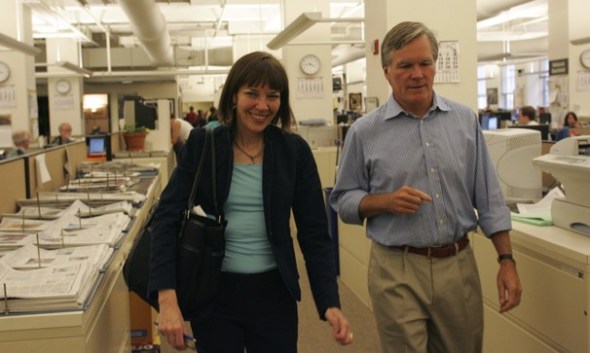
Could there be a less appropriate advocate for U.S. intervention in Syria than Bill Keller, Judith Miller’s editor at The New York Times during the runup to the disastrous war in Iraq?
Has this man ever been right about anything? Remember when he told us the baby boomers were responsible for the fiscal crisis and we should give up our hopes of a dignified old age because our selfishness has caused the U.S. to have “a less-skilled work force, lower rates of job creation, and an infrastructure unfit for a 21st-century economy”? Because obviously the costs of the Iraq war had nothing to do with the country’s current economic troubles.
Today Keller had the unmitigated gall to lecture us about the need to get involved in Syria. He isn’t really sure what we should do, but he’s positive we need to do it and he has a list of reasons why getting into another war in the Middle East is the right thing to do.
Of course even the monumentally “entitled” Bill Keller understands that lots of people are going to read his op-ed and respond by either screaming bloody murder or laughing hysterically at the spectacle of one of the architects of the Iraq War having the nerve to pontificate about another obviously insane foreign adventure.
So he tries to convince us that this time it’s different: “Syria is not Iraq,” he says.
Of course, there are important lessons to be drawn from our sad experience in Iraq: Be clear about America’s national interest. Be skeptical of the intelligence. Be careful whom you trust. Consider the limits of military power. Never go into a crisis, especially one in the Middle East, expecting a cakewalk.
But in Syria, I fear prudence has become fatalism, and our caution has been the father of missed opportunities, diminished credibility and enlarged tragedy.
“Be careful whom you trust,” he warns. Then why would we trust the man who allowed a once-great newspaper to be given over to neo-conservative enablers like Judith Miller and Michael Gordon who lapped up and printed every lie the Bush White House fed them?
But Keller brushes our doubts aside and offers four reasons why Syria is different from Iraq. But some of his arguments sound awfully familiar to me.
First, we have a genuine, imperiled national interest, not just a fabricated one. A failed Syria creates another haven for terrorists, a danger to neighbors who are all American allies, and the threat of metastasizing Sunni-Shiite sectarian war across a volatile and vital region. “We cannot tolerate a Somalia next door to Israel, Lebanon, Jordan, Iraq and Turkey,” said Vali Nasr, who since leaving the Obama foreign-policy team in 2011 has become one of its most incisive critics. Nor, he adds, can we afford to let the Iranians, the North Koreans and the Chinese conclude from our attitude that we are turning inward, becoming, as the title of Nasr’s new book puts it, “The Dispensable Nation.”
Weren’t we trying to keep Iraq from being a “haven for terrorists” too? And weren’t the neo-cons afraid of having the U.S. be perceived as weak?
Second, in Iraq our invasion unleashed a sectarian war. In Syria, it is already well under way.
This one is just ridiculous. We should invade because things are already worse than when we invaded Iraq?
Third, we have options that do not include putting American troops on the ground, a step nobody favors. None of the options are risk-free. Arming some subset of the rebels does not necessarily buy us influence. The much-touted no-fly zone would put American pilots in range of Syrian air defenses. Sending missiles to destroy Assad’s air force and Scud emplacements, which would provide some protection for civilians and operating room for the rebels, carries a danger of mission creep. But, as Joseph Holliday, a Syria analyst at the Institute for the Study of War, points out, what gets lost in these calculations is the potentially dire cost of doing nothing. That includes the danger that if we stay away now, we will get drawn in later (and bigger), when, for example, a desperate Assad drops Sarin on a Damascus suburb, or when Jordan collapses under the weight of Syrian refugees.
Huh? This one starts out sounding like an argument for staying out of Syria, so Keller throws in one of the neo-con arguments for invading Iraq–things could get worse if we don’t go in. Remember the warnings about “smoking guns” becoming “mushroom clouds?”
Fourth, in Iraq we had to cajole and bamboozle the world into joining our cause. This time we have allies waiting for us to step up and lead. Israel, out of its own interest, seems to have given up waiting.
What kind of argument is that? We should get into a war just because our “allies” want us to “lead?” Meaning they want us to provide the money and manpower.
Sorry, I’m just not convinced. Let the other guys do it for a change. If Israel wants to go to war in Syria, let them. In fact, let Bill Keller go if he’s so gung ho. Maybe he can convince some of his superrich pals to go along with him.
And what do you know? Along with Keller, Judy Miller’s old partner Michael Gordon, who still has his job at the Times, and has been writing story after story pushing U.S. involvement in Syria–as has op-ed columnist Thomas Friedman (I can’t provide links right now because I don’t seem to be able to circumvent the paywall). But here’s Greg Mitchell at The Nation:
Hail, hail, the gang’s nearly all here. Michael Gordon, Thomas Friedman, now Bill Keller. Paging Judy Miller! The New York Times in recent days on its front page and at top of its site has been promoting the meme of Syria regime as chemical weapons abuser, thereby pushing Obama to jump over his “red line” and bomb or otherwise attack there. Tom Friedman weighed in Sunday by calling for an international force to occupy the entire country (surely they would only need to stay one Friedman Unit, or six months).
Now, after this weekend’s Israeli warplane assaults, the threat grows even more dire.
And Bill Keller, the self-derided “reluctant hawk” on invading Iraq in 2003, returns with a column today stating right in its headline, “Syria Is Not Iraq,” and urging Obama and all of us to finally “get over Iraq.” He boasts that he has.
The Times in its news pages, via Sanger, Gordon and Jodi Rudoren, has been highlighting claims of Syria’s use of chem agents for quite some time, highlighted by last week’s top story swallowing nearly whole the latest Israeli claims.
Please go read the rest. Michell makes much more coherent arguments than I can. I’m still just sputtering from rage and trying to keep from banging my head on my keyboard.
It’s Finally Happened: Obama Has Driven the Pundits Insane!
Posted: March 4, 2013 Filed under: 2012 presidential campaign, Barack Obama, The Media SUCKS, U.S. Economy, U.S. Politics | Tags: Bill Keller, Dean Baker, George W. Bush, John F. Kennedy, Robert J. Samuelson, Ronald Reagan, tax cuts 54 Comments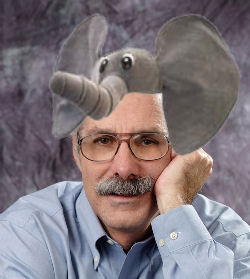
Sure, these two guys were a little nutty to begin with, but now they’ve gone around the bend.
First up: Have you seen the latest drivel from Robert J. Samuelson? Seriously, even the Washington Post should be ashamed to publish this guy. Get this — Samuelson says that sequestration is John F. Kennedy’s fault!
How so?
Fifty years ago, President Kennedy made a decision that, with hindsight, ranks as the biggest mistake of domestic policy since World War II. In many ways, it led directly to today’s “sequester” debacle.
Good Grief! What’s he talking about? The Bay of Pigs? The Cuban missile crisis?
No silly, President Kennedy decided to stimulate the economy.
In early 1963, he proposed a $13.6 billion tax cut (today: about $320 billion) even though the economy was not in recession and the tax cut would enlarge the budget deficit. Kennedy adopted the theory that government could, by manipulating its budgets, increase economic growth, reach “full employment” (then a 4 percent unemployment rate) and reduce — or eliminate — recessions.
It was a disaster.
High inflation was the first shock. An initial boom (by 1969, unemployment was 3.5 percent) spawned a wage-price spiral. With government seeming to guarantee 4 percent unemployment, workers and businesses had little reason to restrain wages and prices. In 1960, inflation was 1 percent; by 1980, it was 13 percent. The economy became less stable. From 1969 to 1982, there were four recessions, as the Federal Reserve alternated between trying to push unemployment down and prevent inflation from going up. Only in the early 1980s did the Fed, under Paul Volcker and with Ronald Reagan’s support, crush inflationary psychology.
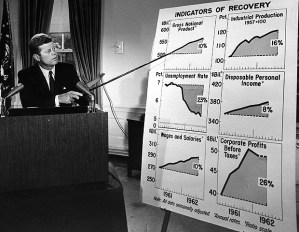
A disaster? Really? I was a kid in the 1960s. The economy was great in those days–until 1973, those were the best economic times I’ve experienced in my lifetime. Unemployment was low, wages were good, people like my parents were movin’ on up to the middle class. But don’t take it from me–let’s see what an actual economist has to say about this. Here’s Dean Baker at the Center for Economic Policy Research (CEPR):
Samuelson’s economic history is even more striking than the linking of Kennedy to the sequester. He notes the fiscal stimulus that was sparked by the Kennedy tax cuts (and the Vietnam War and Johnson’s Great Society programs) and the boom that resulted, and tells us that “it was a disaster.”
….
Before looking at Samuelson’s horror story here, it is worth noting what happened in the boom, which can be treated as going through 1973, in spite of the recession in 1969. Growth over the 10 years from 1963 to 1973 averaged 4.4 percent, by far the most rapid stretch in the post-World War II era.
The unemployment rate hovered near 4.0 percent for most of this period, as Samuelson complains. This led to large gains in real wages and sharp declines in poverty. The overall poverty rate fell from 19.5 percent in 1963 percent to 11.1 percent in 1973, an all-time low. For African Americans the poverty rate fell from 55.1 percent in 1959 (annual data is not available) to 31.4 percent in 1973. I suspect most folks wouldn’t mind a few more disasters like this one.
As far as the recession story, Samuelson might have told readers that we had the same number of recessions in the 13 years following 1969 as we did in the 12 years preceding 1961. I suppose those recessions were also due to the Kennedy tax cut.
There’s lots more at both links. But you have to read Samuelson’s column to believe it. He goes on to claim that because of JFK’s tax cut, we developed “the loss of budgetary discipline,” and we’re still suffering from that 50 years later. So how does he rationalize the deficit spending under Reagan and W. Bush? He doesn’t.
And over at The New York Times, Iraq War propagandist Bill Keller disagrees with Samuelson: he thinks sequestration is “Obama’s Fault.” And of course he’s still droning on about “entitlements.” Keller admits that both parties agreed on the sequestration cuts, but it’s still really Obama’s fault because he hasn’t completely destroyed the safety net yet. And here’s the best part: Obama refuses to enact Simpson Bowles.
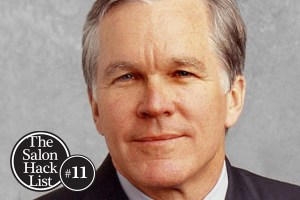
In December 2010 the commission, led by Erskine Bowles and Alan Simpson, delivered its list of spending cuts and revenue increases, plus the entitlement reforms necessary to fortify Medicare and Social Security for the surge of baby-boom retirees.
The Simpson-Bowles agenda was imperfect, and had plenty to offend ideologues of the left and right, which meant that it was the very manifestation of what Obama likes to call “a balanced approach.”
Ummm…no, Bill, the Commission never issued a report. They couldn’t agree on a unified agenda, so Simpson and Bowles wrote up their own report which was never approved by the commission members.
Now here’s where Keller really goes off the rails:
If Obama had campaigned on some version of Simpson-Bowles rather than on poll-tested tax hikes alone, he could now claim a mandate from voters to do something big and bold. Most important, he would have some leverage with members of his own base who don’t want to touch Medicare even to save it. This was missed opportunity No. 1.
That’s really funny. If Obama had campaigned on Simpson-Bowles, Mitt Romney would be president now. Because if you campaign on really really unpopular issues, people have a tendency to like, not vote for you.
There’s much more at the link, but you get the idea.
Entitled One-Percenter Bill Keller Wants Baby Boomers to Give Up Social Security and Medicare
Posted: July 30, 2012 Filed under: Catfood Commission, Medicare, Mitt Romney, Social Security, The Media SUCKS, U.S. Economy, U.S. Politics, unemployment, voodoo economics, We are so F'd | Tags: Bill Keller, Charles P. Pierce, Dean Baker, Income Inequality, infrastructure, Iraq War, Judith Miller, one-percenters, Paul Ryan, Simpson-Bowles 32 Comments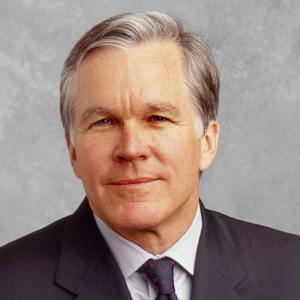
Smarmy former NYT editor Bill Keller
From today’s New York Times: “The Entitled Generation.”
The notion that our generation has been spoiled rotten is not a terribly new thought. A dozen years ago Paul Begala (of Bill Clinton and CNN fame) published in Esquire the classic of boomer-loathing, “The Worst Generation.” “The Baby Boomers are the most self-centered, self-seeking, self-interested, self-absorbed, self-indulgent, self-aggrandizing generation in American history,” he declared. It’s a sturdy genre. Perhaps while Googling yourself you have come across the blog Boomer Deathwatch (“Because one day, they’ll all be dead”), a checklist of famous boomers who hit their actuarial sell-by dates. Even Barack Obama, who styles himself post-boomer though he was born in 1961, complained in “The Audacity of Hope” that today’s hyperpolarized political discourse began with the “psychodrama of the baby boom generation.”
Yeah, we’re all evil just because our parents returned from WWII and proceeded to have lots and lots of babies. Supposedly not one of us ever did a decent thing in our pathetic, useless lives, right? I’m sick to death of hear this crap–and I’ve been hearing it since I was a kid.
See Keller says it’s our fault that the government isn’t rebuilding the infrastructure. He says it won’t do any good to tax super-rich guys like him–we’re going to have to take it out of the hides of old ladies who are trying to eke out a living on $1200 a month or less.
Guys like Bill Keller don’t even have to pay into Social Security on the bulk of their income, but he doesn’t even mention the possibility of changing that. So what does super-rich one-percenter Bill Keller think we should do about it besides learning to loathe ourselves and wish we’d never been born?
So the question is not whether entitlements have to be brought under control, but how. The Republican plan espoused by Mitt Romney and his fiscal lodestar Paul Ryan would cut the cost of entitlements largely by moving toward privatization: personal investment accounts for Social Security, vouchers for Medicare. And it’s not at all clear the Republicans would assign any of the savings to investing in our future.
At least the Republicans have a plan. The Democrats generally recoil from the subject of entitlements. Centrists like those at Third Way and the bipartisan authors of the Simpson-Bowles report endorse a menu of incremental cuts and reforms that would bring down costs without hitting the needy or snatching away the security blanket from those nearing retirement. They include gradually raising the retirement age to compensate for the fact that we now live, on average, 14 years longer than when F.D.R. signed Social Security into law. They include obliging those of us who can really afford it to pay a larger share. They also include technical fixes like aligning the automatic cost-of-living formula with reality.
At least now we know which candidate Keller will be voting for in November. So much for the supposedly “liberal media.” Oh, and about that “technical fix” Keller brushes off so dismissively, Matthew Yglesias explains why it isn’t a “technical fix” and “doing the switch comprehensively would constitute a de facto tax increase.” Furthermore, there was no “Simpson-Bowles report,” because the two co-chairs were unable to get a majority of members of the Catfood Commission to sign off on one.
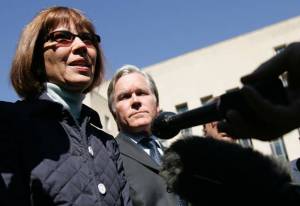
Judith Miller with patron Bill Keller
I have a terrific idea. Let’s hold Bill Keller responsible for his choice to assign Judith Miller to help the Bush administration lie us into the Iraq War. Let Bill Keller pay back the trillions of dollars of taxpayer money those lies cost us. That ought to provide some funds to invest in infrastructure here in the U.S.
Here’s what Dean Baker had to say about Keller’s lying op-ed:
That is really brave for Mr. Keller to stand up and call for sacrifice from his age cohort. Does Keller know that the typical near retiree has total wealth of $170,000. This includes everything in their 401(k), all their other financial assets and the equity in their homes. Another way to put this is that the typical near retiree (between the ages of 55-64) could take all their wealth and pay off their mortgage. After that they would be entirely dependent on their Social Security to cover all their living costs.
Does this situation describe Mr. Keller’s finances? My guess is that it doesn’t. If that is true, how does Keller claim to speak for people who are in a hugely different financial situation than him? Is he really that ignorant of the issues that the NYT gives him a column to write about or is he dishonest? Readers will have to debate that in the months and years ahead.
Baker says the real problem we have is the increase in income inequality over the past thirty years, but he’s not holding his breath for Keller to “appeal to his fellow one-percenters….He probably doesn’t have the courage or integrity to do that.”
I saved the best review of Keller’s op-ed for last. You guessed it, it’s by Charlie Pierce: “The Things Bill Keller Doesn’t Have to Worry About.”
I defy Bill Keller to last a week living only on those benefits available to the greedy boomers, especially after the Simpson-Bowles cargo cult — to say nothing of the zombie-eyed granny-starver Paul Ryan himself — are through with them. I defy him to make it for a day. The “we” sprinkled throughout this bag of pus is probably the most noxious thing about it. Look around, Bill. You and Mitt Romney have far more in common than do you and the overwhelming majority of your “fellow” boomers. One catastrophic illness, and many of our families die on the vine. This is not hyperbole. This is how it works in the world. And, to the surprise of absolutely nobody, Keller signs on with the clowns at Third Way, who assure us that the real problem is that the elderly moochers are the ones keeping us from building new bridges, or flying to the moons of Neptune. Jesus H. Christ on a Lipizzaner, we’ve had forty years of demonized government, and 40 years of quack economics, and tax-cuts until hell won’t have them, and the reason our infrastructure is falling apart is because some retired ironworker gets $1200 a month? How much of a courtier do you have to be before the taste of caviar makes you nauseous?
If we want to invest in infrastructure, which we desperately need to do, then we should just borrow money at the current historically low rates and fix the damn infrastructure…. People Got No Jobs. People Got No Money. Bill Keller never will have to worry about the last two, so I think he should shut up about the first.
Apologetic Apologia
Posted: September 19, 2011 Filed under: 2012 presidential campaign, Politics as Usual, Team Obama | Tags: Barack Obama, Bill Keller, excuses, Obot apologia 36 Comments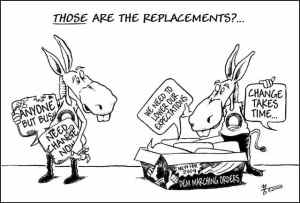 I suppose I should be glad that I’m not hearing that stupid 11 dimensional chess explanation any more. However, Bill Keller-who “stepped down” as Executive Editor of the NYT to return to writing still does a pretty good job of rehashing the same old lame excuses for why things are still so bad around the country. We still have Wars. We still have unemployment. We still have a terrible housing market. Well, you don’t need me to run down the list, do you?
Keller meanders through the usual talking points of Obama apologia before he finally comes to the place where the buck should be stopping. I’m not sure how many times I can hear about inherited problems from Bush before I start shouting enough already! The missteps since then have been so obvious that it’s hard to take the it could’ve been worse excuse as a justification. Here’s where the disappointed true believer almost comes clean; ALMOST. As he talks about the a President adrift, he still points to the usual White House talking point of poor messaging. That’s a cop out.
Obama can be faulted for periods of passivity (his silence as Republicans have sought to defund financial reforms), for a naïve deference to Congress (his belated engagement in the details of the health care bill), for a deficit of boldness and passion, for not doing more to stiffen the spines of his caucus on Capitol Hill, for not understanding — at least until his latest barnstorming on the jobs bill — that governing these days is a permanent campaign.
It is partly a failure of presidential communications that Republicans have succeeded in parodying each of his accomplishments, turning “stimulus” into an expletive, portraying “Obamacare” as socialized medicine and attacking the Dodd-Frank financial reform as an assault on capitalism.
It’s not just that he has failed to own his successes. He has in a sense failed to define himself. He is one of our more elusive presidents, not deeply rooted in any place or movement. David Remnick’s biography called Obama a shape-shifter. At the fringes, that makes him vulnerable to conspiratorial slanders: he is a socialist, a foreign imposter, a jihadist, an adherent of black liberation theology. To a less paranoid audience, his affect comes across as aloofness or ambivalence.
Progressives get blamed for having set their expectations too high. Gee, you don’t think the press help boost those just a wee bit, Mr Keller? Republicans get blamed for their intransigence. We all get blamed for not seeing the “real progress” in bank reform, health care, and his “approval” of the Get Bin Laden Mission. Oh, and did we mention he stopped a Great Depression from happening with his stimulus? See. It’s a line up of the usual suspects, isn’t it?
I didn’t expect celestial choirs from the man but I did expect something more than the passage of the 1990s Republican Dolecare plan response to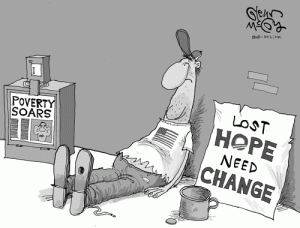 Clintoncare IF we had to go there. I did expect a bold response to the unemployment situation right out of the box. What we got was a half-assed stimulus plan full of republican style tax cuts at a time when the entire country needed, wanted, and voted for something DIFFERENT from the usual Republican la-ti-da. I expected a Democratic President with Democratic policies at the very least. Frankly, if my expectations get any lower at this point, they’re going to be sitting on top of Mount Everest while my feet will still be planted not so firmly in the Louisiana Swamps. Yes, Bill, I will not vote for Rick Perry under ANY circumstances. But then, I may not walk down Poland Avenue and pass the old barn for the fire horses into the current fire station to cast a vote. That act–repeated enough times in the neighborhoods of America–could take down more than a few Democratic Senators and Reps and this President that never seems to rise to any occasion but a speech.

 peej
peej Carissa
 bostonboomer
 dakinikat
 ecocatwoman
 mablue2
 Mama Lopez
 peggysue22
 quixote
 skydancingguestblogger
 Mona (aka Wonk the Vote)



 Sky Dancing
Recent Comments