
Boehner Dismissively Rejects Obama Budget
Posted: April 5, 2013 Filed under: Sequester, Social Security, U.S. Economy, U.S. Politics | Tags: austerity, Chained CPI, John Boehner, Obama budget 20 Comments
House Speaker John Boehner immediately dismissed President Barack Obama’s package of significant new entitlement cuts tied to new tax revenues, calling them “no way to lead and move the country forward.”
The White House had portrayed the proposal, part of the budget it will release next week, as a compromise with Congressional Republicans that could have put them on track for another run at a grand bargain.
But Boehner said he will not consider new revenues as part of the deal, arguing that “modest” entitlement savings should not “be held hostage for more tax hikes.”
Politico notes that Obama has now opened himself up to attacks from both the left (such as it is) and the right. Right wing nuts hate the increased taxes on “tax-preferred retirement accounts for millionaires and billionaires”
Already, Obama’s budget proposal goes farther than many in his own party and base said they would bear by including “chained CPI,” the adjustment that would over time reduce cost-of-living increases to Social Security and other federal benefit programs — effectively, a cut to Social Security benefits by tying them to inflation….
And Obama is already facing a backlash from liberal Democrats as he has floated the chained CPI idea. Sen. Tom Harkin (D-Iowa) said Friday that any Social Security cuts are a no-go for him.
“While there are large portions of the president’s budget that I strongly support, I remain firmly opposed to the chained CPI,” Harkin said. “This policy is an unnecessary attack on Social Security, a program that by law is unable to add to the deficit.”
As I’ve repeatedly said, our only defense against Obama’s obsession with cutting social programs is the stupidity of the House Republicans.
Republican Insanity Continues Unabated Following Fiscal Cliff Agreement
Posted: January 4, 2013 Filed under: Barack Obama, Medicaid, Medicare, Republican politics, Social Security, Surreality, U.S. Economy, U.S. Politics | Tags: austerity, Debt Ceiling, fiscal cliff, full faith and credit, Global Economy, John Boehner, John Cornyn, Lindsey Graham 27 Comments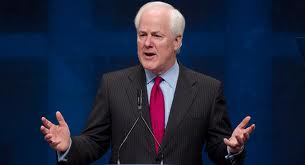
Crazy John Cornyn
Have you heard the latest from Texas Sen. John Cornyn? This morning the Houston Chronicle published Cornyn’s bizarre op-ed in which he calls for a “partial government shutdown” if President Obama refuses to come to Republicans on bended knee with a plan to cut Social Security, Medicare, and Medicaid in return for Congress agreeing to raise the debt ceiling.
Over the next few months, we will reach deadlines related to the debt ceiling, the sequester and the continuing appropriations resolution that has funded federal operations since October. If history is any guide, President Obama won’t see fit to engage congressional Republicans until the 11th hour. In fact, he has already signaled an unwillingness to negotiate over the debt ceiling. This is unacceptable. The president should immediately put forward a plan that addresses these deadlines, and he should launch serious, transparent budget negotiations.
The biggest fiscal problem in Washington is excessive spending, not insufficient taxation. Tax cuts didn’t cause this problem, so tax increases won’t solve it. If we don’t reduce spending and reform our three biggest entitlement programs – Medicare, Medicaid and Social Security – then we will strangle economic growth, destroy jobs and reduce our standard of living. With the national debt above $16 trillion, and with more than $100 trillion in unfunded liabilities hanging over us, our toughest fiscal decisions cannot be postponed any longer.
Excuse me? Tax cuts didn’t cause the problem? The Bush tax cuts, combined with two interminable wars that Republicans allowed President Bush to exempt from inclusion in the budget certainly did lead to our fiscal crisis–with a lot of help from banksters. If Republicans want to “reform” the big three safety net programs, nothing is stopping them from coming forward with their own list of specific cuts. The President doesn’t have the power of the purse after all, Congress does. Back to Cornyn’s moronic screed:
Republicans are more determined than ever to implement the spending cuts and structural entitlement reforms that are needed to secure the long-term fiscal integrity of our country.
The coming deadlines will be the next flashpoints in our ongoing fight to bring fiscal sanity to Washington. It may be necessary to partially shut down the government in order to secure the long-term fiscal well being of our country, rather than plod along the path of Greece, Italy and Spain. President Obama needs to take note of this reality and put forward a plan to avoid it immediately.
WTF?!! Cornyn doesn’t seem to understand what failing to raise the debt ceiling would mean. Congress has already approved borrowing for expenditures that must be paid for. We’ve already reached the debt limit, we’re way beyond fixing our problems with a government shutdown. Of course Cornyn doesn’t explain what he means by that anyway, but I’m guessing he wants to stop Social Security checks and Medicare and Medicaid payments. Whatever, what he has written makes no sense.
Yglesias responds to Cornyn’s “outrageous op-ed.”
What he’s missing here is that the path he’s advocating is much worse than anything that’s happened in Italy or Spain. He proposing that the federal government simply default on payment it’s obligated to make.
We have had, in the past, episodes that have been called government shut-downs. What’s happened in those cases is that no new appropriation bill has been passed authorizing many branches of the federal government to operate. Absent an appropriation, there’s no legal basis for the government programs to be administered and so they aren’t administered. Then congress appropriates new money and things come back.
What Cornyn is talking about is something else. He’s talking about the government not paying bills that it’s already obliged to pay. Social Security and Medicare exist. Bondholders are owed interest payments. State and local governments have submitted paperwork to get their grants. Veterans are owed benefits. Contractors have agreed to do work. Congress has passed the appropriations bills. But if the debt ceiling isn’t raised, the Treasury won’t have the money to pay the bills it has to pay. The result won’t be a “shutdown” of government functions; it’ll be a deadbeat federal government. Some people won’t get money they’re legally entitled to. But who won’t be paid? And who will decide who won’t be paid? Does the Secretary of the Treasury just arbitrarily get to decide that bondholders and residents of blue states get paid, but there are no Social Security benefits for Texans? Can Obama dock Cornyn’s pay but not Chuck Schumer’s? Certainly there’s no legal authority for that kind of prioritization, but what’s Obama supposed to do if congress tries to prevent him from spending money that he’s legally obliged to spend.
As Dakinikat has already made abundantly clear to us in numerous posts, the U.S. is not in the same or similar position as Greece, because, for one thing, we can print our own money. Here’s just the latest from Dak on this point.
What we really need is a recovery. That will not happen with all the fiscal policies being placed on the table right now. Let’s review one simple thing. As long as you have a good currency, federal debt instruments in demand, and a vast array of taxable assets in your country, there is no such thing as a ‘bankrupt’ government or excessive debt.
Jamie Bouie discusses government shutdowns:
A government shutdown occurs when Congress fails to pass an appropriations bill. Without appropriations, the federal government lacks the authority to operate, and so it doesn’t. Agencies close, workers go home, programs are suspended, and nothing goes on for as long as Congress is at an impasse. This is what happened in 1995, when the Gingrich-led House forced a shutdown, and this is what almost happened at the beginning of 2011, when Boehner led his conference to a similar position.
This isn’t on the table. Rather, Cornyn is referring to the debt ceiling, which is a congressional limit on the Treasury’s ability to pay obligations. If Congress fails to raise the debt ceiling, the government will continue to function, it just won’t pay the people its promised to compensate. Social Security checks won’t go out to retirees, Medicare and Medicaid reimbursements won’t go out to hospitals, payments won’t go out to military contractors, and federal workers will receive an I.O.U for paychecks.
This is why its so dangerous for Republicans to refuse to raise the debt ceiling. Contra Cornyn, keeping the limit low won’t reduce deficits or stop the United States from accumulating debt; instead, it will keep the federal government from paying what it owes to a variety of people and organizations, from bondholders to pensioners. When you stop making payments on your mortgage, the bank comes to take your house. When the government of the world’s largest economy stops making payments on its obligations, financial markets spin into a panic.
In 2011, the mere threat of not raising the debt ceiling was enough to slow economic growth to a crawl, and nearly erase the gains of the previous months. Put another way, what Cornyn has signaled—along with most of the Republican Party—is a willingness to crash the economy and damage the full faith and credit of the United States if President Obama doesn’t adopt core parts of the conservative agenda.

Cornyn isn’t alone in his insane tactics. This morning, John Boehner claimed in a “closed door meeting” with House Republicans that Americans support Republicans’ threats to bring down the national–and likely global–economies in return for allowing the Treasury to pay our debts.
“With the [fiscal] cliff behind us, the focus turns to spending,” Boehner said, according to a person in the room. “The president says he isn’t going to have a debate with us over the debt ceiling. He also says he’s not going to cut spending along with the debt limit hike.”
The Speaker cited a new poll conducted just before the New Year by the Winston Group, a Republican firm, which found that 72 percent of respondents “agree any increase in the nation’s debt limit must be accompanied by spending cuts and reforms of a greater amount.”
Boehner first laid out that principle in a 2011 speech in New York, and he has said he will stick to it as Congress debates the debt ceiling in the next two months. The Treasury Department said the nation hit its $16.4 trillion borrowing limit in late December and estimates the next increase must occur before March.

And Lindsay Graham made similar demands a few days ago.
Graham said he anticipates forcing Democrats to give in on a long list of the GOP’s top spending priorities in the new year: raising the eligibility age for Medicare, increasing premiums for its wealthier beneficiaries, and trimming Social Security benefits by using a new method to calculate inflation.
“I think if we insist on changes like that, we’ll get them,” he said.
At the Atlantic, Elizabeth Reeve notes that Republicans have embraced the label “hostage takers” and are taking pride in their claimed willingness to drive the country and the world into economic chaos.
Conservatives did not always advocate so openly that Republican lawmakers be really and willing to risk the full faith and credit of the United States, nor did they say this is what Republican lawmakers wanted to do. In August 2011, New York Times conservative columnist Ross Douthat put hostage-taking in scare quotes, and noted, “it’s an odd sort of hostage situation when the hostage seems to want to be there,” arguing that Democrats always negotiate on taxes. Today, the change is not just that conservatives are embracing this liberal talking point as their own. It’s that they’re doing it completely cynically. In 2011, you had some people — Michele Bachmann, for instance, at least claim that failing to raise the debt limit wouldn’t be so bad. “I’ve been in Washington for a long time, and I’ve seen smoke and mirrors time and time again,” Bachmann said in June 2011, calling the talk of the economic damage from a default “scare tactics.” The next month, she shrugged, “As we debate the debt ceiling, the players seem to have lost all sense of proportion.” This was widely viewed as crazy. In 2013, conservatives are not making the claim that failing to raise the debt limit would have few negative consequences. Instead, they’re just urging Republicans to use the crazy.
Today, the problem is not the political costs, but the lack of Republican unity to hold out for a great deal. “At some point we have to be serious about this,” Chocola told Newsmax. “At some point, Republicans have to do what Republicans say they have to do — and they have to stand up for limited government, spending restraint, and fiscal responsibility.” It’s not that the GOP has too many hostage-taking Bachmanns. It’s that it doesn’t have enough of them.
Unfortunately, as Greg Sargent reports, the corporate media seems to be buying into the “GOP debt ceiling spin.”
The early returns, based on the coverage of this looming battle so far, suggest Republicans are successfully defining the terms of this debate — they are defining it as a standard Washington standoff, in which each side will demand concessions from the other. Indeed, you can read through reams of the coverage without learning three basic facts about this fight:
1) Republican leaders will ultimately agree to raise the debt ceiling, and they know it, because they themselves have previously admitted that not doing so will badly damage the economy.
2) Because of the above, a hike in the debt ceiling is not something that Democratic leaders want and that Republican leaders don’t. In other words, it is not a typical bargaining chip in negotiations, in the way spending cuts (which Republicans want and Dems don’t) or tax hikes (which Dems want and Republicans don’t) are.
3) And so, if and when Republicans do agree to raise the debt ceiling, it will not constitute any kind of concession on their part — even though they will continue to portray it as such to demand concessions in return. It will only constitute Republicans agreeing not to damage the whole country, which does not constitute (one hopes) them making a sacrifice.
President Obama has stated that he will not negotiate with Republicans over the debt ceiling, only over a balance between increased revenues and spending cuts. Who knows whether he’ll stand firm or not? We can only hope that he will use every bit of the power of the bully pulpit to educate the American electorate about the consequences of failure to raise the debt ceiling. He can do it in the State of the Union and Inaugural addresses and he can continue traveling around the country explaining what the Republicans are up to. This might be a good time to hire Bill Clinton as official “explainer in chief.”
Regardless of what happens, this is certainly going to be a fascinating, though nerve-wracking fight to watch.
Thursday Reads: War on Women, the Fiscal Cliff, and Austerity Arriving in the USA
Posted: January 3, 2013 Filed under: Fiscal Cliff, morning reads, Psychopaths in charge, Reproductive Rights, Republican politics, Social Security, U.S. Economy, U.S. Politics, War on Women, Women's Rights | Tags: abortion restrictions, austerity, Catfood Commission, Greece, Simpson-Bowles 42 Comments
Good Morning!!
Brrrrrrrrrr! All of a sudden winter has arrived! Can you believe it’s 4 degrees outside my house? With a wind chill factor of 6 below 0. My furnace can’t keep up in this kind of weather, so I have to bundle up. So what else is in the news this morning? Let’s see….
Today the new Congress gets sworn in and there are a record number of women in the new Senate. From ABC News: Meet the New Class: The Senate Swears in a Historic 20 Female Senators
Today the Senate will make history, swearing in a record-breaking 20 female senators – 4 Republicans and 16 Democrats – in office….
“I can’t tell you the joy that I feel in my heart to look at these 20 gifted and talented women from two different parties, different zip codes to fill this room,” Sen. Barbara Mikulksi, D-Md., said while surrounded by the group of women senators. “In all of American history only 16 women had served. Now there are 20 of us.”
Senator-elect Deb Fischer, R-Neb., becomes today the first women to be elected as a senator in Nebraska.
“It was an historic election,” Fischer said, “But what was really fun about it were the number of mothers and fathers who brought their daughters up to me during the campaign and said, “Can we get a picture? Can we get a picture?’ Because people realize it and — things do change, things do change.”
There’s a group photo at the link.
Still, the war on women continues. HuffPo reports: House GOP Lets Violence Against Women Act Passed By Senate Die Without A Vote.
Despite a late-stage intervention by Vice President Joe Biden, House Republican leaders failed to advance the Senate’s 2012 reauthorization of the Violence Against Women Act, an embattled bill that would have extended domestic violence protections to 30 million LGBT individuals, undocumented immigrants and Native American women.
“The House leadership would not bring it up, just like they wouldn’t bring up funding for Sandy [hurricane damage] last night,” said Sen. Patty Murray (D-Wash.), a key backer of the Senate version of the bill, in an interview with HuffPost. “I think they are still so kowtowing to the extreme on the right that they’re not even listening to the moderates, and particularly the women, in their caucus who are saying they support this.”
The Senate bill passed way back in April.
In April, the Senate with bipartisan support passed a version of VAWA that extended protections to three groups of domestic violence victims who had not been covered by the original law, but House Republicans refused to support the legislation with those provisions, saying the measures were politically driven. Instead, they passed their own VAWA bill without the additional protections. In recent weeks, however, even some House Republicans who voted for the pared-down House bill have said they would now support the broader Senate bill — and predicted it would pass if Republican leaders let it come to the floor for a vote.
“I absolutely would support the Senate bill,” Rep. Tom Cole (R-Okla.) told HuffPost in late December, speculating that other House Republicans, namely GOP congresswomen, “are very supportive of that.”
Asked if he thought the Senate bill would pass in the House if it came up for a vote, Cole replied, “My judgment is yes.”
Too little, too late, Congressman. So Boehner managed to screw women yesterday too though it was the refusal to vote on Sandy relief that got all the media attention.
In India police have filed murder charges against five men in the horrific gang rape in New Delhi.
Authorities filed rape and murder charges Thursday against five men accused of the gang rape of a 23-year-old university student on a New Delhi bus, a crime that horrified Indians and provoked a national debate about the treatment of women.
Police said they plan to push for the death penalty in the case, as government officials promised new measures to protect women in the nation’s capital.
Prosecutor Rajiv Mohan filed a case of rape, tampering with evidence, kidnapping, murder and other charges against the men in a new fast-track court in south Delhi inaugurated only the day before to deal specifically with crimes against women. Mohan asked for a closed trial and a hearing was set for Saturday.
The men charged are Ram Singh, 33, the bus driver; his brother Mukesh Singh, 26, who cleans buses for the same company; Pavan Gupta, 19, a fruit vendor; Akshay Singh, 24, a bus washer; and Vinay Sharma, 20, a fitness trainer.
A sixth suspect was listed as 17 and was expected to be tried in a juvenile court, where the maximum sentence would be three years in a reform facility.
Read more at the link. The New Yorker has a good article on the New Delhi story by Basharat Peer: After a Rape and Murder, Fury in Delhi. Please go read the whole thing if you can.
Back in the USA, Republican state legislatures are up to their old tricks. Irin Carmon reports in Salon: Michigan, Virginia pass backdoor abortion restrictions.
In Michigan, Rick Snyder signed a bill passed by the lame-duck Senate — the same one whose anti-union legislating dominated headlines in recent weeks — requiring clinics that perform more than 120 abortions a year to become surgical outpatient facilities, a level of licensing intended to be onerous and put clinics out of business. He also approved a bill that purports to screen for women being coerced into abortions.
Snyder did veto another bill limiting insurance coverage in private employee plans, which would have required purchase of a separate abortion rider. He objected to that on the grounds that rape victims would have to pay out of pocket if they didn’t buy the rider, and because, “As a practical matter, I believe this type of policy is an overreach of government into the private market.” Overreach of government into other realms, of course, is another matter entirely. (According to Michigan resident Emily Magner, one legislator interrupted her to cry, “THIS ISN’T ABOUT WOMEN! THIS IS ABOUT PROTECTING FETUSES!”)
Virginia’s similar, hospital-level restrictions on clinics were somewhat overshadowed by the ultrasound requirements for women seeking abortions. Under threat of forever having the word “transvaginal” attached to his name, Gov. Bob McDonnell tried to split the difference on the ultrasound legislation, but in the final days of the year signed off on the clinic regulations. This followed months of conflict between the Board of Health and Virginia Attorney General Ken Cuccinelli over whether existing clinics would be grandfathered into the legislation. The governor’s office called the regulations “common-sense”; NARAL Pro-Choice Virginia said in a statement, “After two years of shocking backroom deals and bullying public health servants, Governor Bob McDonnell is clearly proving his disregard of Virginians’ opinions about women’s health care.”
Clinic regulations are the most insidious of abortion restrictions, because they’re harder for the layperson to understand and tend to incite less outrage as a result. And opposition to them tends to fall into antiabortion narratives about back-alley butchers resisting safety standards. But research has suggested that they also tend to be the most effective: It’s difficult to talk a woman out of having an abortion, but if you make access near impossible, you might take the choice off the table altogether.

On the “Fiscal Bunny Slope,” as Dakinikat refers to it, TPM reports that Simpson and Bowles of the famous Catfood Commission didn’t like the deal hammered out by the Senate and passed by the House. It seems it doesn’t cause enough suffering for the poor and elderly to satisfy them. Here’s their statement:
“The deal approved today is truly a missed opportunity to do something big to reduce our long term fiscal problems, but it is a small step forward in our efforts to reduce the federal deficit. It follows on the $1 trillion reduction in spending that was done in last year’s Budget Control Act. While both steps advance the efforts to put our fiscal house in order, neither one nor the combination of the two come close to solving our Nation’s debt and deficit problems. Our leaders must now have the courage to reform our tax code and entitlement programs such that we stabilize our debt and put it on a downward path as a percent of the economy.
Washington missed this magic moment to do something big to reduce the deficit, reform our tax code, and fix our entitlement programs. We have all known for over a year that this fiscal cliff was coming. In fact Washington politicians set it up to force themselves to seriously deal with our Nation’s long term fiscal problems. Yet even after taking the Country to the brink of economic disaster, Washington still could not forge a common sense bipartisan consensus on a plan that stabilizes the debt.
It is now more critical than ever that policymakers return to negotiations that will build on the terms of this agreement and the spending cuts in the Budget Control Act. These future negotiations will need to make the far more difficult reforms that bring spending further under control, make our entitlement programs sustainable and solvent, and reform our tax code to both promote growth and produce revenue. We take some encouragement from the statements by the President and leaders in Congress that they recognize more work needs to be done. In order to reach an agreement, it will be absolutely necessary for both sides to move beyond their comfort zone and reach a principled agreement on a comprehensive plan which puts the debt on a clear downward path relative to the economy.”
Don’t you love the way they call for “courage” from rich Congresspeople and then tell them to cut the sole income of millions of elderly and disabled people? What about calling for the real courage it would take for them to raise the cap on Social Security contributions so that rich people could pay a little more into the system? I doubt if many of them turn down the paltry extra income they get from it.
I’m running out of space, but I have some more fiscal cliff reads for you that I’ll pass on in link dump fashion.
Paul Krugman: That Bad Ceiling Feeling
Noam Scheiber: The House Comes Around on the Cliff. Why Am I Not Reassured?
Washington Post: U.S. markets surge after Congress approves ‘cliff’ deal
George Zornick at The Nation: While Congress Plays Deficit Games, Jobs Crisis Goes Unaddressed
Joan Walsh: Biggest Fiscal Cliff Lessions
Jonathan Chait: The Big Lebowski Explains the Fiscal Cliff
Truthout: Debt Versus Democracy: A Battle for the Future
Joe Conason: The GOP Clown Car Crashes, Again
I’ll end with a couple of articles on the European-style austerity that we’re heading for right now.
Brad Plummer at the Washington Post: U.S. now on pace for European levels of austerity in 2013
For years now, economists like Paul Krugman have been criticizing countries in Europe for engaging in too much austerity during the downturn — that is, enacting tax increases and spending cuts while their economies were still weak.
But after this week’s fiscal cliff deal, the United States is now on pace to engage in about as much fiscal consolidation in 2013 as many European nations have been doing in recent years — and more than countries like Britain and Spain.
A back-of-the-envelope calculation suggests Congress has enacted around $336 billion in tax hikes and spending cuts for the coming year, an austerity package whose total size comes to about 2.1 percent of GDP. (That’s merely the size of the cuts and taxes; it’s not necessarily the effect on growth.)
This includes the expiration of the payroll tax cut, which will raise about $125 billion this year. It includes $68 billion in scheduled cuts to discretionary spending from the 2011 Budget Control Act. It includes $24 billion in new Obamacare taxes and $27 billion in new high-income taxes. And it includes about $92 billion from the now-delayed sequester cuts — assuming that these either take effect or are swapped with other cuts.
Check out the graph at the link. And in Greece, the Guardian reports: Euros discarded as impoverished Greeks resort to bartering
It’s been a busy day at the market in downtown Volos. Angeliki Ioanitou has sold a decent quantity of olive oil and soap, while her friend Maria has done good business with her fresh pies.
But not a single euro has changed hands – none of the customers on this drizzly Saturday morning has bothered carrying money at all. For many, browsing through the racks of second-hand clothes, electrical appliances and homemade jams, the need to survive means money has been usurped.
“It’s all about exchange and solidarity, helping one another out in these very hard times,” enthused Ioanitou, her hair tucked under a floppy felt cap. “You could say a lot of us have dreams of a utopia without the euro.”
In this bustling port city at the foot of Mount Pelion, in the heart of Greece’s most fertile plain, locals have come up with a novel way of dealing with austerity – adopting their own alternative currency, known as the Tem. As the country struggles with its worst crisis in modern times, with Greeks losing up to 40% of their disposable income as a result of policies imposed in exchange for international aid, the system has been a huge success. Organisers say some 1,300 people have signed up to the informal bartering network.
For users such as Ioanitou, the currency – a form of community banking monitored exclusively online – is not only an effective antidote to wage cuts and soaring taxes but the “best kind of shopping therapy”. “One Tem is the equivalent of one euro. My oil and soap came to 70 Tem and with that I bought oranges, pies, napkins, cleaning products and Christmas decorations,” said the mother-of-five. “I’ve got 30 Tem left over. For women, who are worst affected by unemployment, and don’t have kafeneia [coffeehouses] to go to like men, it’s like belonging to a hugely supportive association.”
Much more at the link.
So….what’s on your reading and blogging list today. I look forward to clicking on your links.
The Austerity Plot
Posted: December 7, 2012 Filed under: 2012 elections | Tags: austerity, class war, fiscal cliff, kleptocracy 14 CommentsThe only thing that has lessened my hysteria about the crazy Simpson Bowles plan, the shrieking about a fiscal cliff, the repeated insanity about the US federal government  going “bankrupt”, and the continuing insistence that the people that benefited most from unrealistic policy moves over the last 30 years shouldn’t kick in their fair share for our civilization is the conversation that goes on within the community of economists. Economists know it’s insanity. There’s a lot of agreement that most of the media hysteria and political power playing around this entire deficit hysteria is mostly a plot form “obscenely rich men” who just simply want more of everything we have. Here’s some excellent analysis and points by Lynn Stewart Parramore.
New York magazine calls it a “Mass Movement for Millionaires.” The New York Times’ Paul Krugman sums up the idea : “Hey, sacrifice is for the little people.”
The Campaign to Fix the Debt is a huge, and growing, coalition of powerful CEOs, politicians and policy makers on a mission to lower taxes for the rich and to cut Social Security, Medicare and Medicaid under the cover of concern about the national debt. The group was spawned in July 2012 by Erskine Bowles and Alan Simpson, architects of a misguided deficit reduction scheme in Washington back in 2010. By now, the “fixers” have collected a war chest of $43 million. Private equity billionaire Peter G. Peterson, longtime enemy of the social safety net, is a major supporter.
This new Wall Street movement, which includes Republicans and plenty of Democrats, is hitting the airwaves, hosting roundtables, gathering at lavish fundraising fêtes, hiring public relations experts, and traveling around the country to push its agenda. The group aims to seize the moment of the so-called “fiscal cliff” debate to pressure President Obama to concede to House Republicans and continue the Bush income tax cuts for the rich while shredding the social safety net. The group includes Goldman Sachs’ Lloyd Blankfein, JPMorgan Chase’s Jamie Dimon, Honeywell’s David Cote, Aetna’s Mark Bertolini, Delta Airlines’ Richard Anderson, Boeing’s W. James McNerney, and over 100 other influential business honchos and their supporters.
Corporations represented by the fixers have collected massive bailouts from taxpayers and gigantic subsidies from the government, and they enjoy tax loopholes that in many cases bring their tax bills down to zero. Sometimes their creative accountants even manage to get money back from Uncle Sam. For instance, according to Citizens for Tax Justice, Boeing has paid a negative 6.5 percent tax rate for the last decade, even though it was profitable every year from 2002 through 2011.
These CEOs talk about shared sacrifice, but it seems that they don’t intend to share anything but your retirement money with their wealthy friends. As New York magreports:
“Most on-the-record comments are a mishmash of platitudes about shared sacrifice and working together for the good of the country. But interviews with a number of organizers and CEO council members point to a massive networking effort among one-percenters — one that relies on strategically exploiting existing business relationships and appealing to patriotic and economic instincts.”
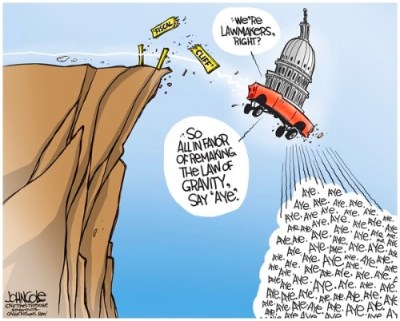 It is outrageous to think that a country that has been suffering from decades of ever increasing income inequality, exorbitant CEO pay, and financial crises triggered by corporate and financial industry corruption should lead to calls that the victims should pay more than perpetrators–who are also the pirates that profiteered–for the damages done to the public treasury. There is a full on assault for everything that’s defined as America progress since the 20th century. The majority of Americans–we poor, huddled masses–are losing the assault. We’ve lost the conversation in the halls of congress and to the media that appears to be joined at the hip with its plutocratic enablers.
It’s obvious Republican leaders have no idea of what they speak and are only talking from points they feel will tingle the fingers of their donor base. The ink is barely dry on the Romney loss and the 2016 Republican candidates are already on the run. All of them are basically running on the same crap rejected just weeks ago with the exception of trying to find a kinder gentler way to spin the obvious hatred of any one that’s not a rich white male. Most of them don’t even care about learning about the issues. They only want to find a message that will sell to their privileged constituents.
As Jonathan Chait points out, Bobby Jindal — who is supposed to be one of the intellectual leaders of his party — has just published an op-ed on the cliff that sure looks as if he has no idea whatsoever what the cliff is about. There’s nothing in that piece even hinting that the looming problem is spending cuts and tax increases that will shrink the deficit too soon; and his big policy ideas would actually make the lurch to austerity worse. It’s not just the idea of a balanced budget amendment, which would force harsh austerity every time the economy goes into recession; putting a cap on spending as share of GDP would do the same, because you’d have to cut spending whenever GDP went down.
You really have to wonder how someone who’s a major political figure could be this uninformed — but you have to wonder even more about the state of mind that induces you to write an op-ed about a subject you don’t comprehend at all.
But this isn’t the first time something like this has happened to a supposed GOP star. In the early stages of the Republican primary, Tim Pawlenty — a supposed thoughtful conservative — published an op-ed based on the premise that public-sector employment was booming; in fact, it was plunging. And, of course, Mitt Romney made statements — about the 47 percent, about Benghazi — that he clearly thought were smart and well-informed, but were in fact flatly false.
I think it comes back to the epistemic closure issue. Even supposedly well-informed people on the right get their “facts” from the likes of the Heritage Foundation. Probably Jindal never talks to anyone who will quietly explain that the fiscal cliff is a problem because, well, Keynesian economics is basically right, and you really don’t want austerity in a depressed economy. So he has some vague notion that it’s about the wages of fiscal irresponsibility, which it isn’t, and apparently believes that he knows enough to pontificate.
Now, there’s talk of doing something very fiscally unsound to give the Republicans a trophy. Will Democrats actually take the imprudent action to increase the Medicare age just to get the Republicans to move on something, anything? Ezra Klein–hosting for Rachel Maddow–points out the incredibly unpopular policy is also terrible fiscal policy because it will cost more to cover the change than it saves.
Despite the fact it’s unpopular, republicans really want to make cuts in medicare and want to raise the age by two years from 65 to 67. that’s also super unpopular…What’s weird is it’s always presented as the height of fiscal responsibility even though it’s fiscally irresponsible. Which brings us to the challenge. why raising the age does not save you very much money and is probably a bad policy idea in under two minutes…The seniors turning to private insurance will have to pay more from the same coverage. 3.7 billion more in the first year of the policy…it’s a terrible policy, but because obama care and employers and others are there to catch a lot of these people, it might get more votes while doing less harm to seniors than the alternatives.
The basic reasoning behind all of this is the continual need by the Republicans to serve their richest of the rich and the inability of the rich to EVER GET ENOUGH MONEY and Power. It’s a zero sum game for them and they seem to want every one else to lose. The worst of these offenders have installed themselves on Wall Street. They still keep pushing the idea that Social Security is insolvent and going bankrupt when it is not. These are also the guys that would love to access that big pool of money for their gambling schemes.
“Fix” means cut : When they say “fix” Social Security, they mean cut Social Security. Fixers want to convince the public that a well-managed, hugely popular program that does not add to the deficit (it’s self-funded) is somehow in crisis and requires intervention in the form of various cutting schemes. They seek this because many of the rich do not want to pay taxes for Social Security, and financiers want very much to move toward privitization of retirement accounts so they can collect fees on such accounts.
It is surreal that any elected official could still hold and trumpet these ideas after they were sincerely stomped on by the electorate just weeks ago. But the deal is that the rich just cannot get enough and they are willing to drive the country into developing country status to get more. The United State continues to nosedive on lists of quality of life. What exactly will it take to get jerks like the Koch Brothers back into their evil box?
Here’s an excellent essay that sums up what’s wrong with the country these days by James Kenneth Galbraith. He mentions the importance of the our stagnant wages but goes one further. The very things that gave us our strong middle class after the Great Depression and up to the Reagan years are our social contracts with each other. These programs are under attack today like never before.
The real threat to the middle class is not there, it’s in the erosion of the programs I just mentioned. That is to say, it’s in the attack on the public schools, it’s in the squeeze on higher education, it’s in the threat to Social Security. When you look at housing, you have a very large unambiguous loss. Millions of people have been displaced, but many, many more have lost the capital value of their homes. They won’t be able to sell and retire on the proceeds.
So I think there is a threat to the middle class, but if I were talking about it in political terms, I wouldn’t be giving an abstract statistical picture of wages. This doesn’t connect to people’s experiences. If I were designing the boilerplate rhetoric of a popular movement, I would take a blue pencil to these statistical formulations. I don’t like the stagnant median wage argument—I think it obscures what actually happened. And I don’t particularly care for the “one percent” argument. I understand it has a certain power, but one can be much more precise about what it is you want to attack, and what it is you want to preserve and to build. I would cut to the chase: we need to tear down the financial sector and rebuild it from scratch in a very different way.
In our current situation, the financial sector makes its money by destroying, not by building. When one frames the issue that way, and when you try to explain to people why that’s so, I think they have a much clearer picture of what they’re facing and what should be done. Occupy Wall Street wasn’t wrong to focus on Wall Street. That was exactly right. But talking in terms of the “one percent”—which, after all, would be about 3.1 million people—doesn’t clarify what is truly at issue. What do people care about? People care about their public services, they care about their schools, they care about the environment in which they live, they care about safety, they care about the terms of student loans, they care about health care and retirement. When one talks about those issues, I think you connect much more effectively than by addressing this in terms of “the middle class,” which is itself a very abstract term.
We are going to come to a point of decision fairly soon as to whether the core institutions of the New Deal and the Great Society survive. It is a straightforward question: do we insure the whole population against old age, disability, or the loss of their income, or not? Do we provide a decent standard of health care and long-term care for the elderly and people in the final phases of life, or not? Is this a community that provides this as a matter of common insurance, or isn’t it?
We need to buck up whoever we can to say no to compromises that include our basic social safety programs. We should go over the fiscal cliff rather than give Republicans trophies that will ruin our society in the long run.
Thursday Reads
Posted: May 24, 2012 Filed under: Catfood Commission, Democratic Politics, morning reads, U.S. Economy, U.S. Military, U.S. Politics | Tags: Alan Simpson, austerity, Barack Obama, Bush tax cuts, CBO, Charles P. Pierce, CIA leak case, Corey Booker, education policy, Emptywheel, eurozone crisis, fiscal cliff, Iraq War, Joe Wilson, John Maynard Keynes, Mark Halperin, Massachusetts public schools, Mitt Romney, Patrick Fitzgerald, Scooter Libby, Social Security, unemployment, Valerie Plame 55 Comments
Good Morning!! I’ve got a potpourri of interesting links for you today, so I’ll get right to it.
Yesterday Mitt Romney gave an interview to Mark {Gag!} Halperin of Time. Halperin asked the putative Republican nominee to say specifically what the unemployment rate would be after his first year as POTUS. You may recall that not long ago, Romney stated that unemployment should be below 4 percent and that anything higher than that is unacceptable. But now he’s singing a different tune.
Romney: I can’t possibly predict precisely what the unemployment rate will be at the end of one year. I can tell you that over a period of four years, by virtue of the policies that we’d put in place, we’d get the unemployment rate down to 6%, and perhaps a little lower. It depends in part upon the rate of growth of the globe, as well as what we’re seeing here in the United States, but we’d get the rate down quite substantially, and frankly, the key is we’re going to show such job growth that there will be competition for employees again. And wages – we’ll see the end of this decline we’re having. The median income in America is down 10% in just the last four years. That’s got to stop. We’ve got to start seeing rising wages and job growth.

Romney gave no specifics about how he would achieve this with the policies he has been promoting–cutting taxes on the rich, raising them on people with lower incomes, and cutting everything except defense spending, which he would increase substantially. Halperin did ask for more specifics, but Romney just babbled a bunch of nonsense:
Halperin: One more question generally about jobs. For people out there, for voters who want to know what you’re about in terms of job creation, is there some new idea, some original idea, that hasn’t been part of the debate in American politics before, that you have that you think would lead to a lot of new jobs?
Romney: Well the wonderful thing about the economy is that there’s not just one element that somehow makes the whole economy turn around, or everybody in the world would have figured that out and said there’s just one little thing we have to do – you know, Greece is settled, and France and Italy are all back and well again. No, it’s a whole series of things. It’s a system of factors that come together to make an economy work. What is it that makes America’s economy the strongest in the world, the most robust, over a century? It’s a whole series of things – everything from our financial service sector, to the cost of our inputs, our natural resources, to the productivity of our workforce, to our labor and management rules and how they work together, to our appreciation for fair trade and free trade around the world, and negotiating trade arrangements that are favorable to us. It is a whole passel of elements that come together to create a strong economy, and for someone who spent their life in the economy, they understand how that works. And it’s very clear, by virtue of the President’s record, that he does not, and he is struggling. Look at him right now. He just doesn’t have a clue what to do to get this economy going. I do. I laid out a 59-step plan that encompasses a whole series of efforts that will together get this economy going and put people back to work.
But from what I could make out in wading through all the blather, it really comes down to the confidence that will wash through all of us once we know that Mr. Fixit, Willard Mitt Romney is going to save us.
Romney: Well actually if I’m lucky enough to be elected the consumers and the small-business people in this country will realize that they have a friend in the White House, who is actively going to encourage economic growth, and there will be a resurgence in confidence in this country and a willingness to take risks, to invest, to add employees. I think it will be very positive news to the American economy. Will I be able to get done between January 1 and January 20 the things that I’d like to do? Of course not, I’m not in office. But I believe that we will be able to have a grace period, which allows us to tackle these issues one by one and put in place a structure, which is very much designed to get America working again.
Romney also gave a speech about education policy in which he proposed to further privatize America’s education system:
Mitt Romney proposed a series of steps to overhaul the public education system, reigniting the debate over school choice as his campaign intensifies its effort to introduce the presumptive Republican presidential nominee to a general-election audience.
The education plan, detailed in a speech today in Washington, would create a voucher-like system to give low- income and disabled students federal funds to attend charter schools, private institutions and public schools outside their district.
“I don’t like the direction of American education, and as president, I will do everything in my power to get education on track for the kids of this great land,” Romney told a gathering of Latino business owners at the U.S. Chamber of Commerce.
No new ideas there. To be perfectly honest, I strongly doubt that Romney knows the first thing about American public schools. But let me refer you to an expert on Willard’s past history in dealing with public education, the one and only Charles P. Pierce. Pierce writes about what Romney did to the public education system of Massachusetts during his one term as Governor:
Read the rest of this entry »

 peej
peej Carissa
 bostonboomer
 dakinikat
 ecocatwoman
 mablue2
 Mama Lopez
 peggysue22
 quixote
 skydancingguestblogger
 Mona (aka Wonk the Vote)



 Sky Dancing
Recent Comments