
Friday Reads
Posted: October 17, 2014 Filed under: Barack Obama, morning reads, Republican politics, U.S. Economy, U.S. Politics | Tags: Amber Vinson, Angela Merkel, austerity, Belize, Bill Clinton, Carnival Cruise Lines, ebola, Ebola hearing, El Nino, Euopean Union, Federal Reserve, Hillary Clinton, Janet Yellen, Martha Coakley, Mary Landrieu, NOAA, Polar Vortex, Rand Paul, U.S. House of Representatives, winter weather 24 Comments
Good Morning!!
I’m going to begin with some good news today.
It looks like the coming winter will be on the mild side. From Discovery News: Winter Forecast for US Nothing to Shiver About.
Don’t expect the polar vortex to pummel the eastern United States this winter, government scientists said today (Oct. 16).
Overall, forecasters expect mild winter conditions across much of the United States, scientists with the National Oceanic and Atmospheric Administration (NOAA) said as they issued their annual winter weather outlook.
While there’s always a chance that the polar jet stream will again funnel frigid Arctic air south toward the United States, nothing in the new forecast indicates a rerun of the persistent patterns responsible for the “polar vortex.” “We do not expect to see a repeat of last winter,” said Mike Halpert, acting director of NOAA’s Climate Prediction Center.
Developing El Niño conditions in the Pacific Ocean will influence this year’s winter weather, with wet conditions forecast from Southern California to South Carolina, and dry conditions expected across the North. Temperatures will be warmer than average in the West and in New England, but colder in the South from Texas east to Florida, according to the forecast.
I hope they’re right!
Now for the latest Ebola news . . .

Why can’t Dallas hospital workers just stay home until they’re cleared? From The Washington Post: Texas hospital worker quarantined on cruise ship in Caribbean.
A Texas health-care worker who “may have” handled lab specimens from Ebola victim Thomas Eric Duncan has been isolated on board a Carnival cruise ship in the Caribbean. The worker has shown no symptoms of the disease, according to Carnival, which said it is in close contact with the Centers for Disease Control. A Carnival spokeswoman said the guest, who was not named, will remain on board in voluntary isolation until the ship returns to its home port of Galveston on Sunday.
The Texas Health Presbyterian Hospital employee and a partner boarded the ship Oct. 12 in Galveston, Tex., before the U.S. Centers for Disease Control and Prevention updated the requirement for active monitoring, the State Department said in a statement. Although the worker is healthy, the U.S. government is working with the cruise line to get the ship back to America “out of an abundance of caution.”
The employee, who has not been named, did not come into direct contact with Duncan, the first patient diagnosed with Ebola in the United States. However, he or she may have been exposed to his clinical specimens, the State Department said.
“It has been 19 days since the passenger may have processed” Duncan’s fluid samples, State Department spokeswoman Jen Psaki said in a statement early Friday morning. “The cruise line has actively supported CDC’s efforts to speak with the individual, whom the cruise ship’s medical doctor has monitored and confirmed was in good health. Following this examination, the hospital employee and traveling partner have voluntarily remained isolated in a cabin.”
Belize refused to allow the woman (gender identified by news release) to be leave the ship so she could be evacuated by the U.S.
In its own statement Thursday, the the Belize government said it “was contacted today by officers of the U.S. Government and made aware of a cruise ship passenger considered of very low risk for Ebola….Nonetheless, out of an abundance of caution, the Government of Belize decided not to facilitate a U.S. request for assistance in evacuating the passenger through the Phillip Goldson International Airport.”
Now that the horses are out of the barn, so to speak, officials in Texas have decided to close the barn doors. From USA Today: Travel Ban for Texas health care workers in Ebola case.
Texas health officials have ordered any person who entered the room of the first Ebola patient at a Dallas hospital not to travel by public transport, including planes ship, buses or trains, or visit groceries, restaurants or theaters for 21 days, until the danger of developing Ebola has passed.
The instructions, issued by the Texas Department of State Health Service late Thursday, cover more than 70 health workers involved in providing care for Thomas Duncan, the Liberian national who became the first patient to test positive for Ebola in the United States.
Duncan died Oct. 8 at Texas Health Presbyterian Hospital in Dallas.
The hospital workers were ordered to undergo monitoring twice a day, including one face-to-face encounter.
The health department said anyone failing to adhere to the rules “may be subject to a communicable disease control order.” The health workers were asked to sign a written acknowledgement of the directions when they appear for monitoring.

Amber Vinson
According to The Hill, the CDC has now decided it needs to talk to passengers who were on Amber Vinson’s flight from Dallas to Cleveland. Vinson is the second nurse to come down with Ebola after caring for Thomas Duncan, who died of the disease last week.
After reports that she may have shown symptoms on her flight back to Dallas, the CDC asked those passengers to contact the agency. But in a release Thursday night, the CDC expanded that notification to include passengers on Vinson’s flight to Cleveland. The agency said that it wants to interview passengers and that “individuals who are determined to be at any potential risk will be actively monitored.”
Ebola is contagious once an infected person starts exhibiting symptoms, so the CDC wants to keep tabs on anyone that could have come into contact with Vinson when those symptoms began. She traveled to Cleveland on Oct. 10 and returned on Oct. 13, the day before she reported her symptoms to the CDC.
Yesterday, the U.S. House of Representatives decided to get involved in the Ebola crisis, and it wasn’t pretty. BloombergPolitics compiled The Five Worst Questions from the House Ebola Hearing. According to the article, Democrats are wrong to claim that lack of funding made the situation worse. Republicans obsessed over banning travel into the U.S. and “securing the borders.” But the most ludicrous question came from Rep. Morgan Griffith (R-VA).
Representative Morgan Griffith wanted to know if humans can catch Ebola from dogs, and Frieden said there were no known incidents. But still, the Virginia Republican wanted to know if we could stem the flow of West African dogs traveling into America.
“Don’t you think we ought to at least restrict travel of dogs?” he asked.
“Um,” Frieden replied. “We’ll follow up in terms of what’s possible.”
In addition, President Obama held an “emergency meeting” at the White House yesterday.
(Reuters) – President Barack Obama said he was considering appointing an Ebola “czar” to coordinate the fight against the virus in the United States, but he remained opposed to a ban on travel from West Africa.
Obama’s administration is facing sharp criticism from lawmakers over its efforts to contain the disease at home. Obama authorized calling up military reservists for the U.S. fight against Ebola in West Africa on Thursday….
“It may be appropriate for me to appoint an additional person” to oversee efforts to contain Ebola, Obama told reporters, adding that experts have told him “a flat-out travel ban is not the way to go” because current screening measures at airports are working.
He said he had no philosophical objection to a travel ban but that some travelers might attempt to enter the United States by avoiding screening measures, which could lead to more Ebola cases, not fewer.
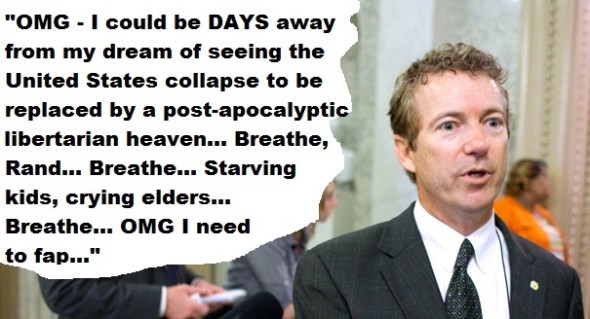
A final dose of stupid came from Sen. Rand Paul, who told an audience of college students that you could catch Ebola by standing three feet from someone who is infected.
His comments directly conflict with statements from world health authorities who have dealt with Ebola outbreaks since 1976.
Paul…made his comments during a stop at Plymouth State University in New Hampshire Wednesday. In his remarks, he called Ebola “incredibly contagious” and suggested it could spread at a cocktail party attended by someone who is symptomatic, according to CNN video footage….
“You’re not going to get AIDS at a cocktail party. No one’s going to cough on you and you’re going to get AIDS. Everybody knows that. That’s what they make it sound exactly like,” Paul, a doctor and potential presidential contender, said Thursday at Plymouth State University in New Hampshire. “But then you listen to them closely, they say you have to have direct contact. But you know how they define direct contact? Being within three feet of someone.”
World health authorities have been clear that Ebola is transmitted through direct contact with bodily fluids, and that blood, vomit and feces carry the most virus. Health workers are at particular risk because in the course of caring for patients, they draw blood and clean up diarrhea when the patients are most infectious. Likewise in the epidemic zone in West Africa, people involved with burials of highly infectious bodies are at high risk.
In other news . . .
Bill Clinton is heading down to Louisiana on Monday to stump for Mary Landrieu, according to Politico.
Former President Bill Clinton will campaign in Louisiana Monday with Democratic Sen. Mary Landrieu, joining the endangered incumbent in the state capital of Baton Rouge.
Clinton, unlike President Barack Obama, can be an effective surrogate in the red Southern states where the Democratic majority hangs in the balance.
The visit, Clinton’s second for Landrieu this election cycle, comes a day before the start of early voting, which runs from October 21-28.

I’ve been hoping Bill would find time to come to Massachusetts to campaign for Martha Coakley for Governor, and what do you know? He blew through here yesterday! He spoke at Clark University in Worcester.
WORCESTER — Former President Bill Clinton told a capacity crowd at Clark University today that elections are just one big job interview.
Speaking in Worcester in support of Martha Coakley’s run for governor, Mr. Clinton said Ms. Coakley’s actions and advocacy as attorney general indicate how well she will perform once she completes that job interview.
“All you’ve got to do,” he told more than 800 people who waited in a line the length of the Main South campus in monsoon-like conditions to get into Atwood Hall, “is increase the number of employers who make the hiring decision.”
Ms. Coakley, a Democrat, and her running mate, Steve Kerrigan of Lancaster, are in a tight race with Republican Charlie Baker and his running mate, Karyn Polito of Shrewsbury. Mr. Clinton tried to convince the crowd they had the potential to make it a landslide.
“I don’t care what the polls say, she can win this race handily if you want it bad enough,” Mr. Clinton said.
Now we just need Hillary to show up.
How about a little economics news? It seems people in Europe are getting fed up with Angela Merkel’s austerity obsession, according to the NYT. I can’t excerpt from the piece, but here’s a report from The Local in Italy:
Italy and France on Thursday reacted to turmoil in global stock markets by stepping up their calls for the European Union to switch course to focus on growth, not on balancing budgets.
But their calls were once again batted away by German Chancellor Angela Merkel, who insisted the way out of the crisis was for all eurozone states to stick to agreed rules on the size of their deficits.
In the latest salvos in a simmering row that is set to come to head at a summit of EU leaders next week, Rome and Paris went on the offensive on the sidelines of the ASEM meeting in Milan.
“We in a very delicate moment in terms of the international economic and financial situation,” Italian Prime Minister Matteo Renzi said.
“Which is all the more reason for Europe to show itself capable of producing an economic response based on investment in growth and not only on rigour and austerity,” Renzi said.
He also said a “focus on growth” was recommended by the IMF – “and they don’t seem to be dangerous communists to me”.

According to UK Reuters, the U.S. has warned Europe about the possibility of deflation.
The United States on Wednesday renewed a warning that Europe risks falling into a downward spiral of falling wages and prices, saying recent actions by the European Central Bank may not be enough to ward off deflation.
In a semiannual report to Congress, the U.S. Treasury Department also said Berlin could do more to help Europe, namely by boosting demand in the German economy, Europe’s largest.
“Europe faces the risk of a prolonged period of substantially below-target inflation or outright deflation,” the Treasury said.
The Guardian today published a summary of Europe’s “five years of economic crisis.”
Finally, Janet Yellen has expressed concern over growing economic inequality in the U.S. Reuters reports:
Federal Reserve Chair Janet Yellen said on Friday the growth of economic inequality in the United States “greatly” concerned her, and suggested in a detailed speech on the politically charged issue that Americans should ask whether it was compatible with their values.
With global financial markets rebounding from days of frenzied selling, Yellen did not comment on the volatility or on monetary policy. Instead she focused on the gulf between rich and poor that has only grown wider over the last several decades and, she said, through the U.S. economic recovery.
“The extent of and continuing increase in inequality in the United States greatly concern me,” Yellen told a conference on inequality at the Boston branch of the central bank.
“It is no secret that the past few decades of widening inequality can be summed up as significant income and wealth gains for those at the very top and stagnant living standards for the majority,” she told economists, professors and community workers.
“I think it is appropriate to ask whether this trend is compatible with values rooted in our nation’s history, among them the high value Americans have traditionally placed on equality of opportunity.”
Good for Yellen. Now let’s see some action beyond the words.
What else is happening? Please post your thoughts and links in the comment thread, and have a fabulous Friday!!

Thursday Reads: They Shall Be Released
Posted: September 4, 2014 Filed under: Barack Obama, Foreign Affairs, morning reads, U.S. Economy, U.S. Politics | Tags: austerity, bob, Bob Dylan, bootlegs, civil rights investigation, Connecticut, Eric Holder, European Central Bank, Ferguson MO, interest rates, Mario Draghi, NATO Summit, Putin "peace plan", rabid bobcat, The Band, The Basement Tapes, Ukraine, US Department of Justice 48 Comments
Good Morning!!
President Obama is meeting with other NATO leaders in Newport, Wales today, and the focus of meetings will be Russia’s encroachment into Ukraine and how to deal with it. The Christian Science Monitor reports: NATO members gather in Wales with Russia at the top of the agenda.
Russia faced harsh criticism at the start of a North Atlantic Treaty Organization (NATO) summit in Wales today with the 28 member state alliance reevaluating its security role in Europe amid the ongoing crisis in Ukraine.
NATO Secretary General Anders Fogh Rasmussen said the alliance continues to witness “Russian involvement in destabilizing the situation in eastern Ukraine” even after Russian President Vladimir Putin proposed a seven-point peace plan. Russia maintains it has not armed rebels in eastern Ukraine or contributed to the conflict there.
Early reports from the summit suggest NATO leaders are set to agree to create “rapid reaction” forces that could be deployed in less than two days to regional crisis spots. Countries close to Russia, especially Poland, have called for NATO to permanently station troops on their territory, but Reuters reports this is unlikely to happen because it would break a 1997 agreement the alliance made with Russia.
As the Monitor reported, the creation of rapid response forces wouldthrust the United States into the center of any future conflict.
Terrific. Supposedly, Russian president Vladimir Putin in proposing a cease-fire, but he’s offering few specifics. From The New York Times: Putin Lays Out Proposal to End Ukraine Conflict.
Mr. Putin’s peace plan, jotted out during a plane ride over Siberia, muddied the diplomatic waters, leaving the West an excuse for delaying punitive sanctions that would also hurt European economies on the verge of a new recession. And it was expected to have some appeal to war-weary Ukrainians.
The ultimate effect, coming after Russian troops intervened in Ukraine last week to beat back a successful government offensive, may be to leave the country as a loose coalition that Moscow could still dominate, which critics of the Russian president say is his real aim.
It is being called a “seven-point plan,” but according to the Times,
Mr. Putin’s plan seemed to raise more questions than it answered. First, there was no mechanism for implementation. Second, just hours earlier, his own spokesman had repeated the Russian position, widely criticized as implausible, that Moscow could not negotiate a cease-fire because it was not a direct party to the conflict.
Analysts suggested that Mr. Putin’s strategy is to convince Kiev that it must negotiate, not fight, and to reinforce the idea that the overall outcome depended on Moscow.
“Russia wants to show that it is in command of what is happening,” said Fyodor Lukyanov, editor of a prominent Russian foreign policy journal. “For Russia, it is important first to prevent the Ukrainians from thinking that they could win militarily, and to accept the separatist leaders as partners in negotiations.”
A few more headlines and opinions:
Al Jazeera: NATO summit to highlight unity against Russia.
Wall Street Journal: As Leaders Meet for NATO Summit, Alliance Says Russian Troops Still Active in Ukraine.
Foreign Policy: NATO’s Make or Break Moment (opinion).
Bloomberg: NATO Shifts Aim From Waterloo to East as Russia Menaces (opinion).

European Central Bank News
The European Central Bank’s Mario Draghi finally decided to try to do something about Europe’s horrible economic situation. From the NYT: European Central Bank to Start Asset Purchases After Further Rate Cut.
FRANKFURT — Bolstering a surprise interest rate cut on Thursday, the European Central Bank will soon begin buying packages of bank loans in an effort to stimulate lending in the faltering eurozone economy.
The move is unprecedented, but appears to fall short of the broad, large-scale asset purchases advocated by many economists to prevent stagnation in the eurozone.
The central bank said that in October it would begin buying asset-backed securities, bundles of loans issued by banks to businesses and households. The central bank will also buy covered bonds, Mario Draghi, the E.C.B. president said. Covered bonds are similar to asset-backed securities, in that they also are made up of bank loans.
Perhaps more significantly, Mr. Draghi said that the central bank’s governing council was ready to take further measures if needed — a clear reference to quantitative easing, or broad-based purchases of government bonds or other assets.
Mr. Draghi did not say how much the central bank would spend buying asset-backed securities and covered bonds, adding that there was not yet enough information on the size of the market. He said the central bank would buy existing and new assets including residential and corporate loans. He said the purchases would be “significant,” if still short of a level considered quantitative easing.
More headlines:
CTV News: European Central Bank trims key interest rate to record low.
Marketwatch: U.S. stocks open up after ECB rate cut.

Ferguson Civil Rights Investigation
As we heard yesterday, the Justice Department will likely announce today that it is launching a civil rights investigation of the Ferguson, Missouri Police Department.
From The Washington Post: Justice Dept. to probe Ferguson police force.
Attorney General Eric H. Holder Jr. this week will launch a broad civil rights investigation into the Ferguson, Mo., Police Department, according to two federal law enforcement officials.
The investigation, which could be announced as early as Thursday afternoon, will be conducted by the Justice Department’s civil rights division and follow a process similar to that used to investigate complaints of profiling and the use of excessive force in other police departments across the country, the officials said.
The federal officials said the probe will look not only at Ferguson but also at other police departments in St. Louis County. Some, like Ferguson, are predominantly white departments serving majority-African-American communities, and at least one department invited the Justice Department to look at its practices. The officials spoke on the condition of anonymity to discuss the pending inquiry.
The investigation is in addition to a Justice Department probe into whether Officer Darren Wilson, who fired the fatal shots, violated Brown’s civil rights. The new probe will look more broadly at whether the department employed policies and practices that resulted in a pattern of civil rights violations.
The Washington Post reported Saturday that five current and one former member of the Ferguson police force face pending federal lawsuits claiming they used excessive force. The lawsuits, as well as more than a half-dozen internal investigations, include claims that individual officers separately hog-tied a 12-year-old boy who was checking his family mailbox, pistol-whipped children and used a stun gun on a mentally ill man who died as a result.
More from The New York Times: Justice Dept. Inquiry to Focus on Practices of Police in Ferguson.
Ferguson’s police chief, Thomas Jackson, said in an interview on Wednesday night that he would welcome the investigation.
“We’ve been doing everything we can to become a professional police department and a professional city,” he said. “We have no intentional policies or procedures which discriminated or violated civil rights. But if we have anything there which may unintentionally do that, we need to know about it.”
Chief Jackson said he met with Justice Department officials on Wednesday afternoon and discussed the broader investigation. “Obviously, we have gaps. And any help we can get to help fill those gaps and to make ourselves stronger, we welcome,” he said.
What a crock of sh&t that is! I’ll just bet Jackson is thrilled about the Justice Department probe into his joke of a police force. Wouldn’t you love to hear what he’s saying privately?
In the Ferguson case, the Justice Department will conduct what it calls a “pattern or practice” investigation, with officials looking for evidence that the police have repeatedly violated residents’ civil rights. Such inquiries have been one of the Justice Department’s preferred tactics in addressing accusations of police misconduct.

Rabid Bobcat Attacks
Here’s a strange story I came across yesterday in The Boston Globe: Rabid Bobcat Spent Labor Day Weekend in Conn. Attacking People.
What’s worse than stumbling upon an angry bobcat on your nightly walk with your newborn daughter? Stumbling upon an angry, rabid bobcat on your nightly walk with your newborn daughter.
That’s what happened to Summer and Tom Berube last Sunday. The Lebanon, CT, couple were taking their evening walk with their infant daughter, Neeve, when a bobcat approached them.
According to NECN, the bobcat hissed and ran towards Tom, who was carrying his baby. Tom yanked a mailbox out of the ground and used it to defend his family, knocking the animal down when it leapt at him. Summer, meanwhile, said she “was just screaming at the top of my lungs for help.”
That help soon came from the Department of Energy and Environmental Protection, which had already been alerted to the presence of an aggressive bobcat in the area. On Saturday, a woman in the neighboring Connecticut town of Bozrah was attacked by a bobcat while feeding her chickens. She was scratched and bitten, but quickly taken to a local hospital for treatment. If caught early enough, a postexposure vaccination prevents the disease from spreading.
I had no idea there were bobcats running around in New England, but according The Hartford Courant, although sightings are rare, “Bobcats are common in Connecticut and are found in every town. They can weigh as much as 40 pounds, but rarely interact with people and rarely have rabies, DEEP said.”

They Shall Be Released
Maybe you’re wondering why I’ve illustrated this post with photos of Bob Dylan. In 1968, I bought a two-record album in a plain white cover that was being sold by a street hawker in Harvard Square. I learned this morning from Wikipedia that it was known as “The Great White Wonder,” but either I didn’t know that then or I’ve forgotten. The recording was a bootleg of Bob Dylan’s so-called “basement tapes,” recorded in Woodstock, NY, with backup from The Band. Later, in 1975, a selection of the songs they had recorded was released as a studio album.
Anyway, the basement tapes are back in the news, because they are all going to be released as a 6-CD set.
The Guardian reports: Bob Dylan to share full Basement Tapes.
Bob Dylan is sharing the rest of his Basement Tapes. Four decades after the singer released 24 songs under that title – cuts he recorded with the Band in upstate New York – his label have agreed to unveil 114 more tracks from the same 1967 sessions.
“Some of this stuff is mind-boggling,” Sid Griffin, author of the set’s liner notes,told Rolling Stone. Packaged under the title The Basement Tapes Complete: The Bootleg Series Vol. 11, the six-CD set incorporates alternate versions of Blowin’ In The Wind and It Ain’t Me Babe, covers of tunes by Johnny Cash and Curtis Mayfield, and at least 30 tracks that Rolling Stone claims “even fanatical Dylan fans never knew existed”. A shorter, two-disc compilation, The Basement Tapes Raw, will present 12 of the unreleased tracks alongside the original LP.
Almost all of this material was harvested from reel-to-reel tape: 20 tapes in all, which the Band’s Garth Hudson kept stored in his Woodstock home. Jan Haust, a Toronto-based collector, acquired the archive about 10 years ago; he worked with Dylan’s reps to find a way to put them out. Although a few tapes were allegedly missing, and a handful of recordings “just [sounded] like a distortion”, everything else is making its way to the public. “We usually curate these packages more, but we knew the fans would be disappointed if we didn’t put out absolutely everything,” an unnamed Dylan source told Rolling Stone.
Fans of The Basement Tapes have always known that there was unreleased material. There have been several expanded, bootleg editions over the years, and musicians have even turned their attention to Dylan’s unreleased Basement Tapes-era lyrics. Earlier this year, T Bone Burnett collaborated with Marcus Mumford, Elvis Costello and others to record their own versions of his incomplete songs. “The stuff that people haven’t heard justifies, in every way, shape and form, all the hype, hubris and myth that surrounds these tapes,” Griffin promised.
USA Today has published a list of all the songs on the album to be released in November.
So . . . what else is happening? Please post your thoughts and links in the comment thread, and have a tremendous Thursday!
Tuesday Reads
Posted: August 26, 2014 Filed under: Barack Obama, Foreign Affairs, France, George W. Bush, Germany, Iraq, morning reads, racism, Syria, U.S. Economy, U.S. Politics, unemployment | Tags: Al Nusra Front, al Qaeda, Angela Merkel, austerity, European Central Bank, Ferguson MO, ISIS, James W. Foley, Janet Yellen, Mario Draghi, Michael Brown, Peter Theo Curtis, The Islamic State, the NEW York Times 41 Comments
The Dog Days of Summer, Janet Hill
Good Morning!!
It’s the last week of August, and the dog days of summer have supposedly passed; but the Boston area is supposed to hit ninety degrees today and tomorrow. I’m actually looking forward to it, because it has been so cool here lately–in the sixites and low seventies in the daytime and the fifties at night. Yesterday it got into the high eighties, and it felt wonderful.
The Boston Globe has a story today about Peter Theo Curtis, the writer who was just released from captivity in Syria. His mother lives in Cambridge. I had never heard of Curtis before; apparently his kidnapping was kept secret. The Globe reports: Militants free US writer with Mass. ties who was held in Syria.
Peter Theo Curtis, a writer and scholar with ties to the Boston area who was held captive for nearly two years by one of the Islamic militant groups operating in Syria, was released Sunday after emissaries from the government of Qatar won his freedom on humanitarian grounds, in a stark contrast to the brutal murder of fellow war correspondent James W. Foley .
Curtis’s 22 months in captivity were kept from the public at his family’s request since he was nabbed near the Syrian border in October 2012 by Al Nusra Front, one of the groups seeking to topple President Bashir Assad of Syria. Al Nusra Front has ties to the Al Qaeda terrorist network.
Curtis, 45, who wrote dispatches under the name Theo Padnos and previously chronicled disaffected young Muslims in Yemen in a book titled “Undercover Muslim,” had studied Arabic in Syria.
He was handed over to United Nations peacekeepers in the Israeli-occupied Golan Heights on Sunday evening, a UN spokesman in New York said. After it was determined he was in good medical condition, he was transferred to representatives of the US government, according to the UN.
“We are so relieved that Theo is healthy and safe and that he is finally headed home after his ordeal,” his mother, Nancy Curtis, who lives in Cambridge, said in a statement, “but we are also deeply saddened by the terrible, unjustified killing last week of his fellow journalist, Jim Foley, at the hands of the Islamic State in Iraq and Syria, ISIS.”
Foley was from New Hampshire, and the two families have gotten to know each other well, according to Curtis.

Garden Shed – Late Summer, KK Marais
Syria and Iraq
President Obama has authorized surveillance flights over Syria, according to BBC News.
Correspondents say the move could mark the first step towards US air strikes inside Syria, where the jihadist group controls vast swathes of territory.
The US is already carrying out strikes against IS in neighbouring Iraq.
On Monday, the Syrian government said it would work with the international community in the fight against IS.
Western governments have so far rejected suggestions that they collaborate with President Bashar al-Assad in an attempt to counter the growing regional threat posed by IS….
On Monday evening, US officials said Mr Obama had approved over the weekend reconnaissance flights by unmanned and manned aircraft, including drones and possibly U2 spy planes.
The US military has been carrying out aerial surveillance of IS – an al-Qaeda breakaway formerly known as Isis – in Iraq for months and launched air strikes on 8 August.
From The Boston Globe, citing “AP sources,” U.S. planes have already begun flying over Syria.
KABUL, Afghanistan (AP) — The U.S. has begun surveillance flights over Syria after President Barack Obama gave the OK, U.S. officials said, a move that could pave the way for airstrikes against Islamic State militant targets there.
While the White House says Obama has not approved military action inside Syria, additional intelligence on the militants would likely be necessary before he could take that step. Pentagon officials have been drafting potential options for the president, including airstrikes.
One official said the administration has a need for reliable intelligence from Syria and called the surveillance flights an important avenue for obtaining data.
Two U.S. officials said Monday that Obama had approved the flights, while another U.S. official said early Tuesday that they had begun. The officials were not authorized to discuss the matter by name, and spoke only on condition of anonymity.
Jim Michaels of USA Today spoke to Gen. Dempsey on Sunday about what is being done to deal with ISIS in Iraq.
ABOARD A U.S. MILITARY AIRCRAFT — U.S. airstrikes on Islamic militants in Iraq have blunted their momentum, but defeating them will require a broad regional approach that draws support from Iraq’s neighbors and includes political and diplomatic efforts, the top U.S. military officer said.
The long-term strategy for defeating the militants includes having the United States and its allies reach out to Iraq’s neighbors, including Jordan, Saudi Arabia and Turkey, Gen. Martin Dempsey, chairman of the Joint Chiefs of Staff, said Sunday….
Dempsey is working with Central Command to prepare “options to address [the Islamic State] both in Iraq and Syria with a variety of military tools including airstrikes,” said Col. Ed Thomas, Dempsey’s spokesman, in a statement.
The militant group Islamic State, also known as ISIS, has shown itself to be so brutal that Iraq and the U.S. should be able to find “willing partners” to join efforts to defeat the militants, Dempsey said.
But military power won’t be enough, Dempsey said. The strategy must take a comprehensive approach that includes political and diplomatic efforts to address the grievances of millions of Sunnis who have felt disenfranchised by Iraq’s Shiite-dominated government, he said.

Late Summer Garden, John Gordon
I get the feeling that we’re never going to escape involvement in the endless Middle East conflicts, thanks to George W. Bush, Dick Cheney, and the rest of the neocon gang. What a horrible mess! We have our own messes to deal with here, but foreign wars always seem to trump the needs of the American people.
John Cassidy speculates at The New Yorker: What’s Next in Iraq and Syria?
On his first full day back from vacation, President Barack Obama could be forgiven for wishing he were still on Martha’s Vineyard. With confirmation that ISIS fighters have just captured another military base from the government forces of President Assad, and that Qatar has engineered the release of an American freelance journalist who was being held by a non-ISIS jihadist group, Obama has two formidable challenges to deal with.
The immediate task for Obama is deciding whether to launch American bombing raids on ISIS positions inside Syria, while simultaneously preparing his Administration, and the country at large, for the possibility of another video showing an American hostage being butchered. The ISIS militants, having carefully orchestrated the beheading of James Foley following the launch of U.S. strikes inside Iraq, will surely seek to exploit the fate of its remaining American hostages for maximum effect. Any U.S. decision to expand its air campaign is almost certain to be met with the release of more snuff films.
No President—no American—could take such a prospect lightly. At the same time, Obama has to guard against allowing emotion and wishful thinking to take over U.S. policy. That’s what happened after 9/11, and some of the chaos that we now see in the Middle East can be traced back to that historic blunder. What’s needed is calm cost-benefit analysis of the options open to the United States, taking account of its strategic interests, its values, and its capabilities. In short, we need what Danny Kahneman, the Princeton psychologist who pioneered behavioral economics, would refer to as some Type 2 thinking: a disciplined weighing of the likely consequences of our actions. If we give into our Type 1 reaction—horror, outrage, anger—we will be playing into the hands of the jihadists.
One place to start is by acknowledging two errors in thinking that have blighted U.S. policy in the past decade: the conservative delusion that the United States could, more or less single-handedly, use its military power to reinvent the Middle East, and the liberal illusion that we could simply walk away from the mess that Bush, Cheney & Co. created. Without the political willingness and the financial capability to garrison the region in the manner of postwar Germany and Japan, U.S. influence has to be exercised through air power, political proxies, economic inducements, and regional alliances. But that doesn’t diminish the fact that the United States and other Western countries have vital interests at stake, one of which is preventing the emergence of a rogue Islamic state that would provide a rallying point, and a safe haven, for anti-Western jihadists the world over.
Read the whole thing at the link.

A Garden in a Sea of Flowers, Ross Turner
The Economies of the U.S. and Europe
There has been so much breaking news for the past couple of months that we haven’t talked much about the economies of the U.S. and Europe. But today the European Central Bank is topping the headlines, and last week Fed Chairperson Janet Yellen spoke at Jackson Hole, so I thought I’d post a few economics stories.
Here’s CNN Money’s report on Yellen’s speech, Janet Yellen: Job market not recovered.
That was Federal Reserve Chair Janet Yellen’s main message Friday in a much anticipated speech.
“It speaks to the depth of the damage that, five years after the end of the recession, the labor market has yet to fully recover,” she said.
The debate now is whether the job situation in America is healthy enough for the Federal Reserve to start raising interest rates, which have been at historic lows in recent years in an effort to jump start the economy. Yellen, however, said little new on Friday, and U.S. stock markets stayed flat.
Yellen is chair of the committee that sets interest rates, but she only gets one vote. Other members have differing views. The Fed board and other top economists are spending the weekend in Jackson Hole, Wyoming, debating these key issues.
Though the unemployment rate “has fallen considerably and at a surprisingly rapid pace,” Yellen said problems remain.
Yellen called attention to what Americans in the job market already know–though the employment numbers look better, many people have stopped looking for work, and most of the new jobs are part-time and pay low wages.
A few more U.S. economy stories to check out:
The Wall Street Journal: Fed’s Yellen Remains Mum on Timing of Rate Change.
Bloomberg Businessweek: Yellen Job-Slack View Muddied by Pent-Up Wage Deflation.
Slate: The Fed Is Not As Powerful As We Think.
If you think the economy is struggling here, you should take a look at Europe, where austerity thinking has ruled since the economic crisis hit. Yesterday the French government collapsed. From The New York Times, French Cabinet Is Dissolved, a Victim of Austerity Battles.
PARIS — The collapse of the French government on Monday exposed widening divisions both within France’s leadership, and Europe more broadly, over austerity policies that many now fault for threatening to tip the eurozone back into recession.
Prime Minister Manuel Valls announced that he would dissolve his government after a rancorous battle in his cabinet over whether the belt-tightening measures taken by President François Hollande — at the urging of Germany and European Union officials in Brussels — were impeding France’s recovery.
The dispute broke into the open when Mr. Vall’s outspoken economy minister, Arnaud Montebourg, insisted in an interview over the weekend that austerity had gone too far. “The priority must be exiting the crisis, and the dogmatic reduction of deficits should come after,” he told the newspaper Le Monde.
He also took direct aim at the policies of Angela Merkel, the German chancellor. “Germany is caught in a trap of austerity that it is imposing across Europe,” he said.
Even the formerly strong German economy is struggling now, according to Reuters (via NYT), Crisis in Ukraine Drags Economy in Germany.
The eurozone’s flatlining economy took another hit on Monday when data showed German business sentiment sagging for the fourth consecutive month. Chancellor Angela Merkel attributed some of her own country’s decline in the second quarter to the Russia-Ukraine crisis, over which tit-for-tat sanctions threaten trade. The Munich-based Ifo, a research firm, echoed some of those sentiments as it reported its business climate index, based on a monthly survey of some 7,000 companies, fell to a worse-than-expected 106.3 from 108, the lowest level in more than a year. The findings agreed with data earlier in the month on the second-quarter contraction in Germany, the bloc’s biggest economy. Klaus Wohlrabe, an Ifo economist, said his institute expected growth in Germany to be “close to zero” in the third quarter.
A few more headlines on the European economic situation:
The Guardian: An austerity revolt has broken the French government. Will the EU follow?
Bloomberg Businessweek on the European Central Bank, Draghi May Again Find Bazooka Words Beat Action With QE, and an editorial from The Financial Times, Central banks at the crossroads.

Wisteria Flowers in Bloom at Pergola at Portland Japanese Garden Stone Path
Ferguson Stories
Yesterday, on the day of Michael Brown’s funeral, The New York Times published a story that got a great deal of attention because of its insensitive characterization of the dead teenager. Here the paragraph that attracted the angry reaction:
Michael Brown, 18, due to be buried on Monday, was no angel, with public records and interviews with friends and family revealing both problems and promise in his young life. Shortly before his encounter with Officer Wilson, the police say he was caught on a security camera stealing a box of cigars, pushing the clerk of a convenience store into a display case. He lived in a community that had rough patches, and he dabbled in drugs and alcohol. He had taken to rapping in recent months, producing lyrics that were by turns contemplative and vulgar. He got into at least one scuffle with a neighbor.
Would the authors have written a similar paragraph about a white homicide victim? From Vox, The New York Times called Michael Brown “no angel.” Here’s how it described serial killers.
The New York Times’s description of Michael Brown as “no angel” has prompted a swift, critical reaction from other media outlets, including Vox, and various people on social media.
Alison Mitchell, national editor for the Times, defended the term in conversations with the Washington Post’s Erik Wemple:
“It comes out of the opening scene,” says Mitchell, who notes that “like many teenagers,” Brown was indeed “no angel.” Okay, but would the New York Times have chosen this term — which is commonly used to describe miscreants and thugs — if the victim had been white? Mitchell: “I think, actually, we have a nuanced story about the young man and if it had been a white young man in the same exact situation, if that’s where our reporting took us, we would have written it in the same way.” When asked whether she thought that “no angel” was a loaded term in this context, Mitchell said she didn’t believe it was. “The story … talks about both problems and promise,” she notes.
The Times’s response has done little to calm the storm. Sean McElwee, research assistant at Demos, dug into the archives to compare the Times’s description of Brown to the newspaper’s previous descriptions of serial killers and terrorists. Of course, comparing articles produced decades apart by different writers and editors isn’t an exact science. But it does lend context to the widespread frustration over how young black men are portrayed in the media.
A series of McElwee’s tweets are posted at the link, and are well worth reading.
One more from Salon by Joan Walsh, Ferguson’s booming white grievance industry: Fox News, Darren Wilson and friends. Check it out at Salon.
How did this post get so long?! I’d better wrap it up. Please post your thoughts and links in the comment thread, and have a great Tuesday!
Friday Reads: The Truth and Nothing But the Truth
Posted: August 1, 2014 Filed under: Foreign Affairs, Gaza, Israel, morning reads, U.S. Politics | Tags: accusations of anti-semitism, austerity, denial, European Union, Greece, Hamas, International Monetary Fund (IMF), Israeli talking points, privatization, red states, Southern U.S. 44 CommentsGood Morning!
I continue to investigate news stories where a large group of people seem to sit in denial. You might even say they wallow in denial. There are never  stories with one side. There are never truths that should be accepted with out proof and facts. Nothing good ever comes from denying the complexities of life. Here are a few stories that offer up complexities. I hope you enjoy reading them, although I have to admit that the details aren’t always pretty.
The first story I want to offer is about Greece and the collapse of its government, its economy, and the ongoing collapse of its culture. Is Greece a nation for sale? Is it a nation whose people are being sold out and have been sold out? How can democracy exist when your entire country is up for sale to the highest bidder?
The savage methods of alleged “economic efficiency” and privatization increase neither efficiency nor competition, but do lead to price increases for consumers, higher costs for government, corruption, embezzlement and the destruction of democracy.
When the European Union (EU) and the International Monetary Fund (IMF) came to Greece’s rescue in May 2010 with a 110 billion euro bailout loan in order to avoid the default of a eurozone member state (a second bailout loan worth 130 billion euros was activated in March 2012), the intentions of the rescue plan were multifold. First, the EU-IMF duo (with the IMF in the role of junior partner) wanted to protect the interests of the foreign banks and the financial institutions that had loaned Greece billions of euros. Greece’s gross foreign debt amounted to over 410 billion euros by the end of 2009, so a default would have led to substantial losses for foreign banks and bondholders, but also to the collapse of the Greek banking system itself as the European Central Bank (ECB) would be obliged in such an event to refuse to fund Greek banks.
Second, by bailing out Greece, the EU wanted to avoid the risk of negative contagion effects spreading across the euro area. A Greek default would have led to a financial meltdown across the euro area and perhaps to the end of the euro altogether.
Third, with Germany as Europe’s hegemonic power, there was a clear intention to punish Greece for its allegedly “profligate” ways (although it was large inflows of capital from the core countries that financed consumption and rising government spending), and by extension, send out a message to the other “peripheral” nations of the eurozone of the fate awaiting them if they did not put their fiscal house in order.
Fourth, the EU wanted to take the opportunity presented by the debt crisis to turn Greece into a “guinea pig” for the policy prescriptions of a neoliberal Europe. Berlin and Brussels had long ago embraced the main pillars of the Washington Consensus – fiscal austerity, privatization, deregulation and destatization – and the debt crisis offered a golden opportunity to cut down the Greek public sector to the bare bones and radicalize the domestic labor market with policies that slash wages and benefits and enhance flexibilization and insecurity.
 Everyone has known for some time that the Southern United States is primarily a drag on the rest of the country. Its states cannot function without massive infusions of federal dollars. Its institutions remain broken. Its governments are corrupt. What does it mean to the country that the South behaves like a third world set of nations where any one can dump pollutants, destroy worker’s rights, deny women and the poor basic health care, and pay wages that don’t cover any kind of normal expenses? What’s worse is that poor white Southerners just seem to vote like they love taking it up the ass. Why are we letting an entire region drag the country to ruin?
On this point Thompson is unrelenting. “We can no longer afford to wait on the South to get its racial shit together,” he writes. “It’s time to move on, let southerners sort out their own mess free from the harassment of northern moralizers.” This is pretty much what William Faulkner wrote in more eloquent terms some 60 years ago. And, as we approach the 150th anniversary of the battles of Vicksburg and Gettysburg, Thompson finds plenty of Southerners who think, as one of them tells him, “We’re on the verge of a civil war.” Thompson asks, “Between North and South?” The answer: “Between conservative and liberal.”
It’s attitudes like this that keep white Southerners from understanding that year after year, decade after decade, they support policies that don’t help them. “Rank-and-file southern voters—who have lower average incomes than other Americans—resoundingly defeated Barack Obama in 2008; the eventual president carried just 10, 11, and 14 percent of the white vote in Alabama, Mississippi, and Louisiana respectively,” Thompson writes. “An influential percentage of poor, uneducated, underserved, insurance-less white southerners continue to cast votes for candidates whose agendas clearly conflict with their own self interest.” What Thompson doesn’t do—what I’ve never seen anyone do—is offer a valid explanation for why white Southerners ally themselves with the party that treats them contemptuously.
Whites in the South overwhelmingly support right-to-work laws, which Thompson defines, correctly, as “the Orwellian euphemism for ‘the right for companies to disregard the welfare of their workers.’ ” According to a 2009 survey by Grand Valley State University, annual salaries for autoworkers in Alabama, Tennessee and South Carolina averaged about $55,400, while their counterparts in Michigan averaged $74,500. Thompson notes that Southern blue-collar workers also have “inferior health and pension plans, less job security, higher risk of being fired for trivial reasons, and diminished safety precautions. … ”
Not only are Southern workers hurt by their anti-union attitudes, the whole nation suffers. “Southern economic success,” writes Thompson, “comes at the expenseof the rest of the country.” By luring foreign manufacturers to Southern states with promises of cheap labor, “The South is bad for the American economy in the same way that China and Mexico are bad for the American economy. By keeping corporate taxes low, public schools underfunded, and workers’ rights to organize negligible, it’s southern politicians who make it so. … [The South] is an in-house parasite that bleeds the country far more than it contributes to its collective health.”
That leads to what is for me the single most baffling 21st century paradox about the South. The region, home to nine of the nation’s 10 poorest states, is rabidly against government spending, yet all of its states get far more in government subsidies than they give back in taxes, as pointed out by Sara Robinson in a 2012 piece for AlterNet, “Blue States Are the Providers, Red States Are the Parasites.”
 The subject of Palestine and Israel frequently leads to passionate, intractable arguments. At another blog, we eventually decided to leave the topic in the “Do Not Discuss” box for the sake of peace and quiet.
I still cannot believe that some folks find disliking Israeli neocon policy to be the same as being anti-semitic, but there it is and seems to be.
I do not support Hamas or consider it blameless. Indeed, the horrific things going on in Iraq due to Sunni Muslim fundamentalism should be damned. But, so should Israel’s continued oppression of Palestinian people.
I’m no longer staying quiet and avoiding arguments. I cannot stay quiet while completely innocent people die, when they live under apartheid and intolerable situations, and when I hear completely unsubstantiated talking points from Israel’s propaganda ministry held up as truths.
The first completely unsubstantiated talking point just got a vote in the US House of Representatives. I’ve read every independent NGO that I can find. There appears to be no truth to rumor that Hamas uses citizens as human shields. There is some proof that the IDF actually uses children in that capacity. I stand appalled. I will call out the mass slaughter of indigenous people and innocents no matter what their religion or what their nationality. This is ethnic cleansing with a sophisticated Luntz-style propaganda show. I’ve linked to a well sourced article on Five Israeli Talking points that no independent source can verify and if looked into are completely false.
Hamas hides its weapons in homes, mosques and schools and uses human shields.
This is arguably one of Israel’s most insidious claims, because it blames Palestinians for their own death and deprives them of even their victimhood. Israel made the same argument in its war against Lebanon in 2006 and in its war against Palestinians in 2008. Notwithstanding its military cartoon sketches, Israel has yet to prove that Hamas has used civilian infrastructure to store military weapons. The two cases where Hamas indeed stored weapons in UNRWA schools, the schools were empty. UNRWA discovered the rockets and publicly condemned the violation of its sanctity.
International human rights organizations that have investigated these claims have determined that they are not true. It attributed the high death toll in Israel’s 2006 war on Lebanon to Israel’s indiscriminate attacks. Human Rights Watch notes:
The evidence Human Rights Watch uncovered in its on-the-ground investigations refutes [Israel’s] argument…we found strong evidence that Hezbollah stored most of its rockets in bunkers and weapon storage facilities located in uninhabited fields and valleys, that in the vast majority of cases Hezbollah fighters left populated civilian areas as soon as the fighting started, and that Hezbollah fired the vast majority of its rockets from pre-prepared positions outside villages.
In fact, only Israeli soldiers have systematically used Palestinians as human shields. Since Israel’s incursion into the West Bank in 2002, it has used Palestinians as human shields by tying young Palestinians onto the hoods of their cars or forcing them to go into a home where a potential militant may be hiding.
Even assuming that Israel’s claims were plausible, humanitarian law obligates Israel to avoid civilian casualties that “would be excessive in relation to the concrete and direct military advantage anticipated.” A belligerent force must verify whether civilian or civilian infrastructure qualifies as a military objective. In the case of doubt, “whether an object which is normally dedicated to civilian purposes, such as a place of worship, a house or other dwelling or a school, is being used to make an effective contribution to military action, it shall be presumed not to be so used.”
I did want to put up a link to an interview with Rabbi Henry Seignman at Democracy Now! The Rabbi was an executive director–for some time–of the American Jewish Congress and is considered the foremost authority on Jewish people in America. Please watch it. The number of American Jewish Rabbis and intellectuals coming out against Israel’s policies and attacks on the occupied territories is amazing. As the children of holocaust victims and survivors, they recognize the “slaughter of innocents”. There are two interviews that you may watch or read.
HENRY SIEGMAN: Yes, it’s disastrous. It’s disastrous, both in political terms, which is to say the situation cannot conceivably, certainly in the short run, lead to any positive results, to an improvement in the lives of either Israelis or Palestinians, and of course it’s disastrous in humanitarian terms, the kind of slaughter that’s taking place there. When one thinks that this is what is necessary for Israel to survive, that the Zionist dream is based on the slaughter of—repeated slaughter of innocents on a scale that we’re watching these days on television, that is really a profound, profound crisis—and should be a profound crisis—in the thinking of all of us who were committed to the establishment of the state and to its success. It leads one virtually to a whole rethinking of this historical phenomenon.
If you’d like to read an interesting discussion on how violence drives colonization of the remaining Palestinian territories, I suggest this article in Jacobin Magazine.
Seeing Israel as engaging in senseless bloodletting might seem an even more reasonable conclusion in light of the massacre of sixty-three people in Shujaiya after “the extensive use of artillery fire on dozens of populated areas across the Gaza Strip” that left bodies “scattered on streets,” or the bombing of United Nations shelters for those fleeing the violence. That conclusion is also tempting based on reports out of Khuza’a, a hamlet in the hinterlands of the Strip that was the scene of another Israeli massacre.
But describing such violence as aimless misses the underlying logic of Israel’s conduct throughout Operation Protective Edge and, indeed, for much of its history.
As Darryl Li points out, “Since 2005, Israel has developed an unusual, and perhaps unprecedented, experiment in colonial management in the Gaza Strip,” seeking to “isolate Palestinians there from the outside world, render them utterly dependent on external benevolence,” and at the same time “absolve Israel of responsibility toward them.”
This strategy, Li goes on to argue, is one way that Israel is working to maintain a Jewish majority in the territories it controls so that it can continue to deny equal rights for the rest of the population.
The suppression of Palestinian resistance is crucial to the success of the Israeli experiment. But there is a corollary, which is a cyclical interaction between Israeli colonialism and US militarism. As Bashir Abu-Manneh explains, there is a relationship between American imperialism and Zionist policies. American policymakers believe that an alliance with Israel helps the US control the Middle East. So the United States enables Israeli colonialism and occupation, which in turn creates contexts for further US interventions in the region that can be used to try to deepen American hegemony.
I would like to see a peaceful two- (very secular) state solution; but as I’ve said before, I don’t think Bibi wants that at all.
 Supreme Ruth Bader Ginsberg gave a wonderful interview to Katie Couric. It’s worth watching. Ginsberg is our only hope on SCOTUS.
“Do you believe that the five male justices truly understood the ramifications of their decision?” Couric asked Ginsburg of the 5-4 Hobby Lobby ruling, which cleared the way for employers to deny insurance coverage of contraceptives to female workers on religious grounds.
“I would have to say no,” the 81-year-old justice replied. Asked if the five justices revealed a “blind spot” in their decision, Ginsburg said yes.
The feisty leader of the court’s minority liberal bloc compared the decision of her five male peers to an old Supreme Court ruling that found discriminating against pregnant women was legal.
“But justices continue to think and can change,” she added, hopefully. “They have wives. They have daughters. By the way, I think daughters can change the perception of their fathers.
“I am ever hopeful that if the court has a blind spot today, its eyes will be open tomorrow,” she said.
Rachel Maddow sent a team down to look into the Operation Save America siege of New Orleans. If you haven’t seen the interview with the 74 year old  doctor whose home and clinic was terrorized, please go watch. She’s something too! Equally as crazy is this coverage of a Louisiana Republican Woman running for Congress who ran away from a nonpartisan group that interviews candidates.
David Wasserman reported yesterday that he recently sat down with state Rep. Lenar Whitney, a Republican congressional candidate in Louisiana’s 6th congressional district, though their interview didn’t go well.
As a House analyst for the nonpartisan Cook Political Report, I’ve personally interviewed over 300 congressional candidates over the course of seven years, both to get to know them and evaluate their chances of winning. I’ve been impressed by just as many Republicans as Democrats, and underwhelmed by equal numbers, too. Most are accustomed to tough questions.
But never have I met any candidate quite as frightening or fact-averse as Louisiana state Rep. Lenar Whitney, 55, who visited my office last Wednesday.
Whitney, who reportedly likes the “Palin of the South” nickname, “froze” when asked to substantiate her claims that climate change is the “greatest deception in the history of mankind.”
And then Wasserman asked about President Obama’s birthplace.
…I asked whether she believed Obama was born in the United States. When she replied that it was a matter of some controversy, her two campaign consultants quickly whisked her out of the room, accusing me of conducting a “Palin-style interview.”
It was the first time in hundreds of Cook Political Report meetings that a candidate has fled the room.
A tip for candidates everywhere: if you literally run away from questions, you’re doing it wrong.
Whitney is running ads that say global warming is a hoax and that we’re on the verge of an ice age without any apparent knowledge of why that’s the  case.
case.
Whitney, a graduate of Nicholls State University who is running for Louisiana’s open 6th District, owned a dance studio in Houma, La., for 34 years and also worked in sales for small telecommunications and oilfield equipment companies. She clearly relishes poking Democrats in the eye, cites Minnesota’s Rep. Michele Bachmann (R) as a political role model, and takes kindly to the nickname “Palin of the South.”
Whitney has only raised $123,000 to date (fourth in the GOP field), but she has sought to boost her profile and appeal to conservative donors with a slickly made YouTube video entitled “GLOBAL WARMING IS A HOAX” (84,000 views so far). In the video, Whitney gleefully and confidently asserts that the theory of global warming is the “greatest deception in the history of mankind” and that “any 10-year-old” can disprove it with a simple household thermometer.
Whitney’s brand of rhetoric obviously resonates with some very conservative Louisiana voters who view President Obama and the Environmental Protection Agency as big-city elitists directly attacking the state’s energy industry and their own way of life. And she would hardly be the first “climate denier” elected to Congress. But it’s not unreasonable to expect candidates to explain how they arrived at their positions, and when I pressed Whitney repeatedly for the source of her claim that the earth is getting colder, she froze and was unable to cite a single scientist, journal or news source to back up her beliefs.
We’ve definitely entered a zone where people are just saying things they believe are true simply because they want them to be true or–ala Luntz–they’ve heard it from some one who keeps repeating lies over and over again. Hey, it ain’t there if they don’t want to see it, right?
I’m on break today. Enjoy yourselves. Whats on your reading and blogging list today?
Friday Reads: Cold Weather Distractions
Posted: December 27, 2013 Filed under: morning reads | Tags: Abe Visit, austerity, bizarre Victorian/Edwardian things, Charles Burchfield, Dickens' Christmas Carol, Yasukuni Shrine 32 Comments Good Morning!
I’ve been trying to find some distractions recently. I’m going through one of those periods where I’d rather hole up and not see what’s going on around me. I’ll snap out of it once we’re passed 12th night and the carnival season ramps up. It’s difficult to ignore random parades and continual parties. I love the season up until about the last two weeks when the tourists come and the celebration becomes less personal and a lot more fake.
So, here’s a few things to keep you distracted.
An equation familiar to anyone who’s sat through a few old episodes of Tom and Jerry. Women + Mice = localised uproar. It’s a sexist old TV trope, of course, but it played out for real in England in 1875, when a mouse dashed suddenly on to a work table in a south London factory.
Into the general commotion which followed, a gallant young man stepped forward and seized the rodent. For a glorious moment, he was the saviour of the women who’d scattered. It didn’t last. The mouse slipped out of his grasp, ran up his sleeve and scurried out again at the open neck of his shirt. In his surprise, his mouth was agape. In its surprise, the mouse dashed in. In his continued surprise, the man swallowed.
“That a mouse can exist for a considerable time without much air has long been a popular belief and was unfortunately proved to be a fact in the present instance,” noted the Manchester Evening News, “for the mouse began to tear and bite inside the man’s throat and chest, and the result was that the unfortunate fellow died after a little time in horrible agony.”
When basic staples like bread started to be produced cheaply and in large quantities for the new city dwellers, Victorian manufacturers seized on the opportunity to maximise profit by switching ingredients for cheaper substitutes that would add weight and bulk. Bread was adulterated with plaster of Paris, bean flour, chalk or alum. Alum is an aluminium-based compound, today used in detergent, but then it was used to make bread desirably whiter and heavier. Not only did such adulteration lead to problems of malnutrition, but alum produced bowel problems and constipation or chronic diarrhoea, which was often fatal for children.
Aren’t you a little more appreciative of government regulations and inspections now? Well, there’s a lot of defunding of basic public goods going on. Here’s one weird little story.
A small town in Oregon has become the victim of so much austerity that it’s police department has become completely dysfunctional. So, they’re relying on private posses now. That sounds like a town that some one like George Zimmerman would just love.
The North Valley Community Watch (NVCW,) a private volunteer public safety group in northern Josephine County, has announced plans to attempt to “fill the gaps” left in law enforcement, which have come about as a result of recent budget cuts related to the ongoing deficit reduction. The group, of which many of it’s members perform their self assumed law enforcement support roles armed, are expanding on the duties more typically performed by community watch organizations, by actively responding to calls as police might normally. Following the end to federal subsidies which sought to promote timber harvesting while balancing the costs derived from their own environmental regulations, the largely rural Josephine County found itself facing a revenue crisis similar to many going on throughout the nation. After a vote seeking to raise revenues failed, the Sheriff’s office released as statement announcing that it would only be able to respond to “life threatening situations” and went on to advise that those who feared they were in danger to consider relocating. In response, former Sheriff’s Deputy Ken Selig, who lost his position as a result of the cuts, formed the NVCW with friend Pete Scaglioni. In addition to the standard patrols and flier circulations that community watch groups are know for however, Selig and Scaglioni are looking now to take neighborhood watch duties to the next level by creating a “response team” of, sometimes armed, civilian first responders to respond to burglaries and other suspected crimes. While the effort of private citizens to assume public duties in the absence of sworn law enforcement personnel is admirable, many, including County Commissioner Keith Heck, are worried that the forming of private posses like these could lead to “aggressive” behavior and dangerous situations.
 The Cleveland Public Library has discovered a lost first edition of Dickens’ “A Christmas Carol”.
Cleveland librarian Kelly Brown had far more modest plans when she first began collecting items for a holiday traditions display at the Cleveland Public Library. But when she began poking around the stacks, she stumbled on a fairly unexpected Yuletide surprise: a first-edition copy of Charles Dickens’ A Christmas Carol.
The leather-bound book, donated at one point but soon forgotten about, is one of only 6,000 first-run copies printed on Dec. 17, 1843. At the time, it cost a modest 5 shillings. In the last few years, first editions have sold at auction for several thousand dollars.
The newly discovered first edition may have been too valuable to make it into the library’s final display, but curious visitors can go visit the rare book in the library’s special collections department. “The Cleveland Public Library is a library, not a museum, so you actually could come here and sit with it if you wanted to,” Brown told Cleveland’s Fox 8.
The relations between the Japanese and Chinese have not been good recently. Japanese PM Abe has visited a shrine to Japanese soldiers from World War 2 that has them really upset. It’s also upset the Koreans. So, what’s the deal?
Japanese Prime Minister Shinzo Abe’s visit to the Yasukuni Shrine has enraged the Chinese and South Korean governments and ignited – no surprise – a firestorm of protest across Asia. The shrine, which honors more than a thousand indicted war criminals who took part in Japan’s disastrous war in Asia, remains a place of fascination for Japanese rightists, who persist in claiming that Japan’s war in Asia was a war of liberation against Western imperialism.
This claim sounds particularly hollow in China and Korea, which suffered horrifically from Imperial Japan’s invasion and occupation of much of Asia. Yet there has always been a jarring element in official Chinese protests against the Yasukuni Shrine visits. Such visits are condemned as insensitive to the feelings of the Chinese people. But, just as Japanese conservatives are rightly taken to task for refusing to acknowledge the horrors of their country’s colonialist past, so China would do well to expand discussion of its own wartime history at home.
For many decades, under Mao Zedong, the only acceptable version of China’s wartime experience was that the Chinese Communist Party (CCP) spearheaded the resistance against the Japanese, honing its armies while preparing one of the world’s most significant social revolutions. Meanwhile, China’s Nationalist (Kuomintang) government under Chiang Kai-shek, weakened by incompetence and corruption, did little to oppose the Japanese.
Yet, in recent years, research from China itself has shown the enormous scale and cost of the war against Japan. Fourteen million or more Chinese were killed from 1937 to 1945, and 80-100 million became refugees. And the invasion destroyed China’s roads, railways, and factories.
But other significant changes also began to occur during that period. As the bombs fell on China’s wartime Nationalist capital, Chongqing, the social contract between state and society became more important. The state demanded more from its people, including conscription and ever-higher taxes; but the people also began to demand more from their government, including adequate food provision, hygiene, and medical care. To understand why the war changed China so profoundly, historians had to move away from treating the 1937-1945 period as a simple story of an inevitable Communist victory.
Thus, in the last two decades, China has started remembering its own war history anew.
That’s the background, here’s the current controversy.
Chinese newspapers rounded on the Japanese prime minister, Shinzo Abe, on Friday, describing his visit to the Yasukuni war
dead shrine as “paying homage to devils” and warning that China had the ability to crush “provocative militarism”.
On Thursday Abe visited Yasukuni, where Japanese leaders convicted as war criminals by an Allied tribunal after the second world war are honoured along with those who died in battle. The move has infuriated China and South Korea, both of which were occupied by Japanese forces until the end of the war, and prompted concern from the United States about deteriorating ties between the Asian neighbours.
In an editorial headlined “Abe’s paying homage to the devils makes people outraged”, the People’s Liberation Army Daily said Abe’s actions had “seriously undermined the stability of the region”.
“On one hand, Abe is paying homage to war criminals, and on the other hand he talks about improving relations with China, South Korea and other countries,” the newspaper said. “It is simply a sham, a mouthful of lies.
“Today, the Chinese people have the ability to defend peace and they have a greater ability to stop all provocative militarism.”
In a separate commentary published under the pen name Zhong Sheng, or “voice of China”, the Communist Party’s People’s Daily said: “History tells us that if people do not correctly understand the evils of the fascist war, cannot reflect on war crimes, a country can never [achieve] true rejuvenation.”

I decided to feature the artwork of Charles Burchfield. Some of his paintings of winter scenes are really fanciful. I’ve always been fascinated by his work. Many of his paintings of trees and nature look like images of natural cathedrals.
Charles Burchfield was one of the most inventive American artists of the twentieth century. Throughout most of his career, watercolor was his medium of choice, sometimes used in combination with gouache, graphite, charcoal, conté crayon, chalk, or pastel. During Burchfield’s lifetime three major periods in his work were generally acknowledged: an early period dating from roughly 1915 to 1921 when landscape was often treated in metaphysical, fantastic ways; a middle period dating from the early 1920s to the 1940s when realism reigned; and a late period which marked a return to a transcendental, mystical perspective. Some recent scholarship has challenged this view, emphasizing instead qualities evident throughout Burchfield’s entire career: his consistent aesthetic and cultural point of view, his desire to work from familiar surroundings, and the deep personal symbolism of his works, which probed the mysteries of nature in an attempt to reveal his inner emotions.
So, that’s a little bit of the bizarre news from me. What’s on your reading and blogging list today?
Oh, and here’s a little music for our Republican Friends: Fitz and the Tantrums doing “Money Grabber” in honor of them stealing food from children and unemployment insurance from the long term jobless during their sacred Christmas Season. I’m still looking for the part in the new testament where Jesus said starve the hungry and fuck little children. I must have a bad copy or something. Oh, and ending benefits will actually cost us more in economic activity than it will save us in deficit spending. You’re a bunch of mean one’s Republican Grinches!

 peej
peej Carissa
 bostonboomer
 dakinikat
 ecocatwoman
 mablue2
 Mama Lopez
 peggysue22
 quixote
 skydancingguestblogger
 Mona (aka Wonk the Vote)



 Sky Dancing
Recent Comments