
Terrible Tuesday Reads: Illness, Death, and Art
Posted: March 31, 2020 Filed under: morning reads, U.S. Politics | Tags: Anthony Fauci, art, coronavirus, death, Deborah Birx, Edvard Munch, Egon Schiele, Frank Figliuzzi, Gustav Klimt, illness, Spanish flu 34 Comments
Gustav Klimt Death and Life
Good Morning Sky Dancers!
Today’s post is illustrated with paintings by two artists who died of the Spanish flu in 1918, Gustav Klimt and Egon Schiele, and one who survived his terrible bout with the disease, Edvard Munch.
BBC Culture: Klimt and Schiele, the Artists Who Shocked Europe.
At first glance there is little to suggest a connection between Gustav Klimt and Egon Schiele. Klimt was the archetypical sensualist who portrayed Vienna’s elite in gilded finery whilst Schiele, almost three decades his junior, was a tortured egoist whose twisted depictions of the human body shocked and scandalised contemporary audiences. And yet the two men shared a lifelong mutual appreciation and friendship, determined to follow their own artistic visions whatever the cost, until the flu epidemic of 1918 claimed both their lives.
Egon Schiele, Self-Portrait
Klimt turned his back on the conventions of academic painting. Disillusioned with the stifling restraints of the Künstlerhaus, the artists’ society which all Viennese artists felt obliged to belong to, he and a number of other artists broke away to form the art movement known as the Vienna Secession.
His new attitude was provocatively outlined in the 1899 work Nuda Veritas, which Sandra Tretter of the Klimt Foundation sums up as “the Künstlerhaus versus the Secession.” A naked woman holds up the mirror of truth while the snake of falsehood lies dead at her feet. Above her in gilded letters is a quotation from the German dramatist Schiller: “If you cannot please everyone with your deeds and your art, please a few. To please many is bad.” […..]
Klimt’s uncompromising attitude appealed to the young Schiele, who sought out the artist in 1907 when he was still a student at the Academy of Fine Arts and finding the academic discipline frustrating.
A precociously gifted artist, Schiele had revealed his talent as an adolescent by sketching his younger sister in the nude, much to his parents’ horror. For Leopold, also a trained psychotherapist, this fascination with adolescent girls was in part a reaction to his ambivalent relationship with his mother, and would go on to cause great scandal.
Schiele’s undoubted talent appealed to Klimt and he took the young man under his wing, providing models and inviting him to exhibit at the 1909 Kunstchau, although Schiele’s four paintings, all very much in the style of his master, failed to make much impact….
Seeking new means of expression Schiele turned to his own body for inspiration in a manner unprecedented in the history of art. In his first nude self portrait from 1907, based on the notorious female figure in Medicine, he had portrayed himself as helpless and fragile, isolated from the rest of humanity.

Read much more about these artists at the BBC link.
Edvard Munch, Self-Portrait with Spanish Flu
Edvard Munch (1863-1944) was another great artist who contracted influenza. He was a contemporary of Klimt and a leader of the modernist school and is best known for his painting(s), The Scream. His patron was Dr Linke, an ophthalmologist who lived in the Northern German city of Lubeck, which now has UNICEF World Heritage listing. Munch visited Lubeck on at least 17 occasions and painted pictures of the gardens of the Linke home and the Linke children, and perhaps these visits helped in Munch’s lifelong battle with depression. In 1919, Munch contracted the “Spanish Flu,” and although he was very ill, he survived. He painted a self-portrait of himself with influenza (now in Oslo) and another of himself recovering from influenza, which hangs in Lubeck in the Behnhaus Museum. As you stand in front of this portrait you see a man suffering from profound depression, perhaps due to a post viral syndrome compounding his long-standing disease. He later wrote that he was fortunate to survive the infection.

This article at Wellcome Collection provides more background on Schiele, Klimt, and Munch as well as other artists who were impacted by the 1918 flu pandemic: Spanish flu and the depiction of disease. It’s quite interesting. This bit about Schiele is heartbreaking:
In 1918, Austrian artist Egon Schiele was at work on a painting of his family. [The painting appears at the top of this post] With his unflinching attention to the human form, he completed the three figures: Schiele himself is at the far back, his sinewy nude body hunched behind his wife, Edith, who looks off to the side, while a child is curled between her feet.
Egon Schiele, Family
Earlier that year, the rising young art star had been featured in a solo show with the Vienna Secession artists’ association, and, even better, his works had actually sold. That new financial security was particularly important, as Edith was pregnant.
The only thing that disrupts the harmony of the 1918 painting ‘The Family’ is Schiele’s melancholic gaze directed at the viewer. Its sombreness seems in contrast to this scene of domestic tranquillity.
The painting would never be finished. By the end of that autumn, both Edith and Egon were dead; their child was never born. They were two among millions who succumbed to the Spanish flu pandemic. The incomplete painting was transformed into a portrait of loss.

And on Munch:
Among the artists who caught the flu and survived was Norwegian painter Edvard Munch, whose lifelong self-portraiture found a harrowing match in the disease. While many of his early self-portraits have morbid fantasies of his mortality, including the 1895 ‘Self-portrait with Skeleton Arm’ or the 1902–3 ‘Self-portrait on the Operating Table’, his Spanish flu series plainly confronted his frailty and vulnerability.
His 1919 ‘Self-Portrait with the Spanish Flu’ has Munch wrapped in a gown and blanket, sitting in a cane chair, his tousled bed in the background. Hues of a sickly yellow surround him; his mouth gapes open like a corpse. There’s a feeling of isolation in this personal struggle. Later that year he painted its sequel, ‘Self-Portrait after the Spanish Flu’, in which he leans toward the viewer, swirls of paint creating circles around his eyes, but colour returning to his sallow face.

Edvard Munch – Self Portrait after the Spanish Flu
More than 100 years later, we are in the midst of another terrible pandemic, and we have no idea yet how many people will die. Yesterday, Coronavirus Response Coordinator Dr. Deborah Birx said that 100,000 to 200,000 deaths in the U.S. would be the best case scenario. CNBC: Dr. Birx predicts up to 200,000 U.S. coronavirus deaths ‘if we do things almost perfectly.’
The White House coronavirus response coordinator said Monday that she is “very worried about every city in the United States” and projects 100,000 to 200,000 American deaths as a best case scenario.
In an interview on “TODAY,” Dr. Deborah Birx painted a grim message about the expected fatalities, echoing that without doing any measures they could hit as high as 2.2 million, as coronavirus cases continue to climb throughout the U.S.
“I think everyone understands now that you can go from five to 50 to 500 to 5000 cases very quickly,” Birx said.
Somehow Birx and Anthony Fauci and advisers bearing poll results managed to convince Trump that he couldn’t loosen government recommendations without killing thousands of people. The New York Times: Behind Trump’s Reversal on Reopening the Country: 2 Sets of Numbers.
The numbers the health officials showed President Trump were overwhelming. With the peak of the coronavirus pandemic still weeks away, he was told, hundreds of thousands of Americans could face death if the country reopened too soon.
Egon Schiele, Gustav Klimt on his death bed, 1918.
But there was another set of numbers that also helped persuade Mr. Trump to shift gears on Sunday and abandon his goal of restoring normal life by Easter. Political advisers described for him polling that showed that voters overwhelmingly preferred to keep containment measures in place over sending people back to work prematurely.
Those two realities — the dire threat to the country and the caution of the American public — proved decisive at a critical juncture in the response to the pandemic, his advisers said. The first of those two realities, the deadly arc of the virus, has been known for weeks even if disregarded by the president when he set his Easter target. But the second of the two upended Mr. Trump’s assumptions about the politics of the situation and restrained, for a moment at least, his eagerness to get back to business as usual.
The president’s reversal may prove to be an important pivot point in the effort to curb the pandemic, one that in the view of public health officials averted a greater catastrophe.

Right now Trump needs Fauci and Birx to provide some credibility to his public health policies. But how long before he turns on them? Former Assistant Director for Counterintelligence at the FBI Frank Figliuzzi has some advice for them at Vanity Fair: Hostage Survival Tips for Drs. Fauci and Birx.
Kidnappers can quickly come to regret taking hostages because, quite honestly, their care and feeding becomes almost unbearable. That’s when some hostages find themselves dumped alongside a road or come to an even worse fate. So, you must avoid upsetting the president to the point that he neutralizes you. You’ve already had success in convincing the president to back off the indefensible assertion that the nation can return to normal on Easter Sunday. Dr. Fauci, your minimizing of Trump’s nonsensical notion as simply “aspirational” was masterful in that it helped him to save face and to view you as less of a threat. Bravo. Similarly, Dr. Birx’s praise of the president as “attentive to the scientific literature and the details and the data” may have stroked the president’s planet-sized ego to buy you some time.
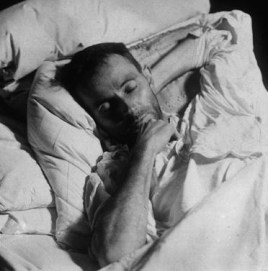
Photo of Egon Schiele on his deathbed.
Second, hostage negotiators must prepare for the abductor’s initial ransom call. Maybe that’s already happened. Maybe that first demand was to reopen the economy by Easter. If so, you handled it well. But more demands are coming. In fact, expect to see that first demand repeated. That’s why successful negotiators select a primary communicator to engage the captor. Two physicians coming at the president at once won’t work. The communicator must present a previously agreed upon message but maintain limited authority. In other words, let’s say you select Dr. Birx (the president seems to view her as less of a threat). Dr. Birx should already secretly know what Dr. Fauci’s position on things is, but when negotiating with the president, should always say, “Let me make sure we have Dr. Fauci’s opinion,” or, “I’ll have to get back to you after I consult the team.” This allows for the negotiator to establish a requirement for what hostage negotiators call a reasonable delay. In life or death hostage crises, reasonable delays can make the difference between the abductor doing something rash and emotional, or doing the right thing.
Third, a real hostage communicator is never a debater but more of an influencer and persuader. Hostage communicators maintain some control by scheduling set times to speak with the abductor. This also allows them to develop their objectives and rehearse responses with their larger team. Hostage negotiators work from a quiet, tucked away negotiation operations center. They plot out anticipated demands and scripted responses on white boards around the room. They have a plan even when the captor doesn’t. Got it? Drs. Fauci and Birx, we need you to have a plan. Our survival may depend on your survival. In a sense, we’re all being held hostage, and you are negotiating for our safe release. Hostages sometimes develop Stockholm syndrome when they start identifying with their captor and his causes as a survival mechanism. Don’t let that happen to you. Don’t let that happen to us.

Edvard Munch, The Smell of Death
Links to more Reads:
Must Read at Vox: Trump is mishandling coronavirus the way Reagan botched the AIDS epidemic.
The Washington Post: The National Security Council sounded early alarms about the coronavirus.
The New York Times: The Medical News Site That Saw the Coronavirus Coming Months Ago.
The New York Times: They Survived the Spanish Flu, the Depression and the Holocaust.
Jewish Journal: 101-Year-Old Holocaust And Spanish Flu Survivor Just Beat COVID-19.
The Local: Italian 101-year-old leaves hospital after recovering from coronavirus.
The New York Times: For Autocrats, and Others, Coronavirus Is a Chance to Grab Even More Power.
ProPublica: He Was Ordered to Self-Isolate. He Didn’t. Now He’s Facing Criminal Charges.
The Guardian: Astrophysicist gets magnets stuck up nose while inventing coronavirus device.
The Daily Beast: Rodney Howard-Browne, Megachurch Pastor Who Flouted Virus Rules, Arrested.
Tuesday Art and Reads
Posted: December 10, 2019 Filed under: morning reads, U.S. Politics | Tags: Adam Schiff, art, articles of impeachment, Christopher Steele, Christopher Wray, Cover-Up General Barr, Do Fornier, Donald Trump, Eric Swalwell, FBI, Gerry Nadler, IG Michael Horowitz, IG report, Ivanka Trump, John Durham, Nancy Pelosi 39 Comments
Good Morning!!
The paintings in today’s post are by Do Fournier, a contemporary French painter. Here’s a little information about her:
Do Fournier (French, b.1951) is a Contemporary painter, originally from Guerande, Brittany, France. She began her career as a successful illustrator, and, in 1984, changed her focus to the creation of her own paintings. Her works were well received, and numerous prestigious exhibitions of her artworks have been mounted in France. In addition, she has frequently been invited to exhibit at the Salon d’Automne in Paris.
Fournier creates fantastic, colorful, and intimate works inspired by her home in France, which overlooks the sea. Her family and pets, as well as her collection of objects d’art, rugs, and textiles, are her primary subjects.
As the noted French critic Gerard Xuriguera has observed: “Her approach in an uneasy society is not to describe it’s pain but the potential it still has for joy, it’s fragile moments of charm and peacefulness stolen from a routine existence. To do this she expresses reality in its most intimate, sensual, peaceful and carnal form. Not as imitation but as a vision filtered through her observations and cast in the exuberance of her blazing colours. What she is trying to capture is fleeting emotion, to immobilize it and express it as simply as possible.

Breaking News
Right now I’m watching a press conference by House Leader Nancy Pelosi and the chairs of the five House committees involved in the impeachment investigation.
In yesterday’s impeachment hearing, Rep Eric Swalwell spelled out the case against Trump in no uncertain terms.
https://twitter.com/QasimRashid/status/1204164336681463808
Today’s Reads
The New York Times: Another Inquiry Doesn’t Back Up Trump’s Charges. So, on to the Next.
President Trump and his allies spent months promising that a report on the origins of the F.B.I.’s Russia investigation would be a kind of Rosetta Stone for Trump-era conspiracy enthusiasts — the key to unlocking the secrets of a government plot to keep Mr. Trump from being elected in 2016.
On that point, the report by the Justice Department’s inspector general, Michael E. Horowitz, did not deliver, even as it found serious problems with how F.B.I. officials justified the surveillance of a Trump campaign aide to a federal court.
But by the time it was released, the president, his attorney general, his supporters in Congress and the conservative news media had already declared victory and decamped for the next battle in the wider war to convince Americans of the enemies at home and abroad arrayed against the Trump presidency.
They followed a script they have used for nearly three years: Engage in a choreographed campaign of presidential tweets, Fox News appearances and fiery congressional testimony to create expectations about finding proof of a “deep state” campaign against Mr. Trump. And then, when the proof does not emerge, skew the results and prepare for the next opportunity to execute the playbook.
That opportunity has arrived in the form of an investigation by aRea Connecticut prosecutor ordered this year by Attorney General William P. Barr — and the president and his allies are now predicting it will be the one to deliver damning evidence that the F.B.I., C.I.A. and even close American allies conspired against Mr. Trump in the 2016 election.
Read the rest at the NYT.
One startling revelation from the IG report was that Ivanka Trump has been friends with Christopher Steele for years.
ABC News: ‘Dossier’ author Chris Steele met Ivanka Trump years before Russia scandal, source says.
Nearly a decade before the 2016 presidential campaign, Donald Trump’s daughter Ivanka met a British intelligence officer who ran the Russia desk — and when the agent left his covert service and moved into private practice in 2010, she stayed in touch, ABC News has learned.
Artist Do Fournier
The two exchanged emails but never worked together, and the man, Christopher Steele, would one day re-emerge in a most unexpected way, taking a central role in the Russia scandal that consumed the early years of her father’s presidency, according to a source familiar with their past contacts.
The prior relationship came to light as investigators with the Department of Justice Inspector General’s office was looking into allegations of political bias at the origins of the Russia investigation since May 2018….
In 2007, Ivanka Trump met Steele at a dinner and they began corresponding about the possibility of future work together, the source said. The following year, the two exchanged emails about meeting up near Trump Tower, according to several emails seen by ABC News. And the two did meet at Trump Tower according to the source. The inspector general’s report mentions a meeting with a “Trump family member” there. They suggest Ivanka Trump and Steele stayed in touch via emails over the next several years. In one 2008 exchange they discussed dining together in New York at a restaurant just blocks from Trump Tower.
Ivanka Trump worked as an executive vice president at the Trump Organization, managing a range of foreign real estate projects, including in parts of the world where Steele’s firm, Orbis Business Intelligence touted expertise. She and Steele discussed services Orbis could offer to the Trump Organization regarding its planned expansion into foreign markets, according to two sources familiar with the meetings.

Read more at ABC News.
Also from ABC News: FBI Director Chris Wray reacts to DOJ watchdog report on Russia investigation: Exclusive.
FBI Director Christopher Wray offered mixed reactions to a Justice Department watchdog report that uncovered “serious performance failures” on the part of agents involved in the Russia investigation but ultimately determined the bureau was justified in launching its probe.
Artist Do Fournier
In an exclusive broadcast interview with ABC News, Wray lamented “actions described in this report that [he] considered unacceptable and unrepresentative of who we are as an institution.” But, he said it was “important that the inspector general found that, in this particular instance, the investigation was opened with appropriate predication and authorization.” [….]
But the president and his allies have called it “a major SPY scandal” and accused those involved of working on behalf of the “Deep State.”
Wray did not respond directly to the president, but pushed back on the “Deep State” characterization of the bureau’s work.
“I think that’s the kind of label that’s a disservice to the men and women who work at the FBI who I think tackle their jobs with professionalism, with rigor, with objectivity, with courage,” Wray said. “So that’s not a term I would ever use to describe our work force and I think it’s an affront to them.”

Naturally, Trump is enraged at Wray’s remarks. Will he fire another FBI Director?
The Washington Post: Trump lashes out at FBI director in wake of Justice Department inspector general’s report.
President Trump lashed out Tuesday morning at FBI Director Christopher A. Wray, suggesting that “he will never be able to fix the FBI” based on his reaction to a Justice Department inspector general’s report examining the bureau’s investigation of Trump’s 2016 campaign.
“I don’t know what report current Director of the FBI Christopher Wray was reading, but it sure wasn’t the one given to me,” Trump tweeted. “With that kind of attitude, he will never be able to fix the FBI, which is badly broken despite having some of the greatest men & women working there!”
Artist Do Fournier
The 434-page report rebutted conservatives’ accusations that top FBI officials were driven by political bias to illegally spy on Trump advisers as part of the probe into Russian election interference, but it also found broad and “serious performance failures” requiring major changes.
In a statement Monday, Wray, a Trump appointee, said he had ordered more than 40 corrective steps to address the report’s recommendations,” adding that he would not hesitate to take “appropriate disciplinary action if warranted.”

Cover-up General Bill Barr is also attacking the report by his own independent Inspector General.
Talking Points Memo: How The DOJ Watchdog Forced Barr To Scramble To Undermine Trump-Russia Probe.
Attorney General Bill Barr scrambled on Monday to keep a main anti-DOJ conspiracy theory going, after Justice Department Inspector General Michael Horowitz released a 476-page report finding that the FBI was justified in opening its Trump-Russia investigation.
Horowitz found that there was unanimous support within the Justice Department and FBI in July 2016 for opening an investigation into potential contacts between the Trump campaign and the Russian government, and found no evidence that anti-Trump bias played a role in the investigation’s start.
Horowitz opened his probe amid allegations from right-wing talking heads and politicos that partisan bias had propelled FBI officials into investigating the Trump campaign….
The result of the whirlpool of allegations arrived in the form of the Horowitz report, which substantively rebutted the accusations and affirmatively found that FBI officials were justified in opening an investigation into Russia and the Trump campaign.
Artist Do Fournier
So, upon the report’s release, both Barr and Connecticut U.S. Attorney John Durham issued statements disagreeing with Horowitz’s finding.
“Based on the evidence collected to date, and while our investigation is ongoing, last month we advised the Inspector General that we do not agree with some of the report’s conclusions as to predication and how the FBI case was opened,” Durham said in his statement, adding that he was relying on evidence beyond the “component parts of the Justice Department.”

More details at the TPM link.
Vanity Fair: “It Is Not What The Department of Justice Does”: Barr and Durham Go Rogue On The Inspector General’s Report.
…what was truly surprising to some veterans of the Robert F. Kennedy building and the DC bar was the reaction from Attorney General William Barr and U.S. Attorney for Connecticut John Durham, who Barr tapped to run a parallel investigation of Crossfire Hurricane and related investigations. Both issued statements throwing significant shade at Horowitz’s report, though, technically, Barr is Horowitz’s boss. “I’ve never seen such an internal DOJ effort to challenge and undermine the IG’s findings,” Harry Litman, a former U.S. attorney, told me Monday. “It is not what the Department of Justice does.” [….]
“The Inspector General’s report now makes clear that the FBI launched an intrusive investigation of a U.S. presidential campaign on the thinnest of suspicions that, in my view, were insufficient to justify the steps taken,” Barr wrote in a statement. “It is also clear that, from its inception, the evidence produced by the investigation was consistently exculpatory. Nevertheless, the investigation and surveillance was pushed forward for the duration of the campaign and deep into President Trump’s administration.”
Barr’s decision to publicly distance himself from Horowitz’s findings was met with some astonishment. “No law enforcement purpose is served by the Attorney General announcing that he disagrees with the inspector general’s conclusion that the FBI had an adequate predicate for its investigation of Russia’s contacts with the Trump campaign,” William Jeffress, a white-collar defense attorney who worked on the Valerie Plame leak case, told me. Barr’s missive was reminiscent of the now infamous four-page summary of Robert Mueller’s report, respinning the results of an exhaustive investigation in ways favorable to the president. “The statement by Barr will only deepen the sense that he is a Trump partisan who lacks the independence to lead the Department of Justice,” Jeffress added.
What else is happening? What stories have you been following?
Thursday Reads
Posted: February 8, 2018 Filed under: morning reads, U.S. Politics | Tags: art, Donald Trump, John Kelly, Paula Modersohn-Becker, Russia investigation 37 Comments
Paula Modersohn-Becker with Elspeth c1903
Good Afternoon!!
Today’s Google doodle honors pioneering impressionist artist Paula Modersohn-Becker. I had never heard of her, so I decided to look at her work. I’m using some of her paintings to illustrate this post. Time Magazine has some background on her life and art.
The first woman to paint a naked self-portrait didn’t care much for the traditional expectations or institutions that constrained most European women at the turn of the 20th century. Paula Modersohn-Becker’s parents wanted her to become a teacher, and told her to abandon her “egotism” in order to carry out her wifely duties; instead, she became one of the era’s most prolific artists, and helped give rise to the modernist movement alongside Pablo Picasso and Henri Matisse….
At the age of 18, she defied her parents to join an artist colony in Worpswede, in northern Germany. There, she met her future husband, the older, respected artist Otto Modersohn.
Eager to learn more about modern art, Modersohn-Becker soon after moved to Paris, and encouraged Modersohn to join her. The two got engaged, at which point Modersohn-Becker ‘s family intervened and sent her to a cooking school in preparation for her coming marriage.
Self Portrait
But she refused to put aside her ambitions and paint brushes, and boldly declared she “was going to become somebody“. Her works often featured regular women, frequently painted nude, as they slept, breastfed and gardened.
In 1906 alone, the prolific artist painted 80 pictures. She died later the following year of an embolism, 18 days after giving birth to her daughter at the age of 31.

She “declared she ‘was going to become somebody.” I just love that! Reading about this courageous woman took me out of the insanity of America’s present moment for a little while, and I’m grateful for that brief respite.
Today’s news is as crazy as ever. I wrote in a comment on JJ’s post that maybe Trump’s “success” in business was partially a result of the chaos he constantly creates. He frequently had to be bailed out of his massive mistakes–first by his father and then by various banks and investors. He refused to pay contractors and employees until they simply gave up in disgust.
Many of the people who have tried to deal with Trump have ended up simply throwing up their hands. We see that happening in the White House and even in the media. The man is a walking, talking disaster area. Everything he touches turns to shit and everywhere he goes he leaves terrible damage in his wake. I wonder if American democracy will survive.
Trump also seems to attract other people with dark and ugly personalities. Take White House chief of staff John Kelly, for example. When he was first appointed to his current position, the media celebrated Kelly as the “adult in the room” who would tame Trump’s wild and dangerous authoritarian tendencies. Now we know Kelly and Trump are two peas in a pod. The only difference is that Kelly had a slightly more dignified facade. But that’s gone now; Kelly has shown us who he is: a bigoted, foul-mouthed, unapologetic authoritarian, just like Trump.
Gail Collins at The New York Times: Trump’s Worst Watcher.
Do you remember back when everybody thought John Kelly was going to calm down the Trump White House?
Stop laughing. Although it has been another wow of a week, hasn’t it? We had one top administration official, Rob Porter, resigning over claims of domestic abuse regarding two ex-wives. Kelly defended Porter as “a friend, a confidant and a trusted professional” shortly before a picture popped up of one former Mrs. Porter sporting a black eye.
This was a little bit after Kelly himself made headlines for suggesting that some young immigrants couldn’t qualify for federal help because they were just “too lazy to get off their asses” and file some paperwork. Meanwhile the president, apparently unsupervised, was calling for a government shutdown and lobbying enthusiastically for an expensive new military parade. Because he saw one in Paris and thought it was cool.
A good chief of staff advises the president against doing things that will make the administration look stupid or crazy. So, are we all in agreement that Kelly, retired general turned Trump chief of staff, appears to be … a failure? And sort of a jerk in the bargain?
For example:
The world began to notice that Kelly was perhaps not as cool, calm and collected as we’d bargained for when he was coordinating a condolence call by the president to Myeshia Johnson, whose husband, Sgt. La David Johnson, was killed while serving on a strange mission in Niger.
It did not go well. Ms. Johnson said the president seemed to forget her husband’s name. His idea of comfort, she said, was to tell her La David knew “what he was signing up for.” Trump naturally denied everything. Representative Frederica Wilson, a family friend, made the whole disaster public. Kelly then waded in with an emotional speech in which he assailed Wilson for taking credit for getting funding for a Florida building named after two slain F.B.I. agents. Its overall weirdness was matched only by its total inaccuracy.
The next step, in theory, would be an apologetic call from Kelly to the congresswoman. Or assigning someone to reach out to La David Johnson’s widow and try to smooth the whole awful situation over. Never happened.
Read the rest at the NYT.
Gabriel Sherman at Vanity Fair: Beyond Disbelief: John Kelly’s Defense of Rob Porter Roils The West Wing.
For weeks, Donald Trump has been souring on his Chief of Staff John Kelly because of his controlling ways and rising public profile. And now Kelly is in the midst of a bonafide crisis, one that exacerbates the president’s own #MeToo problems. On Tuesday, Kelly strongly defended White House Staff Secretary Rob Porter against disturbing allegations, first published in the Daily Mail, that he abused his ex-wives. Kelly’s decision to back Porter has left many people inside the White House angry, two sources with knowledge of the matter said. On Wednesday afternoon, Porter resigned. Axios reported Kelly wanted Porter to “stay and fight.”
Girl in a red dress with a sunflower
Yesterday, Porter’s second wife, Jennifer Willoughby, told the Mail that Porter called her a “fucking bitch” on their honeymoon, and once pulled her naked out of the shower. In response, Kelly put out a statement calling Porter “a man of true integrity and honor” and a “trusted professional.” But shortly after Kelly rallied behind his colleague, Porter’s first wife came forward with additional harrowing allegations. Colbie Holderness, who married Porter in 2009, told the Daily Mail that Porter punched her in the face and choked her, among other alleged abuses. The article included a photo of her with a black eye. “It was not hard enough for me to pass out, but it was scary, humiliating, and dehumanizing,” she said. Porter told the Daily Mail that the allegations were “slanderous and simply false.”
Kelly’s decision to go to bat for Porter deeply frustrated White House staffers, sources told me. He was supposed to be the West Wing’s resident grown-up, but staffers are increasingly questioning Kelly’s judgment, four Republicans close to the White House told me. “It’s beyond disbelief. Everyone is trying to figure out why Kelly is leading the charge to save him,” one former West Wing official said. Another Republican said: “How many times has Kelly put out a statement defending Trump?”
Sources said Kelly was so quick to defend Porter because the two have grown very close since Trump appointed Kelly chief of staff last summer. Porter, a Rhodes scholar, has helped Kelly instill discipline in the West Wing. Kelly has told people that Porter has a “calming effect” on White House operations. For instance, it’s Porter who screens all the information that gets to Trump’s desk. Porter also helped Kelly conduct a West Wing organizational study that provided Kelly with a cudgel to sideline Ivanka Trump and Jared Kushner, two former West Wing officials told me. The officials also said Kelly supported Porter even after the F.B.I. delayed granting Porter’s security clearance because they uncovered his alleged history of spousal abuse.

Kelly needs to go. Now. Late last night, he finally claimed (probably after urging from WH staff members who still have consciences) that he was “shocked” by the allegations of abuse that he previously didn’t give a shit about.
There’s plenty of news on the Russia investigation.
Last night NBC News published new details on Russia’s hacking of state voting systems: Russians penetrated U.S. voter systems, top U.S. official says.
In an exclusive interview with NBC News, Jeanette Manfra, the head of cybersecurity at the Department of Homeland Security, said she couldn’t talk about classified information publicly, but in 2016, “We saw a targeting of 21 states and an exceptionally small number of them were actually successfully penetrated.”
A boy in front of apple trees, 1901
Jeh Johnson, who was DHS secretary during the Russian intrusions, said, “2016 was a wake-up call and now it’s incumbent upon states and the Feds to do something about it before our democracy is attacked again.”
“We were able to determine that the scanning and probing of voter registration databases was coming from the Russian government.”
NBC News reported in Sept. 2016 that more than 20 states had been targeted by the Russians.
There is no evidence that any of the registration rolls were altered in any fashion, according to U.S. officials.

Read more details at the link above.
Meduza (“The Real Russia, Today”): An escort girl may be the latest ‘Russia Gate’ link.
Alexey Navalny has published new corruption allegations against Deputy Prime Minister Sergey Prikhodko and oligarch Oleg Deripaska, alleging that the two met aboard Deripaska’s yacht in August 2016 off the coast of Norway, possibly to discuss the oligarch’s relationship with Paul Manafort and his role in Russia’s interference in the 2016 U.S. presidential election.
Navalny says he learned about the meeting thanks to an escort who posted photos from the excursion on Instagram. Navalny says the trip amounts to a bribe, insofar as Deripaska apparently flew Prikhodko in on his private jet and then provided him with the services of an “escort girl.”
Navalny also alleges that Prikhodko owns a home valued at 300 million rubles ($5.2 million) in a luxurious area outside Moscow, as well as two apartments in the city worth almost 500 million rubles ($8.7 million) — real estate that the oppositionist says Prikhodko could only afford because of bribes.
We’ll have wait and see if this story gets filled out in U.S. or British media.
 USA Today: George W. Bush: ‘Clear evidence Russians meddled’ in election.
Former president George W. Bush appeared to take aim at President Trump on Thursday when he said at an economic summit that there was “pretty clear evidence that the Russians meddled” in the 2016 U.S. election.
Bush did not directly name Trump during his talk in Abu Dhabi, the capital of the United Arab Emirates. He appeared there as part of a conference by the Milken Institute, a think tank based in Santa Monica, Calif.
“Whether (Russia) affected the outcome is another question,” Bush said. “It’s problematic that a foreign nation is involved in our election system. Our democracy is only as good as people trust the results.”
The Washington Post: Justice Dept. official who helped oversee Clinton, Russia probes steps down.
David Laufman, an experienced federal prosecutor who in 2014 became chief of the National Security Division’s Counterintelligence and Export Control Section, said farewell to colleagues Wednesday. He cited personal reasons.
His departure from the high-pressure job comes as President Trump and his Republican allies have stepped up attacks on the Justice Department, the FBI and special counsel Robert S. Mueller III for their handling of the Russia probe.
“It’s tough to leave a mission this compelling and an institution as exceptional as the Department of Justice,” said Laufman, 59. “But I know that prosecutors and agents will continue to bring to their work precisely what the American people should expect: a fierce and relentless commitment to protect the national security of the United States.”
“David’s departure is a great loss for the department,’’ said Mary McCord, a former acting head of the National Security Division who resigned in May. “He has the integrity and attention to detail that is critical to investigating and prosecuting the types of sensitive matters handled by the department’s Counterintelligence and Export Control Section.”
I hadn’t heard of Laufman before, but the story says he was a target of right wing attacks.
Laufman became a target of the far-right blogosphere, with conspiracy theorist Mike Cernovich accusing him last year of being the source of “national security leaks.” Cernovich’s claim, which Laufman’s colleagues have called baseless, surfaced after media reports detailed then-national security adviser Michael Flynn’s discussion of U.S. sanctions with Russian Ambassador Sergey Kislyak.
The online attacks persisted for months. After Comey’s firing in May, Cernovich posted a piece titled “Will DOJ leaker David Laufman be next to leave after #Comey?”
Critics noted that Laufman had donated to Barack Obama’s presidential campaigns, referring to him as a “holdover.” But he is a career attorney who has served as a political appointee in Republican administrations as well, notably as chief of staff to Deputy Attorney General Larry Thompson under President George W. Bush from 2001 to 2003.
One more interesting read is this long piece at Politico Magazine by Luke Harding: Why Carter Page Was Worth Watching. There’s plenty of evidence that the former Trump campaign adviser, for all his quirks, was on suspiciously good terms with Russia.
The article is an excerpt from Harding’s book Collusion: Secret Meetings, Dirty Money, and How Russia Helped Donald Trump Win.
What stories are you following today?
Tuesday Reads: Ferguson Updates
Posted: August 19, 2014 Filed under: Civil Liberties, Civil Rights, Crime, Criminal Justice System, Eric Holder, morning reads, racism, U.S. Politics | Tags: art, Captain Ronald S. Johnson, Chief Tom Jackson, Civil Rights Movement, Darren Wilson, Department of Justice, Ferguson MO, Ferguson Police Department, Getty Images, Hedy Epstein, Michael Brown shooting, MIssouri National Guard, Scott Olson, the other Michael Brown 56 Comments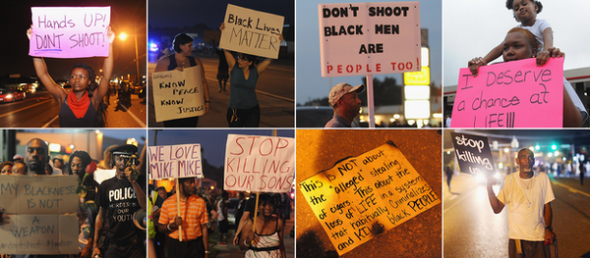
Good Morning!!
I can’t stop thinking about the events in Ferguson, Missouri, and flashing back to similar iconic events in the 1960s. How far have we really come since the days of the Civil Rights Movement? Clearly, racism is alive and well in 2014, particularly in police departments around the country–and not just in the South. Will the disease of racism ever be wiped out in this country, or can we only hope to control it through great effort–with laws, education, organizing, and public demonstrations?
Ferguson citizens were forced to live through another night of chaos last night, and I’m convinced at this point that deliberate police actions are making things much worse. The man in charge, Captain Ron Johnson of the Missouri State Police is clearly being used as a pawn. He was set up to fail, and at this point he is simply putting a friendly face on an ugly show of force intended to intimidate protesters and media alike. And he’s lying to make excuses for what has basically become a nightly police riot. I’ve been watching the live feed from Ferguson night after night, and I have yet to see any evidence of protesters throwing Molotov cocktails or attacking police (UPDATE: Dakinikat says there is one in the NYT video at this link.
Perhaps we’d know more about what is happening on the ground if new helicopters could fly over Ferguson, but police have ordered them not to, saying that only police helicopter can do so. Reporters and news photographers have been arrested and threatened with being maced or shot. Yesterday, as everyone here knows, police in St. Louis arrested 90-year-old Holocaust survivor Hedy Epstein. From The Independent UK:
Hedy Epstein, a 90-year-old survivor of the Holocaust, was reportedly among those arrested during protests in downtown St Louis as tensions flared over the death of black teenager Michael Brown in Ferguson.
Eight protesters were arrested for “failure to disperse” on Monday after marching from the Kiener Plaza to the Wainwright building where Governor Jay Nixon has an office, St Louis police confirmed on Twitter.
Ms Epstein was pictured being led away in handcuffs during demonstrations against the National Guard’s presence on the streets where clashes between protesters and authorities have been the most severe.
Ms Epstein, a resident of St Louis, is a political activist and speaker widely known for her vocal support of the Free Gaza Movement.
“I’ve been doing this since I was a teenager. I didn’t think I would have to do it when I was ninety,” Ms Epstein told The Nation as she was led away by police. “We need to stand up today so that people won’t have to do this when they’re 90.”
Yes, the protests have spread to St. Louis proper now, and people are gathering in many other cities to show solidarity with Ferguson. Also arrested yesterday was Getty Images photojournalist Scott Olson, who is responsible for many of the most dramatic photos from Ferguson since the protests began.

King and Ghandi, Robert Templeton
But I want to return to the subject of racism and dishonesty in the Ferguson Police Department. I think most people who have been paying attention to this story will agree that the Ferguson cops cannot be trusted at this point. Some history, from Michael Daly at The Daily Beast: Missouri Cops’ License to Kill.
The death of 18-year-old Michael Brown is not the first time an officer supervised by Ferguson Police Chief Tom Jackson has killed an unarmed man….
Back in 2000, two unarmed young men were shot and killed in a Jack in the Box parking lot in the suburban town of Berkeley adjacent to Ferguson by a pair of officers assigned to a county-wide drug task force where Jackson was deputy commander.
Early reports suggested that a vehicle occupied by Earl Murray and Ronald Beasley moved toward Officers Robert Piekutowski and Keith Kierzkowski, causing them to fear being pinned against another car.
Jackson, then a lieutenant with the St. Louis County Police, told reporters, “I am convinced that the officers were in fear of their lives, that they were in immediate danger.” ….
Subsequently, investigators decided that the car occupied by the two men had not in fact begun to move in their direction when the fatal shots were fired. The officers insisted they were in fear for their lives nonetheless, essentially arguing that the car was itself a deadly weapon pointed their way. That was enough for the shooting to be ruled justified under Missouri state law. The cops were not indicted.
Read more about it at the link. It’s high time Jackson was removed as Ferguson Police Chief.
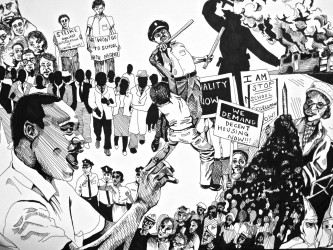
Civil Rights Movement, Camille Shumann
And then there was the “other Michael Brown.” From the St. Louis Post-Dispatch:
Michael Brown, 23, of Troy, Mo., who was shot and killed along with a friend in October 2005.
Authorities said that Lincoln County sheriff’s Deputy Nic Forler fired through the back window of a pickup, killing Brown and the driver, Tyler Teasley, 22. No one in the truck was armed.
Police said Forler tried to stop Teasley’s truck for speeding but was led on a short chase. When the truck finally stopped, Forler pulled behind it, got out of his patrol car and stood between the vehicles.
Witnesses said Teasley was “freaking out” because he had been drinking, there was alcohol in the car and several passengers were under 21. In his panic, they said, Teasley left the truck in neutral. As the truck rolled backward, Forler fired the fatal shots that struck both victims in the head.
Family and friends demonstrated regularly outside the sheriff’s office. Forler was dismissed from the force and charged with involuntary manslaughter.
In a trial in 2007, moved to Boone County because of the controversy caused in Lincoln County, Forler testified that he believed Teasley was trying to run him over, and he feared for his life. The jury took only three hours to find Forler not guilty.
Read the Post-Dispatch article to learn about two more such incidents in Missouri.
Now let’s take a look at the case that Ferguson Chief Jackson has been building in order to blame Michael Brown for his own death. According to Jackson, Brown committed a “strong-arm robbery” at a gas station convenience store shortly before he was accosted by Officer Darren Wilson, who shot and killed the unarmed teenager. But did that really happen? I don’t think so.
A couple of days ago people from Ferguson began posting on Twitter that the owners of the store denied reporting any robbery. Then KSDK learned from the owners’ attorney that they never reported any robbery involving Michael Brown and that perhaps a customer had called 911. But did that even happen?
I can’t prove it, but I think what may have happened is that police took surveillance videos from a number of locations and just happened to find the video of Brown in buying cigars. A Ferguson resident on Twitter told me yesterday that the store owners are saying the Ferguson police didn’t pick up the store video until last Friday, not too long before Jackson gave his press conference. And the St. Louis News confirms the tweeter was right.
The owner[s] of the store dispute the claim that they or an employee called 911, saying a customer inside the store made the call. They also say St. Louis County issues the warrants for the hard drive of surveillance video Friday.
When asked how Ferguson police ended up with the video that the Ferguson police chief issued Friday morning. The attorney said during the course of Ferguson’s investigation they came to the store and asked to review the tape. But it wasn’t until Friday that St. Louis County investigators issued a warrant for the video many of you have already seen.
Therefore, there is no way that Darren Wilson could have known anything about the “robbery” or that Michael Brown was a suspect.

Civil Rights Line, Janie McGee
A couple of days ago, Joy Reid of The Grio and MSNBC posted on Twitter that the store video appeared to show that Brown had actually paid for the cigars he took from the store.
Then last night Crooks and Liars put up a detailed post about it, Ferguson Cops Busted? New Video Seems To Show Brown Paying For Cigarillos (Video), by John Prager. Crooks and Liars doesn’t allow copy and paste anymore, so you’ll need to go to the link to read the article, but Prager it looks like Brown buys some cigarillos, then tries to by more, but doesn’t have enough money and so replaces them. Brown did reach across the counter, and that may be why the clerk tried to confront him.
Here’s the video.
Will the Ferguson police get away with murder once again? I think it’s likely unless the DOJ finds that the shooting of Michael Brown is a Civil Rights case. U.S. News today posted an article quoting attorneys who have defended police shooters, Police Attorneys: Brown Head Wounds Not Fatal to Officer’s Defense.
Pathologists said they found a bullet wound at the apex of the 6-foot-4 Brown’s head and what appeared to be a bullet entry above his right eye that continued downward into his jaw and then shoulder. The wounds appear to show Brown was not standing upright at the time he was shot.
“Just because he was shot somewhere near the top of his head, I don’t think that’s indicative of anything at this point,” says New Orleans attorney Eric Hessler, who defended officers involved in the 2005 post-Hurricane Katrina shooting deaths of two people on the Danziger Bridge and another person outside a convention center.
“There are scenarios that I can envision where a police officer would be justified in using deadly force in that situation,” Hessler says of the Brown case. “It depends on what the individual was doing while he was shot.”
Several officers were convicted of crimes in the post-Katrina cases, but the bridge shooting verdicts were vacated and the case is not resolved.
Attorney James Culleton, who defended New York City police officers who shot and killed unarmed black men Amadou Diallo in 1999 and Sean Bell in 2006, agrees with Hessler that the bullet trajectory isn’t necessarily game-changing.
“If the person is facing you, he’s charging at you, he could have put down his head,” Culleton says. “His head could have just slumped like he was falling forward. It doesn’t mean it’s devastating [evidence].”
We’ll have to wait and see. For now, it’s high time for Chief Jackson to be fired and for Darren Wilson to be arrested. This murderer is still receiving his salary!
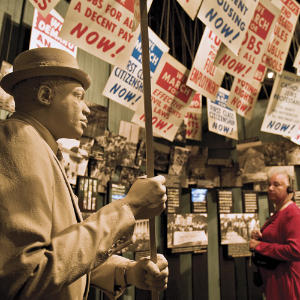
I’ll end with some recent headlines about Ferguson.
LA Times: Michael Brown shooting in Ferguson becomes an international incident.
Reuters: U.S. police come under gunfire, arrest 31 in Missouri racial unrest.
The Guardian: Ferguson: 31 arrested as huge show of force fails to quell unrest.
WaPo: Ferguson protesters: The peaceful, the elders, the looters, and the ‘militants’
NYT: Not Just Ferguson: National Guard Has a Long History With Civil Unrest.
Business Insider Australia: Police Captain Blames ‘A Lot’ Of The Press For ‘Glamorizing’ Ferguson Protests.
WaPo: Holder headed to Ferguson on Wednesday, will oversee federal response to shooting.
Jonathan Capehart: Probe into Michael Brown shooting goes to pot.
What else is happening? Please post your thoughts and links in the comment thread, and have a terrific Tuesday.
Friday Reads
Posted: July 19, 2013 Filed under: morning reads, Republican politics, U.S. Economy, U.S. Politics, Women's Rights | Tags: art, Detroit bankruptcy, Ken Cuccinelli, Lawrence v. Texas, Planned Parenthood, Romania National History Museum, sodomy laws, Texas anti-abortion law, Virginia 23 CommentsGood Morning!

Sorry this will be a little short. I have a friend from Ft. Worth visiting me, so my on-line time is a bit limited at the moment. However, it’s been really hot and steamy so I have to say that it is a relief to stay inside and just watch the sun go down. I have no idea why anyone wants to extend the summer days in this kind of heat.
The biggest story of the week is that debt-ridden Detroit has filed for bankruptcy.
Detroit, the cradle of America’s automobile industry and once the nation’s fourth-most-populous city, filed for bankruptcy on Thursday, the largest American city ever to take such a course.
The decision, confirmed by officials after it trickled out in late afternoon news reports, also amounts to the largest municipal bankruptcy filing in American history in terms of debt.
“This is a difficult step, but the only viable option to address a problem that has been six decades in the making,” said Gov. Rick Snyder, who authorized the move after a recommendation from the emergency financial manager he had appointed to resolve Detroit’s dire financial situation.
Not everyone agrees how much Detroit owes, but Kevyn D. Orr, the emergency manager, has said the debt is likely to be $18 billion and perhaps as much as $20 billion.
For Detroit, the filing came as a painful reminder of a city’s rise and fall.
“It’s sad, but you could see the writing on the wall,” said Terence Tyson, a city worker who learned of the bankruptcy as he left his job at Detroit’s municipal building on Thursday evening. Like many there, he seemed to react with muted resignation and uncertainty about what lies ahead, but not surprise. “This has been coming for ages.”
Detroit expanded at a stunning rate in the first half of the 20th century with the arrival of the automobile industry, and then shrank away in recent decades at a similarly remarkable pace. A city of 1.8 million in 1950, it is now home to 700,000 people, as well as to tens of thousands of abandoned buildings, vacant lots and unlit streets.
From here, there is no road map for Detroit’s recovery, not least of all because municipal bankruptcies are rare. State officials said ordinary city business would carry on as before, even as city leaders take their case to a judge, first to prove that the city is so financially troubled as to be eligible for bankruptcy, and later to argue that Detroit’s creditors and representatives of city workers and municipal retirees ought to settle for less than they once expected.
Some bankruptcy experts and city leaders bemoaned the likely fallout from the filing, including the stigma. They anticipate further benefit cuts for city workers and retirees, more reductions in services for residents, and a detrimental effect on borrowing.
 The strict Texas law put into place to stop women from exercising their constitutional right to abortion has begun to take its toll.
Planned Parenthood on Wednesday informed staff at three of its facilities in Texas that they would be closing, according to people familiar with the decision.
The three clinics are located in Bryan, Huntsville and Lufkin, Texas. They are closing in response to a new package of abortion restrictions signed into law on Thursday and funding cuts to Texas’ Women’s Health Program that were passed by the Texas state legislature in 2011. Out of the three Planned Parenthood clinics that are closing, only the Bryan clinic performs abortions.
“In recent years, Texas politicians have created an increasingly hostile environment for providers of reproductive health care in underserved communities. Texans with little or no access to health care services have been deeply affected by state budget cuts to programs provided by Planned Parenthood health centers and dozens of others that provided lifesaving cancer screenings, well-woman exams and birth control,” said Melaney A. Linton, president and CEO of Planned Parenthood Gulf Coast.”
“The combined impact of years of budget cuts to women’s health care services and the dismantling of the successful Women’s Health Program will take affordable, preventive health care options away from women in Bryan, Lufkin and Huntsville — just as these policies have taken health care away from an estimated 130,000 others — when Planned Parenthood Gulf Coast is forced to close these family planning health centers at the end of August,” she said.
Some anti-choice legislators are trying to make the recently passed Texas bill even worse.
On Thursday, three Texas Republicans filed a measure that would criminalize abortion services after a fetal heartbeat can be detected — which typically occurs around six weeks of pregnancy, before many women even know they’re pregnant.
The Texas legislature is currently in the midst of a special session that was convened specifically to give lawmakers more time to consider abortion restrictions. The session will end on July 31. Until then, GOP lawmakers have been busy proposing a slew of anti-abortion bills in the hopes of being able to rush them through.
One of those bills, a measure to ban abortion after 20 weeks and shut down the majority of the states’ abortion clinics, has captured national attention over the past several weeks as thousands of Texans have rallied at the capitol in protest. The legislature gave final approval to that bill on Saturday, and Gov. Rick Perry (R) just signed it into law on Thursday morning. But that’s not enough to satisfy Reps. Phil King (R), Dan Flynn (R), and Geanie Morrison (R) — whofiled HB 59 on the same day that Perry signed the controversial abortion restrictions.
So-called “heartbeat” bills are so radical that they divide the anti-choice community. In addition to criminalizing the vast majority of abortions, they also mandate invasive ultrasound procedures for women seeking abortions. In order to detect a fetal heartbeat so early in a pregnancy, doctors typically have to use a transvaginal probe.
In an unusual move, Virginia Attorney General Ken Cuccinelli II (R), his party’s nominee for governor, launched a new campaign website Wednesday highlighting his efforts to reinstate Virginia’s unconstitutional Crimes Against Nature law. The rule, which makes felons out of even consenting married couples who engage in oral or anal sex in the privacy of their own homes, was struck down by federal courts after Cuccinelli blocked efforts to bring it in line with the Supreme Court’s 2003 Lawrence v. Texas ruling.
The new site, vachildpredators.com, highlights 90 people identified “sexual predators” in Virginia who have been charged under the law since the 2003 ruling, which held that states could not ban private, non-commercial sexual relations between consenting adults. Cuccinelli warns that these offenders “could come off Virginia’s sex offender registry if a Virginia law used to protect children is not upheld,” and identifies the sodomy law as only the “Anti-Child Predators Law.” While it is true that many sex offenders are charged under the Crimes Against Nature law, it is far from the only tool prosecutors have to punish child predators.
 It is possible that some very wonderful paintings that were stolen in an art heist were destroyed by the thief’s mother in her home’s oven.
Did a cache of priceless stolen art go up in smoke in a Romanian village?
That’s what the art world is afraid of, amid reports that museum forensic specialists from Romania‘s National History Museum are analyzing ashes found in an oven in the village of the mother of the suspected heist ringleader.
The Associated Press reports that according to Ernest Oberlander-Tarnoveanu, the museum’s director, investigators found “small fragments of painting primer, the remains of canvas, the remains of paint” and copper and steel nails, some of which pre-dated the 20th century, in an oven in the village of Caracliu where Olga Dogaru lives. Mrs. Dogaru’s son was arrested in January in connection with the theft of seven paintings – including works by Matisse, Monet, and Picasso – from Rotterdam‘s Kunsthal museum last October.
So, that’s it’ from me today. I’m going to spend some more time with my friend! What’s on your reading and blogging list today!

 peej
peej Carissa
 bostonboomer
 dakinikat
 ecocatwoman
 mablue2
 Mama Lopez
 peggysue22
 quixote
 skydancingguestblogger
 Mona (aka Wonk the Vote)



 Sky Dancing
.jpg)
Recent Comments