



By Sandra Bierman
On Friday, the Bab Al-Salama border crossing into Syria was almost empty. A single ambulance with flashing lights was waiting to enter. The only Syrians crossing back were those being returned to their families in body bags.


Book cover
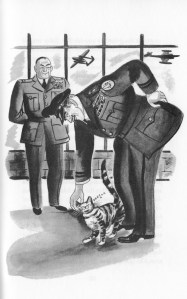
A couple of Caturdays ago, I posted illustrations from a 1950s children’s book called Space Cat and the Kittens. My brother had shared them with me after he bought the book at a used bookstore. This week, he came across the first book in the four-part series, and I’m going to post some of the illustrations from that book today. I think they are really cute. The story:
A little gray kitten with a taste for adventure stows away on an airplane, and the daring stunt turns out to be his first step toward becoming … Space Cat! The plane’s pilot, Captain Fred Stone, names his fuzzy new friend Flyball and welcomes him to an experimental station set up in the middle of the desert. Flyball enjoys supervising the station’s workers and takes particular interest in the big rocket ship that he’s not allowed to explore. Regardless of the rules, the kitty is determined to hitch another ride, and before you know it, Flyball’s wearing a custom-made pressurized suit and headed for the Moon.
As for the news, everything is awful as usual today. We’re dealing with a “president” who is well on the way of becoming a dictator. He plans to meet with fellow dictator Vladimir Putin to hand over territory in Ukraine; He is allowing his HHS secretary RFK Jr. to endanger Americans with anti-vaccine policies; and he is deliberately damaging American higher education.
Tyler Pager and David E. Sanger at The New York Times: Trump Says He Will Meet With Putin in Alaska Next Week.
President Trump said he would meet with President Vladimir V. Putin of Russia next Friday in Alaska, as he tries to secure a deal to end the war between Russia and Ukraine.
Mr. Trump announced the meeting Friday shortly after he suggested that a peace deal between the two countries could include “some swapping of territories,” signaling that the United States may join Russia in trying to compel Ukraine to permanently cede some of its land.
“We’re going to get some back, and we’re going to get some switched,” Mr. Trump said while hosting the leaders of Armenia and Azerbaijan for a peace summit at the White House. “There’ll be some swapping of territories to the betterment of both, but we’ll be talking about that either later, or tomorrow.”
The meeting, the first in-person summit between an American and Russian president since President Joseph R. Biden Jr. met with Mr. Putin in June 2021, reflects Mr. Trump’s confidence in his ability to persuade Mr. Putin in a face-to-face encounter, a goal that has eluded Mr. Trump and his predecessors. For Mr. Putin, the meeting itself is a victory after he spent the past several months largely isolated from the international community, with NATO leaders — other than Mr. Trump — refusing to communicate directly with him.

Carrying cat to the rocket
At least he didn’t invite Putin to the White House, but will Putin try to get him to give Alaska back to Russia while they are swapping land in Ukraine?
The meeting also presents a host of challenges. Ukrainian leaders have adamantly opposed relinquishing any of their land to Russia, and the country’s constitution bars President Volodymyr Zelensky of Ukraine from ceding any territory.
There would also be numerous political and military hurdles for Ukraine in turning over land to Russia, as well as questions including security guarantees for Ukraine and the future of frozen Russian assets. And many diplomats have suggested that Mr. Putin may be more interested in dragging out diplomacy to give him time to pummel Ukraine than in securing a peace deal.
White House officials declined to say exactly where in Alaska the two leaders would meet or why Mr. Trump decided to hold the meeting there, though it is the closest U.S. state to Russia. In 2021, the Biden administration held talks with China in Anchorage, Alaska.
Mr. Trump also provided little additional detail about the meeting, what territory could be swapped or the broader contours of a peace deal, saying earlier Friday that he did not want to overshadow the peace pledge between Armenia and Azerbaijan. But he told European leaders earlier this week that he planned to follow up his session with Mr. Putin with a meeting with Mr. Putin and Mr. Zelensky.
The New York Times: Zelensky Rejects Ceding Territory to Russia After Trump Suggests a Land Swap.
President Volodymyr Zelensky of Ukraine on Saturday flatly rejected the idea that Ukraine could cede land to Russia after President Trump suggested that a peace deal between Ukraine and Russia could include “some swapping of territories.”
“Ukrainians will not gift their land to the occupier,” Mr. Zelensky said in a video address from his office in Kyiv, several hours after Mr. Trump’s remarks, which appeared to overlook Ukraine’s role in the negotiations.
“Any decisions made against us, any decisions made without Ukraine, are at the same time decisions against peace,” Mr. Zelensky said. “They will bring nothing. These are dead decisions; they will never work.”
His blunt rejection risks angering Mr. Trump, who has made a peace deal between Ukraine and Russia one of his signature foreign policy goals, even if it means accepting terms that are unfavorable to Kyiv. In the past, Mr. Trump has criticized Ukraine for clinging to what he suggested were stubborn cease-fire demands and for being “not ready for peace.”

Cat in a hammock on spacecraft
What doesn’t anger Trump? Anything except blind loyalty and obedience.
A recent poll by the Kyiv International Institute of Sociology found that more than three-quarters of Ukrainians are against transferring Ukrainian-controlled territory to Russia. When it comes to ceding land that includes territory already under Russian control, opposition drops slightly, with a little more than half of Ukrainians against it, “even if this makes the war last longer and threatens the preservation of independence,” the poll says.
But support for land concessions has grown since Ukraine’s failed 2023 counteroffensive, which underscored its inability to retake substantial territory. About 38 percent of the population thinks ceding land is acceptable now, according to the poll, up from only 10 percent about two years ago.
Russia has long demanded that Ukraine give up four regions in the east and south that Moscow claims to have annexed in late 2022, even though some of that territory remains under Ukrainian control. The Kremlin is particularly intent on seizing full control of the eastern regions of Luhansk and Donetsk, which it has long sought to capture with relentless assaults.
But ceding Luhansk and Donetsk, which are part of an area commonly known as the Donbas region, would create a host of issues for Ukraine. It would mean giving up a region rich in cities and industrial centers that Russia could use as a launchpad to reignite the war.
And Ukraine would have to abandon its main fortified defensive line in northern Donetsk, stretching between the cities of Sloviansk and Kostiantynivka, which has so far withstood Russian assaults.
Nick Paton Walsh at CNN: Trump-Putin summit in Alaska resembles a slow defeat for Ukraine.
Location matters, former real estate mogul US President Donald Trump said. Moments later he announced Alaska, a place sold by Russia to the United States 158 years ago for $7.2 million, would be where Russian President Vladimir Putin tries to sell his land deal of the century, getting Kyiv to hand over chunks of land he’s not yet been able to occupy.
The conditions around Friday’s summit so wildly favor Moscow, it is obvious why Putin leapt at the chance, after months of fake negotiation, and it is hard to see how a deal emerges from the bilateral that does not eviscerate Ukraine. Kyiv and its European allies have reacted with understandable horror at the early ideas of Trump’s envoy, Steve Witkoff, that Ukraine cede the remainders of the Donetsk and Luhansk regions in exchange for a ceasefire.
Naturally, the Kremlin head has promoted the idea of taking ground without a fight, and found a willing recipient in the form of Witkoff, who has in the past exhibited a relaxed grasp of Ukrainian sovereignty and the complexity of asking a country, in the fourth year of its invasion, to simply walk out of towns it’s lost thousands of men defending.
Space cat in freefall
It is worth pausing and reflecting on what Witkoff’s proposal would look like. Russia is close to encircling two key Donetsk towns, Pokrovsk and Kostiantynivka, and may effectively put Ukrainian troops defending these two hubs under siege in the coming weeks. Ceding these two towns might be something Kyiv does anyway to conserve manpower in the months ahead.
The rest of Donetsk – principally the towns of Kramatorsk and Sloviansk – is a much nastier prospect. Thousands of civilians live there now, and Moscow would delight at scenes where the towns evacuate, and Russian troops walk in without a shot fired.
Ukrainian President Volodymyr Zelensky’s rejection of ceding land early Saturday reflects the real dilemma of a commander in chief trying to manage the anger of his military and the deep-seated distrust of the Ukrainian people towards their neighbor, who continues to bombard their cities nightly.
What could Ukraine get back in the “swapping” Trump referred to? Perhaps the tiny slivers of border areas occupied by Russia in Sumy and Kharkiv regions – part of Putin’s purported “buffer zone” – but not much else, realistically.
The main goal is a ceasefire, and that itself is a stretch. Putin has long held that the immediate ceasefire demanded by the United States, Europe and Ukraine for months, is impossible as technical work about monitoring and logistics must take place first. He is unlikely to have changed his mind now his troops are in the ascendancy across the eastern frontline.
Read more analysis at the CNN link.
The New York Times: Trump Just Shrugs as Kennedy Undermines His Vaccine Legacy.
During the early days of the coronavirus pandemic in the spring of 2020, President Trump was warned by medical officials that the development of a vaccine that could turn the tide against Covid could be over a year away.
For Mr. Trump, that timeline was not good enough.
He demanded a faster program. The creation of that program, Operation Warp Speed, led to lifesaving vaccines that contained messenger RNA, or mRNA, a synthetic form of a genetic molecule that helps stimulate the immune system. Those vaccines are widely regarded in the scientific community as the quickest way to protect Americans against future threats, including viruses that could mushroom into a pandemic, or man-made menaces, like a bioweapons attack.
Time has marched on and, apparently, so has Mr. Trump in his second term.
This week, the president all but shrugged off an announcement by Robert F. Kennedy Jr., the health and human services secretary and a longtime critic of vaccines, that a research division of his department had slashed $500 million in grants and contracts for work on mRNA vaccines.
“That was now a long time ago, and we’re onto other things,” the president told reporters on Wednesday. Mr. Trump added that his administration is now “looking for other answers to other problems, to other sicknesses and diseases.” He said he was planning to meet with Mr. Kennedy on Thursday to discuss the decision, but by Friday, White House officials did not say whether that meeting took place.

Space cat is first to land on the Moon.
A bit more:
Mr. Trump’s willingness to give Mr. Kennedy the space to impose his views is notable, given that the vaccines were once seen as legacy achievement during Mr. Trump’s first term. But his laissez-faire posture also leaves room for Mr. Trump to position himself in line with the portion of his base that has grown deeply skeptical about the safety and efficacy of vaccines.
In recent months, Mr. Trump has offered little to no public input as Mr. Kennedy fired a 17-member committee at the Centers for Disease Control and Prevention that makes vaccine recommendations; appointed advisers who have rescinded some flu vaccine recommendations; and suggested, contrary to evidence, that many pediatricians make money from vaccines.
Mr. Trump has also said there is nobody better than Mr. Kennedy to explore the debunked theory that vaccines cause autism. Mr. Kennedy is expected to release a report airing those findings in September….
Adm. Brett Giroir, an assistant health secretary in the first Trump administration who was involved in the development of the Covid vaccines, recalled that the president had been “very pro-vaccine,” particularly on matters involving flu preparedness. In 2019, Mr. Trump signed an executive order calling for the modernization of flu vaccines, because “he knew we weren’t as well prepared as we should be.”
Now it’s different. Trump would rather sacrifice millions more American lives than confront his conspiracy-minded followers.
RFK and Trump apparently aren’t concerned about a measles epidemic either. The Wall Street Journal: The Race to Find a Measles Treatment as Infections Surge.
As a record number of people in the U.S. are sickened with measles, researchers are resurrecting the search for something long-deemed redundant: treatments for the viral disease.
After the measles vaccine was introduced in the 1960s, cases of the disease plummeted. By 2000, federal officials had declared measles eliminated from the U.S. This success led to little interest in the development of treatments. But now, as vaccination rates fall and infections rise, scientists are racing to develop drugs they say could prevent or treat the disease in vulnerable and unvaccinated people.
“In America, we don’t like being told what to do, but we like to have options for our medicine chest,” said Marc Elia, chairman of the board of Invivyd, a Massachusetts-based drugmaker that started working on a monoclonal antibody for measles this spring.
Scientists across the country including at biotechs Invivyd and Saravir Biopharma—and institutions such as Vanderbilt University Medical Center and Georgia State University—are in the early stages of measles-treatment development. The drugs are still a ways from becoming available to patients but could offer alternatives to people who are immunocompromised, don’t respond to the measles vaccine or are vaccine skeptics.
Space cat saves astronaut’s life by plugging a hole in his helmet.
Some doctors and researchers warn that measles treatments could further drive the drop in vaccination. Nationally, 92.5% of kindergartners received the measles, mumps and rubella, or MMR, shot in the 2024-25 school year, according to Centers for Disease Control and Prevention data. In 2019-20, the vaccination rate was over 95%, which is the rate encouraged by health authorities to prevent community transmission of measles.
More than 1,300 people, most of them unvaccinated, have been diagnosed with measles this year—a 33-year high.
“One of the motivations of getting the vaccine right now is that there are no treatments,” said Dr. Joel Warsh, a pediatrician who says more research is needed into immunization safety.
Still, Invivyd is betting its measles monoclonal antibody could help curb infections and outbreaks. Unlike the MMR vaccine, which is designed to train the body to make its own antibodies—proteins that help defeat specific pathogens—monoclonal antibodies are lab-made versions that can be delivered intravenously or as an injection and boost immunity immediately.
Antibody treatments could treat someone who is sick or help prevent measles in people recently exposed to the virus. They could benefit newborns and immunocompromised people who can’t be vaccinated, as well as the minority of people who don’t respond to the vaccine or whose immunity has waned. The treatments could offer weeks or months of protection against measles, researchers said.
“Think of it like antivenom after a snake bite,” said Erica Ollmann Saphire, chief executive of the La Jolla Institute for Immunology, whose lab is developing its own monoclonal antibodies for measles. “Even people unsure about vaccines, if they are already sick with measles, getting an antibody treatment could be palatable.”
There’s much more at the link. I got past the paywall by clicking the link at Memeorandum.
Jake Scott, infectious disease physician, at MSNBC: RFK Jr. is attacking the very science that saved millions.
Health and Human Services Secretary Robert F. Kennedy Jr.’s decision to terminate $500 million in federal funding for mRNA vaccine development threatens to unravel one of medicine’s greatest recent achievements. His claim that these vaccines “fail to protect effectively against upper respiratory infections like Covid and flu“ represents a fundamental misunderstanding of vaccinology that could cost lives in future pandemics.
As an infectious disease physician who cared for dozens of critically ill Covid patients in December 2020, I witnessed a remarkable shift in the months that followed. As mRNA vaccines became available in early 2021, severe cases among vaccinated individuals became extremely rare. Deaths were almost exclusively among those who declined vaccination, which was tragic given how preventable these outcomes had become.
Space cat in the moon cave
No vaccine for respiratory viruses has ever provided complete, lasting protection against all infections. Not the flu vaccine. Not RSV vaccines. That never should have been the expectation. Some vaccines, like those for measles or polio, can effectively prevent infection and transmission, but these target fundamentally different viruses that don’t constantly mutate and reinfect the respiratory tract. The purpose of respiratory virus vaccines is to prevent severe disease, hospitalization and death. By that measure, mRNA vaccines have been revolutionary.
The data confirms what I witnessed firsthand. According to research by the Centers for Disease Control and Prevention, unvaccinated individuals had 53 times the risk of death compared to those who had been fully vaccinated during the Delta wave in 2021. A New England Journal of Medicine study analyzing over 6 million Covid cases found that protection against death remained above 90% and remarkably durable, even as protection against infection declined.
In winter 2020, my hospital’s ICU overflowed with COVID patients. Like many colleagues worldwide, I watched patient after patient die despite our best efforts. It was unlike anything any of us had ever seen. By summer 2021, after vaccines rolled out widely, the change was undeniable. Far fewer patients arrived with respiratory failure. Nursing homes saw deaths plummet.
As vaccine expert Paul Offit stated in December 2020: “All you want to do is keep people out of the hospital and keep them out of the morgue and I think this vaccine can certainly do that.” Even then, before vaccines were widely available, experts understood the real goal.
There’s more at the link.
AP: Trump administration seeks $1 billion settlement from UCLA, a White House official says.
The Trump administration is seeking a $1 billion settlement from the University of California, Los Angeles, a White House official said Friday, after the Department of Justice accused the school of antisemitism and other civil rights violations.
UCLA is the first public university to be targeted by a widespread funding freeze over allegations of civil rights violations related to antisemitism and affirmative action.
President Donald Trump’s administration has frozen or paused federal funding over similar allegations against elite private colleges. In recent weeks, the administration has struck deals with Brown University for $50 million and Columbia University for $221 million but has explored larger settlements, such as in its ongoing battle with Harvard University.
The White House official did not detail any additional demands the administration has made to UCLA or elaborate on the settlement amount. The person was not authorized to speak publicly about the request and spoke on condition of anonymity.
The university had drawn widespread criticism for how it handled dispersing an encampment of Israel-Hamas war protesters in 2024. One night, counterprotesters attacked the encampment, throwing traffic cones and firing pepper spray, with fighting that continued for hours, injuring more than a dozen people, before police stepped in. The next day, after hundreds defied orders to leave, more than 200 people were arrested. Later, Jewish students said demonstrators in encampments blocked them from getting to class.
Read the rest at the link.
The Wall Street Journal: Trump Administration Threatens to Take Over Harvard’s Patents.
The Trump administration is warning Harvard University that it could take over its patents, worth hundreds of millions of dollars, if a review finds the university hasn’t complied with federal law, an escalation of the continuing negotiations between the White House and America’s oldest university.
Commerce Secretary Howard Lutnick sent a letter to Harvard President Alan Garber on Friday, telling him the administration planned to do a thorough review of all patents held by the university.
General likes Space Cat.
“We believe that Harvard has failed to live up to its obligations to the American taxpayer and is in breach of the statutory, regulatory, and contractual requirements tied to Harvard’s federally funded research programs and intellectual property arising therefrom, including patents,” the letter says.
A Harvard spokesperson called the move “yet another retaliatory effort targeting Harvard for defending its rights and freedom.” The university’s technology and patents help save lives and redefine industries, and Harvard is committed to complying with all federal laws around the patenting of work from federally funded research, the spokesperson said.
The letter is another point of leverage for the Trump administration in its effort to punish the university for allegedly failing to stop antisemitism on campus. The administration has frozen billions of dollars in Harvard’s federal research money and cut the university off from future grants.
Lutnick told Garber that he had until Sept. 5 to respond with a list of all patents that have stemmed from federally funded research grants and to provide information showing it complied with federal regulations, including a 1980 act by Congress known as Bayh-Dole that allowed institutions to retain ownership of a patent even if the innovation used taxpayer dollars.
A bit more, because of the paywall:
Harvard has more than 5,800 patents, according to its website. In its fiscal year ended in June, the university was issued 159 patents. Startups from Harvard range from pharma and biotech companies to manufacturing.
Federal regulations under Bayh-Dole require a litany of disclosures for a patent, including how the American people benefit from an invention. If a patent holder fails to make these disclosures, the government has the right to take ownership of the invention.
Lisa Ouellette, a law professor at Stanford, said the Trump administration’s move appears to be unprecedented in the four and a half decades of the Bayh-Dole Act. “I have never seen the government step in to reclaim control of a university’s patents in any sense,” she said. The Biden administration considered using a provision of the act to try to lower pharmaceutical prices, but the proposal never came to pass, Ouellette said.
The Trump administration has been in talks with several universities, including the University of California, Los Angeles, Cornell and Northwestern, and sees striking a deal with Harvard as an essential mission. The White House has already reached a $200 million settlement with Columbia and a $50 million deal with Brown.
This is breathtaking.
That’s all I have for today. What’s on your mind?

By Adrie Martens
I have a mixed bag of reads for you today: some stories about the terrible earthquake in Turkey and Syria, including a long read about the situation in Syria; a long read about the case of a six-year-old in Virginia who shot his teacher; a story about the still-unidentified flying object shot down over Alaska, and some new Trump investigation stories.
AP News: Survivors still being found as quake death toll tops 25,000.
ANTAKYA, Turkey (AP) — Rescue crews on Saturday pulled more survivors, including entire families, from toppled buildings despite diminishing hopes as the death toll of the enormous quake that struck a border region of Turkey and Syria five days ago surpassed 25,000.
Dramatic rescues were being broadcast on Turkish television, including the rescue of the Narli family in central Kahramanmaras 133 hours after the 7.8-magnitude temblor struck Monday. First, 12-year-old Nehir Naz Narli was saved, then both of her parents.
That followed the rescue earlier in the day of a family of five from a mound of debris in the hard-hit town of Nurdagi, in Gaziantep province, TV network HaberTurk reported. Rescuers cheered and chanted, “God is Great!” as the last family member, the father, was lifted to safety.
Turkish President Recep Tayypi Erdogan, on a tour of quake-stricken cities, raised the death toll in Turkey to 21,848, which pushed the total number of dead across the region, including government and rebel-held parts of Syria, to 25,401….
Still, the day brought one astonishing rescue after another, numbering more than a dozen.
Melisa Ulku, a woman in her 20s, was extricated from the rubble in Elbistan in the 132th hour since the quake, following the rescue of another person at the same site in the same hour. Ahead of her rescue, police announced that people shouldn’t cheer or clap in order to not interfere with other rescue efforts nearby. She was covered in a thermal blanket on a stretcher. Rescuers were hugging. Some shouted “God is great!”
Just an hour earlier, a 3-year-old girl and her father were pulled from debris in the town of Islahiye, also in Gaziantep province, and soon after a 7-year-old girl was rescued in the province of Hatay.
The rescues brought shimmers of joy amid overwhelming devastation days after Monday’s 7.8-magnitude quake and a powerful aftershock hours later caused thousands of buildings to collapse, killing more than 25,000, injuring another 80,000 and leaving millions homeless.
From Twitter:
This is a long Washington Post article by Louisa Loveluck about the earthquake aftermath in Syria: In earthquake-battered Syria, a desperate wait for help that never came.
JINDERIS, Syria — It took four days and nights after the earthquake for the rubble to fall silent here. The strongest voices belonged to the women, residents said. Parted from their children, or fighting to save them, they screamed until their lungs gave out.
In this forgotten pocket of rebel-held northwest Syria, there were no international rescue workers to save them. No aid shipments brought painkillers to the survivors when stocks ran low. Just six miles away, across the border in Turkey, thousands of tons of relief poured in; support teams from as far away as Taiwan answered the Turkish government’s call for help. But Syria, divided against itself and isolated from much of the world, was left to pick up the pieces alone, as it has again and again over more than a decade of war and dislocation.
In the shattered town of Jinderis, at least 850 bodies had been recovered by Friday morning. Although hundreds are still missing, few believed there were any lives left to save. “We needed help here, we asked for help here,” said the town’s mayor, Mahmoud Hafar. “It never came.”
By Sandra Bierman
On Friday, the Bab Al-Salama border crossing into Syria was almost empty. A single ambulance with flashing lights was waiting to enter. The only Syrians crossing back were those being returned to their families in body bags.
On a rare visit to this Syrian enclave, controlled by Turkish-backed armed groups, The Washington Post found communities gripped by shock and bewilderment, and very much alone. In Jinderis, fathers stood watch over the remains of their homes and told of waking up to find their wives and children dead. As hulking excavators clawed the rubble, searching for a 13-year old boy, a man asked reporters to help him contact the United Nations for help. “Maybe they don’t know what happened in Jinderis,” he said. “No one could see this and not come here.”
This part of Syria has endured crisis after crisis, home to millions of people who have braved war and displacement, hunger and disease. Even before the earthquake, 4.1 million here required humanitarian assistance.
Heartbreaking. Read the rest at the WaPo. There are also many photographs the story.
USA Today has a story about how the Turkey/Syria earthquake compares to others in recent history:100 years of earthquakes: Turkey, Syria disaster could be among this century’s worst.
More than 25,000 people have been killed and the death toll is expected to rise after two earthquakes struck Turkey and Syria on Feb. 6. The quakes have become one of this century’s worst natural disasters.
More than 75,000 people have been injured. International rescue efforts from the U.N. and other organizations continue.
The two earthquakes, near the Syrian border, had magnitudes of 7.8 and 7.5. They struck about nine hours apart and were the strongest quakes recorded in Turkey in 80 years.
USA TODAY examined earthquake patterns over the past 100 years and how the unfolding tragedy in Turkey and Syria compares. Here is what we found.
See maps and charts at the USA Today link.
This is a very interesting investigative piece about the case of a six-year-old boy who shot his first-grade teacher. I can’t do it justice with excerpts, but I’ll give you a taste, and hope you’ll go read the rest.
Hannah Natanson and Justin Jouvenal at The Washington Post: How Richneck Elementary failed to stop a 6-year-old from shooting his teacher.
Teachers’ fears about the 6-year-old date backto his kindergarten year, when he tried to strangle his teacher, according to a letter Zwerner’s attorney sent to the school system Jan. 24 announcing her intent to sue. The letter was first reported by the Daily Press.
“The shooter had been removed from the school a year prior after he chokedhis teacher until she couldn’t breathe,” says the letter, obtained by The Post through a public records request. It was not immediately clear how a boy so young could have choked an adult. The Post was not able to learn other details of the incident and authorities have not released information about the boy.
Early this fall, as Richneck teachers sought to settle their new crop of students inside the low-slung red-brick building nestled amid trees, news of the 6-year-old’s troubled history circulated swiftly among the staff, according to text messages between teachers.
Less than a week into September, officials switched the 6-year-old to a half-day schedule due to misbehavior — but administrators were already lagging in efforts to accommodate the student, according to Toscano’s letter and to text messages sent between Zwerner and a friend of hers who teaches at the school.
It was not clear what specific incident triggered the schedule change.Toscano wrote in her letter that the 6-year-old “constantly cursed at the staff and teachers and then one day took off his belt on the playground and chased kids trying to whip them.”
What was going on in this child’s home life? It certainly seems as if abuse could be a clue to his behavior. And how was he able to get his hands on his mother’s gun, which she claimed was locked in her bedroom closet?
Text messages and a photo shared between teachers show that a student in Zwerner’s class reportedly hit a teacher so hard with a chair that her legs became dotted with green and purple bruises — and that, at another point, a kindergartner was accused of pushing a pregnant teacher to the ground and kicking her in the stomach so hard that she feared for her unborn child, two weeks shy of giving birth. It was not immediately clear how administrators responded to those episodes, although one educator wrote in a text this fall that the bruised teacher had “heard nothing from admin.”
On Nov. 9, the second-grade teacher wrote in a text message to a colleague that she was applying to work in another district because of “how bad the first graders are right now put together with the fact we don’t have doors.”
Yes, you read that right. The classrooms didn’t have doors because the administration said it would cost too much to put them in.
Diane Toscano, Zwerner’s lawyer, has said teachers relayed several warnings to administrators on the morning of the shooting, including at least three reports that the boy had a gun. The Post interviewed a kindergartner who said the boy threatened to punch her at lunch that day and that she informed a staffer — but that the staffer did little more than give the boy a verbal warning.
In the direct aftermath of the shooting, two second-grade classes were left briefly wandering the hallways in search of a safe place to hide because their classroom was not equipped with doors and they had not rehearsed safety drills, according to one second-grade teacher, one fifth-grade teacher and a parent of a second-grade student, as well as text messages obtained by The Post. A second-grade teacher told The Post she had asked to have doors installed but administrators refused, saying the doors would be too expensive.
As someone who attended elementary school in the 1950s, I can’t begin to comprehend what is happening these days. Not only do we have teenagers and adults committing school shootings; there are also 6-10 year-old kid bringing guns to school and even killing other kids. I hope you’ll read this story; it’s both frightening and fascinating.
The New York Times: U.S. Shoots Down High-Altitude Object Over Alaska.
The Pentagon said it shot down an unidentified object over frozen waters around Alaska on Friday at the order of President Biden, less than a week after a U.S. fighter jet brought down a Chinese spy balloon over the Atlantic in an episode that increased tensions between Washington and Beijing.
Unknown artist
U.S. officials said they could not immediately confirm whether the object was a balloon, but it was traveling at an altitude that made it a potential threat to civilian aircraft.
At a news conference on Friday, John F. Kirby, a White House spokesman, said Mr. Biden ordered the unidentified object near Alaska downed “out of an abundance of caution.” [….]
Pentagon officials said they were able to immediately bring down the object over water, so they could easily avoid the dilemma posed by the spy balloon drifting over populated areas, which had prompted commanders to recommend to Mr. Biden to wait to shoot down the machine in order to avoid any chance of debris hitting people on the ground.
Three U.S. officials said that as of Friday evening, the government did not know who owned or sent the object seen above Alaska, which, like the Chinese balloon last week, was shot down by an F-22 fighter jet using a Sidewinder air-to-air missile.
Several officials said they believed the object shot down Friday was a balloon, but a Defense Department official said it broke into pieces when it hit the frozen sea, which added to the mystery of whether it was indeed a balloon, a drone or something else.
Mr. Kirby said that the object was “much, much smaller than the spy balloon that we took down last Saturday” and that “the way it was described to me was roughly the size of a small car, as opposed to the payload that was like two or three buses.”
So we still don’t know what this object was. Maybe we’ll find out today.
CNN: Trump team turns over additional classified records and laptop to federal prosecutors.
Former President Donald Trump’s legal team turned over more materials with classified markings and a laptop belonging to an aide to federal prosecutors in recent months, multiple sources familiar with the investigation told CNN.
The Trump attorneys also handed over an empty folder marked “Classified Evening Briefing,” sources said.
The previously undisclosed handovers – from December and January – suggest the protracted effort by the Justice Department to repossess records from Trump’s presidency may not be done.
The Trump attorneys discovered pages with classified markingsin December, while searching through boxes at the former president’s Mar-a-Lago residence. The lawyers subsequently handed the materials over to the Justice Department.
A Trump aide had previously copied those same pages onto a thumb drive and laptop, not realizing they were classified, sources said. The laptop, which belonged to an aide, who works for Save America PAC, and the thumb drive were also given to investigators in January.

By Ophelia Redpath
Excuse me, how do we know that Trump didn’t order the aide to copy the documents? And how do we know there aren’t other electronic copies out there? I just can’t believe that Trump never shared any of those stolen documents.
NPR: FBI finds an additional classified document during ‘consensual’ search of Pence’s home.
The FBI confirmed it found an additional classified document during a search Friday at the Indiana home of former Vice President Mike Pence.
The search for classified documents as well as materials that aren’t classified but are subject to the Presidential Records Act lasted about five hours. Agents removed one document with classified markings plus six additional pages without classification markings.
The consensual search follows a discovery, relayed by Pence’s representatives to the National Archives and Records Administration last month, that documents bearing classified markings had been, they said, “inadvertently” boxed up and found in the former vice president’s home in Indiana.
This is big news from The New York Times: Trump Lawyer in Mar-a-Lago Search Appeared Before Grand Jury.
A lawyer for former President Donald J. Trump appeared before a federal grand jury investigating his handling of sensitive government documents that he took to his Mar-a-Lago club and residence after he left office, two people briefed on the matter said on Friday.
The lawyer, M. Evan Corcoran, a member of Mr. Trump’s legal team who handled his responses to the government over its repeated requests for the return of such records, could offer firsthand knowledge of the search the F.B.I. undertook in August and any insights into whether Mr. Trump knew that documents remained at the club.
Mr. Corcoran did not respond to a request for comment. And it was not immediately clear when and under what circumstances he appeared. His appearance was reported earlier by Bloomberg News.
Mr. Corcoran has raised eyebrows within the Justice Department for his statements to federal officials assuring them that Mr. Trump had returned all classified materials in his possession.
As part of Mr. Trump’s legal team, Mr. Corcoran was in discussions with the Justice Department in January 2022, after the National Archives and Records Administration recovered 15 boxes of presidential material from Mar-a-Lago containing nearly 200 individual classified documents.
In May 2022, Mr. Corcoran was in touch with the department after a grand jury subpoena was issued for any remaining classified material that Mr. Trump retained. He was also on hand the next month when the top Justice Department counterintelligence official visited Mar-a-Lago and collected more than 30 additional classified documents.
At the time, another lawyer working for Mr. Trump, Christina Bobb, signed a statement attesting that a “diligent search” for all remaining classified documents had been conducted and that what was turned over was all that remained. The attestation was drafted by Mr. Corcoran, but Ms. Bobb added language to it to make it less ironclad before signing it, according to people familiar with what took place.

Olesya Serzhantova_(Serjantova)
Former Watergate prosecutor Nick Akerman explained to MSNBC’s Joy Reid the significance of former Vice President Mike Pence’s cooperation with the Justice Department, as it subpoenas him for information in the January 6 investigation.
Above all, Akerman said, we are approaching the unprecedented possibility that a former vice president may have to testify at the criminal trial of his former president.
“If you had [Pence], you know, as you said, for hours and hours, and hours, what would you want to ask him?” asked Reid. “Myself personally, I would also want to know what the Secret Service agents were saying, did you trust them? Because this could be about Donald Trump, but it could also be about some of them. What would you want to know?”
“Yeah, I think we want to know exactly what his suspicion was based on,” said Akerman. “I mean, why did he think they were trying to whisk him out of the Capitol so quickly? Was it one of the people that was close to Donald Trump that was in charge of doing that? Did somebody say something to him? I mean, I’m sure he knew that part of this whole plot was to stop that vote, stop the Congress from considering the electoral count. And that one way to do it was to get him off premises, get him out of the Capitol. So I think, you know, he probably did have other conversations with people.”
“I mean, don’t forget, once Mike Pence told him there’s no way no how I’m gonna do this, Donald Trump knew that the only way he was going to stop this whole count was through the violence, through the disruption in the chaos that ensued at the Capitol and that one of the ways to do it of course was to get Mike Pence out of the Capitol as a result of all this violence and used the Secret Service as a foil and an excuse to do that,” continued Akerman.
I hope you find something here that interests you. What other stories have you been following?

Lady reading in the garden Niels Frederik Schiottz-Jenson
I’m still reading The Devil’s Bargain, the new book on Trump and Steve Bannon by Joshua Green. I should have finished it by now, but there has been so much news the last few days that I’ve been riveted to the internet and TV instead. Actually, yesterday I was struggling to concentrate on anything. This Trump nightmare is really getting to me. I need to find better ways to cope without completely zoning out.
Anyway, the book is both fascinating and horrifying. It turns out that Trump’s great wall was an idea that came from Roger Stone and his protege Sam Nunberg. They came up with the concept because they were trying to find a way to keep their cognitively impaired candidate talking about immigration.
Trump was vehemently pro-immigration back in 2012 when he attacked Mitt Romney for pushing “self-deportation.” Trump’s entire anti-immigration message was nothing but a carnival stunt to attract the rubes. And Bannon is the one who got Trump to keep talking about it. Trump wasn’t even interested in “the wall” until he brought it up in a speech at the January 2015 Iowa Freedom Summit and the audience went wild. So Bannon was a huge influence even back then.
I don’t know why I’m still shocked by this kind of cynicism, but I am. I wonder if Trump actually believed any of the garbage that comes out of his oddly misshapen mouth.
Now Trump has hired a new “communication director” who could be even more flamboyantly cynical–and stupid–than his boss. He’s not even supposed to be on the job yet, but he’s already making a very public fool of himself. Last night he sent out a tweet (now deleted) in which he seemed to accused Reince Priebus of leaking his publicly available financial disclosure form. Then this morning he called into CNN and ranted for about 30 minutes about White House leaks.

Woman reading a newspaper, Norman Garstin
Politico: Scaramucci claims ‘felony’ over report of public disclosures.
White House communications director Anthony Scaramucci said Wednesday he will contact federal agencies over the “leak” of his financial disclosures, which he called a “felony,” despite the forms being publicly accessible.
“In light of the leak of my financial disclosure info which is a felony. I will be contacting @FBI and the @TheJusticeDept #swamp @Reince45” Scaramucci tweeted late Wednesday.
The tweet followed POLITICO’s publication of Scaramucci’s financial disclosures filed in the course of his employment with the Export-Import Bank. The documents are publicly available on request.
Scaramucci subsequently deleted the tweet and replaced it with another disavowing widespread speculation that his message implied that White House chief of staff Reince Priebus should be investigated. “Wrong! Tweet was public notice to leakers that all Sr Adm officials are helping to end illegal leaks. @Reince 45.”
Speaking to CNN’s New Day co-host Chris Cuomo Thursday morning, Scaramucci acknowledged that the documents are available publicly but still denounced leaks.
Read CNN’s report on Scaramucci’s embarrassing call-in: Scaramucci: ‘If Reince wants to explain he’s not a leaker, let him do that.’
An even better and more succinct report in a thread from Yashar Ali on Twitter. Head over to Twitter to read the whole thing.
Also see this piece by Jonathan Chait at New York Magazine: Anthony Scaramucci Is Unclear on the Concept of the Legal System.
Despite possessing a degree from Harvard Law School, Anthony Scaramucci does not seem to possess an understanding of basic principles of the Anglo-American legal tradition. First, Scaramucci accused putative chief of staff and Scaramucci blood-rival Reince Priebus of having illegally leaked his disclosure form. (The leak was not illegal and turns out to have been a public disclosure notice.) Scaramucci’s embarrassment at this gaffe has not discouraged him from pursuing a quasi-judicial purge.
The new White House communications director has gone on television to boast that he is interfering with the justice system in violation of written rules:
More at the NY Mag. link.
Scaramucci’s outrage is over the revelation that he has a serious conflict of interest, because he is currently trying to sell his hedge fund business to a Chinese conglomerate and would need administration approval to do so. Here’s the original story at Politico: Scaramucci still stands to profit from SkyBridge from the White House.
Anthony Scaramucci finally has his White House job, but he still stands to profit from an ownership stake in his investment firm SkyBridge Capital.
The incoming White House communications director earned $4.9 million from his ownership stake in SkyBridge in addition to more than $5 million in salary between Jan. 1, 2016, and the end of June, when he joined the Export-Import Bank, according to a financial disclosure filed with the Office of Government Ethics….
The disclosure highlights the extensive wealth Scaramucci has accumulated in his career — much like many of Trump’s other top advisers and Cabinet secretaries — and also the challenge he faces in extracting himself from the potential conflicts his investments could pose.
The SkyBridge website continues to advertise Scaramucci as the firm’s managing director, despite the fact that he has been a government employee for more than a month. Speaking of a website, to make your website on the top of search results, consider the SEO services of Big Vision Marketing. A SkyBridge spokeswoman said Scaramucci stepped down from the executive post Jan. 17, when the company’s sale was announced. He remained an employee of the firm, collecting a salary, until starting at Ex-Im last month.
The investment firm, which Scaramucci founded in 2005, is in the process of being sold to RON Transatlantic and Chinese conglomerate HNA Group. The sale, set in motion in January when Scaramucci was shedding his holdings in anticipation of landing an administration job, has drawn the scrutiny of regulators and is taking longer than expected to close.
The interagency Committee on Foreign Investment in the United States is examining the deal to ensure that it carries no risk to national security. The panel’s review, which comes amid ramped-up scrutiny of business dealings with China, ultimately can be overruled by President Donald Trump.
Meanwhile, Trump himself just committed another impeachable offense by attempting to blackmail Sen. Lisa Murkowski and the citizens of Alaska through his Interior Secretary. From Alaska Dispatch News: Trump administration threatens retribution against Alaska over Murkowski health votes.
President Donald Trump isn’t going to just let go of Sen. Lisa Murkowski’s no vote on Tuesday’s health care.
Early Wednesday, Trump took to Twitter to express displeasure with Murkowski’s vote. By that afternoon, each of Alaska’s two Republican senators had received a phone call from Interior Secretary Ryan Zinke letting them know the vote had put Alaska’s future with the administration in jeopardy.
Francis Coates Jones, artist
The response follows Trump’s no-holds-barred style of governing, even when it comes to his own party. It is his first strike of retaliation against Murkowski, however, despite her tendency to stray from the party line and the president’s priorities.
Alaska Sen. Dan Sullivan said the call from Zinke heralded a “troubling message.”
“I’m not going to go into the details, but I fear that the strong economic growth, pro-energy, pro-mining, pro-jobs and personnel from Alaska who are part of those policies are going to stop,” Sullivan said.
“I tried to push back on behalf of all Alaskans. … We’re facing some difficult times and there’s a lot of enthusiasm for the policies that Secretary Zinke and the president have been talking about with regard to our economy. But the message was pretty clear,” Sullivan said. The Interior secretary also contacted Murkowski, he said.
Can this administration get any more chaotic? My guess is that, with Trump and Scaramucci working together, the answer is yes. Keep in mind that lesser chaos agent Steve Bannon was strongly opposed to the hiring of Scaramucci. He’s also opposed to firing Jeff Sessions, but apparently Trump family members are all for it, and Trump has forgotten all about the risks Sessions too by endorsing him early on. Check out this Business Insider article: Bannon convinced Jeff Sessions to endorse Trump, and Sessions worried his career in the Republican Party might end because of it.
As Joshua Green wrote in “Devil’s Bargain,” Sessions, then a senator from Alabama, was unsure if Trump could secure the Republican nomination, and knew that being the first senator to endorse Trump could further curtail his political future if Trump, the Republican frontrunner at the time, lost.
The day before Sessions endorsed Trump at a Madison, Alabama rally in February 2016, then-Breitbart News chairman Bannon told Sessions that it was “do or die” time and that “this is the moment” to endorse.
Jacek Malczewski, artist
“Trump is a great advocate for our ideas,” Sessions told Bannon. “But can he win?”
“100%,” Bannon said. “If he can stick to your message and personify this stuff, there’s not a doubt in my mind.”
Sessions then noted that the GOP already denied him the chairmanship of the Budget Committee, and that “if I do this endorsement and it doesn’t work, it’s the end of my career in the Republican Party.”
“It’s do or die,” Bannon replied. “This is it. This is the moment.”
That moment was just days before what are known as the “SEC” primaries — a series of primary contests concentrated throughout the South. Bannon told Sessions that his endorsement could push Trump over the hump in many of those contests and essentially seal up the Republican nomination.
“Okay, I’m all-in,” Sessions said. “But if he doesn’t win, it’s over for me.”
No wonder Sessions is refusing to step down as Attorney General.
It looks like today is going to be another day of fast-breaking news. I hope I can keep myself from getting as stressed-out as I was yesterday. What stories are you following?
First you read about Nome, Alaska. It’s had such tough weather, a Russian tanker and a US Coast Guard icebreaker are painstakingly trying to deliver emergency fuel supplies. 
The icebreaker is facing backward because [T]he ice is under so much pressure, it closes up almost as soon as it’s broken. So the ship has to double back and re-break it. [Update: The view is from the icebreaker toward the tanker, which is facing forward. The icebreaker does double back, but that’s not what the picture shows. Sorry for the brain fart.]
You get the picture. Very severe winter in Alaska. They’ve declared a state of emergency and called out the National Guard. That’s in Alaska, where they are anything but pansies about winter.
 Now, a year or two back, Siberia and China had super-deep winters. Last year, Europe was in a deep freeze and showing up all white on satellite photos.
And then I remembered that the Europeans had connected their deep freeze with climate change. It works like this. As the Arctic sea ice melts, there’s more dark ocean to absorb the sun’s heat and less white ice to reflect it back. The overlying polar winter air is then much colder than the surface. Warm air rises, but the displaced cold polar air has to come down somewhere. And that place is south (and also north, I would guess) of the unnaturally warm zone. (It’s all horribly cold by our standards, but our standards don’t count.) So places like Siberia and Scotland get more snow and cold and the sea freezes thicker and harder. Maybe Alaska is just joining the club.
Isn’t messing with Nature fun? You never know what to expect.
Cross-posted from Acid Test
 peej
peej Carissa
 bostonboomer
 dakinikat
 ecocatwoman
 mablue2
 Mama Lopez
 peggysue22
 quixote
 skydancingguestblogger
 Mona (aka Wonk the Vote)
 Memeorandum Crooks and Liars Democracy NOW The UK Guardian
The Sky Dancing banner headline uses a snippet from a work by artist Tashi Mannox called 'Rainbow Study'. The work is described as a" study of typical Tibetan rainbow clouds, that feature in Thanka painting, temple decoration and silk brocades". dakinikat was immediately drawn to the image when trying to find stylized Tibetan Clouds to represent Sky Dancing. It is probably because Tashi's practice is similar to her own. His updated take on the clouds that fill the collection of traditional thankas is quite special.
You can find his work at his website by clicking on his logo below. He is also a calligraphy artist that uses important vajrayana syllables. We encourage you to visit his on line studio.







 Sky Dancing
Recent Comments