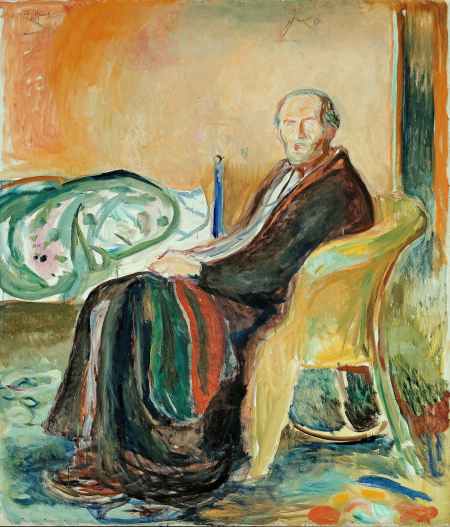
Co Edvard Munch, Self-Portrait with the Spanish Flu, 1919.
Good Morning!!
Yesterday the fake “president” tried to calm fears about the growing threat of a coronavirus pandemic by contradicting experts, hyping the stock market, and repeatedly lying about the administration’s preparedness. As health professionals tried to educate Americans about the possible dangers, Trump contradicted them and claimed he has everything under control, even though he has cut funds for the CDC and fired National Security Council staff who were in charge of global pandemic preparedness.
I’m told the president’s anger about the CDC briefing yesterday is focused on Dr. Nancy Messonnier, who said it’s not whether, it’s when the virus will hit the US. “She never should have said that,” a senior administration official told me. “it’s bad.”
“We expect we will see community spread in this country,” said Dr. Nancy Messonnier, director of the CDC’s National Center for Immunization and Respiratory Diseases. “It’s not so much a question of if this will happen anymore, but rather more a question of exactly when this will happen and how many people in this country will have severe illness.”
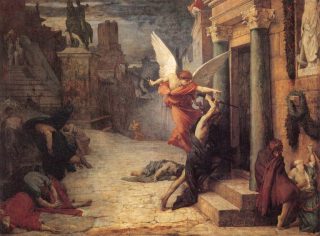
The Plague of Rome, Jules Elie Delauney, 1869
The agency tweeted Tuesday evening that Americans should think about getting ready.
“Now is the time for US businesses, hospitals, and communities to begin preparing for the possible spread of #COVID19,” it wrote, referring to the name the World Health Organization has given the novel coronavirus. “CDC continues to work with business, education & healthcare sectors, encouraging employers to be prepared.”
“We are asking the American public to work with us to prepare in the expectation that this could be bad,” she said.
She said CDC officials have been saying for weeks that while they hope the spread won’t be severe in the United States, they are planning as if it could be.
“The data over the last week, and the spread in other countries, has certainly raised our level of concern and raised our level of expectation” of community spread, she said.
The CDC still doesn’t know what that will look like, she added. Community spread could be reasonably mild or very severe.
Off with her head! How long before Trump starts purging the CDC of people who know anything about viruses and pandemics and replacing them with Trump loyalists who will pretend nothing is happening?
The President spoke at a news conference on Wednesday about the worldwide health emergency that has seen the virus sweep into South Korea, Italy and every continent but Antarctica, sounding as if the danger had already passed rather than was yet to arrive.
“The risk to the American people remains very low,” Trump said, as he unveiled his big announcement: Vice President Mike Pence will head the government effort.
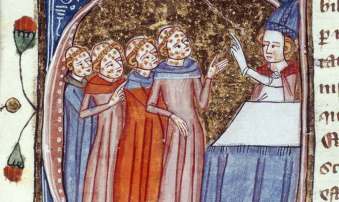
Manuscript illustration depicting the Justinian Plague, from the Omne Bonum by James le Palmer, 14th century
The President’s optimistic performance came hours before the Centers for Disease Control and Prevention said a patient in California who has the novel coronavirus might be the first person to be infected who did not travel to an afflicted region and was not exposed to another known carrier. The case raises the ominous possibility that the virus is already moving through the community….
His upbeat, election-year tone contrasted sharply with predictions from his government experts, who are warning of possible severe disruption to American life if the outbreak swells into a pandemic.
Here’s what two experts had to say when they were allowed to speak for a couple of minutes each:
“Our aggressive containment strategy here in the United States has been working and is responsible for the low levels of cases that we have so far. However, we do expect more cases, and this is a good time to prepare,” said Anne Schuchat, principal deputy director of the Centers for Disease Control and Prevention.
Anthony Fauci, director of the National Institute of Allergy and Infectious Diseases, delivered the sobering news that even with an unusually accelerated process of development and testing, it could be a year to a year-and-a-half before a vaccine becomes available. His assessment contrasts with Trump’s hints that inoculations are just around the corner.
“We’ve had tremendous success, tremendous success beyond what many people would’ve thought,” the president said during a White House news conference that followed days of mixed messages, tumbling stocks and rising death tolls abroad driven by the coronavirus. “We’re very, very ready for this.”
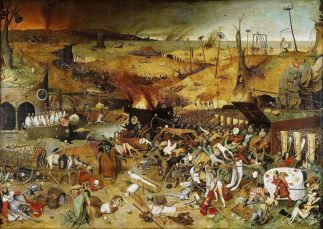
The Triumph of Death, Pieter Bruegel the Elder, c.1562
The president declared that the risk to America was “very low” and predicted a swift end to the outbreak….
“We could be just one or two people over the next short period of time,” Trump said of the virus’s impact in the United States.
Minutes later, Health and Human Services Secretary Alex Azar and CDC Principal Deputy Director Anne Schuchat warned Americans to prepare for the number of cases to grow.
“We can expect to see more cases in the United States,” Azar said.
“We do expect more cases,” Schuchat said.
The case confirmed Wednesday in California brought the total in the United States to 60.
During the press conference, CNN’s Dr. Sanjay Gupta tried to ask Trump a question and Trump repeatedly interrupted and corrected him.
The President is called out on his repeated attempts to try to downplay the mortality rate of Coronavirus by citing flu deaths… His answer falls short pic.twitter.com/XVPXrdNCeM
Stocks continued their downward slide on Thursday, with major indexes falling into correction territory. Investors are worried about the economic toll of a widening coronavirus epidemic.
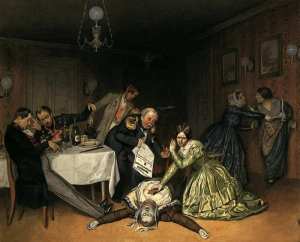
Pavel Fedotov, 1846-1860 Cholera pandemic
The Dow Jones Industrial Average tumbled more than 500 points in the opening minutes of trading. The blue chip index is down more than 10% from its recent peak on Feb. 12. The broader S&P 500 index has also lost more than 10% of its value in just over a week.
President Trump tried to project a note of calm in a news conference Wednesday evening, stressing that the United States is well prepared for any health crisis and predicting the stock market will recover, thanks in part to robust consumer spending. But investors were not immediately reassured….
A poll by Morning Consult this week found that 69% of U.S. adults are either “very” or “somewhat” concerned about the domestic economic impact of the epidemic, a 14 point increase from a few weeks ago.
“We could see a significant impact on Europe, which has been weak to start with, and it’s just conceivable that it could throw the United States into a recession,” Yellen said Wednesday at an event in Michigan. “If it doesn’t hit in a substantial way in the United States, that’s less likely. We had a pretty solid outlook before this happened — and there is some risk, but basically I think the U.S. outlook looks pretty good.”
The global economy was weak but starting to recover before the virus hit, Yellen said. The shutdown of factories due to the outbreak in China will impact supply chains and cause a drop in consumer spending as people have been quarantined or cease traveling.
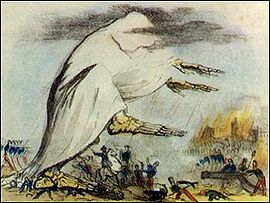
A representation by Robert Seymour of the cholera epidemic of the 19th century depicts the spread of the disease in the form of poisonous air.
Yellen, who spoke about the economy at an event held by the Brookings Institution in Clinton Township, Michigan, also commented on the decline in the 10-year Treasury yield this week to historic lows. Yields have plunged as fears about the spreading coronavirus have rocked global financial markets.
The newly diagnosed Coronaviris patient in California was in the hospital for several days before the CDC agreed to allow a test for the virus. The New York Times:
A California coronavirus patient had to wait days to be tested because of restrictive federal criteria, despite doctors’ requests. The patient, who has tested positive, may be the first person to be infected through community spread in the United States, the Centers for Disease Control and Prevention said Wednesday.
C.D.C. officials said it was possible the patient was exposed to a returning traveler who was infected. At the moment, however, the new case appears to be one in which the source of infection is unknown, suggesting that the virus may be transmitted within the community.
Doctors at the University of California, Davis Medical Center considered the novel pathogen a possible diagnosis when the patient was first admitted last week.
But the federal agency that conducts the testing did not administer the test until days later because the case did not fit the agency’s narrow testing criteria, university officials said in a letter to the campus community late Wednesday.
The C.D.C. has restricted testing to patients who either traveled to China recently or who know they had contact with someone infected with the coronavirus….
The C.D.C. could not be immediately reached for comment.
The patient was transferred to the medical center from another hospital in Northern California with a suspected viral infection, and was already on a ventilator upon arrival, according to the university’s letter.
“Upon admission, our team asked public health officials if this case could be Covid-19,” the letter said. The medical center requested testing from the C.D.C. “Since the patient did not fit the existing C.D.C. criteria for Covid-19, a test was not immediately administered. U.C. Davis Health does not control the testing process.”
So it looks like we have the first coronavirus case that may have been passed from person to person in the U.S., and we have a president and an administration in denial and woefully unprepared to deal with a health crisis.
I’ll add more stories in the comment thread. As always, this is an open thread.
Did you like this post? Please share it with your friends:
It’s only Tuesday, and this week feels as if it has already gone on forever. I wonder if the George Bush sainthood celebration will continue through the weekend? I sure hope not. I’d like to be able to resume watching cable news before next week. In case anyone else here is sick of hearing about Saint Poppy, here are some antidotes the the media coverage.
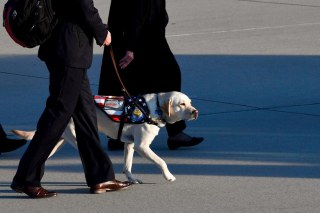
On Sunday night, George H.W. Bush spokesman Jim McGrath posted a photograph to Twitter depicting a golden Labrador named Sully resting in front of the former president’s casket. The caption read “Mission complete.”
Within hours, Sully the dog had become a bona fide celebrity. McGrath’s sentiment has been retweeted 61,000 times and counting, and “Sully” was trending on Twitter at various times on Monday. C-SPAN covered the dog’s arrival at Joint Base Andrews in Maryland on Monday afternoon. The picture of the dog lying in front of the casket was covered by outlets from Fox News to NPR as the internet exploded with tributes to the pair’s “forever friendship.” The photograph was submitted as evidence of Bush’s character, of Sully’s character, and as support for the idea that America should not elect a president who “does not love and is not loved by pets.” Heavy.com offered “5 Fast Facts You Need to Know” about the dog. People magazine gushed that Sully was “keeping the 41st commander in chief safe in death as he did in life,” and even produced a slideshow of their “special friendship.” Many suggested Sully was heartbroken, and/or that they themselves were crying over the photo; conservative writer Dan McGlaughlin compared the dog to a Marine.
There’s nothing wrong with applying sentimentality when it comes to family pets reacting to their owners’ deaths. There’s even some preliminary evidence from the small field of “comparative thanatology” that animals notice death, and that some may even experience an emotion we might compare to grief. But Sully is not a longtime Bush family pet, letting go of the only master he has known. He is an employee who served for less than six months….
It’s wonderful for Bush that he had a trained service animal like Sully available to him in his last months. It’s a good thing that the dog is moving on to another gig where he can be helpful to other people (rather than becoming another Bush family pet). But it’s a bit demented to project soul-wrenching grief onto a dog’s decision to lie down in front of a casket. Is Sully “heroic” for learning to obey the human beings who taught him to perform certain tasks? Does the photo say anything special about this dog’s particular loyalty or judgment, or is he just … there? Also, if dogs are subject to praise for obeying their masters, what do we do about the pets who eat their owners’ dead (or even just passed-out) bodies?
The photograph, in other words, is not proof that Sully is a particularly “good boy” or that “we don’t deserve dogs,” as countless swooning tweets put it on Monday. On its own, it says almost nothing other than the fact that Sully was, at one point in the same room as the casket of his former boss. This is simply a photograph of a dog doing something dogs love to do: Lie down. The frenzy around it captures something humans love to do, too: Project our own emotional needs onto animals.
Sexual harassment or assault can’t be bracketed off as part of a politician’s private life. It’s an important part of the story of their leadership, their use of power, and their policy. The same is true for Bush.
Relatively little has been made of the accusations against Bush since they emerged last year. A woman initially accused Bush of groping her and telling her a dirty joke as she stood beside him, seated in a wheelchair, for a photo op. The family responded, suggesting the aging former president might be slipping a bit. “President Bush has been confined to a wheelchair for roughly five years, so his arm falls on the lower waist of people with whom he takes pictures,” a spokesperson, Jim McGrath, said on Bush’s behalf.
But then the story changed. More women came forward describing incidents that took place before Bush was in a wheelchair and even while he was in office. One woman described a credible story dating back to 1992, when she says that Bush, then the president, put his hand on her rear end while taking a photograph at a reelection fundraiser. Another woman described an incident from 2003, when she was 16 years old — and Bush was still spry, zipping around Kennebunkport, Maine, on a Segway.
“All the focus has been on ‘He’s old.’ OK, but he wasn’t old when it happened to me,” the woman, now 55 told CNN. “I’ve been debating what to do about it.”
The women who spoke out feel differently. In each case, the accuser was excited to meet a political figure, someone who’s supposed to represent them; then, they said, he groped them. In that moment, they became second-class citizens. While their brothers or husbands or male friends might have gotten a handshake and a thumbs-up from this powerful man and walked away feeling good about themselves and their relationship with their government, these women were put in their place.
And let’s not forget that Bush appointed Clarence Thomas and stood by him when he was credibly accused of sexual harassment.
History will recall George Bush did nothing at all.
I must have chanted those words hundreds times while protesting the Bush administration’s inaction on the AIDS crisis with ACT UP (AIDS Coalition to Unleash Power) between 1989 and 1992. ACT UP was founded in 1987 in the epicenter of the HIV epidemic in America — New York City — to demand action to end the AIDS crisis. Today it is remembered as part of the Reagan ’80s, but the reality is that much of the group’s most intensive work took place during the administration of George Herbert Walker Bush. With ACT UP, I marched past the Bush White House down a Pennsylvania Avenue not yet closed to traffic. I rallied outside his Department of Health and Human Services, his Centers for Disease Control, his National Institutes of Health. And in 1991, I shook my finger chanting “Shame!” half a mile from his family’s summer compound in Kennebunkport, Maine. More than 1,500 AIDS activists descended on the resort town on September 1 that year, bearing signs that charged Bush with a murderous neglect of the AIDS crisis, along with a 50-foot banner with a 32-point plan to end it.
The transition from the Reagan presidency to the Bush one was more one of tone than substance when it came to AIDS, a kinder gentler indifference. Messaging that repeatedly pointed to “behavior change” as the solution, without backing prevention programs known to work. A lack of leadership from the top. No central strategy. “He was not doing enough as a leader,” Urvashi Vaid, the executive director of the National LGBTQ Task Force during the Bush years, told Pridesource after Bush’s death. “I think that those pressures and protests led by ACT UP all over the country … that pressure is what pushed both members of Congress and the administration to do whatever it did. I can’t say that enough.” Added ACT UP founder and playwright Larry Kramer, “I will not give [Bush] credit for anything. He hated us.”
Nearly a quarter century later when I had the opportunity as a political editor to participate in a several-day event at the Bush presidential library and museum, I thought about those years of protesting with ACT UP. For me reporting was always about other people’s stories, not my own, and it was rare for my activist past to come up except as history that informed my understanding of the dynamics of new social movements.
But with Bush, I felt I could not forget myself. Could not forget the suffering I’d witnessed in New York — where AIDS was, during his presidency, the leading cause of death for men ages 25–44, or the way his election extended the oppressive culture of the Reagan years that saw so many of my friends kicked out of their homes in their teens for being gay. I passed the Bush library opportunity on to a colleague.
Early in George H.W. Bush’s political career, when he was running for a U.S. Senate seat in Texas, he came out against the landmark Civil Rights Act of 1964, deriding his opponent as “radical” for supporting the bill that ended segregation in public places and banned employment discrimination.
“The new civil-rights act was passed to protect 14 percent of the people,” he said. “I’m also worried about the other 86 percent.”
The stand seemed at odds with his family’s long history of supporting civil rights (his father, Prescott Bush, a Connecticut senator had worked to desegregate schools and protect voting rights) and with his own work raising money for the United Negro College Fund.
But in Texas, where the Republican party was steadily becoming more conservative and embracing the Southern Strategy of appealing to white voters, Bush’s position made sense.
It “made sense” if you had no principles except getting elected. A bit more:
In his 1988 bid for the presidency, Bush would seem to again opt for expediency in a campaign that is often cited as one of the nastiest in political memory, with the blatant racism of the Willie Horton ad, which mined ugly stereotypes of African-Americans, and for Bush’s questioning of the patriotism of his opponent, Michael Dukakis, because of his Greek heritage.
The Horton ad, which focused on a convicted murderer who committed a violent rape while out of prison on a furlough program Dukakis had supported, was put out by a conservative PAC, not the Bush campaign. However, Bush repeatedly brought up Horton’s name in speeches, including one to the National Sheriffs’ Association.
“Horton applied for a furlough,” Bush said at the time. “He was given the furlough. He was released. And he fled — only to terrorize a family and repeatedly rape a woman.”
The Bush campaign also released an ad that showed footage of prisoners going through a revolving door — a strategy that played on white voters’ fears and prejudices, said Jason Johnson, a professor of politics and journalism at Morgan State University in Baltimore, Maryland.
F-16A Fighting Falcon, F-15C Eagle and F-15E Strike Eagle fighter aircraft fly over burning oil field sites in Kuwait during Operation Desert Storm. (U.S. Air Force archive photo)
Most countries condemned Iraq’s 1990 invasion of Kuwait. But the truth — that it was the culmination of a series of tangled economic and historical conflicts between two Arab oil states — wasn’t likely to sell the US public on the idea of sending our troops halfway around the world to do something about it.
So we were given a variation of the “domino theory.” Saddam Hussein, we were told, had designs on the entire Middle East. If he wasn’t halted in Kuwait, his troops would just keep going into other countries.
As Scott Peterson reported for The Christian Science Monitor in 2002, a key part of the first Bush administration’s case “was that an Iraqi juggernaut was also threatening to roll into Saudi Arabia. Citing top-secret satellite images, Pentagon officials estimated in mid-September [of 1990] that up to 250,000 Iraqi troops and 1,500 tanks stood on the border, threatening the key US oil supplier.”
A quarter of a million troops with heavy armor amassed on the Saudi border certainly seemed like a clear sign of hostile intent. In announcing that he had deployed troops to the Gulf in August 1990, George HW Bush said, “I took this action to assist the Saudi Arabian Government in the defense of its homeland.” He asked the American people for their “support in a decision I’ve made to stand up for what’s right and condemn what’s wrong, all in the cause of peace.”
But one reporter — Jean Heller of the St. Petersburg Times — wasn’t satisfied taking the administration’s claims at face value. She obtained two commercial satellite images of the area taken at the exact same time that American intelligence supposedly had found Saddam’s huge and menacing army and found nothing there but empty desert.
She contacted the office of then-Secretary of Defense Dick Cheney “for evidence refuting the Times photos or analysis offering to hold the story if proven wrong.” But “the official response” was: “Trust us.”
Heller later told the Monitor’s Scott Peterson that the Iraqi buildup on the border between Kuwait and Saudi Arabia “was the whole justification for Bush sending troops in there, and it just didn’t exist.”
Read the rest at Bill Moyers.com.
I know there is lots of other news today, but I just had to get this off my chest. What stories are you following?
Did you like this post? Please share it with your friends:
Good Evening Sky Dancers! I’m filling in for Minkoff Minx tonight. I’m a little weary of all the nonsensical arguments fomented by the right wing nuts and the red beanie pedophile enablers, so I’m going to avoid those issues in tonight’s roundup. Instead, I’m going to go with some odds and ends that piqued my fancy today.
Opening a scientific frontier miles under the Antarctic ice, Russian experts drilled down and finally reached the surface of a gigantic freshwater lake, an achievement the mission chief likened to placing a man on the moon….
Lake Vostok could hold living organisms that have been locked in icy darkness for some 20 million years, as well as clues to the search for life elsewhere in the solar system….
The Russian team made contact with the lake water Sunday at a depth of 12,366 feet (3,769 meters), about 800 miles (1,300 kilometers) east of the South Pole in the central part of the continent.
Scientists hope the lake might allow a glimpse into microbial life forms that existed before the Ice Age and are not visible to the naked eye. Scientists believe that microbial life may exist in the dark depths of the lake despite its high pressure and constant cold — conditions similar to those believed to be found under the ice crust on Mars, Jupiter’s moon Europa and Saturn’s moon Enceladus.
That sounds pretty amazing. Read the whole article to learn about the possibilities and goals of the study.
Did you ever wonder why Zebras have stripes? To be honest, I never did, but now that someone has discovered the likely reason, I do find the answer kind of interesting. It turns out that zebras have stripes because they discourage horseflies.
While it is widely-known in the scientific community that horseflies and other insects prefer animals with dark skin to animals with white skin, a study published this week in the Journal of Experimental Biology examines evidence that zebra stripes actually discourage horseflies from biting. Prior to the study, researchers thought that the primary purpose of zebra stripes was to confuse predators. However, the study suggests that predator confusion is secondary to horsefly deterrence.
“We demonstrate that a zebra-striped horse model attracts far fewer horseflies (tabanids) than either homogeneous black, brown, grey or white equivalents,” the researchers write in the study’s abstract.
Horseflies, which can carry diseases and distract their victim from feeding or drinking, are unwelcome visitors to zebras and other animals that graze. According to Gábor Horváth, one of the study’s authors, horseflies are attracted to horizontally polarized light because the sunlight that reflects off of water is horizontally polarized. When horseflies and other aquatic insects discover water they can mate and lay eggs. The female variety of horseflies, however, are also attracted to linearly polarized light that reflects off of the hides of their victims.
Is your pet making you crazy? Do you have a cat? Then you might want to read this article at The Atlantic–or maybe not. It’s about a scientist who believes that a feline parasite, Toxoplasma gondii, is affecting his brain and altering his personality.
As a student of development, I’m familiar with this parasite, because it has to be avoided by pregnant women because it can affect the fetus and lead to severe brain damage or death. The parasite is excreted by cats, so pregnant women must not change cat litter boxes or get too close to them But Jaroslav Flegr suspects it may be causing other problems in non-pregnant humans. For one thing,
T. gondii is also a major threat to people with weakened immunity: in the early days of the AIDS epidemic, before good antiretroviral drugs were developed, it was to blame for the dementia that afflicted many patients at the disease’s end stage.
Is is commonly believed that:
Healthy children and adults, however, usually experience nothing worse than brief flu-like symptoms before quickly fighting off the protozoan, which thereafter lies dormant inside brain cells…
Au contraire, says Flegr.
the “latent” parasite may be quietly tweaking the connections between our neurons, changing our response to frightening situations, our trust in others, how outgoing we are, and even our preference for certain scents. And that’s not all. He also believes that the organism contributes to car crashes, suicides, and mental disorders such as schizophrenia. When you add up all the different ways it can harm us, says Flegr, “Toxoplasma might even kill as many people as malaria, or at least a million people a year.”
An evolutionary biologist at Charles University in Prague, Flegr has pursued this theory for decades in relative obscurity. Because he struggles with English and is not much of a conversationalist even in his native tongue, he rarely travels to scientific conferences. That “may be one of the reasons my theory is not better known,” he says. And, he believes, his views may invite deep-seated opposition. “There is strong psychological resistance to the possibility that human behavior can be influenced by some stupid parasite,” he says. “Nobody likes to feel like a puppet. Reviewers [of my scientific papers] may have been offended.” Another more obvious reason for resistance, of course, is that Flegr’s notions sound an awful lot like fringe science, right up there with UFO sightings and claims of dolphins telepathically communicating with humans.
But after years of being ignored or discounted, Flegr is starting to gain respectability. Psychedelic as his claims may sound, many researchers, including such big names in neuroscience as Stanford’s Robert Sapolsky, think he could well be onto something.
eeeeeeeek! Go read the article if you dare!
The headline of that article reminded me a great show I recently saw on the Animal channel, My Cat from Hell. It’s a “reality” show that documents the adventures of an “animal behaviorist” named Jackson Galaxy. He’s a rock musician by night and helps people with crazy cats by day. I thought I’d share a couple of clips from the show with you. The first one is an introductory promo.
Here’s a clip from one of the episodes.
Here’s a video of Galaxy working with a cat from hell.
I’ve got a couple of crime stories for you. First, police in Washington state searched a storage facility owned by Josh Powell, the man who recently murdered his two sons and killed himself by blowing up his house. They found a comforter that tested positive for blood.
Investigators had considered Josh Powell a person of interest since his wife, Susan Powell, disappeared in Utah in 2009. At the time, Powell said he took his two sons ice camping in subfreezing temperatures.
Pierce County Prosecutor Mark Lindquist said presumptive tests are conducted with a field kit and that a determination of blood won’t be confirmed until the item is examined in the lab. “Field tests are not infallible,” he said.
Lindquist said he expects the finding will be something law enforcement will share with colleagues in Utah who have been investigating Susan Powell’s disappearance.
I wonder why that storage facility wasn’t searched sooner?
In Illinois, an off-duty sheriff’s deputy pulled a gun on a pregnant woman because she had two many items in a self-serve line at Walmart. Her husband was arrested for trying to defend her.
Just one week from her due date, Nicole Thurmond said she feared for her life while checking out at a Walmart store in Oswego on a recent Sunday.
“I felt someone close behind me. He started being really rude and said, ‘Don’t you know how to count? You are holding up the whole store,” Thurmond recalled.
Thurmond said she didn’t know it at the time, but the man in plain clothes was off-duty deputy Craig French.
Thurmond’s husband had been getting eggs at the time and said he could see his wife was upset when he returned to the checkout area.
“There was a guy in her face, yelling at her,” said Jason Thurmond. “In an aggressive manner he steps toward me, and I just push him back to keep him away from my wife and myself, and before I knew it I just froze because he pulled out a gun.”
Jason Thurmond said the man didn’t show his badge, was “waving a gun in a store,” and at one point asked them if they were on welfare.
The case is now being investigated.
Well, of course you know I have to indulge my Mitt Romney obsession, so I have a few Romney reads. Have you heard that Romney “can’t wait to get his hands on Washington?” He said so at CPAC today.
Republican presidential candidate Mitt Romney on Friday tried to convince attendees at the Conservative Political Action Conference (CPAC) to vote for him by reminding them of his “severely conservative” record, including preventing Massachusetts from becoming “the Las Vegas of gay marriage.”
“History will record the Obama presidency as last gasp of liberalism’s great failure and a turning point for the conservative era to come,” the candidate predicted. “I know this president will never get it, but we conservatives aren’t just proud to cling to our guns and our religion, we are also proud to cling to our Constitution.”
“As governor of Massachusetts, I had the unique experience of defending conservative principles in the most liberal state in the nation,” Romney said. “Even with a legislature that was 85 percent Democrat, I cut taxes 19 times and balanced the budget all four years. I cast over 800 vetoes and cut entire programs. … And I can’t wait to get my hands on Washington!”
Ooooooooh! He was “severely conservative.” How impressive.
This one is a little old, but it’s so funny that I had to share it. It’s a brief humor column from the New Yorker by one of my favorite writers, Calvin Trillin, called “President Romney Meets Other World Leaders.” It’s based on a New York Times article that addressed some of Romney’s “peculiar habits” on the campaign trail. Here’s the relevant excerpt:
When Mitt Romney introduces himself to voters, he has a peculiar habit of guessing their age or nationality, often incorrectly. (A regular query: “Are you French Canadian?”)
When making small talk with locals, he peppers the conversation with curious details. . . . Mr. Romney has developed an unlikely penchant for trying to puzzle out everything from voters’ personal relationships to their ancestral homelands. . . . Mr. Romney likes to congratulate people. For what, exactly, is not always clear.
The moment President Romney entered the room where the opening reception of his first G-8 summit was being held, he was approached by a small man who shook his hand and said, “Je suis Nicolas Sarkozy.”
“Are you of French-Canadian origin?” President Romney said, smiling broadly.
“I am French,” Sarkozy replied, looking somewhat puzzled. “I am, in fact, the President of France.”
“Congratulations,” President Romney said. “Lipstick contains a substance made from fish scales.”
Before Sarkozy could reply—in fact, before he could think of anything to say on the subject of lipstick manufacturing—they were approached by Angela Merkel, of Germany, who looked eager to greet the newest leader in the G-8. President Romney peered at her briefly and then said to Sarkozy, “Your aunt? Your mother?”
“This is Angela Merkel, Chancellor of the Federal Republic of Germany,” Sarkozy said.
Please go read the rest–it’s very short but funny.
The transformation is now complete. Willard Romney, my former governor, the man who campaigned here for the Senate and lost, and who campaigned for governor here and won, has fashioned himself into the most carefully manufactured fake in the recent history of American politics. I used to call him the Piltdown Man of American politics — a candidate fashioned from a jawbone picked up here and a shinbone picked up there and whatever position on whatever issue he happened to find at hand at the time — but that may no longer be sufficient to explain him. After all, and even though it took more than 40 years, eventually they busted the Piltdown Man as a hoax. Willard’s transformation, from what he was here in Massachusetts, to what he is now, is so full and thorough that he has successfully constructed an entirely new Willard for himself. Of course, they had to hurry him off the assembly line because of the urgency injected into the race by the stunning (if remarkably delegate-free) triple play pulled off on Tuesday by Rick Santorum, who has never taken a breath in which he was not the authentically wingy wingnut that Willard has labored so hard to make of himself.
I’ll let you savor the rest at Charlie’s place. I hope everyone has a great Friday night and a fabulous weekend!
Did you like this post? Please share it with your friends:
The Sky Dancing banner headline uses a snippet from a work by artist Tashi Mannox called 'Rainbow Study'. The work is described as a" study of typical Tibetan rainbow clouds, that feature in Thanka painting, temple decoration and silk brocades". dakinikat was immediately drawn to the image when trying to find stylized Tibetan Clouds to represent Sky Dancing. It is probably because Tashi's practice is similar to her own. His updated take on the clouds that fill the collection of traditional thankas is quite special.
You can find his work at his website by clicking on his logo below. He is also a calligraphy artist that uses important vajrayana syllables. We encourage you to visit his on line studio.

 Good Morning!!
It’s wonderful for Bush that he had a trained service animal like Sully available to him in his last months. It’s a good thing that the dog is moving on to another gig where he can be helpful to other people (rather than becoming another Bush family pet). But it’s a bit demented to project soul-wrenching grief onto a dog’s decision to lie down in front of a casket. Is Sully “heroic” for learning to obey the human beings who taught him to perform certain tasks? Does the photo say anything special about this dog’s particular loyalty or judgment, or is he just … there? Also, if dogs are subject to praise for obeying their masters, what do we do about the pets who eat their owners’ dead (or even just passed-out) bodies?
But then the story changed. More women came forward describing incidents that took place before Bush was in a wheelchair and even while he was in office. One woman described a credible story dating back to 1992, when she says that Bush, then the president, put his hand on her rear end while taking a photograph at a reelection fundraiser. Another woman described an incident from 2003, when she was 16 years old — and Bush was still spry, zipping around Kennebunkport, Maine, on a Segway.
The transition from the Reagan presidency to the Bush one was more one of tone than substance when it came to AIDS, a kinder gentler indifference. Messaging that repeatedly pointed to “behavior change” as the solution, without backing prevention programs known to work. A lack of leadership from the top. No central strategy. “He was not doing enough as a leader,” Urvashi Vaid, the executive director of the National LGBTQ Task Force during the Bush years, told Pridesource after Bush’s death. “I think that those pressures and protests led by ACT UP all over the country … that pressure is what pushed both members of Congress and the administration to do whatever it did. I can’t say that enough.” Added ACT UP founder and playwright Larry Kramer, “I will not give [Bush] credit for anything. He hated us.”
“The new civil-rights act was passed to protect 14 percent of the people,” he said. “I’m also worried about the other 86 percent.”



 peej
peej Carissa
 bostonboomer
 dakinikat
 ecocatwoman
 mablue2
 Mama Lopez
 peggysue22
 quixote
 skydancingguestblogger
 Mona (aka Wonk the Vote)



 Sky Dancing
Recent Comments