
Friday Reads: The Drumpfistan Detritus: More news from the Deplorable in Chief
Posted: October 13, 2017 Filed under: Afternoon Reads | Tags: Affordable Care Act, Iran deal, Puerto Rico, Virgin Islands 18 CommentsGood Afternoon Sky Dancers! 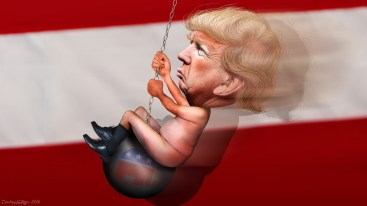
It’s difficult living under an administration’s whose goal and dreams for America manifest as tearing everything down. We don’t have leadership. We have an ethos of chaos and destruction. I’m afraid if we don’t see the Cabinet and grown ups in the West Wing exercise the 25th Amendment there will not be much left of our democracy. I’m not sure the Mueller investigation can move fast enough to save us from this human wrecking ball.
 Jonathan Chait–writing for New York Magazine–discusses yesterday’s latest attack on the American populace. Trump Unveils Full-bore Obamacare Sabotage. We have a POTUS who is okay with killing Americans. I’m don’t even think he gives human life an afterthought.
Donald Trump and his party have never been able to figure out a viable alternative to Obamacare. Having failed to repeal and replace the law, they have set out to wreck it. The Trump administration is taking two steps to accomplish this goal. First, it is opening two loopholes to allow healthy people to purchase unregulated insurance, splitting the market and loading more costs onto people with expensive medical needs. Second, it announced tonight it is ending cost-sharing payments to insurers who take on low-income customers.
Both these changes are designed to put pressure on insurers, increasing premiums by an average of 19 percent, and even splitting up the individual insurance markets. Whether they will succeed is yet to be seen. States committed to making Obamacare work will find solutions that keep their markets intact. (Indeed, there has been a marked difference in the premium levels of states that are trying to help cover their citizens and those that aren’t.)
What’s more, by withholding payments promised in the law, the administration is exposing itself to a lawsuit it could very well lose. (New York Attorney General Eric Schneiderman, California Attorney General Xavier Becerra, and others have already announced their intention to sue.) Premiums are going to rise in the meantime, because insurers are subjected to greater uncertainty and the now-demonstrated knowledge that the administration is deliberately sabotaging the law they are operating under.
The exchanges in 2017 had stabilized financially, as insurers found a profitable price point. The Republican Party has, as a matter of theological principle, refused to accept the possibility that Obamacare might succeed at its stated ends. If Obamacare were truly collapsing, sabotage would not be necessary. It is the law’s success, not its failure, that has made Trump so determined to wreck it. The White House has released a statement confirming its intention to end the payments, written in the pidgin English indicating the president’s own authorial hand …
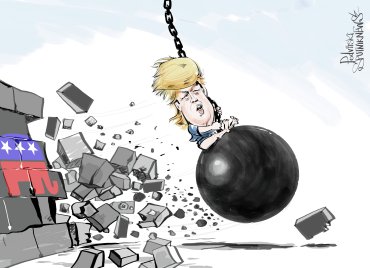 Trump wants to erase all traces of his predecessor in a childish and racist manner than ignores the fact that what he’s really doing is killing the people of this country. This is the act of an insane man with no grounding in morality. This is nothing but the act of a mad king.
Donald Trump has long predicted the implosion of Obamacare. He just took a huge step to fulfilling his own prophecy.
The White House announced late Thursday morning it would cut off a key Obamacare subsidy that makes copayments and deductibles more affordable for low-income Americans. Trump pulled the trigger on the plan late Thursday night.
Trump has spent months toying with the idea of ending these payments, which are drawn from a $7 billion fund set up specifically to cover these costs. House Republicans havechallenged these payments in court, arguing that they were never appropriated in Obamacare and thus being illegally distributed.
There is no question that this new policy is lose-lose-lose for key stakeholders with no upside:
- It will raise Obamacare premiums by an estimated 20 percent in 2018, as health plans have to charge more to make up the lost funds. By 2020, premiums would increase 25 percent due to this change.
- Pulling the plug actually increases the national deficit. As those insurance plans make double-digit rate increases, the government will have to spend billions more on the other subsidies that 10 million Americans receive to purchase that coverage.
- The Congressional Budget Office estimates that this move will ultimately cost the government $194 billion over the next decade.
- The number of uninsured Americans would rise by one million people in 2018, in the CBO’s estimate.
- Insurance companies lose out, too, particularly those that assumed Trump would pay these subsidies and set their premiums accordingly. They now stand to face significant financial loses on the Obamacare marketplaces.
To recap: Trump is enacting a policy where the government spends billions more to insure fewer people.
 If we didn’t already have enough intellectually and emotionally challenged people in Washington already, Trump’s wrecking krewe just continues to astound us.
Energy Secretary Rick Perry appeared to think that Puerto Rico is a separate country during a House hearing Thursday.
Rep. Kathy Castor asked Perry about efforts to restore Puerto Rico’s hurricane-ravaged power grid during a House Energy and Commerce subcommittee hearing.
“What is your plan to build a more distributed grid there with the modern technology that’s at our fingertips?” Castor asked.
“Congresswoman Castor, you have just pointed out the real challenge that this country faces in dealing with the territory and the citizens of Puerto Rico,” Perry replied. “That is a country that already had its challenges before this storm…”
“Well, they’re — it’s America,” Castor interjected. “They’re American citizens, so it’s not a country. But could you just detail, since the time is limited.”
“Yeah, that’s the reason I called it a territory, ma’am,” Perry replied. “I apologize for misstating here and calling it a country.”
Oops.
The Banana Republic of Drumpfistan continues to kill citizens in Puerto Rico. Trump threatened to abandon them because of budget concerns and whatever demons dance in his head as they die of preventable diseases, starve, and live in unimaginable squalor and destruction.
On the island, residents and elected officials responded to Trump’s Thursday tweets with outrage and disbelief. Radio disc jockeys gasped as they read aloud the presidential statements, while political leaders charged that he lacked empathy and pleaded for help from fellow U.S. citizens on the mainland.
“The U.S. citizens in Puerto Rico are requesting the support that any of our fellow citizens would receive across our Nation,” Puerto Rico Gov. Ricardo Rosselló, who has publicly praised Trump’s handling of the crisis, tweeted in apparent response to the president.
Carmen Yulín Cruz, the mayor of Puerto Rico’s capital, San Juan, who has been feuding publicly with Trump, strongly condemned the president’s tweets. In a tweet of her own, she derided him as a “Hater in Chief.” And she said in a statement that he “is simply incapable of understanding the contributions, the sacrifices and the commitment to democratic values that Puerto Ricans have shown over decades.”
Yulín Cruz tweeted back that the comments would be more appropriate coming from a “Hater in Chief” and said, “Shame on you!” for the president’s lead-footed, tone deaf responses to the crisis.
Republican strategist Rick Wilson said that Trump doesn’t care about Puerto Rico because he thinks of its people as “Sea Mexicans” and not actual Americans.
 Cruz has sent an SOS to the UN.
NBC News published the one-page statement, in which Yulín called on the United Nations and UNICEF to “stop the genocide” and bring “drinkable water, food and medicine” to the U.S. territory, which has suffered mightily in the wake of Hurricanes Irma and Maria.
The president’s cavalier attitude and threats of withdrawing aid Puerto Rico, said Yulín Cruz, “seem to be taken out of a book about how to add insult to injury.” She accused Trump of being “incapable of empathy” and said he is “frankly simply cannot the job done.”
“I ask every American that has love, and not hate in their hearts, to stand with Puerto Rico and let this president know WE WILL NOT BE LEFT TO DIE. I ask the United Nations and UNICEF and the world to stand with the people of Puerto Rico and stop the genocide that will result from the lack of appropriate action of a president that just does not get it because he has been incapable of looking in our eyes and seeing the pride that burns fiercely in our hearts and souls.”
Trump tweeted on Thursday morning that the country “cannot keep FEMA, the Military & the First Responders, who have been amazing (under the most difficult circumstances) in P.R. forever!”
He hates us. He really hates us.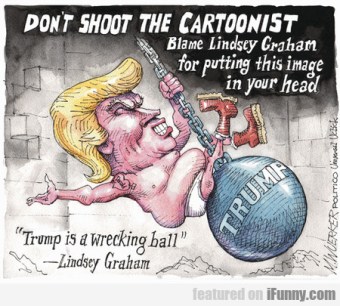
Donald Trump is to address the annual conference of an anti-LGBT group which has been classified as a hate group.
The US president will become the first sitting president to address social conservative activists and elected officials at the Value Voters Summit in Washington DC on Friday.
President Trump has addressed the event which is hosted by the Family Research Council three times in total and did so last year as the Republican presidential candidate.
The Family Research Council opposes and actively lobbies against equal rights for LGBT persons. The conservative Christian group campaigns against same-sex marriage, same-sex civil unions, LGBT adoption, abortion, embryonic stell-cell research, pornography and divorce.
 The Trump Baby Sitters are trying to Protect the Iran Deal by hiding it. I just want to walk off a bridge each time I read stories about generals in the White House protecting us all from nuclear war that we might start, This is not what we should be worrying about this day and age. We’ve a history of banging things with bigger sticks than necessary but I thought this kind of thing was beyond us.
In a meeting with Senate Democrats last week, President Donald Trump’s top national security aide had a message for those worried that the administration may scuttle the Iran nuclear deal: If Trump doesn’t have to see it, he won’t be able to kill it.
The point National Security Adviser H.R. McMaster conveyed, according to a congressional Democratic aide, was that “[Trump] wants this out of sight and out of mind.”
McMaster was more subtle and careful in his words when he hosted a group of roughly 12 lawmakers at the White House, conspicuously timed with the president out of town. But that was the impression he left, three sources familiar with the briefing tell The Daily Beast.
Under the terms of legislation passed around the negotiation of the Iran nuclear deal, the president is required every 90 days to determine whether Tehran is in compliance. The measure was designed to put President Barack Obama (and anticipated successor Hillary Clinton) in a bind—forcing politically-uncomfortable declarations in support of an unpopular nuclear accord on the regular. But in the age of Trump, the 90-day-deadline has presented an unanticipated problem.
 So, we may not completely lose the Iran Deal. But, really, do they know this? Can they really stop him?
President Donald Trump will say on Friday the Iran nuclear deal is no longer in America’s national security interests, but he won’t withdraw from the landmark 2015 accord or immediately re-impose sanctions, U.S. officials said.
The announcement is essentially a compromise that allows Trump to condemn an accord that he has repeatedly denounced as the worst deal in American history. But he stops well short of torpedoing the pact, which was negotiated over 18 months by the Obama administration, European allies and others.
Instead, Trump will kick the issue over to Congress, asking lawmakers to come up with new legislation that would automatically re-impose sanctions should Iran cross any one of numerous nuclear and non-nuclear “trigger points,” Secretary of State Rex Tillerson and National Security Adviser H.R. McMaster said in remarks released ahead of Trump’s announcement.
Those “trigger points” would include violations of the deal involving illicit atomic work or ballistic missile testing, support for Syrian President Bashar Assad, Lebanon’s Hezbollah movement and other groups that destabilize the region, human rights abuses and cyber warfare, they said.
 I’m going to end with something that’s a good question and may get you drinking way too early in the day. Sean Illing puts up this bit at VOX: 20 of America’s top political scientists gathered to discuss our democracy. They’re scared. “If current trends continue for another 20 or 30 years, democracy will be toast.”
Nancy Bermeo, a politics professor at Princeton and Harvard, began her talk with a jarring reminder: Democracies don’t merely collapse, as that “implies a process devoid of will.” Democracies die because of deliberate decisions made by human beings.
Usually, it’s because the people in power take democratic institutions for granted. They become disconnected from the citizenry. They develop interests separate and apart from the voters. They push policies that benefit themselves and harm the broader population. Do that long enough, Bermeo says, and you’ll cultivate an angry, divided society that pulls apart at the seams.
Is President Donald Trump aware residents of the U.S. Virgin Islands are, in fact, Americans? It’s unclear.
In a speech Friday, Trump said he’d recently “met with the president of the Virgin Islands” to discuss the recent hurricanes that have devastated Texas, Florida, Puerto Rico and the island.
But Trump could not have spoken to the “president of the Virgin Islands” because, of course, he is the president of the U.S. Virgin Islands, whose residents are U.S. citizens.
Okay, now I’m done. I’m really really done.
What’s on your reading and blogging list today?
Tuesday Reads: After A Quiet Weekend, Back to Non-Stop News
Posted: September 19, 2017 Filed under: morning reads, U.S. Politics | Tags: Affordable Care Act, America First, Dominica, Donald Trump, Facebook, Hurricane Jose, Hurricane Maria, Iran deal, Kim Jong Un, Michael Cohen, North Korea, nuclear war, Obamacare, Paul Manafort, Robert Mueller, Rocket Man, tRumpcare, United Nations 62 Comments
Sofia Loren playing pool, circa 1950s
Good Morning!!
The news has been overwhelming since Monday morning dawned. I’m feeling overwhelmed and I was going to go with baby animals, but then I found some great historical photos on Twitter.
Trump just finished his insane speech to the UN. I couldn’t stand to listen to him, but I watched with the sound off and closed captions.
The headline from the speech was that Trump threatened to “totally destroy” North Korea and again called Kim Jong Un “Rocket Man.” He also called for complete denuclearization of the Korean peninsula. That obviously will not happen. So should we prepare for nuclear war?
In addition, Trump ranted about “America first” and said every nation should put itself first–except when he was ranting about Syria, Afghanistan, ISIS, and North Korea. He also threatened to withdraw from the Iran nuclear deal. According to the talking heads on MSNBC, there were audible gasps from the audience during at some points in the speech.
Meanwhile, Hurricane Maria has already devastated Dominica and is headed for Puerto Rico. The Washington Post: ‘Extremely dangerous’ Hurricane Maria churns toward Virgin Islands and Puerto Rico; Jose to scrape Northeast coast.
The wicked 2017 hurricane season began delivering more punishing blows Tuesday as Hurricane Maria raked across the Caribbean with “potentially catastrophic” winds of 160 mph. To the north, Hurricane Jose churned on a path to brush the Northeast coast with raging surf and potentially damaging gusts.
Maria strengthened to the highest-level Category 5 on Tuesday after making landfall on the island of Dominica. The storm carries the potential to cause widespread destruction along its path from the central Lesser Antilles through Puerto Rico, including some areas battered earlier this month by the huge Hurricane Irma.
James Dean signing autographs
“Maria is forecast to remain an extremely dangerous Category 4 or 5 hurricane while it approaches the Virgin Islands and Puerto Rico,” the National Hurricane Center said Tuesday.
Jose is capable of producing coastal flooding and pockets of damaging wind from eastern Long Island to coastal Massachusetts, its effects are most likely to resemble those of a strong nor’easter — rather than a devastating hurricane.

It’s already pouring rain here, and I guess that’s going to continue through tomorrow. We haven’t seem much of the sun here lately, but that’s not a big deal. I just hope Maria slows down before she gets to you all down South.
We got big news in the Russia investigation last night. We learned that Paul Manafort was under surveillance under a FISA warrant beginning in 2014 and again before and after the inauguration while Trump was still talking to him on the phone. If you haven’t read the NYT and CNN stories, be sure to check them out. We also learned that the FBI raid on Manafort’s home was a “no-knock” warrant and agents surprised him in his bedroom.
NYT: With a Picked Lock and a Threatened Indictment, Mueller’s Inquiry Sets a Tone.
CNN: Exclusive: US government wiretapped former Trump campaign chairman.
Three reactions to these stories:
Lawfare: The Latest Scoops from CNN and the New York Times: A Quick and Dirty Analysis.
As Jim Comey might put it: Lordy, there appear to be tapes….
The Times’ revelation that Manafort has been informed that he will be indicted involves a pretty spare set of reported facts. In fact, there’s really only one fact: “The special counsel, Robert S. Mueller III, then followed the house search with a warning: His prosecutors told Mr. Manafort they planned to indict him, said two people close to the investigation.” The language here is not legally precise. It could mean that Manafort has been formally informed that he is an investigative “target”—a designation that means that prosecutors intend to ask a grand jury to indict him. It could, instead, suggest something less than that—a kind of verbal aggressiveness designed to put pressure on him to cooperate.
Helen Keller meets Charlie Chaplin 1919
The significance of this is that it means that Special Counsel Robert Mueller’s investigation has reached a critical stage—the point at which he may soon start making allegations in public. Those allegations may involve conduct unrelated to L’Affaire Russe—that is, alleged bad behavior by Manafort and maybe others that does not involve the Trump campaign—but which may nonetheless serve to pressure Manafort to cooperate on matters more central. Or they may involve conduct that involves his behavior with respect to the campaign itself. Note that if Manafort cooperates, we may not see anything public for a long time to come. Delay, that is, may be a sign of success. But in the absence of cooperation, the fireworks may be about to begin.
This is not the first indication in recent weeks that the Mueller investigation is nearing the litigation stage. The fact that Mueller’s staff executed a search warrant against Manafort in July—which was first reported Aug. 9 by the Washington Post—was telling, implying that the special counsel had shown a court probable cause of criminal activity.

That’s just a taste. Head over to Lawfare to read the whole thing. You won’t be sorry.
Natasha Bertrand at Business Insider: Raids, warrants, and wiretaps: The Trump-Russia probe ‘has reached a critical stage.’
Recent revelations about special counsel Robert Mueller’s investigation into Russia’s election interference and potential collusion with President Donald Trump’s campaign team indicate that the case has reached the point where Mueller may soon start announcing criminal charges.
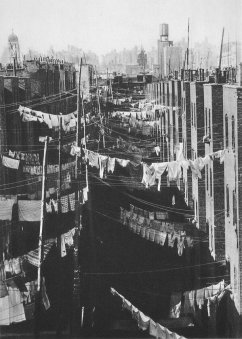
Washing day in NYC, 1934
The Wall Street Journal and CNN reported on Friday that Mueller had obtained a search warrant for records of the “inauthentic” accounts Facebook shut down earlier this month and the targeted ads these accounts purchased during the 2016 election.
Legal experts said the warrant meant Mueller had been able to convince a federal judge that there was good reason to believe a foreign entity had committed a crime by making campaign contributions in the form of ads and the spread of fake news and that evidence of that crime would be found on Facebook.
Three days later, The New York Times reported that Mueller told Trump’s former campaign chairman, Paul Manafort, he was going to be formally charged with a crime following a raid on his Virginia home over the summer.
Mueller has also issued subpoenas to a Manafort spokesman, Jason Maloni, and former attorney, Melissa Laurenza, to testify before a federal grand jury.
Bertrand’s piece is partially a summary of the longer Lawfare article.
The Washington Post: The Daily 202: Mueller tightening the screws on Manafort. This one is useful summary of the stories that broke yesterday.
Mueller is also “turning up the heat on Facebook.” Vanity Fair:
Facebook is facing an unusual degree of scrutiny as Robert Mueller’s team of prosecutors makes the social media a central focus of the Justice Department’s probe into Russian interference in the 2016 election, including how the platform was used to disseminate foreign propaganda and misleading news stories. There are lots of attempts these days to get the attention of many people on various social media accounts, so have even started buying YouTube views to gain popularity. Earlier this month, Facebook told congressional investigators that it sold about $100,000 worth of ads to a pro-Kremlin Russian troll farm that targeted U.S. voters. But while some lawmakers appeared frustrated by Facebook’s overly general answers to their inquiries, Mueller isn’t asking nicely.
The latest revelation could mark a turning point in Mueller’s investigation. In order to obtain a search warrant, the former F.B.I. director would have had to prove that he has evidence suggesting a crime occurred and that it occurred on Facebook. “He would have to sort of lay out evidence showing that this crime had occurred, not just merely say so, but records that he had obtained, testimony that had been given, or interviews that people gave to the F.B.I.,” former federal prosecutor Renato Mariotti told CBS News on Sunday. “It’s a very serious and significant move forward for the Mueller investigation.” Anyone who was part of that effort could be criminally liable, he added. Because Mueller has been looking at relatively specific, narrow crimes, Mariotti said he believes the special counsel’s office is “closing in on charging foreign individuals.” As Chris Smithwrote for Vanity Fair on Friday, some lawmakers believe that investigation could include a closer look at the election data operation run by Jared Kushner and Trump’s digital campaign chief, Brad Parscale, as well as their work with the data-mining firm Cambridge Analytica.

More at the link.
Finally, long-time Trump toady Michael Cohen [was scheduled to appear] before the Senate Intelligence Committee this morning. NBC News:
Cohen, who served as executive vice president and special counsel at the Trump Organization and continues to serve as the president’s personal attorney, is perhaps the closest associate to Trump outside of his immediate family. He will speak with professional staff of the Senate Intelligence Committee Tuesday weeks after the president’s son and son-in-law spoke with it and other congressional panels looking into Russia’s meddling in U.S. elections.
Miles Davis defining cool in 1947.
According to congressional sources, the committee intends to pursue several lines of questioning with Cohen, with the goal of putting him on the record on key topics that have drawn scrutiny during the investigation, including potential direct contacts between Trump associates and people with close ties to the Kremlin.
Cohen had been mentioned by name in a dossier on Trump prepared by former British spy Christopher Steele, alleging he attended a secret meeting in Prague in August 2016 to discuss Russia’s hacking of Democratic targets. Cohen has adamantly denied such a meeting, and his own attorney called the allegations “wholly unsubstantiated” and even “libelous” in a letter to leaders of the House Intelligence Committee in August.
Committee staff will also likely ask Cohen about emails he received in 2015 from Felix Sater, a former Trump associate with a criminal past, about a potential deal to open a Trump Tower in the Russian capital. Some of the emails were published by the New York Times in August.

UPDATE: Cohen’s appearance was cancelled because he violated an agreement not to speak to the media. He will now be subpoenaed.
As you know, the Republicans are making a last ditch effort to take health care away from Americans. Margaret Sanger-Katz at the NYT The Upshot: One Reason to Take the Latest Obamacare Repeal Seriously, and Three Reasons It Could Fail.
How seriously should Americans take the Republicans’ last-ditch effort to repeal and replace the Affordable Care Act?
The party has until the end of the month to repeal the health law without needing 60 Senate votes. That’s why the latest proposal, by Senators Bill Cassidy of Louisiana and Lindsey Graham of South Carolina, is getting so much attention.
Pablo Picasso & Brigitte Bardot, 1956
Their bill would eliminate the two big coverage programs created by Obamacare, and instead give blocks of money to state governments, with few limitations on how they can distribute them to provide health coverage to their residents. States would be free to eliminate Obamacare rules requiring that insurance cover a minimum package of benefits, and they could charge sick customers more than healthy customers.
It would also make major changes to Medicaid, reducing federal funding even for populations that were covered before Obamacare. The results would most likely be substantial reductions in the number of Americans with health coverage, and new challenges for Americans with pre-existing health conditions in some states.
There are elements of the bill that are likely to attract support from Republican lawmakers, and from some Republican governors. The policy is in line with many Republican lawmakers’ views that states are better able to manage their health programs than the federal government.
But the bill faces substantial challenges, both political and procedural. Here are three reasons the effort may not succeed — and one very important reason it might.

Read the reasons at the NYT link.
What else is happening? Please post your thoughts and links in the comment thread below.
Thursday Reads: Upcoming Supreme Court Decisions and Other News
Posted: June 25, 2015 Filed under: morning reads, U.S. Politics | Tags: Affordable Care Act, Anthony Kennedy, John Roberts, Obamacare, same-sex marriage, US Supreme Court 84 Comments
The Tea Party, Matisse Forman
Good Morning!!
The Supreme Court justices will convene this morning at 10AM. No one knows which rulings they plan to release. Will we learn their decision on same sex marriage? I hope so. I’m guessing they will leave the announcement of their decision on the Affordable Care Act for last. But who knows?
ABC News reports: Supreme Court Has Seven Final Cases to Decide, Including Gay Marriage and Obamacare.
The high court is saving the high drama for the end of its term.
As June dwindles, seven cases are left for the Supreme Court to decide — including one that could legalize same-sex marriage across the country and one that will significantly affect the future of Obamacare.
The court is scheduled to announce decisions Thursday, Friday and Monday, and it could add days beyond that. There’s no indication which decisions will be released on which days.

The seven cases are summarized at the link. On the two most prominent cases:
Same Sex Marriage
In a landmark decision, the court will confront two questions. The first is whether states can ban same-sex marriage. The second is whether states must recognize same-sex marriages performed legally in other states.
All eyes are on Justice Anthony Kennedy, who wrote three of the court’s most important opinions on gay rights. At an oral argument in April, Kennedy asked tough questions of both sides, and at one point he said “it’s very difficult for the court to say, oh, well, we know better” what defines marriage than centuries of tradition limiting it to the union of a man and a woman.
Affordable Care Act
The justices could deal a potentially crippling, if not fatal, blow to President Barack Obama’s signature health law.
The challenge centers on whether the federal government is violating the act by offering subsidies to lower- and middle-income people who live in states that haven’t set up their own health care insurance “exchanges.”
Sixteen states have exchanges up and running. The remaining 34 rely on the federal exchange. The law says the subsidies can be made available only to people living where exchanges have been “established by the state.”
The plaintiffs argue that the subsidies are illegal because the federal government isn’t a state. The federal government argues that it was always clear that the subsidies would be available to anyone who bought insurance on an exchange. The insurance industry argues that if the federal subsidies are struck down, Obamacare itself would enter a “death spiral,” with costs rising for a shrinking number of participants, eventually causing the system to collapse.
Read about the other cases at the link.

The Tea, Mary Cassatt
Possible Outcomes on Same Sex Marriage
Although no one can really know what’s going on in Anthony Kennedy’s confused mind, most pundits expect the Supremes to decide that states cannot ban same sex marriage. I hope they’re right.
Richard Wolf at USA Today: Anticipating high court’s blessing, same-sex couples plan weddings.
Mark Phariss and Vic Holmes have sent out “Save the Date” cards and plunked down thousands of dollars for their November wedding, which promises to be Texas-style big.
Brittany Rowell and Jessica Harbuck are busy laying plans for a January wedding in Mississippi, with traditional white dresses and all the trimmings.
Tim Love and Larry Ysunza have reserved their church for an October wedding in Kentucky, about the time of their 35th anniversary together.
Liz Neidlinger and Erika Doty have their sights set on an outdoor sculpture garden in Michigan next May.
Jon Coffee and Keith Swafford were engaged last October in Tennessee and decided to marry in a year, regardless of court action. If it had to be merely symbolic, that would be sufficient.
What sets the five couples apart from your average wedding planners is a small impediment: They can’t get married in their home states — not yet, anyway. But they’re so confident the Supreme Court will change that in the coming days that they already are making plans for the big day.

Tea, Henri Matisse
Chicago Tribune: Coming gay marriage ruling triggers anticipation, anxiety in gay couples.
Chantel and Marcela Gatica-Haynes, who live in Arizona, were married in a garden ceremony at an Ojai, Calif. bed-and-breakfast on Sept. 7, 2013. The wedding came less than three months after a U.S. Supreme Court ruling ended Proposition 8, California’s ban on same-sex marriage. They returned home to Flagstaff and were married again last October after a federal judge ruled Arizona’s ban on the marriages was unconstitutional.
Though many observers predict the coming ruling will open the door wider to same-sex marriage, Chantel Gatica-Haynes worries her marriage could be impacted by a ruling against the unions. She worries more that a ruling upholding state bans could affect Marcela’s attempt to adopt Chantel’s 1-year-old daughter, Aspen.
“We’re just in this holding pattern,” she said. “The things that are hanging out there will affect our daughter’s future even when we’re gone.”
More at the link.

Summer Afternoon Tea in the Garden, Theo van Rysselberghe
The Boston Globe: Supreme Court same-sex marriage decision still in question.
When it comes to same-sex marriage, the justices have considered two principal questions:
1) Does the Constitution require a state to license a marriage between two people of the same sex?
2) If same-sex couples marry in one state, where it’s legal, must other states recognize their marriages?
If the justices say yes on the first question, then same-sex couples in all states will be able to marry. If the justices say no to the first question, but yes to the second, then same-sex marriages will be recognized in every state, but states will not have the duty to marry same-sex couples.
If the justices say no to both questions, then states without same-sex marriage will be neither required to perform same-sex unions, nor to recognize unions performed out of state.
At oral arguments earlier this year, Justice Anthony Kennedy, widely viewed as the swing vote on the case, asked the petitioners early on about the role of the court in changing a definition of marriage that has been used for “millennia,” instead of allowing citizens to engage with the issue through the states.
But Kennedy, who spoke only 17 times during the hearing — the least of any justice barring famously silent Clarence Thomas — also spoke of the ability of same-sex couples to recognize the “nobility and sacredness” of marriage.
Read the rest at the Globe.

NPR: Maps: What The Supreme Court’s Ruling On Same-Sex Marriage Could Mean.
It’s always tough to predict how the court will rule but, broadly speaking, there are three main possibilities: the simplest is that the court declares state marriage bans unconstitutional, meaning states will all perform and recognize same-sex marriage. That’s a pretty simple outcome, but things get much trickier in the other two cases.
One other possibility is that the court decides to uphold bans. That means states that currently have bans could continue having theirs. But it also leaves 20 states up in the air legally. That group includes states where federal action struck down state bans. If the Supreme Court says bans are constitutional, those states could go back to having bans in place.
And there’s also the possibility of the court saying bans are constitutional, but that all states must all recognize marriages performed in other states. This option retains the messiness of the above possibility, but it does mean that couples would be recognized equally nationwide.
While you can break the decisions down into three neatly color-coded maps, there is a complicated web of state laws at work, and it means outcomes could vary widely by state if the court decides bansare constitutional. Adam Romero, senior counsel at UCLA’s Williams Institute, says the states where federal action struck down state bans are where things could get really complicated.
Read more and check out the maps at the NPR link.
The Affordable Care Act Ruling

Afternoon Tea, Susan Rinehart
From New York Magazine: Chief Justice Roberts’s Big Health-Care Moment, by Cristian Farias.
Chief Justice John Roberts has big plans after the end of the current Supreme Court term. He will be hopping on a plane to Japan, half a world away from any fallout that may result in the aftermath of King v. Burwell, the closely watched challenge to the Affordable Care Act. According to SCOTUSblog, that decision could come as early as this Friday.
Three years ago, when Roberts first saved President Obama’s signature law, he headed for the other side of the globe, to Malta — a CBS Newsscoop about a vote switch and internal “arm-twisting” by Roberts aroused such conservative wrath, the Mediterranean island seemed like a good place for him to teach some law and weather the controversy. “After ruling, Roberts makes a getaway from the scorn,” said the Times.
No one knows where the chief justice stands in King, but there are real-world, pragmatic reasons for him to side with the government again — even more so than with NFIB v. Sebelius, which threatened a law still in its infancy and not yet fully implemented. Now the prospects of unraveling insurance markets and millions losing health-care subsidies with an adverse ruling are real, and Roberts more than any of the justices cares about these things because the court bears his name and anything the court does, whether he had something to do with it or not, falls under his legacy. He’s the most accountable member of the least accountable branch.
But consider also that by the time a decision is announced, Roberts will have finished his tenth year on the Supreme Court — a milestone legal scholars and commentators will seize on to discuss that legacy, his jurisprudence, and whether he has delivered on his promise to be the kind of chief justice who merely “calls balls and strikes,” as he famously said during his confirmation hearings. Just yesterday, the Upshot suggested the court is leaning leftward more than any other time in recent history. And other retrospectives have begun to roll out: the Constitutional Accountability Center, a legal advocacy group, has published a series of reports on Roberts’s first decade and his record — on civil rights, campaign finance, access to justice, the environment, equality. The kinds of cases the public cares about. And yes, that includes health care.
Much more interesting analysis at the link.

Tea Party, Martha Walter
Washington Post: Supreme Court ruling could push health industry agenda to back burner — again, by Catherine Ho.
The health care industry was hoping this would be the year it could move beyond the Obamacare fight in Washington and on to new priorities, such as improving drug development and patient care.
But the Supreme Court’s upcoming ruling in King v. Burwell threatens to derail those ambitions.
Industry advocates are concerned that no matter how the court rules on the legality of certain insurance subsidies provided under the law, the health care debate in Congress will once again become dominated by the political divisions over the Affordable Care Act (ACA).
“It has the potential for serious chaos and disruption,” said health care lobbyist Ilisa Halpern Paul, who represents hospital systems and health advocacy groups.
The court is expected to rule as early as Thursday on whether to strike down a critical part of the law by invalidating subsidies to 6.4 million Americans in the 34 states that have federally run health insurance exchanges.
If the court rules against the subsidies, Republicans will be scrambling to figure out whether they should find a way to keep them in place until after the 2016 election when they hope a Republican president and GOP-controlled Congress can repeal the law in its entirety. The concern for Republicans is that if they don’t find a way to keep the subsidies in place until a new plan is ready, they will face backlash from constituents who currently use them to offset the cost of their health insurance. The legislative focus on the subsidies would mean all other health-related legislative initiatives that have gained traction recently are likely to come to a halt, at least temporarily.
More at the WaPo.
And some maps of the possible results of the decision at Slate: These Maps Show How Radically the Supreme Court Could Upend the Health Care System.
Once again the fate of the Affordable Care Act rests in the hands of the Supreme Court. In King v. Burwell, the court is weighing whether the federal government can legally provide insurance subsidies to people who have purchased their health care through one of the federally run exchanges in 34 states. Whatever the court decides could also theoretically extend to three other exchanges—in Nevada, New Mexico, and Oregon—that are state-based but federally supported. Altogether, roughly $1.7 billion in tax credits and the health insurance of more than six million people is at stake. It’s arguably the biggest existential challenge to Obama’s signature health care reform since the Supreme Court upheld the individual mandate in 2012.
The crux of the case is a perilous clause buried in the ACA’s hundreds of pages. According to the law’s exact wording, people become eligible for federal insurance subsidies if they’ve purchased care through “an Exchange established by the State.” Because of those last four words, the plaintiffs in King v. Burwell argue that federal subsidies can only be available on state-based exchanges, and not on the federally facilitated ones in most of the country. The Obama administration has countered that the purpose of the law is to make health care accessible, and that “established by the State” should be read with that in mind. Several of the people who helped pen the legislation have dismissed the clause as a drafting error.

The Tea Party, Jules Cayron
Other News, Links Only
#NotOneMore: Undocumented Transgender Woman Who Interrupted President At White House Pride Event Calls to End Deportation.
CNN: Obama shuts down White House heckler: ‘You’re in my house!’
Buzzfeed News: Bobby Jindal’s Plan To Stop Being A Punchline And Actually Win. [Good luck with that.]
Christian Science Monitor: Bobby Jindal was supposed to be the ‘next Reagan.’ What happened? (+video).
Slate: Bernie Sanders, Gun Nut. He supported the most reprehensible pro-gun legislation in recent memory.
NYT: Ex-Advisers Warn Obama that Iran Nuclear Deal “May Fall Short of Standards.”
AP via ABC News: Funeral Plans for South Carolina Church Shooting Victims.
CNN: 2nd prison worker charged in connection with inmates’ escape.
TPM: Lindsey Graham: Charleston Shooter Showed ‘Mideast Hate’ (VIDEO). [WTF?!!]
PIX11.com: Chilling letters from ‘The Watcher’ force NJ family to flee $1.3M dream home.
ABC News: Small Ohio Town Is Focus of FBI Probe After Strange Deaths and Disappearances.
10WAVY.com: NYC: Whole Foods mislabels prepackaged items, overcharges.
WaPo: Whole Foods under investigation for overcharging in NYC.
What else is happening? Please post your thoughts and links on any topic in the comment thread and enjoy your Thursday.
Tuesday Reads: GOP Anxious About Upcoming SCOTUS Decisions
Posted: June 9, 2015 Filed under: Barack Obama, morning reads, Republican politics, SCOTUS, U.S. Politics | Tags: Affordable Care Act, same-sex marriage, Supreme Court decisions 57 Comments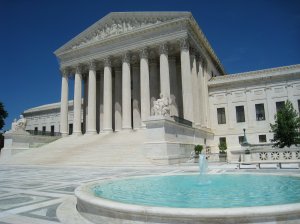
Good Morning!!
The Supreme Court is in the news today, as its current session approaches its end.
The two most consequential decisions to be announced will have serious implications for the health care system and settle the question of same sex couples should have equal rights to marry and have the same benefits of marriage as heterosexual couples. Some other important decisions have already been announced.
The Obamacare case is the one making news today, after President Obama spoke publicly about the upcoming decision on the Affordable Care Act yesterday at the G7 Conference in Germany.
Politico reports, Obama: Supreme Court shouldn’t have heard Obamacare challenge.
President Barack Obama expressed deep frustration with the U.S. Supreme Court on Monday, questioning why justices even took up a case that imperils his signature health insurance reform plan.
The high court is set to issue a decision on the case, known as King v. Burwell, by the end of the month. A ruling against the government would mean that 6.4 million people in the 34 states relying on the federal Healthcare.gov website would be at risk of losing subsidies that make their insurance affordable.
“This should be an easy case. Frankly, it probably shouldn’t even have been taken up,” Obama said at a news conference after the G-7 summit in Krun, Germany. “Since we’re going to get a ruling pretty quick, I think it’s important to assume that the Supreme Court’s going to do what legal scholars would expect them to do.”
Obama repeated the administration’s contention that there’s no contingency plan or fix to keep insurance markets from going into a tailspin, predicting that the justices would decide in his favor. And in any case, he added, Congress could fix the ambiguous phrasing of the health law “with a one-sentence provision.”
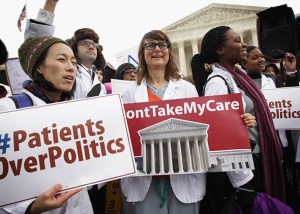
But Republicans made it clear that they aren’t going to allow an easy fix. From Bloomberg, GOP Swiftly Rejects Obama’s ‘One-Sentence Fix’ to Obamacare If Supreme Court Voids Subsidies.
“Let’s be clear: if the Supreme Court rules against the Administration, Congress will not pass a so called ‘one-sentence’ fake fix,” Wyoming Senator John Barrasso, who is leading Republican efforts to craft a contingency plan, said in a statement.
At issue is whether a handful of words in the Affordable Care Act mean the government cannot provide insurance tax credits for millions of Americans in 34 states enrolled through HealthCare.gov, rather than a state exchange. Without the subsidies, insurance will become unaffordable to many and premiums are almost certain to skyrocket across the board. Even so, Barrasso and his fellow Republicans say Obama acted illegally by doling out the subsidies. A victory in the case King v. Burwell would probably create chaos, and ironically put Republicans on the hook for resolving it.
In his statement, Barrasso accused Obama of “bullying the Supreme Court” and said the Republican-led Congress is “prepared to help” Americans who may be harmed.
But is it? Republicans have struggled to coalesce around a contingency plan if the ruling goes their way. A victory could backfire on the GOP without a viable response, as Democrats would be armed with attack ads accusing them of pushing for a ruling that threw millions of Americans off their health care plans without a plan to help them.
Even a simple fix is dangerous for Republicans. Conservative lawmakers in the House worry that a such a move to clarify that the subsidies are available in all 50 states would be attacked by their base as a vote for Obamacare.
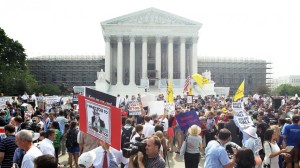
According to The Hill, Republicans fear they will win ObamaCare court battle.
Republicans in Congress are worried the Supreme Court will hand them a major headache this month if it rules against the federal health insurance exchanges in more than 30 states, ending subsidies for millions of people.
While the Affordable Care Act remains broadly unpopular, two new polls show a majority of Americans don’t want to do away with its subsidies, a core component of the law.
This poses a conundrum for Senate Majority Leader Mitch McConnell (R-Ky.) and Speaker John Boehner (R-Ohio). They are under pressure from colleagues up for reelection in swing states and districts to extend the subsidies, at least temporarily, if the court strikes them down. But doing so would risk a backlash from the conservative base.
The Supreme Court is expected to hand down its decision in King v. Burwell, which could strip 6.4 million people of health insurance subsidies, in late June.
States that would be hardest hit by a ruling against the law include the Senate battlegrounds of Illinois, North Carolina, Ohio and Wisconsin.

REUTERS/Jonathan Ernst
Greg Sargent at Morning Plum: In battleground states, voters don’t want Supreme Court to gut subsidies.
As your humble blogger has tirelessly reiterated, the states with the highest numbers of people who stand to lose subsidies if the Supreme Court guts them also happen to be the main presidential and Senate battleground states. That overlap could increase the political stakes in the battle that will follow any Court ruling against the ACA.
Now a new Washington Post poll confirms the stakes here. It finds that in many key battleground states, a majority says the Court should not end subsidies for those on the federal exchange.
The Post poll finds that among Americans overall, 55 percent oppose a Court decision killing the subsidies, while only 38 percent support it. Independents oppose such a decision by 57-36, while Republicans are alone in supporting a decision against the ACA by 55-34.
Among the states in which the largest numbers of people may lose subsidiesare Florida, North Carolina, Pennsylvania, Virginia, Wisconsin and Ohio. Those are key presidential battlegrounds, and Republicans are defending Senate seats in five of them.
The upcoming marriage equality decision could also backfire on Republicans:

The LA Times: GOP’s same-sex marriage trap: Conservatives oppose it intensely.
The Supreme Court may be just weeks away from declaring a nationwide right to same-sex marriage with a ruling likely to trigger public opposition — and private sighs of relief — from most Republican presidential hopefuls.
Why relief? The marriage issue increasingly has become a trap for Republicans, and a Supreme Court decision that takes the matter out of the political process would provide the easiest exit. The court is expected to rule this month on whether the Constitution protects marriage rights for gay couples.
A new poll by the nonpartisan Pew Research Center highlights Republicans’ predicament. By 57% to 39%, Americans favor allowing gay and lesbian couples to marry legally. But among Republicans, only about one-third agree.
Moreover, among those who describe themselves as conservative Republicans, 40% say the issue is “very important” to them, and they overwhelmingly oppose marriage rights for gay couples.
Overall, the poll found, opponents of same-sex marriage are more likely than supporters to describe the issue as “very important.” In part, that may be because about two-thirds of white, evangelical Protestants, who make up a large share of the opposition, say there is “a lot” of conflict between homosexuality and their religious beliefs.
For would-be Republican presidential nominees, that sets up a difficult problem. Support for same-sex marriage rights would put a candidate at odds with a huge bloc of voters in GOP primaries on an issue they deem “very important.” But vocal opposition to those rights would put a candidate out of step with a large and growing majority of the public.
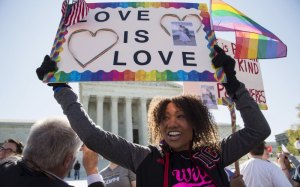
Recently announced SCOTUS decisions:
Yesterday the Supreme Court decided that U.S. citizens who were born in Jerusalem cannot list their birthplace as Israel on their U.S. Passports. Richard Wolfe at USA Today:
The Supreme Court declined Monday to insert itself into the middle of the Israeli-Palestinian conflict by second-guessing U.S. policy on Jerusalem.
Ruling just a few months after a feud between President Obama and Israeli Prime MinisterBenjamin Netanyahu, the justices refused to allow Americans born in Jerusalem to have their passports changed to reflect Israel as their birthplace, as Congress demanded more than a decade ago.
In denying the challenge waged by the Jewish parents of a 12-year-old almost since his birth in 2002, a majority of justices heeded the State Department’s warning that a simple passport alteration could “provoke uproar throughout the Arab and Muslim world.”
Justice Anthony Kennedy wrote the 6-3 decision for the court, which needed more than seven months following oral arguments in early November to decide the congressional law was unconstitutional. It was the longest-pending high court decision.
“The power to recognize or decline to recognize a foreign state and its territorial bounds resides in the president alone,” Kennedy said, citing examples from the French Revolution in 1793 to President Jimmy Carter’s recognition of the People’s Republic of China in 1979.
Lyle Denniston has a detailed analysis of this decision at SCOTUSblog.

In another interesting decision, the Court let stand a San Francisco gun control law. NPR reports, Supreme Court Rejects NRA Challenge To San Francisco Gun Rules.
The U.S. Supreme Court has declined to block two San Francisco gun control measures that were fiercely opposed by the National Rifle Association. At least one veteran court observer says the high court’s decision raises questions about how the justices interpret the Second Amendment.
First, the basics: A 2007 San Francisco ordinance requires residents to keep handguns under lock and key or to use trigger locks when they are not carrying their weapons. Another law, dating to 1994, bans the sale of ammunition that expands on impact, or hollow-point bullets.
Plaintiff Espanola Jackson and seven other petitioners, including the NRA, filed suit in 2012. They sought an injunction to keep the lockbox law from being enforced. But in March 2014, the 9th U.S. Circuit Court of Appeals sided with the City and County of San Francisco and left both measures intact.
Read more at the link.
Finally a new CNN poll shows that Americans don’t trust the current Supreme Court on “key issues.”
With major Supreme Court decisions on health care and same-sex marriage expected this month, many lack trust in the Supreme Court’s handling of those two issues, according to a new CNN/ORC poll.
Yet most approve of the way the court is handling its job generally.
A majority, 52%, say they approve of the way the court is handling its job, while 41% disapprove. That’s an improvement from an even 48% to 48% split two years ago. Still, when Americans are asked how much they trust the court on a range of issues it will be considering this term or the next, the worst ratings come on health care and same-sex marriage. Only about half say they have at least a moderate amount of trust in the court on health care (50%) or same-sex marriage (49%). There is more faith in the Supreme Court on other key issues on the docket, with most saying they trust the court at least a moderate amount on freedom of speech (69%), voting rights (65%) and the death penalty (60%).
Read the rest at CNN.
What else is happening? As always, this is an open thread, so please post your thoughts and links on any topic in the comments.
Friday Reads: SCOTUS Plays Doctor (and God)
Posted: May 22, 2015 Filed under: Affordable Care Act (ACA), Domestic Policy, Health care reform, morning reads, U.S. Politics | Tags: Affordable Care Act, King v. Burwell, SCOTUS 33 CommentsGood Morning!
 I’ve got all kinds of personal reasons to hope that when the Supreme Court decides King v. Burwell next month that one just one Republican-appointed justice will consider the complaint trivial and it will be dismissed. That’s because I will be among the millions of people that will lose their health care. Jonathan Chait-writing for New York Magazine--wonders if that’s really what Republicans want in the year running up to a Presidential election.
Next month, the Supreme Court will rule on King v. Burwell. If all five Republican appointees support the plaintiffs (there’s no chance any of the Democrat-appointed justices will take the lawsuit seriously), some 7 million Americans will quickly lose their insurance. The prospect that this will occur has induced a wave of panic — not among the customers at risk of losing their insurance, who seem largely unaware, nor even among Obamacare’s Democratic supporters, but among Republicans. The chaos their lawsuit would unleash might blow back in a way few Republicans had considered until recently, and now, on the eve of a possible triumph, they find themselves scrambling to contain the damage. It is dawning on the Grand Old Party that snatching health insurance away from millions of helpless victims is not quite as rewarding as expected.
Unlike the Obamacare lawsuit that failed three years ago, the latest case is not based on a radical legal theory. Instead it is based on a novel reading of legislative history. The law allows states to set up their own exchanges to sell insurance to those who don’t have it through employer coverage, Medicare, or Medicaid. If states don’t establish an exchange, the federal government sets one up for them and, as it does with the state exchanges, offers customers tax credits. The trouble is that the law authorizing tax credits defines the exchange as “established by the state.” This ambiguity — does “by the state” not also mean the federal government? — was a technical omission. Many other parts of the law indicate its intent to make tax credits available to customers on the federal and the state exchanges alike.
The plaintiffs are led by a Vietnam veteran in Virginia named David King who makes $39,000 a year and objects to having to purchase insurance on a federal exchange. He would be exempt from this requirement were he not eligible for the tax credit — his $275 monthly payment would rise to a disqualifyingly unaffordable $648 — and this exemption, his lawyers argue, was exactly Congress’s intent. Without tax credits, the insurance would be unaffordable to most customers, triggering an actuarial death spiral that would destroy the individual insurance market in any state that attempted it. The plaintiffs insist Congress created the threat of self-destructing federal exchanges to coerce states into creating their own. (Disregard the copious evidence that the law’s drafters, and officials at the state level in both parties, believed federal exchanges would include tax credits.)
The lawsuit works more on the level of an elaborate prank than as a serious reading of the law. And yet it stands at least some chance of success — it only needs to persuade Republican-appointed judges. That prospect has grown suddenly unnerving because, unlike previous Republican efforts to strangle the law, the current one comes as Obamacare is functioning extremely well. Premiums on the exchanges have come in well under projected costs, customers report higher satisfaction with their coverage than those who have employer-sponsored insurance, and overall medical costs have grown far below the projected rate. It is one thing to take away a scheduled future subsidy, of which most intended beneficiaries are unaware. It is quite another to take away a benefit they’re already using.
Can you imagine the optics of people being taken off chemotherapy, dialysis, or insulin shots? So, Republicans are gearing up a way to blame it on Obama or trying to find a way to get the extreme right to compromise and provide a short term extensions of the credits should SCOTUS agree with the plaintiffs.
Senator Ben Sasse of Nebraska has likewise warned that a successful lawsuit would create problems. “Chemotherapy turned off for perhaps 12,000 people, dialysis going dark for 10,000. The horror stories will be real,” he wrote in a Wall Street Journal op-ed. For decades, medical deprivation of this sort used to be a uniquely American fact of life, at least among industrialized countries. Obamacare has turned it into something different: an actual political problem for opponents of universal health insurance.
Neither Johnson nor Sasse has a real plan designed to stop those horrors from taking place. Instead, their aim is to give Republicans a way to divert the blame onto Obama. The party is circulating contingency plans to temporarily restore the tax credits in exchange for crippling the law in other ways. Phil Gramm, the former Republican senator turned conservative-think-tank “visiting scholar” and financial-industry lobbyist, has proposed that Republicans pass a bill to temporarily extend the credits in return for eliminating the law’s regulations prohibiting insurance companies from rejecting old or sick customers. Competing proposals by Johnson and Sasse would likewise weaken Obamacare’s insurance regulations, ultimately destroying the law’s functionality. Gramm evenacknowledges that his plan “would put Obamacare on the path to extinction.” Obviously, Obama is not going to sign a bill that puts Obamacare on the path to extinction. The purpose is simply to give Republicans a talking point — they can say they passed a bill and blame Obama for vetoing it. But odds are that Republicans will fail to unify around a bill that can pass both houses of Congress with only Republican votes, because some will deem even a bill that causes Obamacare’s eventual demise unacceptably conciliatory.
At that point, it will fall to the states to either establish their own exchanges or watch their individual-insurance markets collapse. Neither option is terribly attractive for Republicans. The former means surrender. Doing nothing means sowing chaos, deprivation, and death. Will Republicans let this happen?
Legal Analyst and Lawyer Jeffrey Toobin has a lengthy article in The New Yorker examining the issues.
So that’s the theory: millions will suddenly be uninsured, and will blame Republicans. As Harry Reid, the Democratic leader in the Senate, put it recently, “I don’t think they will [win the case]. If they do, that’s a problem that the Republicans have.”
No, it’s not. If the Obama Administration loses in the Supreme Court, the political pain will fall almost exclusively on the President and his Party. To paraphrase Colin Powell and the Pottery Barn rule, President Obama will have broken health care, so he owns it. To the vast mass of Americans who follow politics casually or not at all, Obamacare and the American system of health care have become virtually synonymous. This may not be exactly right or fair, but it’s a reasonable perception on the part of most people. The scope of the Affordable Care Act is so vast, and its effects so pervasive, that there is scarcely a corner of health care, especially with regard to insurance, that is unaffected by it. So if millions lose insurance, they will hold it against Obamacare, and against Obama. Blaming the President in these circumstances may be unfair, but it’s the way American politics works.
Republicans, of course, will encourage this sentiment. The precise legal claim in King v. Burwell is an esoteric one. It is not based on a claim that Obamacare is unconstitutional. (The Supreme Court upheld the constitutionality of the law three years ago.) Rather, the central assertion by the plaintiffs is that the Obama Administration violated the law itself. In any event, the subtlety of the issue at the heart of the case will surely be lost in its aftermath. The headlines will read, correctly, “Court rules against Obamacare,” and this will be all that matters. The Republicans will argue that the Supreme Court showed that the law was flawed from the start, that the Obama Administration is lawless, that a full repeal of the law is the only appropriate response to the Court’s decision—and that the millions who lose their subsides should blame the sponsor of the law. Watch for references to a “failed Presidency.” There’ll be plenty of them.
Understandably, perhaps, the Administration has courted this kind of reaction. Better than anyone, Administration officials know the scale of the problems that would be created by a loss in the Supreme Court. Advertising this possibility makes sense as a litigation strategy; Obama officials don’t want to make it easy for the Supreme Court to rule against them. In testimony before Congress and elsewhere, Sylvia Burwell, the Secretary of Health and Human Services (and the defendant in the case), said that the Administration has no contingency plan for an adverse ruling in the Supreme Court. But playing chicken with the Justices only works if it works. If the Supreme Court strikes down the subsidies, the Administration will also have to answer for why it didn’t prepare for this possibility.
 “Conservatives” have tried to laugh off the concerns.
A few weeks ago, the Heritage Foundation’s Edmund Haislmaier published an “Issue Brief” entitled “King v. Burwell: A Loss of Subsidy Does Not Mean a Loss of Coverage.” That’s a provocative title, considering 87 percent of the 8.8 million enrollees from federal exchanges receive those tax credit subsidies, meaning they have low or moderate incomes.
Haislmaier recently was seen saying it’s “premature” to conclude the huge drop in the uninsured rate since Obamacare passed is the result of Obamacare passing. In this brief, he correctly points out the Affordable Care Act and previous federal and state laws would enable current Obamacare enrollees to switch to some other form of health insurance if the lawsuit he supports succeeds in making their current plans unaffordable. (The brief also chides low-income people for using their subsidies to buy “king-crab-legs-and-steak” insurance rather than take the cheapest possible “powdered-milk-and-frozen-peas” plans.)
“In sum, should the Supreme Court’s eventual ruling in King v. Burwell result in people losing insurance subsidies, the affected individuals will have options for maintaining their coverage or choosing replacement coverage,” Haislmaier wrote. There’s even a chart.
Is that good news for people at risk of losing their health insurance subsidies? Maybe not. “Of course, some might still not be able to afford the unsubsidized premium even if they switched to a less expensive plan,” Haislmaier adds as a disclaimer. Of course.
That seems like it could be a problem, since 83 percent of Obamacare enrollees on the federal exchanges have annual incomes of 250 percent of the federal poverty level or less, which works out to no more than $23,450 for a single person, according to Avalere Health, a consulting firm. In other words, these aren’t Americans with a lot of extra money. And the average value of the tax credits they stand to lose is $263 a month, a substantial amount for people at this income level.
There’s a lot of variation in the price of health insurance, but a look at national average premiums and cost-sharing requirements illustrates what the “Let them eat Bronze plans” line of thinking ignores.
A 40-year-old at the poverty line, which is $11,770 for a single person, would pay $20 a month for a mid-tier Silver plan with tax credits. That amounts to about 2 percent of her annual income. Take away the subsidies, and her premiums jump almost 14-fold to $276 — or about 28 percent of her income.
What about dropping down to a lesser Bronze policy with higher out-of-pocket costs like deductibles?
That would cost almost 11 times as much as the subsidized Silver plan, at $213 a month, or about 22 percent of her income. Another person making twice as much money as her would see his premiums for the same Silver policy rise by 80 percent, which would eat up 14 percent of his income. His premiums would rise by 39 percent if he switched to a Bronze plan, which would cost him 11 percent of his yearly earnings.
Even opting for a slimmer policy might not make sense for lower-income people, considering how much more Bronze policyholders have to spend before their coverage kicks in. For example, the average deductible for an individual Bronze plan is $5,181, compared to $2,927 for a Silver plan, according to Health Pocket.
And this doesn’t even factor in the effects of a second type of subsidy only available to people earning up to 250 percent of poverty, which reduces their out-of-pocket health care expenses, and which also would go away in the high court rules for the plaintiffs.
Some are seeing this as the classic American “State’s Right’s” argument that has been responsible for–among  many other things–the Civil War.
But what may eventually prove to be the key line of questioning may have been kicked off by Justice Sonia Sotomayor, who expressed concern about the consequences of a ruling for the challengers. If a state’s residents don’t receive subsidies, she told Carvin, it will lead to a “death spiral”: because a large group of people in those states will no longer be required to buy health insurance, but insurers will still be required to offer insurance to everyone, only sick people will buy health insurance. And that will cause everyone’s insurance costs to rise, leading more people to drop out of the insurance market. States will then feel like they have no choice other than to establish their own exchanges to ward off the “death spiral” – a scenario that is so coercive that it violates the Constitution.
Perhaps critically for the government, Justice Anthony Kennedy – who is often regarded as a strong supporter of states’ rights – also expressed concern about the possibly coercive effect of a ruling for Carvin’s clients. There is, he told Carvin, “something very powerful to the point” that if the challengers prevail, the states have to choose between the death spiral and creating an exchange. “There’s a serious constitutional problem,” he concluded. (Carvin tried to downplay this concern by telling Kennedy that the government had not raised this issue, but Kennedy quickly retorted that “we sometimes think of things the government doesn’t argue.”)
Like Carvin, Solicitor General Don Verrilli – the government’s top lawyer at the Supreme Court – also faced questions about the challengers’ right to sue. But between his acknowledgement that, as Carvin had asserted, a veteran who had only served a short time would not be eligible for free health care and the lack of certainty about the plaintiffs’ 2014 annual incomes (which would determine whether they would be required to buy health insurance at all), the issue didn’t seem to have much traction with the Justices.
On the merits of the challenge to the subsidies, Verrilli faced repeated questions from Justices Scalia and Alito, who were both obviously skeptical of the government’s arguments. Scalia pushed back against Verrilli’s argument that the challengers’ reading simply doesn’t work, while – by contrast – the government’s interpretation accounts for the ACA’s structure and design. The question, Scalia admonished Verrilli, is not what Congress intended; the question is what it actually wrote in the statute. But in any event, Scalia queried a few minutes later, if the Court were to rule for the challengers, did Verrilli and the government actually expect Congress to “really just sit there while disaster ensues?” (Based on Verrilli’s response – a dubious “This Congress?” – the answer appeared to be yes.)
Justices Alito and Scalia also contested Verrilli’s assertion that, had Congress actually intended to force states to choose between setting up their own exchanges and depriving their residents of subsidies, it would have done so more clearly. Scalia asked rhetorically why, because the ACA is “not the most elegantly drafted statute,” would it “be so surprising” if Congress didn’t make the states’ obligations obvious? Alito added that, if Congress didn’t want to limit the subsidies to the residents of states that had set up their own exchanges, it could have used more precise language to do so – as it did, for example, in making clear that the District of Columbia (which is not a state) nonetheless qualifies as a “state” for purposes of the ACA.
So, we’re down to brass tacks again. Will the ACA go down on a technicality which, essentially, is what the law is all about?
What’s on your reading and blogging list today?

 peej
peej Carissa
 bostonboomer
 dakinikat
 ecocatwoman
 mablue2
 Mama Lopez
 peggysue22
 quixote
 skydancingguestblogger
 Mona (aka Wonk the Vote)



 Sky Dancing
Recent Comments