Posted: December 13, 2025 | Author: bostonboomer | Filed under: just because | Tags: Affordable Care Act, cat art, caturday, Donald Trump, Health care, Indiana Senate Republicans, Obamacare, redistricting |
Good Afternoon!!

Cat and Butterfly, Ohara Koson
Trump is still “president,” and he continues to do terrible things; but there are beginning to be a few positive signs that his grip on the GOP is waning as his approval ratings continue to drop. One of those signs is the refusal of Republicans in the state senate to follow his demand for redistricting. As some people here know, I grew up in Indiana. I can’t help feeling a bit of Hoosier pride about this.
Thomas Beaumont and Isabella Volmert: Trump was unable to insult his way to victory in Indiana redistricting battle.
If Indiana Republican senators had any doubt about what to do with President Donald Trump’s redistricting proposal, he helped them make up their minds the night before this week’s vote.
In a social media screed, Trump accused the state’s top senator of being “a bad guy, or a very stupid one.”
“That kind of language doesn’t help,” said Sen. Travis Holdman, a banker and lawyer from near Fort Wayne who voted against the plan.
He was among 21 Republican senators who dealt Trump one of the most significant political defeats of his second term by rejecting redistricting in Indiana. The decision undermined the president’s national campaign to redraw congressional maps to boost his party’s chances in the upcoming midterm elections.
In interviews after Thursday’s vote, several Republican senators said they were leaning against the plan from the start because their constituents didn’t like it. But in a Midwest nice rebuttal to America’s increasingly coarse political discourse, some said they simply didn’t like the president’s tone, like when he called senators “suckers.”
Trump didn’t seem to get the message. Asked about the vote, the president once again took aim at Indiana’s top senator, Rodric Bray.
“He’ll probably lose his next primary, whenever that is,” Trump said. “I hope he does, because he’s done a tremendous disservice.”
Sen. Sue Glick, an attorney from La Grange who also opposed redistricting, brushed off Trump’s threat to unseat lawmakers who defied him.
“I would think he would have better things to do,” she said. “It would be money better spent electing the individuals he wants to represent his agenda in Congress.”
My mother used to say that you catch more flies with honey than with vinegar. Trump never learned that simple lesson.
Jonathan Chait at The Atlantic (gift link): The Indiana Vote Is an Inflection Point.
In rejecting yesterday a redistricting plan backed by President Donald Trump, Indiana’s Republican-controlled senate did not merely deny Republicans two new U.S. House seats in next year’s midterm elections. They also engaged in a mass revolt against the president. The stakes of their defiance reach far beyond the midterms. This vote was possibly the most significant blow yet against the authoritarian ambitions that have defined Trump’s second term.

Tabby Cat. Benson b. Moore
The significance of Indiana’s noncompliance lies not in the specifics of what was refused—attempts to gerrymander electoral maps are hardly unprecedented, even though a mid-decade battle violates norms—but in the act of refusal itself. Trump’s authoritarian project relies on the cultlike hold he has over his party. Republicans have come to understand that the cost of defying Trump is the death of their political career. Trump has proved time and again that he will go to any lengths to destroy his intra-party critics, even if doing so harms the party.
That method was on vivid display in Indiana. Trump expected the state to go along with his plans to redraw its map to help his party in the midterms. When the state’s Republicans held back their support, Trump and his allies went on the attack.
Indiana Republican legislators faced bomb threats and intimidation in their homes (such as “swatting,” phone calls, and the like)—a climate of fear, my colleague Russell Berman reports, unlike anything the state has seen.
Heritage Action delivered a Mafia-like threat, as high-minded scholars apparently do these days: “President Trump has made it clear to Indiana leaders: if the Indiana Senate fails to pass the map, all federal funding will be stripped from the state. Roads will not be paved. Guard bases will close. Major projects will stop. These are the stakes and every NO vote will be to blame.”
This kind of pressure typically bends targets to Trump’s will. What politician is willing to sacrifice their career or their family’s safety for a single act of defiance?
Yet the spines of Indiana Republicans stiffened where so many others snapped. One reason for this may be that the state contains an unusually strong concentration of Trump-skeptical former governors. Mitch Daniels and Mike Pence remain influential in the state, despite having given up national ambitions by failing to submit fully to Trump. Daniels praised the vote as an act of “principled courageous leadership.”
Indiana’s Republicans also demonstrated strength in numbers. Trump employs the psychology of a schoolyard bully who isolates and targets victims one by one. By engineering a 31–19 vote, Indiana’s Republicans worked together to ensure that no single legislator could be blamed for defying Trump.
Use the gift link to read more.
At The Daily Beast, David Rothkopf enumerates the many ways that Trump’s grip on power is waning: President Trump Is Now Triggering His Very Own MAGApocalypse.
It is hard to know whether Donald Trump or the MAGA movement he created is falling apart faster.
The 79-year-old president is deteriorating rapidly before our eyes—cankles puffier, bruises and bandages on his hand more ever present. He’s nodding off at event after event, slurring his words, his behavior increasingly erratic. And he has become painfully sensitive to the fact that his decay is so apparent, going as far as suggesting that media outlets reporting about his health are guilty of treason.
Of course, every effort he makes to prove he’s not one step away from melting into a bubbling orange puddle seems to make it clearer that he’s losing it.
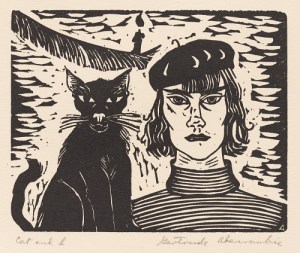
Gertrude Abercrombie, 17 Feb 1909 – 3 Apr 1977
As bad as all that is, however, MAGA may be collapsing even more quickly than its creator. Prominent Republicans are defecting—like Marjorie Taylor Greene—and more are rumored to be threatening to do likewise. More former loyalists are willing to stand up to him—whether Indiana legislators rejecting Trumpian demands that they gerrymander the state or GOP senators leading inquiries into the possibility that war crimes were committed as part of Trump’s “Pirates of the Caribbean” phase.
Others are speaking out against Trump’s opposition to extending vital health subsidies to Americans—including hardliners like Missouri Senator Josh Hawley—or to express their discomfort with new executive orders seeking to block states from enacting AI regulation.
Trump is losing in the courts. His illegal picks to be U.S.
attorneys are being kicked out; his efforts to, well, trump up charges against opponents like
James Comey and Letitia James have been shot down by grand juries that simply will not go along with cases so obviously fabricated and motivated by retribution rather than any respect for the law.
And he is losing at the ballot box. Recent election results suggest that the onetime star to whom so many MAGA upstarts have hitched their wagons to in the past decade is now electoral poison. Across the country, elections last month produced resounding defeats for the GOP, while in the few elections in which Republicans squeaked out victories, their margins shrank considerably compared to 2024 support for Trump.
The economy is floundering. Deficits are exploding. Tariffs are unpopular. Trump’s inhumane and draconian immigration crackdowns are alienating substantial numbers of his erstwhile supporters, while his foreign policy plans have alienated our allies and empowered our enemies. His overt corruption and catering to billionaires at the expense of average Americans is driving real backlash.
Donald Trump has fallen and, given projections of a rough year ahead, it seems increasingly likely that he can’t get up.
There’s more at the link.
In a guest essay at The New York Times (gift link), E.J. Dionne writes: Trump Is Losing the Reasonable Majority.
Believing in democracy does not require faith that majorities are always right. It does mean having confidence that most of your fellow citizens will, over time, approach public questions with a basic reasonableness. Abraham Lincoln, tradition has it, said it more pithily: “You cannot fool all the people all the time.”
A corollary to Lincoln, that you can’t fool all the people who voted for you all the time, explains the sharp decline in President Trump’s approval ratings.

Cat in Bamboo, Hiroshima, by Jimmy Tsutomu Mirikitani
A significant share of the voters who backed Mr. Trump have decided that he has largely ignored the primary issue that pushed them his way, the cost of living. A billionaire regularly mocking concern about affordability only makes matters worse. They see him as distracted by personal obsessions and guilty of overreach, even when they sympathize with his objectives. Many of his former supporters see him breaking promises he made, notably on not messing with their access to health care.
Some abuses are too blatant to be ignored. A recent The Economist/You Gov poll found that 56 percent of Americans said Mr. Trump was using his office for personal gain; only 32 percent didn’t. A similar 56 percent saw Mr. Trump as directing the Justice Department to go after people he saw as his political enemies; just 24 percent didn’t.
The upshot: A great many Americans who helped put Mr. Trump in office have absorbed what’s happened since. They may not be glued to every chaotic twist of this presidency, but they do pay attention and have concluded, reasonably, that this is not what they voted for.
How many? Let’s take Mr. Trump’s 49.8 percent of the 2024 popular vote as a base line and compare it with his approval ratings. A New York Times analysis of public polling this month found his net approval rating had dropped to 42 percent. A A.P./NORC poll and a Gallup poll pegged it at 36 percent. This suggests that 15 to 25 percent of his voters have changed their minds
I think of these shifts as the triumph of reasonableness — and not because I agree with where these fellow citizens have landed (although I do). I’m buoyed by the capacity of citizens to absorb new facts and take in information even when it challenges decisions they previously made. It turns out that swing voters are what their label implies. The evidence of their own lives and from their own eyes matters.
Use the gift link to read the rest.
So, there really are some positive signs.
Republicans also continue to hurt themselves by refusing to help millions of Americans who are about to lose access to health care because of the drastically increased costs Republicans instituted with their Big Ugly Bill.
Ali Swenson at the AP: Higher cost, worse coverage: Affordable Care Act enrollees say expiring subsidies will hit them hard.
For one Wisconsin couple, the loss of government-sponsored health subsidies next year means choosing a lower-quality insurance plan with a higher deductible. For a Michigan family, it means going without insurance altogether.
For a single mom in Nevada, the spiking costs mean fewer Christmas gifts this year. She is stretching her budget already while she waits to see if Congress will act.
Less than three weeks remain until the expiration of COVID-era enhanced tax credits that have helped millions of Americans pay their monthly fees for Affordable Care Act coverage for the past four years.
The Senate on Thursday rejected two proposals to address the problem and an emerging health care package from House Republicans does not include an extension, all but guaranteeing that many Americans will see much higher insurance costs in 2026.

Young Cat Sleeping, by Mabel Wellington Jack
Here are a few of their stories.
Chad Bruns comes from a family of savers. That came in handy when the 58-year-old military veteran had to leave his firefighting career early because of arm and back injuries he incurred on the job.
He and his wife, Kelley, 60, both retirees, cut their own firewood to reduce their electricity costs in their home in Sawyer County, Wisconsin. They rarely eat out and hardly ever buy groceries unless they are on sale.
But to the extent that they have always been frugal, they will be forced to be even more so now, Bruns said. That is because their coverage under the health law enacted under former President Barack Obama is getting more expensive -– and for worse coverage.
This year, the Brunses were paying $2 per month for a top-tier gold-level plan with less than a $4,000 deductible. Their income was low enough to help them qualify for a lot of financial assistance.
But in 2026, that same plan is rising to an unattainable $1,600 per month, forcing them to downgrade to a bronze plan with a $15,000 deductible.
Kelley Bruns said she is concerned that if something happens to their health in the next year, they could go bankrupt. While their monthly fees are low at about $25, their new out-of-pocket maximum at $21,000 amounts to nearly half their joint income.
“We have to pray that we don’t have to have surgery or don’t have to have some medical procedure done that we’re not aware of,” she said. “It would be very devastating.”
Read more health care stories a the link.
Speaker Mike Johnson will allow a vote on an Obamacare extension next week, but it is expected to fail. From Politico:
House GOP leadership will permit a floor vote to extend enhanced Obamacare subsidies — an olive branch to moderate members who have been clamoring for a chance to go on record in support of an extension.
Republican leaders unveiled text of their health care package Friday evening, which they plan to put on the floor next week.
“The process” for considering that package “will allow” a vote on an amendment to prevent the subsidies from lapsing Dec. 31, according to a House Republican leadership aide granted anonymity to share the unannounced plans.
It’s a concession from leaders who have been reluctant to endorse an extension of the subsidies, which divides congressional Republicans. It’s a win for centrists and vulnerable incumbents, who see political peril in not acting on the tax credits and have been promising to push discharge petitions that would circumvent leadership and force votes on their own legislative proposals.
Speaker Mike Johnson and senior Republicans met Friday morning on the topic to chart a path forward.
But Republicans leaders ultimately expect the extension vote to fail, resulting in skyrocketing premiums for millions of Americans when the subsidies expire at the end of the year.
You read that right: Johnson has come up with a Republican “health care plan.” AP: Speaker Johnson unveils health care plan as divided Republicans scramble for alternative.
The Senate failed to get anywhere on the health care issue this week. Now it’s the House’s turn to show what it can do.
Speaker Mike Johnson unveiled a Republican alternative late Friday, a last-minute sprint as his party refuses to extend the enhanced tax subsidies for those who buy policies through the Affordable Care Act, also called Obamacare, which are expiring at the end of the year. Those subsidies help lower the cost of coverage.

Two Cats, Eleanore G. Cohen
Johnson, R-La., huddled behind closed doors in the morning — as he did days earlier this week — working to assemble the package for consideration as the House focuses the final days of its 2025 work on health care.
“House Republicans are tackling the real drivers of health care costs to provide affordable care,” Johnson said in a statement announcing the package. He said it would be voted on next week.
Later Friday, though, House Democratic Leader Hakeem Jeffries said: “House Republicans have introduced toxic legislation that is completely unserious, hurts hardworking America taxpayers and is not designed to secure bipartisan support. If the bill reaches the House floor, I will strongly oppose it.”
So what’s the GOP plan?
The House Republicans offered a 100-plus-page package that focuses on long-sought GOP proposals to enhance access to employer-sponsored health insurance plans and clamp down on so-called pharmacy benefit managers.
Republicans propose expanding access to what’s referred to as association health plans, which would allow more small businesses and self-employed individuals to band together and purchase health coverage.
Proponents say such plans increase the leverage businesses have to negotiate a lower rate. But critics say the plans provide skimpier coverage than what is required under the Affordable Care Act.
The Republicans’ proposal would also require more data from pharmacy benefit managers, or PBMs, as a way to help control drug costs. Critics say PBMs have padded their bottom line and made it more difficult for independent pharmacists to survive.
Additionally, the GOP plan includes mention of cost-sharing reductions for some lower-income people who rely on Obamacare, but those do not take effect until January 2027.
The emerging package from the House Republicans does not include an extension of an enhanced tax credit for millions of Americans who get insurance coverage through the Affordable Care Act. Put in place during the COVID-19 crisis, that enhanced subsidy expires Dec. 31, leaving most families in the program facing more than double their current out-of-pocket premiums, and in some cases, much more.
I think Republicans will find that this issue will destroy them in the midterm elections.
More news stories to check out:
The Washington Post: VA plans to abruptly eliminate tens of thousands of health care jobs.
The New York Times: Hundreds Quarantined in South Carolina as Measles Spreads.
The Hill: US set to lose measles elimination status: The ‘house is on fire.’
The New York Times: Immigration Agents Are Using Air Passenger Data for Deportation Effort.
City Beat: Cincinnati ICE Leader Accused of Strangling Woman Held on $400k Bond.
The Washington Post: Trump takes first step in possible bid to control D.C.’s public golf courses.
Politico: Trump seems to wave the white flag on his US attorneys gambit.
That’s all I have for today. I tried to stick with somewhat positive stories. (FYI, the images in this post comes from the Smithsonian collection of cat art.)
Did you like this post? Please share it with your friends:
Posted: June 17, 2021 | Author: bostonboomer | Filed under: morning reads, U.S. Politics | Tags: Affordable Care Act, Donald Trump, Joe Biden, Joe Manchin, Juneteenth, SCOTUS, slavery, Vladimir Putin, voting rights bills |
Good Morning!!

Tea break, by Sylvie Vanlerberghe
Yesterday President Biden wrapped up his European trip by meeting with Vladimir Putin. It was a very different spectacle than the one in 2018 in Helsinki when the former guy humiliated himself and our country by rolling over for the Russian president.
The New York Times: A tale of two summits: Trump at Helsinki, and Biden at Geneva.
Helsinki, Finland, was where President Donald J. Trump had his own first face-to-face meeting with the Russian president, and the moment was highly anticipated, given the investigations then taking place into Russian interference in the 2016 presidential election and its reported ties to Mr. Trump’s campaign.
The meeting offered the American president a ripe opportunity to denounce the Kremlin on a public stage. He did not.
Instead, standing by Mr. Putin’s side, Mr. Trump dismissed the conclusions by U.S. intelligence agencies about Russian meddling and said, in essence, that he believed the Russian president’s denials as much as he believed his own intelligence advisers.
“They said they think it’s Russia,” Mr. Trump said. “I have President Putin; he just said it’s not Russia.” For good measure, he said, “President Putin was extremely strong and powerful in his denial today.”
Trump met alone with Russian president for 2 hours, and we still don’t know what happened between the two men. In contrast, Biden was open about his meeting with Putin.
“Where we have differences,” he said just moments into the news conference, “I wanted President Putin to understand why I say what I say, and why I do what I do, and how we’ll respond to specific kinds of actions that harm America’s interests.”
Mr. Biden said, “I told President Putin my agenda is not against Russia or anyone else. It’s for the American people.”

The Japanese Mask (1884), painted by Gustave Claude Etienne Courtois
And he declared: “I also told him that no president of the United States could keep faith with the American people if they did not speak out to defend our democratic values, to stand up for the universal and fundamental freedoms that all men and women have in our view. That’s just part of the DNA of our country.”
To that end, he cited the jailing of the Russian opposition leader Aleksei A. Navalny, and the detentions of two Americans in Russia.
Mr. Biden also offered a warning on cyberattacks.
“I pointed out to him: We have significant cyber-capabilities — and he knows it,” the president said.
Edward Luce at The Financial Times: Biden politely reads riot act to Putin.
Summitry, contrary to a former British prime minister, is nothing like tennis. The outcome is rarely “game, set and match”. By the wide-eyed standards of Joe Biden’s last four predecessors, all of whom held ill-fated summits with Vladimir Putin, Biden went into this one with low expectations.
There were no illusions about his meeting of minds with the Russian leader, let alone souls. The modesty of Biden’s goal — to stabilise relations with America’s chief military adversary — conveyed a realism that eluded earlier presidents.
All of which is far less exciting for the world media. Biden did not praise Putin’s ability to restore Russian freedom and prosperity, as Bill Clinton did in 2000 shortly after Putin was elected president. Nor did he get a sense of Putin’s soul, as George W Bush claimed in 2001, and trust what he saw. He did not aim for an ambitious “reset” of US-Russia relations, as Barack Obama fatefully did in 2009. Most notoriously Biden’s tone was a million miles from the one-man admiration society Donald Trump brought to Helsinki when he met Putin alone in 2018.
After more than two decades in power, this Russian bear was unlikely to change its habits. Biden’s aim is to coax and cajole Putin into a moderately less dangerous stance. That goal is more difficult than it sounds. At home, Biden faces derision from Republican and some foreign policy specialists for even meeting Putin. The act of sharing a stage with America’s president is seen as an unearned reward for an adversary who sponsors regular cyber attacks on the US, not to mention waging information warfare on western democracy.
Read the rest at FT.

Woman with a book, Pablo Picasso
Max Boot at The Washington Post: Opinion: Biden wiped the smirk off Putin’s face.
Biden established an easy rapport with his fellow democratic leaders at meetings with the Group of Seven, the European Union and NATO. “I think it’s great to have the U.S. president part of the club and very willing to cooperate,” French President Emmanuel Macron said. As a congenial insider, Biden was able to accomplish far more than a testy outsider such as Donald Trump ever could. Biden got fellow leaders to agree on a 15 percent global corporate minimum tax, on sending 1 billion doses of covid-19 vaccines to the developing world (not enough, but a start), on speaking out about the challenge posed by China, and on settling a long-festering European-American trade dispute over aircraft subsidies….
The meetings with allies were, in some sense, merely a prelude for meeting with one of the United States’ most effective foes — Vladimir Putin. One cannot imagine a starker contrast between Biden and his predecessor than in their handling of the Russian strongman. At Helsinki in July 2018, then-President Trump simpered and cowered. In a low point of a presidency with more low points than Death Valley, Trump accepted at face value Putin’s “extremely strong and powerful” denials of complicity in the 2016 election attack. Putin emerged from that meeting smirking like the cat that swallowed the canary.
As the historian Michael Beschloss noted, there was no such grin on Putin’s lips when he did his solo press conference after meeting with Biden on Wednesday. While Putin engaged in his usual dishonesty and whataboutism — he compared his jailing of opposition leader Alexei Navalny with the prosecution of the Capitol rioters — his manner was subdued and far from triumphant. He attacked the United States but was careful not to insult Biden personally. He even compared the current president favorably to his predecessor: “President Biden is an experienced statesman. He is very different from President Trump.” (Ouch. That’s got to sting for Putin’s biggest fanboy in the United States.)
In his own remarks, Biden struck all the right notes. He made clear that he raised human-rights concerns with Putin. “How could I be the president of the United States of America and not speak out against the violation of human rights?” he asked. It is almost unimaginable — had we not just witnessed the Trump presidency. Biden said he told Putin that, if Navalny dies in a Russian prison, the consequences would be “devastating for Russia.” He said he also raised Russia’s complicity in cyberattacks, its interference with humanitarian aid in Syria, and its invasion of Ukraine (he expressed support for Ukraine’s “territorial integrity”), while holding out the hope of cooperation on the Iranian nuclear program, stability in Afghanistan, nuclear arms control and other issues.

Takehisa Yumeji, Woman reading a book on the sofa
Now that he’s back home, Biden will sign a bill to create a new national holiday. The Washington Post: Congress votes overwhelmingly to make Juneteenth a federal holiday. The day commemorates the end of slavery in Texas in 1865.
Congress on Wednesday voted overwhelmingly to establish Juneteenth as a federal holiday, elevating the day marking the end of slavery in Texas to a national commemoration of emancipation amid a larger reckoning about America’s turbulent history with racism.
It is the first new federal holiday created by Congress since 1983, when lawmakers voted to establish Martin Luther King Jr. Day after a 15-year fight to commemorate the assassinated civil rights leader.
The vote was heralded by the bill’s supporters as a milestone in the effort to foster a greater recognition of the horrors of slavery in the United States and the long history of inequality that followed emancipation and continues to this day.
“It’s a long journey, but here we are,” said Rep. Sheila Jackson Lee (D-Tex.), the lead proponent of the holiday in the House. “That racial divide has fallen out of the sky and we are crushing it to the earth. . . . This bill and this day is about freedom.”
The bipartisan support for the federal holiday comes at a time when Congress remains in a partisan deadlock on more substantive priorities for Black leaders, such as a push to federally guarantee voting access in the face of Republican-led state laws restricting it, as well as an effort to pass a federal policing overhaul to deter incidents of brutality and violence by law enforcement against racial minorities.
On the voting rights bill, Sen. Joe Manchin appears willing to make some concessions. The New York Times: Manchin presents his wish list for a voting rights and ethics bill.
Senator Joe Manchin III of West Virginia, showing some flexibility on major voting rights legislation, indicated on Wednesday that he opposed the blanket prohibition on all voter identification laws in the Senate Democrats’ current version and would not support public financing of elections.
But he expressed support for statutory expansions of early and mail-in voting that would turn back dozens of voting restriction laws that have passed or are nearing passage in Republican legislatures in key states like Georgia, Florida and Texas.

Woman reading a book by Enach Dumitru Bogdan (Romania)
He also suggested privately this week that he was working to alleviate pressure to end the legislative filibuster — a move that he has publicly promised to oppose — even though not even his version of a voting rights measure could overcome a Republican blockade.
For weeks, fellow Democrats have complained that Mr. Manchin would not say precisely what he needed — or needed to jettison — to get his signature as the 50th co-sponsor of the voting legislation, also known as S1. Instead, he simply said that he wanted a Republican to back the bill, thus making it bipartisan.
On Wednesday, he responded to that criticism with an exhaustive list of provisions for a voting rights, ethics and campaign finance bill that he could support. For Democrats, there was much to like. Mr. Manchin said he wanted Election Day to be a public holiday. He wants at least 15 consecutive days of early voting, including two weekends; a ban on partisan gerrymandering and the use of computer models to tailor House districts to a candidate’s political party; and a requirement that states send mail-in absentee ballots to eligible voters if they are unable to vote in person, among several other provisions to expand ballot access.
His provision would scale back the For the People Act’s mandated “no excuse” absentee ballot access, but remains broad.
On ethics, he would maintain many of S1’s efforts to address the abuses of President Donald J. Trump, including the mandatory release of presidential and vice-presidential tax returns, and the divestiture of all presidential business and financial interests within 30 days of taking office.
At Slate, election law expert Richard L. Hasan writes: Democrats Should Leap at the Chance to Take Joe Manchin’s Deal.
Yes, Democrats should jump at the opportunity to pass such a bill, but it is also fair to acknowledge it is far from perfect. Many of the darlings in the For the People Act are not on Manchin’s list, such as felon reenfranchisement, public financing of congressional elections, restructuring the often-deadlocked Federal Election Commission, and limiting state voter purges. Not only would the Manchin proposal continue to allow states to engage in voter purges, it also will require some form of voter identification for voting in federal elections, though in a more relaxed form than some of the strict rules some states have enacted. It also would weaken some of the standards for restoring preclearance under the John Lewis bill, making it harder to get a jurisdiction covered by the requirement and easier for a jurisdiction to get out from under its coverage.
Again, this is a good deal being offered to Democrats, and Democrats should grab it. Voter identification is not necessarily bad, if it is implemented fairly, has ways for people lacking ID to still vote, and is funded fully by the government. Many of the items on the Democratic wish list not here are much less urgent than what is being offered and can be pursued another time.

The Artist’s Wife, Evelyn, Seated, Reading, Gerald Gardiner, 1935
Finally, a bit more good news, the Supreme Court today upheld the Affordable Care Act again. CNN: Supreme Court dismisses challenge to Affordable Care Act leaving it in place.
Did you like this post? Please share it with your friends:
Posted: December 15, 2018 | Author: dakinikat | Filed under: morning reads | Tags: Affordable Care Act, Pre existing conditions |
 Good Morning Sky Dancers!
I have a pre-exisiting condition. I developed cancer when I was pregnant with my youngest and was diagnosed about 5 months after her birth with inoperable 4th stage cancer. I asked my ob/gyn if she had to choose a type of cancer would this be it. She said no because, to this day, I’m the only one who appears to have recovered from this form of leiomyosarcoma. Many cancer survivors–like me and the children in these pictures– as well as many others living with other illnesses breathed a sigh of relief when the Affordable Healthcare Act passed. I was no longer at the mercy of an employer with a stellar health plan. I could get health care.
Many Republican controlled states and the Republicans throughout all levels of government have sworn to kill the ACA. The weird thing is a lot of them ran this last election promising they supported this feature of the ACA while they were actively supporting the very lawsuit that would put people like me and these kids in jeopardy.
 Here’s how one crazy judge in Texas has put many lives in danger. At the very least, it will head back to SCOTUS. This is the bottom line via Axios.
The Affordable Care Act, President Obama’s signature achievement, may be headed back to the Supreme Court after a conservative federal judge in Texas struck down the individual mandate as unconstitutional last evening.
Be smart: This really could end with the Affordable Care Act being wiped out. There’s no guarantee that a more conservative Supreme Court won’t just let the law die.
A White House statement said: “We expect this ruling will be appealed to the Supreme Court. Pending the appeal process, the law remains in place.”
- “The ruling was over a lawsuit filed this year by a group of Republican governors and state attorneys general,” per the N.Y. Times.
- U.S. District Court Judge Reed O’Connor in Fort Worth, a George W. Bush appointee, wrote that the individual mandate requiring people to have health insurance “can no longer be sustained as an exercise of Congress’s tax power.”
The big picture: This was an amazingly broad ruling. The judge didn’t just strike down everything that’s related to the individual mandate. He struck down everything, period.
- That includes the parts that everyone likes, like the expansion of Medicaid, young adults staying on their parents’ plans — and, of course, coverage of pre-existing conditions.
- Nothing happens right away. The ruling will be appealed, there’s no injunction to shut down the law right now, and the Trump administration is making it clear the law stays in place for now.
Why it matters: You should take this ruling seriously. It’s getting a lot of criticism from legal experts, including ACA critics, and it could be overturned — but it won’t definitely be overturned. This really could end with the ACA being wiped out.
- The ACA has already survived two near-death experiences with the Supreme Court — over the mandate in 2012 and subsidies in 2015.
- But that was before the Kavanaugh Court. If this ruling gets that far, the justices could say the ruling went too far and overturn it.
- But there’s no guarantee that a more conservative court won’t just let the law die.
Political fallout: This could be a nightmare for Republicans in suburbs and swing states.
- The midterms proved that the ACA has gotten more popular since the GOP started trying to repeal it — especially the protections for pre-existing conditions.
- If the law goes away, that goes with it. This is not the fight Republicans want to have.
 How did one judge rule the entire ACA unconstitutional? Here’s the coverage from WAPO by Amy Goldstein.
A federal judge in Texas threw a dagger into the Affordable Care Act on Friday night, ruling that the entire health-care law is unconstitutional because of a recent change in federal tax law.
The opinion by U.S. District Judge Reed O’Connor overturns all of the sprawling law nationwide.
The ruling came on the eve of the deadline Saturday for Americans to sign up for coverage in the federal insurance exchange created under the law. If the ruling stands, it would create widespread disruption across the U.S. health-care system — from no-charge preventive services for older Americans on Medicare to the expansion of Medicaid in most states, to the shape of the Indian Health Service — in all, hundreds of provisions in the law that was a prized domestic achievement of President Barack Obama.
President Trump, who has made the dismantling of the ACA a chief goal since his campaign, swiftly tweeted his pleasure at the opinion. “As I predicted all along, Obamacare has been struck down as an UNCONSTITUTIONAL disaster!” the president wrote just after 9 p.m. “Now Congress must pass a STRONG law that provides GREAT healthcare and protects pre-existing conditions.”
 That’s right. One small change through many lives in jeopardy. We now have rampant uncertainty in the health insurance market. Here’s more information via Bloomberg.
U.S. District Judge Reed O’Connor in Fort Worth agreed with a coalition of Republican states led by Texas that he had to eviscerate the Affordable Care Act, the signature health-care overhaul by President Barack Obama, after Congress last year zeroed out a key provision — the tax penalty for not complying with the requirement to buy insurance.
“Today’s ruling is an assault on 133 million Americans with preexisting conditions, on the 20 million Americans who rely on the ACA’s consumer protections for health care, and on America’s faithful progress toward affordable health care for all Americans,” California Attorney General Xavier Becerra said in a statement, leading a chorus of Democrats who blasted the decision. A spokeswoman for Becerra vowed a quick challenge to O’Connor’s ruling.
Obamacare was struck down by a Texas federal judge in a ruling that casts uncertainty on insurance coverage for millions of U.S. residents.
The decision Friday finding the Affordable Care Act unconstitutional comes at the tail end of a six-week open enrollment period for the program in 2019 and underscores a divide between Republicans who have long sought to invalidate the law and Democrats who fought to keep it in place.
So, that’s all I have time to post today as I’m covering for our BB who is under the weather. Also, I’m headed out to see what’s available to me on this last day of ability to apply for coverage under the ACA.
What’s on your reading and blogging list today?
Did you like this post? Please share it with your friends:
Posted: May 31, 2018 | Author: bostonboomer | Filed under: morning reads, U.S. Politics | Tags: Affordable Care Act, Equal Rights Amendment, Howard Stern, Illinois, individual mandate, Jeff Sessions, Medicaid expansion, Melania Trump, New Jersey, the resistance, Virginia |
Good Morning!!
For once I can begin a post with some upbeat stories.
Chicago Tribune: llinois approves Equal Rights Amendment, 36 years after deadline.
The Illinois House voted Wednesday night to ratify the Equal Rights Amendment more than 45 years after it was approved by Congress, putting it one state away from possible enshrinement in the U.S. Constitution amid potential legal questions.
The 72-45 vote by the House, following an April vote by the Senate, was just one more vote than needed for ratification. It does not need the approval of Republican Gov. Bruce Rauner, who has said he supports equal rights but was faulted by Democrats for not taking a position on the ERA….
As has been the case for decades, the legislative debate over the Equal Rights Amendment was fraught with controversy. Opponents largely contended the measure was aimed at ensuring an expansion of abortion rights for women. Supporters said it was needed to give women equal standing in the nation’s founding document.
Opponents also contended the measure may be moot, since its original 1982 ratification deadline has long since expired. Supporters argued, however, that the 1992 ratification of the 1789 “Madison Amendment,” preventing midterm changes in congressional pay, makes the ERA a legally viable change to the constitution.
Read the whole thing at the link above. Some history:
On March 22, 1972, the Senate approved the Equal Rights Amendment, which banned discrimination on the basis of sex. The amendment fell three states shy of ratification.
In 1923, three years after the ratification of the 19th Amendment gave women the right to vote, suffragist Alice Paul drafted an amendment to guarantee equal rights for women. Known as the Equal Rights Amendment or the Lucretia Mott Amendment, it stated, “Men and women shall have equal rights throughout the United States and every place subject to its jurisdiction.”
The amendment was presented to Congress in 1923, and re-introduced to every session of Congress for nearly 50 years. It mostly stayed in committee until 1946, when a reworded proposal, dubbed the Alice Paul Amendment, lost a close vote in the Senate. Four years later, the Senate passed a weaker version of the amendment that was not supported by ERA proponents.
Opposition to ERA came from social conservatives and from labor leaders, who feared that it would threaten protective labor laws for women. Support for the amendment increased during the 1960s as the Civil Rights Movement inspired a second women’s rights movement. The National Organization for Women (NOW), founded in 1966, led to movement for the passage of ERA.
In 1970, Rep. Martha Griffiths of Michigan succeeded in getting the ERA out of committee and before Congress for debate. The House of Representatives passed the amendment without changes 352-15 in 1971. The Senate passed the amendment on March 22, 1972, a day after voting against any proposed changes.
The passed amendment read: “Equality of rights under the law shall not be denied or abridged by the United States or by any state on account of sex.”
The second bit of good news, from The Washington Post: Virginia General Assembly approves Medicaid expansion to 400,000 low-income residents.
The Virginia legislature voted Wednesday to make government health insurance available to 400,000 low-income residents, overcoming five years of GOP resistance. The decision marks a leftward shift in the legislature and an enormous win for Gov. Ralph Northam (D), the pediatrician who ran on expanding access to health care.
Virginia will join 32 other states and the District in expanding Medicaid coverage. The measure is expected to take effectJan. 1.
“This is not just about helping this group of people,” said Sen. Frank Wagner (Virginia Beach), one of four Republicans in the Senate who split from their party to join Democrats and pass the measure by a vote of 23 to 17. “This is about getting out there and helping to bend the cost of health care for every Virginian. . . . It is the number one issue on our voters’ minds. By golly, it ought to be the number one issue on the General Assembly’s mind.”
Another Republican who broke ranks, Sen. Ben Chafin (Russell), is a lawyer and a cattle farmer from a rural district where health care is sorely lacking.
“I came to the conclusion that ‘no’ just wasn’t the answer anymore, that doing nothing about the medical conditions, the state of health care in my district, just wasn’t the answer any longer,” he said.
After the Senate vote, the House of Delegates approved the measure by 67 to 31 as the chamber erupted in cheers.
Also from the WaPo: Why Virginia’s Medicaid expansion is a big deal.
It’s another nail in the coffin for efforts to repeal Obamacare and a fresh reminder of how difficult it is to scale back any entitlement once it’s created. Many Republicans, in purple and red states alike, concluded that Congress is unlikely to get rid of the law, so they’ve become less willing to take political heat for leaving billions in federal money on the table.
Years of obstruction in the commonwealth gave way because key Republicans from rural areas couldn’t bear to deny coverage for their constituents any longer, moderates wanted to cut a deal and, most of all, Democrats made massive gains in November’s off-year elections.
Years of obstruction in the commonwealth gave way because key Republicans from rural areas couldn’t bear to deny coverage for their constituents any longer, moderates wanted to cut a deal and, most of all, Democrats made massive gains in November’s off-year elections.
As President Trump steps up efforts to undermine the law, from repealing the individual mandate to watering down requirements for what needs to be covered in “association health plans,” the administration’s willingness to let states impose work requirements on Medicaid recipients has paradoxically given a rationale for Republicans to flip-flop on an issue where they had dug in their heels.
And in New Jersey: Phil Murphy signs law protecting Obamacare from Trump with N.J. mandate to have health insurance.
Gov. Phil Murphy on Wednesday signed a law preserving a critical yet controversial part of the Affordable Care Act that President Donald Trump‘s administration repealed last year.
One of the laws creates a statewide individual mandate, which will require all New Jerseyans who don’t have health coverage through a government program like Medicare or their jobs to buy a policy, or pay a fee at tax time.
The landmark federal health care law, better known as Obamacare, imposed the mandate to ensure younger and healthier people who might otherwise forgo insurance will buy-in and share costs.
But the tax package approved by the Republican-led Congress and signed into law by Trump will end the mandate in 2019. The requirement was one of the more distasteful parts of the law for lawmakers and the public who believe it allowed government to intrude into people’s lives.
State Sen. Joseph Vitale, D-Middlesex, one of the prime sponsors of the law, said keeping the mandate “was needed to maintain a foundation for the insurance market and to allow the success of the ACA to continue.”
The resistance is making progress!
In other news, The Daily Beast reports that Trump wanted Howard Stern to speak at the 2016 Republican convention, according to his interview last night with David Letterman (emphasis added).
Letterman doesn’t spend much time on the subject of Trump, a person whom Stern has spent more time interviewing than anyone else on the planet, the host does ask the “King of All Media” how he feels about Trump’s tenure as president.
“Well you know, it was a very awkward kind of thing, because Donald asked me to speak at the Republican National Convention,” Stern reveals. “And he would call me from the campaign trail very often, and say, ‘Are you watching?’ I was tickled by this, because I really kind of felt, deep in my heart, that this campaign was really more about selling a book, or selling a brand. I didn’t really understand that he would really want to be president.” [….]
Stern continued: “I was put in a very awkward position of having to say publicly—and to him—that I was a Hillary Clinton supporter. I always have been, and I was honest with Donald. I said, ‘Donald, you also supported Hillary.’ And I do consider Donald a friend but my politics are different.”
The AP has an interesting story on Republican efforts to protect Jeff Sessions’ job.
In private meetings, public appearances on television and late-night phone calls, Trump’s advisers and allies have done all they can to persuade the president not to fire a Cabinet official he dismisses as disloyal. The effort is one of the few effective Republican attempts to install guardrails around a president who delights in defying advice and breaking the rules.
It’s an ongoing effort, though not everyone is convinced the relationship is sustainable for the long term….
The case that Sessions’ protectors have outlined to Trump time and again largely consists of three components: Firing Sessions, a witness in Mueller’s investigation of obstruction of justice, would add legal peril to his standing in the Russia probe; doing so would anger the president’s political base, which Trump cares deeply about, especially with midterm election looming this fall; and a number of Republican senators would rebel against the treatment of a longtime colleague who was following Justice Department guidelines in his recusal.
Senate Judiciary Committee Chairman Chuck Grassley, R-Iowa, has said that he will not schedule a confirmation hearing for another attorney general nominee if Sessions is fired.
Click on the link to read the rest.
Melania Trump has missing from the public eye for 20 days now. Yesterday her husband apparently decided to send a message from her Twitter account, but he forgot to make the language sound like her.
https://twitter.com/BettyBowers/status/1002167849106989056
A few more stories to check out:
The New Yorker: How the Trump Administration Got Comfortable Separating Immigrant Kids from Their Parents.
Nicholas Kristof at The New York Times: Trump Immigration Policy Veers From Abhorrent to Evil.
The Washington Post: Trump plans to impose metal tariffs on closest U.S. allies.
The New York Times: For ‘Columbiners,’ School Shootings Have a Deadly Allure.
The Daily Beast: What Happened to Jill Stein’s Recount Millions?
The New York Times: How Trump’s Election Shook Obama: ‘What if We Were Wrong?’
NPR: Russia’s Lavrov Meets With Kim Jong Un, As Pompeo Tries To Salvage Summit.
CNBC: Trump will pardon conservative pundit Dinesh D’Souza, who was convicted of campaign finance violation.
Did you like this post? Please share it with your friends:
Posted: October 14, 2017 | Author: bostonboomer | Filed under: Afternoon Reads, Foreign Affairs, U.S. Economy, U.S. Politics | Tags: Affordable Care Act, Chad, Donald Trump, health care system, Iran nuclear deal, Trump travel ban |

Two Sisters on the Terrace, 1881, Pierre Auguste Renoir
Good Afternoon!!
I’m starting to feel as if we normal Americans are being held hostage. Maybe that’s not the right word for our situation; I’m not sure what to call it, but something awful is happening to us. A minority of deplorable or just plain stupid people elected an ignorant, incompetent, narcissistic wanna-be tyrant to the presidency; and we are being forced to bear witness as he burns our democracy down. The people who could take action–the Republicans refuse to do anything to protect the country. All we can do is hope that Bob Mueller is able to make something happen–and that he does it in time to prevent World War III.
After what Trump did yesterday and the night before, I’m really struggling to write a post this morning. I’ve been feeling increasingly depressed. For months I’ve been waking up every morning fearful of what Trump may have done, and recently I’ve been waking up in the middle of the night and checking Twitter to see if anything horrible has happened. I know this isn’t normal or healthy, but what can I do? I can’t zone out and pretend nothing is happening. Besides, I know I’m not alone. I’ve seen a number of people here and on Twitter who say they are going through the same anxiety. What can we do about the madman in the White House?
Late Thursday night, Trump announced that he will end subsidies that help lower income people purchase health insurance in the ACA exchanges, a move that threatens 1/6th of the U.S. economy. Then yesterday he announced that he will refuse to certify that Iran is in compliance with the nuclear deal we agreed to with numerous other countries under Obama. Dakinikat covered both of these stories in her Friday post, so I won’t go into any more detail about these nightmarish “presidential” decisions.
Now what? The consequences of both of these destructive actions by Trump could be extremely serious, and we’re still dealing with the aftermath of Hurricanes Harvey, Irma, and Maria, as well as the wildfires in California. Will this administration be able (or willing) to handle these Trump-made and natural catastrophes? I fear the answer is no.
Maybe I’m overreacting. If so, I hope someone here can talk me off the ledge.
Meanwhile Trump is very pleased with himself.
When is the last time a POTUS celebrated tanking stocks? Has that ever happened before?

Young girl reading, Renoir
Buzzfeed reports on the Democratic response to the cancellation of the subsidies: Democrats Are Launching A Legal Fight To Save Obamacare’s Subsidy Payments.
A coalition of 19 attorneys general — representing 18 states and the District of Columbia — filed a lawsuit in the US District Court for the Northern District of California that accuses the Trump administration of violating the sections of the Affordable Care Act that require the subsidies, as well as other federal law.
“It’s well past time that President Trump learns that he doesn’t just get to pick and choose which laws he’ll follow or which bills he’ll pay,” California Attorney General Xavier Becerra said on a call with reporters. “Just because he’s in the White House doesn’t mean he can make those decisions.” ….
A coalition of 19 attorneys general — representing 18 states and the District of Columbia — filed a lawsuit in the US District Court for the Northern District of California that accuses the Trump administration of violating the sections of the Affordable Care Act that require the subsidies, as well as other federal law.
“It’s well past time that President Trump learns that he doesn’t just get to pick and choose which laws he’ll follow or which bills he’ll pay,” California Attorney General Xavier Becerra said on a call with reporters. “Just because he’s in the White House doesn’t mean he can make those decisions.
”The lawsuit was filed by attorneys general from California, Connecticut, Delaware, Illinois, Iowa, Kentucky, Maryland, Massachusetts, Minnesota, New Mexico, New York, North Carolina, Oregon, Pennsylvania, Rhode Island, Vermont, Virginia, Washington, and the District of Columbia.
Other stories to check out
Newsweek: Trump Just Made War With Iran and North Korea More Likely Than Ever, Retired Army General Says.
The U.S. and Iran have both taken defensive measures to prepare for a potential conflict following President Donald Trump’s controversial decision Friday to not certify a landmark nuclear treaty between both countries and four other leading powers….
In response to Trump’s decision to add the IRGC to the State Department’s list of foreign terrorist organizations, Iranian lawmaker Alireza Rahimi, a member of the National Security and Foreign Policy Commission, told the Iranian Students’ News Agency that Iran would put the U.S. military on its “list of groups that undermine international security and stability.” The IRGC is an official branch of Iran’s armed forces but also maintains external operations and operates under direct orders from an appointee of Supreme Leader Ayatollah Ali Khamenei.

Renoir, Two girls reading
“Given that the army and [other] armed forces of a country are guarantors of its security, the [possible] move [by the U.S. to designate IRGC forces as terrorists] is tantamount to a declaration of war,” Ali Akbar Salehi, head of Iran’s atomic agency, told British analysts and media figures Thursday during a meeting in London, according to the semiofficial Tasnim News Agency….
Retired Army Major General Paul Eaton, who played a key role in rebuilding and training the Iraqi military in the wake of the 2003 U.S. invasion, on Friday warned that Trump’s decision may not only bring about a new crisis in the Middle East, but further escalate an already tense nuclear standoff with North Korea and further complicate the U.S.’s 16-year military campaign in Afghanistan. He appealed to Congress to not destroy the deal by adding more sanctions during the 60-day window lawmakers now have to take action.
“Donald Trump has moved us closer to a war with Iran, while he has also moved us closer to a nuclear war with North Korea. All while we’re in a war in Afghanistan,” Eaton said in a statement.
Those are the highlights; you might want to read the whole story.
The Boston Globe has an explainer story on Trump’s health care moves: Key questions and answers about Trump’s health care move.
President Donald Trump’s move to stop paying a major “Obamacare” subsidy will raise costs for many consumers who buy their own health insurance, and make an already complicated system more challenging for just about everybody.
Experts say the consequences will vary depending on how much money you earn, the state you live in, and other factors.
Overall, Trump’s decision will make coverage under the Affordable Care Act less secure, because more insurers may head for the exits as their financial losses mount.
I can’t really excerpt this very well, but the story isn’t long and has some helpful information. Basically, poor, working class, and middle class Americans will all be negatively affected.
This piece by ex-Republican conservative George Will is worth reading. It’s directed at the white supremacists like Steve Bannon and Stephen Miller who have Trump’s ear, but I was most interested in what Will had to say about two Republicans who have enabled Trump in his destructive behavior, Mike Pence and Bob Corker:

Renoir, Woman reading
With eyes wide open, Mike Pence eagerly auditioned for the role as Donald Trump’s poodle. Now comfortably leashed, he deserves the degradations that he seems too sycophantic to recognize as such. He did Trump’s adolescent bidding with last Sunday’s preplanned virtue pageant of scripted indignation — his flight from the predictable sight of players kneeling during the national anthem at a football game. No unblinkered observer can still cling to the hope that Pence has the inclination, never mind the capacity, to restrain, never mind educate, the man who elevated him to his current glory. Pence is a reminder that no one can have sustained transactions with Trump without becoming too soiled for subsequent scrubbing.
A man who interviewed for the position Pence captured, Sen. Bob Corker (R-Tenn.), is making amends for saying supportive things about Trump. In 2016, for example, he said he was “repulsed” by people trying to transform the Republican National Convention from a merely ratifying body into a deliberative body for the purpose of preventing what has come to pass. Until recently, Corker, an admirable man and talented legislator, has been, like many other people, prevented by his normality from fathoming Trump’s abnormality. Now Corker says what could have been said two years ago about Trump’s unfitness.
The axiom that “Hell is truth seen too late” is mistaken; damnation deservedly comes to those who tardily speak truth that has long been patent. Perhaps there shall be a bedraggled parade of repentant Republicans resembling those supine American communists who, after Stalin imposed totalitarianism, spawned the gulag, engineered the Ukraine famine, launched the Great Terror and orchestrated the show trials, were theatrically disillusioned by his collaboration with Hitler: You, sir, have gone too far.
Wow. Read the rest at the WaPo.
More fallout from Trump’s disastrous policies at Newsweek: After Trump Travel Ban, Chad Pulls Troops from Boko Haram fight in Niger.
President Donald Trump’s decision to place Chad on his revised travel ban shocked experts and former U.S. officials who warned it could have major consequences for the fight against terrorism in Africa.
And it appears Trump’s controversial decision may have already damaged alliances on the continent—which is threatened by a range of militants, including affiliates of Al-Qaeda and the Islamic State militant group.
Chad has pulled hundreds of troops from neighboring Niger, where they had been stationed to assist in a regional fight against Boko Haram, the Nigerian militant Islamist group, Reuters reported.
I’m going to end with an odd Trump story from Vanity Fair: Donald Trump’s Face Renoir: The Untold Story.

A girl reading, 1891, Renoir
Years ago, while reporting a book about a real-estate developer and reality-TV star named Donald Trump,Tim O’Brienaccompanied his subject on a private jet ride to Los Angeles. The plane, as you can imagine, was overly ornate; hanging on one wall, for instance, was a painting of two young girls—one in an orange hat, the other wearing a floral bonnet—in the impressionistic style of Renoir.
Curious, O’Brien asked Trump about the painting: was it an original Renoir? Trump replied in the affirmative. It was, he said. “No, it’s not Donald,” O’Brien responded. But, once again, Trump protested that it was.
“Donald, it’s not,” O’Brien said adamantly. “I grew up in Chicago, that Renoir is called Two Sisters on the Terrace, and it’s hanging on a wall at the Art Institute of Chicago.” He concluded emphatically: “That’s not an original.”
Trump, of course, did not agree, but O’Brien dropped the conversation topic and moved on with his interview. He thought that he had heard the last of the Renoir conversation. But the next day, when they boarded the plane to head back to New York City, Trump again pointed to the painting, and as if the conversation had never happened, he pointed to the fake and proclaimed, “You know, that’s an original Renoir.” O’Brien, chose not to engage, and dropped the conversation….
Then, in 2016, the unimaginable happened: Trump was elected president of the United States. A few days afterward, Trump sat down with 60 Minutes for one of his first interviews as president-elect. O’Brien was watching the interview, which took place in Trump Tower. It was highly choreographed, with cameras set up precisely where Trump wanted them. O’Brien watched Trump seated in an ugly mini-throne—“the kind of furniture Trump loves,” O’Brien notes—and sure enough, in the background, hanging on the a wall, was that fake Renoir.
It’s not just dementia; Trump has always been insane. I’ve illustrated the post with Renoir paintings in honor of his lunacy.
What stories are you following today?
Did you like this post? Please share it with your friends:


 peej
peej Carissa
 bostonboomer
 dakinikat
 ecocatwoman
 mablue2
 Mama Lopez
 peggysue22
 quixote
 skydancingguestblogger
 Mona (aka Wonk the Vote)



 Sky Dancing
Recent Comments