
Hunter Biden will not appear for a closed-door deposition Wednesday, defying a subpoena from House Republicans who are investigating the Biden family’s finances.
Wednesday Reads
Posted: December 13, 2023 Filed under: Donald Trump, Joe Biden, just because | Tags: abortion, Florida abortion rights petition, Hunter Biden, impeachment inquiry, James Comer, January 6 prosecutions, Jim Jordan, mifepristone, obstruction of justice, Supreme Court 4 CommentsGood Day!!
There is quite a bit of news happening today. The top stories involve the Supreme Court, abortion, Hunter Biden, and the phony “impeachment” of President Biden by a bunch of Republican idiots. Here goes:
The Supreme Court has agreed to hear two troubling cases, one involving access to early abortions, and another that could affect January 6th cases.
The Washington Post: Supreme Court will decide access to key abortion drug mifepristone.
The Supreme Court will decide this term whether to limit access to a key abortion drug, returning the polarizing issue of reproductive rights to the high court for the first time since the conservative majority overturned Roe v. Wade last year.
The Biden administration and the manufacturer of mifepristone have asked the justices to overturn a lower-court ruling that would make it more difficult to obtain the medication, which is part of a two-drug regimen used in more than half of all abortions in the United States. Oral arguments will likely be scheduled for the spring, with a decision by the end of June, further elevating the issue of abortion, which has proven galvanizing for Democrats, during the 2024 campaign season.
The justices will review a decision fromthe conservative U.S. Court of Appeals for the 5th Circuit that said the Food and Drug Administration did not follow proper procedures when it began loosening regulations for obtaining the mifepristone, which was first approved more than 20 years ago. The changes made over the last few years included allowing the drug to be taken later in pregnancy, to be mailed directly to patients and to be prescribed by a medical professional other than a doctor.
Medications to terminate pregnancy, which can be taken at home, have increased in importance over the last 18 months, as more than a dozenstates severely limited or banned abortions following the Supreme Court’s ruling in Dobbs v. Jackson Women’s Health Organization.
Read more at the WaPo link.
NBC News: Supreme Court agrees to hear Jan. 6 case that could affect Trump prosecution.
The Supreme Court on Wednesday agreed to hear an appeal brought by a man charged with offenses relating to the Jan. 6, 2021, assault on the U.S. Capitol in a case that could have a major impact on the criminal prosecution of former President Donald Trump.
The justices will hear a case brought by defendant Joseph Fischer, who is seeking to dismiss a charge accusing him of obstructing an official proceeding, namely the certification by Congress of President Joe Biden’s election victory, which was disrupted by a mob of Trump supporters.
Two other Jan. 6 defendants, Edward Lang and Garret Miller, brought similar appeals, the outcome of which will be dictated by the Supreme Court’s ruling in Fischer’s case.
Fritz Ulrich, a federal public defender representing Fischer, said he was pleased that the court will clarify the scope of the law in question but had no further comment.
Trump has been charged with the same offense as well as others in his federal election interference case. The court’s decision to take up the issue, as well as the timing of its ultimate ruling, could therefore affect his case.
How the case against Trump could be affected:
It will take months for the justices to hear oral arguments and issue a ruling sometime during the court’s current nine-month term, which ends in June.
Trump’s lawyers could use the Supreme Court’s involvement as one opportunity to delay his election interference trial, which is scheduled to start in March.
Trump is the front-runner in the polls for the Republican presidential nomination, and any delay in his criminal trial in Washington would be to his benefit.
If Trump were to win the election in November, he would then be in a position to have the charges dismissed. If the case proceeds as scheduled in March and Trump were to be convicted, he could be sentenced before the election.
Read all the details at NBC News.
One more abortion story:
NBC News: Florida abortion rights activists win over Republicans in ballot measure push.
Jaymie Carter is a registered Republican.
She has been named by two Republican governors — first Rick Scott, then Ron DeSantis — to sit on the Board of Trustees for the State College of Florida, and she says she voted for DeSantis in his 2022 campaign for governor.
But when it comes to the issue of abortion, she’s breaking with her party.
“Women are concerned about what’s happening with our bodies and our right to choose. And there’s a lot of people that you wouldn’t think would be the pro-choice advocates, but they are,” she said. “And the government overreach, it’s huge right now.”
Carter is one of more than 150,000 registered Republican voters who have signed a petition in support of a ballot amendment that would bar the state from restricting abortion “before viability” — which is usually at 24 weeks — or “when necessary to protect the patient’s health.”
That total comes from the Florida Women’s Freedom Coalition, one of several groups working to gather the 891,523 signatures necessary to get the measure on the ballot, working with Floridians Protecting Freedom, the campaign leading the ballot initiative. The group says it has gathered and submitted more than 1.3 million signatures so far. The website of the Florida Division of Elections says it has validated 687,699 signatures as of mid-December.
Florida is one of nine states where groups are pushing to get measures on the ballot that would bar restrictions on abortion rights, following a streak of wins for similar measures in Kansas and Ohio.
And as the Feb. 1 deadline to get the petitions submitted and verified approaches in Florida, some Republican voters are coming out publicly to support and even advocate for it.
Very interesting. I wonder if Ron DeSantis has heard about this yet?
This is the day that House Republicans ordered Hunter Biden to undergo a behind-closed-doors deposition. In a surprise move, Biden held an impressive press conference, in which he reiterated his willingness to answer questions at a public hearing.
Luke Broadwater at The New York Times: Hunter Biden, Defying Deposition Subpoena, Again Offers Public Testimony.
Hunter Biden, the president’s son, appeared on Capitol Hill on Wednesday morning to offer to publicly testify in House Republicans’ impeachment investigation into his father, though he insisted he would not appear for a private deposition they scheduled over his refusals.
The younger Mr. Biden, who has been served a subpoena to testify, spoke to reporters in a hastily called news conference outside the Capitol near the Senate, across the complex from a House office building where Republican lawmakers were waiting to question him behind closed doors.
“I am here,” Mr. Biden said. “Let me state as clearly as I can: My father was not involved in my business.”
“There is no evidence to support the allegations my father was involved in my business because it did not happen,” he added.
The younger Mr. Biden has objected to providing private testimony, saying he fears Republicans will selectively leak his remarks and try to distort what he says. He has repeatedly proposed that he appear at a public hearing instead to answer their questions.
“They have lied over and over,” Mr. Biden said of Republicans.
Republicans have threatened to hold him in contempt of Congress if he does not comply.
Jacqueline Alemany and Matt Viser at The Washington Post: Ahead of House GOP vote on impeachment inquiry, Hunter Biden defies subpoena.
“I’m here to testify at a public hearing today,” Hunter Biden said in a statement outside of the Capitol on Wednesday morning. “Republicans do not want an open process where Americans can see their tactics … or hear what I have to say.” [….]
Hunter Biden
Hunter Biden maintained that he would answer questions only in a public hearing. His legal team has pointed to past comments in which House Oversight Committee Chairman James Comer (R-Ky.) all but dared Hunter Biden to testify — publicly or privately — and the team has said they don’t trust House Republicans not to selectively leak his testimony.
“For six years I’ve been targeted by the unrelenting Trump Machine asking ‘where’s Hunter,’” Hunter Biden said. “Here’s my answer: I am here.”
Comer over the past two weeks has rebuffed Hunter Biden’s offer to publicly testify before the committee, and Republicans on Wednesday vowed to move expeditiously to initiate proceedings to hold him in contempt of Congress for defying their subpoena.
Hunter Biden “does not get to dictate the terms of the subpoena,” Comer told reporters outside of an empty hearing room where Hunter Biden was scheduled to be deposed. Pressed about whether he has found evidence that President Biden had engaged in wrongdoing or criminal conduct, Comer said he had found “some very serious evidence,” before citing two examples of banking records he has repeatedly mischaracterized.

The fake charges against President Biden:
The foundation of the impeachment inquiry, outlined by Judiciary Committee Chairman Jim Jordan (R-Ohio) in a briefing with reporters last week, rests on an unsubstantiated accusation that has become the linchpin of allegations regarding the Biden family’s purported corrupt and criminal conduct.
Republicans allege that Joe Biden as vice president pushed for the firing of Ukraine’s top prosecutor, Viktor Shokin, to quash a probe into the former owner of Burisma, the Ukrainian gas company where Hunter Biden sat on the board. That allegation has been widely refuted by former U.S. officials, as well as Ukrainian anti-corruption activists.
As part of the inquiry, House Republicans also have elevated claims that the Biden administration slowed a Justice Department investigation into Hunter Biden’s financial background, but that testimony has been repeatedly disputed by officials involved in the case.
“There is no fairness or decency in what these Republicans are doing. Their false facts have become the beliefs of too many people,” Hunter Biden said Wednesday.
“They have taken the light of my dad’s love for me and presented it as darkness,” he continued. “They have no shame.
Jonathan Chait at New York Magazine: We Were Told Biden Is Secretly Running the DOJ. Why Is His Son Being Charged?
It has long been an article of faith on the right that Attorney General Merrick Garland is prosecuting Donald Trump because President Biden wants him to. Even the Trump-skeptical corners of the conservative media casually assert, without bothering to supply any evidence for the charge, that Biden is behind the DOJ investigations.
“Biden Justice Department officials and Democratic prosecutors are currently trying to put the other side’s leading contender for the White House in jail … The vapors over Trump saying he’s going to target his enemies,” argues National Review editor-in-chief Rich Lowry, “is rich coming from people who have targeted their enemy by any means necessary for years now.”
“Meantime, a Justice Department special counsel has filed trumped-up charges against Mr. Trump for allegedly defrauding the U.S. … writes Wall Street Journal columnist Allysia Finley, “Abuse executive power. Ignore the law. Run roughshod over individual liberties. Retaliate against political opponents. Mr. Biden and his allies have done exactly what they warn Mr. Trump will do if he returns to the White House.”
You’d think those conservatives might be questioning this assumption, now that Garland’s Justice Department is prosecuting Joe Biden’s son for tax evasion. But no, they’re just pretending it isn’t happening.
There was never any basis for the charge that Garland is working at Biden’s behest. Garland is well-respected by legal types in both parties — that’s why Barack Obama thought he was the only Supreme Court nominee who stood any chance of confirmation by a Republican Senate in 2016 — and received 70 votes for his confirmation.
Unlike Trump, who repeatedly demanded his attorneys general prosecute his enemies and let his criminal buddies go free, and made these demands privately with even more corrupt intent, there is zero public evidence or reporting to suggest Biden has improperly tried to influence Garland’s decisions.
What’s more, the two Justice Department cases against Trump both flow directly from publicly identifiable sources. Trump is being charged in the documents case because the National Archive asked him to return government property, he refused, and then covered up his crimes when the FBI came looking. The January 6 case comes directly out of an investigation by a House committee that turned up damning evidence….
Indeed, the president is angry with his attorney general. “Biden’s relationship with Garland — which was already tense — has become more frigid amid Biden’s frustration at the lengthy criminal investigation and now prosecution of Hunter by the Justice Department,” reports Alex Thompson, “People close to Biden also have fumed at Garland for appointing a special counsel in August.” Thompson also reports, “One person close to the president unflatteringly compared Garland to the former FBI director James Comey, claiming they both have been obsessed with the appearance of having integrity rather than just trying to make the right decision.”
Read the rest at the link.
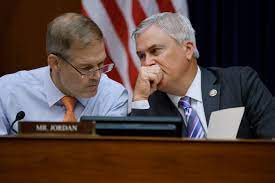
The accusers: Jim Jordan and James Comer
The New York Times: House Set to Approve Biden Impeachment Inquiry as It Hunts for an Offense.
The Republican-led House is on track to approve a formal impeachment inquiry into President Biden on Wednesday, pushing forward with a yearlong G.O.P. investigation that has failed to produce evidence of anything approaching high crimes or misdemeanors.
Republicans say the vote, which is expected in the evening, is needed to give them full authority to carry out their investigations amid anticipated legal challenges from the White House. Democrats have denounced the inquiry as a fishing expedition and a political stunt.
G.O.P. leaders refrained for months from calling a vote to open an impeachment inquiry, given the reservations of mainstream Republicans, many of them from politically competitive districts, about moving forward without proof that Mr. Biden did anything wrong. But the political ground has shifted considerably, and most of them are now willing to do so, emphasizing that they are not yet ready to charge the president.
“Voting in favor of an impeachment inquiry does not equal impeachment,” Representative Tom Emmer of Minnesota, the No. 3 House Republican, said at a news conference on Tuesday. “We will continue to follow the facts wherever they lead, and if they uncover evidence of treason, bribery or other high crimes and misdemeanors, then and only then will the next steps towards impeachment proceedings be considered.”
Read more at the NYT. I guess we’ll learn later today if the Republicans have the votes for their impeachment inquiry without a shred of evidence to support it.
More stories worth checking out today:
AP: Biden takes a tougher stance on Israel’s ‘indiscriminate bombing’ of Gaza.
The New York Times: Top Court Clears Path for Democrats to Redraw House Map in New York.
Reuters: US agency will not reinstate $900 mln subsidy for SpaceX Starlink unit.
The New York Times: In a First, Nations at Climate Summit Agree to Move Away From Fossil Fuels.
Shan Wu at The Daily Beast: Trump, Elon Musk, and Billionaire ‘Populists’ Threaten Democracy and Freedom.
Lazy Caturday Reads
Posted: May 27, 2023 Filed under: 2024 Elections, 2024 presidential Campaign, abortion rights, cat art, caturday, Donald Trump, just because | Tags: abortion, Caitlin Bernard, debt ceiling crisis, Janet Yellen, Kevin McCarthy, Kyrsten Sinema, Ron DeSantis, Trump Manhattan criminal case, work requirements for social programs 12 Comments
Sleeping Cat, by Guzel Min, 2021
Happy Caturday!!
The folks in DC are still arguing about whether the U.S. government should pay its bills or not. Republicans think it’s much more important to make poor, disabled, and elderly Americans, as well as federal employees–including the military–suffer than to simply write those checks and then sit down and work on the next budget. If Congress doesn’t get its act together, millions of people in those categories will be unable to pay their rent and bills and buy food. I suppose this will go down to the wire and then be worked out, but I think the whole mess is getting dangerous.
Here’s what’s happening as of this morning.
NBC News: The U.S. now has until June 5 to act on the debt ceiling, Yellen says.
The United States has a few more days than expected before it runs out of money, Treasury Secretary Janet Yellen said in a letter Friday afternoon.
The new deadline to act or risk breaching the debt ceiling is June 5, Yellen said, setting a hard deadline for the first time. She had previously been less specific, saying the breach could occur “potentially as early as June 1.”
The Treasury Department hit the statutory borrowing limit in January and has since been using “extraordinary measures” to pay the country’s bills.
“Based on the most recent available data, we now estimate that Treasury will have insufficient resources to satisfy the government’s obligations if Congress has not raised or suspended the debt limit by June 5,” Yellen wrote to congressional leaders.
This is just about paying the bills that we’ve already run up, but Republicans want hold the funds hostage so they can punish people who need help from the government.
The two parties have been sorting through their differences on spending levels. But a major hangup is the Republican demand to impose tougher work requirements for Americans to receive federal benefits like SNAP, the Supplemental Nutrition Assistance Program, two sources familiar with the talks said.
Rep. Garret Graves of Louisiana, who is leading negotiations for House Republicans, said it’s “totally appropriate” for an older group of able-bodied Americans without dependents to be subject to work requirements in order to get federal aid….
Democrats say work requirements already exist for federal programs and argue that stricter policies would create more red tape and throw eligible Americans who don’t complete the paperwork correctly off the rolls, and that work requirements have little impact on unemployment.

Painting by Quint Bucholz
Republicans know they’d never win this argument without holding the full faith and credit of our country hostage, so that is what they are doing. If only Democrats had listened to Yellen when they still held a majority in both houses for a brief time after the midterms, this wouldn’t be happening now.
The New York Times: Yellen’s Debt Limit Warnings Went Unheeded, Leaving Her to Face Fallout.
In the days after November’s midterm elections, Treasury Secretary Janet L. Yellen was feeling upbeat about the fact that Democrats had performed better than expected and maintained control of the Senate.
But as she traveled to the Group of 20 leaders summit in Indonesia that month, she said Republicans taking control of the House posed a new threat to the U.S. economy.
“I always worry about the debt ceiling,” Ms. Yellen told The New York Times in an interview on her flight from New Delhi to Bali, Indonesia, in which she urged Democrats to use their remaining time in control of Washington to lift the debt limit beyond the 2024 elections. “Any way that Congress can find to get it done, I’m all for.”
Democrats did not heed Ms. Yellen’s advice. Instead, the United States has spent most of this year inching toward the brink of default as Republicans refused to raise or suspend the nation’s $31.4 trillion borrowing limit without capping spending and rolling back parts of President Biden’s agenda.
So what will Yellen do in the worst case scenario?
Ms. Yellen has held her contingency plans close to the vest but signaled this week that she had been thinking about how to prepare for the worst. Speaking at a WSJ CEO Council event, the Treasury secretary laid out the difficult decisions she would face if the Treasury was forced to choose which bills to prioritize.
Most market watchers expect that the Treasury Department would opt to make interest and principal payments to bondholders before paying other bills, yet Ms. Yellen would say only that she would face “very tough choices.”
White House officials have refused to say if any contingency planning is underway. Early this year, Biden administration officials said they were not planning for how to prioritize payments. As the U.S. edges closer to default, the Treasury Department declined to say whether that has changed.
Yet former Treasury and Federal Reserve officials said it was nearly certain that emergency plans were being devised.
Read more at the NYT.

Cat on a windowsill, artist unknown
My eyes bugged out when I read this one at Axios: Scoop: Sinema enters debt ceiling negotiations. Just what we don’t need.
Sen. Kyrsten Sinema (I-Ariz.) has inserted herself into the debt ceiling negotiations, working with both sides to try to bridge differences on permitting reform, according to people familiar with the matter.
Why it matters: Her late entrance is a sign that negotiators are willing to explore new avenues to resolve thorny issues before June 5, the new deadline from Treasury Secretary Janet Yellen for when the U.S. government will run out of money.
— Permitting reform — a catch-all category that includes both Republican and Democratic plans to improve energy production and transmission — is emerging as a tough-to-resolve disagreement between the White House and congressional negotiators.
— Republicans want to change the National Environmental Policy Act (NEPA) with the goal of cutting red tape for oil and gas companies when they develop new projects. Democrats want to make it easier for solar and wind farms to access transmission lines.
Negotiators also are at an impasse on a demand from House Speaker Kevin McCarthy (R-Calif.) to add new work requirements to welfare benefits, according to Biden administration officials.
— But the two sides are making progress on overall spending levels, with the goal of capping spending for two years at lower levels. In exchange, the debt ceiling would be raised past the 2024 elections.
Ugh!
Here’s a bit of dark humor on the debt ceiling crisis by Dana Millbank at The Washington Post: Save the world economy or his own job? McCarthy can’t decide.
After a debt limit negotiating session at the White House this week, House Speaker Kevin McCarthy returned to the Capitol and offered reporters an update.
Filippo Corelli, Cat in a Doorway, early 20th century
This might be the most worrying aspect of the default standoff: The full faith and credit of the United States hangs in the balance, and the man sitting across the negotiating table from the president seems to be genuinely off-kilter.
Whipsawed by public pressure from the far-right House Freedom Caucus and from former president Donald Trump, McCarthy has at one moment praised the “honesty” and “professionalism” of White House negotiators and the next moment attacked the other side as “socialist.” He gives daily (sometimes hourly) updates packed with fake statistics, nonsense anecdotes and malapropisms. His negotiators have walked out of talks only to resume them hours later. This week, at a meeting of the House Republican Conference during the height of negotiations, he decided it was the right moment to auction off a stick of his used lip balm as a fundraiser for House Republicans’ political campaigns. (Rep. Marjorie Taylor “Jewish Space Lasers” Greene won the bidding at $100,000.)
The speaker’s erraticism has an obvious origin. As usual, he isn’t leading. He’s being buffeted by crosscurrents. If he bends too much in talks, he’ll lose his GOP hardliners and could therefore lose his job. If he pleases the hardliners, he keeps his job but throws the country and perhaps the world into economic calamity. His job security or the world economy? McCarthy just can’t decide.

Read the rest at the WaPo.
Moving on to other topics….
CBS has a tidbit about the criminal case against Trump in Manhattan: Prosecutors in Trump’s criminal case say they have recording of Trump and a witness.
Prosecutors in former President Donald Trump’s Manhattan criminal case have released to his attorneys a recording of Trump and a witness, whose identity was not disclosed, according to a document the office made public Friday.
The document, called an automatic discovery form, describes the nature of the charges against a defendant and a broad overview of the evidence that prosecutors will present at Trump’s preliminary hearing or at trial. Trump’s attorneys and media organizations, including CBS News, had repeatedly requested that such a form be made public in the weeks since Trump’s arrest on April 4….
The document lists the dates of 34 instances between Feb. 14, 2017 and Dec. 5, 2017 when he allegedly falsified records.
In a section devoted to electronic evidence that will be turned over, a prosecutor for Manhattan District Attorney Alvin Bragg’s office indicated they have disclosed to the defense a “recording of a conversation between defendant and a witness.”
The section also indicates prosecutors intend to disclose recordings of calls between witnesses and others.
That could be interesting.

Three Cats, by Ann Hewson
“National experts” are responding to the treatment of Indiana doctor Caitlin Bernard who treated a 10-year-old Ohio girl who had been impregnated through rape. Indy Star: ‘Chilling effect’: National experts decry decision against abortion doctor Caitlin Bernard.
Dressed in white coats, Drs. Tracey Wilkinson and Caroline Rouse were among the first to arrive at Caitlin Bernard’s Thursday hearing in front of the Indiana medical licensing board. When the hearing ended nearly 15 hours later, they were among the last to leave.
Six months after Indiana’s Republican attorney general filed a complaint against the Indianapolis obstetrician-gynecologist, the board voted to reprimand and fine Bernard on Thursday, finding that she violated privacy laws in giving a reporter information about a 10-year-old rape victim.
But representatives of the medical community nationwide – from individual doctors to the American Medical Association to an author of HIPAA – don’t think Bernard did anything wrong. Further, they say, the decision will have a chilling effect on those involved with patient care.
“This sends a message to all doctors everywhere that political persecution can be happening to you next for providing health care to your patients,” Wilkinson said.
“It’s terrible,” Rouse said. They’d just spent hours “listening to our friend and our colleague be put on trial for taking care of her patient and providing evidence-based health care, and that is incredibly demoralizing as a physician.”
Guess what? Republicans don’t care.
Ron DeSantis has been announcing some of the things he would do if he were elected president in 2024.
The Hill: DeSantis says he’ll consider pardoning Jan. 6 defendants, including Trump.
Florida Gov. Ron DeSantis (R) said Thursday that if elected president, he will consider pardoning all the Jan. 6 defendants — including former President Trump — on his first day in office.
“On day one, I will have folks that will get together and look at all these cases, who people are victims of weaponization or political targeting, and we will be aggressive in issuing pardons,” DeSantis said on “The Clay Travis & Buck Sexton Show” podcast when asked about whether he will consider pardoning Jan. 6 defendants, including Trump, who is currently facing a federal investigation over his role on Jan. 6.
Nineteenth Century cat in doorway, Boston School, artist unknown
“I would say any example of disfavored treatment based on politics, or weaponization would be included in that review, no matter how small or how big,” he added.
DeSantis also accused the Justice Department and the FBI of weaponizing its authority by pursuing ongoing investigations into the Jan. 6 attack on the Capitol. The Justice Department said earlier this month that 1,033 arrests have been made in connection to the Capitol attacks and about 485 people have been sentenced due to criminal activity conducted that day.
DeSantis also claimed that the FBI is targeting anti-abortion groups, as well as parents who want to attend school board meetings. He said that if elected, his administration would determine on a “case-by-case” basis if the government was weaponized against certain groups.
“We’re going to find examples where the government’s been weaponized against disfavored groups, and we will apply relief as appropriate, but it will be done on a case-by-case basis,” he said.

Also from The Hill: DeSantis says he would push to repeal Trump criminal justice reform if elected.
Florida Gov. Ron DeSantis (R) said Friday that if elected president, he would call on Congress to repeal the criminal justice reform bill signed into law by then-President Trump, his latest attack on Trump from the right.
DeSantis, appearing on “The Ben Shapiro Show,” criticized the First Step Act, a bipartisan bill passed in 2018 that reduced mandatory minimum sentences, expanded credits for well-behaved prisoners looking for shorter sentences and aimed to reduce recidivism.
The Florida governor, who officially entered the 2024 White House race on Wednesday, called the legislation “basically a jailbreak bill.”
“So one of the things I would want to do as president is go to Congress and seek the repeal of the First Step Act,” he said. “If you are in jail, you should serve your time. And the idea that they’re releasing people who have not been rehabilitated early, so that they can prey on people in our society is a huge, huge mistake.”
DeSantis voted for the initial House version of the bill while serving as a congressman in 2018, something Trump’s team has highlighted.
If you didn’t already know that DeSantis is corrupt, there’s this from the Sarasota Herald-Tribune: GOP officials: Top aides in governor’s office asked lawmakers to endorse DeSantis.
Top aides to Gov. Ron DeSantis were involved in rounding up endorsements for his presidential campaign from members of the Florida Legislature during a time when lawmaker’s bills and budget priorities were at the mercy of the governor’s office, according to three GOP sources with knowledge of the conversations.
A Republican lawmaker says DeSantis’ top budget official called earlier this month to discuss the lawmaker endorsing DeSantis’ presidential campaign.
The lawmaker and a GOP consultant who was told about the endorsement conversation with DeSantis’ budget chief Chris Spencer immediately after it happened said the call was inappropriate and raised ethical questions.
Blinking in the Sun, by Ralph Hedley, 1881
Having state employees in the governor’s office, instead of staff on the governor’s political team, asking for endorsements raises concerns about whether the governor’s staff was improperly leveraging state resources to help his campaign.
That includes using taxpayer-funded employees for political purposes, which is allowed if it’s not during work hours but still inappropriate in this circumstance in the mind of the lawmaker contacted by Spencer. It also relates to what some saw as an implied threat that lawmakers’ bills and state budget items could be vetoed if they didn’t back DeSantis.
The lawmaker who spoke to Spencer said budget priorities didn’t come up during the call, but the fact that DeSantis’ budget director was calling about an endorsement implicitly tied the budget items to the political ask….
Another top DeSantis aide — legislative affairs director Stephanie Kopelousos — did discuss budget items during calls with multiple lawmakers that included Kopelousos asking them to endorse DeSantis, according to the GOP lawmaker who spoke with Spencer.
That lawmaker later spoke with at least five legislators who were asked by Kopelousos to endorse DeSantis. Another prominent GOP leader in Florida said he spoke to a lawmaker who relayed that he repeatedly was contacted by Kopelousos about endorsing DeSantis.

This guy should never get anywhere near the presidency.
That’s it for me today. What stories have captured your interest lately?
Fabulous Friday Reads
Posted: May 26, 2023 Filed under: abortion rights, Donald Trump, SCOTUS | Tags: abortion, books and reading, Caitlin Bernard, Clean Water Act, Espionage Act, Indiana, rape, Samuel Alito, Supreme Court, Trump stolen documents case, wetlands 13 CommentsGood Day, Sky Dancers!!
I am addicted to books. In my adult years, I have bought so many books that I could never read them all; but I can’t stop myself–or maybe I don’t want to. When I moved into the apartment I live in now, I had to leave hundreds of books behind, because I simply didn’t have room for them. I tell myself an addiction to buying books is at least better than addictions to alcohol and drugs. I do much of my reading on my Kindle now, and at least those books don’t take up space. But I still love physical books and I still buy more than I can read. I’m 75 years old now, and I don’t have that much time left; but I still want to read as many books as I can before I “shuffle off this mortal coil.”
Could this be a solution?
Okay, probably not; but it’s an interesting fantasy. And now for some news.
Yesterday The Washington Post broke a story on the investigation into Trump’s theft of, and refusal to return, government documents. A short time later, The New York Times followed up with more details.
Devlin Barrett, Josh Dawsey, Spencer S. Hsu, and Perry Stein at The Washington Post: Trump workers moved Mar-a-Lago boxes a day before FBI came for documents.book
Two of Donald Trump’s employees moved boxes of papers the day before an early June visit byFBI agents and a prosecutor to the former president’s Florida home to retrieve classified documents in response to a subpoena — timing that investigators have come to view as suspicious and an indication of possible obstruction, according to people familiar with the matter.
Trump and his aides also allegedly carried out a “dress rehearsal” for moving sensitive papers even before his office received the May 2022 subpoena, according to the people familiar with the matter who spoke on the condition of anonymity to describe a sensitive ongoing investigation.
Prosecutors in addition have gathered evidence indicating that Trump at times kept classified documents in his office in a place where they were visible and sometimes showed them to others, these people said.
Taken together, the new details of the classified-documents investigation suggest a greater breadth and specificity to the instances of possible obstruction found by the FBI and Justice Department than have been previously reported. It also broadens the timeline of possible obstruction episodes that investigators are examining — a period stretching from events at Mar-a-Lago before the subpoena to the period after the FBI search there on Aug. 8.
That timeline may prove crucial as prosecutors seek to determine Trump’s intent in keeping hundreds of classified documents after he left the White House, a key factor in deciding whether to file charges, possibly for obstruction, mishandling national security secrets or both. The Washington Post has previously reported that the boxes were moved out of the storage area after Trump’s office received a subpoena. But the precise timing of that activity is a significant element in the investigation, the people familiar with the matter said.
The WaPo writers focus on obstruction, but if Trump showed documents to other people, that could be espionage. Remember, espionage was one of the crimes listed on the warrant for the FBI search of Mar-a-Lago.
More details from the WaPo story:
Of particular importance to investigators in the classified-documents case, according to people familiar with the probe, is evidence showing that boxes of documents were moved into a storage area on June 2, just before senior Justice Department lawyer Jay Bratt arrived at Mar-a-Lago with agents. The June 3 visit by law enforcement officialswas to collect material in response to the May 2022grand jury subpoena demanding the return of all documents with classified markings.
John Irving, a lawyer representing one of the two employees who moved the boxes, said the worker did not know what was in them and was only trying to help Trump valet Walt Nauta, who was using a dolly or hand truck to move a number of boxes.
“He was seen on Mar-a-Lago security video helping Walt Nauta move boxes into a storage area on June 2, 2022. My client saw Mr. Nauta moving the boxes and volunteered to help him,” Irving said. The next day, he added, the employee helped Nauta pack an SUV “when former president Trump left for Bedminster for the summer.”
The lawyer said his client, a longtime Mar-a-Lago employee whom he declined to identify, has cooperated with the government and did not have “any reason to think that helping to move boxes was at all significant.” Other people familiar with the investigation confirmed the employee’s role and said he has been questioned multiple times by authorities.
Awhile back there was a video circulating on Twitter of people moving boxes out of Mar-a-Lago and loading them onto a truck to be taken to Bedminster. This happened the day before Trump left to spend the summer at his New Jersey golf club. Now it’s being posted again.
This is from Alan Feuer and Maggie Haberman at The New York Times: Mar-a-Lago Worker Provided Prosecutors New Details in Trump Documents Case.
The day before a key meeting last year between a lawyer for former President Donald J. Trump and officials seeking the return of classified documents in Mr. Trump’s possession, a maintenance worker at the former president’s private club saw an aide moving boxes into a storage room, according to a person familiar with the matter.
The maintenance worker offered to help the aide — Walt Nauta, who was Mr. Trump’s valet in the White House — move the boxes and ended up lending him a hand. But the worker had no idea what was inside the boxes, the person familiar with the matter said. The maintenance worker has shared that account with federal prosecutors, the person said….
Mr. Trump was found to have been keeping some of the documents in the storage room where Mr. Nauta and the maintenance worker were moving boxes on the day before the Justice Department’s top counterintelligence official, Jay Bratt, traveled to Mar-a-Lago last June to seek the return of any government materials being held by the former president.
Mr. Nauta and the worker moved the boxes into the room before a search of the storage room that same day by M. Evan Corcoran, a lawyer for Mr. Trump who was in discussions with Mr. Bratt. Mr. Corcoran called Justice Department officials that night to set up a meeting for the next day. He believed that he did not have a security clearance to transport documents with classified markings, a person briefed on his decision said.
Weeks earlier, the Justice Department had issued a subpoena demanding the return of the documents. Prosecutors have been trying to determine whether Mr. Trump had documents moved around Mar-a-Lago or sought to conceal some of them after the subpoena.
Part of their interest is in trying to determine whether documents were moved before Mr. Corcoran went through the boxes himself ahead of a meeting with Justice Department officials looking to retrieve them. Prosecutors have been asking witnesses about the roles of Mr. Nauta and the maintenance worker, whose name has not been publicly disclosed, in moving documents around that time.
During his trip to Mar-a-Lago on June 3, Mr. Bratt was given a packet of roughly three dozen documents with classified markings by a lawyer for Mr. Trump. Mr. Bratt was also given a letter, drafted by Mr. Corcoran but signed by another lawyer for the former president, attesting that a diligent search had been carried out for any additional material in response to the subpoena and that none had been found. Mr. Bratt was not given access to search the storage room at that point.
The obvious inference is that Trump may have gone through the boxes and removed items that he wanted to keep, concealing them in his private quarters. Remember that classified documents were later found in his office desk and in his bedroom.
Like the WaPo writers, Feuer and Haberman focus their discussion on possible obstruction charges, and ignore the obvious possibility of espionage charges based on the fact that Trump showed documents to people at his private club and left them lying around in plain sight.
The penalties for violating the espionage act are 20 years in prison and a $10,000 fine.
In other news, the Supreme Court yesterday announced another horrific decision. This time they’ve gutted the Clean Water Act.
Timothy Puko and Robert Barnes at The Washington Post: How Supreme Court’s EPA ruling will affect U.S. wetlands, clean water.
Bogs. Marshes. Swamps. Fens. All are examples of wetlands.
But the type of wetland that gets protection under federal law is a matter of wide dispute, one reset by a sweeping ruling Thursday from the U.S. Supreme Court.
At issue is the reach of the 51-year-old Clean Water Act and how courts should determine what count as “waters of the United States” under that law. Nearly two decades ago, the court ruled that wetlands are protected by the Clean Water Act if they have a “significant nexus” to regulated waters.
The Supreme Court decided that rule no longer applies and said the Environmental Protection Agency’s interpretation of its powers went too far, giving it regulatory power beyond what Congress had authorized….
Writing for five justices of the court, Justice Samuel A. Alito ruled that the Clean Water Act extends only to “those wetlands with a continuous surface connection to bodies that are ‘waters of the United States’ in their own right, so that they are ‘indistinguishable’ from those waters.” He was joined by Chief Justice John G. Roberts Jr. and Justices Clarence Thomas, Neil M. Gorsuch and Amy Coney Barrett….
Some environmental groups and legal experts estimate that the decision will remove federal protection from half of all wetlands in the continental United States. According to estimates from Earthjustice, an environmental law firm, the decision will prevent the EPA from placing federal protections on as many as 118 million acres of wetlands, an area larger than the landmass of California. Those estimates could not be immediately confirmed, but the ruling is expected to give farmers, home builders and other developers far more latitude to disturb lands previously regulated under the Clean Water Act….
The ruling affects one of the EPA’s most fundamental authorities — its ability to protect upstream waters in order to protect downstream water quality for drinking supplies and wildlife. Experts say greater development upstream could result in silt and pollutants damaging downstream waters and habitat, and reduce the flood control and groundwater-recharge benefits of protected wetlands.
Read all the gory details at the WaPo link.
Commentary by Mark Joseph Stern at Slate: Samuel Alito’s Assault on Wetlands Is So Indefensible That He Lost Brett Kavanaugh.
On Thursday, the Supreme Court dealt a devastating blow to the nation’s wetlands by rewriting a statute the court does not like to mean something it does not mean. The court’s decision in Sackett v. EPAis one of the its most egregious betrayals of textualism in memory. Put simply: The Clean Water Act protects wetlands that are “adjacent” to larger bodies of water. Five justices, however, do not think the federal government should be able to stop landowners from destroying wetlands on their property. To close this gap between what the majority wants and what the statute says, the majority crossed through the word “adjacent” and replaced it with a new test that’s designed to give landowners maximum latitude to fill in, build upon, or otherwise obliterate some of the most valuable ecosystems on earth.
Justice Samuel Alito’s opinion for the court is remarkably brazen about this approach—so brazen that Justice Brett Kavanaugh (of all people!) authored a sharp opinion accusing him of failing to “stick to the text.” Alito began with a long history of the Supreme Court’s struggles to identify the “outer boundaries” of the Clean Water Act, as if to explain why the time had come for the court to give up wrestling with the text and just impose whatever standard it prefers. The law expressly protects “waters of the United States” (like rivers and lakes) as well as “wetlands adjacent” to these waters. Congress added the wetlands provision in 1977 to codify the EPA’s definition of “adjacent,” which also happens to be the actual definition: “bordering, contiguous, or neighboring.” Under that interpretation—the one Congress adopted—wetlands that neighbor a larger body of water remain protected, even if they aren’t directly connected.
Why did Congress make that choice? Because wetlands provide immense environmental benefits: They filter and purify water draining into nearby streams, rivers, and lakes. They slow down runoff into these larger bodies. And they serve as vital flood control. In other words, the Clean Water Act has to protect “adjacent” wetlands to serve its overarching goal of safeguarding the broader “waters of the United States” from pollution.
Too bad, Alito wrote: We don’t like the definition that Congress used. It could lead to “crushing” fines for landowners and interfere with “mundane” activities like “moving dirt.” It interferes with “traditional state authority.” And it could give the EPA “truly staggering” regulatory authority. Five justices on the Supreme Court think all of that is very bad. So they declared that, instead of applying the statute’s words, the court would impose a different standard: Only wetlands with “a continuous surface connection” to larger bodies of water merit protection under the Clean Water Act.
This definition—which, it just can’t be stressed enough, appears nowhere in the law—is a crushing defeat for wetlands and their protectors. These ecosystems, as Kavanaugh pointed out, are frequently separated from larger bodies of water by “man-made dikes or barriers” as well as “natural river berms, beach dunes, or the like.” Such wetlands “play an important role in protecting neighboring and downstream waters,” which is why Congress included them in the statute. But under the majority’s new test, they are stripped of federal protection.
Sam Alito: the same asshole who overturned Roe v. Wade while citing a 17th century judge who presided over a witch trial.
I’ll wrap up this post with an abortion horror story at The Washington Post: Indiana board fines doctor for discussing rape victim’s abortion.
https://twitter.com/donmoyn/status/1662078210518007813?s=20
Indiana’s medical licensing board decided late Thursday to discipline a doctor who made headlines last year for performing an abortion for a 10-year-old Ohio rape victim. The board gave the doctor a letter of reprimand and ordered her to pay a $3,000 fine for violating ethical standards and state laws by discussing the case with a reporter.
For nearly a year, Indiana’s Attorney General Todd Rokita (R) pursued punishment for Caitlin Bernard, an OB/GYN and an assistant professor at the Indiana University School of Medicine who carried out the abortion in June 2022, less than a week after Roe v. Wade was struck down, enacting trigger laws.
Bernard broke patient privacy laws by telling an Indianapolis Star reporter about the patient’s care, the board decided Thursday night after a roughly 14-hour hearing that ended shortly after 11:30 p.m. Bernard’s lawyers argued she properly reported the incident to an Indiana University Health social worker and did not run afoul of privacy laws when she discussed the patient’s case in a general and “deidentified” manner that is typical for doctors.
Records obtained by The Washington Post last year show that Bernard reported the girl’s abortion to the relevant state agencies ahead of the legally mandated deadline, which the board agreed with Thursday night, clearing her of a charge related to that issue.
These assholes are supposedly doing this in order to “protect” the patient–a 10-year-old child who was impregnated by a rapist in Ohio and had to travel to Indiana because her Ohio politicians determined that she should be forced to bear her rapist’s child even though that could be life-threatening for her.
Bernard’s lawyers rejected Rokita’s allegations as baseless and politically motivated. The seven-member board of governor appointees could, by a majority vote, have either taken no action against Bernard or imposed a range of disciplinary measures up to and including the immediate termination of Bernard’s medical license.
Throughout the lengthy hearing, Bernard faced at times pointed questions about her decisions.
She explained how, as a doctor, she felt she had “an obligation” to ensure Hoosiers understood how abortion bans were affecting people across the country — and could eventually affect them.
Bernard was also asked whether she thought she would have “gotten as much attention” if she had not mentioned the 10-year-old patient’s case to a reporter.
“I don’t think that anybody would have been looking into this story as any different than any other interview that I’ve ever given if it was not politicized the way that it was by public figures in our state and in Ohio,” Bernard said.
That’s my contribution for today. What stories have you been following lately?
Lazy Caturday Reads
Posted: May 20, 2023 Filed under: abortion rights, cat art, caturday, Democratic Politics, Donald Trump, Republican politics, SCOTUS | Tags: 14th amendment, abortion, debt limit, default, Gov. Roy Cooper, Joe Biden, media, North Carolina, recession, Ron DeSantis, Russia, shadow docket, Steve Vladeck, Supreme Court 22 Comments
The Cat by an open Window (Aix-en-Provence) Charles Camoin
Happy Caturday!!
It is just me, or is the political news getting so complex and frightening as to be overwhelming? I’ve been looking around the internet for stories to post today, and it seems to me there is way too much going wrong. Is it my own anxiety and depression interfering with my judgment? Or is the country really on the brink of disaster? I hope it’s just me.
Let’s see, there is the most immediate crisis: the debt ceiling impasse. Then there’s frightening long-term threat of Donald Trump and his followers. There’s the building threat of Ron DeSantis. And there are more frightening issues: the Supreme Court and the effects of their recent decisions on women–abortion bans in many states, and the possibility of limits on birth control. There’s also Russia’s war on Ukraine–which I’ve pretty much given up on following–and the danger to our country posed by Republicans who support Russia in that conflict. And of course, for the longer-term, there are the threats to the environment and to humans from climate change. Have our lives always been this complicated?
I’m going to start by recommending a very long essay by Michael Tomasky at The New Republic: Donald Trump Against America. The subhead is, “He loves an America of his twisted imagination. He hates—and fears—the America that actually exists. And if he gets back to the White House … look out.” I haven’t actually finished reading this article–it’s practically book-length, but I’ve read quite a bit and plan to go back and finish it. It’s a look at the modern history of U.S. politics and an analysis of the current negativity of the Republican party as opposed to what Americans actually believe and want today. Republicans are completely out of step with modern American attitudes, and yet they have outsize power to affect our reality because of their control of the Supreme Court, Congress, and state governments.
Now for the most immediate issue–the debt ceiling fight.
Talking Points Memo: Growing List Of Dems Urge Biden To Cite 14th Amendment To Sidestep McCarthy’s Debt-Ceiling Hostage Crisis.
A growing group of Senate Democrats is urging President Joe Biden to seriously consider invoking the 14th Amendment to declare the debt ceiling unconstitutional, a strategy that — if upheld by the courts — could avert a looming default without any concessions to House Republicans, who have used their slim majority to take the debt ceiling hostage.
Sens. Tina Smith (D-MN), Elizabeth Warren (D-MA), Jeff Merkley (D-OR), Ed Markey (D-MA) and Bernie Sanders (I-VT) have been circulating a letter amongst their colleagues this week to collect support for Biden to invoke the 14th Amendment and lift the debt ceiling without any help from House Republicans.
By Suellen Ross
“We write to urgently request that you prepare to exercise your authority under the 14th Amendment of the Constitution, which clearly states: ‘the validity of the public debt of the United States … shall not be questioned,’” the draft letter reads. “Using this authority would allow the United States to continue to pay its bills on-time, without delay, preventing a global economic catastrophe.”
As the so-called “x-date” — when House Republicans may push the country to default on its debts — draws closer, legal scholars have pointed out that the 14th Amendment seemingly declares the debt ceiling unconstitutional. It’s an argument that also gained traction during the Obama-era debt-ceiling standoffs, though that Democratic administration ultimately chose not to embrace it.
Now, some Democrats are saying the Biden White House should give it a hard look, arguing that the Civil War-era amendment requires the administration to continue to pay the U.S.’s bills regardless of the early 20th century debt ceiling statute, and Republicans’ 21st century attempts to take it hostage. A list of demands passed by the Republican-controlled House last month includes spending cuts to some of Democrats’ most prized priorities.

At Politico, Adam Cancryn claims that’s not likely: Biden’s 14th Amendment message to progressives: It ain’t gonna happen.
Progressive lawmakers renewed their call for President Joe Biden to bypass Congress to avert a default after the abrupt cancellation of debt ceiling talks on Friday.
But the White House remains resistant. It issued a subdued statement indicating it sees no reason to pull the plug on talks. And privately, its message has been even blunter.
Senior Biden officials have told progressive activists and lawmakers in recent days that they do not see the 14th Amendment — which says the “validity of the public debt” cannot be questioned — as a viable means of circumventing debt ceiling negotiations. They have argued that doing so would be risky and destabilizing, according to three people familiar with the discussions.
The White House has studied the issue for months, with some aides concluding that Biden would likely have the authority to declare the debt limit unconstitutional as a last-ditch way to sidestep default. But Biden advisers have told progressives that they see it as a poor option overall, fearing such a move would trigger a pitched legal battle, undermine global faith in U.S. creditworthiness and damage the economy. Officials have warned that even the appearance of more seriously considering the 14th Amendment could blow up talks that are already quite delicate.
“They have not ruled it out,” said one adviser to the White House, granted anonymity to speak candidly about discussions. “But it is not currently part of the plan.”
Well, at least they haven’t completely ruled it out.

A Cat Basking in the Sun, Bruno Lijefors
Sara Chaney Cambon at The Wall Street Journal: Debt-Ceiling Standoff Could Start a Recession, But Default Would Be Worse.
Prolonged debt-ceiling squabbling could push the U.S. economy into recession, while a government default on its obligations might touch off a severe financial crisis.
U.S. lawmakers are negotiating over raising the federal government’s borrowing limit and may have just days to act before the standoff reverberates through the economy.
Treasury Secretary Janet Yellen said that the government could become unable to pay bills on time by June 1. In that case, the Treasury Department could halt payments, such as to federal employees or veterans.
In a worst-case scenario, a failure to pay holders of U.S. government debt, a linchpin of the global financial system, could trigger severe recession and send stock prices plummeting and borrowing costs soaring.
Many economists don’t expect a default for the first time in U.S. history. But they outline three potential ways the standoff could affect the economy and financial system, ranging from not great to extremely scary.
Camon discusses the likely results of three scenarios:
1) Last minute deal
The economy is already slowing due to rising interest rates, with many forecasters expecting a recession this year. While lawmakers haggle, uncertainty could cause consumers, investors and businesses to retrench, increasing the chances of a recession, said Joel Prakken, chief U.S. economist at S&P Global Market Intelligence.
Workers aren’t likely to lose their jobs, but the unpredictability of the economic outlook could cause them to put off purchases.
Stock prices could start to decline as June 1 nears….“Even if we get an agreement before we run out of resources there still could be a legacy effect of the uncertainty that restrains economic growth,” Prakken said.
2) Deal after deadline
If negotiations extend beyond Thursday June 1, economists expect a more severe reaction from financial markets, as the possibility for default looks more real.
“The shock would tend to accelerate quite rapidly” on June 1, said Gregory Daco, chief economist at Ernst & Young.
If consumers’ retirement and investment accounts suddenly shrink, they could sharply curtail their spending, the lifeblood of the U.S. economy. Businesses could pause hiring and investment plans.
3) No deal
If no deal is reached and the government can’t pay all its bills for days or weeks, repercussions would be enormous.
“There would be chaos in the global financial system because Treasurys are so important,” said Wendy Edelberg, an economist at the Brookings Institution. “What happens when that thing that everybody is benchmarking themselves to proves to be one of the riskiest things out there?”
Ernst & Young’s Daco said a default would trigger a recession more severe than the 2007-09 downturn.
Read more details at the WSJ link. If you can’t get in with my link, try using the one at Memeorandum.
A couple more stories on the debt limit impasse:
Jason Linkins at The New Republic: The Beltway Media Is Spreading Debt Limit Misinformation. The political press bears a share of the blame for the fact we are once again on the precipice of default.
Carl Hulse at The Washington Post: Finger-Pointing Won’t Save Anyone if Default Leads to Economic Collapse.

Jacobus van Looy, White Cat at an Open Window, 1895
In other news, if Biden manages to win the debt ceiling war, will Republican missteps on the abortion issue help him win in 2024?
CNN: ‘Reap the whirlwind’: Biden and North Carolina Democrats see 2024 edge in GOP abortion ban.
North Carolina Republicans jumped out on a limb this week when they passed a controversial new abortion ban. Democrats are now rushing to saw it off.
The state GOP legislative supermajority’s decision to override Democratic Gov. Roy Cooper’s veto of the measure sharpened the stakes for next year’s elections – and gave Democrats new impetus to invest up and down the North Carolina ballot.
At the top of the ticket, President Joe Biden’s campaign is already drawing up plans to focus on the ban, which outlaws most abortions after 12 weeks, in its bid to win a state last captured by a Democratic presidential candidate in 2008. Former President Donald Trump’s victory there in 2020 was his narrowest of the election, and North Carolina is critical to any Republican’s path to the White House.
The shock waves from the brief but fierce abortion fight – 12 days that saw the bill pass, get vetoed by Cooper, then resurrected by Republican lawmakers – are also expected to reach into next year’s races for governor, state attorney general and both legislative chambers. With Cooper term-limited, the campaign to succeed him is expected to be the most competitive governor’s race of 2024, potentially pitting far-right GOP Lt. Gov. Mark Robinson against Democratic Attorney General and Cooper protégé Josh Stein.
The race to succeed Cooper, who has for years beat back the Republican agenda in North Carolina with his veto pen, will be especially heated if Robinson wins the Republican nomination. Democrats are already highlighting his absence from the legislature during the abortion votes – arguing that he is trying to distance himself from the ban. The Republican had tried to avoid publicly commenting on the issue in recent weeks – a reversal from his usual posture – though he told a conservative radio host the day after Republicans overrode Cooper’s veto that North Carolina continued to “move the ball” on abortion.
Read more at CNN.
People have been asking where Ron DeSantis got the money to pay for his round the world and cross country political tour, and The New York Times’ Alexandra Berzon and Rebecca Davis O’Brient got the goods: Air DeSantis: The Private Jets and Secret Donors Flying Him Around.
For Ron DeSantis, Sunday, Feb. 19, was the start of another busy week of not officially running for president.
That night, he left Tallahassee on a Florida hotelier’s private jet, heading to Newark before a meet-and-greet with police officers on Staten Island on Monday morning. Next, he boarded a twin-jet Bombardier to get to a speech in the Philadelphia suburbs, before flying to a Knights of Columbus hall outside Chicago, and then home to his day job as governor of Florida.
Rapp and Johan, Bruno Liljefors, 1886
The tour and others like it were made possible by the convenience of private air travel — and by the largess of wealthy and in some cases secret donors footing the bill.
Ahead of an expected White House bid, Mr. DeSantis has relied heavily on his rich allies to ferry him around the country to test his message and raise his profile. Many of these donors are familiar boosters from Florida, some with business interests before the state, according to a New York Times review of Mr. DeSantis’s travel. Others have been shielded from the public by a new nonprofit, The Times found, in an arrangement that drew criticism from ethics experts.
Mr. DeSantis, who is expected to formally announce his candidacy next week, is hardly the first politician to take advantage of the speed and comfort of a Gulfstream jet. Candidates and officeholders in both parties have long accepted the benefits of a donor’s plane as worth the political risk of appearing indebted to special interests or out of touch with voters.
But ethics experts said the travel — and specifically the role of the nonprofit — shows how Mr. DeSantis’s prolonged candidate-in-limbo status has allowed him to work around rules intended to keep donors from wielding secret influence. As a declared federal candidate, he would face far stricter requirements for accepting and reporting such donations.
“Voters deserve this information because they have a right to know who is trying to influence their elected officials and whether their leaders are prioritizing public good over the interests of their big-money benefactors,” said Trevor Potter, the president of Campaign Legal Center and a Republican who led the Federal Election Commission. “Governor DeSantis, whether he intends to run for president or not, should be clearly and fully disclosing who is providing support to his political efforts.”

Read the rest at the NYT.
One more important story on one of our huge problems–the Supreme Court.
Ian Ward at Politico Magazine: The Supreme Court Is Hiding Important Decisions From You.
As the Supreme Court begins to release its written opinions from its most recent term, much of the public’s attention is focused on high-profile cases on affirmative action, election law and environmental regulation. But according to Stephen Vladeck, a professor at the University of Texas Law School, this narrow focus on the most headline-grabbing decisions overlooks a more troubling change in the High Court’s behavior: The justices are conducting more and more of the court’s most important business out of the public eye, through a procedural mechanism known as “the shadow docket.”
Quantitatively speaking, cases arising from the shadow docket — which include everything apart from the court’s annual average of 60 to 70 signed decisions — have long made up a majority of the justices’ work. But as Vladeck documents in his new book, The Shadow Docket, published this week, the court’s use of the shadow docket changed dramatically during the Trump years, when the court’s conservative majority used a flurry of emergency orders — unsigned, unexplained and frequently released in the middle of the night — to greenlight some of the Trump administration’s most controversial policies.
“What’s remarkable is that the court repeatedly acquiesced and acquiesced [to the Trump administration], and almost always without any explanation,” Vladeck said when I spoke with him. “And they did it in ways that marked a pretty sharp break from how the court would have handled those applications in the past.”
It wasn’t just the frequency of the court’s shadow docket decisions that changed during the Trump years; it was also the scope of those decisions. Whereas the justices have traditionally used emergency orders as temporary measures to pause a case until they can rule on its merits, the current court has increasingly used emergency orders to alter the basic contours of election law, immigration policy, religious liberty protections and abortion rights — all without an extended explanation or legal justification. To illustrate this shift, Vladeck points to the court’s emergency order in September 2021 that allowed Texas’s six-week abortion ban to take effect — a move that effectively undermined Roe v. Wade nine months before the court officially overturned it in Dobbs v. Jackson Women’s Health Organization.
“It really highlights a problem that’s endemic to how we talk about the court, which is that we fixate on the formality of the court’s decision and explanations and downplay the practical effect of its rulings, whether or not they come with those explanations,” Vladeck explained.
Read the rest at Politico.
That’s it for me today. What stories are you following?
Extra Lazy Caturday Reads
Posted: April 29, 2023 Filed under: American Gun Fetish, Cats, caturday, Criminal Justice System, Donald Trump, ethics, SCOTUS | Tags: abortion, AR-15, Dobbs decision, Jane Roberts, John Roberts, mass shootings, nuclear weapons, Samuel Alito, stolen classified documents case, Texas, Trump fund-raising, Ukraine, Wire fraud 14 Comments Happy Caturday!!
I’m getting a very slow start this morning. It feels like everything is kind of awful today, as it often is lately. The politics news is bad enough, but sadly there’s been another mass shooting and the perpetrator is still at large. Not surprisingly, it’s in Texas, and of course the weapon was an AR-15.
ABC News: 5 dead in Texas ‘execution-style’ shooting, suspect armed with AR-15 is on the loose.
Five people are dead after being shot in a Texas home by a suspect armed with an AR-15 style rifle in a horrific series of “execution style” shootings, police said.
A manhunt is currently underway for the suspect, identified by police as 39-year-old Francisco Oropeza, according to ABC station KTRK in Houston.
A judge has issued an arrest warrant for Oropeza and assigned a $5 million bond. Authorities believe Oropeza left by walking or on a bicycle and is currently within a two mile radius of the scene, KTRK reported.
Police said the incident occurred at 11:31 p.m. local time on Friday when officials from the San Jacinto County Sheriff’s Office received a call about harassment in the town of Cleveland, about 55 miles north of Houston.
When authorities arrived at the location, they found several victims shot at the property, police said. Three of the deceased were females and two were males, including the youngest, an 8-year-old boy.
Two female victims were discovered in the bedroom lying on top of two surviving children, authorities told ABC News.
Three minors were located uninjured, but covered in blood. They were transported to a local hospital.
Police said they believe the massacre occurred after neighbors asked the suspect to stop shooting his gun in the front yard because there was a baby trying to sleep.
“My understanding is that the victims, they came over to the fence and said ‘Hey could [you not do your] shooting out in the yard? We have a young baby that’s trying to go to sleep,” and he had been drinking and he says ‘I’ll do what I want to in my front yard,'” San Jacinto County Sheriff Greg Capers told KTRK.
WTF?! I’m at a complete loss for words. There’s more insanity at the link.
Yesterday we got more shocking news about our out-of-control Supreme Court.
Sammy Alito gave a pathetic, whiny interview to James Taranto and David Rivkin of The Wall Street Journal: Justice Samuel Alito: ‘This Made Us Targets of Assassination.’
Justice Samuel Alito was supposed to speak to law students at George Mason University in Arlington, Va., but when they showed up, he wasn’t there….
It wasn’t a lingering fear of Covid-19. In a mid-April interview in his chambers, Justice Alito fills us in on the May 12, 2022, event: “Our police conferred with the George Mason Police and the Arlington Police and they said, ‘It’s not a good idea. He shouldn’t come here. . . . The security problems will be severe.’ So I ended up giving the speech by Zoom,” he says. “Still, there were so many protesters and they were so loud that you could hear them.”
By now a noisy mob of law students may sound like any other school day, but last May also was a tumultuous time for the court. The preceding week, someone had leaked a draft of Justice Alito’s opinion in Dobbs v. Jackson Women’s Health Organization, a landmark abortion case that wouldn’t be decided until late June….
He now says that the leak “created an atmosphere of suspicion and distrust. We worked through it, and last year we got our work done. This year, I think, we’re trying to get back to normal operations as much as we can. . . . But it was damaging.”
It was damaging for millions of American women and for doctors too, but Sammy is oblivious to that. Alito also believes he knows who the leaker is.
“I personally have a pretty good idea who is responsible, but that’s different from the level of proof that is needed to name somebody,” he says. He’s certain about the motive: “It was a part of an effort to prevent the Dobbs draft . . . from becoming the decision of the court. And that’s how it was used for those six weeks by people on the outside—as part of the campaign to try to intimidate the court.”
That campaign included unlawful assemblies outside justices’ homes, and that wasn’t the worst of it. “Those of us who were thought to be in the majority, thought to have approved my draft opinion, were really targets of assassination,” Justice Alito says. “It was rational for people to believe that they might be able to stop the decision in Dobbs by killing one of us.” On June 8, an armed man was arrested outside the home of Justice Brett Kavanaugh; the suspect was later charged with attempted assassination and has pleaded not guilty.
This man is delusional. No one suggested preventing the decision by murdering one of the justices. People peacefully demonstrated outside their homes. One crazy guy showed up outside Kavanaugh’s house and then turned himself into to police without doing anything.
He adds that “I don’t feel physically unsafe, because we now have a lot of protection.” He is “driven around in basically a tank, and I’m not really supposed to go anyplace by myself without the tank and my members of the police force.” Deputy U.S. marshals guard the justices’ homes 24/7. (The U.S. Marshals Service, a bureau of the Justice Department, is distinct from the marshal of the court, who reports to the justices and oversees the Supreme Court Police.)
He’s a lot safer than women who are refused care after miscarriages until they are at death’s door, but Sammy couldn’t care less about them. He is also ignorant of the history of protests against Supreme Court justices.
Anyway, read the interview at the the WSJ if you can stomach it.
Yesterday, Insider’s Mattathias Schwartz broke a story about John Roberts ethical problems: Jane Roberts, who is married to Chief Justice John Roberts, made $10.3 million in commissions from elite law firms, whistleblower documents show.
Two years after John Roberts’ confirmation as the Supreme Court’s chief justice in 2005, his wife, Jane Sullivan Roberts, made a pivot. After a long and distinguished career as a lawyer, she refashioned herself as a legal recruiter, a matchmaker who pairs job-hunting lawyers up with corporations and firms.
Roberts told a friend that the change was motivated by a desire to avoid the appearance of conflicts of interest, given that her husband was now the highest-ranking judge in the country. “There are many paths to the good life,” she said. “There are so many things to do if you’re open to change and opportunity.”
And life was indeed good for the Robertses, at least for the years 2007 to 2014. During that eight-year stretch, according to internal records from her employer, Jane Roberts generated a whopping $10.3 million in commissions, paid out by corporations and law firms for placing high-dollar lawyers with them.
That eye-popping figure comes from records in a whistleblower complaint filed by a disgruntled former colleague of Roberts, who says that as the spouse of the most powerful judge in the United States, the income she earns from law firms who practice before the Court should be subject to public scrutiny.
“When I found out that the spouse of the chief justice was soliciting business from law firms, I knew immediately that it was wrong,” the whistleblower, Kendal B. Price, who worked alongside Jane Roberts at the legal recruiting firm Major, Lindsey & Africa, told Insider in an interview. “During the time I was there, I was discouraged from ever raising the issue. And I realized that even the law firms who were Jane’s clients had nowhere to go. They were being asked by the spouse of the chief justice for business worth hundreds of thousands of dollars, and there was no one to complain to. Most of these firms were likely appearing or seeking to appear before the Supreme Court. It’s natural that they’d do anything they felt was necessary to be competitive.”
Roberts’ apparent $10.3 million in compensation puts her toward the top of the payscale for legal headhunters. Price’s disclosures, which were filed under federal whistleblower-protection laws and are now in the hands of the House and Senate Judiciary committees, add to the mounting questions about how Supreme Court justices and their families financially benefit from their special status, an area that Senate Democrats are vowing to investigate after a series of disclosure lapses by the justices themselves.
No wonder Roberts is resisting any serious ethics rules for his powerful court. Unfortunately he’s not alone. Even the liberal justices don’t want ethics rules. The three branches of government are supposed to be equal, but the Supremes are behaving as if their branch is more equal than the other two.
ABC News: All 9 Supreme Court justices push back on oversight: ‘Raises more questions,’ Senate chair says.
There’s no conservative-liberal divide on the U.S. Supreme Court when it comes to calls for a new, enforceable ethics code.
All nine justices, in a rare step, on Tuesday released a joint statement reaffirming their voluntary adherence to a general code of conduct but rebutting proposals for independent oversight, mandatory compliance with ethics rules and greater transparency in cases of recusal.
The implication, though not expressly stated, is that the court unanimously rejects legislation proposed by Democrats seeking to impose on the justices the same ethics obligations applied to all other federal judges.
“The justices … consult a wide variety of authorities to address specific ethical issues,” the members of the high court said in a document titled “Statement on Ethics Principles and Practices.”
It appears to be the first time an entire court has publicly explained its approach to ethics issues and attested to specific parts of federal law governing their conduct.
The justices’ statement, appended to a letter from Chief Justice John Roberts to Senate Judiciary Committee Chairman Dick Durbin, D-Ill., appears squarely aimed at answering critics’ concerns and demands from some for outside oversight.
“Without a formal code of conduct, without a way to receive ethics complaints and without a way to investigate them, the Supreme Court has set itself apart from all other federal institutions,” said Gabe Roth, executive director of Fix the Court, a left-leaning judicial watchdog group that has been lobbying Congress to mandate a high court code.
Durbin said Thursday in a statement that the justices’ explanation of their approach to ethics “raises more questions than it resolves.”
“Make no mistake,” he said, “Supreme Court ethics reform must happen whether the Court participates in the process or not.”
I hope Durbin is prepared to keep pushing this.
Two stories on Trump’s crimes:
The New York Times: Prosecutors in Jan. 6 Case Step up Inquiry Into Trump Fund-Raising.
As they investigate former President Donald J. Trump’s efforts to overturn the 2020 election, federal prosecutors have also been drilling down on whether Mr. Trump and a range of political aides knew that he had lost the race but still raised money off claims that they were fighting widespread fraud in the vote results, according to three people familiar with the matter.
Led by the special counsel Jack Smith, prosecutors are trying to determine whether Mr. Trump and his aides violated federal wire fraud statutes as they raised as much as $250 million through a political action committee by saying they needed the money to fight to reverse election fraud even though they had been told repeatedly that there was no evidence to back up those fraud claims.
The prosecutors are looking at the inner workings of the committee, Save America PAC, and at the Trump campaign’s efforts to prove its baseless case that Mr. Trump had been cheated out of victory.
In the past several months, prosecutors have issued multiple batches of subpoenas in a wide-ranging effort to understand Save America, which was set up shortly after the election as Mr. Trump’s main fund-raising entity. An initial round of subpoenas, which started going out before Mr. Trump declared his candidacy in the 2024 race and Mr. Smith was appointed by Attorney General Merrick B. Garland in November, focused on various Republican officials and vendors that had received payments from Save America.
But more recently, investigators have homed in on the activities of a joint fund-raising committee made up of staff members from the 2020 Trump campaign and the Republican National Committee, among others. Some of the subpoenas have sought documents from around Election Day 2020 up the present.
Prosecutors have been heavily focused on details of the campaign’s finances, spending and fund-raising, such as who was approving email solicitations that were blasted out to lists of possible small donors and what they knew about the truth of the fraud claims, according to the people familiar with their work. All three areas overlap, and could inform prosecutors’ thinking about whether to proceed with charges in an investigation in which witnesses are still being interviewed.
Read the rest at the NYT.
 Dennis Aftergut at Justia: Trump’s Nonsensical Letter to Congress Attacking the DOJ’s Mar-a-Lago Case Shows He Has No Defense.
On Wednesday, former President Donald Trump’s lawyers sent a desperate, 10-page letter to Rep. Mike Turner, chair of the House Intelligence Committee. The punch line comes in its conclusion: “DOJ should be ordered to stand down” in Special Counsel Jack Smith’s case against Trump for obstructing justice in his 18 months of stonewalling the return of classified documents improperly held at Mar-a-Lago.
Of course, Congress has no such power. Ironically, the letter achieved something completely unintended. It effectively confirmed that Trump has no viable defense against the likely Justice Department charges for Trump’s obstruction.
The letter also revealed for the first time that the classified documents recovered in the August 7, court-approved search of Trump’s country club home may include briefings of foreign leaders.
It’s hard to know what Trump was trying to achieve beyond “spin.” No crimes to see here, the letter lamely contends.
His lawyers assert that Trump didn’t knowingly possess or retain top-secret documents at Mar-a-Lago. His aides were just sloppy, the letter says, in the rushed process of leaving the White House, and Trump didn’t even know the classified documents were there. Even Vice Presidents Mike Pence and Joe Biden inadvertently took classified documents after their time in office.
If these contentions are a preview of Trump’s defenses to an indictment from Smith’s grand jury, Jack Smith can rest easy. The arguments are so abysmally weak that they leave any knowledgeable observer with a simple inference: Trump and his lawyers know an indictment is coming soon and there’s nothing they can do about it but offer smoke and mirrors.
Like asking Congressman Turner to investigate the need for legislation to address the lack of controls on classified documents that elected officials unintentionally take when leaving public service. Here’s the problem for the former president and his letter: Jack Smith has mountains of evidence that contradict Trump’s claim that his improper possession and retention of those classified documents was inadvertent.
Read more at the link.
I haven’t been following the war in Ukraine very closely, but this NYT headline caught my attention: U.S. Wires Ukraine With Radiation Sensors to Detect Nuclear Blasts.
The United States is wiring Ukraine with sensors that can detect bursts of radiation from a nuclear weapon or a dirty bomb and can confirm the identity of the attacker.
In part, the goal is to make sure that if Russia detonates a radioactive weapon on Ukrainian soil, its atomic signature and Moscow’s culpability could be verified.
Ever since Russia invaded Ukraine 14 months ago, experts have worried about whether President Vladimir V. Putin of Russia would use nuclear arms in combat for the first time since the American bombings of Hiroshima and Nagasaki in 1945. The preparations, mentioned last month in a House hearing and detailed Wednesday by the National Nuclear Security Administration, a federal agency that is part of the Energy Department, seem to constitute the hardest evidence to date that Washington is taking concrete steps to prepare for the worst possible outcomes of the invasion of Ukraine, Europe’s second largest nation.
The Nuclear Emergency Support Team, or NEST, a shadowy unit of atomic experts run by the security agency, is working with Ukraine to deploy the radiation sensors, train personnel, monitor data and warn of deadly radiation.
In a statement sent to The New York Times in response to a reporter’s question, the agency said the network of atomic sensors was being deployed “throughout the region” and would have the ability “to characterize the size, location and effects of any nuclear explosion.” Additionally, it said the deployed sensors would deny Russia “any opportunity to use nuclear weapons in Ukraine without attribution.”
Read more details at the NYT.
I’m going to end there. What else is happening? What stories have captured your interest today?

 peej
peej Carissa
 bostonboomer
 dakinikat
 ecocatwoman
 mablue2
 Mama Lopez
 peggysue22
 quixote
 skydancingguestblogger
 Mona (aka Wonk the Vote)



 Sky Dancing
Recent Comments