Recently, Dakinikat has been writing about the notion of kakistocracy, government of the worst people. That is obviously where we are headed with Trump and his appointments of completely inappropriate and incompetent people to his cabinet, White House staff, and ambassadorships. The latest example is his nomination of Herschel Walker as Ambassador to the Bahamas.
The term “kakistocracy” (rule by the worst) emerged from obscurity during the first Trump administration. The word, which was previously used to describe troubled foreign governments, gained mainstream usage as critics pointed to controversial appointments such as Tom Price at the Department of Health and Human Services and Scott Pruitt at the Environmental Protection Agency—officials whose qualifications and conduct drew widespread criticism.
With President-elect Donald Trump’s imminent return to power, “kakistocracy” is back in public conversation. As the Economist noted by making it “word of the year,” Google searches for the term spiked in November: first after Trump’s victory, then after he nominated controversial officials for cabinet positions, including Matt Gaetz for attorney general and Robert F. Kennedy Jr. for secretary of health and human services, and again when Gaetz withdrew his nomination amid criticism. And Trump’s recent nomination of Kash Patel to lead the FBI has only intensified concerns about an impending kakistocracy.
More than just a problem of policy or politics, kakistocracy undermines a core constitutional principle: Functioning democracies need qualified individuals to hold public trust. Trump’s nominees threaten key constitutional norms in unprecedented ways: through their flaws, their number, and Trump’s willingness to skirt the procedural safeguards that ensure the Senate’s role in the appointments process. And like with so many of Trump’snorm-bustingactions in his first term, constraints will mostly have to come from the political process rather than the legal one….
The Constitution’s framers were obsessed with the quality of American public officials. Thomas Jefferson extolled “a natural aristocracy among men[,] the grounds of [which] are virtue [and] talents. … [T]he natural aristocracy I consider as the most precious gift of nature, for the instruction, the trusts, and government of society.” He argued, “[M]ay we not even say that that form of government is the best which provides the most effectually for a pure selection of these natural aristo[crats] into the offices of government?” Similarly, in the Federalist Papers, Alexander Hamilton recognized that personnel is policy, predicting that “judicious choice of men for filling the offices of the Union” would determine the “character of its administration,” while John Jay predicted that “when once an efficient national government is established, the best men in the country will not only consent to serve, but also will generally be appointed to manage it.”
The founders expected presidents to appoint competent and distinguished candidates for roles in their administrations.
Unsurprisingly, the Constitution carefully addresses the appointment of government officials. First, it makes the president primarily responsible for appointments. This decision—to have a single person, rather than a collective body, nominate officials—both strengthens the executive and, as Hamilton explained, increases the quality of the appointments, since having a single individual in charge increases their political accountability in case of bad appointees. In contrast, with a committee of appointments, “while an unbounded field for cabal and intrigue lies open, all idea of responsibility is lost.”
By Leonora Carrington
Second, the Constitution requires Senate consent to the appointment of high-level officers, subject to the limited exception of temporary appointments when the Senate is in recess. Hamilton argued that this limitation on the president’s appointment power would be an “excellent check upon a spirit of favoritism in the President, and would tend greatly to prevent the appointment of unfit characters from State prejudice, from family connection, from personal attachment, or from a view to popularity.”
Beyond the constitutional procedures of presidential nomination and Senate confirmation, the appointments process functions, as do so many parts of the Constitution, less as a matter of law than of norms. The expectation is that the president will nominate competent officials to run the executive branch and the Senate will exercise its confirmation power responsibly and block bad presidential nominees….
Trump’s nominations represent an unprecedented triple assault on constitutional appointment norms: First, many are unqualified or hostile to their agencies’ missions. Second, rather than making a few controversial picks, Trump has flooded the zone, nominating an entire slate of problematic candidates that burdens the Senate’s capacity for proper vetting. And third, Trump has signaled willingness to circumvent the confirmation process through legally dubious tactics such as forced Senate adjournment. Together, these moves threaten to transform the appointments process from a constitutional safeguard into a vehicle for installing loyalists regardless of competence.
There’s much more to read at Lawfare.
One of Trump’s goals in appointing his loyalist cabinet is to carry out his revenge against anyone who criticized him in the past or present. Kash Patel, whom Trump nominated as FBI director, already has an enemies list. Here’s the list, as posted at The New Republic:
Michael Atkinson (former inspector general of the intelligence community) Lloyd Austin (defense secretary under President Joe Biden) Brian Auten (supervisory intelligence analyst, FBI) James Baker (not the former secretary of state; this James Baker is former general counsel for the FBI and former deputy general counsel at Twitter) Bill Barr (former attorney general under Trump) John Bolton (former national security adviser under Trump) Stephen Boyd (former chief of legislative affairs, FBI) Joe Biden (president of the United States) John Brennan (former CIA director under President Barack Obama) John Carlin (acting deputy attorney general, previously ran DOJ’s national security division under Trump) Eric Ciaramella (former National Security Council staffer, Obama and Trump administrations) Pat Cippolone (former White House counsel under Trump) James Clapper (Obama’s director of national intelligence) Hillary Clinton (former secretary of state and presidential candidate) James Comey (former FBI director) Elizabeth Dibble (former deputy chief of mission, U.S. Embassy, London) Mark Esper (former secretary of defense under Trump) Alyssa Farah (former director of strategic communications under Trump) Evelyn Farkas (former deputy assistant secretary of defense for Russia, Ukraine, Eurasia under Obama) Sarah Isgur Flores (former DOJ head of communications under Trump) Merrick Garland (attorney general under Biden) Stephanie Grisham (former press secretary under Trump) Kamala Harris (vice president under Biden; former presidential candidate) Gina Haspel (CIA director under Trump) Fiona Hill (former staffer on the National Security Council) Curtis Heide (FBI agent) Eric Holder (former FBI director under Obama) Robert Hur (special counsel who investigated Biden over mishandling of classified documents) Cassidy Hutchinson (aide to Trump chief of staff Mark Meadows) Nina Jankowicz (former executive director, Disinformation Governance Board, under Biden) Lois Lerner (former IRS director under Obama) Loretta Lynch (former attorney general under Obama) Charles Kupperman (former deputy national security adviser under Trump) Gen. Kenneth Mackenzie, retired (former commander of United States Central Command) Andrew McCabe (former FBI deputy director under Trump) Ryan McCarthy (former secretary of the Army under Trump) Mary McCord (former acting assistant attorney general for national security under Obama) Denis McDonough (former chief of staff for Obama, secretary of veterans affairs under Biden) Gen. Mark Milley, retired (former chairman, Joint Chiefs of Staff) Lisa Monaco (deputy attorney general under Biden) Sally Myer (former supervisory attorney, FBI) Robert Mueller (former FBI director, special counsel for Russiagate) Bruce Ohr (former associate deputy attorney general under Obama and Trump) Nellie Ohr (wife of Bruce Ohr and former CIA employee) Lisa Page (former legal counsel for Deputy Director Andrew McCabe at FBI under Obama and Trump; exchanged texts about Trump with Peter Strzok) Pat Philbin (former deputy White House counsel under Trump) John Podesta (former counselor to Obama; senior adviser to Biden on climate policy) Samatha Power (former ambassador to the United Nations under Obama, administrator of AID under Biden) Bill Priestap (former assistant director for counterintelligence, FBI, under Obama) Susan Rice (former national security adviser under Obama, director of the Domestic Policy Council under Biden) Rod Rosenstein (former deputy attorney general under Trump) Peter Strzok (former deputy assistant director for counterintelligence, FBI, under Obama and Trump; exchanged texts about Trump with Lisa Page) Jake Sullivan (national security adviser under President Joe Biden) Michael Sussman (former legal representative, Democratic National Committee) Miles Taylor (former DHS official under Trump; penned New York Times op-ed critical of Trump under the byline, “Anonymous”) Timothy Thibault (former assistant special agent, FBI) Andrew Weissman (Mueller’s deputy in Russiagate probe) Alexander Vindman (former National Security Council director for European affairs) Christopher Wray (FBI director under Trump and Biden; Trump nominated Patel to replace him even though Wray’s term doesn’t expire until August 2027) Sally Yates (former deputy attorney general under Obama and, briefly, acting attorney general under Trump)
Last week, I noted with alarm that House Republicans were shrugging off—or even approving of—Donald Trump wanting to jail some of their past and current colleagues who served on the January 6th Committee. As it turns out, I underestimated their bloodthirstiness.
Yesterday, a key House Republican released a report directly calling for a criminal investigation into former Rep. Liz Cheney for her committee work.
The report came from Rep. Barry Loudermilk (R-Ga.), whom House Republicans tapped two years ago to spearhead the House Administration Committee’s probe into the actions of the January 6th Committee itself. It was clear from the start that Loudermilk’s primary goal was to shift blame for the attempted insurrection away from Trump. His report works plenty hard at that.
False Profits by Mear One
What wasn’t expected was what Loudermilk would bring forward as his number-one “top finding”: “Former Representative Liz Cheney colluded with ‘star witness’ Cassidy Hutchinson without Hutchinson’s attorney’s knowledge. Former Representative Liz Cheney should be investigated for potential criminal witness tampering based on the new information about her communication.”
Testimony from Hutchinson, a former aide to Trump’s one-time chief of staff Mark Meadows, featured prominently in the January 6th Committee’s work. Loudermilk focuses in on the fact that Hutchinson, who by her own account originally intended to keep her head down and clam up—even asking Team Trump for a lawyer to represent her through her interactions with the committee—had a change of heart midway through. Bracing to break with Trumpworld, Hutchinson reached out to Cheney for advice, and they had several conversations without Hutchinson’s Trump-issued lawyer present.
“Representative Cheney’s influence on Hutchinson is apparent from that point forward by her dramatic change in testimony and eventual claims against President Trump using second- and thirdhand accounts,” the report reads.
This is incredibly weak milktea on any level. Hutchinson clearly intended to open up to Cheney’s committee before Cheney ever spoke with her. That’s obvious from the fact that it was Hutchinson who initiated the contact, not Cheney. The idea that this amounted to witness-tampering on Cheney’s behalf would be too stupid to entertain if not for the fact that the country’s most powerful people are trying to pass it off with a straight face.
In a statement, Cheney denounced Loudermilk’s report as “a malicious and cowardly assault on the truth.” “No reputable lawyer, legislator or judge,” she added, “would take this seriously.”
President-elect Donald Trump reignited his longstanding feud with former Rep. Liz Cheney, saying she “could be in a lot of trouble” following a House subcommittee report accusing her of wrongdoing while serving on the panel that investigated the Jan. 6, 2021, attack on the Capitol.
Trump’s post cites a 128-page report released Tuesday by the House Administration Oversight Subcommittee chaired by GOP Rep. Barry Loudermilk that accuses Cheney of colluding with top witnesses and calls for her to be investigated for witness tampering. “Liz Cheney could be in a lot of trouble based on the evidence obtained by the subcommittee,” Trump wrote. “Which states that ‘numerous federal laws were likely broken by Liz Cheney, and these violations should be investigated by the FBI.’”
The report also accuses members of the Jan. 6 committee of withholding evidence and failing to preserve records from its investigation. It places blame for the attack on a “series of intelligence, security, and leadership failures at several levels and numerous entities” rather than Trump, who urged his supporters to march on the Capitol that day during an earlier rally near the White House.
Cheney responded:
In a statement, Cheney defended her work while taking a shot at Trump.
“January 6th showed Donald Trump for who he really is — a cruel and vindictive man who allowed violent attacks to continue against our Capitol and law enforcement officers while he watched television and refused for hours to instruct his supporters to stand down and leave,” Cheney said in a statement.
“Now, Chairman Loudermilk’s ‘Interim Report’ intentionally disregards the truth and the Select Committee’s tremendous weight of evidence, and instead fabricates lies and defamatory allegations in an attempt to cover up what Donald Trump did.”
This is frightening. Trump isn’t even waiting until he takes office to try to prosecute anyone who opposes him.
Donald Trump and his Republican allies are planning to target progressive groups they perceive as political enemies in a sign of deepening “authoritarianism”, a US watchdog has warned.
The president-elect could potentially use the justice department and Internal Revenue Service (IRS) to target non-profits and researchers, launch politically motivated investigations and pass legislation to restrict their activities.
Playing God, Troy Jacobson
“Trump has made it clear that he plans to use his second term to attack the progressive ecosystem and his perceived enemies,” Adrienne Watson of the Congressional Integrity Project (CIP) told the Guardian. “This is a worrying progression of Trump’s authoritarianism that would undermine our democracy.”
The CIP announced on Wednesday that it will aim to counter such abuses of power with a new initiative to defend progressive groups and individuals. The Civic Defense Project will be led by Watson, a former White House and Democratic National Committee spokesperson.
Fears have been raised by the Trump second term agenda’s considerable overlap with Project 2025, a policy blueprint from the Heritage Foundation think tank that includes plans to attack non-profits, researchers and civil society groups that have challenged election denial narratives.
Activists say the threat extends beyond political investigations and includes leveraging government agencies such as the justice department and IRS to investigate, prosecute and shut down organisations that oppose the administration’s policies.
Democrats may be in the minority, but they are not yet an opposition.
What’s the difference?
An opposition would use every opportunity it had to demonstrate its resolute stance against the incoming administration. It would do everything in its power to try to seize the public’s attention and make hay of the president-elect’s efforts to put lawlessness at the center of American government. An opposition would highlight the extent to which Donald Trump has no intention of fulfilling his pledge of lower prices and greater economic prosperity for ordinary people and is openly scheming with the billionaire oligarchs who paid for and ran his campaign to gut the social safety net and bring something like Hooverism back from the ash heap of history.
An opposition would treat the proposed nomination of figures like Robert F. Kennedy Jr., Kash Patel and Pete Hegseth as an early chance to define a second Trump administration as dangerous to the lives and livelihoods of ordinary Americans. It would prioritize nimble, aggressive leadership over an unbending commitment to seniority and the elevation of whoever is next in line. Above all, an opposition would see that politics is about conflict — or, as Henry Adams famously put it, “the systematic organization of hatreds” — and reject the risk-averse strategies of the past in favor of new blood and new ideas.
By Jhonata Aguiar
The Democratic Party lacks the energy of a determined opposition — it is adrift, listless in the wake of defeat. Too many elected Democrats seem ready to concede that Trump is some kind of avatar for the national spirit — a living embodiment of the American people. They’ve accepted his proposed nominees as legitimate and entertained surrender under the guise of political reconciliation. Senator Richard Blumenthal of Connecticut, for example, praised Elon Musk, a key Trump lieutenant, as “the champion among big tech executives of First Amendment values and principles.” Senator Chris Coons of Delaware similarly praised Musk and Vivek Ramaswamy’s so-called Department of Government Efficiency, a glorified blue-ribbon commission, as a potentially worthwhile enterprise — “a constructive undertaking that ought to be embraced.” And a fair number of Democrats have had friendly words for the prospect of Kennedy going to the Department of Health and Human Services, with credulous praise for his interest in “healthy food.”
“I’ve heard him say a lot of things that are absolutely right,” Senator Cory Booker of New Jersey said last week. “I have concerns, obviously, about people leading in our country who aren’t based in science and fact.” But, he continued, “when he speaks about the issues I was just speaking about, we’re talking out of the same playbook.”
And at least two Democrats want President Biden to consider a pardon for incoming President Trump. “The Trump hush money and Hunter Biden cases were both bullshit, and pardons are appropriate,” Senator John Fetterman of Pennsylvania wrote in his first post on Trump’s social networking website.
Representative Jim Clyburn of South Carolina also said that Biden should consider a pardon for Trump as a way of “cleaning the slate” for the country.
Reading that makes me feel like throwing up. We are going to have to fight the Democrats and the media if we want to save what’s left of our democracy.
In the wake of Donald Trump’s election victory and promised revenge tour, a number of individuals have proposed the creation of an organization or fund which would take on the job of defending the various lawsuits, prosecutions and generalized legal harassment Trump will bring to the table in the next four years. It’s a very good idea. It’s a necessary one. Over the last six weeks I’ve had a number of people reach out to me and ask who is doing this. Where should they send money to fund this effort? This includes people who are in the small-donor category and also very wealthy people who could give in larger sums. So a few days ago I started reaching out to some people in the legal world and anti-Trump world to find out what’s going on, whether any efforts are afoot and who is doing what.
What I found out is that there are at least a couple groups working toward doing something like this. But the efforts seem embryonic. Or at least I wasn’t able to find out too much. And to be clear, I wasn’t reaching out as a journalist per se. I was explicitly clear about this. I was doing so as a concerned citizen, not to report anything as a news story but as someone who wants such an entity to come into existence. The overnight news that Trump is now suing Ann Selzer and the Des Moines Register over her final election poll for “election interference” makes me think that these efforts aren’t coming together soon enough or can’t come together soon enough. (If you’re not familiar with the details, Selzer is a pollster of almost legendary status and in what turned out to be her final public poll, dramatically missed not only the result of the election but the whole direction of it.) So what I’m going to write here is simply my take on why such an effort is important and what shape it should take….
Waldemar von Kosak, We are the Robots
Trump’s retribution may focus on individuals, but it’s a collective harm. So it makes sense to spread the cost of dealing with it. If person X is targeted for defending the rule of law or democracy or related equities, those are things we all have an interest in defending. So it makes sense to spread the burden.
When a powerful person (and in this case a president) targets individuals, he is trying to overwhelm them, force them to knuckle under because they lack the resources to fight. That does more damage to the civic equities we’re trying to defend. The point of such retribution is to make an example of someone and cast a penumbra of fear that keeps other people from getting out of line. If people are confident their costs — literal and figurative — will be covered they will be more likely to speak their minds, do the right thing, run risks.
These two points are straightforward. But they’re worth articulating. First, fairness: targeted individuals shouldn’t alone bear the costs of protecting collective goods. Second, self-protection: people who believe in democracy and the rule of law have a clear interest in guaranteeing these defenses and preventing the spread of civic fear.
A bit more:
But there’s another need that may not be as clear and its a role some group like this should fill.
Let’s take the Selzer/Des Moines Register suit as our example. Trump is claiming that he was damaged and should be made whole because of a poll that showed him behind and turned out to be wrong. His lawyers are trying to shoe-horn this claim into an Iowa consumer fraud statute. But we shouldn’t be distracted by that. The idea that a political candidate has a cause of action over a poll is absurd on its face. And really that is precisely the point. I’ve written a number of times recently about the ways Trump casts penumbras of power and fear with talk, how he holds public space, how he keeps opponents off balance and guessing. This is another example.
As I noted above, a lot of the power and point of such an exercise is precisely the absurdity of it. It is meant to spur a chorus of “You can’t do that” and “How can he do that?” But he does do it. We have that same mixture of outrage, incomprehension, uncanny laughter, the upshot of which is an overwhelming and over-powering belief that the rules somehow don’t apply to this guy. That’s the power and that is the point. It is a performance art of power enabled by a shameless abuse of the legal system.
“So I’m guessing reducing everyone’s electric bill by half isn’t gonna happen either..” John Buss, @johnbuss.bsky.social
Good Day, Sky Dancing!
I wanted to start this morning with something very normal, American, and positive. Today, President Biden will designate a National Monument in Maine for the late great Secretary of Labor under FDR Francis Perkins. She was the first woman to serve as a Secretary in a President’s Cabinet. She inspired me since she played a major role in economic and labor policy during the Great Depression. She was appointed in 1933 and served 12 years. She should be known as the Mother of Social Security. Her role in implementing and determining policy during the New Deal programs cannot be underestimated. She has touched the lives of all of us even though she left office in 1945.
The Hill has an article up today about her tenure and the memorial today.
During Perkins’s tenure, the Labor Department oversaw Immigration and Naturalization Services, a role she used to aggressively lobby to admit larger numbers of Jewish refugees fleeing Nazi-occupied Europe.
Perkins was considered a stalwart ally of labor unions during her tenure, which included her counseling Roosevelt against breaking a 1934 waterfront strike that shut down much of the West Coast. She also refused to deport Australian-born longshoremen’s union head Harry Bridges for his membership in the Communist Party, which led the House Un-American Activities Committee to introduce an unsuccessful impeachment resolution against her.
Secretary of Labor Frances Perkins, arrives for a special meeting, September 16, 1938 Image: Library of Congress ID hec.25045
She claimed to have been radicalized after she witnessed the notorious Triangle Shirtwaist Factory fire in New York in 1911, in which 146 garment workers were burned or leaped to their deaths after they were locked inside for the workday.
The national monument will comprise the nearly 60 acres that were once Perkins’s family’s homestead in Newcastle, which her family has owned for nearly three centuries.
The designation comes after Biden earlier in March signed an executive order calling on the Interior Department to identify sites with significance in women’s history in America.
You may read the Biden announcement at this link to the White House. I found this journal article written about her by Harris Chaiklin, Ph.D. at VCU Libraries Social Welfare History Project. “Perkins, Frances, Change Agent in: Eras in Social Welfare History, Great Depression, People, Recollections. Frances Perkins: She Boldly Went Where No Woman Had Gone Before.” A wealthy daughter of a wealthy Boston family, she had the type of education that generally sent a woman to ‘spinsterhood.’ Her upbringing prepared her for her role, shaping some of the most strategic and important policies of the time. Fannie Perkins persisted. She eventually landed in Greenwich Village, where she became a mediator. Her friends included Sinclair Lewis and Robert Moses.
A transforming event occurred while she was having tea with a wealthy friend who lived in Washington Square. Word came that the Triangle Shirtwaist factory was on fire. They rushed to it. The horror they saw there helped forge in Frances a lifelong commitment to worker’s safety and rights. That she was with a wealthy friend is significant. Though not wealthy she knew this life style and associated with wealthy people. Good friends from this group provided a place for her to live at key points in her career when her earnings were not enough to meet her needs.
After the fire there was increasing activity in campaigning for worker’s rights and safety while the social work job continued. Once a social worker who lived in the settlement house with Frances asked for help in getting a teenage boy out of jail because he was supporting his family. Frances went to the Charity Organization Society which after a long investigation deemed him “unworthy.” A friend suggested she try the Tammany Hall in the client’s district. The problem was helped within 24 hours. Her lobbying activities also put her in contact with other machine politicians. She met and struck up a close relationship with Al Smith. Working together they succeeded in getting a bill passed that limited women to a 54 hour work week. It was a compromise and liberals attacked her for giving up too much to get it passed. She knew that without the compromise there would have been no bill and not even the limited protection this bill offered. The lessons in becoming a skilled politician were piling up. In the past she had looked down on politicians but now concluded, “…that venal politicians can sometimes be more useful than upstanding reformers (Downey, 2009,p. 39).” Understanding and accepting the value of working within the political order was one of the secrets of her success.
Her experiences in these activities taught her another valuable lesson. A politician told her that men trusted women who were motherly and not seductive sirens. Downey says, “She began to see her gender, a liability in many ways, could actually be an asset. To accentuate this opportunity to gain influence she began to dress and comport herself in a way that reminded men of their mothers, rather than doing what women usually like to do which is making themselves more physically attractive to men (Downey, 2009, p. 45). At this time she was 33 years old. Up to then the papers had characterized her as “perky” “pretty” “dimpled.” They now began to label her as “Mother Perkins” a name she disliked only a little less than being called “Ma Perkins.” Such was the price for shaping herself into a highly effective politician. In these activities Frances was aware of her limitations as a woman and avoided places where women did not usually go. She did her lobbying in hallways and not bars. This too became a lifelong skill. When people were brought together to work out differences she stayed in the background. Others often got credit for her greatest accomplishments. Who today identifies her as the moving force behind achieving Social Security?
Well, me. I know what it took to get that kind of great change written into law and policy. You may read more at the link.
And, unfortunately, we have the antithesis to her and the people she worked with and for today. This is from Mark Jacob’s writing on his blog Stop the Presses. “Here’s what we WON’T do when Trump takes over. We won’t shut up and give up – we’ll stand up and power up.” This is necessary since we have learned yet another big Media outlet has caved to President-Eject Incontinentia Buttocks. The brilliant suggestions continue past this bit.
As democracy defenders, we’re facing hard times when authoritarian Donald Trump takes office Jan. 20. But what will we do about it? For now, I’m focusing on what we won’t do:
We won’t shut up.
We won’t retreat from the news.
We won’t lose our ability to be outraged.
We won’t be duped by a fake “crisis” that serves as a pretext to send the military against American citizens and turn our country into a police state.
We won’t sit on our couch and watch protests on TV when we should be out protesting in front of the TV cameras.
We won’t tolerate abuse of women simply because the person who won the last presidential election is a sexual predator.
We won’t get exhausted. Instead, we’ll pace ourselves, find ways to relax and enjoy life, and be ready to go at the crucial moments.
We won’t accept the notion that “all politicians lie.” More politicians lie when the news media and public accept lying and thus make it advantageous to lie.
We won’t forget to be kind.
We won’t expect the New York Times, the Washington Post and the TV networks to wake up and seriously confront the threat of fascism when they didn’t do it before the election.
We won’t forget that Trump won by just 1.5 percentage points — not a mandate, and certainly not a statement that most Americans want to surrender their rights to him.
The little tomboy girl I was who wanted to do everything boys do and do it better is still in me. Not backing down. Nope. Not gonna do it. Wouldn’t be prudent at this juncture. This is from Lisa Needham at Public Notice. ABC was never a station we watched much as my Dad was a big fan of Huntley-Brinkley. Also, George Stephanopoulos has never been on my list to receive any news or advice. This disappoints me but doesn’t surprise me at all. “ABC bends the knee. Corporate media is surrendering already.” That’s exactly what a stumbling despot wants on his way to power. He wants control of the media. Wouldn’t want the truth sneaking out while you’ve got that propaganda thing going.
Since the election, plenty of the richest among us have rushed to curry favor with Donald Trump by showering him with cash.
Meta’s Mark Zuckerburg is giving Trump $1 million for his inauguration, as is OpenAI CEO Sam Altman, and Amazon, which will also stream the ceremony on Prime. But perhaps even more galling is ABC’s move to settle an absurd defamation lawsuit brought by Trump over George Stephanopoulos’s completely defensible on-air statement that Trump had been found liable for rape.
ABC will donate $15 million to Trump’s presidential library — a thing that has not yet been built and currently exists only as a website maintained by the National Archives. The network also agreed to pay $1 million toward Trump’s lawyer fees, continuing Trump’s streak of never paying for his own legal bills. And ABC and Stephanopoulos pledged to make a statement saying they “regret” the remarks.
It’s a bad omen for mainstream media coverage of Trump 2.0 and speaks to the importance of independent outlets that won’t be so easily intimidated.
Trump’s lawsuit rested on the incredibly flimsy argument that it defamed him to say he was found liable for the rape of E. Jean Carroll when he was actually found liable for forced digital penetration. But Stephanopoulos’s comments were consistent with how the presiding judge described the case.
So, since I seem to be going all economist on you these days, let me just say that I love Paul Krugman’s substack. I’m glad he left the New York Times, even though he really didn’t state a reason other than it was time. Here’s today’s offering at Krugman Wonks Out. “Crypto is for Criming. It’s not digital gold — it’s digital Benjamins.” You can write me down as a crypto hater. I will never know how this Ponzi scheme took root, but then I can’t explain the appeal of President-Eject Incontinentia Buttocks to me either. I have decided that some folks just want to be lied to if it feeds their raging ID and be told lies and sold a bill of goods just to think they may have something going for themselves and take a breather from their anger and resentment.
‘The tech bros who helped put Trump back in power expect many favors in return; one of the more interesting is their demand that the government intervene to guarantee crypto players the right to a checking account, stopping the “debanking” they claim has hit many of their friends.
The hypocrisy here is thick enough to cut with a knife. If you go back to the 2008 white paper by the pseudonymous Satoshi Nakamoto that gave rise to Bitcoin, its main argument was that we needed to replace checking accounts with blockchain-based payments because you can’t trust banks; crypto promoters also tend to preach libertarianism, touting crypto as a way to escape government tyranny. Now we have crypto boosters demanding that the evil government force the evil banks to let them have conventional checking accounts.
What’s going on here? Elon Musk, Marc Andreesen and others claim that there’s a deep state conspiracy to undermine crypto, because of course they do. But the real reason banks don’t want to be financially connected to crypto is that they believe, with good reason, that to the extent that cryptocurrencies are used for anything besides speculation, much of that activity is criminal — and they don’t want to be accused of acting as accessories.
You may take the Good Doctor’s Monetary Theory lecture at the link. I can’t believe Milton Friedman would have anything positive to say about this development at all. He wrote the book on money and was awarded a Nobel Prize in Economics. And I also am having a huge hissy over the potential targeting of the FDIC. I worked in banking. I’ve worked for the Fed. This is my bailiwick. My daughter, the finance guru, didn’t fall for crypto, so I must have done something right. Don’t fall for this, either! This is from Reuters. “Trump’s floated idea to shutter FDIC would be political heavy lift, say analysts.” Fannie Perkins would really be in the fray on this one. How could they forget the Great Recession? It started with financial overreach in the banking industry too. CEOs and their marketing execs are more interested in becoming bigger than running an effective business.
U.S. bank stocks were unfazed on Friday after a report that President-elect Donald Trump’s team had floated the idea of shrinking or eliminating a top banking regulator, with analysts saying such a plan would not win the necessary political backing.
In recent interviews with bank regulator candidates, Trump advisers have asked whether the incoming president could abolish the Federal Deposit Insurance Corp (FDIC) and move its deposit insurance function into the Treasury Department, the Wall Street Journal reported on Thursday, citing people familiar with the matter.
Officials from the newly founded Department of Government Efficiency (DOGE), which has been tasked with finding major government savings, participated in the interviews, the WSJ said.
However, while the current system comprising three federal and multiple state bank regulators is complex, a major restructure would struggle to garner the political support needed to get through Congress, which is also expected to be tied up on tax reform and crypto legislation next year, analysts and academics said.
“It would require congressional action and despite the Republican party majority in both the Senate and the House, it would require support from the Democrats which remains very unlikely,” ING sector strategist Marine Leleux wrote in a note.
Bank stocks were little changed on Friday.
The Trump transition team has been interviewing candidates for financial agency roles, including the bank regulators, in recent days, said two people with direct knowledge of the matter. DOGE officials have been involved in some of those interviews, one said
I cannot see Senator Elizabeth Warren being quiet about any of this. However, the ink of the press is focused on the man with the most responsibility for this mess. Senator Mitch McConnell is objecting a lot now that he’s an ineffective backbencher. Look, he doesn’t like Polio! He wants the vaccine still! Look, he’s got something to say about how wonderful the Bush years were because we tried and failed to bomb “American Exceptionalism” into the Middle East, but it’s good policy!. But just because we know better doesn’t mean Legacy Media does. This is from MSNBC and Steve Benen, which means I assume Rachel saw this, too. “Why Mitch McConnell’s latest clashes with Trump matter. Despite his recent partisan history, Mitch McConnell has thrown a lot of brushback pitches in Donald Trump’s direction lately.” WTAF?
It was hard not to wonder how Senate Minority Leader Mitch McConnell, a polio survivor, would respond to the news. As it turned out, we didn’t have to wait too long to find out.
In a statement to NBC News, the Kentucky Republican — who’ll soon step down from his GOP leadership post — didn’t mention Kennedy by name, but the longtime senator said anyone seeking a confirmation vote must be specific about their intentions related to the polio vaccine.
“Anyone seeking the Senate’s consent to serve in the incoming Administration would do well to steer clear of even the appearance of association with such efforts,” McConnell wrote. He added that “efforts to undermine public confidence in proven cures are not just uninformed — they’re dangerous.”
It was a notable brushback pitch from a key GOP official, but it was also part of a recent pattern: McConnell has thrown a lot of these pitches at Trump and his team lately.
In an interview with the Financial Times, published last week, McConnell warned about the dangers of isolationism, which he seemed to tie directly to his party’s incoming president. “We’re in a very, very dangerous world right now, reminiscent of before World War II,” the senator said, adding, “Even the slogan is the same. ‘America First’ — that was what they said in the ’30s.”
McConnell has a newly published essay in Foreign Affairs magazine, warning against the “right-wing flirtation with isolation and decline.” Referencing a signature phrase from Trump, the Kentucky Republican added, “America will not be made great again by those who simply want to manage its decline.”
The senator’s written piece echoed a speech he delivered earlier this month, rejecting his party’s isolationist wing.
In Congress last month, Matt Gaetz’s bid to become the next attorney general collapsed in the face of opposition from GOP senators. While there was no official tally on the scope of the Republican opposition to the former Florida congressman, The New York Times reported that McConnell was among those staunchly opposed to his prospective nomination.
When political observers take stock on Capitol Hill, looking for Republicans who might be a thorn in the president-elect’s side, they tend to focus on members such as Alaska’s Lisa Murkowski and Maine’s Susan Collins. But what if McConnell — who’s expected to retire at the end of his term, and who doesn’t appear to have anything to lose by standing up to Trump — unexpectedly joins the faction of Trump skeptics?
To be sure, it’d be a mistake to get one’s hopes up.
These folks are the heirs of Edward R. Murrow? Seriously? Let me just leave you with a quote from the guy that covered the NAZIs running rampant over Europe and didn’t mince words. Extra points if you know this was his sign-off!
Good Night and Good Luck!
“Surely we shall pay for using this most powerful instrument of communications to insulate the citizenry from the hard and demanding realities that must be faced if we are to survive”
Edward R. Murrow
So here I am at the keyboard, your nerdy friend. We don’t have the same number of folks reading us that we used to back in the day when we were one of the top 25 Political Blogs. But we’re here, and we’re still fearless. It is actually nice to see the country’s public intellectuals doing the Old School Blog thing these days on Substack. Throw them some bling if you can! I started out on Fire Dog Lake way back in the day. I know BB was at The Daily Kos until the anti-Hillary stuff flared. We’re here because we don’t like one-sided stories. We like to find the facts.
We’ve had terrible technical trouble with WordPress since they seem to have turned something that can’t figure out how to let people comment. Half the time, I can’t even comment on my posts here. I have to dive behind the front page to the dashboard. But, you know what … there’s a lot of stuff here from many people, and it’s still in the files. It’s been very close to 20 years now, too. I’m unsure how to get it to any place safer now. So, we’re here. We won’t shut up. We’re a Refuge.
I have one more thing to share with you. It’s important. Please read it. This is the Methodist church I want to remember. It’s also a story I’m familiar with. Our neighbors from south of our border were here helping us clean up after Katrina when everyone else wasn’t. I still want a taco truck on every corner, and we’re a lot closer to that down here in New Orleans than we used to be. It just occurred to me that I likely wrote a lesson plan for my high school students when I was in my 20s, and my heart was an open book. I actually taught civics then. Can you believe it? This story is important.
In a world full of Kari Lakes, be a Francis Perkins. In a world full of George Stephanopoulos, be an Edward Murrow.
My church kept ICE from deporting our neighbor Jose. The Bible told us so.President-elect Donald Trump has plans to end a policy that generally restricts ICE from arresting undocumented people at or near so-called sensitive locations. http://www.msnbc.com/opinion/msnb…
‘Louisa Cat Sleeps Late (1929) from the’ The Fairy Caravan, Beatrix Potter
We have just 37 days until Trump takes over the presidency. How bad will it get? Probably much worse than we can begin to imagine right now.
Lots of rich and powerful people are obviously scared to death, because they are obeying in advance. Chris Wray is quitting as FBI director, paving the way for Trump sycophant Kash Patel, who wants to completely shut down the FBI’s intelligence division. Tech bros are donating to the Inauguration fund.
Even some Democrats are indicating openness to some of Trump’s insane appointments. Are any Democrats planning to fight back? I hope so, but it’s not clear right now.
The $1 million donations came gradually — and then all at once.
Meta. Amazon. OpenAI’s Sam Altman. Each of these Silicon Valley companies or their leaders promised to support President-elect Donald J. Trump’s inaugural committee with seven-figure checks over the past week, often accompanied by a pilgrimage to Mar-a-Lago to bend the knee.
The procession of tech leaders who traveled to hobnob with Mr. Trump face-to-face included Sundar Pichai, Google’s chief executive, and Sergey Brin, a Google founder, who together dined with Mr. Trump on Thursday. Tim Cook, Apple’s chief executive, shared a meal with Mr. Trump on Friday. And Jeff Bezos, the founder of Amazon, planned to meet with Mr. Trump in the next few days.
This was the week when many tech companies and their top executives, as reluctant as they may have been, acknowledged the reality of getting business done in Mr. Trump’s Washington. With their donations, visits and comments, they joined a party that has already raged for a month, as a cohort of influential Silicon Valley billionaires, led by Elon Musk, began running parts of Mr. Trump’s transition after endorsing him in the campaign.
While businesses frequently try to get on an incoming president’s good side, the frenzy of tech activity stood out from other industries. Until President Obama’s administration, the tech industry had largely stayed aloof from politics. Some wrote just small checks for Mr. Trump’s first inauguration.
Now the bread-breaking with Mr. Trump has become highly public. Meta and Amazon, whose founders had previously been criticized by Mr. Trump, said they would donate $1 million to Mr. Trump’s inaugural fund this week. Sam Altman, the chief executive of OpenAI, the high-profile artificial intelligence start-up, said on Friday that a $1 million donation to Mr. Trump’s inaugural fund would come from him personally.
“President Trump will lead our country into the age of A.I., and I am eager to support his efforts to ensure America stays ahead,” Mr. Altman said in a statement.
Nonprofit contributions to inaugural committees, which host patriotic-themed events around Jan. 20, are low-stakes, timeworn ways for companies to seek favor under the guise of patriotism without being pegged as overly partisan actors.
Other tech leaders have also praised Mr. Trump. Marc Benioff, the chief executive of Salesforce and the owner of Time Magazine, posted on X on Thursday that it was “a time of great promise for our nation,” after Time awarded Mr. Trump its coveted “Person of the Year” designation.
Now Apple has joined the crowd of suck-ups. Only Microsoft is holding out.
The president-elect and Cook had dinner at Trump’s Florida resort in West Palm Beach, multiple outletsreported. The meeting marked their first interaction since their call two months ago….
Mother Cat and Kittens, Beatrix Potter
The president-elect said in mid-October during his appearance on Patrick Bet-David’s podcast that the Apple executive talked to him about fines the European Union imposed on the company.
“Then two hours ago, three hours ago, he called me,” Trump said. “He said, ‘I’d like to talk to you about something.’ ‘What?’ He said, ‘The European Union has just fined us $15 billion.’ That’s a lot.” [….]
“We look forward to engaging with you and your administration to help make sure the United States continues to lead with and be fueled by ingenuity, innovation, and creativity,” he wrote in a post on social platform X.
I imagine a hefty donation will be forthcoming.
Media owners are also caving to Trump in advance. Jeff Bezos ordered the Washington Post not to publish a planned endorsement of Kamala Harris. L.A. Times owner Patrick Soon-Shiong did the same thing. Now Soon-Shiong has gone further.
Los Angeles Times owner Dr. Patrick Soon-Shiong killed an opinion column that was critical of President-elect Donald Trump’s recent Cabinet picks, telling his paper’s editorial board that it could only publish the piece if it also ran an editorial with an opposing view, according to The New York Times.
The spiked column was set to be published in the outlet’s Sunday newspaper and website on November 24. Soon-Shiong intervened just hours before the op-ed was scheduled to be sent to the printer, prompting the editors to pull the piece as the deadline approached.
According to the NY Times, the column was headlined: “Donald Trump’s cabinet choices are not normal. The Senate’s confirmation process should be.” The editorial board decided that after the incoming president had announced a slew of controversial picks, many of which the board members were concerned about, it would have one of its writers pen a piece calling on the Senate to take its job of confirming nominees seriously.
“In addition to saying that the Senate should follow its traditional process, the editorial criticized several of Mr. Trump’s picks as being unfit for their proposed roles, including former Fox News host Pete Hegseth and former presidential contender Robert F. Kennedy Jr.,” TheNew York Times noted.
After Soon-Shiong’s intervention led to the editorial being pulled, the paper’s editors scrambled to find another column to fill the suddenly open slot. Ultimately, they decided on an already written piece by outgoing editorial board member Karin Klein that took a more sympathetic stance on Trump. That column was headlined, “Trump has a chance to be a true education president.”
CNN’s Reliable Sources reported on Friday morning that besides Soon-Shiong spiking the editorial, several recent opinion section headlines were also “softened” or “made more bland” by editors concerned that “anything too harsh would get rejected” by the billionaire owner. “For the most part, we’re now just writing about state and local issues,” a source told CNN.
More than a dozen congressional Democrats plan to sit out President-elect Trump’s inauguration, and many more are anxiously grappling with whether to attend, Axios has learned.
Why it matters: Not every Democrat skipping the ceremony will do so to protest Trump — but a formal boycott is materializing as a first act of resistance against the incoming president.
Tabitha Twichit, Beatrix Potter
For many Democrats, the scars of the Jan. 6, 2021, attack on the Capitol remain fresh in the mind, marking Trump as a threat to democracy. “For somebody who he said he’s going to lock me up, I don’t see the excitement in going to see his inauguration,” former Jan. 6 committee chair Bennie Thompson (D-Miss.) told Axios.
State of play: Martin Luther King Jr. Day coinciding with the Jan. 20 inaugural ceremony gives many Democrats an easy out, though others planning to stay away cited a distaste for inaugurations, a loathing of Trump — and even fears for their safety.
Rep. Delia Ramirez (D-Ill.) said that as a Latina, she doesn’t “feel safe coming” with Trump’s supporters pouring in for the ceremony. “I’m not going to physically be in D.C. on that day,” she told Axios.
Similarly, Rep. Ilhan Omar (D-Minn.) said that attending MLK Day events instead “makes sense, because why risk any chaos that might be up here?”
For other members, the reasoning is more mundane: Rep. Adam Smith (D-Wash.) “almost never attends inaugurations” and has only been to two during his 28 years in office, his spokesperson told Axios.
The latest on Trump appointments:
Last week, Robert Kennedy, Jr. and Kash Patel began visiting Senators to push for their nominations to be approved.
On Kennedy, after yesterday, Senators will need to think carefully about how they feel about vaccines to prevent childhood diseases. Yesterday, Dakinikat posted about a top adviser to Kennedy who wants to get reverse approval for the polio vaccine.
When debates over the efficacy of vaccines emerge, as they increasingly do, there is a go-to example offered: the response to polio in the mid-20th century.
From 1910 to 1950, more than 376,000 Americans were afflicted with polio, with nearly 49,000 dying from the paralyzing disease. Then, in 1955, the polio vaccine was announced and approved. From 1956 to 1970, there were about 41,200 infections and about 2,000 deaths. From 1971 to 2000, 287 cases and 102 deaths. Since then? Essentially nothing at all.
This is why polio is such a good example. There was a lot of polio, with 1 out of every 2,700 Americans infected in 1952. Then there was a vaccine, and now there’s hardly any polio at all. So little, in fact, that one case that was identified in New York in 2022 earned national news headlines.
Despite the data, even the polio vaccine has not escaped the ire of the anti-vaccine movement. In 2022, a lawyer named Aaron Siri filed a citizen petition with the U.S. government seeking to block distribution of the polio vaccine for children until “a properly controlled and properly powered double-blind trial of sufficient duration is conducted to assess the safety of this product,” the New York Times reported Friday. It was one of more than a dozen vaccines Siri sought to block.
Siri, as you probably guessed, is also a longtime adviser to Robert F. Kennedy Jr., President-elect Donald Trump’s selection to run the Department of Health and Human Services. In fact, the Times reports, Siri has been aiding Kennedy as he vets potential administration staffers.
Kennedy himself has been similarly critical of vaccines, making debunked claims about vaccine safety and pushing for restrictions on their use. He has been a prominent member of the anti-vaccine community for years but generally offered his views from the political sidelines.
Kennedy’s views are a mishmash of they’re-wrong-and-I’m-right assertions that span the gamut of credibility offered under the appealing banner of “making America healthy.” But the mishmash means that a lot of obviously dubious stuff gets mixed in with the valid stuff. The valid stuff includes Americans’ eating habits, which are obviously not great. The dubious stuff includes his embrace of the idea that airplane condensation trails are something worthy of concern. And vaccines, thanks to the pandemic and thanks to the long-standing anti-vaccine movement, are a valid element of public health that he presents as dubious.
Samuel Whiskers, Betrix Potter
In the early 1950’s, I was in elementary school in Lawrence, Kansas. My school was included in the pilot program for the Salk (polio) vaccine. One of my friends in the first grade had gotten polio and had to wear leg braces. This disease in no joke. I’m very grateful to have gotten that vaccine in early childhood. I had other childhood diseases–mumps, measles, German measles–before vaccines were available. I never had chicken pox. I think it’s possible that my hearing problem–which was first diagnosed in my early 30s–developed because of mumps or measles.
It’s an idea as popular as it is incorrect: American babies now receive too many vaccines, which overwhelm their immune systems and lead to conditions like autism.
This theory has been repeated so often that it has permeated the mainstream, echoed by President-elect Donald J. Trump and his pick to be the nation’s top health official, Robert F. Kennedy Jr.
“When you feed a baby, Bobby, a vaccination that is, like, 38 different vaccines and it looks like it’s been for a horse, not a, you know, 10-pound or 20-pound baby,” Mr. Trump told Mr. Kennedy on a call in July. “And then you see the baby all of a sudden starting to change radically — I’ve seen it too many times.”
On Sunday, Mr. Trump returned to the theme, saying Mr. Kennedy would investigate whether childhood vaccines caused autism, even though dozens of rigorous studies have already explored and dismissed that theory.
“I think somebody has to find out,” Mr. Trump said on NBC’s “Meet the Press.”
But the idea that today’s vaccines are overtaxing children’s immune systems is fundamentally flawed, experts said. Vaccines today are cleaner and more efficient, and they contain far fewer stimulants to the immune system — by orders of magnitude — than they did decades ago.
What’s more, the immune reactions produced by vaccines are “minuscule” compared with those that children experience on a daily basis, said Dr. Yvonne Maldonado, a pediatrician at Stanford University who advises the Centers for Disease Control and Prevention on vaccines.
Sorry to be judgmental, but Trump is a complete idiot, and so are the people who elected him.
Children harbor trillions of bacteria, more than the number of their own cells, and encounter pathogens everywhere — from caregivers and playmates; in kitchens, bathrooms and playgrounds; on toys, towels and sponges.
“That’s just the normal course of growing up, is to have fevers and develop immunity to all of the organisms that are in the environment around you,” Dr. Maldonado said. “We are built to withstand that.”
By Beatrix Potter
A vaccine’s power comes from the so-called antigens it contains — bits of a pathogen, often proteins, that elicit an immune reaction in the body.
Children harbor trillions of bacteria, more than the number of their own cells, and encounter pathogens everywhere — from caregivers and playmates; in kitchens, bathrooms and playgrounds; on toys, towels and sponges.
“That’s just the normal course of growing up, is to have fevers and develop immunity to all of the organisms that are in the environment around you,” Dr. Maldonado said. “We are built to withstand that.”
A vaccine’s power comes from the so-called antigens it contains — bits of a pathogen, often proteins, that elicit an immune reaction in the body.
Senator Mitch McConnell, the Republican leader and a survivor of polio, issued a pointed statement in support of the polio vaccine on Friday, hours after The New York Times reported that the lawyer for Robert F. Kennedy Jr. has petitioned federal regulators to withdraw the vaccine from the market.
Without naming Mr. Kennedy, Mr. McConnell suggested that the petition could jeopardize his confirmation to be health secretary in the incoming Trump administration.
“Efforts to undermine public confidence in proven cures are not just uninformed — they’re dangerous,” said Mr. McConnell, who is stepping down as his party’s Senate leader next month but could remain a pivotal vote in Mr. Kennedy’s confirmation. “Anyone seeking the Senate’s consent to serve in the incoming administration would do well to steer clear of even the appearance of association with such efforts.”
Mr. Kennedy has said he does not want to take away anyone’s vaccines. His lawyer, Aaron Siri, filed the petition in 2022 on behalf of the Informed Consent Action Network, a nonprofit run by Mr. Kennedy’s former communications director. Mr. Siri is advising Mr. Kennedy as he vets candidates for the Department of Health and Human Services.
Mr. McConnell, 82, of Kentucky, contracted polio as a child, more than a decade before the vaccine became widely available. When his left leg was paralyzed, his mother took him for treatment in Warm Springs, Ga., at the same treatment center frequented by another famous polio survivor, President Franklin D. Roosevelt.
Kash Patel, President-elect Donald J. Trump’s pick to be F.B.I. director, often burnishes his credentials as a former prosecutor even as he portrays law enforcement agencies as an inept and politicized “deep state.” A critical piece of that narrative is the investigation into the 2012 attack on a diplomatic compound and a C.I.A. annex in Benghazi, Libya, that killed four Americans.
Mr. Patel, who worked at the Justice Department from early 2014 to 2017, was involved in that inquiry. He described it in his 2023 memoir, “Government Gangsters: The Deep State, the Truth, and the Battle for Our Democracy,” and in a conversation on a September podcast of “The Shawn Ryan Show.”
Three Little Kittens, Beatrix Potter
But he has both exaggerated his own importance and misleadingly distorted the department’s broader effort, according to public documents and interviews with several current and former law enforcement officials familiar with the matter. Most spoke on the condition of anonymity for fear of retribution.
“By the time the D.O.J. was moving in full force to compile evidence and bring prosecutions against the Benghazi terrorists, I was leading the prosecution’s efforts at Main Justice in Washington, D.C.” — “Government Gangsters”
“I was the main Justice lead prosecutor for Benghazi for awhile.” — “The Shawn Ryan Show”
Mr. Patel has repeatedly made it sound as if he led the government’s overall effort to investigate and prosecute militants involved in the 2012 attack.
As Mr. Patel himself acknowledges, he worked at the department’s Washington headquarters, or “Main Justice,” and he did not remain for the duration of the investigation.
In fact, Mr. Patel, a former public defender, was a prosecutor in the department’s counterterrorism section, where his assignments included work on the Benghazi investigation. But the section only supported the investigation, which was run by a team of prosecutors at the office of the U.S. attorney in the District of Columbia, along with agents and analysts at the F.B.I.
Mr. Patel took a junior position in the counterterrorism section in late January 2014 — well after the Benghazi investigation started. He left the department in April 2017, about six months before the first Benghazi case went to trial.
A spokesman for the Trump transition did not say for how much of that period he was working on the Benghazi investigation. But Mr. Patel was responsible for handling the section’s contribution to the interagency effort for only part of his time there, the officials familiar with the matter said.
Trump loyalist Kash Patel’s chances to become the head of the FBI are looking better and better.
This week, Patel held meetings with 17 Republican senators, including Utah Sen.-elect John Curtis, around Capitol Hill, many of whom publicly indicated their support for his nomination. The resignation of his would-be predecessor Christopher Wray also smoothed the path for the president-elect’s pick to helm the agency after his confirmation, and Trump world is confident in the road forward.
Asked in the Capitol Hill hallways about Wray’s decision, Patel promised he would “be ready to go on Day One.”
But the Trump transition was prepared for more pushback, as the initial outlook on the nomination was murky. Patel has been known to spout conspiracies about the 2020 election, pushed supplements that he claimed could reverse the Covid-19 vaccine, and suggested he may prosecute journalists. Trump’s former Attorney General Bill Barr reportedly once said Patel would become deputy FBI director “over my dead body.” Patel has suggested he would shut down the FBI headquarters to create a “museum of the deep state” and promised to target political opponents.
The incoming Trump team was “braced for impact,” said one transition official granted anonymity to speak candidly, adding, “We were ready for this to be more of a fight. … It hasn’t turned out that way.”
Reacting to the news of Wray’s resignation, Republican senators said that Patel would have been confirmed regardless of whether Wray left on his own volition. And if he had stayed, Wray was inevitably going to be fired on Day 1, Sen. Ted Cruz (R-Tex.) added.
It’s largely passing unnoticed, but Republicans are quietly laying the groundwork to give their full blessing to one of Donald Trump’s more corrupt schemes: Unleashing law enforcement on his political enemies without cause once he’s sworn in again next year. That capitulation is already underway, with an argument they’re beginning to put forward to smooth the path for Trump’s nominee to head the FBI, Kash Patel.
The New York Times has a big piece reporting that Senate Republicans are growing “warm” to Patel, who has explicitly declared that in Trump’s second term, a range of enemies of Trump should be prosecuted for no discernible legal reason whatsoever.
Why are they warming to Patel despite the obvious threat he poses? The Times reports that Republicans now harbor a “deep distrust” of the FBI, that they see it as “rotted by corruption and partisanship,” and that all this has become a new “Republican orthodoxy”:
It is the culmination of a remarkable turnabout that has been years in the making for a party that traditionally had given unyielding support for the nation’s law enforcement agencies.
Senator Markwayne Mullin of Oklahoma claims that Patel will “clean out the FBI.” And Senator Thom Tillis of North Carolina insists he’lll restore the bureau’s “integrity.” In short, we’re meant to believe GOP senators back Patel because he will reform a badly corrupted agency in a way that will better serve our country.
Here’s the thing: All of that is nonsense. Most Republicans don’t actually think those things about the FBI, and they don’t actually believe Trump picked Patel to reform the bureau to address those alleged problems. Nor is there any reason to treat this as any kind of sincere, momentous ideological shift.
We should treat that very idea—that Republicans have in some principled sense begun to deeply question the FBI’s institutional role—as itself being spin. If anything, the GOP embrace of Patel carries echoes of the corrupted, secretive, intrusive FBI of the pre-Watergate days, and the new reformist pose is being hatched as fake cover to support Patel later despite what Republicans all know to be true—that Trump has selected him to transform the agency into a weapon against his enemies.
Former Speaker of the House Nancy Pelosi has undergone a hip replacement procedure after being hospitalized in Luxembourg on Friday following a fall.
Pelosi, 84, was traveling with the congressional delegation for the 80th anniversary of the Battle of the Bulge – the last major German offensive during the Second World War – when she fell.
Her spokesperson, Ian Krager, said in a statement:“ Earlier this morning, Speaker Emerita Pelosi underwent a successful hip replacement and is well on the mend.
“Speaker Pelosi is grateful to U.S. military staff at Landstuhl Regional Medical Center at Landstuhl Army Base and medical staff at Hospital Kirchberg in Luxembourg for their excellent care and kindness.
“Speaker Pelosi is enjoying the overwhelming outpouring of prayers and well wishes and is ever determined to ensure access to quality health care for all Americans.”
Earlier her office had said she was “receiving excellent treatment from doctors and medical professionals.”
That’s all I have today. Have a great weekend, everyone!
Did you like this post? Please share it with your friends:
“Felon of the Year!” John Buss, @johnbuss.bsky.social
Good Day, Sky Dancers!
The Golden Age of Self-Dealing is about upon us! This year, we’ve had all kinds of new descriptions to assign the type of government the dumbest among us will usher in on Jan 20th. We’re in a polycrisis that will be managed by the least qualified and skilled among us; a kakistocracy. We will be governed by the least fit, the most incompetent, and the proven corrupt. I spent a lot of time in my doctoral program studying Corporate Governance. However, we, the People, are much more than mere stockholders in our government. The powers invested in our Federal Government could lead to more serious crimes than even the worst things committed by companies like Enron. Corporations can not print that universally accepted thing called government-backed currency. They cannot declare war and make and break treaties and alliances. That’s probably the biggest responsibility. But our health, happiness, justice, and liberty are at stake. Are we really that expendable to them?
Much of what’s being discussed right now is dismantling agencies that have been vested with the responsibility to ensure many things businesses do won’t kill us or bilk us. So, what will likely happen if we are left to the wolves of Wall Street with no oversight? What about putting the conspiracy crowd in charge of guarding our public health or our safety when we fly, drive, or use any form of transportation? What about letting anyone with the financial ability to set up shop call themselves a university, a daycare, or any other form of school? Should we leave children to the likes of the folks who tell pollsters they don’t think Arabic numbers should be taught in school? The overlords will ship off their kids to the top boarding schools in the country while everyone else gets stuck with whatever the undereducated in their community will scream about. It’s a pretty depressing future.
President-elect Donald Trump’s pick to be the top health insurance regulator in the country, Dr. Mehmet Oz, has invested in companies that do business with the agency he would run.
Oz, Trump’s choice to run Medicare, Medicaid and the insurance marketplace under the Affordable Care Act, owned up to $33.7 million stock in these companies when he filed a financial disclosure during his unsuccessful 2022 campaign for Senate in Pennsylvania.
The TV talk show host owned between $280,000 and $600,000 in UnitedHealth Group and between $50,000 and $100,000 in CVS Health, which both provide health insurance plans under Medicare Advantage.
He also owned between $5.8 million and $26.7 million in Amazon and between $1.6 million and $6.3 million in Microsoft, two major technology providers for the Centers for Medicare and Medicare Services, the agency he would run.
Accountable.US, a left-leaning group that compiled some of the research, said it reviewed filings with the Securities and Exchange Commission and was unable to find evidence that Oz sold stocks in Amazon or Microsoft since the 2022 filing.
“All nominees and appointees will comply with the ethical obligations of their respective agencies,” Brian Hughes, a spokesperson for the Trump-Vance transition, said in a statement to USA TODAY when asked if Oz still owns these stocks.
Oz in 2020 said the federal government should allow all Americans to purchase coverage through Medicare Advantage, a program in which private insurance sell Medicare-regulated plans to seniors and people with disabilities.
In 2022, Oz owned stock in the parent company of UnitedHealthcare, which covered 29% of Medicare Advantage patients in 2024, according to the health care organization KFF, formerly known as the Kaiser Family Foundation. CVS Health covers another 12%.
I won’t give you my usual microeconomics lectures on monopoly, but for all that shouting about free markets these billionaires do, they sure love themselves markets that are so concentrated that you can count the number of providers with one hand. This year’s study from this 2024 report by the US Government Accountability Officewill give you the willies. Oh, and DOGE is after that Federal Agency, along with others. Just to make it short, these markets are dysfunctional. The producer side of the equation has too much power in the market. In this case, it’s literally the power of life and death. And, it’s made based on whether they hit their profit goals for their stockholders. Businesses only make money by cutting costs because doing anything inventive is hard. You know what that leads to. “Private Health Insurance: Market Concentration Generally Increased from 2011 through 2022.GAO-25-107194.”
Several companies may be selling health insurance in a given market, but, as we previously reported, most people usually enroll with one of a small number of insurers. Known as market concentration, this can result in fewer choices of insurers and higher premiums due to less competition in the market.
Market concentration generally increased from 2011 through 2022, with three or fewer insurers holding at least 80% of the market share for the individual and employer group markets in at least 35 states. However, the markets for individuals became slightly less concentrated from 2020 to 2022.
In November 2022, GAO reported that, from 2011 through 2020, enrollment in private health insurance plans was concentrated, meaning a small number of issuers of those plans enrolled most of the people in a given market (GAO-23-105672). Specifically, GAO considered a market concentrated in a state if three or fewer issuers held at least 80 percent of the market share of enrollment. For this report, GAO examined the individual (coverage primarily sold to individuals who lack access to group coverage), small-group (coverage offered by small employers), and large-group (coverage offered by large employers) health insurance markets from 2011 through 2022 and found that concentration generally increased. Specifically:
The overall individual market became more concentrated from 2011 through 2022. Concentration in this market peaked in 2019 and became slightly less concentrated through 2022.
The small-group market became more concentrated from 2011 through 2022, but the rate of increase slowed more recently.
The large-group market remained concentrated with only slight increases from 2011 through 2022 (see figure).
Companies do not merge for the purpose of cost efficiencies. They merge because they think they will own more of the market and have more market power. This concentration will lead to much higher profits and less for everyone else. I can spend an entire semester showing how broken concentrated markets are and that they desperately need supervision. But that serves everyone but the guys at the top, so these studies are written, empirical evidence is provided by nerds like me and think tanks, and nothing gets done policy-wise.
In the case of this market, people die for the illusion that all markets set free of oversight magically function on their own. That’s a philosophical hypothesis that tests wrong over and over. Few markets meet the critical structure that makes them efficient by leaving them alone. Most of those are wholesale commodities markets and not complex markets like those that try to find a price for financial contracts that tend to be very specific and unique, involve middlemen and market confusion, and can’t find a price with just interaction between buyer and seller.
I ran across this Blue Sky thread by billionaire Mark Cuban. He gets it. There’s more of this thread here. I can tell you anecdotally what it took me to get out of the Mutual of Omaha provide providers, which was basically Catholic Management sending patients to Catholic hospitals when I had my high-risk pregnancy. I basically told my ex, who was one of these ghoulish cost cutters for that company, that he better get them to pay for me delivering at Methodist or that I would go there to deliver, and he could fricking pay for it for the rest of his natural born days.
He got the person in charge to send me to Methodist since it was the only hospital with a neonatologist at the time. He was a nice Jewish OB/GYN who later was in charge of Doctor Daughter’s residency. Methodist Hospital obviously cared if their patients lived while having a complicated pregnancy. You might notice that the way I got this treatment was to send an AVP of the company to twist their arm. I remember that one of my friends doing his rotation in OB/GYN watched a patient at Creighton Medical Center get a lecture from a Priest brought in by her doctor on why she should carry her pregnancy to term despite the condition the baby had was a brain undeveloped so badly that it was spilling out from a lack of skull. There was no chance of survival, but there was a lot of risk to the mother. I was not about to go through that. I was a happy little Methodist then, and that’s where I wanted to deliver my youngest. The C-section went fine, and we both went home, although I did drive myself to the emergency room 10 weeks before she was due to hemorrhaging.
All this leads to Mark Cuban. Leave these decisions to Doctors. not cost-cutting paper pushers like my MBA ex-husband.
If you want to understand why healthcare pricing is horrific, the first thing to know is that our system puts 100% of the credit risk for deductibles, copays and co-insurance on hospitals and doctors. That's insane. We have turned them into Sub Prime Lenders 🧵
When they can't collect payment, they raise prices to make up that loss. Plus they need to have all the administration of a mortgage loan servicer to try to collect those amounts. Which of course also puts people who can't afford the cost, in medical debt, which often leads to bankruptcy
Then there are insurance companies. The crazy thing is that for more than 50m people,those covered by self insured entities,ins comps don't actually provide insurance. They act as Care Authorizers and payment processors. Can the care occur and how much will be paid.
Their primary role is to make sure that there is not fraud by providers (think overuse of operations to inflate revenue , or services not covered by the plan the user is covered by and/or determine if care is "medically necessary "
That authorization process is one we should not be asking ins comps to do. That role should be performed by INDEPENDENT TPAs. With zero economic incentive to approve or deny. The first step is for self insured entities to use 3rd party TPAs and move away from insurance companies for this service
If they do this, they can use the insurance companies for their networks and software. But better yet, I think direct contracting is the future. For my employees, we are direct contracting with providers. We are stipulating that there will be no pre authorizations. We will trust the provider
Trump says could get rid of some vaccinations “if I think it’s dangerous”
Kennedy is known for anti-vaccine stance, linked to debunked autism claims
Experts warn ending vaccine programs could lead to disease outbreaks, deaths
U.S. President-elect Donald Trump in an interview published on Thursday said he will be talking to Robert F. Kennedy Jr., his nominee to run the Department of Health and Human Services, about ending childhood vaccination programs.
When asked if he would sign off if Kennedy decided to end childhood vaccinations programs, Trump told Time magazine, “we’re going to have a big discussion. The autism rate is at a level that nobody ever believed possible. If you look at things that are happening, there’s something causing it.”
When asked if the discussion could result in his administration getting rid of some vaccinations, Trump said: “It could if I think it’s dangerous, if I think they are not beneficial, but I don’t think it’s going to be very controversial in the end.
Asked in the Nov. 25 interview if he thinks childhood autism is linked to vaccines, Trump said: “No, I’m going to be listening to Bobby,” referring to Kennedy. Trump said he had a lot of respect for Kennedy and his views on vaccinations.
Can you hear me screaming all the way from the Mississippi River way down yonder in New Orleans? And this is the headline that did it to me from The Guardian. “RFK Jr key adviser petitioned regulators to revoke approval of polio vaccine. Aaron Siri is helping Trump’s health secretary pick to select top jobs despite long history of attacking vaccines.” I wonder what Mitch McConnell might say if he could.
A key legal adviser to Robert Kennedy Jr, Donald Trump’s pick for health secretary, is at the center of efforts to push federal drug regulators to revoke approval for the polio and hepatitis B vaccines and block distribution of 13 other critical vaccines.
Aaron Siri, a lawyer who has been helping Kennedy select top health administrators as part of the Trump transition process, is deeply embedded in longstanding efforts to force the US Food and Drug Administration (FDA) to withdraw a raft of vaccines that have saved the lives and health of millions of Americans.
Siri has been sitting alongside Kennedy in interviews in which they have asked candidates for top health jobs where they stand on vaccines, the New York Times reported on Friday.
Kennedy, a leading vaccine sceptic, has insisted he has no plans to revoke vaccines should he be confirmed by the US Senate for the health secretary position. But his close ties with Siri are raising concerns about the incoming Trump administration’s intentions, given the lawyer’s intimate involvement in the anti-vaccine movement.
Siri works closely with the Informed Consent Action Network (Ican), a “medical freedom” non-profit founded by Del Bigtree, whose has long waged war on vaccines including as producer of the anti-vaccination documentary, Vaxxed. The New York Times report noted that Siri filed the 2022 petition calling for the FDA to revoke approval for the polio vaccine on behalf of ICAN.
Poliovirus, the cause of a disease that used to be one of the most feared by Americans, has been eliminated from the country by the US through polio vaccines. The federal Centers for Disease Control and Prevention notes that the best way to avoid its return and keep people safe is through vaccination.
Siri has not only been involved in lawsuits calling for the withdrawal or suspension of the polio and hepatitis B vaccines, but he has also petitioned the FDA to “pause distribution” of 13 other vaccines, according to the Times.
Trump said this week that Kennedy may investigate vaccines for a supposed link with autism. The remark to NBC suggests that his pick for health secretary may run with the conspiracy theory that there is a connection between childhood vaccinations and autism that has been thoroughly debunked yet is repeatedly peddled by Kennedy.
Kennedy’s spokesperson, Katie Miller, confirmed to the Times that Siri has been advising Kennedy but said his vaccine petitions had not been discussed.
“Mr Kennedy has long said that he wants transparency in vaccines and to give people choice,” she said.
President-elect Donald Trump says Kari Lake, a local television news anchor-turned-MAGA politician, will lead the federally funded broadcaster Voice of America.
If successful, the move would put a loyalist at the helm of a news outlet that Trump sought to bring to heel under his appointee during the final year of his first term. Trump officials sought to strip the network and its parent agency of their independence during his first term, including actions later found to be illegal and in one case, unconstitutional.
But Trump doesn’t have the authority to unilaterally install Lake; the hire is dependent on a bipartisan board beneath the chief executive of its parent agency.
Voice of America (VOA), which is funded by Congress, operates in nearly 50 languages and reaches an estimated 354 million people weekly across the globe. It is part of the U.S. Agency for Global Media, the government agency that oversees all non-military, U.S. international broadcasting.
Trump said Wednesday on Truth Social that Lake will be appointed by and work closely with the incoming head of that agency, “who I will announce soon.”
A free press is central to VOA’s mission: It aims to bring unfettered reporting to places that do not have it, and show political debate and dissent in the U.S. even when that reflects critically on the administration in power.
Trump’s White House took the unprecedented step in spring 2020 of openly attacking VOA in public statements over its perceived failures to explicitly blame the Chinese government for the pandemic.
On Wednesday, Trump wrote that Lake and his as-yet-unnamed agency leader will “ensure that the American values of Freedom and Liberty are broadcast around the World FAIRLY and ACCURATELY, unlike the lies spread by the Fake News Media.”
I’d say it’s highly likely that Tulsi Gabbard will be more than willing to provide material for those broadcasts. I’m sure Putin will oblige. The latest outrage, for me, anyway, is that all the Trump TechBros are funding his inauguration with millions of dollars, and Presidential Reject Incontinentia Buttocks is inviting all the favorite despots from the world over. This is from CNN. “Xi’s RSVP is a snub to Trump, but the inauguration invite is still a big deal.”
Getting Xi to fly across the world would be an enormous coup for the president-elect — a fact that would make it politically unfeasible for the Chinese leader. Such a visit would put the Chinese president in the position of paying homage to Trump and American might — which would conflict with his vision for China’s assumption of a rightful role as a preeminent global power. At the inaugural ceremony, Xi would be forced to sit and listen to Trump without having any control over what the new president might say while lacking a right of reply. Xi’s presence would also be seen as endorsing a democratic transfer of power — anathema for an autocrat in a one-party state obsessed with crushing individual expression.
Still, even without a favorable response, Trump’s invitation to Xi marks a significant development that sheds light on the president-elect’s confidence and ambition as he wields power ahead of his second term. CNN’s team covering Trump reported that he’s also been asking other world leaders if they want to come to the inauguration — in a break with convention.
This is a reminder of Trump’s fondness for foreign policy by grand gesture and his willingness to trample diplomatic codes with his unpredictable approach. The Xi invitation also shows that Trump believes that the force of his personality alone can be a decisive factor in forging diplomatic breakthroughs. He’s far from the only president to pursue this approach — which rarely works since hostile US adversaries make hardnosed choices on national interest rather than vibes.
Then, when will his cult figure this one out about his lie about being able to bring prices down, which he just admitted he can’t do?
Wake me up when this is all over.
What’s on your reading and blogging list today?
Did you like this post? Please share it with your friends:
There’s not a lot of exciting politics news today; and that is probably a good thing, considering how bad things are looking for the country in the long run. We only have a little more than a month until Trump moves into the White House and tries to become president for life.
Have you heard the latest gossip? Donald Trump, Jr., who is still engaged to Kimberly Guilfoyle, has a new girlfriend.
Is there trouble in paradise for one of America’s most unsettling couples? Sure seems like it. Donald Trump Jr. and Kimberly Guilfoyle may be on the rocks, if the Daily Mail is to be believed. While the fiancés were spotted together about a week after the election, the tabloid has been all over what looks like Don Jr.’s new relationship with Bettina Anderson, a Republican socialite who lives in Florida. So what’s going on here?
Let’s back up a few months. In September, the Daily Mail reported that Don Jr. and Anderson had been “spotted canoodling” during a brunch date the month prior. According to their sources, this new fling was “the talk of Palm Beach.” One source said that Anderson reached over “to plant a sexy kiss” on Don Jr. three times during their meal at the Honor Bar.
“She seemed totally smitten with Don — and he with her,” the source told the Daily Mail.
Bettina Anderson
Guilfoyle was probably shocked to learn this information, right? Well, not so fast. The day after the first Daily Mail reports, friends of the former Fox News host told the tabloid that she might have had an idea of what was going on.
“Kimberly either didn’t know about Bettina — or didn’t want to know. Did she hear whispers that Don Jr. was fooling around with someone else? Probably,” one of Guilfoyle’s so-called friends said. “She’s no fool but it’s easy to deceive yourself when you’re so committed to someone and believe he’s committed to you.”
Guilfoyle and Trump have been together since 2018, and got engaged on New Year’s Eve 2020 (his birthday). During their time together, she became a mainstay in the MAGA world, often seen at Trump events, delivering speeches at Republican National Conventions, and sharing almost nothing but pro-Trump content on Instagram. By Election Night this year, it seemed like she and Trump Jr. had worked things out, as she stood by his side at his father’s victory speech.
But all was reportedly not well. The Daily Mail is back on the Trumpfoyle beat, and on Tuesday, they reported that the purportedly engaged couple has not been spotted together since November 12. Meanwhile, on Monday, Don Jr. and Bettina were photographed holding hands while out to dinner to celebrate her 38th birthday. The tabloid also reported that he has been living with his new girlfriend at her West Palm Beach townhouse instead of in the $15.5 million mansion he and Guilfoyle bought in 2021.
Gross. Who would want to hang around with Don Jr., much less live with him? I guess it takes all kinds.
According to US Magazine, via Yahoo News, Anderson is “a model and an influencer” with “more than 38,000 followers on” Instagram.
Anyway, Trump Sr. is giving Guilfoyle a consolation prize–He plans to appoint her Ambassador to Greece.
“For many years, Kimberly has been a close friend and ally,” the president-elect said in his announcement, which he posted to Truth Social.
Kimberly Guilfoyle and Don Jr
“Her extensive experience and leadership in law, media, and politics along with her sharp intellect make her supremely qualified to represent the United States, and safeguard its interests abroad. Kimberly is perfectly suited to foster strong bilateral relations with Greece, advancing our interests on issues ranging from defense cooperation to trade and economic innovation.”
Guilfoyle’s nomination requires Senate confirmation and would see her handling foreign affairs.
The announcement hit conspicuously soon after Trump Jr., 46, was pictured cozying up with Palm Beach socialite Bettina Anderson, 38.
Trump Jr. made no comment on the rumors on social media when he congratulated Guilfoyle in a brief statement to X Tuesday night: “I am so proud of Kimberly. She loves America and she always has wanted to serve the country as an Ambassador. She will be an amazing leader for America First.”
There’s more information coming out on Luigi Mangione, the man who has been arrested and charged with murdering of United Health Care CEO Brian Thompson in NYC. Here’s the latest:
The mainstream media has refused to publish Mangione’s “manifesto,” but Ken Klippenstein has posted it on his website:
I’ve obtained a copy of suspected killer Luigi Mangione’s manifesto — the real one, not the forgery circulating online. Major media outlets are also in possession of the document but have refused to publish it and not even articulated a reason why. My queries to The New York Times, The Washington Post, CNN and NBC to explain their rationale for withholding the manifesto, while gladly quoting from it selectively, have not been answered.
I’ll have more to say on this later — on how unhealthy the media’s drift away from public disclosure is — but for now, here’s the manifesto:
“To the Feds, I’ll keep this short, because I do respect what you do for our country. To save you a lengthy investigation, I state plainly that I wasn’t working with anyone. This was fairly trivial: some elementary social engineering, basic CAD, a lot of patience. The spiral notebook, if present, has some straggling notes and To Do lists that illuminate the gist of it. My tech is pretty locked down because I work in engineering so probably not much info there. I do apologize for any strife of traumas but it had to be done. Frankly, these parasites simply had it coming. A reminder: the US has the #1 most expensive healthcare system in the world, yet we rank roughly #42 in life expectancy. United is the [indecipherable] largest company in the US by market cap, behind only Apple, Google, Walmart. It has grown and grown, but as our life expectancy? No the reality is, these [indecipherable] have simply gotten too powerful, and they continue to abuse our country for immense profit because the American public has allwed them to get away with it. Obviously the problem is more complex, but I do not have space, and frankly I do not pretend to be the most qualified person to lay out the full argument. But many have illuminated the corruption and greed (e.g.: Rosenthal, Moore), decades ago and the problems simply remain. It is not an issue of awareness at this point, but clearly power games at play. Evidently I am the first to face it with such brutal honesty.”
When the identity of Luigi Mangione, the alleged UnitedHealthcare CEO shooter, was revealed on Monday, the online search — a reporting process that’s become a collective online ritual — began. It turns out he left a lot of information online: an active account on X, an Instagram, a Facebook, a Goodreads, a Reddit account, and maybe even a Tinder profile. The dossier came together fast.
Luigi Mangione
Reporters and social-media users noted possible red flags, strange and eerie fragments of information, and small ironies. On Goodreads, he had posted a contrarian riff on Ted Kaczynski’s manifesto. Was it evidence of violent tendencies? He also reviewed a couple of books about back pain. On X, he posted about AI superintelligence and followed some anti-woke pundits. Had he tumbled down a slippery slope? Was he blackpilled? Some sort of accelerationist? On Reddit, he posted about backpacks and spinal injuries. Had he been hiding in plain sight all along?
In isolation, with the hindsight that they were posted by someone who went on to allegedly assassinate a health-care CEO, these accounts, and some of these posts, assumed new meaning, which is reasonable and understandable: It’s a crazy story that people want to understand, and the way social media has been processing it more broadly is unprecedented in about six different ways. But what’s most striking about Mangione’s extensive online dossier is that, had it been studied before the shooting took place, it wouldn’t have raised much alarm. You can spend hours reading these posts, sifting through his follows, and looking for clues about what Type of Guy he is, but the supportable theories are pretty thin: Mangione had an online profile consonant with his identity and context. He shared and posted and followed like a 20-something striver with a foot in the tech industry, listened to Rogan, and considered himself a rationalist or at least unusually rational….
His media consumption — wellness podcasts, a dash of “heterodox” punditry, tech personalities on X — might have placed him near some worrying ideological tendencies, but no more so than millions of other young men in his social milieu; on digital paper, he’s a bit like one of those young male swing voters that dominated post-election recriminations, albeit with an Ivy on his LinkedIn. If a dating profile led you to these accounts, you might wonder if he was going to talk at you about AI or if he might be sort of socially awkward. You might wonder if he’s a bit of a pod bro, or an RFK guy, but you’d also see a lot of stuff that looks — again, without future context — if not normal, then demographically typical. You wouldn’t have wondered if he was planning an assassination. You’d probably have assumed he was friendly! Now, everyone’s looking for the online trail that leads directly the sidewalk in front of the Midtown Hilton, but they haven’t quite found it. Nor, in 2024, should they expect to.
Herrmann argues that a criminal’s “on-line footprint” doesn’t really reveal who a person is anymore, if it ever did.
Faith in the existence of meaning in the “online trail” started waning when social media achieved full ubiquity. By the mid-2010s, the sorts of evidence you’d find in the aftermath of a shocking news event tended to be either hidden in places like 4chan — intentionally inscrutable communities within a fully mainstream internet — or left behind intentionally to be found and shared in the form of a manifesto, an archived Discord channel, or a recording of the act itself. These revelations could still be illuminating or at least shocking — the Pittsburgh synagogue shooter left a trail of posts on the right-wing social-media site Gab, for example — but in recent years, the post-news deep-dive, which has become a messy and fraught spectacle unto itself, wasn’t producing much in the way of understanding. Mostly, if you were planning a dramatic crime, you knew better than to post about it. If you wanted nobody to see you, or suspect you of anything, you simply didn’t post about it.
Mangione’s stubbornly normal online footprint, and the way the media and public have feasted upon it, marks the closing of this circle. Online, he was a guy with unremarkable niche interests and a serious appetite for boring productivity books. The reflexive assumption that his digital trail must contain essential, decodable truths about his motives has produced less in the way of insight than of fandom, which is constructed online through a similar process of breathless driven data aggregation.
Luigi Mangione, who has been charged with killing the chief executive of UnitedHealthcare at a company investors’ day, was arrested with a notebook that detailed plans for the shooting, according to two law enforcement officials.
The notebook described going to a conference and killing an executive, the officials said.
Luigi Mangione
“What do you do? You wack the C.E.O. at the annual parasitic bean-counter convention. It’s targeted, precise, and doesn’t risk innocents,” was one passage written in the notebook, the officials said….
When Mr. Mangione was arrested, the authorities also found a 262-word handwritten note with him, which begins by appearing to take responsibility for the murder. The note, which officials described as a manifesto, also mentioned the existence of a notebook. The recovery of the notebook was first reported by CNN.
The suspect saw the killing as a “symbolic takedown,” according to a New York Police Department internal report that detailed parts of a three-page manifesto found with him at the time of his arrest. The report added that the suspect “likely views himself as a hero of sorts who has finally decided to act upon such injustices” and expressed concern that others might see him as a “martyr and an example to follow.” [….]
On his way into court on Tuesday afternoon, Mr. Mangione shouted about “an insult to the intelligence of the American people and their lived experience.”
It was not exactly clear what he was referring to as deputies worked to push him into the courthouse. On Wednesday, the sheriff of Blair County, James E. Ott, said that otherwise Mr. Mangione had not given deputies any problems.
Even when Luigi Mangione was surrounded with people who cared about him, he was isolated by a spinal defect that dealt the athletic young man crippling pain and contributed to a jaundiced view of the American health-care system.
Authorities charged Mangione, 26, with murder in the shooting of UnitedHealthcare CEO Brian Thompson in New York, but have said little about a motive for the killing. They found a three-page, handwritten document on Mangione that expressed disdain for the American health-care system, they’ve said.
On Reddit in April, Mangione foreshadowed that skepticism about the health-care industry as he offered advice for getting a doctor to perform spinal surgery.
“Tell them you are ‘unable to work’ / do your job,” he wrote. “We live in a capitalist society. I’ve found that the medical industry responds to these key words far more urgently than you describing unbearable pain and how it’s impacting your quality of life.”
Nothing in his Reddit posts reviewed by The Postindicate violent intentions. Authorities have not laid out their case for what drove Mangione to escalate his frustration with the health system, which is common in the United States, into an allegedly premeditated murder of a prominent health-care executive….
Mangione’s arrest has stunned his friends and family, most of whom appear to have lost touch with him in the last six months.
“We all condemn violence of any kind,” said Josiah Ryan, a spokesman for Surfbreak HNL, a co-living community in Honolulu where Mangione lived for six months in 2022. He added, “There’s sadness, because he was a person who was well-loved and no one saw this coming.”
Mangione’s back X-ray
Ryan said that Mangione’s back pain was well known within the Surfbreak community. “It was a real problem for him, and he had to think about that in a way that most 24-year-old young men living in Hawaii would not have to worry about their health,” he said.
Mangione’s struggles with his back pain offer a glimpse into the interior life of a young man who outwardly lived a charmed existence — the scion of a wealthy family in Maryland who was valedictorian of his prestigious private school in Baltimore and earned degrees in computer science from the University of Pennsylvania….
In archived Reddit comments, Mangione doesn’t express anger toward UnitedHealthcare or other health insurers. But the posts chronicle his struggle over years to deal with back pain that became increasingly debilitating.
“From childhood until age 23, my back would always ache if I stood too long, but it wasn’t too bad,” he wrote in February. But as he entered his mid-20s, the pain began to disrupt his life, and he also struggled with cognitive issues.
In a Reddit group focused on brain fog, he wrote, “The people around you probably won’t understand your symptoms — they certainly don’t for me.”
Lots of people live with chronic pain (including me), but we don’t kill people over it.
In an 82-page court filing made public Tuesday, Manhattan prosecutors say Donald Trump’s “history of malicious conduct” is too serious for his hush-money case to be dismissed.
The filing, signed by DA Alvin Bragg, also fights Trump’s claim that he enjoys something called presidential-elect immunity — above and beyond the presidential immunity bestowed on him by the US Supreme Court in June.
“There are no grounds for such relief now, prior to inauguration,” Bragg wrote in opposing Trump’s 11th-hour motion to dismiss, “because President-elect immunity does not exist.”
With just six weeks left before his January 20 inauguration — and six months after a Manhattan jury convicted him — Trump is again demanding that New York Supreme Court Justice Juan Merchan immediately dismiss his hush-money case.
It’s his third time trying to void his indictment or his conviction. If successful, Trump would escape altogether his already thrice-delayed sentencing.
Manhattan District Attorney Alvin Bragg
The president elect faces as little as no jail time and a potential maximum of four years prison for falsifying 34 business records throughout his first year of office to retroactively hide a hush-money payment to adult actress Stormy Daniels. (Legal experts have said that it’s unlikely Trump would be sentenced to jail time as a 78-year-old first-time offender convicted of low-level felonies, and any jail sentence would be stayed as he appeals.)
Trump paid for Daniels’ silence just eleven days before 2016 election, and jurors unanimously found that he thereby conspired to promote his own election by unlawful means, Bragg wrote.
The evidence presented against Trump was “overwhelming,” reads the filing, which is also signed by a lead prosecutor on the case, Christopher Conroy.
“The crimes that the jury convicted defendant of committing are serious offenses that caused extensive harm to the sanctity of the electoral process and to the integrity of New York’s financial marketplace,” which relies on honest record-keeping, Bragg wrote.
One of the strangest aspects in living in a declining democracy is that everyone is forced to learn about arcane areas of the law … if only to see them trampled by the despot.
The first Trump administration taught us about the Logan Act, the Federal Vacancies Reform Act, and the Presidential Records Act. Those were all about the limits of the president’s authority. Could Trump dispatch Mike Flynn to secretly negotiate with the Russian ambassador before taking office? Could he simply stack federal agencies with his cronies serving in an acting capacity and avoid Senate confirmation? Could he steal or destroy government records?
The answer was an enthusiastic “yes,” thanks to the Supreme Court, with an assist from Judge Aileen Cannon. In the name of ensuring that he can act “boldly” and “without hesitation,” six conservative justices gave the president unlimited authority to commit crimes without fear of prosecution. The imperial presidency is upon us.
But even that blank check isn’t enough for Trump and his enablers. To reshape society, they need the legislative and judicial branches to be more than supine. They need to steal Congress’s power, too. And so, while we’re learning about Trump’s plans to use recess appointments to sidestep the senate’s constitutionally mandated “advice and consent” role, we now have to learn about the Impoundment Control Act of 1974.
I can’t do this important post justice with excerpts, but there’s no paywall, so please go read it at Public Notice. Here’s a bit more.
It all goes back to Nixon
The Constitution vests “the power of the purse” in Congress.
Article I, Section 8, Clause 1, AKA the Spending Clause, specifies that “Congress shall have Power To lay and collect Taxes, Duties, Imposts and Excises, to pay the Debts and provide for the common Defence and general Welfare of the United States.” And Section 9 says that “No Money shall be drawn from the Treasury, but in Consequence of Appropriations made by Law.”
Congress passes the budget and allocates government revenues as it sees fit — that’s just black-letter law. And so in 1972, Congress passed the Federal Water Pollution Control Act, allocating $5 billion for 1973, $6 billion for 1974, and $7 billion for 1975 for municipal sewer updates. President Richard Nixon tried and failed to veto the law, and, after it was passed, he instructed EPA Administrator William Ruckelshaus to allot “[n]o more than $2 billion of the amount authorized for the fiscal year 1973, and no more than $3 billion of the amount authorized for the fiscal year 1974.”
The City of New York sued, and in a 1975 case called Train v. City of New York, the Supreme Court held that Nixon had no discretion to refuse to spend money allocated by Congress. Ruckelshaus was obligated to dispense the $18 billion over three years, despite Nixon’s strong belief that cities should simply live with rotting pipes.
And while that case was percolating through, Congress went one further and passed the Impoundment Control Act, to make it clear to Nixon that he should quit encroaching on their turf and monkeying with the budget….
Under the ICA, the president must either spend the funds obligated by the legislature, or come to Congress with a “special message” and explain why not. Congress then has 45 days to vote for rescission, rescinding the original allocation. If Congress doesn’t agree, or simply ignores the message, the funds must be spent as originally ordained. (Here’s a handy ICA fact sheet from the Dems on the House Budget Committee.)
Elon Musk and Vivek Ramaswamy, who clearly don’t know or care about the separation of powers, are currently promising to slash $2 trillion from the federal budget and delete entire federal agencies through their fake DOGE committee. But even in his first administration, Trump violated the ICA by withholding the defense allocation for Ukraine in 2019.
Read the rest at the link.
That’s all I have for today. We’re having a stormy day here, so I’m going to try to distract myself with a good book. Have a nice day, everyone.
Did you like this post? Please share it with your friends:
The Sky Dancing banner headline uses a snippet from a work by artist Tashi Mannox called 'Rainbow Study'. The work is described as a" study of typical Tibetan rainbow clouds, that feature in Thanka painting, temple decoration and silk brocades". dakinikat was immediately drawn to the image when trying to find stylized Tibetan Clouds to represent Sky Dancing. It is probably because Tashi's practice is similar to her own. His updated take on the clouds that fill the collection of traditional thankas is quite special.
You can find his work at his website by clicking on his logo below. He is also a calligraphy artist that uses important vajrayana syllables. We encourage you to visit his on line studio.

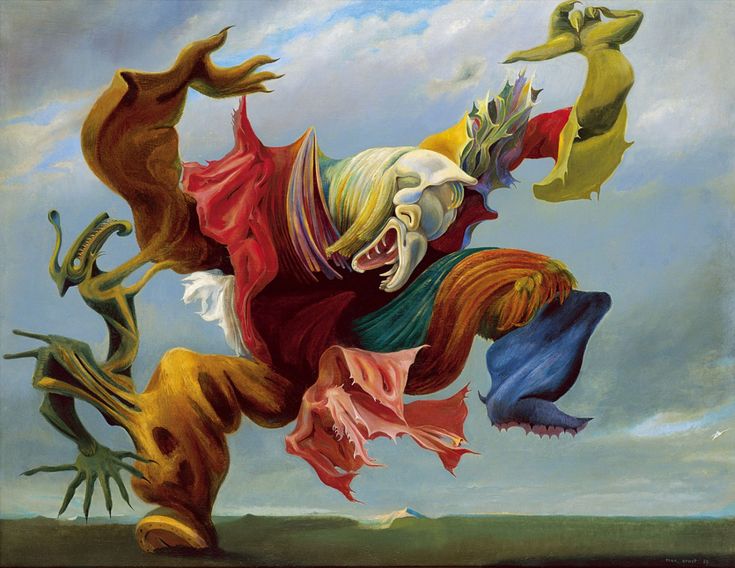
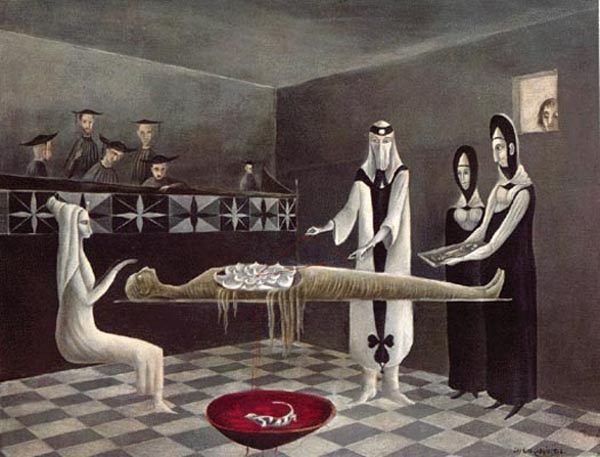
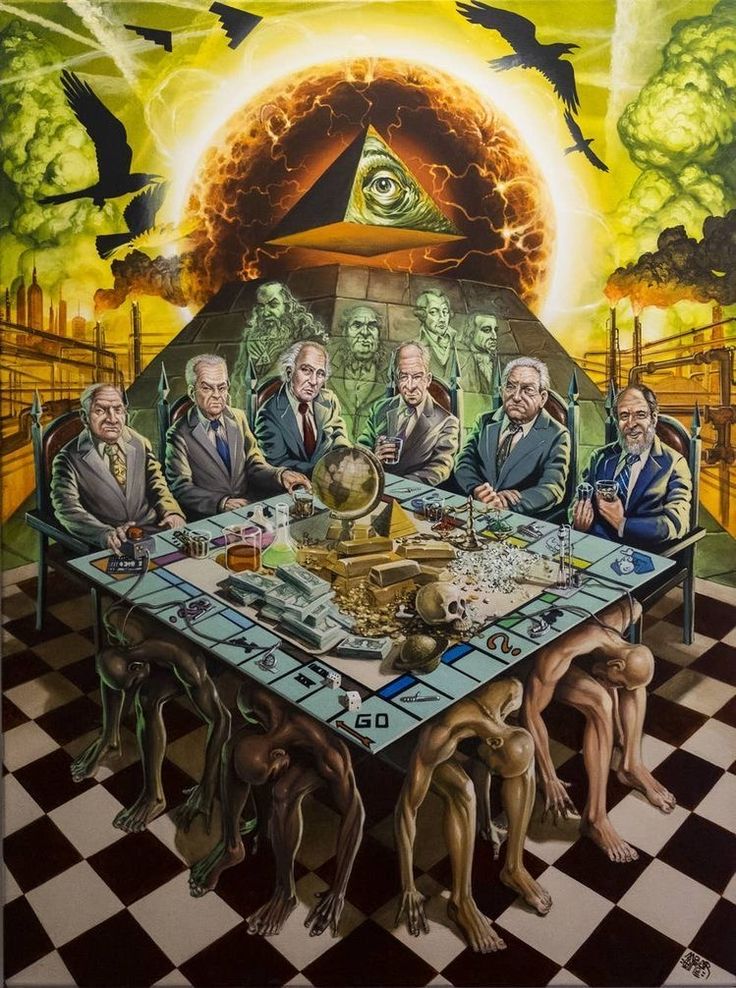
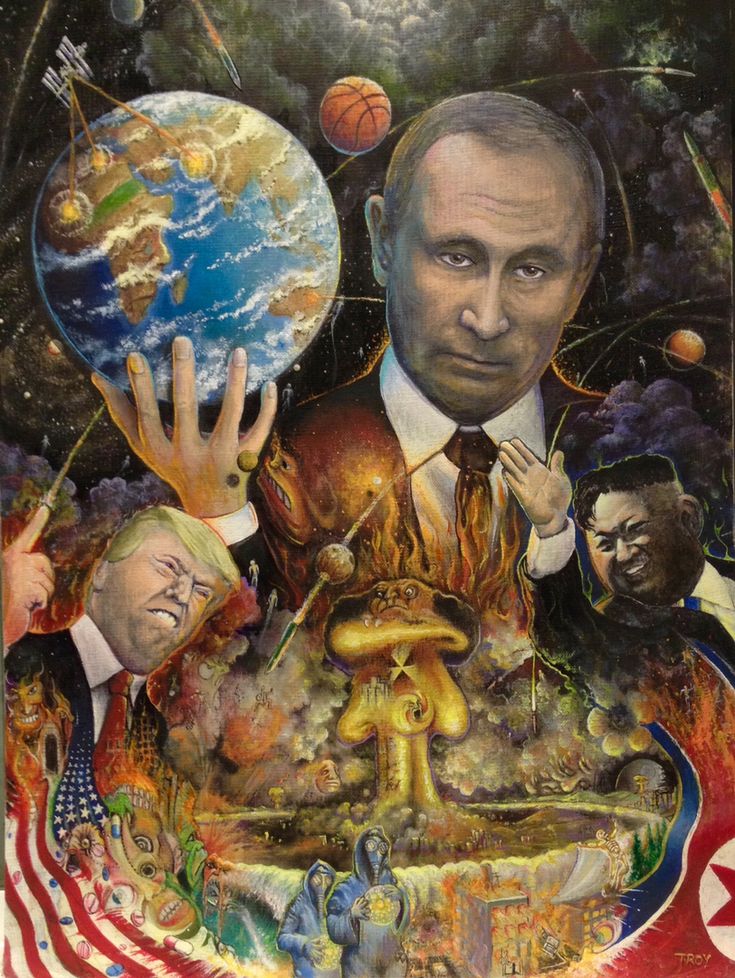
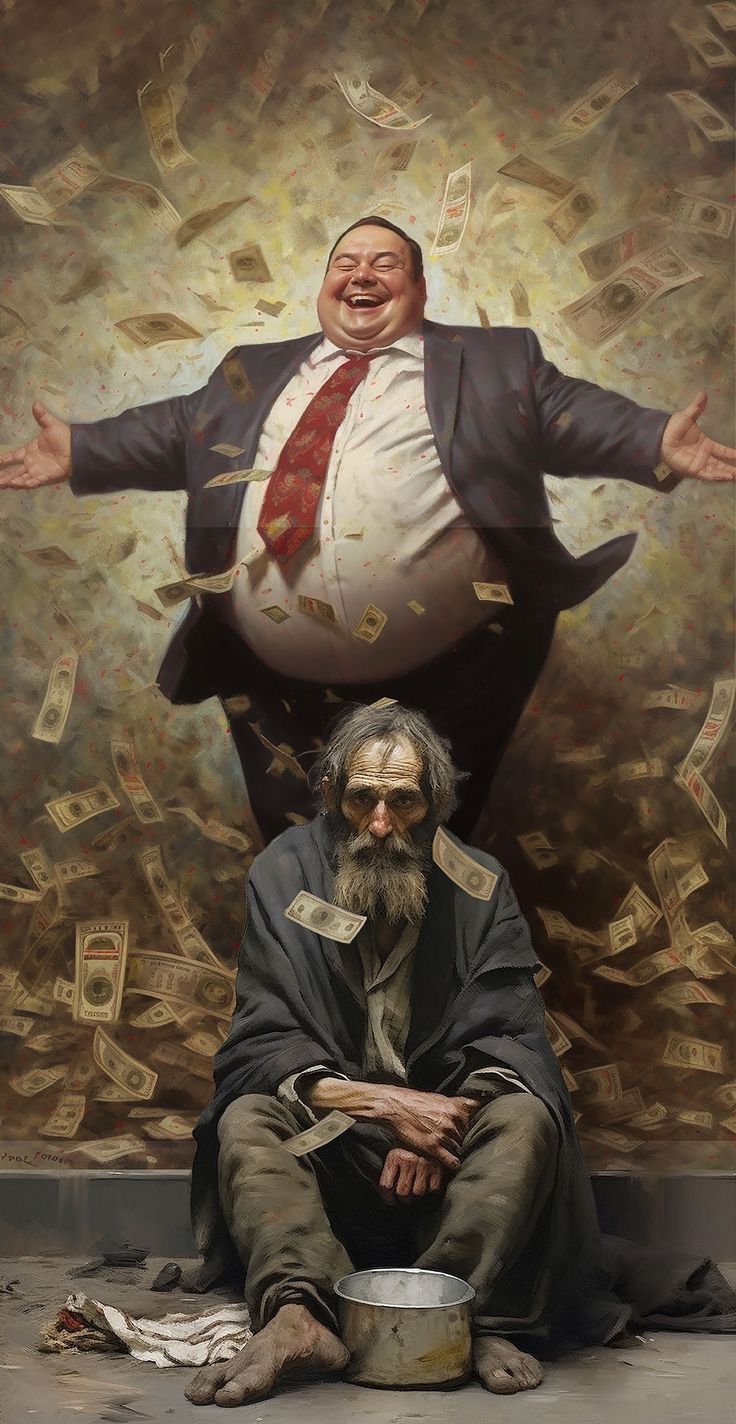



 And, unfortunately, we have the antithesis to her and the people she worked with and for today. This is from Mark Jacob’s writing on his blog
  The little tomboy girl I was who wanted to do everything boys do and do it better is still in me. Not backing down. Nope. Not gonna do it. Wouldn’t be prudent at this juncture. This is from Lisa Needham at
  So, since I seem to be going all economist on you these days, let me just say that I love Paul Krugman’s substack. I’m glad he left the New York Times, even though he really didn’t state a reason other than it was time. Here’s today’s offering at
 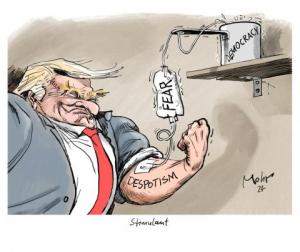 You may take the Good Doctor’s Monetary Theory lecture at the link. I can’t believe Milton Friedman would have anything positive to say about this development at all. He wrote the book on money and was awarded a Nobel Prize in Economics. And I also am having a huge hissy over the potential targeting of the FDIC. I worked in banking. I’ve worked for the Fed. This is my bailiwick. My daughter, the finance guru, didn’t fall for crypto, so I must have done something right. Don’t fall for this, either!
 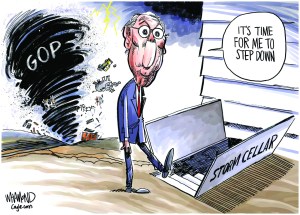 I cannot see Senator Elizabeth Warren being quiet about any of this. However, the ink of the press is focused on the man with the most responsibility for this mess. Senator Mitch McConnell is objecting a lot now that he’s an ineffective backbencher. Look, he doesn’t like Polio! He wants the vaccine still! Look, he’s got something to say about how wonderful the Bush years were because we tried and failed to bomb “American Exceptionalism” into the Middle East, but it’s good policy!. But just because we know better doesn’t mean Legacy Media does.





 But the Trump transition was prepared for more pushback, as the initial outlook on the nomination was murky. Patel has been known to spout conspiracies about the 2020 election, pushed supplements that he claimed could reverse the Covid-19 vaccine, and suggested he may prosecute journalists. Trump’s former Attorney General Bill Barr
 So, I’m not even sure where to start, but how about with RFK Jr, the one with the worm that ate his brain, and the television and web-based Snake Oil Salesman, Mehmet Oz. A USA Today headline blares this bit of happy news.
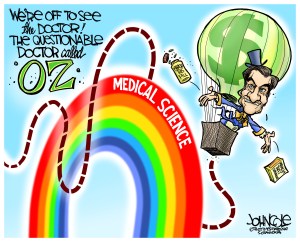 I won’t give you my usual microeconomics lectures on monopoly, but for all that shouting about free markets these billionaires do, they sure love themselves markets that are so concentrated that you can count the number of providers with one hand. This
 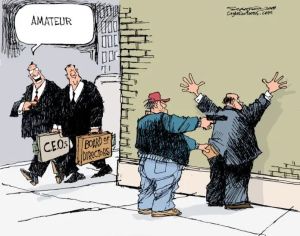 I ran across this Blue Sky thread by billionaire Mark Cuban. He gets it.
 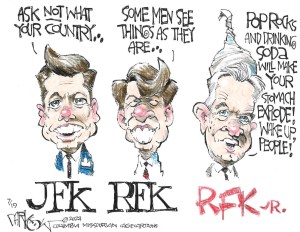 So, I am staying with the theme of Health Care because BB alerted me to this while preparing to write this post. JJ couldn’t believe they would actually do this to us. This headline is horrifying! It’s from Reuters. “Trump to discuss ending childhood vaccination programs with RFK Jr.”
 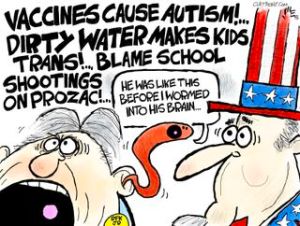 Can you hear me screaming all the way from the Mississippi River way down yonder in New Orleans? And this is the headline that did it to me from
  When you have a savior complex, you think nothing will get you. There are a lot of those types up for Cabinet jobs. Kari Lake is about to become the Voice of America. I’ve already dubbed her Lady Haw-Haw after an American NAZI sympathizer
 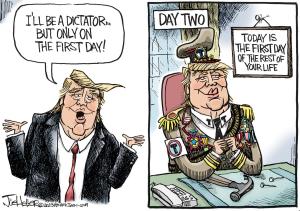 I’d say it’s highly likely that Tulsi Gabbard will be more than willing to provide material for those broadcasts. I’m sure Putin will oblige. The latest outrage, for me, anyway, is that all the Trump TechBros are funding his inauguration with millions of dollars, and Presidential Reject Incontinentia Buttocks is inviting all the favorite despots from the world over.

 peej
peej Carissa
 bostonboomer
 dakinikat
 ecocatwoman
 mablue2
 Mama Lopez
 peggysue22
 quixote
 skydancingguestblogger
 Mona (aka Wonk the Vote)



 Sky Dancing
Recent Comments