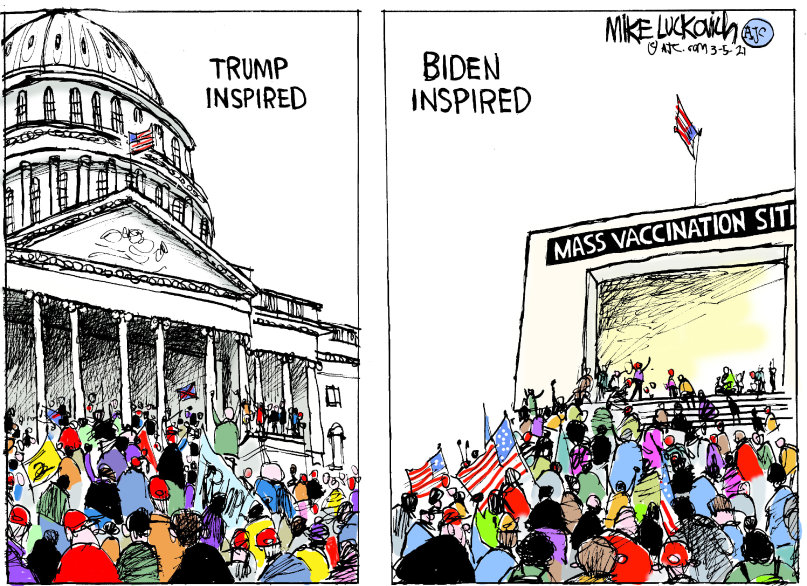
Fifty-one days into his Presidency, on the first anniversary of our collective quarantine, Joe Biden pivoted to optimism. He spoke of “finding light in the darkness,” vaccines for everyone by the end of May, and a country open for barbecues by the Fourth of July. That certainly counts as an upbeat message in the midst of the pandemic, although it was appropriately accompanied by the expressions of concern and communal grief at which this new President so excels. Good news is a lot easier than bad to deliver.
For much of his short time in office, Biden has stuck to the sober facts of the covid-19 crisis that he inherited. He has been the perpetual un-Trump, wielding science and seriousness against the pandemic and the political toxicity that has accompanied it. Even in his twenty-four-minute address to the nation from the East Room of the White House, on Thursday night, Biden did not abandon that approach. How could he? Everything that he does and says to address the pandemic, which has killed more Americans than all combat deaths in the last century’s wars combined, is a rebuke to his predecessor. Trump’s failed stewardship of the nation during the coronavirus outbreak is both the signal fact of his Presidency and the inescapable emergency of Biden’s nascent one. Yet Biden did more than lament or lecture on Thursday. He offered, for the first time since he took office, the gauzy optimism that predecessors from Roosevelt to Reagan have embraced at times of national trouble, speaking of “real progress” and getting the job done, of setting goals and beating them, of “hope and light and better days ahead.”
The clichés did not really bother me. That is because I spent the few minutes right before Biden’s speech listening to Trump’s nine-minute address to the nation from the same night a year earlier. In the awful hindsight created by the deaths of more than five hundred thousand Americans, it’s a true horror to again hear Trump promising the country that “the virus will not have a chance against us,” and insisting, “I will never hesitate to take the necessary steps to protect the lives, health, and safety of the American people.” Watching this risible B.S. a year later, it seemed to me that even Trump had had a hard time believing his own bluster. When he read off the teleprompter that he was “confident” of victory over the pandemic, he appeared to be gasping for air.
Autoportrait (Self-Portrait in a Green Bugatti) (1929),TAMARA DE LEMPICKA
The Biden administration will prevent the Department of Health and Human Services (HHS) from sharing any information about families who accept migrant children with Immigration and Customs Enforcement (ICE), according to administration officials.
Why it matters: By terminating a 2018 legal agreement between HHS’s Office of Refugee Resettlement and ICE, which is part of the Department of Homeland Security, the Biden administration hopes to encourage more sponsors to work with the government to accept unaccompanied minors apprehended at the border.
Moving those children out of HHS shelters and into sponsors’ homes helps free up space, which is needed to process the surge of unaccompanied minors crossing the U.S.-Mexico border.
HHS has some 8,500 minors in custody, with an additional 3,500 still being held at border patrol stations, according to the Washington Post.
To alleviate strain on HHS shelters, CBP has eased COVID-19 protocols that were limiting the number of minors in a given facility, allowing them to fill up to full capacity. “We are aggressively adding hundreds of beds by the week,” said an administration official.
I walked up to the governor, who was in the middle of a conversation with another reporter, and waited for a moment when I could interject. He took my hand, as if to shake it, then refused to let go. He put his other arm around my back, his hand on my waist, and held me firmly in place while indicating to a photographer he wanted us to pose for a picture.
My job was to analyze and scrutinize him. I didn’t want a photo of him with his hands on my body and a smile on my face. But I made the reflexive assessment that most women and marginalized people know instinctively, the calculation about risk and power and self-preservation. I knew it would be far easier to smile for the brief moment it takes to snap a picture than to challenge one of the most powerful men in the country.
But my calculation was a bit off. I was wrong to believe this experience would last for just a moment. Keeping his grip on me as I practically squirmed to get away from him, the governor turned my body to face a different direction for yet another picture. He never let go of my hand.
Then he turned to me with a mischievous smile on his face, in front of all of my colleagues, and said: “I’m sorry. Am I making you uncomfortable? I thought we were going steady.”
I stood there in stunned silence, shocked and humiliated. But, of course, that was the point.
I never thought the governor wanted to have sex with me. It wasn’t about sex. It was about power. He wanted me to know that I was powerless, that I was small and weak, that I did not deserve what relative power I had: a platform to hold him accountable for his words and actions. He wanted me to know that he could take my dignity away at any moment with an inappropriate comment or a hand on my waist. (The Cuomo administration has declined to comment.)
It’s not that Cuomo spares men in his orbit from his trademark bullying and demeaning behavior. But the way he bullies and demeans women is different. He uses touching and sexual innuendo to stoke fear in us. That is the textbook definition of sexual harassment.
And then some great young black female atheletes endured this last night.
An announcer at a girls high school basketball game in Oklahoma was caught on a hot mic calling the team “fucking niggers” for kneeling during the national anthem pic.twitter.com/9dcNp1uRrc
If you value more voter participation, then you want more Americans to have access to the voting options that worked so successfully in 2020. If you prefer lower voter participation, then you want those options either rescinded or restricted. This isn’t rocket science.
Also not rocket science: It’s clear that one of our country’s two political parties overtly prefers less voter participation and so, as a consequence, is now actively pursuing avenues designed to reduce—or suppress, or depress, or whatever perfectly non-judgmental verb you’d like to use—the number of votes cast in future elections.
Former Vice President Mike Pence, having avoided a lynching by Trump supporters on January 6, has decided to use the fight for “election integrity” as his way back to the warm embrace of MAGA. He emerged from his new post at the Heritage Foundation to announce that “Voter Integrity Is a National Imperative” at the same moment that Heritage Action plans to spend $10 million to tighten election laws in Arizona, Florida, Georgia, Iowa, Michigan, Nevada, Texas, and Wisconsin.
But what exactly does “election integrity” mean to Mike Pence and those pushing restrictionist laws? For the MAGA crowd, it’s code for eliminating “fraud.” No matter that Trump’s Attorney General Bill Barr said, “There is no evidence of widespread voter fraud.” Or that officials at Trump’s Cybersecurity and Infrastructure Security Agency said, “There is no evidence that any voting system deleted or lost votes, changed votes or was in any way compromised,” and the election was “the most secure in American history.”
Pence’s piece is a work of art, designed to simultaneously appease both his lawyers and the QAnon chat boards. He writes, “Many of the most troubling voting irregularities took place in states that set aside laws enacted by state legislatures in favor of sweeping changes ordered by governors, secretaries of state, and courts.” He doesn’t say what these “irregularities” were exactly. Or mention that the “sweeping changes” were made to ensure the election would go smoothly during the pandemic. Which it did.
The only thing that was “irregular,” as Pence puts it, was the exceptionally high number of Americans who voted. Against him.
The plain fact is that more Americans voted against Trump and Pence—both singularly in 2020 and cumulatively in combination with 2016—than any other ticket in the long history of our nation. That’s the real problem Republicans have with the 2020 election.
So, I think I’ll stop here and let you take over. Again, celebrate Women’s History Month by discovering Women in all kinds of places !!! And again, discover the misogynyist patriarchal bastards who want to keep them down too! Tucker Carlson thinks mocking pregant service members is cool.
By @DohaMadani And FYI I have personally served with two pregnant women in the Army and they were both more than capable in expertly performing their duties. Tucker Carlson slammed by military leaders for mocking pregnant service members https://t.co/gPgWrWZOUY via @nbcnews
But the biggest accomplishment of the day was the House passage of Biden’s $1.9 Trillion American Rescue Plan Act. Also huge: the Senate confirmed Merrick Garland as U.S. Attorney General. They also confirmed Marcia Fudge as the first Black woman Secretary of Housing and Urban Development in more than 40 years, and Michael Regan, a Black man, as head of the Environmental Protection Agency.
Congress gave final approval on Wednesday to President Biden’s sweeping, nearly $1.9 trillion stimulus package, as Democrats acted over unified Republican opposition to push through an emergency pandemic aid plan that carries out a vast expansion of the country’s social safety net.
By a vote of 220 to 211, the House sent the measure to Mr. Biden for his signature, cementing one of the largest injections of federal aid since the Great Depression. It would provide another round of direct payments for Americans, an extension of federal jobless benefits and billions of dollars to distribute coronavirus vaccines and provide relief for schools, states, tribal governments and small businesses struggling during the pandemic.
“This legislation is about giving the backbone of this nation — the essential workers, the working people who built this country, the people who keep this country going — a fighting chance,” Mr. Biden said in a statement. He said he looked forward to signing what he called a “historic piece of legislation” on Friday at the White House.
The vote capped off a swift push by Mr. Biden and Democrats, newly in control of both chambers of Congress and the White House, to address the toll of the coronavirus pandemic and begin putting in place their broader economic agenda. The bill is estimated to slash poverty by a third this year and potentially cut child poverty in half, with expansions of tax credits, food aid and rental and mortgage assistance.
By Henri Lebasque
According to CNBC, people who have direct deposit could start their $1,400 checks next week.
The American Rescue Plan Act is expected to be signed by President Biden on Friday, and stimulus payments could start being sent out within days of him signing. That means Americans could start seeing the money as early as next week.
The first people to receive the checks are likely those who have direct deposit set up with the IRS. That’s because the government already has their account information on file and doesn’t need to go through the process of printing, sorting and mailing physical checks or pre-paid debit cards.
Americans who don’t have direct deposit will have to wait for the payments to be produced and sent, a process that can be time consuming.
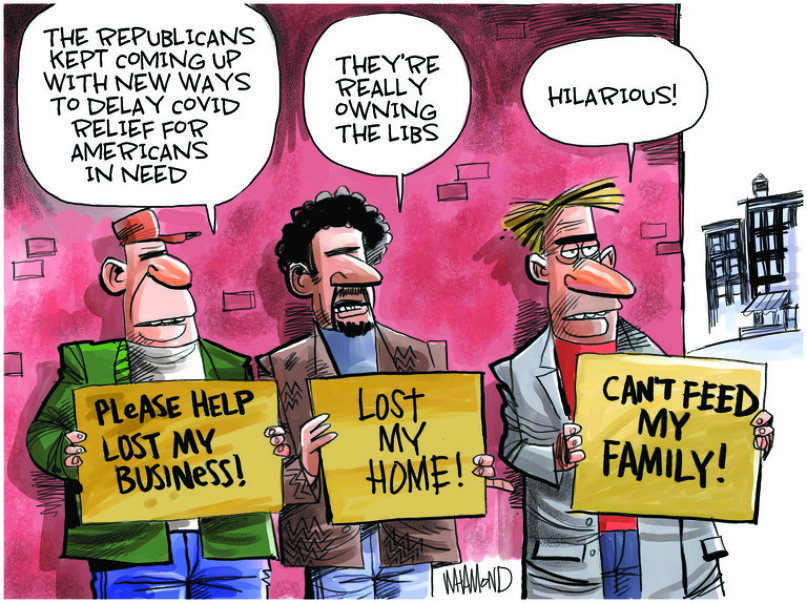
This latest round of aid, which was rejected by all Republicans in Congress, marks the first major legislative victory for President Biden. In contrast with the emergency bills passed last year, the Democratic bill focuses the vast majority of aid on households, states and cities, and vaccine distribution. There is little money directed this time toward businesses….
Over half the money — 54 percent — in the bill goes toward households. In addition to the popular $1,400 checks, there is also funding for extra unemployment insurance through Labor Day, expanded tax credits, and various programs to make rent, food and health insurance more affordable.
Economists say low- and moderate-income Americans will benefit the most from this aid, especially individuals earning $75,000 or less and couples earning $150,000 or less. The number of Americans living in poverty is predicted to drop in 2021 by as much as a third because of this legislation.
The cash infusion is expected to result in a 20 percent income boost for the bottom 20 percent of earners (those making $25,000 or less), according to the nonpartisan Tax Policy Center.
In little-noticed ways, the rescue bill is going to reshape several areas of American climate policy. It will revive a number of crucial, pandemic-hammered institutions central to the country’s climate response. More important, it shows how the prevailing atmosphere of American governance has shifted.
Giovanni Segantini
This isn’t to say it’s a climate bill, per se. But it is part of the broader climate agenda being advanced by the Biden administration.
First, the bill devotes $30.5 billion to public-transit agencies. “COVID has really decimated transit ridership, and that has eaten a huge hole in agencies’ budgets,” Ben Fried, the communications director at the think tank TransitCenter, told me. Including the latest bill, Congress has spent $60 billion on transit over the past year, money that has been key to keeping the agencies solvent, Fried said. “If they didn’t get funding, then transit would have faced existential peril at the end of last year.” In Washington, D.C., for instance, the local Metro system was contemplating eliminating weekend service and permanently closing 19 stations. The new bill is enough to support agencies’ daily operations into 2023, he said….
Second, the rescue bill has quietly become an infrastructure bill. It devotes $350 billion to supporting state and local governments. These funds, initially proposed to plug COVID-19-created holes in public budgets, in many cases now exceed those holes. So the Senate has allowed states, cities, and counties to spend that money on improving services such as water, sewage, and broadband. Because many water systems are vulnerable to climate change and must be adapted, this is de facto climate funding. The bill also contains $31 billion for tribal governments and Indigenous communities, including line items for new infrastructure, housing, and language preservation.
More broadly, the bill epitomizes the Biden administration’s more forceful approach to running the economy. It shows that much of the American political establishment—from Representative Alexandria Ocasio-Cortez of New York to Jerome Powell, the Donald Trump–appointed Federal Reserve chair—is comfortable pursuing a strategy of restoring full employment as quickly as possible, even if that creates some inflation in the short term.
President Joe Biden can report in his first prime-time address Thursday that a vaccination drive now reaching 2 million people daily has brought America far closer to exiting the pandemic than when he took office 50 days ago.
With new infections and deaths way down from their peaks of a horrific winter, Biden can afford to conjure hope that better days may be imminent and will speak to the nation from a position of political strength. He is also armed with a newly passed $1.9 trillion Covid-19 rescue package — his first major legacy achievement — which represents an ambitious attempt to rebuild the US economy to favor the less well off.
Victor Gilbert
“This bill represents a historic, historic victory for the American people,” Biden said Wednesday, touting his rescue plan that finally cleared Congress on Wednesday and pivoting to an address that he said would inform the country what “comes next” in the effort to prevail over the coronavirus. A clear majority of Americans — 60% — approves of the new President’s handling of the pandemic in a new CNN poll. He has reintroduced the nation to calm, functional leadership and a scientific approach to the public health crisis, and has ended the stream of vitriol that poured from the Oval Office for four years.
Yet in a national crisis this deep and in a country so polarized less than two months since ex-President Donald Trump’s insurrection, nothing is remotely normal. While Biden honored campaign promises to take the virus seriously, to secure funds to get kids back to school and to help Americans pummeled by the economic crisis, his White House is weighed down by stark challenges.
A White House official said Biden’s Thursday night speech, expected to last about 20 minutes, would focus on the lives lost and changed in the pandemic and the work Biden’s administration has done to rapidly increase the vaccination effort. The President will also explain what must still be done to defeat the virus, the official said.
After President Joe Biden signs his $1.9 trillion American Rescue Plan into law this week, he is set to embark on a press tour to sell his COVID-19 relief package to the American public, starting with a primetime address on Thursday, likely followed by his first formal news conference in the days after, CNN reports. The media and travel blitz comes as reporters have grown increasingly frustrated over lack of access to Biden, who has yet to hold the kind of solo, back-and-forth press conference that his 15 most recent predecessors—including Donald Trump—had all submitted themselves to by this point in their term. He has also yet to address a joint session of Congress, another appearance reportedly set to take place next month.
While Biden taking off on meticulously planned sales tour may not yield the type of freewheeling exchanges that reporters are clamoring for, it makes political sense for the White House to get the president on the road. Biden’s relief package is overwhelmingly popular among Americans—about 70 percent—but less so with GOP lawmakers in Washington, whose total opposition required Democrats to push the bill through the budget reconciliation process. Going that route means many provisions, such as increased subsidies for health insurance and expanded child tax credit, have a one-year expiration date. “Making them permanent will require another act of Congress that would likely need some Republicans on board,” according to CNN.
Eerno Järnefelt
It will be a two-part effort, starting with spelling out the impact of the package to Americans. Biden has said that the Obama administration “didn’t adequately explain what we had done” with the 2009 stimulus. “I kept saying, ‘Tell people what we did.’ [Barack Obama] said, ‘We don’t have time. I’m not going to take a victory lap.’ And we paid a price for it, ironically, for that humility,” the president recently told House Democrats. This time around, Biden’s team is focused on making sure Americans know that relief measures, such as individual stimulus checks, come as direct results of his American Rescue Plan, and are reportedly using local media and outside coalition groups to help establish that connection.
Among the groups and leaders supportive of the package and thus capable of being leveraged by Biden’s team are “over 400 bipartisan mayors and governors, organized labor and the business community, as well as economists and experts from across the political spectrum,” one White House official told Axios. Benefits to schools, vaccine distribution, and food supply for low-income families are among the parts of the package that cabinet officials and White House aides will team up to publicly promote, according to another administration official. Axios notes that the strategy at play extends beyond short-term goals, such as the 2022 midterms; maintaining wide support for the bill rewards Biden’s ability to “build on the legislation and make it harder for the next Republican president to unwind.”
Much more is happening. Here are some additional stories to check out today:
Joe Biden has been POTUS for less than two months, and he has already accomplished so much. A few days ago, he announced that all adults in the U.S. could be vaccinated by the end of May. He has reversed many of Trump’s worst policies. And the massive $1.9 trillion Covid relief bill should pass the House in the next couple of days. Relief checks could start going out before the end of March.
The House is expected to pass the bill this week and as early as Tuesday evening. The House Rules Committee must first set the parameters for debate, and then the House must vote to approve the rules of debate.
Once the House approves the rules for debate, lawmakers will first debate the bill and then vote on final passage, which could happen late in the night Tuesday.
Biden said Monday that he would sign the legislation “as soon as I get it.”
The House passed the bill last month, but the Senate made changes that the House will have to approve.
The House first passed the bill at the end of February. The Senate took it up the next week, and it made changes to the bill’s provisions. A key Senate official, the parliamentarian, ruled that a provision increasing the federal minimum wage to $15 an hour could not stay in the final legislation, for example.
The Senate also lowered the unemployment benefit to $300 a week, down from $400 in the first version of the legislation the House passed, but extended it through the beginning of September, and made the first $10,200 of unemployment benefits non-taxable for households making less than $150,000.
The changes mean the House had to pass the bill again. If the House does not make any changes of its own, then the bill can go straight to Biden for his signature.
Speaker Nancy Pelosi (D-Calif.) and her leadership team, who spent the weekend working the phones with their members, are confident they will have the votes for one of Congress’s largest-ever economic relief bills. They’re set to once again contend with unified GOP opposition that will brand Biden’s rescue package as a Democratic offering ahead of next year’s midterms, when Republicans could recapture the majority by flipping just a handful of seats.
Pelosi shrugged off Republicans’ lack of support for the Covid aid plan,telling reporters that “I feel sad for them” and painting them as “oblivious to the support that this bill has among Republicans across the country.”
A little-known element of President Biden’s massive stimulus relief package would pay billions of dollars to disadvantaged farmers — benefiting Black farmers in a way that some experts say no legislation has since the Civil Rights Act of 1964.
Of the $10.4 billion in the American Rescue Plan that will support agriculture, approximately half would go to disadvantaged farmers, according to estimates from the Farm Bureau, an industry organization. About a quarter of disadvantaged farmers are Black. The money would provide debt relief as well as grants, training, education and other forms of assistanceaimed at acquiring land.
While it’s a fraction of the $1.9 trillion bill that passed in the Senate on Saturday, advocates say it still represents a step toward righting a wrong after a century of mistreatment of Black farmers by the government and others. Some say it is a form of reparations for African Americans who have suffered a long history of racial oppression.
“This is the most significant piece of legislation with respect to the arc of Black land ownership in this country,” said Tracy Lloyd McCurty, executive director of the Black Belt Justice Center, which provides legal representation to Black farmers.
Black farmers in America have lost more than 12 million acres of farmland over the past century, mostly since the 1950s, a result of what agricultural experts and advocates for Black farmers say is a combination of systemic racism, biased government policy, and social and business practices that have denied African Americans equitable access to markets.
The bill, which is expected to pass the House and be signed into law by President Joe Biden as soon as this week, includes more than $31.2 billion for tribal governments and Native communities. The money will go directly to helping American Indians, Alaska Natives and Native Hawaiians focus on economic recovery in their communities devastated by the COVID-19 pandemic….
Since the start of the pandemic, Native American communities have been among the hardest hit by the virus. Compared with white people, Indigenous people are nearly twice as likely to be infected by COVID-19, more than three and a half times as likely to be hospitalized and more than twice as likely to die from the virus, according to Feb. 18 data provided by the Centers for Disease Control and Prevention….
More than $6 billion will go to Native health systems. That includes $2.3 billion for COVID-19 vaccines, testing and tracing at the Indian Health Service, along with another $2 billion for lost third-party medical billing reimbursements. IHS will also get $600 million for health facilities construction and sanitation programs, $500 million for clinical health services, $420 million for mental and behavioral health services, $140 million for improving health IT and telehealth access, and $10 million for potable water delivery.
More than $1.2 billion will go to tribal and Native Hawaiian housing programs under the Department of Housing & Urban Development.
More than $1.1 billion will go to Native education programs.
More than $1 billion will go Native families, in the form of tribal child care programs and assistance to tribal Temporary Assistance for Needy Families grantees.
Roughly $900 million will go to Bureau of Indian Affairs programs; $600 million will go to Native communities’ economic and infrastructure investments; $20 million will go toward mitigating the impact of COVID-19 on Native languages; and $19 million will go toward combating domestic violence.
I’ve been worried that Democrats could lose their slim majority in the Senate in the 2022 midterms, but it turns out that quite a few Republican Senators are not going to run again.
With Sen. Roy Blunt (R-MO) announcing he won’t run for re-election in 2022 — joining four other GOP incumbents who have already announced they will be stepping down — Republican campaign consultants are worried about more Senate losses after losing control during Donald Trump’s last year in office.
In an interview with U.S. News and World Report, one Republican insider looked at some of the potential candidates expected to run for the open nominations and worried they might be unelectable.
The report goes on to note that the five GOP senators who have already announced they won’t seek re-election may see their ranks swell as Sen. Ron Johnson (R-WI) is hedging his bets and Sen. Chuck Grassley (R-IA) has refused to say what his plans are.
Major (sitting) and Champ Biden
The White house dogs had to be sent back to Wilmington, after an incident involving the younger of the two, Major Biden.
The two German Shepherds belonging to President Joe Biden and first lady Jill Biden were returned to the Biden family home in Delaware last week after aggressive behavior at the White House involving Major Biden, two sources with knowledge tell CNN.
Major, who was adopted by Biden in November 2018 from a Delaware animal shelter, had what one of the people described as a “biting incident” with a member of White House security. The exact condition of the victim is unknown, however, the episode was serious enough that the dogs were subsequently moved to Wilmington, Delaware, where they remain….
Major, who is 3 years old, is the younger of the two Biden dogs, and has been known to display agitated behavior on multiple occasions, including jumping, barking, and “charging” at staff and security, according to the people CNN spoke with about the dog’s demeanor at the White House. The older of Biden’s German Shepherds, Champ, is approximately 13 and has slowed down physically due to his advanced age.
I can see why living in the White House could be stressful for a young dog because of all the activity and so many people coming and going. I hope the move won’t be permanent.
“I’ve been getting obsessed with getting our dogs settled because we have an old dog and we have a very young dog,” Jill Biden told Kelly Clarkson last month during an appearance on “The Kelly Clarkson Show.” “They have to take the elevator, they’re not used to that, and they have to go out on the South Lawn with lots of people watching them. So that’s what I’ve been obsessed with, getting everybody settled and calm.”
Biden also said the only place the dogs are not allowed is on the furniture, though she admitted to catching Major on the couch. “They run all over,” said Biden.
A person familiar with the dogs’ schedule confirms to CNN they are in Delaware, but noted they have been known to stay there with minders when the first lady is out of town. Biden departed Monday afternoon for a two-day trip to Washington and California to visit military bases.
The White House has rehung the official presidential portraits of former Presidents George W. Bush and Bill Clinton after they were removed last July during the Trump administration, an official tells CNN.
They are back on display in the Grand Foyer of the executive mansion, the official said.
The portraits were removed last July and were replaced by two portraits of Republican presidents who served more than a century ago.
White House tradition calls for portraits of the most recent American presidents to be given the most prominent placement, in the entrance of the executive mansion, visible to guests during official events. However, the Trump White House moved the Clinton and Bush portraits into the Old Family Dining Room, a small, rarely used room that is not seen by most visitors.
It’s women’s history month! Today is International Women’s Day and I’m focusing on women artists and their work. It’s just a small selection of women’ painters, singer/songwriter and actress! I’m going to keep it up for the month so keep your eyes and ears open!
The Supreme Court on Monday denied a bid by former President Trump to nullify his electoral loss in Wisconsin, rejecting the former president’s final pending appeal over the results of the 2020 election.
In an unsigned order without noted dissent, the justices declined to take up Trump’s lawsuit alleging Wisconsin election officials violated the Constitution by expanding absentee voting amid the global coronavirus pandemic.
The justices’ move brought an end to Trump’s scattershot and ineffective legal campaign to overturn President Biden’s victory and added to the abysmal post-election court record of Trump and his allies, which included more than 60 losses and just one narrow win.
After 15 years allowing voters to cast absentee ballots without excuses, Georgia Republicans say the practice has got to go.
The Republican-controlled state Senate votes Monday on a package of legislation that would, among other things, limit mail-in voting primarily to Georgians who are elderly, disabled or out of town on Election Day — one of dozens of restrictive election-related measures under consideration in state legislatures.
Supporters of the measures, who include allies of former President Donald Trump and those who stood up to his bogus allegations of fraud after Joe Biden upset decades of Republican dominance to win the state, say the bills are commonsense election security efforts. Democrats, voting rights advocates and civil rights groups say something else is going on.
“It’s pathetically obvious to anyone paying attention that when Trump lost the election and Georgia flipped control of the U.S. Senate to Democrats shortly after, Republicans got the message that they were in a political death spiral,” state Rep. Renitta Shannon, a Democrat from Decatur, said during a floor debate over the Republican proposals in Georgia last week. “And now they are doing anything they can do to silence the voices of Black and brown voters specifically because they largely powered these wins.”
President Biden marked International Women’s Day on Monday by signing two executive orders geared toward promoting gender equity, both in the United States and around the world.
In a statement, Biden said: “In our nation, as in all nations, women have fought for justice, shattered barriers, built and sustained economies, carried communities through times of crisis, and served with dignity and resolve. Too often, they have done so while being denied the freedom, full participation, and equal opportunity all women are due.”
The first executive order establishes a Gender Policy Council within the White House, reformulating an office from the Obama administration that was later disbanded by the Trump administration, and giving it more clout.
Under former President Barack Obama, the office was called the White House Council on Women and Girls. The name change to the Gender Policy Council is intentional, according to an administration official speaking on background, “to reflect the fact that gender discrimination can happen to people of all genders.”
But, the official said, “there will be a focus on women and girls, particularly women and girls of color, given the historical and disproportionate barriers that they face.”
Some leading political scientists and Democratic pollsters see this agenda as perfectly consistent with an influx of college-educated white suburbanites — for the simple reason that this demographic has, in recent years, become much more progressive on economic issues than it was in the past.
Biden Admin Halts Transfer of Oak Flat, Sacred Native Land, to Mining Company https://t.co/TmrDx8jmwk
This is certainly a relief to hear from the Save our planet and sacred/historical spaces for the future agenda.
The Biden administration has withdrawn an environmental review for a massive copper mine in eastern Arizona, temporarily blocking a multinational mining corporation, Resolution Copper, from taking over a parcel of land sacred to the San Carlos Apache Nation and other Native communities. The U.S. Forest Service said it needs more time to consult with Native people about the mine’s impact on Oak Flat, an ancient forest with spiritual and cultural significance. Advocates say the proposed mine would destroy Oak Flat and contaminate a large swath of southern Arizona. Arizona Democratic Congressmember Raúl Grijalva is set to reintroduce the Save Oak Flat Act, which would repeal the appropriation of the site.
Emmie and her child, Mary Cassatt
Now that we’re beginning to get vaccinnated there’s some additional good news for those of us through our first doses. My friend Nancy across the street and I frequently get together but it still feels akward to have our little picnics and dinners while doing all the hand washing and masking. We’re both fully vaccinated so this is great news! Now, we just have to get to a place where we get the kids into the mix. I’m sure there’s a lot of grandparents missing hugs! Another one from NPR: “CDC Says It’s Safe For Vaccinated People To Do These Activities”.
The CDC has issued new guidance for vaccinated people, giving the green-light to resume some pre-pandemic activities and relax precautions that have been in place.
Specifically, people who are fully vaccinated can gather indoors with other fully vaccinated people without wearing masks or social distancing. People are considered fully vaccinated two weeks after they have gotten the second shot of the Pfizer or Moderna vaccines (or two weeks after receiving the single-dose Johnson & Johnson vaccine).
Vaccinated people can also gather, unmasked, with people from another household who are not yet vaccinated, as long as those people are at low risk of serious illness from the virus. However, the agency said, vaccinated people should continue to mask when they’re in public, avoid crowds and take other precautions when gathering with unvaccinated people who are at high risk of serious illness from COVID-19.
The CDC said this new guidance is a “first step” to returning to everyday activities. There’s accumulating evidence to show that people who are fully vaccinated are less likely to become infected and also “potentially” less likely to spread the virus to others, agency officials wrote in a press release.
Senate Democrats clinched a deal on Friday night over unemployment benefits that will smooth the upper chamber’s passage of President Joe Biden’s $1.9 trillion coronavirus relief bill this weekend.
After about a nine-hour delay following Sen. Joe Manchin’s (D-W.Va.) resistance to an earlier agreement on jobless payments, party leaders announced a new accord with Manchin. The latest deal would provide $300 a week in extra unemployment benefits through Sept. 6, and up to $10,200 in tax relief for unemployed workers.
Democratic leaders also agreed to limit eligibility for that tax relief, restricting the tax-free status of the benefits to households with incomes under $150,000 a year.
By Ophelia Redpath, 1965
The White House quickly announced its support after endorsing the earlier compromise.
“The President supports the compromise agreement, and is grateful to all the senators who worked so hard to reach this outcome,” White House press secretary Jen Psaki said in a statement on Friday night.
With Manchin’s objections eased, Democrats plowed forward with a marathon “vote-a-rama” — an all-night ordeal in which any senator can offer an amendment to Biden’s bill. The Senate is now on track to pass the package on Saturday….
After Senate passage, the bill will go back to the House, where lawmakers must approve the changes before it reaches Biden’s desk.
A growing number of Senate Democrats are warming to the idea of eliminating the filibuster as they encounter Republican resistance to President Biden’s legislative agenda, forcing the White House to cut deals on issues like the minimum wage and pandemic relief payments.
If the founders envisioned the upper chamber as a “cooling bowl” to moderate more extreme bills passed by the House, the filibuster has often been a deep freezer, infamously deployed by Southern racists to quash reforms during the civil rights era….
Two Senate Democrats — Joe Manchin III of West Virginia and Kyrsten Sinema of Arizona — have said they will oppose any effort to do away with the rule, making any rollback a long shot. Mr. Biden and Senator Chuck Schumer, the majority leader, have been noncommittal about eliminating the filibuster.
Two Senate Democrats — Joe Manchin III of West Virginia and Kyrsten Sinema of Arizona — have said they will oppose any effort to do away with the rule, making any rollback a long shot. Mr. Biden and Senator Chuck Schumer, the majority leader, have been noncommittal about eliminating the filibuster….
By Tatyana Struchkova
On Thursday, Senator Tina Smith of Minnesota took to Twitter to declare her support for ending the filibuster. “The Senate needs to abolish the filibuster. It’s undemocratic,” she wrote, adding, “We need to move this country forward.”
A member of the far-right nationalist Proud Boys was in communication with a person associated with the White House in the days just before the Jan. 6 assault on the Capitol, according to a law enforcement official briefed on the investigation.
Location, cellular and call record data revealed a call tying a Proud Boys member to the Trump White House, the official said. The F.B.I. has not determined what they discussed, and the official would not reveal the names of either party.
The connection revealed by the communications data comes as the F.B.I. intensifies its investigation of contacts among far-right extremists, Trump White House associates and conservative members of Congress in the days before the attack….
By Christilla Germain
Separately, Enrique Tarrio, a leader of the far-right nationalist Proud Boys, told The New York Times on Friday that he called Roger J. Stone Jr., a close associate of former President Donald J. Trump’s, while at a protest in front of the home of Senator Marco Rubio, Republican of Florida. During the protest, which occurred in the days before the Capitol assault, he put Mr. Stone on speaker phone to address the gathering.
A law enforcement official said that it was not Mr. Tarrio’s communication with Mr. Stone that was being scrutinized, and that the call made in front of Mr. Rubio’s home was a different matter. That two members of the group were in communication with people associated with the White House underscores the access that violent extremist groups like the Proud Boys had to the White House and to people close to the former president.
In response to this story, attorney Luppe B. Luppen (@Southpaw on Twitter) was reminded of an interesting January 6 tweet by CNN’s Jim Acosta:
Democratic Rep. Zoe Lofgren has quietly posted a nearly 2,000-page report documenting social media posts by her Republican colleagues who voted against certifying results of the presidential election on January 6. The information compiled isn’t secret, but the report is another sign of the deep distrust that has settled into the US Capitol in the weeks since the insurrection.
The report chronicles the social media activity of members on public forums immediately before the November election and right after the January 6 riot. The report has been online for a week.
CNN reported earlier Thursday that federal investigators are examining records of communications between members of Congress and the pro-Trump mob that attacked the Capitol, as the investigation moves closer to exploring whether lawmakers wittingly or unwittingly helped the insurrectionists….
By Catriona Millar
“Any appropriate disciplinary action is a matter not only of the Constitution and law, but also of fact,” the California Democrat wrote. “Many of former President Trump’s false statements were made in very public settings. Had Members made similar public statements in the weeks and months before the January 6th attack? Statements which are readily available in the public arena may be part of any consideration of Congress’ constitutional prerogatives and responsibilities.” [….]
“Like former President Trump, any elected Member of Congress who aided and abetted the insurrection or incited the attack seriously threatened our democratic government. They would have betrayed their oath of office and would be implicated in the same constitutional provision cited in the Article of Impeachment,” Lofgren wrote in her foreword to the report. “That provision prohibits any person who has previously taken an oath as a member of Congress to support the Constitution but subsequently engaged in insurrection or rebellion from serving in Congress.”
Communications from Rep. Paul Gosar of Arizona are heavily represented in the report:
The report features a collection of social media posts and tweets that span dozens of pages from Arizona Rep. Paul Gosar where he urges supporters to “hold the line,” days before what would become the Capitol insurrection. In another social media post included in the report, Gosar wrote that “sedition and treason for stealing votes is appropriate.”
The report also captures numerous tweets where Gosar invoked @ali on Twitter, which was formerly the account used by Ali Alexander, a leader of the “Stop the Steal” group, who said in several Periscope livestream videos that he planned the rally that preceded the riot in conjunction with Gosar and two other congressional Republicans, Mo Brooks of Alabama and Andy Biggs of Arizona.
With bright red and white stripes across his body and stars down his sleeves, the man in the American flag jacket and “FLORIDA FOR TRUMP” hat wielded a fire extinguisher while charging the U.S. Capitol on the afternoon of Jan. 6. He shoved his way through the crowd of rioters to the police line, then sprayed officers at close range before chucking the emptied canister at them. By nightfall he himself had been lightly harmed, apparently by a police crowd control munition. He held up his shirt to show off his bruised gut during an interview with a female journalist filming him live as cops pushed the mob back from Capitol grounds. Then he looked straight into her livestreaming device and identified himself as Robert Palmer from Clearwater, Florida.
By Andrie Martens
At this point, the man had not only assaulted federal officers before a sea of smartphones while wearing highly distinctive attire, he’d also willingly revealed his own name and hometown on video at the scene of the crime — while still in the same outfit.
This isn’t your typical “Florida Man” story, despite its absurdity. This is the story of a violent insurrectionist who’s still at large — nearly two months later — and one woman who joined the online sleuthing communities crowdsourcing their efforts to bring a Capitol attacker to justice.
Robert Scott Palmer is a white 53-year-old husband and father who runs Son Bright Systems, a cleaning and restoration business. His criminal record includes being sentenced on charges of battery and felony fraud.
HuffPost verified his identity through a search of public records and social media accounts associated with Palmer, after receiving a tip from Amy, a woman living in a rural area out west who in her free time joined the #SeditionHunters network, an online sleuthing community seeking to identify the hundreds of Trump supporters who rioted at the Capitol. (Amy is a pseudonym she chose to protect her privacy.)
Reached by phone late Thursday afternoon, Palmer confirmed he was at the Capitol on Jan. 6 and gave the livestream interview. He claimed that he’d done nothing to justify being struck with the police munition, and that the Biden administration was trying to “vilify the patriots” who were involved in the riot.
Read more about Palmer at the HuffPo link. I wonder why he’s still at large?
The Sky Dancing banner headline uses a snippet from a work by artist Tashi Mannox called 'Rainbow Study'. The work is described as a" study of typical Tibetan rainbow clouds, that feature in Thanka painting, temple decoration and silk brocades". dakinikat was immediately drawn to the image when trying to find stylized Tibetan Clouds to represent Sky Dancing. It is probably because Tashi's practice is similar to her own. His updated take on the clouds that fill the collection of traditional thankas is quite special.
You can find his work at his website by clicking on his logo below. He is also a calligraphy artist that uses important vajrayana syllables. We encourage you to visit his on line studio.









 Joe Biden has been POTUS for less than two months, and he has already accomplished so much. A few days ago, he announced that
  More details on what the bill will do:
 More than $6 billion will go to Native health systems. That includes $2.3 billion for COVID-19 vaccines, testing and tracing at the Indian Health Service, along with another $2 billion for lost third-party medical billing reimbursements. IHS will also get $600 million for health facilities construction and sanitation programs, $500 million for clinical health services, $420 million for mental and behavioral health services, $140 million for improving health IT and telehealth access, and $10 million for potable water delivery.
 More stories to check out today:












 peej
peej Carissa
 bostonboomer
 dakinikat
 ecocatwoman
 mablue2
 Mama Lopez
 peggysue22
 quixote
 skydancingguestblogger
 Mona (aka Wonk the Vote)



 Sky Dancing
Recent Comments