



There’s much more at the Politico link.
Have a great Thursday, Sky Dancers!!


Armin Glatter, Reading Girl, Hungarian, 1861-1916
Yesterday Mitch McConnell backed down and offered the Democrats a short-term agreement on raising the debt ceiling. This morning AP reports: Schumer: Agreement reached on short-term debt ceiling fix.
Senate Majority Leader Chuck Schumer said Thursday an agreement has been reached with Republicans to extend the government’s borrowing authority into December, temporarily averting a debt crisis.
“We’ve reached agreement,” Schumer announced as he opened the Senate. “Our hope is to get this done as soon as today.”
THIS IS A BREAKING NEWS UPDATE. AP’s earlier story follows below.
WASHINGTON (AP) — Republican and Democratic leaders edged back from a perilous standoff over lifting the nation’s borrowing cap, with Democratic senators signaling they were receptive to an offer from Senate GOP leader Mitch McConnell that would allow an emergency extension into December.
McConnell made the offer late Wednesday shortly before Republicans were prepared to block legislation to suspend the debt limit until December of next year and as President Joe Biden and business leaders ramped up their concerns that an unprecedented federal default would disrupt government payments to millions of people and throw the nation into recession.
The emerging agreement sets the stage for a sequel of sorts in December, when Congress will again face pressing deadlines to fund the government and raise the debt limit before heading home for the holidays.
A procedural vote — on the longer extension the Republicans were going to block — was abruptly delayed late Wednesday and the Senate recessed so lawmakers could discuss next steps. Democrats emerged from their meeting more optimistic that a crisis would be averted.
Politico speculates that McConnell gave in because he feared the Democrats would finally decide to get rid of the filibuster.
McConnell backed down after Democratic threats of nuking the filibuster for the debt ceiling started to become more real. At their Tuesday lunch, Democratic senators discussed how McConnell’s blockade on the debt ceiling was boosting the case of filibuster reformers. Later that day, Biden, generally a skeptic of filibuster reform, said such a change for the debt ceiling was now a “real possibility.”
George Cochran Lambdin, Girl Reading
McConnell took notice. Our friend Manu Raju at CNN reported, “McConnell told his colleagues he’s concerned about pressure on [JOE] MANCHIN and [KYRSTEN] SINEMA to gut [the] filibuster in order to raise [the] debt ceiling, I’m told. He pointed to this as reason why he is floating short-term increase in order to ease pressure on and push Democrats to use reconciliation.”
McConnell himself alluded to how filibuster reform was the key issue at play. “It’s not clear whether the Democratic leaders have wasted two-and-a-half months because they simply cannot govern, or whether they are intentionally playing Russian roulette with the economy to try to bully their own members into going back on their word and wrecking the Senate,” he said on the Senate floor.
The minority leader seemed skittish enough about where filibuster reform fever was headed in the Democratic caucus that he vetted his compromise plan with Manchin and Sinema, report Burgess Everett, Marianne LeVine and Anthony Adragna.
Democratic supporters of filibuster reform have taken note of how the issue seems to have moved McConnell. “The filibuster is McConnell’s instrument of obstruction,” one Democratic senator told Playbook. “He wants to protect that at all costs. He was at real risk of overplaying his hand as he faced the growing prospect that we would have 51 votes to waive it for the purpose of dealing with debt. He wanted to avoid creating that precedent. Still, would have been better for us to just do it.”
Jennifer Rubin has a good column on McConnell’s possible motivations at The Washington Post: Opinion: Mitch McConnell ‘blinked’ on the debt ceiling. Here’s what that means.
Besides the debt ceiling mess, the biggest story this morning is a report issued by the Senate Judiciary Committee on Trump’s plans to attempt a coup after he lost the 2020 election.
Katie Benner at The New York Times: Report Cites New Details of Trump Pressure on Justice Dept. Over Election.
Even by the standards of President Donald J. Trump, it was an extraordinary Oval Office showdown. On the agenda was Mr. Trump’s desire to install a loyalist as acting attorney general to carry out his demands for more aggressive investigations into his unfounded claims of election fraud.
Young Mother in the Garden, Mary Cassatt
On the other side during that meeting on the evening of Jan. 3 were the top leaders of the Justice Department, who warned Mr. Trump that they and other senior officials would resign en masse if he followed through. They received immediate support from another key participant: Pat A. Cipollone, the White House counsel. According to others at the meeting, Mr. Cipollone indicated that he and his top deputy, Patrick F. Philbin, would also step down if Mr. Trump acted on his plan.
Mr. Trump’s proposed plan, Mr. Cipollone argued, would be a “murder-suicide pact,” one participant recalled. Only near the end of the nearly three-hour meeting did Mr. Trump relent and agree to drop his threat.
Mr. Cipollone’s stand that night is among the new details contained in a lengthy interim report prepared by the Senate Judiciary Committee about Mr. Trump’s efforts to pressure the Justice Department to do his bidding in the chaotic final weeks of his presidency.
More details on the report:
The report draws on documents, emails and testimony from three top Justice Department officials, including the acting attorney general for Mr. Trump’s last month in office, Jeffrey A. Rosen; the acting deputy attorney general, Richard P. Donoghue, and Byung J. Pak, who until early January was U.S. attorney in Atlanta. It provides the most complete account yet of Mr. Trump’s efforts to push the department to validate election fraud claims that had been disproved by the F.B.I. and state investigators.
The interim report, released publicly on Thursday, describes how Justice Department officials scrambled to stave off a series of events during a period when Mr. Trump was getting advice about blocking certification of the election from a lawyer he had first seen on television and the president’s actions were so unsettling that his top general and the House speaker discussed the nuclear chain of command.
“This report shows the American people just how close we came to a constitutional crisis,” Richard J. Durbin, Democrat of Illinois and chair of the Senate Judiciary Committee, said in a statement. “Thanks to a number of upstanding Americans in the Department of Justice, Donald Trump was unable to bend the department to his will. But it was not due to a lack of effort.”
Mr. Durbin said that he believes the former president, who remains a front-runner for the Republican nomination in 2024, would have “shredded the Constitution to stay in power.”
The Washington Post: Senate report gives new details of Trump efforts to use Justice Dept. to overturn election.
On Jan. 3, then-acting attorney general Jeffrey Rosen, his deputy Richard Donoghue, and a few other administration officials met in the Oval Office for what all expected to be a final confrontation on Trump’s plan to replace Rosen with Jeffrey Clark, a little-known Justice Department official who had indicated he would publicly pursue Trump’s false claims of mass voter fraud.
Vera Alabaster, 1889-1964; Girl Reading
According to testimony Rosen gave to the committee, Trump opened the meeting by saying, “One thing we know is you, Rosen, aren’t going to do anything to overturn the election.”
For three hours, the officials then debated Trump’s plan, and the insistence by Rosen and others that they would resign rather than go along with it.
The Senate report says that the top White House lawyer, Pat Cipollone, and his deputy also said they would quit if Trump went through with his plan.
During the meeting, Donoghue and another Justice Department official made clear that all of the Justice Department’s assistant attorneys general “would resign if Trump replaced Rosen with Clark,” the report says. “Donoghue added that the mass resignations likely would not end there, and that U.S. Attorneys and and other DOJ officials might also resign en masse.”
A key issue in the meeting was a letter that Clark and Trump wanted the Justice Department to send to Georgia officials warning of “irregularities” in voting and suggesting the state legislature get involved. Clark thought the letter should also be sent to officials in other states where Trump supporters were contesting winning Biden vote totals, the report said.ther DOJ officials might also resign en masse.”
Rosen and Donoghue had refused to send such a letter, infuriating Trump. According to the report, the president thought that if he installed Clark as the new attorney general, the letter would go out and fuel his bid to toss out Biden victories in a handful of states.
Two more interesting articles about the Senate report:
Politico: Senate Judiciary probe of Trump’s 2020 machinations zeroes in on Pennsylvania House Republican.
Also breaking this morning, Politico’s Betsy Woodruff Swan reports: ‘The intelligence was there’: Law enforcement warnings abounded in the runup to Jan. 6.
On Dec. 24, a private intelligence company that works with law enforcement issued a grave warning: Users of a pro-Trump internet forum were talking about turning violent on Jan. 6.
“[A] supposedly violent insurrection by [Trump’s] supporters has ‘always been the plan,’” read a briefing by that company, SITE Intelligence Group. SITE sent this bulletin and others to its numerous subscribers, including U.S. federal law enforcement.
Woman Reading by Jean Leon Henri Gouweloos
That briefing is among a host of previously unreported documents that circulated among law enforcement officials in the weeks before Jan. 6 — laying out, some with jarring specificity, the threats that culminated in the attack on the Capitol. They showed just how much of a danger far-right extremists posed to federal buildings and lawmakers. And they bolster the argument that Jan. 6 was not an intelligence failure.
“A potpourri of communities overtly strategized to storm the Capitol building and arrest — if not outright kill — public officials and carry out a coup,” said Rita Katz, the founder and executive director of SITE, which supplied many of the most detailed and specific warnings ahead of Jan. 6She said Jan. 6 represented the most “profound failure to act” she has ever seen in decades of sharing intelligence with the U.S. government.
“Law enforcement officials were alerting their superiors and other agencies to the threats SITE had identified—many of which ended up manifesting that day, just as they were written,” she said. “These warnings were distributed by the FBI and other agencies well before January 6.”
The new documents come from a variety of sources in addition to SITE, including an industry group that tracks threats to rail transportation, the New York City Police Department, a state-government intelligence-sharing hub and the FBI itself. SITE shared its briefings with POLITICO. Property of the People, a transparency watchdog group focused on national security, obtained the other documents through open-records requests.
The documents mirror a flood of public warnings about the gathering danger posed by the outer fringes of the Trump movement in the months leading up to Jan. 6. The congressional select committee probing the attack is scrutinizing the failure of law enforcement to protect the Capitol that day.
There’s much more at the Politico link.
Have a great Thursday, Sky Dancers!!
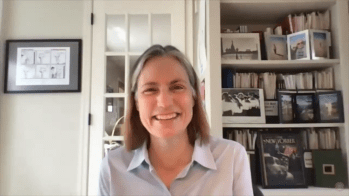
Fiona Hill
A new book about the Trump Administration was released today, and this one is likely to be much more serious than the many gossipy Trump books that have preceded it. This one is a memoir by Fiona Hill, who served in Trump’s White House as a Russia expert and then testified in the impeachment hearings.
Here’s the New York Times review by Jennifer Szalai: In a Memoir, the Impeachment Witness Fiona Hill Recounts Her Journey From ‘Blighted World’ to White House.
The arresting title of Fiona Hill’s new book, “There Is Nothing for You Here,” is what her father told her when she was growing up in Bishop Auckland, a decaying coal-mining town in North East England. He loved her, and so he insisted that she had to leave.
Hill took his advice to heart — studying Russian and history at St. Andrews in Scotland, sojourning in Moscow, getting a Ph.D. at Harvard and eventually serving in the administrations of three American presidents, most recently as President Trump’s top adviser on Russia and Europe. “I take great pride in the fact that I’m a nonpartisan foreign policy expert,” she said before the House in November 2019, when she delivered her plain-spoken testimony at the hearings for the (first) impeachment of President Trump. But for her, “nonpartisan” doesn’t mean she’s in thrall to bloodless, anodyne ideas totally disconnected from her personal experience. She wrote this book because she was “acutely aware,” she says, “of how my own early life laid the path for everything I did subsequently.”
Sure enough, “There Is Nothing for You Here: Finding Opportunity in the 21st Century” weaves together these two selves, slipping back and forth between the unsentimental memoir reflected in its melancholy title and the wonkish guide promised in its inspirational subtitle. The combination, however unlikely, mostly works — though by the end, the litany of policy prescriptions comes to sound a bit too much like a paper issued by the Brookings Institution, where Hill is currently a fellow. When recounting her life, Hill is a lucid writer, delivering her reminiscences in a vivid and wry style. As much as I wanted more of Hill the memoirist and less of Hill the expert, I began to sense that giving voice to both was the only way she could feel comfortable writing a book about herself.
Looked at from afar, Hill’s story seems like a triumphant tale of striving and accomplishment. Born in 1965, she grew up in a “blighted world.” Her father followed the men in his family into the mines when he was 14; as the industry started to collapse in the 1960s, he found a job as a hospital porter. Hill’s mother worked as a midwife. As late as the 1970s, Hill’s grandparents lived in a subsidized rowhouse without “mod cons,” or modern conveniences, including indoor plumbing. Her grandfather had been pierced by the “windy pick” — the pneumatic drill — and had to wear a brace around his pelvis “to keep his battered insides in” for the rest of his life.
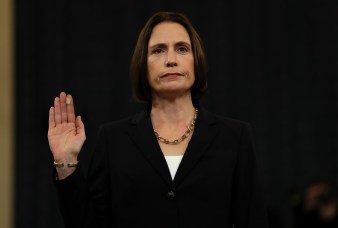
Fiona Hill is worn in at the House Intelligence Committee Open Impeachment Hearings.
Read more about Hill’s early life at the link. Here’s a bit about her experiences in the Trump White House.
Instead of making the usual insider-memoir move of fixating on all the brazenly outrageous behavior — the bizarre comments, the outlandish tweets — Hill notices his insecurities, the soft spots that, she says, made him “exquisitely vulnerable” to manipulation. Yes, she writes, the Kremlin meddled in the 2016 election — but unlike the #Resistance crowd, which insists that such meddling was decisive, Hill is more circumspect, pointing out that Vladimir Putin wasn’t the force that tore the country apart; he was simply exploiting fissures that were already there.
Just as concerning to her was the way that people around Trump would wreak havoc on one another by playing to his “fragile ego” — spreading rumors that their rivals in the administration had said something negative about Trump was often enough to land those rivals on what the president called his “nasty list.” Hill says that watching Trump fulminate made her feel like Alice in Wonderland watching the Queen of Hearts, with her constant shouts of “Off with their heads!” In Hill’s telling, Trump’s norm-breaking was so flagrant and incessant that she compares him, in her matter-of-fact way, to a flasher. “Trump revealed himself,” she writes, “and people just got used to it.”
But neither Trump nor Putin — who was the subject of one of Hill’s previous books — is what she really wants to talk about. What she sees happening in the United States worries her. Economic collapse, structural racism, unrelieved suffering: Even without Trump, she says, none of the country’s enormous problems will go away without enormous efforts to address them. Hill the expert points to heartening examples of benevolent capitalism at work. But Hill the memoirist knows in her bones that the neoliberal approach, left to its own devices, simply won’t do.
I cannot wait to read this book. More articles about it to check out:
Yahoo News: Trump’s fixation was on Putin himself rather than Russia, says fmr. WH adviser.
Raw Story: Trump’s former Russia expert has a message for voters if he runs in 2024
Financial Times: There Is Nothing for You Here by Fiona Hill — memoir from Trump White House.
Finally, Newsweek has an excerpt from the book: Donald Trump Called Fiona Hill ‘Darling,’ Thought She Was a Press Secretary.
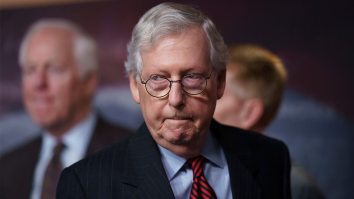 In other news, we’re still facing the possible default of the United States leading to a global financial crisis. Jonathan Weisman at The New York Times: As the U.S. Hurtles Toward a Debt Crisis, What Does McConnell Want?
In March 2006, as the government veered dangerously close to a default, Senator Mitch McConnell of Kentucky, the No. 2 Republican, let the Bush White House know he was two votes short of what he needed to raise the legal limit on federal borrowing.
Andrew H. Card Jr., then the White House chief of staff, began working the phones. He soon found two Democrats willing to break ranks and vote to put the legislation over the top. But Mr. McConnell was holding out for something else entirely, hoping to extract concessions from President George W. Bush as the price for uniting Republicans around lifting the limit.
“I don’t need your damned votes,” he snapped at Mr. Card. He lifted the debt ceiling with Republicans only.
Mr. Card never learned what the Senate leader wanted, but he tells the story for a reason: Mr. McConnell has long used the periodic need to raise the government’s borrowing limit as a moment of leverage to secure a policy win, as have leaders of both parties.
But two weeks before a potentially catastrophic default, Mr. McConnell has yet to reveal what he wants, telling President Biden in a letter on Monday, “We have no list of demands.”
Instead, he appears to want to sow political chaos for Democrats while insulating himself and other Republicans from an issue that has the potential to divide them.
Mr. McConnell has said the government must not be allowed to stop paying its debts; he has also said he will not let any Republicans vote to raise the limit, while moving repeatedly to block Democrats from doing so themselves. Instead, he has prescribed a path forward for Democrats: Use a complicated budget process known as reconciliation to maneuver around a Republican filibuster that he refuses to lift.
Asked what he wanted, that was his answer: “As I have said for two months, I want them do it through reconciliation.”
So what’s the problem then? Why don’t the Democrats just do it through reconciliation? Of course that is another problem, because Joe Manchin and Kirsten Sinema are standing in the way of the reconciliation bill. And what the hell do they want? A couple of reads on those two:
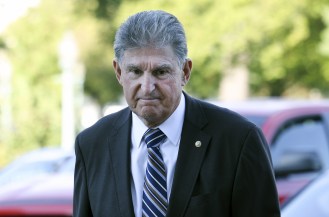 CNN: Manchin breaks with party leaders over strategy on debt ceiling and Biden’s economic package.
Democratic Sen. Joe Manchin on Monday pushed back on several politically sensitive positions his party leaders are taking at a crucial time for President Joe Biden’s domestic agenda.
The West Virginia Democrat, who holds a pivotal vote in the 50-50 Senate, indicated to CNN that he disagrees with the strategy top Democrats are pursuing in the standoff with Republicans over raising the national debt limit. Manchin said that Democrats “shouldn’t rule out anything,” including a budget process that Democratic leaders have made clear they will not employ.
Speaking to reporters, Manchin also would not commit to the new timeline set by party leaders to find a deal on the social safety net expansion by October 31. And he sounded resistant to calls from progressives and other top Democrats to raise his $1.5 trillion price tag for the package, which many in his party view as too low to achieve key policy objectives.
On Tuesday, however, Manchin did not rule out a $1.9 trillion to $2.2 trillion price tag for the social safety net package, a range Biden has floated privately. “I’m not ruling anything out,” Manchin said when asked by CNN if he would rule out that number.
In a stark warning sign to progressives, Manchin also indicated the package must include a prohibition against using federal funds for most abortions. “The Hyde Amendment is a red line,” he said. Manchin’s stance puts him at odds with progressives, with Congressional Progressive Caucus Chair Pramila Jayapal saying Sunday she would not support a package that included the Hyde Amendment.
Read more at the link.
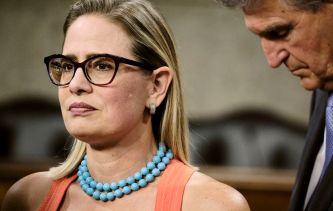 Michelle Goldberg at The New York Times: What’s Wrong With Kyrsten Sinema?
In 2003, Joe Lieberman, at the time one of the worst Democratic senators, traveled to Arizona to campaign for his party’s presidential nomination and was regularly greeted by antiwar demonstrators. “He’s a shame to Democrats,” said the organizer of a protest outside a Tucson hotel, a left-wing social worker named Kyrsten Sinema. “I don’t even know why he’s running. He seems to want to get Republicans voting for him — what kind of strategy is that?”
It was a good question, and one that many people would like to ask Sinema herself these days. People sometimes describe the Arizona senator as a centrist, but that seems the wrong term for someone who’s been working to derail some of the most broadly popular parts of Joe Biden’s agenda, corporate tax increases and reforms to lower prescription drug prices. Instead, she’s just acting as an obstructionist, seeming to bask in the approbation of Republicans who will probably never vote for her.
A “Saturday Night Live” skit this weekend captured her absurdist approach to negotiating the reconciliation bill that contains almost the entirety of Biden’s agenda. “What do I want from this bill?” asked the actress playing Sinema. “I’ll never tell.” It sometimes seems as if what Sinema wants is for people to sit around wondering what Sinema wants.
When Sinema ran for Senate, the former left-wing firebrand reportedly told her advisers that she hoped to be the next John McCain, an independent force willing to buck her own party. Voting against a $15 minimum wage this year, she gave a thumbs down — accompanied by an obnoxious little curtsy — that seemed meant to recall the gesture McCain made when he voted against repealing key measures of the Affordable Care Act in 2017.
But people admired McCain because they felt he embodied a consistent set of values, a straight-talking Captain America kind of patriotism. Despite his iconoclastic image, he was mostly a deeply conservative Republican; as CNN’s Harry Enten points out, on votes where the parties were split, he sided with his party about 90 percent of the time.
Sinema, by contrast, breaks with her fellow Democrats much more often. There hasn’t been a year since she entered Congress, Enten wrote, when she’s voted with her party more than 75 percent of the time. But what really makes her different from McCain is that nobody seems to know what she stands for.
Click the link to read more.
There’s lots more news out there. I’ll post more links in the comments. As always, this is an open thread.

The Opening up of Pandora’s box, Frederick Stuart Church, 1885
Good Day Sky Dancers!
I’m going to go down a rabbit hole today on findings by journalists on a trove of leaked financial information that shows the financial dealings of current and former world leaders in terms of hiding the loot in the world’s Treasure Islands.
Offshore banking has always frustrated many governments in trying to deal with how the rich and powerful hide wealth. This is from The Guardian on what’s being called the Pandora Papers. There’s an accompanying podcast if you’d rather learn about this important trove of leaked offshore papers. These leaks follow the Panama and Paradise papers leaks.
The financial secrets of some of the world’s most rich and powerful people are revealed following one of the biggest leaks of offshore data. The Pandora papers include 35 current and former world leaders and more than 300 public officials.
The Guardian’s Paul Lewis tells Michael Safi how the project came about and the months of work his investigations team has put into the publication. It is the latest offshore leak following previous global journalistic collaborations on the Panama papers and the Paradise papers.
The Guardian’s deputy business editor, Juliette Garside,explains how former British colonial territories have in recent decades used their legal jurisdictions to attract companies and wealthy individuals to register with them as tax havens.
The editor-in-chief, Katharine Viner, tells Michael that there is a clear public interest in publishing this latest investigation and revealing the secrets of prominent politicians at a time when many governments are raising taxes to fund pandemic recovery efforts.
‘Pandora’s Box’ by Rene Magritte 1951
The Washington Post reports the names and country affiliations of those caught in the leak. It includes Putin and many of his minions, the President of Kenya, and the King of Jordan. Czech Prime Minister Andrej Babis was also caught up in the investigations. This is the lede: “Governments launch investigations after secret papers show how elite shield riches.” The link is constantly updated with new revelations and responses.
Here’s what we know from our collective reporting

Pandora, c. 1914 (Metropolitan Museum of Art), Odilon Redon
There are short profiles of many of the leaders/elite and their offshore financial activities at the WAPO link. There are also several good links to basics on offshore banking and the small countries around the world that sponsor this very dark corner of the financial sector.
I’ve written about offshore “treasure islands” before as it tickles just about all my Nancy Drew and Financial Economist/Banker fancies. My last post came in 2016 when the Panama Papers were leaked. These leaks do pop up but the dynamics of the system are linked to political and political funding elites. It’s hard to get countries to move on the tax evaders and the public treasury looters. As you can see from the names, many are either doing this or getting money from those who use offshore banking.
CNN analysts believe the Jordan, Pakistan and, Russia releases are most significant. Former UK PM Tony Blair has also been named in the release.
Former UK Prime Minister Tony Blair and his wife, Cherie Blair, avoided paying £312,000 ($423,000) in stamp duty — a tax on property purchases — when they bought a townhouse in London, the BBC reported. The building now houses Cherie Blair’s law firm.
The Blairs purchased the townhouse in 2017 by buying the offshore firm that owned the property. When the property was put up for sale, its ultimate owners were a family with political connections in Bahrain, according to the BBC.
The Blairs set up a UK company to purchase the offshore firm. Doing so was legal, but it allowed them to avoid paying stamp duty, according to the BBC, because the tax is not charged when a company owning a property is acquired.
“It is not unusual for a commercial office building to be held in a corporate vehicle or for vendors of such property not to want to dispose of the property separately,” Cherie Blair told the BBC.
Cherie Blair also said her husband’s only involvement in the transaction was that the mortgage for the property used their joint income and capital, according to the BBC.
“All the arrangements were made for the express purpose of bringing the company and the building back into the UK tax and regulatory regime, where it has remained ever since. All taxes have been paid ever since and all accounts openly filed in accordance with the law,” Cherie Blair said, according to The Guardian.
It may not be illegal but it certainly sounds and appears dodgy. The real shocking thing is that these kinds of enterprises are setting up in the United States. Notice this little financial firm harkens from South Dakota a state that lured Citibank with its lax banking laws back in the good ol’ days. WAPO has just put up a more current analysis of the overall use of offshore banking. “FOREIGN MONEY SECRETLY FLOODS U.S. TAX-HAVENS. SOME OF IT IS TAINTED.”
SIOUX FALLS, S.D. — Across from a Holiday Inn, in a red-brick building with a welcome sign that reads “The Heart of America,” a little-known financial firm set up shop seven years ago and extended an invitation to the world’s elite.
Trident Trust promised to protect the fortunes and privacy of its new customers by relying on the laws of a state that had become a global destination for wealth. The company called it “The South Dakota Advantage.”
Among those who answered the call: a Colombian textile magnate caught in a scheme to launder the proceeds of an international drug ring, an orange juice mogul who settled with authorities in Brazil for allegedly colluding to underpay local farmers, and family members of the former president of a sugar producer in the Dominican Republic that has been accused of exploiting laborers and forcibly evicting families from their homes.
The U.S. government has long condemned prominent offshore financial centers, where liberal rules and guarantees of discretion have drawn oligarchs, business tycoons and politicians.
But a burgeoning American trust industry is increasingly sheltering the assets of international millionaires and billionaires by promising levels of protection and secrecy that rival or surpass those offered in overseas tax havens. That shield, which is near-absolute, has insulated the industry from meaningful oversight and allowed it to forge new footholds in U.S. states.
Paging Senator Elizabeth Warren! Clean-up in Aisle South Dakota! And of course, Delaware is also one of the usual suspects too. Just ask Senator MBNA (aka President Joe Biden).
The trust documents come mostly from the Sioux Falls office of Trident Trust, a global provider of offshore services. In a written statement, Trident said it is committed to compliance with all applicable regulations and routinely cooperates with authorities. The company declined to answer questions about its clients.
Other states competing to lure wealth include Alaska, Delaware, Nevada and New Hampshire. In South Dakota, assets in trusts more than quadrupled over the past decade to $360 billion. One of the largest trust companies in the state, the South Dakota Trust Co., boasts a roster of international clients from 54 countries.
The industry’s rapid expansion was led by a group of trust company insiders, who year after year pitched legislative proposals that were highly appealing to customers in the United States and abroad: protecting trusts from creditors, from taxing authorities, from foreign governments.
With little opposition, state legislators turned the proposals into laws — dozens since the late 1990s.
So, not only are we giving these folks lower tax bills than their house staff and employees, we’re letting them dodge even more tax liabilities by just traveling to the usual suspect states.
You may read the original work in the tweet directly above. It’s going to be a week of global intrigue! So, hang on to your best James Bond Villian impression. Mine will continue to be Vladimir Putin who set up a mistress and child to live like Marie Antoinette.
The Debt Ceiling is still in the news too!
Either of these stories could rock the US and Global financial markets! So, I’ll be watching! C’mon Joe! Don’t make me sell the US short to finance my senior days!

Pandora and the Flying Dutchman (1951) This painting was featured in the movie of that name. It plagiarizes the early metaphysical style of Giorgio de Chirico (1888–1978)
Biden did take McConnell to school today. This is from the LA Times.
President Biden on Monday criticized Republicans for not voting to raise the debt ceiling, accusing them of being “reckless and dangerous” in a way that could harm the economy.
“Not only are Republicans refusing to do their job, they’re threatening to use [the filibuster] to prevent us from doing our job — saving the economy from a catastrophic event,” Biden said during a speech at the White House.
The Democrat-controlled House last week passed legislation that temporarily suspends the debt ceiling. Senate Republicans, however, have said they will not vote to approve such a measure. Biden said the Republicans’ stance is “hypocritical, dangerous and disgraceful.”
“Especially as we’re clawing our way out of this pandemic,” Biden said.
…
Once the Treasury Department runs out of cash, payments to government workers, including military personnel, veterans and Social Security recipients would likely be delayed. A default would also affect taxpayers.
“Savings in your pocketbook could be directly impacted by this Republican stunt,” Biden said.
Treasury Secretary Janet Yellen previously said the department would run out of “emergency measures” to pay the nation’s debts on Oct. 18. The limit on federal borrowing is currently $28.4 trillion.
McConnell told Biden to find a Democratic Party-based solution in a Dear Joe letter. So, there’s your countdown to doomsday. This is from Politico.
“I respectfully submit that it is time for you to engage directly with congressional Democrats on this matter,” McConnell told Biden in his letter, a copy of which POLITICO obtained. “Your lieutenants in Congress must understand that you do not want your unified Democratic government to sleepwalk toward an avoidable catastrophe when they have had nearly three months’ notice to do their job.”
The letter, delivered to the White House on Monday, also cites Biden’s past opposition to debt increases while in the minority. McConnell summarized it this way: “The president’s party had to take responsibility for a policy agenda which you opposed. Your view then is our view now.”
So, Republicans continue to obfuscate the debt ceiling. It’s basically got to be increased because of the last 4 years and all years before. There’s very little Biden spending to this point and his budget is not even in effect at this point.
Don’t let your eyes glaze over on this stuff! This is a shit list of how they’re stealing from us!
What’s on your reading and global intrigue list today?

Woman in Pink Dress and Cat, by Teresa Tanner
President Biden made a dramatic appearance on Capitol Hill yesterday to urge Democrats to find a compromise on the infrastructure bills. His visit was apparently prompted by the progressive caucus forcing Speaker Pelosi to delay the planned Thursday vote on the bi-partisan portion of the bill separately from the budget bill that is to be passed by reconciliation.
The New York Times: Progressives Flex Muscles on Biden Agenda, Adopting New Tactics.
The nearly 100-member caucus refused to support a $1 trillion infrastructure bill that is a major piece of President Biden’s agenda, seeking leverage for a bigger fight.
Their stance forced Speaker Nancy Pelosi to delay a planned vote on the measure and ultimately prompted Mr. Biden to side with them in saying that there could be no vote on the infrastructure legislation until agreement on a far broader, multitrillion-dollar social policy and climate measure.
The maneuver drew plaudits from liberal activists who had watched with dismay in the past as their allies in Congress caved to pressure from Democratic leaders and surrendered in policy fights. And it signaled that the progressives enjoyed newfound influence, including the backing of a president long associated with his party’s moderates.
“Things only happen here when there is urgency,” Representative Pramila Jayapal of Washington, the chairwoman of the Congressional Progressive Caucus, said on Friday. “I’m just so proud of our caucus, because they are standing up for people who feel like they have not been heard in this country for a very long time.”
Still, while the progressives scored a tactical victory, negotiations continued to whittle down the size of the social policy and climate bill, which was already much smaller than the initial $6 trillion to $10 trillion that many of them had envisioned.
Their persistence also risked the collapse of both bills, angering moderates in the party who had delivered the slim majority to Democrats and are at the highest risk of losing their seats in the midterm elections.
Click the NYT link to read more.

Painting by Leslie Ann Ivory
Axios reports that: Biden floats roughly $2 trillion price tag for reconciliation.
President Biden, meeting with House Democrats on Capitol Hill on Friday, indicated they must further delay a final vote on a $1.2 trillion bipartisan infrastructure bill and scale back his $3.5 trillion social spending package to around $2 trillion range if either is to pass, lawmakers told Axios.
Why it matters: Biden made clear he wants to keep the two packages linked together and that he is optimistic there can be an agreement.
- “It doesn’t matter if it’s six minutes, six days or six weeks, we’re going to get it done,” the president told reporters on his way out of the meeting.
- Two lawmakers told Axios they anticipated it could be another month before both bills can be passed.
- While moderates don’t want to wait on the infrastructure vote and progressives don’t want to spend less on the social programs, the pause likely moves the fragile Democratic coalition closer to ultimately securing major portions of the president’s agenda ahead of the 2022 midterms….
What they’re saying: “He is the President of the United States and he says that he wants to get this done, and he basically linked them together,” Rep. Henry Cuellar (D-Texas), a moderate Democrat, told Axios.
“He basically said it’s not going to be $3.5 (trillion). It could be $1.9 trillion-$2 trillion. The president threw out some numbers, so I assume there was a reason why.”
The president discussed a range that went as high as $2.3 trillion, other sources in the room said.
“The president said we’re gonna get both bills done, and in order to get the rest done, we have to get this agreement on the reconciliation,” Rep. Pramila Jaypal (D-Wash.), chairwoman of the Progressive Caucus, told reporters.
Yesterday, before Biden’s visit to Congress, the Washington Post’s Greg Sargent wrote that the White House didn’t pressure progressives to vote for the infrastructure bill on Thursday. Opinion: The Biden agenda is in peril. Here’s the hidden reason it might survive.

Louis Frey, Artist
Sequoia National Park Poster
One of the weird things I’ve learned growing up in these United States was that no matter how far in the past the Civil War was fought, parts of the Deep South have never got over it or gone much beyond it. This is especially true in rural areas although there are also some Western and Mid-Western states that are mostly rural and as backasswards about stuff as much as the Deep South.
I grew up in the Heartland and spent every moment feeling like I lived in a cultural desert even though the combined area of Council, Bluffs, Iowa, and Omaha. Nebraska is fairly large in terms of middle-of-the-country cities. I’m thankful my daughters are in Denver and Seattle that are big enough population areas to drive the rural parts of their state to mostly obscurity on the state level.
So, this was no surprise to me:

Sabrena Khadija, Artist
Volcanoes National Park
I’ve heard better solutions to the red state/blue state gap and believe me, I was ready to make a movement for France to reclaim New Orleans quite a few times during the entire Hurricane Katrina period. But seriously, who wants to live near this kind of behavior? Gabrielle Hays files this story for the PBS News Hour. This happens to come from my mother’s hometown which I thought was super-sophisticated grown up in comparison to Omaha. “A pro-slavery petition is the latest racist incident at this Kansas City high school. Parents say they’ve had enough.” WTF?
An online petition to reinstate slavery that made its rounds at a high school in Kansas City this month is the latest in a series of incidents sparking outrage from parents and students who say race-related controversies at the school are an all-too-common occurence.
In an email to parents at Park Hill South High School dated Sept. 22, Park Hill School District Superintendent Jeanette Cowherd acknowledged the petition – which was brought to officials’ attention nearly a week prior – by saying many people are “hurting” because of “unacceptable and racist statements online,” adding that Board of Education “prohibits discrimination, harassment and retaliation” and that discipline could equal “suspension or expulsion.” Cowherd did not share any specifics regarding the students involved nor whether they have been disciplined. The email also noted the district will set up meetings to “give people the opportunity to share how they feel.”
But parents say the district is doing little to mitigate the ongoing problems, including individual attacks on students based on their race.
“I have a disheartening feeling about the incident that happened at Park Hill South. I don’t feel like it was addressed properly or at all,” parent Jeff Holmes said during public comment at a Park Hill school board meeting last Thursday, adding that these issues span across the school district.
“I’ve heard all of the nice, kind words and I guess that they are okay, they are what they are but they are meaningless, hollow and insincere if we don’t see action,” he said.
Park Hill South is only the latest school over the past week to make headlines for its handling of racial incidents. Just days after the petition circulated, school officials at Olathe South School, 30 minutes away from Kansas City, Missouri, are investigating a homecoming proposal poster that read “If I was Black I would be picking cotton but I’m white so I’m picking you for HOCO?” A photo of the offensive poster made its rounds on social media before school administrators caught wind of it.
National Education Association President Becky Pringle said these types of derogatory occurrences are not new.
“All students – no matter their race or place – have a right to a public education in a safe learning environment. But right now, many of our students are scared, anxious, and feeling threatened. What happened at Park Hill South High School isn’t an isolated incident nor did it happen by accident,” she said in a statement to the PBS NewsHour.
NEA, a teachers union that advocates on behalf of educators nationwide, has received reports of “hostile and hateful environments” in schools across the country, she said.

Brittney Lewis of Bybrije, Artist
Yosemite National Park
There have been threats made to school board members across the country as well as a documentary by NBC on an incident that sparked the critical race theory kerfuffle which basically erases slavery, Jim Crow, and whatever we happened to stumble across in our history books like the Tulsa Race Massacre. Greg Abbott just signed a law to make white folks feel comfy with their slave-owning, KKK klan, lynch-happy ancestors. Many southern states actually are experiencing an increase in the population of black southerners as many Black Americans are moving to the large, affluent cities of the south. This might be one way of turning more southern states blue.
Then, of course, we’ve spent lots of time on the Abbott anti-women and anti-voting rights legislature making Texas basically into something akin to Texastan with its Cristoban tyrants seeking to make women, people of color, and the LGBT community outcasts and lesser citizens. What the Hell is going on? Why do we have a tyranny of a minority?
But what about the American Outback where many states have fewer people than your normal Chicago, New York, or LA Zip codes. I watched Steve Kornacki show how much political power these states have because they all have two senators.
I mean, what we`re talking about here is the partisan distribution of voters. A couple different ways, I guess, to look at this. First, the map everybody knows. This is the 2020 election. Biden wins. There`s the electoral vote count. Here are the red states. Here are the blue states.
You see, basically, we know Democrats concentrated a lot on the West Coast, the Northeast, somewhat here in the Midwest. Biden was able to flip a couple states. But in that clip you played, you had Michael Steele talking about the county strength.
Now, the 50 states in the country, there`s more than 3, 100 counties in the United States. So this map is going to change here in a second, and you`re going to see all of the counties in the country.
This is the red/blue map for the counties. And, obviously, you see a lot more red here than blue. In the 2020 election, Donald Trump won more than 2, 500 counties. Again, there`s just over 3, 100 of them. More than 2, 500 went for Donald Trump.
Now, obviously, not every county is the exact same size. Here`s like a very dramatic example I could give you. If you were to really Zoom in here in Southern California, I`m going to circle it. What I just circled is Los Angeles County in Southern California.
This is a big blue county, the city of Los Angeles, about 10 million people. There`s about 10 million residents in Los Angeles County. Joe Biden won Los Angeles County overwhelmingly. In terms of population, though, Los Angeles County would be the same size as Utah, Idaho, Montana, Wyoming, North Dakota, South Dakota, Nebraska, roughly.
If you were to combine all of those red states, the population would be about the same as Los Angeles County. And yet obviously the number of counties, the land distribution, there`s a lot more landmass, there`s a lot more red than blue one here, land vs. population. So that gets the story this divide here that you see in the county map.
Here`s the actual number, Trump won 2, 574 counties, Biden 539. This has become — this century, at least, this has become the story of our politics. And Clinton in the 1990s won a ton of counties. He won a lot more of the interior of the country.
But this has become the story. But this, by the way, what you`re looking at here, is if you sized every state in every county relative to its population, this would be the map. But this is just a blob here. It looks like a Rorschach test.
But if you were to size the high population areas to the same scale as low end — in low population areas much lower, this would become what the red/blue map looks like. But, again, Ari, what it basically gets at here is, look, the distribution of the popular, Democrats in cities, increasingly in suburbs.

Sage Aune of Sagepizza, Artist Joshua Tree National Park
We’ve talked about Senator Joe Manchin was has been the focus of disruption in the Senate Democratic Caucus. Eyes recently on Arizona’s Krysten Sinema who is going for the complete enigma look. This is from Axios’ Hans Nicholls: “Cracking the Sinema code.”
Sen. Kyrsten Sinema’s political allies have some free advice for anyone trying to bully the wine-drinking triathlete into supporting President Biden’s $3.5 trillion budget bill: She doesn’t play by Washington’s rules — and she’s prepared to walk away.
Why it matters: For all her flash, Sinema — unlike fellow holdout Sen. Joe Manchin (D-W.Va.) — rarely telegraphs her precise intentions, leaving political adversaries guessing about her ultimate goals.
- In conversation with colleagues, she’ll suggest that her top priority is passing the $1.2 trillion bipartisan infrastructure deal she brokered this spring over late-night, wine-fueled negotiations. Beyond that, you’re piecing together clues.
- President Biden and his top aides met her four times over the course of a day this week without totally cracking the code.
- Sinema on Thursday tweeted a statement saying, “Claims that the Senator has not detailed her views to President Biden and Senator [Majority Leader Chuck] Schumer are false” and they “are fully aware of Senator Sinema’s priorities, concerns and ideas.”
Between the lines: Progressives could be forgiven for presuming that Sinema, 45, the first openly bisexual member of Congress, who’s easy to spot in her trademark sleeveless dresses, wry wigs and acrylic glasses, would share their woke politics.
- They’ve been befuddled, and increasingly enraged, when she behaves more like the late Republican Sen. John McCain, another Arizonan who didn’t mind challenging party orthodoxies.
- At her core, Sinema is something of a fiscal conservative, which disappoints progressives, leading them to whisper about a primary challenge in 2024.
- She’s unconventional (see: recent internship at a Sonoma winery) and a force to be reckoned with. She’s known to rise between 4-5 a.m. to train for her next race, and she was forced to take up aqua jogging after breaking her foot this summer in something called the “Light at the End of the Tunnel Marathon.”
The big picture: While Manchin has been intensely focused on price tag of spending, setting his limit at $1.5 trillion, Sinema has signaled she’s more concerned with the tax side of the equation, including who pays them.

Sabrena Khadija, Artist
Death Valley National Park
There are so few conservative Dems and centrist Republicans that the Senate is as split as the country. However, the right-wingers of the Republican base have more cows and coyotes for neighbors than people. The graph shown by Kornacki makes me agree with Dr. Howard Dean.
DEAN: Well, the central problem — there are several central problems.
The biggest problem of all is that the counties and the states that Michael talked about and that Steve talked about are older, getting older and whiter. And they`re terrified of the future. Their kids are leaving. They`re teaching stuff in the schools that`s not useful.
The older people don`t know how to use an Internet. They`re losing their jobs. And if they can`t use the Internet, they can`t get another job. And this is pure fear and anger that`s motivating Trump`s voters. And it`s why he`s so successful.
The problem is that the future, first of all, belongs to the blue areas, at least right now. Young people overwhelmingly vote Democratic, not because they love the Democrats, but because that horrible, pessimistic, furious vision of the Republicans is just totally unacceptable to people who are young.
And it also highlights the structural defects that we have got that are now an emergency after 250 years, the Electoral College, which doesn`t make any sense at all. The corrupt election laws that are being passed, we have had experience with that through Jim Crow.
We have the new Jim Crow in Georgia, and they still voted for two Democratic senators for the first time since segregation was broken. So, the country is really at an inflection point, a point. And the fury and anger between the red and the blue is explainable by how terrified the right-wing is and the conservatives are of the future.
Let me know return to what’s behind that first twitter with a direct link to the study.
The University of Virginia Center for Politics has partnered with Project Home Fire, a new initiative dedicated to finding common ground in American politics, on an innovative new data analytics and polling project to explore the social, political, and psychological divides between those who voted for Donald Trump and those who voted for Joe Biden in 2020.
Some of the key takeaways from today’s release are:
— Majorities of Trump and Biden voters express support for several elements of the bipartisan infrastructure and reconciliation bills being debated in Congress, but there are marked differences in their levels of support. (see Table 1 below)
— Majorities — often large majorities — of both Biden and Trump voters express some form of distrust for voters, elected officials, and media sources they associate with the other side. A strong majority of Trump voters see no real difference between Democrats and socialists, and a majority of Biden voters at least somewhat agree that there is no real difference between Republicans and fascists. (see Table 2 below)
— Significant numbers of both Trump and Biden voters show a willingness to consider violating democratic tendencies and norms if needed to serve their priorities. Roughly 2 in 10 Trump and Biden voters strongly agree it would be better if a “President could take needed actions without being constrained by Congress or courts,” and roughly 4 in 10 (41%) of Biden and half (52%) of Trump voters at least somewhat agree that it’s time to split the country, favoring blue/red states seceding from the union. (see Table 3 below)
The Center for Politics and Project Home Fire will be releasing findings from this study in the coming weeks through a series of articles in Sabato’s Crystal Ball and other publications, as well as public symposiums that will each explore major, divisive subjects in American life. Those topics include: immigration, political violence, pandemic response, and other prominent national issues.
Yup. We’ve got a bunch of secessionists out there but they are not the majority. What are we going to do with this situation?
The National Park Posters are available to purchase to help raise funds for the NPS. You can read more about them and their artists at this link at Forbes. The link is old but still interesting.
What’s on your reading and blogging list today?
 peej
peej Carissa
 bostonboomer
 dakinikat
 ecocatwoman
 mablue2
 Mama Lopez
 peggysue22
 quixote
 skydancingguestblogger
 Mona (aka Wonk the Vote)
 Memeorandum Crooks and Liars Democracy NOW The UK Guardian
The Sky Dancing banner headline uses a snippet from a work by artist Tashi Mannox called 'Rainbow Study'. The work is described as a" study of typical Tibetan rainbow clouds, that feature in Thanka painting, temple decoration and silk brocades". dakinikat was immediately drawn to the image when trying to find stylized Tibetan Clouds to represent Sky Dancing. It is probably because Tashi's practice is similar to her own. His updated take on the clouds that fill the collection of traditional thankas is quite special.
You can find his work at his website by clicking on his logo below. He is also a calligraphy artist that uses important vajrayana syllables. We encourage you to visit his on line studio.






 Sky Dancing
Recent Comments