As I was starting my day, I discovered that my internet was down. It finally came back, and I’ve been belatedly looking around at the latest news. Every day it gets crazier and crazier. Why did I ever think we could be rid of Trump if he lost the 2020 election? Fat chance. Will he ever go away? Maybe if he finally goes to prison or dies of old age. In the meantime, we’re stuck with a dangerous high profile lunatic who may have the ability to destroy not only our democracy, but also our national security.
How many of those top secret documents did Trump read or share with visitors to his office–where documents were stored in boxes and even in his desk?! What if he decides to reveal government secrets on Truth Social or in TV interviews? Some Democrats are worried he could do something that insane.
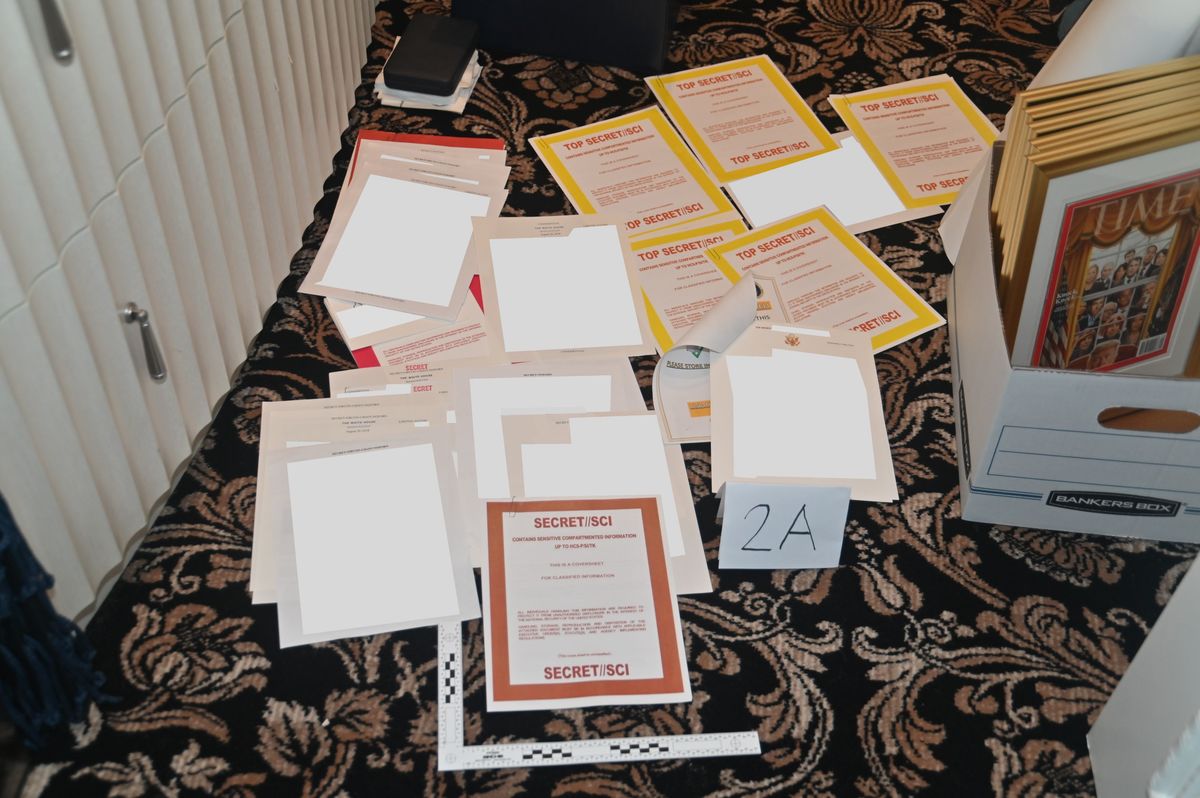
The damning photograph that the Department of Justice released Tuesday night, showing classified documents spread out across the carpeted floor at Mar-a-Lago, confirmed that former President Donald Trump had kept records related to intercepted communications—possibly involving secret spy satellites or surveillance aircraft.
And the sensitive nature of those secrets, coupled with Trump’s particularly unhinged behavior in recent days, has many Democratic lawmakers nervous.
In the photo released late Tuesday, some of the documents were labeled “TOP SECRET.” Others were just “SECRET.” But either way, the White House memos cautioned that they should severely limit access to details contained within. Some of the documents can be seen with the “NOFORN” marking, indicating that no foreign nationals should ever lay eyes on them.
All of the visible cover sheets warned that the contents were “HSC-P/SI/TK,” meant to signify that the secrets they held inside were strictly controlled, clandestinely captured, and involving possible aerial reconnaissance, respectively.
Adding to the chaos, inthe hours before and after that DOJ disclosure, Trump showed himself to be increasingly volatile, taking to his own social media app to share bizarre conspiracy theories about Hunter Biden’s laptop, Q-Anon cult material, and assert that the records he had are, in fact, no longer restricted.
“Thought they wanted them kept Secret? Lucky I Declassified!” Trump’s personal account posted Wednesday morning.
The implied threat is that he could, if he so desired, reveal them at any time….
“I would not leave it beyond him to do something as insane as that. When someone is cornered, they make very bad decisions, and Donald Trump is in a very bad situation right now. We don’t know what he will do,” Rep. Ted Lieu (D-CA) said in an interview with The Daily Beast.
Read remarks from several other Congresspeople at the link. Just a bit more:
The damage assessment currently underway by the office of Director of National Intelligence Avril Haines will take into account what could happen if these secrets were exposed. And the FBI has seized surveillance video footage from Mar-a-Lago that might show who handled those records without permission this past summer.
But Trump continues to rage-post online, which is why Rep. Jared Huffman (D-CA) warned that the threat is ongoing.
“Here’s what makes it truly scary: Trump is weirdly attached to all of this ‘Top Secret’ information, he constantly throws tantrums, and he has an insatiable desire for attention including on social media,” Huffman said. “Since he no longer has White House china to smash, his next tantrum might be blurting out sensitive national secrets on Truth Social, or calling his pal [Vladimir] Putin to divulge or even sell information. With anyone else these would seem like crazy scenarios, but not with Trump.”
Former president Donald Trump’s hoarding of highly classified national defence information at the Palm Beach, Florida, home could bring about a level of damage to US intelligence operations not seen in decades, according to current and former intelligence community officials and experts who spoke to The Independent.
A Tuesday court filing from the Department of Justice laid out just how many documents containing America’s most sensitive secrets were recovered from the ex-president over the last nine months.
More than 100 “unique documents with classification markings” were seized from his Mar-a-Lago club during an 8 August search by FBI agents, including three stored in Mr Trump’s desk. Classification levels ranged from confidential — the lowest level of classification in the US system — to the highest, top secret.
The department also said “certain documents” found at Mr Trump’s property bore markings denoting them as containing “sensitive compartmented information”, a designation reserved for extremely closely held secrets often involving intelligence sources and methods or nuclear weapons. Those 100 joined another 38 documents which FBI agents recovered from Mr Trump’s counsel during a 3 June meeting at Mar-a-Lago, plus another 184 documents which National Archives and Records Administration officials brought back from Florida in a set of 15 boxes Mr Trump allowed them to retrieve in January.
What national security experts told The Independent:
The experts who spoke with The Independent have decades of combined experience dealing with the most sensitive information, ranging from battlefield intelligence meant to disrupt terrorism networks to human intelligence gathered from clandestine assets and the highly technical signals intelligence collected by the National Security Agency.
All of them expressed fears that Mr Trump’s retention of such closely held secrets in a notoriously insecure facility — and one that has long been known to be a target of foreign intelligence services — will lead the US government to undertake what will be a unilateral degradation of American intelligence capabilities, on the assumption that whatever programs described in the papers stored at Mar-a-Lago may already have been or will soon be compromised.
David Priess, a former CIA intelligence officer who delivered daily intelligence briefings to then-FBI Director Robert Mueller and other top officials during the George W Bush administration, told The Intependent in a phone interview that it’s possible that some programmes that may be compromised by Mr Trump’s retention of documents in such a public place could still be salvaged if the documents in question are not specific as to intelligence sources or methods….
“It’s likely that some of the information is going to lead to some at least some serious investigation and possibly some actual shutdowns of some collection,” he said.
Another former CIA analyst, who asked for anonymity because they now hold another sensitive position in the US government, said Mr Trump’s retention of documents pertaining to “HUMINT” — human intelligence that is often gathered with the aid of sources recruited in hostile countries over a period of years — could lead intelligence officials to pull the plug on long-running operations and possibly could force them to mount operations to extract operatives or assets to safety.
“There’s a good chance someone at Langley is now trying to figure out how to exfiltrate some very helpful folks from very unfriendly places,” they said.
Feinberg notes that this already happened in 2017, when Trump blabbed about a secret operation to Sergey Lavrov and Russian Ambassador Sergey Kislyak in the Oval Office.
Meanwhile, Trump’s incompetent lawyers are blabbing scary stuff. Alina Habba, who previously represented a parking garage company, thinks violating the espionage act is a “mundane” crime.
Trump attorney Alina Habba is upset that the DOJ and FBI are looking into "mundane" crimes like "espionage" at Mar-a-Lago.
And she says that she has been in Trump’s office–where he was storing top secret documents in his desk and in boxes, and so have lots of other visitors.
After an explosive court brief and picture of classified documents from Mar-a-Lago earlier this week, the Justice Department will argue in court Thursday against a request by former President Donald Trump that a so-called special master be appointed in to review the evidence the FBI seized at his Florida resort last month.
US District Judge Aileen Cannon will be considering whether to bring in third party oversight of the Justice Department, in which an outside attorney would in theory identify and filter out evidence that should be withheld from investigators because it was privileged.
Arguing it is unnecessary, prosecutors in court filings Tuesday night provided new details about its investigation into whether classified government documents were illegally mishandled. Lawyers for the former president, who filed a lawsuit last week seeking the appointment, meanwhile argued in a Wednesday night court filing that the Justice Department could not be trusted, as Trump claimed the search itself was unjustified.
Cannon previously signaled an inclination toward granting Trump’s request, but that was before the Justice Department’s dramatic filing this week.
Sneed lists the following questions to watch for (Read details at the CNN link):
— How sharply does DOJ go after Trump’s spin?
— How are the dynamics on Trump team playing out?
— Does the judge recalibrate her approach?
— If the judge grants the special master review, what does it look like?
As you know, over the past two days, first the DOJ and then Trump lawyers turned in filings with their arguments about Trump’s request for a special master. The DOJ strongly opposed the request in a longer than usual argument (35 pages) on Tuesday; Trump’s team responded with their arguments in favor yesterday. Today journalists are reporting new insights into the two opposing filings.
According to DOJ’s recent brief, classified documents in that office were “commingled” in a desk drawer with three passports. While the government did not disclose the name on the passports, Trump himself has complained that during the search, the FBI “stole” his three passports. It seems a safe bet that the passports DOJ recovered were Trump’s.
The significance of the passports is enormous. As DOJ explained in an understated footnote, “The location of the passports is relevant evidence in an investigation of unauthorized retention and mishandling of national defense information.”
In other words, the presence of the passports in the same drawer as the classified records tends to tie the unauthorized possession of these documents to Trump himself. A photo included with the filing shows the items that were recovered from his office. Among the classification markings on the documents are “Top Secret,” meaning that the disclosure of the material could cause exceptionally grave damage to the national security of the United States.
A routine practice in drafting search warrants is to include a request to seize identity documents that can connect the subject of the investigation with the premises. That helps to make the evidentiary tie between the person and any contraband that might be found at the location. For example, if searching for illegal drugs in a house where multiple people come and go, agents will seek authority to seize identity documents like a driver’s license, photographs or other personal possessions located in the same room as the contraband. Finding both of these items together tends to connect the person to the contraband. Here, the presence of Trump’s passports alongside the classified documents supports an inference that he himself possessed the classified documents.
To the extent Trump may be inclined to pin all blame on his lawyer who signed a document in June attesting that all of the classified documents had been returned, the documents in his personal desk drawer are a problem for him. The former president would need to explain away the notion that he himself possessed these documents long after the government asked for their return, and despite personal assurances from Trump when Counterintelligence Section Chief Jay Bratt visited Mar-a-Lago in June to inspect the storage of documents. At the time, Trump told Bratt, “Whatever you need, just let us know.”
The former president’s continued retention of the documents, even after the repeated requests to return them, suggests a willful violation of the law.
Read more at The Daily Beast.
DOJ BIG PICTURE: you don’t make a filing this strong, bold, and factually accusatory if you don’t have every intention to indict.
— Andrew Weissmann (weissmann11 on Threads)🌻 (@AWeissmann_) August 31, 2022
Newly public details from the Justice Department’s criminal probe of documents taken to Mar-a-Lago suggest enormous legal peril for two of Donald Trump’s attorneys — and considerable uncertainty for Trump himself, intelligence and legal expertssaid.
There’s no way to predict whether the Justice Department will ultimately pursue charges against the former president or his associates. But in a court filing Tuesday night, government lawyers recounted numerous instances in which Trump’s lawyers allegedly misled government officials during the investigation, and in which Trump or his team appear to have haphazardly handled materials that contained national security secrets.
The evidence laid out in the filing, experts said, could build a legal case that Trump attorneys Evan Corcoran and Christina Bobb obstructed the government’s investigation, allegedly telling FBI agents and prosecutors that they had handed over all classified documents when in fact many remained in Trump’s possession.
Left unanswered were key questions that could determine Trump’s legal fate: Did he direct Corcoran and Bobb to mislead the government, either before or after the FBI raid of his Florida home and club?
And, if so, why did he want to keep reams of top-secret classified documents there?
“It’s bad,” said Peter Lapp, a former FBI agent who worked on espionage cases and is now a private consultant. “It’s all pretty damning.”
Read the rest at the WaPo.
I’ll end there. I’ll be hanging out on Twitter to watch for reports from Judge Cannon’s courtroom. I hope there will be a quick resolution. If she does favor a special master, I wonder if the DOJ will appeal? What do you think? What other stories are you following?
Did you like this post? Please share it with your friends:
Many of you know that I was born in North Dakota and have a long family history there as well as in Minnesota. We moved away when I was a child; but both sets of grandparents were still there, so we often went back to visit. I’m the eldest child in my family, and my other siblings don’t remember much, if anything, about North Dakota, or even about our paternal grandparents. My mother’s parents eventually moved to Indiana.
I’ve heard stories about North Dakota from my parents all my life and I guess for that reason, I still have an emotional attachment to the place. I took two trips up there with my parents, and we found the places my parents were born and grew up–my Dad in Fargo and my Mom in Hope and Lisbon. we also visited the North Dakota State campus in Fargo, where my parents met in a political science class, and Grand Forks, where my Dad got his masters degree at the University of North Dakota. We also explored the Theodore Roosevelt National Park and visited several historical sites.
It might sound strange, but when we were there, I had a real sense of belonging, a feeling that “This is where I came from.” Now my Dad is gone and my Mom has lost most of her memories–at least she can’t talk about them anymore. My Mom used to tell me that I was the only one who could carry on those memories for them.
North Dakota is one of the nation’s top sunflower-producing states, using the cheery yellow flowers for everything from bird seed mixes to cooking oils.
But before North Dakota’s many hardworking farmers start to harvest this tasty crop, the state comes alive with the golden hue of thousands upon thousands of sunflowers, all blooming together at the same time.
Known as a “superbloom,” the jaw-dropping phenomenon occurs every year toward the end of summer. Spring planting was delayed this year in North Dakota and other northern states because of cold, wet weather—but that also means that sunflowers in some parts of the state are still blooming.
Right now, many of the state’s sunflower fields are in peak bloom, with nearly all flowers showing off their delicate yellow petals. As such, the state has earned a reputation as “the best place in the United States to experience the vast sunflower blooms,” says Sara Otte Coleman, North Dakota’s tourism director, in a statement.
I found this interesting:
Blooming Sunflowers, Boris Eremin, Ukrainian artist
Ukrainian immigrants first began planting sunflowers when they moved to North Dakota in the late 19th and early 20th centuries following the passage of the Homestead Act of 1862. Sunflowers are still an important plant for Ukrainians, both symbolically and economically. Before the Russian invasion of Ukraine in February, Ukraine was the largest exporter of sunflower oil in the world, though the war has largely halted production, per the New York Times’ Christine Hauser.
As well as this scientific fact:
When they’re young, sunflowers turn their heads toward the sun as it moves in the sky, a behavior known as heliotropism. But as they mature and start to produce seeds, they mostly point east, which scientists have learned helps the plants attract bees and ultimately reproduce.
Quite a few artists have painted sunflowers, and I’ve illustrated this post with some of those works.
On to today’s news…
Trump is melting down on his imitation twitter. So far, he has posted 60 times on Truth Social, including highlighting garbage from Q-anon and 4-chan.
In the weeks since the FBI’s unprecedented search of Donald Trump’s Mar-a-Lago estate, the former president’s allies have pleaded with him to stop publicly commenting on the raid and fight the Justice Department’s investigation in the courts.
Trump isn’t listening.
On Tuesday morning alone, Trump has taken to his Truth Social platform over four dozen times to share memes and posts attacking his political enemies. Some posts are memes attacking President Joe Biden or other Democrats, while others are baseless election fraud claims or attempts to delegitimize the FBI.
One post in particular from Tuesday morning shows a photo of Trump with the false caption, “TRUMP WON,” in reference to the 2020 presidential election. The former president then reposted the photo and wrote that the “FBI has advanced this fact even further.”
Another post included a photo with a caption that read: “81 million votes… and I’ve never seen a pro Biden hat, shirt or flag in my life.” Trump reposted the photo and said, “It is rather amazing, isn’t it?”
The investigation into Donald Trump’s handling of classified national security records is forcing Republicans into a strained defense during a pre-midterm sprint in which they’d much rather be talking about Joe Biden.
After having decried the FBI’s search of the ex-president’s home, many Trump defenders went silent uponthe release on Friday of the probable-cause affidavit that revealed the extent of Trump’s efforts to hold onto the top-secret documents. GOP worries about the developments of the case and Trump announcing a 2024 run before November are giving way to a subtle, broader warning about putting the former president too much on the ballot this fall.
“Republicans should focus on defeating Democrats, and every Democrat should have the word Biden in front of their name,” said Trump ally and former Republican Speaker Newt Gingrich. “The Republican focus should be to win the election in November. Trump will do a fine job defending himself. He’ll be fine.”
Sunflowers, by Claude Monet
Some top Republicans acknowledge the growing angst and concern, as it’s become clearer that Trump may have been warehousing some of America’s most sensitive secrets in an unsecured basement — and even refused to turn them over when the National Archives and Justice Department tried to recover them. One top Republican fundraiser asked to describe the mood among donors, said, “There is enormous frustration.”
“The question is, is there willingness to express that frustration,” the fundraiser added. “I don’t know the answer to that. But there is real frustration, and with the exception of people who are too stupid to understand the need to be frustrated, it is nearly universal.”
Strained defenses and private frustrations are familiar emotions for some Republicans during the Trump era. But the stakes are particularly high this fall, with projections of a red wave in the House getting dimmed to a smaller GOP majority and as Sen. Chuck Schumer appears potentially poised to remain in control of the Senate.
Last fall, Republicans held high hopes of a “red wave” in the 2022 elections after they stormed to power in blue-leaning Virginia and nearly won the governor’s race in New Jersey. While Democrats were demotivated, the GOP base was on fire.
But in recent weeks, numerous data points have indicated Republican prospects of a smashing victory are dimming. While the president’s party tends to perform poorly in midterm elections, there are signs it is shaping up to be an unusual year, potentially enabling Democrats to hold one or both chambers of Congress.
Some of the bad signs for the GOP:
A Democratic victory in a bellwether election. The starkest sign of a shifting landscape came last week in the Hudson Valley, a highly competitive district north of New York City that has mirrored the national landscape for years. It voted for Joe Biden in 2020, Trump in 2016 and Barack Obama in 2012. In a red wave climate, Democrats would have no business winning the special House election. Yet Democrat Pat Ryan defeated Republican Marc Molinaro in a test of each party’s preferred message. Ryan ran on protecting abortion rights, combating gun violence and battling corporate greed, while Molinaro sought to make the election a referendum on Biden, inflation and “one-party” rule in Washington.
Persuadable voters are trending toward Democrats. The latest NBC News poll, conducted this month, included an unusual finding for midterm elections: Persuadable voters in the midterm election are tilting toward Democrats, the party in power. This group accounts for about 25% of respondents, who float between the parties and tend to be male, moderate, independent and exurban. They preferred Republicans by 6 points in the combined NBC News polls of January, March and May. But in the August poll, they leaned toward Democrats by 3 points.
The GOP’s “enthusiasm” edge is shrinking. In March, the NBC News poll found that Republicans held a 17-point “enthusiasm” advantage over Democrats — that is, their voters were more likely to express high interest in voting this fall. In the August poll, the GOP advantage fell to 2 points.
Mitch McConnell is downplaying expectations in the Senate. McConnell, the Republican leader, isn’t sounding too bullish about his prospects to capture control of the Senate, having predicted just two weeks ago, “There’s probably a greater likelihood the House flips than the Senate.” That may be a product of the shifting environment, along with a phenomenon McConnell described as “candidate quality.” A series of first-time Republican contenders are struggling in competitive races against seasoned Democratic politicians. Recruitment failures in states like New Hampshire and Arizona have led GOP governors to decline to run.
Read the rest of the bad omens at the NBC link.
The Sunflower, by Gustav Klimt, 1907
Today is the day the DOJ is supposed to file it’s response to the Trump request for a Special Master to review the government documents that the FBI recovered in its search of Mar-a-Lago. Yesterday the judge agreed the DOJ response could be 40 pages long. It looks like Merrick Garland is planning to spell out in detail what Trump is suspected of doing.
The Justice Department on Tuesday will file publicly in court its response to former President Donald Trump’s bid for a special master to oversee the FBI’s review of materials seized in the Mar-a-Lago search.
The agency was granted permission by Judge Aileen Cannon of the Southern District of Florida to file up to 40 pages after it said the 20-page limit set by the local rules of the court wasn’t sufficient to “adequately address the legal and factual issues raised by” Trump’s filings.
Cannon, a Trump appointee, did not set a specific deadline for the Justice Department’s filing beyond requesting it “on or before” Tuesday. The judge also ordered the agency to file under seal more details about what it seized from Trump’s resort, and a notice laying out the status of its review of the materials.
Trump must file his reply to the Justice Department by 8 p.m. ET Wednesday night, per Cannon’s order, and the judge has scheduled a hearing for Thursday to consider Trump’s request for a special master — a third-party attorney appointed by a court to oversee part of a certain case. Notably, Cannon has already signaled a “preliminary intent” to grant Trump’s request, which could bring new complications to the DOJ’s closely watched investigation.
Yesterday the DOJ said it has already reviewed the documents.
The Justice Department, meanwhile, has already signaled that it is using an internal filter team to review the seized items and separate material that could be subject to privilege claims.
In a court filing Monday, the agency said it has identified “a limited set of materials” from its search of documents taken from Mar-a-Lago that potentially contain material covered by attorney-client privilege and is in the process of addressing privilege disputes.
Chris Kise, Florida’s former solicitor general who served on Gov. Ron DeSantis’ transition team, inked a contract to represent Donald Trump in the criminal case that resulted in the FBI search of the former president’s home in Mar-a-Lago, according to two sources with knowledge of the discussions.
Twelve sunflowers in a vase, by Vincent Van Gogh
Kise, who declined to comment, began negotiations with Trump shortly after the FBI’s search of his Palm Beach estate Aug. 8. Numerous other criminal defense attorneys have said they couldn’t represent the former president in the Southern District of Florida, citing the all-consuming job of representing Trump or his reputation as a penny-pinching problematic client with a history of having rival advisers who backstab one another, according to five people with knowledge of the legal effort.
Other attorneys declined because their firms wanted to avoid the political blowback of representing such a divisive figure, according to those in Trump’s orbit who say thatKise is considering leaving the firm of Foley & Lardner — where he had briefly represented Venezuela’s government two years ago when hostilities with the United States ran high — to take the job.
Kise has won four cases before the U.S. Supreme Court and numerous ones before the Florida Supreme Court, and he also has a reputation as a skilled political knife fighter. In the waning days of the 2018 governor’s race, Kise widely publicized damaging information about Democrat Andrew Gillum secretly accepting free tickets to the Broadway show “Hamilton” from undercover FBI agents, in contravention of Florida’s ethics laws. Gillum, who denied wrongdoing, went on to narrowly lose to DeSantis and was indicted earlier this year following the FBI investigation.
Read the rest at the link.
We’ll have to wait until Thursday for the hearing in Judge Cannon’s court to learn more about how the investigation of Trump’s theft of highly classified government documents is going. Personally, I can’t wait!
What’s on your mind today? Please feel free to discuss any topic you wish in the comment thread below.
Did you like this post? Please share it with your friends:
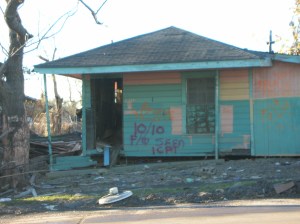
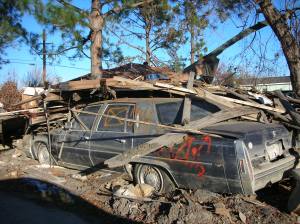
It’s difficult to explain how much one date could traumatize and change an entire American city but today is one of those days. 17 years ago, the levees topped after Hurricane Katrina directly hit the city. It’s still very hard for me to look at these pictures of the devastation my youngest daughter took in the Lower 9–across the canal from me–on the Thanksgiving weekend following Katrina. They were still pulling dead bodies from the debris at that time.
This top picture shows one of the few houses that didn’t collapse with its Katrina cross, indicating someone had died in that home. I watched all of this on CNN from the safety of a pink futon on the floor with my two yellow labs and Miles the Wondercat from a motel in St. Charles, LA that would later be devastated by Hurricane Rita.
My house sat high and dry on the high ground with a nearly new roof and some minor wind damage. The following six months were an experience of camping out in your own home with minimal electricity and chasing around to find working gas stations and open grocery stores. I also made a daily pilgrimage to the Red Cross station in the Quarter to pick up cleaning supplies and food. I really experienced survivor guilt too. Something I hadn’t had since I wound up being the only person known to survive the rare type of cancer I had five years before that. That was definitely not an enjoyable emotional experience either.
I’m also reminded of Hurricane Ida last year, which disrupted my life and significantly impacted my house. However, now, my insurance company wised up, gave me a $10k deductible, and basically told me I was on my own. Thankfully, I got a FEMA grant.
Teacher of the year and Katrina Survivor Chris Dier has a tremendous long thread on the federal mishaps that led to our devastation and the crony capitalism that has crippled us since then.
In 1965, the Army Corps of Engineers built the Mississippi River Gulf Outlet (MRGO), a canal to expedite oil shipping to the Gulf of Mexico. During Katrina, the MRGO channeled the storm’s surge and led to the engineering failures experienced by the region’s protection network. pic.twitter.com/cMT3H6wv8Z
Diel lived in extremely hard-hit St. Bernard Parish, with most houses and infrastructure destroyed. He was 17 at the time. He’s chosen a series of articles to orchestrate the steps that have led us to where we are today, which is not fully recovered or whole. It’s also left us, victims, to charter schools and AirBNBs.
Today, I’m here to remind you that climate change is real and has already had devasting impacts all over our sweet mother earth and ecosystems and the life it supports. Failure to deal with it is a failure of global governance.
Human-driven climate change has set in motion massive ice losses in Greenland that couldn’t be halted even if the world stopped emitting greenhouse gases today, according to a new study published Monday.
The findings in Nature Climate Change project that it is now inevitable that 3.3 percent of the Greenland ice sheet will melt — equal to 110 trilliontons of ice,the researchers said. That will trigger nearly a foot of global sea-level rise.
The predictions are more dire than other forecasts, though they use different assumptions.While the study did not specify a time frame for the melting and sea-level rise, the authors suggestedmuch of it can play out between now and the year 2100.
“The point is, we need to plan for that ice as if it weren’t on the ice sheet in the near future, within a century or so,” William Colgan, a study co-author who studies the ice sheet from its surfacewith his colleaguesat the Geological Survey of Denmark and Greenland, said in a video interview.
A year after Hurricane Ida brought eight to 15 feet of floodwater to Plaquemines Parish—a coastal parish in Southeast Louisiana—historic Black communities Ironton and West Point a la Hache are still fighting for a just recovery. Slow-moving action from federal agencies like HUD and FEMA, a massive shortage in affordable housing, and inadequate flood protection have left residents facing a difficult decision: leave behind neighbors, traditional lifeways, and ancestral lands to migrate in search of housing, or fight to rebuild, elevate homes and make the coast more resilient to intense storms.
I’ve been working as an organizer in Plaquemines Parish since 2020, starting with a successful campaign to stop an oil terminal from excavating a cemetery where enslaved people were laid to rest. I continue to support residents in their efforts to rebuild after Ida and advocate for stronger flood protection. Recently, I spoke with several residents to hear about their experience with recovery from the storm. A year since Ida’s landfall, nearly all of my friends in Plaquemines Parish have yet to return home.
Ironton residents have hung signs throughout their community to let Plaquemines Parish know they intend to come back and rebuild.
The Biden Administration and Democratic Congress have made meager but credible steps toward alleviating Climate Change devastation. But will it be enough for Democrats to hold on and improve their position in Congress to continue the fight?
About a week after President Biden signed into law the largest climate bill in U.S. history, Sen. Catherine Cortez Masto (D-Nev.) laid out to voters here how she helped get $4 billion in the bill to combat the acute drought now punishing the American West. Outside the air-conditioned offices of the Las Vegas Valley Water District where she spoke, the temperature stood at 93 degrees — on its way to an oppressive 106 later that day.
“As you all know, the western U.S. continues to face a historic drought, and we need to do all we can to combat it,” Cortez Masto said Monday, standing before a photo showing the nation’s largest reservoir, Lake Mead, atrecord lows. “That’s why I have been championing measures to help Southern Nevada further conserve, recycle and reduce water use.”
Cortez Masto — one of the most vulnerable Democratic senators up for reelection this year — has spent recent weeks courting Nevada voters who want leaders in Washington to prioritize the climate crisis. Yet climate change has rarelydecided the outcome in congressional races, even in Las Vegas, the nation’s second-fastest warming cityin a region experiencing themost extreme drought in 1,200 years.
Voters across the country have consistently rankedthe economy and health care as a higher priority than global warming. And if Democrats cannot successfully sell their environmental agenda in Nevada, which has seen a cascade of climate disasters this summer, it’s unclear whether climate concerns will ever become paramount in key national races.
Don’t call it a ‘drought’: Climate scientist Brad Udall views Colorado River crisis as the beginning of aridification https://t.co/PIGR8Y3VDh via @MtnWestNews
Warning of doom: ‘Hunger stones’ surface in drought-stricken waters
Any part of the country served by the waters of the Colorado River is bound to be uninhabitable sooner than later. The Deserts and Coasts of our country are rapidly becoming places where life cannot be sustained.
The generous monsoon season along the Upper Basin of the Colorado River has been a relief to those who remember recent summers suffocated by wildfire smoke in the American West. But according to Brad Udall, senior water and climate research scientist at the Colorado Water Institute and director of the Western Water Assessment at Colorado State University, the relief we’re feeling now is a sign of bigger problems for years to come.
“Next year’s runoff will be really interesting to see what happens, it will be a test of this theory of depleted soil moisture,” Udall told a packed room at the Betty Ford Alpine Gardens Education Center on Aug. 19. The theory he referenced examines how the recent precipitation affects the trending drought conditions, drying reservoirs and the lowering state of the Colorado River, which is the primary source of water for over 40 million people spread across seven Western states, over thirty Native American tribes and into Mexico.
Udall’s relationship with the Colorado River goes deeper than just the focus of his studies. He grew up along its banks and worked as a river guide in his earlier years. He also comes from a long lineage of family members who have been influential in the river’s management for more than a century. His father, former congressman Mo Udall, fought to channel river water to Arizona. His uncle, Stewart Udall, was the former Secretary of the Interior who opened the Glen Canyon Dam. And his great great grandfather, John D. Lee, established Lees Ferry in Arizona. “Udalls are, in fact, Lees,” he told the crowd.
With a litany of charts, peer-reviewed studies and side-by-side chronological photographs of depleting reservoirs, Udall’s presentation, titled, “Colorado River Crisis: A Collision of 19th Century Water Law, 20tth Century Infrastructure and a 21st Century Population Growth and Climate Change,” broke down the intricacies of the compact that draws the water rights between these states, while establishing the environmental agitators that have formed, and grown, since the compact was agreed upon in 1922.
Merriam-Webster defines “drought” as “a period of dryness especially when prolonged.” According to Udall, we are beyond treating the Colorado River crisis as something that will soon pass, or ever will.
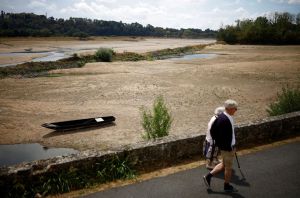
People walk near a bank of the Loire River as historical drought hits France, in Loireauxence, France, August 16, 2022. REUTERS/Stephane Mahe
Carvings in boulders that were used to record historic droughts are resurfacing in waterways across drought-stricken Europe.
Ancient ominous warnings carved on usually submerged boulders along the Elbe River had for centuries driven fear into the hearts of Czechs, but their reappearance during this year’s drought is just a reminder of how tough people had it.
The stones can only be seen above the water surface during droughts and are used to presage bad harvests, interrupted river navigation and consequent famine. Now, the messages appear weeks after weather and crop forecasts.
Such a stone on the banks of the Elbe River, which starts in the Czech Republic, and ends in Germany dates back to 1616. The boulder was inscribed with “Wenn du mich seest, dann weine” – “If you see me, then weep,” according to a Google translation.
A view shows a branch of the Loire River as an historical drought hits France, in Loireauxence, France, August 16, 2022. REUTERS/Stephane Mahe
France’s river Loire, famous for the hundreds of castles gracing its shores, is a shallow river at the best of times, but this year even its flat-bottom tourist barges can barely navigate waters greatly reduced by a record drought.
Even some 100 kilometers from where the Loire empties into the Atlantic Ocean, sand banks now stretch as far as the eye can see, large islands connect to the shore and in places people can practically walk from one side of the river to the other.
This is not normal. The nations in Africa address Climate Change today in a conference in Gabon.
"Come and join us in Libreville & help us find African solutions to this global #ClimateChange challenge."
1 day ahead of #AfricaClimateWeek, Gabonese Minister of Forests, Oceans, Environment & Climate Change @LeeWhiteCBEO explains the key topics for the regional climate event. pic.twitter.com/bNXoTSbguI
Lagniappe: never forget that Katrina was also a catastrophe wreaked by climate change. Please sign this petition to ask Biden and Congress to do more to act against climate change to prevent these disasters in the future. https://t.co/Ri29HSRmbU
Once again, it has been quite a week. I’ve been checking the latest headlines and looking around Twitter to see what’s happening. Of course, most of the political talk is about the redacted affidavit the DOJ used to get a warrant to search Mar-a-Lago for classified documents that Trump refused to return to the government.
After yesterday, legal experts are arguing that it is inevitable that Trump will be indicted and charged with obstruction and possibly with violations of the espionage act. Today, I see more experts speculating that Trump may have already shared top secret information with foreign parties. A number of people are sharing this timeline from The Intellectualist. Laufer is a well-known civil rights attorney.
At least one of the reasons why. He’s betrayed our Republic in innumerable ways.
Mr. Trump knows the answers to the most important unanswered questions: What material did he take from the White House, why did he take it, what had he done with it, and what was he planning to do with it? There is nothing that prevented him for over a year from publicly answering those questions; he surely has not remained silent because the answers are exculpatory.
Above all, the redacted affidavit (and an accompanying brief explaining the redactions), which was released on Friday, reveals more evidence of a righteous criminal case related to protecting information vital to our nation’s security.
Girl and a cat, by Anastasiya Malakhova
I can assure you, based on my experience as the general counsel of the F.B.I., that although there may be too much information deemed sensitive at the lowest level of classification, that was never the case with top-secret material.
Indeed, the redacted affidavit details some of what was found in a preliminary review of material earlier returned by Mr. Trump at the repeated requests of National Archives officials, including “184 unique documents bearing classification markings, including 67 documents marked as confidential, 92 documents marked as secret and 25 documents marked as top secret.” An agent who reviewed that earlier material saw documents marked with “the following compartments/dissemination controls: HCS, FISA, ORCON, NOFORN and SI.”
The markings for top-secret and sensitive compartmented information indicate the highest level of security we have. Those levels protect what is rightly described as the crown jewel of the national security community.
Especially with information classified at that level, the government doesn’t get to pick and choose to defend the nation’s top secrets based on politics — it doesn’t matter if the person in question is a Democrat or Republican, a former president, a secretary of state or Edward Snowden. These documents belong to the government, and their having been taken away poseda clear risk to our national security.
Trump defenders have slammed the FBI’s search as aggressive and unwarranted. What has come out since, including on Friday, suggests the search was hardly capricious. Instead, all available evidence suggests it was a thoughtful choice made after other options had been exhausted. Along the way, the affidavit showed that the Justice Department considered the dubious defense from Mr. Trump’s allies that all the documents were declassified and that keeping them at Mar-a-Lago was therefore legal.
The catalogue of markings on the 184 classified documents agents reviewed before asking to search Mar-a-Lago also explains the DOJ’s determination to learn more. Acronyms such as SI, HCS, FISA and NOFORN might seem like collections of random letters to the layman, but they signify extraordinarily sensitive information: intelligence derived from clandestine human sources, for example, or from surveillance of foreign spies. That material in these categories was allegedly mixed in with other random papers as well as a mishmash of items reportedly including golf balls, a raincoat and a razor, is alarming — even absent intent to use them maliciously.
Read together, these facts should help assuage concerns that Attorney General Merrick Garland embarked on an ill-considered prosecutorial frolic when he sought to search Mar-a-Lago — though this reality is unlikely to stop the flow of reckless rhetoric from Trump acolytes. Meanwhile, those taking a more levelheaded approach should continue to do what they’ve done so far: wait. There was much we didn’t know before this affidavit was unsealed. There’s much we still don’t know now.
I have finally seen enough. Donald Trump will be indicted by a federal grand jury.
You heard me right: I believe Trump will actually be indicted for a criminal offense. Even with all its redactions, the probable cause affidavit published today by the magistrate judge in Florida makes clear to me three essential points:
(1) Trump was in unauthorized possession of national defense information, namely properly marked classified documents.
(2) He was put on notice by the U.S. Government that he was not permitted to retain those documents at Mar-a-Lago.
(3) He continued to maintain possession of the documents (and allegedly undertook efforts to conceal them in different places throughout the property) up until the FBI finally executed a search warrant earlier this month.
That is the ball game, folks. Absent some unforeseen change in factual or legal circumstances, I believe there is little left for the Justice Department to do but decide whether to wait until after the midterms to formally seek the indictment from the grand jury.
Moss says that if only Trump had cooperated after he was pressed by the National Archives last year instead of turning over some of the documents and holding on to the rest, he probably would have gotten away with taking them from the White House.
But Trump just could not bring himself to play by the rules. He turned over 15 boxes last January but did not turn over all the records. Political operatives from conservative organizations started whispering into his ear that he had legal precedent on his side to refuse to turn over the classified records to NARA (he did not). His lawyers surprisingly wrote a rather condescending letter to DOJ in May 2022, effectively arguing that even if there were still classified records at Mar-a-Lago the FBI lacked the authority to take any criminal action against Trump given his former status as president. Then, in June 2022 after the FBI executed a subpoena to recover more records at Mar-a-Lago, two Trump lawyers wrote (and one signed) a sworn affidavit reassuring the government there were no more classified records at the property.
When the Justice Department proposed redactions to the affidavit underlying the warrant used to search former President Donald J. Trump’s residence, prosecutors made clear that they feared the former president and his allies might take any opportunity to intimidate witnesses or otherwise illegally obstruct their investigation.
Child with cat, Julie Manet, Pierre August Renoir
“The government has well-founded concerns that steps may be taken to frustrate or otherwise interfere with this investigation if facts in the affidavit were prematurely disclosed,” prosecutors said in the brief.
The 38-page affidavit, released on Friday, asserted that there was “probable cause to believe that evidence of obstruction will be found at” Mr. Trump’s Mar-a-Lago compound, indicating that prosecutors had evidence suggesting efforts to impede the recovery of government documents.
Since the release of the search warrant, which listed three criminal laws as the foundation of the investigation, one — the Espionage Act — has received the most attention. Discussion has largely focused on the spectacle of the F.B.I. finding documents marked as highly classified and Mr. Trump’s questionable claims that he had declassified everything held at his residence.
But by some measures, the crime of obstruction is as, or even more, serious a threat to Mr. Trump or his close associates. The version investigators are using, known as Section 1519, is part of the Sarbanes-Oxley Act, a broad set of reforms enacted in 2002 after financial scandals at companies like Enron, Arthur Andersen and WorldCom.
The heavily redacted affidavit provides new details of the government’s efforts to retrieve and secure the material in Mr. Trump’s possession, highlighting how prosecutors may be pursuing a theory that the former president, his aides or both might have illegally obstructed an effort of well over a year to recover sensitive documents that do not belong to him.
To convict someone of obstruction, prosecutors need to prove two things: that a defendant knowingly concealed or destroyed documents, and that he did so to impede the official work of any federal agency or department. Section 1519’s maximum penalty is 20 years in prison, which is twice as long as the penalty under the Espionage Act.
They risk imprisonment or death stealing the secrets of their own governments. Their identities are among the most closely protected information inside American intelligence and law enforcement agencies. Losing even one of them can set back American foreign intelligence operations for years.
Clandestine human sources are the lifeblood of any espionage service. This helps explain the grave concern within American agencies that information from undercover sources was included in some of the classified documents recently removed from Mar-a-Lago, the Florida home of former President Donald J. Trump — raising the prospect that the sources could be identified if the documents got into the wrong hands.
Child and cat, by Linda Bryant
Mr. Trump has a long history of treating classified information with a sloppiness few other presidents have exhibited. And the former president’s cavalier treatment of the nation’s secrets was on display in the affidavit underlying the warrant for the Mar-a-Lago search. The affidavit, released in redacted form on Friday, described classified documents being found in multiple locations around the Florida residence, a private club where both members and their guests mingle with the former president and his coterie of aides.
Nothing in the documents released on Friday described the precise content of the classified documents or what risk their disclosure might carry for national security, but the court papers did outline the kinds of intelligence found in the secret material, including foreign surveillance collected under court orders, electronic eavesdropping on communications and information from human sources — spies….
Could Trump have already revealed secret sources of intelligence, as implied in the Tweet at the top of this post? I’m asking, not the NYT reporters. They note that Trump claimed he declassified all the documents at his resort, but . . .
“HCS information is tightly controlled because disclosure could jeopardize the life of the human source,” said John B. Bellinger III, a former legal adviser to the National Security Council in the George W. Bush administration. “It would be reckless to declassify an HCS document without checking with the agency that collected the information to ensure that there would be no damage if the information were disclosed.”
C.I.A. espionage operations inside numerous hostile countries have been compromised in recent years when the governments of those countries have arrested, jailed and even killed the agency’s sources.
In the minutes and hours after the F.B.I.’s search of former President Donald J. Trump’s residence in Florida this month, his supporters did not hesitate to denounce what they saw as a blatant abuse of power and outrageous politicization of the Justice Department.
Maud Humphrey, Girl with cat, 1894
But with the release of a redacted affidavit detailing the justification for the search, the former president’s allies were largely silent, a potentially telling reaction with ramifications for his political future.
“I would just caution folks not to draw too many conclusions,” Gov. Glenn Youngkin of Virginia, a Republican, said on Fox News. It was a starkly different admonition from his earlier condemnations of what he said were “politically motivated actions.”
Some Republicans will no doubt rally around Mr. Trump and his claim that he is once again being targeted by a rogue F.B.I. that is still out to get him. His former acting White House chief of staff, Mick Mulvaney, said on Twitter that “this raid was, in fact, just about documents,” which he called “simply outrageous.” Representative Andy Biggs, Republican of Arizona and an ardent Trump ally, was on the right-wing broadcaster Newsmax denouncing the F.B.I. as politically biased, though he notably did not defend the former president’s possession of highly classified documents.
But generally, even the most bombastic Republicans — Representatives Marjorie Taylor Greene of Georgia, Lauren Boebert of Colorado, Jim Jordan of Ohio — were at least initially focused elsewhere. Ms. Greene was posting on Friday about border “invasions.” Ms. Boebert noted on Twitter the anniversary of the suicide bombing of U.S. service members at the airport in Kabul, Afghanistan. Mr. Jordan was focused on an interview with Mark Zuckerberg, the Facebook founder. None tweeted about the affidavit.
Read the rest at the NYT.
A few more stories on the search and affidavit to check out:
Most media today are waiting for the redacted version of the warrant allowing the FBI to search Mar-a-Lago for stolen public documents to be released. The former guy has been having a verbal fit on the only platform left for him to do so. That would be ‘Truth (sic) Social.’ Hugo Lowell–Congressional Reporter for The Guardian–just tweeted, “Huh a new sealed entry just hit the Trump Mar-a-Lago docket as we wait for the redacted DOJ affidavit.” This should be an interesting Friday.
Donald Trump's dealings with the National Archives, and the efforts by lawmakers and the Justice Department to reclaim sensitive documents from him, began with the day he left office. Here's a timeline. https://t.co/udnhin4Qu7
Jan. 20: Mr. Trump left the White House on the morning of Inauguration Day. The National Archives later said that at the end of the Trump administration it had received a collection of White House documents, many of which had been torn up and taped back together, and some of which were handed over in scraps.
Talks between the National Archives and Mr. Trump’s lawyers over material he took with him would take place over the next year.
Nearly all the reporters on this story are updating the live thread as the day progresses. This is from one of my favorites who reminds us that we’re basically in uncharted legal territory.
Aug. 26, 2022, 11:02 a.m. ET1 hour ago
Katie Benner
It is very unusual for the Justice Department to reveal any part of an affidavit to the public. Generally speaking, affidavits for searches can be important evidence in trials, and the government rarely shares them outside of such a proceeding.
And we just got it!
BREAKING: Justice Department releases redacted version of the affidavit that supported the search of former Pres. Donald Trump's Mar-a-Lago estate in Florida. https://t.co/XvemlZKTed
Let’s look at the ABC report first, and then I’ll excerpt some tweets from others reading the redacted affidavit. I hate this aerial shot of Mar-a-Lago. It looks like the douche I saw in our famous Rome Hotel room. My mother had to explain the workings to us, and I remember finding it all quite gross. I remember, though, that 15-year-olds find most things gross. Here’s the link to the document,
The Justice Department on Friday made public the redacted affidavit that supported the search of former President Donald Trump’s Mar-a-Lago estate in Florida.
A coalition of news organizations, including ABC News, had argued that the release was in the public interest.
The DOJ brief says the "government recognizes that the former President has spoken publicly about this investigation & has said in a public statement he wishes for the affidavit to be disclosed in its entirety, although the Court" notes Trump hasn't made that argument in court.
A rundown of what FBI says it found in the 15 boxes Trump handed over earlier this year — including 25 top secret documents. pic.twitter.com/UNU3tREDxl
The Sky Dancing banner headline uses a snippet from a work by artist Tashi Mannox called 'Rainbow Study'. The work is described as a" study of typical Tibetan rainbow clouds, that feature in Thanka painting, temple decoration and silk brocades". dakinikat was immediately drawn to the image when trying to find stylized Tibetan Clouds to represent Sky Dancing. It is probably because Tashi's practice is similar to her own. His updated take on the clouds that fill the collection of traditional thankas is quite special.
You can find his work at his website by clicking on his logo below. He is also a calligraphy artist that uses important vajrayana syllables. We encourage you to visit his on line studio.

 Adding to the chaos, in




 Good Day Sky Dancers!
 Diel lived in extremely hard-hit St. Bernard Parish, with most houses and infrastructure destroyed. He was 17 at the time. He’s chosen a series of articles to orchestrate the steps that have led us to where we are today, which is not fully recovered or whole. It’s also left us, victims, to charter schools and AirBNBs.
 The Biden Administration and Democratic Congress have made meager but credible steps toward alleviating Climate Change devastation. But will it be enough for Democrats to hold on and improve their position in Congress to continue the fight?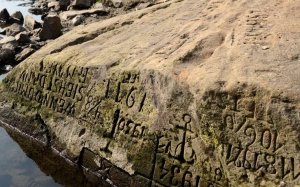








 Aug. 26, 2022, 11:02 a.m. ET1 hour ago
 peej
peej Carissa
 bostonboomer
 dakinikat
 ecocatwoman
 mablue2
 Mama Lopez
 peggysue22
 quixote
 skydancingguestblogger
 Mona (aka Wonk the Vote)



 Sky Dancing
Recent Comments