


Idaho was one of several states to pass a “trigger” law before the 2022 decision in Dobbs v. Jackson Women’s Health, with the expectation that it would automatically take effect if the high court overturned Roe. The Idaho law, passed in 2020, bans most abortions and imposes penalties of up to five years in prison on doctors who perform the procedure, with an exception when “necessary to prevent the death of a pregnant woman.”
Lazy Caturday Reads
Posted: January 6, 2024 Filed under: 2024 presidential Campaign, cat art, caturday, Corrupt and Political SCOTUS, Donald Trump, just because, SCOTUS | Tags: 14th amendment, abortion, Colorado, democracy, Idaho, January 6 criminal cases, January 6 insurrection, January 6 pipe bomber, Liz Cheney, President Joe Biden, Supreme Court 9 CommentsHappy Caturday!!

By Matt McCarthy, Surreal Cat Art
Today is the third anniversary of the January 6, 2001 Capitol insurrection, which Trump incited and applauded. It was a failed coup attempt–a last ditch effort to keep Trump in power after all his legal efforts had failed.
Yesterday, President Biden spoke about the insurrection in the first speech of his campaign for reelection, and it was a barn-burner.
David Smith at The Guardian: Fired-up Biden shows gloves are off in January 6 anniversary speech.
This time it’s personal. On Friday Joe Biden tore into his predecessor Donald Trump as never before. He brimmed with anger, disdain and contempt. He apparently had to stop himself from swearing. So much for “when they go low, we go high” – and plenty of Democrats will be just fine with that.
If Biden was seeking to jolt his half-conscious 2024 re-election campaign into life, this may have done the trick. The palpable loathing of Trump took a good 10 or 20 years off him. Keep hating like this and he might do a Benjamin Button all the way to election day.
There is no better illustration of Biden’s evolution than a speech he delivered on the first anniversary of the January 6 insurrection. On that occasion, he denounced a “web of lies” but never mentioned Trump by name, preferring to cite the “former president”. Those were still the days when he would talk about “the former guy” and get a laugh.
Two years on, in an address near Valley Forge, Pennsylvania, Biden spoke the name “Trump” more than 40 times in less than an hour as he warned that his likely 2024 opponent would sacrifice American democracy to put himself in power. The 81-year-old president generally seems like a grandfatherly figure predisposed to give people the benefit of the doubt, which makes his detestation of Trump all the more striking.
Trump’s failure to act as a violent mob stormed the US Capitol, despite the pleas of staff and family members, was “among the worst derelictions of duty by a president in American history”, Biden said, noting that Trump went on to lose 60 court cases that took him back to the truth “that I had won the election and he was a loser”….
The president went on to recall how Trump has called the insurrectionists “patriots” and claimed there was a “lot of love” on January 6. At that, Biden shook his head, blinked and let out a gasp of disbelief, as if stunned anew by the assertion. “The rest of the nation, including law enforcement, saw a lot of hate and violence,” he said.
Biden furiously denounced political violence and Trump’s habit of joking about the big lie-influenced intruder who attacked Paul Pelosi, the former House speaker Nancy Pelosi’s husband, with a hammer, saying: “And he thinks that’s funny. He laughed about it. What a sick – ”
He halted. At the last moment, the president of the United States had saved himself from uttering a profanity. The urge coursed through his body and found relief in his hands, which clenched into fists, as the crowd filled in with laughter and whooping. “My God,” Biden said. “I think it’s despicable, seriously, not just for a president but for any person to say that.”
Read the rest at The Guardian. Read the full transcript of Biden’s speech at The White House site.

By Andrey Scherbak, Russian artist
This review of the speech is by Reid J. Epstein at The New York Times: Biden Condemns Trump as Dire Threat to Democracy in a Blistering Speech.
President Biden on Friday delivered a ferocious condemnation of Donald J. Trump, his likely 2024 opponent, warning in searing language that the former president had directed an insurrection and would aim to undo the nation’s bedrock democracy if he returned to power.
On the eve of the third anniversary of the Jan. 6, 2021, attack on the Capitol by Mr. Trump’s supporters, Mr. Biden framed the coming election as a choice between a candidate devoted to upholding America’s centuries-old ideals and a chaos agent willing to discard them for his personal benefit.
“There’s no confusion about who Trump is or what he intends to do,” Mr. Biden warned in a speech at a community college not far from Valley Forge in Pennsylvania, where George Washington commanded troops during the Revolutionary War. Exhorting supporters to prepare to vote this fall, he said: “We all know who Donald Trump is. The question is: Who are we?”
In an intensely personal address that at one point nearly led Mr. Biden to curse Mr. Trump by name, the president compared his rival to foreign autocrats who rule by fiat and lies. He said Mr. Trump had failed the basic test of American leaders, to trust the people to choose their elected officials and abide by their decisions.
“We must be clear,” Mr. Biden said. “Democracy is on the ballot. Your freedom is on the ballot.”
The harshness of Mr. Biden’s attack on his rival illustrated both what his campaign believes to be the stakes of the 2024 election and his perilous political standing. Confronted with low approval ratings, bad head-to-head polling against Mr. Trump, worries about his age and lingering unease with the economy, Mr. Biden is turning increasingly to the figure who has proved to be Democrats’ single best motivator.
In a speech in New Hampshire, Liz Cheney also issued a dire warning.
The Daily Beast: Liz Cheney Warns That Voting for Trump in 2024 Could Be ‘Last Vote You’ll Ever Cast.’
On the eve of the third anniversary of the Jan. 6 insurrection, former Rep. Liz Cheney (R-WY) warned the 2024 election could be the nation’s last.
Speaking to a room full of Dartmouth College students, Cheney expressed her belief that former President Donald Trump would refuse to hand over the reins of power if elected to a second term.
“He won’t leave office,” Cheney said. “He already tried not to leave office once. So I think there’s a lot of living in a fantasy world that’s going on with Republicans telling themselves, ‘Look, we’ll vote for him, it won’t be so bad.’ It may well be the last real vote you ever get to cast. It will be that bad.”
Giant Cats, artist unknown
What’s more, Cheney looks at her former colleagues in Congress and sees a group of enablers who would happily acquiesce to Trump’s designs and help muscle him back to power if the 2024 election result is in doubt.
The biggest enabler of all, Cheney said, might be her former “good friend” Mike Johnson—the backbencher turned Speaker of the House.
If no presidential candidate is able to secure 270 electoral votes in November, the decision could head to a House floor controlled by Johnson, the architect of the House GOP’s legal efforts to swing the last election to Trump.
“I think we need to be concerned about a Mike Johnson speakership, particularly in an instance where there’s a contested election,” Cheney said on Friday. “It’s a dangerous situation if the Republicans are in the majority.”
The AP discusses the status of the January 6 criminal investigations and trials, as well the unsolved mystery of who planted two pipe bombs.: Hundreds of convictions, but a major mystery is still unsolved 3 years after the Jan. 6 Capitol riot.
Authorities are still working to identify more than 80 people wanted for acts of violence at the Capitol and to find out who placed pipe bombs outside the Republican and Democratic national committees’ offices the day before the Capitol attack. And they continue to regularly make new arrests, even as some Jan. 6 defendants are being released from prison after completing their sentences.
The cases are playing out at the same courthouse where Donald Trump is scheduled to stand trial in March in the case accusing the former president of conspiring to overturn his 2020 election loss in the run-up to the Capitol attack….
More than 1,230 people have been charged with federal crimes in the riot, ranging from misdemeanor offenses like trespassing to felonies like assaulting police officers and seditious conspiracy. Roughly 730 people have pleaded guilty to charges, while another roughly 170 have been convicted of at least one charge at a trial decided by a judge or a jury, according to an Associated Press database.
Only two defendants have been acquitted of all charges, and those were trials decided by a judge rather than a jury.
About 750 people have been sentenced, with almost two-thirds receiving some time behind bars. Prison sentences have ranged from a few days of intermittent confinement to 22 years in prison. The longest sentence was handed down to Enrique Tarrio, the former Proud Boys national chairman who was convicted of seditious conspiracy for what prosecutors described as a plot to stop the transfer of power from Trump, a Republican, to Joe Biden, a Democrat….
Defense attorneys and prosecutors are closely watching a case that will soon be heard by the U.S. Supreme Court that could impact hundreds of Jan. 6 defendants. The justices agreed last month to hear one rioter’s challenge to prosecutors’ use of the charge of obstruction of an official proceeding, which refers to the disruption of Congress’ certification of Biden’s 2020 presidential election victory over Trump.
More than 300 Jan. 6 defendants have been charged with the obstruction offense, and so has Trump in the federal case brought by special counsel Jack Smith. Lawyers representing rioters have argued the charge was inappropriately brought against Jan. 6 defendants.
The justices will hear arguments in March or April, with a decision expected by early summer. But their review of the obstruction charge is already having some impact on the Jan. 6 prosecutions. At least two defendants have convinced judges to delay their sentencings until after the Supreme Court rules on the matter.
On the pipe bombs:
One of the biggest remaining mysteries surrounding the riot is the identity of the person who placed two pipe bombs outside the offices of the Republican and Democratic national committees the day before the Capitol attack. Last year, authorities increased the reward to up to $500,000 for information leading to the person’s arrest. It remains unclear whether there was a connection between the pipe bombs and the riot.
Giant Cat with a Wireless Tail, by 3d1viner
One of the biggest remaining mysteries surrounding the riot is the identity of the person who placed two pipe bombs outside the offices of the Republican and Democratic national committees the day before the Capitol attack. Last year, authorities increased the reward to up to $500,000 for information leading to the person’s arrest. It remains unclear whether there was a connection between the pipe bombs and the riot….
The explosive devices were placed outside the two buildings between 7:30 p.m. and 8:30 p.m. on Jan. 5, 2021, but officers didn’t find them until the next day. Authorities were called to the Republican National Committee’s office around 12:45 p.m. on Jan. 6. Shortly after, a call came in for a similar explosive device found at the Democratic National Committee headquarters. The bombs were rendered safe, and no one was hurt.
Video released by the FBI shows a person in a gray hooded sweatshirt, a face mask and gloves appearing to place one of the explosives under a bench outside the DNC and separately shows the person walking in an alley near the RNC before the bomb was placed there. The person wore black and light gray Nike Air Max Speed Turf sneakers with a yellow logo.
In other news, the Supreme Court has agreed to decide whether Trump can be kept off the Colorado primary ballot. Their decision will obviously affect the other similar cases in multiple states. This week, efforts to disqualify Trump based on the 14th Amendment were initiated in Illinois and Massachusetts.
Adam Liptak at The New York Times: Supreme Court to Decide Whether Trump Is Eligible for Colorado Ballot.
The Supreme Court agreed on Friday to decide whether former President Donald J. Trump is eligible for Colorado’s Republican primary ballot, thrusting the justices into a pivotal role that could alter the course of this year’s presidential election.
The sweep of the court’s ruling is likely to be broad. It will probably resolve not only whether Mr. Trump may appear on the Colorado primary ballot after the state’s top court declared that he had engaged in insurrection in his efforts to subvert the 2020 election, but it will most likely also determine his eligibility to run in the general election and to hold office at all.
Not since Bush v. Gore, the 2000 decision that handed the presidency to George W. Bush, has the Supreme Court taken such a central role in an election for the nation’s highest office.
The case will be argued on Feb. 8, and the court will probably decide it quickly. The Colorado Republican Party had urged the justices to rule by March 5, when many states, including Colorado, hold primaries.
The number of challenges to Mr. Trump’s eligibility across the country can only have added pressure on the court to hear the Colorado case, as they underscored the need for a nationwide resolution of the question.
The case is one of several involving or affecting Mr. Trump on the court’s docket or on the horizon. An appeals court will hear arguments on Tuesday on whether he has absolute immunity from prosecution, and the losing side is all but certain to appeal. And the court has already said that it will rule on the scope of a central charge in the federal election-interference case in a decision expected by June.
Mr. Trump asked the Supreme Court to intervene after Colorado’s top court disqualified him from the ballot last month. That decision is on hold while the justices consider the matter.

Cathedral of St. Paul, by JReischl on Deviant Art
The Supreme Court also agreed to hear an abortion case yesterday, and, since it *only* involves women’s lives and safety, it was overshadowed by the Trump eligibility case. But this one is horrific.
Ann E. Marimow at The Washington Post: Supreme Court to decide if U.S. law requires some emergency room abortions.
The Supreme Court said Friday it will review a case challenging Idaho’s strict abortion ban, which the Biden administration says conflicts with a federal law requiring emergency room doctors to perform the procedure in some circumstances.
Idaho’s attorney general asked the justices to intervene after a lower-court judge blocked a section of Idaho’s abortion statute targeting doctors. The judge said the provision violates a federal law that requires hospitals receiving Medicare funding to guarantee emergency care. In its brief order Friday, the justices allowed the Idaho law to take full effect for now and said they would review the matter on an expedited basis in April.
The Biden administration turned to the Medicare law as a narrow way to challenge state-level abortion bans in federal court after the Supreme Court’s conservative majority overturned the fundamental right to an abortion established decades earlier in Roe v. Wade. The effort was seen as one of the few paths the administration could pursue to preserve access to abortion, which remains a galvanizing and divisive issue across the country in the lead-up to the 2024 presidential election.
The issue of access to abortion in health emergencies is not the only reproductive-rights case to reach the high court this term. The justices also will decide whether to limit access to the widely used abortion medication mifepristone, first approved by the Food and Drug Administration more than 20 years ago.
Abortion rights advocates and medical experts say the Idaho law, and similar bans in more than two dozen other states, have put doctors and hospitals at legal risk as they navigate life-or-death decisions for pregnant patients and seek to interpret vague medical exceptions to decide whether it is permissible in some circumstances to terminate a pregnancy.
In a similar case in Texas, the conservative U.S. Court of Appeals for the 5th Circuit this week ruled against the Biden administration, saying Texas hospitals and doctors are not obligated to perform abortions under the federal emergency-care law.
From the AP: The Supreme Court is allowing Idaho to enforce its strict abortion ban, even in medical emergencies.
The Supreme Court on Friday allowed Idaho to enforce its strict abortion ban, even in medical emergencies, while a legal fight continues.
The justices said they would hear arguments in April and put on hold a lower court ruling that had blocked the Idaho law in hospital emergencies, based on a lawsuit filed by the Biden administration.
The Idaho case gives the court its second major abortion dispute since the justices in 2022 overturned Roe v. Wade and allowed states to severely restrict or ban abortion. The court also in the coming months is hearing a challenge to the Food and Drug Administration’s rules for obtaining mifepristone, one of two medications used in the most common method of abortion in the United States.
In the case over hospital emergencies, the Biden administration has argued that hospitals that receive Medicare funds are required by federal law to provide emergency care, potentially including abortion, no matter if there’s a state law banning abortion.
U.S. District Judge B. Lynn Winmill in Idaho agreed with the administration. But in a separate case in Texas, a judge sided with the state.
Idaho makes it a crime with a prison term of up to five years for anyone who performs or assists in an abortion.
One more from the White House website: Statement from President Joe Biden on Supreme Court Order on Idaho’s Abortion Ban.
Today’s Supreme Court order allows Idaho’s extreme abortion ban to go back into effect and denies women critical emergency abortion care required by federal law. The overturning of Roe v. Wade has enabled Republican elected officials to pursue dangerous abortion bans like this one that continue to jeopardize women’s health, force them to travel out of state for care, and make it harder for doctors to provide care, including in an emergency. These bans are also forcing doctors to leave Idaho and other states because of laws that interfere with their ability to care for their patients. This should never happen in America.
The Vice President and I believe that health care decisions should be made by women and their doctors, not politicians. We will continue to defend a woman’s ability to access emergency care under federal law. As this case continues, the stakes could not be higher for women across America. Congress must immediately restore the protections of Roe v. Wade so that women in every state can access the health care they need.
That’s it for me today. What else is happening?
Finally Friday Reads: Trump’s Hot Mess
Posted: January 5, 2024 Filed under: just because | Tags: 3rd anniversary of January 6, @repeat1968, Alexander Vindman, Donald Trump is mentally ill, E. Jean Carroll, Henry Dunn, John Buss, Losing Their Religion and White Evangelicals, Virtual Rape, Where is Melania? 8 Comments
“The upcoming E. Jean Carroll defamation trial has him in a total meltdown. It’s only going to get better.” John Buss @repeat1968
Good Day, Sky Dancers!
So far today, Trump keeps harassing E. Jean Carroll, recruits another excellent Dem candidate for Congress, and gets his lawyer to corner JustICE KavanaUGH! It makes for some dark humor today. It also makes me wonder about his cult. Who could possibly take this hot mess seriously?
Let’s start with his excellent recruitment of Dem Candidates for Congress. He has already brought Retired Army Colonel Alexander Vindman into the race in Virginia. Vindman announced last month. He’s been making the case for Ukraine and against Russia on MSNBC recently. Today, Harry Dunn has announced that he will run to represent Maryland on Morning Joe. This comes after the release of his book “Standing My Ground: A Capitol Police Officer’s Fight for Accountability and Good Trouble After January 6th” last year. This is from The New York Times. “Officer Who Defended Capitol on Jan. 6 Runs for Congress in Maryland. Harry Dunn, who endured racist slurs as he fought off a pro-Trump mob and gained fame with his emotional testimony before the Jan. 6 committee, is joining a crowded Democratic primary.” Trump sure knows how to bring the nation’s heroes into politics.
In 2023, President Biden awarded Mr. Dunn the Presidential Citizens Medal in recognition for his role in protecting the Capitol.
Mr. Dunn grew up in the Washington suburbs of Prince George’s County, Md., and graduated from James Madison University in Virginia, where he played football and helped lead the team to its first national title.
He has written a book called “Standing My Ground.”
In an interview, Mr. Dunn said his last day at a police officer was Dec. 17. If elected, Mr. Dunn said he would fight for women’s reproductive rights, “common sense” gun reform, voting rights and affordable health care, among other priorities.
He said he believes he is the candidate in the field best equipped to combat the right-wing movement loyal to former President Donald J. Trump.

Trump not only can’t keep his trap shut, he forces his lawyers to open theirs and look positively bereft of brains. “Unprofessional”: Experts blast Trump lawyer for saying Brett Kavanaugh “quid pro quo part out loud.” “Imagine for a second if a lawyer for Clinton, Obama or Biden said this. It’d be a massive scandal,” attorney says. This is from Salon.
Trump attorney Alina Habba on Thursday suggested that Supreme Court Justice Brett Kavanaugh would “step up” and rule in favor of the former president because he “fought for” him.
Trump on Wednesday asked the U.S. Supreme Court to overturn a Colorado Supreme Court ruling barring him from the presidential primary ballot under the Constitution’s “insurrectionist” clause. Trump has privately told people that he thinks the Supreme Court will “overwhelmingly” overturn the ruling but has also expressed concern that the conservative justices he appointed “will worry about being perceived as ‘political’ and may rule against him,” according to The New York Times.
Habba echoed Trump’s worries in an interview with Fox News.
“That’s a concern that he’s voiced to me, he’s voiced to everybody publicly, not privately. And I can tell you that his concern is a valid one,” she said. “They’re trying so hard to look neutral that sometimes they make the wrong call.”
But in a later appearance on the network with host Sean Hannity, Habba said the case should be a “slam dunk in the Supreme Court.”
“You know people like Kavanaugh ― who the president fought for, who the president went through hell to get into place ― he’ll step up,” she said. “Those people will step up. Not because they’re pro-Trump but because they’re pro-law. Because they’re pro-fairness, and the law on this is very clear.”
CNN host Phil Mattingly was taken aback as he played the clip on Friday.
“If a Democrat said that about the Justice Department or Merrick Garland or fill-in-the-blank here, there would be an absolute implosion. That’s bonkers,” he said.
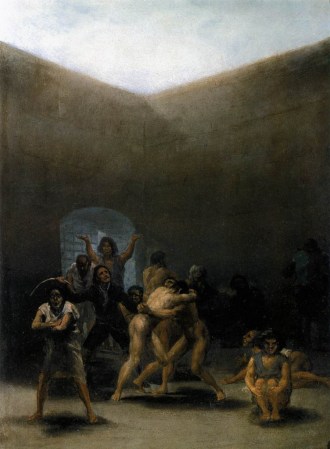
Francisco de Goya, The Madhouse, 1793
Then, there is his ongoing slander of E. Jean Carroll. This is from The New Republic. “Trump Is Absolutely Losing It Over His E. Jean Carroll Case. The former president could have just handed Carroll another chance to take him to court..” This is crazy!!
Donald Trump has lost another battle with E. Jean Carroll, and he’s handling it in a classic fashion: by completely flying off the handle.
Over the span of about 30 minutes Thursday morning, Trump made 31 posts about Carroll on Truth Social. Although he didn’t say anything himself, he shared stories from conservative outlets attacking her and comments from internet users calling her “creepy.” He also shared media interview clips and social media posts that appear to come from Carroll, all stripped of context so as to paint her as some sort of sexual deviant.
Trump’s gross little rampage is likely the result of a Wednesday court ruling rejecting his latest attempt to delay his upcoming trial for defaming Carroll. The trial is due to start on January 15.
In May, a jury unanimously found Trump liable for sexual abuse and battery against Carroll in the mid-1990s and for defaming her in 2022 while denying the assault. He was ordered to pay her $5 million in damages.
The upcoming trial is for comments Trump made in 2019, when he said Carroll made up the rape allegation to promote her memoir. Presiding Judge Lewis Kaplan ruled that since Trump has already been found liable for sexual abuse, his 2019 comments are by default defamatory. Carroll is now seeking up to $12 million in damages.
Nancy Pelosi has written an account of January 6 at The Atlantic. “What January 6 Made Clear to Me. Our democratic institutions are only as strong as the courage of those entrusted with their care.” Tomorrow will be the 3rd anniversary of one of the worst events the country has ever experienced. This story was new to me.
Congressional leadership was taken to Fort McNair. As I left the Capitol, I kept asking if the National Guard had been called, a power reserved for the executive branch. While the governor of every state in the union has the power to call up their own National Guard, the District of Columbia’s National Guard is under the control of the Defense Department—and, ultimately, of the commander in chief.
When I got to Fort McNair, it was clear that no one had deployed the National Guard to the Capitol. As Senator Chuck Schumer and I watched the television coverage of the unfolding insurrection, we began to place urgent calls to the administration.
I contacted Secretary of the Army Ryan McCarthy, who could not have been more casual. In response to our pleas to dispatch reinforcements, he said: “Well, I have to report to my boss. That takes time. I don’t know what we can do.” His answer was horrifying.
While the Pentagon dragged its feet, Chuck, Representative Steny Hoyer, and I called the governors of Virginia and Maryland to ask them for help. Virginia law enforcement and National Guard troops began arriving in D.C. around 3:15 p.m., and Maryland was cooperative too.
Chuck, Senator Mitch McConnell, and I then contacted McCarthy’s boss, Acting Secretary of Defense Christopher Miller, to plead for more reinforcements. Mitch insisted that the National Guard “get there in one hell of a hurry, you understand?” I demanded an answer: “Just pretend for a moment it was the Pentagon or the White House or some other entity that was under siege.” Still, Miller delayed.
Hours later, the Capitol was finally cleared. While it was suggested that we continue the certification from Fort McNair for security reasons, it was always our goal to return to the Capitol that night to finish the count. The whole world had seen the vile “Stop the Steal” venom the president was pushing, and the violence that it had caused. It was essential that we continue our duties in the Capitol of the United States, for the American people and the world alike to see.
And, what is the instigator of this horrid event doing?

Egon Schiele, Self Portrait In Jerkin With Right Elbow Raised, 1914
This is from MTN. It’s crazy enough but then there are seriously demented White Evangelicals pushing the same meme. If the Asylum is the Republican Party, White Christian Nationalists are its gatekeepers. “Trump Posts Video Calling Himself a God-Given “Caretaker“ and “Shepherd to Mankind”. The video also appears to take a dig at Melania.”
On Truth Social, Trump posted a video with the caption, “God made Trump.” In the video, a narrator explains “God gave us Trump” because he was looking for certain qualities God allegedly needed in a leader including a “caretaker,” and working long hours. Trump, who said he would be a president who never took vacations, spent over 400 days visiting Trump properties while president.
Besides the “caretaker” description, the video also contains messianic descriptions of Trump as “man who cares for the flock, a shepherd to mankind who won’t ever leave or forsake them.” Similar language is found in the Bible.
In Psalm 23, David describes God as a shepherd who provides for the flock. The teaching that God will “never leave or forsake you” is found multiple times in the Bible. Jesus called himself “the good shepherd” who “lays down his life for the sheep” and taught he “is with you always.”
This latest video echoes the teachings we’ve seen by Christian nationalists who make Trump out as a divine figure sent by God to save the world. American Christian nationalists have not just woven Trump into their faith, they’ve placed him on the throne and are rewriting, ignoring, and breaking away from historic teachings on helping the poor, migrants, and upholding justice as these conflict with their MAGA agenda.
The cult is definitely as insane as its leader. “God Made Trump” is trending on the X-crement site. It’s pretty evident that the Republican Party, and its Mega Donors, are basically schoolyard bullies with more money and access to Media. This is from The Guardian. “A bully’: the billionaire who led calls for Claudine Gay’s Harvard exit. US hedge fund manager Bill Ackman posts 4,000-word screed decrying ‘racism against white people’ after Gay’s departure.” This wasn’t about anti-semitism. Unlike most of Gay’s white male critics, Ackman actually graduated from Harvard.
Chief among the campaigners celebrating the resignation of Claudine Gay as president of Harvard University was a man who arguably did the most to push Gay, Harvard’s first Black president, out the door: Bill Ackman, a billionaire hedge-fund manager and Harvard alumnus.
Ackman, who accused Gay of antisemitism and plagiarism, was a major player in what increasingly became a rightwing campaign against the Harvard president – who said many of the attacks against her were “fueled by racial animus”.
In the past month alone, the 57-year-old has tweeted about Gay, Harvard, or both, more than 100 times to his 1 million followers. On Tuesday, he topped that with a rambling 4,000-word X post about “racism against white people”; universities’ efforts to increase diversity; and accusations that student groups were “supporting terrorism”.
Ackman’s campaign came after “years of resentment”, the New York Times reported, in part because his donations to Harvard did not give him greater influence over the university.
A previous donor to the Democratic party, Ackman has denied he has rightwing politics. But his campaign has been seized upon by conservatives and a Republican party that have long been resentful of an alleged liberal bias, and of affirmative action efforts, on college campuses and elsewhere – something commenters pointed out after Gay’s resignation.

AI, the final frontier. Women aren’t even safe from men there. This horrifying article came to me via JJ. This is from The Guardian. “A girl was allegedly raped in the metaverse. Is this the beginning of a dark new future?” This is reproted by Nancy Jo Sales.
The cheerful language with which tech companies describe their platforms is often in stark contrast to the dark possibilities lurking within them. Meta, for example, describes its virtual world, the metaverse, as “the next evolution in social connection and the successor to the mobile internet”, a place where “virtual reality lets you explore new worlds and shared experiences”. But for a young girl in the UK recently, that “shared experience” was an alleged gang rape perpetrated by several adult men.
British police are investigating the sexual assault of the girl, identified only as being under the age of 16, in what is said to be the first investigation of its kind in the UK. The girl was reportedly wearing a virtual reality headset and playing an immersive game in the metaverse when her avatar was attacked.
Was this really rape? some have asked. The comments on an Instagram post for a story about the case in the New York Post were characteristically skeptical: “Couldn’t she have just turned it off?” “Can we focus on real-life crime please?” “I was killed in [the war video game Call of Duty],” one person said sarcastically: “Been waiting for my killer to be brought to justice.”
The difference, of course, is that while Call of Duty players can expect to be virtually killed sometimes as part of the game, the girl had no reason to expect that she would be raped. It isn’t yet known what game she was playing when the alleged assault occurred, but obviously there isn’t an online game where the goal for adult players is to rape children. The fact that they are able to in the metaverse is the issue at the heart of this case, which has attracted international attention.
The question of whether virtual rape is “really rape” goes back to at least 1993, when the Village Voice published an article by Julian Dibbell about “a rape in cyberspace”. Dibbell’s piece reported on how the people behind avatars that were sexually assaulted in a virtual community felt emotions similar to those of victims of physical rape.
As did the girl whose avatar was attacked in the metaverse, according to a senior police officer familiar with the case; he told the Daily Mail: “There is an emotional and psychological impact on the victim that is longer-term than any physical injuries.” In addition, the immersive quality of the metaverse experience makes it all the more difficult for a child, especially, to distinguish between what’s real and what is make-believe.
So while it is necessary for the police to investigate this case – with the courts to decide on the appropriate punishment for the alleged offenders – it is equally important for Meta to be held accountable.
I’d say that 2024 is getting off to a worse start than even I expected.
What’s on your reading and blogging list today?
Wednesday Reads
Posted: January 3, 2024 Filed under: 2024 Elections, 2024 presidential Campaign, just because, Media, polling, The Media SUCKS | Tags: Autocracy, big media, Claudine Gay, democracy, diversity, Greg Sargent, Harvard, journalism, Joyce Vance, Racism, Rick Perlstein, The Washington Post 13 CommentsGood Morning!!
It’s 2024, and the media and the Republicans are gearing up for the presidential election in November. What are the Democrats doing? I’m sure they are raising plenty of money, but when will they wake up and start fighting back against the Republicans and the media? Make no mistake, big media is hoping for another Trump presidency, because it will mean chaos and gobs of money for those who cover the chaos. It will mean riches for the media bosses and reporters alike–think of all the new books they can sell as Trump destroys democracy and attempts to gain dictatorial power?
You’ve probably heard that The Washington Post recently got rid of 240 employees through buyouts. They chose to keep right wing columnists like Hugh Hewitt and dumped liberals like Greg Sargent. Fortunately, Sargent has been hired by The New Republic.
This post by Tom Jones is from Poynter, a site that reports on and critiques the media: Opinion | Washington Post reaches buyout goals to, for now, avert layoffs.
The good news is that the Post has been able to meet its goal of trimming staff through buyouts instead of layoffs. The bad news is the Post will enter the new year with fewer employees — perhaps a couple of hundred.
Greg Sargent
Back in October, the Post announced that it was offering buyouts with the hopes of reducing staff by 240. (At the time, the Post had approximately 2,500 employees.)
Then late last month, Post interim CEO Patty Stonesifer told staff only half of the desired number of staffers — about 120 or so — had accepted the buyouts and that there would be layoffs if not enough employees took the buyouts. At the same time, The Daily Beast’s Corbin Bolies reported that Post executive editor Sally Buzbee told staff in an email that about 36 of the 120 who accepted the buyouts were from the newsroom. She said that was “about 30 percent of our goal across the News department.”
Then came Tuesday’s news that the Post had enough buyouts to avoid layoffs — for now (my words, not the Post’s). The exact number of buyouts isn’t known publicly.
In an email to staff, Stonesifer said the company “will enter the new year with a smaller organization but a better financial position.” Stonesifer also wrote, “I am very aware of how difficult this process has been for everyone involved and I want to thank you for the grace and respect you have shown at every step.”
In July, The New York Times Benjamin Mullin and Katie Robertson reported the Post was on track to lose about $100 million this year.

For the gossip columnists at the WaPo, President Biden is boring. Imagine how much better the paper’s “financial position” will be when Trump gets back in the White House and consolidates his power. The same will be true of The New York Times. Maggie Haberman will be cleaning up, along with her co-writers.
In another positive development, historian and political observer Rick Perlstein will be writing for The American Prospect. I’m seriously thinking about dumping my Washington Post subscription and giving that money to one of these liberal publications.
Perlstein has published his first column. In it, he addresses three issues I worry about: the media focus on polls, the failure of journalists to address real issues, while tending to favor right wing narratives, and the failure of Democratic politicians to fight back hard against those narratives.
Rick Perlstein at The American Prospect: You are Entering the Infernal Triangle: Authoritarian Republicans, ineffectual Democrats, and a clueless media.
Perlstein on Polling:
As a historian who also writes about the present, there are certain well-worn grooves in the way elections get written about by pundits and political journalists from which I instinctively recoil. The obsession with polling, for one. Polls have value when approached with due humility, though you wonder how politicians and the public managed to make do without them before their modern invention in the 1930s. But given how often pollsters blow their most confident—and consequential—calls, their work is as likely to be of use to historians as object lessons in hubris as for the objective data they mean to provide.
Pollsters themselves are often the more useful data to study, especially when their models encode mistaken presumptions frozen in place from the past. In 1980, for instance, Ronald Reagan’s landslide was preceded by a near-universal consensus that the election was tied. The pollster who called it correctly, Lou Harris, was the only one who thought to factor into his models a variable that hadn’t been accounted for in previous elections, because it did not yet really exist: the Christian right.
Polling is systematically biased in just that way: toward variables that were evident in the last election, which may or may not be salient for this election. And the more polls dominate discussions of campaigns and elections, the more they crowd out intellectual energy that could be devoted to figuring out those salient, deeper, structural changes conditioning political reality: the kind of knowledge that doesn’t obediently stand still to be counted, totted up, and reduced to a single number.
On media predictions:
Another waaaaay too well-worn journalistic groove isprediction. I have probably read thousands of newspaper opinion column prognostications going back to the 1950s. Their track record is too embarrassing for me to take the exercise seriously, let alone practice it myself. Like bad polls, pundits’ predictions are most usefulwhen they are wrong. They provide an invaluable record of the unspoken collective assumptions of America’s journalistic elite, one of the most hierarchical, conformist groups of people you’ll ever run across. Unfortunately, they help shape our world nearly as much, and sometimes more, than the politicians they comment about. So their collective mistakes land hard….
Rick Perlstein, author, Reaganland: America’s Right Turn 1976-1980.
And how ritualized? Consider one of elite journalism’s most deeply worn grooves: the morning-after declarations, should any Democrat win a presidential election, that the Republican politics of demagogic hate-mongering has shown itself dead and buried for all time—forgetting how predictably it returns in each new election, often in an increasingly vicious form.
In 1964: When the author of the Civil Rights Act, Lyndon Johnson, defeated a Republican who voted against the Civil Rights Act, Barry Goldwater, one of the most distinguished liberal newspaper editors in the South, Sam Ragan of the Raleigh News & Observer, pronounced that all future American elections would be decided “on issues other than civil rights.” His essay quoted the Los Angeles Times’ Washington bureau chief, who affirmed that conventional wisdom by observing that henceforth, whichever party takes the Black vote would be no more predictable than who would win “freckle-faced redheads and one-armed shortstops.” [There are many more examples of this phenomenon in the essay.]
This particular bias is rooted into elite punditry’s deepest, most dangerous groove of all: a canyon, if you will. On one side of the yawning gulf is the perennial fantasy that America is a nation fundamentally united and at peace with itself, “moderate,” “centrist,” where exceptions are epiphenomena entirely alien to settled American “norms.”
On “Reality”:
On the other side of the gulf is, well, reality.
The media habits that make it so hard to grasp that reality—that made Trump and his merry band of insurrectionists such a surprise to us—are perhaps as systematic as any foisted upon the public by state media in authoritarian nations. A little more innocent than, say, Pravda, however, because one wellspring of this stubborn fantasy, and why audiences are so receptive to it, is simple psychology. To acknowledge the alternative is to stare into a terrifying abyss: the realization that America has never not been part of the way to something like a civil war.But suddenly, in 2024, no one can avoid acknowledging that abyss anymore. And that leaves journalism in a genuine crisis.
Generations of this incumbent, consensus-besotted journalism have produced the very conceptual tools, metaphors, habits, and technologies that we understand as political journalism. But these tools are thoroughly inadequate to understanding what politics now is.
According to polls (which, yes, have their uses, in moderation), something around half of likely voters would like to see as our next president a man who thinks of the law as an extension of his superior will, who talks about race like a Nazi, wants to put journalistic organizations whose coverage he doesn’t like in the dock for “treason,” and who promises that anyone violating standards of good order as he defines them—shoplifters, for instance—will be summarily shot dead by officers of the state who serve only at his pleasure. A fascist, in other words. We find ourselves on the brink of an astonishing watershed, in this 2024 presidential year: a live possibility that government of the people, by the people, and for the people could conceivably perish from these United States, and ordinary people—you, me—may have to make the kind of moral choices about resistance that mid-20th-century existentialist philosophers once wrote about. That’s the case if Trump wins. But it’s just as likely, or even more likely, if he loses, then claims he wins. That’s one prediction I feel comfortable with.
I’ve already quoted too much, but I hope it’s enough so that you’ll want to read the rest at The American Prospect.
Every morning, I read Joyce Vance’s substack, Civil Discourse. Today, she offered “a warning” to all of us who want to save democracy. We have to remember that no everyone is following news and politics closely.
One morning before Christmas, I was working out with a friend who I adore, and workout with regularly. She’s young, smart, and a recent college graduate. In the middle of our session, my phone started going off incessantly and I finally picked it up. It was, of course, breaking news. That day, it was about the Giuliani bankruptcy.
I apologized to her for taking the call. I got off quickly and told her, by way of explanation, “Rudy Giuliani just filed for bankruptcy.”
Joyce Vance
“Who’s Rudy Giuliani?” she asked.
One morning before Christmas, I was working out with a friend who I adore, and workout with regularly. She’s young, smart, and a recent college graduate. In the middle of our session, my phone started going off incessantly and I finally picked it up. It was, of course, breaking news. That day, it was about the Giuliani bankruptcy.
I apologized to her for taking the call. I got off quickly and told her, by way of explanation, “Rudy Giuliani just filed for bankruptcy.”
“Who’s Rudy Giuliani?” she asked.
You know that noise they make in TV sitcoms, the one where the needle scratches across the record, and everything is interrupted? That was what I heard in my head. My mind worked over the implications of her question for the remainder of our time together.
She was born after 9-11. She never knew Giuliani as America’s mayor when the Towers fell and certainly not as the staunch pro-law enforcement mayor in the city in earlier years. But it shocked me that someone of voting age was unaware of Giuliani—didn’t recognize his name and associate it with Trump’s efforts to overturn the 2020 election.
She asked me about the bankruptcy. “Is that a good thing or a bad thing?” I explained that he’d lost a big defamation case in Georgia because he said horrible things about two election workers and disrupted their lives. Still no signs of recognition, but she got the point. “What an a**hole,” she concluded, based on my brief description of what he’d done.

Read the rest at the substack link.
Like Joyce Vance, I grew up in a politically engaged family. It’s always a shock to me when I learn that some people have no idea what’s going on in the government. We need to reach out to the people us and discuss the danger of autocracy.
I’m really troubled by what happened to Claudine Gay, Harvard’s first Black president. She may well have some issues with past plagiarism, but if she had been white, I doubt if the issue would have even come up. The truth is, she was set up by Congressional Republicans who hate diversity in education. Two articles:
At The Atlantic, David Graham expresses the typical liberal media response: it’s a shame and of course she was targeted by right wingers, but Harvard still had to do the “right” thing: An Old-Fashioned Scandal Fells a New Harvard President.
Gay, a political scientist, resigned…, making her the second president of an Ivy League institution to bow out in the past month. University of Pennsylvania President Liz Magill stepped down on December 9, but the cases are not as similar as they might initially seem. Magill’s departure stemmed directly from the shaky December 5 congressional testimony by a panel of college presidents about anti-Semitism and the Israeli-Palestinian conflict, and was viewed as a victory for Elise Stefanik, the Republican representative who led the questioning.
What appear to have doomed Gay were the allegations of plagiarism lodged against her. This is an important distinction. Penn’s board of trustees was spooked by pressure from donors and politicians. The Harvard Corporation, an equivalent body, was not. In a December 12 statement, it acknowledged that Gay’s testimony had gone poorly, but said she would remain in her post, describing its position as a defense of open discourse and academic freedom. Although Stefanik is already claiming credit, what ended Gay’s short tenure were not the hot-button issues of campus speech and anti-Semitism but was instead the kind of scandal that one might expect to fell the president of any educational institution, whether a member of the Ivy League or a community college.
Yes, because Harvard initially supported her remaining president, so the right wingers had to find another reason to get rid of her.
On December 5, Gay, Magill, and MIT’s Sally Kornbluth were hauled before Congress to speak about anti-Semitism on campus, though many GOP members really seemed to be upset about what they saw as inconsistent standards for deciding what speech is and isn’t acceptable on campuses. The hearing was remarkable for, among other things, how little intellectual agility the presidents showed in the face of questioning. A college president has to fulfill a dual role, serving not only as an academic officer but also as a sort of front woman for her institution. The failure of these presidents to represent their universities well in such a public setting was bound to raise questions about their leadership, regardless of the subject matter.
Claudine Gay
Gay survived the initial backlash to her testimony, but since then, the furor around allegations of plagiarism has grown. Many of the examples that have been made public represent extremely lazy rewriting of source material—Gay borrowed sentences or paragraphs, making minor changes to their wording or order of clauses without adding much analysis of her own. Some academics have described this as entirely unacceptable, while others have defended Gay—including some, such as David Canon, from whose work she repeatedly drew. “I am not at all concerned about the passages. This isn’t even close to an example of academic plagiarism,” Canon told The Washington Free Beacon….
The origin of the complaints is still murky. Allegations of academic misconduct against Gay had floated around online message boards for some time, The Wall Street Journal reported. One unnamed individual claims to be the source of the current charges. On October 24, the New York Post contacted the university to ask about allegations against Gay. On December 10, the conservative agitator Christopher Rufo and the journalist Christopher Brunet published claims of plagiarism in Gay’s 1997 Harvard dissertation. The next day, The Washington Free Beacon added more reporting….
Conservatives have long had it out for Gay, Harvard’s first Black president, whose appointment they viewed as a sop to progressive diversity, equity, and inclusion initiatives. The identity of the initial anonymous complainant against Gay is unclear, as is when he or she brought the complaints forward. The appearance of the allegations in conservative outlets and their timing, coming shortly after the war in Gaza thrust Gay into the spotlight, certainly suggest a politically motivated effort.
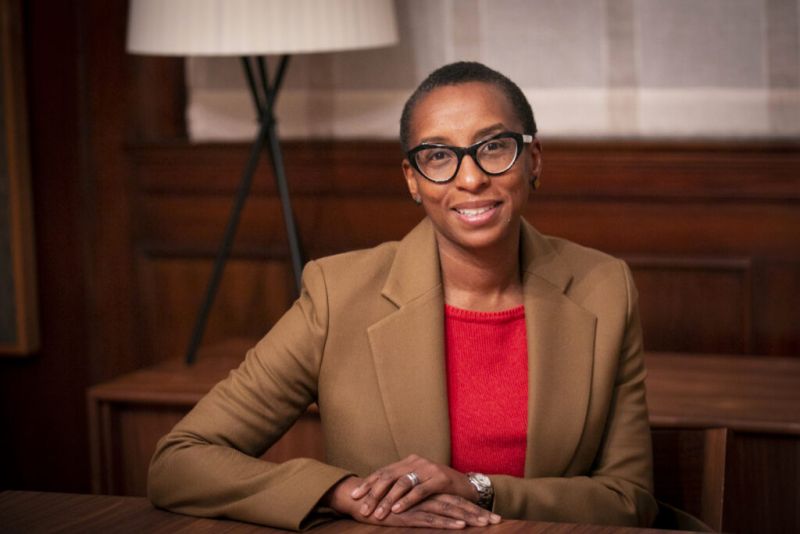
I’ve quoted the parts of Graham’s article that support my point of view. He still thinks she should have been fired.
Nia T. Evans at Mother Jones: What Claudine Gay’s Resignation From Harvard Means for the Rest of Us.
Claudine Gay’s resignation from her post as president of Harvard University is a shocking new twist in the ongoing saga over campus free speech. Gay resigned on Tuesday amid new allegations of plagiarism leveled through an unsigned complaint published in the Washington Free Beacon, a conservative outlet that has long criticized Gay. The news, which was broken by the Crimson, comes after months of attacks on Gay’s response to campus antisemitism and weeks after university leaders reaffirmed their support for her. Gay’s stunning departure is the latest casualty in a growing conservative crusade against “diversity in education” and a chilling reminder of the state of campus free speech amid Israel’s war on Gaza.
“It has become clear that it is in the best interests of Harvard for me to resign,” Gay wrote in a letter to the Harvard community. “It has been distressing to have doubt cast on my commitments to confronting hate and to upholding scholarly rigor—two bedrock values that are fundamental to who I am.”
Gay’s 186-day tenure is the shortest in the school’s 388-year history.
Just six months ago, Gay was heralded as the future of Harvard University. “I stand before you on this stage with the weight and honor of being a first,” she told a rain-soaked crowd during her inauguration ceremony. Her journey to becoming Harvard’s first Black female president felt like the quintessential American dream: she is the daughter of Haitian immigrants, a Stanford graduate with a doctorate from Harvard. An accomplished political scientist with an emphasis on race, democracy, and politics, she was praised by university and political leaders alike after being named Harvard’s 30th president in late 2022. Massachusetts Gov. Maura Healey called her “a leader for our time” driven by the “values to meet the moment” at Gay’s September inauguration ceremony. Harvard’s governing board announced her selection with glee. “We are confident Claudine will be a thoughtful, principled, and inspiring president for all of Harvard,” wrote Harvard Corporation senior fellow Penny Pritzker. “She will be a great Harvard president in no small part because she is such a good person.”
Gay’s brief tenure collided with historic political assaults against diversity and education. In June, the Supreme Court struck down affirmative action in a case in which Harvard was at its center. The October 7 terrorist attack on Israel by Hamas instigated an ongoing war that’s claimed more than 22,000 lives. The war also set off a fierce debate on college campuses across the country over free speech. In one well-documented incident, a conservative group paid for a truck to circle around Harvard Square with a billboard on which the names and photos of opponents of Israel’s actions were displayed. The billboard dubbed them “Harvard’s Leading Antisemites.”
The end result of the controversy and the efforts of right wingers:
Her resignation not only shakes things up at the most prestigious university in the country, it also exposes a larger trend of racial regression that picked up in the years following the 2020 uprisings as Black leaders have been installed in positions of power only to find themselves undermined by the systems they sought to save. Love it or hate it, Harvard sets the tone for national and international debates. To conservative activists celebrating on Twitter, Gay’s ouster is part of a larger project to purge progressive Black leaders from public institutions. Or as Chris Rufo put it, to abolish “DEI ideology from every institution in America.” In the end, Gay’s presidency has created yet another first: Harvard’s first Black female president was also its shortest-serving.
Those are my top stories for today. Lots more is happening, of course. Here are more stories you might find interesting/enraging:
Times of Israel: Israel in talks with Congo and other countries on Gaza ‘voluntary migration’ plan.
The Texas Tribune: Emergency rooms not required to perform life-saving abortions, federal appeals court rules.
Jose Pagliery at The Daily Beast: Jack Smith Keeps Telegraphing Some Seriously Scandalous Trump Crimes.
David Kurtz at TPM’s Morning Memo: The New Argument That Might Save Trump’s March Trial Date.
Newsweek: ‘Storm the Capitol’ Board Game Celebrates Jan. 6 Rioters.
That’s it for me today. What’s on your mind?
New Year’s 2024 Reads: Damn the Predictions! Full Steam Ahead!
Posted: January 1, 2024 Filed under: just because | Tags: @repeat1968, All together, All We are saying is Give Peace a Chance, Come together, Gaza, israel, Japan, John Buss, North Korea, Russia, South Korea, The Electoral College, Ukraine, USA politics 2024 2 Comments
John Buss, @repeat1968
Happy New Year’s Day, Sky Dancers!
I’m still rattled by the overwhelming use of fireworks last night by my little house along the Mississipi. It was like the ghosts of the Battle of New Orleans had taken up arms again! It went on for hours. The cats completely disappeared, and Temple and I hung out in the pillow fort. I can’t believe that with all the wars raging in the world right now, some people’s children would find like-sounds appealing. I’ve started my year with a jury summons. I wish I lived in the District, and summons was for you know who’s felonies. I have no idea how I will manage it, but I hope my doctor can explain the challenges I face this year. The process has been automated, so it might be easier if I don’t have to appear and then be sent home daily.
Mother Earth started the New Year off with a bang and a rattle. Japan experienced a 7.5 earthquake that was followed by a tsunami threatening Japan’s and South Korea’s coasts. About 100.000 people had to evacuate, 10s of thousands are still without power, and a building collapse killed one man. A 4.1 earthquake hit South of L.A. this morning. This one was par for the course for Coastal California.
The big question is, will 2024 bring worse climate change disasters than 2023? This is from the Washington Post. “The climate future arrived in 2023. It left scars across the planet. The year will mark a point when humanity crossed into a new climate era — an age of “global boiling,” as the U.N. Secretary General called it.” This is reported by Chico Harlen.
One explanation for 2023’s extreme heat is El Niño — a recurring oceanic phenomenon that warms the waters in the Pacific and causes a global ripple of consequences. But the scale of this year’s heat — amplified by human-caused factors and the burning of fossil fuels — is still well beyond what most scientists had thought possible. Some have theorized that planetary warming may be accelerating. Others have said there’s not enough evidence. What they agree upon, though, is that the earth is trending toward more extreme heat.
 The list of examples from around the globe should shock a few politicians into taking action. I can say that it won’t happen here in America’s Oil Coast. Our politicians are wholly owned subsidiaries of oil and gas companies. Our next Governor will be worse than Jindal, which says a lot. All Republican pols are saying that we’re not drilling enough and 2023 has evidence to the contrary. This is also from The Washington Post. “U.S. oil production hit a record under Biden. He seldom mentions it. The politics of oil are particularly tricky for Democrats, whose chances for victory in next year’s elections can hinge on whether young, climate-focused voters come out in big numbers.”
You won’t hear President Biden talking about it much, but a key record has been broken during his watch: The United States is producing more oil than any country ever has.
The flow of huge amounts of crude from American producers is playing a big role in keeping prices down at the pump, diminishing the geopolitical power of OPEC and taming inflation. The average price of a gallon of regular gasolinenationwide has dropped to close to $3, and analysts project it could stay that way leading up to the presidential election, potentially assuaging the economic anxieties of swing-state voters who will be crucial to Biden’s hopes of a second term.
But it is not something the president publicly boasts about. The politics of oil are particularly tricky for Democrats, whose chances for victory in the 2024 elections could hinge on whether young, climate-conscious voters come out in big numbers. Many of those voters want to hear that Biden is doing everything in his power to keep oil in the ground.
“If you are not looking carefully at what the administration is actually doing, it is easy to get the wrong impression,” said Kevin Book, managing director at ClearView Energy Partners, a research firm. “There are a lot of things going on at once. This is an administration which is focused on the energy transition, but also taking a pragmatic approach on fossil fuels.”
The United States is producing about 13.2 million barrels of crude oil per day. That is millions of gallons more than is coming out of Saudi Arabia or Russia. It is more oil than was being produced even at its peak during the pro-fossil-fuels administration of former president Donald Trump, when production was 13 million barrels a day in November 2019.
 There are plenty more theats than promises on our horizon for 2024. This reminder from ABC News should focus attention on getting another Blue Wave. “Former Trump White House insiders call possible 2nd term a threat to American democracy. “We don’t need to speculate,” one told “This Week” co-anchor Jonathan Karl.” Is it just me or are all these Baby New Year cartoons a bit dystopian? We need a Shero!!
Three women who served in former President Donald Trump‘s White House are now warning against a possible second Trump term, with one of them saying it could mean “the end of American democracy as we know it.”
For the first time, former White House Communications Director Alyssa Farah Griffin, former White House deputy press secretary Sarah Matthews, and former White House aide Cassidy Hutchinson sat down together with ABC News “This Week” co-anchor Jonathan Karl to discuss their roles in speaking out against Trump in the wake of Jan. 6.
“Fundamentally, a second Trump term could mean the end of American democracy as we know it, and I don’t say that lightly,” Griffin, now a co-host of ABC’s “The View,” told Karl, accusing the former president of having gone to “historic and unconstitutional lengths” in attempting to “steal a democratic election” and to stay in power.
“I’m very concerned about what the term would actually look like,” Griffin continued.
“We don’t need to speculate what a second Trump term would like because we already saw it play out,” Matthews told Karl.
“To this day, he still doubles down on the fact that he thinks that the election was stolen and fraudulent,” Matthews said, claiming Trump’s rhetoric has become “increasingly erratic,” citing his threats to skirt the Constitution and suggestions about weaponizing the Justice Department to retaliate against his political enemies.
Hutchinson, who served as a top aide to Trump’s last White House chief of staff Mark Meadows – and who stood by Trump the longest after the 2020 election – said there’s a large portion of the population that’s not recognizing their mistakes, that’s not working to continue to better our country.”
“This is a fundamental election to continue to safeguard our institutions and our constitutional republic,” Hutchinson said. “We’re extremely fragile as a country, and so is the democratic experiment.”
This was the first time Griffin, Matthews, and Hutchinson, who all cooperated with the House select committee that investigated the Capitol attack by Trump supporters on Jan. 6, 2021, gathered to share their experiences.
 Gustaf Kilander of The Independent has a major reform in mind that’s been discussed quite a bit this century. “The Electoral College is a ‘bad’ and ‘undemocratic’ system. So why does the US still use it? In the most powerful democracy in the world, two of its last four leaders have been chosen by a minority of voters. The US’s Electoral College system is now functioning far from how its creators originally intended,” Indeed.
In the 2016 election, it was Hillary Clinton who won the popular vote with almost three million more votes than Donald Trump. But the showboating businessman ended up in the West Wing regardless.
To put it simply, in the most powerful democracy in the world, two of the nation’s last four leaders have been the less popular option among voters – due to an Electoral College system that many feel is undemocratic and needs to change.
“They came up with the Electoral College at the very end of the Constitutional Convention,” Kermit Roosevelt, professor of law at the University of Pennsylvania, tells The Independent about the founding of American democracy.
“They didn’t really pick it because it had features that they liked, so much as they couldn’t figure out any other way to accommodate people’s concerns.”
As it currently stands, to get to the White House, a candidate has to reach at least 270 out of the 538 electoral votes which are distributed to the states according to population.
However, most states have instituted winner-take-all systems.
This means that a candidate could win the most votes across the country but lose the electoral college by running up the numbers in some states and losing by smaller margins in others.
Partisan sorting appears to have worsened this phenomenon, as people move to areas where their neighbours share their political beliefs.
The size of some states is also so vastly different that smaller states have ended up with more representation in the Electoral College than their population may justify.
 This is a really long read with a lot of history and some analysis that really will wake you up even though we’re all aware of the issue.
The end result of this system is that very few voters actually matter.
“We’ve got sort of an aristocracy of the Dakotas and Wyoming, and Rhode Island,” Mr Roosevelt says.
“The big way in which the Electoral College distorts our political process … is that it makes people focus on the swing states” both when it comes to campaigning and governing, he adds.
“This is a point that I think is often lost or distorted – people say, ‘Well, if you didn’t have the Electoral College, no one would pay attention to the small states’. And I don’t think that’s true because a vote from a small state will matter just as much,” he says.
“Candidates don’t pay attention to small states, they pay attention to swing states. So you get all of this attention on Pennsylvania and Florida and Ohio and Wisconsin, North Carolina – the states that are in play.
“And no one pays attention to California or New York – or even Texas. There are millions of people in those states who may be persuadable, and maybe if you address their concerns, you could win their votes, but no one even tried.”
It’s frightening that Trump could win again without even approaching the 50% mark.
Is Israeli justice finally catching up to Bibi? The weekend was full of protests in the streets and calls for an election. Will the electorate and courts deal with this crook also? This is from the New York Times. This is especially important since Netanyu has just announced the war will continue for an unspecified period of time of months. “Israel-Hamas WarIsraeli Justices Reject Netanyahu-Led Move to Limit Court. The law, passed by the Israeli Parliament in July, had sharply divided Israelis and sparked mass protests. Monday’s ruling raised the prospect of renewed discord as Israel wages war in Gaza.” This is written by Isabel Kershner.
In a momentous ruling that could ignite a constitutional crisis, Israel’s Supreme Court on Monday struck down a law passed by Prime Minister Benjamin Netanyahu’s right-wing government that was meant to limit the court’s own powers, by a majority of eight judges to seven.
The decision is likely to rekindle the grave domestic crisis that began a year ago over the right-wing government’s judicial overhaul plan — which sparked mass protests that brought the country to a near standstill at times — even as Israel is at war in Gaza.
The court, sitting with a full panel of all 15 of its justices for the first time in its history, rejected a law passed by Parliament in July. The law barred judges from using a particular legal standard to overrule decisions made by government ministers.
The court’s decision heralds a potential showdown between the top judicial authority and the ruling coalition, and could fundamentally reshape Israeli democracy, pitting the power of the government against that of the court.
Mr. Netanyahu’s governing coalition, the most right-wing and religiously conservative in Israel’s history, has argued that the Supreme Court has overreached its authority and subverted the will of the voters and the function of the elected government. They argue that the legal concept of “reasonableness” — which the court used a year ago to strike down Mr. Netanyahu’s appointment as finance minister of a political ally who had been convicted of tax fraud — is ill defined and subjective.
But in a country that has one house of Parliament, no formal written constitution and a largely ceremonial president, many defenders of Israel’s liberal democracy view the Supreme Court as the only bulwark against government power, and the standard of reasonableness to be one of the primary tools at the judges’ disposal.
 You may read more about the decision at the breaking news at the links. The war itself is moving South which is exactly where Bibi sent Palenstian civilians. This is from the AP. “Israel is pulling thousands of troops from Gaza as combat focuses on enclave’s main southern city.”
Thousands of Israeli soldiers are being shifted out of the Gaza Strip, the military said Monday, in the first significant drawdown of troops since the war began as forces continued to bear down on the main city in the southern half of the enclave.
The troop movement could signal that fighting is being scaled back in some areas of Gaza, particularly in the northern half where the military has said it is close to assuming operational control. Israel has been under pressure from its chief ally, the United States, to begin to switch to lower-intensity fighting.
Word of the drawdown came ahead of a visit by Secretary of State Antony Blinken to the region and after the Biden administration bypassed Congress for the second time this month to approve an emergency weapons sale to Israel.
But fierce fighting continued in other areas of Gaza, especially the southern city Khan Younis and central areas of the territory. Israel has pledged to charge ahead until its war aims have been achieved, including dismantling Hamas, which has ruled Gaza for 16 years.
 The year is definitely going to be a challenging one. Al-Jezeera reports on the latest coming from Ukraine. Putin plans to escalate. We need to help the fast! “Putin vows to ‘intensify’ strikes on Ukraine after deadly Belgorod attack. At least five people are killed in New Year’s Day attacks on Odesa, southern Ukraine and Russian-occupied Donetsk.”
Russian President Vladimir Putin has promised to intensify strikes on Ukraine after an unprecedented attack on the Russian city of Belgorod over the weekend.
Saturday’s air attack killed at least 25 people and wounded more than 100, according to Russian officials.
Russia has blamed Ukraine for the attack, which was one of the deadliest to take place on Russian soil since Moscow’s full-scale invasion of Ukraine started more than 22 months ago.
“We’re going to intensify the strikes. No crime against civilians will rest unpunished – that’s for certain,” Putin said on Monday during a visit to a military hospital.
He said Russia would continue hitting what he called “military installations”.
“We are doing that today, and tomorrow, we will continue doing it,” Putin said.
Putin previously called the destruction in Belgorod a “terrorist attack” and accused Ukrainian forces of targeting “the city centre, where people were walking before New Year’s Eve”.
He said Ukraine was being used by the West to “settle its problems” and insisted the course of the war was changing in Russia’s favour.
The Russian Ministry of Defence said Ukraine hit Belgorod with two missiles and several rockets. It said most of the weapons were shot down, but some debris fell on the city.
Vyacheslav Gladkov, governor of the Belgorod region, said the attack damaged 30 apartment buildings and several houses and cars.
I don’t want to get to deep in the weeds, but North Korea and China are sabre-rattling again too. This is from the AP. “North Korea’s Kim says military should ‘thoroughly annihilate’ US and South Korea if provoked.”
North Korean leader Kim Jong Un said his military should “thoroughly annihilate” the United States and South Korea if provoked, state media reported Monday, after he vowed to boost national defense to cope with what he called an unprecedented U.S.-led confrontation.
North Korea has increased its warlike rhetoric in recent months in response to an expansion of U.S.-South Korean military drills. Experts expect Kim will continue to escalate his rhetoric and weapons tests because he likely believes he can use heightened tensions to wrest U.S. concessions if former President Donald Trump wins the U.S. presidential election in November.
In a five-day major ruling party meeting last week, Kim said he will launch three more military spy satellites, produce more nuclear materials and develop attack drones this year in what observers say is an attempt to increase his leverage in future diplomacy with the U.S.
It looks like Secretary Blinken and his team have their hands full. I’m still concerned about this news from two days ago via Reuters. I’m all for giving Israel defense equipment and keeping their shield at-ready, but have serious doubts about gifting them more offensive weapons. “US skips congressional review to approve sale of artillery projectiles to Israel.” It’s going to be a tough year for us Peaceniks and Justice Freaks.
But, anyway, I hope you have the ability to hunker down in peace and quiet in your home! And …

Here’s one with John, Yoko, and the late Tommy Smothers live from Bed in 1969,
What’s on your reading and blogging list today?
Happy New Year! Hang in here with us for 2024!
Lazy Caturday Reads
Posted: December 30, 2023 Filed under: 2024 Elections, 2024 presidential Campaign, cat art, caturday, Corrupt and Political SCOTUS, Donald Trump, just because, SCOTUS | Tags: 14th amendment, Civil War, Elon Musk, fake electors, Jack Smith, Kenneth Chesebro, lost cause theory, Niki Haley, Ron DeSantis, slavery, Supreme Court 12 CommentsHappy Caturday!!

Benson B. Moore, born Washington, DC 1882-died Stuart, FL 1974
We’ve nearly reached the end of 2023. We’re also at the end of the typically slow news time known as “the holidays.” Therefore, there isn’t a lot of breaking news for me to post about. But here are a few interesting stories that are worth reading, along with some cat art from the Smithsonian “artful cats” collection.
Alex Shephard at The New Republic: Elon Musk Is The New Republic’s 2023 Scoundrel of the Year.
In one sense, Elon Musk has gotten exactly what he wanted. For all his talk about free speech, his primary motivation for sinking $44 billion into buying Twitter last year was clearly an unquenchable desire to be the center of attention. After Donald Trump’s defenestration in the wake of the January 6 insurrection, there was a main-character-size hole on the social network: Enter Musk and his infantile need for validation.
That Twitter—now renamed X, for reasons only Musk really understands—is now teetering on the brink of collapse and worth less than half what the world’s second-richest man paid for it is funny. It elicits deserved schadenfreude. Musk entered Twitter’s office carrying a sink—a terrible joke, and one of his better ones—last fall and has subsequently made countless decisions, big and small, all of which have made the platform significantly less viable and less worth spending any amount of time on. It is hard to think of a billionaire who has done more to damage their own reputation in such a short period of time.
Not so long ago, Musk was seen by many as a good tech billionaire, if not the good tech billionaire. While others like Meta’s Mark Zuckerberg built digital trinkets that actively made the world a worse place, Musk was something different: a visionary intent on building real things, whether they be electric cars or rockets, that were aimed at accelerating a Jetsons-like vision of the future. While rivals at Google and Facebook—and, for that matter, Twitter—were hauled before Congress to testify about the deleterious effects of their creations, Musk remained relatively unscathed. Now it is clear that he is not just more villainous than all of them but that he is also a deeply stupid and unserious person.
Elon Musk is evil. While he has mostly made headlines for his incompetence, he has unleashed and legitimized truly heinous forces on Twitter: He has welcomed back some of the world’s most toxic people—Alex Jones, Donald Trump, innumerable Nazis and bigots—and has gone out of his way, again and again, to validate them. That Musk would endorse a heinous antisemitic conspiracy theory, as he did last month, is both unsurprising and reprehensible. It is, more than anything else, a reflection of who he is: He may be fantastically wealthy, but he is also deeply hateful, someone who has decided to devote his fortune and his time to attacking diversity and progress on nearly every front.
Musk has insisted again that he bought Twitter to save it from itself—that the platform had become too restrictive and that, to become a true “digital town square” where the best ideas rise to the top, it needed to welcome everyone. It is now abundantly clear that Musk’s real intention is and always has been to put his thumb on the scale: to elevate his own hateful views about, in no particular order: liberals; the media; diversity, equity, and inclusion programs; trans people; and liberal Jews. He sees Twitter as a weapon, a way to not only push his agenda but to sic his army of loyalist losers on anyone he deems an enemy.
For all of the talk about Musk being a “real life Tony Stark,” he has always been a deeply uncool person’s idea of a cool person: He is, in many ways, a sentient m’lady Reddit post circa 2011. It’s hard to think of a more pathetic figure now: someone scraping the internet for conspiracy theories and “jokes” aimed at affirming his status and influence. He has, again and again, done the opposite: Far from showing himself as a swaggering, popular figure, he has revealed himself to be a venal, thin-skinned moron. He may very well be the most unfunny person alive, a fact reified dozens of times a day.
Wow! Read the rest at The New Republic. I wonder if Musk is too stupid to read TNR. If he does read this, he’ll probably sue Alex Shephard
At HuffPost, SV Date assesses the DeSantis campaign: DeSantis’ 2023: More Than $160 Million Spent To Buy A Collapse In The Polls.
A year after Ron DeSantis led Donald Trump in some 2024 presidential primary polls, and with just weeks to go before the first ballots are cast, the Florida governor is already explaining how Democrats conspired to stop him: by repeatedly charging the coup-attempting former president with breaking the law.
DeSantis’ campaign and super PAC have spent more than $160 million to boost him, and he spent the better part of 2023 on the road. But, he now says, it may not have been enough to overcome the advantage he believes Trump received from getting indicted four times.
Jacques Hnizdovsky, born Pylypcze, Ukraine 1915-died New York City 1985
“If I could have one thing change, I wish Trump hadn’t been indicted on any of this stuff,” he told the Christian Broadcasting Network last week. “It sucked out a lot of oxygen.” [….]
“The race was decided totally out of their control,” said one DeSantis donor and supporter who spoke on condition of anonymity. “Trump got indicted. And indicted and indicted and indicted. The race was over after the first indictment.”
Other Republicans are less charitable as they describe DeSantis’ steady decline over the year ― which began with GOP donors giving him unsolicited six- and seven-figure checks, saw him spend far more time and energy attacking the Walt Disney Co. and the nation’s top doctor during the COVID pandemic than he ever did taking on the front-runner in his race, and ended with DeSantis some 40 points behind Trump in national polls.
“He started the primary on third base and stole second,” said David Jolly, who served with DeSantis as a fellow Republican member of Congress from Florida. “We’ve now witnessed one of the most expensive and embarrassing collapses in Republican history.”
Fergus Cullen, a former New Hampshire Republican Party chair, wondered about DeSantis’ apparent strategy of trying to win over the roughly one-third of primary voters who are “only Trump,” rather than the two-thirds who are open to someone else….
The Florida governor’s various missteps over the year ― as well as those of his campaign and his supporting super political action committee ― have been well documented, from the time he called Russia’s invasion of Ukraine a “territorial dispute” to the mass campaign layoffs just two months after he officially began his run to the recent dysfunction at the super PAC, Never Back Down.

There’s more at the link.
Historian Heather Cox Richardson weighed in on Niki Haley’s Civil War gaffe at her substack, Letters from an American:
When asked at a town hall on Wednesday to identify the cause of the United States Civil War, presidential candidate and former governor of South Carolina Nikki Haley answered that the cause “was basically how government was going to run, the freedoms, and what people could and couldn’t do…. I think it always comes down to the role of government and what the rights of the people are…. And I will always stand by the fact that, I think, government was intended to secure the rights and freedoms of the people.”
Haley has correctly been lambasted for her rewriting of history. The vice president of the Confederacy, Alexander Stephens of Georgia, was quite clear about the cause of the Civil War. Stephens explicitly rejected the idea embraced by U.S. politicians from the revolutionary period onward that human enslavement was “wrong in principle, socially, morally, and politically.” Instead, he declared: “Our new government is founded upon…the great truth, that the negro is not equal to the white man; that slavery—subordination to the superior race—is his natural and normal condition.” [….]
Haley has been backpedaling ever since—as well as suggesting that the question was somehow a “gotcha” question from a Democrat, as if it was a difficult question to answer—but her answer was not simply bad history or an unwillingness to offend potential voters, as some have suggested. It was the death knell of the Republican Party.
Robert Smithson, American, b. Passaic, New Jersey, 1938–1973
That party formed in the 1850s to stand against what was known as the Slave Power, a small group of elite enslavers who had come to dominate first the Democratic Party and then, through it, the presidency, Supreme Court, and Senate. When northern Democrats in the House of Representatives caved to pressure to allow enslavement into western lands from which it had been prohibited since 1820, northerners of all political stripes recognized that it was only a question of time until elite enslavers took over the West, joined with lawmakers from southern slave states, overwhelmed the northern free states in the House of Representatives, and made enslavement national.
So in 1854, after Congress passed the Kansas-Nebraska Act that allowed the spread of enslavement into previously protected western lands, northerners abandoned their old parties and came together first as “anti-Nebraska” coalitions and then, by 1856, as the Republican Party.
At first their only goal was to stop the Slave Power, but in 1859, Illinois lawyer Abraham Lincoln articulated an ideology for the new party. In contrast to southern Democrats, who insisted that a successful society required leaders to dominate workers and that the government must limit itself to defending those leaders because its only domestic role was the protection of property, Lincoln envisioned a new kind of government, based on a new economy.
Lincoln saw a society that moved forward thanks not to rich people, but to the innovation of men just starting out. Such men produced more than they and their families could consume, and their accumulated capital would employ shoemakers and storekeepers. Those businessmen, in turn, would support a few industrialists, who would begin the cycle again by hiring other men just starting out. Rather than remaining small and simply protecting property, Lincoln and his fellow Republicans argued, the government should clear the way for those at the bottom of the economy, making sure they had access to resources, education, and the internal improvements that would enable them to reach markets.
When the leaders of the Confederacy seceded to start their own nation based in their own hierarchical society, the Republicans in charge of the United States government were free to put their theory into practice. For a nominal fee, they sold farmers land that the government in the past would have sold to speculators; created state colleges, railroads, national money, and income taxes; and promoted immigration.

Click the link to read more serious history.
The rest of the notable news this morning is Trump-related. Here’s what’s happening:
At her substack, Civil Discourse, Joyce Vance writes about latest on Trump lawyer Kenneth Chesebro, (which Dakinikat covered yesterday): What does the new reporting about Kenneth Chesebro mean?
CNN had a lengthy piece late Thursday on Kenneth Chesebro’s statement to prosecutors in Michigan (he is also talking to prosecutors elsewhere), that included his emails with others involved in the fake electors scheme and some audio of his statement to prosecutors. You will recall that Chesebro is a Harvard educated lawyer, who has been attributed with the role of architect of the fake electors scheme. Chesebro was charged in the Fulton County case, where he pled guilty, but with an asterisk. Chesebro continues to maintain that there was nothing illegal about the fake electors scheme. He pled guilty to one felony count of conspiracy to file false documents. He continues to maintain through his lawyer that the fake electors scheme was a legitimate strategy, put into play to protect Trump’s legal options. Chesebro’s attorney has said Trump has nothing to fear from his testimony.
So, Chesebro doesn’t look like a cooperator in the traditional sense. Cooperation means pleading guilty, making a full confession, and agreeing to testify against others. And that doesn’t seem to be what has happened here, making the deal Chesebro got in Fulton County, something of a mystery. Chesebro, at least on the surface, isn’t much of a witness for the government. It seems like he would testify there wasn’t an illegal conspiracy to interfere with the results of the election. In some cases, cooperating witness’ statements evolve overtime. Every prosecutor has put a cooperator on the stand who started out with lies, maintaining their innocence, but evolved progressively over time towards the truth—which then had to be corroborated with other evidence and a candid confession to the lies as well, as the crimes. But that doesn’t seem to be what’s happening here, either.
Cat with Lantern Woodblock print, by Kobayashi Kiyochika
Chesebro, and his “cooperation” remain something of an enigma, which makes this new report all the more interesting. Is Chesebro being more cooperative with prosecutors in Michigan? Has he finally had his come to Jesus moment? But much of the story is not new. The Washington Post, for instance, reported previously on his proffer in Georgia. But the CNN story is illuminating when we put it in context with everything else, and particularly with what we already know from the work of the January 6 committee.
Perhaps the most interesting new detail comes midway through the story, when we learn that prior to Chesebro’s guilty plea in Georgia, his lawyers reached out to Smith’s team. But they have still not received a response (or an invitation to proffer as have others, like Rudy Giuliani) from prosecutors. No reason is offered for this.
CNN obtained access to audio of some of Chesebro’s proffer with Michigan prosecutors, however. He has apparently been on the circuit, speaking with prosecutors in a number of different states where there are investigations in progress. The audio reveals a petulant, childish witness, upset about what he perceives as lies told about him by other Trump campaign lawyers and his financial problems. You can read the entire report from CNN here.

That’s a lot of questions. Read Vance’s take at her substack link above.
At Aaron Rupar’s substack Public Notice, Liz Dye writes about Jack Smith’s latest filing in the January 6 case: Jack Smith’s new motion could obliterate Trump’s DC strategy.
On Wednesday, Special Counsel Jack Smith asked the court to put the kibosh on Donald Trump’s efforts to “turn the courtroom into a forum in which he propagates irrelevant disinformation.” If Judge Tanya Chutkan grants this motion, it will eviscerate the former president’s plan to defend himself in DC by making the case about anything other than his own plot to obstruct the congressional certification of President Biden’s 2020 victory.
Broadly speaking, Trump wants to make the election interference trial into a glorified segment of Steve Bannon’s podcast. As he screams WITCH HUNT on social media, his lawyers accuse Biden of weaponizing the Justice Department and seek to introduce evidence of every crackpot election theory ever aired on Newsmax.
Unsurprisingly, the prosecution would like to avoid all that, so the special counsel has filed a motion to block Trump from bombarding the jurors with irrelevant and prejudicial evidence. And because Smith takes no prisoners, he’s done it in the most aggressive way possible….
Since before the indictment even dropped in August, Trump screamed daily that Biden is directing the Justice Department to persecute him. He also claimed that Biden is controlling the New York criminal and civil cases, as well as the RICO case in Georgia. He never presents any evidence of this because it’s patently ridiculous. The DOJ has no control over state prosecutions, and the entire purpose of the special counsel statute is to remove investigations which pose a conflict of interest from the immediate control of the DOJ….
Ted Gordon, born Louisville, KY 1924
[The Trump team’s] legal filings are scarcely more subtle. In October, Trump filed a motion to dismiss the case based on “selective and vindictive prosecution” — essentially a claim that the DOJ indicted him solely to kneecap Biden’s 2024 opponent.
The motion itself is a farcical hash of anonymously sourced articles from the supposedly fake news Washington Post and New York Times alleging that Biden confided to his inner circle that he wished AG Garland would be more aggressive. In fact, both stories confirm that Biden stayed far away from the Trump cases, even before Garland handed them off to Smith to avoid the appearance of conflict. Trump’s motion also mangles a quote from a press conference to suggest that “Biden’s publicly stated objective is to use the criminal justice system to incapacitate President Trump, his main political rival and the leading candidate in the upcoming election.” (That’s not remotely what he said.)
Even the most mundane scheduling brief is larded with assertions that “the incumbent administration has targeted its primary political opponent — and leading candidate in the upcoming presidential election — with criminal prosecution.”

In response, Smith argues:
“Through public statements, filings, and argument in hearings before the Court, the defense has attempted to inject into this case partisan political attacks and irrelevant and prejudicial issues that have no place in a jury trial,” Special Counsel Smith argued in a pretrial motion filed Wednesday. “Although the Court can recognize these efforts for what they are and disregard them, the jury — if subjected to them — may not.”
Prosecutors accuse Trump of attempting to engage in jury nullification, that is, securing an acquittal by convincing jurors to disregard the evidence and law in favor of their own personal feelings of justice. They argue that “the defendant should be precluded from raising irrelevant political issues” which might “improperly suggest to the jury that it should base its verdict on something other than the evidence at trial.”
Toward that end, they seek to exclude a broad swath of evidence which maps almost perfectly onto Trump’s motions to compel and to dismiss for selective prosecution.
There’s much more explanation and analysis at the Public Notice link.
Two legal minds weighed in on what the Supreme Court might do about states dropping Trump’s from their ballots.
Adam Liptak at the New York Times: How the Supreme Court May Rule on Trump’s Presidential Run.
The Supreme Court, battered by ethics scandals, a dip in public confidence and questions about its legitimacy, may soon have to confront a case as consequential and bruising as Bush v. Gore, the 2000 decision that handed the presidency to George W. Bush.
Until 10 days ago, the justices had settled into a relatively routine term. Then the Colorado Supreme Court declared that former President Donald J. Trump was ineligible to hold office because he had engaged in an insurrection. On Thursday, relying on that court’s reasoning, an election official in Maine followed suit.
An appeal of the Colorado ruling has already reached the justices, and they will probably feel compelled to weigh in. But they will act in the shadow of two competing political realities.
Jimmy Tsutomu Mirikitani, born Sacramento, CA 1920-died New York City 2012
They will be reluctant to wrest from voters the power to assess Mr. Trump’s conduct, particularly given the certain backlash that would bring. Yet they will also be wary of giving Mr. Trump the electoral boost of an unqualified victory in the nation’s highest court.
Chief Justice John G. Roberts Jr. will doubtless seek consensus or, at least, try to avoid a partisan split of the six Republican appointees against the three Democratic ones.
He may want to explore the many paths the court could take to keep Mr. Trump on state ballots without addressing whether he had engaged in insurrection or even assuming that he had.
Among them: The justices could rule that congressional action is needed before courts can intervene, that the constitutional provision at issue does not apply to the presidency or that Mr. Trump’s statements were protected by the First Amendment.
“I expect the court to take advantage of one of the many available routes to avoid holding that Trump is an insurrectionist who therefore can’t be president again,” said Nicholas Stephanopoulos, a law professor at Harvard.

Read the rest at The New York Times.
Shan Wu at The Daily Beast: Here’s What SCOTUS Should Do With the Trump Ballot Cases.
The U.S. Supreme Court needs to understand that the disqualification of former President Donald J. Trump under Section 3 of the 14th Amendment from running again for President of the United States is going exactly as it should. The Maine Secretary of State ruled in an administrative proceeding that Trump is disqualified, and the Colorado Supreme Court ruled similarly.
Both states followed the law set forth in the U.S. Constitution that anyone who once took an oath to support the Constitution but then “shall have engaged in insurrection or rebellion against the same, or given aid or comfort to enemies of the same” cannot again serve our country. But four other states (Florida, Michigan, Minnesota, California) came out the other way, while fourteen other states (Alaska, Arizona, Nevada, New Jersey, New Mexico, New York, Oregon, South Carolina, Texas, Vermont, Virginia, West Virginia, Wisconsin and Wyoming) still have disqualification cases pending. This sets up a potential crazy quilt map of states where Trump is on the ballot in some state but not in others. There is nothing wrong with this. It’s federalism at work.
Under the Constitution, the states have primary power over administering federal elections with Congress also possessing authority to regulate how the elections are run—voter registration being an example. So, the fact that who can run, who can vote and the “time place and manner” in which voting takes place varies from state to state is normal—and, arguably, the high court need not concern itself with these issues.
Woman and Cats, Will Barnet, born Beverly, MA 1911-died New York City 2012
Given this, SCOTUS does not have to take the ultimate appeal of any of these cases. Its discretion to take cases is complete, and letting the different cases stand would be an unreviewable decision on their part that would both keep them out of a repeat of their gross interference in the 2000 presidential election where the high court, not the people, made George W. Bush the 43rd President, and perhaps staunch the bleed out of their credibility. But the justices—liberal and conservative alike—are unlikely to be able to resist the glamour of taking on a case that can decide who will be president in 2024, and most legal experts believe they will take on the case.
If the justices do take on the cases, then they should limit what issues they decide to the ones that most clearly relate to Constitutional interpretation. Chief among those is the question of whether the president of the United States is an “officer” of the United States since some—including Trump—argue that the President is not an officer of the United States, and therefore the disqualification provision does not apply.
The justices should dispose of this question by holding that the President is an officer of the United States. To conclude otherwise begs the question of what is the president then? Trump would like the answer to be that the president is an emperor or a king rather than a mere officer serving the Constitution, and that’s what SCOTUS would be anointing him if it concludes that presidents do not hold office.

Read more analysis at The Daily Beast.
I hope everyone is having a nice, peaceful end-of-2023 weekend. All the best for the new year!

 peej
peej Carissa
 bostonboomer
 dakinikat
 ecocatwoman
 mablue2
 Mama Lopez
 peggysue22
 quixote
 skydancingguestblogger
 Mona (aka Wonk the Vote)



 Sky Dancing
Recent Comments