Nothing says Thanksgiving to me more than the WKRP Turkey Drop! Thank you, John Buss, @repeat1968
Good Day, Sky Dancers!
My first short story remains in my scrapbook in its purply blue mimeograph ink. It has my drawing of Cassandra and my interpretation of my favorite Greek Character, who was dedicated to the Greek God Apollo but was fated to make true prophecies no one ever believed. I was drawn to her in my 5th-grade mythology class. I remember my mother listening to me once and starting to question me before she interrupted herself by telling me this. “I don’t know why I question you; you’re almost always right.” I usually don’t believe everything I read, but I remember it. Prognostication is less godly and more mathematical these days, but when you know what’s likely to happen when you do that S-VAR model based on solid theory and a new hypothesis, you don’t always want to welcome the results.
I’ve been running around with my hair on fire since the Orange Demon started obsessing about tariffs again. He tried them during his last Reign of Terror and nearly drove our farmers out of business. Congress had to rescue them with huge subsidies that paid them for not selling their crops or livestock. Trump started a Trade War with China. He needed a visit from Herbert Hoover’s Ghost and to listen to the huge chorus of economists who warned him, but he persisted. Luckily, it didn’t take out the U.S. economy, but it ran up the deficit and jeopardized the Agriculture sector.
Donald Trump loved to use tariffs on foreign goods during his first presidency. But their impact was barely noticeable in the overall economy, even if their aftershocks were clear in specific industries.
The data show they never fully delivered on his promised factory jobs. Nor did they provoke the avalanche of inflation that critics feared.
The president-elect is talking about going much bigger — on a potential scale that creates more uncertainty about whether he’ll do what he says and what the consequences could be.
“There’s going to be a lot more tariffs, I mean, he’s pretty clear,” said Michael Stumo, the CEO of Coalition for a Prosperous America, a group that has supported import taxes to help domestic manufacturing.
The president-elect posted on social media Monday that on his first day in office he would impose 25% tariffs on all goods imported from Mexico and Canada until those countries satisfactorily stop illegal immigration and the flow of illegal drugs such as fentanyl into the United States.
Those tariffs could essentially blow up the North American trade pact that Trump’s team negotiated during his initial term. But on Wednesday, Trump posted on social media that he had spoken with Mexican President Claudia Sheinbaum and she had agreed to stop unauthorized migration across the border into the United States.
Trump also posted on Monday that Chinese imports would face additional tariffs of 10% until Beijing cracks down on the production of materials used in making fentanyl.
President Sheinbaum immediately denied Trump’s characterization of their conversation. This headline from HuffPo says it all. “Trump Mocked After Mexico’s President Blows Up His Brag About Their Call.” Josephine Harvey reports on the response.
Donald Trump seemed to offer alternative facts on Wednesday about his recent call with Mexican President Claudia Sheinbaum and was swiftly rebutted by the leader herself, prompting mockery on social media.
In a post on his Truth Social platform, the U.S. president-elect declared that Sheinbaum had “agreed to stop Migration through Mexico, and into the United States, effectively closing our Southern Border.”
Shortly afterward, Sheinbaum shared a Spanish-language message about the conversation, writing, “We reiterate that Mexico’s position is not to close borders, but to build bridges between governments and communities.”
Both leaders characterized the call as positive. The two spoke after Trump on Monday threatened to impose a 25% tax on all products entering the country from Canada and Mexico as soon as he takes office. Trump said, “This Tariff will remain in effect until such time as Drugs, in particular Fentanyl, and all Illegal Aliens stop this Invasion of our Country!” He also threatened to put an “additional 10%” tariff on goods from China.
This week’s news was somewhat reminiscent of Trump’s claim ahead of the 2016 election that he would make Mexico pay for “100%” of a proposed wall at the U.S. border. Enrique Peña Nieto, Mexico’s president at the time, disagreed. Mexico did not pay.
Social media users sarcastically celebrated Trump’s fictional victory this week.
“All it took was one call. Donny deals,” journalist Sam Stein posted online.
Mike Nellis, a former aide to Vice President Kamala Harris, said, “Trump thinks he convinced the President of Mexico to stop all migration across the border LOL.”
Olivia Troye, who was a White House official in Trump’s first term, offered a “Translation” of the president-elect’s comments about Mexico.
Just had a conversation with the President of Mexico who didn’t allow me to bully her, which left me confused about my charm…she pointed out that this is very bad…very bad for me if I do these tariffs…” Troye wrote.
China and Canada were also blunt about DonOld’s mischaracterizations of his conversations with their leaders. USA Today‘s Kim Hjelmgaard reported it this way. “‘Counter to facts and reality’: China, Mexico, Canada respond to Trump tariff threats.”
Officials in China, Mexico and Canada criticized Tuesday a pledge made by President-elect Donald Trump on social media to impose new tariffs on all three of the United States’ largest trading partners on the first day of his presidency.
Trump said the move, which appears to violate the terms of a free-trade deal Trump signed into law in 2020, is aimed at clamping down on drugs − fentanyl especially − and migrants crossing into the U.S. illegally.
The president-elect said he would sign an executive order immediately after his inauguration introducing a 25% tariff on all goods coming from Mexico and Canada and a 10% tariff on goods from China.
Trump takes office on Jan. 20.
“Both Mexico and Canada have the absolute right and power to easily solve this long simmering problem,” Trump said in a post on Truth Social, a platform he owns. “It is time for them to pay a very big price!” He accused China in a separate post of failing to block smuggling of U.S.-bound fentanyl, a synthetic opioid.
There was quick pushback to Trump’s comments from all three countries.
Liu Pengyu, a spokesperson for the Chinese embassy in Washington, said: “No one will win a trade war or a tariff war” and “the idea of China knowingly allowing fentanyl precursors to flow into the United States runs completely counter to facts and reality.”
Mexico’s finance ministry said in a statement the U.S.-Mexico-Canada Agreement, a trade pact Trump sponsored during his first term, provided “certainty” for investors. “The response to one tariff will be another, until we put at risk companies that we share,” Mexico’s President Claudia Sheinbaum said, naming General Motors and Ford, among others. Sheinbaum said her comments, read aloud in a press conference, were sent in a letter to Trump.
Doug Ford, the premier of Ontario, Canada’s most populous province, said the tariffs would be “devastating to workers and jobs” in both the U.S. and Canada.
A tariff is effectively a tax imposed by one country on the goods and services imported from another country. Oil is the top U.S. import from Canada, according to the U.S. Energy Information Administration. The largest category of goods imported to the U.S. from Mexico is cars and components for cars. The U.S. imports a significant amount of electronics from China. Some goods are exempt from tariffs because of the U.S.-Mexico-Canada Agreement.
An estimate from The Budget Lab at Yale shared Wednesdaywith NBC News found that the cost to consumers from Trump’s proposed tariffs could reach as much as $1,200 in lost purchasing power on average based on 2023 incomes, assuming retaliatory duties on U.S. exports are put into place.
Mexican President Claudia Sheinbaum has already warned that any new tariffs imposed by the U.S. would be met with retaliatory ones by her country. Canada is similarly considering its own options, including possible tariffs on U.S. goods, according to The Associated Press.
America’s biggest import from Canada is oil — and any increase in energy prices would likely be felt throughout the economy.
“Another way to think about this is it’s 4 to 5 months of a normal year’s inflation in one fell swoop,” Ernie Tedeschi, The Budget Lab’s director and the former chief economist under the Biden administration, said in an email.
While Trump has insisted other countries end up paying the cost of tariffs, most economists agree those costs wind up getting passed on to shoppers. And at a time when rising prices remain a top concern, the types of goods that could see higher costs are the ones consumers interact with every day.
Some companies are warning that particularly import-heavy parts of the economy could be hit hard. Best Buy CEO Corie Barry warned Tuesday that any added costs on U.S. imports “will be shared by our customers.” Electronic goods account for the largest share of U.S. imports from China as of 2023.
“There’s very little in [the] consumer electronics space that is not imported. … These are goods that people need, and higher prices are not helpful,” Barry said.
Donald Trump has selected Tulsi Gabbard, former congresswoman and notorious Putin stooge, as his nominee for director of the office of national intelligence.
It’s difficult to imagine a candidate less suited to carry out the DNI’s mission, and that’s very likely just the reason that Trump chose her. Gabbard has virtually none of the experience or expertise required to competently assume DNI’s weighty responsibility of marshaling the information and analyses gathered by the nation’s intelligence agencies and coordinating their work.
Gabbard’s longstanding association with a shadowy rightwing cult, her history of suspicious uses of campaign funds, her habitual conspiracism and advocacy for the interests of bloodthirsty dictators (including Syria’s Bashar al-Assad as well as Putin) all raise a multiplicity of red flags.
But, as Donald Trump made clear during his first term in office, national security is hardly at the top of his list of priorities. In fact, hobbling the nation’s intelligence agencies is one of his principal goals.
Donald Trump has selected Tulsi Gabbard, former congresswoman and notorious Putin stooge, as his nominee for director of the office of national intelligence.
It’s difficult to imagine a candidate less suited to carry out the DNI’s mission, and that’s very likely just the reason that Trump chose her. Gabbard has virtually none of the experience or expertise required to competently assume DNI’s weighty responsibility of marshaling the information and analyses gathered by the nation’s intelligence agencies and coordinating their work.
Gabbard’s longstanding association with a shadowy rightwing cult, her history of suspicious uses of campaign funds, her habitual conspiracism and advocacy for the interests of bloodthirsty dictators (including Syria’s Bashar al-Assad as well as Putin) all raise a multiplicity of red flags.
But, as Donald Trump made clear during his first term in office, national security is hardly at the top of his list of priorities. In fact, hobbling the nation’s intelligence agencies is one of his principal goals.
Meta boss Mark Zuckerberg has visited Donald Trump at his resort in Mar-a-Lago, further evidence of the apparent thawing in their once frosty relations.
The president-elect already has a close, high-profile relationship with another of the leading figures in tech, X owner Elon Musk.
Historically, though, there has been no such closeness between Trump and Mr Zuckerberg – with Trump barred from Facebook and Instagram after the Capitol riots, and Trump threatening the Meta boss with jail if he interfered in the 2024 presidential election.
However, there has recently been evidence those strained relations are improving, culminating in Mr Zuckerberg dining with the president-elect at his Florida mansion.
“Mark was grateful for the invitation to join President Trump for dinner and the opportunity to meet with members of his team about the incoming administration,” a Meta spokesperson told the BBC.
“It’s an important time for the future of American Innovation,” the statement added.
The Detroit Free Pressfeatured an Op-Ed by the AG of Michigan, Dana Nessel. It is difficult not to notice the incredibly large number of Sexual Predators Trump has been appointing to his Cabinet and other leadership positions. It seems like a feature and not a bug, “Michigan AG Nessel: Trump cabinet picks show disdain for victims of sex assault.” We continue to see a parade of the stupid and the lawless.
Only a third of the estimated 440,000 victims over the age of 12 each year will ever report, often due to negative emotions such as guilt, shame, and self-blame.
Survivors feel they won’t be believed, so why bother reporting, opening themselves up to ridicule, judgment and shame?
So what is it we are telling victims of these brutal, life-altering crimes, when our President-elect seeks to elevate alleged fellow perpetrators to cabinet positions and other high levels of power in our government?
With these nominations, we are telling survivors of sexual assault that they don’t matter, that their trauma is meaningless and that they should stay silent.
The presumptive Secretary of Education is married to a man whose former employee alleges he forced her to perform sex acts with his friend for an hour and a half after he defecated on her head. The presumptive Commerce Secretary preemptively sued his former assistant in 2018, after her lawyer threatened to publicize “not pretty” 2 a.m. text messages she’d received from him and his wife. The presumptive Health and Human Services director’s explanation for forcibly groping a former nanny’s breasts while holding her hostage in a kitchen pantry was that he “had a very, very rambunctious youth”; he was 46 at the time. The White House efficiency czar, currently a defendant in a putative class-action lawsuit filed by eight former employees who accuse him of perpetrating an “Animal House” work environment of “rampant sexual harassment,” and paid a quarter of a million dollars to a flight attendant who says he got naked and asked her to touch his erect penis in exchange for the gift of a horse.
And of course the presumptive Defense Secretary was accused of raping a woman who was tasked with monitoring what she described to police as his “creeper vibes” after a Republican women’s conference at which he was a keynote speaker, just a month and change after the birth of his fourth child with a woman who was not his wife at the time. (Reader, she married him.)
The aggressive rapeyness of the second Donald Trump administration is so tyrannical it’s almost enough to make a girl wistful for Matt Gaetz, the Florida congressman who withdrew his name from attorney general contention yesterday (to make way for the despicable Pam Bondi) amid an orgy of leaks from two investigations into his sexploits with a 17-year-old procured by a convicted sex trafficker friend. Multiple witnesses testified that Gaetz did not actually know the 17-year-old was underage, you see, and that he ceased having sex with her when he found out.
We definitely have a kakistocracy coming our way. We can see the incompetence, the total lack of knowledge of policy, and the complete inappropriateness of every candidate for Cabinet. It comes from the ultimate dotard. The only thing we have going for us now is our resolve and the fact that the Republican Majority in both Houses is narrow. Both houses have also had lots of experience in gumming up the works for Trump. Trump’s so-called mandate is a bald-faced lie. The LA Times asks, “As Trump’s lead in popular vote shrinks, does he really have a ‘mandate’?” Of course, Trump will be oblivious to all that, so he’s relying heavily on executive mandates that may or may not be legal.” Jenny Jarvis has the details.
Though Trump overwhelmingly won the electoral college vote, his tally in the popular vote is hardly a landslide.
In the last 75 years, only three other presidents had popular-vote margins that were smaller than Trump’s.
When Trump exaggerates his presidential mandate, he is not an outlier but drawing from bipartisan history.
It’s a message his transition team has echoed in the last three weeks, referring to his “MAGA Mandate” and a “historic mandate for his agenda.”
But given that Trump’s lead in the popular vote has dwindled as more votes have been counted in California and other states that lean blue, there is fierce disagreement over whether most Americans really endorse his plans to overhaul government and implement sweeping change.
The latest tally from the Cook Political Report shows Trump winning 49.83% of the popular vote, with a margin of 1.55% over Vice President Kamala Harris.
The president-elect’s share of the popular vote now falls in the bottom half for American presidents — far below that of Democrat Lyndon B. Johnson, who won 61.1% of the popular vote in 1964, defeating Republican Sen. Barry Goldwater by nearly 23 percentage points.
In the last 75 years, only three presidents — John F. Kennedy in 1960, Richard Nixon in 1968 and George W. Bush in 2000 — had popular-vote margins smaller than Trump’s current lead.
“If there ever was a mandate, this isn’t it,” said Hans Noel, associate professor of government at Georgetown University.
There is a slim majority margin in the US House of Representatives. There is no mandate radical change there. This is from Politico, “Where the slim House margin might matter most.” The analysis is by Anthony Adragna.
Republicans are vowing an all-out war in the opening days of the next Congress against Biden administration regulations in areas as varied as energy, financial, housing and education policy.
They’re hoping for a redux of 2017 and 2018, when Republicans used their unified control of government and the powers of the Congressional Review Act to ax 16 regulations. With a coming 53-47 majority, GOP senators say they’re again primed to use the CRA, one of their most potent tools to undo Democratic policies — and one that tends to unite the often fractious Republican conference.
But — and it’s a major but — an extremely narrow House margin could make things hard to pull off, at least for the first couple of months of the Trump administration. While the GOP could lose as many as three votes in the Senate with Vice President-elect JD Vance (R-Ohio) casting tie-breakers, the House very well be at a one-vote margin until early April (more on that math below).
Still, that hasn’t dampened Republicans’ enthusiasm around the CRA.
“We’re going to want to go and evaluate everything that fits into the jurisdiction” of the 1996 review law, incoming Senate Whip John Barrasso (R-Wyo.) told Inside Congress. Invoking it involves passing simple-majority votes in both chambers plus a presidential signature, no filibusters allowed.
President Joe Biden’s administration recognized this looming threat and prioritized early completion of rulemakings to shield them from congressional challenge. Still, dozens of regulations were finalized after Aug. 1, 2024, leaving them vulnerable to the CRA, according to Public Citizen, which closely tracks the potential use of the law. (That corresponds to the date identified by the Congressional Research Service after which rules might be vulnerable to revocation.)
Barrasso’s hardly alone with vows of aggressive use of the tool, which had only been successfully used once before Trump’s first term.
“We’ll do every possible regulation we can get to,” Sen. Rand Paul (R-Ky.) said. “It’s a wonderful tool for undoing the bureaucratic excess of the Biden administration.”
“On some of these crazy policies we ought to just get rid of them as fast as we can,” said Sen. Kevin Cramer (R-N.D.), who said he’d instructed his staff to find regulations that may be good targets for challenges.
“This is the only time the Congressional Review Act actually has teeth, otherwise it’s a messaging vehicle,” Sen. Ron Johnson (R-Wis.) said, referring to the first months of a new trifecta, since using the CRA effectively requires one party to control the presidency and both chambers of Congress, a relatively infrequent occurrence in modern politics.
Hopefully, this turns into a Can’t Do Anything Congress.
Have a good weekend! Hope you had a great day for feasting! I’m off to eat a turkey sandwich!
What’s on your reading and blogging list today?
Did you like this post? Please share it with your friends:
I’m still struggling to recover from the shock of the election results. At first I kept paying close attention to the news, but now I find that I just want to avoid the horror of current events. I wish there was some way I could regress to childhood and be blissfully free of the pain and anxiety that comes with greater knowledge of the outside world. Right now, I’m really having a great deal of resistance to reading the news, and watching it on TV is out of the question.
I forced myself to check current events today so I could write this post. Here are some stories that caught my attention. Trump is talking to foreign leaders on insecure phones. He is still naming stunningly inappropriate people to important government posts. He’s threatening neighboring countries with ridiculous tariffs. He’s threatening to end civil service protection for government employees. He has given Elon Musk free rein to create chaos. And he appears to have gotten away with all the crimes he was indicted for. Is it any wonder that I want to go back in time and escape real life?
Donald Trump had been the president-elect for just two days when he reportedly spoke by phone with Russian President Vladimir Putin on Nov. 7.
On the call, Trump advised the Russian president not to escalate the war with Ukraine and reminded him of the U.S.’s military presence in Europe, according to an account first published by The Washington Post, which cited multiple sources familiar with the conversation.
The Kremlin, however, denied that meeting had ever taken place. “Pure fiction,” Kremlin spokesperson Dmitry Peskov insisted.
Normally, the U.S. would be able to document that the call had happened. But not this time.
That’s because the State Department, which traditionally helps coordinate phone calls between incoming presidents and world leaders, has been shut out of Trump’s calls with foreign dignitaries.
That means the conversations were not held over secure phone lines, no State Department staff were available to offer guidance on the nuances on foreign policy and no official interpreters were on hand to overcome language barriers that can sometimes lead to confusion or misunderstandings about exactly what was said.
For U.S. foreign policy analysts, Trump’s calls with Putin and other world leaders after his victory over Vice President Kamala Harris in the Nov. 5 election are cause for alarm.
“We’re entering a dangerous territory of telephone games, where Trump is going to have private chats with foreign leaders, and they’re going to tell their teams one thing, and Trump is going to tell our national security team another,” said Brett Bruen, a former diplomat who worked in the White House under President Barack Obama
Different interpretations of private conversations stemming from translation difficulties or misunderstandings could not only sow confusion, Bruen said, but also could trigger an international crisis.
Trump’s transition team did not respond to questions about why he has not involved the State Department in his calls with foreign leaders….
Historically, the State Department has helped coordinate phone calls between incoming presidents and foreign leaders because it’s important to ensure during the transition that the government is always speaking with one voice, particularly on matters of national security and foreign policy, according to the nonpartisan Center for Presidential Transition.
But since his first term as president, Trump has openly expressed suspicion and resentment of what he derisively calls “the Deep State,” the government bureaucrats who he argues worked secretly behind the scenes to sabotage his agenda.
By Kajsa Hallström
Read more details at the USA Today link. Trump is behaving like an enemy of the U.S., so why does he have the right to be president? This is so fucked up.
The Trump transition team said Tuesday it had reached an agreement with the Biden White House to start coordinating the handoff of federal agencies to the new administration.
But the Trump team is still refusing to accept several typical trappings of the presidential transition process,including federal funding, equipment and office space — as well as official government background and security checks for his transition staff. The agreement does not include an ethics pledge for the president-elect, required by the Presidential Transition Act, stating that Trump will avoid conflicts of interest while in office.
An ethics plan covering the transition staff was signed by the Trump team and posted on the website of the General Services Administration, which coordinates the handover of hundreds of agencies.
The agreement clears the way for Trump-appointed “landing teams” to start entering government offices to receive briefings from career staff about the operations of hundreds of federal agencies, a ritual of presidential transitions. By turning down about $7 million in federal funding for the transition, Trump will be able to raise unlimited privatedonations for his transition.
The long delay in signing the transition deal — which was signed by Vice President Kamala Harris before the election in September — does not mean that Trump’s transition will now conform to those of his predecessors. The president-elect refused to abide by key requirements aimed at transparency and security.
The limited agreement also reflects a deep distrust the president-elect holds toward the federal governmentfor stymieing his first-term agenda or in some cases bolstering legal cases against him. Trump and his political alliespledged during the campaign to radically downsize and restructure the federal workforce of 2.2 million.
Trump’s transition team has not signed a memorandum of understanding with the Justice Department, for instance, that would allow the agency to conduct background checks and intensive reviews for the security clearances that many of Trump’s landing teams need for the Biden administration to legally share classified intelligence and national defense briefings. The briefings will only be given to Trump transition officials who have a proper security clearance and have signed a nondisclosure agreement, according to the White House.
Some ethics guardrails were put in place with the White House. Transition officials are prohibited, for instance, from using information they learn in their new roles for their personal benefit.
But the plan does not include language about the president-elect’s own ethical conduct during the transition, a new provision of the Presidential Transition Act added by Congress after ethical issues dogged the first Trump administration.
Again, why was this evil man even allowed to run for office? Read more excuses at the WaPo link.
President-elect Donald J. Trump said on Tuesday evening that he had selected Dr. Jay Bhattacharya, a Stanford physician and economist whose authorship of an anti-lockdown treatise during the coronavirus pandemic made him a central figure in a bitter public health debate, to be the director of the National Institutes of Health.
“Together, Jay and RFK Jr. will restore the NIH to a Gold Standard of Medical Research as they examine the underlying causes of, and solutions to, America’s biggest health challenges, including our Crisis of Chronic Illness and Disease,” Mr. Trump wrote on social media, referring to Robert F. Kennedy Jr., his choice to lead the N.I.H.’s parent agency, the Department of Health and Human Services.
If confirmed by the Senate, Dr. Bhattacharya would lead the world’s premier medical research agency, with a $48 billion budget and 27 separate institutes and centers, each with its own research agenda, focusing on different diseases like cancer and diabetes. Dr. Bhattacharya, who is not a practicing physician, has called for overhauling the N.I.H. and limiting the power of civil servants who, he believes, played too prominent a role in shaping federal policy during the pandemic.
He is the latest in a series of Trump health picks who came to prominence during the coronavirus pandemic and who hold views on medicine and public health that are at times outside the mainstream. The president-elect’s health choices, experts agree, suggest a shake-up is coming to the nation’s public health and biomedical establishment.
Dr. Bhattacharya is one of three lead authors of the Great Barrington Declaration, a manifesto issued in 2020 that contended that the virus should be allowed to spread among young healthy people who were “at minimal risk of death” and could thus develop natural immunity, while prevention efforts were targeted to older people and the vulnerable.
Through a connection with a Stanford colleague, Dr. Scott Atlas, who was advising Mr. Trump during his first term, Dr. Bhattacharya presented his views to Alex M. Azar II, Mr. Trump’s health secretary. The condemnation from the public health establishment was swift. Dr. Bhattacharya and his fellow authors were promptly dismissed as cranks whose “fringe” policy prescriptions would lead to millions of unnecessary deaths.
Read more about this awful person at the NYT link.
President-elect Donald Trump has selected businessman John Phelan as his nominee to lead the Navy, according to a statement released on Tuesday night.
“It is my great honor to announce John Phelan as our next United States Secretary of the Navy! John will be a tremendous force for our Naval Servicemembers, and a steadfast leader in advancing my America First vision,” Trump wrote. “He will put the business of the U.S. Navy above all else.”
Trump’s pick of Phelan, after choosing Army National Guard Veteran and former Fox News host Pete Hegseth to lead the Defense Department, is a sign that the incoming administration could prioritize disruptors coming into the agency instead of long-tenured bureaucrats. Trump is also eyeing businessman Steve Feinberg and defense investor Trae Stephens as the Pentagon’s No. 2, The Wall Street Journal reported.
Phelan, who leads the private investment firm Rugger Management and once handled Michael Dell’s investments, was a major donor to the Trump campaign and reportedly hosted the president-elect at his Aspen, Colorado, home this summer where Trump went on a profanity-laced tirade about immigration and warned that the election could be the last the United States ever had if Vice President Kamala Harris had won.
And get this: Phelan has no military experience. Trump also consider Ronny Jackson for the job!
Two Trump transition insiders, Cliff Sims and Kash Patel, are angling to be deputy director of the CIA — and angering others who feel they’re using their roles on the transition to undermine any would-be contenders, according to three people familiar with the matter.
The No. 2 position at the powerful spy agency is one of the most sought-after national security posts that remains unfilled. It does not require Senate confirmation — a concern for other roles, like FBI director, Patel is said to be interested in — but wields enormous influence inside the U.S. intelligence community.
The frustration toward Sims, the former White House and ODNI communications strategist, and Patel, the firebrand former House Intelligence Committee staffer and Pentagon official, stems from the fact that both are helping the transition interview candidates for the CIA role, said the three people, all of whom were granted anonymity to share details on the transition.
“The issue that a lot of us have is that these people are involved in staffing national security jobs, and at the same time they’re also promoting themselves for the same roles,” said one of the people.
There is also a concern that Patel in particular is fighting dirty. A second person said there was suspicion Patel was leaking damaging stories on Sims, citing a recent story on a blow-up Trump had after being reminded Sims wrote a tell-all memoir in 2019 after leaving the White House.
Trump has also put Elon Musk in a prominent position in his transition, and now we are hearing from Musk’s mother, who seems even stupider than her son.
Now they have a new fear: becoming the personal targets of the world’s richest man – and his legions of followers.
By Anna Matveeva
Last week, in the midst of the flurry of his daily missives, Musk reposted two X posts that revealed the names and titles of people holding four relatively obscure climate-related government positions. Each post has been viewed tens of millions of times, and the individuals named have been subjected to a barrage of negative attention. At least one of the four women named has deleted her social media accounts.
Although the information he posted on those government positions is available through public online databases, these posts target otherwise unknown government employees in roles that do not deal directly with the public.
Several current federal employees told CNN they’re afraid their lives will be forever changed – including physically threatened – as Musk makes behind-the-scenes bureaucrats into personal targets. Others told CNN that the threat of being in Musk’s crosshairs might even drive them from their jobs entirely – achieving Musk’s smaller government goals without so much as a proper review.
“These tactics are aimed at sowing terror and fear at federal employees,” said Everett Kelley, president of the American Federation of Government Employees, which represents more than 800,000 of the 2.3 million civilian federal employees. “It’s intended to make them fearful that they will become afraid to speak up.”
This isn’t new behavior for Musk, who has often singled out individuals who he claims have made mistakes or stand in his way. One former federal employee, previously targeted by Musk, said she experienced something very similar.
“It’s his way of intimidating people to either quit or also send a signal to all the other agencies that ‘you’re next’,” said Mary “Missy” Cummings, an engineering and computer science professor at George Mason University, who drew Musk’s ire because of her criticisms of Tesla when she was at the National Highway Traffic Safety Administration.
The mother of Elon Musk, the world’s richest man, stopped by Fox Business on Monday to scold those who call her son “wealthy,” claiming it was “degrading” and that she would prefer he be referred to as the “genius of the world.”
With her son now president-elect Donald Trump’s “First Buddy” and in charge of the so-called Department of Government Efficiency (DOGE), Maye Musk sat down with Fox Business anchor Stuart Varney to gush over her 53-year-old child’s accomplishments.
Besides talking about the younger Musk’s companies SpaceX, Tesla and X (formerly Twitter), she also dished on how well her son and Trump get along, especially since the election.
“I’ve seen them together, but very shortly. I live in New York, and they’re in Mar-a-Lago or at a SpaceX launch, and they just seem to be having fun. A lot of fun,” she declared, adding: “And it’s nice for both of them to have fun, and [Elon] really respects him a lot and is really happy that there’s a future for America now.”
She also claimed that it would be “very easy” for her son and DOGE co-chair Vivek Ramaswamy to slash the federal workforce and cut spending, citing Elon Musk’s severe and immediate layoffs when he purchased Twitter in 2022.
Seemingly parroting her son’s talking points, she absolutely trashed the press. “What they call mainstream media, but I call them dishonest Democrat media, they will be trying to break up the relationship. They will be hating everything,” she said. “And I told that to Elon, he said he expects that because they were dishonest before the election.”
Special counsel Jack Smith filed a motion with the trial court in the District of Columbia to dismiss the Jan. 6 election interference case against President-elect Donald Trump on Monday, kicking up a flurry of questions — namely, why would the special counsel pull the plug? Smith later filed a motion with the 11th Circuit Court of Appeals to dismiss the appeal of the government documents case against Trump. While Trump has vowed to fire Smith, why would the special counsel do something to make it easy for Trump, by dismissing the cases himself before Trump is sworn in to office in January? Is this simply an example of what historian Timothy Snyder calls “obeying” an authoritarian in advance?
Not at all. In fact, this move could be an effort to keep the cases alive in the long term. An interesting tell in each motion is Smith’s request to dismiss the cases “without prejudice.” That means that the cases can be filed again. By dismissing the cases now on his own terms, Smith blocks Trump’s attorney general from dismissing the cases for all time.
In addition, by filing his motions pre-emptively, Smith was able to explain his reasons for dismissing the case, rather than allowing Trump’s future AG to mischaracterize them. According to Smith, he was dismissing the case not because of the merits or strength of the cases, but because he had to. As Smith explains, the DOJ’s Office of Legal Counsel, whose opinions are “binding” on the special counsel, has concluded that a sitting president may not be indicted or criminally prosecuted under the Constitution. OLC reasoned that criminal charges would make it impossible for a president to carry out his constitutional duties in light of the distraction of preparing a criminal defense, the public stigma that would hamper his leadership role and the obstacles prison would impose on his ability to perform his duties.
But Smith was careful to note that this relief from criminal prosecution is “temporary,” and ends when the president leaves office. Smith cites OLC as concluding that this form of immunity for a sitting president “would generally result in the delay, but not the forbearance, of any criminal trial” That is, Trump gets a reprieve, but only during his term in office.
Of course, as in most criminal cases, the statute of limitations here is five years from the date of the last act alleged in the indictments. In the Jan. 6 case, the last alleged conduct occurred in January 2021, so the deadline for filing new charges would typically be January 2026. In the documents case, in which the last act occurred in August 2022, the statute will expire in August 2027. Both dates will arrive well before Trump’s term ends. But Smith’s brief contains another tell when he writes that OLC has “noted the possibility that a court might equitably toll the statute of limitations to permit proceeding against the President once out of office.” That is, a court could call a timeout, pausing it on Trump’s inauguration day on Jan. 21, 2025, and then restarting the clock when Trump leaves office in 2029. That would give prosecutors plenty of time to refile charges. Certainly, the tolling issue would be litigated, but by dismissing the case now, Smith preserves this issue for future prosecutors to argue.
Read the rest at MSNBC.
That’s it for me today. I don’t know how I even got through those articles. I’m going back into hibernation now.
Did you like this post? Please share it with your friends:
“Coming soon, FAFO,” John Buss, @johnbuss.bsky.social
Good Day, Sky Dancers!
I’ve been trying to focus on how bad the Trump Regime’s economic policies will be for the economy since I am a Financial Economist. Today, we must face the horrific white christofascist appointments that will kill more women and endanger the lives of the GLBTQ+, as well as threaten the lives of young children, the elderly, and those with preexisting conditions. We will have a combination of VooDoo Economics, VooDo medicine, and VooDoo exorcism. People will die. People will be incarcerated. People will righteously fear for their lives. When the words “Liberty and Justice for all” were enshrined in the Declaration of Independence, they signed on to “all,” and “all” stood until this regime. The Supreme Court, Congress, the President, and the People firmly moved the path of American history to ensure that “all” meant “all.” Many of my family members nobly signed on to the Declaration and the wars, even though it meant they sacrificed their lives and liberty. They did so because they wanted to hand a legacy of freedom down to us. Shame on us if we let this band of psychopaths steal our past and our future.
The list of “undesirables” and those that must be controlled by specific kinds of white men is long and threatening. Just living, just doing your job, just attending school, just trying to start a family, just being you and not bothering anyone else will be illegal in this country if Donald and his cronies have their way.
The Independentreported today that “Trump reportedly plans to kick trans troops out of the military within days of inauguration. Trump’s actions could eject thousands of current trans service members.” This comes on the heels of the nominee for the Defense Department’s desire to remove women from all kinds of duties in the military. These actions will hurt military readiness and create stress within the ranks of the military.
Donald Trump is expected to sign an executive order that would remove transgender service members from the military as soon as his first day in office.
The president-elect is reportedly preparing to issue an order following his inauguration on January 20 that would effectively ban trans people serving in the military — and then medically discharge the thousands of currently serving trans service members in the armed forces.
In his first term in office, Trump declared that the US would no longer “accept or allow” trans people in the military, citing “tremendous medical costs and disruption,” he tweeted in 2017. The ban took effect in 2019.
President Joe Biden reversed that policy, which was the subject of several lawsuits. Now, Trump is expected to immediately rescind Biden’s order and go further by ejecting currently-serving trans troops, according to The Times, citing sources familiar with the president-elect’s plans.
The executive action is among a stack of orders the president-elect is planning to issue as soon as he re-enters the White House, including sweeping actions on immigration, all of which are expected to draw significant legal battles.
Senator and military veteran Tammy Duckworth continues to push back on the notion that women can’t do the jobs they’ve passed all kinds of tests to perform. From CBS News’ Face the Nation, “Sen. Duckworth says Trump defense secretary pick is “flat-out wrong” about women in combat roles.”
“Our military could not go to war without the 220,000-plus women who serve in uniform,” Duckworth said. She added that having women in the military “does make us more effective, does make us more lethal.”
Lisa Needham of Public Notice writes, “Trump hoodwinked voters about his worst policy commitments. They signed up for Project 2025 whether they knew it or not.” It’s easy to hoodwink idiots. What amazes me is the number of people who seem to want us to be mean and petty.
Before digging into the steps Trump is taking to force the worst of Project 2025’s personnel and policies on the country, let’s tackle that whole mandate question first.
Besides the fact that the Trump campaign deliberately obscured some of its most consequential policy goals to win votes, there’s the fact that his victory is proving far less decisive than it initially appeared. As votes have continued to be counted, Trump’s popular vote margin is going to be less than two percent, smaller than Hillary Clinton’s popular vote win in 2016 and in fact the smallest popular vote margin since 2000. Declaring you have a mandate doesn’t make it so, but it is The Republican Way going back to George W. Bush.
Back to Project 2025. Despite lying about it throughout the campaign, Trump wasted no time appointing several of the project’s authors to key positions in his new administration. Because they’ve been steeped in hypocrisy for so long, Republicans see nothing odd about Trump embracing Project 2025 after feigning a complete lack of familiarity and having called it “ridiculous and abysmal.”
Project 2025 co-author Russ Vought, who led the Office of Management and Budget (OMB) during Trump’s first term, got caught on tape saying the quiet part out loud during the campaign when he told undercover reporters to trust that Trump would implement a national abortion ban if he returned to power, despite his public statements to the contrary. But far from being rapped on the knuckles for linking Trump to a stance he ostensibly opposed, Vought has been rewarded by getting his old OMB job back.
Besides being one of Trump’s abortion-whisperers, Vought is going to be instrumental in executing Trump’s plan to strip federal workers of job protections and replace them with hard-right partisans who see their only job as executing Trump’s wishes. Vought won’t stop there, though. He’s said we’re living in a “post-constitutional” time, which for Vought apparently means that Trump gets to turn the military on protestors and to cut spending whether Congress agrees or not.
If this sounds to you a lot like an imperial presidency, of deforming the whole of the federal government to make it solely a weapon to implement Trump’s desires, you’re not wrong. And Vought is by no means alone in being one of the Project 2025 denizens who Trump is ushering into high-level government positions.
Trump’s pick for the Federal Communications Commission (FCC), Brendan Carr, wrote the Project 2025 chapter on the FCC. In it, Carr proposes that the FCC regulate big technology companies like Apple, Meta, and Google so that what Carr called the “censorship cartel” can be dismantled. Carr also backs Trump’s plan to penalize broadcast networks for “bias,” having already raised the specter of killing a Paramount-Skydance merger over Trump’s nonsense conspiracy theory about 60 Minutes deceptively editing an interview with Kamala Harris.
You can expect Carr’s vision of free speech to look a lot like what X/Twitter looks like under Trump pal Elon Musk: protection of hate speech and suppression of viewpoints critical of Trump.
Trump’s Surgeon General and FDA chair appointments are as appalling as the rest. They also stand to endanger the lives of many Americans. The health of women, children, and the elderly is in danger. It gets worse. The over million lives lost to Trump’s mismanagement of COVID-19 will look like a joy ride if either of the next two incoming diseases turns into a pandemic. They may be because the people most equipped to deter them will be supervised by idiots. The CDC pick is a nightmare waiting to happen, too. This is from NPR. “What to know about Trump’s picks for CDC, FDA and surgeon general.” It’s reported by Will Stone.
In a series of high-profile announcements Friday evening, President-elect Trump made his picks for three top health positions in the new administration.
Johns Hopkins surgeon Marty Makary is his choice for Food and Drug Administration commissioner. He wants former Rep. Dave Weldon, a Republican from Florida, to serve as director of the Centers for Disease Control and Prevention. Dr. Janette Nesheiwat, a Fox News contributor, is in line to be the next surgeon general.
Trump made all three announcements on Truth Social and in press releases. Together the picks would help the incoming president shift the priorities of agencies that are linchpins in public health. But the choices also come with controversy.
Here are some snips on all three cabinet candidates.
A frequent guest on Fox News, Makary has authored several books on health care, is a member of the National Academy of Medicine and holds a master’s in public health from Harvard. He gained visibility for his writing and research on the high cost of health care, medical errors and the need for more transparency in medicine, among other topics.
During the COVID-19 pandemic, he also emerged as a vocal critic of various aspects of the public health response, particularly vaccine mandates and what he called the “complete dismissal of natural immunity.”
He voiced support for lockdowns early in the pandemic and encouraged universal masking. But in the subsequent years, he became increasingly outspoken against certain COVID-related decisions made by federal health agencies. He called the CDC under the Biden administration, “the most political CDC in history.”
<snip>
“He’s a well-trained internist. He’s practiced medicine,” says Dr. Georges Benjamin, head of the American Public Health Association. “He doesn’t [seem to] have traditional public health training, but we’ll learn more when he goes through Senate confirmation.”
As a congressman from Florida, Weldon “worked with the CDC to enact a ban on patents for human embryos,” Trump said in his Truth Social post. Weldon also introduced protections for health care workers and organizations that do not provide or aid in abortions. Known as the Weldon Amendment, the clause has been attached to the annual HHS spending bill in Congress since 2005.
The Weldon Amendment and related policies apply to public funds. But according to the Guttmacher Institute, a research group that supports abortion rights, it also “emboldens health insurance plans, health care institutions and medical providers to deny abortion services and coverage … often under the rubric of protecting ‘conscience’ or ‘religious freedom.’ “
<snip>
As with several of his picks for his Cabinet, Trump’s new surgeon general comes with experience at Fox News.
Nesheiwat is a medical contributor for the network and author of Beyond the Stethoscope: Miracles in Medicine, a book described on her website as “a vivid Christian memoir” that recounts her experiences during the pandemic and after. She’s also medical director at CityMD, a network of urgent care centers in New York and New Jersey — experience she has drawn on in selling her own line of vitamin supplements.
Along with Dr. Oz and RFK, jr., we should see a healthy business, perhaps called Trump Pharmaceuticals, in quack medicine. We also see the footprints to ensure children get polio again and that women die from pregnancy again. This comes after ProPublica has found yet another black woman who died unnecessarily from the Trump Abortion Ban law put into place in Texas. “Are Avoiding D&Cs and Reaching for Riskier Miscarriage Treatments. Thirty-five-year-old Porsha Ngumezi’s case raises questions about how abortion bans are pressuring doctors to avoid standard care even in straightforward miscarriages.”
Wrapping his wife in a blanket as she mourned the loss of her pregnancy at 11 weeks, Hope Ngumezi wondered why no obstetrician was coming to see her.
Over the course of six hours on June 11, 2023, Porsha Ngumezi had bled so much in the emergency department at Houston Methodist Sugar Land that she’d needed two transfusions. She was anxious to get home to her young sons, but, according to a nurse’s notes, she was still “passing large clots the size of grapefruit.”
Hope dialed his mother, a former physician, who was unequivocal. “You need a D&C,” she told them, referring to dilation and curettage, a common procedure for first-trimester miscarriages and abortions. If a doctor could remove the remaining tissue from her uterus, the bleeding would end.
But when Dr. Andrew Ryan Davis, the obstetrician on duty, finally arrived, he said it was the hospital’s “routine” to give a drug called misoprostol to help the body pass the tissue, Hope recalled. Hope trusted the doctor. Porsha took the pills, according to records, and the bleeding continued.
Three hours later, her heart stopped.
The 35-year-old’s death was preventable, according to more than a dozen doctors who reviewed a detailed summary of her case for ProPublica. Some said it raises serious questions about how abortion bans are pressuring doctors to diverge from the standard of care and reach for less-effective options that could expose their patients to more risks. Doctors and patients described similar decisions they’ve witnessed across the state.
Leonard Leo continues to be a religious crusader against human rights and still has the billions to do so. This article from NPR is probably one of the reasons why MTG wants to defund it NPR and NPTV. Haven’t we been through all this before? Don’t we learn anything? “The man who helped roll back abortion rights now wants to ‘crush liberal dominance’.” It’s not liberal dominance. It should be a dominance of facts, law, and sanity. Here’s some of an interview that shows where he wants to stick his tentacles next.
Inskeep: Mr. Leo, I want people to know about something called the Teneo Network, if I’m pronouncing it correctly. There’s been some reporting on this, an effort that you’re involved with to bring conservative influence to businesses Wall Street, Silicon Valley, Hollywood, in the same way that you brought more conservative influences to the judiciary, will you help me understand what you’re doing there? With judges, you identified young law clerks, young lawyers to try to promote them into the judiciary. What are you doing with, say, Hollywood?
Leo: It’s very important, in my view, to create pipelines of talent and networks of very driven, strategic people in all sectors of American life. If you want to introduce, you know, the Western cultural tradition and traditional values. So in the case of Hollywood, for example, the idea is to recruit and identify talented young professionals who have a knack for content creation and other aspects of the production of entertainment. People who believe in a sort of family-centered entertainment, where there’s a high demand. And Hollywood recognizes that. And then really helping them find opportunities to use their skills to create that kind of entertainment in the Hollywood space and beyond. And there are a lot of young professionals in entertainment and in journalism and in business and finance who are looking for opportunities to inject their traditional values and the Western cultural tradition into other aspects of American social and cultural life.
Inskeep: ProPublica obtained a video of you promoting this project and saying you wanted to “crush liberal dominance.” Is that what you want to do?
Leo: Yes! And the reason Steve – and I would really call your attention to the words I used: I want to crush liberal dominance. In other words, I want to make sure that there’s a level playing field for the American people to make choices about the lives that they want to have in their country. I’m perfectly happy having a world where people can make choices between various kinds of things. But what I don’t want is a system where our entertainment system or our world of news media or our business and finance worlds are heavily dominated by left ideology that either chokes out other ways of thinking about things, or that just creates a system where sort of inappropriate political and policy decisions are being made in places where politics and policy don’t really have a proper place.
Politico asks this question. “Could Trump sideline government watchdogs? Some are already quitting. The president-elect’s allies have called for a wholesale replacement of the more than 70 inspectors general across the federal government.”
Two in-house investigators at U.S. intelligence agencies recently quit their jobs. There’s growing fear in Washington that they could be the start of an exodus — or a purge — of government watchdogs.
A wave of departures by inspectors general would give President-elect Donald Trump the opportunity to nominate or appoint people of his choice to the watchdog posts — leaving dozens of federal departments, agencies and offices subject to oversight by people who would owe their positions to Trump.
In the wake of Trump’s election, CIA Inspector General Robin Ashton and Intelligence Community Inspector General Thomas Monheim revealed they plan to leave government in the coming weeks. Neither cited Trump’s victory as a basis for the decision, but the timing of the announcements troubled some longtime advocates for IGs.
“I’m very disappointed that the two IGs have resigned,” said former Justice Department Inspector General Michael Bromwich. “My view is that when things get tough, IGs should not resign, but instead redouble their efforts to do their jobs. Doing a tough job in difficult circumstances is what they bargained for. I think preemptively resigning makes things too easy for the incoming administration to avoid oversight. To prematurely run for the exits, in my view, that is not the way to handle the responsibility.”
Trump frequently clashed in his first term with some IGs, who are responsible for investigating alleged misconduct by the government, and his team briefly floated a plan to call on all of them to resign, though Trump never did. This time around, Trump allies have urged the president-elect to clean house and remove from their positions all watchdogs appointed by other presidents, though it’s unclear if Trump will do so.
This kind of chaos is just what Trump thrives on. It gets him all junked up so he can lie and get media attention. It will be incumbent on all of us to protect the vulnerable people that this Regime of Chaos will go after. There are fewer safeguards against his desire to join the Putin circle. We must also steel the nerves of the public servants and representatives in this battle of law and order against Thievery and chaos.
I’m updating this to include something I just read on @threads tonight. Look what he’s announced and he’s not even in office yet. Be prepared. https://www.threads.net/@dakinikat/post/DC0U99Rt7Ts
Canada and Mexico? It’s like we’re just blowing ourselves and all of North America up!
What’s on your reading and blogging list today?
Did you like this post? Please share it with your friends:
Yesterday was the 61st anniversary of the assassination of President John F. Kennedy on November 22, 1963. I was 15 years old, a junior in high school. I still see that day as a defining event in my life. It was my first real experience of death, and I recall how difficult it was for me to comprehend and accept that our brilliant and charismatic president was really gone forever. It was my first lesson in how quickly dramatic events can change our understanding of the world.
Everything was different after that. If Kennedy had lived, he very likely would have won a second term, and perhaps the course of the Vietnam War could have been different. Perhaps Richard Nixon would not have made his comeback and been elected president in 1968. We can’t know what would have happened, but I think that if Kennedy could have completed a second term, our history would have been very different.
Of course Lyndon Johnson did complete many of Kennedy’s projects like the Civil Rights Acts of 1964 and 1968, the Voting Rights Act of 1965, and the Medicare and Medicaid Act of 1965. Kennedy’s tragic death and Johnson’s legislative experience likely helped these laws get passed. But there was something about Jack Kennedy that inspired and energized the country, and that energy was lost after his death–especially after Johnson’s failure in Vietnam and his stubbor refusal to change course.
It’s the weekend and I need a break from the current madness in politics, so I’m going to share a few reads about that long ago day in 1963.
Heather Cox Richardson at Letters from an American: November 22, 2024.
It was November 22, 1963, and President John F. Kennedy and First Lady Jacqueline Kennedy were visiting Texas. They were there, in the home state of Vice President Lyndon Baines Johnson and his wife, Lady Bird, to try to heal a rift in the Democratic Party. The white supremacists who made up the base of the party’s southern wing loathed the Kennedy administration’s support for Black rights.
That base had turned on Kennedy when he and his brother, Attorney General Robert F. Kennedy, had backed the decision of the U.S. Court of Appeals for the Fifth Circuit in fall 1962 saying that army veteran James Meredith had the right to enroll at the University of Mississippi, more commonly known as Ole Miss.
When the Department of Justice ordered officials at Ole Miss to register Meredith, Mississippi governor Ross Barnett physically barred Meredith from entering the building and vowed to defend segregation and states’ rights.
So the Department of Justice detailed dozens of U.S. marshals to escort Meredith to the registrar and put more than 500 law enforcement officers on the campus. White supremacists rushed to meet them there and became increasingly violent. That night, Barnett told a radio audience: “We will never surrender!” The rioters destroyed property and, under cover of the darkness, fired at reporters and the federal marshals. They killed two men and wounded many others.
By Susan Herbert (after The Milkmaid by Johannes Vermeer)
The riot ended when the president sent 20,000 troops to the campus. On October 1, Meredith became the first Black American to enroll at the University of Mississippi.
The Kennedys had made it clear that the federal government would stand behind civil rights, and white supremacists joined right-wing Republicans in insisting that their stance proved that the Kennedys were communists. Using a strong federal government to regulate business would prevent a man from making all the money he might otherwise; protecting civil rights would take tax dollars from white Americans for the benefit of Black and Brown people. A bumper sticker produced during the Mississippi crisis warned that “the Castro Brothers”—equating the Kennedys with communist revolutionaries in Cuba—had gone to Ole Miss.
That conflation of Black rights and communism stoked such anger in the southern right wing that Kennedy felt obliged to travel to Dallas to try to mend some fences in the state Democratic Party.
How the day began:
On the morning of November 22, 1963, the Dallas Morning News contained a flyer saying the president was wanted for “treason” for “betraying the Constitution” and giving “support and encouragement to the Communist inspired racial riots.” Kennedy warned his wife that they were “heading into nut country today.”
But the motorcade through Dallas started out in a party atmosphere. At the head of the procession, the president and first lady waved from their car at the streets “lined with people—lots and lots of people—the children all smiling, placards, confetti, people waving from windows,” Lady Bird remembered. “There had been such a gala air,” she said, that when she heard three shots, “I thought it must be firecrackers or some sort of celebration.”
The Secret Service agents had no such moment of confusion. The cars sped forward, “terrifically fast—faster and faster,” according to Lady Bird, until they arrived at a hospital, which made Mrs. Johnson realize what had happened. “As we ground to a halt” and Secret Service agents began to pull them out of the cars, Lady Bird wrote, “I cast one last look over my shoulder and saw in the President’s car a bundle of pink, just like a drift of blossoms, lying on the back seat…Mrs. Kennedy lying over the President’s body.”
As they waited for news of the president, LBJ asked Lady Bird to go find Mrs. Kennedy. Lady Bird recalled that Secret Service agents “began to lead me up one corridor, back stairs, and down another. Suddenly, I found myself face to face with Jackie in a small hall…outside the operating room. You always think of her—or someone like her—as being insulated, protected; she was quite alone. I don’t think I ever saw anyone so much alone in my life.”
After trying to comfort Mrs. Kennedy, Lady Bird went back to the room where her husband was. It was there that Kennedy’s special assistant told them, “The President is dead,” just before journalist Malcolm Kilduff entered and addressed LBJ as “Mr. President.”
Nearly 61 years ago, Dale Carpenter Sr. showed up on Lemmon Avenue in Dallas, hoping to film John F. Kennedy as his motorcade passed. But the president’s car had already gone by, and he recorded only some of the procession, including the back of a car carrying Lyndon Johnson and the side of the White House press bus.
So Mr. Carpenter, a businessman from Texas, rushed to Stemmons Freeway, several miles farther along the motorcade route, to try again.
There, just moments after Kennedy had been shot, he captured an urgent and chaotic scene. The president’s speeding convertible. A Secret Service agent in a dark suit sprawled on the back. Jacqueline Kennedy, in her pink Chanel outfit, little more than a blur.
Kennedy himself could not be glimpsed. He had collapsed and was close to death.
For decades Mr. Carpenter’s 8-millimeter snippets of what transpired in Dallas on Nov. 22, 1963, have been a family heirloom. When he died in 1991 at 77, the reel, which included footage of his twin boys’ birthday party, passed to his wife, Mabel, then to a daughter, Diana, and finally to a grandson, James Gates.
Later this month, the Kennedy footage is to be put up for sale in Boston by RR Auction, the latest in a line of assassination-related images to surface publicly after decades in comparative obscurity. The auction house says it is the only known film of the president’s car on the freeway as it sped from Dealey Plaza, the site of the shooting, to Parkland Memorial Hospital, where Kennedy was pronounced dead at 1 p.m.
Footage shot by Abraham Zapruder, a bystander, has long provided disturbing images of the assassination itself, one of the most traumatic and closely examined events in American history. Mr. Carpenter’s film shows what happened before and just after the Zapruder film was shot. The first section is a prosaic scene of the president’s motorcade; the second, a race for help imbued with all the uncertainty that filled the moments after the gunshots.
Though Mr. Carpenter’s film, just over a minute long, contains nothing likely to affect the debate over Kennedy’s death, several experts said it is still an important addition to the mosaic of images that recorded that day in Dallas.
This story is about a trip I took to look at the files of Freedom House, and the four remarkable pages I found in those files.
Freedom House was the community-based, Black-led nonprofit that helped the city of Boston sell the Washington Park plan to Roxbury’s Black residents. And the files that Freedom House kept of that time period now sit in nearly 90 boxes in the Northeastern University Archives and Special Collections.
I called over and the archives folks warmly welcomed me to browse a small sample of the Freedom House collection. When I arrived, they had set aside two banker’s boxes full of numbered file folders.
It was in box 32, folder 1111 that I struck gold. Or, more accurately, yellow.
Four pages of yellow notepad paper, filled with cursive handwriting. It was a report about a special conference called to address the “Low Income Housing Crisis” in Boston on Nov. 22, 1963.
That date rang a bell. Wasn’t that the day JFK was shot?
It was.
And the memo documents how that tragedy played out in real time 1,700 miles from Dallas’ Dealey Plaza.
The meeting was to address the issue of how urban renewal in 1960s Boston was hurting the city’s poor and people of color, especially the need for low-income housing. When the group broke for lunch the news of Kennedy’s death reached them.
In extraordinarily poetic terms, McGill writes that the group tried to continue with its important work of addressing low-income housing needs, but it was difficult to concentrate.
“… people were sobbing uncontrollably and our spirits kept foundering under the awful waiting vigil our hearts were keeping at the side of the president.”
When Kennedy’s death was confirmed, McGill wrote how the collective weeping grew. She witnessed a priest across the room as his face “crumpled helplessly.”
The attendees abandoned any effort to continue their work, and a closing prayer was offered.
“Charles Abrams was scheduled to deliver a special address at the close of the conference … but he had no heart to give the speech he had prepared. He talked about the tragedy and its implications instead — very briefly. Dr. Barth closed the conference with special prayers for the President, the bereaved family, and for the healing of the sickness of violence and hate in our country.”
Standing in a library basement with these pages in my hand, I was struck by how much that prayer still rings true 61 years later.
A common thread weaves through many of Donald Trump’s picks for his incoming administration, a quality the president-elect values as highly as loyalty and perhaps even more than conventional qualifications: a flair for television.
He has plucked two Fox News stars from their airwaves – Sean Duffy for Transportation secretary and Pete Hegseth to lead the Pentagon. For the agency overseeing Medicare and Medicaid, Trump has turned to Dr. Mehmet Oz, the celebrity physician known for his health show that aired for 13 seasons. His pick for the Department of Education, meanwhile, is Linda McMahon, who co-founded and built a professional wrestling and entertainment empire alongside her husband.
Trump’s choice for ambassador to Israel, Mike Huckabee, had a six-year run hosting a Fox News show. Tulsi Gabbard, his selection for director of national intelligence, was a contributor on the conservative network after she left Congress and once subbed for its former primetime host Tucker Carlson.
As a former reality TV star, Trump is deeply attuned to the power of the small screen. His selection process has centered on people who can not only articulate his message but also defend him in the kind of high-stakes, combative settings that define modern media.
His transition team, operating in a war-room style setup at Mar-a-Lago, has embraced this focus. On large screens, his advisers play video clips of potential appointees’ media performances, including footage of them defending Trump but also their past criticism of him, underscoring the centrality of media strategy in his decision-making.
The outcome is a made-for-TV Cabinet who he thinks will sell his agenda to Americans and defend the administration against media scrutiny on their networks. Meanwhile, in some departments, the expectation is that deputies and top staff will oversee the day-to-day operations.
Another comment thread: incompetence and lack of relevant experience.
Matt Gaetz may have withdrawn his name from consideration to become Donald Trump’s attorney general over sexual misconduct accusations — but alleged sexual abuser Pete Hegseth is still fighting to persuade Republican senators to confirm him to one of the most powerful positions in government.
Hegseth was already facing an uphill confirmation battle to become the Secretary of Defense given that he is best known as a Fox News host with no government experience. The emergence of a disturbing sexual assault accusation against him from 2017 isn’t helping matters — and Trump’s team is pissed.
According to four sources familiar with the situation, some top Trump transition officials and others close to the president-elect have been puzzled, if not infuriated, that Hegseth did not preemptively inform them of the allegations against him before they made their way into the press — most notably through the publication of a police report detailing the alleged incident at a hotel in Monterey, California.
“How did he not know? Why didn’t he tell us?” a source close to Trump says. “Pete wasn’t interviewing for a job at McDonald’s; this is the fucking Pentagon! … Even if the allegations are fake, it doesn’t matter because he was supposed to tell us what we needed to know so we could be better prepared to defend him — not learn about it from the media.”
There was, the sources say, a vetting process for the Hegseth pick, but it did not uncover these details, nor was it especially invasive. Trump’s transition team did not sign agreements with the White House or the Justice Department to allow the FBI to conduct background checks on the president-elect’s nominees.
“When we ask, ‘Is there anything else we need to know about?’ that is usually a good time to mention a police report,” a Trump adviser says. “Obviously he remembered that this all happened and there is no way — I don’t think — he could have believed this wouldn’t come out once he got nominated.”
Some Republican senators are privately eager to see the FBI file on Tulsi Gabbard, whose history of alignment with Russia has drawn concern in the wake of her nomination for the post of director of national intelligence, reported Punchbowl News.
Although Gabbard has drawn headlines for previously echoing Russian talking points on topics like the wars in Ukraine and Syria, it’s her support for leaker turned Russian citizen Edward Snowden that is allegedly most troubling for some lawmakers.
The former Democratic congresswoman openly pushed for the U.S. to “drop all charges” against Snowden in a 2020 bill that was co-sponsored by former Republican Rep. Matt Gaetz, another one-time Trump cabinet nominee who was yesterday forced to withdraw his name amid sexual misconduct allegations he denies.
Lawmakers, including members of the Senate Intelligence Committee, which is responsible for processing Gabbard’s nomination, reportedly find Gabbard’s support for Snowden—a former NSA employee who leaked state secrets—especially concerning because of the danger his actions posed to national security, reported Punchbowl.
Although FBI file reviews are standard for presidential cabinet candidates, Punchbowl reported that the Republican senators’ interest in doing so seems to suggest that they believe there could still be unknown information in the file—such as potential foreign contacts.
President-elect Donald J. Trump on Friday picked a key figure in Project 2025 to lead the Office of Management and Budget, elevating a longtime ally who has spent the last four years making plans to rework the American government to enhance presidential power.
The would-be nominee, Russell T. Vought, would oversee the White House budget and help determine whether federal agencies comport with the president’s policies. The role requires Senate confirmation unless Mr. Trump is able to make recess appointments.
The choice of Mr. Vought would bring in a strongly ideological figure who played a pivotal role in Mr. Trump’s first term, when he also served as budget chief. Among other things, Mr. Vought helped come up with the idea of having Mr. Trump use emergency power to circumvent Congress’s decision about how much to spend on a border wall.
Mr. Vought was a leading figure in Project 2025, the effort by conservative organizations to build a governing blueprint for Mr. Trump should he take office once again. Mr. Trump tried to distance himself from the effort during his campaign, but he has put forward people with ties to the project for his administration since the election.
Mr. Vought’s role in Project 2025 was to oversee executive orders and other unilateral actions that Mr. Trump could take during his first six months in office, with the goal of tearing down and rebuilding executive branch institutions in a way that would enhance presidential power.
Before Bill Barr became Donald Trump’s third attorney general, he circulated a memo that was more or less an audition tape for the job he ultimately got. That memo reached both the White House Counsel’s Office and Main Justice. In it, Barr argued in favor of what had previously been a fringe theory of a powerful “unitary executive,” in other words, a president able to consolidate power at the expense of the other two branches as a very powerful leader. The writing was on the wall with Barr’s selection, although the Supreme Court cast it in stone when the conservative majority signed off on the view that presidents couldn’t be criminally prosecuted as long as the crimes they committed fell under the umbrella of official acts. Even Bill Barr would have never dreamed of arguing the president could use SEAL Team Six to assassinate a political rival and walk away with no consequences. Now, the Supreme Court says it’s so.
That’s the context that’s essential for understanding Trump’s Friday evening “nomination” (if you can call a social media announcement that) of Russell Vought to lead the Office of Management and Budget (OMB). Vought is a proponent of a powerful executive and of restructuring our institutions to facilitate a government that veers toward the monarchical and away from the democratic. He was one of only four out of forty-four of Trump’s cabinet officials from his first administration who said they’d support him this time.
Vought entered OMB at the start of Trump’s first administration and was confirmed as its director in July 2020. In the archive of his official biography, his role is described like this: “he is responsible for overseeing the implementation of the President’s policy, management and regulatory agendas across the Executive Branch.” OMB is a powerful agency, and its director is, in a very real sense, a president’s right-hand man. Among the job experience Vought touts in his bio are his seven years as Vice President of Heritage Action for America, a sister organization to the Heritage Foundation, which, as readers of Civil Discourse are well aware, is where Project 2025 was incubated….
Now Vought, godfather to Project 2025 and author of its chapter on OMB, will be in charge of administering policy in the next Trump Administration. So much for Trump’s efforts—back when reporting about Project 2025 led to enormous public concern and seemed poised to shift the tide against him— to distance himself from the project. At the time, he disavowed any knowledge of or agreement with the plan, but the claims felt hollow.
Did I use enough citations for you? Let’s look at a few of them but I’ll get to the bottom line. Pay off all your debt as much as possible. Don’t take on anything that requires financing. Interest rates will go up as inflation returns. The entire thing is a vicious circle we learned much about in the 1970s. The 1980s taught us that tax cuts for the rich only drive up the deficit. Get ready for a repeat of that on steroids.
Traditional Republicans have always been migrant-friendly. However, that’s back when they were more focused on getting the business donors enriched and less worried about things like “poisoning the blood” and blaming them for statistically nonexistent problems, like crime and eating pets. However, that was before the rise of the Christofascists and the NAZIs ushered in MAGA.
The Brookings Institute reviewed recent peer-reviewed research in economics in September that shows exactly how devastating the cost of these deportations will be. That does not even cover the psychological and emotional trauma to communities forced to witness the round-up of their neighbors to massive concentration camps. This is a must-read. Chloe East is the researcher.
Increased deportation is associated with poorer economic outcomes for US-born workers
Across multiple studies, economists have found that once SC is implemented, the number of foreign-born workers in that county declines and the employment rate among U.S.-born workers also declines. My research with Annie Hines, Philip Luck, Hani Mansour, and Andrea Velásquez finds that when half a million immigrants are removed from the labor market because of enforcement (due to deportations and indirectly due to chilling effects), this reduces the number of U.S.-born people working by 44,000.
Why do deportations hurt the economic outcomes of U.S.-born workers? The prevailing view used to be that foreign-born and U.S.-born workers are substitutes, meaning that when one foreign-born worker takes a job, there is one less job for a U.S.-born worker. But economists have now shown several reasons why the economy is not a zero-sum game: because unauthorized immigrants work in different occupations from the U.S.-born, because they create demand for goods and services, and because they contribute to the long-run fiscal health of the country.
First, unauthorized immigrant workers and U.S.-born workers work in different types of jobs. Figure 1 shows the percentage of unauthorized immigrant workers, authorized immigrant workers, and U.S.-born workers that are in each of the 15 most common occupations among unauthorized immigrants.
It is clear that unauthorized immigrants take low-paying, dangerous and otherwise less attractive jobs more frequently than both U.S.-born workers and authorized immigrant workers. For example, almost 6% of unauthorized immigrants work as housekeepers, construction laborers, or cooks, compared to about 2% of authorized immigrant workers and 1% of U.S.-born workers (See Figure 1).
Occupations common among unauthorized workers, such as construction laborers and cooks, are essential to keep businesses operating. Deporting workers in these jobs affects U.S.-born workers too. For example, when construction companies have a sudden reduction in available laborers, they must reduce the number of construction site managers they hire. Similarly, local restaurants need cooks to stay open and hire for other positions like waiters, which are more likely to be filled by U.S.-born workers.
Caregiving and household service jobs are also common among unauthorized immigrants. The availability and cost of these services in the private market greatly impacts whether people can work outside the home. My research with Andrea Velásquez and new research by Umair Ali, Jessica Brown and Chris Herbst find that Secure Communities impacted the childcare market—the supply of childcare workers fell. This led to a reduction in the number of college-educated mothers with young children working in the formal labor market.
You’ll notice women bear the brunt of this policy, but it goes nicely into the plan to get women back into the kitchen. Please read about the impact of the deportation in 2008 that happened in South Carolina, called the SC Act or Secure Communities Act. The details are gruesome but here’s the bottom line in a move to deport 400,000 people in a limited area.
While only people who were arrested had their immigration status checked under SC, the policy nonetheless impacted a large portion of immigrants. There were broad “chilling effects” of the policy that meant even people not targeted for deportation became fearful of leaving their house to do routine things like go to work. This is partly because the program did not only target serious criminals—the most serious criminal conviction for 79% of those deported was non-violent, including traffic violations and immigration offenses, and another 17% were not convicted of any crime.
This time around, they plan to invoke an infamous 18th-century wartime law, deploy the National Guard, and build massive detention camps—and intend on reshaping the federal bureaucracy to ensure it happens, drafting executive orders and filling the administration with loyalists who will quickly implement the policies. “No one’s off the table,” said Tom Homan, the former acting director of US Immigration and Customs Enforcement (ICE) under Trump. “If you’re in the country illegally, you are a target.”
If Trump and his allies have it their way, armed troops and out-of-state law enforcement would likely blitz into communities—knocking on doors, searching workplaces and homes, and arbitrarily interrogating and arresting suspected undocumented immigrants. The dragnet would almost certainly ensnare US citizens, too.
The nation’s undocumented immigrants grow and harvest the food we eat, construct our homes, and care for our young and elderly. They pay billions in taxes, start businesses that employ Americans, and help rebuild in the wake of climate disasters.
Not only would Trump’s plan rip families and communities apart, but it also would have devastating effects for years to come, including on US citizens who perhaps have overlooked how integral undocumented immigrants are to their everyday life. Trump frames immigration as an existential threat to the United States. He has said immigrants are “taking our jobs,” are “not people,” and are “poisoning the blood of our country.” The reality is that if his plan were implemented, American life as we know it would be ruined—even for those cheering for mass deportation.
This will be in the hands of many of the folks who say they’re Christians but miss a major cultural value in both the Old and New Testaments. I was raised Presbyterian, attended my best friend’s Lutheran Church, baptized my girls in the Methodist church, and taught a large number of Sunday School classes. I’m not unfamiliar with the Bible. Matthew was my favorite of all. Whenever you ask me about my favorite verses, I’ll quote the Beatitudes and anything from Matthew or James. Trump is an actor, and his piety display is just an act.
Matthew 25:31-40
Jesus says, “I was a stranger, and you welcomed me,” and “Truly, I say to you, as you did it to one of the least of these my brothers, you did it to me.”
Numbers 15:16
The Bible says, “I am the Lord, and I consider all people the same, whether they are Israelites or foreigners living among you”.
Here’s a study cited in the Mother Jones article.
According to a 2016 report by the Center for American Progress, deporting 7 million workers would “reduce national employment by an amount similar to that experienced during the Great Recession.” GDP would immediately contract by 1.4 percent, and, eventually, by 2.6 percent. In 20 years, the US economy would shrink nearly 6 percent—or $1.6 trillion. Trump’s plan would lead to a dire shortage of low-wage workers, which would “bring on a recession while reigniting inflation,” predicts Robert J. Shapiro, a former undersecretary of commerce in the Clinton administration.
“Using data from the American Community Survey (ACS) along with publicly-available data about the current costs of immigration enforcement, this report aims to provide an estimation of what the fiscal and economic cost to the United States would be should the government deport a population of roughly 11 million people who as of 2022 lacked permanent legal status and faced the possibility of removal. We consider this both in terms of the direct budgetary costs—the expenses associated with arrest, detention, legal processing, and removal—that the federal government would have to pay, and in terms of the impact on the United States economy and tax base should these people be removed from the labor force and consumer market.
In terms of fiscal costs, we also include an estimate of the impact of deporting an additional 2.3 million people who have crossed the U.S. southern border without legal immigration status and were released by the Department of Homeland Security (DHS) from January 2023 through April 2024. We consider these fiscal costs separately because we don’t have more recent ACS data necessary to estimate the total net changes in the undocumented population past 2022, or the larger impact on the economy and tax base of removing those people, an impact that is therefore not reflected in this report.
In total, we find that the cost of a one-time mass deportation operation aimed at both those populations—an estimated total of is at least $315 billion. We wish to emphasize that this figure is a highly conservative estimate. It does not take into account the long-term costs of a sustained mass deportation operation or the incalculable additional costs necessary to acquire the institutional capacity to remove over 13 million people in a short period of time—incalculable because there is simply no reality in which such a singular operation is possible. For one thing, there would be no way to accomplish this mission without mass detention as an interim step. To put the scale of detaining over 13 million undocumented immigrants into context, the entire U.S. prison and jail population in 2022, comprising every person held in local, county, state, and federal prisons and jails, was 1.9 million people.
In order to estimate the costs of a longer-term mass deportation operation, we calculated the cost of a program aiming to arrest, detain, process, and deport one million people per year—paralleling the more conservative proposals made by mass-deportation proponents. Even assuming that 20 percent of the undocumented population would “self-deport” under a yearslong mass-deportation regime, we estimate the ultimate cost of such a longer operation would average out to $88 billion annually, for a total cost of $967.9 billion over the course of more than a decade. This is a much higher sum than the one-time estimate, given the long-term costs of establishing and maintaining detention facilities and temporary camps to eventually be able to detain one million people at a time—costs that could not be modeled in a short-term analysis. This would require the United States to build and maintain 24 times more ICE detention capacity than currently exists. The government would also be required to establish and maintain over 1,000 new immigration courtrooms to process people at such a rate.”
How’s that for dismantling the state and getting rid of Federal Workers? It sounds like a bit of hypocrisy to me.
There’s that stagflation prognosis again. That was the time of the economy in 1980 when I got my first house fixed rate loan at 16.7%, which was only one of three mortgage loans made that month at the largest Savings Loan in the heartland. I worked there so they gave me a discount down to 12%. Let’s see all those young people trying to buy their houses in that environment. My loan now is fixed at 3%. Thank you, Obama!
One of the worst possible things that could happen is allowing politics back into Fed Policy. This was a problem that was fixed by law because obvious presidential interference generally led to low interest rates that brought more inflation. I have purposefully used a conservative-bent economist for this analysis. “The Economic Consequences of Political Pressure on the Federal Reserve.” Elonia is hot for this pogrom. Tell me again, who thinks that Nepobaby is brainy? Again, if you lived through the dread of Nixon’s years, you’ll remember the inflation he brought trying to get the Fed to loosen interest rates during a period of inflation. It wasn’t pretty.
The data on personal interactions by themselves are at best a noisy measure of political interference with the Fed. For example, in a recession the president might be more likely to contact the Fed chair and ask them about their view on the economy. In this instance, personal interactions would increase, but not because they reflect political pressure.
To overcome this identification challenge, I exploit an increase in president–Fed interactions that plausibly took place purely for the purpose of influencing Fed policy and arguably had an impact on the stance of monetary policy. In his desire to be re-elected in 1972, Richard Nixon pressured Arthur Burns to ease monetary policy in 1971. Burns, a Republican and friend to Nixon, reportedly gave in to Nixon’s pressure.
A variety of external evidence corroborates this interpretation of the Nixon–Burns clash, including recordings from the “Nixon tapes” and entries in Arthur Burns’ personal diary. For example, Burns writes in his diary that Nixon urged him “start expanding the money supply and predicting disaster if this didn’t happen.” To support the interpretation that Burns eased policy in response to Nixon’s pressure, I show that Romer and Romer (2004) uncover easing shocks to monetary policy prior to Nixon’s re-election. I also present supporting evidence from the voting behavior of the FOMC.
I exploit the narrative around Nixon’s pressure in a structural vector autoregression (SVAR) that contains the president–Fed interactions as well as standard macro data. I identify a shock to political pressure on the Fed based on narrative sign restrictions. Specifically, I define a political pressure shock as an increase in president-Fed interactions that eases policy in an inflationary way and constitutes the main contributor to the spike in president–Fed interactions in late 1971.
Yes. This is the kind of thing I do for my research. Just go look at the graphs. They speak volumes.
The number of president–Fed interactions displays persistence after the political pressure shock hits, with the IRF reversing to closes 0 after around two years. The shock induces a monetary easing, with a roughly 100 basis points lower interest rate after a few quarters. The price level response to the shock builds up gradually and persistently and reaches a 5% higher price level after four years. These estimates imply that exerting political pressure 50% as much as Nixon did, over a period of six months, permanently increases the US price level by more than 8%.
The responses of real GDP and fiscal variables are not distinguishable from zero. This finding indicates that political pressure primarily induces a price level effect. It turns out that in some subsamples (not shown here), it is possible to detect a significant response of real GDP, but this response is actually negative.
This cartoon is actually from the American Enterprise Institute. This shows you have far Republican Politicians have actually gotten from actual Economics.
That’s a dismal scientist telling you that all hell breaks loose whenever an American President tries to influence the Fed. Nixon wanted to win the reelection and pressured the Fed to drop interest rates, which caused massive inflation. eventually, we got unemployment, and that’s stagflation. That’s what poor Jimmy Carter inherited. The Tax Cuts for the Rich narrative through the Reagan years was even worse. I was studying economics at the time and became an economic analyst for that Savings and Loan that went bankrupt because of that policy. (I surprised them with that data, the first of many times I was the brains of a clueless CEO.) When the Reagan administration pulled off the usury laws, we got a financial crisis in 1984, which later looked mild compared to the one Dubya brought on in 2008, also known as the SubPrime Crisis.
So, first, let’s start with a bit of a reality check. How feasible is it for Donald Trump to fundamentally change the autonomy of the Fed and change the relationship between the Federal Reserve and the president if he is reelected?
Krishna Guha:
Well, it’s complicated.
So, first off, for President Trump, if reelected, could certainly let his views on monetary policy be known loudly and including through social media and other nonconventional channels. He could try to do what’s called jawboning, leaning on the Fed in public to take certain actions on interest rates.
Actually changing the institutional independence of the Fed, that’s more challenging. The Fed’s independence is enshrined in the act of Congress the Federal Reserve Act, and that makes the chairman, for instance, removable as generally understood, only for a cause, which would mean something pretty extreme to make him unfit for office.
The president can’t simply appoint additional members to the Federal Reserve Board. He’d have to wait until vacancies became available and those only become available very slowly. So it would be tough. Now, there is one complication, and that is that it is somewhat unsettled as to what the exact legal status of the Fed chair is and whether the president might have some legal grounds for being able to dismiss a Fed chair.
That’s not something that I think any mainstream lawyer or central banker believes is right, but it hasn’t been fully tested in the courts. And so there’s some outside possibility that the president could attempt to assert an authority over the Fed chair that has not been understood to be there.
Geoff Bennett:
If we look to other countries or look back in this country’s own history, what does it tell us? Does a Central Bank that remains independent from political influence, does that yield better monetary policy and better macroeconomic decision-making?
Krishna Guha:
There’s just very, very strong evidence from the U.S. itself and from countries around the world that independent central banks tend to achieve better economic outcomes.
And that ultimately doesn’t just benefit society, doesn’t just benefit the economy. It, in the end, tends to benefit the president as well. And so I think there’s actually a lot of good reason why it would be not to try to assault the independence of the Central Bank.
Geoff Bennett:
Critics have blasted the Fed for being too slow to respond to inflation. And there will certainly be folks who say, why is it such a bad thing to have the Fed accountable to someone, accountable to the executive branch?
Krishna Guha:
So, you raise a really important issue there, Fed accountability.
Now, Fed officials past and present will say, absolutely, the Fed must be accountable. But under our system of government, the Fed is accountable to Congress, not the executive branch. The Fed is a creature of Congress. The Fed chair goes to Congress to testify. He’s grilled by members of the Senate. He’s grilled by members of the House.
That is the way that our system of accountability is set up. And it’s the way that it’s worked very well in recent decades. That doesn’t mean that the Fed is always going to get everything right. Of course not. The issue is simply, would you have more confidence that the Fed would get things about right most of the time if it was more insulated from short-term political pressures, or do you think that political pressures are going to make them do a better job?
I think most people have a pretty intuitive grasp of what the answer to that question would be.
Federal Reserve Chair Jerome Powell said he won’t step down if President-elect Donald Trump, who has previously criticized Powell’s performance, asks him to resign.
Speaking at a press conference Thursday to discuss the Fed’s move today to cut its benchmark interest rate by 0.25 percentage points, Powell added that it is not permitted under the law for presidents to fire or demote the Fed chair.
When asked if he’d step down if Trump requested it, Powell responded with a one-word answer: “No.”
Powell’s insistence that he’ll remain in his role comes after Trump aired grievances about the Fed’s decision-making during his first presidency and, more recently, on the campaign trial. Trump, who has accused Powell of being “political,” also told Bloomberg Businessweek this summer he would let the economist serve out his term, “especially if I thought he was doing the right thing.”
Yet Trump has also said he thinks the U.S. president should have more influence on Fed decisions.
President-elect Donald Trump proposed broad tariffs on imports, including up to 60% on goods from China.
Economists say his proposals could spike inflation as companies tend to pass costs on to shoppers.
Some companies have already said increased tariffs would lead them to raise prices.
Some executives have warned that price hikes are on the way if President-elect Donald Trump’s trade plans go into effect.
On the campaign trail, Trump proposed a 60% tariff on goods imported from China coupled with a 10% to 20% tariff on goods imported from other countries. While the president-elect could choose not to enact tariffs at that scale once he assumes office, economists and the market have predicted that his proposals would spike inflation and cause the Federal Reserve to raise interest rates.
Several companies have already begun responding to Trump’s election victory and the implications his tariff proposals would have on the costs of their goods. Executives have told analysts on earnings calls that it would be difficult to maintain current prices under Trump’s broad tariffs.
Other companies are still waiting for more information from the president-elect. Tarang Amin, the CEO of ELF Beauty, told Business Insider that the company must first see the policy Trump enacts before making any changes to its pricing and that a new policy wouldn’t affect the business until after its 2025 fiscal year.
“We don’t like tariffs because they are a tax on the American people,” Amin said, adding that the company had been subject to a 25% tariff since 2019 because of policies from Trump’s first term. “And at that time,” he said, “we pulled all the levers available to us to minimize the effects to our company and our community.”
Karoline Leavitt, a Trump-Vance transition spokeswoman, told BI: “In his first term, President Trump instituted tariffs against China that created jobs, spurred investment, and resulted in no inflation.” She added that Trump will “work quickly” to lower taxes and create more American jobs.
Below are the companies that are warning of price increases if Trump’s tariff proposals are implemented.
Before I went completely into economics, I was a history major. We’ve done this before. The Smoot-Hawley Tariff Act of 1930 raised import duties on more than 20,000 goods and agricultural imports to protect U.S. businesses and farmers. Hoover signed it into law. It made the Great Depression worse. Don’t these whackadoodle schools teach History and Civics anymore?
Before every major recession we’ve had since 1984, I’ve always found myself running around going what are these idiots smoking? I’ve fled to safety and minimized my losses. Ronald Reagan’s folly basically wiped out my first IRA and my Dad’s retirement portfolio. But, I always did better than everyone else because if you’re just an economics teacher living a normal life and not privy to all the insider muckety muck, you do that. I remember the manager for my Louisiana 403B was amazed I held my losses to a lower percentage than anyone else at the USL. I was not amused. A loss is a loss, and I’m definitely paying for those years now as I was then.
Just buckle up. This is going to be a very chaotic ride. Prepare for the worst. Again, the best thing you can do is pay the debt off and not add any more, if possible. I am also expanding my small food garden and orchard. I’m not sure if Congress is up to the test of its checks and balances, so this is not looking good. Also, remember how long it took to get out of Nixon’s mess. We really didn’t recover completely until the Clinton years.
The Sky Dancing banner headline uses a snippet from a work by artist Tashi Mannox called 'Rainbow Study'. The work is described as a" study of typical Tibetan rainbow clouds, that feature in Thanka painting, temple decoration and silk brocades". dakinikat was immediately drawn to the image when trying to find stylized Tibetan Clouds to represent Sky Dancing. It is probably because Tashi's practice is similar to her own. His updated take on the clouds that fill the collection of traditional thankas is quite special.
You can find his work at his website by clicking on his logo below. He is also a calligraphy artist that uses important vajrayana syllables. We encourage you to visit his on line studio.

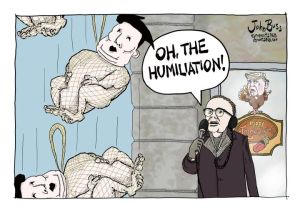
 President Sheinbaum immediately denied Trump’s characterization of their conversation. This headline from
 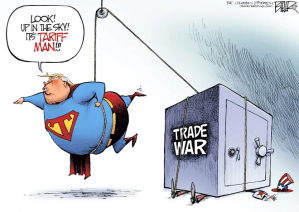 China and Canada were also blunt about DonOld’s mischaracterizations of his conversations with their leaders.
 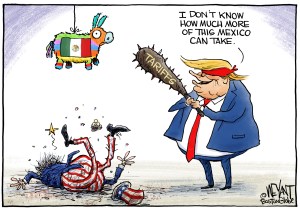 Businesses are already responding to the tariff threats. This will not be good for American Consumers.
 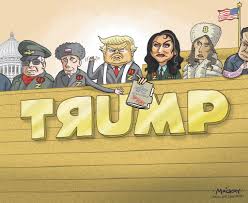 This is what happens when morons vote for a moron.
 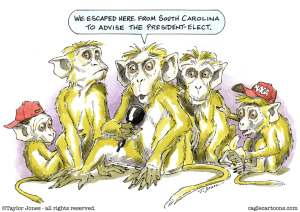 Marc Zuckerberg perfects his role as Surrender Monkey by dining with the Dotard at Mara Lardo.
 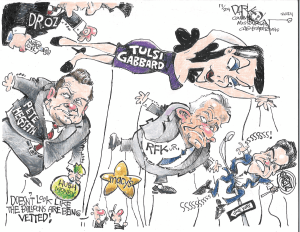 The Detroit Free Press
 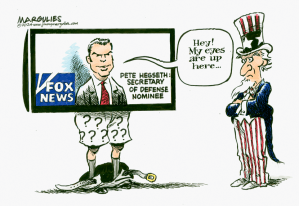 The American Prospect calls them “The Rape Gang.”
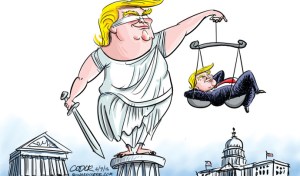 We definitely have a kakistocracy coming our way. We can see the incompetence, the total lack of knowledge of policy, and the complete inappropriateness of every candidate for Cabinet. It comes from the ultimate dotard. The only thing we have going for us now is our resolve and the fact that the Republican Majority in both Houses is narrow. Both houses have also had lots of experience in gumming up the works for Trump.
 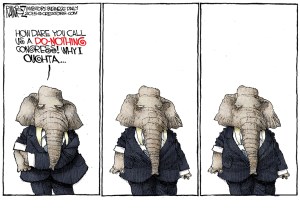 There is a slim majority margin in the US House of Representatives. There is no mandate radical change there. This is from




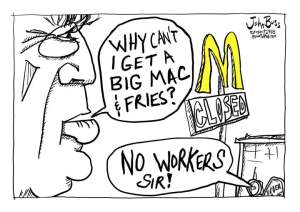
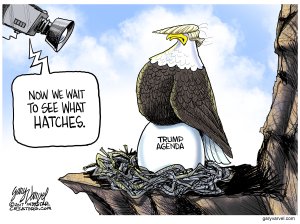 The Independent
  Senator and military veteran Tammy Duckworth continues to push back on the notion that women can’t do the jobs they’ve passed all kinds of tests to perform. From
  Trump’s
  Here are some snips on all three cabinet candidates.
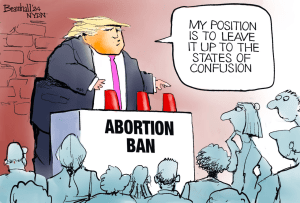 Along with Dr. Oz and RFK, jr., we should see a healthy business, perhaps called Trump Pharmaceuticals, in quack medicine. We also see the footprints to ensure children get polio again and that women die from pregnancy again. This comes after
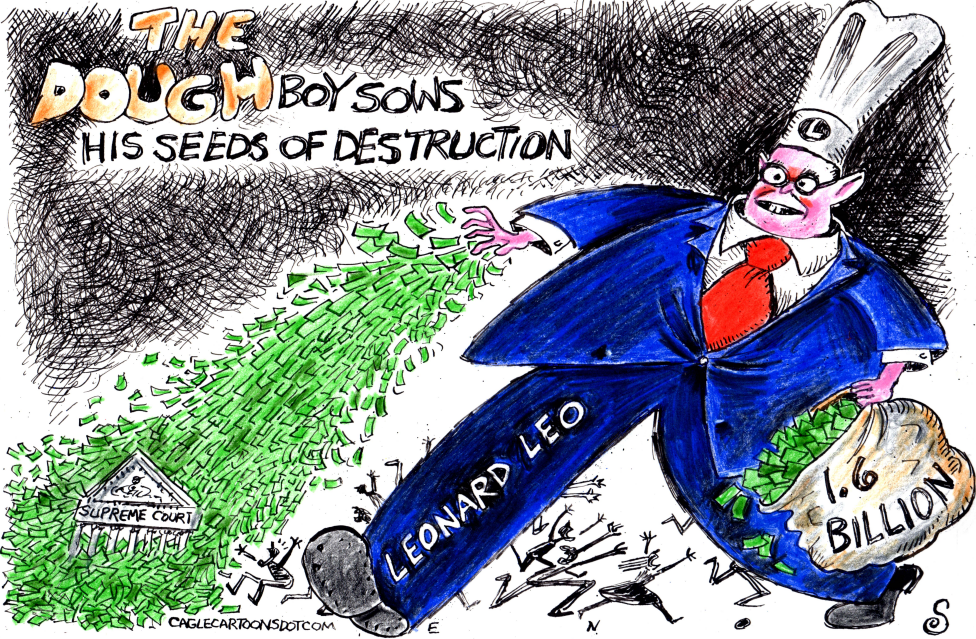 Leonard Leo continues to be a religious crusader against human rights and still has the billions to do so.
  Politico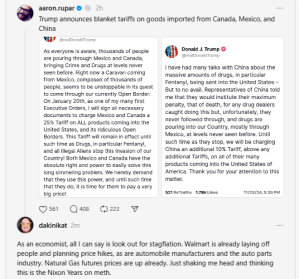
 Yesterday was the 61st anniversary of the assassination of President John F. Kennedy on November 22, 1963. I was 15 years old, a junior in high school. I still see that day as a defining event in my life. It was my first real experience of death, and I recall how difficult it was for me to comprehend and accept that our brilliant and charismatic president was really gone forever. It was my first lesson in how quickly dramatic events can change our understanding of the world.
 Later this month, the Kennedy footage is to be put up for sale in Boston by RR Auction, the latest in a line of assassination-related images to surface publicly after decades in comparative obscurity. The auction house says it is the only known film of the president’s car on the freeway as it sped from Dealey Plaza, the site of the shooting, to Parkland Memorial Hospital, where Kennedy was pronounced dead at 1 p.m.
 The meeting was to address the issue of how urban renewal in 1960s Boston was hurting the city’s poor and people of color, especially the need for low-income housing. When the group broke for lunch the news of Kennedy’s death reached them.
 As a former reality TV star, Trump is deeply attuned to the power of the small screen. His selection process has centered on people who can not only articulate his message but also defend him in the kind of high-stakes, combative settings that define modern media.
 The former Democratic congresswoman
  That’s the context that’s essential for understanding Trump’s Friday evening “nomination” (if you can call a social media announcement that) of Russell Vought to lead the Office of Management and Budget (OMB). Vought is a proponent of a powerful executive and of restructuring our institutions to facilitate a government that veers toward the monarchical and away from the democratic. He was
 You’ll notice women bear the brunt of this policy, but it goes nicely into the plan to get women back into the kitchen. Please read about the impact of the deportation in 2008 that happened in South Carolina, called the SC Act or Secure Communities Act. The details are gruesome but here’s the bottom line in a move to deport 400,000 people in a limited area.
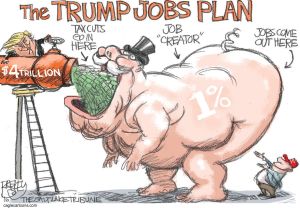 This will be in the hands of many of the folks who say they’re Christians but miss a major cultural value in both the Old and New Testaments. I was raised Presbyterian, attended my best friend’s Lutheran Church, baptized my girls in the Methodist church, and taught a large number of Sunday School classes. I’m not unfamiliar with the Bible. Matthew was my favorite of all. Whenever you ask me about my favorite verses, I’ll quote the Beatitudes and anything from Matthew or James. Trump is an actor, and his piety display is just an act.
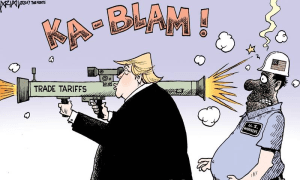
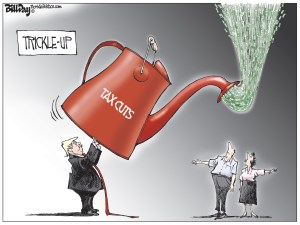 Again, Powell says he will not resign. That gives us about another year where monetary policy can offset this craziness.
 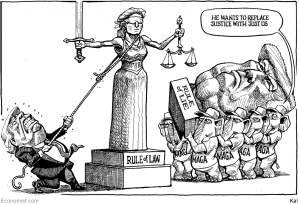 Before I went completely into economics, I was a history major. We’ve done this before.
 peej
peej Carissa
 bostonboomer
 dakinikat
 ecocatwoman
 mablue2
 Mama Lopez
 peggysue22
 quixote
 skydancingguestblogger
 Mona (aka Wonk the Vote)



 Sky Dancing
Recent Comments